PART 2: We Heard Seven Newborn Puppies Crying Inside a Concrete Wall—Then Their Mother Appeared and the Truth Was Even Worse
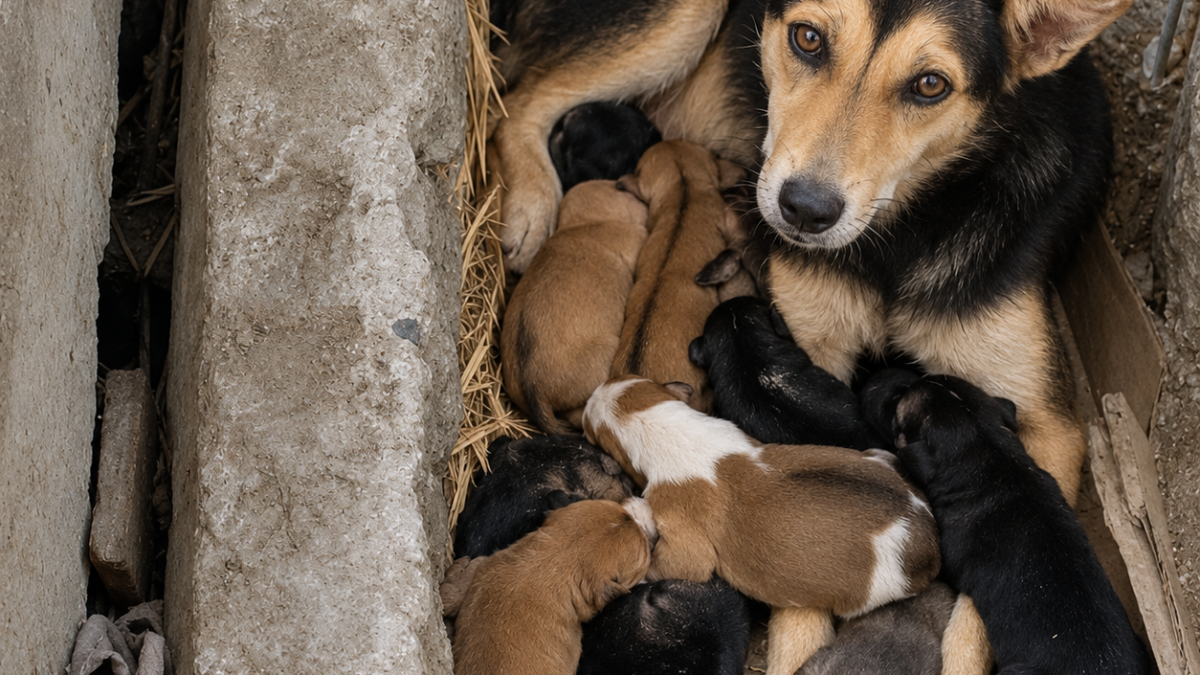
PART 2
It was a terrible idea, but desperation makes you try things you would normally reject.
I lowered it carefully.
“Left,” Mihai said.
“I can’t see.”
“A little more.”
The cloth touched one puppy.
It rolled slightly.
I jerked the pole back.
“No.”
“What?”
“They’re too fragile.”
“We have to do something.”
“I know.”
I looked down.
One wrong move could break a leg.
Or a neck.
Or push one under another.
Mihai grabbed a towel.
“What if we make a loop?”
We tried.
It was worse.
There wasn’t enough space to position it.
The towel kept catching against the concrete.
A puppy squealed when the fabric brushed its side.
I immediately pulled it out.
“That’s it.”
Mihai stared at me.
“What do you mean?”
“We stop.”
“They’ll die down there.”
“I know. That’s why we stop doing stupid things.”
He looked frustrated.
“So what?”
“We call rescue.”
He nodded.
I made the call.
Then we waited.
Those twenty minutes felt longer than entire workdays.
I stayed beside the crack.
Every few seconds I looked down.
The puppies continued moving, but less and less.
That frightened me.
Crying meant energy.
Silence could mean exhaustion.
I started talking to them.
“You’re okay.”
Mihai looked at me.
“They don’t know what you’re saying.”
“I know.”
“Probably can’t even hear properly.”
“I know.”
I kept talking.
“We’re getting you out.”
One puppy lifted its head slightly.
“Just stay with us.”
I don’t know who I was trying to convince.
Them.
Or myself.
When the rescue team arrived, they brought equipment, blankets, lights, medical supplies, and the calm energy of people used to dangerous situations.
The team leader introduced himself as Victor.
He looked about fifty, strong, gray at the temples, with the kind of expression that suggested panic had no place in his world.
He crouched near the crack.
“How many?”
“Seven.”
“How old?”
“Newborn. Eyes still closed.”
He lowered a light.
His jaw tightened.
“Temperature?”
“Cold.”
“Mother?”
“Missing.”
Victor stood and walked around the wall.
He checked the concrete.
He tapped sections lightly.
Then he looked at us.
“We can’t break the slab.”
I had expected that to be the easiest solution.
“Why not?”
“Too much vibration.”
He pointed at cracks near the base.
“This structure is old and unfinished. We don’t know how the load is distributed.”
“So?”
“If we use a jackhammer, part of the wall could shift.”
Mihai stared at him.
“And crush them.”
“Yes.”
My stomach dropped.
“What do we do?”
Victor looked toward the side wall.
“We open it from there.”
“With hand tools?”
“Yes.”
“That’ll take forever.”
He looked me directly in the eyes.
“Then it takes forever.”
That shut me up.
A younger rescuer stepped forward.
His name was Sergiu.
He was maybe twenty-eight or twenty-nine, thin but strong, with short dark hair and a quiet voice.
He examined the gap.
“If we open thirty centimeters from the side, I can get my arm through.”
Victor nodded.
“Slowly.”
The team started working.
Nobody struck hard.
They chipped away concrete piece by piece.
Each movement was controlled.
After every few blows, Victor inspected the crack.
Dust floated through the air.
The puppies cried.
Then stopped.
Then cried again.
I stood nearby feeling useless.
I wanted to help.
Victor eventually gave me gloves and said, “Move debris.”
That was enough.
I carried every piece of concrete away.
Mihai did the same.
For almost an hour, we worked without talking much.
At one point, I looked down and noticed the white puppy with the brown patch wasn’t moving.
“Sergiu.”
He stopped.
“That one.”
I pointed.
“The white one.”
He took the flashlight.
“What about him?”
“He stopped moving.”
Sergiu looked.
For several seconds, he said nothing.
My chest tightened.
Then he nodded.
“He’s breathing.”
“You sure?”
“Yes.”
“How can you tell?”
“Watch the ribs.”
I stared.
Nothing.
Then I saw it.
A tiny movement.
Up.
Down.
So small.
I exhaled.
Sergiu looked at me.
“We’ll get him.”
I nodded.
“Okay.”
But I heard the uncertainty in his voice.
He wasn’t making a promise.
He was trying to give me hope.
Eventually, the hole in the side wall became large enough.
Victor inspected it.
“Sergiu.”
“Yeah.”
“You’re smallest.”
“I know.”
Sergiu put on thin gloves.
He lay on his stomach.
Victor held his legs.
Sergiu slid one arm through the opening.
His shoulder pressed against the wall.
“Can you reach them?”
“Not yet.”
He stretched.
His face tightened.
“Almost.”
Everyone stopped moving.
I realized I was holding my breath.
Then he said, “Got one.”
His arm came back slowly.
In his hand was a reddish puppy.
The smallest one.
Seeing it up close was completely different from seeing it at the bottom.
It was tiny.
Smaller than I imagined.
Its fur was damp.
Its body trembled uncontrollably.
The puppy pressed its nose against Sergiu’s glove.
Searching.
One of the female rescuers wrapped it in a warm towel.
“Hi, baby.”
The puppy made a tiny sound.
Nobody spoke for a second.
Then Sergiu reached in again.
The second puppy came out.
Black.
Then the third.
Spotted.
The fourth.
Another reddish one.
The fifth.
The sixth.
Each time, relief grew.
Six puppies now lay together inside a plastic crate lined with towels and warm water bottles wrapped in fabric.
Victor counted.
“Six.”
Mihai looked down.
“We saw seven.”
Sergiu reached in again.
He moved his hand around.
“Nothing.”
I grabbed the flashlight.
“There was another.”
“I know.”
He tried again.
Then suddenly raised his free hand.
“Quiet.”
Everyone froze.
Even the workers farther away seemed to understand.
The building went silent.
At first, I heard nothing.
Then…
A squeak.
So weak it barely existed.
Sergiu looked at Victor.
“There.”
I aimed the light deeper.
The white puppy.
It had somehow shifted into the far corner.
A broken chunk of concrete rested partly over its back legs.
“Oh, no.”
Sergiu repositioned himself.
Victor grabbed his ankles.
“I need both hands.”
“You’re going in too far.”
“I can reach it.”
“Don’t get stuck.”
“I won’t.”
He slid farther.
His chest pressed against the edge.
“I’ve got the concrete.”
“Can you lift it?”
“Maybe.”
Victor looked toward another rescuer.
“Stabilize.”
A long narrow tool was inserted carefully.
Sergiu lifted.
The piece moved.
Dust fell.
The puppy didn’t react.
I felt sick.
“Come on,” I whispered.
Sergiu moved his other hand underneath.
“Got him.”
He pulled back slowly.
The white puppy came out.
It was limp.
Completely limp.
Nobody said anything.
Sergiu placed it on a towel.
“Come on, little man.”
He rubbed the puppy’s body.
The female rescuer checked its airway.
“Breathing?”
“I don’t know.”
“Again.”
Sergiu rubbed harder but carefully.
I crouched nearby.
Please.
I didn’t say it aloud at first.
Then I did.
“Come on.”
Nothing.
Sergiu bent down.
Then the puppy twitched.
It was barely noticeable.
But I saw it.
“So did you see that?”
“Yes.”
Sergiu continued warming him.
The puppy moved again.
Then came a tiny sound.
I closed my eyes.
Someone behind me whispered, “Thank God.”
All seven were alive.
For the first time that morning, I allowed myself to believe we had won.
We hadn’t.
Not yet.
The puppies were placed together.
The rescuers worked on warming them slowly.
You can’t heat an animal too quickly after severe cold exposure, Victor explained.
They used wrapped bottles and warm towels.
The tiny bodies began moving more.
One puppy crawled over another.
Another tried to suck on the edge of the towel.
Mihai laughed.
“He’s hungry.”
Victor nodded.
“They’re all hungry.”
“Formula?”
“Soon.”
I sat on the ground next to the crate.
My knees felt weak.
For almost two hours, everything had been about reaching them.
Now they were out.
Safe.
Or at least safer.
I looked toward the wall.
The crack seemed harmless now.
Just a dark gap.
I hated it.
Then I noticed movement outside.
Something had crossed behind the broken fence.
I looked again.
A dog.
She stepped slowly into view.
Light reddish coat.
Thin.
Very thin.
She stopped about thirty feet away.
“Victor.”
He looked up.
I pointed.
The dog didn’t bark.
She didn’t approach.
She stood with her body low and her tail tucked.
Her ribs were visible.
Her coat was dirty.
Her eyes were locked on the crate.
Then I saw her belly.
Her nipples were swollen.
Full of milk.
I felt cold despite the sun.
“That’s the mother.”
Everyone turned.
The dog immediately backed away.
“Don’t crowd her,” Victor said.
We spread out.
Sergiu crouched.
“Hey, girl.”
The dog stared at him.
One puppy cried.
The mother’s ears lifted.
She took one step forward.
Then stopped.
Another puppy cried.
The mother began trembling.
Not from cold.
Fear.
She wanted to come closer.
But she was terrified of us.
Sergiu lowered his head and avoided direct eye contact.
“It’s okay.”
The dog took another step.
Victor shifted slightly.
She jumped backward.
“Freeze,” Sergiu said.
Nobody moved.
A puppy squealed.
The mother whined.
That sound hurt more than the puppies’ cries.
I had heard fear all morning.
That sound was desperation.
Sergiu whispered, “Bring me one.”
The female rescuer handed him the smallest reddish puppy.
The mother instantly leaned forward.
She could smell it.
Sergiu placed the puppy on a folded towel ten feet from the dog.
Then he moved backward.
“Everyone back.”
We moved.
The mother stared at us.
Then at the puppy.
Ten seconds.
Twenty.
Thirty.
The puppy cried.
The dog ran forward.
She reached the towel and began licking the puppy frantically.
The tiny body moved beneath her tongue.
Then the puppy pushed its head under her belly.
The mother lowered herself.
The puppy latched.
I looked away.
My eyes burned.
Mihai rubbed his face.
“Dust.”
I smiled.
“Yeah.”
“Terrible dust.”
One by one, the other puppies were placed near her.
She checked each one.
Licked each one.
Counted them in the only way a mother dog could.
Then she curled her body around all seven.
The crying stopped.
Just like that.
For the first time that day, there was silence.
The mother lay around them like a wall of fur.
I watched the puppies nurse.
Victor exhaled.
“That’s better medicine than anything we brought.”
A rescuer placed a bowl of water nearby.
The dog watched us suspiciously.
Nobody moved closer.
After a few minutes, she drank.
And drank.
And drank.
She returned to the puppies immediately.
I should have felt happy.
Instead, one thought kept growing in my mind.
How?
How had the puppies gotten inside the concrete crack?
I stood.
Mihai looked at me.
“What?”
I walked to the wall.
“Look at this.”
“At what?”
“The gap.”
He frowned.
“You saw it.”
“No. Think.”
I pointed.
“Could that mother fit in there?”
“No.”
“Could those puppies crawl six feet down by themselves?”
“No.”
“Could she carry them through?”
Mihai stared at the crack.
His face changed.
“No.”
I looked back at the dog and her litter.
“Someone put them there.”
He didn’t answer.
He didn’t need to.
The joy of rescue disappeared.
Something darker replaced it.
Anger.
—
A veterinarian named Dr. Elena Popescu arrived about forty minutes later.
She ran a small clinic nearby and worked with several animal rescue groups.
She approached the mother slowly.
The dog growled once.
Elena stopped.
“Good girl.”
The growl was weak.
Fearful.
Not aggressive.
Elena waited.
Then moved closer.
Eventually, the dog allowed her to examine her.
Elena checked her gums.
Her eyes.
Her abdomen.
“She’s dehydrated.”
“How bad?” I asked.
“Significantly.”
“Starving?”
“Not quite, but close.”
Elena touched the dog’s ribs gently.
“She’s been living on almost nothing.”
“What about the puppies?”
“They need the clinic.”
“All of them?”
“Yes.”
She looked at the white puppy.
“Especially that one.”
My stomach tightened.
“Is he going to make it?”
“I don’t make promises.”
I hated that answer.
But I understood.
“What do we do?”
“We transport the puppies together.”
The mother became tense when the crate moved.
Sergiu noticed.
“Wait.”
He placed the crate inside the rescue van and opened the side door.
The mother paced.
She whined.
Then she jumped inside.
Nobody touched her.
Nobody forced her.
She chose to follow.
Elena smiled.
“Perfect.”
Before the doors closed, the mother looked back at me.
I don’t know if animals understand gratitude the way humans do.
Maybe she was simply afraid.
Maybe she was memorizing us as threats.
But something about that look stayed with me.
The van drove away.
The building became quiet.
I stood beside the wall.
Elena had left in her own car.
Victor’s team was packing equipment.
Mihai walked over.
“What now?”
I stared at the gap.
“We figure out who did it.”
He sighed.
“Andrei…”
“You know someone did.”
“I know.”
“So we figure it out.”
“With what?”
I looked toward the fence.
“Whatever we can find.”
—
The police officer who arrived that afternoon was named Radu.
He didn’t look excited about the case at first.
Not because he didn’t care.
Because there wasn’t much evidence.
Seven puppies had been found inside an abandoned building.
No witnesses.
No visible cameras.
No obvious suspect.
He examined the crack.
“You’re sure the mother couldn’t access it?”
“Look at it.”
He crouched.
“No.”
“Exactly.”
“Could they have fallen?”
“Seven newborn puppies?”
He nodded slowly.
“Unlikely.”
“Impossible.”
Radu walked around the structure.
“Who has access?”
“Half the town, with that fence.”
“Workers?”
“Yes.”
“Security?”
“Sometimes.”
“Name?”
“Petru.”
“Foreman?”
“Dorin Ionescu.”
Radu wrote everything down.
“Any conflict with stray dogs?”
I shrugged.
“Not that I know.”
Mihai hesitated.
I noticed.
“What?”
He looked at me.
“Dorin complained about them.”
“About what?”
“Dogs.”
“When?”
“Last week.”
I stared at him.
“You didn’t tell me.”
“It didn’t seem important.”
Radu turned.
“What exactly did he say?”
Mihai thought.
“That there were too many stray animals around the property.”
“Anything else?”
“He said we had an inspection coming and the place needed to look professional.”
I felt something tighten in my chest.
“Inspection?”
Mihai nodded.
“Investors.”
Radu wrote that down.
I wanted to jump immediately to a conclusion.
But I stopped myself.
Dorin was unpleasant.
That didn’t make him cruel.
Not yet.
—
I went to Elena’s clinic after work.
I told myself it was because I wanted an update.
The truth was I couldn’t go home without seeing them.
Elena led me to the back room.
The mother dog lay inside a large enclosure.
All seven puppies were pressed against her belly.
She lifted her head when I entered.
Her eyes followed me.
I crouched.
“Hey, girl.”
She didn’t growl.
Elena smiled.
“She knows you.”
“I doubt it.”
“She remembers the rescue site.”
“That might not be a good memory.”
“Maybe not.”
The dog lowered her head again.
“How are the puppies?”
“Improving.”
“All seven?”
“Yes.”
I pointed at the white one.
“And him?”
“Still weak.”
“What happened?”
“Hypothermia. Probably the coldest of the litter. He may have been pinned long enough to stop moving.”
“Will he survive?”
Elena looked at me.
“If he keeps nursing, his chances are good.”
The little white puppy pushed between two siblings.
“He seems determined.”
“That helps.”
I watched the mother.
“Does she have a name?”
“No collar. No microchip.”
I looked at her coat.
Rust red under the dirt.
“Ruby.”
Elena smiled.
“Ruby?”
“Yeah.”
The dog lifted her head.
“Ruby.”
Her tail moved once.
Elena laughed.
“Well, that’s settled.”
I returned the next day.
And the next.
By the third visit, Ruby no longer watched me with fear.
She watched me with caution.
That felt like progress.
—
Radu called two days later.
“We found something.”
I stood from my kitchen chair.
“What?”
“Come to the construction site tomorrow morning.”
“What did you find?”
“I’d rather show you.”
“Radu—”
“Eight o’clock.”
I barely slept.
At eight the next morning, he was waiting near the rear fence.
Petru, the night watchman, stood beside him.
Petru was in his sixties, thin, gray-haired, always wearing the same faded jacket.
He looked terrible.
Ashamed.
Nervous.
Radu pointed behind a stack of concrete blocks.
“Show him.”
Petru led us through weeds.
There, beneath a sheet of plastic, was a nest.
Old blankets.
Cardboard.
Insulation.
Dirt.
Dog hair.
Bloodstains.
I stared.
“Ruby’s.”
Petru nodded.
“She gave birth there?”
“Yes.”
“You knew?”
He looked at the ground.
“I saw her.”
“When?”
“Maybe ten days before you found the puppies.”
My anger rose.
“Why didn’t you tell anyone?”
“She wasn’t bothering anything.”
“That’s not what I asked.”
“I thought she was safer hidden.”
Radu raised a hand.
“Let him finish.”
Petru swallowed.
“Dorin came late three nights before the rescue.”
My heart slowed.
Not faster.
Slower.
Like my body already knew.
“Why?”
“He said he was checking the property before the investor visit.”
“And?”
“He saw Ruby.”
“What happened?”
“He got angry.”
I looked at him.
“How angry?”
“He said the site looked like a garbage dump.”
“What did you say?”
“I told him she had puppies.”
Petru rubbed his hands together.
“He said stray dogs couldn’t stay.”
“What did you do?”
“I told him I would call someone the next morning.”
“And?”
“He said that wasn’t good enough.”
I stepped closer.
“What happened next?”
Petru looked at Radu.
Then at me.
“The mother ran away when he approached.”
“And the puppies?”
“I had to go to the front gate. A truck arrived.”
“For how long?”
“Ten minutes. Maybe fifteen.”
“When you came back?”
“The puppies were gone.”
I stared at him.
“You asked Dorin?”
“Yes.”
“What did he say?”
Petru’s voice dropped.
“He said he moved them.”
“Where?”
“He said somewhere the mother could find them.”
I laughed once.
It sounded ugly.
“Inside a concrete hole?”
“I didn’t know.”
“You didn’t check?”
Petru’s eyes filled with tears.
“I should have.”
“Yes.”
“I know.”
I wanted to yell at him.
Part of me blamed him.
But when I looked at his face, I saw a man already punishing himself.
Radu stepped in.
“Petru didn’t witness where Dorin took them.”
I turned toward him.
“But Dorin admitted moving them.”
“According to Petru.”
“That’s evidence.”
“It helps.”
“Helps?”
“We need more.”
I looked toward the road.
Then remembered something.
A repair shop stood across from the bus stop.
Its cameras faced the street.
“Costin.”
Radu frowned.
“What?”
“The auto repair place.”
“So?”
“He has cameras.”
We all turned toward the road.
One camera pointed almost directly at the construction gate.
Radu smiled slightly.
“That might be useful.”
—
Costin, the owner, didn’t hesitate when Radu explained.
“You need footage?”
“Yes.”
“Take whatever you want.”
We crowded around his office computer.
The system stored recordings for thirty days.
Radu entered the date.
The footage showed a dark road.
Occasional cars.
Nothing.
We fast-forwarded.
9:30 p.m.
9:45.
10:02.
Then headlights appeared.
A company van.
I recognized it.
Dorin’s.
My hands became cold.
The van stopped.
A man stepped out.
Even with poor image quality, I knew the walk.
The posture.
Dorin.
He opened the side door.
Took out a plastic crate.
Carried it through the broken gate.
We couldn’t see inside the crate.
He disappeared behind the building.
Four minutes later, he returned.
The crate was empty.
Nobody in that office spoke.
Radu rewound.
Played it again.
Same thing.
Van.
Dorin.
Crate.
Building.
Empty crate.
Costin whispered, “Son of a…”
Radu paused the video.
I stared at the screen.
“He did it.”
Radu nodded.
“It certainly looks that way.”
“Arrest him.”
“Andrei.”
“He put seven newborn puppies inside a wall.”
“We follow procedure.”
“He knew they would die.”
“We have strong evidence. Let me do my job.”
I stepped back.
Then another thought hit me.
“He came to the site.”
“When?”
“The morning we rescued them.”
“What time?”
“Late.”
Mihai had told me Dorin arrived around noon.
I remembered him standing beside the rescue vehicles.
Watching.
He had asked what happened.
I had told him.
Seven puppies.
Concrete crack.
One nearly dead.
Dorin had shaken his head.
“Crazy,” he said.
Then:
“Good thing you found them.”
I wanted to be sick.
He knew.
He had stood there while we were covered in dust from cutting through the wall.
He watched us trying to save animals he had placed there.
He said nothing.
That was the part I could not forgive.
Not ignorance.
Not panic.
Not a terrible mistake.
He watched.
—
The next morning, Dorin arrived at work carrying coffee.
He looked exactly the same.
That almost made me lose control.
“Morning,” he called.
Nobody answered.
He stopped.
“What’s everybody’s problem?”
I walked toward him.
Mihai followed several feet behind.
Dorin looked at me.
“Andrei?”
“You put them in the wall.”
He blinked.
“What?”
“The puppies.”
His face remained still for half a second too long.
“What are you talking about?”
“You know.”
He rolled his eyes.
“I don’t have time for this.”
He tried to walk past.
I stepped in front of him.
“Why?”
“Move.”
“Why did you do it?”
“Andrei, get out of my way.”
“No.”
He stared at me.
“You want to lose your job?”
I almost laughed.
“You’re threatening my job right now?”
“Yes.”
I looked around.
The crew had stopped working.
Everyone was watching.
Mihai said, “We saw the footage.”
Dorin’s head turned.
“What footage?”
That reaction told me everything.
I said, “You carried a crate into the building at ten at night.”
He went silent.
Then laughed.
“So?”
“So it had seven puppies inside.”
“You can’t prove what was in it.”
My stomach twisted.
He hadn’t denied being there.
Mihai stepped forward.
“Why was it empty when you came out?”
Dorin’s face hardened.
“You people have lost your minds.”
I moved closer.
“They were newborns.”
“They were strays.”
There it was.
Not denial.
Not anymore.
“Strays?”
“Yes.”
“Newborn dogs.”
“There are stray animals everywhere.”
“So you put babies inside a hole?”
“I moved them away from the work area.”
“To a place their mother couldn’t reach.”
“She could find them.”
“No.”
“You don’t know that.”
“I saw her try.”
Dorin blinked.
I continued.
“She stood thirty feet away from the crate because she was terrified of us.”
He looked away.
“She nearly starved.”
“That’s not my problem.”
The crew reacted.
Someone swore.
Another worker said, “What the hell is wrong with you?”
Dorin looked around angrily.
“Oh, give me a break. They’re dogs.”
Mihai’s voice was low.
“They’re alive.”
“And?”
That one word changed something.
Until then, maybe some workers still thought there could be an explanation.
After that, there wasn’t.
I stepped closer.
“You watched us rescue them.”
He said nothing.
“You stood there.”
Still nothing.
“You knew exactly what was inside that wall.”
He looked at me.
“Move.”
“No.”
His eyes narrowed.
I saw his fist tighten.
For one moment, I thought he might hit me.
I almost wanted him to.
Then a car door slammed outside.
Radu walked through the gate with another officer.
Dorin’s face drained.
Radu approached.
“Dorin Ionescu?”
Dorin forced a smile.
“What is this?”
“We need you to come with us.”
“For what?”
“We’re investigating an animal cruelty complaint.”
“This is insane.”
Radu looked toward me.
“Everyone step back.”
Dorin pointed at me.
“He’s making this up.”
Radu replied calmly.
“We have video.”
Silence.
“We also have a witness.”
Petru appeared near the gate.
Dorin’s expression changed.
“You.”
Petru stared at him.
“You told me you moved them somewhere safe.”
“I did.”
Radu raised an eyebrow.
Dorin realized his mistake.
“I mean—no. That’s not what I meant.”
Radu said, “We’ll discuss it at the station.”
“This is ridiculous.”
“You’re coming with us.”
Dorin looked at me.
The hatred in his eyes surprised me.
Not guilt.
Hatred.
“You ruined my career over some stray dogs.”
I stared back.
“No.”
I pointed toward the concrete wall.
“You did that.”
—
The story spread quickly.
Faster than I expected.
One worker told his wife.
She knew someone at an animal rescue group.
Someone posted a photo of the puppies.
Within days, people were calling Elena’s clinic.
Offering blankets.
Food.
Formula.
Money.
Homes.
The clinic received so many adoption requests that Elena put a sign on the front door.
THE SEVEN PUPPIES ARE SAFE.
THEY ARE NOT YET AVAILABLE FOR ADOPTION.
THEIR MOTHER IS RECOVERING.
PLEASE GIVE THEM TIME.
People still came.
Some brought supplies.
Others simply wanted to help.
Ruby hated the attention.
Whenever strangers appeared, she positioned herself between them and her puppies.
But with me, she slowly changed.
At first, she tolerated my presence.
Then she allowed me to touch her.
Then one evening, while I sat beside the enclosure, she walked over and put her head on my knee.
I froze.
Elena saw it.
“You’re finished.”
“What?”
“She chose you.”
“I’m not adopting a dog.”
“Of course not.”
“I mean it.”
“You work long hours?”
“Yes.”
“You have a yard?”
“Yes.”
“You live alone?”
“Yes.”
She smiled.
“You need a dog.”
“I do not.”
Ruby rolled onto her side.
I scratched her chest.
Elena laughed.
“You definitely don’t.”
I pointed at her.
“Stop.”
She walked away laughing.
—
The white puppy became Sergiu’s favorite.
He denied it for nearly two weeks.
Every time he visited, he went directly to the same pup.
Elena eventually wrote “Patch” on the puppy’s chart.
I stared at Sergiu.
“Patch?”
He looked annoyed.
“It’s for identification.”
“You named him.”
“No.”
“You named him Patch.”
“He has a patch.”
“So?”
“So that’s medically descriptive.”
Elena walked past.
“It’s not.”
Sergiu glared at her.
“Whose side are you on?”
“Patch’s.”
The puppy yawned in Sergiu’s hands.
I laughed.
“You’re adopting him.”
“No.”
“You are.”
“I rescue animals. I don’t automatically adopt all of them.”
“Just this one.”
“No.”
Patch tried to bite his thumb.
Sergiu smiled.
That was the end of the argument.
He simply hadn’t realized it yet.
—
As the puppies grew, Ruby became healthier.
Her ribs disappeared beneath a stronger body.
Her coat became glossy.
She discovered beds.
Blankets.
Treats.
And socks.
She stole socks constantly.
Nobody knew why.
Elena would find piles of them behind Ruby’s bed.
One morning she said, “I’m missing four.”
Ruby looked innocent.
I checked her blanket.
Six socks.
“Criminal,” I told her.
Ruby wagged her tail.
The puppies opened their eyes one by one.
I happened to be there when Patch opened his.
Sergiu was holding him.
“Look.”
Patch blinked.
One eye.
Then the other.
Sergiu stared like he had just witnessed something holy.
“You’re crying,” I said.
“No.”
“You are.”
“Dust.”
“We’re inside.”
“Clinic dust.”
“Right.”
Patch yawned.
Sergiu wiped his eye.
“Shut up.”
I laughed.
It felt good.
After weeks of anger, laughing felt almost strange.
—
The investigation continued.
Radu collected the original security footage.
Elena submitted veterinary reports.
Petru gave a formal statement.
The rescue team provided documentation of where and how the puppies were found.
The company suspended Dorin immediately.
Two weeks later, they fired him.
When I heard, I felt satisfaction.
But not enough.
I wanted legal consequences.
I wanted him to understand.
One evening, Radu called.
“The prosecutor is taking the case.”
I sat on my porch.
“What does that mean?”
“Charges are moving forward.”
“For animal cruelty?”
“Yes.”
“What kind of sentence?”
“That depends.”
“Fine?”
“Possibly part of it.”
“That’s it?”
“Andrei.”
“They nearly died.”
“I know.”
“You didn’t see Patch when Sergiu pulled him out.”
“I saw the reports.”
“That’s not the same.”
“No.”
I was quiet.
Radu continued.
“You want revenge.”
I didn’t answer.
“You do.”
“Wouldn’t you?”
“Maybe.”
“What’s wrong with that?”
“Nothing, if revenge means consequences.”
I stared into the dark yard.
“And if I want him to feel what they felt?”
“Then you’re giving him too much space in your head.”
That annoyed me.
But I remembered it later.
—
By five weeks, the puppies had transformed.
The weak bundles from the crack were gone.
Now they stumbled around on oversized paws.
They wrestled.
Barked.
Bit blankets.
Chased each other.
Patch was the loudest.
Of course.
Sergiu picked him up.
“He has confidence.”
“He just peed on your shoe.”
“Confidence.”
“He ate a corner of Elena’s paperwork.”
“Leadership.”
Elena walked in.
“I heard that.”
Sergiu smiled.
“Future rescue dog.”
“Future furniture destroyer.”
Patch barked.
We all laughed.
Ruby watched from her bed.
She looked peaceful.
That mattered more than anything.
—
Adoption applications arrived constantly.
Elena screened them hard.
She rejected people who wanted outdoor-only dogs.
Rejected anyone who thought puppies were toys.
Rejected anyone unwilling to vaccinate, sterilize, train, or provide proper care.
“You’re brutal,” I told her.
“I’m responsible.”
“You rejected that nice couple.”
“They work fourteen-hour shifts.”
“They had a big yard.”
“A yard isn’t a family.”
Fair.
She approved several homes.
One reddish male would go to an older couple whose dog had died the previous year.
Two siblings would stay together on a farm.
A black puppy with white feet would live with a teacher and her teenage daughter.
A spotted female would go home with one of Elena’s veterinary technicians.
Costin from the repair shop adopted another.
That left Patch.
And Ruby.
Sergiu filled out his adoption form pretending it was a bureaucratic inconvenience.
Elena read it.
“You wrote ‘Patch’ under name.”
“Yes.”
“So you named him.”
“For identification.”
“Sure.”
I laughed.
Then Elena pushed another form toward me.
I frowned.
“What’s this?”
“Ruby.”
“No.”
“She’s ready for adoption soon.”
“I know.”
“You have a fenced yard.”
“I know.”
“You already bought her a collar.”
I stared at her.
“How do you know that?”
“You left the bag here.”
I looked at Ruby.
She was asleep near my chair.
“I was just thinking.”
“Fill out the form.”
“You’re pushy.”
“Yes.”
I picked up the pen.
Ruby opened one eye.
“Fine.”
Her tail tapped once.
—
Ruby came home with me two months after the rescue.
Her first night was a disaster.
I had bought a dog bed.
A good one.
Too expensive, honestly.
She sniffed it once.
Then climbed onto my couch.
“No.”
She stared.
I pointed.
“Bed.”
She stayed.
I lifted her gently.
Put her in the dog bed.
Five minutes later, she was back on the couch.
I blocked the couch with chairs.
Ruby slept on my work jacket instead.
At two in the morning, I gave up.
“You win.”
She wagged her tail.
The next day, she discovered the kitchen.
Then the yard.
Then my neighbor’s cat.
The cat won that argument immediately.
Ruby returned with a scratched nose and a new respect for boundaries.
Within a week, the house felt different.
Not cleaner.
Definitely not cleaner.
But alive.
When I came home, someone was waiting.
When I woke up, someone was already watching me.
When I dropped food, it vanished.
When I sat too long, a nose pushed under my hand.
I had lived alone for years.
I hadn’t realized how quiet it was until Ruby filled the silence.
—
Dorin’s case took months.
That frustrated me.
In my head, justice should have been immediate.
Video.
Witness.
Veterinary evidence.
Done.
Reality doesn’t work that way.
There were interviews.
Documents.
Delays.
Arguments.
His lawyer claimed Dorin never intended to kill the puppies.
He said Dorin believed the mother would retrieve them.
That made no sense.
An adult dog couldn’t fit into the crack.
The puppies couldn’t climb out.
Even if Ruby had found them, she could only have listened to them die.
That thought haunted me.
Maybe she had.
Maybe before we arrived, she had stood outside that wall listening.
Unable to reach them.
I stopped thinking about it whenever I could.
—
Three months later, we went to court.
Mihai came.
Petru came.
Elena came.
I almost didn’t.
Radu told me I should.
“You were there.”
“So?”
“You can describe what condition they were in.”
“They have veterinary reports.”
“Reports don’t cry.”
That convinced me.
Dorin looked different in court.
Smaller.
He wore a clean shirt.
His hair was neat.
He didn’t look like a monster.
That was almost worse.
People expect cruelty to have a face.
It doesn’t.
Sometimes it looks ordinary.
His lawyer repeated the argument.
No intent to kill.
He was simply removing stray animals from a work zone.
The prosecutor asked one question.
“If Mr. Ionescu believed the puppies were safe, why did he deny placing them there?”
Silence.
Then they played the video.
Dorin carrying the crate.
Entering.
Returning with it empty.
Petru testified.
Then Elena.
She explained hypothermia.
Dehydration.
Risk of death.
She described Patch’s condition.
Then I spoke.
I hadn’t written anything.
Maybe I should have.
But when I stood there, I just remembered.
“I heard them before I saw them.”
The room was quiet.
“I thought it was a bird.”
I described the crack.
The cold concrete.
The sealed eyes.
The shaking bodies.
“I remember one of them stopped moving.”
I looked toward Dorin.
“He was white with a brown patch near his eye.”
Dorin looked down.
“We had to cut through the wall by hand because heavy tools could have crushed them.”
I swallowed.
“When we got six out, we thought we were done. Then Sergiu heard one more cry.”
I paused.
“He was trapped under concrete.”
Nobody moved.
“We thought he was dead.”
My voice almost broke.
“He wasn’t.”
I looked toward the judge.
“And then their mother appeared.”
That was the hardest part to describe.
Ruby standing behind the fence.
Afraid.
Starving.
Watching strangers hold her babies.
“She wanted to come closer, but she was terrified.”
I stopped.
For a second, I couldn’t continue.
Then I said, “She had milk. She had been looking for them.”
I looked at Dorin again.
“He stood at the rescue site later that morning.”
Dorin finally met my eyes.
“He knew.”
That was all.
I stepped down.
The court eventually imposed fines and restrictions under the applicable animal cruelty laws, along with other consequences.
It wasn’t a movie sentence.
Dorin didn’t disappear into prison for decades.
Part of me had wanted something more dramatic.
But when I walked outside, I felt strangely calm.
His job was gone.
His actions were public.
His record now carried the consequences.
And he could no longer pretend nothing had happened.
Mihai stood beside me.
“You satisfied?”
I thought about it.
“Not exactly.”
“What would satisfy you?”
I looked toward my truck.
Ruby was waiting inside.
Sergiu had brought her because I didn’t want to leave her alone all day.
Her head appeared at the window.
Her tail started wagging.
I smiled.
“That.”
“What?”
“All seven survived.”
Mihai nodded.
“Yeah.”
I walked toward Ruby.
Maybe that was the revenge I needed.
Dorin had decided those lives didn’t matter.
Now they mattered to dozens of people.
He had tried to hide them.
Instead, everyone knew their story.
—
The seven puppies eventually left for their homes.
Elena organized the departures gradually so Ruby wouldn’t lose the entire litter at once.
The first was the reddish male.
The older couple came with a blanket and a toy.
The woman cried before she even picked him up.
“We’ve been waiting for you.”
Ruby watched carefully.
The puppy licked the woman’s chin.
Then left.
That evening, Ruby searched the enclosure.
My heart hurt.
“She knows,” I said.
Elena nodded.
“Yes.”
“Is this cruel?”
“No. It’s natural.”
Ruby looked at me.
I sat beside her.
One by one, the others left.
The farm siblings together.
The black puppy.
The spotted female.
Costin’s pup.
Each departure was happy and painful.
Patch left last.
Sergiu arrived with a collar, leash, food, toys, a crate, and enough supplies to open his own pet store.
I stared at him.
“You said you weren’t adopting.”
“I changed my mind.”
“You bought him three beds.”
“Different rooms.”
“You live in a two-room apartment.”
“Exactly.”
Patch ran toward him.
Sergiu picked him up.
Ruby approached.
She sniffed Patch’s face.
Then licked him.
Sergiu’s eyes filled.
I smiled.
“Dust?”
“Shut up.”
Patch went home.
Ruby stood at the clinic door watching.
Then she looked at me.
I held up her leash.
“You ready?”
She walked toward me.
That was the day she officially became mine.
—
Months passed.
The group chat became one of the best parts of my phone.
Elena had added every adopter.
Photos arrived constantly.
The reddish puppy sleeping between the older couple.
The farm siblings covered in mud.
The black puppy sitting beside a pile of schoolbooks.
Costin’s dog wearing sunglasses.
Patch destroying Sergiu’s couch.
I replied:
“Leadership?”
Sergiu responded:
“Interior design.”
Ruby would sometimes hear barking from the videos.
Her ears would lift.
I’d show her the screen.
“Your kids.”
She sniffed the phone.
Then returned to whatever she was doing.
Usually stealing a sock.
—
Almost one year after the rescue, our company received the contract to demolish the old building.
When I heard, I felt strange.
For months, I had driven past that structure and looked at the wall.
The place where seven puppies had nearly died.
The place where Ruby had appeared.
The place where everything changed.
On demolition day, I walked to the narrow crack one final time.
Mihai came beside me.
“You okay?”
“Yeah.”
“You look like you’re saying goodbye.”
“Maybe.”
He looked at the concrete.
“Hard to believe they were down there.”
“I know.”
I touched the rough wall.
For a long time, I had hated that place.
But now I realized something.
The wall hadn’t won.
Cruelty hadn’t won.
The darkness hadn’t won.
That crack was supposed to hide them.
Instead, it became the reason they were found.
I stepped back.
The machine operator waited.
Mihai asked, “Ready?”
I nodded.
“Take it down.”
The excavator pushed.
Concrete cracked.
Dust rose.
The wall collapsed.
For a second, I saw the gap disappear beneath rubble.
Then it was gone.
I expected sadness.
Instead, I felt relief.
Nothing was trapped there anymore.
—
That evening, I came home covered in dust.
Ruby was waiting at the gate.
The moment she heard my truck, she started running.
I opened the door.
She jumped against me.
“You know you’re too big for this.”
Her tail slammed against my legs.
I sat on the porch.
Ruby lay beside me.
My phone buzzed.
Sergiu.
A photo of Patch sleeping upside down.
All four legs in the air.
The caption said:
“Victim of extreme hardship.”
I laughed.
Then more photos came.
One from the older couple.
One from the farm.
One from Costin.
All seven.
Alive.
Healthy.
Loved.
I scrolled through them.
Ruby lifted her head.
I turned the phone.
“Look.”
She sniffed the screen.
“Everybody’s okay.”
She rested her head against my leg.
The sun was setting.
I thought about Dorin.
For a long time, I had imagined revenge.
I imagined him suffering.
Losing everything.
Feeling helpless.
But sitting there beside Ruby, I realized the most complete revenge had already happened.
He had treated those puppies like trash.
They became treasured family members.
He had tried to hide them.
Their story spread across town.
He had put them in darkness.
They grew up sleeping in warm homes.
He had taken them from their mother.
Ruby lived long enough to watch them grow.
He had decided they didn’t matter.
He was wrong.
That was enough.
—
A few weeks later, Sergiu visited with Patch.
I almost didn’t recognize him.
Patch had grown huge.
His white coat was bright.
The brown mark beside his eye made him look permanently mischievous.
The same puppy I once watched lying motionless beneath concrete jumped out of Sergiu’s truck like he owned the world.
Ruby froze.
Patch ran toward her.
I held my breath.
He stopped.
Sniffed her.
Ruby sniffed him back.
Then she licked his face.
Patch exploded with energy.
He began running circles around her.
Ruby chased him.
They tore across my yard.
Around the tree.
Past the porch.
Back again.
Sergiu laughed.
“Remember when he couldn’t move?”
“Yeah.”
“I thought he was dead.”
“So did I.”
Patch tackled Ruby gently.
They rolled in the grass.
Sergiu wiped his eye.
I looked at him.
“Dust?”
“Pollen.”
“It’s November.”
“Rare pollen.”
We both laughed.
Then we stood there watching.
That became my favorite memory.
Not the rescue.
Not the court.
Not Dorin being confronted.
Ruby running through sunlight with Patch.
Alive.
Free.
Home.
—
Years later, people still sometimes asked me about the puppies.
Some remembered the photos.
Some remembered the rescue.
A few people would recognize Ruby when I took her into town.
“Is that the mother dog?”
I’d smile.
“Yeah.”
People wanted to call me a hero.
I hated that.
I wasn’t.
Neither was Mihai.
Neither was Sergiu.
We just stopped when we heard something.
That’s all.
But maybe that’s what matters.
Cruelty often depends on people looking away.
Rescue begins when someone refuses to.
I still think about how easy it would have been to miss those cries.
If a machine had been running.
If we had been working on another floor.
If the wind had been stronger.
If I had told myself it was only a bird.
Seven lives might have disappeared inside a concrete wall.
Nobody would have known.
That thought stays with me.
Sometimes the difference between life and death isn’t something dramatic.
Sometimes it is one person stopping.
Listening.
Looking again.
Asking:
“What was that?”
Ruby taught me something else too.
Trust does not return all at once.
When she first appeared behind that broken fence, she wouldn’t come within thirty feet of us.
Months later, she slept beside my bed.
Eventually, she stopped flinching when men raised their voices.
She stopped hiding when trucks entered the yard.
She learned that hands could mean food.
Touch.
Safety.
She learned that doors could open instead of trapping her.
She learned home.
And I learned it with her.
Before Ruby, my house was just a place where I slept between jobs.
After Ruby, it became somewhere I wanted to return to.
She waited.
She noticed.
She cared.
Years later, when gray began appearing around her muzzle, she still stole socks.
She still refused the expensive dog bed.
She still claimed the couch.
And every evening, she still ran toward the gate when she heard my truck.
Sometimes I would crouch beside her and remember the first time I saw her.
Thin.
Dirty.
Terrified.
Standing behind broken fencing.
Watching strangers rescue her babies.
I would put my hand against her head.
“You made it.”
She never knew what I meant.
Maybe she didn’t need to.
—
Patch visited often.
Sergiu eventually moved into a house with a yard mostly because Patch had become too large for the apartment.
“You moved because of a dog,” I told him.
“I wanted more space.”
“For Patch.”
“For me.”
“You bought a house beside a park.”
“Coincidence.”
Patch barked.
I laughed.
The other puppies grew too.
Every year, Elena organized a small reunion.
Not everyone could always come.
But usually several families did.
The first reunion was chaos.
Seven young dogs.
Ruby.
People.
Leashes.
Toys.
Food.
Patch knocked over a chair.
One of the farm dogs stole an entire bag of treats.
Costin’s dog jumped into a kiddie pool.
Ruby sat in the middle like a tired mother wondering how her life had come to this.
Elena took a photograph.
All seven puppies around Ruby.
She printed it.
Hung it inside the clinic.
Above it, she wrote:
THE CONCRETE SEVEN — ONE YEAR LATER.
I stared at that photo for a long time.
Seven lives.
Seven homes.
One mother.
None of them were supposed to be there.
And yet there they were.
—
I saw Dorin once after the court case.
About two years later.
I was buying supplies at a hardware store.
I turned down an aisle.
He was there.
For a second, neither of us moved.
He looked older.
Tired.
I didn’t know what had happened to him after he lost his job.
I didn’t ask.
He stared at me.
“You.”
I nodded.
“Dorin.”
He looked away.
Then said, “You destroyed my life.”
The old anger returned instantly.
But it wasn’t as strong as before.
I took a breath.
“No.”
He laughed bitterly.
“You still say that?”
“Yes.”
“All because of some dogs.”
I looked at him.
“That’s why you still don’t understand.”
His face tightened.
I could have argued.
I could have insulted him.
I could have told him what I thought.
Instead, I said:
“They lived.”
He stared.
“All seven.”
I stepped closer.
“The white one you left under concrete? He’s huge now.”
Dorin said nothing.
“His name is Patch.”
I don’t know why I told him.
Maybe I wanted him to know.
“The mother lives with me.”
His eyes shifted.
“She sleeps on my couch.”
Still nothing.
“The others have families.”
I smiled slightly.
“You tried to erase them.”
Dorin’s jaw tightened.
“You failed.”
Then I walked away.
That was the last time I ever saw him.
And strangely, that conversation gave me more peace than the court case had.
Not because I hurt him.
Because I realized I no longer needed to.
His actions didn’t define the ending.
That mattered.
—
Ruby lived many good years after the rescue.
Far more than I expected when I first saw her.
She became slower.
Her muzzle turned white.
She stopped jumping onto the couch and started using a small ramp I built.
She still ignored the dog bed.
Some things never change.
Patch continued visiting.
Even when he became an older dog himself, he seemed to become a puppy around her.
He would sniff her face.
Ruby would lick his ear.
Then both would sleep in the grass.
Sometimes I sat near them and thought about time.
About how life had stretched beyond that one terrible morning.
The concrete crack had been only a few hours.
Fear had been temporary.
Love lasted much longer.
That is the part people forget in rescue stories.
The rescue is dramatic.
The years afterward are the real victory.
Warm meals.
Veterinary visits.
Walks.
Annoying habits.
Birthdays.
Rainy afternoons.
Mud on the floor.
Chewed shoes.
Old dogs sleeping in sunlight.
That is what survival looks like.
Not one perfect moment.
Thousands of ordinary ones.
—
One evening, long after the old building had disappeared, I drove past the empty property.
Grass had grown over most of it.
A new warehouse was being built nearby.
Nobody would ever know exactly where that concrete wall had stood.
I stopped the truck.
Ruby was beside me.
Old now.
She looked out the window.
I smiled.
“You remember this place?”
She yawned.
Probably not.
Or maybe she did.
Dogs don’t tell us.
I got out and helped her down.
We walked slowly through the grass.
The site looked completely different.
No broken walls.
No rusted fence.
No darkness.
Just open sky.
Ruby sniffed the ground.
I stood where I thought the crack had been.
For years, that place represented cruelty to me.
Now it didn’t.
Now it represented interruption.
Someone tried to do something terrible.
Then other people interrupted it.
That’s the part I choose to remember.
Cruelty happened.
But it didn’t get the final word.
I crouched beside Ruby.
“You know something?”
She looked at me.
“You changed my life.”
Her tail moved once.
I laughed.
“Yeah. I know. You want food.”
We walked back to the truck.
Slowly.
Together.
—
When Ruby eventually passed away, she was old, warm, and safe in my home.
Sergiu came.
Elena came.
Mihai came.
I didn’t expect that.
But they all remembered.
Patch lay beside her for a while.
He didn’t understand.
Or maybe he did.
I sat on the floor with my hand against Ruby’s head.
I thought I would remember the first rescue.
Instead, I remembered everything after.
The socks.
The couch.
The scratched nose from the neighbor’s cat.
The way she carried her food bowl around.
The way she ran toward my truck.
The way she slept with one paw touching my boot.
The way she watched her puppies leave.
The way she recognized Patch.
The way she trusted me.
That was her life.
Not the concrete wall.
Not Dorin.
Not fear.
Her life was everything that came after.
I whispered, “You did good, Mom.”
The same words I had said years earlier.
Her breathing slowed.
Then stopped.
For a while, nobody spoke.
Eventually Sergiu sat beside me.
“She had a good life.”
“I know.”
“That matters.”
“I know.”
Patch rested his head on my leg.
I cried then.
No jokes about dust.
No jokes about pollen.
Just grief.
But grief is proof that something mattered.
Ruby mattered.
More than I could explain.
—
A few months later, Elena asked me to come to the clinic.
She had changed the wall display.
The old photograph of Ruby and the seven puppies was still there.
But beneath it was another picture.
Ruby sitting on my porch.
Gray muzzle.
Bright eyes.
One stolen sock between her paws.
Under the photograph, Elena had written:
SHE WAS FOUND AFRAID.
SHE LEFT THIS WORLD LOVED.
I stood there for a long time.
Then Elena handed me something.
Ruby’s old identification tag.
I had forgotten it at the clinic.
I closed my hand around it.
“Thanks.”
Elena hugged me.
“You know what she would want?”
“What?”
“For you to adopt another dog.”
I laughed through tears.
“Absolutely not.”
Elena smiled.
“Of course.”
Six months later, I adopted another rescue.
But that is another story.
—
People sometimes ask me what happened to the seven puppies.
Patch lived with Sergiu.
He became the biggest of the litter.
The older couple’s dog became inseparable from them.
The farm siblings spent years running across fields together.
The teacher’s dog slept beside her daughter while she studied for college.
Costin’s dog continued greeting every customer at the repair shop like he owned the business.
The veterinary technician’s puppy practically grew up inside Elena’s clinic.
The seventh became a therapy companion for his adopter’s elderly mother.
All seven lived lives that once seemed impossible.
That is the answer I give.
But there is another answer.
They became evidence.
Evidence that cruelty doesn’t have to be the end.
Evidence that one sound can matter.
Evidence that ordinary people can interrupt something terrible.
Evidence that survival can become a form of justice.
I used to think justice meant punishment.
Sometimes it does.
Dorin deserved consequences.
But punishment alone would never have healed what he did.
The better answer was life.
Seven dogs running through grass.
A mother sleeping on a couch.
Families sending photos.
A rescue worker buying a house for a dog he swore he would never adopt.
An old man at a repair shop sharing lunch with a spotted mutt.
A veterinarian hanging pictures on a wall.
Those things lasted longer than anger.
And that is why, when I think about that morning now, I don’t hear the crying first.
I see Ruby in sunlight.
I see Patch racing across my yard.
I see seven dogs alive.
I see a wall collapsing with nothing trapped behind it.
I see an ending that cruelty never intended.
The man who put those puppies into darkness believed they were disposable.
He believed nobody would notice.
He believed nobody would care.
He was wrong three times.
We noticed.
We cared.
And we never forgot them.
That was our revenge.
That was their victory.
And that was the ending they deserved.
**THE END**








