PART 2: We Heard Scratching Beneath a Storm Drain—Then One Dog’s Collar Revealed Why They Were All Trapped Down There
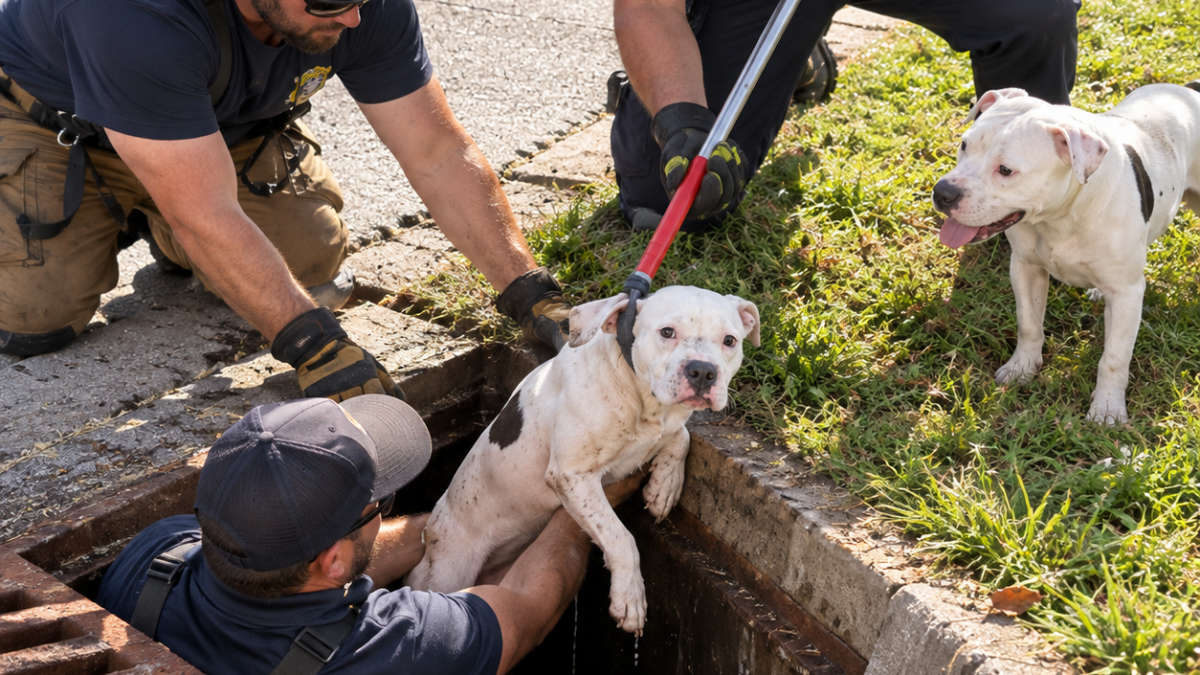
The first sound we heard beneath the storm drain wasn’t barking—it was the frantic scraping of claws against concrete somewhere under our boots.
By the time we realized several dogs were trapped inside the drainage system, the September heat was climbing, the tunnel was too narrow for a firefighter in full gear, and nobody could tell us how far underground the animals had gone.
Then one exhausted dog appeared in the darkness wearing something around his neck that made me realize getting them out might only be the beginning.
It was September 21, 2026, and I was working with a rescue crew in Baldwin County, Georgia, when the call came in near Milledgeville Manor along South Jefferson Street.
The dispatch sounded almost ordinary.
Possible animals trapped in storm drainage.
I had answered stranger calls.
Snakes in garages. Raccoons inside walls. A terrified deer caught between sections of ornamental fencing.
I expected one frightened dog that had crawled into a culvert chasing something and couldn’t figure out how to turn around.
I was wrong.
When our engine pulled up, an animal-control truck was already parked near the curb. A water-department crew had arrived behind us, and two residents were pointing toward a rectangular drainage opening at the edge of the property.
A woman in slippers kept saying, “There’s more than one.”
“How many?” I asked.
“I don’t know.”
“Did you see them go in?”
“No. I heard them.”
That changed everything.
I crouched near the opening.
At first, all I heard was water dripping somewhere inside the system.
Then came a faint whine.
Another answered farther away.
And suddenly the tunnel erupted with scrambling.
Claws against concrete.
Quick breathing.
A bark that echoed so hard through the pipe it sounded like it came from every direction at once.
“Definitely more than one,” I said.
Our captain, Rick Lawson, knelt beside me and aimed a flashlight into the drain.
The beam disappeared down a narrow concrete channel and hit nothing but darkness.
“Anybody know the layout?”
A water-department employee named Marcus unfolded a utility map across the hood of his truck.
The storm system beneath that section of road was older than I expected.
Multiple lines connected beneath the neighborhood.
Some sections were wide enough for a person to crouch through.
Others weren’t.
And after several dry weeks, most of the channel carried only a thin stream of water—but rain was forecast later that evening.
That meant the dogs weren’t only trapped.
We had a clock.
Animal control set food near one opening.
Nothing came out.
We tried another access point fifty yards away.
Nothing.
We heard movement, but every time someone approached, the sounds retreated deeper into the pipe.
“They’re scared of people,” the animal-control officer said.
“Or somebody taught them to be,” I answered.
I didn’t know then how accurate that would turn out to be.
The water crew removed the first heavy grate while we blocked traffic and positioned lights.
Heat rolled out of the opening carrying the smell of wet concrete, mud, and something stronger.
Dog waste.
They had been down there for more than a few minutes.
Maybe much longer.
I lowered myself near the opening and called softly.
“Hey, buddy. Come on. Nobody’s going to hurt you.”
Nothing.
Then two eyes appeared.
Far inside.
Low to the ground.
A brown dog crawled toward us.
Every few feet he stopped and looked backward as though checking whether something behind him was following.
“Easy,” I whispered.
He came close enough for us to see his ribs.
Then another dog appeared behind him.
Then a third.
My captain looked at me.
“Three.”
The first dog reached the edge of the light.
That was when I noticed the faded red collar around his neck.
He let the animal-control officer slip a lead around him, but instead of climbing out, he twisted around and stared back into the darkness.
He refused to leave.
“Something else is in there,” I said.
The officer ran her fingers beneath his collar.
“There’s a tag.”
She turned it over.
I leaned closer.
There was no phone number.
No ordinary pet name.
Just a handwritten identification number and three words scratched into the metal.
Marcus read them first.
His face changed.
“What?” I asked.
He looked toward the drainage tunnel.
Then back at the tag.
“Before we pull another dog out,” he said quietly, “somebody needs to call the sheriff.”
PART 2
For a second, nobody moved.
Traffic continued passing at the far end of the blocked lane, people slowed their cars to stare, and somewhere underneath us another dog barked from inside the storm system.
I looked at Marcus.
“What does it say?”
He handed me the tag.
The metal was cheap aluminum, scratched badly enough that I had to angle it toward the light.
On the front was a number.
**C-17.**
On the back were the words:
**HOLLOW CREEK KENNELS.**
I had heard the name before.
Most people in Baldwin County had.
Hollow Creek wasn’t a veterinary clinic or a normal boarding facility. It was a dog-breeding property outside town that advertised working dogs, hunting dogs, and “family companions” through online listings.
I had driven past the entrance several times.
High chain-link fencing.
A long gravel driveway.
A painted wooden sign.
Nothing that had ever made me think about it twice.
The animal-control officer beside me didn’t look surprised.
Her name was Tasha Greene.
She took the tag from my hand.
“You know them?” I asked.
“I know the name.”
“That’s not what I asked.”
Tasha looked toward our captain.
Then at the residents standing nearby.
Finally she lowered her voice.
“We’ve had complaints.”
“What kind?”
“Noise. Sanitation. Too many animals. Dogs getting loose.”
“And?”
“Every inspection we were able to conduct met the minimum standard at the time.”
I looked at the skinny brown dog.
His hip bones stood out sharply beneath his coat.
“That dog doesn’t look like a minimum standard.”
“No,” she said. “He doesn’t.”
The dog was trembling.
Not violently.
Just enough that the lead vibrated in Tasha’s hand.
She crouched.
“Hey, C-17.”
His eyes moved to her.
“That isn’t much of a name, is it?”
He looked back toward the tunnel.
Again.
Always the tunnel.
I knelt beside him.
“What are you waiting on?”
The answer came almost immediately.
A high-pitched cry echoed beneath us.
Puppy.
Every person around the opening heard it.
Tasha stood.
“There are puppies down there.”
Captain Lawson pointed toward the water-department map.
“Where does that branch go?”
Marcus traced the line.
“Runs under the parking area, then splits. One line goes south toward Jefferson. Other line runs beneath the back side of the property.”
“How far?”
“Maybe two hundred fifty feet to the next access.”
“Diameter?”
“Thirty-six inches most of the way.”
“Most?”
Marcus grimaced.
“There’s a reduced section.”
“How reduced?”
“Twenty-four.”
That ended any thought of sending a firefighter through from our side.
Even without turnout gear, twenty-four inches of drainage pipe filled with mud, debris, frightened dogs, and uncertain air quality was not a place anyone should enter blindly.
Captain Lawson stood.
“Camera.”
The water crew had an inspection system—a wheeled pipe camera normally used to find blockages and structural damage.
Within fifteen minutes, they were lowering it into the storm drain.
We watched from a small monitor.
The image shook as the camera rolled forward.
Concrete.
Mud.
Leaves.
A crushed soda can.
Then eyes flashed white in the infrared light.
One dog.
It backed away.
Another crossed behind it.
The camera moved forward another ten feet.
More eyes.
Tasha whispered, “Lord.”
There were at least six.
Maybe seven.
Some were adults.
At least two looked small enough to be puppies.
They had clustered near a junction where the pipe widened slightly.
Then the camera image jerked.
One of the dogs had bumped it.
Static filled the screen.
The picture returned.
And behind the animals, barely visible against the wall, was a wire transport crate.
Inside the storm drain.
My stomach turned.
“Back up,” I said.
Marcus reversed the camera.
The crate appeared again.
Rusty.
Door open.
One side bent.
There was something attached to the top.
A length of nylon rope.
Tasha stared at the screen.
“Those dogs didn’t all crawl in here by accident.”
Nobody answered.
We didn’t need to.
Dogs chase things.
Dogs wander into culverts.
Dogs hide underground during storms.
But transport crates don’t crawl into drainage systems.
Neither do ropes tie themselves.
Captain Lawson took out his phone.
“I’m calling the sheriff’s office.”
The rescue operation changed in that moment.
Until then, our problem had been simple in principle.
Animals trapped underground.
Get them out.
Now we also had a potential crime scene.
That meant we had to preserve anything we could without delaying rescue.
And rescue still came first.
Rain did not care about evidence.
The forecast showed a line of storms moving toward Baldwin County later that afternoon.
If enough rain fell upstream, water could race through those tunnels far faster than a frightened dog could escape.
Captain Lawson pointed at the map.
“We need access from both sides.”
Marcus nodded.
“We can open the downstream manhole.”
“Do it.”
Tasha said, “I’ll set containment at the other end. Food, catch poles, crates.”
I looked at C-17.
He was still staring underground.
“Take him with you.”
Tasha shook her head.
“He may help.”
“How?”
“These dogs know him.”
She was right.
Sometimes the best tool in an animal rescue is another animal.
We moved to the downstream access point.
The water crew lifted a circular iron cover near the rear edge of the complex.
The smell that came out was stronger.
I shined a light down.
The chamber was about eight feet deep.
A concrete bench ran beside the narrow water channel.
The pipe entered from one side and disappeared out the other.
Big enough for someone to climb down.
Still dangerous.
We tested the atmosphere.
Oxygen level acceptable.
No dangerous gas reading.
Captain Lawson assigned me and another firefighter, Ben Carter, to enter the chamber—not the narrow pipe itself.
Harnesses.
Helmets.
Gloves.
Retrieval lines.
We climbed down.
C-17 remained above with Tasha.
The dog whined the moment he lost sight of us.
“Bring him closer,” I called.
Tasha lowered herself to the edge but kept him secured.
“Come on, buddy,” she whispered. “Call your friends.”
C-17 looked into the tunnel.
Then barked.
Once.
The sound traveled through the concrete.
Several seconds later, something answered.
Then another bark.
Then whining.
Ben looked at me.
“That’s promising.”
We placed food near the pipe opening and backed away.
Nothing happened.
Five minutes.
Ten.
The storm system was dark beyond our lights.
Then a nose appeared.
Black.
Wet.
Gone again.
“Don’t move,” I whispered.
We didn’t.
C-17 whined above us.
The nose returned.
Then a face.
A small tan female crawled out.
Her belly nearly touched the concrete.
She froze when she saw us.
I turned my head away slightly.
Direct eye contact can feel like a threat to a frightened dog.
Tasha called softly from above.
“Come on, sweetheart.”
C-17 made another sound.
The female looked up.
Then moved.
Three steps.
Five.
She reached the food.
I slid a loop lead toward her slowly.
She flinched.
Stopped.
I froze.
Waited.
She started eating.
I moved the loop another inch.
Around her neck.
Then pulled gently.
“Got her.”
The chamber erupted in relieved voices from above.
But we kept everything quiet.
Too much cheering could send the rest deeper.
We lifted her out.
She weighed almost nothing.
The next dog took twenty minutes.
A black male with a white chest.
Then another brown female.
Each emerged because C-17 kept calling.
Each looked toward him the moment they reached the surface.
By the fourth dog, I stopped thinking of C-17 as a number.
He was the reason this was working.
“What should we call him?” Ben asked.
I looked up at the brown dog.
“Scout.”
Ben smiled.
“Why Scout?”
“Because he found the exit first and came back for everybody else.”
Tasha heard me.
“Scout it is.”
The fifth animal was one of the puppies.
A little black-and-tan thing, maybe twelve weeks old.
He came out limping.
Tasha wrapped him in a towel.
“Dehydrated,” she said. “But alert.”
Then came another puppy.
Then silence.
The camera still showed movement deeper inside.
One adult remained.
Maybe two.
And they weren’t moving toward us.
Marcus radioed from the upstream opening.
“Storm line is thirty miles west.”
Captain Lawson checked the weather radar.
“How much time?”
“Maybe ninety minutes before we see anything here.”
Not enough.
We sent the camera back through from our side.
This time we could see the remaining dog clearly.
Large female.
Gray-and-white coat.
She was lying near the junction.
And she wasn’t getting up.
Beside her was another puppy.
Tasha stared at the monitor.
“She may be injured.”
“Can the camera push them?”
“No.”
“Can we reach from the upstream side?”
Marcus shook his head.
“Not without going through the narrow section.”
Captain Lawson stared at the map.
“We need another access.”
The water crew began tracing the line above ground.
Measurements.
Utility marks.
Concrete depth.
One technician used a locator to track the camera’s transmitter.
Finally he pointed toward a patch of grass beside the rear parking lot.
“Junction is almost directly underneath us.”
“How deep?”
“About six feet.”
Captain Lawson looked at Marcus.
“Can we excavate?”
“Yes.”
“How fast?”
“Faster than waiting for the rain.”
A county excavator arrived.
The operator removed soil carefully while the water crew exposed the top of the drainage junction.
We weren’t smashing into the pipe.
One wrong bucket movement could collapse concrete onto the dogs.
So it was slow.
Painfully slow.
Clouds were already forming to the west.
Scout sat beside Tasha.
The other rescued dogs had been loaded into climate-controlled animal-control vehicles.
But Scout refused to settle.
Every time the excavator stopped, he moved toward the opening.
Listening.
Waiting.
“He knows she’s still there,” I said.
Tasha nodded.
“Could be his mother. Could be his mate. Could just be his group.”
“Does it matter?”
“No.”
Another twenty minutes.
Then the water crew exposed the top section of the junction box.
They drilled small pilot openings first.
We used a borescope.
The gray female was directly below.
Alive.
The puppy was pressed against her stomach.
Captain Lawson gave the order.
“Open it.”
The crew cut through the top slab.
When the first section lifted away, daylight entered that storm drain for probably the first time since it was installed.
The female tried to stand.
Her front legs worked.
Her back legs didn’t.
Tasha climbed down before anyone could stop her.
“I’ve got her.”
I followed.
The dog growled weakly.
“Easy,” Tasha whispered.
The puppy crawled against the wall.
I caught him gently and passed him upward.
The female snapped once when Tasha touched her hip.
Pain.
Not aggression.
We used a blanket as a stretcher.
Four of us lifted.
Scout started barking above us.
The female heard him.
Her head came up.
She made a low sound.
Scout lost his mind.
Not panic.
Recognition.
His tail hammered against the ground.
Tasha looked at me.
“Yeah,” she said. “They know each other.”
We lifted the female out.
Scout tried to reach her immediately.
He licked her face.
She closed her eyes.
I had seen people reunited after car crashes, house fires, and searches in the woods.
That moment felt no different.
Nobody there needed a shared language to understand it.
The rain began ten minutes later.
Not heavy.
At first.
Just drops darkening the dust around the excavation.
Then the sky opened.
We had gotten the last dog out with less than fifteen minutes to spare.
Water began rushing through the pipe where they had been lying.
I stood in the rain and watched muddy runoff disappear into the tunnel.
Ben came beside me.
“If we’d waited…”
“I know.”
We didn’t finish the sentence.
There are some sentences firefighters learn not to finish.
All eight dogs survived the initial rescue.
Scout.
The gray female.
Four other adults.
Two puppies.
Animal control transported them to a veterinary clinic.
I thought my part was over.
I should have known better.
At 8:40 that night, while I was eating reheated pasta at the station, Tasha called.
“You still awake?”
“It’s not nine.”
“You firefighters live strange lives.”
“What happened?”
“The gray female has a fractured pelvis.”
My stomach dropped.
“Fresh?”
“No. Older.”
Like the kind of injury that had never been treated properly.
“And the others?”
“Underweight. Fleas. Worms. One has an infected wound. Puppies are dehydrated but should be okay.”
“Scout?”
“Exhausted. Otherwise better than most.”
I pushed my food away.
“What did the sheriff find?”
“That’s why I’m calling.”
I waited.
“The crate from the drain has the same inventory markings as Hollow Creek.”
“So the dogs came from there.”
“Looks like it.”
“Owner say anything?”
“Claims six dogs escaped three weeks ago.”
“Eight dogs were in the drain.”
“I know.”
“Why was there a crate underground?”
“He says he has no idea.”
I laughed once.
No humor in it.
“You believe that?”
“My job isn’t believing. My job is documenting.”
I respected Tasha for that.
Facts first.
Anger later.
The next morning, sheriff’s investigators visited Hollow Creek Kennels with animal control.
I wasn’t there.
What I know came later from reports, photographs, and testimony.
The property had dozens of dogs.
Some looked healthy.
Some didn’t.
Records were incomplete.
Several kennel runs contained more animals than listed.
Medications had expired.
Waste drainage was poor.
One storage building contained broken transport crates matching the one recovered from the storm system.
Still, none of that proved who placed the dogs underground.
The owner, Wade Holloway, denied everything.
He was fifty-two.
Ran the kennel with two employees and occasionally his adult nephew.
His statement was simple.
Dogs escaped.
Someone else must have put the crate in the drain.
He suggested teenagers.
He suggested trespassers.
He suggested animal-rights activists trying to frame him.
He suggested almost everyone except himself.
And because suspicion is not evidence, the investigation continued.
Meanwhile, Scout became something of a local hero.
I hated that description at first.
He was just a frightened, underweight dog who had followed daylight out of a pipe.
But then Tasha showed me video from the rescue.
Every dog that came out had looked toward Scout.
Every one.
The gray female most of all.
The clinic staff named her Grace.
Scout and Grace were housed in adjacent kennels because separating them completely caused both to panic.
Grace needed surgery.
A local rescue group covered part of the cost.
Donations covered the rest.
I visited three days later.
Scout recognized me.
At least I told myself he did.
He stood when I entered.
Tail wagging.
“You look different without a storm drain around you.”
He pushed his nose through the kennel bars.
Grace was recovering next door.
Her eyes followed him constantly.
Tasha joined me.
“You thinking about adopting him?”
“No.”
“That sounded fast.”
“I work twenty-four-hour shifts.”
“People with jobs own dogs.”
“My yard isn’t fenced.”
“Fences exist.”
“I travel.”
“When?”
“That’s not the point.”
Tasha smiled.
“I didn’t say you should adopt him.”
“You were thinking it.”
“I was thinking loudly.”
I walked away.
Then came back ten minutes later with a bag of treats.
The investigation broke open because of something nobody expected.
A teenager.
His name was Eli Porter.
Sixteen years old.
He lived with his grandmother two streets behind the kennel.
For months, Eli had been using an old trail camera to record deer near a wooded strip bordering the stormwater easement.
After seeing the rescue coverage, he told his grandmother he might have footage.
She called the sheriff.
The camera had captured a pickup truck three nights before the dogs were found.
The truck stopped near a drainage access farther upstream.
Two people got out.
The video was grainy.
Faces unclear.
But the truck had a distinctive missing tailgate panel and a large dent above the rear wheel.
Investigators compared it with vehicles registered to Hollow Creek.
One matched.
Wade Holloway’s kennel truck.
That still wasn’t enough to prove who was driving.
Then detectives obtained traffic-camera footage from South Jefferson Street.
Same truck.
Same night.
Same time window.
A gas station camera caught it too.
This time the driver’s face was visible.
Not Wade.
His nephew.
Caleb Holloway.
Twenty-seven years old.
Worked part-time at the kennel.
Investigators interviewed him.
He denied it.
Then changed his story.
Then changed it again.
First the dogs had escaped.
Then he had been “moving them.”
Then he claimed the animals had become aggressive and he was trying to transport them to another property.
Finally investigators confronted him with the transport crate recovered underground.
His answer collapsed.
He said Wade told him the kennel was over capacity.
Several dogs were sick or injured.
A buyer had backed out.
Expenses were rising.
Wade allegedly told him to “get rid of the extras.”
Caleb insisted Wade had not specifically told him to put the dogs in the drain.
That distinction became important later.
According to Caleb, he loaded eight dogs into crates after dark.
He planned to leave them near an abandoned property outside town.
But he saw a sheriff’s cruiser on the road and panicked.
He pulled behind the apartment complex.
He opened a stormwater access.
He pushed one crate down the embankment.
Some of the dogs got loose.
Several ran into the pipe.
Instead of trying to retrieve them, Caleb left.
Scout’s group stayed together.
For three nights.
Underground.
No reliable food.
Little clean water.
Grace unable to walk normally.
Two puppies depending on adults.
And somehow Scout found the opening when residents heard them.
When Tasha told me, I didn’t speak for a long time.
Finally I asked, “Why?”
“You heard why.”
“No. I heard what he said.”
She looked at me.
“Money. Convenience. Fear of getting caught. Pick one.”
I thought of Grace lying beneath concrete as rain approached.
“Did Wade know?”
“Caleb says yes about removing dogs, no about the drain.”
“Do you believe him?”
Again, Tasha gave me the answer I needed.
“Evidence first.”
Investigators searched phones.
Deleted messages can be surprisingly stubborn.
One recovered exchange became central.
Caleb had texted:
**What am I supposed to do with the gray one? She can’t walk right.**
Wade replied:
**I told you I don’t care where they go. They can’t be here tomorrow.**
Caleb:
**And pups?**
Wade:
**All of them. Handle it.**
There it was.
Not an order to use a storm drain.
But an order to make living animals disappear because they had become inconvenient.
The county seized twenty-three additional dogs from Hollow Creek pending proceedings.
That nearly overwhelmed animal control.
Rescue groups from surrounding counties stepped in.
Veterinarians volunteered.
Foster families opened their homes.
The same cooperation that had pulled eight dogs from underground spread outward.
Firefighters donated food.
The water department donated temporary fencing panels they had in storage.
People who had never met started coordinating transport schedules.
One woman drove three hours to foster a pregnant hound.
A retired couple took two senior beagles because they refused to separate them.
A veterinary student spent her weekend bathing dogs with skin infections.
The story people remembered was the storm drain.
But the part I remember was what happened afterward.
A community looked at animals someone had treated like garbage and answered together:
No.
They matter.
Scout came to the fire station while he waited for adoption.
Officially, it was a “socialization visit.”
Unofficially, Tasha had decided I was adopting him and believed reality would eventually catch up.
Scout walked into the bay, sniffed every tire on Engine 4, stole half a turkey sandwich from Ben, and fell asleep beside my boots.
Captain Lawson looked down at him.
“You know he chose your chair.”
“He’s temporary.”
“Sure.”
Scout stayed through dinner.
Then the evening.
Tasha returned at eight.
“You ready?”
“For what?”
“To take him home.”
“I thought you were taking him back.”
“I said I was transporting him.”
“You transported him here.”
“Correct.”
I stared at her.
“That is manipulative.”
“Yes.”
Scout rested his head on my shoe.
Ben started laughing.
Captain Lawson said, “Congratulations.”
“I hate everyone in this building.”
That night Scout slept in my truck while I stopped at a store for a dog bed, bowls, food, collar, leash, and enough supplies to make the cashier ask whether I had just adopted my first dog.
“No,” I said.
Scout leaned between the front seats and licked my ear.
The cashier smiled.
“Of course not.”
The first week was rough.
Scout hated closed bathroom doors.
If I went behind one, he scratched.
He refused to eat unless I stayed in the room.
Rain terrified him.
The first heavy storm after the rescue sent him beneath my kitchen table, trembling so hard the table legs rattled.
I sat on the floor.
“Nothing underground here.”
Scout pressed himself against me.
Thunder hit.
He buried his face under my arm.
“You’re okay.”
I repeated it until the storm passed.
Grace recovered more slowly.
Her pelvic injury did not require the most invasive surgery, but rehabilitation took months.
She began walking better.
Never perfectly.
Scout visited her whenever Tasha could arrange it.
Their reunions became quieter.
Less desperate.
As if both were slowly learning that separation no longer meant permanent loss.
Grace eventually went to a woman named Marlene who had a small farm outside Milledgeville.
I visited once with Scout.
The moment Grace saw him, she ran.
Not well.
Not straight.
But she ran.
Scout met her halfway.
They circled each other, tails whipping.
Marlene wiped her eyes.
“So that’s him.”
“That’s Scout.”
“He really brought the others out?”
“I think he helped.”
Marlene crouched beside Grace.
“Then I owe you one.”
Scout licked her chin.
I said, “That’s his preferred payment method.”
The legal case moved more slowly than public anger.
People wanted immediate punishment.
That isn’t how courts work.
Evidence has to be tested.
Statements challenged.
Intent established.
Attorneys argue.
Dates move.
Months pass.
Caleb eventually entered a plea on multiple animal-cruelty and abandonment-related charges.
He received jail time, probation, financial penalties, mandatory service requirements, and restrictions involving animal ownership and commercial handling.
Wade fought longer.
His attorney argued that telling an employee to remove dogs was not the same as directing abandonment.
Technically, that was true.
The prosecution focused instead on conditions at the kennel, veterinary neglect, falsified records, and the recovered messages.
More former employees came forward.
One described injured dogs being kept without treatment because Wade considered veterinary bills “wasted money” on animals that could no longer be sold.
Another testified that puppies with medical problems were routinely moved off the main property before scheduled inspections.
A third produced photographs.
The most damaging evidence involved Grace.
Records showed her pelvic injury had been noted almost three weeks before the storm-drain rescue.
No veterinarian had examined her.
Instead, an internal note beside her identification number read:
**Not sellable. Remove.**
I saw that photograph during one hearing.
Two words.
Not sellable.
Remove.
I thought of her underground, unable to stand.
Scout refusing to leave without her.
Rain fifteen minutes away.
Something inside me hardened.
Wade Holloway eventually lost his commercial kennel license.
The court barred him from operating a breeding facility during the applicable restriction period and imposed penalties tied to animal-care violations and record failures.
Civil action followed.
The property went into financial distress.
People around town called that revenge.
Maybe.
But the moment that felt like revenge to me came later.
Nearly a year after the rescue, the county and a nonprofit coalition leased part of the former Hollow Creek property.
The kennel buildings were renovated.
Runs were rebuilt.
Drainage improved.
Shade structures added.
A veterinary room installed.
The sign at the road came down.
The new one went up.
**BALDWIN SAFE PAWS RECOVERY & ADOPTION CENTER**
I stood beside Tasha when workers mounted it.
She looked at me.
“You’re smiling.”
“No.”
“You definitely are.”
“I have dust in my eyes.”
“It’s raining.”
“Very aggressive rain.”
Scout sat between us.
Grace arrived with Marlene later that morning.
Several of the other storm-drain dogs came too.
Not all.
Two adopters lived too far away.
One puppy had moved to Florida with a military family.
But five returned.
Healthy.
Heavier.
Collars with actual names.
Scout.
Grace.
Penny.
Otis.
Blue.
The two dogs who had once been listed as inventory numbers ran together across the same land where someone had decided they were worth less than the cost of care.
That was revenge.
Not suffering.
Not cruelty returned for cruelty.
Transformation.
A place that had once measured dogs by sale value now existed to help animals nobody could sell.
Wade’s old office became an adoption counseling room.
The isolation building became medical recovery.
The largest breeding shed became indoor kennels for senior dogs.
And above the reception desk, Tasha hung a framed photograph from September 21.
The storm drain.
Rescue crews.
Water-department workers.
Animal control.
And Scout standing muddy beside all of us.
Underneath were four words.
**NO ONE WORKS ALONE.**
I liked that more than any dramatic slogan.
Because that was the truth.
No one person saved those dogs.
Firefighters didn’t.
Animal control didn’t.
The water department didn’t.
The sheriff didn’t.
Veterinarians didn’t.
Residents didn’t.
The teenager with the trail camera didn’t.
Foster families didn’t.
Every one of them was necessary.
Remove one piece and the ending might have changed.
That lesson followed me.
Two years after the rescue, Scout no longer panicked during every rainstorm.
He still noticed storms.
His ears lifted at the first heavy drops.
Sometimes he came closer to me.
But he stopped hiding.
I had fenced my yard.
Naturally.
Tasha claimed victory.
Scout had a dog door.
A ridiculous orthopedic bed he rarely used.
Three actual dog beds, if I’m being honest.
He preferred the couch.
He also became a station regular.
Children visiting on fire-prevention days loved him.
Scout was gentle with everyone.
But he had a strange habit around storm drains.
Whenever we walked near one, he stopped.
Never pulled toward it.
Never panicked.
He simply looked.
Then looked at me.
The first few times, I tried pulling him away.
Eventually I stopped.
I gave him a moment.
“Everybody got out,” I would say.
Then we continued walking.
Maybe he understood the words.
Maybe only the tone.
Maybe I said them for myself.
Everybody got out.
Those words mattered.
Because rescue work rarely gives you that sentence.
Sometimes somebody doesn’t get out.
Sometimes despite coordination, training, equipment, and every person doing everything right, the ending still hurts.
September 21 gave us something rare.
Eight dogs.
Eight survivors.
Years later, we held a small reunion at the recovery center.
Not for publicity.
Just because Tasha thought it would be nice.
Scout was older.
Gray around the muzzle.
Grace moved stiffly but happily.
One of the puppies, now named Cooper, had become enormous.
He had been adopted by a school counselor and apparently slept in bed with three children despite weighing almost eighty pounds.
The other puppy, June, arrived wearing a pink bandana.
Her family said she hated puddles but loved swimming pools.
“Explain that,” I told her.
June licked my hand.
Otis had developed the personality of a professional criminal.
His owner spent fifteen minutes describing things he had stolen.
Sandwiches.
Shoes.
An entire rotisserie chicken.
A birthday cake.
A wallet.
I looked at Scout.
“You saved a felon.”
Otis wagged proudly.
Marlene sat beside Grace under a shade tree.
“Do you ever wonder what they remember?”
“All the time.”
“She still hates concrete tunnels.”
“Scout stops at drains.”
Marlene touched Grace’s back.
“But look at them now.”
I did.
Dogs stretched across grass.
Families talking.
Children throwing tennis balls.
No crates.
No numbers.
No inventory sheets.
Names.
That difference became important to me.
When we found Scout, he was C-17.
Grace had been B-09.
Cooper was P-4.
June was P-5.
The kennel had reduced them to codes because codes are easier to discard than names.
A name makes you imagine somebody answering.
A name creates a relationship.
A name makes absence noticeable.
Maybe that is why the first thing rescuers often do is name an animal.
Not because dogs care about paperwork.
Because humans need to remember they are dealing with a life.
Scout turned ten—or approximately ten, because nobody knew his exact birth date.
Then eleven.
His hips slowed.
The old deprivation showed up earlier than I wanted.
Dr. Carter, the veterinarian who had treated Grace and several of the others, eventually told me Scout had arthritis in both rear legs.
Medication helped.
So did shorter walks.
He retired from long station visits.
He still came for special events.
One September morning, five years after the rescue, I took him back to South Jefferson Street.
The drainage system had been modified.
The county installed protective grates at several access points after reviewing the incident.
Not barriers that blocked water.
Designs that made it much harder for large animals—or people carrying crates—to enter.
Scout sniffed one.
I stood beside him.
“This place look familiar?”
He didn’t react.
Good.
I had once wanted proof he remembered.
Now I hoped he didn’t.
We walked toward the spot where the water crew had excavated the emergency opening.
Grass had grown back.
Cars passed.
People lived ordinary lives nearby.
Nothing about the place suggested what happened beneath it.
That is true of many emergency scenes.
The world repairs itself physically much faster than memory does.
Scout lowered himself onto the grass.
I sat beside him.
“You know, you caused a lot of paperwork.”
His tail tapped once.
“You also cost me a fence.”
Another tap.
“Furniture.”
Scout looked away.
“Yes, I remember the couch.”
He leaned against my leg.
I put my hand on his head.
“Worth it.”
Three months later, Scout collapsed in my kitchen.
I heard the sound from the hallway.
When I reached him, he was conscious but couldn’t stand properly.
The emergency vet found internal bleeding from a mass near his spleen.
Cancer.
Aggressive.
I sat in the consultation room with Scout’s head against my knee.
The veterinarian explained options.
Surgery might buy time.
Might not.
At his age, with his condition, there were no guarantees.
I had spent my career making decisions during emergencies.
Structure fire.
Vehicle extraction.
Medical call.
Hazard assessment.
Risk versus benefit.
But no training prepares you to make that calculation when the patient has slept beside your bed for five years.
“How much time if surgery works?”
The veterinarian was careful.
“Could be weeks. Could be months.”
“And if it doesn’t?”
“He could die during surgery.”
Scout looked up at me.
I remembered the storm drain.
He had refused to leave because Grace remained inside.
He had already spent one part of his life trapped by circumstances humans created.
I would not make his last days another trap just because I wasn’t ready.
We took him home with comfort medication.
Tasha came that night.
She sat on my living-room floor beside him.
“He still looks like a puppy to me.”
“He has a white face.”
“Still.”
Scout placed a paw on her leg.
Tasha cried immediately.
“That was unnecessary.”
I looked away because I was doing the same thing.
Over the next three days, people visited quietly.
Captain Lawson.
Retired by then.
Ben.
Marcus from the water department.
Marlene brought Grace.
That was the reunion that broke me.
Grace was old too.
She walked slowly through my front door.
Scout lifted his head.
For a moment, years vanished.
He tried to stand.
I helped him.
Grace approached.
They touched noses.
Then she lay beside him.
No jumping.
No frantic tails.
Just two old dogs resting shoulder to shoulder.
The first time I saw them together, Grace was being lifted from underground while Scout barked like he could pull her to safety with his voice.
Now he lowered his head onto her front paws.
Marlene sat beside me.
“I guess he still doesn’t want to leave without her.”
I couldn’t answer.
Grace stayed almost two hours.
When Marlene finally led her toward the door, Grace turned back twice.
Scout watched.
Then rested.
The next morning he stopped eating.
I called Dr. Carter.
She had known Scout for years.
She came to the house after her clinic closed.
We carried his bed into the backyard.
The weather was clear.
No rain.
I was grateful for that.
Tasha arrived.
So did Ben.
I didn’t invite anyone else.
Scout deserved peace, not an audience.
He lay beneath the oak near my fence.
The same yard he had transformed from something I barely used into the center of my life.
I sat beside him.
For a while, nobody spoke.
Finally I said, “Do you remember the pipe?”
Scout’s ear moved.
“Probably not.”
I stroked the white fur around his muzzle.
“But I do.”
I told him the story.
Not because he needed it.
Because I did.
I told him about the scraping beneath the concrete.
The first pair of eyes appearing in the tunnel.
The tag.
The camera.
The crate.
The puppies.
Grace.
The rain.
I told him how he refused to leave while others remained underground.
“How many dogs did you get out?” Tasha asked softly.
I looked at Scout.
“Seven besides him.”
“No.”
She wiped her face.
“He got more than that out.”
I knew what she meant.
The dogs later seized from Hollow Creek.
The animals rehabilitated at Baldwin Safe Paws.
The dogs adopted because the center existed.
Scout had become part of a chain of consequences much larger than eight animals beneath one street.
Dr. Carter prepared the medication.
I put both hands around Scout’s face.
His eyes met mine.
“You know what everybody called you?”
His tail moved weakly.
“A hero.”
I smiled through tears.
“You didn’t know what that meant.”
I leaned close.
“You were just trying not to leave your family behind.”
His breathing slowed.
“I’m not leaving you behind either.”
Dr. Carter gave the first medication.
Scout relaxed.
His head grew heavier in my hands.
I whispered the same words I had said during thunderstorms.
“You’re okay.”
His eyes closed.
“Nothing underground.”
Another breath.
“No rain.”
Another.
“Everybody got out.”
That was the last thing I told him.
Everybody got out.
Scout died beneath an open sky.
Years earlier, somebody had left him beneath concrete.
I had thought about that contrast hundreds of times.
But in that moment, it felt like the only ending worthy of him.
We buried his ashes at the recovery center beneath a young oak near the entrance.
Not because he belonged more to the center than to me.
Because that place existed partly because he had survived long enough for us to notice what humans had done.
Grace came to the small memorial.
Marlene held her leash.
She lay beside the tree and refused to move for almost an hour.
The plaque we installed did not call Scout a hero.
I didn’t want that.
It read:
**SCOUT**
**FOUND UNDER SOUTH JEFFERSON STREET — SEPTEMBER 21, 2026**
**HE CAME OUT FIRST, BUT HE WOULD NOT LEAVE THE OTHERS BEHIND.**
Underneath, smaller:
**EVERYBODY GOT OUT.**
A year later, Grace died peacefully at Marlene’s farm.
Her ashes were placed beneath the same oak.
Two small markers.
Side by side.
I still volunteer at the center.
I’m older now.
My knees complain whenever I kneel beside kennel doors.
Tasha says retirement is a real concept.
I tell her so is minding her own business.
There is currently a young hound mix asleep on my couch.
Her name is Millie.
She was found beside a drainage ditch after a storm.
No, that is not why I adopted her.
At least that’s what I tell people.
She hates thunder.
The first night we had a hard rain, she ran beneath my kitchen table.
I sat beside her.
For one strange second, five years collapsed.
I could feel Scout pressed against my side again.
So I put my hand on Millie’s back.
“Nothing underground here.”
She looked at me.
“You’re okay.”
Her shaking slowed.
That is how rescue keeps moving.
Not in headlines.
Not in photographs.
In learned kindness.
One frightened animal teaches a person how to sit quietly with another.
One rescue changes a policy.
One tag starts an investigation.
One teenager keeps a trail camera running.
One water-department worker knows the pipe map.
One firefighter listens instead of assuming.
One animal-control officer refuses to quit.
One community decides eight lives are worth the inconvenience.
And years later, somebody sits on a kitchen floor during a thunderstorm because an old brown dog once taught him what fear sounds like.
People still occasionally ask me about September 21.
They remember the dramatic part.
Dogs beneath a storm drain.
Firefighters.
Animal control.
Water crews.
Excavation.
Rain approaching.
They ask what the hardest part was.
Most expect me to say getting the last dog out.
It wasn’t.
The hardest part was understanding how close those dogs came to disappearing without anyone noticing.
A few more hours.
One heavy storm.
A quieter apartment complex where nobody heard scratching.
A resident who decided the noise was probably nothing.
Any one of those things could have changed everything.
That is what stayed with me.
Cruelty often depends on silence.
On nobody looking twice.
On everybody assuming somebody else will handle it.
Wade Holloway’s downfall did not begin in a courtroom.
It began when a woman in slippers heard scratching beneath the pavement and decided it mattered.
Caleb’s story collapsed because a sixteen-year-old boy checked a trail camera.
The kennel lost its license because former employees finally stopped staying quiet.
The dogs survived because emergency services worked together instead of arguing about whose job it was.
People called what happened to Hollow Creek revenge.
I understand why.
A breeding property became a rescue center.
Dogs once marked “not sellable” became beloved pets.
A man who treated animals as disposable lost the business built on them.
But Scout taught me a different definition.
Revenge is not always making someone suffer.
Sometimes the strongest revenge is making sure the thing they tried to erase becomes impossible to ignore.
They tried to make eight dogs disappear beneath a road.
Instead, those eight dogs changed county procedures.
They helped expose neglect.
They led to more animals being removed from unsafe conditions.
They helped create a recovery center.
Their photographs hang where kennel inventory sheets once hung.
Their names replaced numbers.
Grace was not B-09.
Scout was not C-17.
Cooper was not P-4.
June was not P-5.
They were lives.
And once enough people treated them that way, the whole story changed.
Every September 21, I visit Scout’s oak.
Sometimes firefighters come.
Sometimes nobody does.
I sit on the bench.
I look toward the recovery building.
Dogs bark inside.
Workers move between kennels.
Families arrive.
Families leave.
Every now and then, a newly adopted dog pulls toward the parking lot, uncertain about getting into a stranger’s car.
I watch the adopter kneel.
Wait.
Offer a hand.
No forcing.
No anger.
Just patience.
Then the dog steps forward.
That moment never gets old.
I used to think rescue happened when we lifted Scout out of the storm drain.
I was wrong.
That was only the first rescue.
The second happened when the other dogs followed him.
The third happened at the veterinary clinic.
Then the investigation.
Then Hollow Creek.
Then the seized dogs.
Then the center.
Then every adoption afterward.
Rescue is rarely one dramatic act.
It is a chain.
Somebody hears.
Somebody stops.
Somebody calls.
Somebody comes.
Somebody believes the problem is worth the trouble.
Somebody refuses to leave.
Scout did that first.
He came toward daylight.
Then he turned around.
He knew others were behind him.
He could have run.
Nobody would have blamed him.
Instead he stayed at the opening and called back into the dark.
That is the image I carry.
Not Scout sick.
Not Scout old.
Not Scout dying beneath my oak tree.
Scout standing beside that drainage opening on September 21, 2026, ribs showing, mud on his paws, a numbered collar around his neck, refusing to walk away because his family had not made it out yet.
I spent years thinking we rescued him that day.
Maybe we did.
But I also know this.
If Scout had run when we first pulled him free, we might have assumed only a few dogs remained.
We might have underestimated what was inside.
We might not have noticed the way he kept staring backward.
We might not have understood quickly enough.
Scout stayed.
He told us without words:
**There are more.**
And because someone finally listened, everybody got out.
That is how I remember him.
Not as the dog trapped beneath a street.
As the dog who reached daylight and refused to enjoy it alone.
Scout stayed.
He told us without words that there were more dogs behind him.
And because somebody finally listened, everybody got out.
For a long time, I believed that was where Scout’s story should end.
It was clean that way.
Eight dogs rescued.
A kennel exposed.
The people responsible faced consequences.
A property once used to treat animals like inventory became a recovery center.
Scout grew old in a home where rain no longer meant rising water and darkness no longer meant abandonment.
Then he died beneath an open sky with people who loved him beside him.
It sounded complete.
But grief has a strange way of showing you that an ending and an absence are not the same thing.
After Scout died, I kept waking before sunrise.
For five years, he had been my alarm clock.
Usually somewhere around 5:40, I would hear the soft tap of his nails against the hallway floor.
Then his nose would appear beside the mattress.
If I ignored him, he would sigh.
If I kept ignoring him, he would place his chin on the edge of the bed.
And if that still didn’t work, he had one final strategy.
A single wet nose directly against my cheek.
The first morning after he died, I opened my eyes at 5:38.
The room was dark.
I waited.
Nothing.
5:41.
Still nothing.
I knew he was gone.
I had held him when his heart stopped.
I had watched Dr. Carter lower her stethoscope.
I had buried his ashes beneath the oak at Baldwin Safe Paws.
But my body had not caught up with what my mind already knew.
I got out of bed anyway.
I filled the coffee maker.
Then, without thinking, I reached for Scout’s food bowl.
My hand stopped over the cabinet.
That was the first time I cried after the memorial.
Not when we placed the plaque.
Not when Tasha read the words aloud.
Not when Grace lay beside the tree.
Over a stainless-steel bowl.
That is how grief works.
It lets you survive the ceremony.
Then it waits for breakfast.
For the first two weeks, I avoided South Jefferson Street.
I told myself there was no reason to drive that way.
The truth was simpler.
I did not want to see the storm drain.
For years I had passed it with Scout in the truck.
Whenever we approached, he would lift his head.
Sometimes he would look toward the drain.
Sometimes he wouldn’t.
I never knew what he remembered.
Maybe everything.
Maybe only the smell of wet concrete.
Maybe nothing at all.
But I remembered enough for both of us.
One Saturday morning, Tasha called.
“You coming in?”
“To the center?”
“That is generally what I mean when I ask whether you’re coming in.”
“I don’t know.”
“You haven’t been here in twelve days.”
“I’ve been busy.”
“With what?”
I looked around my silent kitchen.
“Things.”
“Name one.”
I didn’t answer.
Tasha softened.
“You don’t have to stay long.”
“I know.”
“But don’t let losing Scout take away the place Scout helped build.”
That irritated me.
Mostly because she was right.
So I went.
Baldwin Safe Paws looked exactly the same.
That bothered me too.
The world should look different when somebody important is missing.
Cars should stop.
Lights should dim.
People should lower their voices.
Instead, volunteers carried food bags through the front entrance.
A family stood in the adoption room meeting a young hound mix.
A technician was arguing with a beagle who had apparently decided a thermometer was an act of war.
Life had continued.
I stood in the lobby until Tasha saw me.
She came around the desk.
No hug.
Just a hand on my shoulder.
“Morning.”
“Morning.”
Then barking exploded from the recovery wing.
I looked toward the hallway.
“What’s that?”
“New intake.”
“I’m not ready.”
“I didn’t ask you to adopt anything.”
“You have a history.”
“That was one time.”
“Scout lived with me five years.”
“Still counts as one.”
I followed her.
The dog was in the last quiet kennel.
Young male.
Maybe three.
Black coat with a tan face.
He was backed so hard against the wall that his body looked flattened.
His leash lay untouched on the floor.
“What happened?”
“Found behind a grocery store. Somebody tried to catch him with a catch pole before animal control arrived. Scared him half to death.”
“Any injuries?”
“Minor. Fear is the bigger problem.”
The dog looked at me.
Then barked.
Once.
Sharp and frightened.
I stayed outside the kennel.
Tasha handed me a folding chair.
“No.”
“You don’t have to do anything.”
“I know what you’re doing.”
“Then you know you can say no.”
I looked at the dog again.
His whole body trembled.
I sat.
For twenty minutes, he stared at me.
I turned slightly sideways.
No reaching.
No calling.
No eye contact.
Scout had taught me that.
Not through training.
Through necessity.
When Scout first came home, he had hated being cornered.
The fastest way to lose his trust had been to insist on receiving it.
So I learned patience.
This dog needed the same thing.
After half an hour, he stopped barking.
After forty-five minutes, he lowered his head.
After an hour, I stood.
He didn’t panic.
That was enough.
“What’s his name?” I asked.
“Right now? Intake 2287.”
I looked at Tasha.
“No.”
She smiled.
“I knew you’d say that.”
We called him Ash.
Not because I adopted him.
I didn’t.
But because his coat looked like the dark edge of a fire after it cooled.
I came back the next morning.
Then the next.
On the fifth day, Ash ate while I was sitting in the room.
On the ninth, he took a treat from the floor beside my boot.
On the twelfth, he touched his nose to my hand.
A week later, a woman named Rebecca came to meet him.
She had lost her old shepherd the year before.
She did exactly what I hoped she would do.
She sat on the floor and waited.
No reaching.
No baby voice.
No pressure.
Ash eventually walked over and smelled her sleeve.
Rebecca cried.
Quietly.
I looked away.
Three days later, he went home with her.
I watched from the center window as he climbed into her car.
Tasha stood beside me.
“You okay?”
“I’m fine.”
“That is an old-man word meaning absolutely nothing.”
I watched the car disappear.
“I thought helping another dog would feel like replacing Scout.”
“And?”
“It doesn’t.”
“What does it feel like?”
I thought about it.
“Like Scout left instructions.”
That became the beginning of a different kind of grief.
Not less painful.
More useful.
I started volunteering twice a week.
Then three times.
I helped with frightened dogs.
Older dogs.
Dogs recovering from surgery.
Dogs who refused food unless somebody sat nearby.
I did not save all of them.
That is important.
One shepherd arrived too sick from kidney failure.
A senior hound had advanced cancer.
A puppy with severe congenital problems survived only four days.
Those losses hurt.
But Scout had taught me something else.
A rescue is not measured only by whether death can be prevented.
Sometimes rescue means pain is treated.
Sometimes it means an animal is warm.
Sometimes it means the last voice they hear is gentle.
Sometimes it means nobody has to die alone.
That matters too.
Two years after Scout died, a young firefighter named Mason joined our station.
Twenty-three.
Strong.
Confident.
Absolutely convinced he knew everything.
Basically all the qualities I had possessed at twenty-three.
One afternoon, he saw the framed photograph of Scout in the station hallway.
Mud-covered dog.
Storm drain behind him.
My hand resting on his back.
Mason pointed at it.
“That the famous dog?”
“Famous is generous.”
“He’s the one from the drain?”
“Yes.”
“People still talk about that rescue.”
I shrugged.
“Good operation.”
Mason studied the picture.
“You kept him?”
“He kept me.”
Mason laughed.
“I’m serious.”
“So am I.”
A few weeks later, Mason responded to an animal call.
A dog had fallen into an abandoned foundation pit.
No dramatic danger.
No rushing water.
No television crews.
Just a terrified dog six feet below ground.
When Mason returned, he found me cleaning equipment.
“I sat down.”
“What?”
“With the dog.”
He looked embarrassed saying it.
“It kept trying to climb away whenever we approached. I remembered what you said about Scout. So I stopped moving toward it. Just sat there.”
“And?”
“Five minutes later, it came to me.”
I smiled.
“Good.”
Mason hesitated.
“So I guess Scout was still working.”
That sentence stayed with me.
Scout was still working.
Not as a dog.
As a lesson.
Years passed.
Baldwin Safe Paws expanded.
The recovery building added two quiet rooms.
A local contractor donated materials for a shaded exercise yard.
Dr. Carter started a rehabilitation partnership with a veterinary college.
Students came to learn physical therapy techniques for injured dogs.
And every September 21, the center held what Tasha called Rescue Day.
I hated the name.
She ignored me.
Families who had adopted animals through the center returned.
Water-department workers came.
Firefighters brought an engine for children to climb through.
Animal control set up vaccination information.
No speeches about heroes.
No dramatics.
Just a community showing what cooperation looked like when nobody tried to claim all the credit.
One year, Cooper came back.
He had been one of the puppies under the street.
He was enormous now.
Nearly eighty pounds.
Gray beginning around his muzzle.
His family had three children.
Cooper followed the youngest girl everywhere.
I crouched and scratched his chest.
“You remember me?”
He licked my glasses.
“I’ll take that as a maybe.”
His owner laughed.
“He sleeps in my daughter’s room every night.”
I looked at Cooper.
Once he had slept against concrete because there was nowhere else to go.
Now a child complained that he took too much of her pillow.
I loved that.
June came too.
So did Otis.
Otis was still a thief.
His owner told me he had recently stolen a Thanksgiving turkey breast directly from the kitchen counter.
“Scout rescued a criminal,” I said.
Otis wagged proudly.
Grace never made it to that reunion.
She died the year before.
Marlene called me the morning it happened.
“She went peacefully.”
“I’m glad.”
“She was outside.”
“Good.”
“Under the peach tree.”
I closed my eyes.
For a moment, I could see Grace in that storm drain again.
Unable to stand.
Scout refusing to leave.
“Put some of her ashes near Scout,” I said.
“I already planned to.”
So we did.
Two old dogs beneath one oak.
The first had reached daylight and looked backward.
The second had been carried toward it.
Eventually, they ended up together again.
That gave me more comfort than I expected.
On the fifth anniversary of Scout’s death, I finally drove alone to South Jefferson Street.
No ceremony.
No uniform.
No center staff.
Just me.
The storm drain had been modified.
Protective barriers prevented animals from easily entering the pipe.
The grass around it was neat.
Cars passed.
Nobody paid attention to an older man standing near the curb.
I crouched beside the opening.
Water moved quietly beneath the grate.
Nothing dramatic.
I placed my hand on the concrete.
Cold.
Just as I remembered.
For a few seconds, I could hear the rescue again.
Claws scraping.
Marcus shouting pipe measurements.
Tasha calling softly.
The excavator.
Rain beginning.
Scout barking toward Grace.
Then traffic pulled me back.
I said quietly, “Everybody got out.”
That had become my sentence.
My promise.
My memory.
Of course, eventually I learned it was not always literally true.
Not every rescue ends that way.
Not every dog survives.
Not every investigation reaches the answer people want.
Not every person responsible faces the punishment we think they deserve.
But on September 21, everybody got out.
Eight animals.
Eight chances.
And from those eight came changes nobody could have predicted.
County drainage inspections improved.
Animal-control reporting procedures changed.
The kennel investigation led to stronger local scrutiny of large commercial dog operations.
The recovery center existed because people refused to let an ugly property stay defined by what had happened there.
That became the real revenge.
Not Wade losing his license.
Not Caleb standing in court.
Not Hollow Creek collapsing financially.
Those were consequences.
Necessary consequences.
But revenge?
If revenge means proving someone’s judgment wrong, then Scout had the last word every day he lived.
They had treated him as disposable.
He became family.
They had called Grace unsellable.
She became someone’s beloved farm dog.
They had abandoned puppies because they cost money.
Those puppies grew up sleeping in children’s beds.
They had used numbers.
We gave them names.
They tried to make dogs disappear underground.
Their story became the reason people started looking more carefully.
And the land where those dogs had once been counted as inventory became a place where frightened animals learned that hands could be gentle.
That is revenge I can live with.
Nothing destroyed.
Something rebuilt.
At seventy, I finally retired from active fire duty.
Tasha claimed I should have done it sooner.
I told her nobody asked.
She said everybody had asked.
Retirement was strange.
For nearly my entire adult life, emergencies had given structure to my days.
A radio tone.
A destination.
A problem.
Do something.
Without that, mornings felt too open.
So I kept volunteering at Baldwin Safe Paws.
I became the old guy people sent nervous dogs to.
“Give him to Daniel.”
“He’ll sit with her.”
“He has time.”
At first, I resented the word old.
Then I realized patience is easier when nobody expects you anywhere else.
There is value in having time.
One rainy afternoon, a volunteer brought me a small black puppy.
About four months old.
She had been found near a culvert outside town.
“No.”
The volunteer looked confused.
“I didn’t say anything.”
“I know where this is going.”
“She just needs somebody to sit with her.”
“That is how Scout happened.”
“Scout was an adult dog.”
“Technicality.”
The puppy crawled into my lap.
I stared at the ceiling.
“This is manipulation.”
She fell asleep.
I took her home that evening.
Her name became Maggie.
Tasha laughed for five straight minutes when she found out.
“Not one word.”
“I didn’t say anything.”
“You’re thinking loudly.”
I had used that phrase on her years earlier.
She remembered.
Maggie never knew Scout.
But she sleeps beneath the framed photograph of him.
She hates thunder.
The first major storm after I adopted her, she ran behind the couch.
I sat on the floor.
“Nothing underground here.”
Her head appeared.
“You’re safe.”
Slowly, she came out.
Pressed against me.
I rested my hand on her back.
And in that moment, I understood something I had not understood when Scout was alive.
Love does not continue because memory stays perfect.
It continues because behavior changes.
Scout changed the way I respond to fear.
The way I approach frightened animals.
The way Mason approached that dog in the foundation pit.
The way Baldwin Safe Paws trains new volunteers.
The way adopters are taught to give traumatized dogs time instead of demanding instant affection.
That is how Scout survived death.
Not magically.
Practically.
In habits.
In systems.
In people.
In the extra minute somebody waits instead of grabbing.
In the decision to ask one more question when an animal’s condition does not make sense.
In the willingness to call the sheriff when a numbered collar tells you something is wrong.
In refusing to say, “Not my job.”
Every year, I sit beneath Scout’s oak.
The tree is large now.
Grace’s marker sits beside his.
Families sometimes walk past without knowing who they were.
That is fine.
Legacies do not require recognition to work.
Last September 21, I brought Maggie with me.
She sniffed Scout’s plaque.
Then lay down beneath the tree.
I read the inscription again.
HE CAME OUT FIRST, BUT HE WOULD NOT LEAVE THE OTHERS BEHIND.
Under it:
EVERYBODY GOT OUT.
Maggie rested her head across my boot.
I looked toward the recovery center.
A van had just arrived.
Two volunteers opened the rear doors.
Inside was a frightened dog wrapped in a blanket.
Another chance arriving.
Another story beginning.
I thought about Scout’s first day in daylight.
Ribs visible.
Mud on his legs.
Number around his neck.
A whole human system had failed him.
And still, when freedom appeared, he did not run away alone.
He turned back.
That is the part I will remember until my own memory fails me.
Not the courtroom.
Not Hollow Creek.
Not the headlines.
Not even the rescue equipment.
A frightened dog reaching safety and deciding safety meant nothing while others were still in darkness.
Sometimes I wonder whether humans would do better if we understood that instinct.
Not, “I got out.”
But, “Who is still down there?”
Scout could not testify.
He could not explain who left him.
He could not demand justice.
He could not tell us what happened during those nights underground.
He did the only thing available to him.
He stayed.
He looked back.
He called.
And people listened.
That was enough to change everything.
So when somebody asks me now about the dogs under South Jefferson Street, I do not start with the rescue truck.
I do not start with the water department map.
I do not start with the investigation.
I start with a brown dog standing at the edge of a storm drain.
I tell them he had every reason to run.
He had been frightened.
Starved.
Abandoned.
But instead of running toward the road, he turned toward the darkness.
Because his family was still there.
And years later, long after Scout’s final breath, that is still what he asks of the rest of us.
Look back.
Listen.
Make sure nobody has been left behind.








