PART 2: We Found Him Motionless Beside a Dumpster in 104°F Heat—Then the Vet Took Off His Gloves and Looked at Me
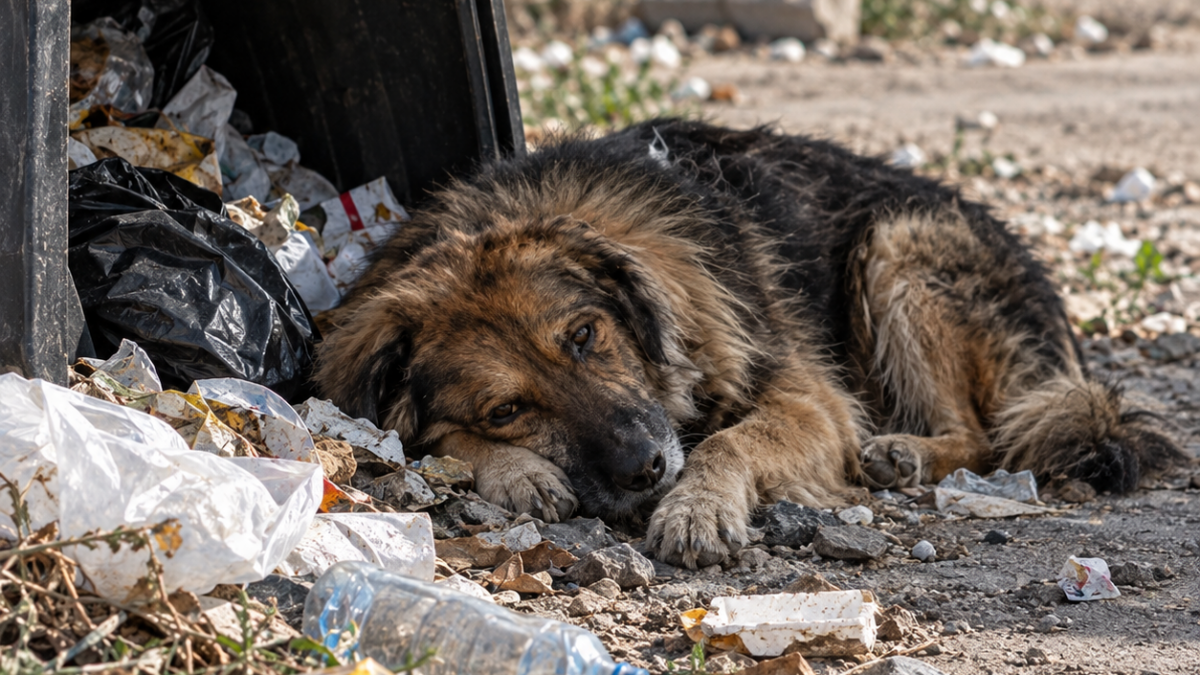
At first, we couldn’t tell whether the dog lying beside the trash was still alive.
By the time I touched his chest, the pavement was pushing nearly 104-degree heat back into my knees, and his heartbeat was so faint I had to hold my breath just to feel it.
But when the veterinarian stopped working, pulled off his gloves, and looked across the treatment table at me, I realized the heat wasn’t going to be the only thing we would have to explain.
My name is Emily Carter, and the message reached our rescue group a little after two on a Tuesday afternoon.
Dog down beside the service road. Looks like he’s dying.
There was a photograph attached.
It showed an overturned plastic trash container, black garbage bags torn open around it, flattened cardboard, bottles, and what looked like a brown patch of fur underneath the container’s shadow.
I called Rachel, another volunteer.
“Can you drive?”
“Already getting my keys.”
The temperature outside was brutal.
The dashboard read 102°F when we left, but the road itself felt hotter. Heat rose from the asphalt in shimmering waves.
We found the dog fifteen minutes later.
He was lying on his side near the shoulder, half hidden beneath the overturned container.
For one terrible second, neither Rachel nor I moved.
“Emily?”
“I know.”
He wasn’t panting.
That frightened me immediately.
A dog lying in extreme heat should have been panting hard.
This one barely seemed to breathe.
I knelt.
“Hey, buddy.”
No response.
His coat was dusty and rough. He was a medium-sized shepherd mix, maybe six or seven years old, with tan legs and a dark back.
His tongue rested partly outside his mouth.
I touched two fingers to his chest.
Nothing.
I moved them.
Waited.
Then felt it.
One weak beat.
Another.
Far too much space between them.
“He’s alive.”
Rachel dropped beside me.
“We need the car.”
When I slid my hands beneath him, he didn’t resist.
Didn’t lift his head.
Didn’t even open his eyes.
His body felt frighteningly hot.
Not warm.
Hot.
Like picking up something that had been sitting beside a fire.
We wrapped him loosely in a damp towel, moved him into the air-conditioned SUV, and drove.
“Check him.”
Rachel kept both hands on the wheel.
I leaned over him.
One breath.
Pause.
Second breath.
Longer pause.
Third.
“Come on.”
His eyelids moved.
“Please breathe.”
I kept talking because silence felt dangerous.
“You don’t know us yet, but you’re not dying next to a trash can. You hear me?”
His paw moved perhaps half an inch.
“That counts.”
Rachel called the emergency clinic.
“We’re five minutes away. Severe heat exposure, barely responsive.”
The receptionist asked whether he was conscious.
“No.”
“Breathing?”
“Yes, but slow.”
“Bring him straight through.”
We pulled into the parking lot hard enough that Rachel barely put the SUV in park.
I carried him inside.
“Help!”
Three people came running.
They placed him on a treatment table.
Temperature.
IV catheter.
Oxygen.
Cool wet towels.
Fans.
Blood pressure.
Blood samples.
Everything happened at once.
“Temperature is 106.8.”
“Pressure’s low.”
“Heart rhythm irregular.”
The veterinarian, Dr. Harris, leaned over him.
“Easy cooling. No ice.”
Someone clipped fur from his leg.
Another technician brought fluids.
I stood against the wall with my hands shaking.
Rachel whispered, “Is he going to make it?”
No one answered.
Five minutes passed.
Then ten.
His temperature dropped slightly.
But the monitor began sounding differently.
Dr. Harris stared at the screen.
“Run another pressure.”
A technician did.
Her face changed.
“It’s falling.”
My stomach dropped.
Dr. Harris listened to the dog’s chest.
“Come on, buddy.”
The dog didn’t move.
Then Dr. Harris stopped.
He slowly pulled off one glove.
Then the other.
He looked at me.
“Did you find him exactly where he collapsed?”
“Yes.”
“Why?”
I stared at him.
“What do you mean?”
He glanced toward the dog’s paws.
Then at a raw patch beneath his old collar.
Finally, he looked back at me.
“Because I don’t think this dog wandered there and collapsed on his own.”
PART 2
I stared at Dr. Harris.
For a second, what he had said didn’t register.
Behind him, the technicians were still moving around the treatment table.
One adjusted the oxygen line.
Another checked the IV pump.
The monitor kept making its thin electronic beeps.
“What do you mean he didn’t collapse there?”
Dr. Harris pointed toward the dog’s feet.
“Look at his paw pads.”
I stepped closer.
I wish I hadn’t.
The pads weren’t simply dusty.
They were damaged.
Red in places, blistered in others, the kind of injury a dog could get from prolonged exposure to hot pavement.
But Dr. Harris wasn’t looking only at that.
He touched the fur above one paw.
“There isn’t enough road debris between the toes.”
I frowned.
“I don’t understand.”
“If he had walked a significant distance on pavement this hot, I’d expect different wear patterns. More dirt. More abrasions between the digits.”
Rachel came beside me.
“So?”
“So his pads were exposed to intense heat, but I don’t think he traveled very far after that happened.”
Dr. Harris moved toward the dog’s neck.
There was an old nylon collar beneath the dusty fur.
Not tight enough to choke him.
But beneath it was an irritated band of skin.
“This has been rubbing for a while.”
“Could he be a stray?”
“Maybe.”
Dr. Harris shook his head.
“But he’s not built like a long-term stray.”
He ran a hand gently over the dog’s shoulder.
“He has muscle loss, yes. He’s dehydrated. His coat is poor. But his nails were trimmed within the last month or two.”
Rachel looked at me.
That bothered both of us.
A truly stray dog could have trimmed nails.
It wasn’t impossible.
But combined with the collar…
Someone had known this dog.
Someone had touched him.
Recently.
I looked back at the table.
“Can we talk about this after he’s stable?”
Dr. Harris nodded.
“That is exactly what we’re going to do.”
He pulled on fresh gloves.
Then the monitor alarm changed.
Everything moved faster.
“Pressure?”
“Dropping.”
“Pulse?”
“Thready.”
Dr. Harris leaned down.
“Come on.”
The dog’s chest barely moved.
A technician adjusted his fluids.
Another announced a number I didn’t understand.
Then Dr. Harris said, “He’s trying to crash.”
I felt Rachel’s hand close around mine.
“What does that mean?”
No one answered us.
“Emily,” Dr. Harris said without looking away from the dog, “I need you and Rachel outside.”
“No.”
“We need room.”
“I’m staying.”
His eyes met mine.
“If you want him to have the best chance, give us room.”
That sentence did it.
Rachel pulled me gently toward the door.
The last thing I saw was Dr. Harris bending over the dog while two technicians crowded around him.
The doors closed.
And I realized something awful.
We hadn’t even named him.
If he died in that room, I would have no name to put on what had happened.
Rachel and I sat in the hallway.
Neither of us spoke for several minutes.
The air-conditioning was so cold after the heat outside that I started shivering.
My shirt was soaked through with sweat.
There was dirt on my knees.
The dog’s hair clung to my arms.
Rachel looked toward the treatment-room doors.
“Did you notice the trash bags?”
“What?”
“At the road.”
I hadn’t.
Not really.
I had seen garbage.
That was all.
“One of them was tied.”
“So?”
“The others had been ripped open.”
“Animals.”
“Probably.”
She looked uncomfortable.
“But the tied one was right beside him.”
I leaned back against the wall.
“Rachel.”
“I know.”
“We don’t know anything.”
“I know.”
“Let’s not invent a story before we know if he survives.”
She nodded.
“You’re right.”
The treatment-room doors opened twenty-three minutes later.
Dr. Harris came out.
His forehead was damp.
He pulled his mask down.
“He’s still with us.”
My knees weakened.
Rachel breathed out.
“Still?”
Dr. Harris nodded.
“He came very close.”
“To dying?”
“Yes.”
I swallowed.
“What happened?”
“Severe heatstroke causes more than overheating. When body temperature stays dangerously elevated, you can get damage to the brain, kidneys, liver, gastrointestinal tract, clotting system—everything.”
I looked toward the door.
“Is that happening?”
“Possibly.”
“Can you stop it?”
“We’re trying.”
“Will he live?”
Dr. Harris was silent for a second too long.
“I don’t know.”
I hated that answer.
But he didn’t soften it.
“His temperature is coming down. His blood pressure has stabilized somewhat. That is encouraging.”
“Can we see him?”
“In a little while.”
Rachel asked, “What did you mean about him not wandering there?”
Dr. Harris glanced down the hall.
“I’d rather get him through the next few hours before we focus on that.”
“Is there something else?”
“I don’t know yet.”
That phrase again.
I don’t know.
That dog had been lying beside a road with no one.
No name.
No history.
No explanation.
And suddenly everything about him seemed built from questions.
At five that afternoon, we were allowed into the intensive-care area.
The dog lay beneath cooling blankets and monitoring wires.
His eyes were closed.
An IV line ran into each front leg.
He looked smaller than he had beside the dumpster.
Maybe because the emergency was quieter now.
At the roadside, danger had been obvious.
Heat.
Trash.
Traffic.
At the clinic, danger hid in numbers on screens.
I sat beside the kennel.
“Hey.”
One eye opened slightly.
Rachel whispered, “He heard you.”
I moved my hand closer but didn’t touch him.
“You scared us.”
His eye closed again.
Dr. Harris entered behind us.
“We scanned him.”
I turned.
“For a microchip?”
“Yes.”
My heart lifted.
“And?”
“He has one.”
Rachel grabbed my arm.
“Seriously?”
Dr. Harris nodded.
The dog had a name.
Tucker.
Seven years old.
Registered owner:
Derek Lawson.
There was an address eight miles away.
A phone number.
Rachel almost laughed from relief.
“So somebody’s looking for him.”
Dr. Harris didn’t answer.
“What?”
“The phone number is disconnected.”
“That happens.”
“Yes.”
“We have an address.”
“Yes.”
“So call animal control.”
“We already did.”
His voice had gone careful again.
I didn’t like it.
“Why do you look like that?”
Dr. Harris looked at Tucker.
“Because the chip record was updated eleven months ago.”
My stomach tightened.
“This isn’t some old puppy registration nobody remembers.”
“No.”
Someone had updated Tucker’s information less than a year before.
Someone had cared enough to log into a database.
Now Tucker was lying near death after being found beside garbage.
Animal-control officer Elena Ruiz arrived before six.
She was in her forties, hair pulled into a tight ponytail, calm enough that I initially thought she didn’t understand how serious things were.
I was wrong.
Elena missed very little.
She photographed Tucker.
His collar.
His paws.
The irritated skin.
His body condition.
Then she asked Rachel and me to describe exactly where we’d found him.
“Did you touch anything besides the dog?”
“The blanket was ours,” I said. “We moved him directly.”
“Trash?”
“No.”
“Container?”
“No.”
“Any vehicles present?”
“No.”
“People?”
“No.”
“Cameras?”
Rachel looked at me.
“There might be.”
Elena stopped writing.
“Where?”
“Gas station across the intersection. Maybe two hundred yards.”
“Good.”
She closed her notebook.
“Show me.”
“I want to stay with Tucker.”
“I only need one of you.”
Rachel stood.
“I’ll go.”
Before they left, I asked, “Are you going to the owner’s house?”
Elena looked at me.
“Eventually.”
“Eventually?”
“I need to know what I’m walking into first.”
“His dog almost died.”
“Yes.”
“So knock on the door.”
“And if there’s another dog there?”
I stopped.
She continued.
“If this is accidental, we’ll figure that out. If it isn’t, I’d rather not give someone time to clean up.”
That was when I understood why Elena seemed calm.
It wasn’t indifference.
It was discipline.
She already suspected something.
She just wasn’t going to announce it before she could prove it.
Tucker survived the night.
Barely.
Around midnight, his temperature had normalized.
Then his bloodwork worsened.
His kidney values climbed.
His liver enzymes rose.
His clotting times became abnormal.
Dr. Harris explained that heatstroke could continue damaging the body even after the temperature dropped.
“So the heat is gone but the damage isn’t?”
“Exactly.”
I slept in a chair in the waiting room.
At 2:10 a.m., a technician woke me because Tucker had vomited.
At 3:30, his blood pressure fell again.
At 4:15, Dr. Harris told me they were starting another medication.
At 5:40, Tucker opened his eyes when I said his name.
Not “buddy.”
Not “sweetheart.”
His real name.
“Tucker.”
His eyes moved toward me.
That nearly broke me.
“Tucker.”
His tail shifted once beneath the blanket.
“There you are.”
I put my fingers against the kennel bars.
“You know that name.”
His nose moved toward them.
“You know somebody.”
That thought hurt.
Tucker wasn’t a nameless roadside dog anymore.
He had a history.
He had heard that name in a house.
Maybe on a couch.
At a food bowl.
On walks.
Someone had called him Tucker thousands of times.
Where were they now?
Rachel returned around seven.
She looked angry.
“What?”
“The gas station has cameras.”
“And?”
“Elena requested footage.”
“Did they have it?”
“Owner said yes. Parking lot, intersection, part of the service road.”
My pulse accelerated.
“Did she watch it?”
“Not yet. He was exporting it.”
Rachel handed me coffee.
“I went by the address.”
“You what?”
“Not onto the property.”
“Elena told us not to.”
“I drove past.”
I stared at her.
“Rachel.”
“I know.”
“What did you see?”
She hesitated.
That told me she’d seen something.
“There’s a chain-link fence.”
“So?”
“Dog house.”
My stomach dropped.
“Dog?”
“Didn’t see one.”
“Tucker’s?”
“Maybe.”
“Don’t go back there.”
“I won’t.”
“You promise?”
“Yes.”
Rachel sat.
Then quietly added, “There were two empty water bowls upside down beside the fence.”
Neither of us said anything.
Elena called that afternoon.
“I have the footage.”
I went into the clinic parking lot.
“What does it show?”
“Emily, I’m not going to discuss all investigative evidence.”
“Then why call me?”
“Because I need you to confirm the time you found Tucker.”
“2:27. Maybe 2:28.”
“Tuesday?”
“Yes.”
She paused.
“Tucker was there before noon.”
My hand tightened around the phone.
“How long?”
“Camera angle isn’t perfect.”
“Elena.”
“Vehicle arrives around 11:14.”
“What vehicle?”
“Dark pickup.”
My heart started pounding.
“And?”
“It stops near the trash container.”
“Then?”
“Someone exits.”
“Who?”
“Can’t identify from that camera.”
“What happens?”
Silence.
“Elena.”
“A dog is removed from the truck.”
My stomach turned.
“Alive?”
“Yes.”
“Walking?”
“Barely.”
I leaned against the wall.
“What happens next?”
“The person places the dog in the shade beside the container.”
Not throws.
Not drags.
Places.
For some reason, that made me angrier.
It meant intention.
Time to notice.
Time to decide.
“Then what?”
“Truck leaves.”
I closed my eyes.
“What time?”
“11:18.”
Tucker had been left there for more than three hours before we arrived.
Three hours.
At nearly 104°F.
Already weak.
Already unable to walk properly.
“Do you have the plate?”
“Partial.”
“Is it Derek Lawson?”
“We’re working on it.”
“Elena.”
“Yes?”
“He didn’t wander there.”
“No.”
Dr. Harris had been right.
Tucker remained critical for three days.
I stopped counting hours.
I counted improvements.
Wednesday morning: lifted his head.
Wednesday afternoon: drank two tablespoons of water.
Thursday: temperature stable without active cooling.
Thursday night: kidney values stopped climbing.
Friday morning: he ate.
Three bites of canned recovery food.
I cried.
The veterinary technician laughed gently.
“He ate three bites.”
“You don’t understand.”
“I absolutely do.”
She had probably watched hundreds of people cry over three bites.
For me, those three bites meant Tucker was choosing something.
Not merely surviving treatment.
Participating.
He licked food from the spoon.
Then looked at me.
“More?”
He ate a fourth bite.
“Greedy.”
Tail movement.
That was the first time Tucker seemed like a dog instead of a medical emergency.
Derek Lawson finally answered his door Thursday evening.
Elena told me only part of what happened.
He was thirty-nine.
Worked construction irregularly.
Lived alone.
At first, he told officers Tucker had disappeared Monday night.
That story lasted approximately six minutes.
Because the gas-station video showed Tucker being left Tuesday morning.
Derek changed it.
He said someone else must have taken Tucker.
Then officers showed him a still image of the pickup.
Derek owned a dark gray Ford.
The partial plate matched.
He said his cousin had borrowed it.
The cousin denied it.
Then investigators found traffic-camera footage from another intersection.
Better angle.
Full plate.
Derek’s truck.
They still couldn’t clearly see the driver’s face.
Derek insisted it wasn’t him.
That might have worked longer if his phone hadn’t betrayed him.
Cell-location records later placed his device near the service road during the relevant window.
Even then, he didn’t confess.
He said he’d driven there to dump household trash.
Tucker must have jumped out.
Elena asked why he didn’t report Tucker missing afterward.
He said he thought the dog had run away.
That was when she asked the question that eventually became important in court.
“If your dog jumped out beside a 104-degree road when he was already sick, why did you drive home?”
Derek had no answer.
Investigators searched the property two days later.
Not because Tucker had been left beside the trash.
Because Elena had noticed something in his veterinary history.
Tucker had been treated at a clinic nine months earlier.
Healthy enough.
Then three months earlier, another visit.
Weight loss.
Skin irritation.
The veterinarian recommended bloodwork.
Derek declined.
One month later, Tucker returned.
More weight loss.
Lethargy.
The clinic recommended testing again.
Declined.
Why?
Cost.
That part alone wasn’t criminal.
People struggle financially.
Veterinary medicine is expensive.
But then there was a note.
Owner reports dog kept outdoors most days due to shedding and accidents in home.
Another note:
Discussed need for continuous access to clean water and shade during warm weather.
Derek had been warned.
Explicitly.
The day before Tucker was abandoned, temperatures exceeded 100°F.
A neighbor later testified that Tucker had been outside.
Chained.
The yard had partial shade in the morning.
Almost none in the afternoon.
She had seen the water bowl empty.
She threw ice cubes over the fence.
That detail haunted me.
An old woman throwing ice cubes to a dog because his owner hadn’t filled a bowl.
Her name was Mrs. Navarro.
Seventy-one years old.
She lived next door.
When Elena interviewed her, Mrs. Navarro produced photographs.
Not because she was spying.
Because months earlier she’d started documenting Tucker’s condition.
“I knew something was wrong,” she told us later.
She had complained to Derek.
Once in May.
Again in June.
“Tucker’s getting skinny.”
“He’s old,” Derek said.
“He’s seven.”
“He doesn’t eat.”
“Take him to the vet.”
“He’s been.”
Then during the heat wave, Mrs. Navarro called animal control.
The first call was routed as a welfare concern.
An officer came.
No one answered.
Tucker was not visible from the front.
A notice was left.
Derek called back later and said Tucker was inside with air-conditioning.
The case was closed pending further complaint.
Except according to Mrs. Navarro, Tucker wasn’t inside.
He was behind the house.
By then she couldn’t see him from her window because Derek had moved his chain farther behind the shed.
The Tuesday morning Tucker was dumped, Mrs. Navarro heard a truck start around ten forty-five.
Then silence.
She looked outside.
Tucker was gone.
She assumed Derek had finally taken him to the vet.
In a way, that assumption almost killed him.
She didn’t call anyone.
Why would she?
She believed help had finally arrived.
When Mrs. Navarro came to see Tucker at the clinic, he was strong enough to stand for nearly thirty seconds.
She entered quietly.
“Tucker?”
His ears lifted.
I watched his entire face change.
Recognition.
She covered her mouth.
“Oh, baby.”
Tucker tried to walk toward her.
His legs trembled.
The rehabilitation technician supported him.
Mrs. Navarro dropped to her knees.
Tucker pressed his face into her hands.
She started crying.
“I am so sorry.”
He licked her fingers.
“I thought he was taking you somewhere safe.”
Tucker leaned against her.
“I should’ve checked.”
I crouched beside her.
“You called animal control.”
“Once.”
“You gave him water.”
“Not enough.”
“You took pictures.”
“Too late.”
Tucker licked her again.
Mrs. Navarro laughed through tears.
“You don’t even know I’m the one who kept yelling at you to stop barking at squirrels.”
His tail moved.
I smiled.
“I think he knows your voice.”
She looked at me.
“I used to talk to him through the fence.”
“What did you say?”
“Mostly nonsense.”
She stroked Tucker’s face.
“I told him my husband snored. I told him my tomatoes were terrible. I told him the news was depressing.”
Tucker’s eyes closed.
“You were company.”
Mrs. Navarro shook her head.
“He deserved more than company through a fence.”
Yes.
He did.
But I was learning something important about rescue.
People torture themselves with all the things they didn’t do.
Sometimes the thing they did was the reason an animal survived long enough for someone else to do more.
On Saturday, Tucker took seven steps.
Sunday, twelve.
Monday, he walked from his kennel to the treatment-room door.
One week earlier, he had been motionless beside garbage.
Now he stood at a doorway and looked into the hallway.
“Want to go?”
He looked at me.
Dr. Harris attached the support sling.
We walked.
Slowly.
Tucker’s paws were still bandaged.
His steps were uneven.
But his tail moved every time a technician said his name.
People emerged from rooms to watch.
Someone whispered, “That’s him.”
The heatstroke dog.
The dumpster dog.
The abandoned dog.
I hated all three descriptions.
His name was Tucker.
I started correcting people.
“Tucker.”
“What?”
“His name is Tucker.”
Because something that happened to him shouldn’t become who he was.
Ten days after rescue, Dr. Harris sat beside me.
“He can leave tomorrow.”
I stared.
“What?”
“Not medically finished. But finished needing ICU.”
“Where does he go?”
That question changed the mood.
Legally, Tucker was evidence in an animal-cruelty investigation.
Derek’s ownership claim was under challenge.
Animal control had placed a protective hold.
He couldn’t simply return home.
The county shelter had space.
I imagined Tucker leaving intensive care for a concrete kennel.
My chest tightened.
“No.”
Dr. Harris looked at me.
“No what?”
“He comes with me.”
Rachel laughed from the corner.
I turned.
“What?”
“You’ve been sleeping here for ten days.”
“So?”
“You think he’s going anywhere else?”
“I foster.”
Rachel raised an eyebrow.
“Sure.”
Dr. Harris smiled.
“You’ll need authorization from animal control.”
Elena approved it that afternoon.
“Temporary foster placement.”
“Yes.”
“Do not transfer ownership.”
“I understand.”
“Do not post his location.”
“Fine.”
“Derek’s attorney may challenge seizure.”
My stomach tightened.
“He’s not getting Tucker back.”
“That isn’t your decision.”
I stared at her.
Elena held up a hand.
“Emily. I agree he shouldn’t. But if you want the system to protect Tucker, respect the system long enough to let it work.”
I hated that sentence.
Mostly because she was right.
Tucker came home with me on day eleven.
The temperature had dropped into the eighties.
Still warm.
The first moment outside the clinic frightened him.
He stopped at the automatic doors.
Sunlight hit the pavement.
His body stiffened.
I waited.
“It’s cooler.”
He looked at the concrete.
“Want the grass?”
I guided him toward a strip of shade.
The instant his paws touched grass, he relaxed slightly.
We loaded him into my SUV using a ramp.
Rachel drove behind us.
At my house, Tucker wouldn’t enter.
He stood on the porch.
Looked through the open doorway.
Then backward.
“No chain.”
His ears moved.
“No yard by yourself.”
I knew he didn’t understand.
But I needed to say it.
I sat on the floor just inside the door.
Didn’t pull.
Didn’t coax harder.
Five minutes passed.
Tucker took one step inside.
Then another.
He sniffed the rug.
The wall.
A chair.
The water bowl.
That was the moment I learned his first real fear.
He approached the bowl.
Stopped.
Looked toward me.
Then backed away.
I frowned.
“Water?”
He was thirsty.
I knew he was.
He’d been drinking carefully at the clinic.
I moved the bowl to the shaded kitchen corner.
Tucker followed.
Then stopped again.
Rachel whispered, “Maybe metal?”
The bowl was stainless steel.
We switched to ceramic.
Tucker drank immediately.
Long.
Slow.
Then looked around.
Metal bowl.
Heat.
Chain.
Yard.
We would spend months discovering which ordinary objects belonged to the life he’d survived.
The first night, Tucker slept near my bedroom door.
I had placed a large orthopedic bed beside mine.
He ignored it.
At midnight, I woke and found him lying on the hardwood in the hallway.
“Tucker.”
His eyes opened.
“You have a bed.”
Nothing.
I patted it.
He watched.
Then closed his eyes.
Fine.
At 2:40 a.m., I heard claws scraping.
I jumped up.
Tucker was standing.
Panting hard.
His eyes were wide.
For one horrifying second, I thought the heatstroke had returned.
Then I realized the room was seventy degrees.
“Tucker.”
He paced.
“Hey.”
I approached.
He backed away.
Not from me.
From the window.
Outside, a garbage truck was moving down the street.
Metal container lifting.
Banging.
Tucker trembled.
I closed the curtains.
Sat on the floor.
The truck moved away.
Slowly, Tucker approached.
He pressed his shoulder against my arm.
I didn’t move.
Five minutes later, he lay down beside me.
For months afterward, trash collection day was difficult.
Some memories enter through the ears.
Recovery came unevenly.
Physical therapy twice a week.
Bloodwork every ten days.
Kidney values slowly normalized.
Liver values followed.
His paws healed.
His coat improved.
Weight came back.
But emotionally, Tucker remained careful.
He hated being outside when the sun was high.
At 10 a.m., he would walk.
At noon, he refused the yard.
Even on mild days.
Shade helped.
Clouds helped.
A covered porch eventually became his favorite place.
I bought a kiddie pool.
Terrible idea.
He saw the water and ran back inside.
“Okay.”
I emptied it.
No need to conquer every fear.
That became one of the most important things Tucker taught me.
Healing wasn’t a performance.
He didn’t need to prove that what happened no longer affected him.
He needed options.
If he hated metal bowls, ceramic existed.
If he hated noon heat, we walked mornings.
If he hated dumpsters, we crossed the street.
There was no prize for making him relive everything.
Three weeks after Tucker came home, Derek Lawson’s attorney filed a petition seeking his return.
I read the document twice.
Then called Elena.
“You said this could happen.”
“Yes.”
“He wants Tucker back?”
“He is asserting ownership.”
“He left him beside garbage to die.”
“That is the state’s allegation.”
“We have video.”
“We have video of a dog being left. Identification evidence is strong, but the criminal case is pending.”
I started pacing.
“He doesn’t want Tucker.”
“Probably not.”
“Then why?”
“Property rights. Leverage. Maybe his attorney’s strategy.”
“He’s a dog.”
“I know.”
“He’s not leverage.”
“I know.”
“What do I do?”
“Nothing.”
“That isn’t happening.”
“Emily.”
I stopped.
Elena’s voice lowered.
“Do you trust me?”
I thought about the clinic.
The photographs.
The evidence.
Her patience.
“Yes.”
“Then let us answer it.”
The county opposed the petition.
The veterinarian submitted Tucker’s condition.
Mrs. Navarro submitted photographs.
The gas-station footage was included.
Derek’s request was denied pending resolution of the cruelty case.
I read the order in my kitchen.
Tucker was asleep beside my chair.
Rachel called.
“Well?”
“He stays.”
“Good.”
“Temporarily.”
“Emily.”
“What?”
“That dog has been sleeping in your bedroom for three weeks.”
“Hallway.”
“Same thing.”
“He’s a foster.”
Rachel laughed.
Tucker opened one eye.
“Both of you stop.”
The criminal case grew stronger.
Investigators obtained footage from a warehouse across from the service road.
Better angle.
The dark Ford pulled into view.
Driver’s door opened.
Derek stepped out.
Clear enough to identify.
He walked around the truck.
Opened the rear passenger door.
Tucker was inside.
Derek lifted him because Tucker couldn’t jump down.
That detail nearly made me sick.
Tucker had already been too weak to exit the truck.
Derek carried him to the shade.
Set him beside the overturned container.
Placed something next to him.
A bowl.
Then returned to his vehicle.
For a second, I thought maybe he’d leave water.
Maybe some tiny act of mercy.
Investigators recovered the object later from behind the container.
It was a disposable food bowl.
Dry.
Empty.
No water.
Derek stood beside Tucker for twenty-one seconds.
Twenty-one seconds.
Enough time to see him panting.
Enough time to see he couldn’t stand.
Enough time to change his mind.
Then he drove away.
When Elena eventually showed me the still images, I couldn’t stop looking at that frame.
Derek standing.
Tucker lying at his feet.
Human upright.
Dog collapsed.
Twenty-one seconds in which the entire story could have changed.
“Why?”
That question consumed me.
Money?
Embarrassment?
Cruelty?
Panic?
The answer came later through Derek’s text messages.
The day before he abandoned Tucker, he had messaged his sister.
Dog’s sick again.
She replied:
Take him in.
Derek:
Not paying 2 grand for an old mutt.
His sister:
Then surrender him somewhere.
Derek:
They’ll ask questions.
She responded:
What questions?
No answer.
The next morning, another message.
Handled it.
That was all.
Handled it.
Tucker had almost died inside that phrase.
The prosecutor offered Derek a plea.
He refused initially.
His attorney argued Tucker’s condition came from an underlying illness.
Dr. Harris dismantled that.
Heatstroke.
Severe dehydration.
Environmental exposure.
Chronic neglect contributing to vulnerability.
The defense suggested Tucker had jumped from the truck accidentally.
Warehouse video ended that.
They suggested Derek intended someone to find him quickly.
The prosecutor asked why he didn’t contact animal control.
No answer.
Why not the county shelter six miles away?
No answer.
Why not the rescue organizations?
No answer.
Why leave at the hottest part of the day?
No answer.
Why choose a service road beside trash?
No answer.
Eventually, the case was set for trial.
I dreaded it.
Not because I was afraid of Derek.
Because I was afraid the law would reduce Tucker to evidence.
Photograph A.
Veterinary Record B.
Microchip Report C.
I wanted the court to understand him as a living thing.
A dog who leaned against your knees.
Who now carried one specific stuffed duck from room to room.
Who refused stainless-steel water bowls.
Who barked every evening at 7:12 because that was apparently dinner time according to a clock only he possessed.
Tucker wasn’t a case.
The case existed because Tucker mattered.
Before trial, Mrs. Navarro came to visit.
Tucker heard her voice through the front door.
His tail started before I opened it.
She stepped inside.
“Tucker.”
He walked to her.
Faster than usual.
She crouched.
He put his head against her chest.
Mrs. Navarro started crying.
Again.
“I hate that he still loves me.”
“Why?”
“I didn’t get him out.”
“You tried.”
“I could’ve climbed the fence.”
“You’re seventy-one.”
“Seventy-two now.”
“That improves nothing.”
She laughed.
Then became serious.
“Do you think he remembers that yard?”
“Yes.”
“Do you think he remembers being thirsty?”
I looked at Tucker.
“I don’t know.”
“He used to sit by the fence at night.”
“What did you do?”
“Talk.”
“What about?”
She smiled.
“My husband.”
“He passed?”
“Five years ago.”
She stroked Tucker.
“I’d sit outside because the house was too quiet.”
Tucker would lie on the other side of the fence.
Two lonely creatures separated by chain-link.
“Maybe you needed each other.”
Mrs. Navarro nodded.
“He always listened better than my husband did.”
Tucker wagged.
“That sounded like agreement.”
She laughed.
For the first time, I understood something.
Tucker’s old life had not been made only of cruelty.
Even there, someone had loved him.
Not enough to control what happened.
Enough to give him moments of kindness.
Maybe that’s why he still trusted people.
Mrs. Navarro had kept one door in the world open.
The trial began seven months after Tucker was found.
By then, he looked almost unrecognizable.
Healthy weight.
Glossy coat.
Clear eyes.
The raw collar line had healed.
His paws were normal.
Only the fear of extreme heat remained.
He was not allowed inside the courtroom.
I was relieved.
He stayed at Rachel’s house.
The prosecution showed the roadside photograph.
Tucker motionless beside trash.
Then the warehouse footage.
Derek carrying him.
Setting him down.
Walking away.
The defense attorney tried to suggest Derek believed someone would immediately rescue Tucker.
The prosecutor asked:
“At 11:18 on a Tuesday, on a service road with no homes?”
Derek didn’t answer.
“Did you call anyone?”
“No.”
“Did you leave water?”
“I thought there was shade.”
“That wasn’t my question.”
“No.”
“Did you contact a shelter?”
“No.”
“Veterinarian?”
“No.”
“Police?”
“No.”
“Animal control?”
“No.”
“Rescue group?”
“No.”
“Your sister told you to surrender him, correct?”
Derek looked at his attorney.
“Yes.”
“And your response was, ‘They’ll ask questions.’”
Silence.
“Yes.”
“What questions were you afraid of?”
The defense objected.
Overruled.
Derek stared at the table.
The prosecutor waited.
Finally he said, “About his condition.”
There it was.
Not ignorance.
Not accident.
He knew Tucker looked bad.
He knew surrendering him meant somebody might ask why.
So he chose a place where the only witness couldn’t speak.
Except Tucker’s body spoke.
The video spoke.
The texts spoke.
Mrs. Navarro spoke.
The veterinarian spoke.
And eventually, Derek had nowhere left to hide.
I testified on the second day.
The prosecutor asked what I saw.
“Trash.”
“Anything else?”
“Tucker.”
“Describe him.”
I looked toward the judge.
“He was lying partly under the container.”
“Moving?”
“Barely.”
“Did he stand?”
“No.”
“Lift his head?”
“No.”
“Respond aggressively?”
“No.”
“Did you believe he was dying?”
“Yes.”
My voice broke.
The prosecutor gave me a second.
“What happened in the car?”
“I counted his breaths.”
“Why?”
“Because I was afraid the next one wouldn’t come.”
Derek was sitting fifteen feet away.
For months, I had imagined screaming at him.
In court, I didn’t want to.
I wanted him to hear something quieter.
The prosecutor asked:
“Did Tucker eventually recover?”
“Yes.”
“How long?”
“Months.”
“Is he healthy now?”
“Yes.”
“What changed?”
I looked at Derek.
“Someone stayed.”
The courtroom went still.
His attorney objected.
The judge allowed the answer to remain.
I continued.
“He had water when he wanted it. Shade. Medicine. Food. Someone watching when he breathed differently.”
My throat tightened.
“He didn’t need a miracle.”
I looked back at the prosecutor.
“He needed care.”
That became the line the newspaper quoted.
I didn’t know until the next morning.
The jury returned a guilty verdict on the central cruelty and abandonment charges.
There were other counts.
Some convictions.
Some dismissed.
Law is rarely as emotionally neat as people imagine.
At sentencing, the judge allowed statements.
Mrs. Navarro spoke first.
She was magnificent.
She looked directly at Derek.
“For months, I thought you were overwhelmed.”
He didn’t look up.
“I told myself maybe you were embarrassed because you couldn’t afford care.”
She paused.
“I understand shame.”
Her husband had died after years of medical debt.
She understood money problems better than most.
“But shame doesn’t fill a water bowl.”
The courtroom became silent.
“Poverty doesn’t require lying.”
She looked at Tucker’s photograph.
“And being overwhelmed doesn’t require leaving someone helpless beside garbage.”
Then she sat.
My turn came.
I had written four pages.
I used six sentences.
“Tucker survived.”
Derek finally looked at me.
“He drinks from a ceramic bowl because metal still scares him.”
My voice shook.
“He won’t go outside during the hottest part of the day.”
I breathed.
“But he sleeps deeply now.”
Derek’s face changed slightly.
“He plays.”
Another breath.
“And when someone reaches for him, he doesn’t expect them to leave.”
I looked at the judge.
“Whatever sentence you impose, please make sure the next animal cannot depend on him.”
I sat.
That was all.
I didn’t tell Derek I hated him.
By then, I didn’t.
Hatred gives someone space inside you.
Tucker had already taken all the space I had available.
Derek received jail time, probation, fines, restitution, and a multiyear prohibition on owning or possessing animals.
Some people online said the sentence wasn’t enough.
Others said it was too harsh.
I stopped reading comments.
The legal consequence mattered.
But it wasn’t the ending.
Not even close.
The most satisfying moment came three weeks later.
Elena called.
“The ownership order is final.”
I stopped breathing.
“What does that mean?”
“Tucker has been permanently forfeited.”
I looked across my kitchen.
Tucker was asleep with his stuffed duck under his chin.
“He’s free?”
“Yes.”
I started crying.
Elena laughed softly.
“I assume the rescue will place him for adoption.”
“Obviously.”
“And you’ll conduct a fair process.”
“Absolutely.”
Rachel arrived that afternoon carrying one sheet of paper.
“No.”
She held it up.
“Application.”
“I know what it is.”
“Name?”
I stared.
Emily Carter.
“You filled this out.”
“Yes.”
“That’s unethical.”
“Probably.”
Under Why do you want to adopt Tucker?, Rachel had written:
Because he already lives there, sleeps there, steals her pillows, and neither of them is fooling anyone.
I laughed.
Then cried.
Tucker lifted his head.
“What?”
Tail wag.
I sat beside him.
“You want to stay?”
He put one paw across my leg.
“That’s legally ambiguous.”
Rachel said, “Approve him.”
“I’m thinking.”
Tucker licked my hand.
“Fine.”
Rachel clapped.
“Tucker Carter.”
“Don’t give him my last name.”
“He has your address.”
Tucker wagged harder.
I signed.
The dog who had been abandoned beside garbage officially had a home.
We celebrated with chicken.
Dr. Harris came.
Elena came.
Mrs. Navarro brought a ridiculous blue blanket.
Rachel brought a cake for humans and dog-safe cupcakes.
Tucker ate his too fast and tried to steal mine.
“Look at you.”
He stared at the cake.
“Seven months ago, you couldn’t lift your head.”
No interest.
“You almost died.”
Cake.
“You changed my life.”
Cake.
“You’re very emotional.”
He barked.
Everyone laughed.
Mrs. Navarro sat beside him.
“I knew you were trouble.”
Tucker put his head on her knee.
She stroked his ears.
For a second, I thought about Derek.
Then realized I hadn’t thought about him in weeks.
That was when I understood real revenge.
It wasn’t watching Derek enter a courtroom.
It wasn’t the guilty verdict.
It wasn’t fines.
Real revenge was irrelevance.
Tucker’s life continued.
Derek’s part in it stopped.
A year after the rescue, Tucker weighed sixty-one pounds.
Exactly where Dr. Harris wanted him.
His bloodwork was normal.
His kidneys had recovered better than anyone expected.
The heatstroke left no obvious permanent organ failure.
Emotionally, he remained himself.
Which meant scars.
The first hot summer was hard.
In May, when temperatures reached ninety degrees, Tucker started refusing afternoon walks.
I didn’t argue.
By June, I had installed a shade sail over the backyard.
Two outdoor water stations.
Both ceramic.
A misting fan.
Rachel came over.
“This yard looks like a resort.”
“He nearly died from heat.”
“I know.”
“I am compensating.”
“You are building a dog spa.”
“Tucker deserves a spa.”
Tucker lay under the fan.
Rachel pointed.
“He agrees.”
That summer, we walked at 6 a.m.
Again after sunset.
On the hottest days, not at all.
Tucker didn’t care.
He had air-conditioning.
His duck.
A couch.
A kitchen full of possibilities.
One afternoon, Mrs. Navarro called.
“I need help.”
“What happened?”
“It’s the house.”
Derek’s old house had been sold.
She had avoided looking into the backyard.
Then the new owners started removing the old fence.
“There’s something here.”
I drove over with Rachel.
Tucker stayed home.
Behind the shed was his old chain.
Rusty.
Attached to a ground anchor.
Beside it sat a cracked plastic water bowl.
Upside down.
Mrs. Navarro stood at the fence.
“I hate this thing.”
Rachel picked up the chain.
“Evidence?”
“Case is finished.”
Mrs. Navarro looked at me.
“What do we do with it?”
For one angry second, I wanted to take it to Derek.
Drop it at his feet.
Make him look.
Instead, I said, “Trash.”
Mrs. Navarro seemed surprised.
“That’s it?”
“Yes.”
Rachel placed the chain into a garbage bag.
The cracked bowl followed.
Mrs. Navarro exhaled.
For years, those objects had represented Tucker’s world.
Now they were trash.
Exactly where they belonged.
We didn’t keep them as symbols.
Didn’t make a memorial.
Tucker deserved better memories than rust.
The new homeowners were a young couple with a daughter named Lily.
She was eight.
When Mrs. Navarro told them what had happened in the yard, they were horrified.
A month later, Lily knocked on my door with her mother.
She held a small potted tree.
“We want to plant this.”
“Where?”
“At the old chain spot.”
I stared at her.
“What kind?”
“Dogwood.”
Her mother smiled apologetically.
“She chose it because of the name.”
I laughed.
“Perfect.”
Tucker came to the planting.
At first, I wasn’t sure.
That yard held memories I couldn’t measure.
But he seemed calm.
He sniffed the fence.
Walked slowly behind the shed.
Stopped where the chain had been.
Mrs. Navarro watched from her porch.
I held my breath.
Tucker sniffed the dirt.
Then Lily approached carefully.
“Can I pet him?”
“Yes.”
She touched his shoulder.
Tucker leaned against her.
Lily smiled.
Then she handed me the small shovel.
We planted the tree.
Tucker peed beside it.
Lily laughed so hard she fell onto the grass.
That became one of my favorite memories.
A place that once represented neglect now had an eight-year-old laughing beside a tree.
Tucker had no interest in symbolism.
He simply marked new territory and went home.
Again, dogs are often better at endings than we are.
Two years passed.
Tucker turned nine.
Then ten.
Gray appeared around his muzzle.
He slowed slightly.
Still hated dumpsters.
Still refused metal bowls.
Still believed stuffed ducks were sacred.
Mrs. Navarro visited every Sunday.
Always with chicken.
“You’re ruining his diet.”
“He almost died.”
“That was three years ago.”
“Trauma lasts.”
“You’re weaponizing his trauma to give him snacks.”
She looked at Tucker.
“Would you like chicken?”
Tail wag.
“See?”
I lost every argument.
Dr. Harris eventually moved to another clinic.
Before he left, he asked me to bring Tucker in.
“No needles,” I said.
“Deal.”
Tucker recognized him immediately.
Tail.
Ears.
Whole-body excitement.
Dr. Harris knelt.
“Look at you.”
Tucker leaned against him.
“I genuinely thought you were going to die.”
My throat tightened.
Dr. Harris rubbed his chest.
“You made me look pessimistic.”
I smiled.
“Good.”
He looked up at me.
“You know what I remember?”
“What?”
“The first temperature.”
“106.8.”
“You remember?”
“I remember everything.”
He nodded.
“I remember thinking we were probably twenty minutes too late.”
I looked at Tucker.
“But we weren’t.”
“No.”
Dr. Harris smiled.
“You weren’t.”
That distinction mattered.
Not miracle.
Timing.
Someone noticed.
Someone sent a message.
We drove.
We stopped.
We touched his chest.
There was still a heartbeat.
Everything came from that.
I eventually found the woman who sent the original rescue message.
Her name was Natalie.
She worked at a warehouse nearby.
She had seen Tucker from her car.
She didn’t stop.
For years, that bothered her.
“I had my kids.”
She told me this when we finally met.
“I was late.”
“You sent the message.”
“I should’ve stopped.”
“You sent the message.”
“What if you hadn’t seen it?”
“But we did.”
She looked at Tucker.
He sniffed her hand.
“I kept thinking I was a coward.”
“No.”
“You don’t know.”
“Yes, I do.”
She looked at me.
“Helping doesn’t always look heroic.”
Tucker licked her fingers.
“You saw him when dozens of people didn’t.”
Her eyes filled.
“You told someone.”
That message saved his life.
Not just our drive.
Not Dr. Harris.
Not the clinic.
A woman who couldn’t stop still refused to ignore what she saw.
That mattered.
Rescue is often a chain of imperfect people doing one useful thing.
Natalie noticed.
We drove.
Dr. Harris treated.
Elena investigated.
Mrs. Navarro testified.
Rachel stayed.
No one person saved Tucker.
A line of people did.
That is usually how survival works.
Five years after Tucker’s rescue, the dogwood tree behind his old house bloomed for the first time.
Lily was thirteen by then.
She sent me a photograph.
White flowers.
Bright green leaves.
Underneath she wrote:
Tucker’s tree finally did something.
I showed Tucker.
He sniffed my phone.
“Deeply moved.”
No reaction.
He was twelve.
Sleeping mattered more than botany.
That evening, we walked past Mrs. Navarro’s house.
She sat on her porch.
“Tucker!”
He turned.
Slow now.
But happy.
She came down the steps.
Her own hair had turned almost completely white.
“So have yours,” I said.
She pointed at Tucker.
“His too.”
“I’m not talking about him.”
“Rude.”
Tucker leaned against her.
Mrs. Navarro stroked his face.
“You got old, handsome.”
He licked her wrist.
“Me too.”
I watched them.
Years earlier, they had been separated by a fence.
Now nothing separated them.
That felt like a better monument than any courtroom sentence.
Tucker was thirteen when Mrs. Navarro died.
Her daughter called me.
“She passed last night.”
I sat down.
“Oh.”
“She was asleep.”
Tucker was beside me.
I looked at him.
“Did she leave anything?”
Her daughter laughed through tears.
“Of course.”
A week later, I received a small box.
Inside was a ceramic water bowl.
Hand-painted.
Blue.
TUCKER written across the side.
There was also a note.
Dear Emily,
You once told me not to punish myself forever for the things I didn’t do. I am trying to listen.
I hope Tucker remembers my voice more than the fence.
Give him chicken even when the vet says he’s fat. Life is short.
And never give him this bowl if he doesn’t like it. I just wanted him to own one that was always full.
I cried until Tucker became concerned.
He put his head in my lap.
I read the last sentence again.
I just wanted him to own one that was always full.
I placed the bowl in the kitchen.
Filled it.
Tucker approached.
Ceramic.
He drank.
From that day forward, Mrs. Navarro’s bowl became his bowl.
I kept it full.
Always.
At fourteen, Tucker developed arthritis.
Nothing unusual.
Dr. Harris’s replacement recommended medication.
Short walks.
Weight control.
Mrs. Navarro would have objected strongly to the last one.
Tucker still enjoyed life.
He slept more.
Walked slower.
Barked less.
Except at delivery drivers.
Apparently age didn’t diminish professional responsibilities.
One summer morning, temperatures were expected to hit 103.
I turned the air-conditioning lower.
Closed the curtains.
Canceled our morning errand.
Tucker was asleep on the cool tile.
I watched him breathing.
Fourteen years old.
Seven years since the roadside.
Every heat wave brought the memory back.
Not for him alone.
For me.
I checked his water obsessively.
His gums.
His breathing.
Rachel said, “You’re doing it again.”
“What?”
“Trying to control every possible bad thing.”
“That’s called responsible pet ownership.”
“Some of it.”
“What part isn’t?”
“The part where you stare at him breathing for ten minutes.”
I looked down.
Tucker opened one eye.
“You see?”
“He thinks you’re weird.”
“He’s alive.”
Rachel softened.
“Yes.”
That was still enough to silence both of us.
Tucker was fifteen when his heart began failing.
Not dramatically.
A cough.
Less stamina.
One fainting episode.
The cardiologist explained.
Medication helped.
For almost a year.
Then one morning, Tucker couldn’t finish the walk to the mailbox.
He stopped.
Looked at me.
I crouched.
“Done?”
He turned home.
That became our new route.
Porch.
Grass.
Mailbox if he wanted.
Home.
I remembered the roadside dog who couldn’t lift his head.
I remembered the months of rebuilding him.
Now age was taking away some of the same things we’d fought to restore.
That felt unfair.
But fairness isn’t the measure of a good life.
Time is.
Love is.
Safety is.
Tucker had all three.
His final week arrived quietly.
He stopped carrying the stuffed duck.
That frightened me more than the coughing.
The duck had survived seven years of Tucker.
Barely.
One eye missing.
Wing sewn twice.
He always brought it to bed.
Then one night, he left it in the living room.
I carried it to him.
He sniffed.
Looked away.
“No.”
My voice broke.
“Come on.”
Tucker rested his head.
I sat on the floor.
“You don’t get to make me understand this yet.”
His tail moved once.
He was fifteen and a half.
Almost sixteen.
That was ancient compared with the dog Dr. Harris once thought wouldn’t survive twenty minutes.
It still didn’t feel like enough.
Nothing does when the ending belongs to someone you love.
The veterinarian came to my house on a cool October morning.
I chose October intentionally, though I don’t know if Tucker cared.
No heat.
No blazing pavement.
No harsh sun.
Windows open.
Cool air moving through the room.
Tucker lay on his blue blanket.
Mrs. Navarro’s bowl sat full nearby.
His duck rested beside his paw.
Rachel sat to my left.
Elena came too.
She had retired from animal control the previous year.
When Tucker saw her, his tail moved.
“You remember me?”
He did.
She knelt.
“You caused paperwork.”
I laughed through tears.
“Mountains.”
“Entire mountains.”
Tucker breathed slowly.
The veterinarian gave us time.
I put one hand beneath Tucker’s chin.
“Do you remember that first day?”
Rachel cried harder.
I continued.
“You were lying beside garbage.”
His eyes stayed on me.
“I thought I was carrying you to the clinic so you wouldn’t die alone.”
My throat closed.
“I didn’t know you were going to take over my house.”
Tail movement.
“Steal my couch.”
Another.
“Destroy three ducks.”
Rachel whispered, “Four.”
“Four.”
I smiled.
“You were supposed to be temporary.”
Tucker’s eyes softened.
“I kept saying that.”
I leaned down.
“You never believed me.”
His breathing slowed.
The veterinarian administered the sedative.
Tucker relaxed.
His head became heavier in my hand.
I stroked the gray fur around his face.
“Listen to me.”
His eyes were half closed.
“You are not beside that road.”
One breath.
“You are not thirsty.”
Another.
“You are not hot.”
Rachel covered her face.
“No one is leaving you.”
I kissed his forehead.
“You’re home.”
The room became very quiet.
I looked at Mrs. Navarro’s bowl.
Still full.
Exactly as she wanted.
I looked at Elena.
At Rachel.
At the duck.
At fifteen years’ worth of dog condensed into one fragile body.
Then I nodded.
The veterinarian gave the final medication.
Tucker took a slow breath.
Released it.
And became still.
My hand remained beneath his chin.
I don’t know how long.
No one moved me.
No one needed to.
After Tucker died, I didn’t go near the service road for months.
Not because I blamed the place.
Because I didn’t want my last memory of him to pull backward.
Finally, Rachel asked me to come.
“Why?”
“Trust me.”
“I hate when people say that.”
“I know.”
We drove there on a cool spring morning.
The overturned container was gone.
The area had been cleaned.
The road had been resurfaced.
A small tree had been planted near the shoulder as part of a county beautification project.
Nothing marked Tucker’s rescue spot.
Good.
I hadn’t wanted a plaque.
A plaque would have made the suffering permanent.
Rachel opened the trunk.
Inside was a cardboard box.
“What is that?”
She handed it to me.
Mrs. Navarro’s blue bowl.
“You stole his bowl?”
“Borrowed.”
Inside the bowl were white dogwood petals from the tree Lily had planted.
I stared.
“Where did you get these?”
“Lily mailed them.”
My eyes filled.
Rachel sat beside me on the grass.
“We’re not leaving the bowl.”
“Good.”
“We’re just here.”
I placed it between us.
Blue ceramic.
TUCKER.
Dogwood petals where water usually went.
Two pieces of his life that never should have connected.
The neglected yard.
The roadside.
Mrs. Navarro.
Lily.
Me.
Somehow they did.
Rachel asked, “Do you still want revenge?”
The question surprised me.
“Against Derek?”
“Yes.”
I thought.
“No.”
“Really?”
“He lost Tucker.”
Rachel looked at me.
“He didn’t want him.”
“That’s not what I mean.”
I looked at the bowl.
“He had years with that dog and never understood what he had.”
I remembered Tucker leaning against Mrs. Navarro.
The stuffed duck.
The adoption papers.
The morning sun.
“That was the loss.”
Rachel nodded.
“And Tucker?”
“Tucker got everything.”
Not everything.
No life does.
But enough.
More than enough to change how I understood endings.
For years, I thought Tucker’s story was about cruelty.
A dog left beside garbage in lethal heat.
A man too afraid of questions to surrender him properly.
A body almost destroyed because another person decided inconvenience mattered more than life.
Those things are true.
But they’re not the whole story.
Tucker’s story is also about Natalie noticing something from her car.
Rachel grabbing her keys.
My fingers finding one weak heartbeat.
Dr. Harris refusing to stop.
A veterinarian who understood that cooling too quickly could hurt him.
Technicians counting breaths.
Elena following evidence instead of anger.
Mrs. Navarro talking through a fence.
A child planting a dogwood tree.
A blue water bowl that was always full.
A stuffed duck carried through years of safe nights.
One terrible afternoon could not outweigh all of that.
Derek gave Tucker three hours beside garbage.
We gave him years after.
Years won.
Years reclaimed.
Years in which Tucker became increasingly uninterested in the story everyone else found remarkable.
He didn’t spend his life thinking about Derek.
He didn’t wake each morning plotting revenge.
He woke thinking about breakfast.
Walks.
Chicken.
Mrs. Navarro.
Where Rachel had hidden the treats.
Whether the delivery driver might finally be defeated through barking.
Dogs are wonderfully practical about survival.
Once safe, Tucker’s greatest revenge was happiness.
Not symbolic happiness.
Real happiness.
Messy.
Greedy.
Ordinary.
The kind that steals half your bed.
The first photograph taken of Tucker shows a dog almost dead beside an overturned trash container.
I kept it because it mattered to the legal case.
I almost deleted it afterward.
Instead, I put it in a folder I rarely open.
The photograph on my wall is different.
Tucker is eleven.
He’s lying beneath the shade sail in my backyard.
One paw rests on the stuffed duck.
Mrs. Navarro’s blue bowl is beside him.
His eyes are half closed.
His body relaxed.
Nothing dramatic is happening.
That’s exactly why I chose it.
Safety often looks boring.
A sleeping dog.
A full bowl.
Shade.
A person nearby.
No emergency.
No rescue.
Nothing worth filming.
After Tucker, I learned that those boring moments are the goal.
Years later, Lily visited the rescue where I still volunteer.
She was in college.
Veterinary school was her plan.
“You did this,” I told her.
“No.”
“Yes.”
“Tucker did.”
I laughed.
“Fair.”
She showed me a photograph of the dogwood tree.
Much bigger now.
White blossoms covered it.
“Mom sold the house.”
My heart sank.
“The new owners know about the tree.”
“Do they?”
“I told them.”
“What did you say?”
“That it belongs to a dog who used to live there.”
I smiled.
“Close enough.”
Then she handed me a small envelope.
Inside was a pressed dogwood flower.
“For Tucker’s picture.”
I placed it in the frame later.
You can barely see it.
One white flower beside his sleeping face.
I like it that way.
Not everything needs to announce what it means.
Sometimes people ask me what I would say to Derek Lawson now.
Nothing.
There was a time I had speeches.
Long ones.
I wanted him to see every bill.
Every IV bag.
Every bandage.
Every night Tucker woke shaking.
I wanted him to know about the metal bowls.
The trash trucks.
The refusal to walk in midday sun.
Then the years diluted that anger.
Not because what Derek did became less serious.
Because Tucker became bigger than it.
If I saw Derek now, I would keep walking.
He doesn’t get another paragraph.
Tucker does.
On the anniversary of the rescue, I still fill Mrs. Navarro’s bowl.
Not because I believe Tucker drinks from it.
I’m not sentimental in that particular way.
It’s ritual.
Water.
Clean.
Cold.
Full.
The first year after Tucker died, Rachel found me doing it.
She leaned against the kitchen door.
“You okay?”
“No.”
“Why fill it?”
I looked down.
“Because somebody should have.”
She didn’t ask again.
Now she comes over every year.
We fill the bowl.
Put chicken beside the framed photograph.
Rachel says it’s wasteful.
Then eats the chicken herself.
Tucker would approve.
The thing I remember most isn’t finding him.
It’s touching his chest.
That first weak beat.
Then waiting.
Another.
So faint.
I think about how easy it would have been to decide there was nothing there.
How easy it would have been to assume.
Too late.
Dead.
Nothing to do.
We almost did.
For three seconds beside that road, neither Rachel nor I moved.
Then I knelt.
Touched him.
Found one beat.
That beat became another.
Then another.
Years of them.
Hundreds of millions, probably.
All because the first one hadn’t stopped yet.
That’s what I tell new rescue volunteers.
Never write the ending before you’ve checked.
Look.
Listen.
Touch.
Confirm.
Hope isn’t a medical plan.
But neither is assumption.
People love dramatic endings.
Derek convicted.
Tucker adopted.
Cruel man punished.
Dog wins.
Real life isn’t that clean.
Derek’s punishment didn’t heal Tucker.
The verdict didn’t make him comfortable with dumpsters.
The adoption papers didn’t erase heat from his memory.
Healing took years.
Some fears remained forever.
And that was okay.
A satisfying ending doesn’t mean every scar disappears.
It means the scar stops owning the story.
Tucker’s scar became small.
Smaller than his love of chicken.
Smaller than his friendship with Mrs. Navarro.
Smaller than the duck.
Smaller than the bowl.
Smaller than the years he slept without wondering whether anyone would come back.
That’s enough.
More than enough.
If I could return to that first afternoon, I wouldn’t change what I said in the SUV.
I had Tucker wrapped loosely beside me.
Rachel was driving.
His breaths were drifting farther apart.
I leaned close.
“You don’t know us yet, but you’re not dying next to a trash can.”
At the time, it was desperation.
A promise I had no power to guarantee.
But somehow, it came true.
Tucker didn’t die there.
He didn’t die in the clinic.
He didn’t die as evidence.
He didn’t die as Derek Lawson’s neglected dog.
Years later, Tucker died in a house where his water bowl was full.
His body was cool.
His blanket soft.
His people beside him.
His stuffed duck near his paw.
And the last thing he heard was not traffic.
Not a truck driving away.
Not garbage shifting in the heat.
It was my voice.
“You’re home.”
That is the ending I keep.
Not the road.
Not the courtroom.
Not the heat.
Home.
Because Tucker spent part of one terrible day being treated like something disposable.
Then he spent the rest of his life proving he never was.








