PART 2: WE FOUND A FREEZING KITTEN CLINGING TO A BUOY IN THE MIDDLE OF THE RIVER—THEN THE VET READ THE ONE WORD ENGRAVED ON HIS COLLAR
PART 2
The word was simple.
WAIT.
That was all.
Four letters scratched deeply enough into the metal that someone had clearly wanted them to last.
Megan leaned over my shoulder.
“Wait?”
Laura turned the tag between her fingers.
“No phone number on the other side?”
“Nothing.”
“No initials?”
She shook her head.
“Just that.”
I stared at the kitten.
He was lying beneath a warmed towel with his nose barely visible.
“Who puts ‘WAIT’ on a cat’s collar?”
Megan asked the question I was thinking.
Laura checked again.
“No microchip that I can detect.”
She ran the scanner over him a second time.
Nothing.
“Could it be his name?”
“Maybe,” I said.
Megan looked doubtful.
“Wait is a terrible name.”
Laura almost smiled.
“I’ve met a Chihuahua named Tax Refund. Never underestimate people.”
Normally I would have laughed.
I didn’t.
Something about that word bothered me.
Maybe because of where we had found him.
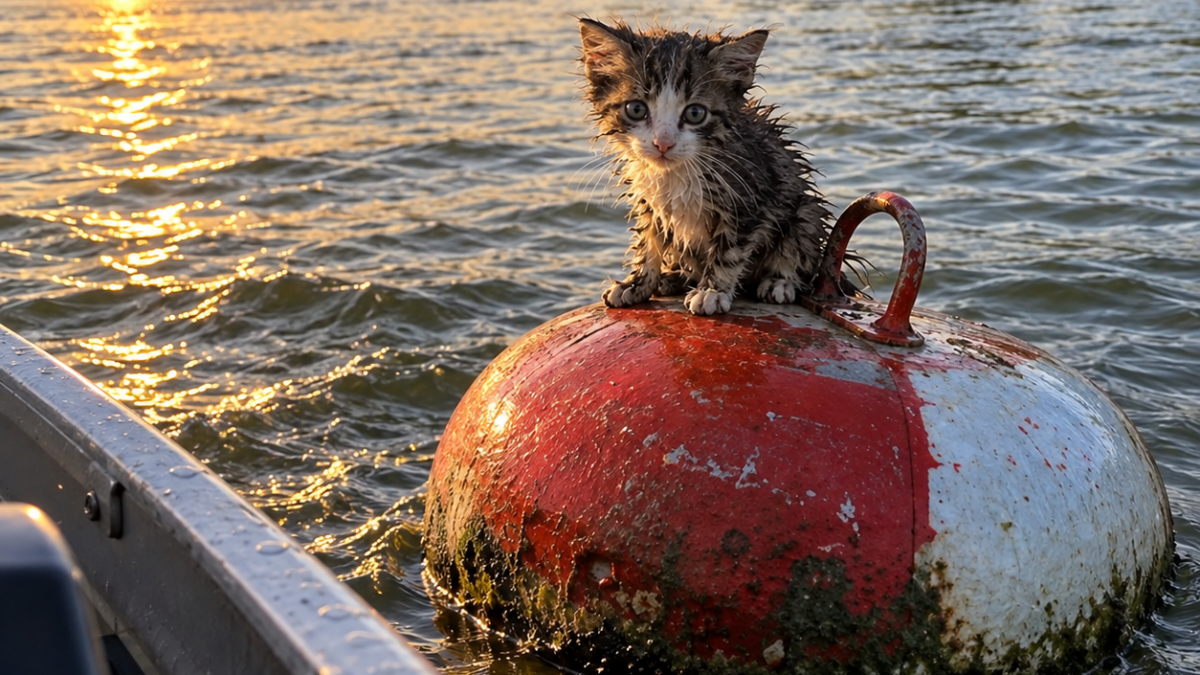
A tiny kitten in the middle of a river, sitting on top of a buoy as if doing exactly what the tag told him to do.
Waiting.
For what?
Or for whom?
Laura continued the examination.
The kitten was male.
Probably twelve to fourteen weeks old.
Underweight, but not severely starved.
No broken bones.
No obvious wounds.
His claws were badly worn at the tips, which Laura said could have happened from desperately gripping metal.
His paw pads were softened and irritated from being wet for too long.
The good news was that his lungs sounded clear.
The frightening news was his temperature.
“He’s lucky,” Laura said again.
“How lucky?”
She looked at me.
“If you had gone by an hour or two later, I’m not sure we’d be having this conversation.”
Megan sat down.
I rested my hand beside the kitten’s head.
His eyes opened.
He immediately pushed his face against my finger.
That settled one question.
He was coming home with me.
At least temporarily.
Laura kept him at the clinic until late afternoon while his temperature stabilized.
During those hours, Megan and I returned to the marina.
I wanted to ask if anyone had reported a missing kitten.
The manager, a broad-shouldered man named Frank Delaney, shook his head.
“Not that I’ve heard.”
“What about a small boat accident?”
That got his attention.
“Today?”
“Recently.”
Frank leaned against the counter.
“There are incidents every season. Nothing today.”
“We found the kitten on Marker Seventeen.”
His eyebrows lifted.
“On the buoy?”
“On top of it.”
“That far out?”
“Yes.”
Frank whistled.
“Well, he sure didn’t swim there from shore.”
That was what I had been thinking.
“Could a kitten climb onto it from the water?”
“Maybe.”
He looked toward the windows facing the river.
“But the current’s nasty around Seventeen. Little thing would’ve had a hard time reaching it.”
“So somebody put him there?”
“I didn’t say that.”
“What else?”
Frank rubbed his beard.
“Could’ve been on a boat. Fell overboard. Climbed up. Could’ve been on debris after the storm Wednesday.”
Megan turned.
“What storm?”
“You didn’t get it your way?”
We had.
Heavy rain.
Strong wind.
A few downed trees.
Frank continued.
“River carries all kinds of things afterward.”
That possibility made more sense than someone deliberately abandoning a kitten on a buoy.
I wanted it to be true.
Then Megan asked, “Do you know anybody around here who engraves pet tags?”
Frank laughed.
“Half the hardware stores in the county.”
I showed him the photograph.
He looked at the little metal tag.
“Wait?”
“That’s what it says.”
His face changed.
Only slightly.
But I noticed.
“You recognize it?”
“No.”
He handed back my phone.
“Just odd.”
“You sure?”
“Positive.”
I did not believe him.
But before I could press, two customers walked through the door.
Frank turned away to help them.
Megan caught my sleeve.
“Did you see that?”
“Yes.”
“He knows something.”
“Maybe.”
“He absolutely knows something.”
“Megan.”
“What?”
“Not every weird expression is evidence.”
She folded her arms.
“You watch too many true-crime documentaries.”
“You’re the one interrogating a marina manager about a kitten.”
Fair.
We spent the next hour driving through nearby neighborhoods.
We stopped at a bait shop.
A gas station.
A riverside restaurant.
Nobody recognized the kitten.
That night, I picked him up from the clinic.
He looked different dry.
His fur was mostly white, with orange patches over his ears, back, and tail.
One orange marking curved beneath his left eye like someone had brushed paint there with a thumb.
He weighed just under three pounds.
When Laura set the carrier on the floor, he refused to enter it.
He planted all four paws against the edge.
Megan laughed for the first time that day.
“He survived the river but draws the line at a plastic box.”
I reached down.
The kitten climbed directly onto my arm.
“He’s got standards.”
We compromised.
Megan drove.
I sat in the passenger seat with him wrapped in the towel.
By the time we reached my house, he was asleep.
I lived alone in a small farmhouse fifteen minutes outside Knoxville.
My only other pet was an eleven-year-old black Labrador named Cooper.
Cooper had spent most of his life believing every living creature wanted to be his friend.
The kitten disagreed.
The moment Cooper entered the kitchen, the tiny orange-and-white survivor arched his back and produced a hiss that sounded far too large for his body.
Cooper stopped.
Looked at me.
Looked at the kitten.
Then slowly backed out of the room.
“Good decision,” I told him.
For the first two days, I kept them separated.
The kitten slept in my guest bathroom inside a blanket-lined laundry basket.
He ate small meals every few hours.
He drank.
He used the litter box.
And he followed me everywhere I allowed him to.
If I sat on the floor, he climbed into my lap.
If I stood, he reached for my jeans.
If I left the room, he cried.
I started calling him Pirate because of the orange mark near his eye and the ridiculous way he rode around on my shoulder.
Megan objected immediately.
“You cannot rename somebody else’s cat.”
“I need to call him something.”
“Call him Kitten.”
“That is worse than Wait.”
“Temporary names become permanent.”
“I am aware.”
“You’re keeping him.”
“I’m finding his owner.”
“You bought him a bed.”
“It cost twelve dollars.”
“You bought him a ceramic bowl with fish painted on it.”
“It was next to the bed.”
“You are emotionally compromised.”
“So are you.”
“Yes, but I don’t own a ceramic fish bowl.”
On Monday, I posted his photograph online.
FOUND KITTEN — TENNESSEE RIVER AREA.
I did not mention the word on his tag.
I wanted anyone claiming him to identify something only his real family would know.
Within twenty-four hours, the post had been shared more than two thousand times.
Messages flooded in.
Some were kind.
Some were useless.
Some were bizarre.
One woman claimed the kitten looked exactly like hers, except hers was black.
A man insisted river cats were a “known phenomenon” and sent me three links about feral cats living near fishing docks.
Another person accused me of staging the rescue for social media.
I deleted that one.
Three people seriously claimed ownership.
None could describe the collar.
One said the kitten’s name was Peaches.
Another said Oliver.
The third insisted he had been called Captain Muffin.
Megan liked Captain Muffin.
I refused to encourage her.
On Wednesday, I took Pirate back to Laura for a checkup.
He had gained four ounces.
His temperature was normal.
His paws were healing.
Laura examined the red collar again.
“Handmade engraving.”
“How can you tell?”
“The letters aren’t aligned.”
I looked closely.
She was right.
The W leaned slightly left.
The A was deeper than the other letters.
Someone had scratched the word manually.
“With what?”
“Could be an engraving pen. Maybe even a small rotary tool.”
“So not from a pet store machine.”
“Probably not.”
I photographed it again.
That evening, Megan called.
“Remember Frank?”
“The marina manager?”
“He called me.”
“Why does Frank have your number?”
“I left it at the front desk in case anyone asked about the kitten.”
I sighed.
“What did he say?”
“He wants to talk.”
“About what?”
“He wouldn’t say.”
“Of course he wouldn’t.”
Twenty minutes later, we were back at the marina.
Frank locked the office door behind us.
That did not improve my confidence.
He looked uncomfortable.
“I should’ve said something Saturday.”
Megan crossed her arms.
“I knew it.”
I ignored her.
“What do you know?”
Frank walked behind the counter and pulled an old binder from a cabinet.
“Our marina keeps incident logs.”
He opened it.
“Not official law-enforcement reports. Just things we need to document.”
He turned several pages.
Then stopped.
A date six months earlier had been written at the top.
March 14.
Boat overdue.
One adult male.
Search initiated 8:40 p.m.
Recovered vessel downstream.
Operator missing.
My stomach tightened.
“What does this have to do with the kitten?”
Frank took a breath.
“The man who disappeared was a regular here.”
“Name?”
“Evan Hale.”
The name meant nothing to me.
Frank continued.
“Forty-two. Lived about ten miles north of here with his mother.”
Megan leaned closer.
“Did he have a cat?”
“I don’t know.”
“Then why are we here?”
Frank tapped the page.
“Because Evan had a habit.”
“What kind of habit?”
“He wrote notes on things.”
I stared at him.
Frank smiled faintly.
“Not normal notes. Little reminders. Jokes. One word sometimes.”
He opened a drawer and removed a photograph.
It showed a man standing beside a battered aluminum fishing boat.
Brown hair.
Baseball cap.
Easy smile.
On the side of a red cooler, in black marker, someone had written:
WAIT.
Megan stopped breathing beside me.
I picked up the photograph.
“Why would he write that?”
Frank looked at it.
“That cooler had a broken latch. If you opened it too quickly, the hinge popped off. Evan wrote ‘WAIT’ so people would remember to lift one side first.”
“That’s not enough.”
“I know.”
“Did you ever see him with a kitten?”
“No.”
“Red collar?”
“No.”
“What happened to him?”
Frank looked toward the windows.
“His boat was found about seven miles downstream. Engine still running.”
“Was there an accident?”
“Search teams believed he went overboard.”
“Did they find him?”
Frank nodded.
“Three days later.”
The room went quiet.
Megan sat down.
I stared again at the word on the cooler.
Same word.
Not proof.
But no longer random.
“Why didn’t you tell us Saturday?”
Frank rubbed the back of his neck.
“Because the family had enough people bothering them after the accident.”
“People?”
“Reporters. Internet detectives. Folks with theories.”
“Theories about what?”
“Nothing worth repeating.”
“Frank.”
He sighed.
“Some people thought Evan’s death was suspicious because of where the boat was found. The sheriff’s office investigated. They ruled it an accident.”
“And you didn’t want us showing up at his mother’s house with another mystery.”
“Exactly.”
I could understand that.
I still did not like it.
“Do you have her name?”
Frank hesitated.
Then wrote something on a piece of paper.
Margaret Hale.
He added a phone number.
“Call first.”
“I will.”
“And Emily?”
“Yes?”
“Don’t tell her you know anything about the accident unless she brings it up.”
I nodded.
Back in the parking lot, Megan stared at me.
“You think it’s connected.”
“I think it might be.”
“The word is identical.”
“It’s a word, Megan.”
“On his cooler.”
“Yes.”
“And the kitten’s collar.”
“Yes.”
“And the kitten was found in the same river where this man died.”
“I understand the evidence.”
“You’re doing that thing.”
“What thing?”
“Where you sound reasonable because you’re scared to believe something.”
I unlocked the car.
“I’m not scared.”
She gave me a look.
“Fine. I’m cautious.”
“That’s the emotionally unavailable version of scared.”
“You’re annoying.”
“I know.”
I did not call Margaret Hale that night.
I wanted to.
Instead, I sat on my couch while Pirate slept beneath my chin and stared at the number Frank had given me.
Cooper had finally been granted supervised access to the living room.
He lay six feet away.
Pirate opened one eye every few minutes to confirm the Labrador remained appropriately respectful.
At eleven-thirty, I searched Evan Hale’s name online.
Frank had been right.
There were news stories.
LOCAL ANGLER MISSING AFTER BOAT FOUND UNATTENDED.
SEARCH CONTINUES FOR KNOX COUNTY MAN.
BODY RECOVERED FOLLOWING THREE-DAY RIVER SEARCH.
The reports were brief.
Evan had left the marina alone shortly after six in the morning.
Weather conditions deteriorated that afternoon.
Another boater found Evan’s vessel moving slowly in circles near a bend.
His life jacket was aboard.
Investigators later concluded he had likely fallen while trying to retrieve loose equipment during worsening weather.
No evidence of foul play.
I closed the laptop.
Pirate was awake.
He reached up and touched my chin with one paw.
“Don’t look at me like that.”
He purred.
“What if you have nothing to do with him?”
Purr.
“What if I call his mother and reopen the worst thing that ever happened to her?”
Pirate climbed onto my shoulder.
“You’re not helping.”
The next morning, Margaret called me.
I had not called her.
She called me.
I nearly dropped my coffee when the number appeared.
“Hello?”
“Is this Emily Carter?”
The voice belonged to an older woman.
“Yes.”
“My name is Margaret Hale.”
I sat down.
Frank.
He must have called her.
“I believe you may have found something that belonged to my son.”
Not someone.
Something.
I looked toward the kitchen.
Pirate was attacking the corner of a paper grocery bag.
“What makes you think that?”
“Frank called last night.”
Of course.
“He said you found a kitten.”
“Yes.”
“Can you send me a photograph?”
I hesitated.
“Before I do, can I ask you something?”
“Yes.”
“Did your son ever own a kitten?”
Silence.
Then her breathing changed.
“Yes.”
One word.
Barely audible.
“When?”
“A few weeks before he died.”
I closed my eyes.
“What did the kitten look like?”
“Mostly white.”
My fingers tightened around the phone.
“Orange ears?”
“Yes.”
“Orange tail?”
“Yes.”
She began crying.
I stood.
“Margaret?”
“There was a patch under his left eye.”
I looked across the room.
Pirate froze inside the grocery bag when he heard my voice.
An orange patch curved beneath his left eye.
“What was his name?”
Margaret laughed through tears.
“My son called him Little One.”
I could not speak for several seconds.
“Margaret, I think you should come see him.”
She arrived that afternoon.
She was seventy-three, petite, with silver hair tucked behind her ears and hands that never quite stopped moving.
She stood on my porch gripping her purse.
“I almost didn’t come.”
“Why?”
“I was afraid it wouldn’t be him.”
I opened the door.
Pirate was asleep on the back of the couch.
Margaret saw him.
She stopped.
The purse fell from her hand.
“Oh.”
That was all she said.
Pirate woke.
For several seconds, he stared at her.
Margaret covered her mouth.
“Little One?”
The kitten stood.
His tail lifted.
He did not run to her.
Not immediately.
He jumped from the couch.
Walked halfway across the room.
Stopped.
Margaret knelt.
I had seen Pirate meet strangers during the previous week.
He was friendly.
Curious.
But this was different.
He sniffed the air.
Then he made a sound I had never heard from him before.
A short chirping cry.
Margaret collapsed onto both knees.
“Oh, baby.”
Pirate ran.
He climbed into her lap.
Not carefully.
Not cautiously.
He scrambled up her coat and pressed his face beneath her chin.
Margaret wrapped both arms around him and began sobbing.
Megan, standing behind me, grabbed my hand.
I looked away.
There are moments you feel like an intruder even inside your own home.
This was one.
Margaret rocked the kitten against her chest.
“I thought you were gone too.”
Pirate purred so loudly I could hear him from across the room.
After several minutes, we sat at my kitchen table.
Pirate refused to leave Margaret.
He curled against her stomach while she stroked his back.
“He remembers you,” I said.
“I fed him every morning for almost a month.”
“What happened?”
Margaret stared down at him.
“My son found him beside a dumpster behind the grocery store.”
“Evan?”
She nodded.
“He called me at ten at night and said, ‘Mom, don’t be mad.’”
A smile touched her face.
“I knew immediately there was an animal involved.”
“What did he do?”
“Walked into my kitchen carrying this tiny wet thing inside his jacket.”
She scratched Pirate’s chin.
“He said he only intended to keep him overnight.”
Megan laughed.
“That’s how they get you.”
Margaret smiled.
“Exactly.”
“What happened after Evan died?”
The smile disappeared.
“For the first few days, I barely noticed anything.”
She stared toward the window.
“There were deputies. Search crews. Neighbors. Food appearing on my porch. People asking questions.”
Her fingers stopped moving.
“Little One kept waiting near the front door.”
My throat tightened.
“Every time a vehicle came down the driveway, he ran to the window.”
Margaret swallowed.
“After they found Evan…”
She stopped.
I waited.
“He still waited.”
The engraved word suddenly felt heavier.
I touched the tag.
“Did Evan make this?”
Margaret looked at it.
“Yes.”
“You’re sure?”
“He had a little engraving tool in his garage.”
“Why ‘WAIT’?”
For the first time since arriving, Margaret looked almost amused.
“Because Evan thought it was funny.”
I frowned.
“He was trying to teach Little One not to attack his food bowl before he finished putting it down.”
Megan smiled.
“That sounds impossible.”
“It was.”
Margaret rubbed Pirate’s ear.
“Evan would hold the bowl and say, ‘Wait, Little One. Wait.’ The kitten would climb his leg instead.”
She laughed softly.
“One evening Evan scratched WAIT into the tag and told me, ‘Maybe he’ll read it since he won’t listen.’”
I looked at the kitten.
So simple.
Not a final message.
Not some mysterious prophecy.
A private joke.
A tiny ordinary moment between a man and an animal he assumed he had years to love.
Those are often the things grief makes sacred.
“But how did he disappear from your house?”
Margaret’s face changed.
“That’s what I never understood.”
“When was it?”
“About three weeks after the funeral.”
“Did he get outside?”
“I suppose.”
“You didn’t see it?”
“No.”
She looked ashamed.
“I went to bed. He was sleeping on Evan’s old sweatshirt in the laundry room. The next morning, the back screen was torn.”
“Torn from inside or outside?”
“I don’t know.”
“Did you search?”
“For weeks.”
She looked at me.
“I put up flyers. Called shelters. Asked neighbors. Frank helped.”
“Could he have reached the river from your house?”
“Not easily.”
“How far?”
“Almost four miles.”
Megan and I exchanged a glance.
A twelve-week-old kitten wandering four miles alone seemed possible.
But then reaching a buoy another hundred yards offshore?
Much harder.
Margaret noticed.
“You don’t think he simply ran away.”
“I don’t know what I think.”
Neither did she.
For the next several days, that question consumed me.
Margaret wanted Little One back.
Of course she did.
He was one of the last living connections she had to Evan.
But she also surprised me.
“Not yet,” she said when I offered to pack his bed.
“You don’t want to take him?”
“I do.”
She looked at Pirate chasing Cooper’s tail.
“But he’s just recovered. He’s comfortable here.”
“He knows you.”
“And he knows you.”
Margaret smiled.
“Let him finish his medicine. Then we’ll decide what’s best for him.”
That told me everything I needed to know about her.
She loved him enough not to grab him simply because grief wanted something back.
We started reconstructing Little One’s disappearance.
Margaret’s house sat north of the river on two wooded acres.
When Megan and I visited, the torn screen had long since been repaired.
Margaret showed us where the kitten had slept.
Evan’s old sweatshirt was still folded in a drawer.
Little One buried his entire face in it.
Margaret had to sit down.
Outside, I walked the property.
No obvious route toward the river.
But behind the house was a narrow service road.
“Where does this go?”
Margaret joined me.
“To the old boat storage lots.”
My attention sharpened.
“Marina storage?”
“Private lots mostly.”
“How far?”
“Maybe half a mile.”
We followed it.
Twenty minutes later, the road reached a collection of sheds, trailers, and fenced equipment yards.
One property belonged to a man named Travis Cole.
Margaret knew him vaguely.
“He bought Evan’s spare trailer after the accident.”
“What kind of trailer?”
“Boat trailer.”
“When?”
“A few weeks after.”
I stopped.
“Before or after Little One disappeared?”
Margaret thought.
“Before.”
Megan looked at me.
There it was.
Not an answer.
A possibility.
We knocked.
No response.
A large aluminum boat sat beside the building under a tarp.
Near the driveway were several old cat-food cans.
Megan whispered, “Don’t start.”
“I didn’t say anything.”
“Your face did.”
We left.
That evening I called Travis.
I explained who I was.
He became defensive almost immediately.
“I don’t know anything about a cat.”
“I haven’t accused you of anything.”
“You’re asking about one.”
“Because Margaret’s kitten disappeared shortly after you were at her property.”
“I bought a trailer.”
“Did you see the kitten?”
“No.”
“Did he ever climb into your truck or trailer?”
“No.”
“Did you check?”
Silence.
“What kind of question is that?”
“A straightforward one.”
“I didn’t steal anybody’s cat.”
“I didn’t say you did.”
“Sounds like you’re saying it.”
Then he hung up.
Megan, listening beside me, raised her eyebrows.
“Very normal reaction.”
“Still not proof.”
“You should have been a defense attorney.”
“I should have gone to bed instead of answering your calls.”
The breakthrough came from someone else.
A retired teacher named Joanne Mercer saw one of our original found-kitten posts.
She messaged me:
I saw this kitten before. I think I fed him near Riverview storage in April.
I called immediately.
Joanne lived close to the storage lots.
She remembered seeing an orange-and-white kitten beneath a parked fishing boat around six months earlier.
“How long was he there?”
“Two or three days.”
“Did you see how he arrived?”
“No.”
“I left tuna.”
“Then what happened?”
“A man loaded the boat and left.”
“Which man?”
“I don’t know his name.”
“Was it Travis Cole?”
“I’d recognize him.”
I drove Joanne to the property.
From the road, she pointed.
“That boat.”
The aluminum boat under the tarp.
My pulse quickened.
“You’re sure?”
“Pretty sure.”
“What happened the day the kitten disappeared?”
“The man took the boat toward the river.”
I called Ben Reyes.
Ben was a friend from college who now worked with the county sheriff’s department.
He listened patiently.
Then said, “Emily, I love you, but being rude on the phone is not a crime.”
“I know.”
“And accidentally transporting a cat isn’t either.”
“I know.”
“And unless you have evidence someone deliberately abandoned him—”
“I know, Ben.”
“Then what are you asking me to do?”
“Tell me whether there were cameras at the public launch six months ago.”
He sighed.
“Why?”
“Because if Little One climbed into Travis’s boat at the storage yard, he might have been transported to the river.”
“And then?”
“I don’t know.”
“That is the important part.”
“Can you check?”
Another sigh.
“You owe me lunch.”
Two days later he called.
“The launch keeps thirty days of footage.”
“So nothing.”
“Nothing from six months ago.”
I leaned against the kitchen counter.
Pirate—Little One—sat at my feet.
“But I spoke with the harbor patrol.”
I straightened.
“And?”
“One officer remembers Travis.”
“Why?”
“He had an engine problem around that time.”
“What day?”
“April twenty-third.”
I grabbed Margaret’s calendar from the notes we had made.
Little One had disappeared the night of April twenty-second.
My skin prickled.
“Where?”
“Near Marker Seventeen.”
I stopped breathing.
The exact buoy where we found the kitten six months later.
“That’s impossible.”
Ben corrected me.
“Unlikely. Not impossible.”
“What happened?”
“According to the officer, Cole’s engine stalled near the marker. He drifted for maybe forty minutes before another boat helped tow him toward the launch.”
“Did anyone see a kitten?”
“No record of one.”
“But—”
“Emily, slow down.”
“How could Little One survive around that area for six months?”
“Maybe he didn’t stay there.”
That was obvious.
But it opened another possibility.
Maybe the kitten had climbed onto Travis’s boat.
Maybe he reached the river by accident.
Maybe he escaped when the engine failed.
Maybe fishermen or residents along the river fed him.
Maybe he wandered docks for months.
Maybe the storm had finally pushed him onto the buoy.
None of it was neat.
Real stories rarely are.
I called Travis again.
This time I told him exactly what we knew.
He stayed silent.
Then said, “I told you I didn’t steal the cat.”
“I believe you.”
That surprised him.
“You do?”
“I think he climbed into your boat.”
More silence.
“Joanne saw him under it.”
Travis cursed softly.
“You took the boat to Marker Seventeen the following morning.”
“I didn’t know there was a cat.”
“I believe you.”
Another long pause.
Then his voice changed.
“Wait.”
I stood still.
“What?”
“There was something.”
“What?”
“When the engine died.”
He sounded different now.
Less angry.
More uncertain.
“I heard scratching.”
“Where?”
“Under the front deck.”
My hand tightened around the phone.
“Did you look?”
“Not right away. I was trying to keep the boat from drifting into another marker.”
“What happened?”
“When the other guy came to tow me, I opened the compartment.”
“And?”
“Nothing was there.”
“Was it open to the outside?”
“A gap near the anchor locker.”
My heart sank.
“You think he got out?”
“I don’t know.”
“Did you tell anyone?”
“Tell them what? That I thought I heard scratching?”
“You could have checked.”
“I did.”
“After forty minutes.”
“I was alone in a dead boat in heavy current.”
His voice rose.
I closed my eyes.
He was right about one thing.
It had been an emergency.
Then he said quietly, “There was orange hair.”
I said nothing.
“In the compartment.”
“Why didn’t you mention that when I called?”
“Because I didn’t connect it. I thought it came off a life jacket or a rag or something.”
“You knew Margaret was missing a kitten.”
“I didn’t.”
“You bought Evan’s trailer.”
“I barely knew his mother.”
My anger drained slightly.
Not because the situation was less painful.
Because I was beginning to see it for what it was.
Not a villain.
A chain of ordinary accidents.
A kitten seeking warmth under a boat.
A man who did not know he was there.
An engine failure.
A frightened animal escaping.
A river.
Months of survival.
And eventually a storm.
I asked the question that mattered.
“Would you tell Margaret?”
Travis was silent.
“I don’t know if I can.”
“She deserves to know.”
“What if it makes it worse?”
“She spent six months wondering whether someone hurt him.”
He exhaled.
“I didn’t.”
“I know.”
“What if she blames me?”
“She might.”
“That’s helpful.”
“But she deserves the truth anyway.”
He came to Margaret’s house the next afternoon.
He stood on the porch twisting his baseball cap between his hands.
Margaret listened.
She did not interrupt.
When he finished, she asked, “Did you know he was there when you launched?”
“No, ma’am.”
“Would you have taken him if you knew?”
“No.”
“Would you have thrown him in the river?”
Travis looked horrified.
“God, no.”
Margaret nodded.
Then she said something none of us expected.
“Then I don’t blame you.”
Travis looked at her.
She continued.
“I’ve spent six months inventing worse answers.”
Her voice trembled.
“You just gave me one I can live with.”
He looked down.
“I’m sorry.”
“I know.”
Little One watched from the window.
Travis saw him.
“That him?”
Margaret nodded.
“Want to meet him?”
Travis hesitated.
“Maybe I shouldn’t.”
Margaret opened the door.
“Come inside.”
That was Margaret.
Grief had taken more from her than any person should have to give.
Yet she still refused to manufacture cruelty where an accident was enough.
Over the next week, we pieced together more of Little One’s likely journey.
A bait-shop owner remembered feeding a small orange-and-white cat in May.
A woman with a riverside cabin had photographs from June showing a kitten sleeping under her deck.
A fisherman thought he saw the same cat near a campground in July.
None of it could be proven with absolute certainty.
But the sightings followed the river south.
Little One had apparently moved between docks, sheds, campsites, and fishing areas for months.
People fed him.
Then he disappeared again.
The night before we found him, another storm had moved through.
Strong winds.
Rising water.
Floating debris.
Frank believed Little One may have sheltered on a low dock or piece of debris and been swept into the current.
Somehow, he reached Marker Seventeen.
Somehow, he climbed.
And then he waited.
The word on his collar had never been an instruction.
But in the end, that was exactly what saved him.
He waited until Megan saw him.
He waited until our boat turned.
He waited until I stretched out my hand.
The remaining question was where he belonged now.
That became harder than I expected.
Margaret loved him.
I loved him too.
So did Megan.
Even Cooper had surrendered.
By the third week, the eighty-pound Labrador allowed Little One to sleep between his front paws.
One evening I found the kitten washing Cooper’s ear while Cooper stared at me with the defeated expression of a father who had lost control of his household.
I sent Margaret a photograph.
She responded:
Evan would have loved this.
That sentence stayed with me.
The following Sunday, Margaret came for dinner.
Afterward, we sat on the porch.
Little One slept in her lap.
“I want to ask you something,” she said.
“Okay.”
“I want him to live with you.”
I stared at her.
“Margaret.”
“I mean it.”
“He’s your family.”
“So are you now.”
I shook my head.
“You don’t have to do this because you think I’m attached.”
“I know you’re attached.”
“That isn’t a reason.”
“No.”
She looked down at Little One.
“The reason is that when he came back into my life, I thought bringing him home would bring part of Evan home too.”
I did not interrupt.
“But every time Little One sits by my front door, I find myself waiting.”
Her voice cracked.
“Not for the cat.”
I understood.
She stared toward the road.
“For my son.”
I reached across and covered her hand.
She continued.
“That isn’t fair to either of us.”
“You don’t have to decide now.”
“I already did.”
“But you’ll see him.”
Her eyes snapped toward me.
“You’re not getting rid of me that easily.”
I laughed.
“Good.”
“I want Sundays.”
“Done.”
“And I get him when you travel.”
“Done.”
“And you are absolutely not calling him Pirate.”
I looked offended.
“That is his respected professional name.”
“His name is Little One.”
“Cooper thinks his name is Menace.”
Margaret laughed.
It was the first full laugh I had heard from her.
Little One woke, stretched, and placed both paws against her chest.
She kissed his forehead.
“You waited long enough.”
That evening she left without him.
I watched her car disappear down the road.
Then I looked at the kitten sitting beside my foot.
“You realize you now have joint custody with a seventy-three-year-old woman who makes rules, right?”
He meowed.
“Exactly.”
The next several months changed all of us.
Little One grew.
His ribs disappeared beneath healthy muscle.
His coat became thick and bright.
The tiny frightened animal from the buoy turned into an eight-pound dictator who considered every closed door a personal insult.
He loved windowsills.
Cardboard boxes.
Rotisserie chicken.
He hated vacuum cleaners.
He had a strange fascination with running water.
The first time I filled the bathtub, he climbed onto the rim and stared at the surface for twenty minutes.
I wondered what he remembered.
Animals do not tell their stories the way we do.
We fill silence with our own theories.
Maybe that is why we so often underestimate them.
Little One did not need to explain the river.
He carried it in small behaviors.
He panicked if trapped beneath blankets.
He hated the sound of boat motors for several months.
When rain struck the roof hard enough, he ran to me.
But he also loved sitting beside the kitchen faucet.
He pawed at water droplets.
He followed Cooper through puddles.
Fear had not taken curiosity from him.
That mattered.
Margaret came every Sunday.
Sometimes she brought photographs of Evan.
I learned his entire life in pieces.
He had been a mechanic.
He hated mushrooms.
He could repair almost anything except relationships.
He played guitar badly.
He once drove six hours to return a wallet because the owner’s address was on the license and he did not trust the mail.
He had never married.
He called his mother every evening.
And he rescued animals constantly.
“He found a turtle in the road once,” Margaret told me.
“Normal.”
“He kept it in my bathtub for two days.”
“Less normal.”
“He said it looked emotionally overwhelmed.”
I laughed.
Little One climbed into her lap.
She scratched his head.
“Evan would be furious you’re feeding him table scraps.”
“I’m not.”
Margaret looked at the piece of chicken in my hand.
“That chicken floated there naturally?”
“I’m being judged in my own home.”
“You should be.”
Those Sundays became something more than visits.
Margaret stopped eating dinner alone once a week.
Megan came often.
Ben sometimes joined us.
Frank came once and brought a tiny red-and-white buoy ornament he found at a flea market.
“That’s terrible,” I told him.
“I know.”
Margaret laughed until she cried.
We hung it on my Christmas tree.
Travis sent a gift too.
A new cat carrier.
On top was a note.
CHECKED FOR STOWAWAYS.
Margaret kept the note.
By spring, nearly a year had passed since Evan’s accident.
Margaret asked me to accompany her to the river.
“What day?”
“March fourteenth.”
I knew immediately.
The anniversary.
Megan came too.
We took Dad’s boat.
Little One did not.
I was not ready to put him on the river again, and neither was Margaret.
Instead, he stayed with Cooper at my house.
We left the marina just after sunrise.
Frank stood on the dock.
As we passed him, he removed his cap.
No one spoke.
Margaret sat beside me holding a small wooden box.
We motored slowly toward the section of river where search crews had found Evan.
The morning was cold.
Water flat.
Sky pale.
When we reached the bend, I cut the engine.
Margaret looked around.
“I’ve never been here.”
“You didn’t have to do this.”
“Yes, I did.”
She opened the wooden box.
Inside was not ash.
I had wondered.
Instead, there were folded pieces of paper.
“What are those?”
“Things I kept wanting to tell him.”
My throat tightened.
“For a year?”
“For longer.”
She removed one.
“I’m not putting them in the river.”
“What are you doing?”
“Reading them.”
So we sat there.
And Margaret talked to her son.
She told him the fence needed repairing.
She told him his cousin finally got married.
She told him his old guitar had gone to a boy at church who wanted to learn.
She told him Frank still cheated at cards.
From fifty yards away on the marina dock, Frank later insisted he had no idea why we all looked at him.
Then Margaret unfolded the final paper.
Her hands shook.
“Evan,” she read, “Little One came back.”
Megan began crying beside me.
Margaret continued.
“He took the longest way possible, which seems appropriate considering you were the one who raised him.”
She laughed through tears.
“He found people who love him. I see him every Sunday.”
Her voice broke.
“And I think maybe the last thing you gave me wasn’t the cat.”
She stopped.
Took a breath.
“It was a reason to keep opening the door.”
No one spoke afterward.
The river moved gently beneath us.
Eventually Margaret folded the paper.
“Take me to Marker Seventeen.”
I restarted the engine.
We found the buoy where Little One had been sitting.
The paint had been refreshed.
Red.
White.
Clean.
It looked smaller than I remembered.
I brought the boat alongside.
Margaret placed one hand on the metal.
“He was here?”
“Right there.”
I pointed to the top.
“All alone?”
“Yes.”
She closed her eyes.
Then she smiled.
“Stubborn little thing.”
“Very.”
She touched the buoy once more.
“Just like Evan.”
On the way back, Margaret sat facing the wind.
She looked different.
Not healed.
I do not think grief works that way.
But lighter.
As though she had finally set down something she had been carrying without realizing it.
That evening, we returned to my house.
Little One met Margaret at the door.
He ran directly to her.
She knelt.
“There you are.”
He climbed against her chest.
She buried her face in his fur.
Then she whispered something.
I almost did not hear it.
“You don’t have to wait anymore.”
A year after that, Margaret asked me to help with something else.
She wanted to donate a bench at the marina in Evan’s name.
Frank chose the location.
It faced the river but sat far enough from the launch that people could hear water instead of engines.
The plaque was simple.
IN MEMORY OF EVAN HALE
WHO NEVER PASSED AN ANIMAL THAT NEEDED HELP.
Margaret refused anything more dramatic.
“He would hate it.”
At the bottom, in smaller letters, she added one word.
WAIT.
When Frank first saw it, he laughed.
“That part he’d love.”
The bench became our place.
On warm Sundays, Margaret and I sat there while fishermen came and went.
Sometimes people asked about the word.
Most assumed it meant to slow down.
Be patient.
Take in the view.
We usually let them believe that.
It meant all those things now anyway.
Three years passed.
Little One became a broad, confident orange-and-white cat who still behaved as though he weighed three pounds.
Cooper grew slower.
Margaret grew older.
So did all of us.
But Sunday dinner remained.
One November evening, Cooper did not get up when Little One approached his bed.
The old Labrador had been declining for months.
Arthritis.
Kidney problems.
Age doing what age eventually does.
Little One climbed beside him.
Usually Cooper would sigh dramatically.
That night he did not.
He only turned his head and rested his muzzle across the cat’s back.
I knew.
Maybe Little One did too.
Cooper died at home the following morning.
He was eleven years old when we found the kitten.
Fourteen when he left us.
Little One searched for him for days.
Behind furniture.
In the laundry room.
By the back door.
Every evening he sat beside Cooper’s empty bed.
Watching.
Waiting.
That word again.
I considered throwing the bed away.
Margaret stopped me.
“Not yet.”
So I waited too.
After about a week, Little One climbed into Cooper’s bed.
He turned three times.
Curled into the center.
And slept.
Margaret found me crying beside him.
“He misses him.”
“I know.”
“I hate that.”
“I know.”
She sat beside me.
“Animals keep losing people and still decide to love the next one.”
I looked at her.
She smiled sadly.
“Maybe we should learn something from that.”
A month later, we adopted another dog.
Not as a replacement.
Nothing replaces anyone.
She was a small brown mutt named Daisy who had spent eight months in foster care because she was terrified of cats.
The rescue coordinator almost laughed when I asked to meet her.
“You have a cat.”
“I know.”
“A confident cat.”
“I know.”
“A cat who thinks dogs are furniture.”
“I know.”
“Emily.”
“Just let them meet.”
The introduction lasted twenty seconds.
Daisy hid behind me.
Little One walked across the room.
Sniffed her nose.
Then rubbed his entire body along her face.
Daisy looked horrified.
Little One climbed into her bed.
That was that.
Within two months they were inseparable.
Margaret declared that Little One was collecting emotionally damaged animals.
I reminded her he had learned from Evan.
Her eyes softened.
“Yes,” she said.
“He did.”
On the fifth anniversary of Evan’s death, Margaret did not ask to go to the place where his boat had been found.
Instead, she wanted the bench.
We sat there at sunset.
Little One had never returned to the water itself.
But I brought him to the marina that evening in a secure backpack carrier.
When we reached the bench, I opened the top.
He lifted his head.
Wind moved through his fur.
He looked toward the river.
For a moment, his body went still.
I watched closely.
Ready to close the carrier.
He did not panic.
He sniffed.
Listened.
Then climbed halfway out and sat between Margaret and me.
Frank saw us from the dock.
“You brought the celebrity.”
“Keep walking, Frank.”
Little One watched boats move past.
One engine revved loudly.
His ears flattened.
But he stayed.
Margaret stroked his back.
“You’re safe.”
He leaned into her.
A boat passed Marker Seventeen.
The red-and-white buoy moved gently in its wake.
I pointed.
“That’s it.”
Margaret looked.
“So small.”
“Yes.”
Little One followed our gaze.
Of course, I have no idea what he understood.
Maybe nothing.
Maybe animals remember places through smell and sound rather than stories.
Maybe the buoy meant no more to him than a cold surface in a terrible night.
Or maybe something in him knew.
He watched it until the boat passed.
Then he turned away.
He climbed directly into Margaret’s lap.
That felt like an answer.
Margaret lived another four years.
She was eighty-two when her heart began failing.
The last six months were difficult.
Hospital visits.
Medication changes.
Days when walking from the bedroom to the kitchen exhausted her.
But she continued Sunday dinners until she could not.
Then Sunday dinner moved to her house.
Little One came with me.
Always.
Near the end, Margaret spent most of her days in a hospital bed beside the living-room window.
Little One learned immediately that the bed belonged partly to him.
He curled near her feet.
Nurses pretended not to notice.
One afternoon, I arrived and found him lying on Margaret’s chest.
Her hand rested across his back.
She was awake.
Barely.
I sat beside her.
“You comfortable?”
“Mostly.”
“Want anything?”
“Yes.”
“What?”
“Tell me the buoy story.”
I smiled.
“You know the buoy story.”
“I know.”
“So why do you want me to tell it?”
“Because you tell it wrong.”
“Excuse me?”
Her eyes opened slightly.
“You always say you saved him.”
“We did.”
“No.”
She stroked Little One.
“You noticed him.”
“That is generally part of saving someone.”
“Emily.”
I laughed softly.
“Fine. What happened?”
“He waited.”
I looked at her.
“For you,” she said. “Then you waited for me to be ready to take him back. Then I waited until I understood he belonged with you.”
Her breathing was shallow.
“And somehow, after Evan died, I kept thinking waiting meant doing nothing.”
She looked toward the window.
“I thought I was just waiting for grief to finish.”
I reached for her hand.
“It doesn’t finish.”
“No.”
She squeezed my fingers weakly.
“But life keeps happening while you wait.”
Little One lifted his head.
Margaret smiled at him.
“Smart little cat.”
Two days later, she died.
Little One was there.
So was I.
Megan stood on the other side of the bed.
Margaret’s breathing grew slower.
Then stopped.
No drama.
No sudden movement.
Just absence.
Little One stood on her chest for several seconds.
He sniffed her face.
Then walked to the edge of the bed.
He did not cry.
He did not search the house afterward.
That surprised me.
When Evan died, he had waited beside the door for weeks.
With Margaret, he seemed to understand.
Maybe age had taught him.
Maybe being there mattered.
He climbed into my lap while the hospice nurse made her calls.
I held him.
And for the first time since that morning on the river, I understood the word on his collar differently.
WAIT.
At first it had been a joke.
Then a mystery.
Then a command we accidentally turned into a story.
But Margaret had been right.
Waiting was not always emptiness.
Sometimes waiting was surviving long enough for somebody to arrive.
Sometimes it was allowing another person time to heal.
Sometimes it was sitting beside someone when no solution existed.
Sometimes it was trusting that love could change shape without disappearing.
Margaret left the marina bench fund in her will.
She also left me Evan’s little engraving tool.
There was a note inside the box.
Emily,
You once asked why that ridiculous word mattered so much.
It didn’t.
Not when Evan scratched it onto the tag.
It was only a joke.
You, Megan, Little One, and everyone who helped him turned it into something else.
Keep the tool.
Use it for something happier.
Love,
Margaret
I cried over that note for an hour.
Then I put the engraving tool in a drawer.
I did not touch it for almost a year.
The following spring, Daisy needed a new tag.
I bought a small silver one.
On the front I engraved:
DAISY
EMILY CARTER
MY PHONE NUMBER
On the back, I considered writing WAIT.
I decided against it.
Some things belonged to one story.
Instead I engraved:
HOME.
Little One watched from the counter.
“You approve?”
He knocked the tag onto the floor.
“I’ll take that as enthusiasm.”
He was nine years old then.
Healthy.
Spoiled.
Still orange-and-white.
Still wearing the same thin red collar only on special occasions because I was terrified of losing it.
The original metal tag stayed in a small frame beside a photograph of Evan and Margaret.
Little One wore a safer breakaway collar every day.
Years continued moving.
Little One eventually slowed.
His jumps became calculations.
He stopped climbing curtains, which I considered the only dignified decision of his adult life.
He slept more.
He preferred the sunny chair beside my kitchen window.
Daisy learned not to disturb him.
Megan had children by then.
They called him Uncle Pirate despite Margaret’s years of resistance.
I did not correct them.
At thirteen, Little One was diagnosed with kidney disease.
We managed it.
Fluids.
Special food.
Medication.
He tolerated all of it with the outrage of a retired king forced to pay taxes.
For nearly two more years, he remained comfortable.
Then one winter morning, I realized he had stopped eating.
Laura was still practicing.
Older now.
So was I.
She examined him.
Her face told me before she spoke.
“We’re getting close.”
I looked down at him.
“When?”
“That’s your decision.”
I hated that sentence.
Every pet owner eventually does.
I brought him home.
For three days, he slept beside me.
On the fourth morning, I carried him to the marina.
Not because he loved the river.
He never did.
Because his story belonged there.
It was February.
Cold but clear.
The marina was almost empty.
Frank had retired years earlier, but the bench remained.
Evan’s name.
The word WAIT beneath it.
I sat down.
Little One rested inside my coat.
His body was light again.
Not like the starving kitten from the buoy.
Age had simply made him small.
A boat crossed the river in the distance.
Marker Seventeen moved gently.
I stroked the orange patch beneath his eye.
“You know, you caused a lot of trouble.”
His eyes opened.
“You made me interrogate half the county.”
A weak purr.
“You ruined one perfectly good towel.”
Another purr.
“You terrorized Cooper.”
His paw touched my hand.
“And Margaret loved you more than she could explain.”
I had to stop.
The river blurred.
“I did too.”
Little One rested his head against me.
We stayed there until the sun moved behind the trees.
Then I drove to Laura’s clinic.
Megan met me.
Daisy was at home.
Laura placed a blanket on the table.
I laid Little One down.
But he tried to climb back toward me.
So I held him.
Exactly as I had on the boat fourteen years earlier.
Against my chest.
His front paws rested on my sleeve.
The memory struck so hard I nearly lost my breath.
Same position.
Different day.
On the river, he had clung to me because he was terrified I might let go.
Now I was holding him because I was terrified I had to.
Megan pressed her forehead against mine.
“You ready?”
“No.”
Laura waited.
I kissed Little One between the ears.
“You don’t have to wait this time.”
His purr vibrated faintly against my palm.
“I’ve got you.”
Laura gave the medication.
Little One relaxed.
His eyes closed.
His body softened.
And after fourteen impossible years, the kitten who had once waited alone above a cold river stopped waiting.
He died in my arms.
I buried his red collar with him.
I kept the tag.
That evening, I sat on my porch beside Daisy.
For a while, I was angry.
Not at anyone.
At time.
At rivers.
At the unfair mathematics of loving animals whose lives are almost always shorter than ours.
I thought about the revenge people sometimes want from stories like this.
We want someone to blame.
Someone who threw the kitten away.
Someone cruel enough to punish.
A villain we can watch lose everything so the suffering feels balanced.
But there had never been one.
Travis had not abandoned Little One.
Margaret had not failed him.
Evan had not broken a promise because he chose to.
The river was not evil.
Life had simply created a terrible chain of accidents.
And Little One had survived them.
That became his revenge.
The river took Evan.
But it did not take the tiny animal Evan rescued.
It carried him through places none of us could fully trace and left him alive long enough for two sisters in a small boat to notice something moving on a buoy.
Little One came back to Margaret.
He gave her nine more years of Sundays.
He slept on the sweatshirt that still smelled like her son.
He sat beside her when she was dying.
He gave Cooper a ridiculous best friend.
He helped Daisy stop being afraid.
He turned strangers into a family.
That was the ending I wanted.
Not punishment.
Not another loss.
A life so full that the terrible beginning could no longer define it.
Several months after Little One died, I returned to Evan’s bench.
I brought the engraving tool Margaret had left me.
And a small brass plate.
I screwed it beneath the original plaque.
The new words were mine.
They read:
LITTLE ONE
FOUND HERE AFTER A VERY LONG JOURNEY.
And beneath that:
SOMETIMES WAITING IS HOW WE SURVIVE UNTIL LOVE FINDS US AGAIN.
I sat there until sunset.
Boats crossed the water.
Children laughed near the dock.
Marker Seventeen rocked far out on the river.
To everyone else, it was only a buoy.
To me, it would always be the place where I first saw what looked like a wet piece of cloth.
The place where Megan whispered, “That’s alive.”
The place where a freezing kitten looked at our boat and made one final decision to trust.
I can still remember extending my hand.
I can still feel his tiny paw landing in my palm.
Then the second.
Then both front legs locking around my sleeve.
As though he had known me.
As though he had been waiting specifically for us.
Of course he hadn’t.
He had simply been waiting for anyone.
Someone who would see him.
Someone who would stop.
Someone who would turn the boat around.
And sometimes that is all rescue really is.
Not destiny.
Not magic.
Not a miracle delivered with music playing in the background.
Someone notices.
Someone stops.
Someone reaches.
And one frightened little life decides to reach back.
That day, his name was still Little One.
I called him Pirate for a while.
Margaret never completely forgave me for that.
But whatever name we used, one fact never changed.
He waited.
And eventually, we found him.








