PART 2: We Found a Blind Puppy Chewing a Rock—A Month Later, He Did Something None of Us Thought Was Possible
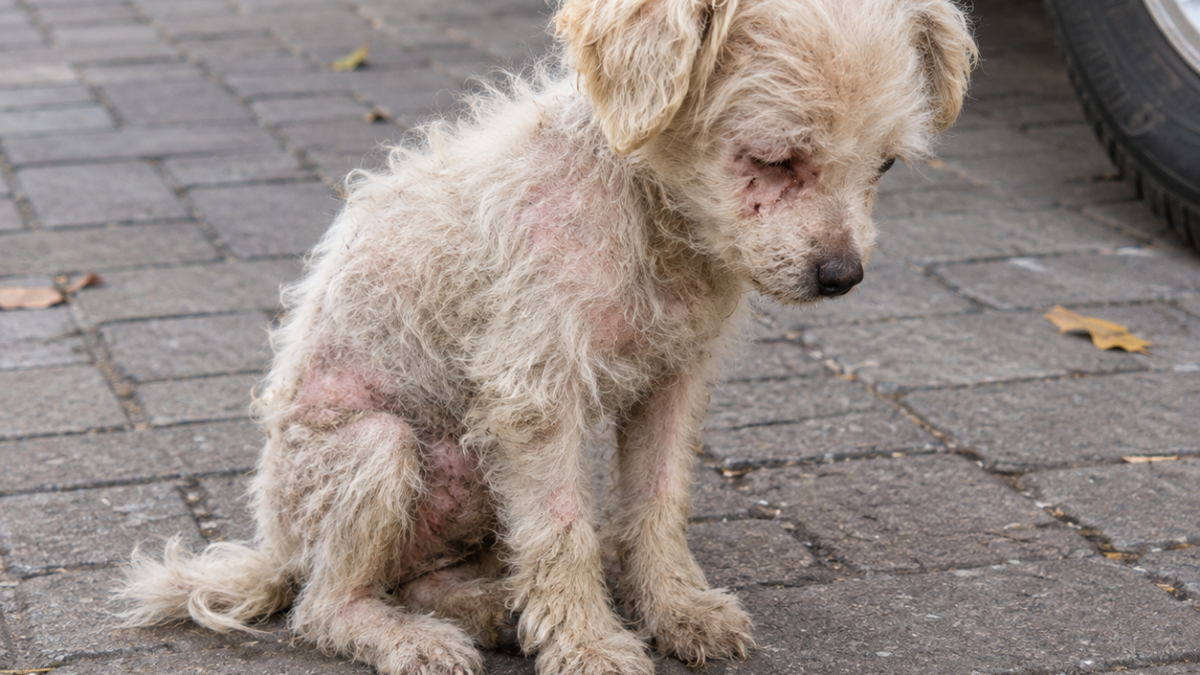
PART 2
The third piece of food was several inches farther away.
Ango stopped.
His nose moved quickly.
He turned left.
Wrong direction.
Paused.
Turned right.
I stayed completely still because every part of me wanted to help.
That had become my greatest problem with him.
Helping too soon.
The veterinarian had warned us.
“If you do everything for him, he’ll learn helplessness instead of learning the room.”
The sentence sounded harsh at first.
He was blind.
Starved.
Weak.
Surely helping him was the entire point.
But there is a difference between making something safe and making it unnecessary for an animal to try.
Ango needed both protection and the freedom to fail.
So I waited.
His nose lifted.
He sniffed again.
One step.
Another.
His front paw passed directly over the food.
He kept moving.
Then stopped.
Turned.
Came back.
His nose touched it.
He ate.
I started crying.
My brother, who was standing in the doorway, stared at me.
“He found kibble.”
“I know.”
“You’re crying.”
“I know.”
Ango began searching for more.
“Do we tell him he just caused an emotional breakdown?”
“He’s busy.”
For the next several days, we turned meals into gentle exercises.
Nothing cruel.
Nothing that made food difficult to access when he was hungry.
His main meals remained easy to find.
But between meals, we placed tiny pieces in predictable spaces and let his nose work.
Ango improved almost immediately.
The little puppy who had once chewed a rock because he didn’t know where his next meal would come from began discovering that food could be found.
More importantly, food would come again.
That mattered.
During the first weeks, he ate as though every bowl might be the last one in his life.
His entire body went into the meal.
He shoved his face into the food.
Swallowed too quickly.
Then searched around the empty bowl.
We began using slow-feeding methods and small portions while his body recovered.
At first, whenever I lifted the bowl after he finished, Ango became frantic.
He circled.
Sniffed.
Whined.
“It’s okay.”
I would bring the bowl back just so he could smell that nothing threatening had happened.
Then place it in the usual location.
The next meal arrived on schedule.
And the next.
And the next.
One morning, nearly three weeks after we found him, Ango finished eating and simply walked away.
He didn’t inspect the bowl again.
Didn’t search the floor.
Didn’t panic.
He walked toward his blanket and lay down.
I stared at him.
My brother asked, “What?”
“He left the bowl.”
“So?”
“He trusted that food will come back.”
That was the strange thing about recovery.
Sometimes the biggest victories looked like nothing.
A puppy leaving an empty bowl.
Sleeping deeply.
Barking because he wanted outside.
Finding a piece of food.
Ordinary things become extraordinary when you remember where an animal began.
Ango’s walking improved more slowly.
The veterinarian believed starvation and severe weakness had contributed significantly to the instability, though blindness also made his early movements uncertain.
For weeks, he still fell.
We padded corners.
Moved anything sharp.
Kept furniture in consistent places.
We placed textured mats at important locations.
One near his water.
Another near the door.
A different texture beside his bed.
Ango learned through his feet.
Soft rug meant resting space.
Rubber mat meant water.
Wood floor followed by the rough mat meant the door was close.
At first, we thought we were teaching him.
Then I realized Ango was teaching us how he learned.
He used everything.
Sound.
Smell.
Texture.
Air movement.
The position of sunlight, though he could not see it.
Vibrations.
Our voices.
Sometimes he seemed to know I had entered the room before I spoke.
“How?”
I would whisper.
His nose lifted.
Of course.
Smell.
Or perhaps the vibration of my steps.
Humans rely so heavily on our eyes that we underestimate the amount of information constantly surrounding us.
Ango did not.
The world was full of clues.
He collected all of them.
About a month after we found him, something happened that frightened me badly and then made me laugh.
I was preparing his breakfast.
Ango was in the living room.
Usually, he waited near his blanket until I called.
That morning he smelled the food.
I heard his paws begin moving.
“Ango, wait.”
He did not wait.
He started walking quickly.
Then faster.
“Ango.”
He crossed the room.
Straight toward the wall.
I dropped the food bowl and moved to catch him.
At the last second, Ango turned.
Perfectly.
He passed the corner.
Crossed the short hallway.
Found the kitchen.
Stopped on the textured mat.
And barked.
I froze.
He had not touched a wall.
Not once.
My brother came downstairs.
“What happened?”
I pointed at Ango.
“He came here.”
“Yes.”
“By himself.”
“Yes.”
“Without falling.”
My brother smiled.
“Well, maybe he finally got tired of waiting for you.”
Ango barked again.
I looked at the spilled food.
“Apparently.”
That morning marked the first time he crossed several rooms confidently.
After that, progress accelerated.
He still bumped into things occasionally.
That never disappeared completely.
But he began moving with purpose.
At first, every new environment reset him.
Take him from the living room to the yard and he became cautious again.
Front paw forward.
Head low.
Nose active.
But after several visits, he created another mental map.
The small step down.
The wall to the left.
The grass beginning five feet from the doorway.
The fence.
A tree.
The patch where rainwater sometimes collected.
Soon he was exploring.
We always stayed close.
Ango was never allowed outside unsupervised.
Blindness did create real risks.
I refused to romanticize that.
He could not see a vehicle.
Could not visually assess a strange dog.
Could not notice a drop.
Safety mattered.
But within a protected space, Ango wanted the same thing every puppy wanted.
Adventure.
One morning, he discovered grass.
He had stepped on it before.
But that morning the grass was damp.
Dew covered everything.
Ango stopped the second his paws touched it.
He lifted one front paw.
Sniffed.
Placed it down.
Lifted the other.
Then lowered his nose.
I laughed.
“It’s water.”
Ango sniffed more intensely.
Then took three steps.
His paws became wet.
He shook one as if offended.
I sat nearby.
“Terrible, isn’t it?”
He suddenly dropped one shoulder and rolled.
I wasn’t expecting it.
Ango rolled directly into the wet grass.
Back.
Side.
Back again.
His legs kicked.
When he stood, half his white fur was green.
I burst out laughing.
The puppy who could barely walk a month earlier was rolling in grass.
Ango heard me.
Turned toward the sound.
Then ran at me.
I say “ran” carefully.
It was not elegant.
It was a fast, slightly crooked puppy charge.
But it was running.
I caught him.
“You’re disgusting.”
His tail hit my leg.
That was the first time I thought:
He is going to be okay.
Not cured.
His eyes would never develop sight.
Not transformed into some imaginary “normal” dog.
Okay as he was.
That distinction became important.
Because when we began posting updates about Ango, strangers responded in ways that surprised me.
Most were kind.
Some were wonderful.
But many comments carried the same idea.
Poor baby.
Poor thing.
So tragic.
My heart breaks for him.
I understood.
I had thought exactly the same things.
Then one person wrote:
Wouldn’t it be kinder to put him down? What kind of life can a blind dog really have?
I stared at the comment for a long time.
Ango was currently in the yard trying to dig a hole.
Badly.
He would dig two inches to the left of wherever he originally intended, shove his nose into the dirt, sneeze, then continue.
I looked from the comment to him.
“What kind of life?”
Ango sneezed again.
Tail wagging.
I decided not to respond online.
I had Ango in front of me.
His life was answering the question better than I could.
Still, the comment bothered me.
That evening I asked our veterinarian.
“Do people euthanize healthy blind puppies?”
“Sometimes.”
“Why?”
“Fear.”
“Whose?”
“Usually the human’s.”
That answer sat heavily with me.
“Is Ango suffering because he’s blind?”
The vet looked at him.
Ango was chewing a rubber toy.
“No.”
“Can he become depressed because he can’t see?”
“He never had vision to lose. His brain has developed around the information he does have.”
“So he doesn’t know what he’s missing.”
“Exactly.”
I remembered the stone.
The circles.
The falls.
I had initially connected all of his suffering to blindness.
But blindness had not starved him.
Blindness had not put fleas on him.
Blindness had not left him on a street.
The dangerous part of Ango’s life had not been the fact that he could not see.
It had been the fact that nobody had protected a puppy who could not see.
That was different.
Once we gave him food, health care, routine and safety, blindness became one characteristic among many.
Ango was blind.
He was also stubborn.
Food obsessed.
Curious.
Affectionate.
Bad at waiting.
Suspicious of vacuum cleaners.
Deeply offended by wet paws despite enjoying wet grass.
Those things described him too.
By the sixth week, Ango had learned the house so thoroughly that changing anything became a negotiation.
I moved a chair approximately two feet.
Ango entered the room.
Walked along his usual route.
Hit the chair with his shoulder.
Not hard.
But enough.
He stopped.
Turned toward me.
I swear he looked offended even though his eyes could not focus on me.
“Sorry.”
He sniffed the chair.
Walked around it.
Then barked.
“You’re right.”
My brother laughed.
“He’s complaining.”
“He should.”
I moved it back.
After that, we developed rules.
If furniture needed to change, Ango was shown the change slowly.
We led him to it.
Let him sniff.
Walk around.
Map the new route.
He adapted quickly.
But we stopped assuming that because something looked insignificant to us, it felt insignificant to him.
Ango’s world was built from predictability.
We respected that.
Two months after rescue, we took him to a quiet park for the first time.
Not a crowded dog park.
A large green space early in the morning.
Few people.
No loose dogs.
Ango wore a secure harness.
I shortened the leash at first.
His nose lifted as soon as we stepped from the car.
Wind.
Grass.
Trees.
Distant dogs.
People.
Food smells.
Cars far away.
Everything reached him at once.
He froze.
I crouched.
“Too much?”
His ears moved rapidly.
I waited.
He sniffed.
One step.
Stop.
Another.
Then another.
We reached the grass.
Ango’s tail moved.
Slowly.
Then faster.
I gave him more leash.
He explored.
His nose almost never left the air.
Sometimes it dropped to the ground.
Sometimes he turned toward distant sounds.
A child laughed.
Ango stopped.
Head tilted.
A bicycle passed on the path.
He turned toward the tires.
Leaves moved above us.
His ears followed them.
I watched him.
The park looked beautiful that morning.
Sunlight through trees.
Green grass.
Blue sky.
For one stupid second, I felt sad that Ango couldn’t see any of it.
Then he lifted his nose into the breeze.
Tail wagging.
And I realized he was experiencing the park more intensely than I was.
I was looking.
Ango was listening to leaves.
Smelling damp earth.
Feeling grass beneath four paws.
Tracking wind across his face.
Hearing birds from three directions.
He did not have my version of the park.
He had his.
And he loved it.
We walked slowly.
Halfway around, Ango became more confident.
By the end, he was leading.
Not recklessly.
Nose forward.
Tail high.
I remember standing there thinking about the rock again.
The puppy we found had put stone between his teeth because hunger had reduced his world to survival.
Now he was walking through a park simply because walking was fun.
That transformation did not need revenge.
Still, I sometimes wondered how a two-month-old blind puppy had ended up on that street.
We searched for answers.
No microchip.
No reliable witness.
No one claimed him.
There were theories.
Maybe he had been born to a stray mother.
Maybe someone had abandoned him because they realized he was blind.
Maybe he became separated from a litter.
We had no evidence.
I refused to invent certainty because anger wanted somewhere to land.
Whoever failed Ango—whether intentionally or through circumstances we would never know—had already disappeared from the only part of his story that mattered.
Ango was here.
We had him.
That was enough.
Then came the question I had been avoiding.
Adoption.
We had always planned to foster Ango until he recovered.
Temporary.
A dangerous word in rescue.
By then, Ango slept near my bedroom door.
Recognized my footsteps.
Barked if breakfast was late.
Followed my voice from one room to another.
He knew the house.
He trusted us.
We could keep him.
Part of me wanted to.
Another part knew that loving a foster animal and being the best permanent home were not automatically the same thing.
So we began reviewing applications.
The first was from a young couple.
Nice people.
Apartment.
No other pets.
They came to meet Ango.
He immediately sniffed both of them.
The woman laughed.
“He’s adorable.”
Her boyfriend crouched.
“Hey, buddy.”
Ango walked toward the voice.
Bumped his knee gently.
Then sat on his shoe.
They loved him.
For twenty minutes.
Then practical questions began.
“How often does he hit things?”
“Rarely in familiar environments.”
“Can we move furniture?”
“Yes, but introduce changes carefully.”
“What about stairs?”
“He can learn them, but they need management.”
“Can he stay alone?”
“For appropriate periods, eventually.”
“What if we travel?”
“He needs a caregiver who understands his routine.”
The boyfriend’s expression changed.
The woman asked:
“Will he ever see?”
“No.”
Silence.
I knew.
They were already leaving emotionally.
Two days later, they withdrew.
The email was kind.
We don’t think we’re prepared for a special-needs dog.
I appreciated the honesty.
Still, it hurt.
Another applicant had experience with dogs but wanted Ango mainly because she felt “called to save a disabled animal.”
That phrase worried me.
During the visit, she kept picking him up.
Ango didn’t like it.
He wanted to explore.
She would lift him every time he came near furniture.
“He might hurt himself.”
“He needs to learn his space.”
“I’d rather carry him.”
“Everywhere?”
“If necessary.”
I watched Ango struggle gently to get down.
Something clicked inside me.
This was not right.
Ango did not need a life in someone’s arms because blindness made them anxious.
He needed someone who respected his competence.
We declined the application.
She became angry.
“I’m offering him a loving home.”
“I believe you.”
“Then why?”
“Because love and fit aren’t always the same thing.”
“You’d rather keep a blind puppy in rescue?”
“I’d rather wait for the right home than teach him that independence is dangerous.”
She left upset.
I felt terrible.
Then Ango walked across the room, found his water bowl and drank without touching a wall.
I stopped feeling terrible.
The third serious applicant lived alone.
A man named Daniel.
Forty-three.
Worked mostly from home.
Had owned dogs before.
One-story house.
Secure fenced yard.
No children.
No current pets.
His application was short.
Almost too short.
Under the question:
Why Ango?
Daniel wrote:
Because he needs someone willing to learn how he experiences the world, not someone trying to make him experience it like we do.
I called him.
He visited two days later.
He did something none of the others had done.
Before entering the room, he asked:
“How should I announce myself?”
I stared.
“What?”
“You said sudden touch can startle him. Should I talk first?”
“Yes.”
Daniel entered.
“Hey, Ango.”
Ango’s ears turned.
Daniel sat on the floor.
Did not call repeatedly.
Did not slap his legs.
Did not reach.
He waited.
Ango sniffed the air.
Walked toward him.
Daniel stayed still.
Ango found his knee.
Sniffed.
Then the shoes.
Then his hands.
Daniel smiled.
“Hello.”
Ango walked away.
Daniel didn’t look disappointed.
“That’s it?” I joked.
“He’s busy.”
Good answer.
We talked for almost an hour.
Daniel asked about texture markers.
Commands.
Harnesses.
Outdoor safety.
How Ango responded to new environments.
How to prevent overprotection.
“What scares him?”
“Unexpected objects.”
“Loud sounds?”
“Some.”
“Does he know a warning word?”
“We’ve started teaching ‘careful’ when he approaches something unfamiliar.”
Daniel wrote it down.
That reminded me of another adopter from another rescue I had once known.
The good ones ask what the animal needs before explaining what they want.
Then Daniel told me why he had applied.
His younger sister had gradually lost much of her vision from a medical condition when they were teenagers.
“I watched people change around her,” he said.
“How?”
“They stopped asking what she wanted.”
I stayed quiet.
“They grabbed her arm without warning. Moved things for her. Answered questions for her.”
He looked at Ango.
“She hated it.”
“So you see Ango as your sister?”
“No.”
The answer came immediately.
“Good.”
Daniel smiled.
“He’s a dog.”
I laughed.
“But I learned from her that helping someone by taking all their choices away isn’t always help.”
That sentence stayed with me.
The home visit went well.
Daniel had already purchased textured mats but hadn’t placed them.
“I didn’t know what patterns he’s used to.”
Perfect.
We replicated some of ours.
Rough mat near water.
Soft runner near bed.
Different texture near outside door.
Daniel agreed not to rearrange major furniture for the first few weeks.
The yard was secure.
One small step led outside.
Easy to teach.
Still, the night before the adoption trial, I panicked.
I sat beside Ango.
“You don’t know you’re leaving tomorrow.”
Ango was chewing his toy.
“You’re very calm.”
Chew.
“I’m not.”
Chew.
“What if you think I abandoned you?”
He stopped.
Turned toward my voice.
Then came closer.
I felt awful.
“You’re not helping.”
He placed his front paws on my leg.
I lifted him.
For once, he allowed it.
His head rested beneath my chin.
I whispered:
“You know my voice.”
His tail moved.
“But you can learn another one.”
That was the point.
Love did not mean making myself irreplaceable.
If I had helped Ango become confident only so he could never function without me, I would have failed.
The next morning, Daniel arrived.
We packed Ango’s blanket.
Food.
Medical records.
His familiar toys.
A mat.
The first days would be a foster-to-adopt trial.
Slow.
Supported.
No pressure.
Daniel sat on the floor.
“Ready, Ango?”
Ango walked toward him.
Sniffed.
Then returned to me.
My heart broke.
I scratched his head.
“You’re allowed to go.”
He didn’t understand.
Daniel waited.
Finally, Ango wandered toward the carrier.
Sniffed it.
Entered because we had trained carriers positively.
Of course.
Food had been involved.
I closed the door.
Ango whined once.
I almost reopened it.
My brother put a hand on my shoulder.
“Don’t.”
“I know.”
Daniel looked at me.
“I’ll call.”
“You better.”
“I will.”
“If he stops eating—”
“I call.”
“If he starts circling constantly—”
“I call.”
“If he—”
“I call.”
I nodded.
“Okay.”
Daniel smiled.
“You can visit.”
“That is dangerous information.”
He carried Ango out.
I watched the car disappear.
Then went inside and found Ango’s water bowl.
I cried.
Not gracefully.
My brother gave me exactly fifteen minutes before saying:
“You know this is good.”
“I know.”
“He has a home.”
“I know.”
“You look like someone died.”
“Leave me alone.”
He did.
Daniel sent the first update forty minutes later.
He’s mapping the living room.
A video followed.
Ango moved slowly.
Nose down.
He found the textured mat near the water.
Stopped.
Drank.
I watched three times.
Two hours later:
He found his bed.
Photo.
Ango curled on his own blanket.
That evening:
He barked at me because dinner was late by approximately forty seconds. I assume this means I have been accepted as staff.
I laughed for the first time all day.
The first night was difficult.
Daniel slept on the couch near Ango.
Ango woke several times.
Walked in circles.
Whined.
Daniel spoke.
Ango followed his voice.
Settled.
By the third night, the circling had decreased.
By day five, Ango could move from bed to water without hesitation.
By day seven, he found the back door.
On day eight, Daniel called.
“He did something.”
My stomach tightened.
“Bad?”
“No.”
“What?”
“Listen.”
I heard barking.
Loud.
Demanding.
I laughed.
“He wants outside?”
“Yes.”
“Congratulations.”
“Why am I being punished?”
“Because you’re his person now.”
Silence.
Daniel’s voice changed.
“Yeah.”
That was the moment.
Not the paperwork.
Not the home visit.
That sentence.
His person.
The adoption became permanent.
I visited the following week.
I was nervous.
What if Ango heard my voice and panicked?
What if seeing—well, hearing—me disrupted everything?
Daniel opened the door.
I entered quietly.
Ango was sleeping.
I said:
“Hey, buddy.”
His head snapped up.
Ears forward.
He stood.
Turned directly toward me.
Then ran.
Not walked.
Ran.
I crouched.
Ango crashed gently into my knees.
I caught him.
“You remember me.”
He licked my chin.
Daniel laughed.
“He absolutely remembers you.”
I cried.
Again.
Ango greeted me for nearly a minute.
Then something happened that mattered even more.
Daniel spoke from the kitchen.
“Ango.”
Ango stopped licking me.
Turned.
Walked toward Daniel.
I sat there smiling.
Perfect.
He remembered me.
But home was Daniel.
That was exactly how it should be.
Months passed.
Ango became stronger.
His body filled out.
The sharp ribs disappeared.
His white coat became clean and thick.
His balance improved beyond anything we expected.
He still occasionally stumbled in unfamiliar places.
He sometimes bumped a doorframe.
But he recovered instantly.
No shame.
Dogs do not feel embarrassed about missing a doorway.
That is a human burden.
Daniel continued taking him to the park.
Same quiet park at first.
Then different walking routes.
Always secure.
Always supervised.
Ango learned commands that gave him information.
“Step.”
A change in height.
“Careful.”
Obstacle nearby.
“Left.”
“Right.”
“Stop.”
Daniel practiced constantly.
Soon, their walks became a conversation.
“Step.”
Ango adjusted.
“Left.”
Turn.
“Careful.”
Slow down.
“Good.”
Tail wag.
Watching them was beautiful.
Not because Ango became independent of help.
All living creatures depend on information.
Sighted dogs read leashes, bodies and environments.
Ango received some information through Daniel’s voice.
Dependence itself was not failure.
The goal was partnership.
One afternoon, I met them in the park.
Wind moved through the trees.
Ango stood still with his nose raised.
His tail wagged slowly.
Daniel said:
“He does this every time the wind changes.”
“What?”
“Just stands there.”
We watched.
Ango turned his face toward the breeze.
I imagined everything arriving at his nose.
Other dogs.
Water.
People.
Leaves.
Food trucks.
Earth.
The city.
“How much do you think he knows from smell?”
Daniel smiled.
“Probably more than we know from looking.”
Ango began walking again.
A woman passing us stopped.
“Is he blind?”
“Yes,” Daniel said.
“Oh, poor thing.”
I felt the familiar irritation rise.
Before I could say anything, Ango found a fallen branch, picked it up, and tried to carry a piece twice his width.
He hit Daniel in the legs.
Daniel laughed.
The woman laughed too.
“Maybe not so poor.”
Exactly.
Ango’s life became ordinary.
That was the greatest victory.
He destroyed one slipper.
Stole a sandwich.
Developed an unreasonable hatred of the vacuum.
Learned to open a partially closed bedroom door with his nose.
Barked at Daniel when breakfast was late.
Slept upside down.
Refused one expensive dog bed and preferred an old blanket.
There were problems.
Of course.
One evening, Daniel moved a small table and forgot to show Ango.
Ango collided with it.
No serious injury.
But he became hesitant in the room afterward.
Daniel felt terrible.
“I did that.”
“You made a mistake.”
“I know better.”
“Yes.”
“Why aren’t you telling me it’s not my fault?”
“Because it was.”
He stared.
I smiled.
“But that doesn’t make you a bad owner.”
We showed Ango the new layout.
Walked him around.
Let him sniff.
By the next day, he moved confidently again.
Daniel kept the table where it was.
Lesson learned.
That incident reminded us of something important.
Good caregiving does not mean never making mistakes.
It means noticing, repairing and adapting.
Ango taught that better than any training manual.
Then came his first major scare after adoption.
He was nearly two years old.
Daniel called me late in the evening.
His voice was tense.
“Ango got out.”
My entire body went cold.
“What?”
“The side gate didn’t latch.”
“How long?”
“Maybe three minutes. Five.”
“Where are you?”
“Outside.”
“I’m coming.”
I grabbed my keys.
Daniel’s neighborhood was quiet, but a blind dog outside alone is vulnerable in ways a sighted dog may not be.
Cars.
Open yards.
Stairs.
Other dogs.
We searched.
Daniel called Ango’s name.
Neighbors came out.
Someone had seen a white dog moving near a hedge.
We followed.
No Ango.
My mind returned instantly to the first day.
Street.
Circles.
Rock.
No.
Not again.
Daniel stood in the road.
“I should have checked the gate.”
“Yes.”
His face broke.
I put a hand on his shoulder.
“We deal with blame later.”
“What if—”
“No.”
“What if he reaches the main road?”
“We find him first.”
We walked another block.
Then I heard barking.
Farther away.
One bark.
Pause.
Another.
Daniel froze.
“Ango?”
Bark.
We ran.
The sound came from a small front yard.
A low decorative fence surrounded it.
Ango stood inside.
He had apparently wandered through an open entrance and then become confused trying to find his way back out.
Daniel stopped outside the gate.
“Ango.”
Ango’s ears lifted.
His entire body changed.
Tail.
Ears.
Head.
Daniel spoke again.
“Come here.”
Ango walked toward his voice.
Found the opening.
Then ran.
Daniel dropped to his knees.
Ango hit him in the chest.
Daniel wrapped both arms around him.
“I’m sorry.”
Ango licked his face.
Daniel cried openly.
I turned away for a moment.
The strange thing was that Ango recovered from the incident faster than Daniel.
For weeks afterward, Daniel checked the gate obsessively.
Then twice.
Then three times.
He installed a self-closing latch.
A backup latch.
A small warning sign.
I visited.
“You’ve built a prison.”
“It’s secure.”
“There are three locks.”
“I sleep better.”
Ango was asleep in the grass.
“You’re the traumatized one now.”
Daniel sighed.
“I know.”
“Don’t let fear shrink his world.”
That was difficult.
He wanted to stop park visits.
Stop new routes.
Keep Ango inside.
Safe.
Completely.
But complete safety can become another kind of cage.
We compromised.
Better equipment.
Stricter routines.
No reduction in healthy exploration.
Daniel learned.
Ango continued.
Three years after rescue, Ango began visiting carefully controlled educational events with Daniel.
Not every blind dog would enjoy that.
Ango did.
Small groups.
Quiet spaces.
Children especially fascinated him.
One boy asked:
“How does he know where I am?”
Daniel said:
“Talk to him.”
The boy whispered:
“Ango.”
Ango turned.
Walked toward him.
The boy’s face lit up.
“He found me!”
Another child asked:
“Does he see darkness?”
Daniel looked at me.
We had discussed that question before.
“We don’t really know what his experience feels like,” I said. “He was born without usable sight, so he doesn’t compare his world to ours.”
The child thought about it.
“Is he sad?”
Ango was currently attempting to steal a treat bag from Daniel’s pocket.
“No.”
The children laughed.
One girl reached toward him too quickly.
Ango startled.
She pulled back immediately.
“Sorry.”
Daniel said:
“Say his name first.”
“Ango?”
His ears moved.
Then she touched his shoulder.
He relaxed.
The girl smiled.
“He likes knowing.”
That was perhaps the best explanation I had heard.
He likes knowing.
Don’t we all?
At four, Ango had become incredibly confident.
Then, unexpectedly, his circling returned.
At first only occasionally.
Daniel called.
“I’m worried.”
We arranged a veterinary examination.
Bloodwork.
Neurological assessment.
Nothing obvious.
The veterinarian asked:
“When does he circle?”
Daniel thought.
“Mostly when he’s excited or somewhere unfamiliar.”
“Has that changed recently?”
“We’ve been renovating one room.”
There it was.
Stress.
Environmental disruption.
The vet believed the behavior could be a self-regulation pattern rather than a new illness, while still advising monitoring.
We simplified the environment during renovations.
Restored routine.
The circling decreased.
That episode taught us not to turn every old behavior into catastrophe.
Trauma and disability can produce patterns that reappear under stress.
Healing does not mean erasure.
It means recovery becomes faster.
Ango still sometimes circled when overwhelmed.
Then he stopped.
Found Daniel.
Moved on.
At five, he developed a favorite trail at the park.
Daniel jokingly called it Ango Boulevard.
A smooth path.
Trees on one side.
Grass on the other.
A bench halfway around.
Ango knew exactly where the bench was.
Not because he could see it.
Because Daniel always sat there.
Because the ground texture changed.
Because people left food smells.
Because a large tree cast cooler air across one section.
Ango would reach the bench and stop.
Every time.
Daniel sat.
Ango put his head against Daniel’s leg.
One afternoon, I joined them.
“You’ve created an old married couple routine.”
Daniel laughed.
“He’s five.”
“He acts seventy.”
Ango sighed dramatically.
Daniel pointed.
“See?”
We sat.
A jogger passed.
A dog barked in the distance.
Wind moved.
Ango lifted his nose.
I thought again about the rock.
I probably always would.
The beginning of a rescue story becomes a shadow you carry.
But the shadow grew smaller every year.
At six, Ango had been safe far longer than he had ever been unsafe.
At seven, nearly his entire remembered life belonged to Daniel.
At eight, the street where we found him became a story he could not possibly understand and did not need to.
That is healing too.
Time eventually makes safety the dominant experience.
Ango’s blindness never changed.
His life did.
He learned new houses.
Hotels on rare trips.
My home when Daniel needed help.
The veterinary clinic.
Different parks.
He learned them all.
Slowly.
Methodically.
Sniff.
Step.
Listen.
Map.
The first hour in any unfamiliar place remained challenging.
Then his body began to understand.
By the second day, he moved better.
By the third, he often looked as if he had lived there for months.
People constantly underestimated him.
A neighbor once said:
“I don’t know how you do it. I couldn’t have a dog like that.”
Daniel asked:
“Like what?”
“You know. Blind.”
Daniel looked at Ango.
Ango was asleep with his head under the coffee table.
“He mostly sleeps, eats and complains about my schedule.”
The neighbor laughed.
“But isn’t it hard?”
“Sometimes.”
Daniel shrugged.
“So are all dogs.”
That became his standard answer.
Not inspirational.
Not defensive.
Honest.
Some things were harder.
Some things were simply different.
Ango could not safely roam.
New environments required planning.
Commands mattered more.
Furniture placement mattered.
But Ango never chewed the sofa.
Rarely barked without reason.
Loved people.
Adapted beautifully.
Every animal is work.
The work just has different shapes.
At nine, Ango began slowing.
Subtle.
Longer naps.
Less enthusiasm for very long walks.
His muzzle, already white, made aging hard to see.
But Daniel noticed.
“He’s getting old.”
“Yes.”
“I don’t like it.”
“No one does.”
“I spent years worrying blindness would limit him.”
Daniel looked toward Ango.
“Turns out time is the thing that limits everybody.”
That line stayed with me.
At ten, arthritis appeared.
Mostly mild.
Medication helped.
Shorter walks.
Warmer bedding.
Ango accepted everything except one new orthopedic bed.
Daniel spent too much money on it.
Ango smelled it.
Walked away.
Returned to his old blanket.
Daniel called me.
“He refuses the bed.”
“How much?”
“I am not telling you.”
“That expensive?”
“Yes.”
I laughed.
Ango slept on the floor beside it.
“Maybe put his blanket on top.”
Daniel did.
Ango immediately slept there.
“See?”
“You are useless.”
“Consulting fee will be mailed.”
Life remained good.
Then, at eleven, Ango’s hearing began to decline.
That frightened us more than blindness ever had.
Sound was one of his primary maps.
At first, Daniel noticed Ango sleeping through the front door opening.
Then failing to respond to softer commands.
The veterinarian confirmed age-related hearing loss.
Not complete.
Progressive.
Daniel looked devastated.
“How does a blind dog handle losing hearing?”
The veterinarian answered:
“The same way Ango handles everything.”
Adaptation.
Again.
We began using vibration signals.
A gentle foot tap on the floor before approaching.
Touch cues.
Scent markers.
Daniel attached a small textured strip beside important thresholds.
Ango learned.
Slowly.
His world changed again.
But it did not disappear.
One evening, I visited.
Ango was asleep.
I entered without speaking.
Years earlier, my footsteps alone would have woken him.
Now they didn’t.
My chest tightened.
I tapped the floor gently.
Nothing.
Closer.
Tap.
Ango lifted his head.
I crouched.
Placed my hand where he could smell.
His nose moved.
Then his tail started.
I smiled through tears.
“Hey, buddy.”
He may not have heard the words clearly.
He knew me anyway.
Scent.
Touch.
Memory.
We had once believed vision was necessary to know someone.
Then hearing.
Ango kept proving that connection could change form.
At twelve, Daniel developed health problems of his own.
Nothing life-threatening at first.
Back surgery.
Mobility restrictions.
For six weeks, he could not walk Ango normally.
I helped.
So did neighbors.
The first time I arrived to take Ango out without Daniel, Ango resisted.
Not dramatically.
He simply stayed near Daniel’s chair.
I offered my hand.
He sniffed.
Then returned to Daniel.
Daniel touched his shoulder.
“Go.”
Ango knew that touch cue.
Eventually he came.
On the walk, I realized something.
For years, Daniel had been Ango’s guide.
Now Ango had become part of Daniel’s reason to recover.
Physical therapy frustrated him.
Pain exhausted him.
One afternoon he said:
“I’m tired of this.”
Ango lay beside his leg.
I replied:
“He’s waiting for his walk.”
Daniel looked down.
“You’re manipulative.”
Ango sighed.
Daniel went to therapy.
Weeks later, he walked the park trail again.
Slowly.
Ango was also slow now.
They matched each other.
At the bench, Daniel sat.
Ango rested his head on Daniel’s shoe.
I stood several feet away.
Two aging creatures who had spent years learning how to move through limitations.
Neither needed pity.
Only time.
At thirteen, Ango’s kidneys began showing age-related changes.
Manageable at first.
Diet.
Monitoring.
Medication.
Daniel became obsessive.
“What if he won’t eat the kidney food?”
“Then we work with the vet.”
“What if—”
“Daniel.”
He stopped.
“You’re doing it again.”
“What?”
“Living tomorrow’s disaster today.”
He sighed.
“I hate when you say things I’ve said to other people.”
“Good.”
Ango adjusted to the food.
Mostly.
He remained deeply interested in chicken, which complicated negotiations.
At fourteen, he no longer walked the entire park trail.
Half.
Then a quarter.
Eventually, Daniel drove him there and they sat near the entrance.
Ango lifted his nose into the wind.
That was enough.
I joined them one morning.
Cool breeze.
Autumn.
Leaves moving.
Ango lay on a blanket.
His body thinner now.
Old.
Safe.
I sat beside him.
“Do you remember when you ate rocks?”
Daniel looked at me.
“You still think about that?”
“All the time.”
Ango sniffed my hand.
“I wonder if he remembers.”
Daniel shook his head.
“I hope not.”
“So do I.”
We were quiet.
Then Daniel said:
“You know what I remember?”
“What?”
“The first time he barked because dinner was late.”
I laughed.
“That was basically immediate.”
“Exactly.”
Ango’s life had become a collection of different firsts.
First meal found alone.
First run.
First park.
First home.
First time lost.
First reunion.
First gray hair.
We rarely know which first will matter most until years later.
The final winter came gently.
No dramatic collapse.
Ango simply began sleeping more.
Eating less.
His kidneys worsened.
Arthritis hurt despite medication.
He became confused occasionally.
Not because of blindness.
Age.
One morning, Daniel called me.
His voice was different.
“Can you come?”
I knew.
Ango was on his favorite blanket.
The original one had been replaced many times, but this one had the same texture.
Daniel had always believed that mattered.
Maybe it did.
Ango’s breathing was slow.
The veterinarian had already been there.
We had reached the point where medicine could give days, perhaps, but not comfortable ones.
Daniel sat on the floor.
“I don’t know how to do this.”
I sat beside him.
“You’ve been doing it for fourteen years.”
“No.”
“This.”
I looked at Ango.
There is no good sentence for that moment.
“I know.”
Daniel’s hand rested near Ango’s shoulder.
“I kept thinking because he survived the street, he’d survive everything.”
“He survived enough.”
“That sounds awful.”
“It sounds true.”
Ango moved slightly.
Daniel immediately leaned closer.
“I’m here.”
Ango’s nose lifted.
He found Daniel’s wrist.
Rested his muzzle against it.
I had seen that hundreds of times.
Contact.
Map.
Home.
The veterinarian returned later that afternoon.
We decided to do it at Daniel’s house.
No clinic.
No unfamiliar room.
No unnecessary fear.
Before she came, Daniel asked:
“Can we take him outside?”
We carried Ango carefully into the yard.
Not the park.
Home.
The sun was weak but warm.
We placed his blanket on the grass.
Ango lay there.
Nose lifted.
The breeze moved across his face.
His tail made one small movement.
Daniel sat beside him.
“He always loved this.”
“Yes.”
“He never saw any of it.”
I knew what he meant.
The yard.
Trees.
Sky.
Sun.
I answered:
“He knew it.”
Daniel looked at me.
Ango sniffed the air.
Grass.
Wind.
Home.
“Yes,” Daniel whispered.
“He did.”
We stayed outside until Ango grew tired.
Then brought him in.
The veterinarian arrived.
She had known him for years.
Even she cried.
“I remember the first reports.”
Daniel smiled sadly.
“The rock?”
“Yes.”
Everyone remembered the rock.
Ango didn’t care about any of us constructing symbolism around his life.
He wanted Daniel.
So Daniel lay beside him.
One hand against his chest.
I sat near his head.
Before touching, I let him smell me.
His nose moved.
Recognition.
I whispered:
“Hey, buddy.”
His tail moved once.
That was enough to break me.
Daniel laughed through tears.
“He knows you.”
“I know.”
The first medication relaxed him.
His body softened.
The tension in his old joints disappeared.
Daniel pressed his forehead gently against Ango’s.
“You were never broken.”
His voice shook.
“I’m sorry it took me meeting you to understand that.”
Ango breathed.
“You were never less.”
Another breath.
“You were just Ango.”
The veterinarian waited.
Daniel nodded.
The final medication entered.
Ango’s breathing slowed.
One breath.
Another.
Then silence.
Daniel kept his hand on him.
For a long time.
I looked at the white fur.
The same color we had uncovered beneath dirt and fleas fourteen years earlier.
I thought about the puppy who could not take three steps without falling.
Then the adult dog who walked park trails.
I thought about the puppy who couldn’t find his food.
Then the dog who could locate Daniel from across a room.
I thought about circles.
Walls.
Texture mats.
Grass.
Wind.
His final yard.
And, finally, I thought about the rock.
That terrible little stone.
For years, I had imagined it as the symbol of everything Ango had survived.
Hunger so deep he tried to chew something that could never feed him.
But now it felt too small to represent him.
A rock was one morning.
Ango had fourteen years afterward.
Fourteen years of meals.
Fourteen years of safe water.
Fourteen years of voices.
Footsteps.
Grass.
Parks.
Blankets.
Chicken.
Complaints.
Daniel.
That was the story.
Not the stone.
We cremated Ango.
Daniel kept his ashes beside a framed photograph of him standing in the park, nose lifted toward the wind.
One of his favorite pictures.
His eyes, as always, looked past the camera.
His tail was high.
His face peaceful.
Months later, Daniel called.
“I’m ready.”
“For what?”
“Come over.”
When I arrived, there was a small box on the table.
Inside were Ango’s textured mats.
His older harness.
Several blankets.
“What are you doing?”
“Donating what can be used.”
I nodded.
Then he showed me something else.
A smooth little stone.
I stared.
“Is that…”
“No.”
Daniel smiled.
“The original is long gone.”
He had picked this one up from the park.
“Why?”
“I spent years hating the thought of that rock.”
“So you got another one?”
“I wanted a different ending for it.”
He placed it beside Ango’s photograph.
Not in his mouth.
Not because he was starving.
Just a stone from a place where he had been happy.
I understood.
A month later, our rescue received another blind puppy.
Female.
Black fur.
Born without developed vision.
Healthy otherwise.
The volunteers looked nervous.
One asked me:
“Is this going to be very hard?”
I almost gave a long explanation.
Then I thought of Ango.
“It’s going to be different.”
The puppy walked into a chair.
Stopped.
Sniffed it.
Walked around.
I smiled.
One volunteer immediately picked her up.
“Put her down.”
She looked surprised.
“She hit the chair.”
“I know.”
“She might hurt herself.”
“Make the space safe.”
I crouched.
“Then let her learn it.”
The volunteer lowered her.
The puppy sniffed.
Walked.
Hit the edge of a blanket.
Climbed onto it.
Lay down.
I laughed.
There he was.
Not Ango.
Never another Ango.
But the lesson he had left.
Help without taking away every choice.
Protect without imprisoning.
Speak before touching.
Keep the bowl where it belongs.
Use texture.
Use sound.
Give time.
Trust the animal to participate in their own life.
Daniel eventually came to meet her.
He sat on the floor.
She approached.
Sniffed his shoe.
Daniel’s eyes filled.
I waited.
He shook his head.
“I’m not adopting her.”
“I didn’t say anything.”
“You were thinking it.”
“I absolutely was.”
He laughed.
A younger family eventually adopted the puppy.
They had a quiet home and a teenage daughter who researched everything about living with blind dogs.
Before leaving, the girl asked me:
“Will she ever know what I look like?”
“No.”
The girl looked disappointed.
Then I said:
“But she’ll know you.”
“How?”
“Your voice. Your steps. Your smell. The way you touch her. Your routines.”
The girl smiled.
“That counts.”
“Yes.”
It does.
Ango taught me that perhaps more than anything.
We humans spend so much energy wanting to be seen.
Ango never saw any of us.
Still, he knew exactly who we were.
He knew my footsteps after weeks.
He knew Daniel’s voice.
Later, when hearing faded, he knew him through scent and touch.
Sight was never the requirement for connection we imagined.
Sometimes people still send me old photographs of Ango.
“This was the puppy who ate rocks, right?”
Yes.
But I always feel the urge to correct the sentence.
He didn’t spend his life eating rocks.
He did it once when he was starving.
He spent his life doing other things.
Walking.
Learning.
Finding food.
Playing.
Getting lost.
Being found.
Growing old.
Being loved.
The rescue photograph is dramatic.
The life after it is more important.
That is true for so many animals.
We freeze them forever in their worst day because that photograph gets attention.
Skinny.
Injured.
Terrified.
Abandoned.
Blind.
But rescue is supposed to make the worst day smaller.
Ango’s did.
Every year after we found him added another layer over that morning.
By the end, the street occupied almost no space at all.
I once drove past the area where we found him.
Years after his death.
I wasn’t looking for it.
I simply recognized the road.
I slowed.
For a moment, I considered stopping.
Then I didn’t.
There was nothing for me there.
Ango’s important places were elsewhere.
Daniel’s house.
The park trail.
The yard.
The textured mat by the water bowl.
The couch he wasn’t technically allowed on.
The veterinarian’s office where he stole a treat.
The bench on Ango Boulevard.
Those were his landmarks.
The street was only where we happened to meet.
That is different.
People sometimes ask what happened to whoever abandoned him.
I tell them the truth.
We never knew for certain that anyone intentionally abandoned him.
We had no proof.
No name.
No confirmed history.
I refuse to invent an abuser because a story feels emotionally cleaner with a villain.
Reality does not always give us one.
And Ango never needed one for his ending to feel complete.
His “revenge,” if we insist on using the word, was against every assumption made about him.
Too weak?
He became strong.
Too disoriented?
He mapped a house.
Couldn’t find food?
He learned scent trails.
Would always fall?
He walked for years.
Blind dogs can’t explore?
He loved the park.
Special-needs dogs are too difficult?
Daniel called Ango the easiest difficult decision he ever made.
A blind dog can’t have independence?
Ango spent most of his life deciding exactly where he wanted to sleep and exactly when breakfast was offensively late.
The people who pitied him imagined darkness.
Ango had no idea what they meant.
His world contained information everywhere.
Wind.
Smell.
Texture.
Voice.
Vibration.
Temperature.
Touch.
Memory.
He did not see Daniel smiling.
He knew Daniel was happy by his voice.
He did not see grass.
He knew it beneath his feet.
He did not see trees.
He heard leaves.
He did not see the park.
He knew its smells better than I ever would.
He did not see the sun.
He felt warmth.
And he never saw himself as a broken dog.
That was our invention.
One we eventually learned to let go.
Years after Ango died, Daniel sent me a photograph.
The little park stone still sat beside Ango’s picture.
Behind it was a new frame.
Inside was a sentence.
Not a dramatic quote.
Just something Daniel had written:
He never saw the road ahead, but he kept walking anyway.
I called him.
“That’s sentimental.”
“You cried?”
“Yes.”
“Then it works.”
I laughed.
Then I looked at my own photograph of Ango.
The one I kept wasn’t the rescue picture.
It was from that first park visit.
Ango standing in the grass.
Head lifted.
Nose pointing into the wind.
Tail wagging.
You cannot tell from the photograph that he was blind.
Maybe that is why I love it.
Not because blindness should be hidden.
Because it wasn’t the whole picture.
Ango was never only the blind puppy.
Never only the starving puppy.
Never only the puppy chewing a rock.
Those were facts.
Not identity.
His identity was built from everything that came next.
And if I had to choose one moment that explained his entire life, it would not be the morning we found him.
It would be day eighteen.
Three pieces of food on the floor.
Ango lifting his nose.
Searching.
Wrong direction.
Stop.
Turn.
Try again.
Find one.
Then the next.
Then the next.
Nobody touching him.
Nobody moving the food closer.
Just a tiny blind puppy discovering that he could solve the problem himself.
That was Ango.
He did not know where the food was.
He searched.
He did not know the room.
He mapped it.
He did not know the park.
He explored.
He did not know Daniel.
He learned him.
He did not know how long his life would be.
He lived it.
One uncertain step at a time.
And in the end, the puppy we found circling helplessly in the street did not spend his life going in circles.
He moved forward.
For fourteen years.








