PART 2: We Cut the Chain Off an Abandoned Rottweiler—But Instead of Running Free, He Walked Straight to the Starving Dog Who Had Been Feeding Him
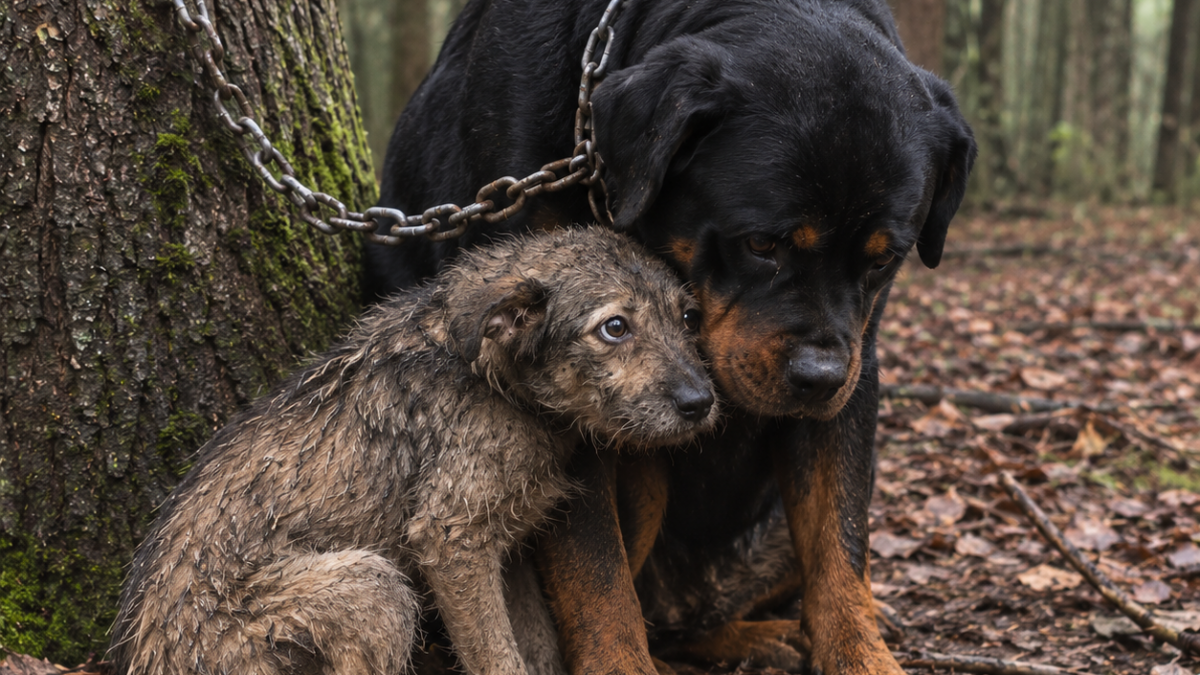
PART 2
The padlock had been outside long enough for orange rust to creep across the metal.
Michaels braced one boot against a root and closed the cutters around the weakest section.
The chain didn’t break.
“Again.”
He repositioned them.
I kept my attention on both dogs.
The Rottweiler remained almost completely still.
The stray stayed where he had sat, maybe fifteen feet away now.
Watching.
Every time Michaels moved, the stray’s ears pulled back.
Every time the cutters bit into the metal, his muscles tensed.
But he didn’t leave.
“You can go,” I told him softly.
His eyes moved toward me.
“You don’t have to stay.”
He stayed.
Michaels grunted.
The metal groaned.
“Come on.”
Another attempt.
Nothing.
I crouched near the Rottweiler without getting close enough to make him nervous.
“You’ve been listening to that thing for a while, haven’t you?”
His eyes shifted toward me.
I pointed toward the stray.
“Is that your friend?”
The Rottweiler looked past me.
His tail touched the ground again.
Once.
That tiny movement affected me more than I expected.
The chained dog barely reacted to us.
He reacted to him.
Michaels stopped working.
“Look around the base of the tree.”
“For what?”
“Food.”
I followed his gaze.
There were bones scattered among the roots.
Small pieces.
Some old enough to be almost clean.
One looked like part of a rabbit.
Another like something taken from garbage.
There were feathers.
A piece of dried hide.
Not one meal.
Many.
I stared.
“Michaels.”
“Yeah.”
“This has been happening for a while.”
He didn’t respond.
I counted what I could see.
At least half a dozen remains.
The Rottweiler had survived long enough for one meal after another to appear beside him.
His chain reached only several feet from the tree.
He could not hunt.
Could not search.
Could not find water beyond a shallow depression where melting snow and rain had collected.
Somebody had kept bringing him food.
I looked at the stray again.
He was thin enough that it hurt to look at him.
“You were sharing.”
The dog lowered his head.
There was no way to know how much he understood.
But the evidence sat beneath the tree.
This dog had been starving too.
And still, somehow, he had brought food here.
Michaels clenched his jaw.
“Try not to turn this into one of your speeches.”
“I don’t have a speech.”
“You’ve got the face.”
“What face?”
“The one where you’re about to say something that’ll make me angry.”
I looked at the bone beside the Rottweiler.
“I was going to say people don’t deserve dogs.”
“That’s exactly the speech.”
He put the cutters back against the chain.
“Help me steady this.”
I moved closer.
The Rottweiler watched.
“Easy.”
His breathing changed slightly.
I rested one hand on the loose part of the chain, careful not to touch him.
“We’re almost there.”
Michaels pushed.
The handles closed.
For a second, nothing happened.
Then—
Snap.
The broken length of chain fell into the pine needles.
Neither dog moved.
Michaels straightened.
“There.”
I looked at the Rottweiler.
“You’re free.”
He stared.
Maybe he didn’t understand.
I carefully removed what remained around his neck.
The skin beneath was irritated.
Hair worn away in places.
Not the worst chain wound I’d ever seen.
But clear evidence that he had been there long enough for the metal to become part of his daily life.
Michaels stepped backward.
“So what now?”
I expected the Rottweiler to stand and head toward us.
Or run.
A large open forest surrounded him.
No chain.
No tree.
Nothing preventing him from going anywhere.
He slowly pushed himself upright.
His legs trembled.
He stood still for a moment.
Then turned.
Not toward the truck.
Not toward the trail.
Toward the stray.
The thin dog immediately stood.
I felt Michaels go silent beside me.
The Rottweiler walked slowly across the pine needles.
His body was weaker than it had looked while he was lying down.
But he kept going.
The stray didn’t move.
When the Rottweiler reached him, he lowered his head.
The smaller dog leaned forward.
Their noses touched.
Then the Rottweiler pressed the side of his face against the stray’s neck.
Michaels whispered something I didn’t catch.
“What?”
“Nothing.”
His voice sounded rough.
The stray remained perfectly still.
Then, cautiously, he licked the Rottweiler’s muzzle.
Once.
The Rottweiler’s tail started moving.
Not fast.
Not dramatically.
Just a slow sweep from side to side.
I looked away for a second because suddenly I needed to.
Michaels cleared his throat.
“Well.”
“Yeah.”
“We’re taking both.”
It wasn’t a question.
“Obviously.”
The next problem was convincing the stray.
The Rottweiler was easy.
He had surrendered to us in a way I didn’t like, but it made handling him possible.
The stray was different.
Every time we approached, he backed away.
Not running.
Not leaving.
But maintaining distance.
“He’ll follow the Rottweiler,” Michaels said.
“Maybe.”
“Get the truck closer.”
The terrain wouldn’t allow us directly beside the tree, but we could bring it within a few hundred yards.
Michaels went.
I stayed.
The Rottweiler lowered himself near his friend.
The stray sat a few feet away.
I opened a package of emergency food we kept in the truck kit.
The smell caught both dogs’ attention.
I put half down for the Rottweiler.
Then moved twenty feet away and put another portion down for the stray.
He stared.
“You already brought him your dinner.”
I backed farther away.
“This one’s yours.”
The Rottweiler ate immediately.
The stray did not.
He watched me.
Then the food.
Then me.
I turned slightly sideways.
Animals find direct staring threatening.
“I’m not going to take it.”
Nothing.
I walked farther away.
Finally, the stray approached.
One step.
Stop.
Another.
Stop.
He reached the food.
Sniffed.
Then ate so fast I was afraid he would choke.
My stomach twisted.
The Rottweiler stopped eating and watched him.
That surprised me.
There was still food in front of the Rottweiler.
But he waited until the stray finished.
Then returned to his own.
I had spent years around wild animals, domestic animals, wounded animals, frightened animals.
I knew better than to turn every behavior into a human story.
Animals are animals.
Their relationships don’t always mean what we want them to mean.
But I also knew what I was seeing.
These two knew each other.
Trusted each other.
And one of them had been keeping the other alive.
Michaels returned with the truck.
“We have crates.”
“Good.”
“How’s our little ghost?”
I looked at the stray.
“Hungry.”
“That’s an improvement over invisible.”
We brought the Rottweiler first.
He walked with us.
Slow.
Stiff.
Every few steps, he turned to look back.
The stray followed at a distance.
“There,” Michaels whispered.
“He’s coming.”
“Don’t look directly.”
“I know.”
The Rottweiler reached the truck.
We opened the rear section.
He hesitated.
The stray stopped.
I stepped into the truck first.
“Come on.”
The Rottweiler looked at the stray.
Then climbed in.
We closed him inside a large secured transport area but left enough visual access for the stray to see him.
Now we waited.
The stray paced.
“Food?”
Michaels asked.
“Food.”
We placed another small portion inside a second crate.
We did not want him eating too much too quickly after obvious long-term hunger.
He approached the truck.
Stopped.
Retreated.
Approached again.
The Rottweiler watched through the barrier.
Then he made the first sound we’d heard from him.
A low whine.
The stray froze.
The Rottweiler whined again.
The thin dog came closer.
I looked at Michaels.
“Don’t move.”
“I’m not breathing.”
The stray reached the truck.
Sniffed the step.
The Rottweiler’s nose appeared against the grate.
The stray climbed up.
Michaels moved slowly behind him.
One second.
Two.
Then the stray stepped into the crate.
Michaels closed the door.
The dog spun around.
Panic.
I immediately covered part of the crate with a blanket.
“Easy.”
He pressed into the back.
Breathing fast.
The Rottweiler whined again.
The stray’s breathing slowed.
I looked at Michaels.
“We got him.”
He nodded.
Then rubbed a hand over his face.
“Let’s get out of here.”
We drove directly toward the nearest veterinary clinic that could evaluate both dogs.
The forest receded behind us.
I kept turning around.
The Rottweiler had settled.
The stray stayed curled against the back wall of the crate.
Every so often, the Rottweiler made a soft sound.
The stray’s ears moved.
That was enough.
At the clinic, we explained everything.
Chained Rottweiler.
Deep forest.
Unknown duration.
Stray dog bringing food.
Both likely dehydrated.
One severely underweight.
The staff separated them for examination.
The Rottweiler immediately became anxious.
He stood.
Paced.
Looked toward the door.
“Can they stay where they can see each other?” I asked.
The veterinarian nodded.
“We’ll try.”
The stray was examined first.
He was badly underweight.
Dehydrated.
Covered in ticks.
Old scars on his legs.
His paw pads were worn and cracked.
No microchip.
No collar.
No identification.
“How long has he been outside?” Michaels asked.
The veterinarian shook her head.
“Long enough.”
Bloodwork showed malnutrition but nothing immediately catastrophic.
“He needs slow nutritional rehabilitation.”
“Meaning don’t let him eat as much as he wants.”
“Exactly.”
The Rottweiler’s condition was better than expected.
Not good.
Better.
Dehydrated.
Weight loss.
Skin irritation around the neck.
Muscle weakness.
Some digestive upset.
But nothing suggesting he was beyond recovery.
The veterinarian looked at the scattered photographs we’d taken beneath the tree.
“Honestly?”
“What?”
“Those food remains may be the reason he’s alive.”
I looked through the glass at the stray.
He was pressed into the corner of his kennel.
Michaels crossed his arms.
“So he really did save him.”
The vet said carefully, “I can’t tell you every piece came from that dog.”
“No.”
“But if you’ve seen him carrying food to the Rottweiler, and there are repeated food remains within chain range…”
She didn’t finish.
She didn’t need to.
Michaels stared through the glass.
The stray looked back.
“We need names.”
I almost laughed.
“Now?”
“Yes.”
“You’re naming dogs?”
“I can’t keep saying Rottweiler and Ghost Dog.”
“What do you suggest?”
He thought.
“Bear.”
“For which one?”
“The Rottweiler.”
I looked at the large black-and-tan dog.
“Bear.”
His ears moved.
“Not terrible.”
Michaels looked offended.
“High praise.”
“And the stray?”
We both looked at him.
Thin.
Quiet.
Watching everything.
Michaels shrugged.
“Scout?”
The dog’s ears lifted.
I smiled.
“Scout.”
That became it.
Bear and Scout.
For the first forty-eight hours, the veterinary staff focused on stabilizing them.
Bear ate carefully measured meals.
Scout did the same.
Both received fluids.
Parasites were treated.
Bear’s neck was cleaned.
Scout hated almost every human interaction.
He tolerated treatment only because he had nowhere to escape.
But when Bear was nearby, Scout’s panic decreased.
The staff noticed.
One nurse told me, “When Bear leaves for testing, Scout won’t settle.”
“What happens when he comes back?”
“He lies down.”
Bear had the reverse problem.
He became agitated whenever Scout disappeared.
“They’re bonded,” the nurse said.
“Already?”
She smiled.
“They were bonded before you found them.”
Right.
We had simply arrived late to the relationship.
The forest knew first.
I visited after patrol the next day.
Scout was lying at the back of his kennel.
Bear rested in the adjacent one.
I sat between them.
“Good news.”
Neither reacted.
“You both smell significantly better.”
Scout stared.
Bear sighed.
“You’re welcome.”
Michaels came in carrying two approved treats.
“Bribery time.”
“You’re supposed to give those slowly.”
“I have instructions.”
“You ignore instructions professionally.”
“Only yours.”
We offered Bear his treat.
He took it gently.
Scout refused.
Michaels put it down.
“Your loss.”
Ten minutes later, when we weren’t looking directly, Scout ate it.
“Progress,” I said.
Michaels smiled.
“Massive.”
The shelter network we worked with had space for one large dog.
Not two.
That became a problem.
“We can’t separate them,” I said.
The coordinator sighed.
“I understand.”
“No, I don’t think you do.”
“I do.”
“Bear was chained to a tree. Scout was feeding him.”
“I know the story.”
“And when Bear was freed, he walked to Scout.”
“I know.”
“We separate them now, what’s the point?”
“The point is finding them safe placement.”
“Together.”
“If possible.”
“Not if possible.”
Michaels put a hand on my shoulder.
“Calm down.”
I looked at him.
“You’re telling me that?”
“Terrifying, isn’t it?”
The coordinator continued.
“We’ll try foster placement.”
Try.
That word again.
I hated it.
For three days, we called rescues.
Large-dog foster homes were hard enough.
A large Rottweiler plus a terrified stray?
Much harder.
Some places could take Bear.
Some could take Scout.
Nobody could take both.
On the fourth day, Michaels said, “My wife is going to kill me.”
I looked at him.
“What did you do?”
“I asked.”
“Asked what?”
“If we could foster them.”
I stopped.
“Both?”
“Both.”
“What did she say?”
“That I was an idiot.”
“Accurate.”
“And then she asked whether Scout was good with chickens.”
I started laughing.
“So that’s a yes?”
“Conditional yes.”
“You have chickens.”
“Exactly.”
Scout had never met a chicken as far as we knew.
That was going to require management.
But Michaels had space.
A secure fenced area.
A heated mudroom.
Experience with dogs.
And a wife, Carla, who complained loudly while quietly preparing bedding before the dogs even arrived.
When the veterinarian cleared them for foster care, we transported them together.
Bear climbed into the vehicle willingly.
Scout needed time.
Then followed Bear.
At Michaels’ house, we kept everything controlled.
No chickens.
No visitors.
No forced interaction.
Bear walked into the mudroom.
Scout froze at the threshold.
“Come on,” Michaels said.
“Don’t push him.”
“I know.”
Bear turned.
Came back.
Stood beside Scout.
Then walked inside again.
Scout followed.
Carla looked at us.
“Did the dog just show him how?”
“Pretty much.”
She shook her head.
“I’m already outnumbered.”
The first night, Scout refused the dog bed we’d set up.
Bear took the larger bed.
Scout slept on the floor beside him.
The next morning, Carla found them curled together.
She texted Michaels a picture.
Michaels showed me during patrol.
Bear’s head rested partly across Scout’s shoulders.
Scout was asleep.
Deeply asleep.
I stared.
“Save that.”
“Already did.”
We received no useful information about Bear’s former owner.
No chip.
No matching lost-dog report.
No documented evidence telling us who had taken him into the forest.
That frustrated me.
Part of me wanted someone to answer for it.
I wanted a name.
A license plate.
A reason.
Something.
Michaels said, “You’re doing the thing again.”
“What thing?”
“Trying to solve the part we don’t have.”
“Somebody left him.”
“Yes.”
“They should face consequences.”
“Yes.”
“But we don’t know who.”
“No.”
I hated that.
Justice feels incomplete when the guilty person remains faceless.
But I had learned enough in twelve years to know that anger doesn’t create evidence.
So we documented the location.
Photographed the chain.
Kept records.
Filed the appropriate report.
And focused on the dogs we could actually help.
Bear recovered quickly compared with Scout.
His strength returned.
His coat improved.
The skin around his neck healed.
He became playful.
Ridiculously playful.
The first time I saw him chase a ball, I laughed.
This massive Rottweiler who had looked emotionally finished beneath a pine tree suddenly became a clumsy oversized puppy.
He grabbed the ball.
Ran.
Dropped it.
Ran past it.
Turned around.
Picked up something completely different.
Michaels shouted, “That’s my glove!”
Bear ran faster.
Carla laughed from the porch.
“Good.”
“Why good?”
“You brought him home.”
“He stole government property.”
“It’s your glove.”
“Government-adjacent property.”
Bear disappeared around the side of the house.
Scout watched from the doorway.
He had started venturing outside.
Not far.
Always with Bear.
Bear ran past him.
Scout flinched.
Then watched.
The next pass, he didn’t flinch.
On the third, his tail moved slightly.
I saw it.
“Michaels.”
“What?”
“Scout.”
“What about him?”
“Tail.”
Michaels looked.
Scout’s tail moved again.
Tiny.
But real.
“Don’t make a big deal.”
“I wasn’t going to.”
“You’ve got the face.”
“What face?”
“The emotional speech face.”
I punched his shoulder lightly.
Scout’s recovery happened in almost invisible increments.
Day one: he entered the house.
Day three: ate with a human still in the room.
Day five: slept somewhere not directly beside an exit.
Week two: accepted a treat from Carla’s fingers.
Week three: allowed Michaels to touch his shoulder.
Week four: approached me first.
That last one nearly ruined me.
I arrived after patrol.
Bear charged toward me.
“Okay, okay.”
I crouched.
Bear leaned his entire body against me like a collapsing wall.
“You weigh eighty pounds.”
He did not care.
Scout stood near the porch.
Watching.
I ignored him intentionally.
Talked to Bear.
Talked to Michaels.
After several minutes, I felt something touch my hand.
Scout’s nose.
I froze.
Michaels saw.
Didn’t say anything.
Good partner.
Scout sniffed.
Then withdrew.
I kept my hand where it was.
He returned.
This time, his nose stayed.
I whispered, “Hey.”
His ears moved back.
But he didn’t leave.
I touched one finger to the side of his cheek.
Scout flinched.
Then stayed.
That was it.
Two seconds.
Maybe three.
It felt bigger than cutting Bear’s chain.
Because metal had been easier.
Metal doesn’t remember.
Fear does.
Over the next weeks, Scout gained weight.
Not quickly.
The veterinarian wanted it gradual.
His ribs became less visible.
His coat began to reveal its actual color—a warm brown-gray with darker patches.
Carla brushed him carefully.
At first, only when Bear was near.
Scout hated the brush.
Then tolerated it.
Eventually, he seemed to like the softer one.
“Look at you,” Carla said.
Scout leaned slightly into the brushing.
“You’re almost a dog.”
Michaels said, “He was always a dog.”
“You know what I mean.”
I did.
Scout had spent so long behaving like a creature trying to disappear that watching him enjoy something ordinary felt strange.
He discovered toys late.
Bear understood toys immediately.
Scout did not.
A rope?
Suspicious.
Ball?
Possibly dangerous.
Squeaker?
Absolutely unacceptable.
The first squeak made Scout jump behind Bear.
Bear looked delighted.
The toy squeaked again.
Scout stared.
Bear grabbed it.
Squeak.
Scout took one step forward.
Squeak.
Another.
Then suddenly Scout grabbed the other end.
Bear froze.
So did we.
Carla whispered, “Nobody move.”
Bear pulled.
Scout held.
A tiny tug-of-war began.
Then Scout released the toy and jumped backward as if embarrassed by his own behavior.
Michaels laughed.
“No, no. Come back.”
Scout didn’t.
But the next day he did.
After that, play became possible.
Their bond remained the center of everything.
Bear checked where Scout was before settling.
Scout followed Bear into unfamiliar spaces.
If Bear greeted someone calmly, Scout sometimes approached later.
Bear became his map of the human world.
Safe person.
Safe room.
Safe sound.
Safe doorway.
Safe touch.
Scout had kept Bear alive physically.
Bear now seemed to be teaching Scout how to live safely.
That symmetry stayed with me.
One evening, Michaels called.
“You need to come over.”
“What happened?”
“Nothing bad.”
“Then say that first.”
“I said nothing bad.”
“You said you need to come over.”
“Just come.”
I arrived after dark.
Carla met me at the door.
She was smiling.
“Back porch.”
Bear and Scout were lying side by side.
Nothing unusual.
Then Carla pointed.
A stainless-steel food bowl sat between them.
Scout was eating.
Bear was not.
Bear had already finished his own meal.
He sat there while Scout ate.
“Okay?”
I whispered.
Michaels said, “Watch.”
Scout finished.
He stepped away.
Bear approached the bowl.
There were two pieces of food left.
Bear ate one.
Then looked at Scout.
Scout came back.
Ate the other.
I stared.
Carla said, “They do this now.”
“Share?”
“Sometimes.”
Michaels folded his arms.
“You’re going to cry.”
“No.”
“Your eyes are already wet.”
“Allergies.”
“In November?”
“Pine.”
“We’re not near pines.”
“Shut up.”
I thought about the old bone in the forest.
The meat Scout had carried.
The starving stray placing food in front of the chained dog.
Now both had full bowls.
And they still shared.
That moment changed my idea of revenge.
I had been angry because somebody had escaped consequences.
Somewhere, perhaps, a person lived their life without thinking about the dog they had chained to a tree.
I wanted the scales balanced.
Then I looked at Bear and Scout.
The person who abandoned Bear had tried to give him an ending.
Tree.
Chain.
Forest.
Silence.
Instead, Bear had a house.
Food.
People.
A friend.
Scout too had been living at the edge of survival.
No bed.
No guaranteed meal.
No safe human.
Now he had all of those.
The cruel decision remained real.
But it had failed.
Completely.
Maybe that was not legal justice.
But emotionally?
It felt like the forest had returned both dogs to us and said:
You don’t get to decide their worth.
Winter arrived.
Scout’s first snow at the house was a disaster.
Bear loved it.
The moment the back door opened, Bear charged into the yard.
Scout followed three steps.
Stopped.
One paw lifted.
His expression changed.
He looked at Michaels.
Then at the snow.
Then back.
Michaels laughed.
“What?”
Scout retreated inside.
Carla said, “Smart dog.”
Bear raced past the window, covered in snow.
Michaels pointed.
“That is joy.”
“That is stupidity.”
Eventually Scout tried again.
This time Bear stayed closer.
Scout sniffed the snow.
Touched it.
Jumped back.
I laughed.
He looked offended.
“Sorry.”
A few minutes later, he was walking through it.
Carefully.
Bear ran circles around him.
Scout barked.
It was the first time I’d heard Scout bark.
All of us turned.
Scout seemed surprised too.
Bear barked back.
Then they ran.
Scout was slower.
Still leaner.
But running.
I stood on the porch watching a dog I’d first seen carrying rotten meat through the forest run through clean snow beside his friend.
Michaels stood next to me.
“You know what bothers me?”
“What?”
“We almost didn’t patrol that trail.”
I knew.
The route had been debated that morning because a section was muddy.
Another crew had suggested postponing.
Michaels had insisted the road was passable.
I hated thinking about alternate versions of that day.
What if.
What if.
What if.
I had learned not to finish those questions.
We did patrol.
We did find them.
That was the version we had.
Bear became increasingly attached to Carla.
It was embarrassing for Michaels.
“I rescued him.”
Carla corrected, “You cut a chain.”
“I drove.”
“You complain about fuel costs constantly.”
“That’s irrelevant.”
Bear lay with his head in Carla’s lap.
Michaels pointed.
“Traitor.”
Bear wagged.
Scout’s preference was different.
He attached himself to Michaels.
Slowly.
Maybe because Michaels was quieter with him than he was with anyone else.
He sat outside with Scout in the evenings without constantly trying to touch him.
Sometimes for forty minutes.
Just sitting.
Eventually Scout started choosing the chair beside him.
Then the ground near his feet.
Then one evening, his head rested on Michaels’ boot.
Michaels did not move for over an hour.
When I arrived, he whispered, “My leg is numb.”
“Move.”
“No.”
“Why?”
He pointed downward.
Scout was asleep.
I smiled.
“You’re ridiculous.”
“I know.”
The foster period was supposed to last three months.
At two months, I asked, “Any adoption applications?”
Michaels looked away.
Carla laughed.
“What?”
I asked.
Michaels said, “There are applications.”
“For both together?”
“One.”
“That’s great.”
“No.”
I stared.
“What do you mean, no?”
Carla said, “He doesn’t mean no.”
Michaels looked at her.
“Don’t.”
She smiled.
“You tell him.”
I crossed my arms.
“Michaels.”
He sighed.
“We’re keeping them.”
I laughed.
“You are?”
“Apparently.”
“Both?”
“No, we’re keeping Bear and releasing Scout back into the woods.”
I stared.
He rolled his eyes.
“Obviously both.”
Carla said, “He filled out the adoption paperwork yesterday.”
I slapped Michaels on the shoulder.
“You old liar.”
“Don’t get emotional.”
“You adopted them.”
“Yes.”
“Together.”
“Yes.”
“You said your wife would kill you.”
“She tried.”
Carla nodded.
“Still considering it.”
Bear ran into the room carrying Michaels’ sock.
Carla pointed.
“Mostly because of that.”
Scout followed.
Michaels looked at both dogs.
Then said quietly, “They belong here.”
That was the only explanation needed.
The legal transfer was completed.
Bear and Scout became Michaels and Carla’s dogs.
Not temporary.
Not foster.
Home.
I had expected that to feel like the end.
It didn’t.
The best part came afterward.
The ordinary part.
Mornings.
Walks.
Vet appointments.
Chewed shoes.
Mud.
Food bowls.
Scout learning the sound of the treat container.
Bear discovering he could open one kitchen cabinet with his nose.
Carla installing a latch.
Bear learning how to defeat the first latch.
Michaels installing a second.
Scout watching all of it like an apprentice criminal.
Their life became funny.
That mattered.
People sometimes tell rescue stories only through suffering.
The chain.
The hunger.
The scars.
But the goal is not to keep an animal forever inside its worst day.
The goal is to give it enough ordinary happiness that the worst day eventually becomes one chapter.
Bear’s chain wound healed.
His coat became glossy again.
He regained muscle.
Visitors who did not know the story simply saw a huge Rottweiler who believed every human had been created to scratch his chest.
Scout changed even more.
He reached a healthy weight.
The knots disappeared from his fur.
His eyes looked different.
Not a different color.
Different expectation.
When I first saw him, his eyes asked:
How close are you going to come?
Months later, they asked:
Did you bring treats?
Progress.
One spring, exactly a year after we found them, Michaels suggested we return to that section of forest.
“With the dogs?”
“Yeah.”
I wasn’t sure.
“Why?”
He shrugged.
“Don’t know.”
Carla said, “Because you’re both sentimental and incapable of admitting it.”
Michaels ignored her.
We waited until the trail opened after snowmelt.
Same patrol period.
Same truck.
Bear and Scout came in secure travel crates.
The road looked almost identical.
Pines.
Mud.
Old snow in shaded gullies.
The closer we got to the tree, the more uncomfortable I became.
“What if Scout recognizes it?”
Michaels asked.
“Probably will.”
“Bear?”
“Maybe.”
“Bad idea?”
I thought.
“We leave if either seems stressed.”
“Agreed.”
We stopped well before the tree.
Opened the crates.
Both dogs came out.
Bear sniffed.
Scout froze.
I watched his body.
Tail low.
Ears moving.
He knew something.
Bear looked at him.
Scout took a step.
Then another.
We did not lead them toward the tree.
We let them choose.
Scout moved first.
Bear followed.
That felt right.
The old pine still stood.
The chain was gone.
We had removed it as evidence and later it had been released to us after the case went nowhere.
The rust mark remained faintly visible around part of the trunk.
Bear approached.
Sniffed.
Stopped.
Scout stood beside him.
For several seconds, nothing happened.
I felt every muscle in my body tense.
Then Bear lifted his leg and urinated on the tree.
Michaels burst out laughing.
I stared.
Bear walked away.
Scout sniffed the same place.
Then did exactly the same thing.
I laughed so hard I had to lean against another tree.
Michaels wiped his eyes.
“There.”
“What?”
“Revenge.”
I laughed harder.
It was ridiculous.
Immature.
Perfect.
The tree that had once been Bear’s prison was now just another tree two healthy dogs could pee on and leave behind.
They didn’t linger.
Scout moved toward a patch of grass.
Bear followed.
Soon they were sniffing animal tracks.
Scout found something interesting beneath a fallen branch.
Bear tried to shove his head into the same space.
They argued quietly.
Normal dogs.
The location meant more to us than to them now.
Maybe that was good.
We stayed less than fifteen minutes.
As we walked back toward the truck, I looked behind.
The pine stood alone.
No dog.
No chain.
No food scraps.
Nothing.
Just a tree.
I felt something inside me finally release.
The forest hadn’t won.
The person who left Bear there hadn’t won.
Hunger hadn’t won.
Fear hadn’t won.
We put the dogs back into their crates.
Michaels started the engine.
Scout lay down.
Bear settled beside the crate wall where he could see him.
I looked through the windshield.
“Ready?”
Michaels nodded.
“Let’s go home.”
Home.
A year earlier, neither dog had one.
Now the word required no explanation.
Years passed.
I remained a forest officer.
Michaels remained incapable of telling a good joke.
Bear grew into the kind of dog who looked terrifying from a distance and became embarrassing up close.
He leaned on everyone.
Everyone.
A delivery driver once nearly fell over because Bear sat on his foot and leaned his full weight against his leg.
Michaels apologized.
The driver laughed and scratched Bear’s ears.
Scout remained more selective.
He never became the kind of dog who loved every stranger.
That was fine.
Trust didn’t have to become indiscriminate.
He had his people.
Carla.
Michaels.
Me.
A few friends.
He decided the rest case by case.
I respected that.
His relationship with Bear never changed.
If Bear left for a veterinary appointment alone, Scout waited near the door.
If Scout went somewhere, Bear paced.
We eventually scheduled routine appointments together when possible.
The clinic staff joked about it.
“Married couple?”
“Old war buddies,” Michaels said.
That description felt closer.
They had survived something together before we entered the story.
Scout had been free but starving.
Bear had food only when Scout brought it.
Each had something the other needed.
Scout could move.
Bear offered companionship.
Maybe safety.
Maybe simply a reason to keep returning.
We’ll never know exactly when Scout found Bear.
Maybe the first day.
Maybe later.
We’ll never know where he got every piece of food.
We won’t know what made him decide to share instead of eat everything himself.
Some mysteries deserve to remain mysteries rather than being filled with invented certainty.
We knew enough.
A starving dog fed another dog.
Repeatedly.
That was fact enough.
One autumn, Bear injured his paw running through the yard.
Nothing serious.
But he had to wear a boot for several days.
He hated it.
Absolutely hated it.
The first time Carla put it on, Bear lifted the paw dramatically and refused to move.
Michaels said, “You survived chained to a tree.”
Bear stared.
“This is a sock.”
Bear refused.
Scout walked over.
Sniffed the boot.
Then licked Bear’s face.
Bear finally took one step.
We laughed.
“Still helping him,” I said.
Michaels smiled.
“Always.”
That was their pattern.
Scout encouraged.
Bear steadied.
When Scout became frightened by fireworks, Bear lay beside him.
When Bear got sick one winter, Scout refused to leave his bed.
When one was nervous, the other stayed.
Their friendship never became less remarkable simply because it became ordinary.
Maybe that’s what love does.
It begins as rescue.
Then becomes routine.
One day, years after the forest rescue, I brought an old photograph to Michaels’ house.
It showed Bear still chained to the pine.
Scout in the background.
Thin.
Almost invisible.
Carla stared at it.
“I hate that picture.”
“I know.”
“Why keep it?”
I looked toward the living room.
Bear was asleep on the rug.
Scout was on the couch.
Healthy.
Warm.
Safe.
“Because I don’t look at it by itself.”
Carla followed my gaze.
I understood why rescue organizations love transformation photos.
Not because suffering should become entertainment.
Because context matters.
One image says:
This happened.
The next says:
But it didn’t get everything.
Bear’s photograph didn’t end at the chain.
Scout’s didn’t end at starvation.
If you only saw the first frame, you’d think tragedy.
If you saw the whole story, you saw resistance.
Loyalty.
Chance.
Work.
Home.
That’s why I kept the picture.
Not to remember cruelty.
To remember that cruelty failed.
The person who abandoned Bear probably never knew Scout had found him.
Never knew another dog was bringing him food.
Never knew forest officers would come.
Never knew the chain would be cut.
Never knew Bear would survive.
Never knew Scout would be rescued too.
Never knew they’d end up together.
There is something satisfying about that.
Whoever tried to erase Bear from their life unknowingly created a story in which Bear became unforgettable.
Not because abandonment made him special.
He was valuable before any of it.
But the attempt to leave him unseen failed completely.
Bear became known.
Loved.
Photographed.
Talked about.
Protected.
Scout too.
The ghost dog who once blended into bushes became a dog people noticed the moment he entered a room.
Not because he was loud.
Because he mattered to them.
That was the deepest revenge against abandonment.
To become impossible to discard.
One winter evening, I stopped by after work.
Snow had started falling.
Carla opened the door.
“They’re in the living room.”
I found Bear on the rug beside the fireplace.
Scout was curled against his side.
Both gray around the muzzle now.
Old.
That sight hit me harder than expected.
“You got old.”
Bear opened one eye.
Scout didn’t move.
Michaels came in behind me.
“Rude.”
“How old are they now?”
“Best estimate?”
He told me.
Enough years that I had to sit down.
Bear stretched.
His joints were slower.
Scout lifted his head.
I held out a hand.
He came toward me.
No hesitation.
That alone was enough to bring back the bushes.
The trembling dog.
The old meat.
The distance he kept.
Now he pushed his forehead beneath my palm.
“Hey, Scout.”
His tail moved.
I scratched behind his ears.
Bear got jealous and came over.
“There’s enough.”
Bear leaned against my knee.
Scout stayed on the other side.
I became trapped between two elderly dogs.
Michaels laughed.
“Need help?”
“No.”
My legs started going numb.
I didn’t move.
I thought about that first day.
Scout refusing to come close.
Bear unable to leave the tree.
Now both were leaning against me because apparently personal space had become optional.
Good.
Some transformations deserve inconvenience.
Bear aged first.
Large dogs often do.
His hips became stiff.
Walks shortened.
He still wanted to go.
His body disagreed.
Michaels bought ramps.
Carla put rugs on slippery floors.
Scout adjusted.
If Bear walked slowly, Scout walked slowly.
He could have moved ahead.
He didn’t.
“Still feeding him,” I joked once.
Not literally anymore.
But in another way.
Still giving something.
Time.
Company.
Patience.
One morning, Michaels sent me a video.
Bear trying to climb the porch ramp.
Scout walked up first.
Turned.
Came back down.
Then walked beside Bear.
I watched it repeatedly.
There are relationships you can over-explain until you ruin them.
I didn’t.
I just watched.
Scout had once carried food through a forest.
Now he carried nothing.
He simply stayed beside Bear.
Maybe that was always the gift.
Not meat.
Presence.
When Bear eventually became seriously ill, Scout knew before we wanted to admit it.
Bear stopped eating normally.
His energy dropped.
Vet visits became more frequent.
Tests.
Medication.
Hope.
Reality.
I will not turn the end of an old dog’s life into cheap drama.
Bear had years.
Good years.
Years nobody could have predicted beneath that pine.
When the veterinarian finally told Michaels and Carla that Bear was suffering more than treatment could reasonably fix, the decision broke them.
It broke me too.
Scout stayed beside Bear during the final days.
At home, because that was where Bear was most comfortable.
The morning came quietly.
Bear lay on his favorite blanket.
Carla held his head.
Michaels sat on the floor.
I was there.
Scout lay pressed against Bear’s back.
The veterinarian came to the house.
Bear had never liked clinics much.
We weren’t making his final memory one.
Carla whispered to him.
Michaels tried to speak and failed.
I touched Bear’s shoulder.
His breathing slowed.
Scout lifted his head.
The vet gave the medication.
Bear relaxed.
Completely.
For the first time since I had known him, I looked at Bear and felt no tension anywhere in his body.
No chain.
No fear.
No pain.
Just rest.
Scout sniffed him afterward.
Stayed for several minutes.
Then lay down beside him.
Nobody moved him.
Later, Scout searched the house.
That was harder to watch than I expected.
Door.
Bed.
Porch.
Living room.
He checked places Bear had been.
Michaels sat on the floor.
Scout came to him.
For a while, neither moved.
Then Scout climbed partly into his lap.
The dog who had once comforted Bear was now the one needing comfort.
Michaels held him.
Carla sat beside them.
I went outside because grief had filled the room too completely.
Snow was melting.
Water dripped from the roof.
For a second, I thought about spring patrol.
The pine tree.
The chain.
Then I remembered the years between.
Bear had not died beneath that tree.
That mattered.
He died old.
At home.
With people touching him.
With Scout beside him.
If you’re looking for the satisfying ending, that’s part of it.
Abandonment had tried to decide where Bear would die.
It failed by years.
Scout struggled after Bear died.
Less appetite.
More searching.
Sleeping near Bear’s old places.
The veterinarian told us grief can affect dogs.
We already knew.
Michaels and Carla kept routine stable.
Walks.
Food.
Company.
No rushing.
Scout slowly adjusted.
He started sleeping near Michaels’ chair.
Then on Bear’s old rug.
We worried about that at first.
Carla said, “Maybe it’s comforting.”
We let him choose.
Months passed.
One afternoon, Michaels called.
“You won’t believe this.”
“What?”
“Scout stole my sandwich.”
I laughed.
“Good.”
“Good?”
“Very good.”
Hunger had returned in the most Scout-like way possible.
Not politely.
He had taken half a turkey sandwich from the coffee table and disappeared.
Michaels found him eating behind the couch.
“You’re proud of this?”
“Yes.”
“I’ve lost control of my household.”
“You never had control.”
True.
Scout became older too.
His muzzle whitened.
Hearing softened.
He slept more.
But he never lost the habit of checking for his people.
If Michaels worked outside too long, Scout waited by the door.
If Carla went into another room, he sometimes followed.
If I visited, he still came.
Not immediately every time.
He was old.
Some things could wait.
But he came.
The dog who once avoided humans had built his life around knowing where his humans were.
That may be the most complete transformation I ever witnessed.
On one of Scout’s last healthy summers, we took him back to the forest.
Not the exact tree.
There was no reason.
A nearby meadow.
Quiet.
Accessible.
Michaels drove.
Carla came.
I walked beside Scout.
Slowly.
His legs weren’t what they used to be.
But his nose worked perfectly.
He stopped every few feet.
Sniff.
Think.
Move.
At one point, he stared toward the darker forest.
I wondered what he remembered.
Maybe nothing.
Maybe everything.
Carla asked, “Do you think he misses being wild?”
I shook my head.
“I don’t know if he was ever wild.”
“What do you mean?”
“He survived outside.”
I looked at Scout.
“That doesn’t mean it was where he belonged.”
Survival and belonging are different.
Scout had survived in the forest.
He belonged with Bear.
Then with Michaels and Carla.
Eventually with all of us.
He sniffed the grass.
Then turned toward Michaels.
Michaels crouched.
Scout walked over.
That answered enough.
Years earlier, freedom had meant avoiding people.
Now freedom meant choosing them.
When Scout’s health eventually began failing, there was no sudden crisis.
Age.
Kidneys.
Joints.
Time.
The usual enemies.
We managed what we could.
He still ate.
Until he didn’t.
Still walked.
Until it became difficult.
Still called sometimes.
Until his voice weakened.
There was no chain to cut this time.
Nothing dramatic to rescue him from.
Only the responsibility to not turn love into selfishness.
Michaels called me one morning.
“It’s time.”
I knew.
Scout was lying on Bear’s old rug.
Carla sat beside him.
Michaels looked older than I’d ever seen him.
Scout lifted his head when I entered.
His tail tapped once.
Once.
Slowly.
Just like Bear’s tail had struck the pine needles when Scout approached with food all those years ago.
I knelt.
“Hey.”
Scout looked at me.
“You found us first, didn’t you?”
Maybe that was the truth.
We like to say we found animals.
Sometimes they reveal something waiting to be found in us.
Scout taught me more about loyalty than most people I’d met.
Not because dogs are morally superior beings.
Not because he was some saint.
He was a scavenger.
A thief of sandwiches.
Suspicious of mail carriers.
Terrible around vacuum cleaners.
But when he had almost nothing, he brought food to another dog.
That was who he was before safety changed him.
The veterinarian came.
Scout stayed calm.
Michaels held him.
Carla touched his face.
I rested my hand against his side.
Scout closed his eyes.
And went to sleep.
Home.
Not bushes.
Not alone.
Home.
For a long time after both dogs were gone, Michaels refused to remove Bear’s old leash from the mudroom.
Scout’s food bowl stayed in a cabinet.
Carla kept photographs everywhere.
One was my favorite.
Not the chain.
Not the forest.
Not even the first rescue photo.
It showed Bear and Scout years later.
Bear asleep on his side.
Scout pressed against him.
Both gray.
Both completely relaxed.
Nothing dramatic.
That was why I loved it.
People see dramatic rescues and think the rescue moment is the miracle.
Sometimes it is.
But the true miracle is everything that comes afterward.
Breakfast.
Walks.
Arguments about furniture.
Vet appointments.
Snow.
Stolen gloves.
Bad jokes.
Old age.
A whole life.
That’s what Bear and Scout got.
A whole life after the day when one was chained and the other was starving.
I kept the broken chain in a storage locker at the ranger station for years.
Not as a trophy.
Evidence first.
Then nobody knew what to do with it.
Eventually, on the anniversary of Bear’s rescue, Michaels asked, “Still have it?”
“Probably.”
We found it.
Rusty.
Heavy.
Ugly.
He held one end.
I held the other.
“What do we do with this?”
I thought about keeping it.
Then decided I didn’t want it.
Neither did he.
We took it to metal recycling.
That was it.
No ceremony.
No speech.
The chain became scrap.
I liked that.
It had once defined Bear’s entire world.
Now it was worthless metal.
That might have been the final revenge.
Not destroying the person who abandoned him.
Destroying the importance of what they had done.
The chain became scrap.
The tree became a tree.
The forest became somewhere Scout later walked safely.
The starving dog became family.
The abandoned dog grew old.
Cruelty lost its monopoly on the story.
A few years later, a young ranger joined our unit.
During training, we drove part of the old patrol route.
He asked why Michaels and I both became quiet near a certain turn.
Michaels said, “Long story.”
The young ranger looked at me.
I told him.
Not every detail.
Enough.
A Rottweiler.
A chain.
A starving stray.
Food carried through the forest.
Two dogs rescued together.
The young ranger sat quietly afterward.
Then asked, “Did you ever find who left him?”
“No.”
“That bother you?”
I looked through the windshield.
Trees passed.
“Yes.”
“Still?”
I thought.
“Less.”
“Why?”
Because Bear had lived.
Because Scout had lived.
Because unanswered anger had been replaced by years of ordinary memory.
Because punishment is only one form of justice.
Because sometimes the most powerful answer to cruelty is not returning cruelty.
It’s making the cruelty fail.
I said, “The person who left him got one day in Bear’s story.”
The ranger looked at me.
“Bear got years.”
He nodded.
That was the truth.
Whoever chained Bear to that tree became almost irrelevant.
They were the reason we found him.
Not the reason he became who he became afterward.
Scout mattered more.
Michaels mattered more.
Carla.
Veterinarians.
Warm rooms.
Food.
Snow.
The sofa.
The people who stayed.
Those things took over.
That is what I hope people understand when they hear Bear and Scout’s story.
The darkest moment does not deserve ownership of everything that follows.
Bear was abandoned.
Yes.
Scout was starving.
Yes.
Both facts matter.
Neither fact gets the last sentence.
The last sentence belongs to the moment after the chain broke.
Bear could have run anywhere.
Instead, he walked to Scout.
I understand that choice differently now.
At the time, I thought it was gratitude.
Maybe it was.
Maybe it was familiarity.
Safety.
Bond.
Something animals understand without needing our words.
Years later, I think it was simpler.
Bear knew where home was before we did.
Home was not a building.
It wasn’t Michaels’ house yet.
It wasn’t a bed or food bowl.
At that moment, home was the one creature who had returned.
Again.
And again.
And again.
When Bear was chained and unable to search for food, Scout returned.
When Scout was afraid of humans, Bear stayed beside him.
When Bear got old, Scout slowed down.
When Bear died, Scout searched for him.
Their lives were stitched together long before we arrived with bolt cutters.
We didn’t create that bond.
We were lucky enough not to separate it.
That may be the best thing we did.
Whenever I patrol that forest now, the place feels different.
I still look for illegal traps.
Tracks.
Signs of poaching.
All the practical things.
But sometimes, when the truck passes a cluster of pines, I remember a thin dog appearing from the brush carrying something in his mouth.
I remember thinking he looked like a ghost.
He wasn’t.
He was a friend.
A starving one.
A frightened one.
A dog with every reason to keep what little food he found.
And yet he brought it to Bear.
I have spent years trying not to make animals into human metaphors.
They don’t need to be.
Scout wasn’t heroic because he fit some human idea of virtue.
He was heroic because the action itself happened.
He was hungry.
He brought food.
Bear was trapped.
Scout returned.
That’s enough.
And when the chain finally fell away, Bear didn’t need anyone to tell him who had mattered.
He stood.
Crossed the pine needles.
And went straight to Scout.
Years later, when I think about revenge, justice, loyalty, or even rescue, I think about that walk.
Not toward freedom.
Toward the one who stayed.
Because freedom without anyone beside you can still be lonely.
Bear had already learned that.
So had Scout.
They got something better than freedom that day.
They got to leave together.
They got a truck ride together.
A hospital together.
A foster home together.
A permanent home together.
Seasons together.
Snow.
Warmth.
Old age.
Everything the forest could not give them.
The person who chained Bear to the tree may have believed the story ended when they drove away.
It didn’t.
They left the first page.
Scout wrote the next one by bringing food.
We wrote another by cutting the chain.
Michaels and Carla wrote years more by opening their home.
Bear and Scout wrote the rest simply by living.
That is why the ending satisfies me.
Nobody came back asking forgiveness.
No dramatic criminal stood in court.
No perfect explanation appeared.
Real life rarely ties every loose end.
But Bear didn’t die at that tree.
Scout didn’t starve alone in the woods.
They were not separated after rescue.
They were not forgotten.
They became family.
And for me, that is the only revenge their story ever needed.
Someone left Bear in the forest expecting silence.
Instead, years later, we’re still telling his story.
Someone left him chained.
He died free.
Someone left him alone.
He died loved.
Scout entered the story with almost nothing.
He left it with people who cried when he was gone.
And the last time I stood near that old pine, there was no chain around it.
No dog beneath it.
No bones.
No evidence of despair.
Just wind moving through branches.
I touched the bark once.
Then walked away.
I didn’t look back.
Because neither of them was there anymore.
They had already gone home.








