PART 2: We Cut a Silent Puppy Out of a Sealed Plastic Drum—Then I Saw What Someone Had Hidden Inside
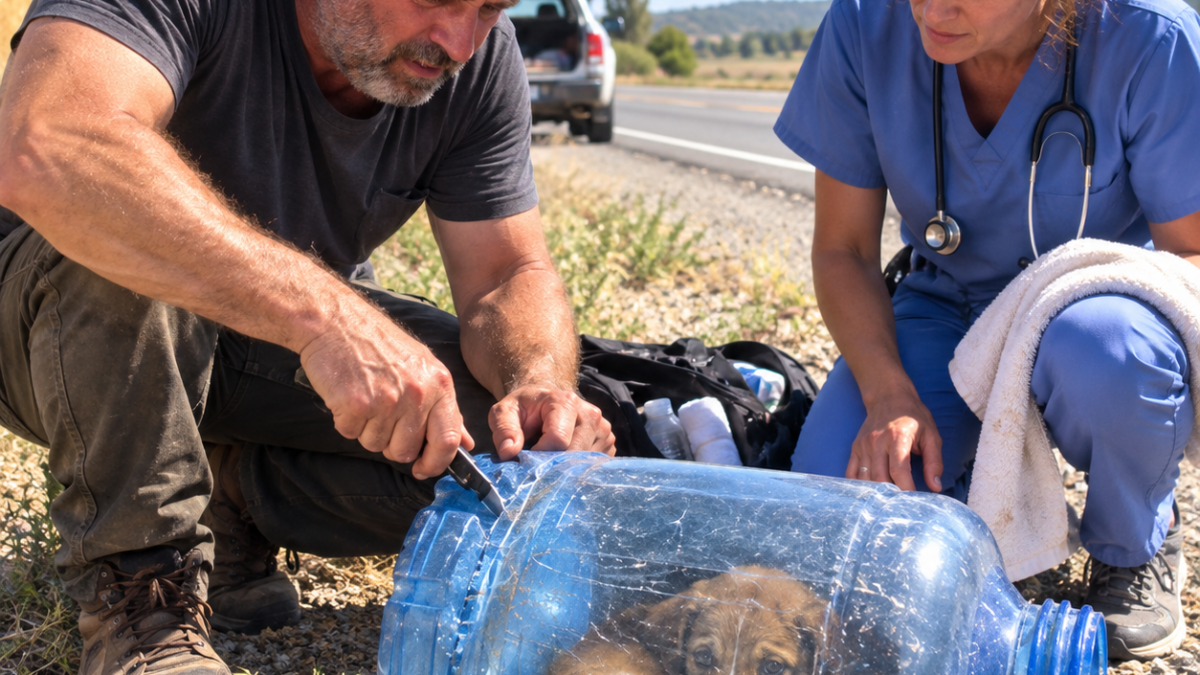
PART 2
What fell into the grass looked, at first, like nothing more than a torn rectangle of white plastic.
Claire was still working on the puppy, so I reached down with my free hand and picked it up.
It was part of a commercial label.
Most of the ink had been smeared by moisture and heat, but several words remained readable.
VETERINARY USE ONLY.
Below that was a batch number.
And beneath the batch number, partly torn through the middle, was the name of a business.
CLINIQUE ANIMALE DES CÈDRES.
I knew the name.
Almost everyone around Nîmes did.
It wasn’t some backyard operation or anonymous warehouse. Les Cèdres was a private veterinary clinic on the northern side of the city, the kind of place with a polished website, stainless-steel examination rooms, and a landscaped entrance where people brought expensive dogs and horses.
For a moment I simply stared at the label.
Then the puppy jerked weakly in my arms.
Everything else disappeared.
“He’s moving.”
Claire was already beside me.
“Put him down here.”
We laid him on a folded towel in the strip of shade.
His tongue was dry. His gums were pale. His chest barely moved.
Claire wet her fingers and touched moisture along his mouth while I held the cardboard shade.
“Come on,” she whispered. “Not after all that.”
The puppy gave one shallow gasp.
Then another.
A truck thundered past.
The wind from it shook the cardboard above us.
I remember becoming angry at the entire world for continuing to move normally.
Cars.
Trucks.
Cicadas.
People somewhere eating lunch.
Someone complaining because a coffee was cold.
Meanwhile this tiny animal was trying to decide whether he had enough strength left for one more breath.
“He’s breathing,” I said.
“Yes.”
“Enough?”
“No.”
That word hit me harder than it should have.
I knelt closer.
“Stay.”
Claire looked at me.
I didn’t explain.
I kept talking to him.
“Stay here. You’re already out. Don’t quit now.”
His front paw moved.
The white one.
The paw I’d seen through the drum.
Claire felt his chest again.
“Better.”
I let out a breath I hadn’t realized I was holding.
Animal services arrived six minutes later with a veterinary technician.
Those six minutes felt longer than the eleven we’d spent cutting the drum.
The technician, a man named Julien, took one look at the puppy and immediately started cooling him gradually while checking his temperature, heart rate, and responsiveness.
“How long was he inside?”
“We don’t know.”
“Did you find the container sealed?”
“Mostly.”
“Any food? Water?”
“No.”
He looked toward the broken drum.
“Don’t throw anything away.”
Claire and I exchanged a glance.
“I wasn’t planning to.”
Julien wrapped the puppy in a light towel and placed him in a ventilated carrier.
“Is he going to make it?”
“I don’t know.”
I hated how often people said that sentence around injured animals.
I don’t know.
Maybe.
We’ll see.
Wait.
All words that sounded responsible and felt unbearable.
Julien lifted the carrier.
“We’re taking him to Saint-Gilles. Emergency unit is ready.”
“I’ll follow.”
He looked at my delivery van.
“You don’t have to.”
“Yes, I do.”
Claire lowered the cardboard.
“I’ll come too.”
“You were going somewhere.”
“So were you.”
That ended the discussion.
I called my dispatcher.
My manager answered on the second ring.
“Thomas, where are you? Montpellier has called twice.”
“I found a puppy trapped in a drum.”
Silence.
“What?”
“I’m going to a veterinary emergency clinic.”
Another silence.
Then he sighed.
“Of course you are.”
That wasn’t criticism.
Patrick had known me for twenty years.
He knew about Lucie.
“I’ll move the delivery,” he said.
“Thanks.”
“Thomas?”
“Yeah?”
“Send me a picture when the dog is okay.”
Not if.
When.
I needed that.
The emergency clinic smelled of disinfectant and warm plastic.
Julien disappeared through double doors with the puppy while a receptionist asked us what had happened.
Then someone brought the broken pieces of the drum inside.
The label fell from my pocket when I stood.
The receptionist picked it up.
She glanced at the name.
Her face changed.
Not dramatically.
But enough.
“You know this clinic?” I asked.
She looked at Claire, then at me.
“Of course.”
“Anything strange about the label?”
“I don’t know.”
“That’s not what your face said.”
She handed it back.
“You should give this to animal services.”
“Why?”
“Because they’ll need to determine where that container came from.”
“That’s obvious.”
She lowered her voice.
“Those drums aren’t normally given to clients.”
I stared at her.
“What are they used for?”
“Medical cleaning products. Sometimes concentrated disinfectant, sometimes waste handling products. Depends on the supplier.”
Claire looked toward the treatment-room doors.
“So the container probably came from a professional facility.”
“Probably.”
“Could a client have taken one?”
The receptionist hesitated.
“Anything is possible.”
I knew that expression.
It meant: technically yes, realistically no.
Animal services arrived at the clinic twenty minutes later.
This time it wasn’t just Julien.
A supervisor named Éric Beaumont came with a municipal police officer.
They photographed the drum.
The label.
The opening.
The red leash I’d used to stabilize it.
Even the position of the jagged plastic pieces.
Éric asked me to describe exactly what I’d seen before touching anything.
I gave him the location.
The time.
The movement of the container.
The sound of the puppy.
The way the plastic had been folded inward.
“Folded?” he asked.
“Yes.”
“Not just broken?”
“No.”
He turned the container.
Claire pointed.
“There. See? These pieces.”
Éric examined them.
Several cut sections around the neck of the drum had been bent inward, forming something like crude teeth.
I felt sick.
“It could’ve happened accidentally,” the officer said.
Claire shook her head.
“Plastic this thick doesn’t fold itself evenly in four places.”
Éric didn’t agree or disagree.
He simply took more photographs.
“Any chance the puppy crawled in?”
“No,” I said immediately.
“Why not?”
“Look at his shoulders.”
The puppy’s head might have fit through the opening.
His chest wouldn’t.
Not without somebody forcing him through before bending the plastic inward.
The idea sat between us.
Nobody said it.
Not yet.
At 4:06 p.m., a veterinarian came out.
Dr. Romain Keller.
Tall, thin, glasses, tired eyes.
“The puppy is alive.”
That was all I needed to hear.
My knees almost gave.
Claire reached for my arm.
Dr. Keller continued.
“Severe dehydration. Hyperthermia. Minor lacerations around the shoulders and chest. Bruising on the hips. But no obvious fractures.”
“How old?”
“Maybe ten to twelve weeks.”
“What breed?”
“Mixed. Possibly shepherd, maybe some terrier. Hard to say.”
“Can we see him?”
“Not yet.”
I nodded.
Then asked the question I was afraid of.
“Will he survive?”
Dr. Keller removed his glasses and cleaned them slowly.
“If he gets through tonight without organ complications, his chances improve considerably.”
That wasn’t yes.
But it wasn’t no.
“He’s young,” Claire said.
“That helps.”
“What should we call him?” the receptionist asked.
I blinked.
“What?”
“For the file. We can’t keep writing ‘unknown male puppy.'”
Claire looked at me.
“You found him.”
I thought about the drum.
The road.
The moment his eye opened.
Then the red leash.
Lucie’s leash.
“Lucas.”
Claire smiled.
“Why Lucas?”
I don’t know where it came from.
Maybe because it sounded close to Lucie without being the same.
Maybe because I wanted him to have a real name immediately.
“Because nobody should be called Unknown.”
So Lucas entered the system.
That night, I went home to a house that had been quiet for eighteen months.
I lived alone outside Sommières in a small stone place I’d bought after my divorce.
Lucie had filled it.
That sounds ridiculous until you’ve lived alone with a dog for fifteen years.
You learn how much sound one animal makes only after the sound is gone.
Nails on tile.
Collar tags.
Breathing beside the sofa.
The soft push of a bowl across the kitchen floor.
After Lucie died, the house became enormous.
I’d never adopted another dog.
People suggested it.
I always found reasons.
Too much work.
Too many deliveries.
Not fair to leave a dog alone.
Not ready.
That last one was the truth.
I sat at my kitchen table and put the torn label in my mind again.
CLINIQUE ANIMALE DES CÈDRES.
At 9:41 p.m., Claire texted.
She had gotten my number from the report.
Any news?
I answered.
Still alive. Critical but stable.
Three dots appeared.
Then:
Good.
A minute later:
You okay?
I stared at that question.
Nobody had asked me that after Lucie died.
People had said they were sorry.
They’d said she had a good life.
They’d said fifteen years was a blessing.
All true.
But nobody had asked whether I was okay.
I typed:
Not really.
Claire answered:
Me neither.
The next morning, Lucas was still alive.
His temperature had normalized.
Kidney values were concerning but not catastrophic.
He’d urinated.
Dr. Keller called that encouraging.
At noon, I visited.
Lucas looked smaller in a proper kennel than he’d looked in the drum.
Maybe because there was space around him now.
He was tan with a white chest, white toes, and a narrow dark line around one eye that made him look permanently worried.
An IV ran into his foreleg.
He lifted his head when I entered.
Only an inch.
But he lifted it.
“Hey.”
One ear moved.
I sat beside the kennel.
“Remember me?”
He blinked.
I put my hand near the bars.
He smelled my fingers.
Then rested his muzzle against them.
That destroyed whatever resistance I had left.
I stayed an hour.
When I left, Éric Beaumont was waiting in reception.
“We traced the drum.”
That got my attention.
“To Les Cèdres?”
“Supplier confirms the batch was delivered there.”
“When?”
“Nine days ago.”
“Can they explain how it ended up beside the road?”
“Not yet.”
“Have you asked?”
He looked at me.
“Thomas.”
“What?”
“You’re a witness.”
“I know.”
“Then witness.”
I didn’t like being told to stay in my lane.
Especially when a puppy had almost died in mine.
But I understood.
“What did the clinic say?”
“The director says empty containers are stored in a locked utility area before collection.”
“Locked?”
“Yes.”
“Who has access?”
“Staff.”
“How many?”
“That’s part of what we’re determining.”
“Was the drum empty?”
He glanced toward the desk.
“Mostly.”
“Mostly?”
“Residue is being tested.”
I felt my stomach turn.
“Was Lucas exposed?”
“We don’t know.”
“But it could’ve been toxic.”
“Possible.”
I clenched my jaw.
Éric watched me carefully.
“Do not go to Les Cèdres.”
“I wasn’t planning to.”
“You’re lying.”
“I haven’t decided yet.”
“Then decide not to.”
He walked away.
I lasted until four that afternoon.
Then my delivery route took me within two miles of Les Cèdres.
That was true.
What I did next was my choice.
I drove past the entrance.
I didn’t stop.
I didn’t trespass.
I didn’t confront anyone.
I simply looked.
The clinic was even nicer than I remembered.
White stone façade.
Cedar trees lining the driveway.
Cars in the parking lot.
A sign offering advanced surgery, imaging, reproduction services, and emergency care.
Reproduction services.
The words stayed with me.
I turned around at the next roundabout.
As I passed again, a white utility van pulled out.
On its side was the Les Cèdres logo.
I wrote down the license plate.
Then immediately felt stupid.
Éric had told me not to investigate.
I was delivering ovens.
Not solving crimes.
Still, I kept the number.
That evening, Lucas ate a teaspoon of soft food.
Claire called me.
“Éric told me you’re becoming annoying.”
“Did he use that word?”
“Worse.”
“What word?”
“‘Motivated civilian.'”
I laughed.
“That sounds serious.”
“It is.”
She became quiet.
Then said, “I can’t stop thinking about those cuts.”
“Neither can I.”
“The plastic being folded inward.”
“Yeah.”
“If someone did that deliberately…”
She didn’t finish.
She didn’t need to.
A puppy small enough to crawl through a hole could maybe escape.
A puppy pushed through and blocked by inward-facing plastic could not.
The container wasn’t merely a box.
It was a trap.
Two days later, the laboratory results came back.
The drum had contained concentrated veterinary disinfectant.
It had been rinsed, but traces remained.
Lucas had small chemical irritation patches on his belly and paws.
Nothing life-threatening after treatment.
But that meant whoever put him inside had used a medical waste container.
Not random roadside trash.
The investigation narrowed.
Then something happened that changed the case.
A woman called animal services.
Her name was Anaïs Perrin.
She had worked at Les Cèdres until three months earlier.
She’d seen a local report about the rescued puppy.
The report didn’t mention the clinic by name, but it showed a blurred photograph of the blue drum.
She recognized it immediately.
Same supplier.
Same container type.
Same batch color.
Éric interviewed her the next morning.
He called me afterward.
“You were right about one thing.”
“Only one?”
“Don’t get excited.”
“What?”
“The container didn’t leave the clinic through normal waste collection.”
“How do you know?”
“Because Anaïs says containers from that batch were being reused.”
“For what?”
He hesitated.
“Temporary transport.”
“Of animals?”
“Sometimes.”
My hand tightened around the phone.
“In sealed drums?”
“No. Don’t jump ahead.”
“I’m not.”
“You are.”
He sighed.
“According to her, a clinic employee had started using cleaned containers to move small animal remains and occasionally supplies between buildings. Completely against policy.”
“Who?”
“I can’t tell you yet.”
“Why would Lucas be in one?”
“That is what we’re trying to establish.”
The answer arrived faster than anyone expected.
Security footage.
Les Cèdres had cameras over the rear loading area.
Most recordings were overwritten after seven days.
The puppy had been found nine days after the drum batch arrived.
But one camera system had recently been upgraded and retained footage for thirty days.
At 11:52 p.m. on July 15, less than fifteen hours before I found Lucas, a man carried a blue drum from the rear service area.
He loaded it into a dark Peugeot van.
The man was a veterinary assistant named Fabien Roussel.
Thirty-eight years old.
Employed at Les Cèdres for six years.
The van was registered to him.
At 12:17 a.m., a roadside traffic camera captured the same van heading toward the departmental road where Lucas was later found.
At 12:43, another camera caught it returning toward Nîmes.
Fabien initially said he’d taken the drum home to dispose of personal waste.
Then investigators told him about the road cameras.
His story changed.
He said the drum had been empty when he left Les Cèdres.
Then investigators showed him footage of the container moving slightly as he lifted it.
His story changed again.
Now he claimed there might have been “an animal” inside but that he believed it was already dead.
That sentence reached me through Éric.
I remember standing in my warehouse beside a pallet of stainless-steel trays.
“Already dead?”
“That’s what he said.”
“Lucas was alive for at least thirteen more hours.”
“I know.”
“He cut the opening?”
“Thomas.”
“He folded the plastic inward?”
“Thomas.”
“Did he?”
“We’re still investigating.”
I kicked the pallet.
Hard enough to hurt my foot.
Éric waited.
“Finished?”
“No.”
“Do it somewhere that doesn’t damage evidence.”
That was his version of sympathy.
Then came the part nobody expected.
Lucas had been treated at Les Cèdres.
Not the day we found him.
Four days earlier.
A woman named Mireille Costa had brought him in.
She was sixty-seven and lived outside Marguerittes.
She’d found Lucas near a farm access road, hungry and limping.
He had no microchip.
She couldn’t keep another dog because she already cared for two elderly animals, so she paid for an examination and asked whether the clinic could help transfer him to a rescue.
The invoice existed.
The intake photograph existed.
Lucas.
Same white paw.
Same dark marking near one eye.
Healthy enough to stand.
Slightly underweight.
Minor cut on one pad.
Nothing more.
Mireille had left him at Les Cèdres after being told a partner association would pick him up.
No association ever received him.
The clinic records claimed Lucas had been transferred the following morning.
There was even a signature.
The rescue organization named on the form denied it.
The signature was false.
Suddenly, the drum wasn’t the whole story.
Someone had falsified a transfer.
Then removed Lucas from the clinic.
Then placed him in a container.
Then left him beside a road in midsummer.
Why?
The police questioned Fabien again.
He refused to answer further without a lawyer.
The clinic director, Dr. Antoine Mercier, suspended him immediately.
Mercier publicly insisted Les Cèdres had no knowledge of what happened.
For a while, I believed him.
Then Anaïs called me.
Not Éric.
Me.
I don’t know how she found my number.
Probably through the delivery company. My name had appeared in the local rescue report.
“Mr. Morel?”
“Yes.”
“My name is Anaïs Perrin.”
I recognized it.
“The former employee.”
Silence.
“You know?”
“Only what I’ve been told.”
“I need to talk to someone.”
“Call Éric Beaumont.”
“I already did.”
“Then why call me?”
Another silence.
“Because I don’t think they’re asking about the right dog.”
Every hair on my arms lifted.
“What does that mean?”
“I can’t say over the phone.”
I almost told her no.
Almost.
Instead we met in a café in Lunel the following afternoon.
Public place.
Middle of the day.
I texted Claire where I was going.
Then, after thinking about it, I told Éric too.
His reply came immediately.
DO NOT INTERFERE WITH A WITNESS.
I answered:
SHE CONTACTED ME.
His reply:
THEN LISTEN. DO NOT LEAD.
Anaïs arrived carrying a folder.
She was thirty-three, with dark hair pulled back and the exhausted look of someone who had rehearsed a conversation too many times.
She didn’t order anything.
She put the folder on the table.
“I worked in recovery and intake.”
“For how long?”
“Almost four years.”
“Why did you leave?”
She looked toward the window.
“Because I got tired of telling myself I didn’t know things.”
That sentence stayed with me.
She opened the folder.
Photographs.
Not Lucas.
Other dogs.
Mostly puppies.
Some healthy.
Some sick.
Kennel cards.
Intake forms.
Transfer sheets.
“What am I looking at?”
“Animals people surrendered because they couldn’t keep them. Strays. Unclaimed litters. Dogs brought in by police or people like Mireille.”
“Okay.”
“Some were transferred properly.”
“Some?”
She nodded.
“Others were listed as transferred.”
“But weren’t.”
“No.”
“What happened to them?”
“I don’t know.”
“How many?”
“I don’t know.”
“Anaïs.”
“Thomas, I don’t know.”
Her eyes filled.
“I told myself paperwork was messy. That Fabien forgot to file things. That rescues were slow sending confirmations.”
“Why Fabien?”
“He handled after-hours transport.”
“Alone?”
“Usually.”
“And Dr. Mercier?”
Her expression changed.
That was the first moment I understood this might not end with one veterinary assistant.
“What about him?”
“He liked problems disappearing.”
I sat back.
“That’s not an answer.”
“No.”
“Was he involved?”
“I don’t know what he knew.”
“What did you see?”
She pulled out an email.
Printed.
From Mercier to several staff members.
It concerned “non-revenue animals occupying clinical capacity.”
The wording was cold but technically normal.
Clinics have limited space.
Strays need placement.
Treatment costs money.
Then one line caught my eye.
FABIEN WILL MANAGE ALL EXTERNAL DISPOSITIONS WITHOUT EXCEPTION.
“Dispositions?”
“Transfers.”
“Why not say transfers?”
Anaïs looked at me.
“Exactly.”
She described a system that had developed slowly.
Les Cèdres took in abandoned animals partly because it improved the clinic’s reputation.
Photos went online.
People donated food.
Local residents trusted them.
But animals that required longer care cost money.
Unadoptable animals occupied cages.
Mercier began pressuring staff to move them faster.
Fabien handled the transfers.
Paperwork got sloppy.
Then too clean.
Rescue signatures appearing before pickup.
Dates that didn’t match.
Animals vanishing overnight.
Anaïs challenged Fabien once.
He told her, “You don’t want to know how sausage gets made.”
She laughed nervously when she told me.
“I still hate that sentence.”
“Did you report it?”
“No.”
“Why?”
She looked down.
“My husband had just lost his job. We had a mortgage. My mother was receiving treatment through the clinic at reduced cost for her dog. I told myself I was imagining things.”
“Until?”
“Until a kitten disappeared.”
Her voice broke.
The kitten was blind in one eye.
A family had surrendered him after finding him under a shed.
Anaïs had already arranged a foster.
Pickup was scheduled for the next morning.
When she arrived for work, the kitten was gone.
The record showed transfer at 5:30 a.m.
The foster organization had never come.
Anaïs confronted Fabien.
He smiled.
“Problem solved.”
She resigned two weeks later.
I closed the folder.
“Why didn’t you tell police all this?”
“I did.”
“Then why me?”
She looked directly at me.
“Because they asked for evidence.”
“As they should.”
“I have something else.”
She slid a photograph across the table.
It showed several blue drums stacked behind a shed.
Not at the clinic.
At a rural property.
“Where is this?”
“Fabien’s father’s old farm.”
My chest tightened.
“When?”
“Three months ago.”
“Why were you there?”
“I followed him.”
I stared at her.
“That was stupid.”
“I know.”
“What did you find?”
“I didn’t go inside.”
“Then what—”
She pointed at the photograph.
One drum had a dark stain around the opening.
Another had holes drilled into its side.
A third was lying open.
Beside it were several collars.
No dogs visible.
No bodies.
Nothing conclusive.
But enough to turn my stomach.
I took out my phone.
“Calling Éric.”
Anaïs reached for my wrist.
“Wait.”
“No.”
“Please.”
“No.”
She let go.
I called.
Éric arrived twenty-eight minutes later.
He looked furious.
Mostly at Anaïs.
Then at me.
“I told you not to lead.”
“I didn’t.”
“Did you ask questions?”
“Of course I asked questions.”
He rubbed both hands over his face.
Then took the folder.
When he saw the photograph, his expression changed.
“Where?”
Anaïs told him.
“What exact date?”
She told him.
“Original file?”
“On my phone.”
“Do not delete anything.”
“I won’t.”
“Have you been back?”
“No.”
“Has Thomas?”
“No.”
Éric looked at me.
“Say it.”
“Say what?”
“That you’re not going there.”
I sighed.
“I’m not going there.”
“Again, like you mean it.”
“I’m not going there.”
“Good.”
Police obtained a warrant.
The search happened two mornings later.
I wasn’t there.
Éric made sure of that.
But I learned what they found.
Twenty-three empty blue drums.
Veterinary packaging.
Old collars.
Two microchip scanners.
Stacks of blank transfer forms.
Medication that should not have left the clinic.
A portable burner used to destroy paper records.
No bodies.
That mattered.
People online later invented gruesome things.
None of us had evidence for that.
But investigators found something more useful than horror.
Records.
Fabien had kept records.
Not because he felt guilty.
Because he had been making money.
Some unclaimed dogs were sold informally.
Working breeds to farms.
Small dogs through online listings.
Young females to backyard breeders.
No adoption checks.
No contracts.
No proper transfer.
Cash.
Lucas?
He wasn’t valuable enough.
Mixed breed.
No chip.
No confirmed owner.
Minor medical needs.
A cage occupied.
Food consumed.
No buyer.
He became, in Fabien’s bookkeeping, a loss.
One handwritten line identified him.
TAN M / WHITE FOOT — 0€ — EXIT.
Exit.
That was all.
Not Lucas.
Not puppy.
Not living animal.
Exit.
Police matched dates.
The line was written the night before I found him.
There was another notation.
MERC OK.
Those two words changed the investigation.
Mercier.
Okay.
Dr. Antoine Mercier claimed it meant he had approved a transfer.
Fabien said it meant Mercier knew the animal would be removed.
Nobody initially admitted what “removed” meant.
Then Fabien’s lawyer tried to save him.
It happens that way sometimes.
When two people share blame, loyalty survives only until one becomes useful to sacrifice.
Fabien gave investigators text messages.
Mercier had written:
No more free-board cases overnight.
Clear cages by morning.
Fabien responded:
Even no-placement?
Mercier:
You know the protocol.
Fabien:
Don’t want another complaint.
Mercier:
Then don’t leave a trail.
That message ended Mercier’s public claim that he knew nothing.
Did it prove he ordered Lucas sealed inside a drum?
No.
And that distinction mattered.
Mercier’s lawyer emphasized it repeatedly.
He had demanded animals be removed.
He claimed he meant transferred.
He denied authorizing abandonment.
Fabien claimed Mercier understood exactly what “protocol” meant.
Two men pointing at each other.
Meanwhile Lucas was learning how to eat from a bowl.
I visited every evening.
By the second week, he could stand.
By the third, he barked at a mop.
That bark made me laugh harder than anything had in months.
He was terrified of enclosed plastic spaces.
The first time a technician carried a blue bucket into the room, Lucas flattened himself against the back of the kennel and urinated.
After that, all blue plastic disappeared from his treatment area.
He liked towels.
He liked chicken.
He liked Claire.
He tolerated me.
At least that’s what I told myself.
Then one evening I got up to leave.
Lucas stood.
I walked toward the door.
He cried.
Not loudly.
One small sound.
I stopped.
He put both front paws against the kennel gate.
I sat back down.
“That’s dirty.”
His tail moved.
“You waited until I was leaving.”
Another tail movement.
I stayed forty-five more minutes.
Claire found me sitting on the floor.
“You know what’s happening, right?”
“What?”
“He’s choosing you.”
“No.”
“Thomas.”
“I work all day.”
“People with jobs have dogs.”
“I’m gone.”
“Change your routes.”
“I can’t.”
“Use daycare.”
“Expensive.”
“So are motorcycles. You still own one.”
“I haven’t ridden in years.”
“Then sell it.”
I looked at her.
She smiled.
“He’s choosing you.”
I looked at Lucas.
His chin was resting on my shoe.
“I had a dog.”
“I know.”
“Fifteen years.”
“I know.”
“I don’t want to replace her.”
Claire sat in the chair opposite me.
“Then don’t.”
I frowned.
“What?”
“Don’t replace Lucie. Adopt Lucas.”
It was the simplest thing anyone had said to me in eighteen months.
I looked down.
Lucas opened one eye.
Closed it again.
I whispered, “You’d better not eat furniture.”
He did.
But that came later.
First came the arrest.
Fabien Roussel was charged with animal cruelty, falsifying transfer records, illegal animal sales, theft-related offenses involving entrusted animals, and evidence tampering.
Mercier was charged separately over falsified records, regulatory violations, and alleged complicity in illegal dispositions of surrendered animals.
Les Cèdres closed temporarily.
That was when the public war began.
Up to that point, most people supported Lucas.
A rescued puppy was easy to support.
Then clinic clients realized their trusted veterinarian was involved.
People became defensive.
Some had used Les Cèdres for twenty years.
Mercier had saved their dogs.
Their horses.
Their cats.
He had stayed late during emergencies.
He had performed surgeries successfully.
Those things could all be true.
That’s what made the story harder.
Bad people don’t always behave badly every hour of every day.
A veterinarian could save one animal and still fail another.
A respected professional could be kind to paying clients and ruthless toward animals who generated no revenue.
People wanted one version.
Saint or monster.
Real life rarely cooperates.
Mercier gave an interview through his attorney.
He said he was being unfairly destroyed by “sensationalism surrounding a single abandoned dog.”
Single abandoned dog.
I watched that interview at home.
Lucas was sleeping beside my chair.
By then I had been approved as his temporary foster pending resolution of the case.
I paused the video.
“Single abandoned dog.”
Lucas opened his eyes.
I shouldn’t have watched it again.
I did.
Mercier said management messages had been taken out of context.
He blamed Fabien.
He described himself as a veterinarian who had dedicated his career to animals.
Then he said something that changed me.
“I cannot be personally responsible for every decision made by every employee.”
Technically reasonable.
Except leadership isn’t only about the decisions you personally make.
It’s also about the system you build.
The next morning, I called Éric.
“Am I allowed to speak publicly?”
“About what?”
“What I saw.”
“You may describe your own experience. Do not disclose confidential evidence. Do not accuse anyone of crimes beyond what is public record.”
“Fine.”
“Thomas.”
“Yes?”
“Do not turn this into revenge.”
I looked at Lucas.
“No.”
But part of me wanted exactly that.
Not violence.
I never wanted to hurt Mercier or Fabien physically.
I wanted them to feel the thing they’d denied animals.
Helplessness.
To watch a decision become irreversible.
To realize someone else controlled what happened next.
That impulse scared me.
So I did something different.
I agreed to one interview.
Local paper.
No television.
No dramatic reconstruction.
No shouting.
The reporter asked me what I thought about Mercier’s statement.
I answered carefully.
“I can’t tell you what he personally ordered. I wasn’t there. I can tell you what I found. A puppy inside a closed plastic drum in nearly 104-degree heat. He couldn’t get out. The opening had sharp plastic folded inward. He stopped responding while we were cutting him free. That part doesn’t require interpretation.”
“What do you want to happen?”
“I want the evidence followed.”
“Do you want the clinic closed permanently?”
“That’s not my decision.”
“Do you forgive whoever did it?”
“No.”
That quote became the headline.
I didn’t forgive them.
Maybe people expected me to sound noble.
I wasn’t.
I still don’t forgive them.
Forgiveness isn’t required for healing.
What mattered was what I did with the anger.
Within days, former Les Cèdres employees began contacting authorities.
Not dozens.
Five.
Then seven.
A veterinary student said she’d questioned unexplained animal transfers during an internship.
A receptionist remembered clients calling rescues that supposedly received their surrendered pets, only to discover the rescues had no record.
A kennel attendant described Fabien loading animals after hours.
One man came forward with the worst story.
His name was Gérard Lefèvre.
He had surrendered a young beagle two years earlier after his wife died and his health declined.
Les Cèdres promised to place the dog through a rescue.
Gérard had spent two years believing the beagle, Milo, had found another home.
Investigators traced Milo’s microchip.
It had been re-registered three weeks after surrender to a hunting-dog dealer near Béziers.
Sold.
Not adopted.
Sold.
The dealer cooperated.
He had bought Milo from Fabien for cash.
Then sold him again.
Milo was eventually located.
Alive.
That became one of the few beautiful surprises in the case.
Gérard was eighty-one when they reunited them.
Milo recognized him.
No one could prove what dogs remember in human terms, but the video left very little room for doubt.
Milo pulled toward Gérard so hard the leash slipped from the handler.
He jumped against the old man’s knees.
Gérard sank onto a chair and held him.
I watched the video with Lucas beside me.
This time, I cried openly.
That reunion changed public opinion more than any legal document.
Because Lucas could have been dismissed as one terrible incident.
Milo showed a pattern.
Then there was Daisy.
A small black spaniel.
Then Hugo.
A shepherd cross.
Then two terrier sisters.
Some had ended up in homes.
Some had been sold.
Several could not be located.
The investigation did not invent outcomes where none could be proven.
That mattered.
Missing does not automatically mean dead.
But every missing animal represented a promise broken.
Someone had trusted a clinic to transfer a living animal safely.
Instead, the animal became paperwork.
A number.
A cash opportunity.
Or an “exit.”
Claire started visiting more often.
Not because of the case, she insisted.
Because Lucas needed socialization.
“With nurses?”
“Specifically with nurses.”
“Convenient.”
She brought treats.
Lucas adored her.
Traitor.
One Sunday, she found Lucie’s red leash hanging by my back door.
I had cleaned it.
For years it had stayed in my glove compartment exactly as it was after Lucie’s last veterinary visit.
Dusty.
Faded.
Untouched.
After using it to stabilize the drum, I finally washed it.
Claire picked it up carefully.
“This hers?”
“Yeah.”
“Why here?”
I looked at Lucas.
He was asleep under the table.
“I thought maybe the glove compartment wasn’t the right place anymore.”
Claire nodded.
She didn’t say anything sentimental.
That was one reason I liked her.
Months passed.
Lucas grew.
His body changed before his confidence did.
His paws became huge.
His legs got long.
His ears couldn’t decide whether to stand up or fold over.
He hated garbage cans.
Hated large plastic containers.
Hated being alone behind closed doors.
But he loved vehicles.
Strangely, the van didn’t scare him.
Maybe because that was where I had gotten Lucie’s leash.
Maybe because every ride ended somewhere safe.
Once he was medically cleared, I started bringing him on shorter delivery routes.
Restaurants loved him.
The first chef who caught him stealing a baguette end threatened to invoice me.
Lucas became known across half my route.
“Where’s the drum dog?” customers asked.
I hated that phrase.
So did Claire.
“His name is Lucas,” I’d say.
Eventually they learned.
The court proceedings began the following spring.
Fabien pleaded guilty to some charges.
Not all.
His strategy was obvious.
Admit enough to appear cooperative.
Blame Mercier for the system.
Mercier pleaded not guilty to the most serious allegations.
His defense was equally obvious.
Bad employee.
Bad judgment.
No knowledge.
No direct order.
The trial wasn’t dramatic the way films make trials dramatic.
There were long discussions about regulations.
Transfer obligations.
Chip records.
Accounting.
Employment responsibilities.
Veterinary waste rules.
Chain of custody.
Boring details.
Important details.
That’s usually how real wrongdoing gets proved.
Not one explosive revelation.
A hundred small facts that refuse to disappear.
I testified about July 16.
I described seeing the drum move.
Hearing Lucas.
Opening the container.
The heat.
The jagged plastic.
The moment he stopped responding.
Mercier’s attorney asked whether I could identify the person who placed Lucas there.
“No.”
“Did you see Mr. Mercier on the road?”
“No.”
“Did you see Mr. Roussel?”
“No.”
“So you cannot personally connect either defendant to the physical act of leaving the puppy.”
“Correct.”
He nodded.
I knew what he was doing.
That’s how law works.
Questions narrowed.
Facts separated.
Then he made a mistake.
“Mr. Morel, emotionally speaking, would it be fair to say you have become deeply attached to this dog?”
“Yes.”
“Would it also be fair to say that attachment affects your objectivity?”
I looked toward Lucas’s photograph among the exhibits.
“No.”
“You don’t believe emotion can affect memory?”
“It can.”
“Then why are you different?”
“I’m not.”
He waited.
I continued.
“That’s why I haven’t told you anything I didn’t personally see.”
He stopped smiling.
“You’ve publicly said you don’t forgive the people responsible.”
“Yes.”
“That sounds prejudicial.”
“It sounds honest.”
“Do you hate my client?”
The judge looked up.
I answered carefully.
“I don’t know your client well enough to hate him.”
“Yet you want him punished.”
“I want whoever is legally responsible punished.”
“So yes.”
“No.”
He frowned.
I leaned slightly forward.
“If evidence says he isn’t responsible, then I don’t want him punished. If evidence says he is, then I do. That’s the difference.”
The attorney moved on.
Claire testified about the rescue.
She described Lucas’s condition.
The hyperthermia.
Dehydration.
Chemical irritation.
Lacerations.
Respiratory distress.
Then the prosecutor asked one question.
“Doctor, had Mr. Morel and Ms. Claire Martin arrived thirty minutes later, what is your medical opinion regarding the puppy’s likely outcome?”
Dr. Keller answered.
“He would probably have died.”
No drama.
No raised voice.
Just that.
Probably have died.
Eleven minutes of cutting.
Thirty minutes of chance.
A dog on a road no one needed to stop for.
I looked down at my hands.
Lucie’s leash had been around that drum.
For eighteen months I’d thought keeping it meant I couldn’t let her go.
Now I understood something else.
The leash had stayed because grief sometimes waits until it has somewhere to go.
Fabien testified as part of his plea agreement.
He admitted placing Lucas in the drum.
That was the first time the physical act became officially undeniable.
He said Lucas had been scheduled for transfer.
No rescue arrived.
Mercier became angry because kennels were full.
Fabien said Mercier told him to “deal with it.”
Fabien had done similar things before—but usually by selling animals or moving them informally.
Lucas had no buyer.
Fabien put him in the drum planning, according to his testimony, to leave him near a rural property where he assumed someone would find him.
Even the courtroom reacted to that.
The prosecutor asked, “Why seal him inside a container?”
Fabien looked down.
“I didn’t seal it completely.”
“You pushed him through an opening too narrow for him to escape.”
“I thought he could breathe.”
“You folded cut plastic inward.”
“To keep the opening from tearing.”
“Toward the animal?”
Fabien said nothing.
“Why not simply leave the puppy loose?”
“He might follow the van.”
That answer made my vision narrow.
Not because it was surprising.
Because it proved he’d thought about Lucas as a living animal.
He knew the puppy would follow.
He knew Lucas trusted people.
So he made sure Lucas couldn’t.
The prosecutor asked, “Did Dr. Mercier tell you to put him in the drum?”
“No.”
“Did he know you were doing that?”
Fabien hesitated.
“Not specifically.”
Mercier’s lawyer looked relieved.
Then the prosecutor continued.
“Did Dr. Mercier know animals were being disposed of outside normal rescue transfers?”
Fabien swallowed.
“Yes.”
“How do you know?”
“Because we argued about it.”
“About what?”
“Complaints.”
“What complaints?”
“People asking where surrendered animals went.”
“And what did Dr. Mercier say?”
Fabien looked across the courtroom.
Mercier stared straight ahead.
“He said if there was no paperwork trail, there was no clinic problem.”
Mercier’s attorney objected.
The statement remained part of testimony subject to credibility assessment.
Then came the texts.
Don’t leave a trail.
The records.
The false signatures.
The financial entries.
The staff warnings.
The missing animals.
One detail mattered more than I expected.
Mercier had received internal emails from Anaïs before she resigned.
She had raised concerns about transfer inconsistencies.
He replied once.
Fabien manages that process. Do not create conflict over administrative details.
Administrative details.
That phrase followed him through the rest of the trial.
Because Lucas had almost died inside an administrative detail.
Milo had been sold through an administrative detail.
Families had lost animals through administrative details.
For years, people had been taught that vague paperwork was harmless.
Until the paperwork acquired faces.
The verdict came after weeks of proceedings.
Fabien was convicted on multiple animal cruelty and fraud-related counts consistent with the acts proven against him. His plea reduced some exposure but did not erase what he had done.
He received a custodial sentence, part of which was suspended under conditions, financial penalties, and a long prohibition on working professionally with animals.
More important to me, the court ordered restitution connected to the affected owners and rescue organizations.
Mercier’s outcome was more complicated.
The court did not find that he personally ordered Lucas sealed inside the drum.
That distinction mattered.
But it found him responsible for falsification-related offenses, regulatory violations, and participation in an unlawful system for disposing of entrusted animals outside proper transfer procedures.
He lost the right to operate the clinic.
His professional standing was severely damaged, and disciplinary authorities later imposed restrictions that effectively ended his ownership of Les Cèdres.
People asked whether that was enough.
I still don’t know how to measure enough.
How many years equal eleven minutes in a drum?
How much money equals a puppy running out of air?
How many professional consequences equal an old man discovering the dog he surrendered in trust had been secretly sold?
Justice isn’t arithmetic.
But Les Cèdres, as Mercier ran it, ended.
The property was purchased months later by another veterinary group.
They changed the name.
Changed management.
Changed procedures.
And did something I respected.
They didn’t pretend the scandal had never happened.
They created a formal surrender-and-transfer protocol.
Every surrendered animal received a traceable case number.
Every transfer required confirmation from the receiving rescue.
Owners who surrendered animals could choose to receive documented placement confirmation.
Two signatures for after-hours transport.
Digital audit.
No single employee able to make an animal disappear through paperwork.
Anaïs was invited to review the system.
She cried when they asked.
Not because she wanted to return.
She didn’t.
She had begun working for a rescue hospital instead.
She cried because for years she had believed speaking up would only destroy her career.
Instead, her evidence helped change the rules.
Mireille visited Lucas after the trial.
I hadn’t met her before.
She arrived carrying a bag of treats and the original intake photograph.
Lucas had been maybe ten weeks old.
Dirty.
Thin.
Standing on an examination table.
Alive.
Trusting.
Mireille knelt when she saw him.
“Oh, sweetheart.”
Lucas froze.
Then something happened.
He approached slowly.
Smelled her hands.
Then climbed into her lap like a forty-pound puppy who had forgotten he was no longer small.
Mireille sobbed.
“I thought you were safe.”
Lucas licked her chin.
She looked at me.
“They told me he’d gone to a rescue.”
“I know.”
“I left him there.”
“You were trying to help.”
“I should have checked.”
I understood that guilt.
The endless replay.
If I had.
Why didn’t I.
I should have.
“Would you have left him if you knew?”
“No.”
“Then don’t carry their decision as yours.”
Claire looked at me when I said it.
Later she smiled.
“What?”
“Nothing.”
“That’s never true.”
“You finally listened to yourself.”
I understood.
For eighteen months I’d blamed myself for things involving Lucie too.
Maybe I should have noticed her illness sooner.
Maybe another specialist.
Another treatment.
Another week.
Another day.
Grief loves impossible negotiations.
Lucas hadn’t replaced Lucie.
He had forced me to stop negotiating with the past.
That summer, exactly one year after I found him, I drove back to the roadside.
Claire came with me.
Lucas was in the back seat.
The place looked smaller than I remembered.
Dry grass.
Ditch.
Road.
Cicadas.
Cars.
No blue drum.
No evidence tape.
No police.
Nothing to suggest a life had nearly ended there.
Lucas jumped from the van.
I kept him on leash.
Not Lucie’s leash.
His own.
Bright red.
New.
He sniffed the grass.
For a moment he stopped near the exact place where the drum had been.
I felt Claire watching me.
“You okay?”
“Yeah.”
Lucas lifted his head.
A truck passed.
He didn’t flinch.
Then he pulled toward a bush because apparently one lizard was more important than commemorating survival.
Claire laughed.
“Very moving.”
“He’s sentimental.”
“Clearly.”
I had brought something in the van.
A small roadside water container I’d built with Patrick from work.
Nothing permanent.
Nothing installed illegally.
Just a temporary shaded water station we would later donate to a local rescue.
I wanted one photograph there.
Not for social media.
For myself.
Lucas drinking clean water beside the place where someone had denied him even air.
He drank.
Then stepped directly into the bowl.
Water splashed everywhere.
Claire jumped back.
I laughed until my stomach hurt.
That became the photograph.
Not Lucas looking heroic.
Not me staring into the distance.
A wet dog with one paw in a water bowl, tongue hanging out, while Claire tried to save her shoes.
It’s framed in my kitchen.
Beside it hangs Lucie’s red leash.
Not in the glove compartment anymore.
The first time someone saw both, they asked whether I kept the leash because it saved Lucas.
I said no.
I keep it because Lucie did.
That confused them.
So I explained.
If I hadn’t loved Lucie, that leash would never have stayed in my van.
If it hadn’t stayed, I might not have had something to stabilize the drum.
Maybe we would have managed another way.
Maybe nothing would have changed.
But grief leaves objects behind.
Sometimes those objects become bridges.
Months after the trial, Gérard invited me to meet Milo.
The old beagle was twelve now.
Gray-faced.
Slow.
Completely obsessed with cheese.
Gérard had been allowed to take him back after the people who legally possessed him learned the truth and agreed to surrender him.
They weren’t villains either.
They had purchased Milo through legitimate-looking paperwork.
Another reminder that wrongdoing spreads outward into innocent lives.
Milo slept beside Gérard’s chair while we drank coffee.
“I hated myself,” Gérard said.
“For surrendering him?”
“Yes.”
“Why did you?”
“My wife died. Then I had surgery. Couldn’t walk him.”
“You thought you were protecting him.”
“I told him I’d find him somewhere better.”
He reached down.
Milo raised his head.
“I broke my promise.”
“No.”
Gérard looked at me.
“Someone else did.”
He nodded slowly.
Then pushed a piece of cheese toward Milo.
The beagle swallowed it without chewing.
“Still greedy.”
“Good.”
“Why good?”
“Means he expects tomorrow.”
Gérard smiled.
I don’t know where that sentence came from.
Maybe Lucas taught me.
Dogs live forward when we allow them to.
Humans are the ones who build houses inside old moments and refuse to leave.
Fabien eventually wrote me a letter.
That surprised me.
It arrived through his attorney almost eighteen months after the verdict.
I left it unopened for three days.
Then Claire asked why it was sitting on my counter.
“Because I don’t care what he has to say.”
“Then throw it away.”
I didn’t.
“Exactly.”
I opened it.
Fabien apologized.
Not beautifully.
Not perfectly.
He didn’t suddenly become wise.
He wrote that he had started cutting corners because he believed he was solving problems no one wanted.
Too many animals.
Not enough placements.
Pressure from management.
Debt.
Cash opportunities.
One compromise became another.
Then another.
He wrote that Lucas was the first time he’d abandoned an animal in a container.
I don’t know whether that’s true.
Investigators couldn’t prove another identical case.
He said he never intended Lucas to die.
That sentence made me angry all over again.
Because intention can become a hiding place.
You put a puppy in a plastic drum in July and leave him beside a road.
At some point, what you intended stops mattering more than what you made likely.
His final paragraph read differently.
He said he had watched the news report showing Lucas alive.
He had expected hatred.
Instead, what stayed with him was Lucas playing with a red ball.
He wrote:
I realized he was happy in a world where I should have ended his chance to be happy.
I read that line many times.
Then I folded the letter.
Claire asked, “Going to answer?”
“No.”
“Forgive him?”
“No.”
“Feel better?”
I looked at Lucas asleep under my table.
“A little.”
That was enough.
Revenge had once meant watching Fabien suffer.
Then watching Mercier lose his clinic.
Then seeing their names exposed.
But anger changes when you stop feeding it.
Eventually, revenge became something much quieter.
Lucas waking me at six in the morning because he had discovered birds.
Lucas stealing sandwiches from delivery drivers.
Lucas learning to sleep inside a travel crate after months of fear around enclosed spaces.
That took almost a year.
We never forced him.
Claire found a behaviorist.
The crate started without a door.
Then treats near it.
Then inside.
Then short rests.
Then the door resting against the frame without closing.
Then seconds closed.
Then minutes.
The first time Lucas voluntarily walked into the crate and fell asleep, I sat on the floor staring at him.
The container had once meant death.
Now a safe enclosure meant rest.
That was revenge.
Someone had taught him confinement was terror.
We taught him choice.
Someone had called him an exit.
We gave him a life so ordinary it became beautiful.
By his second birthday, Lucas had three favorite restaurants on my route.
At one, the owner kept chicken scraps for him.
At another, a pastry chef made plain dog biscuits shaped like tiny baguettes.
Patrick finally stopped pretending Lucas wasn’t part of company operations and ordered a magnetic sign for my van.
LUCAS — ASSISTANT DELIVERY MAN.
I refused to put it on.
Patrick installed it while I was eating lunch.
Customers loved it.
Lucas contributed nothing.
He slept.
Occasionally stole cardboard.
Demanded wages in cheese.
Still, he became better known than I was.
One afternoon, an older woman approached us outside a restaurant.
“I know that dog.”
I tensed.
People sometimes recognized him from the case.
She didn’t mention the drum.
Instead she said, “That’s Lucas.”
I smiled.
“Yes.”
“My granddaughter follows the rescue hospital. She showed me his birthday picture.”
Birthday picture.
Not rescue picture.
Not evidence photograph.
Not puppy in a drum.
Birthday.
That mattered more than she knew.
“Can I pet him?”
“If he agrees.”
Lucas smelled her hand.
Then leaned against her leg.
She scratched his neck.
“What a happy dog.”
I looked at him.
He was.
That sentence completed something inside me.
What a happy dog.
Not what a lucky dog.
Not what a poor dog.
Happy.
Years later, people still occasionally ask about the blue drum.
The physical container was kept through the legal proceedings.
When authorities finally released evidence no longer needed, I was asked whether I wanted any part of it.
I said no.
I never wanted that thing in my home.
Éric asked whether I wanted the original torn label.
Also no.
“What do you want?” he asked.
“Nothing.”
He smiled.
“That’s progress.”
“Don’t get sentimental.”
“Impossible. I’m a government employee.”
I laughed.
By then we’d become friends in the irritating way people become friends after seeing one another through something terrible.
He eventually told me something he hadn’t said during the investigation.
The day he first saw the container, he assumed Lucas would die.
“You never told me.”
“What would that have helped?”
“I don’t know.”
“It wouldn’t.”
“Why tell me now?”
He looked toward Lucas, who was attempting to fit an entire stick through a doorway sideways.
“Because I was wrong.”
Lucas hit the doorframe.
Dropped the stick.
Picked it up.
Tried again exactly the same way.
Éric sighed.
“Possibly wrong about the intelligence level, though.”
“Careful.”
The third time, Lucas turned the stick.
It fit.
Éric raised both hands.
“I withdraw the comment.”
Claire and I eventually stopped pretending she visited only because of Lucas.
That story took longer than his adoption.
Neither of us rushed it.
We had both reached the age where being alone had become comfortable enough to make change frightening.
Lucas made the decision easier.
He started sleeping beside her side of the bed whenever she stayed over.
Traitor.
When she moved in, she brought one suitcase, six boxes, thirty-seven books, and enough medical supplies to treat a small village.
Lucas watched everything enter.
No panic.
No pacing.
No fear that objects moving meant someone was leaving.
That might be my favorite sign of his recovery.
He had learned that changes in a house could mean someone was staying.
On the fourth anniversary of the rescue, Mireille, Gérard, Anaïs, Éric, Claire, Patrick, and several volunteers met at the animal hospital for the opening of a new transfer center.
The hospital named the program TRACE.
Every surrendered animal received continuous placement documentation.
Nothing disappeared between buildings.
Nothing became an undocumented “exit.”
A photograph of Lucas hung in the intake room.
Not the drum.
Never the drum.
It showed him standing beside my van wearing a red harness, one ear upright and the other folded sideways.
Underneath were the words:
EVERY ANIMAL LEAVES WITH A DESTINATION.
That was the closest thing to revenge I ever wanted to see hanging on a wall.
Mercier’s old clinic had used vague paperwork to make inconvenient animals vanish.
Now his case was being taught in regional veterinary ethics seminars as an example of why traceability mattered.
A system built on silence had become a lesson people repeated.
Fabien’s shortcuts helped create stronger rules.
Lucas survived long enough to make the method that nearly killed him harder to repeat.
There is something deeply satisfying about that.
Not because suffering was necessary.
It wasn’t.
But because once suffering happened, it didn’t get the final word.
After the ceremony, Anaïs found me outside.
“You know what I still think about?”
“What?”
“The kitten.”
The blind one.
The foster placement she had arranged before it disappeared.
“Any news?”
She shook her head.
No record had ever led to him.
Maybe someone bought him.
Maybe someone took him.
Maybe he died.
No one knew.
Some stories don’t get satisfying endings.
That truth matters too.
Anaïs wiped her eyes.
“I saved photographs but not him.”
“You don’t know that.”
“I should’ve acted sooner.”
I looked across the yard.
Lucas was playing with a volunteer’s dog.
“I know a nineteen-year-old who said something similar in another case.”
“What did you tell him?”
“That being late matters. But arriving still matters.”
She smiled sadly.
“You always talk like this now?”
“Only when people are crying.”
“Annoying.”
“Claire says the same.”
She laughed.
Then we watched Lucas chase the other dog.
The missing animals became part of why Anaïs kept working.
She helped build a regional database connecting clinics, shelters, rescue groups, and chip records.
It couldn’t solve everything.
But fewer animals vanished into administrative gaps.
That was her answer to guilt.
Not denial.
Work.
Mine was similar.
I started volunteering one Saturday each month.
At first I repaired things.
Shelves.
Kennel latches.
Transport crates.
Then someone made the mistake of asking me to walk dogs.
Now I had favorites.
Old dogs, mostly.
The ones people passed because they wanted puppies.
Maybe Lucie had something to do with that.
One winter morning, I met a twelve-year-old shepherd named Rita.
Gray face.
Arthritis.
Owner had died.
Nobody wanted her.
I sat in her kennel.
She put her head on my boot.
I said, “Absolutely not.”
Claire arrived an hour later.
“You adopted another dog.”
“No.”
Rita was asleep against my leg.
“Thomas.”
“Temporary foster.”
“Of course.”
She stayed four years.
Lucas adored her.
Rita taught him calm.
Lucas taught her to steal toast.
When she died at sixteen, the grief was terrible.
Different from Lucie.
Not smaller.
But I didn’t close the house afterward.
That was the difference.
Lucas lay beside Rita’s empty bed for two nights.
On the third morning, he brought me his leash.
Life forward.
Always forward.
I sometimes return mentally to 2:18 p.m. on July 16.
A delivery van.
A late schedule.
A flash of blue plastic in grass.
What if the drum hadn’t moved?
What if I had been looking at my phone?
What if the road had been busier and I couldn’t safely stop?
What if Claire hadn’t arrived with those scissors?
What if Lucie’s leash hadn’t been in the glove compartment?
People hear stories like this and call it fate.
I don’t.
Fate lets us avoid the uncomfortable part.
The world is full of small moments that require someone to choose inconvenience.
Stopping.
Looking.
Calling.
Waiting.
Speaking.
Most rescue stories begin that way.
Not heroism.
Interruption.
Something gets in the way of the life you planned to have that afternoon.
At 2:17, I was angry about being late.
At 2:18, time became something else entirely.
Eleven minutes.
That’s how long Claire and I cut the drum.
Eleven minutes measured in breaths.
Cut.
Pause.
Check.
Cut.
Pause.
Talk to him.
Cut.
Stay.
Cut.
Stay.
Stay.
For months, that word haunted me because it belonged to Lucie.
Eventually it belonged to Lucas too.
Not because I confused them.
Because love has a vocabulary.
We reuse words.
Stay.
Come here.
Good boy.
It’s okay.
I’m here.
The animal changes.
The promise doesn’t.
Lucas is older now.
The dark line around his eye has faded beneath gray fur.
His white paw is still white.
He moves more slowly.
Still hates blue barrels.
Still steals bread if anyone becomes careless.
Still rides in the van whenever he can.
And every July 16, I take the day off.
No deliveries.
Patrick stopped arguing years ago.
Claire and I drive toward Nîmes.
We stop near the roadside where I found him.
We don’t stay long.
There is nothing sacred about the dirt.
Then we go somewhere with water.
A river.
A lake.
Sometimes just a café with a shaded terrace and a bowl beneath the table.
I bring Lucie’s old red leash in the van.
I never use it now.
The leather is too worn.
But I keep it there.
Not because I haven’t moved on.
Because moving on doesn’t require throwing away every bridge behind you.
Last year, Lucas did something I hadn’t seen before.
We were at the roadside.
A young couple had stopped farther ahead because a tortoise was crossing the pavement.
They stood in the heat directing cars around it until the animal reached the grass.
Nothing dramatic.
No cameras.
No applause.
Just two strangers interrupting their day for something smaller than themselves.
Lucas watched them.
I watched Lucas.
Claire watched me.
“Don’t,” I said.
“I didn’t say anything.”
“You’re about to.”
“I was only going to say you’re crying.”
“I’m sweating.”
“From your eyes.”
“Very common condition.”
She laughed.
The tortoise disappeared into the grass.
The couple drove away.
The road returned to normal.
That’s what most kindness looks like.
The world returns to normal so quickly you can almost convince yourself nothing important happened.
A dog in a drum.
A woman holding cardboard above him.
A delivery driver using an old leash.
A former employee saving photographs.
An old man reunited with a beagle.
A nurse who stopped her car.
A veterinarian who refused to soften medical facts.
An investigator who kept telling me to stay out of his case.
Small choices.
Stacked together.
Strong enough to push back against one terrible one.
I used to think the most important moment in Lucas’s story was when the drum opened.
It wasn’t.
The most important moment was everything that came after.
He breathed.
He ate.
He trusted.
He grew.
He became annoying.
He became loved.
He became old.
That last one is a privilege somebody tried to steal from him.
Every gray hair around his muzzle is evidence they failed.
That is my favorite revenge.
Not a courtroom.
Not a destroyed reputation.
Not a closed clinic.
Time.
Lucas got time.
Years of it.
Years Fabien had reduced to one word in a notebook.
EXIT.
He was wrong.
Lucas didn’t exit.
He stayed.








