PART 2: We Carried Their Owner Out for the Last Time—Then I Saw Her Two Dogs Against the Wall
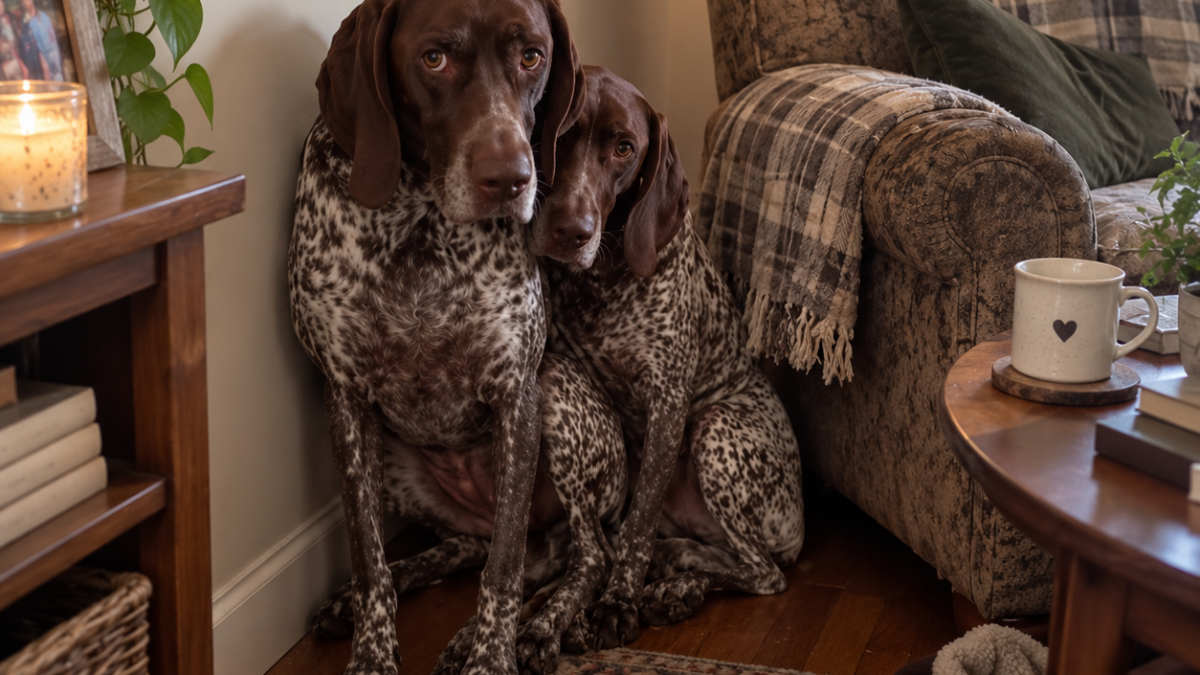
PART 2
My partner, Luis, drove us back to the station.
Normally, after a call like that, we talked.
Sometimes we talked about the case. Sometimes we deliberately talked about anything except the case.
Baseball.
Our kids.
The terrible coffee at the station.
A broken air conditioner.
Anything that reminded us the rest of the world was still moving.
That morning, neither of us said much.
I sat in the passenger seat staring through the windshield.
At every red light, I saw those dogs again.
Pressed together.
Watching the door.
Luis finally glanced at me.
“You okay?”
“Yeah.”
It was the automatic answer.
He knew it.
I knew it.
He gave me another look.
“Those dogs?”
I nodded.
He exhaled.
“Yeah.”
That was all he said.
But there are times when one word between people who do this job carries an entire conversation.
We had both seen them.
We had both understood.
The rest of the shift should have pushed the apartment out of my mind.
It didn’t.
We answered a call from a construction site where a worker had injured his wrist.
Then an elderly man who had fallen beside his bed.
Then a teenage girl having an asthma attack at school.
Life kept presenting us with people who needed help immediately.
That usually works on you.
It forces your attention into the present.
Yet during every quiet minute, my mind went back to that apartment.
At the end of my shift, I drove home.
My wife, Rebecca, was in the kitchen chopping vegetables when I walked through the door.
She took one look at me and put down the knife.
“Bad day?”
“I’ve had worse.”
“That wasn’t what I asked.”
I dropped my keys into the bowl beside the door.
Rebecca and I had been married long enough that she knew when not to accept the first answer.
I opened the refrigerator, stared inside without knowing what I wanted, then closed it again.
“There was an elderly woman.”
Rebecca waited.
“She died at home. Peacefully, from what we could tell.”
“I’m sorry.”
“She had two dogs.”
Something in my voice must have changed because Rebecca stopped what she was doing.
I told her about the neighbor.
The apartment.
The woman in the chair.
The two German Shorthaired Pointers against the wall.
I described how they had watched us.
How one had leaned into the other.
How they had followed their owner with their eyes as we carried her away.
Rebecca rested both palms against the kitchen counter.
“What happened to them?”
“Animal control.”
“Where?”
“I don’t know.”
She looked at me.
“You want to know.”
It wasn’t a question.
“I keep thinking about what that officer said.”
“What?”
“That they might not stay together.”
Rebecca was quiet.
Then she asked, “Do you know anything about them?”
“No.”
“Names?”
“No.”
“Age?”
“No.”
“Whether she had family?”
“Police said nobody nearby.”
Rebecca picked up the knife again but did not start cutting.
“What are you going to do?”
“I don’t know.”
She gave me a small smile.
That smile meant she knew me better than I knew myself.
“You’re going to find them.”
I tried to laugh.
“We already have a house, jobs, bills, and a yard that I can barely keep alive.”
“I didn’t say you were going to adopt them.”
I looked at her.
She raised one eyebrow.
“I said you’re going to find them.”
That night I slept badly.
At 1:17 a.m., I woke up thinking I had heard a dog scratching at our bedroom door.
We didn’t own a dog.
At 2:40, I woke again.
This time I saw the old woman’s apartment exactly as it had been.
Lamp glowing.
Book open.
Dogs against the wall.
At 4:05, I stopped pretending I was asleep.
I went downstairs.
Rebecca found me at the kitchen table just after six.
My phone was in front of me.
“You haven’t called yet?”
“It’s six in the morning.”
“So you have some restraint.”
“Apparently.”
She poured coffee.
At eight-thirty, I called the police department.
I felt ridiculous explaining myself.
“My name is Daniel Mercer. I was with EMS at an unattended death yesterday on Willow Street.”
The desk officer paused.
“Yes?”
“There were two dogs in the apartment.”
Another pause.
“I’m trying to find out where animal control took them.”
The officer sounded cautious.
“Are you family?”
“No.”
“Owner?”
“No.”
“Then may I ask why?”
I looked toward the living room.
Rebecca was pretending not to listen.
“I was there,” I said. “I saw them. I just want to make sure they’re okay.”
The officer was silent for several seconds.
Then his voice softened.
“German Shorthaired Pointers?”
“Yes.”
“I remember the report.”
He gave me the name of the municipal shelter on the north side of the county.
I wrote it down.
Before he hung up, he said, “For what it’s worth, the animal control officer noted they were transported together.”
I closed my eyes.
“Thank you.”
“That doesn’t necessarily mean they’ll be adopted together.”
“I understand.”
When I ended the call, Rebecca slid a mug toward me.
“Well?”
“They’re together.”
“For now?”
“For now.”
She sat across from me.
“When do you work?”
“Not until tomorrow night.”
Rebecca took a sip of coffee.
“Then get dressed.”
I stared at her.
She shrugged.
“You weren’t going to spend the entire day sitting here wondering.”
The shelter opened at ten.
We were there at ten-fifteen.
I had been to animal shelters before, usually on calls involving employees or visitors.
This felt different.
The sound hit me first.
Barking from every direction.
Metal doors.
Water bowls moving across concrete.
Voices echoing down long corridors.
At the front desk, a woman in her fifties greeted us.
Her name tag read MARA JENKINS — SHELTER DIRECTOR.
“How can I help you?”
I explained who I was.
The moment I mentioned the apartment on Willow Street, recognition crossed her face.
“The two pointers.”
“Yes.”
She studied me.
“You were one of the responders?”
“I was.”
Rebecca stood beside me.
“We just wanted to see them,” I said.
Mara’s expression softened.
“Come with me.”
As we walked, she told us their names.
Max and Leo.
Brothers.
Six years old.
Both neutered.
Healthy aside from mild dehydration when they arrived.
Their owner had been Eleanor Whitmore.
Hearing her name did something strange to me.
Until then, she had been “the elderly woman.”
“The patient.”
“The deceased.”
Emergency work can reduce people to terms without meaning to.
Now she was Eleanor.
A woman with a name.
A woman who had owned two dogs named Max and Leo.
A woman whose book was still open beside her chair.
Mara stopped in front of a kennel.
“There they are.”
My chest tightened.
Max and Leo were lying together on one bed despite the kennel having two.
Max lifted his head first.
Leo followed.
For several seconds, they stared at me.
I crouched.
“Hey, guys.”
Max stood.
He approached the kennel door slowly.
He sniffed through the bars.
Then something happened that I will remember for the rest of my life.
His tail moved.
Once.
Then twice.
A tiny, uncertain wag.
Leo got up and came beside him.
He smelled my hand.
Then he looked at Max.
Max looked back.
Leo’s tail moved too.
Rebecca knelt beside me.
“Oh, my God.”
Mara smiled faintly.
“They haven’t done that much.”
“What?”
“Wagged.”
I turned toward her.
“They recognize you?”
“I don’t know.”
Mara folded her arms.
“But dogs remember scent. They remember moments. Sometimes they remember the person who was present during something important.”
I looked at Max.
I wasn’t sure I wanted to be remembered from that day.
Still, I reached through the bars as far as I safely could.
Max pressed his nose against my fingers.
Then Leo did the same.
Mara unlocked the kennel.
“Want to meet them properly?”
Rebecca looked at me.
I nodded.
We went into a small visiting room.
The moment Max and Leo were brought inside, they stayed shoulder to shoulder.
If Max crossed the room, Leo crossed.
If Leo stopped, Max stopped.
Rebecca sat on the floor.
She didn’t call them.
She simply waited.
Max approached first.
He sniffed her knee.
Then her hand.
Leo came next.
Within ten minutes, both dogs were lying near us.
Not touching us.
But close.
It felt like being trusted with something fragile.
Mara sat in a chair near the door.
“They’re what we call a bonded pair,” she said.
“How bonded?”
She looked at the dogs.
“We tried separating them for their intake exams. Max screamed.”
“Screamed?”
“Not barked. Screamed.”
Rebecca’s eyes filled.
Mara continued.
“Leo stopped moving. He just flattened himself on the floor and wouldn’t respond until Max came back.”
“So you won’t separate them.”
It came out more forcefully than I intended.
Mara’s expression changed.
“That’s our recommendation.”
“Recommendation?”
She hesitated.
“That’s why I need to tell you something.”
I felt the same cold sensation I had felt outside Eleanor’s apartment.
“What?”
“There’s a family issue.”
I sat straighter.
“I thought she didn’t have family nearby.”
“She didn’t.”
“Then what family issue?”
Mara glanced toward the door before answering.
“A nephew contacted animal control this morning.”
Rebecca looked at me.
“Does he want them?”
Mara did not answer immediately.
Finally she said, “He says he does.”
There was something in her tone.
“What aren’t you saying?”
Mara sighed.
“He called yesterday asking their breed, ages, whether they had papers, and whether either one could be released separately.”
My stomach turned.
“Separately?”
“Yes.”
“Why?”
“He said he could only keep one.”
I looked at Max and Leo.
They were lying with their sides touching.
“What happens to the other?”
“He didn’t seem particularly concerned.”
Rebecca’s face hardened.
“What exactly does that mean?”
Mara leaned back.
“I have to be careful. He is a relative. There may be an estate process. Until legal custody is clear, the dogs are on a temporary hold.”
“How long?”
“Could be days. Could be weeks.”
“Can he take one?”
“Not today.”
“And later?”
“If he becomes legally authorized to handle Eleanor’s property, animals can unfortunately fall under that category.”
I stared at her.
“You’ve seen these dogs separated.”
“Yes.”
“You know what it does to them.”
“Yes.”
“And someone can just walk in and take one?”
Mara’s jaw tightened.
“I didn’t say I liked it.”
Max raised his head at the sound of my voice.
I lowered it immediately.
“I’m sorry.”
Mara shook her head.
“No. I understand.”
Rebecca reached down and stroked Leo’s ear.
“What can we do?”
Mara looked at us carefully.
“Are you asking as concerned visitors?”
Rebecca glanced at me.
Then she said, “Maybe not.”
I looked at her.
She smiled through wet eyes.
“What?”
“We have a fenced yard.”
“Rebecca—”
“You’ve been awake all night.”
“That doesn’t mean we should adopt two sixty-pound dogs.”
“They’re about fifty-five.”
Mara smiled despite herself.
I looked at her.
“You’re not helping.”
Rebecca touched my arm.
“We don’t have to decide now.”
Max suddenly got up.
He walked toward me.
Then he placed his head on my knee.
The room went silent.
Leo followed.
He pressed his shoulder against Max and lowered himself beside my leg.
Rebecca whispered, “Sure. No pressure at all.”
For the first time since the call, I laughed.
It lasted about three seconds.
Then Mara said, “If you’re serious, fill out an application.”
I looked up.
“Would it matter?”
“It could.”
“How?”
“If Eleanor’s estate releases them to the shelter, we can move immediately. Having an approved home ready—especially one willing to take both—would help.”
Rebecca stood.
“Give us the paperwork.”
On the drive home, I kept telling myself we had not adopted two dogs.
We had filled out an application.
There was a difference.
Rebecca let me repeat that three times.
On the fourth, she said, “Whatever helps you sleep.”
We spent the afternoon researching German Shorthaired Pointers.
By dinner I had learned that they were energetic, intelligent, affectionate, stubborn, athletic, and fully capable of redesigning a house if under-exercised.
Rebecca closed her laptop.
“So basically you.”
“I’m not athletic.”
“Four out of five.”
We submitted veterinary references despite not currently owning pets, personal references, proof of home ownership, photographs of the yard, our work schedules, and everything else the shelter requested.
Two days later, Mara called.
“You’ve passed the initial review.”
“That was fast.”
“I may have encouraged someone to prioritize it.”
“Thank you.”
“Don’t thank me yet.”
My stomach dropped.
“The nephew?”
“Yes.”
His name was Travis Whitmore.
He lived almost four hours away.
According to Mara, he had contacted the shelter three more times.
During one call, he had asked whether the dogs were “show quality.”
During another, whether there were registration papers in their intake belongings.
During the third, he asked what “a trained adult pointer usually goes for.”
Mara could not prove what he intended.
But she didn’t need to explain it.
“He’s trying to sell them.”
“I didn’t say that.”
“You didn’t have to.”
“I’m documenting every call.”
“Can’t you refuse him?”
“Not if he obtains lawful authority from the estate.”
I squeezed the phone.
“So what are we waiting for?”
“Probate.”
That word became the enemy of my week.
Probate.
A process.
A court.
Paperwork.
Necessary things, I understood.
But Max and Leo did not understand courts.
They understood that their person had vanished.
They understood concrete floors and unfamiliar smells.
They understood that every time a door opened, it might mean separation.
Rebecca and I visited them whenever the shelter allowed.
On the third visit, Leo climbed onto the bench beside her.
On the fourth, Max brought me a chewed tennis ball.
On the fifth, both of them ran to the kennel door when they heard my voice.
Each visit made leaving harder.
One afternoon Mara asked me to step into her office.
She closed the door.
“There’s another development.”
I sat down.
“Good or bad?”
“I don’t know yet.”
She handed me a photocopy.
It was an email from Travis.
He claimed Eleanor had promised him the dogs years earlier.
He said he intended to take Max.
Only Max.
“What about Leo?”
“He says Leo can remain here.”
I stared at the page.
“He wants to split them.”
“Yes.”
“After you told him what happens?”
“Yes.”
“Why Max?”
Mara hesitated.
“He asked which dog had the better pedigree.”
I felt heat move up my neck.
“What kind of person—”
“I know.”
“No, I don’t think you do.”
Mara’s eyes hardened.
“I’ve worked here sixteen years, Daniel. I know exactly what kind of person.”
I stopped.
She pointed to the email.
“But anger won’t solve this.”
“So what will?”
“Evidence.”
“Evidence of what?”
“That Eleanor had different wishes.”
“Do we have any?”
“Not yet.”
That evening, I drove back to Willow Street.
I did not go inside Eleanor’s apartment.
I couldn’t.
Instead, I knocked on the neighbor’s door.
The woman who had called 911 answered.
Her name was Rosa Alvarez.
When I explained who I was, she recognized me immediately.
“The paramedic.”
“EMT.”
“Yes. I’m sorry. Come in.”
Her apartment smelled like cinnamon and coffee.
There were family photographs covering almost every shelf.
I told her about Max and Leo.
When I mentioned Travis, her expression changed.
“That boy.”
“You know him?”
“I met him twice.”
“Was he close to Eleanor?”
Rosa gave a short, humorless laugh.
“Close?”
She sat down.
“Travis came around when he needed money.”
“How often?”
“The last time? Maybe two years ago.”
“What happened?”
Rosa looked toward the wall separating her apartment from Eleanor’s.
“I heard them arguing.”
“About what?”
“I never asked. Eleanor was private.”
She paused.
“But afterward she came here crying.”
“What did she say?”
Rosa’s voice softened.
“She said, ‘I finally understood the difference between someone who visits you and someone who checks what you own.’”
I felt my stomach tighten.
“Did she ever say anything about the dogs?”
Rosa smiled.
“Every day.”
“No, I mean if something happened to her.”
Her smile disappeared.
“Yes.”
I leaned forward.
“What?”
“She made me promise.”
“Promise what?”
Rosa’s eyes moved toward mine.
“That Max and Leo would never be separated.”
For several seconds, I said nothing.
“Did she write that anywhere?”
“I don’t know.”
“Did she have a lawyer?”
“I think so.”
“Do you know the name?”
She shook her head.
Then suddenly she stopped.
“Wait.”
She stood and walked toward a small desk.
From a drawer, she removed a Christmas card.
On the front was a photograph of Eleanor with Max and Leo wearing ridiculous red-and-green bandanas.
Rosa turned it over.
There was a return address label.
Below Eleanor’s address were three handwritten words.
Whitmore & Cole Law.
“Is that—”
“She gave me this last Christmas. She wrote her attorney’s office on the back because she wanted me to have it in case she ever got sick and couldn’t speak for herself.”
I took a photograph of the card.
My hands were shaking.
The next morning I called the law office.
I expected to be told nothing.
Instead, after I explained the situation, the receptionist went quiet.
Then she transferred me to an attorney named Helen Cole.
“Mr. Mercer,” she said, “I cannot discuss the details of a client’s estate with you.”
“I understand.”
“But I can tell you that our office was notified of Mrs. Whitmore’s death yesterday.”
“Okay.”
“And I can tell you that you were right to call.”
My heart started beating faster.
“Why?”
“I need to make several calls before I say anything else.”
“Does it have to do with Max and Leo?”
A long pause.
“Yes.”
I stood up from my kitchen chair.
“Are they supposed to stay together?”
Another pause.
“I will contact the shelter.”
That was all she would say.
For the rest of the day, I kept my phone within reach.
At 4:22 p.m., Mara called.
Her voice sounded different.
“You found her attorney.”
“Yes.”
“Daniel, Eleanor left written instructions regarding the dogs.”
I closed my eyes.
“What do they say?”
“That they are to remain together.”
Relief hit me so hard I had to sit down.
“Then it’s over.”
“No.”
My eyes opened.
“What do you mean, no?”
“Travis has filed a petition with probate court.”
“For what?”
“To challenge the instructions.”
“Why?”
“He claims Eleanor was not competent when she signed them.”
I nearly laughed because the alternative was throwing my phone.
“Based on what?”
“I don’t know.”
“Did he see her?”
“Apparently not for almost two years.”
“Then how does he know whether she was competent?”
“Daniel.”
“No. Seriously.”
“I agree with you.”
“So why are we treating this like it’s reasonable?”
“Because a court has to decide.”
I stood and walked to the window.
Max and Leo were twenty minutes away in a kennel.
Travis was four hours away.
Eleanor was gone.
And somehow the person who had shown up least was creating the biggest problem.
“What happens now?”
“The dogs stay here until the hearing.”
“When?”
“Next week.”
A week can be a very long time when you measure it in kennel nights.
Rebecca and I visited every day we could.
Max became more outgoing.
Leo remained cautious.
He liked to press his forehead against Rebecca’s chest when she sat on the floor.
Max discovered that my jacket pockets often contained treats.
Within two visits, he learned how zippers worked.
“They’re manipulating us,” I told Rebecca.
“Yes.”
“And you’re okay with that?”
“Completely.”
But there were signs they were struggling.
They lost weight.
Leo developed a raw spot on one paw from licking.
Max paced at night.
Mara moved them to a quieter kennel away from the main corridor.
Staff members took them outside together.
Nobody separated them unless absolutely necessary.
Then, three days before the hearing, Travis came to the shelter.
I know because Rebecca and I were there.
We were in the outdoor exercise area with Max and Leo when Mara appeared at the gate.
Her face told me something was wrong.
“Could I speak with you?”
Rebecca took both leashes.
I followed Mara inside.
A man was standing near the front desk.
Early forties.
Expensive boots.
Dark jacket.
Phone in his hand.
He glanced at me.
“Who’s this?”
Mara answered.
“An approved adoption applicant.”
His eyes narrowed.
“For my aunt’s dogs?”
I said nothing.
He looked me up and down.
“So you’re the ambulance guy.”
“How do you know that?”
“Mara said some responder had gotten emotionally involved.”
Mara’s jaw tightened.
“I did not use those words.”
Travis smiled.
“Same thing.”
He turned to me.
“These dogs belong to my family.”
“Your aunt left instructions.”
“She was eighty-one.”
“Seventy-nine,” Mara corrected.
He ignored her.
“Old people sign things.”
I felt my hands curl.
Mara noticed.
“Daniel.”
I unclenched them.
Travis smiled again.
“You planning to hit me?”
“No.”
“Good.”
He leaned closer.
“Because then I’d own your house too.”
That told me almost everything I needed to know about him.
I stepped back.
“What do you want?”
“Max.”
“Why only Max?”
“None of your business.”
“Leo nearly shuts down when they’re separated.”
“Dogs adjust.”
“You haven’t seen them together.”
“They’re animals.”
There are sentences people say that reveal more about them than they intend.
That was one of those sentences.
I looked at him.
“They were with your aunt when she died.”
His expression flickered.
Only for a second.
Then it vanished.
“So?”
“They stayed beside her.”
“So?”
“They waited three days.”
He looked bored.
“What’s your point?”
My anger disappeared.
Not because I had forgiven him.
Because suddenly I understood that nothing I could say would reach him.
There are people who do not need a better explanation.
They simply have a smaller definition of love.
I turned away.
Behind me, Travis said, “I already have someone interested in Max.”
I stopped.
Mara froze.
Slowly, I turned back.
“Interested?”
Travis realized he had said too much.
“Friend of mine.”
“You’re selling him.”
“I didn’t say that.”
“You just said—”
“I said someone was interested.”
Mara stepped between us.
“Mr. Whitmore, I think this conversation is over.”
“I came to collect the dog.”
“You cannot.”
“I’m next of kin.”
“You do not currently have authority.”
He pulled folded papers from his jacket.
“My attorney says otherwise.”
Mara took them.
Read the first page.
Then the second.
She walked behind the desk and called someone.
Travis looked at me.
“This is what happens when strangers interfere in family business.”
I said, “From what I’ve heard, you weren’t around much when your aunt was alive.”
His face changed.
“Watch yourself.”
“Why?”
“You don’t know anything.”
“I know her neighbor saw her every day.”
He stepped closer.
“I said watch yourself.”
At that exact moment Max barked from outside.
One sharp bark.
Then another.
Travis glanced toward the sound.
He smiled.
“Good-looking dog.”
Not “Max.”
Not his aunt’s dog.
Not the dog that had waited beside her body.
A good-looking dog.
A commodity.
Mara returned.
“These documents do not authorize release.”
Travis’s face hardened.
“My lawyer—”
“Your lawyer filed a petition. This is a copy of the filing. It is not a court order.”
“You’re refusing next of kin?”
“I am refusing to release an animal without lawful authorization while ownership is disputed.”
“You’ll regret that.”
Mara leaned across the counter.
“I’ve been threatened by people with bigger lawyers than yours.”
Travis grabbed the papers.
“This isn’t over.”
“No,” Mara said. “It isn’t.”
He pointed at me.
“And stay away from my family’s property.”
I did not respond.
He walked out.
The door slammed behind him.
Mara released a breath.
Then she looked at me.
“You heard what he said.”
“About having someone interested?”
“Yes.”
“You documented it?”
She held up her phone.
“Our lobby has audio and video surveillance.”
For the first time in days, I smiled.
“Good.”
The probate hearing was scheduled for Wednesday morning.
I wasn’t supposed to be part of it.
Legally, I was nobody.
Just a prospective adopter.
But Helen Cole called me the day before.
“Mr. Mercer, would you be willing to attend?”
“Why?”
“Because Mrs. Whitmore’s instructions include a provision that whoever ultimately cares for the dogs should understand their history.”
I didn’t understand exactly what that meant.
I agreed anyway.
The courtroom was smaller than I expected.
Travis sat at one table with his attorney.
Helen sat at the other.
Rosa was there.
Mara was there.
Rebecca sat beside me.
When Travis saw us, he shook his head.
The judge entered.
Everyone stood.
What followed was less dramatic than television makes courtrooms look.
Documents.
Dates.
Questions.
Procedures.
Travis’s attorney argued that Eleanor’s written instructions regarding Max and Leo should not control because she had allegedly been experiencing cognitive decline.
Helen asked for evidence.
There wasn’t much.
Travis had one text message from Eleanor in which she had repeated a question.
One.
A woman approaching eighty had asked the same question twice.
That was his evidence.
Then Helen presented Eleanor’s medical records.
With the court’s permission, she summarized the relevant portion.
No diagnosis of dementia.
No finding of incapacity.
No physician questioning her ability to manage her affairs.
Then Eleanor’s primary care physician had provided a sworn statement saying she remained mentally competent at the time the documents were signed.
Travis shifted in his seat.
But Helen wasn’t finished.
She presented the estate documents.
Eleanor had updated her will fourteen months earlier.
She had left modest gifts to several charities.
Her apartment was to be sold, with proceeds distributed according to instructions that did not include Travis.
Then came Max and Leo.
Eleanor had created a small pet-care trust.
Enough to cover food, routine veterinary care, medication, and emergencies for the rest of their expected lives.
The money did not belong to whoever adopted them.
Expenses would be reimbursed through the attorney administering the trust.
There was one central condition.
Max and Leo must remain together.
Unless a veterinarian determined separation was medically necessary, they were never to be permanently placed in different homes.
Rebecca grabbed my hand.
Travis’s attorney stood.
He argued the provision was sentimental and impractical.
The judge asked why Travis wanted Max specifically.
His attorney hesitated.
Then said Travis had developed “a particular bond” with Max.
Rosa made a sound beside me.
The judge looked toward her.
Helen stood.
“Your Honor, we have evidence relevant to that representation.”
My heart began pounding.
Mara was called.
She testified about Travis’s phone calls.
His questions about pedigree.
Registration papers.
Market value.
Whether the dogs could be separated.
Then the shelter’s recording was played.
Travis’s own voice filled the courtroom.
“I already have someone interested in Max.”
His attorney closed his eyes.
The judge looked at Travis.
“Interested in what sense?”
Travis cleared his throat.
“A friend likes the breed.”
“Were you planning to transfer the dog to that friend?”
“Maybe.”
“For money?”
“No.”
The judge waited.
Travis looked away.
“No.”
Helen stood again.
“One additional item, Your Honor.”
She held up a small flash drive.
Travis’s attorney objected.
The judge asked what it contained.
Helen answered, “A video recorded in my office when Mrs. Whitmore executed the pet-care instructions.”
The room became completely still.
I looked at Rebecca.
Neither of us had known.
The judge allowed it.
A monitor was turned toward the courtroom.
Then Eleanor appeared on the screen.
Alive.
Sitting upright.
Silver hair neatly arranged.
Blue cardigan.
The same face I had seen in the chair, but animated now.
Warm.
Alert.
Smiling.
I stopped breathing for a moment.
Max and Leo were beside her.
One on each side.
She stroked their heads.
Then she looked directly into the camera.
“My name is Eleanor May Whitmore.”
Her voice was gentle but steady.
“These two ridiculous creatures are Max and Leo.”
A few people smiled.
Eleanor did too.
“They came into my life when I thought the quiet years had begun. I was wrong.”
She scratched Max behind the ears.
“They have destroyed three pairs of shoes, one sofa cushion, a screen door, and my belief that I was too old to learn new tricks.”
Rebecca covered her mouth.
Then Eleanor’s expression became serious.
“They are brothers.”
She looked down at them.
“They have slept beside each other since they were puppies.”
Her hand rested on Leo’s neck.
“If something happens to me, I know they will grieve.”
The courtroom felt suddenly smaller.
“I cannot prevent that.”
Her voice trembled slightly.
“But I can ask one thing of whoever comes after me.”
She looked into the camera.
“Please do not make them lose each other too.”
I felt my eyes burn.
Beside me, Rosa was crying openly.
Eleanor continued.
“I have family by blood. I also have people who became family by showing up.”
Travis stared at the table.
“I learned late in life that those are not always the same thing.”
Nobody moved.
“If my nephew Travis asks for the dogs, I do not want them placed with him.”
Travis looked up sharply.
His attorney whispered something.
Eleanor continued.
“He has asked me twice whether I would sell Max because someone he knows wanted a purebred pointer.”
A murmur moved through the room.
The judge raised a hand and silence returned.
“I said no.”
Eleanor’s eyes were clear.
“I am saying no again.”
Then she smiled.
“If there is someone patient enough to take both of these fools, please tell them thank you.”
Max lifted his paw in the recording and placed it on her knee.
Eleanor laughed.
That laugh destroyed me.
Because I had only known the silence that came afterward.
The video ended.
No one spoke for several seconds.
The judge removed his glasses.
He looked at Travis.
“Mr. Whitmore, is there anything about your aunt’s wishes that remains unclear to you?”
Travis’s face was red.
“My aunt was manipulated.”
“By whom?”
“Her lawyer.”
Helen did not react.
The judge asked, “For what purpose?”
“To keep me from the estate.”
“Counsel?”
Travis’s attorney stood slowly.
“We have no evidence supporting that allegation at this time.”
The judge put his glasses back on.
What happened next was not the explosive revenge people imagine when they think of justice.
Nobody cheered.
Nobody clapped.
There was no dramatic music.
There was something better.
A record.
A decision.
The judge rejected Travis’s petition concerning the dogs.
He recognized Eleanor’s instructions and the trust provisions.
He directed that custody be transferred according to those documents.
And because Travis had attempted to arrange the transfer of estate property while his authority was disputed, the judge ordered additional review of his role in the estate proceedings and warned him against attempting to remove or dispose of anything belonging to Eleanor without authorization.
Travis stared straight ahead.
His plan had not failed because I had outsmarted him.
It had failed because Eleanor had known him.
And she had protected Max and Leo while she still could.
Outside the courtroom, Travis caught up with us.
“Happy?”
I turned.
Rebecca squeezed my arm.
I said, “No.”
He looked surprised.
“You got what you wanted.”
“This was never about beating you.”
“Sure.”
“It was about keeping them together.”
He laughed bitterly.
“They’re dogs.”
I looked at him.
“That’s why you lost.”
His expression changed.
I continued before he could answer.
“You thought everybody else saw what you saw. Property. Money. Something to transfer.”
I pointed back toward the courtroom.
“Your aunt knew better.”
Travis stepped forward.
A deputy near the doors watched him.
He stopped.
I didn’t feel triumphant.
I didn’t hate him.
Mostly, I felt sorry for a man who had just watched his dead aunt explain exactly why she did not trust him and had apparently learned nothing from it.
Rebecca and I walked away.
Mara caught us near the elevator.
“Don’t make plans tonight.”
“Why?”
She smiled.
“Because tomorrow might be busy.”
The next morning, my phone rang at 8:03.
Mara.
“You still want two extremely energetic, emotionally complicated German Shorthaired Pointers?”
I looked across the kitchen at Rebecca.
She saw my face.
Her eyes widened.
I answered, “Yes.”
“Both?”
“Both.”
“Forever?”
“Forever.”
“Then come get your dogs.”
Rebecca screamed.
Actually screamed.
I pulled the phone away from my ear.
Mara laughed.
“I assume that was your wife.”
“Yes.”
“I’ll have the paperwork ready.”
We arrived at the shelter before they finished preparing everything.
For once, nobody seemed to mind.
Mara walked us through the adoption contract.
Then the trust paperwork.
Then feeding instructions.
Veterinary records.
Microchip information.
Behavioral notes.
Max liked carrots.
Leo hated vacuum cleaners.
Both pulled on leashes when they saw squirrels.
Max was afraid of thunderstorms.
Leo refused to walk through puddles unless Max went first.
Rebecca read every line as if she were signing mortgage papers.
Then Mara placed two old red collars on the desk.
“These came with them.”
I touched one.
The leather was worn smooth.
Small metal tags hung from each.
MAX WHITMORE.
LEO WHITMORE.
Below their names was Eleanor’s old phone number.
Rebecca brushed one finger across the engraving.
“Do we change them?”
Mara shook her head.
“You don’t have to.”
I looked at Rebecca.
“No.”
She nodded.
“We keep them.”
Mara led us toward the kennel corridor.
Before we reached the door, barking exploded from inside.
Then I heard two voices above the rest.
Max and Leo.
When the door opened, they were standing against the kennel gate.
Tails whipping.
Bodies shaking.
Max let out a sound halfway between a bark and a cry.
Leo jumped straight up.
Mara laughed.
“I think they know.”
The kennel door opened.
Max came first.
He hit me in the chest hard enough to make me stumble.
Leo went directly to Rebecca.
She dropped to her knees.
He buried his face beneath her chin.
Rebecca started crying.
I wasn’t doing much better.
Mara handed me Max’s leash.
Then Leo’s leash to Rebecca.
“Ready?”
No.
Absolutely not.
I had no idea what I was doing.
I had never owned two German Shorthaired Pointers.
I did not know whether they would sleep.
Whether they would destroy our furniture.
Whether they would ever stop waiting for Eleanor.
Whether they would truly accept us.
But sometimes ready is not a feeling.
Sometimes it is a choice.
I looked down at Max.
He looked up at me.
“Yeah,” I said.
“We’re ready.”
They walked out of the shelter side by side.
Not perfectly.
Max pulled.
Leo stopped to smell a trash can.
Their leashes tangled around my knees before we reached the parking lot.
Rebecca laughed so hard she had to lean against the car.
“This is going great.”
“Very smooth.”
“Natural dog owners.”
“Obviously.”
We opened the back door.
Max jumped in.
Leo immediately followed.
They sat together.
Shoulder against shoulder.
Exactly as they had been against Eleanor’s wall.
But the expression was different.
Their mouths were open.
Their tongues hung out.
Max pressed his nose to the window.
Leo leaned into him.
As we pulled away, I looked at them in the mirror.
For weeks I had remembered those dogs as two frightened animals watching their world disappear through an apartment door.
Now that door was behind them.
When we reached our house, Max jumped out first.
Leo followed.
They stood in the driveway staring at everything.
Grass.
Trees.
Mailboxes.
A kid riding a bicycle.
A lawn mower three houses away.
Max sniffed the air.
Leo looked back at the car.
Then at us.
Rebecca opened the gate.
“Come on, boys.”
They entered the backyard cautiously.
For almost a minute, they stayed near the patio.
Then Max saw a squirrel.
Everything changed.
He launched across the yard.
Leo exploded after him.
Rebecca shouted.
I shouted.
The squirrel escaped easily.
Max and Leo ran three circles around the maple tree, chased each other across the grass, crashed into a patio chair, recovered, and took off again.
I started laughing.
Not a polite laugh.
Not a careful laugh.
The kind that hurts your stomach.
Rebecca stood beside me with tears on her cheeks.
“They’re running.”
“I see that.”
“No. Look at them.”
I understood.
At the shelter they had moved because people moved them.
They had walked because leashes required it.
This was different.
They were running because they wanted to.
Max sprinted toward us.
At the last second he swerved.
Leo followed.
The two of them tore across the lawn again.
For the first time since Eleanor died, they looked like dogs instead of survivors.
That first night was terrible.
There is no poetic way to say it.
Max paced.
Leo whined.
Neither wanted the dog beds we had purchased.
Both stared at the front door.
At 11:30, Max scratched it.
At midnight, Leo joined him.
At 12:20, I took them outside.
At 12:45, they were back at the door.
At 1:10, Rebecca found me sitting on the floor between them.
“They’re waiting for her,” I said.
Rebecca sat beside me.
“I know.”
“How long do you think they’ll do this?”
“As long as they need to.”
Max rested his chin on my thigh.
Leo lay against Rebecca.
At some point all four of us fell asleep on the living room floor.
I woke before sunrise with a terrible pain in my neck and Max’s back pressed against my ribs.
Leo was curled behind Rebecca’s knees.
She opened one eye.
“Comfortable?”
“No.”
“Me neither.”
Neither of us moved.
At 6:45, both dogs stood up at exactly the same time.
Max walked toward the door.
Leo followed.
They stared at us.
I checked my phone.
6:47.
Something clicked.
“What time did Rosa say Eleanor walked them?”
Rebecca sat up.
“Seven.”
We took them out.
The moment we reached the sidewalk, both dogs turned left.
Not randomly.
Confidently.
They knew where they were going.
I let them lead.
We walked six blocks.
At every intersection, Max slowed.
Leo checked beside him.
Then they continued.
Eventually we reached a small park.
Both dogs stopped near a wooden bench.
Max sniffed it.
Leo sat.
Rebecca looked at me.
“This was their route.”
I nodded.
For ten minutes, we stood there.
I imagined Eleanor sitting on that bench.
Maybe she carried coffee.
Maybe she complained about her knees.
Maybe Max chased squirrels.
Maybe Leo sniffed every tree.
Maybe neighbors waved.
A whole life existed before we entered it.
That realization became important.
Rebecca and I were not replacing Eleanor.
We could never replace her.
We were simply arriving after her.
There is a difference.
For the first few weeks, grief lived inside our house with us.
It had routines.
At seven every morning, Max and Leo went to the door.
At around five in the afternoon, both became restless.
Rosa later told us Eleanor fed them at 5:15.
Whenever an older woman with silver hair passed our house, Max froze.
Whenever keys jingled outside, Leo ran to the window.
Sometimes both dogs woke suddenly from sleep and searched the room.
Those moments were hard.
I had thought bringing them home would be the happy ending.
It wasn’t.
It was the beginning of healing.
And healing is rarely clean.
One evening, two weeks after the adoption, I came home from a shift.
Max ran toward me.
Leo followed.
They stopped halfway across the room.
For one second, they stared.
Then Max charged.
He jumped against me.
Leo pushed his head under my hand.
Rebecca stood in the kitchen smiling.
“What?”
“They’ve been listening for your truck for twenty minutes.”
I looked down at them.
Something in my chest shifted.
They had been waiting for me.
Not Eleanor.
Not because they had forgotten her.
Because their hearts had made room.
That may be one of the most extraordinary things animals do.
They can remember one love without refusing another.
A month passed.
Then two.
Max gained five pounds.
Leo’s paw healed.
They learned where we kept treats.
They learned that Rebecca was more likely to give in.
They learned that I said no twice before saying yes.
They learned our bed was technically off-limits and that this rule had absolutely no enforcement mechanism.
They learned that the mail carrier carried biscuits.
The mail carrier learned to bring four because Max believed two were insufficient compensation for protecting the property.
Our furniture suffered.
One couch cushion died a violent death.
Rebecca came home one afternoon to find foam scattered across the living room.
Max was sitting in the middle of it.
Leo was under the table.
“Which one did it?” she asked when I came home.
I examined the scene.
Max had foam stuck to his lip.
Leo looked ashamed despite being nowhere near the evidence.
“Impossible to determine.”
Rebecca pointed at Max.
“He’s wearing the crime.”
“Circumstantial.”
We laughed.
It felt good to laugh about them.
Not cry.
Not worry.
Laugh.
Then one Saturday Rosa called.
“I found something.”
Her voice was shaking.
“What?”
“The estate people finished clearing Eleanor’s apartment.”
I stopped what I was doing.
“They gave me a box.”
“What kind of box?”
“She wrote my name on it.”
I looked across the yard.
Max and Leo were sleeping in a patch of sunlight.
“What’s inside?”
“Things for the boys.”
We drove to Rosa’s apartment that afternoon.
It was the first time I had returned to that building since the day Eleanor died.
Max and Leo came with us.
The moment we entered the hallway, everything changed.
Max stopped.
Leo froze behind him.
Their tails dropped.
I immediately regretted bringing them.
Rebecca crouched.
“It’s okay.”
Max sniffed the air.
Then he began pulling.
Toward Eleanor’s door.
Leo followed.
My throat tightened.
The apartment was empty now.
The door was locked.
Max pressed his nose against the bottom.
Leo sat.
For nearly a minute, neither dog moved.
I did not pull them away.
Neither did Rebecca.
Rosa stood in her doorway crying silently.
Finally Max stepped back.
He looked at Leo.
Leo stood.
Together they turned toward us.
That moment changed something in me.
I don’t know what dogs understand about death.
Anyone who claims certainty is probably giving animals either too much or too little credit.
But I know they understood absence.
They understood that the door no longer opened.
They understood that the scent on the other side was fading.
And somehow, that afternoon, they turned away from it.
Rosa brought us inside.
The box was on her dining table.
Inside were photographs.
Veterinary documents.
Two winter coats.
A battered tennis ball.
A red rubber bone.
A photograph of Max and Leo as puppies asleep in the same laundry basket.
Rebecca laughed through tears.
“They were always like this.”
Rosa nodded.
“From the first day.”
At the bottom of the box was an envelope.
Written across the front were seven words:
TO WHOEVER LOVES MAX AND LEO NEXT.
Nobody spoke.
Rosa pushed it toward me.
“You should read it.”
My fingers trembled as I opened it.
Eleanor’s handwriting was neat.
Not perfect.
But steady.
The letter began:
“If you are reading this, then I was not lucky enough to stay as long as I wanted.”
I stopped.
Rebecca took my hand.
I continued.
“First, thank you.
“I know two dogs are more work than one. I know they will take up your couch, your time, your money, and probably most of your bed.
“Please forgive them.
“They have never understood personal space.”
Rebecca laughed softly.
I kept reading.
“Max will act brave when he is frightened.
“Leo will act frightened when he is perfectly fine.
“Max hates thunder.
“Leo hates closed doors.
“Both believe cheese is a basic human right.
“They need more exercise than I have probably been giving them lately, although I assure you they have never filed a formal complaint.
“They have been together since the day they were born.
“When they were puppies, Max would not sleep unless his nose touched Leo’s back.
“Leo still checks the room when Max leaves it.
“If you ever wonder why I made such a fuss about keeping them together, that is why.
“They are not two possessions.
“They are one family.”
I could barely see the page.
Then came the line that broke all three of us.
“If they stand by your door for a while, please don’t think they don’t love you.
“They are only waiting for me.
“Let them wait.
“Do not punish them for remembering.
“One day, they will understand that you came when I could not.
“And I hope they will love you for it.”
I stopped reading.
Rosa covered her face.
Rebecca cried openly.
Max stood and walked toward me.
He placed his head against my knee.
Leo came beside him.
I rested my hand on Max’s neck.
There was one final paragraph.
“I used to worry about dying because I wondered what would happen to them.
“Then my lawyer told me something simple.
“She said I could not control who would find them, only make it easier for the right person to say yes.
“So if you are the person who said yes, please know that an old woman you never met properly is grateful to you.
“Take them somewhere they can run.
“Keep them together.
“And when they finally stop looking for me at the door, do not be sad.
“It will mean they know they are home.”
I lowered the letter.
Nobody said anything for a long time.
That evening we took Max and Leo to the park.
Not Eleanor’s old park.
A different one.
There was a huge field behind it.
The sun was low.
I unclipped Max’s long training line.
Rebecca unclipped Leo’s.
They stood still for half a second.
Then they ran.
Across the grass.
Around a tree.
Through fallen leaves.
Toward us.
Away again.
Together.
Always together.
Months later, the estate dispute involving Travis finally ended.
Helen called me once to explain that his remaining objections had been dismissed.
The court had also required him to reimburse part of the estate for expenses caused by several unauthorized attempts to advertise Eleanor’s property before he had legal authority to do so.
Apparently the dogs had not been the only things he had tried to turn into money.
I expected to feel satisfaction.
Maybe even revenge.
Instead, I felt almost nothing.
Travis had wanted to take something from a woman who was no longer there to defend herself.
Eleanor had defended herself anyway.
Not through anger.
Through preparation.
She had written things down.
She had recorded her wishes.
She had chosen people she trusted.
She had made sure that after her voice was gone, the truth would still speak for her.
That was enough.
The best consequence Travis received was not a fine or a courtroom warning.
It was hearing his aunt say, in her own voice, exactly why she had stopped trusting him.
Whether he ever learned from it was his responsibility.
Our responsibility was Max and Leo.
A year after Eleanor died, Rosa came to our house for dinner.
Max recognized her immediately.
He nearly knocked her over.
Leo cried.
Actually cried.
Rosa sat on our floor for twenty minutes while they climbed over her.
“I haven’t seen them this happy since Eleanor was alive,” she said.
Rebecca smiled.
“You think she’d approve?”
Rosa looked around.
Max was lying halfway across my feet.
Leo had stolen my spot on the couch.
One of Eleanor’s photographs was framed on a shelf.
It showed her sitting between the dogs beneath a maple tree.
Rosa nodded.
“She’d complain you spoil them.”
I laughed.
“She spoiled them.”
“Yes.”
“So we’re honoring tradition.”
Rosa smiled.
“Exactly.”
After dinner, we walked the dogs.
At 6:47 the next morning, they were waiting beside the door.
Some habits never disappeared.
I clipped Max’s leash.
Rebecca clipped Leo’s.
We walked through our neighborhood.
They no longer pulled toward Eleanor’s old route.
They had their own now.
Past the elementary school.
Across the little bridge.
Around the pond.
Through the park.
Home.
One morning, almost eighteen months after they came to us, I realized something.
Max had stopped checking every silver-haired woman we passed.
Leo no longer ran to the window whenever he heard unfamiliar keys.
And neither dog waited beside the front door in the afternoon anymore.
Eleanor’s letter came back to me.
“When they finally stop looking for me at the door, do not be sad.
“It will mean they know they are home.”
I stood in our kitchen that morning watching them sleep.
Max on his side.
Leo curled against his back.
Exactly the way they had been when I first saw them.
Their bodies still touching.
Their breathing slow.
But there was no fear now.
No concrete kennel floor.
No apartment full of silence.
No doorway carrying away the person they loved.
Only sunlight through the window.
Two old red collars hanging from hooks near the door.
Two food bowls waiting in the kitchen.
A basket full of toys.
A couch they had largely stolen from us.
A photograph of Eleanor watching over the room.
And us.
I still work emergency calls.
I still enter homes on some of the worst days of people’s lives.
There are scenes I remember.
There are scenes I wish I could forget.
And sometimes there are scenes that change the way you understand something you thought you already knew.
Before Max and Leo, I thought loyalty meant staying.
They taught me that sometimes loyalty means surviving after someone else cannot.
I thought grief was something you moved past.
They taught me you can carry grief and still run through a field.
I thought a second home replaced the first.
They taught me love does not work that way.
Nothing replaced Eleanor.
We never tried.
She was the woman who raised them.
The voice they listened for.
The hands that fed them.
The person they waited beside when she left this world.
We became something different.
We became the people who arrived afterward.
The people who opened another door.
And maybe that is one of the quietest forms of love there is.
Not asking someone to forget what they lost.
Just giving them somewhere safe to remember it.
A few nights ago, I woke around two in the morning.
I went downstairs for water.
The house was dark except for moonlight coming through the windows.
Max and Leo were on the couch.
They were both older now.
A little gray around their muzzles.
They still slept pressed together.
I stood there watching them.
Max opened one eye.
His tail thumped once against the cushion.
Leo didn’t wake.
Max closed his eye again.
That was it.
No dramatic moment.
No miracle.
Just one old dog hearing me in the dark and deciding he was safe enough to go back to sleep.
I thought about the first night I had seen him.
Pressed against a wall.
Eyes wide.
Watching strangers carry his entire world through a doorway.
Then I looked at him now.
Safe.
Warm.
Beside his brother.
Home.
I walked toward the stairs.
Halfway up, I heard paws behind me.
I turned.
Max and Leo were standing at the bottom.
“You two have beds.”
They stared.
“Very expensive beds.”
No movement.
I sighed.
“Fine.”
They followed me upstairs.
Rebecca opened one sleepy eye when all three of us entered the bedroom.
“No.”
Max jumped onto the bed.
Leo followed.
Rebecca disappeared beneath the blanket.
“I said no.”
“You’ll have to take that up with them.”
Max circled twice and dropped between us.
Leo collapsed against my legs.
Rebecca looked at me across sixty pounds of dog.
“This is your fault.”
I smiled.
“Probably.”
She reached over and rubbed Max’s ear.
A minute later the room was quiet again.
I lay there thinking about Eleanor.
I never really knew her.
Not alive.
I heard only a recording of her voice.
Read one letter in her handwriting.
Saw her life mostly through photographs, neighbors, and two dogs who loved her enough to wait.
But sometimes I feel as though she trusted me with something more important than knowing her.
She trusted the world to send somebody.
Not necessarily me.
Just somebody.
Somebody who would notice.
Somebody who would care that two frightened dogs were pressed against a wall.
Somebody who would ask where they had gone.
Somebody who would refuse to believe that losing one family meant they had to lose each other.
That morning in Eleanor’s apartment, I apologized to Max and Leo because I couldn’t promise everything would be okay.
I was right not to promise it.
Things were not okay for a while.
They grieved.
They were frightened.
Someone tried to separate them.
They spent weeks behind kennel doors.
They waited for a woman who could never return.
But “not okay yet” is not the same thing as “never okay again.”
That is what they taught me.
Sometimes the worst moment of your life is not the last chapter.
Sometimes somebody opens another door.
Sometimes the family you lose makes room for the family you have not met yet.
And sometimes, if you are very lucky, the one thing you feared losing most gets to walk through that door beside you.
Max and Leo lost Eleanor.
Nothing could change that.
But they never lost each other.
And when I look at them now, sleeping shoulder to shoulder in the home they once entered as frightened strangers, I know we kept the only promise that really mattered.
They came together.
They stayed together.
And they will never have to face the world alone again.








