PART 2: We Almost Gave Our “Difficult” Cat Away—Then She Tore at the Nursery Door for Six Minutes at 1:44 A.M.
PART 2
At first, none of us heard her.
That is one of the details that still makes me feel sick when I think about it.
The house was asleep.
The fire was growing.
And Smudge was alone in the hallway, trying to warn people who had spent two years calling her difficult.
Later, investigators would estimate that by 1:44, smoke had already begun collecting along the utility room ceiling.
The heater had ignited material stored too close to the wall.
A plastic laundry basket had started to melt.
A shelf above it caught.
The flames were still mostly contained to the utility room, but the smoke was moving faster.
Smudge must have smelled it before we did.
Cats have senses we understand in theory but rarely appreciate until something forces us to.
She left three newborn kittens in a cardboard box and ran toward the nursery.
Then she started scratching.
Scratch.
Scratch.
Scratch.
Again.
Again.
Again.
The nursery door had white paint.
By morning, four deep vertical marks would be carved through it.
At 1:45, I was still asleep.
At 1:46, Claire moved slightly but didn’t wake.
At 1:47, Smudge kept scratching.
At 1:48, the smoke entered the hallway.
At 1:49, Noah stirred in his crib.
At 1:50, Claire opened her eyes.
She told me later that the first thing she noticed wasn’t the scratching.
It was the smell.
Burning plastic.
Hot wiring.
Smoke.
Then she heard Smudge.
Claire sat upright.
“Daniel.”
I didn’t answer.
“Daniel.”
She shoved my shoulder.
“What?”
“Do you smell that?”
I opened my eyes.
For one confused second, I thought she had left something burning in the kitchen.
Then I heard Smudge clawing at the nursery door.
Hard.
Fast.
Desperate.
Scratch-scratch-scratch-scratch.
“What’s wrong with her?”
Claire was already out of bed.
She opened our bedroom door.
Smoke rolled past the hallway light.
Not thick yet.
But visible.
Gray.
Moving.
Claire screamed my name.
I was awake instantly.
“Fire.”
That one word changes the body.
There is no gradual understanding.
No thoughtful planning.
Your brain stops negotiating.
I ran toward Lily’s room.
Claire ran toward the nursery.
Smudge jumped backward when Claire opened the door.
Noah was awake now, beginning to cry.
Claire grabbed him from the crib.
I pushed open Lily’s bedroom door.
She was asleep under a pink blanket.
“Lily.”
Nothing.
I picked her up.
She stirred.
“Daddy?”
“We’re going outside.”
“Why?”
“Right now.”
The smoke detector in the hallway remained silent.
I remember looking at it.
That stupid white circle.
The dead battery.
The battery I had planned to replace.
My chest tightened with a kind of terror I had never experienced.
We had been depending on that alarm.
It had been depending on me.
I had failed.
Smudge hadn’t.
Claire emerged holding Noah against her chest.
“Front door.”
“Go.”
“What about—”
“Go!”
We ran.
The living room was already hazy.
I could see an orange glow near the back of the house.
Lily began crying.
“Daddy, what’s happening?”
“Don’t look. Hold on.”
Claire opened the front door.
Cold night air hit us.
We crossed the porch.
Onto the lawn.
Away from the house.
I remember my bare feet touching wet grass.
I remember Claire holding Noah under her shirt because he was wearing only a sleep sack.
I remember Lily wrapping her arms around my neck so tightly I could barely breathe.
Our neighbor’s porch light came on.
Then another.
Someone yelled.
Someone called 911.
For a few seconds, all I could think about was counting.
Claire.
Noah.
Lily.
Me.
Four.
We were outside.
We were alive.
Then Claire looked toward me.
Her face changed.
“Where’s Smudge?”
Everything inside me dropped.
I turned.
The front door was open.
Smoke poured from it.
No cat.
“Smudge!”
Claire screamed her name.
Nothing.
“Smudge!”
Then I remembered.
The kittens.
The utility room.
“Oh God.”
Claire understood at the same moment.
“No.”
I handed Lily to Maria, our neighbor, who had run across the yard in a robe.
“Take her.”
Claire grabbed my arm.
“Daniel, no.”
“The kittens are back there.”
“You cannot go inside.”
“Smudge is inside.”
I moved toward the porch.
A man from across the street, Eric, caught me around the chest.
“Don’t.”
“Let go of me.”
“You can’t see in there.”
“My cat is inside.”
“The fire department is coming.”
“She saved my children!”
I fought him.
I am not proud of that.
I punched his arm.
Tried to twist away.
“Daniel!”
Claire screamed.
I stopped.
Not because of her.
Because the utility room window flashed orange.
Glass shattered.
Heat pushed smoke through the broken frame.
Eric tightened his grip.
“You go in there, your wife loses you too.”
I hated him for being right.
I hated myself more.
Smudge had gone back.
I couldn’t.
I stood barefoot in the grass while the cat I had once considered giving away disappeared into a burning house.
Then something moved near the kitchen window.
Maria shouted.
“There!”
A small shape appeared.
Smudge.
She climbed through the window.
Something was in her mouth.
A kitten.
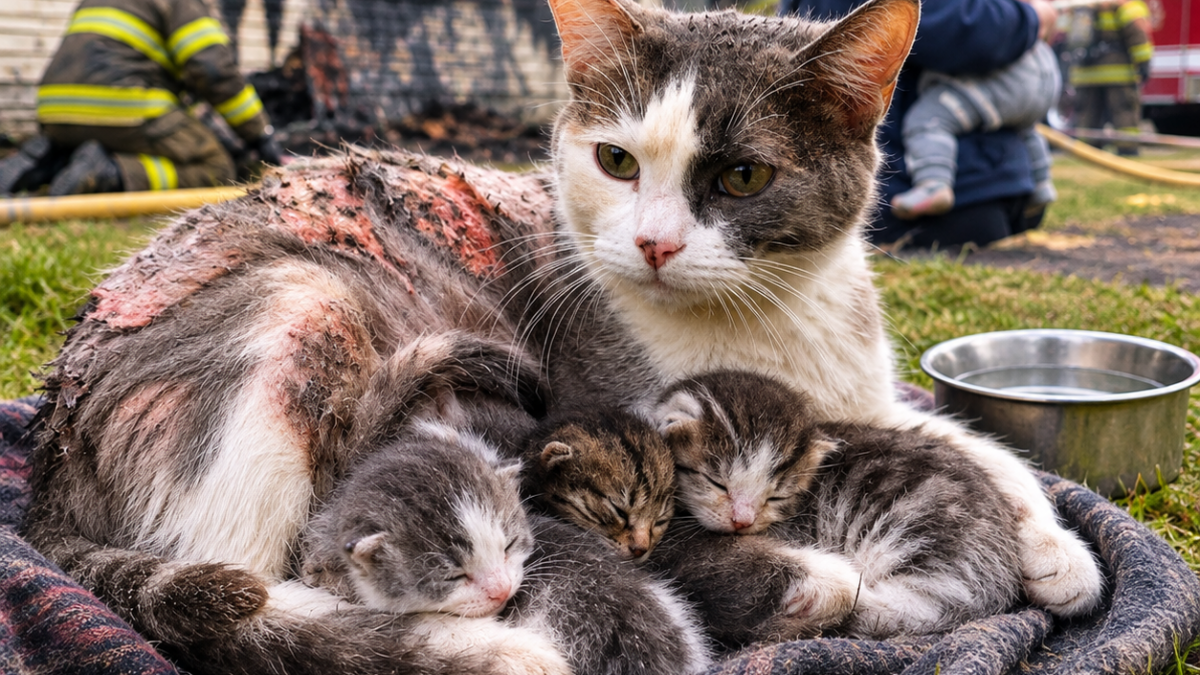
One of the tiny gray babies dangled gently between her jaws.
She dropped onto the grass awkwardly.
Her front paw buckled.
Claire gasped.
“Smudge!”
The cat carried the kitten another few feet.
Then placed it on the lawn.
I started toward her.
Smudge looked at me.
For one second, I thought she was finished.
Then she turned around.
“No!”
She jumped back through the kitchen window.
Claire screamed.
“No, Smudge!”
I don’t know why we expected her to stop.
The kittens were her babies.
The way Noah and Lily were ours.
She had already made her decision.
Thirty seconds felt like ten minutes.
I stared at that window.
Smoke poured through it.
Fire sirens sounded somewhere in the distance.
“Come on.”
I whispered it.
“Come on, girl.”
Smudge appeared again.
Second kitten.
She landed badly.
The kitten nearly slipped from her mouth.
She caught it.
Carried it to the first.
Set it down.
Her whiskers looked shorter.
I could smell burned fur from several feet away.
I moved toward her.
“Smudge.”
She looked at me.
Then turned.
“Don’t.”
She disappeared again.
Claire began crying.
“She’s going to die.”
I had no answer.
I wanted to chase her.
I wanted to be brave enough.
But courage isn’t always what we imagine.
Sometimes running into a fire saves someone.
Sometimes running into that same fire simply creates another body firefighters have to find.
I stood there helpless.
That may be the worst feeling I have ever known.
Inside, the fire had spread from the utility room toward the kitchen ceiling.
Later, investigators told us part of the ceiling collapsed during those final minutes.
We heard it from outside.
A deep crash.
Claire screamed Smudge’s name.
I knew.
I knew she was gone.
I felt it with certainty.
There was no way a six-pound cat could survive that.
Then the kitchen window moved.
A gray face appeared through the smoke.
Smudge.
She had the third kitten.
Her body looked different.
The fur along her back was burned away in patches.
One side of her face was black with soot.
Her right whiskers were gone.
She tried to jump.
Her hind legs slipped.
For half a second she hung from the frame.
I ran forward.
“Come on!”
She dropped.
I caught neither her nor the kitten.
They hit the grass.
Smudge immediately stood.
The kitten cried.
That tiny sound was one of the most beautiful things I had ever heard.
Smudge picked it up again.
She carried it toward the other two.
Every step looked painful.
Her paw pads were burned.
Dark marks appeared on the grass.
She reached the kittens.
Set the third beside them.
Then lowered herself around all three.
Front legs forward.
Kittens tucked against her chest.
Only then did she look at us.
Claire was standing several yards away holding Noah.
I was beside Lily.
Smudge looked directly toward the baby.
Not toward me.
Not toward Claire.
Noah.
She stared for several seconds.
Then she lowered her head between her kittens.
Her eyes closed.
The fire department arrived less than a minute later.
Everything became movement.
Hoses.
Lights.
Shouting.
Firefighters forcing us farther from the house.
A paramedic checking Noah.
Another checking Lily.
Claire answering questions.
Someone putting a blanket around my shoulders.
I ignored all of them.
“Cat.”
“What?”
“Our cat.”
I pointed.
“She went back three times.”
A firefighter looked toward Smudge.
His expression changed.
“Get me a carrier.”
Maria ran to her house.
The firefighter crouched near Smudge.
She opened her eyes.
Hissed.
He smiled.
“Good.”
I stared at him.
“How is that good?”
“Means she’s responsive.”
Smudge tried to stand.
Couldn’t.
The firefighter stopped her.
“Easy.”
Her kittens were alive.
All three.
One had singed fur near its tail.
Another was coughing slightly.
But they were breathing.
Smudge was worse.
The fur across her back had burned nearly to the skin.
Her paws were injured.
One ear was bleeding.
I knelt beside her.
“I’m sorry.”
I don’t know why that was the first thing I said.
Maybe because it had been waiting inside me.
I remembered every time I complained about her.
Every time I called her difficult.
Every time I pushed her away from the nursery.
Every time I suggested finding another home.
She looked at me.
I reached toward her.
Smudge usually hated being picked up.
That night, when I slid my hands beneath her, she didn’t fight.
I lifted her.
Her body trembled.
She smelled like smoke.
Burned hair.
Ash.
Her kittens cried from the carrier.
Smudge turned her head toward them.
“They’re here.”
I carried her closer.
“They’re safe.”
Claire crouched beside me with Noah.
For a moment, our entire family was together on the lawn.
Children.
Cat.
Kittens.
Our house burning behind us.
Claire began sobbing.
“She woke me.”
I nodded.
“She scratched until I woke up.”
“I know.”
“She knew.”
“I know.”
I had called her difficult.
The word felt disgusting now.
Smudge had spent eight months sitting outside Noah’s door.
I had interpreted it as obsession.
Maybe she had been guarding him.
Maybe she had simply included him in the map of things she considered hers.
We will never know exactly what a cat thinks.
But I knew what she had done.
When danger came, she didn’t run for herself.
She ran to the nursery.
Then to us.
Then back to her kittens.
The emergency veterinarian opened early for us.
A firefighter drove behind our car because I was shaking too badly to trust myself.
Claire sat in the passenger seat holding the kitten carrier.
Smudge was wrapped in a towel on her lap.
Noah and Lily stayed temporarily with Maria.
I kept looking over.
“Is she breathing?”
“Yes.”
A minute later.
“Still?”
“Yes, Daniel.”
Another minute.
“Claire?”
“Yes.”
Smudge’s eyes were closed.
“Talk to her.”
Claire looked down.
“Hey, baby.”
Her voice cracked.
“You’re okay.”
Smudge’s ear moved.
Claire stroked the unburned fur beneath her chin.
“You got them.”
Smudge remained still.
“All three.”
Another ear movement.
“And Noah.”
Claire began crying again.
“You got him too.”
At the clinic, Dr. Patel met us at the door.
She took one look at Smudge.
“Straight back.”
I tried to follow.
A technician stopped me.
“We need room.”
“I’m coming.”
“You can’t.”
“She hates strangers.”
“Right now, sir, she needs oxygen.”
I stood there.
Claire grabbed my hand.
The kittens were examined first.
All three had mild smoke exposure.
One needed supplemental oxygen.
No major burns.
Then we waited for Smudge.
Twenty minutes.
Forty.
An hour.
Nobody told me anything.
I walked circles around the waiting room.
Claire eventually said, “Sit down.”
“I can’t.”
“You’re bleeding.”
I looked.
My bare foot had a cut from something on the lawn.
I hadn’t noticed.
I sat.
A nurse cleaned it.
I stared at the treatment-room door.
Finally Dr. Patel came out.
I stood so fast the chair hit the wall.
“She’s alive.”
The doctor held up one hand.
“She’s stable.”
I exhaled.
Claire pressed both hands to her face.
“Her smoke inhalation appears mild to moderate. We’re giving oxygen and fluids. She has first-degree burns on two paw pads, superficial burns across the back, and a small burn near the right ear. The fur damage looks dramatic, but most of the skin underneath is viable.”
“She’s going to live?”
“I believe so.”
I nearly collapsed.
Dr. Patel continued.
“The next twenty-four hours matter. Smoke injuries can worsen after exposure.”
“Can we see her?”
“In a little while.”
“What about the kittens?”
“They’re doing well.”
Claire laughed once.
It came out like a sob.
“All of them?”
“All three.”
The doctor looked between us.
“You’re very lucky.”
I looked through the clinic door.
“No.”
Claire squeezed my hand.
“Smudge made us lucky.”
We visited her two hours later.
She was inside an oxygen enclosure.
Her back looked terrible.
The beautiful gray fur was gone in long patches.
Her right ear was red and swollen.
Her paws were bandaged.
But when she saw Claire, she lifted her head.
Then she searched.
Looking past us.
“The kittens,” I said.
A technician brought the carrier.
The moment Smudge heard one of them cry, she tried to stand.
“Easy.”
The technician carefully placed the kittens near her once the veterinarian approved it.
Smudge immediately began checking them.
One.
Two.
Three.
She smelled each face.
Licked one.
Then lowered herself around them.
I turned away because I couldn’t handle it.
Claire touched my back.
“You okay?”
“No.”
Neither of us was.
We were alive because of an animal we had nearly removed from our home.
That truth didn’t become easier with repetition.
It became heavier.
The house was badly damaged.
The utility room was destroyed.
The kitchen needed extensive repair.
Smoke affected nearly everything.
But the fire department told us something I will never forget.
“If you’d slept another five or ten minutes, this conversation could be very different.”
Five minutes.
That was it.
The dead alarm would not have saved us.
Smudge had.
The investigator walked me through the cause later.
Baseboard heater.
Electrical malfunction.
Combustible material too close.
Then he asked about the hallway detector.
I stared at the floor.
“Dead battery.”
He nodded.
“Did you know?”
That question hurt.
“Yes.”
Claire looked at me.
“I was going to replace it.”
The investigator didn’t lecture me.
He didn’t need to.
“I bought batteries.”
Still nothing.
“They were in the drawer.”
He finally said, “Then replace them when you get settled somewhere.”
I nodded.
That night, I barely slept.
We stayed at Maria’s house.
Noah slept in a portable crib.
Lily slept beside Claire.
I sat alone at the kitchen table.
Maria came downstairs around three.
“You should sleep.”
“I can’t.”
She poured water.
Then sat across from me.
“You’re blaming yourself.”
“The alarm.”
“Yes.”
“It was my job.”
“You made a mistake.”
“My mistake could’ve killed them.”
Maria didn’t argue.
That mattered.
Sometimes people try to comfort you by making your failure smaller.
I didn’t need that.
It wasn’t small.
I had failed to replace a smoke detector battery.
I needed to live with that honestly.
But Maria eventually said, “Then make sure you never make it twice.”
I looked at her.
“That cat made sure you got the chance.”
The next morning, I bought nine smoke detectors.
We didn’t even have nine places to put them in the temporary rental.
I didn’t care.
Combination smoke and carbon monoxide units.
Sealed batteries.
Extra alarms.
I read every instruction.
Wrote replacement dates on the boxes.
Set reminders on my phone.
Claire watched me.
“You can’t undo Thursday.”
“I know.”
“Daniel.”
“I know.”
She put her arms around me.
I broke down.
“I called her a problem.”
Claire said nothing.
“We were going to give her away.”
“We didn’t.”
“We almost did.”
“But we didn’t.”
“Because Lily cried.”
Claire pulled back.
“Does it matter why?”
“Yes.”
“Why?”
“Because I wasn’t the one who saw her.”
Claire understood.
Our five-year-old had recognized something I hadn’t.
Smudge belonged.
Lily knew it before me.
When we brought Smudge home from the veterinary hospital four days later, Lily was waiting at Maria’s door.
Her face changed when she saw the bandages.
“Smudge?”
The cat lifted her head.
Lily began crying.
“What happened to her fur?”
“She got burned.”
“Does it hurt?”
“A little.”
“Because she saved the kittens?”
I knelt.
“And us.”
Lily stared.
“What?”
I told her.
Not everything.
Not the frightening details.
Just enough.
Smudge woke Mommy because of the fire.
Smudge helped us get out.
Then she went back for her babies.
Lily looked at the cat.
Then at me.
“She saved Noah?”
“Yes.”
Lily moved toward Smudge.
I stopped her gently.
“Careful.”
“I know.”
She sat on the floor.
Smudge watched.
Lily extended one finger.
Smudge moved forward and touched her nose against it.
My daughter whispered, “I told you she was family.”
There are sentences a five-year-old can say that hit harder than anything an adult could manage.
I closed my eyes.
“You did.”
She looked at me.
“You wanted to give her away.”
“I know.”
“That’s mean.”
Claire made a quiet sound that might have been a laugh.
I nodded.
“Yes.”
Lily turned back to Smudge.
“You can’t give her away anymore.”
“No.”
“Promise.”
“I promise.”
That was the easiest promise I ever made.
The first week in temporary housing was difficult for Smudge.
She wanted to care for her kittens.
Her burns made movement painful.
We created a nest in the corner of our bedroom using the same cardboard box from the utility room.
It smelled faintly like smoke even after we cleaned it.
Claire wanted to replace it.
I didn’t.
“That box came out with her?”
“Yes.”
“Then it stays.”
Smudge recognized it immediately.
She climbed inside.
The kittens followed.
For several days, she barely left except to eat, drink, and use the litter box.
At night, though, something strange happened.
She tried to leave the room.
The first time, I thought she was confused.
I followed.
Smudge limped down the hallway.
Past the bathroom.
Toward the room where Noah’s portable crib was.
She sat outside.
Same position.
Facing the door.
My throat tightened.
“Smudge.”
She looked at me.
“You don’t have to do that.”
She turned back toward the door.
I sat beside her.
The hallway was dark.
For almost twenty minutes, neither of us moved.
Then I opened Noah’s door.
Smudge looked inside.
Noah was sleeping.
She walked to the crib.
I tensed.
Old habits.
The pediatrician.
Cats near babies.
Every warning.
But Smudge didn’t jump inside.
She lay on the floor beneath him.
Curled into a gray-and-white circle.
I sat in the doorway.
For eight months, I had been the one closing the door.
That night, I left it open.
She slept there until morning.
Her fur took eleven weeks to grow back.
The wounds healed faster than my guilt.
For a long time, whenever I looked at the scar on her ear, I saw the smoke detector battery in that drawer.
But Smudge didn’t treat me differently.
That almost made it harder.
She still knocked things from the counter.
Still hissed at my brother.
Still disappeared under furniture when she wanted privacy.
She was still Smudge.
Heroism had not turned her into some perfect animal.
And I was grateful for that.
Because I slowly understood something.
We often love animals conditionally.
As long as they are quiet.
As long as they don’t scratch furniture.
As long as they don’t inconvenience guests.
As long as they fit inside our idea of what a “good pet” should be.
Smudge had never fit.
So I called her difficult.
But when the house caught fire, every annoying quality I had criticized suddenly looked different.
She noticed everything.
That was why she stared at visitors.
Why she watched doors.
Why she followed noises.
Why she sat outside the nursery.
She was vigilant.
Alert.
Intensely aware of her territory and the people inside it.
“She was never difficult,” I told Claire one evening.
We were sitting in the temporary house while Smudge cleaned one of her kittens.
Claire smiled.
“No?”
“She was paying attention.”
Claire looked toward her.
“And we weren’t listening.”
That sentence stayed.
Eventually, it became the sentence I used whenever anyone asked about Smudge.
Because people did ask.
The story spread.
A firefighter told someone.
Someone posted about it.
A local reporter contacted us.
I almost refused.
I didn’t want Smudge turned into a cute headline.
Cat Saves Family.
Hero Mom Cat.
Miracle Pet.
It all sounded too simple.
But Claire changed my mind.
“Tell them about the detector.”
I stared at her.
“You want me to admit that?”
“Yes.”
“I’ll look irresponsible.”
“You were irresponsible.”
That hurt.
Because it was true.
Claire continued.
“If someone replaces a battery because they’re embarrassed by what happened to us, good.”
So I agreed.
The reporter came to the temporary house.
Smudge hid beneath the couch.
Of course.
The woman laughed.
“That’s the hero?”
“That’s her.”
“She doesn’t like cameras?”
“She doesn’t like anyone.”
From beneath the couch came a hiss.
The reporter smiled.
“I see.”
We told the story.
Six minutes of scratching.
The nursery.
The fire.
The kittens.
The dead smoke alarm.
When the article came out, the title focused on Smudge.
But near the bottom, the reporter included my quote.
**“My family survived because our cat noticed the danger before I corrected something I already knew was unsafe.”**
That was the truth.
Not comfortable.
Not flattering.
True.
Messages began arriving.
Most were kind.
Some people called Smudge an angel.
Others sent toys.
Someone mailed three tiny blankets for the kittens.
A local pet store offered free food for a year.
But one message mattered more than all the others.
A man named Steven wrote:
**Your story made me check my smoke alarms. Two weren’t working. My daughter’s room was between them. Thank you for being honest.**
I read it three times.
Then showed Claire.
“That,” she said, “is why we told them.”
Our insurance claim took months.
The house needed major repairs.
There were arguments about smoke damage.
Replacement costs.
Electrical inspections.
Every delay exhausted us.
But compared with what could have happened, it was paperwork.
Walls could be rebuilt.
Cabinets replaced.
Carpets removed.
Noah couldn’t.
Lily couldn’t.
Claire couldn’t.
Smudge couldn’t.
When we finally moved back, the house looked familiar but different.
Fresh paint.
New kitchen.
Repaired utility room.
And smoke detectors everywhere.
Nine.
Probably excessive.
I didn’t care.
I tested every one.
Lily covered her ears.
“Daddy!”
“Sorry.”
“You always do that!”
“First day of every month.”
Smudge stared at the alarm.
Then at me.
I pointed.
“You don’t have to do its job anymore.”
She walked away.
The nursery was the biggest change.
I removed the door.
Not opened.
Removed.
Took it off the hinges.
Carried it into the garage.
Claire watched.
“You know we could just leave it open.”
“No.”
“Daniel.”
“No door.”
She laughed.
“Fine.”
The original damaged nursery door had been destroyed by smoke and water anyway.
But I saved one section.
The piece of frame with Smudge’s claw marks.
Four deep vertical scratches.
It sits in my workshop now.
Not because I enjoy remembering the fire.
Because those marks are the sound we slept through.
Six minutes.
Six minutes of a cat refusing to stop.
Every time I see them, I think about persistence.
Smudge could have scratched once.
Twice.
Then fled.
She didn’t.
Something in her understood that the people behind that door were not awake.
So she kept going.
Noah grew.
At first, Smudge slept beneath his crib.
Then beneath his toddler bed.
When he learned to crawl, she became more cautious.
When he learned to walk, she stayed just out of reach.
When he learned to say a few words, one of them sounded suspiciously like “Mudge.”
I tried to convince Claire it was “Dad.”
It was not.
“Mudge.”
He would point.
Smudge’s ears would move.
“Mudge.”
She tolerated him in a way she tolerated no other person.
Not even me.
Once, when Noah fell while learning to walk, he began crying.
Smudge appeared from another room before Claire or I reached him.
She sat beside him.
No touching.
No licking.
Just there.
Noah reached for her fur.
I moved quickly.
“Gentle.”
Smudge didn’t run.
He placed one tiny hand against her side.
She stayed.
I looked at Claire.
Neither of us spoke.
Some relationships do not need explanation.
The kittens grew too.
We named them Ash, Ember, and Pepper.
Yes, the names were obvious.
Lily chose them.
All three survived.
When they were old enough, we faced another decision.
We couldn’t realistically keep four cats.
Smudge had never liked sharing territory with other adult animals.
The veterinarian agreed the kittens could be adopted once properly weaned and treated.
Lily cried.
Of course.
But this time we handled it differently.
We found families ourselves.
People we knew.
People willing to keep us updated.
Ash went to Maria.
That felt right.
Ember went to one of the firefighters who had helped that night.
Pepper went to Claire’s sister.
Smudge watched each kitten leave.
I worried about her.
She searched the house for a few days.
Then settled.
Ash visited occasionally because Maria lived next door.
The first time he came back, now larger, Smudge hissed at him.
So much for sentimental reunions.
But later that afternoon, I found them sleeping several feet apart in the sun.
Smudge had her own way of loving.
Everything about her had its own rules.
Months after the fire, we received an invitation from the local fire station.
They were holding a community safety event.
Someone wanted Smudge there.
I laughed when Claire told me.
“You expect us to bring Smudge into a fire station full of strangers?”
“We can try.”
“We’ll need protective equipment.”
Smudge hated the carrier.
Hated the car.
Hated the station.
Hated the microphone.
Hated the firefighter mascot.
She hissed at a city councilman.
Lily thought it was the funniest thing she had ever seen.
The firefighters presented us with a small plaque.
**SMUDGE — FOR EXTRAORDINARY ACTION IN ALERTING HER FAMILY TO A HOUSE FIRE**
I stared at it.
Then looked at Smudge inside her carrier.
She looked furious.
The captain told the crowd what happened.
Then he talked about smoke alarms.
He held up a detector.
“Pets can sometimes alert us to danger, but they should never be your fire safety system.”
I nodded harder than anyone.
“Install alarms. Test them. Replace batteries. Make an escape plan.”
A little boy raised his hand.
“Did the cat know there was a fire?”
The captain looked at me.
I answered.
“I don’t know what she understood.”
“Then why did she scratch the door?”
I looked at Smudge.
“Because she knew something was wrong.”
The boy nodded as if that was enough.
Maybe it was.
After the event, a woman approached me.
She had tears in her eyes.
“My husband hates our cat.”
I wasn’t sure what to say.
She laughed awkwardly.
“Not hates. He complains. Says she’s unfriendly.”
“Smudge is unfriendly.”
The woman smiled.
“Did you really almost give her away?”
“Yes.”
“Do you feel terrible about that?”
“Yes.”
Claire touched my arm.
The woman looked surprised by the answer.
I could have softened it.
Could have said we were stressed.
New baby.
Small house.
Difficult behavior.
All true.
But guilt doesn’t always need to be defended.
Sometimes it simply needs to teach you.
“I judged her according to what was convenient for me,” I said. “That was the mistake.”
The woman nodded.
“She didn’t suddenly become valuable because she saved us. She was valuable before. I was just too focused on what annoyed me to see everything else.”
Smudge hissed from the carrier.
The woman laughed.
“She really is difficult.”
“Yes.”
I smiled.
“And she’s going home with us.”
That became our family’s running joke.
Whenever Smudge knocked something over, Lily would say, “Remember, Daddy, she’s paying attention.”
When Smudge hissed at my brother, Claire would say, “Very attentive.”
When she stole a piece of chicken from the counter, I said, “Extremely observant.”
We didn’t romanticize everything she did.
She could still be a menace.
But “difficult” stopped meaning disposable.
That distinction mattered.
A year after the fire, the scar on Smudge’s ear was still visible.
Her back fur had completely returned.
If you didn’t know the story, you would never guess what happened.
The nursery remained doorless.
Noah slept with a small night-light.
Smudge still chose the floor beneath his bed more often than anywhere else.
On September 18, exactly one year after the fire, I woke at 1:40 a.m.
I hadn’t set an alarm.
My body remembered.
I walked through the house.
Every detector showed green.
Utility room clear.
Kitchen quiet.
Lily asleep.
Noah asleep.
Smudge under his bed.
I sat in the hallway.
At 1:44, I looked at the clock.
Claire appeared behind me.
“You too?”
“Couldn’t sleep.”
She sat beside me.
For a while, we listened.
Nothing.
No scratching.
No smoke.
No sirens.
Just the low hum of the house.
Claire leaned against me.
“Do you ever think about what would’ve happened?”
“Yes.”
“Every day?”
“Almost.”
“Me too.”
Smudge emerged from under Noah’s bed.
She stretched.
Walked toward us.
Sat between us.
I touched the scar on her ear.
She tolerated it for three seconds.
Then bit me lightly.
Claire laughed.
“Hero.”
I pulled my hand away.
“Still rude.”
Smudge began cleaning herself.
I looked toward Noah’s room.
“I thought she wanted into the nursery all those months.”
“Maybe she did.”
“Why?”
Claire shrugged.
“Maybe she loved him.”
I smiled.
“Smudge doesn’t love anyone.”
The cat stopped cleaning.
Looked directly at me.
Claire whispered, “Careful.”
Smudge stood.
Walked into Noah’s room.
Lay down beneath his bed.
Claire looked at me.
“Case closed.”
Over time, the story became something other people remembered more dramatically than we did.
Strangers sometimes recognized us.
“Is that the fire cat?”
One person asked if Smudge had received a medal.
Another wanted to know whether she was trained.
Trained.
That made me laugh.
Smudge refused to come when called.
If anything, she had trained us.
But the questions sometimes bothered me because people wanted a clean hero story.
Heroic cat senses fire.
Wakes family.
Saves kittens.
Everyone lives happily ever after.
Real life was messier.
The fire happened partly because of equipment failure.
But our danger was worse because I neglected something basic.
Smudge survived, but she was injured.
The kittens lived, but she risked everything retrieving them.
Our children were safe, but they were frightened for months.
Lily had nightmares about flames.
For weeks, she asked us every night, “The house isn’t going to burn again, right?”
There is no honest promise a parent can make to that question.
So I would say, “We’re doing everything we can to keep it safe.”
Then I showed her the smoke detector.
I showed her the fire extinguisher.
We practiced leaving through the front door.
Then through her bedroom window with my help.
We chose a meeting spot by Maria’s mailbox.
Fire safety became part of our family routine.
Not fear.
Preparation.
Smudge attended every drill accidentally.
The first time the alarm test sounded, she bolted under the couch.
I felt terrible.
The second time, she hid behind the refrigerator.
Eventually, I started putting her carrier near the front door during drills.
That taught us another lesson.
Getting pets out during a fire is complicated.
You cannot assume they will come when called.
We placed a sticker near the entrance showing the number of pets in the house.
We kept carriers accessible.
I wrote the veterinarian’s number near our emergency contacts.
All things I should have thought about before.
I learned.
That is the only useful thing guilt can become.
Years later, the original section of scratched door frame still hangs in my workshop.
No fancy plaque.
Just wood.
White paint.
Four deep grooves.
Noah once asked me about it when he was old enough to understand.
“Smudge did that?”
“Yes.”
“Why?”
“You were sleeping.”
“So?”
“The house was on fire.”
His eyes widened.
“She woke me up?”
“She woke Mommy first.”
“Then you?”
“Pretty much.”
“Why?”
Children always ask the question adults spend years pretending they can answer.
Why?
“Because she didn’t want anything to happen to you.”
Noah looked toward the hallway.
Smudge was older then.
Slower.
Her dark eye patch had begun fading into a graying face.
He walked over.
Sat beside her.
“You saved me?”
Smudge looked at him.
Then turned away.
Noah smiled.
“I think that means yes.”
I laughed.
“Probably.”
He wrapped one arm around her carefully.
Smudge tolerated it.
For almost ten seconds.
A record.
Then she moved.
Noah followed.
“Do you remember the fire?”
I watched them.
Maybe she did.
Maybe animals store memory differently.
Maybe the smell of smoke still meant something.
I never burned candles in the house after that.
Never left the dryer running when we went out.
Never ignored a strange electrical smell.
Some people would call that anxiety.
Maybe part of it was.
But responsibility often looks obsessive to people who haven’t been frightened awake by nearly losing everything.
Smudge aged.
That part of the story arrived whether we wanted it or not.
At ten, she slept more.
At eleven, she developed kidney disease.
Manageable at first.
Special food.
Medication.
More water bowls.
Noah helped me remember her pills.
Lily, now older, still reminded me of the promise I had made years earlier.
“She’s never leaving, right?”
“No.”
One evening, while giving Smudge fluids under the skin, I thought about how absurd life can be.
Years earlier, I had considered giving her away because she hid under furniture and hissed at guests.
Now I was sitting on the floor at midnight, slowly pushing fluids into an elderly cat’s body while Noah held a treat in front of her.
No inconvenience felt too large.
Not because she had earned it by saving us.
That was important.
Smudge did not buy lifelong care with heroism.
She deserved care because she was ours.
That was the lesson I had failed to understand at the beginning.
Family is not a reward for good behavior.
It is responsibility.
One winter, Smudge stopped sleeping beneath Noah’s bed.
She couldn’t climb the stairs easily anymore.
I carried her.
The first time, she complained loudly.
“You ran through a burning house three times but this is unacceptable?”
She meowed.
“Fine.”
I carried her upstairs anyway.
At night, she chose a blanket near Noah’s door.
There was still no door.
There never would be.
Sometimes Noah slept on the floor beside her.
Claire found them one morning.
Boy under a blanket.
Old cat against his shoulder.
She took a photograph.
It remains my favorite picture of them.
Not the fire.
Not Smudge with bandages.
Not the newspaper article.
Just a child sleeping beside the animal who refused to let him sleep through the most dangerous night of his life.
When Smudge turned twelve, the veterinarian warned us her kidneys were worsening.
I knew what that meant.
So did Claire.
We didn’t tell the children immediately.
We adjusted medication.
Food.
Fluids.
Smudge had good days.
Then difficult ones.
She remained opinionated until the end.
She hissed at a new veterinary technician.
Knocked a water cup from the examination table.
Bit me when I tried to trim one claw.
I laughed harder than I should have.
The technician looked confused.
“Sorry.”
I wiped water from the floor.
“She’s herself.”
That was what mattered.
When animals get old, every annoying habit becomes reassurance.
As long as Smudge complained, I knew she still wanted to participate.
Eventually, there came a morning when she didn’t.
She stayed on her blanket.
Didn’t eat.
Didn’t drink.
No hiss when I touched her.
That frightened me more than anything.
I called the veterinarian.
The children came downstairs.
Lily knew immediately.
“No.”
Claire hugged her.
Noah sat beside Smudge.
“Is she dying?”
I wanted to lie.
I had spent years protecting him.
But Smudge had once protected him with absolute honesty.
Danger was danger.
So I gave him truth.
“Yes.”
He cried.
“Today?”
“Maybe.”
“I don’t want her to.”
“I know.”
He pressed his face into her fur.
Smudge barely moved.
Then, slowly, she placed one paw on his wrist.
Noah froze.
I had to leave the room for a minute.
The veterinarian agreed to come to our house.
I wanted Smudge home.
In the place she had saved.
Near the nursery that no longer had a door.
We carried her upstairs.
Placed her on the floor beneath Noah’s bed.
Her old spot.
Claire sat beside her.
Lily on one side.
Noah on the other.
I sat at her feet.
The veterinarian explained everything.
Kidney failure.
Pain.
Dehydration.
Her body was tired.
We knew.
Knowing doesn’t help enough.
Before the final injection, Noah whispered, “Does she know I love her?”
The veterinarian looked at me.
I answered.
“Yes.”
“How?”
I touched the worn fur between Smudge’s ears.
“Because you stayed.”
He nodded.
That answer had come from somewhere deeper than thought.
Maybe from the years.
From every night Smudge sat outside his door.
From every night later when he slept with no door between them.
We had spent so much time asking whether animals understand us.
Maybe love is less complicated.
You stay.
You feed.
You protect.
You return.
You make room.
Smudge’s breathing slowed.
Lily cried quietly.
Claire kissed her forehead.
I placed my hand near the scar on her right ear.
That small scar.
The one piece of fire she carried forever.
“I’m sorry I didn’t understand you.”
Her eyes were nearly closed.
“I spent years calling you difficult.”
My voice broke.
“You were paying attention.”
Noah took her paw.
“And we weren’t listening.”
Smudge exhaled.
Then she was gone.
The house became unbearably quiet.
For the first time in years, nothing slept beneath Noah’s bed.
He asked if we should put the nursery door back.
“No.”
“Why?”
I looked at the empty hinges.
“Because that’s Smudge’s door.”
There was no door.
He smiled through tears.
“That doesn’t make sense.”
“I know.”
We kept it that way anyway.
Smudge was cremated.
Lily wanted the urn near the old scratched door frame.
Noah wanted it in his room.
Claire solved the argument.
We placed a small memorial shelf in the hallway between the bedrooms.
One photograph.
Smudge before the fire.
Gray-and-white.
Dark patch over one eye.
Looking annoyed.
Under it, the plaque from the fire department.
And beside that, a small piece of the scratched wood.
I considered using the heroic photograph of Smudge recovering with her kittens.
But that wasn’t how I wanted to remember her.
I didn’t want her entire life reduced to the worst night she survived.
She was more than the fire.
More than the burns.
More than a headline.
She was the cat who stole chicken.
The cat who hated my brother.
The cat who knocked pens off tables.
The cat who terrified delivery drivers.
The cat who sat outside a baby’s room for eight months while I misunderstood what she was doing.
The cat who became old beside that same child.
Months after she died, a new family moved into Maria’s old house next door.
They had a young couple, a toddler, and a black cat named Rocket.
One afternoon, I saw the father replacing a smoke detector battery.
He noticed me watching.
“Your story scared my wife.”
“Good.”
He laughed.
“I guess.”
He looked toward our house.
“That was your cat, right?”
“Yes.”
“The fire cat?”
I almost corrected him.
Then decided not to.
“Smudge.”
“Right.”
He tightened the detector.
“We test ours every month now.”
I nodded.
“Good.”
He climbed down from the ladder.
“Crazy that a cat did all that.”
I looked at the nursery window.
“No.”
He seemed surprised.
“What’s crazy is that we almost didn’t understand who she was until she had to walk through fire to show us.”
That stayed with me.
Because there was the poetic justice I could never have planned.
Smudge never took revenge on us.
She didn’t need to.
Life did something more powerful.
It forced me to live with the knowledge that the animal I had once labeled inconvenient was the reason I still had a wife, a daughter, and a son.
Every birthday Noah celebrated existed on the other side of Smudge’s six minutes at that door.
Every Christmas.
Every school picture.
Every scraped knee.
Every bedtime story.
Every argument.
Every ordinary morning.
All of it.
Sometimes people asked me whether that made me feel guilty.
Yes.
But guilt isn’t the whole story.
Mostly, it made me grateful.
And careful.
And slower to decide that something difficult has no value.
Years later, Noah wrote about Smudge for a school assignment.
The topic was:
**Someone Who Protected Me.**
He could have chosen a firefighter.
A parent.
A teacher.
He chose a cat.
His essay began:
**I don’t remember the night Smudge saved my life because I was a baby. But she remembered that I was in the room.**
I had to stop reading.
Claire finished it.
At the end, Noah wrote:
**My dad says we almost gave her away before the fire. I think sometimes people don’t know who loves them until something scary happens. I wish Smudge didn’t have to prove it.**
That sentence broke me.
Because that was exactly it.
I wish she hadn’t had to prove anything.
I wish the fire never happened.
I wish the detector worked.
I wish I had replaced the battery.
I wish Smudge never burned her paws.
Never lost her whiskers.
Never ran through smoke.
But I can’t rewrite that night.
All I can do is tell it correctly.
Smudge was not valuable because she saved us.
She saved us because she already considered us hers.
That is different.
She didn’t become family on the lawn when we watched her emerge from the smoke.
She had been family long before.
We were simply late to understand it.
For years, I thought the most important moment in Smudge’s story was when she carried the final kitten through the kitchen window and collapsed on the grass.
It wasn’t.
The most important moment happened months earlier.
Nothing was burning.
No one was watching.
The house was quiet.
And a small gray-and-white cat walked down the hallway after everyone went to bed.
She stopped outside the closed nursery door.
Then she sat.
No scratching.
No meowing.
No praise.
No reward.
Just watching.
Night after night.
Eight months.
We thought she was being strange.
Maybe she was already telling us exactly who she was.
A mother before she had kittens.
A guardian nobody had appointed.
A difficult little cat who paid attention when the rest of us didn’t.
Then one night, the thing she had been watching for finally happened.
Something was wrong.
And Smudge refused to let us sleep through it.
She scratched until paint came off the door.
Until Claire woke.
Until Noah was carried outside.
Until Lily was safe.
Then she turned around.
Back toward the smoke.
Back toward the heat.
Back toward three tiny lives that depended on her.
She brought one out.
Then another.
Then another.
Only when every life she considered hers was outside did Smudge finally lie down.
And when she looked across that lawn, she didn’t check the burning house.
She looked at Noah.
The baby behind the door.
The baby we had tried to keep her away from.
The baby she had watched for eight months.
Safe in his mother’s arms.
Then she lowered her head to her kittens.
Her job was done.
I used to tell people Smudge was difficult.
Now, whenever someone asks what she was like, I give them a different answer.
I say she was stubborn.
Observant.
Suspicious.
Annoying.
Protective.
Brave.
Completely herself.
And ours.
Most of all, ours.
The nursery door still has no hinges.
The smoke alarms still get tested on the first day of every month.
And in my workshop, those four claw marks remain exactly as they were that night.
I will never sand them away.
Because when everything else failed—the detector, my memory, my responsibility—Smudge kept scratching.
Six minutes.
She didn’t know whether anyone would wake up.
She didn’t know whether the door would open.
She only knew something she loved was on the other side.
So she kept going.
Sometimes the smallest member of a family is the one listening when everyone else is asleep.
Sometimes the one you call difficult is the one who notices danger first.
And sometimes you don’t understand how deeply an animal has chosen you until the night she runs into the fire after making sure you got out.
We almost gave Smudge away.
Instead, she gave us the rest of our lives.








