PART 2: We Adopted the 9-Year-Old Pit Bull Nobody Could Touch—Then His Past Came Knocking at Our Door
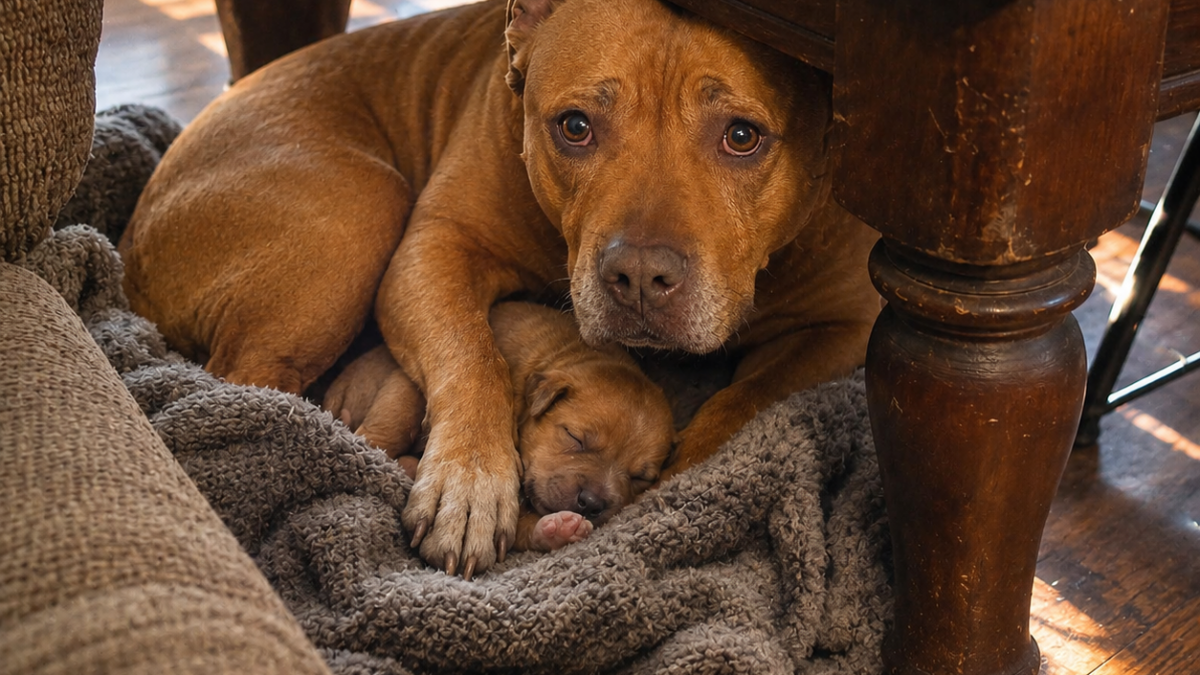
PART 2
I came home from work around six.
Jessica usually arrived twenty minutes later.
We ate dinner at the kitchen counter because the dining table belonged to Rocky now.
Then, around eight, I sat on the floor.
Same place.
Same distance.
I read aloud.
Sometimes a novel.
Sometimes the newspaper.
Once, because I had nothing else nearby, I read Rocky the instruction manual for our dishwasher.
Jessica stopped in the doorway.
“Seriously?”
I kept reading.
“Page fourteen. Cleaning the filtration system.”
“He’s going to think we’re idiots.”
“He already lives with us. It’s too late.”
Under the table, one of Rocky’s ears moved.
Jessica smiled.
“Maybe he likes appliances.”
Nothing dramatic happened.
That’s important.
People like stories where a traumatized animal suddenly realizes he’s safe and runs into someone’s arms.
That wasn’t Rocky.
Progress came in inches.
Sometimes less.
On day nine, he ate while I was still in the room.
I pretended not to notice.
My entire body wanted to turn around.
I didn’t.
I heard the bowl scrape gently against the floor.
Then chewing.
Slow.
Careful.
I kept reading.
On day twelve, he shifted closer to the edge of the table while I spoke.
Maybe three inches.
I noticed because I’d memorized every inch of that floor.
On day fifteen, I woke at two in the morning and found the water bowl empty.
Rocky had left his hiding place sometime after we’d gone to bed.
The next morning, muddy paw prints crossed the kitchen.
Jessica stared at them as if we’d discovered proof of extraterrestrial life.
“He walked around.”
“At night.”
“He walked around.”
She photographed the paw prints before cleaning them.
I made fun of her.
Then I secretly saved the picture.
On day nineteen, Rocky came out while Jessica was sitting in the living room.
Only halfway.
His front paws crossed the edge of the table.
His head appeared.
Jessica froze.
I was standing in the hallway.
She saw me.
Her eyes widened.
Don’t move.
I understood.
For nearly thirty seconds, Rocky stayed there.
He looked at the room.
Then at Jessica.
Then toward me.
Something changed in his face.
His body tightened.
He retreated immediately.
Jessica exhaled.
“Did I scare him?”
“No.”
“I didn’t move.”
“I know.”
She looked disappointed.
I sat beside her.
“He came out.”
“For thirty seconds.”
“Yesterday it was zero.”
That became the way we measured Rocky.
Not by what he couldn’t do.
By what was different from yesterday.
Week three brought our first setback.
I dropped a frying pan.
It hit the kitchen floor with a violent metallic crash.
Rocky didn’t simply run beneath the table.
He slammed himself against the wall underneath it.
Jessica screamed my name.
I dropped to my knees.
Rocky was trembling so badly his teeth clicked.
“Rocky.”
He flattened himself harder against the wall.
I stopped.
Every instinct told me to crawl under there.
To touch him.
Comfort him.
But comfort for me wasn’t comfort for Rocky.
So I sat down.
Far away.
I lowered my voice.
“It’s okay.”
His eyes were huge.
“Nothing’s going to happen.”
I talked for almost an hour.
Eventually, the trembling slowed.
That night, Rocky didn’t eat.
The next day, he barely drank.
It felt as if three weeks of progress had disappeared in one second.
I told Marta.
She wasn’t surprised.
“Trauma doesn’t move in a straight line, Lucas.”
“It was just a pan.”
“To you.”
I looked through the shelter office window.
“To him?”
“It may have been something else.”
“What?”
“We’ll probably never know.”
That was one of the cruelest things about Rocky’s past.
He couldn’t tell us.
Every scar was a sentence from a story we would never fully hear.
We could only watch what frightened him.
Raised voices.
Sudden movements.
Metal clanging.
Men wearing heavy boots.
Brooms.
A garden hose.
And belts.
I discovered the last one by accident.
One morning, I pulled my belt from the loops of my jeans while Rocky happened to be standing near the kitchen doorway.
The sound of leather sliding through fabric made him collapse.
Not back away.
Collapse.
His legs folded beneath him.
His head dropped.
His eyes closed.
I stood frozen with the belt in my hand.
I felt sick.
“Jessica.”
She came running.
Then she saw Rocky.
“Oh, God.”
I dropped the belt immediately.
Rocky didn’t move.
I walked backward.
I had never hated a stranger so much in my life.
I didn’t know who had hurt Rocky.
But in that moment, I wanted to.
I wanted a name.
A face.
Someone I could blame.
That evening, I called Marta.
“What happened to him?”
Silence.
“I want to know.”
“Lucas—”
“I need to know.”
“No. You want someone to be angry at.”
She was right.
That made me angrier.
“Wouldn’t you?”
“I was.”
“Was?”
“For months.”
“What changed?”
Marta sighed.
“I realized Rocky doesn’t need my anger.”
I didn’t answer.
“He needs people who don’t become frightening when they’re angry.”
That silenced me.
I looked toward the dining room.
Rocky was beneath the table.
Again.
That became another lesson.
Healing Rocky meant confronting parts of myself I had never considered dangerous.
I wasn’t violent.
I’d never hit an animal in my life.
But I was loud when frustrated.
I slammed cabinet doors.
I yelled at football games.
I threw my keys onto counters.
Normal things.
Except Rocky didn’t know they were normal.
So I changed.
Not because Jessica told me to.
Not because some trainer ordered me.
Because I wanted Rocky to stop believing every loud man eventually became dangerous.
For the next month, we lived quietly.
And Rocky began emerging.
First at night.
Then in the evening.
Then, one Sunday afternoon, while I was sitting on the floor reading, I heard nails against hardwood.
I kept my eyes on the page.
Click.
Click.
Click.
Rocky walked past me.
Three feet away.
I could see him in my peripheral vision.
He moved toward the water bowl.
Drank.
Then stood there.
I didn’t turn.
My heart was beating absurdly hard.
After a few seconds, he walked back beneath the table.
When Jessica came home, I told her.
She hugged me.
“He walked past you?”
“Yes.”
“How close?”
“Three feet.”
“That’s huge.”
“I know.”
Then she frowned.
“Did you look?”
“No.”
“Good.”
“I know.”
“Did you talk?”
“No.”
“Good.”
“I understand the rules, Jessica.”
“You’re emotionally needy.”
“I am being rejected by a dog in my own house.”
She kissed my cheek.
“He’s working on you.”
Rocky’s first voluntary contact happened forty-seven days after we brought him home.
I remember because Jessica had written the adoption date on the calendar.
It was raining.
I was sitting beside the couch watching television with the volume low.
Rocky was standing in the doorway.
That alone was becoming normal.
He sometimes watched us now.
Not joining.
Just watching.
I had my hand resting on the floor.
Rocky walked toward me.
I stopped breathing.
He came close enough that I could see the white scar along his nose.
Then he lowered his head.
His nose touched the back of my hand.
One second.
Maybe less.
He immediately stepped backward.
I didn’t move.
He stared at me.
Then he approached again.
Another sniff.
Longer this time.
My eyes burned.
I wanted to touch him more than I had wanted almost anything in my life.
I didn’t.
He left.
Jessica had been watching from the kitchen.
She was crying silently.
“He touched you.”
“No.”
I swallowed.
“I think I was inspected.”
She laughed through her tears.
Two days later, Rocky sniffed Jessica’s hand.
A week later, he took a piece of chicken from her fingers.
Another week passed.
Then one evening, Rocky stood beside my chair.
I lowered my hand slowly.
Stopped halfway.
Let him decide.
He moved forward.
My fingertips touched the side of his neck.
His entire body stiffened.
I removed my hand immediately.
Rocky stayed.
I waited.
Then offered my hand again.
He leaned forward.
Barely.
That was the first time I pet him.
One stroke.
Two seconds.
Then he walked away.
I sat there crying like an idiot.
Jessica took a photograph.
“I hate you.”
“You’re adorable.”
“Delete it.”
“Never.”
Rocky didn’t transform overnight.
He still slept beneath the table.
He still startled easily.
But little pieces of another dog began appearing.
One morning, I dropped a sock.
Rocky picked it up.
I stared.
He stared back.
“That’s mine.”
Rocky held the sock.
I took one step.
He retreated.
I stopped.
He dropped the sock.
Then looked at it.
Then at me.
I picked up another sock.
Tossed it gently across the floor.
Rocky watched.
Didn’t chase.
The next morning, the sock was beneath the table with him.
Jessica found three more there by the end of the week.
“He’s hoarding your laundry.”
“That’s progress.”
“It’s disgusting.”
“You don’t understand our relationship.”
Then Rocky discovered the couch.
It happened accidentally.
A thunderstorm hit one evening in January.
Thunder terrified him.
Usually, he hid under the table.
But that night, Jessica and I were sitting on the living room floor.
A loud crack shook the windows.
Rocky ran from the dining room.
He stopped.
Looked at the table.
Looked at us.
Another boom.
Then Rocky did something neither of us expected.
He moved toward Jessica.
Not under the table.
Toward her.
She stayed still.
Rocky pressed his shoulder against her side.
Jessica slowly put one hand against his back.
He shook.
But he stayed.
I moved closer.
Not touching.
Just close.
For forty minutes, we sat on the floor with Rocky between us.
When the storm ended, he didn’t immediately leave.
Instead, he lowered himself.
Then rested his head on Jessica’s leg.
She looked at me.
I had never seen her so happy.
That night Rocky slept outside the table.
Three feet away.
The next morning, he went back underneath it.
That was Rocky.
Two steps forward.
One backward.
Sometimes five backward.
But gradually, home stopped being a place where he waited for pain.
It became just home.
Around four months after the adoption, Marta called.
Her voice was different.
“Lucas, can you come to the shelter?”
“Is something wrong?”
“I don’t know.”
That wasn’t reassuring.
Jessica and I went together.
Marta met us in a small office.
A file sat on the desk.
Rocky’s name was written on the tab.
“What is this?” I asked.
“His intake records.”
“We’ve seen those.”
“Not everything.”
She sat down.
“When Rocky came here, the cruelty case involving his previous owner was still technically open.”
Jessica became still.
“Previous owner?”
Marta nodded.
“His name is Vernon Hale.”
Finally.
A name.
I felt my jaw tighten.
Marta noticed.
“Lucas.”
“I’m fine.”
“You’re not.”
“No.”
I looked at the folder.
“I want to hear it.”
Vernon Hale owned a rural property almost forty miles north of us.
He called it a breeding kennel.
According to animal control, it was anything but.
Dozens of dogs had been found on the property.
Many lacked veterinary care.
Some lived outside in makeshift enclosures.
Rocky had been one of the oldest.
“Why wasn’t Hale convicted?” I asked.
“He was.”
“For what?”
“Several misdemeanor cruelty charges.”
“Misdemeanor?”
My voice rose.
Jessica touched my arm.
I lowered it.
Marta continued.
“Most of the serious charges were reduced because the prosecution couldn’t establish who caused which injuries or when.”
“So he walked?”
“He paid fines. Served some time in county jail. Lost the dogs.”
“That was it?”
“For that case.”
I stood.
I couldn’t sit.
“What happened to the other dogs?”
“Most were adopted.”
“Most?”
Marta looked down.
I understood.
I didn’t ask.
Jessica did.
“And Rocky?”
“He was considered the hardest case.”
“Because he wouldn’t trust anyone.”
“Yes.”
I stared at the photograph attached to the file.
Rocky on intake day.
Thin.
Head lowered.
Eyes empty.
“Why are you telling us now?”
Marta pushed another piece of paper toward me.
Vernon Hale was applying to regain a commercial kennel license.
I thought I’d misheard.
“What?”
“The county received an application under a new business name.”
Jessica’s face changed.
“He wants dogs again?”
“Yes.”
I laughed once.
There was nothing funny in it.
“You’re kidding.”
“No.”
“How is that even possible?”
“The previous restriction expired.”
I looked at Marta.
“And what do you want from us?”
“There will be a public licensing hearing.”
My stomach tightened.
“You want Rocky there?”
“No.”
Marta answered immediately.
“Absolutely not.”
I relaxed slightly.
“I want you to understand why some people may contact you.”
“Who?”
“Local animal welfare groups. Possibly reporters.”
Jessica shook her head.
“We’re not turning Rocky into a story.”
“I agree.”
Marta leaned forward.
“But the public record matters.”
That night, I couldn’t sleep.
Rocky had stopped sleeping beneath the dining table weeks earlier.
He now had a large bed near the fireplace.
He was lying there.
I sat beside him.
Not too close.
Old habits.
I looked at the scars along his muzzle.
“Vernon Hale.”
Rocky’s eyes opened.
Just hearing the name meant nothing to him.
At least I thought it meant nothing.
I whispered, “I know who you are now.”
Rocky lifted his head.
I corrected myself.
“No.”
I touched his shoulder.
“I know who he is.”
Rocky leaned slightly into my hand.
That was the difference.
Vernon Hale had a name.
But Rocky had a life.
I promised myself I wouldn’t let the first destroy the second.
Jessica and I attended the licensing hearing without Rocky.
The room was more crowded than I expected.
Animal advocates sat along one side.
Several farmers and breeders sat on the other.
Vernon Hale entered five minutes before the meeting began.
I knew him immediately.
He was in his early sixties.
Tall.
Broad.
Gray hair.
Clean shirt.
Calm expression.
He didn’t look like a monster.
That bothered me more than if he had.
Monsters should look different.
They usually don’t.
Vernon sat with an attorney.
When his application was discussed, the attorney argued that Hale had served his punishment.
That the old violations were years behind him.
That citizens had a right to earn a living after paying their debt.
Legally, the argument wasn’t ridiculous.
Emotionally, I wanted to break something.
Then the public comments began.
Former shelter workers spoke.
A veterinarian described the condition of several animals taken from Hale’s property.
Marta testified.
She never exaggerated.
That made her words stronger.
Then my name was called.
I hadn’t planned to speak.
Jessica looked at me.
“You don’t have to.”
I stood.
“Yes, I do.”
I walked to the microphone.
“My name is Lucas Bennett.”
I looked toward the licensing board.
“My wife and I adopted one of the dogs seized from Mr. Hale’s property.”
Vernon looked at me for the first time.
“His name is Rocky.”
Something happened.
Tiny.
But I saw it.
Recognition.
Vernon leaned toward his attorney.
I continued.
“When Rocky came into our house, he spent weeks beneath a table.”
I described the food.
The darkness.
The belt.
The frying pan.
The first touch.
I never accused Vernon of specific acts I couldn’t prove.
I didn’t need to.
“I don’t know everything that happened to Rocky.”
I looked directly at Vernon.
“I never will.”
His face remained expressionless.
“But I know what fear looked like after nine years.”
Nobody moved.
“I know what it looks like when a dog believes a human hand is something to survive.”
Vernon’s attorney shifted.
I turned back to the board.
“If the law says Mr. Hale has the right to apply again, then that’s the law.”
I took a breath.
“But you have the right to decide whether somebody who left animals carrying that kind of fear should be trusted with more of them.”
Then I sat down.
Jessica took my hand.
The board delayed the decision.
Outside, Vernon approached me.
I saw him coming.
Jessica did too.
“Lucas.”
“I know.”
Vernon stopped six feet away.
“So you’re the one who got Old Rock.”
Old Rock.
The nickname hit me strangely.
“You know him?”
He smiled.
“Had him nine years.”
My hands tightened.
Jessica stepped closer to me.
“He’s doing well,” she said.
Vernon looked at her.
“I’m sure you people spoil him.”
You people.
I hated the way he said it.
“He deserves it,” I replied.
Vernon shrugged.
“Dog was always strange.”
I felt heat move into my face.
“Strange?”
“Skittish.”
His smile widened slightly.
“Some dogs are born wrong.”
I wanted to hit him.
I’m not proud of that.
I wanted one minute where he understood fear.
Then I remembered Marta.
Rocky doesn’t need my anger.
I stepped closer instead.
“Interesting.”
Vernon’s smile faded.
“What?”
“He lives in my house now.”
“So?”
“He sleeps beside our couch.”
Vernon said nothing.
“He eats from my hand.”
Still nothing.
“And when I touch him, he doesn’t flinch anymore.”
The smile was gone completely.
I hadn’t expected those words to affect him.
They did.
Maybe because men like Vernon depend on believing the damage they cause is permanent.
I continued.
“So maybe he wasn’t born wrong.”
I looked him in the eyes.
“Maybe he just needed to get away from you.”
His attorney appeared immediately.
“Mr. Hale.”
Vernon stared at me.
Then walked away.
That felt good.
Too good.
And it frightened me a little.
The board denied his kennel license two weeks later.
I thought that would be the end.
It wasn’t.
A month passed.
Then someone drove past our house at midnight.
Slowly.
I wouldn’t have noticed except Rocky did.
He stood at the front window.
Body rigid.
No barking.
The vehicle continued.
Two nights later, it happened again.
Dark pickup.
Slow.
Jessica looked at me.
“Do you think—”
“No.”
I said it too quickly.
The third time, I wrote down the license plate.
It didn’t match Vernon’s vehicle.
At least not according to public records.
Maybe coincidence.
Maybe not.
Then we found a note in our mailbox.
No envelope.
Three words.
LEAVE IT ALONE.
Jessica stared at it.
“This isn’t funny.”
“I know.”
“We’re calling the police.”
I almost argued.
Then I looked at Rocky.
Months earlier, I’d promised myself I wouldn’t become one more man who made this house frightening.
So we called.
The officer took the note.
Without evidence, there wasn’t much he could do.
We installed cameras.
Motion lights.
Changed routines.
I hated it.
Rocky noticed.
Dogs notice everything.
My tension became his tension.
For three nights, he returned to sleeping beneath the dining table.
That hurt more than the note.
I sat several feet away, just like the beginning.
“I’m sorry.”
Rocky watched me.
“I brought it inside.”
Jessica stood in the doorway.
“What?”
“The fear.”
I looked at her.
“I let him bring it back into our house.”
She sat beside me.
“You didn’t.”
“I’ve been pacing. Checking windows. Jumping at cars.”
“You’re scared.”
“So is Rocky.”
Jessica looked beneath the table.
“Then we do what we did before.”
“What?”
“Nothing.”
I almost laughed.
She smiled.
“We stay.”
So we did.
We kept the cameras.
But I stopped standing at the window every five minutes.
We went back to normal.
Rocky gradually came out again.
Then something happened that changed the entire situation.
Marta called.
Not about Vernon.
About another dog.
Animal control had received a report about a property in the next county.
Nine dogs were removed.
The property was rented under a company name.
The person listed as manager?
Vernon Hale’s nephew.
Investigators found evidence connecting Vernon to the operation.
My stomach dropped.
“He started again.”
“Maybe he never stopped,” Marta said.
This time, investigators were prepared.
Financial records showed Vernon purchasing food and veterinary supplies for the property.
His phone records placed him there repeatedly.
A former employee agreed to cooperate.
And then came something none of us expected.
A woman named Rachel Pierce contacted the county prosecutor.
She had worked briefly for Vernon years earlier.
Including during the time Rocky lived there.
She had photographs.
Old photographs.
Videos.
Records.
I didn’t want to see them.
Then I did.
Then I regretted it.
The prosecutor didn’t show us everything.
Enough.
Rocky appeared in one video.
Younger.
Maybe five.
He was chained near a wooden structure.
Vernon’s voice could be heard off camera.
I turned away.
Jessica covered her mouth.
“That is enough.”
The investigator stopped the video.
I walked outside.
I threw up beside the courthouse parking lot.
Jessica stood behind me.
“Lucas.”
I wiped my mouth.
“I wanted proof.”
“I know.”
“I spent months wanting proof.”
She put her hand on my back.
“I know.”
I started crying.
“I wish I didn’t have it.”
Vernon was arrested three weeks later.
Multiple charges.
Some connected to the new property.
Others related to falsified records, unlawful breeding activity, and violations of previous court orders.
The old evidence Rachel preserved supported additional investigation into earlier abuse.
Not every old charge could be revived.
Statutes.
Evidence rules.
Legal complications.
I learned quickly that justice rarely looks as clean as people want it to.
But this time Vernon couldn’t simply pay a fine and disappear.
He had built a pattern.
And the pattern had finally caught up with him.
Then he made his biggest mistake.
He came to our house.
It was a Thursday night.
Jessica was working late.
I was home alone with Rocky.
Around nine, the doorbell rang.
Rocky lifted his head from his bed.
I checked the camera.
Vernon.
My blood went cold.
He was out on bail.
He wasn’t supposed to contact witnesses.
I called 911 before opening anything.
I spoke through the door.
“Leave.”
“Lucas.”
“Police are coming.”
“I just want to talk.”
“Leave.”
Rocky stood.
Something changed in him.
His nose lifted.
He moved toward the hallway.
Then he froze.
I watched his body.
The tail dropped.
His ears pulled back.
His legs trembled.
He knew.
Nine years.
Different house.
Different life.
He still knew.
Vernon knocked again.
“Lucas, open the door.”
Rocky backed up.
For one terrible second, he looked toward the dining room.
Toward the table.
His old hiding place.
I thought he would run.
Instead, he stopped.
Vernon knocked harder.
“Come on.”
Rocky looked at me.
I can’t explain what happened next without sounding like I’m giving a dog human thoughts.
Maybe I am.
Rocky looked at me.
Then at the door.
And he moved forward.
Not charging.
Not barking wildly.
He walked.
Slowly.
Until he stood beside me.
His body was trembling.
But he stood.
I crouched.
“You don’t have to.”
Rocky remained.
Another knock.
This time Rocky barked.
One bark.
Deep.
Powerful.
Vernon stopped.
Rocky barked again.
For nine years, that dog had survived by making himself invisible.
Now the man connected to his fear was standing ten feet away.
And Rocky was making sure he knew he was there.
Vernon stepped back from the door.
I saw it on the camera.
He heard the dog.
He recognized the bark.
Maybe he recognized something else.
Whatever control he’d once had over Rocky was gone.
Police arrived six minutes later.
Vernon was still near his truck.
They detained him.
The no-contact issue became another problem for his defense.
But none of that mattered to me then.
I sat on the floor with Rocky.
His body shook violently.
I held out my hand.
He came to me.
Not under the table.
Not behind the couch.
To me.
He pushed his head against my chest.
I wrapped one arm around him.
Very slowly.
Rocky let me.
Jessica arrived while we were still sitting there.
She saw us and stopped.
“What happened?”
I told her.
She knelt beside Rocky.
He moved closer to both of us.
Jessica cried.
“You stayed.”
Rocky’s tail moved once.
That night, he slept in our bedroom for the first time.
On the floor beside my side of the bed.
I woke at three in the morning.
Same hour I’d woken on his first night.
I looked down.
Rocky was asleep.
Really asleep.
Legs stretched out.
Eyes closed.
No hiding.
I didn’t sleep again.
I just watched him breathe.
Vernon’s case took almost a year.
Rachel became the key witness.
She had been twenty-three when she worked for him.
She told the court she’d been frightened.
Vernon threatened employees who complained.
He controlled paychecks.
Housing in some cases.
She left after six months.
“Why keep the evidence?” the prosecutor asked.
Rachel swallowed.
“Because I knew eventually someone would need to prove those dogs weren’t born afraid.”
I cried when she said it.
The defense tried to portray her as bitter.
A former employee seeking attention.
Then they displayed one of her photographs.
Rocky was visible in the background.
I couldn’t look.
Jessica did.
She squeezed my hand.
Later, Vernon testified.
Against his lawyer’s advice, according to reporters.
He insisted he had never intentionally abused Rocky.
Said the dogs were difficult.
Aggressive.
Unstable.
Then the prosecutor asked him about Rocky specifically.
“Was Rocky aggressive?”
“No.”
“Did he bite?”
“Not that I recall.”
“Attack people?”
“No.”
“Then what made him difficult?”
Vernon hesitated.
“He wouldn’t listen.”
“What did he do?”
“He’d hide.”
The room became very still.
The prosecutor looked at him.
“He would hide from you?”
Vernon realized too late what he’d said.
“I mean, sometimes.”
“Where?”
“I don’t remember.”
“You owned the dog for approximately nine years.”
“Yes.”
“And he regularly hid from you.”
Objection.
Overruled.
Vernon became irritated.
“Dogs hide.”
The prosecutor nodded.
“No further questions.”
It was devastating precisely because it was simple.
Vernon had spent years describing Rocky as defective.
But every detail made the truth clearer.
Rocky hadn’t failed to trust people.
He had learned exactly which people were unsafe.
When closing arguments ended, we waited three days.
The jury returned guilty verdicts on several major counts connected to the newer operation and supporting offenses.
Some charges ended differently.
Some were dismissed.
Some merged.
Again, justice wasn’t clean.
But Vernon was convicted.
At sentencing, the judge prohibited him from owning, breeding, housing, selling, or supervising animals for a lengthy period beyond his incarceration.
His remaining animals had already been surrendered.
The kennel operation was finished.
Before the sentence was announced, victims and affected parties were allowed to submit statements.
I nearly didn’t speak.
Then Marta called me.
“You don’t owe anyone a speech.”
“I know.”
“Especially not Rocky.”
“I know.”
I looked toward him.
Rocky was sleeping on our couch by then.
Yes.
Our couch.
Jessica had officially lost that battle.
I smiled.
“I think I need to say something for me.”
So I did.
I stood in the courtroom.
Vernon sat at the defense table.
I had prepared three pages.
I used none of them.
“When my wife and I adopted Rocky, he lived beneath our dining room table.”
I paused.
“Not for an hour.”
I looked at Vernon.
“For weeks.”
Vernon looked down.
“He believed a person walking toward him meant something bad was coming.”
My voice shook.
“I used to hate the person who taught him that.”
I looked at the judge.
“I still don’t have kind feelings toward him.”
A few people shifted.
“But Rocky taught me something.”
I breathed.
“Fear can be taught.”
Then I looked at Vernon.
“So can safety.”
For the first time, Vernon looked directly at me.
“You had nine years with him.”
I stopped.
“I’ve had less than two.”
My throat tightened.
“In less than two years, he learned to sleep in the open.”
Jessica was crying behind me.
“He learned to eat while people were nearby.”
I smiled slightly.
“He steals my socks.”
A few people in the courtroom laughed softly.
“He sleeps on our couch even though he absolutely knows he’s not supposed to.”
More quiet laughter.
I looked at Vernon again.
“And when somebody knocks on our door, he doesn’t always run anymore.”
Vernon’s expression hardened.
“You spent nine years teaching that dog the world was dangerous.”
I let the silence sit.
“And you failed.”
That was the only revenge I ever needed.
I turned toward the judge.
“Whatever sentence you give Mr. Hale belongs to the law.”
I swallowed.
“But Rocky’s life belongs to Rocky now.”
I returned to my seat.
Jessica grabbed my hand.
Vernon received a prison sentence.
Not life.
Not enough to satisfy everyone.
Enough.
His licensing privileges were gone.
His operation was gone.
Several surviving dogs were transferred into rehabilitation programs.
Rachel helped create a fund for their care.
Vernon disappeared from Rocky’s life.
And this time, for good.
But healing didn’t suddenly become easy because a judge said guilty.
That’s another thing people misunderstand.
Justice does not erase trauma.
Rocky still hated thunder.
He still hated belts.
When I dressed for work, I removed mine inside the closet where he couldn’t see it.
Eventually, I stopped doing that.
Not carelessly.
Gradually.
One morning, almost two years after Rocky came home, I removed my belt while he was lying near the bed.
He raised his head.
I froze.
Rocky looked at the belt.
Then at me.
His body tightened slightly.
I placed it on the chair.
“It’s okay.”
Rocky stood.
I thought he’d leave.
Instead, he walked toward me.
Sniffed my hand.
Then went back to his bed.
I sat down.
That tiny moment hit me harder than the courtroom verdict.
Because Vernon being convicted proved Vernon was guilty.
Rocky staying proved something else.
Rocky was free.
Jessica found me sitting on the floor.
“What happened?”
I pointed at the belt.
She understood immediately.
“Oh.”
Her eyes filled.
“He stayed.”
“Yeah.”
She sat beside me.
“He stayed.”
The dining room table remained in the same place.
Rocky stopped hiding beneath it.
But he never stopped liking it.
Sometimes, on hot afternoons, we’d find him sleeping there.
At first, seeing him beneath the table frightened me.
Then I realized the difference.
His body was loose.
Head stretched between his paws.
Eyes closed.
Sometimes snoring.
Same place.
Different meaning.
It wasn’t a hiding place anymore.
It was just shade.
That may be the clearest definition of healing I’ve ever seen.
The thing doesn’t always disappear.
Sometimes it simply stops being frightening.
Three years after we adopted Rocky, Jessica came home carrying a cardboard box.
“No.”
She hadn’t even entered the living room.
“What?”
“No.”
“You don’t know what’s inside.”
“It moved.”
“Lucas.”
“We have Rocky.”
“Yes.”
“We agreed one dog.”
“We agreed we weren’t actively looking for another dog.”
“That is manipulative wording.”
She placed the box down.
A tiny head appeared.
Brown ears.
White nose.
I closed my eyes.
“What happened?”
“Found near the highway.”
“Shelter?”
“Full.”
“Foster?”
“No one available tonight.”
“Tonight.”
“Yes.”
“Only tonight?”
Jessica smiled.
I pointed.
“That’s the face you made before Rocky.”
Rocky approached slowly.
The puppy froze.
Rocky sniffed him.
The puppy licked Rocky directly on the nose.
Rocky stepped backward as if insulted.
I laughed.
“Good. He hates him.”
Five minutes later, the puppy followed Rocky across the living room.
Ten minutes later, Rocky lay down.
The puppy climbed onto his front legs.
Rocky looked at me.
I swear the expression said, Do something.
I shrugged.
“Your problem.”
We named the puppy Milo.
And yes.
He stayed.
At first, I worried Milo would overwhelm Rocky.
Instead, something remarkable happened.
Milo taught Rocky how to play.
Not us.
Another dog.
Milo chased a ball.
Rocky watched.
Milo brought it back.
Rocky watched.
Milo stole the ball.
Rocky followed.
One afternoon, I threw the ball across the yard.
Milo ran.
Rocky ran after him.
Then, unexpectedly, Rocky reached it first.
He picked it up.
Stopped.
Looked confused.
I crouched.
“Bring it.”
Rocky stared at me.
Milo bounced around him.
Rocky walked toward me.
Dropped the ball six feet away.
I picked it up.
Threw again.
Rocky ran.
Jessica stood on the porch crying.
I shouted, “Stop crying every time he does something normal!”
She wiped her eyes.
“It’s rude to judge me.”
Rocky became Milo’s teacher.
He corrected him when he played too rough.
Let him sleep against his back.
Waited beside the door when Milo went to the veterinarian.
And when Milo became frightened by his first thunderstorm, guess where he went?
Under the dining table.
Rocky followed.
Jessica and I watched from the kitchen.
Milo trembled.
Rocky lay beside him.
Not touching.
Just there.
Exactly what we’d done for Rocky.
I looked at Jessica.
She whispered, “He learned.”
I shook my head.
“No.”
“What?”
“He’s teaching.”
That broke both of us.
Years passed.
Rocky’s muzzle turned white.
He slowed down.
Nine became ten.
Then eleven.
Then twelve.
The shelter invited us to an anniversary event.
Marta was retiring.
She asked whether we’d bring Rocky.
Crowds were difficult for him, so we went early before the event began.
The shelter had changed.
New paint.
New outdoor runs.
Better soundproofing.
Rocky stopped at the entrance.
His body went rigid.
I crouched.
“We can leave.”
Jessica nodded.
“Right now.”
Rocky looked toward the door.
Marta came outside.
She stopped twenty feet away.
“Rocky.”
His ears moved.
She didn’t approach.
The same rule she’d taught us.
Let him decide.
Rocky stared at her.
Then took one step.
Another.
Marta covered her mouth.
Rocky walked slowly across the pavement.
He stopped in front of her.
Marta held out her hand.
Rocky sniffed it.
Then something happened I had never expected.
He leaned against her leg.
Marta started crying.
“Oh, buddy.”
She didn’t hug him.
She simply rested her hand lightly on his shoulder.
“I waited eight months for that.”
I smiled.
“Apparently he’s dramatic.”
Marta laughed.
“He always was.”
Inside the shelter, a photograph hung in the hallway.
Rocky’s original intake photo.
Next to it was a newer one Jessica had sent.
Rocky asleep upside down on our couch with Milo sitting on his stomach.
Underneath were two words.
WHY WE WAIT.
I stared at it for a long time.
Marta stood beside me.
“Staff training.”
“What?”
“We use his story with new volunteers.”
I looked at her.
“To teach them that rehabilitation doesn’t have a deadline.”
I smiled.
“Rocky would hate being educational.”
“Probably.”
Rocky lived to fourteen.
I wish I could tell you he died suddenly after one perfect day.
Real life wasn’t that kind.
His hips became painful.
Then his appetite changed.
Our veterinarian found a tumor.
Aggressive.
Treatment might buy time.
It might also make that time miserable.
Jessica and I sat in the consultation room.
Rocky lay between our feet.
“How long?” I asked.
The veterinarian sighed.
“Without aggressive treatment? Maybe several months.”
Jessica’s voice broke.
“And with it?”
“Possibly longer.”
“Good quality?”
She hesitated.
That was the answer.
We took him home.
For three weeks, Rocky was himself.
Slower.
But himself.
He ate chicken.
Stole socks.
Corrected Milo.
Slept under the table.
Then one morning, he couldn’t stand.
I carried him outside.
He weighed less than he used to.
Still heavy.
I didn’t care.
I placed him on his favorite patch of grass.
The sun was coming up.
Jessica sat beside us.
Milo lay near Rocky’s paws.
I touched Rocky’s head.
Five years earlier, that touch would have terrified him.
Now he closed his eyes.
“We have to do it,” Jessica whispered.
I knew.
“No.”
“Lucas.”
“I know.”
My voice broke.
“I just don’t want to know.”
We called the veterinarian.
She came to the house that afternoon.
Rocky was lying beneath the dining room table.
Not hiding.
Resting.
Jessica laughed through tears.
“Of course.”
I lay on the floor beside him.
The first time Rocky entered our house, he had pressed himself into that same corner to get as far away from me as possible.
Now his head rested on my arm.
I whispered, “You made me wait a long time for this.”
His tail moved once.
Jessica crawled under the table with us.
There wasn’t enough room.
We didn’t care.
Milo stayed at the edge.
The veterinarian explained everything.
I barely heard her.
I looked into Rocky’s eyes.
They weren’t empty anymore.
Tired.
Yes.
Old.
Yes.
But not empty.
There was a whole life in them.
A house.
A couch.
Jessica.
Milo.
Chicken.
Thunderstorms.
Stolen socks.
My ridiculous dishwasher manual.
Five years of being safe.
I put my forehead against his.
“You never had to forgive anybody.”
My voice shook.
“You know that?”
Rocky breathed slowly.
“You never owed us trust either.”
Jessica cried beside me.
“Thank you for giving it anyway.”
The veterinarian gave the medication.
Rocky’s body relaxed.
His breathing slowed.
I felt every breath against my arm.
Then the breaths stopped.
No panic.
No fear.
No hiding.
Rocky died beneath the table where he’d once gone because he believed nobody could reach him.
But this time, he wasn’t alone.
Our hands were on him.
His family was around him.
And the table wasn’t protecting him from us.
It was holding all of us together.
For weeks afterward, I avoided the dining room.
I hated that table.
Jessica understood.
She never said anything.
One night, I woke around three.
Again.
Three in the morning had become strangely tied to Rocky.
I walked downstairs.
Milo was beneath the table.
I froze.
Then I noticed something beside him.
One of my socks.
I laughed.
Then cried.
Then sat on the floor.
Milo came out immediately and put his head in my lap.
Rocky had spent his first weeks teaching me that love sometimes meant sitting near someone without demanding anything.
His death taught me the opposite.
Sometimes love means allowing people to sit with you.
A month later, we received a letter.
Not from Vernon.
From Rachel.
The woman whose evidence had helped convict him.
She had started working with an animal welfare organization.
Several of the dogs rescued from Vernon’s second operation had found homes.
One had become a certified search-and-rescue dog.
Another lived with an elderly couple.
A third had been adopted by a veterinary technician.
At the bottom, Rachel wrote:
Rocky changed more lives than he ever knew.
I read that sentence repeatedly.
Then I folded the letter and placed it beside his ashes.
Vernon eventually completed his sentence.
I know because someone sent me a news article.
I almost didn’t open it.
The article said his remaining appeals had failed and his restrictions involving animals remained in place.
There was a photograph.
He looked older.
Smaller.
For years, I had imagined feeling something when I saw that.
Satisfaction.
Anger.
Victory.
Instead, I felt almost nothing.
Jessica found me looking at the screen.
“What is it?”
I turned the laptop.
She read.
Then looked at me.
“You okay?”
“Yeah.”
“You sure?”
I closed the article.
“Rocky is still dead.”
She sat beside me.
“I know.”
“And Vernon going to prison didn’t give Rocky those first nine years back.”
“No.”
I looked toward the dining table.
“But he didn’t get the last five.”
Jessica smiled through tears.
“No.”
That was the real victory.
Vernon had owned Rocky for nine years.
But he never got to know him.
He never saw Rocky chase Milo through autumn leaves.
Never saw him fall asleep with his paws in the air.
Never knew Rocky made a quiet whining sound whenever Jessica opened a bag of shredded cheese.
Never saw him steal exactly one sock and carry it around like treasure.
Never knew that beneath all that fear was a dog who was gentle with puppies.
A dog who loved sunlight.
A dog who preferred chicken over beef.
A dog who eventually learned to ask for affection by pushing his head under my hand.
Vernon knew Rocky’s fear.
We knew Rocky.
That difference became everything.
A year after Rocky died, Marta invited us back to the shelter.
They had created a quiet room for severely traumatized dogs.
No metal kennel doors.
Dim lighting.
Sound insulation.
Beds built into sheltered corners.
A place where animals could watch people without being approached.
On the wall was a small plaque.
Jessica saw it first.
She took my hand.
It read:
THE ROCKY ROOM
For the animals who need time.
Underneath:
Nothing is required here except patience.
I couldn’t speak.
Marta stood beside us.
“You didn’t do this.”
She smiled.
“Donations.”
“Why his name?”
“Because people know his story.”
I looked through the glass.
A brown dog was curled in the farthest corner.
A volunteer sat across the room.
Back turned.
Reading a book aloud.
I laughed.
“What?”
Marta asked.
“Nothing.”
The volunteer kept reading.
The dog didn’t move.
But one ear shifted toward the sound.
I felt my throat close.
I had seen that before.
I wanted to walk in.
Tell the volunteer everything would work.
Promise that one day the dog would sleep on somebody’s couch.
That he’d chase a ball.
That he’d lean into a hand.
But I couldn’t promise that.
Rocky taught me better.
Patience wasn’t waiting for the ending you wanted.
It was making today safe enough that tomorrow had a chance.
So I stood outside the room.
And watched.
A few minutes later, the dog lifted his head.
Nothing more.
It was enough.
Jessica leaned against me.
“You know what I keep thinking?”
“What?”
“The first night.”
I smiled.
“Under the table.”
“We thought nothing was happening.”
“Yeah.”
She looked through the glass.
“But everything was happening.”
She was right.
Rocky’s greatest changes happened when there was nothing dramatic to photograph.
The meal eaten while I remained in the room.
The three inches closer.
The first night walking through the kitchen.
The nose against my hand.
The decision during a thunderstorm to move toward Jessica instead of away from her.
The bark at our front door.
The moment he saw a belt and chose to stay.
Healing wasn’t one miracle.
It was thousands of ordinary moments in which nothing bad happened.
That was what finally taught Rocky safety.
Repetition.
Predictability.
Kindness so boring it became believable.
People sometimes ask whether I hate Vernon Hale.
For a while, I did.
I hated him with an intensity that frightened me.
I wanted him humiliated.
I wanted him afraid.
I wanted someone to take nine years from him.
Then Rocky walked out from under a table.
And the more Rocky healed, the less room there was for Vernon.
That’s the strange thing nobody tells you about revenge.
Sometimes the best revenge isn’t making the person who hurt you suffer.
Sometimes it’s watching the thing they tried to destroy become something beautiful without them.
Vernon taught Rocky that hands hurt.
Rocky learned hands could feed him.
Vernon taught him that footsteps meant danger.
Rocky learned mine meant I was home.
Vernon taught him to hide.
Rocky eventually slept in the middle of the living room with his belly exposed to the ceiling.
Vernon taught him silence.
Rocky found his bark.
Vernon taught him survival.
We watched him discover life.
When I think about it that way, Vernon lost long before the judge ever sentenced him.
He lost the first time Rocky took chicken from Jessica’s fingers.
He lost when Rocky rested his head on her leg during that thunderstorm.
He lost when Rocky stood beside me at the front door instead of disappearing beneath the table.
He lost every morning Rocky woke up knowing nobody in that house was going to hurt him.
And Rocky?
Rocky won five years.
People might hear that and say five years isn’t enough.
They’re right.
It wasn’t.
I wanted ten.
I wanted fifteen.
I wanted to complain about an ancient, gray-faced Rocky stealing socks when I was fifty.
But Rocky didn’t measure his life in years.
Dogs don’t.
He measured it in mornings.
Meals.
Sunlight.
Warm floors.
Familiar voices.
Hands that stopped when he asked them to.
People who came back.
By that measure, his final years were full.
We still have the oak dining table.
Jessica once asked whether I wanted to replace it.
“Never.”
She smiled.
“Me neither.”
There are scratches beneath it.
Some from Rocky.
Some from Milo.
I refuse to repair them.
And tucked into the corner underneath the table is a small framed photograph.
Most visitors never see it.
It’s Rocky on his first day.
Not the shelter photograph.
One Jessica took after we brought him home.
You can barely see him in the shadows beneath the table.
Eyes open.
Waiting.
Beside it is another photograph.
Rocky five years later.
Same place.
Same table.
Rocky asleep on his back.
Legs spread in every direction.
Mouth slightly open.
Completely vulnerable.
Completely safe.
I keep both photographs because one without the other doesn’t tell the story.
The first is what people did to him.
The second is what patience gave back.
And whenever someone tells me they want to adopt a traumatized animal but they’re afraid the animal might never love them, I think of Rocky.
I tell them something I wish someone had told me.
Don’t make love the goal.
Make safety the goal.
Don’t ask when they’ll let you touch them.
Ask whether today they were a little less afraid.
Don’t measure progress by affection.
Measure it by choice.
Did they choose to eat?
Choose to sleep?
Choose to stay in the room?
Choose not to run?
Love may come.
It may come slowly.
It may look different from what you imagined.
But safety has to come first.
Rocky never owed me affection because I adopted him.
He didn’t owe Jessica gratitude.
We weren’t heroes for giving him a house.
We were simply responsible for making sure the house became a place he no longer had to survive.
He did the hard part.
He learned to believe us.
That’s why, when people call Rocky a rescue dog, I sometimes smile.
Technically, yes.
We rescued him from a shelter.
But the truth is more complicated.
Rocky taught me how to control anger.
How to lower my voice.
How to pay attention.
How to sit quietly.
How to understand that fear can exist even when danger is gone.
He taught Jessica that love didn’t have to be returned immediately to be worth giving.
He taught Milo how to lie quietly beside another frightened dog during a storm.
He changed the shelter.
He helped close the door on a man who should never have been allowed near animals again.
And years after his death, dogs who never knew him still sleep in a room bearing his name.
So who rescued whom?
I don’t know anymore.
Maybe that’s not how love works.
Maybe nobody keeps score.
Last October, on the anniversary of the day we brought Rocky home, Jessica and I sat beneath the dining table.
Yes.
Two adults.
On the floor.
Milo joined us.
Jessica had brought two glasses of wine.
“This is ridiculous,” I said.
“You’re the one who started reading dishwasher manuals to a dog.”
“Fair.”
We sat there quietly.
Then Jessica touched one of the scratches in the wood.
“Do you remember what you said that first night?”
“No.”
“You said, ‘I think he’ll live under here forever.’”
I laughed.
“I was optimistic.”
She rested her head against my shoulder.
“I thought he might.”
“So did I.”
Milo snored beside us.
After a while, Jessica said, “Do you think he knew?”
“Knew what?”
“That he was safe.”
I looked at the photograph in the corner.
Rocky asleep.
Belly exposed.
No table leg between himself and the world.
“Yes.”
I didn’t hesitate.
“He knew.”
That was enough.
Not the conviction.
Not the headlines.
Not Vernon losing his license.
Not even the Rocky Room at the shelter.
Those things mattered.
Justice mattered.
But the ending I cared about had happened long before any courtroom.
It happened slowly.
Quietly.
Under an old wooden table.
A frightened nine-year-old dog began to understand that footsteps could pass without kicking him.
That food didn’t disappear as punishment.
That sleep didn’t make him vulnerable.
That a hand could stop before he flinched.
That people could leave for work and come back.
That a raised voice wasn’t inevitable.
That thunder wasn’t anyone’s fault.
That a home could simply be a home.
Vernon Hale had nine years to convince Rocky that humanity was cruel.
Rocky gave us five years to prove that one cruel human didn’t get to speak for everyone.
In the end, that was his revenge.
Not biting Vernon.
Not attacking him at the door.
Rocky never needed to hurt the man who had hurt him.
His revenge was standing there trembling and refusing to hide.
His revenge was surviving long enough to discover kindness.
His revenge was becoming gentle despite what had been done to him.
His revenge was dying with his head in my arms instead of alone in fear.
Most of all, his revenge was this:
The man who had spent years trying to break Rocky eventually became nothing more than a name in an old court file.
But Rocky became a story people still tell.
A room at a shelter.
A lesson taught to volunteers.
A photograph under our table.
A dog named Milo who learned kindness from him.
And a permanent part of two people who once believed patience meant waiting for something to happen.
Rocky taught us otherwise.
Sometimes nothing has to happen.
Sometimes you just sit nearby.
You speak softly.
You put the food down.
You turn your back.
You let frightened eyes watch you.
And tomorrow, you do it again.
Then again.
Then again.
Until one ordinary day, a nose touches your hand.
And years later, when that same dog takes his final breath with his head resting against you, you realize something.
He wasn’t the only one learning to trust.
You were learning how to deserve it.
That was Rocky’s gift to me.
And even now, whenever I wake around three in the morning and the house is quiet, I sometimes walk downstairs.
I stand beside that old dining table.
For half a second, I can still picture him beneath it.
Nine years old.
Terrified.
Watching.
Waiting for pain.
Then I remember the dog he became.
Gray muzzle.
Soft eyes.
Stolen sock between his teeth.
Sleeping in the sunlight without a care in the world.
And I wish I could go back to that first night.
Not to change anything.
Not to drag him out.
Not to tell him the ending.
I would simply sit where I sat before.
Six feet away.
Back turned.
And I would tell him the one thing he wasn’t ready to believe yet.
Take all the time you need, Rocky.
Nobody is going to hurt you here.
You’re home.








