PART 2: We Adopted One Labrador and Drove Away—Five Minutes Later His Look Made Us Turn Back for His Blind Brother
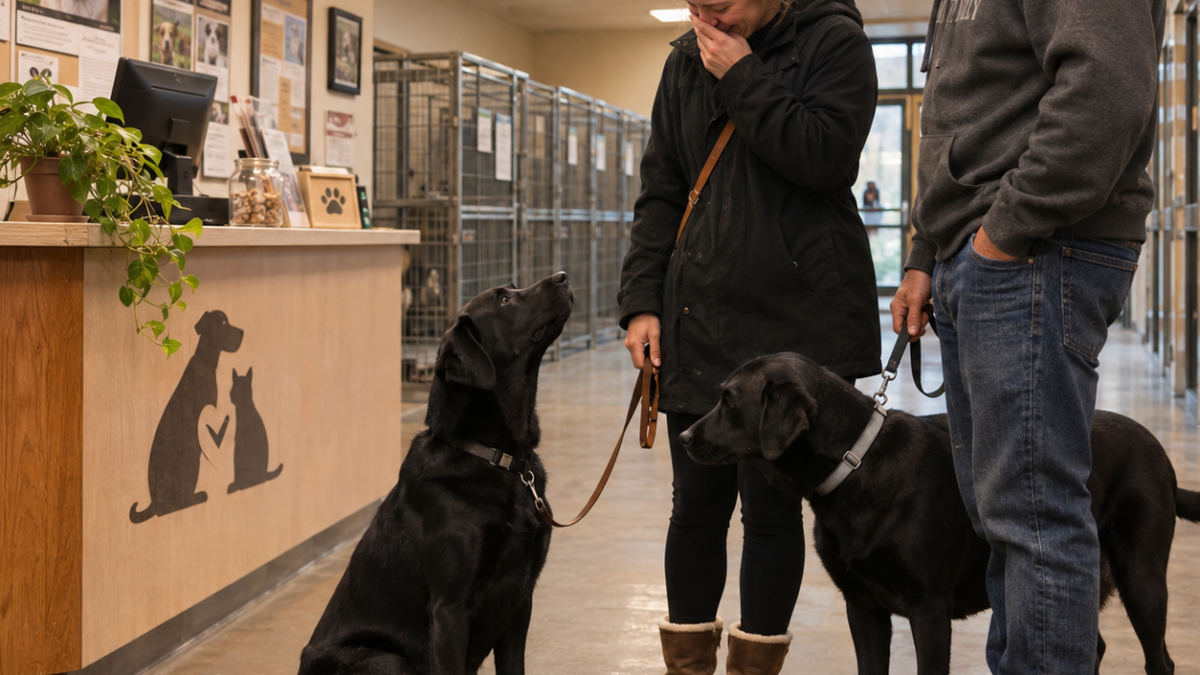
PART 2
Margaret didn’t speak for a second.
Then her expression changed.
Not surprise exactly.
Relief.
“You came back for Cooper.”
It wasn’t a question.
I nodded.
“Can we see him?”
She pressed her lips together.
“Yes.”
We followed her down the hallway.
Before we reached the kennel, we heard him.
Not barking.
A low, broken whine.
Cooper was standing near the front gate, turning his head toward every sound.
His body looked wrong without Bailey beside him.
That sounds sentimental, but I don’t know another way to explain it.
The kennel was the same size.
Same blanket.
Same stainless-steel water bowl.
But Cooper seemed smaller.
Lost.
His nose worked constantly.
Searching the air.
When my shoes stopped near the gate, he turned toward me.
Then toward Margaret.
Then back toward the hallway.
“Where’s Bailey?” I whispered.
Margaret opened the gate.
Cooper did not come forward.
“He’s been looking for him since you left.”
That sentence hurt.
“How long were they separated before today?”
“They weren’t.”
“Never?”
“Not since they arrived here.”
David looked at me.
“They came in together?”
Margaret nodded.
“Same owner surrendered both.”
“Why?”
She hesitated again.
This was the second hesitation.
I noticed more this time.
“The owner was moving.”
“And couldn’t take either?”
“That was the original explanation.”
“Original?”
Margaret looked toward Cooper.
“Let’s get Bailey first.”
David went outside.
I stayed.
Cooper paced in a small circle.
His nails clicked against the concrete.
Every time the hallway door opened, his head snapped toward it.
Then Bailey barked outside.
Cooper froze.
Every part of his body became still.
Bailey barked again.
Cooper exploded.
Not aggressively.
Joyfully.
He ran toward the kennel gate so fast he hit it with his shoulder.
Margaret opened it.
David came around the corner with Bailey.
The leash nearly left his hand.
Bailey pulled.
Cooper ran.
They met halfway down the hallway.
I will never forget the sound Cooper made.
Half whine.
Half cry.
He shoved his face against Bailey’s neck.
Bailey pushed back.
They circled each other.
Sniffing.
Touching.
Tails beating against walls.
Cooper kept pressing his nose to Bailey’s shoulder as if confirming again and again:
You’re here.
You’re here.
You’re here.
David looked at me.
“That’s it.”
I already knew.
“We’re taking both.”
Margaret smiled.
“Let’s talk first.”
That sentence worried me.
We went into a small consultation room with both dogs.
Bailey lay beside my chair.
Cooper lay against Bailey.
Margaret closed the door.
“I want you to understand what you’re agreeing to.”
“We understand he’s blind.”
“Knowing that sentence and living with a blind dog are different things.”
“Okay.”
“Cooper maps environments through scent, texture, sound and memory. Moving furniture unexpectedly can confuse him. Stairs need management. Pools are dangerous. Open gates are dangerous.”
“We have no pool.”
“Good.”
“Our backyard is fenced.”
“Check every gap.”
“We will.”
“He may panic in unfamiliar places.”
“Okay.”
“He can learn.”
She looked directly at me.
“But you cannot treat him like he’s helpless.”
That surprised me.
“I wasn’t planning to.”
“People do.”
She rubbed Cooper’s neck.
“They either expect too much or nothing.”
“What does he need?”
“Consistency.”
David asked, “And Bailey?”
Margaret looked toward him.
“Bailey needs a chance to be a dog too.”
I understood.
“He’s been responsible for Cooper.”
“Yes.”
“Too responsible?”
“Maybe.”
She sighed.
“They’re bonded. Deeply. But I don’t want Bailey’s entire life reduced to being Cooper’s guide.”
That stayed with me.
We completed a second adoption application.
The shelter normally required another review period.
Margaret disappeared for ten minutes.
When she returned, the shelter manager came with her.
A woman named Carol.
She studied us.
“You’re certain?”
David answered first.
“No.”
Carol blinked.
He smiled.
“We’re not certain about anything except we’re not separating them.”
I loved him for that.
Carol sat.
“That’s a better answer than pretending you understand everything.”
She approved the adoption.
Two dogs.
Two collars.
Two leashes.
Two sets of records.
Twice the food.
Twice the insurance.
Twice everything.
When we reached the parking lot, Cooper stopped.
Outdoor sounds surrounded him.
Cars.
Wind.
Birds.
Shopping carts from the store next door.
His body tightened.
Bailey walked ahead.
Cooper hesitated.
Bailey returned.
Touched his shoulder.
Then moved again.
Cooper followed.
We loaded them into the car together.
This time, Bailey did not look backward.
He curled beside Cooper.
Cooper rested his head on Bailey’s leg.
Five minutes later, both were asleep.
David glanced at them through the mirror.
“You realize we own two Labradors.”
“We adopted two.”
“That’s what I said.”
“No. You said own.”
He smiled.
“Fine.”
Then he looked at the back seat.
“We’ve been outnumbered for thirty minutes and you’re already correcting my language.”
I laughed.
That was our first ride home as a family of four.
It was also the easiest part.
The first hour at home taught us how little we knew.
Bailey charged through the front door like he had purchased the property.
Living room.
Kitchen.
Back door.
Stairs.
Bedroom.
He investigated everything.
Cooper stood in the entryway.
Frozen.
His nose moved.
His ears moved.
His body did not.
“Should I guide him?” I whispered.
David remembered Margaret’s advice.
“Let him map.”
So we did.
Bailey ran back.
Touched Cooper.
Then walked toward the living room.
Cooper followed carefully.
One step.
Another.
His nose brushed the wall.
He stopped.
Moved forward.
Furniture became landmarks.
The rug.
Couch.
Coffee table.
Doorway.
We had put textured mats at transitions between rooms after Margaret suggested it.
Cooper discovered the first one.
He sniffed.
Stepped across.
Bailey waited.
Within an hour, Cooper had found the water.
Two hours later, the back door.
By evening, he understood the route between the kitchen and living room.
Then David moved a dining chair.
Cooper walked into it.
Not hard.
Enough.
He backed up.
I stared at David.
He stared at the chair.
“Okay.”
“Don’t move things.”
“I moved it six inches.”
“Congratulations.”
“It was in the way.”
“Not to Cooper.”
David returned the chair exactly where it had been.
Cooper sniffed.
Continued.
Lesson one.
Our first night was chaos.
We had purchased two large dog beds.
Bailey ignored both.
Cooper ignored both.
They slept together on the rug beside our bed.
At three in the morning, Bailey climbed onto the mattress.
At 3:02, Cooper tried.
He missed.
His front paws hit the side.
He slid down.
I sat up.
“Wait.”
David turned on the lamp.
Bailey stood at the edge of the bed.
Cooper tried again.
This time Bailey leaned down.
Cooper touched his nose.
Adjusted.
Jumped.
Success.
Seventy pounds of Labrador landed on my legs.
Then another seventy pounds settled beside him.
David looked at me.
“Our bed is gone.”
“Yes.”
“We spent money on dog beds.”
“Yes.”
“Why?”
“I don’t know.”
The next morning, we began learning.
Blind dogs use sound differently.
We started saying “step” before curbs.
“Careful” near obstacles.
“Left.”
“Right.”
“Door.”
“Outside.”
Cooper learned faster than we did.
Within two weeks, he could navigate most of the first floor independently.
Bailey still hovered.
If Cooper bumped a chair, Bailey returned.
If Cooper hesitated at a doorway, Bailey touched him.
Sometimes it was beautiful.
Sometimes it became a problem.
Bailey refused to play if Cooper seemed uncertain.
At the dog park, Bailey spent more time monitoring his brother than chasing balls.
Our trainer, Denise, noticed.
“Bailey has made Cooper his job.”
“That’s bad?”
“Not bad.”
She threw a ball.
Bailey ran halfway.
Then stopped because Cooper had turned toward a barking dog.
Bailey returned.
“See?”
“Yes.”
“Cooper needs independence.”
“And Bailey?”
“Permission to stop being responsible every second.”
That sounded strangely human.
We worked on both.
Cooper learned scent markers.
A drop of lavender oil near the back door.
Vanilla near the kitchen.
Cedar near the stairs.
Not strong.
Just enough.
Textured strips indicated changes.
Bailey learned a release cue.
“Go play.”
At first, he refused.
Then one afternoon David threw a tennis ball.
“Bailey. Go play.”
Bailey looked at Cooper.
Cooper was sniffing near me.
David threw again.
Bailey hesitated.
Then ran.
Full speed.
That dog exploded across the yard.
I laughed.
He brought the ball back.
Again.
Again.
Eventually Cooper heard him running.
His tail began wagging.
He joined.
Not chasing the ball.
Chasing the sound of Bailey.
Two black Labs tore across our yard like idiots.
Cooper occasionally ran into Bailey.
Bailey didn’t care.
Neither did Cooper.
That was the first time I saw them as brothers instead of caretaker and dependent.
They wrestled.
Stole toys.
Competed for treats.
Bailey sometimes stole Cooper’s bed.
Cooper sometimes sat directly on Bailey.
Normal.
That was what we wanted.
Then, six weeks after adoption, Cooper disappeared.
For seven minutes.
Seven minutes.
It remains one of the worst seven minutes of my life.
David had opened the side gate while carrying branches from a storm.
He closed it.
Or thought he did.
The latch had not caught.
Bailey and Cooper were in the yard.
I was inside.
David was in the garage.
Then I heard Bailey barking.
Not ordinary barking.
Frantic.
I ran outside.
Bailey stood at the open gate.
Alone.
“Cooper?”
Bailey ran into the driveway.
My heart stopped.
“DAVID!”
We searched.
I called Cooper.
No response.
Blind dogs don’t always orient toward voices well in unfamiliar open spaces.
Bailey ran toward the road.
“Bailey!”
He ignored me.
That terrified me.
He crossed the front yard.
Turned right.
Ran along the sidewalk.
David followed.
I grabbed my phone.
Our neighborhood wasn’t busy.
But one car was enough.
“COOPER!”
Nothing.
Then Bailey stopped near a drainage ditch.
He barked.
Again.
I ran.
Cooper was down inside the ditch.
He had apparently followed the sidewalk until it ended at a grassy slope.
Then lost his footing.
He was standing in shallow water, confused but uninjured.
Bailey scrambled down.
Cooper immediately pressed against him.
I almost collapsed.
David climbed into the ditch.
“Hey, buddy.”
Cooper heard him.
Tail wag.
I started crying.
The gate had been open less than three minutes.
That was all.
Back home, David replaced every latch.
Then added secondary clips.
Then alarms.
Then checked them five times.
He blamed himself.
For days.
“It was an accident.”
“He could’ve been killed.”
“But he wasn’t.”
“Because Bailey found him.”
That was true.
But something about the incident changed how we approached Cooper’s independence.
Independence did not mean pretending blindness created no risk.
Respect meant giving Cooper freedom with intelligent safeguards.
The balance mattered.
We installed a low fence extension near the ditch side.
Added a GPS tag to both collars.
Worked harder on emergency recall using a whistle Cooper could localize better than shouting.
The next time the gate accidentally failed—a year later—Cooper stopped at the threshold when the whistle sounded.
Progress.
Three months after adoption, Margaret called.
“You need to come to the shelter.”
My stomach dropped.
“Why?”
“Nothing is wrong.”
“People only say that immediately before something is wrong.”
She sighed.
“There’s information about Bailey and Cooper.”
David and I went that afternoon.
Margaret had their old surrender file.
Not the public adoption summary.
The full intake notes.
“The previous owner contacted us.”
“Why?”
“She saw the adoption story.”
“What story?”
Apparently the shelter had posted a photograph of Bailey and Cooper sleeping together in our home.
The post spread locally.
The caption said:
**They were nearly separated. Their family turned around.**
I knew they had posted it.
I didn’t know how widely it had traveled.
“What does she want?”
Margaret looked uncomfortable.
“She says Bailey wasn’t supposed to be adopted.”
I stared.
“What?”
David leaned forward.
“Explain.”
The previous owner’s name was Vanessa Cole.
She had surrendered both dogs four months before we adopted them.
At intake, she had stated she was moving after a divorce and could not keep either dog.
But the original notes told a more complicated story.
Vanessa had asked whether the shelter could take Cooper and let her keep Bailey.
The shelter refused to separate them immediately because staff observed extreme distress when Cooper lost contact with Bailey.
A week later, Vanessa surrendered both.
“Why?” I asked.
Margaret read the note.
“She said if Cooper couldn’t go alone, she couldn’t manage either.”
David’s expression hardened.
“So she wanted to keep the sighted dog and dump the blind one.”
Margaret raised a hand.
“That’s an interpretation.”
“It sounds accurate.”
“She may have had housing restrictions.”
“Did she?”
“No documentation.”
I looked toward the file.
“What does she want now?”
“Bailey.”
The word made me cold.
“Not Cooper?”
Margaret didn’t answer.
She didn’t need to.
David laughed once.
No humor.
“Absolutely not.”
“She has no automatic right to him.”
“Automatic?”
“Legally, she surrendered ownership.”
“So why are we here?”
“Because she is threatening action.”
“On what grounds?”
“She claims she was emotionally distressed during the surrender and that staff pressured her.”
“Did they?”
“No.”
“Then?”
“She also claims Bailey has significant monetary value because he’s from a breeder line.”
That explained part of it.
“How much?”
Margaret hesitated.
“Apparently she paid several thousand dollars.”
“And Cooper?”
“Same litter.”
“But she doesn’t want him.”
Margaret’s face said everything.
David leaned back.
“Let her sue.”
I was less confident.
Not because I thought Vanessa would win.
Because the idea of anyone threatening to separate them again made me physically sick.
That evening, Bailey and Cooper slept together beneath our kitchen table.
I sat nearby reading the surrender notes repeatedly.
One line stood out.
**Owner reports Cooper “too difficult” due to blindness and dependence on Bailey.**
Too difficult.
Cooper was asleep with his head on Bailey’s side.
I whispered:
“You’re not difficult.”
Cooper’s ear moved.
Bailey opened one eye.
“Neither of you is going anywhere.”
The next morning, Vanessa called me.
I don’t know where she got my number.
Probably social media.
“Is this the woman who has Bailey?”
“The woman who adopted Bailey and Cooper.”
Pause.
“I need to speak to you.”
“You are.”
“I want Bailey back.”
“No.”
“You haven’t even heard—”
“No.”
“He was my dog for four years.”
“And you surrendered him.”
“Because the shelter told me they wouldn’t take Cooper alone.”
There it was.
I became quiet.
Vanessa continued.
“I couldn’t handle Cooper anymore.”
“Why?”
“He was destroying my life.”
I looked across the room.
Cooper was navigating toward his water bowl.
Slowly.
Confidently.
“That’s dramatic.”
“You didn’t live with him then.”
“What did he do?”
“He panicked if Bailey wasn’t there.”
“Because he’s blind.”
“He barked.”
“Dogs do that.”
“He knocked things over.”
“Blind dogs do that when environments aren’t adapted.”
“You think you’re better than me?”
“No.”
I meant it.
At least then.
“I think you had choices.”
“You don’t know what I was dealing with.”
“Then explain.”
“My husband left. I had to move. I was working two jobs.”
That changed my anger slightly.
Not enough.
But slightly.
“I couldn’t manage a blind dog.”
“I understand being overwhelmed.”
“No, you don’t.”
“Maybe not.”
I looked toward Bailey.
He was asleep.
“What I don’t understand is asking for Bailey now without asking how Cooper is.”
Silence.
“You haven’t asked once.”
Another silence.
Finally:
“I know he’s fine.”
“How?”
“The posts.”
“You know what posts show.”
“He looks happy.”
“He is.”
“I’m glad.”
It sounded genuine.
That made the conversation harder.
People are easier to hate when they are simple villains.
Vanessa continued.
“Bailey was mine.”
“He was.”
“I loved him.”
“I believe you.”
“Then why won’t you let me see him?”
“Because you are threatening to take him.”
“I just want—”
“You want Bailey.”
“Yes.”
“Without Cooper.”
Long pause.
“I can’t take Cooper.”
“Then you can’t have Bailey.”
She started crying.
That surprised me.
“I miss him.”
I believed that too.
I hated how many truths could exist at once.
Vanessa may have loved Bailey.
She may also have failed Cooper.
She may have been overwhelmed.
She may have made a cruel choice.
All could be true.
“I’m sorry you’re hurting.”
My voice softened.
“But Bailey isn’t medicine for your guilt.”
She became silent.
“He has a family.”
“He had a family.”
“He still does.”
I looked at Cooper.
“Two, actually.”
Vanessa hung up.
A lawyer’s letter arrived four days later.
David read it.
Then handed it to our attorney.
The shelter provided the surrender agreement.
Clear.
Signed.
No coercion language.
No temporary placement.
Full relinquishment.
The legal threat weakened immediately.
But Vanessa didn’t stop.
She posted online.
Said the shelter had “stolen” Bailey.
Said we were keeping him from his “real mother.”
People started messaging us.
Most supported us.
Some didn’t.
One comment said:
**Why not give Bailey back and keep the blind one?**
I stared at that sentence for a long time.
Keep the blind one.
Like Cooper was the leftover.
The burden.
The dog nobody expected anyone to choose.
I almost responded.
David stopped me.
“Don’t fight strangers.”
“They’re talking about our dogs.”
“They don’t know our dogs.”
“They’re saying—”
“I know.”
He took my phone.
“Come outside.”
Bailey and Cooper were wrestling in the yard.
Cooper had Bailey’s rope toy.
Bailey was pretending he couldn’t take it.
David pointed.
“That’s the answer.”
He was right.
The internet argument lasted a week.
Then faded.
Real life remained.
Breakfast.
Walks.
Work.
Training.
Cooper learning.
Bailey learning to relax.
We stopped reading comments.
The hearing never became a full trial.
Vanessa’s attorney withdrew the claim after reviewing the surrender contract and shelter documentation.
But before it ended, Vanessa requested one supervised visit.
Our lawyer said we could refuse.
I wanted to.
David surprised me.
“Maybe we shouldn’t.”
I stared at him.
“You want her near them?”
“I want to know what we’re protecting them from.”
“What does that mean?”
“Maybe Bailey deserves to see her.”
“And Cooper?”
“Both.”
That mattered.
If she visited, she would not get the version of the story where Cooper vanished.
The shelter agreed to supervise.
Margaret.
Carol.
Our attorney nearby.
No transfer.
No leash handed over.
We brought Bailey and Cooper together.
Vanessa arrived alone.
The moment Bailey heard her voice, he froze.
Then his tail began moving.
Fast.
My stomach tightened.
Vanessa knelt.
“Bailey.”
He ran to her.
She sobbed.
Wrapped her arms around him.
Bailey licked her face.
I looked away for one second.
Not because I feared losing him legally.
Because I feared something more primitive.
That love could invalidate us.
David touched my hand.
“It’s okay.”
I nodded.
Bailey remembered.
Of course he did.
Four years cannot be erased because paperwork changed.
Then Cooper heard Vanessa crying.
He turned toward her.
His tail moved.
Slowly.
He walked forward.
Vanessa looked at him.
Everything changed in her face.
“Cooper.”
He approached.
Sniffed her.
Then pushed his nose into her hand.
Vanessa broke.
Not graceful crying.
Full-body sobbing.
She put one hand over her mouth.
“Oh God.”
Cooper remained.
No fear.
No accusation.
Dogs don’t perform morality for us.
He just recognized someone from his life.
Vanessa touched his head.
“I’m sorry.”
Cooper licked her wrist.
Bailey stood beside them.
The three were together again.
For a few minutes, I understood what she had lost.
Then Vanessa said something that ended the illusion.
She looked at Bailey.
“You can come home.”
Cooper’s head lifted at her voice.
Bailey wagged.
Margaret stepped closer.
“This is a visit, Vanessa.”
“I know.”
She looked at us.
“But look at him. He wants me.”
I felt anger return.
David answered before I did.
“He remembers you.”
“Same thing.”
“No.”
David shook his head.
“Remembering isn’t choosing.”
Vanessa stood.
“Let him choose.”
The room went quiet.
I looked at Margaret.
She looked worried.
Our attorney said:
“This has no legal meaning.”
Vanessa wiped her eyes.
“I know.”
She looked at Bailey.
“Call him.”
I didn’t like reducing a dog’s attachment to a test.
But before anyone could stop it, Vanessa moved toward one end of the room.
David and I stood at the other.
Cooper remained near the center.
Bailey looked between us.
Vanessa called:
“Bailey!”
His ears lifted.
He took two steps toward her.
My heart dropped.
Then Cooper moved.
Not toward us.
He simply began walking.
His nose searched.
He touched Bailey’s flank.
Bailey stopped.
Cooper leaned against him.
Bailey looked at his brother.
Then at Vanessa.
Then turned.
He walked with Cooper toward us.
Not running.
Not dramatic.
Together.
Bailey reached David first.
Cooper reached my leg.
Both sat.
Vanessa stared.
Nobody spoke.
Finally she whispered:
“He won’t leave him.”
Margaret answered gently:
“No.”
Vanessa sat down.
For the first time, I saw something in her face that wasn’t grief for Bailey.
It was recognition of Cooper.
Not as the difficult blind dog.
As the reason Bailey’s world had shape.
She cried quietly.
“I thought Bailey was trapped.”
“What do you mean?” I asked.
“He always followed Cooper.”
“He guided him.”
“I know.”
She wiped her face.
“I used to think Cooper took everything from him.”
David looked at Bailey.
“Maybe Bailey thought giving it was part of loving him.”
That sentence stayed with me.
Vanessa looked toward Cooper.
“I was exhausted.”
“I believe you,” I said.
“I hated myself for feeling relieved when I surrendered them.”
That confession was ugly.
And human.
“I kept telling myself Bailey would get adopted immediately.”
“He almost did.”
She looked at me.
I continued.
“We left with him.”
Her face tightened.
“Then why did you go back?”
I looked toward Bailey.
“Because he told us.”
Vanessa almost smiled.
“How?”
“He wouldn’t stop looking back.”
She lowered her head.
“That sounds like him.”
For the first time, we weren’t enemies.
Not friends.
Not absolved.
Just people connected by two dogs.
Vanessa withdrew the last of her public accusations the following day.
She posted one message.
**Bailey and Cooper are together, safe and loved. I made mistakes when my life fell apart, and I am grateful the people who adopted them understood something I didn’t at the time: separating them was never the answer.**
She received sympathy.
Criticism.
Anger.
Support.
I stopped reading.
Her punishment was not ours to manage.
The most satisfying consequence was already happening.
Cooper was thriving.
The dog she once believed impossible to manage became confident enough to navigate our home without Bailey.
That transformation took time.
At six months, Cooper learned the stairs with verbal cues.
At eight months, he could walk from the bedroom to the yard independently.
At one year, we moved a chair three feet.
I nearly panicked.
Cooper bumped it lightly.
Stopped.
Sniffed.
Mapped the new position.
Continued.
I stared.
David smiled.
“He doesn’t need the museum anymore.”
He was right.
We had protected Cooper so much that our house had become frozen.
Margaret’s old warning returned.
Don’t make him helpless.
So we challenged him carefully.
New walking routes.
New parks.
Different surfaces.
A beach.
That one was hilarious.
The first time Cooper felt sand beneath his paws, he stopped.
Lifted one foot.
Then another.
He looked personally offended.
Bailey ran into the waves.
Cooper heard him.
Followed.
Then the water touched Cooper’s paws.
He jumped backward.
David laughed so hard he dropped the leash.
Eventually Cooper entered ankle-deep water.
Bailey stood beside him.
Cooper leaned into his shoulder.
Then walked farther.
Not because Bailey dragged him.
Because Bailey made uncertainty survivable.
That became the pattern.
At two years with us, Cooper became less dependent.
Bailey became more playful.
Their relationship changed.
Cooper no longer followed every movement.
Sometimes Bailey went into the yard alone.
Cooper stayed inside sleeping.
The first time that happened, I almost called Margaret.
Then realized how ridiculous that was.
Independence was success.
Bailey could leave a room.
Cooper knew he would come back.
That mattered.
They still slept touching.
Always.
Even when we bought two giant orthopedic beds, Cooper squeezed into Bailey’s.
Eventually we pushed the beds together.
Problem solved.
At age seven, Bailey injured his knee.
Nothing catastrophic.
A partial ligament tear.
But he needed surgery and six weeks of restricted movement.
Suddenly, the guide became the one who needed help.
Cooper did not understand why Bailey wasn’t walking normally.
The first night after surgery, Bailey whimpered.
Cooper stood beside the recovery pen.
He couldn’t get inside.
He paced.
“Cooper.”
Nothing.
He pressed his nose through the bars.
Bailey moved toward him.
The two noses touched.
Cooper lay down outside the pen.
He stayed all night.
For six weeks, Cooper adapted.
Bailey couldn’t guide him on walks.
So Cooper used me.
Voice.
Harness.
Cues.
He became more independent because Bailey temporarily couldn’t do the job.
Then something beautiful happened.
When Bailey began walking again, Cooper started guiding him.
Not literally.
But he matched Bailey’s slower pace.
Stopped when Bailey stopped.
Waited near the porch step.
If Bailey struggled standing, Cooper pressed against him.
The dependent dog had learned care.
I cried more than was reasonable.
David did too.
He just called it allergies.
At age eight, both became certified participants in a shelter education program.
Not therapy dogs exactly.
Ambassadors.
Bailey demonstrated calm handling.
Cooper helped teach children about disability.
We were careful with the message.
I hated when people called Cooper “inspiring” merely for existing while blind.
He wasn’t brave because he woke up blind every morning.
He was a dog.
A funny, stubborn, food-obsessed Labrador who happened not to see.
The lesson wasn’t:
Look how amazing the poor blind dog is.
It was:
Blind does not mean broken.
Children understood quickly.
One boy asked:
“Does Cooper know he’s blind?”
I laughed.
“What would that mean?”
“Like, does he know other dogs see?”
“I don’t know.”
The boy thought.
“Maybe he thinks Bailey is weird because Bailey keeps looking at stuff.”
That became my favorite theory.
The shelter eventually changed its bonded-pair policy.
Before Bailey and Cooper, staff could strongly recommend bonded adoptions but often still separated pairs if one dog was considered more adoptable.
After reviewing several cases, including theirs, Carol implemented a stronger behavioral assessment.
Pairs showing severe dependency or distress during separation required special review before separate placement.
Not every pair had to remain together.
That would be irresponsible too.
But convenience could no longer be the only reason for separation.
Margaret called me the day the policy became official.
“Your boys did that.”
“Our boys stole a loaf of bread last night.”
“Heroes contain multitudes.”
“They contain carbohydrates.”
She laughed.
Another year passed.
Then Bailey developed cancer.
The first mass appeared near his shoulder.
We thought it was benign.
It wasn’t.
Lymphoma.
I remember sitting in the veterinary office hearing the word and looking toward Cooper.
He was lying beside Bailey.
Calm.
Unaware.
David asked all the questions.
Treatment.
Chemotherapy.
Side effects.
Time.
Quality.
I heard only fragments.
Bailey had always been Cooper’s certainty.
The idea of Cooper without Bailey felt impossible.
Then I hated myself for thinking first about Cooper.
Bailey was the one with cancer.
He deserved to be the center of his own crisis.
We chose treatment.
Bailey responded well.
Six months became a year.
Good year.
Walks.
Meals.
Beach.
Shelter visits.
He lost some energy.
Not himself.
Cooper adjusted to slower days.
Then remission ended.
The second round worked less.
Our veterinarian, Dr. Patel, sat with us.
“We need to start thinking in weeks, not months.”
David looked away.
I stared at Bailey.
He was eating cheese from a technician.
“How do we tell Cooper?”
Dr. Patel’s face softened.
“You don’t.”
“What?”
“You let him experience what happens.”
“That sounds awful.”
“Dogs understand absence differently than we do.”
“I don’t want him searching.”
“Then when the time comes, let him be present if possible.”
I cried in the parking lot.
Not only because Bailey was dying.
Because for years, every decision had been about keeping them together.
Now there was one separation no U-turn could fix.
Bailey declined over the next month.
Cooper knew something.
He stopped roughhousing.
Stayed closer.
Slept with his head across Bailey’s ribs.
Sometimes, Bailey would wake and lick Cooper’s face.
The sight ruined me.
Vanessa wrote after hearing through the shelter.
She asked if she could visit.
We said yes.
No lawyers now.
No ownership.
No fight.
Just goodbye.
She came to our house.
Older.
Quieter.
Bailey recognized her immediately.
Tail wag.
Not strong.
Enough.
Vanessa sat on the floor.
He placed his head in her lap.
She cried.
Then Cooper came.
She put one arm around each dog.
“I’m sorry.”
Same words as years earlier.
Different meaning.
“I thought separating you would make my life easier.”
Bailey breathed.
Cooper leaned against him.
“I was wrong.”
She stayed an hour.
Before leaving, she looked at us.
“Thank you for turning around.”
I couldn’t speak.
David answered.
“So are we.”
Two weeks later, Bailey stopped eating.
That was the sign.
He loved food more than dignity.
If Bailey refused chicken, we were done asking his body for more.
Dr. Patel came to the house.
We spread blankets in the backyard.
Bailey loved the grass there.
Cooper lay beside him.
I sat near Bailey’s head.
David held one paw.
The afternoon was warm.
Birds.
Wind.
Normal life continuing around a moment that felt impossible.
I whispered:
“You know what you did?”
Bailey looked at me.
“You made us turn around.”
His tail moved once.
“You looked through that back window and told us we’d made the wrong choice.”
David cried.
“Best argument you ever won.”
Cooper lifted his head at David’s voice.
He moved closer.
Bailey touched noses with him.
I started shaking.
Dr. Patel waited.
No rush.
Then I said the thing I had been afraid to say.
“Cooper’s going to be okay.”
Bailey’s eyes stayed on mine.
“I promise.”
I didn’t know whether I believed it.
But I needed Bailey to hear it.
“We’ve got him.”
David put his hand on Cooper.
“He’s not alone.”
Bailey relaxed.
Maybe medication.
Maybe exhaustion.
Maybe nothing mystical at all.
It didn’t matter.
The sedative went in.
Bailey’s breathing slowed.
Cooper stayed pressed against him.
When Bailey died, Cooper did not react immediately.
He remained lying there.
Then he lifted his head.
Sniffed Bailey’s face.
Neck.
Paws.
He nudged him.
Once.
Waited.
Nudged again.
Nothing.
Cooper stood.
Walked around Bailey.
Then lay back down beside him.
My heart broke in a different way.
We let him stay.
Ten minutes.
Twenty.
Almost an hour.
Eventually Cooper stood.
Walked toward me.
Pressed his head against my stomach.
I wrapped my arms around him.
“I know.”
He didn’t.
Not the way I did.
But he knew something had changed.
That night, Cooper searched the house.
Bedroom.
Living room.
Back door.
Bailey’s bed.
He returned to the hallway.
Listened.
Nothing.
I slept on the floor beside him.
David slept on the other side.
Three bodies.
One missing.
The first week was awful.
Cooper ate less.
Moved cautiously.
Not because he had forgotten the house.
Because his confidence had changed.
Bailey’s sound was gone.
The tags.
Footsteps.
Breathing.
Those had been landmarks too.
We increased verbal cues.
Wore small bells temporarily around the house so Cooper could locate us.
Maintained routine.
Most importantly, we did not bring another dog home immediately.
People suggested it.
“Cooper needs another guide.”
No.
Cooper needed to learn that he was not incomplete without Bailey.
That was the last gift we could give both brothers.
For three months, Cooper struggled.
Then one morning, David opened the back door.
Cooper walked outside alone.
No hesitation.
Down the step.
Across the yard.
To the tree where Bailey used to lie.
He sniffed.
Then continued.
David called me.
I came outside.
Cooper was standing in sunlight.
Alone.
Tail moving.
I cried.
Not because he had forgotten Bailey.
Because he hadn’t stopped living.
Six months later, we fostered a young Labrador mix named Milo.
Temporary.
Cooper ignored him for two days.
Milo adored Cooper immediately.
Followed him everywhere.
The irony made us laugh.
The blind dog who had once followed Bailey now had another dog following him.
Cooper became impatient.
If Milo bumped him while playing, Cooper barked.
If Milo tried stealing food, Cooper corrected him.
If Milo became nervous in new places, Cooper walked ahead.
Confident.
Mapped.
Certain.
One afternoon at the shelter, Margaret watched them.
“Look at him.”
I smiled.
“He thinks he’s Bailey.”
Margaret shook her head.
“No.”
She looked toward Cooper.
“He’s Cooper.”
That was better.
Milo was adopted by another family.
Cooper did not collapse when he left.
He looked for him that evening.
Then slept.
Proof of something enormous.
Connection without dependence.
Love without losing yourself.
Cooper lived three more years after Bailey.
He became the shelter’s unofficial ambassador for blind-dog adoption.
Families met him.
Asked questions.
Watched him navigate.
One woman cried because her own dog had recently lost his eyesight and she believed euthanasia might be necessary.
Cooper walked across the room.
Found her by voice.
Put his head on her knee.
She laughed through tears.
“Okay.”
That dog lived another four years.
Cooper changed lives without knowing it.
Vanessa visited occasionally.
Not often.
No confusion about ownership.
Just visits.
She eventually adopted a senior dog.
Blind in one eye.
The shelter called me before approving her.
Not because she was legally disqualified.
Because they wanted context.
I spoke honestly.
“She failed Cooper once.”
Then:
“She also admitted it.”
“Would you trust her?”
I thought a long time.
“With support?”
“Yes.”
Vanessa adopted the dog.
His name was Charlie.
She sent one photograph.
Charlie asleep on her couch.
No grand apology.
No dramatic redemption.
Just changed behavior.
That was enough.
People sometimes asked whether that meant Vanessa “deserved forgiveness.”
I stopped answering.
Forgiveness wasn’t the point.
Cooper didn’t need a moral conclusion about Vanessa.
Bailey didn’t either.
What mattered was what she did next.
Did she repeat the harm?
No.
Good.
That is how accountability should work when it can.
Not endless punishment.
Change.
Cooper reached twelve.
His face turned gray.
His hearing weakened.
Blind and hard of hearing was a new challenge.
We used floor vibrations.
Touch cues.
Scent.
He adapted.
Of course.
This dog had spent his whole life adapting.
At thirteen, kidney disease.
Medication.
Diet.
More vet visits.
At fourteen, stairs became difficult.
We moved our bedroom downstairs.
Not for Cooper, we claimed.
Convenience.
Nobody believed us.
His final year was quiet.
He slept in Bailey’s old bed.
We had kept it.
For years, Cooper preferred the one beside it.
Then one winter, he simply switched.
Maybe scent no longer remained.
Maybe memory did.
Maybe the bed was softer.
Dogs don’t owe us symbolism.
Still, seeing him there mattered.
One spring morning, Cooper stopped eating.
The same sign Bailey had given us.
I offered chicken.
Nothing.
Peanut butter.
Nothing.
Cheese.
He sniffed.
Turned away.
“That’s rude.”
His tail moved faintly.
I called Dr. Patel.
She came that afternoon.
Same backyard.
Same tree.
Different dog.
David and I sat beside Cooper.
His eyes had never seen us.
That thought hit me strangely after fourteen years.
Cooper knew my face in ways sighted people didn’t.
My footsteps.
Breathing.
Scent.
Voice.
Hands.
He knew when I was upset before I spoke.
He knew David’s truck vibration.
The sound of our kitchen cabinet.
The exact distance from bedroom to back door.
He had never seen our home.
He knew it completely.
Dr. Patel listened to his heart.
Then looked at us.
I nodded.
No heroic last treatment.
No fear-driven extension.
Dignity.
Cooper lay with his head across my leg.
I ran my hand along his gray muzzle.
“Bailey’s not here to tell you where to go.”
My voice broke.
David covered his face.
“But you figured that out years ago.”
Cooper’s tail moved.
“You know what I think?”
His breathing continued.
“I think we were wrong about you.”
Dr. Patel waited.
“The day we met you, we thought Bailey was your whole world.”
I swallowed.
“He wasn’t.”
Cooper’s ear moved.
“He was your brother.”
Another breath.
“Your first safe place.”
Another.
“But you had a world too.”
My hand shook.
“And you found it.”
The sedative entered.
Cooper relaxed.
I leaned close.
“You found us.”
David put his hand on Cooper’s shoulder.
“You found the yard.”
Another breath.
“The beach.”
Another.
“Milo.”
Another.
“Your own way.”
Cooper’s head became heavier.
I whispered:
“And now you don’t need anybody to guide you.”
Dr. Patel prepared the final medication.
I kissed Cooper between the eyes that had never seen light.
“You already know the way home.”
His breathing slowed.
Then stopped.
The backyard became silent.
David and I stayed there for a long time.
We buried Cooper’s ashes beside Bailey’s beneath the maple tree.
Their markers are simple.
Bailey’s:
**BAILEY**
**HE ALWAYS LOOKED BACK FOR HIS BROTHER.**
Cooper’s:
**COOPER**
**HE NEVER NEEDED TO SEE TO KNOW WHERE HOME WAS.**
Between them, David placed a small stone.
No name.
Just:
**TOGETHER FROM THE BEGINNING.**
We thought that was the ending.
Then Margaret called.
Again.
Years had passed since our first visit to the shelter.
She was retiring.
“Come Saturday.”
“Why?”
“Trust me.”
We did.
The shelter had renovated the old adoption wing.
Near the bonded-dog area was a new room.
Soft lighting.
Low barriers.
Textured flooring.
Separate quiet spaces.
A sign over the entrance:
**THE BAILEY & COOPER BOND ROOM**
I stared.
Margaret watched me.
“You didn’t.”
“I did.”
“What is it?”
“A meeting space for bonded pairs, disabled dogs and families considering multi-dog adoption.”
David touched the sign.
“Why them?”
Margaret smiled.
“Because you left with one dog.”
I laughed through tears.
“And came back.”
“Yes.”
She pointed toward a plaque.
It read:
**SOMETIMES ADOPTION ISN’T ABOUT CHOOSING THE EASIEST DOG.**
**SOMETIMES IT IS ABOUT UNDERSTANDING WHO A DOG CANNOT BE ASKED TO LEAVE BEHIND.**
Below that:
**BAILEY LOOKED BACK. HIS FAMILY DID TOO.**
I cried.
Of course.
Margaret handed me a folder.
Inside were photographs.
Bonded pairs adopted together.
Two senior Chihuahuas.
A mother and adult daughter.
Two shepherd mixes.
A deaf dog and the companion dog who helped him navigate.
“How many?”
“Forty-three pairs since the policy changed.”
I sat down.
Forty-three.
Bailey and Cooper had never known.
Didn’t matter.
Their story became procedure.
Procedure became decisions.
Decisions became families.
That was legacy.
Not statues.
Not viral posts.
Behavior repeated.
The most satisfying part came a year later.
A woman arrived wanting to adopt only one dog from a bonded pair.
One was young and confident.
The other was older and partially blind.
The situation was not identical.
But close enough.
Staff explained the assessment.
The woman became frustrated.
“I only want the healthy one.”
A volunteer later told me she used those exact words.
Healthy one.
Staff did not shame her.
They showed her the dogs together.
Explained.
Let her think.
She left.
Came back the next day.
Adopted both.
Months later, she sent a photograph.
Two dogs asleep on one enormous bed.
I printed it.
Placed it beside Bailey and Cooper’s picture.
Not revenge exactly.
Something better.
The old idea—that the easier dog is more valuable—kept losing.
One family at a time.
Vanessa visited the memorial room once.
Margaret told me.
She stood beneath the sign for a long time.
Then donated enough money to cover adoption fees for the next bonded pair.
Anonymous.
Margaret knew.
Of course.
Shelter people know everything.
I didn’t contact Vanessa.
No need.
The story had moved beyond all of us.
David and I waited almost two years before adopting again.
People were surprised.
“You have space.”
We did.
But grief isn’t a vacancy to fill.
Then one afternoon, we met a senior Golden Retriever named Arthur.
Eleven years old.
Arthritis.
One ear permanently folded.
No dramatic bond.
No blindness.
No special story.
He simply sat on David’s foot.
David looked at me.
“Oh no.”
I laughed.
We adopted Arthur.
One dog.
Just one.
On the drive home, I checked the rearview mirror.
Arthur was asleep.
Not looking backward.
I smiled.
David noticed.
“What?”
“Nothing.”
He knew anyway.
Years earlier, a black Labrador had sat in that same back seat staring desperately toward the shelter because we’d left his brother behind.
We had thought adoption meant choosing a dog we wanted.
Bailey taught us something else.
Sometimes love asks whether your happiness costs someone else theirs.
Sometimes you make the wrong choice.
The important part is whether you are willing to turn around.
That U-turn changed everything.
If we hadn’t looked back, Bailey probably would have loved us.
I believe that.
He was that kind of dog.
He would have adapted.
Eventually.
But Cooper would have remained at the shelter without the brother who had been his guide since birth.
Maybe Cooper would still have been adopted.
Maybe by wonderful people.
Maybe he would have learned independence sooner.
We will never know.
What I do know is that the five minutes after we drove away told us something every piece of paperwork had failed to say.
Bailey was not celebrating his freedom.
He was grieving his separation.
We had mistaken adoptability for readiness.
We saw the friendly dog at the gate.
We did not initially see the responsibility attached to loving him.
We corrected it.
That is all.
We were not heroes.
We were people who almost made the wrong decision and were lucky enough to notice before it became permanent.
I think about that often.
Especially when people call the story beautiful.
It became beautiful.
It began with a mistake.
That’s important.
Good people make selfish choices.
Loving people miss obvious truths.
People with good intentions can still hurt something.
The difference isn’t perfection.
It’s what you do when you finally understand.
David turned the car.
We went back.
Years later, Cooper walked across our yard without Bailey.
Vanessa admitted she had been wrong.
The shelter changed policy.
Forty-three pairs stayed together.
Then more.
None of that required pretending the first decision was good.
It required changing direction.
That is why my favorite image of Bailey is not his adoption photograph.
Not the picture under the maple tree.
Not even the one where he and Cooper were sleeping with their paws crossed.
It’s a blurry phone picture from the car.
Bailey on the back seat.
Head turned.
Looking through the rear window.
At the time, his face broke my heart.
Now I see something else.
He was asking us a question.
Not in words.
Not magically.
Just through behavior.
**Are we really leaving him?**
For five minutes, the answer was yes.
Then we changed it.
Years after both brothers died, I sometimes sit beneath their tree.
Arthur lies nearby.
David brings coffee.
We talk.
Sometimes about Bailey.
Sometimes Cooper.
Sometimes nothing.
Their stones sit side by side.
The maple tree has grown.
Roots probably reach beneath both.
I like that.
I don’t need to imagine them somewhere together to feel peace.
They were together here.
That was real.
They had years.
Bailey spent his life learning he was allowed to play without constantly protecting Cooper.
Cooper spent his life learning blindness did not make him helpless.
One learned he didn’t have to carry everything.
The other learned he could carry himself.
They changed each other.
Then changed us.
And somewhere in that shelter, another pair of dogs is probably lying against each other right now.
A family may be standing outside the kennel.
Maybe they planned for one dog.
Maybe they feel overwhelmed by the idea of two.
That’s fair.
Two dogs are expensive.
Messy.
Complicated.
Not every family can do it.
The lesson is not:
Always adopt both.
The lesson is:
Look carefully before you separate what you don’t yet understand.
Ask what the bond means.
Ask whether one animal is truly dependent.
Ask whether there are alternatives.
Don’t assume the more convenient dog is the more valuable one.
And if you discover halfway down the road that you misunderstood?
Turn around.
That’s what we did.
Thirty minutes after adopting Bailey, we walked back through the same shelter doors.
Margaret looked at us like she already knew.
Cooper heard Bailey before he saw him.
Of course, Cooper never saw anything.
But he heard his brother.
He ran.
Bailey ran.
They collided in the middle of the hallway.
That was the real adoption.
Not signatures.
Not fees.
Not collars.
That moment.
Two brothers discovering that the separation had been temporary.
That somebody had changed their mind.
That the car had come back.
If I could relive one part of their story, I would choose that.
Cooper running toward a sound he trusted.
Bailey pulling toward the dog he refused to forget.
And David standing beside me saying:
“We’re taking both.”
We thought we were giving Cooper a home.
Years later, I understood that Bailey had simply made sure we brought his home with us.








