PART 2: Two Kittens Were Dumped Beside a Warehouse to Di3—Then the One Who Couldn’t Move Made a Choice That Saved Them Both
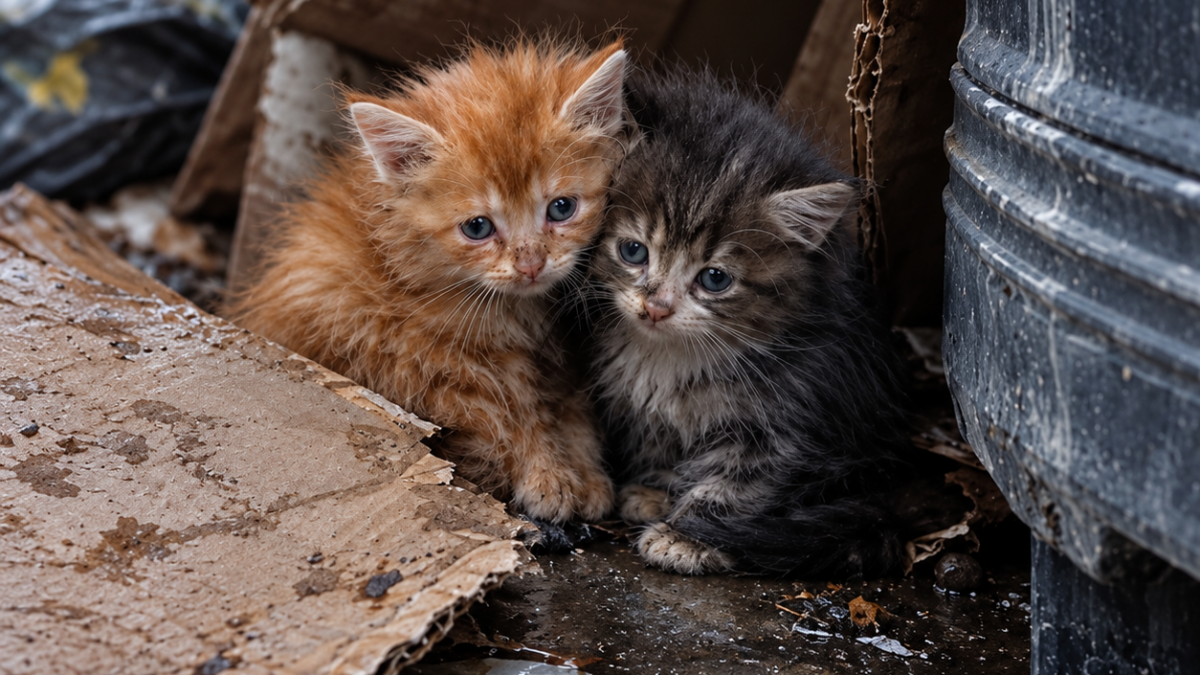
The orange kitten tried to stand when he saw me coming, took three trembling steps through the wet cardboard, and collapsed before I could reach him.
His gray brother never moved at all—he only stared at me with enormous frightened eyes while their tiny bodies shook against each other in the freezing dawn.
I thought I had found two abandoned kittens who needed warmth and food, but within hours I would learn that someone had deliberately left them there—and one small detail near that warehouse would eventually lead us straight back to the person responsible.
My name is Marina Cole, and I had been volunteering with a small animal rescue outside Dayton, Ohio, for nearly seven years when I received the call that changed my life.
It came at 5:47 on a Thursday morning.
A security guard at an old warehouse had reported seeing a stray cat moving around the loading docks. I was already awake, and because our rescue was short on volunteers that week, I threw on jeans, grabbed two carriers, and drove across town.
I expected an adult cat.
Instead, I heard a sound so faint I almost mistook it for a bird.
A tiny meow.
Then another.
I walked behind a row of rusted dumpsters and saw several collapsed cardboard boxes pressed against the concrete wall.
Something moved between them.
I crouched.
“Hey, sweetheart.”
A small orange kitten lifted his head.
He was soaked from the overnight rain.
His fur stuck tightly to his ribs, making him look even smaller than he was. His eyes were crusted around the edges, and his paws seemed barely strong enough to support him.
Beside him lay another kitten.
Gray with a white chest.
Smaller.
Still.
For one terrible second, I thought he was dead.
Then his eyes opened.
“Oh God.”
I moved closer.
The orange kitten tried to come toward me.
One step.
Two.
Three.
His back legs buckled.
He fell onto his side.
I dropped to my knees.
“Easy. I’ve got you.”
He didn’t hiss.
He didn’t run.
He didn’t even have the energy.
The gray kitten watched while I reached for his brother.
Then he gave one weak cry.
Not loud.
Barely a sound.
But the orange kitten turned his head immediately.
Even in that condition, he was checking on him.
I slipped one hand beneath each tiny body.
They were ice cold.
The orange kitten weighed almost nothing.
The gray one felt even lighter.
I tucked them inside my jacket and could feel both hearts beating against my chest.
Fast.
Fragile.
Still there.
“You’re not dying here,” I whispered.
I carried them to my car, turned the heater on, and wrapped them in fleece blankets from my emergency kit.
The orange kitten crawled toward the gray one despite barely being able to move.
He placed one paw across his brother’s neck.
That was when I knew separating them wasn’t an option.
I called Dr. Rachel Morgan at the emergency veterinary clinic.
“Rachel, I have two neonatal kittens. Hypothermic, severely weak, possibly dehydrated.”
“How old?”
“Maybe five weeks. Six at most.”
“Bring them now.”
I drove with one hand on the carrier.
Every few minutes, I spoke just to keep hearing myself say something hopeful.
“You’re almost there.”
Neither kitten answered.
At the clinic, Rachel took one look and moved quickly.
Warm fluids.
Glucose checks.
Temperature support.
Bloodwork.
Nutritional assessment.
The gray kitten’s blood sugar was dangerously low.
The orange kitten was dehydrated and severely underweight.
Both had fleas.
Both had intestinal parasites.
Neither should have been outside alone.
Rachel looked at me.
“Marina, another night out there might have killed them.”
I looked through the glass.
The orange kitten had positioned himself against his brother again.
“Can they make it?”
“We’re going to try.”
Then a veterinary technician came into the room holding something she had found caught in the orange kitten’s damp fur.
A strip of bright blue plastic.
Not trash.
Not something from the warehouse.
It had been cut cleanly from what looked like a pet carrier identification tag.
There were three handwritten numbers still visible.
Rachel looked at me.
I looked back at her.
And suddenly I remembered something else I had seen beside those wet cardboard boxes that morning.
Fresh tire tracks.
Someone hadn’t simply failed to help these kittens.
Someone had brought them there.
PART 2
I stared at the blue strip in the technician’s gloved hand.
“What exactly is that?”
She turned it over.
“Looks like part of one of those plastic tags people attach to a carrier or kennel.”
Three numbers had survived whatever had torn or cut the rest away.
That was all.
Rachel looked toward the treatment room.
“Could mean anything.”
“I know.”
But something inside me had already changed.
There is a difference between finding animals born outside and finding animals discarded outside.
I had seen both.
Feral kittens usually came with clues.
A mother nearby.
A colony.
A hiding place.
Fear of humans.
These two didn’t behave that way.
Even weak and terrified, the orange kitten had tried to come toward me.
And when I picked him up, he hadn’t fought.
Neither had his brother.
They knew people.
They knew carriers.
They knew hands.
Someone had handled these kittens before.
Then someone had placed them behind a warehouse in thirty-eight-degree weather and driven away.
I took out my phone.
“I’m going back.”
Rachel looked at me.
“Now?”
“Before trucks start moving through there.”
“Marina, they need you here too.”
“You have them.”
She nodded reluctantly.
“Call animal control first.”
She was right.
I contacted Officer Elena Ramirez, who handled many of the neglect cases involving our rescue.
She answered with the voice of someone who had clearly been asleep.
“Please tell me nobody has an alligator.”
“No alligator.”
“Good.”
“Two kittens.”
“That sounds less terrible.”
“It isn’t.”
I explained.
By 7:15, Elena met me behind the warehouse.
The rain had stopped.
Morning traffic hummed beyond the industrial park.
The cardboard where I had found the kittens was soaked nearly flat.
Elena photographed everything before we touched it.
Boxes.
A small towel.
A disposable food container.
Tire tracks.
A torn grocery bag.
There was no proper shelter.
No water bowl.
No cat food.
Just two kittens placed between trash and a wall.
Elena crouched near the boxes.
“How long do you think they were here?”
“I don’t know.”
“The guard?”
“Didn’t see them during his midnight round. He heard something around four-thirty.”
“So likely dumped overnight.”
I pointed toward the tire marks.
“They looked fresher earlier.”
Elena photographed them.
“They’re common tread. Probably won’t get us much.”
I searched the wet cardboard carefully.
Nothing.
Then I saw something beneath one box.
A white rectangle.
I picked it up using one of Elena’s evidence gloves.
Part of a shipping label.
The ink had run badly.
Most of the name was gone.
But a street was partly visible.
…WILLOW CREEK DR
And beneath it:
DAYTON, OH
Elena’s eyes narrowed.
“That’s better.”
“You know the street?”
“Yes.”
“So do I.”
Willow Creek Drive was a residential street about eleven miles away.
“Could’ve been on the box before the kittens.”
“Absolutely.”
But it was a lead.
And when animals are suffering, a weak lead is still a lead.
We checked with the warehouse security guard.
His name was Leonard Price.
Sixty-two.
Night shift.
He had not seen who left the kittens.
But when Elena asked about cameras, Leonard pointed toward the building.
“Front lot cameras don’t reach here.”
My disappointment must have shown.
Then he continued.
“But the delivery company across the alley has one pointing at their gate.”
We both turned.
The camera was mounted high above a metal door.
Its angle included part of the service road.
Elena smiled.
“Now we’re getting somewhere.”
The delivery company manager arrived at eight.
He agreed to preserve the footage for law enforcement.
We couldn’t view everything immediately.
There were procedures.
Records.
Requests.
So I returned to the clinic.
The second I walked inside, Rachel intercepted me.
“The gray kitten crashed.”
My heart stopped.
“What?”
“His glucose dropped again.”
“Is he alive?”
“Yes.”
I rushed toward treatment.
He was inside a heated oxygen enclosure.
Tiny body under a blanket.
An IV catheter seemed enormous against his leg.
The orange kitten was in a neighboring enclosure.
Standing.
Barely.
He was crying.
Not for us.
For his brother.
“He started doing that when we separated them,” Rachel said.
“Can they be together?”
“Not until Gray stabilizes.”
I had already started calling them Orange and Gray in my head.
Temporary names.
Rescue people do that when they are afraid to name an animal too soon.
Names create futures.
Sometimes you are afraid to imagine one.
The orange kitten pressed his face against the transparent wall.
The gray kitten did not respond.
I put my fingers against the outside.
“You stay here.”
Orange meowed.
“He needs you to stay too.”
Rachel glanced at me.
“You’re naming them.”
“Not yet.”
“You always say that right before you name them.”
I ignored her.
For the next three hours, the gray kitten remained critical.
His blood sugar improved.
Then dipped.
His temperature slowly climbed.
Bloodwork showed severe anemia, likely from flea infestation and malnutrition.
His gums were almost white.
Rachel discussed the possibility of a transfusion if he worsened.
“He’s tiny,” I whispered.
“I know.”
“How can there even be enough blood in him to lose?”
Rachel didn’t answer.
Sometimes there is no useful answer.
At eleven-thirty, Orange managed to eat a small amount of recovery formula.
He screamed afterward because he wanted more.
Rachel refused.
“We go slowly.”
He disagreed loudly.
I laughed for the first time that morning.
“Okay. You’re definitely going to be trouble.”
He climbed against the front of the enclosure.
His tiny claws scratched weakly at the door.
The gray kitten’s vitals stabilized shortly after noon.
Rachel allowed us to move Orange beside him under supervision.
I will never forget what happened.
Orange crawled toward his brother.
Gray barely lifted his head.
Orange pressed himself along Gray’s body.
Then began licking his ear.
Gray closed his eyes.
His breathing settled.
Rachel watched the monitor.
“Well.”
“What?”
“Heart rate just came down.”
I smiled.
“He knows his brother’s there.”
“Maybe.”
“No maybe.”
Rachel knew arguing with me was pointless.
That afternoon, I named them.
The orange kitten became Finn.
The gray one became Theo.
Why?
No profound reason.
I looked at Orange and thought Finn.
I looked at Gray and thought Theo.
Sometimes names arrive like that.
And once I said them out loud, I became even more determined that both kittens would live long enough to learn them.
Theo needed the most help.
His anemia was severe but not yet at the level where Rachel felt transfusion outweighed risk.
He was treated for fleas carefully because of his fragile condition.
Both kittens needed parasite medication, fluids, controlled feeding, eye treatment, and monitoring.
Finn recovered faster.
Within two days, he had enough energy to climb onto everything he wasn’t supposed to.
Theo still slept most of the time.
Finn never let him sleep alone.
If Theo moved, Finn moved.
If Theo cried, Finn appeared.
If a technician removed Theo for treatment, Finn protested like someone had violated federal law.
“They’re bonded,” Rachel said.
“They’re brothers.”
“We don’t know that biologically.”
I looked at her.
“They’re brothers.”
She raised both hands.
“Fine.”
On the third day, Elena called.
“We have footage.”
My pulse jumped.
“What does it show?”
“A vehicle enters the service lane at 2:13 a.m.”
“What kind?”
“Dark-colored Honda Odyssey. Older model.”
“Plate?”
“Partial.”
I sat down.
“How partial?”
“Last four characters look like 4J17.”
I looked toward the counter.
The blue carrier tag.
Coincidence?
Maybe.
But suddenly those three numbers felt important.
“Can you find the vehicle?”
“We’re working on it.”
“Willow Creek Drive?”
“Also working on it.”
“Elena.”
“I know, Marina.”
“What if they have more animals?”
Silence.
That was exactly what frightened me.
She softened.
“I promise you I’m taking it seriously.”
That night I fostered Finn for the first time.
Theo remained hospitalized.
Finn hated leaving him.
The drive home was twenty-five minutes of outrage.
He screamed from the carrier.
At red lights, I put my hand against the side.
“Your brother is okay.”
Scream.
“I know.”
Scream.
“You are very small to have this much opinion.”
Scream.
At home, I set up a large crate in my spare bathroom.
Warm bed.
Heating pad beneath half of it.
Food.
Water.
Small litter box.
Finn stared at everything.
Then at me.
Then behind me.
Searching.
“Theo isn’t here.”
He meowed.
“I’m sorry.”
He paced.
That broke my heart more than I expected.
So I placed a small blanket from Theo’s hospital enclosure inside the bed.
Finn sniffed it.
Immediately curled on top.
He slept.
The next morning, we drove back before sunrise.
The moment Finn heard Theo cry from the treatment room, he went insane.
Rachel let them reunite.
Finn almost climbed over the technician carrying him.
Theo stood for the first time.
Not long.
Maybe five seconds.
But he stood.
Finn rubbed against him.
Theo collapsed against his brother.
Rachel smiled.
“Now that’s progress.”
The investigation moved faster after police matched the partial plate with vehicles registered near Willow Creek Drive.
There were nine possible matches.
One belonged to a woman named Cynthia Mercer.
Not related to me.
She lived at 417 Willow Creek Drive.
The blue tag.
My stomach tightened when Elena told me.
“Same number.”
“Yes.”
“What does she say?”
“We haven’t contacted her yet.”
“Why?”
“Because I want more before I knock.”
Elena had learned not to rush cruelty investigations.
If people knew authorities were coming, animals could disappear.
Evidence could disappear.
Stories could be rehearsed.
So an officer drove by the residence first.
There was a dark blue Honda Odyssey in the driveway.
Plate matched the surveillance footage.
Now we had more.
But still not everything.
The next piece came from a veterinary receptionist.
Elena circulated photographs of Finn and Theo to several local clinics.
At Meadowbrook Animal Hospital, one technician recognized them immediately.
She called the police.
The kittens had been brought in nine days before I found them.
Their names then were Pumpkin and Smokey.
The owner listed?
Cynthia Mercer.
My hands shook when Elena told me.
“Why were they at the vet?”
“Upper respiratory infection, fleas, low body weight.”
“So she knew they were sick.”
“Yes.”
“What treatment?”
“Medication prescribed. Follow-up recommended.”
“Did she fill the prescription?”
“Clinic records indicate she purchased the first doses.”
“And then dumped them?”
“That’s what we’re investigating.”
I was furious.
Not because someone became overwhelmed.
People become overwhelmed.
Vet care costs money.
Kittens get sick.
Life collapses.
Rescues exist for exactly those moments.
Shelters exist.
Friends exist.
Clinics often know assistance programs.
You can ask.
You can surrender.
You can knock on a rescue volunteer’s door at two in the morning if you truly have no other option.
What you cannot do is place two sick five-week-old kittens in wet cardboard behind a warehouse in freezing weather and drive home.
Elena and another animal-control officer visited Cynthia’s house that afternoon.
I wasn’t there.
I learned what happened afterward.
Cynthia initially denied owning kittens.
Then the officers showed her veterinary photographs.
Her story changed.
Yes, she had kittens.
But she had “given them away.”
To whom?
She didn’t remember the name.
Where?
A parking lot.
When?
She became uncertain.
The officers asked whether they could inspect the property.
Cynthia refused.
That was her right without a warrant or applicable authority.
So they left.
But before leaving, one officer heard barking from behind the house.
Several dogs.
One sounded distressed.
That changed the urgency.
They obtained additional legal authority based on evidence already collected and returned with law enforcement.
Inside the backyard were three dogs.
Two were thin but otherwise stable.
The third, an elderly beagle, had a large untreated mass hanging near her abdomen.
Inside the garage were two adult cats.
One had severe eye discharge.
There were no kittens.
All five animals were removed pending investigation because of documented medical concerns and conditions officers found.
When Elena called me, I felt sick.
“How many?”
“Five.”
“Are they alive?”
“Yes.”
“The beagle?”
“On the way to a clinic.”
I closed my eyes.
Finn and Theo were not isolated mistakes.
They had simply been the animals Cynthia found easiest to remove.
The investigation deepened.
Neighbors reported seeing litters of kittens at Cynthia’s property more than once.
One neighbor said Cynthia occasionally posted animals for sale online.
Another claimed she bred cats casually.
A third said animals seemed to “come and go.”
Police obtained records showing multiple litters advertised over the previous two years.
Now the case was no longer only about abandonment.
Investigators began examining possible neglect involving other animals too.
I tried not to obsess.
My job was Finn and Theo.
Theo still wasn’t safe.
On day six, he stopped eating.
Again.
Rachel called.
“I think we need the transfusion.”
I drove to the clinic immediately.
Theo’s anemia had worsened.
His tiny body simply wasn’t recovering fast enough.
A donor cat named Winston belonged to one of the veterinary technicians.
Large.
Healthy.
Extremely offended by the entire situation.
Blood typing confirmed compatibility.
I met Winston in the treatment area.
He glared at me.
“You’re a hero.”
Winston hissed.
“Understood.”
The transfusion took time.
Finn remained nearby.
I sat outside Theo’s enclosure.
Watching blood move slowly through a line into a body small enough to fit in both my hands.
There are moments in rescue when everything becomes painfully simple.
You stop thinking about court cases.
Abandonment.
Money.
Anger.
You watch a chest rise.
That’s all.
Rise.
Fall.
Rise.
Fall.
Keep doing that.
Theo did.
His gums became slightly pinker.
His temperature held.
By evening, he lifted his head.
Finn immediately shoved his face against him.
Theo licked Finn’s nose.
I cried.
Rachel pretended not to notice.
By the end of the week, both kittens came home with me.
Temporarily.
That was the lie I told myself.
I already had two adult cats, Jasper and Nellie.
Jasper was fourteen and believed all kittens were evidence of civilization’s decline.
Nellie was seven and curious about everything.
Introductions happened slowly.
Finn wanted immediate friendship.
Theo wanted Finn.
That was enough.
The first night, I set up a large playpen in the guest room.
At midnight, I checked.
Finn was asleep across Theo’s body like a seat belt.
At two, same position.
At five, Theo was eating while Finn attempted to sit inside the food dish.
Progress.
The next several weeks transformed them.
Finn gained weight rapidly.
His orange fur became soft and bright.
His eyes cleared.
His legs strengthened.
He discovered climbing.
Then discovered gravity.
Then apparently forgot what he had learned and climbed again.
Theo improved more slowly.
He tired easily.
He remained smaller.
But his personality emerged.
He was observant.
Gentle.
He would sit back while Finn charged into new situations.
Then follow once Finn survived.
The first time they saw a staircase, Finn ran up three steps and fell backward into a laundry basket.
Theo watched.
Turned around.
Walked away.
Smart cat.
At night, they slept together.
Always touching.
Sometimes one paw.
Sometimes noses.
Sometimes Finn practically suffocated Theo with affection.
If I moved Theo to another bed, Finn followed.
There was no question anymore.
Whatever their genetics, these two belonged together.
Which created a problem.
Adoption.
Our rescue normally began accepting applications once kittens were healthy enough.
Sarah, our coordinator, asked:
“Bonded pair?”
“Yes.”
“You sure?”
“Yes.”
“Bonded pairs take longer.”
“Then they take longer.”
“You’re attached.”
“I’m objective.”
Sarah laughed for an unreasonable amount of time.
“I am.”
“Marina, you sent me seventeen pictures yesterday.”
“Medical documentation.”
“One was Finn inside your cereal bowl.”
“Behavioral documentation.”
She stopped arguing.
We listed them as a bonded pair.
Applications came.
One person wanted Finn only.
Rejected.
Another wanted Theo because he was calmer.
Rejected.
A family said they might take both but would probably give one to a relative later.
Absolutely not.
I began wondering whether I was unconsciously finding reasons to reject everybody.
Then an application arrived from David and Emily Carter.
Married.
Early forties.
One daughter, Lucy, age twelve.
Their previous cat had died at seventeen.
No other animals currently.
Indoor-only home.
Veterinary references excellent.
The final answer on their application caught my attention.
Why do you want to adopt these kittens?
David wrote:
Because they already chose each other. We don’t want to ask either one to lose his family again.
I read that sentence twice.
Then three times.
“Sarah.”
“I know.”
“You read it?”
“Yes.”
“I hate them.”
“Because they’re perfect?”
“Exactly.”
The meet-and-greet was scheduled Saturday.
I told myself I hoped it went badly.
It did not.
Lucy sat on the floor.
Finn climbed onto her immediately.
Traitor.
Theo watched from beneath a chair.
Lucy didn’t reach.
After fifteen minutes, Theo came out.
Sat two feet away.
Lucy whispered, “Hi.”
Theo blinked.
David asked me about medical history.
Good questions.
Emily asked about feeding schedules.
Better questions.
Nobody asked which kitten was friendlier.
Nobody asked whether Theo would “catch up” physically.
Nobody complained about possible future vet expenses.
Then Finn fell asleep in Lucy’s lap.
Theo climbed beside him.
Placed his head on Finn’s back.
Lucy looked at me.
“Do they always do that?”
“Yes.”
She smiled.
“Good.”
I knew.
I hated knowing.
They were the family.
The court case was happening at the same time.
Cynthia had been charged with several counts related to abandonment and neglect.
Her attorney claimed she had become overwhelmed caring for too many animals.
I believed she was overwhelmed.
I also believed overwhelm explained behavior without excusing it.
The strongest evidence involved Finn and Theo.
Veterinary records proved she knew they were sick.
Surveillance placed her van at the warehouse.
The blue tag linked to her address.
The cardboard shipping label carried her street.
And investigators recovered the original pet carrier from her garage.
A broken blue identification holder was still attached.
The missing section matched the strip tangled in Finn’s fur.
When Elena told me, I actually sat down.
“That’s it.”
“It’s strong.”
“She can’t say somebody else dumped them?”
“She can say anything. Evidence is evidence.”
The case took months.
That frustrated me.
Finn and Theo didn’t care.
Their lives were accelerating.
They learned to chase springs across my kitchen.
They discovered windows.
Birds.
Sunbeams.
Cardboard boxes that were now warm and dry and used because they wanted them.
The symbolism of that wasn’t lost on me.
The first time I saw them, a wet cardboard box had been their shelter.
Now Finn slept in shipping boxes despite having three expensive cat beds.
Cats are humbling.
Theo developed a strange habit of carrying socks.
Only clean socks.
He would steal them from laundry baskets and arrange them beneath the dining table.
I found eleven one morning.
“You building something?”
Theo sat proudly beside his collection.
Finn arrived carrying underwear.
“We’re not discussing that.”
I laughed constantly because of them.
And that made adoption day harder.
The Carters finalized everything six weeks after meeting them.
By then, both kittens had been medically cleared.
Theo’s bloodwork was normal.
His weight remained slightly below Finn’s but appropriate.
Rachel hugged me when she gave the final report.
“He’s good.”
I exhaled.
“Actually good?”
“Actually good.”
“No hidden disaster?”
“Marina.”
“I’m checking.”
“He’s healthy.”
That word meant everything.
On adoption morning, I packed their belongings.
Medication records.
Food.
Favorite blanket.
Toys.
Theo’s stolen sock collection, because apparently I had become insane.
Finn climbed into the cardboard box containing supplies.
“Not you.”
He refused to leave.
I lifted him out.
He jumped back in.
Theo sat nearby judging us both.
David arrived with two carriers.
One for each kitten.
I shook my head.
“They’ll be calmer together.”
He opened one larger carrier instead.
“We brought this too.”
Inside was a fleece blanket.
Lucy had written their names on a tag.
FINN + THEO.
Not Pumpkin.
Not Smokey.
Their new names.
Their new family.
My throat tightened.
Lucy noticed.
“Are you sad?”
“A little.”
“We can send pictures.”
“That will make me slightly less terrible to live with.”
Sarah, standing nearby, said, “Please send lots.”
I glared.
She smiled.
I knelt beside the kittens.
Finn immediately climbed onto my knee.
Theo sat against my ankle.
“You two were supposed to be temporary.”
Finn bit my shoelace.
“Exactly.”
I stroked Theo’s head.
“You take care of him.”
Then Finn.
“And you stop sitting on your brother.”
Neither promised anything.
I put them into the carrier together.
Theo immediately leaned into Finn.
Finn wrapped one paw over him.
The same position from the first morning.
Except now their bodies were warm.
Their bellies full.
Their eyes bright.
When the Carters drove away, I cried in my driveway.
There is no dignity in fostering.
You spend weeks begging animals to survive.
Then they survive and leave.
That is the point.
It still hurts.
Thirty minutes later, Lucy sent the first photograph.
Finn was already on her bed.
Theo was inside her open closet.
Caption:
They’re home.
I cried again.
The trial took place several months later.
By then, Finn and Theo were nearly grown.
I attended because prosecutors wanted testimony about their condition when found.
Cynthia sat at the defense table.
I had never met her.
Seeing her was strangely anticlimactic.
She looked ordinary.
Late forties.
Tired.
Hair pulled back.
No visible sign saying THIS PERSON LEFT TWO KITTENS TO FREEZE.
That is something rescue teaches you too.
Cruel choices are often made by ordinary-looking people.
The prosecutor showed photographs from the warehouse.
Finn collapsed beside the boxes.
Theo barely responsive.
Then clinic photographs.
Then veterinary records from nine days earlier.
The defense argued Cynthia intended to surrender them but “panicked.”
The prosecutor asked the obvious question.
“Why drive eleven miles past two animal shelters and three veterinary clinics to leave sick kittens behind a closed warehouse at 2:13 in the morning?”
No good answer came.
Her attorney argued financial hardship.
Then Rachel testified.
She explained that surrender would have cost nothing at several local facilities.
She described hypothermia.
Dehydration.
Anemia.
Parasites.
The risk of death.
Then she said something that made the courtroom completely quiet.
“These kittens did not need extraordinary care before being abandoned. They needed basic care and timely veterinary follow-up. Their condition became an emergency because that care stopped.”
I looked toward Cynthia.
She stared at the table.
Then I testified.
The defense attorney asked:
“You are emotionally attached to these animals?”
“Yes.”
“You named them?”
“Yes.”
“You fostered them?”
“Yes.”
“So you may have strong feelings toward my client.”
“I have strong feelings about what happened.”
“Which could affect your interpretation.”
I looked at him.
“I found two kittens so cold they could barely move.”
He paused.
“That wasn’t an interpretation.”
The prosecutor later asked me to describe what I remembered most.
I could have talked about the boxes.
The rain.
The tire tracks.
Instead I said:
“Finn tried to stand.”
The courtroom became quiet.
“He saw me coming and tried to get up. He made it three steps and collapsed.”
My throat tightened.
“Theo couldn’t even do that.”
Cynthia finally looked at me.
I continued.
“They were still trying to stay together.”
That was enough.
The judge found Cynthia guilty on multiple counts related to abandonment and failure to provide necessary care, along with additional violations involving some of the other animals removed from her home.
She received probation with strict conditions, fines, restitution for part of the veterinary costs, mandatory animal-care education, and a significant prohibition on owning or breeding animals.
Some people were angry the punishment wasn’t harsher.
I understood.
But something happened after sentencing.
Cynthia approached me in the hallway.
Her attorney was beside her.
Elena immediately stepped closer.
Cynthia stopped several feet away.
“Are they alive?”
I stared at her.
“Finn and Theo?”
She nodded.
“Yes.”
She closed her eyes.
For a moment, she looked relieved.
That made me angry.
“You don’t get relief from me.”
Her eyes opened.
“I know.”
“Do you?”
She swallowed.
“I made a terrible decision.”
“You made several.”
“I couldn’t afford everything.”
“Then you surrender them.”
“I was ashamed.”
“And because you were ashamed, they almost died.”
She started crying.
I expected satisfaction.
None came.
Only exhaustion.
“I know,” she whispered.
I thought of all the speeches I had imagined.
Everything I wanted to say.
Instead, I pulled out my phone.
I opened a recent picture Lucy had sent.
Finn and Theo were stretched together across a windowsill.
Finn almost twice the size he had been.
Theo glossy gray and white.
Healthy.
Safe.
I held the screen where Cynthia could see.
Her hand covered her mouth.
“That’s them?”
“Yes.”
“They look…”
“Loved.”
She cried harder.
I lowered the phone.
“That’s what you left behind that warehouse.”
She nodded.
I walked away.
Outside the courthouse, Elena caught up.
“You okay?”
“I thought that would feel better.”
“What?”
“Her seeing them.”
Elena nodded.
“Revenge usually sounds cleaner in your imagination.”
I looked toward the courthouse doors.
“Do you think she meant it?”
“Her apology?”
“Yes.”
“Maybe.”
“That’s not very satisfying.”
“It doesn’t need to be.”
I looked at her.
“Accountability isn’t dependent on remorse.”
That stayed with me.
Cynthia could be sorry.
Or not.
She could change.
Or not.
Finn and Theo no longer depended on either possibility.
Their lives had moved beyond her.
That was more satisfying than any punishment.
A year after adoption, the Carters invited me to Finn and Theo’s first “found day.”
Lucy refused to call it a birthday because nobody knew their actual birth date.
So the day I found them became the celebration.
When I arrived, Finn met me at the door.
He was enormous.
“What happened to you?”
Lucy laughed.
“He likes breakfast.”
“Apparently all breakfasts.”
Theo came more slowly.
Still smaller.
Still cautious.
Then he recognized me.
He walked over.
Sniffed my hand.
And pressed his forehead against my fingers.
I nearly cried on the spot.
“You remember me.”
Lucy smiled.
“Of course he does.”
I wasn’t sure cats worked that way.
But I chose to believe her.
Their house had become exactly what I hoped.
Cat trees beside windows.
Toys under furniture.
Scratching posts.
Food schedules.
Photographs of the brothers everywhere.
Finn slept with Lucy.
Theo preferred David’s office chair.
They still slept together at least once every day.
Always touching.
Some habits were born from fear.
Others became love.
The most emotional moment came after dinner.
Lucy brought out the original fleece blanket I had sent with them.
It was worn.
Covered in orange and gray fur.
“They still use it,” she said.
I touched the edge.
The first morning, they had been pressed together because body heat might have been the only thing keeping them alive.
Now they chose closeness even when the house was warm.
“They saved each other,” Lucy said.
I looked at her.
“What?”
“The vet said Theo might’ve done worse without Finn.”
“Yes.”
“And Finn cried whenever Theo left.”
“Yes.”
“So they saved each other before anybody else found them.”
She was twelve when she adopted them.
Thirteen now.
And somehow she had summarized the entire story better than I had.
“Yes,” I said. “I think they did.”
Years passed.
Finn remained fearless.
Theo remained thoughtful.
Finn once climbed inside a chimney and required professional removal.
Theo watched from six feet away with the expression of a brother who had predicted this outcome.
Finn ate a piece of birthday candle.
Theo stole only socks.
Finn greeted strangers.
Theo chose people carefully.
But one thing never changed.
If one was sick, the other stayed close.
At age four, Finn developed a urinary blockage.
Emergency.
Hospitalization.
Theo stopped eating at home.
Emily called me.
“He keeps sitting by Finn’s carrier.”
They brought a blanket from Finn to him.
Theo slept on it.
The day Finn came home, Theo ran toward the carrier before anyone opened it.
When Finn stepped out, Theo sniffed him for nearly two minutes.
Then slapped him across the face.
Apparently reunion emotions vary.
They slept together that night.
At age six, Theo developed dental disease and needed several extractions.
Finn screamed outside the closed bathroom door when Theo returned groggy.
Lucy finally allowed him inside.
Finn lay beside the recovery bed.
Didn’t move for hours.
“They’re ridiculous,” Lucy told me.
“They’re brothers.”
She smiled.
“You still say that.”
“Because I’m still right.”
The warehouse eventually changed owners.
Several years after the rescue, I drove through that industrial area and almost didn’t recognize it.
The building had been renovated.
New paint.
New businesses.
The dumpsters were gone.
The corner where the cardboard boxes had been was now part of a fenced loading area.
I parked across the street.
I hadn’t planned to stop.
For several minutes, I sat inside my car.
I expected that place to make me sad.
Instead, I thought about Finn falling after three steps.
Then Finn climbing Lucy’s curtains.
I thought about Theo barely breathing.
Then Theo stealing eleven socks.
The warehouse no longer felt powerful.
A terrible thing had happened there.
But it did not own the ending.
That realization became important in other rescue cases too.
We often talk about animals by the places where they were found.
The dumpster dog.
The highway kitten.
The abandoned-house cat.
The chained shepherd.
But those places should be beginnings, not identities.
Finn and Theo were not warehouse kittens anymore.
They were the Carters’ cats.
Lucy’s shadows.
Sock thieves.
Window sleepers.
Brothers.
One rainy spring morning, almost eight years after I found them, Lucy called.
She was twenty by then.
Away at college.
Her voice shook.
“Marina?”
“What happened?”
“Theo’s sick.”
My stomach tightened.
“How sick?”
“Mom’s at the emergency hospital.”
I called Emily.
Theo had developed severe lethargy and stopped eating.
Bloodwork showed kidney abnormalities.
Additional testing followed.
Chronic kidney disease.
Manageable at first.
Not curable.
Theo was only eight.
I hated the unfairness.
He had fought so hard as a kitten.
Shouldn’t survival buy you immunity later?
Life doesn’t work that way.
Treatment began.
Special diet.
Fluids.
Medication.
Regular monitoring.
Finn remained glued to him.
On fluid days, Finn sat beside Theo like a nurse nobody had hired.
When Theo refused food, Finn sometimes ate beside him.
That seemed to encourage him.
The Carters adjusted everything.
Lucy came home whenever she could.
Theo stabilized.
For almost two years.
Good years.
He slept in sunlight.
Stole fewer socks.
Spent more time curled beside Finn.
His illness became part of life without becoming all of life.
Then at ten, his kidneys declined rapidly.
Emily called me.
“Lucy is driving home.”
I knew.
“Is it time?”
“We think so.”
I drove to their house.
Theo was lying on the same old fleece blanket.
Finn beside him.
Gray beside orange.
Exactly like that morning behind the warehouse.
Except nothing else was the same.
Theo was warm.
Comfortable.
Surrounded.
David sat on the floor.
Emily stroked his back.
Lucy arrived crying.
She knelt.
Theo lifted his head when he heard her.
“Hi, baby.”
He pressed his face weakly toward her.
Finn watched.
The veterinarian came to the house that evening.
Nobody moved Finn away.
He sniffed Theo.
Lay against him.
Lucy held Theo’s front paws.
I sat nearby.
I thought about that first morning.
The gray kitten who couldn’t move.
How desperately I had wanted more time.
He got it.
Ten years.
Not enough.
Never enough.
But ten years of being somebody’s cat.
Ten Christmases.
Ten winters in warm rooms.
Thousands of meals.
Thousands of nights beside his brother.
Lucy whispered:
“You never have to be cold again.”
I almost broke apart.
Theo relaxed under the sedative.
His breathing slowed.
Finn pressed closer.
Then Theo was gone.
Silence filled the room.
Finn sniffed his brother’s face.
Then sat beside him for almost twenty minutes.
No one rushed him.
Finally, Finn stood.
Walked to Lucy.
Climbed into her lap.
He had never done that as an adult.
Not fully.
He was too large.
But that night he tried.
Lucy wrapped both arms around him.
They cried together in the only ways they knew.
The weeks afterward were difficult.
Finn searched.
Especially at bedtime.
He would walk from room to room.
Call.
Wait.
The Carter family left Theo’s blanket in its usual place.
Finn slept on it.
For months.
Lucy stayed home from college longer than planned.
“I don’t want him alone.”
Emily told her:
“He isn’t.”
Finn had them.
But losing the companion who had been beside him from the first days of life was different.
We couldn’t replace Theo.
We didn’t try.
Finn slowly adapted.
He became quieter.
More affectionate.
He began sleeping beside David in the office chair Theo once claimed.
As if inheriting pieces of his brother’s routine.
Theo’s ashes were placed in a wooden box beneath a framed photograph of both kittens.
The picture came from their first found day.
Finn leaning over Theo.
One orange paw draped across gray shoulders.
Lucy chose the inscription:
THEO CARTER
HE NEVER HAD TO BE ALONE AGAIN.
I thought that was perfect.
For another three years, Finn lived as the only cat in the house.
By then, Lucy had graduated and moved back to Dayton for work.
Finn adored having her home.
At thirteen, his orange face had faded to cream around the muzzle.
He became lazy.
Large.
Opinionated.
He stopped climbing curtains.
Mostly because gravity had finally won their lifelong argument.
One summer afternoon, Lucy sent me a photograph.
Finn asleep beside Theo’s wooden memorial box.
His paw touching the base.
The message said:
Still brothers.
I saved it immediately.
Finn reached fifteen.
Then sixteen.
Older than anyone expected given how his life began.
His health eventually declined too.
Arthritis.
Thyroid disease.
Then cancer.
The Carter family treated what could be treated.
Managed pain.
Kept him comfortable.
On his final day, I drove over.
Finn was lying in Lucy’s lap.
He opened his eyes when I touched his head.
“You’re still trouble.”
His tail moved once.
“Do you remember me?”
Lucy laughed through tears.
“He remembers everybody who ever fed him.”
“Fair.”
I stroked the orange fur between his ears.
I could still picture it soaked and flattened that first morning.
“You know, you scared ten years off my life.”
He blinked.
“Then you lived sixteen anyway, which seems rude.”
Lucy cried harder.
I kissed his forehead.
“I need you to do something for me.”
His eyes remained on mine.
“If there’s somewhere after this…”
I stopped because I didn’t know what I believed.
But sometimes grief deserves language even when certainty doesn’t exist.
“If Theo’s there, go find him.”
Lucy covered her face.
I continued softly.
“You’ve never been good at letting your brother stay anywhere alone.”
Finn’s breathing slowed.
The veterinarian administered the medication.
Lucy held him.
Emily held Lucy.
David rested one hand on Finn’s back.
And I kept my fingers beneath his chin.
He died surrounded by the same family that had once written:
They already chose each other. We don’t want either one to lose his family again.
They kept that promise.
Finn never lost his family again.
Neither did Theo.
After Finn died, Lucy asked me to come outside.
She brought two small boxes.
Theo’s ashes.
Finn’s.
“What are you going to do?”
She looked toward the large maple tree behind their house.
“They loved that window because they could see this tree.”
We buried some of their ashes together beneath it.
Not all.
Lucy kept part of each inside.
The marker was simple.
FINN & THEO
Beneath it:
FOUND TOGETHER.
LOVED TOGETHER.
FAMILY FOREVER.
As we stood beneath the tree, Lucy reached into her pocket.
She handed me something.
A tiny strip of blue plastic.
I stared.
“What is this?”
“The police returned some evidence after the case closed years ago. Mom saved it.”
The identification-tag fragment.
The little piece that helped lead investigators back to Cynthia.
I had forgotten it existed.
Lucy looked at it.
“This used to make Mom angry.”
“Me too.”
“What do you feel now?”
I thought for a long time.
“Nothing toward her.”
“Really?”
I nodded.
“Look around.”
The backyard.
The house.
The tree.
Two memorial boxes had come from sixteen and ten years of life.
Thousands of photographs filled the Carter home.
Cynthia occupied one night.
One terrible night.
Everything afterward belonged to somebody else.
“That little piece of plastic used to feel like evidence of what someone did to them,” I said.
Lucy waited.
“Now it’s evidence that what she did didn’t get the final word.”
Lucy closed her fingers around it.
Then she smiled.
“Can I throw it away?”
“Yes.”
She did.
Just like that.
Into the trash.
No ceremony.
No dramatic speech.
We didn’t need it anymore.
The family who abandoned them had once been central to the story because cruelty was the reason Finn and Theo almost died.
Years later, cruelty had become the smallest part of who they were.
That was the revenge.
Not punishment.
Not anger.
Not Cynthia crying in a courthouse.
Time.
Sixteen years of Finn.
Ten years of Theo.
A girl who grew up with them.
A family shaped by them.
Veterinary records full of care instead of neglect.
Christmas pictures.
Birthday pictures.
College pictures.
Pictures of Theo stealing socks.
Pictures of Finn asleep in impossible positions.
Evidence everywhere.
Not of abandonment.
Of belonging.
After Finn and Theo were gone, Lucy began volunteering at our rescue when her schedule allowed.
The first litter she fostered contained four kittens.
She called me at midnight on day two.
“I made a mistake.”
“What happened?”
“They’re everywhere.”
I laughed.
“Welcome.”
“One is inside my couch.”
“That’s normal.”
“How is that normal?”
“Cats.”
“One knocked over the food.”
“Also normal.”
“And the smallest one won’t eat.”
My joking stopped.
“Okay.”
We talked through it.
Warmth.
Weight.
Formula.
Vet check if needed.
The kitten began eating later that night.
Lucy sent me a photograph at 1:43 a.m.
Tiny black kitten wrapped in a towel.
Message:
I understand you better now.
I replied:
No you don’t. I was much calmer.
She answered:
Mom says that’s a lie.
Traitors everywhere.
All four kittens survived.
When adoption time came, Lucy cried.
I reminded her that she had once watched me cry when Finn and Theo left.
“I thought you were being dramatic.”
“You were twelve.”
“I was right.”
“Goodbye, Lucy.”
She fostered again.
And again.
Years later, she helped establish a small emergency fund through the rescue specifically for families who loved their animals but couldn’t afford unexpected veterinary treatment.
She called it the Finn & Theo Fund.
I asked why.
“Because I keep thinking about what Cynthia said.”
“Money?”
“Yes.”
Lucy became serious.
“She still had choices. What she did was wrong. But if someone else is standing at that point—scared, broke, thinking they have no options—I want there to be an option.”
That mattered.
The fund paid for antibiotics.
Emergency exams.
Spay surgeries.
Parasite treatment.
Food.
Temporary boarding.
Sometimes assistance meant animals stayed safely with loving families.
Sometimes it helped owners surrender them responsibly.
Either outcome was better than wet cardboard behind a warehouse.
The first year, the fund helped twenty-three animals.
The second year, forty-one.
By year five, I stopped counting.
One afternoon Lucy called.
“You need to see something.”
She sent a photograph.
Two kittens.
One orange.
One gray.
I stared at the screen.
“No.”
“Yes.”
“Where?”
“Shelter transfer.”
“Brothers?”
“They think so.”
“Absolutely not.”
Lucy laughed.
“What?”
“You are not naming them Finn and Theo.”
“I wasn’t.”
“Good.”
“I was thinking Frankie and Teddy.”
I closed my eyes.
“That’s suspiciously close.”
“They’re different.”
“Barely.”
The orange kitten had one white paw.
The gray kitten had no white chest.
They were entirely different animals.
But seeing them together hurt and healed something at the same time.
Lucy fostered them.
Naturally.
And naturally they were adopted together.
Because some stories echo without repeating.
I grew older.
The rescue changed directors.
New volunteers came.
Many had never met Finn and Theo.
But their photographs stayed on the wall.
The first photograph showed two tiny bodies inside a clinic incubator.
Finn pressed against Theo.
The second showed them as adults on Lucy’s windowsill.
Beneath the photographs was a small plaque:
KEEP THEM TOGETHER.
New volunteers often asked why.
I told them.
Not the entire fifteen-year story.
Usually the short version.
Two kittens were abandoned.
One was strong enough to try standing.
The other wasn’t.
They kept each other alive long enough for somebody to find them.
And when we had the chance to decide what happened next, we decided they had already lost enough.
So they stayed together.
That principle began influencing other cases.
Bonded senior dogs.
Paired cats.
Animals whose relationship mattered more than adoption convenience.
We became more careful about separating companions.
Not because every pair was truly bonded.
But because Finn and Theo had taught us to pay attention.
Sometimes another animal is not simply sharing a cage.
Sometimes that animal is the reason the frightened one eats.
Sleeps.
Moves.
Keeps trying.
Years after both brothers died, I stood at the rescue during an overnight intake.
A deputy had brought two kittens found inside an abandoned vehicle.
Cold.
Hungry.
One louder than the other.
I wrapped them together.
The louder kitten immediately put one paw across the smaller.
My chest tightened.
A young volunteer named Megan stood beside me.
“What?”
“Nothing.”
“You look like you’re going to cry.”
“I’m old. We do that randomly.”
She laughed.
I adjusted the blanket.
“Keep them together tonight.”
“Okay.”
“Even during feeding if possible.”
“Why?”
I looked down.
The smaller kitten had stopped trembling quite so hard.
“Sometimes being together is part of the treatment.”
Megan nodded.
She didn’t know the history behind that sentence.
She didn’t need to.
That was how legacy worked.
Lessons eventually stopped needing names.
But I remembered.
I always remembered.
Especially on cold mornings.
Sometimes I still wake before six.
The world outside dark.
Quiet.
And for a split second I am back beside that old warehouse.
Wet cardboard.
Tiny meow.
Finn trying to stand.
Three steps.
Collapse.
Theo watching.
There are memories that never lose their sharpness.
But that one no longer ends where it used to.
My mind continues now.
The incubator.
The transfusion.
Finn yelling.
Theo standing.
Lucy sitting on the floor.
The adoption carrier.
The windowsill.
The sock pile.
The maple tree.
Sixteen years.
Ten years.
The Finn & Theo Fund.
Kittens I will never meet living because two abandoned brothers once survived.
That is the full memory.
People sometimes ask me whether rescue work makes me lose faith in people.
It can.
I have seen animals thrown away.
Starved.
Injured.
Abandoned when they become inconvenient.
But I have also seen a security guard stop because he heard a tiny cry.
A veterinarian wake before sunrise.
A technician lend her own cat as a blood donor.
An animal-control officer refuse to give up on three numbers written on plastic.
A family adopt two kittens because they refused to separate brothers.
A twelve-year-old girl grow into a woman who helped strangers pay veterinary bills.
Which group represents humanity?
Both.
That is the uncomfortable answer.
Cruelty exists.
So does care.
Neglect exists.
So does the person who gets out of bed at 5:47 in the morning because somebody heard a cat.
You do not defeat cruelty by pretending it is rare.
You defeat it by refusing to let it be the only thing that acts.
Finn and Theo had someone abandon them.
Then they had dozens of people refuse to.
In the end, the numbers weren’t even close.
That is what I choose to remember.
The person who left them gave them one cold night.
The Carters gave them years.
One night versus years.
Cruelty was loud at the beginning.
Love was longer.
And length matters.
Near my desk now is a framed photograph Lucy gave me after Finn died.
It isn’t polished.
It isn’t professional.
Finn is asleep on his back.
Theo is curled against his side.
Lucy’s sock is beneath Theo’s paw.
The room is messy.
There is laundry in the background.
A half-open textbook on the bed.
Ordinary.
That is why I love it.
The photograph proves something no rescue intake photo ever can.
They became ordinary.
They stopped being an emergency.
They stopped being “the abandoned kittens.”
They became two cats sleeping in a teenager’s messy bedroom.
That was the goal from the beginning.
Not to create heroes.
Not to create a viral story.
To make their lives boring enough that nobody needed to be afraid.
Food would come.
Heat would stay on.
If somebody left the house, they returned.
If one got sick, somebody noticed.
If one cried, his brother was there.
Ordinary safety.
That is one of the greatest gifts an animal can receive.
I sometimes think about Cynthia.
Not often.
I heard years later that she completed probation.
Never regained permission to breed animals during the restriction period.
What happened afterward, I don’t know.
I hope she changed.
Not because she deserves a tidy redemption arc.
Because any person who changes may spare another animal.
But I don’t need to know.
Finn and Theo’s story does not require her ending.
That realization took years.
At first I believed justice meant making sure the person responsible experienced consequences.
That mattered.
It still does.
But justice also means moving the harmed beyond the reach of the person who hurt them.
Finn and Theo reached that place quickly.
Cynthia became irrelevant to them the second Lucy became home.
They never spent a day waiting for an apology.
Animals are wiser that way.
They care about what exists in front of them.
Warm bed.
Full bowl.
Familiar person.
Brother breathing beside them.
I try to remember that.
Especially when anger wants more space than it deserves.
One winter, many years after the rescue, Lucy and I visited the maple tree.
Snow covered the ground.
She brushed it from the small marker.
FINN & THEO.
“Do you think they knew how lucky they were?” she asked.
I looked at her.
“I think they knew they were safe.”
“Same thing?”
“Maybe better.”
She smiled.
We stood quietly.
Then she said:
“I still remember the first day they came home.”
“What do you remember?”
“The carrier.”
I waited.
“I opened it in my room, and Finn came out immediately.”
“That sounds like Finn.”
“Theo stayed inside.”
“That sounds like Theo.”
“I sat there for almost an hour.”
“What happened?”
“Finn went back into the carrier.”
I had never heard this story.
“He did?”
“He lay beside Theo.”
Lucy’s eyes filled.
“Then Theo came out.”
I looked at the marker.
Of course.
Of course Finn had gone back.
He had spent his entire life doing that.
Going first.
Then returning for his brother.
I thought of the warehouse.
Finn trying to stand because I approached.
Theo unable to move.
I had interpreted Finn’s movement as an attempt to reach me.
Maybe part of it was.
But perhaps he had also been placing himself between Theo and whatever was coming.
A tiny orange kitten with nothing left trying to be brave enough for two.
My throat tightened.
“He always went back for him.”
Lucy nodded.
“Always.”
That became my favorite detail.
Not the investigation.
Not the courtroom.
Not even the adoption.
Finn went first.
Then went back.
Sometimes love looks like that.
You become strong enough to move.
Then you refuse to leave the one who cannot.
On the morning I found them, Finn had almost no strength.
Theo had even less.
Neither could save himself.
But they gave each other enough reason to keep breathing until help arrived.
Years later, when Theo died first, Finn again stayed beside him until the end.
When Finn died, Lucy asked him to find Theo if there was somewhere beyond us.
I don’t know what happens after death.
No one does.
But if there is anything—
a field,
a warm room,
a patch of sunlight,
a place without clinics or cold warehouses—
I know exactly what I like to imagine.
A gray cat waiting.
An orange cat arriving.
And before doing anything else, Finn walking straight toward his brother.
Because some habits become love.
And some love survives every place we have words for.
The abandoned cardboard boxes disappeared decades ago.
The warehouse changed.
The court case closed.
Veterinary records were archived.
The blue tag was thrown away.
But Finn and Theo are still part of what our rescue does.
Every time we keep a truly bonded pair together.
Every time somebody receives assistance from their fund.
Every time a volunteer sits quietly beside a frightened kitten instead of forcing contact.
Every time we remember that physical survival is only the first part of rescue.
I see them.
Tiny.
Cold.
Touching.
Then older.
Warm.
Still touching.
That is the whole story between two photographs.
People sometimes want dramatic revenge in rescue stories.
They want the person responsible ruined.
They want confrontation.
They want justice to make suffering balance perfectly.
Life rarely gives us arithmetic that clean.
Cynthia faced consequences.
That mattered.
But nothing the court could have done would have warmed Finn and Theo on that first night.
Nothing could return the hours they spent cold.
Nothing could erase Theo’s transfusion or Finn collapsing after three steps.
Punishment could acknowledge wrong.
It could not create the ending.
People did that.
Care did that.
Time did that.
The Carters did that.
Finn and Theo did that for each other.
That was the revenge worth remembering.
Someone left them beside garbage as though their lives were disposable.
Then one grew to sixteen.
The other to ten.
They became loved enough that their deaths broke hearts.
They became important enough to change rescue policy.
They became the names of a fund helping animals years after they were gone.
Disposable things do not leave legacies.
Finn and Theo did.
So if I had one final photograph of them to choose, I would not use the warehouse.
I would not use the incubator.
I would not even use the dramatic adult portraits people loved.
I would choose the messy bedroom.
Finn asleep.
Theo beside him.
A stolen sock.
Laundry in the background.
Nothing happening.
Because nothing happening was what we fought for.
No cold.
No hunger.
No danger.
No abandonment.
Just two brothers asleep because they knew morning would come and someone would still be there.
That is what I wanted when I lifted them from those wet boxes.
I didn’t have words for it then.
I only knew they were cold.
I only knew one had fallen trying to reach me.
I only knew the other was too weak to move.
I tucked them beneath my jacket and said:
“You’re not dying here.”
For years, I thought that was the promise I kept.
I was wrong.
The real promise was bigger.
You’re not living like this either.
Not anymore.
And they didn’t.
From that morning forward, the cold warehouse was behind them.
Ahead were doctors.
Warm blankets.
A blood donor.
A foster room.
A girl on the floor.
A carrier with both their names.
A house.
A windowsill.
Thousands of mornings.
One brother always near the other.
That is how two abandoned kittens became Finn and Theo.
Not because somebody threw them away.
Because everybody who came afterward refused to.








