PART 2: Two Delivery Men Ignored the Old Suitcase on My Porch—Inside, a Dog Was Still Waiting for the Woman Who Would Never Come Back
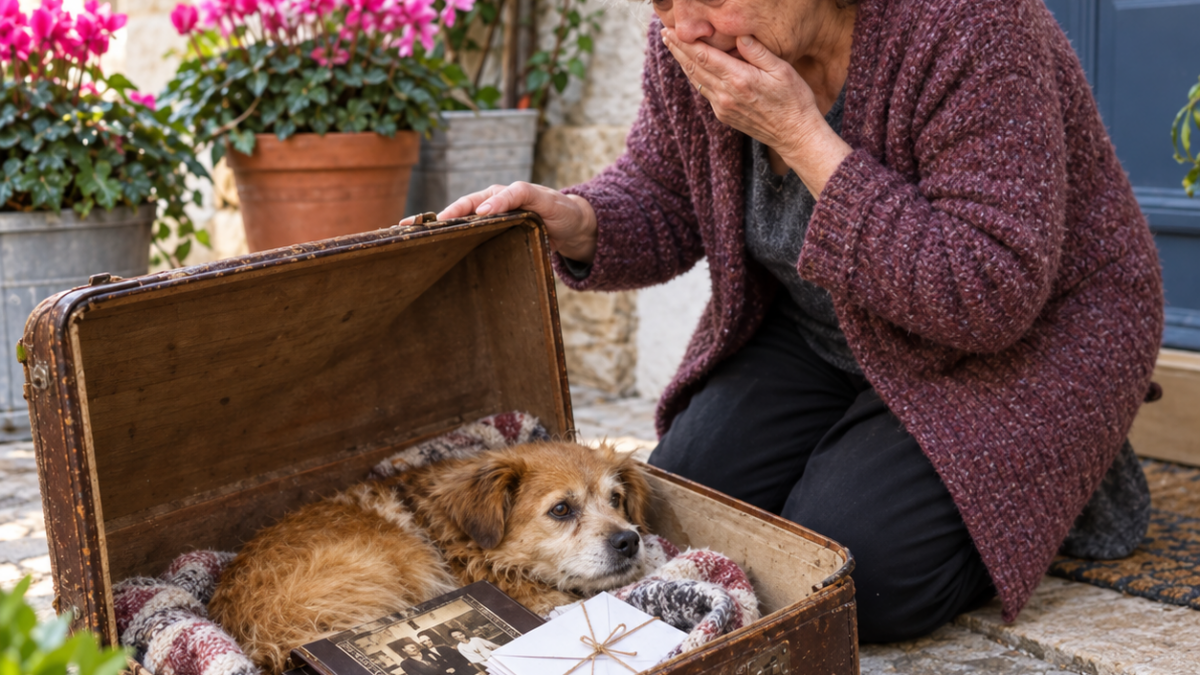
The suitcase on my porch moved before I touched it.
Inside was a small tan dog curled around a photo album, staring past me as though the person he loved had only stepped away for a minute.
By sunset, I would understand that whoever left him there had chosen my house for a reason—and that reason would reopen a part of my life I had spent seven months trying not to touch.
It was just after six in the morning when I stepped outside to water the cyclamens.
I was seventy-four years old then, seven months widowed, and still living in the little gray-shuttered house in Angers where my husband, Pierre, and I had spent forty-three years together.
The brown suitcase blocked the first porch step.
It was old, scratched at the corners, and fastened by one tarnished latch.
Two delivery men unloading groceries across the street had apparently noticed it before I did. One glanced toward my porch, said something to the other, and both went back to their truck.
I assumed someone had dumped old clothes.
Then the lid moved.
I froze.
A faint sound came from inside.
Breathing.
I crouched slowly and lifted the latch.
A little tan dog lay inside on a folded blanket.
He had wrapped himself around a thick photo album as if guarding it.
His chin rested on a white envelope.
His eyes were open.
He wasn’t growling.
He wasn’t even trembling.
He was simply staring over my shoulder toward the street.
Waiting.
“Oh, sweetheart,” I whispered. “What are you doing in there?”
Nothing.
I reached toward him carefully.
His fur was clean. His red leather collar had no identification tag, but there was a pale mark where one had recently been removed.
The envelope contained only a few lines.
His name is Benji.
He is gentle.
He needs his medicine every day.
Please take care of him.
I don’t have much time left.
Forgive me for asking this of you.
No signature.
No address.
No phone number.
I remained crouched there with the note shaking between my fingers, overwhelmed by the strange feeling that someone had placed an entire life on my doorstep.
Inside the suitcase were medication packets, food, vaccination papers with the address section carefully cut away, two bowls, a leash, and enough supplies for several weeks.
This wasn’t careless abandonment.
Someone had planned every detail.
Someone who believed they wouldn’t be coming back.
I called the municipal animal service.
When someone answered, I opened my mouth.
Then Benji lifted his head.
His eyes went toward the front door behind me.
I hung up.
I still couldn’t explain why.
Maybe because of the album.
Maybe because of the way he waited.
Or maybe because I understood something about waiting for someone who would never walk through a door again.
My daughters called me almost every day after Pierre died.
“Are you eating, Mom?”
“Are you sleeping?”
“Have you thought about moving closer to us?”
I always gave them the same answer.
“I’m doing fine.”
I wasn’t.
Doing fine meant making one casserole and eating it four nights in a row.
It meant leaving Pierre’s slippers beneath our bed because putting them away felt like admitting he didn’t need them anymore.
It meant pouring water into two coffee cups some mornings before remembering there was only one person in the kitchen.
The flowers had become my routine.
Every morning before seven, I opened the door, watered the cyclamens, picked away the dead leaves, and swept the dirt from the steps.
It wasn’t much.
But it forced me outside.
That morning, it led me to Benji.
For six hours, he refused to leave the suitcase.
I placed water beside him and sat across the kitchen.
Whenever I moved, he watched the window.
Whenever a car passed, his ears lifted.
At noon, he finally placed one paw on the tile.
Then another.
He circled the suitcase once.
And climbed right back inside.
My neighborhood veterinarian, Claire, came by that afternoon.
She examined him gently.
“His heart is a little weak,” she said. “That’s what the medication is probably for. Otherwise, physically, he’s stable.”
“Then why won’t he move?”
Claire watched Benji stare toward the window.
“He’s under enormous stress.”
“He’s waiting for someone.”
She looked at me for a moment.
“Maybe.”
I don’t know why I whispered:
“So am I.”
Claire didn’t answer.
Instead, she reached for the photo album.
She opened the first page.
Then the second.
Her expression changed.
“Madeleine.”
“What?”
She turned the album toward me.
My breath stopped.
The photograph was several years old.
Benji was sitting on a park bench beside a smiling silver-haired woman I had never seen before.
But the man kneeling beside the dog wasn’t a stranger.
I knew the brown jacket.
I knew the crooked smile.
I knew the wedding ring on his left hand.
It was Pierre.
And underneath the photograph, written in blue ink, were eight words that made my knees almost give way.
Pierre promised me Madeleine would know what to do.
PART 2
For several seconds, I couldn’t hear anything except the ticking clock over my kitchen door.
Claire said my name again.
I didn’t answer.
I took the album from her and brought the photograph closer to my face, as if age or grief might have tricked my eyes.
It hadn’t.
That was Pierre.
There was no question.
The jacket had been his favorite autumn jacket, brown corduroy with a button missing from the left cuff because he had stubbornly refused to let me replace it.
The watch was the one our daughters bought him for his sixty-fifth birthday.
And the smile—
I knew every version of that smile.
The polite smile he gave people at the bank.
The mischievous one he wore when he had eaten the last piece of cake and wanted me to believe he hadn’t.
The soft, crooked smile that had belonged only to people he cared about.
In the picture, he was smiling at the woman on the bench.
My stomach tightened.
“Who is she?”
Claire shook her head.
“I don’t know.”
I turned the photograph over.
Nothing.
The next page showed the same woman walking Benji beside the Maine River.
Then Benji sleeping beneath a table.
Then the woman sitting in what appeared to be a hospital waiting room, a scarf tied around her head.
Pierre wasn’t in those photographs.
Three pages later, he appeared again.
This time, he was holding two paper cups while the woman sat beneath a tree.
I heard my own voice harden.
“How long did he know her?”
Claire sat beside me.
“We don’t know what this is.”
“He’s in her album.”
“Yes.”
“Twice.”
“Madeleine.”
“My husband never mentioned her.”
The words came out sharper than I intended.
Benji lifted his head.
I immediately lowered my voice.
“I’m sorry.”
Claire didn’t look offended.
She had treated Pierre during the last years of his life. She had seen me bring him in carrying our old cat, Lucette, wrapped in a towel after she stopped eating. She had seen Pierre cry in the parking lot when we had to let Lucette go.
She knew what grief could do to ordinary thoughts.
“Don’t decide what the photographs mean before we know,” she said.
That sentence irritated me because it was sensible.
Grief made sensible people unbearable.
I turned another page.
A folded pharmacy receipt had been tucked beneath one photograph.
The name at the top was still visible.
ÉLISE DELAUNAY.
Below it was the name of a pharmacy in central Angers.
I read it twice.
Élise Delaunay.
The woman on the bench suddenly had a name.
Claire checked Benji’s microchip.
He had one.
When she entered the number into the professional registry, the information confirmed it.
Owner: Élise Delaunay.
The telephone number listed was disconnected.
The home address had been marked confidential after a recent update.
But there was an emergency contact.
Laurent Delaunay.
“Probably family,” Claire said.
She called.
A man answered after four rings.
Claire identified herself.
“I’m calling regarding a dog named Benji registered to Élise Delaunay.”
Silence.
Then:
“Where is he?”
Something about the man’s tone made Benji’s head come up.
Claire glanced at me.
“He’s safe.”
“Where?”
“Before I give you any information, can you tell me your relationship to Madame Delaunay?”
“I’m her nephew.”
“Do you know where she is?”
Another pause.
“She’s ill.”
“How ill?”
“That’s none of your concern.”
Claire’s expression changed.
“I’m a veterinarian caring for her dog. It is very much my concern if his owner is unable to make decisions for him.”
The man exhaled angrily.
“Listen. My aunt is not capable of making rational decisions anymore. That dog was supposed to be dealt with days ago.”
I felt something cold move through me.
Claire sat straighter.
“What do you mean by dealt with?”
“Placed somewhere. Removed. I don’t care. She was told she couldn’t keep it.”
“Told by whom?”
“By the people handling her affairs.”
“And are you one of those people?”
Another silence.
Then he said, “Where is the dog?”
Claire looked directly at me.
I shook my head.
She understood.
“He’s safe,” she repeated.
“Give me the address.”
“No.”
His voice sharpened.
“That animal is part of my aunt’s property.”
I nearly laughed.
Not because it was funny.
Because sometimes anger comes out wearing the wrong face.
I leaned toward the phone.
“Benji isn’t a chair.”
The man went silent.
Claire covered the receiver.
“Madeleine—”
But it was too late.
“Who is this?” he demanded.
“The woman whose doorstep he was left on.”
There was such a long pause that I heard traffic on his end of the line.
Then the man said something that made every hair on my arms rise.
“She left him with you?”
“Apparently.”
He whispered a curse.
Not surprise.
Recognition.
He knew who I was.
“How do you know me?” I asked.
He hung up.
Claire and I stared at the phone.
Benji climbed out of the suitcase.
For the first time all day, he crossed the kitchen on his own.
He walked directly to me.
Then he placed his chin on my knee.
That was the moment I stopped thinking of him as the dog in the suitcase.
He was Benji.
And somebody was afraid that he had ended up with me.
That night I barely slept.
Benji did.
Eventually.
He refused the dog bed I made beside the radiator but accepted the blanket from his suitcase.
At around eleven, he carried it into my bedroom and dropped it beside Pierre’s side of the bed.
I stood there watching him circle three times.
Then he lay down directly beside Pierre’s slippers.
My throat closed.
“No,” I whispered.
Benji looked up.
I sat on the edge of the mattress.
“That’s not fair.”
He thumped his tail once.
I hadn’t cried in weeks.
Not properly.
I had learned how to carry grief in small, controlled portions.
A tear while washing dishes.
Thirty seconds in the shower.
A sudden tightness in the supermarket when I saw Pierre’s favorite mustard.
But that night, with a strange dog lying beside my dead husband’s slippers, something inside me simply gave up trying to remain dignified.
I cried until my chest hurt.
Benji climbed onto the bed without permission.
Pierre would have objected.
For approximately six seconds.
Then he would have moved over.
Benji pressed himself against my hip.
I buried my hand in his fur.
“You knew him, didn’t you?”
His ears twitched.
“What did he promise her?”
Benji closed his eyes.
The next morning, I went through the album page by page.
I stopped looking at the photographs as a wife searching for betrayal.
I began looking at them as evidence.
Dates had been written beside several pictures.
The earliest photograph containing Pierre had been taken fourteen months earlier.
That mattered.
Fourteen months earlier, Pierre had been receiving treatment at the Saint-Augustin oncology center.
I remembered those months painfully well.
I had driven him to nearly every appointment.
Nearly.
There had been three occasions when he insisted I stay home because he said the appointments were routine.
“You don’t need to waste an entire afternoon watching me read old magazines,” he had joked.
Had he met Élise there?
The photograph of her in the head scarf suddenly made sense.
I found another clue tucked between pages.
A café receipt.
Two coffees.
One herbal tea.
The date matched one of Pierre’s hospital appointments.
On the back, in the same blue handwriting, Élise had written:
P. says his Madeleine is stronger than she thinks.
I sat alone at the table reading those words.
Then I laughed.
Actually laughed.
“That sounds like you,” I said to the empty kitchen.
Benji looked at me.
Pierre had said that about me whenever I became frightened.
Before my hip surgery.
When our youngest daughter moved to Toulouse.
When my mother died.
You’re stronger than you think, Mado.
I had always answered:
Then stop giving me things to be strong about.
At ten, I called my older daughter, Sophie.
I told her about the suitcase.
The dog.
The letter.
The photographs.
I did not get three sentences into the story before she interrupted.
“Dad knew a woman named Élise?”
“Apparently.”
“What kind of knew?”
“Sophie.”
“I’m asking.”
“So was I.”
“Mom.”
“I don’t think it was anything like that.”
“You don’t know.”
“No. But I’m beginning to know your father again.”
That silenced both of us.
There are parts of people you stop seeing after four decades of marriage.
Not because they are hidden.
Because familiarity makes you believe you have already read every page.
Sophie asked me to send photographs.
Ten minutes later she called back.
“I know that jacket.”
“I know.”
“Are you okay?”
“No.”
That answer surprised both of us.
Then I added, “But I think I want to find her.”
Sophie offered to come immediately.
I told her not to.
For once, I didn’t want one of my daughters solving something for me.
I wanted to do it myself.
The pharmacy receipt gave me a starting point.
Privacy rules prevented the pharmacist from giving me an address or medical information, as they should have.
But when I showed him Élise’s photograph, his expression softened.
“I know her.”
“Is she alive?”
He hesitated.
That was enough.
“Please,” I said. “Her dog was left at my house.”
I showed him Benji’s picture.
Then Pierre.
The pharmacist studied me.
“You’re Madeleine.”
I felt the room tilt.
“You know my name too?”
He looked uncomfortable.
“I heard it from Madame Delaunay.”
“Where is she?”
“I can’t tell you that.”
“Can you tell her I’m looking for her?”
His eyes dropped.
“I don’t think she can come here anymore.”
I understood.
“Hospital?”
He didn’t answer.
“Hospice?”
His silence answered for him.
Before I left, he said, “There is one thing I can tell you.”
I stopped.
“She loved that dog more than anything.”
“I know.”
“No. I mean more than anything she had left.”
I walked home with those words.
Benji was waiting at the front window.
The moment he saw me, his whole body lifted.
Then he looked behind me.
He still expected Élise.
I couldn’t bear it.
That afternoon, Claire called with news.
The microchip registry had contacted the registered owner through a secondary channel.
A representative from a hospice facility had returned the call.
Élise Delaunay was alive.
Barely.
And she had asked to see me.
Saint-Charles Hospice sat behind a row of chestnut trees on the edge of the city.
I almost turned around twice.
The first time was in the parking lot.
The second was outside Room 214.
A nurse named Amélie opened the door.
“She’s been waiting.”
I looked through the opening.
The woman from the photographs lay in a narrow bed beside the window.
She looked smaller than I expected.
Her silver hair had grown back in soft wisps after treatment ended.
Her skin was pale.
An oxygen tube rested beneath her nose.
But when she saw me, she smiled.
Not politely.
With relief.
“Madeleine.”
I stepped inside.
“You know who I am.”
“Pierre talked about you constantly.”
There are sentences that can hurt and comfort at the same time.
That was one of them.
I sat beside her.
For several seconds, neither of us spoke.
Then I asked the question that had been burning through me since yesterday.
“Why did my husband never tell me about you?”
Élise closed her eyes briefly.
“Because I asked him not to.”
“Why?”
“Because when we met, you were already losing him.”
My hands tightened around my purse.
She continued slowly.
“We met in oncology. Same dreadful coffee. Same uncomfortable chairs. Different cancers.”
She smiled faintly.
“Pierre was terrible at sitting quietly.”
I almost laughed.
“Yes.”
“He talked to everyone.”
“Yes.”
“Especially people who wanted to be left alone.”
“Absolutely.”
That made her laugh, which became a cough.
I waited until it passed.
“At first we only talked in the waiting room,” she said. “Then he learned my husband had died years earlier and that my only sister was gone. My nephew lived nearby, but we were not close.”
“Laurent.”
Her face changed.
“You’ve spoken to him.”
“Yesterday.”
“I’m sorry.”
“For what?”
“For bringing him near your life.”
“You didn’t. Benji did.”
The moment I said his name, Élise’s eyes filled.
“Is he all right?”
“Yes.”
“Is he eating?”
“Not much.”
“Chicken.”
“What?”
“Put a little boiled chicken in his food. He’ll pretend he doesn’t care. He’s a liar.”
I smiled despite myself.
“He sleeps beside Pierre’s slippers.”
Élise covered her mouth.
A small sound escaped her.
Then she began crying.
I moved closer.
“How did Benji know Pierre?”
“Pierre used to walk him.”
The answer stunned me.
“When?”
“When my treatments became difficult. He’d come after his appointments. Sometimes he took Benji around the block while I rested.”
I stared at her.
Pierre had been dying, and during his own cancer treatments he had been walking another dying woman’s dog.
It was so absurdly like him that my anger suddenly had nowhere to go.
Élise reached for my hand.
“I asked him once why he helped me.”
I swallowed.
“What did he say?”
“He said, ‘Because one day Madeleine may need somebody to do something small for her, and I hope they don’t wait to be asked.'”
I looked away.
For seven months I had been angry at Pierre for dying.
I had never admitted that aloud.
I knew he hadn’t chosen it.
Grief doesn’t care about logic.
He had left me with bills he used to pay, a garden I didn’t know how to prune, a boiler that made noises at midnight, a bed that suddenly felt enormous.
And now, from a hospice room, a stranger was handing me another piece of him.
“Why Benji?” I asked.
Élise’s fingers tightened around mine.
“Because Pierre made me promise.”
“Promise what?”
“That if I reached the point where I couldn’t care for Benji, I would not let Laurent decide what happened to him.”
I thought of the man’s voice.
That dog was supposed to be dealt with.
“What did Laurent want?”
Élise stared toward the window.
“My apartment.”
She said it without drama.
Perhaps because she no longer had the energy for drama.
“He had debts. More than I realized. At first he visited often. Groceries. Repairs. Papers. He made himself useful.”
Her mouth tightened.
“Then he began asking questions about my accounts.”
“Did he have access?”
“I gave him limited authority after my second round of treatment. I thought I was making things easier.”
“What happened?”
“He started making them easier for himself.”
She told me he had transferred money.
Paid personal bills from her account.
Tried to convince her to sell the apartment early.
When she objected, he told relatives that chemotherapy had made her confused.
“I wasn’t confused,” she said quietly. “I was tired.”
There was anger in that sentence.
The deep kind.
The kind that doesn’t need volume.
“When I changed my legal arrangements, he became furious.”
“What arrangements?”
“I removed him as beneficiary.”
I blinked.
Élise gave a small smile.
“He thought the apartment would be his.”
“What did you do with it?”
“I left most of the proceeds to Saint-Charles and an animal welfare foundation.”
“And Benji?”
“I needed someone.”
Her eyes met mine.
“I asked Pierre.”
My heart clenched.
“He told me he couldn’t promise for you. He said that would be unfair.”
I nodded.
“That sounds like him too.”
“But then he said, ‘If the day comes and you truly have no one, go to Madeleine. Don’t manipulate her. Don’t make demands. Ask her. She will decide for herself.'”
I looked down at our joined hands.
“You didn’t exactly ask.”
“I know.”
“You left a suitcase.”
“I know.”
“On my porch.”
“I know.”
“And disappeared.”
Her eyes filled again.
“I panicked.”
That simple admission dissolved most of my remaining anger.
She explained.
Three days earlier, Laurent had come to the hospice with papers.
He wanted her to sign authority allowing him to “handle final arrangements.”
She refused.
They argued.
Then he said Benji was already too old and sick for anyone to want.
“He told me he could have him put down before the week was over.”
My stomach turned.
“Could he?”
“Not legally without authority. But he had keys to my apartment. He had taken Benji before.”
“What happened?”
“My neighbor stopped him.”
Élise drew a shallow breath.
“I knew I didn’t have much time. So I asked my home aide, Nadia, to pack everything Benji needed.”
“The suitcase?”
“Mine. From my honeymoon.”
I looked at her.
She smiled.
“My husband hated it. Said it was ugly even when it was new.”
I laughed softly.
“How did it get to my porch?”
“Nadia’s brother drove.”
“Why remove the address and Benji’s tag?”
“Because Laurent knew people at the shelter. I was afraid he would trace him before you decided what to do.”
“So Laurent knew about me?”
“He found Pierre’s note.”
“What note?”
Élise pointed weakly toward the bedside cabinet.
The nurse retrieved a sealed envelope.
My name was written on it.
Madeleine Girard.
I recognized the handwriting before I touched it.
Pierre.
My knees went weak.
“When did he give you this?”
“About three weeks before he died.”
I couldn’t open it.
Not there.
Not yet.
I held the envelope against my chest.
Élise watched me.
“He knew he was getting worse.”
I nodded.
“He was afraid he wouldn’t be around when I needed help.”
My voice broke.
“He wasn’t around when I needed help either.”
“I know.”
We sat silently.
Then Élise asked:
“Do you hate me?”
“No.”
“Do you hate him?”
I looked at Pierre’s envelope.
“Sometimes.”
She smiled.
“Good.”
I stared at her.
She shrugged faintly.
“Only people we love very much earn the right to make us that angry.”
I laughed through tears.
Then I asked the question she had been waiting for.
“What happens to Benji now?”
Her face became still.
“That is entirely your decision.”
“If I say no?”
“Nadia has instructions to contact the rescue foundation.”
“So you didn’t leave me no choice.”
“No.”
“But you wanted me.”
“Yes.”
“Why?”
Élise looked at me for a long time.
Then she said:
“I didn’t choose you because you were lonely, Madeleine.”
I stopped breathing.
“I chose you because Benji was going to be lonely too.”
Something inside me broke open.
Not painfully.
Like a locked window finally giving way.
I stayed with Élise for nearly two hours.
Before I left, I showed her a photograph on my phone.
Benji was asleep beside Pierre’s slippers.
She touched the screen with one finger.
“Tell him I didn’t leave because I wanted to.”
“I will.”
“That’s foolish, isn’t it?”
“No.”
She looked at me.
“Will you bring him?”
The nurse answered before I could.
“Tomorrow, if Madame Girard agrees.”
“I agree.”
Élise smiled.
That was the last full smile I ever saw on her face.
At home, I sat at the kitchen table with Pierre’s letter.
Benji sat beneath my chair.
I opened it carefully.
Mado,
If Élise has given you this letter, then I probably failed at something I hoped I would live long enough to do myself.
First, don’t be angry that I never told you.
Actually, you can be angry.
You’ll be angry anyway.
I know you.
I laughed so suddenly that Benji jumped.
The letter continued.
I met Élise during treatment. She is stubborn, proud, frightened, and terrible at asking for help.
You will notice I have a type.
“Idiot,” I whispered.
Tears blurred the words.
Her nephew has become a problem. I don’t know how serious it will get, and I’ve encouraged her to speak to her notary and social worker.
There is also Benji.
He’s a good dog.
He snores.
He pretends he hates rain but will stand in it for ten minutes if he smells bread.
If I am gone and Élise has nowhere safe for him, I told her she could ask you.
ASK, Madeleine.
Not dump him on you.
If she dumped him on you, please know I specifically told her not to do that.
I covered my mouth.
Benji stared up at me.
“Apparently your mother didn’t follow instructions.”
His tail moved.
Then came the part that undid me.
I know what you’re going to do after I’m gone.
You’re going to tell Sophie and Caroline you’re fine.
You’re going to keep my slippers under the bed.
You’re going to make too much food because after forty-three years you won’t know how to cook for one.
You’re going to water those flowers every morning because routine will be easier than grief.
Please keep watering them.
But please don’t make grief your whole life.
If Benji arrives, you do not owe me anything.
You do not owe Élise anything.
You do not owe loneliness anything.
Choose whatever life you still want.
I had to stop reading.
I pressed the letter flat against the table and cried until I could see again.
The final lines were short.
I loved being your husband.
But I hope being my widow is the smallest part of what you become next.
Pierre.
I read it four times.
Then I got down on the floor.
Benji crawled into my lap.
“You can stay.”
His ears moved.
“You hear me?”
I held his face gently.
“You can stay.”
For the first time since arriving, Benji licked my chin.
The next morning, Claire drove us to the hospice.
Benji recognized the building before we reached the entrance.
He began whining.
Not barking.
Whining.
His whole body trembled.
When the automatic doors opened, he pulled so hard on the leash that I nearly lost my balance.
A nurse led us upstairs.
Élise was weaker.
Much weaker.
But the moment Benji entered her room, she opened her eyes.
He made a sound I will never forget.
Half cry.
Half howl.
He jumped onto the bed with help from Claire and pressed himself against Élise’s chest.
She buried both hands in his fur.
“There you are.”
Benji licked her face.
She laughed.
He whined again.
“I know.”
She kissed the top of his head.
“I know, my darling.”
I stood near the door because that goodbye did not belong to me.
After a few minutes, Élise looked toward me.
“Madeleine.”
I came closer.
She reached for my hand.
Then she placed it on Benji’s back beside hers.
“Thank you.”
“You don’t have to thank me.”
“Yes.”
Her fingers were cold.
“Promise me one thing.”
I braced myself.
“No more suitcases?”
A tiny smile.
“No more suitcases.”
Then she became serious.
“Don’t let Laurent scare you.”
“I don’t scare easily.”
“Pierre said that.”
“He exaggerated.”
“No. He didn’t.”
She closed her eyes.
Benji placed his chin beneath her hand.
After nearly an hour, the nurse told us Élise needed rest.
Getting Benji to leave was terrible.
He planted his paws against the floor.
He pulled backward.
He cried.
I had to kneel beside him.
“Benji.”
He looked at me.
I touched his face.
“She knows you love her.”
He shook.
“So does she.”
Finally, he came.
Élise watched us from the bed.
As I reached the door, she whispered:
“Madeleine?”
I turned.
“Yes?”
“You were exactly the way he described you.”
Those were the last words Élise ever spoke to me.
She died at 4:12 the next morning.
The hospice called at six.
I was already awake.
I had been sitting at the kitchen table drinking coffee while Benji stared through the front window.
When the phone rang, he turned his head.
I don’t believe dogs understand telephone calls.
But I believe they understand us.
After I hung up, I sat without moving.
Benji came over.
He rested his head on my thigh.
“She’s gone,” I whispered.
His ears lowered.
“She’s not coming back.”
He walked to the suitcase.
For a moment, I thought he would climb inside.
Instead, he sniffed it.
Then he walked away.
That nearly destroyed me.
Three hours later, Laurent arrived.
He didn’t call first.
A black sedan stopped outside my house at 9:17.
Benji was in the living room.
The moment the driver’s door opened, he began growling.
It was the first time I had heard him growl.
The man approaching my gate was in his late forties, perhaps early fifties, dressed too carefully for a condolence visit.
He pressed the bell.
I opened the door but kept the chain fastened.
“Madame Girard?”
“Yes.”
“I’m Laurent Delaunay.”
“I know.”
“I need the dog.”
“No.”
He blinked.
Perhaps he wasn’t used to elderly women answering him with one syllable.
“My aunt died this morning.”
“I know.”
“Then her property has to be collected.”
I stared at him.
“Benji is not property you’re collecting.”
“Legally—”
“Legally, you’ll speak to Élise’s notary.”
His expression tightened.
“You’ve already been talking to people.”
“Yes.”
“That was quick.”
“So was showing up three hours after your aunt died to collect a dog you said you didn’t want.”
His jaw clenched.
Behind me, Benji growled again.
Laurent glanced through the opening.
“There he is.”
Benji backed away.
That mattered more to me than anything Laurent could say.
“You should leave.”
“Madame Girard, I don’t think you understand what you’re involved in.”
“Then explain it.”
“My aunt was heavily medicated.”
“Yes.”
“Her judgment was impaired.”
“According to whom?”
“According to reality.”
“Interesting. Her doctors didn’t mention that.”
His eyes narrowed.
“You went to the hospice?”
“She invited me.”
Laurent stared at me.
“She spoke to you?”
“For two hours.”
That frightened him.
I saw it.
Tiny changes.
A tightening around the eyes.
His mouth opening before he had decided what to say.
“What did she tell you?”
There it was.
Not sorrow.
Fear.
I stepped closer to the door.
“Enough.”
He lowered his voice.
“My aunt made accusations during the final months of her life.”
“Against you?”
“She was ill.”
“You’ve said that.”
“She misunderstood financial arrangements.”
“What financial arrangements?”
“Family matters.”
“You came to my house.”
Laurent exhaled.
“I’m trying to be reasonable.”
“No. You’re trying to find out what she told me.”
For the first time, the polished mask slipped.
“Give me the dog.”
Benji barked.
Laurent flinched.
Then he looked past me again.
“There’s something that belongs to my family.”
“What?”
“The photo album.”
My hand tightened around the door.
I had not mentioned the album.
Neither had Claire.
“How do you know about it?”
He said nothing.
“Leave.”
“Madame Girard—”
“Leave my property.”
He stared at me for several seconds.
Then he smiled.
It was an ugly little smile because it contained no warmth.
“You have no idea what you’re doing.”
I closed the door.
My hands started shaking only after I locked it.
That afternoon, I called Élise’s notary.
His name was Maître Benoît Lemaire.
When I told his secretary my name, I was immediately transferred.
“Madame Girard,” he said, “I’ve been expecting your call.”
Of course he had.
Everyone in this story seemed to know who I was except me.
“I believe Laurent wants something from the album.”
Silence.
Then:
“Do you still have it?”
“Yes.”
“Do not give it to anyone.”
“What’s in it?”
“Madame Delaunay did not tell you?”
“No.”
“Then I would prefer to show you in person.”
I was tired of people preferring things.
“Does Laurent know?”
“He knows enough to be concerned.”
That evening, my daughters arrived.
Both of them.
Despite my telling them not to.
Sophie came from near Lyon.
Caroline came from Toulouse after taking the first train she could manage.
They entered my house talking over each other.
“Where is he?”
“Did Laurent threaten you?”
“Why didn’t you call us?”
“Which one first?” I asked.
Caroline saw Benji.
Everything stopped.
“Oh.”
Benji stood near the hallway, uncertain.
Caroline crouched.
“Hi, handsome.”
He approached cautiously.
Within thirty seconds, he was leaning against her knees.
Sophie looked at me.
“Traitor.”
“He has taste,” Caroline said.
That night the three of us sat around the kitchen table while I showed them Pierre’s letter.
Sophie cried.
Caroline cried.
I cried again despite being furious that I apparently had no remaining control over my tear ducts.
Then Sophie reached the line about cooking too much food.
She laughed.
“Dad knew.”
“Your father was extremely annoying.”
Caroline wiped her eyes.
“You loved that.”
“I did.”
We looked at the empty chair.
For the first time since Pierre died, remembering him in that kitchen did not feel only like losing him.
It felt like having had him.
There is a difference.
The next morning we met Maître Lemaire.
He was a small, serious man with silver glasses and an office filled with more paper than I thought legally possible.
He placed the album on his desk.
“Madame Delaunay asked me to prepare for the possibility that her nephew would challenge her final wishes.”
“He already wants the album,” I said.
“I expected that.”
“Why?”
Lemaire opened the back cover.
Then he slid one finger beneath the lining.
I had examined that album repeatedly.
I had never noticed the narrow hidden pocket.
Inside were three items.
A small digital memory card.
A folded bank statement.
And a key.
Sophie whispered, “What is this?”
Lemaire looked at us.
“Insurance.”
The bank statement showed withdrawals.
Many of them.
Small at first.
Five hundred euros.
Nine hundred.
Twelve hundred.
Then larger transfers.
Five thousand.
Eight thousand.
One transfer was nearly fifteen thousand euros.
All authorized through the access Élise had granted Laurent for household expenses.
“How much?” I asked.
“Just over forty-two thousand euros is currently disputed.”
Caroline swore quietly.
Lemaire continued.
“Madame Delaunay confronted him.”
“Did he return it?”
“No.”
“Did she report him?”
“Eventually.”
“What stopped her?”
“Shame.”
I understood that immediately.
Older people are often embarrassed when someone they trusted steals from them.
As if trusting family were the foolish act.
Not stealing from family.
The memory card contained recordings.
Élise had started recording conversations after her social worker became suspicious.
We listened to only one.
Laurent’s voice filled the quiet office.
You don’t need that apartment anymore.
Élise answered:
It is my home.
You’re never going back there.
Then sell it while there’s something left.
I am leaving it where I want.
A pause.
And the dog?
Benji stays with me.
You can’t even walk him.
I’ll arrange something.
Don’t touch him.
A harder voice:
Then sign the papers.
No.
A chair scraped.
You think those people at the hospice care what happens to you?
Yes.
More than you do.
The recording ended.
Nobody spoke.
Lemaire removed his glasses.
“That was made six weeks ago.”
“Why wasn’t he arrested?”
“The matter was under review. Madame Delaunay’s declining health complicated interviews. We were gathering records.”
“And now?”
“Now the records remain.”
He pointed to the key.
“This opens a document box held with her bank.”
“What’s inside?”
“The original revocation of Laurent’s financial authority, copies of transfers, written instructions regarding her estate, and a statement made in the presence of two witnesses.”
Sophie looked at me.
“So Laurent gets nothing.”
Lemaire chose his words carefully.
“Under the final will, he receives a small family heirloom and a symbolic monetary bequest. The apartment is to be sold. After outstanding expenses, most proceeds go to Saint-Charles Hospice and an animal welfare charity.”
“And Benji?”
Lemaire turned to me.
“Madame Delaunay could not legally force you to accept responsibility for him. She therefore established two alternatives.”
“What alternatives?”
“If you voluntarily keep Benji, a modest fund has been reserved for his veterinary care.”
I stared at him.
“Money?”
“For Benji. Not for you.”
“I don’t want her money.”
“It is not an inheritance to you. It is specifically restricted to his medical expenses.”
“And if I refuse?”
“The animal foundation assumes care.”
I thought of the little body beside Pierre’s slippers.
“I’m not refusing.”
Lemaire nodded as though he had already known.
“Then Benji is yours, subject to the ordinary transfer documentation.”
Mine.
The word frightened me.
Because mine meant loving.
And loving meant eventually losing.
I had learned that lesson too well.
Laurent challenged everything.
Of course he did.
Three days after Élise’s funeral, his lawyer sent a letter claiming Élise had lacked capacity when she changed her estate plan.
A week later another letter accused unnamed “third parties” of influencing her.
I was one of those third parties.
A woman Élise had met exactly once before her death.
The accusation would have been ridiculous if it hadn’t been so insulting.
Laurent even claimed I had hidden Benji to gain access to money.
That was when something in me changed.
Until then, I had wanted only to protect Benji and honor Élise.
Now I wanted the truth stated clearly enough that Laurent could never twist it again.
Not revenge in the ugly sense.
I didn’t want him destroyed.
I wanted him unable to hide behind Élise’s illness.
There is a particular kind of cruelty in telling the world that an elderly person became confused simply because they stopped agreeing with you.
Laurent had done that to Élise.
He had turned her cancer into a weapon against her credibility.
I could not undo what he had taken.
But I could refuse to let him take her voice.
The first hearing took place several months later.
By then, Benji had changed.
So had I.
Every morning at six, he woke me.
We walked before breakfast.
At first we went only to the corner.
His heart condition made long walks difficult.
Mine probably did too, though I didn’t tell Claire.
Then we began going farther.
Past the bakery.
Across the little square.
Along the river.
People started learning Benji’s name.
Then they learned mine.
A widow from two streets away began walking with us on Tuesdays.
A retired teacher joined on Fridays.
I started buying fresh bread again instead of freezing half a loaf for weeks.
I cooked smaller meals.
Sometimes I invited someone to eat them.
Pierre’s slippers remained under the bed.
But one morning, I finally picked them up.
I held them for a long time.
Then I put them into a box with his jacket, his watch boxes, several letters, and the ridiculous tie he had worn to Caroline’s wedding.
I did not throw them away.
I simply stopped requiring the bedroom to remain exactly as he had left it.
Benji’s bed went where the slippers had been.
The day of the hearing, Laurent stood across the corridor from us.
He looked at me as though I had personally stolen his inheritance.
He approached during a recess.
“You could have stayed out of this.”
I looked at him.
“So could you.”
“My aunt was family.”
“Then you should have treated her like family.”
His face reddened.
“You knew her for one day.”
“Yes.”
“And you think that gives you the right to judge me?”
“No.”
I stepped closer.
“Your recordings do that.”
He stared at me.
For once, he had no answer.
The most important witness was not me.
It was Élise’s oncologist.
Then her hospice physician.
Then her social worker.
All three described her as physically frail but mentally capable during the relevant period.
Her notary testified that he met with her without Laurent present.
Twice.
He asked detailed questions designed to determine whether she understood her assets, decisions, and consequences.
She did.
The bank records were entered.
The recordings were verified.
Then came something even I had not known.
Nadia, the home aide who packed Benji’s suitcase, testified.
She described the day Laurent tried to remove Benji from Élise’s apartment.
“He said the dog was costing too much,” Nadia told the court.
“What did Madame Delaunay say?”
“She said she paid for Benji herself.”
“And then?”
“He told her she wouldn’t be paying for anything much longer.”
The room became completely silent.
Laurent’s lawyer shifted in his chair.
Nadia continued.
“Madame Delaunay became frightened after that.”
“Did she ask you to contact Madame Girard?”
“Yes.”
“Had Madame Girard ever spoken to Madame Delaunay at that point?”
“No.”
“Had Madame Girard asked for money?”
“No.”
“Property?”
“No.”
“Anything?”
“No.”
“What instructions did Madame Delaunay give you?”
Nadia looked toward me.
“She said, ‘Take Benji to Madeleine. Leave the letter. If Madeleine says no, call the foundation. Don’t pressure her.'”
There it was.
The truth.
Simple.
Uncomplicated.
Not theft.
Not manipulation.
A dying woman making one final decision for the creature who depended on her.
The challenge to Élise’s will failed.
But that was not the end.
The financial investigation continued separately.
Several transfers Laurent had described as authorized expenses were shown to have paid his private debts.
He eventually agreed to repay a substantial portion rather than continue disputing the evidence.
Additional penalties and legal costs followed.
I learned this from Lemaire.
I did not attend those proceedings.
I didn’t need to.
The money returned to Élise’s estate went exactly where she wanted it to go.
Part to the hospice.
Part to the animal foundation.
Not a cent to me.
Laurent’s final letter arrived almost eleven months after Benji appeared on my porch.
He blamed me.
Of course.
He said if I hadn’t interfered, none of it would have happened.
I sat at the kitchen table reading those words.
Then I looked at Benji.
He was asleep in a rectangle of sunlight.
I tore the letter in half.
Not dramatically.
I didn’t burn it.
I didn’t write back.
I put it in the recycling bin.
Some people believe revenge means hurting the person who hurt you.
I learned something different.
Sometimes the most complete revenge is simply making sure they fail to erase the person they tried to silence.
Élise had died.
But Laurent did not get to rewrite her final months.
He did not get her apartment.
He did not get to call her confused and have everyone accept it.
He did not get Benji.
And most importantly, he did not get the last word.
A year after Élise died, Saint-Charles Hospice invited me to a small gathering.
The apartment had been sold.
Her bequest had helped fund a program for terminally ill patients who were worried about what would happen to their animals.
Temporary foster care.
Veterinary treatment.
Permanent placement when necessary.
Nobody wanted to name it after Élise because she had left written instructions saying she would find that “embarrassingly sentimental.”
So the staff named it the Homeward Program.
I brought Benji.
He wore a new red collar.
This one had a tag.
BENJI GIRARD.
My phone number underneath.
I had hesitated before ordering it.
Girard.
Was I allowed to give him our name?
Then I imagined Pierre answering.
Mado, it’s a dog tag, not a royal title.
So Benji Girard it became.
After the ceremony, I walked him past the hospice garden.
We stopped beneath the same chestnut trees I had passed the first day I met Élise.
Benji sniffed the grass.
Then he looked toward the building.
For several seconds, he didn’t move.
I knelt beside him.
“You remember.”
His tail moved slowly.
“So do I.”
I had brought something with me.
A copy of the photograph from the album.
Élise on the bench.
Pierre kneeling beside Benji.
Three lives that had somehow crossed before mine caught up with them.
I kept the original at home.
That photograph belonged to my story now too.
Sophie once asked whether I regretted discovering a part of Pierre’s life he had never told me about.
I thought about that for a long time.
“No,” I finally said.
“Even though he kept it secret?”
“He didn’t keep another life from me.”
I looked at her.
“He kept doing the kind of things that made me love him, even when I wasn’t watching.”
That was harder to resent.
My daughters still asked whether I wanted to move closer.
I still said no.
But the answer meant something different now.
Before Benji, “I’m fine” had meant:
Please stop asking because I don’t want you to see how empty everything feels.
After Benji, it meant:
I have a life here.
Caroline visited every few months.
Sophie came more often.
They both accused me of loving the dog more than them.
I neither confirmed nor denied it.
Benji’s heart remained weak.
Claire adjusted his medication twice.
Every pill reminded me of the note in the suitcase.
He needs his medicine every day.
I kept that note.
I kept Élise’s album too.
Eventually, Lemaire gave it to me according to instructions she had left.
There were blank pages at the back.
One evening, I began filling them.
The first photograph I added showed Benji asleep beside Pierre’s slippers.
The second showed him walking by the river.
The third showed my daughters kneeling on my kitchen floor while Benji sat between them looking deeply satisfied with himself.
Then came Christmas.
My first Christmas after Pierre had been terrible.
I had spent most of it pretending.
My second was different.
Not easy.
Different.
Both daughters came.
So did two grandchildren.
Claire stopped by.
My neighbor brought dessert.
There were too many coats on the hooks, too many glasses in the sink, crumbs everywhere, and a dog circling the table with the strategic patience of a military commander.
At one point I went into the kitchen alone.
Through the doorway, I could see everyone talking.
Benji was lying underneath Pierre’s chair.
Not beside it.
Under it.
As though that place had always belonged to him.
I felt the old ache.
It still came.
Grief does not disappear when life improves.
That is not how it works.
Joy grows around it.
That night after everyone went to bed, I poured myself tea.
Only one cup.
I noticed immediately.
For years, I had feared the morning when I would stop automatically reaching for Pierre’s cup.
I thought forgetting the second cup would mean I was forgetting him.
Instead, I realized something.
I hadn’t forgotten.
I simply no longer needed to reenact his absence every morning to prove he had existed.
I carried my tea into the living room.
Benji followed.
“You know,” I told him, “you were a terrible thing to leave on someone’s porch.”
He climbed onto the sofa.
“Very rude.”
He rested his head in my lap.
“Your mother had absolutely no manners.”
His eyes closed.
I stroked his ears.
“But she had good instincts.”
Two years passed.
Benji slowed down.
So did I.
Our morning walks became shorter again.
Some days, we only reached the corner.
But every morning, without fail, he stopped at the gate and looked down the road.
For the first year, I believed he was waiting for Élise.
Later I began to think he was simply remembering.
There is a difference between those things too.
Waiting asks someone to return.
Remembering allows them to remain without requiring it.
One spring morning, I found the old suitcase in the attic.
I had stored it there after Benji finally stopped sleeping in it.
The brown leather was cracked.
One latch still worked.
I carried it downstairs.
Benji saw it.
He walked over slowly.
Sniffed the corner.
Then looked at me.
For one terrible second, I wondered if I had made a mistake bringing it out.
Then he did something that made me laugh.
He lifted one leg and urinated against it.
“Benji!”
He walked away without shame.
I laughed so hard I had to sit down.
That afternoon I threw the suitcase away.
Not the album.
Not the blanket.
Not the letter.
Just the suitcase.
Some things are memories.
Some things are luggage.
You have to learn the difference.
Benji lived with me for four years.
He was older than anyone had originally realized.
Claire estimated he was probably thirteen when Élise left him with me.
Near the end, his heart weakened.
I knew before Claire told me.
He slept more.
Ate less.
Walked to the gate and sometimes forgot why he had gone there.
I hated every sign.
I hated the medicines.
I hated counting breaths while he slept.
Most of all, I hated the terrible bargain hidden inside every love.
If you are lucky, you get enough time to become terrified of losing it.
One evening, Claire sat on my living room floor beside him.
“He isn’t suffering badly yet,” she said. “But we’re getting close.”
I nodded.
“I know.”
“You don’t have to decide tonight.”
“I know.”
Benji opened his eyes.
He looked toward the hall.
Pierre’s old jacket hung there now.
I had started wearing it on cold mornings.
It was too large.
I liked it that way.
That night, Benji slept beside my bed.
At 5:52 the next morning, I woke to the sound of his paws moving across the floor.
He stood at the bedroom door.
“Need to go out?”
He looked back.
I put on Pierre’s jacket and followed him.
Outside, dawn was beginning.
The street was empty.
Benji walked to the cyclamens.
I still grew them.
Every year.
He sniffed the first pot.
Then he lowered himself carefully onto the porch.
Exactly where the suitcase had been.
I sat beside him.
For a long time, we watched the road together.
No cars.
No delivery trucks.
No mysterious suitcases.
Just morning.
I placed my hand on his back.
“I think we’ve waited long enough.”
Benji leaned against me.
A few hours later, Claire came.
My daughters were on speakerphone until they could reach me.
I sat on the floor with Benji in my arms.
I told him about Élise.
I told him about Pierre.
I told him he had been a very good dog.
Then I told him the thing I wished somebody could have told me when Pierre died.
“You don’t have to keep waiting.”
Benji’s breathing became quiet.
Then quieter.
Then still.
I held him long after Claire gently touched my shoulder.
The house felt impossibly silent.
I thought the loneliness would return exactly as it had been before.
It didn’t.
Loss returned.
But I was not the same woman who had opened that suitcase four years earlier.
There were people in my life now.
Friends from our morning walks.
The hospice staff.
Claire.
My daughters, who finally understood that I didn’t need rescuing from my house.
I needed reasons to keep opening its door.
A week after Benji died, I added the final photograph to Élise’s album.
It showed him sitting on my front porch in morning sunlight.
His gray muzzle lifted.
His red collar visible.
Underneath, I wrote:
He stopped waiting.
Then I hesitated.
And added:
So did I.
The album now sits on a shelf beside Pierre’s photograph.
Sometimes visitors ask about it.
I tell them the story.
About an ugly brown suitcase.
About a dying woman who loved a dog enough to make an impossible decision.
About a husband who spent some of his final months quietly helping someone else survive hers.
About a nephew who thought illness made an old woman powerless and discovered that her voice could outlive her.
And about a seventy-four-year-old widow who believed her life had already become a collection of things that would never happen again.
Pierre would never come home again.
Élise would never come home again.
Eventually, Benji wouldn’t either.
For a long time, I believed love was measured by who stayed.
I was wrong.
Sometimes love is measured by what someone leaves behind.
A letter.
A photograph.
A promise.
A dog on a porch.
A reason to open the door tomorrow morning.
I still live in the same gray-shuttered house in Angers.
I still water the cyclamens before seven.
But there is one thing I no longer do.
I don’t look down the street expecting the dead to return.
I look at the people and animals who are still here.
And when something frightened, lonely, or unexpected arrives at my door, I remember what Pierre wrote to me.
Choose whatever life you still want.
So I do.
Every morning, I choose it again.
The strange thing about surviving grief is that nobody tells you how ordinary the world looks afterward.
The morning after I wrote those final words beneath Benji’s photograph—He stopped waiting. So did I—the garbage truck still came at 7:10.
The bakery opened.
A neighbor argued with her husband about where he had parked the car.
Someone’s child rode a bicycle down the sidewalk, laughing so loudly that I could hear him from my kitchen.
And I stood at the sink with one hand wrapped around my coffee mug, staring at the empty patch of floor where Benji’s water bowl had been.
For four years, I had stepped around that bowl without thinking.
Now the absence of it seemed larger than the kitchen.
I almost put it back.
That would have been easy.
Keep his leash by the door.
Leave the blanket folded beside the radiator.
Pretend that preserving every object exactly where it had been might somehow keep loss from becoming permanent.
I had done that once already with Pierre’s slippers.
I knew where that road led.
So I washed Benji’s bowl.
I dried it.
Then I placed it inside the cupboard.
Not in the trash.
Not yet.
Just somewhere it no longer had to pretend to be useful.
That afternoon, the doorbell rang.
When I opened the door, Claire stood there holding a paper bag from the bakery.
“You forgot lunch,” she said.
“I did not.”
She raised one eyebrow.
“What did you eat?”
“Coffee.”
“That is not lunch.”
“There was milk in it.”
“Madeleine.”
I stepped aside.
She came in as though she belonged there.
In some ways, she did.
Claire had been present at the beginning of Benji’s life with me and at the end of it.
There are certain people who enter your story quietly and become part of the structure without anyone noticing.
She placed two pastries on the table.
For a while we ate without talking.
Then Claire glanced toward the empty space beside the radiator.
“I keep expecting to hear his nails on the tile,” she said.
“So do I.”
“He was a stubborn little thing.”
“Impossible.”
“Manipulative.”
“Terrible manners.”
“Selective hearing.”
I smiled.
Claire smiled too.
Then neither of us smiled.
“I miss him,” I said.
“I know.”
“I thought losing him would put me back where I started.”
“Did it?”
I looked around the kitchen.
At the new calendar Sophie had sent.
At Caroline’s scarf hanging over a chair.
At the photograph from the hospice gathering.
At Pierre’s letter inside the drawer.
“No,” I said.
And that was when I finally understood the gift Benji had given me.
He had not cured loneliness.
He had taught me that loneliness did not have to be obeyed.
There was a difference.
Three weeks later, Saint-Charles Hospice called.
The woman on the phone was Amélie, the nurse who had cared for Élise.
“Madeleine, I hope I’m not disturbing you.”
“No.”
“We have a situation.”
I laughed softly.
“That phrase has caused me trouble before.”
“So I remember.”
Her voice became gentler.
“We have a patient named Madame Fournier. She’s eighty-one. Advanced heart failure.”
I waited.
“She has a cat.”
“No.”
Amélie laughed.
“I haven’t even asked yet.”
“I know what you’re going to ask.”
“Do you?”
“You want me to take the cat.”
“Not permanently.”
“No.”
“A week.”
“No.”
“Possibly two.”
“Absolutely not.”
There was a pause.
Then:
“His name is Marcel.”
“That is emotional manipulation.”
“He’s twelve.”
“Worse.”
“He sleeps on laundry.”
“Amélie.”
“And Madame Fournier is refusing admission unless someone promises her he’ll be safe.”
I closed my eyes.
Pierre’s voice appeared in my head with irritating clarity.
Because one day Madeleine may need somebody to do something small for her, and I hope they don’t wait to be asked.
I hated that dead man sometimes.
“What color is the cat?”
Amélie knew she had won.
“Black and white.”
“I’m not keeping him.”
“Of course not.”
“I mean it.”
“Naturally.”
“And if he scratches my sofa—”
“I’ll tell him there will be consequences.”
Marcel arrived that evening.
He hated me immediately.
The feeling was mutual.
He spent his first six hours beneath the dining table glaring at me as though I personally had caused human mortality.
At eleven that night, I went to bed.
At eleven fifteen, Marcel jumped onto my chest.
I opened my eyes.
Two green eyes stared back at me.
“Absolutely not.”
He sat down.
“Move.”
He began purring.
“You are not Benji.”
The purring grew louder.
“You’re not staying.”
Marcel tucked his paws beneath himself.
I sighed.
“Fine. One night.”
He stayed twelve days.
When Madame Fournier returned home under palliative care, I brought him back myself.
She cried when she saw him.
Not dramatically.
Quietly.
She pressed her face against his fur and whispered, “I knew you’d come back.”
I stood in the doorway and had to look away.
That sentence still had power over me.
I knew you’d come back.
Some people did.
Some didn’t.
The trick, I was learning, was to love without demanding that life make promises it could not keep.
After that, the hospice began calling more often.
A spaniel named Rosie stayed four days.
A rabbit called Monsieur Lapin stayed a weekend, though Caroline insisted that giving a rabbit the surname “Rabbit” showed a lack of imagination.
Then came Oscar, an elderly beagle whose owner died before arrangements could be finalized.
Oscar was supposed to stay two nights.
He stayed six weeks.
I nearly kept him.
Nearly.
But a retired couple from Saumur met him through the Homeward Program, and when I saw Oscar asleep between them on their sofa during the trial visit, I knew.
He belonged there.
Letting him go hurt.
That surprised me.
Claire said, “That’s how you know you did it properly.”
I understood what she meant.
Love was not possession.
Pierre had taught Élise that.
Élise had taught me.
Benji had proved it.
A year passed.
Then another.
I became, without ever intending to, part of the Homeward Program.
Not an employee.
Not exactly a volunteer with a title.
I was simply Madeleine.
The woman who would take a frightened animal for a night.
The woman who knew what medications had to be hidden inside chicken.
The woman who understood why a dying person might care more about where their dog would sleep next month than what would happen to their furniture.
Hospice families began asking for me.
One afternoon, a man named Jérôme sat across from me in the Saint-Charles garden.
He was fifty-eight and terminally ill.
His Labrador, Hugo, lay at his feet.
“My sister says she’ll take him,” Jérôme told me.
“That’s good.”
“But she has two dogs already.”
“Does Hugo know them?”
“Yes.”
“Do they get along?”
“Mostly.”
I smiled.
“Then what are you afraid of?”
His face changed.
Not much.
Just enough.
“That he’ll think I abandoned him.”
There it was.
The real question.
Not logistics.
Not money.
Not food.
Guilt.
I looked at Hugo.
Then at Jérôme.
“Benji waited for Élise.”
He listened.
“For a long time, I thought that was the saddest part of his story.”
“Wasn’t it?”
“No.”
“The saddest part would have been if Élise had kept him beside her simply because she was afraid of being the one to let go.”
Jérôme looked down.
I continued.
“She made sure he had somewhere to land.”
His eyes filled.
“Did he forget her?”
“No.”
That answer mattered.
“He never forgot her.”
“Then how did he move on?”
I thought of Benji standing at my gate.
Looking down the road.
Then eventually turning back toward the house.
“Slowly.”
Jérôme laughed through tears.
“That’s not very comforting.”
“It’s true.”
That seemed to comfort him more.
Hugo moved in with Jérôme’s sister three weeks before Jérôme died.
The sister later sent me a photograph.
Hugo was asleep beside her two dogs.
Underneath, she had written:
He still waits by the window around five every afternoon.
That was when Jérôme used to come home.
But afterward, he comes to sit with us.
I printed the photograph.
It joined Benji’s album.
The blank pages Élise had left at the back were filling.
Not with Benji anymore.
With all of them.
Marcel.
Rosie.
Oscar.
Hugo.
Animals who had been loved by people running out of time.
People who had been terrified that death would make their love meaningless.
I knew better now.
Love did not become meaningless because it ended.
Sometimes endings revealed its shape.
On the fifth anniversary of Pierre’s death, Sophie and Caroline came home.
We visited his grave in the morning.
I brought flowers.
No dramatic speech.
No tears at first.
I simply stood there reading his name.
Pierre Girard.
Husband.
Father.
Grandfather.
Those words were true.
But incomplete.
He had also been the irritating man who talked to strangers in oncology waiting rooms.
The man who walked a dying woman’s dog while dying himself.
The man who predicted my grief with embarrassing accuracy.
The man whose quiet act of kindness had rearranged years of my life after his own ended.
“I found something,” Caroline said.
She handed me a small envelope.
“What is it?”
“Dad’s.”
My heart skipped.
“Where?”
“In a box of old papers you gave me.”
I opened it.
Inside was a photograph.
Pierre.
Benji.
Élise.
The same park.
But this photograph was different.
Someone else must have taken it.
Pierre stood behind the bench.
Élise was laughing.
Benji was halfway between them, pulling on his leash.
On the back, Pierre had written:
Two stubborn patients and one reasonable dog.
I laughed.
Sophie leaned over.
“That sounds like Dad.”
“It does.”
Below that sentence was another line.
Small.
Almost squeezed into the bottom edge.
Must remember to tell Mado about them when things calm down.
I stared at it.
For years, one tiny question had remained inside me.
Why hadn’t Pierre told me?
I had accepted Élise’s explanation.
I had forgiven him.
But part of me had still wondered whether he had intentionally kept that entire friendship separate from our marriage.
Now I knew.
He had planned to tell me.
Then cancer had accelerated.
Things had never calmed down.
Life had simply run out of time.
I sat on the stone bench near his grave and cried.
Not because I had discovered another secret.
Because I had discovered there had been no secret at all.
Only unfinished business.
Sophie sat beside me.
“You okay?”
“Yes.”
And this time, it was true.
I placed the photograph against my chest.
“You know what your father’s biggest flaw was?”
Caroline smiled.
“Only one?”
“He always believed there would be more time.”
Neither daughter answered.
Because we all did that.
We postponed phone calls.
Visits.
Apologies.
Truths.
We saved good dishes for special occasions and difficult conversations for better moments.
As though time were a bank account that quietly earned interest.
Pierre had been wrong.
There was not always more time.
But there was still today.
That evening, all three of us returned to my house.
I cooked too much food.
Some habits deserve to survive.
During dinner, Sophie said, “Mom, have you ever thought about getting another dog?”
“No.”
Caroline immediately said, “That means yes.”
“It means no.”
“You’ve fostered fourteen animals.”
“Fifteen.”
Both daughters stared at me.
I realized my mistake.
Sophie smiled.
“Fifteen?”
“A terrier named Gaston. Three nights. He was unbearable.”
“Did he sleep in your bed?”
“That is irrelevant.”
They laughed.
I tried not to.
Failed.
A month later, Amélie called again.
“There’s a dog.”
“No.”
“This is different.”
“They are always different.”
“She belonged to a hospice patient who died yesterday.”
“I’m sorry.”
“No family can take her.”
“The foundation?”
“Full this week.”
I sighed.
“How old?”
“About nine.”
“What kind?”
“Mixed breed.”
“Health?”
“Good enough.”
“Name?”
There was a pause.
“Hope.”
I almost hung up.
“That is ridiculous.”
“I did not name her.”
“You expect me to believe that?”
“I swear.”
Hope arrived at four thirty.
She was larger than Benji.
White fur with brown patches.
One ear stood up.
The other refused.
She entered my hallway, sniffed the furniture, inspected the kitchen, and then walked directly to the front window.
My heart tightened.
She stared down the street.
Waiting.
Of course.
I stood behind her.
For a few minutes, neither of us moved.
Then Hope turned.
She looked at me.
I crouched.
“I know.”
Her tail moved once.
“You can wait if you need to.”
Another small wag.
“But dinner is at six.”
She came closer.
“And I don’t allow dogs on the bed.”
Hope licked my hand.
“That rule has been historically difficult to enforce.”
That night, I opened Élise’s album.
The last few pages remained blank.
I placed Pierre’s newly discovered photograph inside.
Then I added a picture of Hope standing at my window.
I did not write beneath it.
Not yet.
Some stories deserve time before you decide what they mean.
Hope was meant to stay one week.
After three weeks, Claire stopped asking.
After six weeks, Sophie mailed me a new collar.
After two months, Caroline arrived carrying a metal identification tag.
I held it between my fingers.
HOPE GIRARD.
“You two are impossible.”
Caroline shrugged.
“Must be genetic.”
I attached the tag.
Hope shook herself, making it jingle.
The sound filled the hallway.
For one second, I heard Benji’s old tag.
I heard Pierre laughing.
I heard Élise telling me that she had not chosen me because I was lonely.
She had chosen me because Benji would be lonely too.
I looked at Hope.
Then toward the window.
“No more waiting alone,” I said.
Hope leaned against my leg.
Years earlier, I had believed the suitcase on my porch contained a dog someone had abandoned.
I had been wrong about that too.
It contained a promise.
Élise’s promise to Benji that she would find him safety.
Pierre’s promise that kindness would continue even if he could not.
And eventually, my promise to myself that grief would never again become the only thing living inside my house.
People sometimes ask whether finding Benji saved me.
I never know how to answer that.
He did not rescue me in the way stories often claim.
I was not drowning.
I was breathing.
Eating.
Sleeping.
Paying bills.
Watering flowers.
Functioning.
That was precisely the problem.
I had mistaken surviving for living.
Benji changed that.
Not all at once.
He simply needed breakfast.
Then a walk.
Then medicine.
Then reassurance.
One ordinary responsibility after another pulled me back toward the world.
And after he died, I discovered something even more important.
The door he opened inside me did not close with him.
That was his final gift.
I still miss him.
I still miss Pierre.
I miss Élise too, though I knew her for only a few hours.
That may sound strange.
But some people do not need years to alter your life.
Sometimes they need one conversation.
One letter.
One decision made at exactly the right moment.
The old brown suitcase is gone now.
The porch has been repainted.
The cyclamens have been replaced many times.
Even the gray shutters finally needed new hinges.
But every morning, I still open that front door.
Hope usually pushes past me first.
She stands at the top step, nose lifted toward whatever the day has brought.
Sometimes she looks down the street.
Maybe she remembers someone too.
I don’t ask.
I water the flowers.
She watches pigeons.
The neighborhood wakes around us.
And sometimes, when the morning is very quiet, I think about the first day Benji arrived.
A frightened dog curled around a photo album.
A widow who had forgotten how to move forward.
Two strangers waiting for people who would never return.
Neither of us knew what to do next.
So we did the smallest thing possible.
We stayed.
Then we ate.
Then we walked.
Then one morning became another.
That is how a life begins again.
Not with a miracle.
Not with forgetting.
With a door opening.
With someone trusting you enough to cross the threshold.
With the courage to love something even after learning that love does not guarantee permanence.
Pierre once wrote:
Choose whatever life you still want.
For years, I thought he meant I had to make one great decision.
I understand him differently now.
Choosing life is not something you do once.
It happens in tiny decisions.
Answer the phone.
Visit the friend.
Take the walk.
Open the curtains.
Adopt the dog.
Return the cat.
Cook for people.
Say the thing you keep postponing.
Put the slippers away when you are ready.
Keep the photograph.
Throw away the suitcase.
And tomorrow morning, open the door again.
That is what I do.
Hope waits beside me while I turn the handle.
Sunlight falls across the porch.
The street stretches ahead of us.
And for the first time in many years, neither of us is waiting for somebody to come back.
We are simply ready to see who—or what—might arrive next.
[END OF FULL STORY]








