PART 2: TWENTY BIKERS FOUND A DYING DOG IN A RAIN-FILLED DITCH—THEN HIS TAIL MOVED ONCE
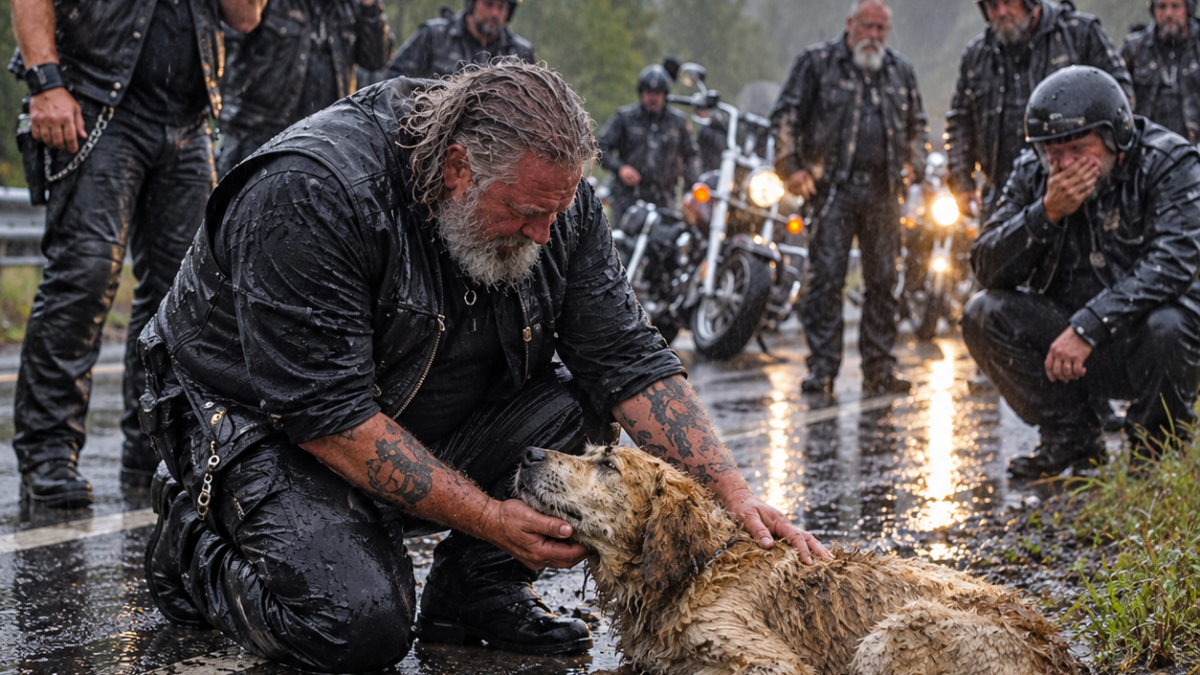
Twenty motorcycles were roaring through the rain when I saw what looked like a filthy blanket lying half-submerged in a roadside ditch.
When that “blanket” opened two exhausted brown eyes, every engine behind me went quiet.
Then the dog did one tiny thing that made twenty hard-looking men forget where we had been going.
Five minutes earlier, we had been making enough noise to announce ourselves long before anyone could see us.
Our motorcycles rolled in a staggered line along a wet country road between Lyon and the Beaujolais hills, rain streaking across our visors and turning the pavement almost black. There were twenty of us that afternoon, mostly older men with gray in our beards, tattoos disappearing beneath soaked leather, and enough mechanical horsepower between us to make people turn their heads when we passed.
People often misunderstood us.
They saw the motorcycles, heavy boots, shaved heads, beards, scarred hands, and patched jackets, then filled in the rest of the story themselves.
My name is Jacques Morel, though almost nobody calls me Jacques.
For years, I had been Grizzly.
At sixty-two, with a beard that had gone almost completely white, shoulders still broad from decades of physical work, and knees that complained every time I got off my motorcycle, I suppose the nickname still fit.
The men riding with me were volunteers.
We organized food drives, charity rides, emergency collections, and whatever else we could manage when a local family was having the kind of year nobody should have to survive alone.
A lot of us knew what it meant to be judged by appearances.
Maybe that was why we had learned to notice the things other people passed without seeing.
We were returning from a charity event when Alain, riding near the front, lifted two fingers.
Alain was fifty-eight, lean, sharp-eyed, with a shaved head and a gray beard trimmed close to his jaw. He had an irritating gift for spotting trouble before the rest of us even realized something had changed.
At first, I thought debris had fallen into the road.
Then I saw the shape beside the ditch.
Brown.
Motionless.
Half in muddy water.
I raised my fist.
One by one, twenty motorcycles slowed.
The thunder became a low mechanical rumble.
Then the engines shut off.
Rain suddenly sounded much louder.
Nobody spoke as we climbed from our bikes.
The dog must once have been golden or light brown, but mud had turned his coat almost the same color as the ditch. His soaked fur clung tightly to his body, exposing ribs so sharply defined that I could count them from several feet away.
His hips looked like corners beneath his skin.
His legs were folded awkwardly beneath him.
There was no collar.
No tag.
No leash.
Nothing to explain how he had ended up dying beside a country road in cold rain.
What frightened me most was that he did not cry.
A dog in pain usually gives you something—whimpering, growling, trembling, an attempt to crawl away.
This one barely moved.
Alain touched my shoulder.
“Easy, Grizzly. Don’t let everybody crowd him.”
The others backed away immediately.
I knelt in the wet gravel.
My knees protested hard enough to make me wince, but standing over him felt wrong.
The dog opened his eyes slightly.
Brown eyes.
Dull with exhaustion.
Still aware enough to be afraid of me.
Not strong enough to escape.
I extended one hand, palm down, stopping well short of his nose.
“Hey, buddy.”
His eyes followed my fingers.
“That’s it. You don’t have to move.”
Rain ran from my beard onto my jacket.
Behind me, twenty men who could normally argue for forty minutes about spark plugs stood completely silent.
I moved a few inches closer.
“We see you now.”
The dog’s tail twitched.
I froze.
It moved again.
Not a wag the way healthy dogs wag.
Just a weak sweep of a few centimeters through brown water.
Benoît stood behind me.
Everyone called him Bear because he was nearly six foot six, built like a refrigerator, and had hands large enough to lift an engine block with help from only his bad judgment.
I heard him inhale.
Then his voice cracked.
“He’s thanking you.”
I looked back at him.
Benoît wiped rain from his face, though not everything on his cheeks was rain.
When I turned back, the dog’s tail moved once more.
That tiny motion should have meant nothing.
Instead, it became a promise.
I placed my hand against the wet gravel beside his head.
“You stay with us,” I whispered.
Then Alain suddenly pointed toward the dog’s rear leg.
“Grizzly.”
I followed his gaze.
Around the muddy fur, almost hidden beneath the water, was something that told us this dog had not simply wandered there and collapsed.
PART 2
At first I thought Alain was pointing at a wound.
Then the dog shifted half an inch, and I saw a dark red strip beneath the mud.
A strap.
Not a collar.
It was wrapped around his rear leg.
I leaned closer without touching it.
“What the hell is that?”
Alain crouched beside me.
“Looks like nylon.”
Benoît moved around behind us, careful not to box the dog in.
“Could be part of a leash.”
“No,” Alain said. “Look at the buckle.”
The strap disappeared beneath the dog’s thigh, tightened so deeply against his wet fur that the skin around it had swollen.
I felt something hot rise through me despite the cold rain.
A dog could lose a collar.
A dog could get caught in brush.
A dog could run away and end up injured beside a road.
But nylon did not normally buckle itself tightly around an animal’s hind leg.
“Don’t touch it yet,” Alain warned.
“I know.”
I did know.
Anger tells you to act immediately.
Experience tells you that sometimes immediate action makes things worse.
We needed to know whether his leg was broken, whether the strap had cut circulation, whether moving him would cause internal damage.
I pulled my phone from inside my jacket.
“No signal worth a damn.”
“Mine’s got one bar,” Benoît said.
“Call emergency veterinary care.”
He stepped away.
Behind us, the other riders had already gone to work without being told.
Two men moved their motorcycles farther up the shoulder to warn traffic.
Another took off his waterproof overlayer and held it like a shield against the rain.
Someone produced a thermal emergency blanket from a saddlebag.
Another man brought a bottle of water.
“Not yet,” Alain said. “We don’t know if he needs surgery.”
The bottle went back.
That was our group.
People expected twenty bikers to create chaos.
In reality, twenty men who had spent decades riding together knew how to become organized very quickly when one mistake could hurt somebody.
The dog’s eyes closed.
I tapped the gravel beside his nose.
“No. Stay with me.”
One eye opened.
“There you go.”
His tail did not move again.
Benoît returned.
“Clinic in Villefranche says bring him immediately. They’ll have someone ready.”
“How far?”
“Twenty-seven minutes.”
“Too long.”
“Closest one open.”
I looked at Alain.
“We move him.”
He nodded.
“But not by his legs.”
We slid the emergency blanket beside him like a stretcher.
The moment Alain’s fingers touched the wet ground near his stomach, the dog made a sound.
It was almost nothing.
A breath with pain inside it.
All twenty of us heard it.
Benoît muttered something under his breath that I will not repeat.
“Easy,” I said. “Easy, buddy.”
We moved him one inch at a time.
When his body finally came out of the puddle, I saw just how thin he really was.
The water had hidden half of him.
Without it, there was nowhere for my eyes to escape.
His ribs were not merely visible.
They looked carved into his body.
His stomach tucked up sharply beneath them.
Mud covered sores along his side.
One front paw was raw.
And around that rear leg, the nylon strap had been tightened several turns before being buckled.
Alain looked at me.
“That was put there.”
I did not answer.
I was afraid of what I would say.
We carried him toward the support van that accompanied our charity rides.
Usually it hauled food, tools, first-aid supplies, and whatever one of us had forgotten.
That afternoon it became an ambulance.
I climbed into the back with the dog.
Benoît got behind the wheel.
Alain joined me.
The other riders split up.
Some followed.
Others stayed to photograph the place where we had found him.
That mattered later.
At the time, none of us knew how much.
The van pulled onto the road.
I sat on the floor because there was nowhere else I wanted to be.
The dog lay on the thermal blanket, his head against my thigh.
His eyes were half closed.
I put two fingers near his nose.
“You’re not dying in this van.”
Alain looked at me.
“Grizzly.”
“What?”
“Don’t promise things you can’t control.”
“I’m not promising him.”
“Who, then?”
I looked down at the dog.
“Myself.”
Alain said nothing after that.
Every few seconds I checked the dog’s breathing.
Shallow.
Fast.
Then slower.
Too slow.
“Come on.”
I touched his shoulder.
His ear moved.
“That’s it.”
The ride took twenty-three minutes because Benoît considered speed limits a philosophical suggestion in emergencies.
When we reached the clinic, two veterinary nurses were already waiting outside with a stretcher.
The van had barely stopped before the doors opened.
“What happened?” one asked.
“Found in roadside water,” I said. “Severely emaciated. Barely responsive. Strap tied around rear leg. We didn’t remove it.”
“How long was he there?”
“No idea.”
They lifted him.
His head rolled toward me.
For one strange second, I felt as if I were abandoning him.
“I’m coming,” I told him.
The nurse looked at me.
“You can wait inside.”
“No. I mean him.”
She seemed to understand.
We followed them into treatment.
A veterinarian came through another door while pulling on gloves.
She was perhaps in her forties, dark hair tied back, glasses slipping slightly down her nose.
“I’m Dr. Élodie Mercier.”
“Jacques.”
“Owner?”
“No.”
“You found him?”
“Twenty of us did.”
She looked through the glass toward the parking area, where motorcycles were arriving one after another.
Her eyebrows lifted.
“I see.”
She examined him quickly.
“Temperature is dangerously low.”
A nurse read numbers from the monitor.
“Thirty-four point six.”
Dr. Mercier’s expression tightened.
“Warm fluids. Oxygen. Blood glucose now.”
She ran her hands carefully along his ribs and abdomen.
The dog barely reacted.
“That worries me.”
“What?”
“He should object more.”
Those words landed hard.
They placed a catheter.
Another nurse began clipping fur around wounds.
Dr. Mercier found the nylon strap.
“Who removed any part of this?”
“Nobody.”
“Good.”
She cut only enough of the surrounding fur to see underneath.
Then she stopped.
“This has been here for a while.”
“How long?”
“I can’t give you an exact time.”
“Days?”
“Possibly.”
The skin underneath was badly inflamed.
In one area, the strap had rubbed deep enough to create an infected wound.
I stared at it.
“Could he have gotten tangled?”
She glanced at me.
“Anything is possible.”
It was the kind of answer professionals give when they refuse to speculate.
I respected her for it.
I also hated it.
A nurse brought the blood glucose result.
“Low.”
Dr. Mercier nodded.
“Correct slowly.”
She checked his gums.
“Severe dehydration. Likely anemia. Malnutrition.”
“Can he survive?”
She did not answer immediately.
“I need bloodwork and imaging.”
“That wasn’t my question.”
“I know.”
She looked directly at me.
“He is alive. He is not stable.”
Benoît stood in the doorway behind us.
His face changed.
For a giant man, he could suddenly look very young when he was frightened.
“What do you need from us?”
Dr. Mercier glanced at him.
“Right now? Space.”
Benoît stepped backward at once.
“What else?”
“Someone needs to authorize emergency treatment if no owner is present.”
“I will.”
She looked at me.
“There will be costs.”
“I said I will.”
“Jacques,” Alain began.
I turned.
“No.”
He lifted both hands.
“I was going to say all of us will.”
Behind him, men filled the waiting room.
Wet jackets.
Helmets under arms.
Boots leaving water on the floor.
The receptionist looked as though twenty pirates had invaded her clinic.
Then one by one, the men began putting money on the counter.
Cash.
Cards.
Whatever they had.
I watched Benoît empty his wallet.
“You don’t need to—”
He stared at me.
“If you finish that sentence, I’m throwing you into the parking lot.”
A nurse smiled despite herself.
Dr. Mercier did too, briefly.
Then she returned to work.
For the next two hours, we learned how slowly time can move when a life is balanced on measurements you barely understand.
Temperature.
Heart rate.
Red blood cells.
Blood pressure.
Lactate.
Glucose.
Every number seemed capable of becoming good news or disaster.
X-rays showed no major fractures.
That surprised everyone.
There was bruising around the pelvis and one hip, but nothing shattered.
His lungs were clear enough.
No obvious internal bleeding.
The bloodwork was worse.
He was anemic.
His protein levels were low.
His body had consumed nearly every reserve it had.
He had infected skin wounds.
His paws were damaged.
His rear leg had impaired circulation from the strap, but the tissue was still viable.
Dr. Mercier finally came into the waiting room shortly after seven.
Twenty men stood up at once.
She stopped.
“I feel like I’m briefing a military unit.”
“You kind of are,” Alain said.
She looked at me.
“He has a chance.”
Nobody cheered.
We had all heard the part she had not said.
Not a guarantee.
A chance.
“What happens tonight?” I asked.
“We warm him slowly. Continue fluids. Start antibiotics. Small, controlled nutrition. Monitor his heart closely. Severe malnutrition creates complications when feeding restarts.”
“Can I see him?”
“For five minutes.”
“I only need one.”
That was a lie.
I wanted the whole night.
He was lying beneath warmed blankets when I entered.
The mud had been cleaned from his face.
For the first time, I could see his real coat.
Golden.
Not bright gold.
More like old wheat.
His muzzle was narrow.
His ears were soft and darker than the rest of him.
He looked younger without the dirt.
“Age?” I asked.
Dr. Mercier stood beside me.
“Maybe three or four.”
“That young?”
“Neglect can age an animal.”
There was a sentence I understood too well.
I sat beside the kennel.
The dog’s eyes opened.
He looked at me.
“Hey.”
His nose moved.
I held out my hand.
He sniffed my fingers.
Then his tail moved under the blanket.
Once.
Dr. Mercier inhaled.
“You saw that?”
“Yes.”
She smiled.
“Good.”
I looked at him.
“You keep doing that, and you’re going to cause problems.”
His eyes closed again.
“What do we call him?” she asked.
I had not thought about it.
Benoît, watching through the glass, pressed his face near the door.
“Call him Harley.”
Half the room shouted no.
I laughed for the first time that day.
“Definitely not Harley.”
Alain entered.
“What about Hope?”
I shook my head.
“Too sentimental.”
“You cried in a ditch.”
“Rain.”
“Of course.”
The dog opened his eyes again when voices rose.
I lowered mine.
“Quiet.”
Then I remembered the first thing I had said to him.
We see you now.
“Rémy,” I said.
Alain frowned.
“Why Rémy?”
“No reason.”
There was one, though I could not explain it then.
The name sounded gentle.
Like something that belonged in a home.
Dr. Mercier wrote it on his chart.
RÉMY — FOUND ROADSIDE.
That became the beginning of his second life.
I slept badly.
At four in the morning I woke up convinced the clinic had called.
It had not.
At five-thirty I gave up, made coffee, stared at it, and drove back before sunrise.
Three motorcycles were already outside.
Benoît.
Alain.
Marc.
I parked beside them.
“You idiots.”
Benoît looked at my truck.
“You’re here too.”
“I’m different.”
“Of course you are.”
The receptionist had not even unlocked the main door yet.
At seven, Dr. Mercier arrived and found four grown men standing outside like parents waiting for school admissions results.
She looked at us, then at the sky.
“You know normal people sleep?”
“Normal people don’t ride motorcycles,” Benoît said.
She unlocked the door.
“Come inside.”
Rémy had survived the night.
His temperature was improving.
His glucose was more stable.
He had eaten less than a spoonful of carefully prepared food.
To us, that spoonful might as well have been a Thanksgiving dinner.
“Did his tail move?” Benoît asked.
The nurse laughed.
“Yes.”
Benoît slapped my shoulder.
“Told you. He likes us.”
“He likes food.”
“Same thing.”
Then Dr. Mercier showed us something else.
The strap.
It had been cleaned after removal and sealed in a clear medical evidence bag because its appearance concerned her.
Now that the mud was gone, we could see writing printed along one side.
A company name.
DOMAINE DES PINS — ÉLEVAGE & PENSION CANINE.
A kennel.
Alain stared at it.
“Dog boarding?”
“Breeding and boarding,” I said.
Dr. Mercier crossed her arms.
“That does not prove where the dog came from.”
“No,” I agreed.
But my stomach had tightened.
“Do you know the place?”
“No.”
Benoît was already searching his phone.
“Forty kilometers from where we found him.”
Alain looked at me.
“Grizzly.”
“I know.”
“Do not go charging over there.”
“I said I know.”
“You get that look.”
“What look?”
“The one right before somebody has a complicated afternoon.”
I ignored him.
Dr. Mercier held out one hand.
“Before any of you decide you are detectives, let me do something actually useful.”
She scanned Rémy for a microchip.
The first pass found nothing.
Second pass.
Nothing.
Then the scanner beeped near his shoulder.
All of us looked up.
“He’s chipped,” she said.
That changed everything.
The registration database gave us a name.
Not the kennel.
A private owner.
Claire Lenoir.
Address: a village north of Lyon.
Phone number disconnected.
Dr. Mercier contacted the identification registry through the appropriate channels and notified the local animal authorities that a critically neglected chipped dog had been found.
Then she looked at twenty men who were visibly prepared to mount a cavalry charge.
“You let the authorities contact the registered owner.”
Alain nodded.
“Absolutely.”
I nodded too.
Dr. Mercier narrowed her eyes at me.
“You especially.”
“Why especially me?”
“Nobody calls a man Grizzly because he responds gently to disappointment.”
Benoît started laughing so hard he had to lean against the counter.
“I like her.”
I did not.
Not in that moment.
I spent the morning beside Rémy.
He slept most of it.
Around noon, he stood for the first time.
Or tried.
His front legs straightened.
His rear legs trembled.
His body rose perhaps four inches from the blanket, then collapsed.
I caught him before his chin hit the floor.
“That was ambitious.”
His tail moved.
“You’re impossible.”
He tried again an hour later.
This time he remained standing for three seconds.
The veterinary nurse clapped softly.
Rémy looked surprised by the attention.
That became our rhythm.
Tiny victories.
A bite of food.
A few degrees of body temperature.
Five steps.
A tail wag.
A normal bowel movement, which caused twenty bikers to celebrate a medical detail none of us ever expected to discuss over coffee.
For three days, there was no word from the registered owner.
Then the gendarmerie called.
Claire Lenoir had not owned Rémy for almost a year.
She came to the clinic that afternoon.
I happened to be there.
I knew who she was immediately because she walked into the waiting room carrying a photograph against her chest.
A photograph of Rémy.
Healthy.
Young.
Standing beside a little girl.
Claire was around forty, with tired eyes and a nervous way of twisting the strap of her handbag.
“Where is he?” she asked.
The receptionist stood.
“You’re Madame Lenoir?”
“Yes.”
“I’m Jacques,” I said.
Her eyes went to my beard, then my tattoos, then back to my face.
“You found him?”
“My friends and I did.”
Her mouth opened.
Then she started crying.
Not polite tears.
Her entire face crumpled.
“I thought he was dead.”
I had been prepared for anger.
That sentence stopped me.
“You thought he was dead?”
She nodded.
“What happened?”
She pressed the photograph against her chest.
“His name was Soleil.”
Sun.
Of course.
A golden dog.
She sat.
I stayed standing because my knees hurt less that way.
“My husband died two years ago,” she said. “Afterward I had to sell our house. I moved into an apartment temporarily with my daughter. The building wouldn’t allow a dog his size.”
She wiped her face.
“I found a boarding kennel that said they could keep him for three months while I found another home.”
I already knew which kennel.
“Domaine des Pins?”
Her head lifted.
“Yes.”
Alain, who had been sitting across the room, leaned forward.
“What happened?”
“The first month, they sent pictures. Then they said Soleil had been placed with a family who wanted to adopt him.”
“Without you?”
“I had signed a temporary foster authorization if they found a suitable home. I was desperate. I thought…” Her voice failed. “I thought I was doing something good.”
“When was the last time you saw him?”
“Eleven months ago.”
“And they told you he was adopted?”
“Yes.”
“By whom?”
“They said privacy rules meant they couldn’t give me the address, but that he was safe.”
I felt my hands close into fists.
“Did you transfer ownership?”
“No. They told me they would handle the paperwork.”
“That’s why the chip stayed in your name.”
She looked toward the treatment-room door.
“What happened to him?”
I did not want to tell her.
But lying would have been crueler.
“We found him dying in a ditch.”
She covered her mouth.
I told her about the nylon strap.
When I said the kennel’s name was printed on it, Claire went very still.
“No.”
“I’m sorry.”
“No. They told me he was with a retired couple.”
Alain stood.
“Do you have the messages?”
She stared at him.
“What?”
“Messages, emails, invoices, pictures. Anything from the kennel.”
Her face changed.
Grief remained.
But something new appeared behind it.
“Yes.”
That was the first brick.
Over the next week, the wall began to come down.
Claire still had everything.
Receipts.
Emails.
Photos.
A boarding contract.
Messages from a kennel manager named Thierry Vasseur.
The final photograph supposedly taken after Soleil—our Rémy—had been placed with his new family showed him wearing a blue collar beside a garden fence.
At first nothing seemed unusual.
Then Marc noticed the metadata on the original file.
The photograph had been taken three weeks before the date Vasseur claimed the adoption had occurred.
That did not prove abuse.
But it proved someone had lied.
Claire filed a formal complaint.
The animal welfare authorities opened an investigation.
We were told very clearly not to interfere.
So naturally, everyone assumed we would interfere.
We did not.
Not the way people expected.
We did something much more irritating.
We became impossible to ignore.
Our group knew people.
Not powerful people.
Ordinary people.
Mechanics.
Farmers.
Nurses.
Retired police officers.
Teachers.
Shop owners.
Delivery drivers.
People who had boarded dogs.
People who had adopted dogs.
People who remembered things.
We shared only verified information privately with investigators.
No online mob.
No threats.
No addresses posted publicly.
No vigilante nonsense.
Just records.
One former customer remembered picking up her Labrador from Domaine des Pins unusually thin.
Another had been told her dog “escaped” during boarding three years earlier.
A third had paid hundreds of euros for veterinary treatment after her dog returned with infected sores the kennel claimed had “appeared overnight.”
Then a former employee contacted Claire.
Her name was Manon.
Twenty-four years old.
She had worked at Domaine des Pins for six months.
She agreed to speak only if her identity was protected until authorities interviewed her.
When Alain and I first met her in a café with Claire, she looked terrified.
“What I tell you stays with the investigators,” she said.
“Yes,” Alain answered.
She looked at me.
“And him?”
I leaned back.
“I can leave.”
“No. I just…” She glanced at my arms. “You look angry.”
“I am.”
“That’s what scares me.”
I understood.
So I put both hands flat on the table.
“I’m angry at what happened. I am not going to hurt anybody.”
She studied my face.
Then nodded.
“They kept too many dogs.”
“How many?” Claire asked.
“Sometimes sixty.”
The licensed capacity, we later learned, was less than half that.
“Where?” I asked.
“Main kennels. Storage buildings. Temporary cages.”
“Why?”
“Money.”
Manon looked at Claire.
“Boarding dogs were one thing. Breeding dogs were another. But sometimes people left animals and stopped paying, or surrendered them, or signed loose foster agreements.”
Claire’s face went pale.
“What happened then?”
“They tried to place some. Others…”
She stopped.
“Others what?”
“They were moved off the books.”
I felt Alain’s boot press against mine under the table.
A warning.
Stay calm.
“What does that mean?”
Manon swallowed.
“There was a second property.”
“Where?”
She shook her head.
“I don’t know exactly. I only went twice. Somewhere south of the kennel, near vineyards and an old quarry.”
“What was there?”
“Dogs.”
Claire whispered, “How many?”
“Maybe fifteen. Maybe more.”
My skin went cold.
“In what condition?”
“Bad.”
Manon looked at her hands.
“I quit because of that place.”
“Was Soleil there?”
She looked at the photograph Claire had placed on the table.
“I think so.”
Claire stopped breathing for a second.
Manon pointed.
“There was a dog like him. Golden coat. Very friendly at first. Later he got thin.”
“You’re sure?”
“No. I’m not sure.”
That mattered.
We refused to turn uncertainty into certainty just because it hurt.
“Did you see a strap around his leg?” I asked.
“No.”
“Did you see kennel-branded straps?”
“Yes. Red tie-downs were used for crates and temporary tethering.”
I looked at Alain.
He had gone very still.
Manon continued.
“One day, two dogs escaped from the second property. Thierry was furious. He said if animals caused trouble, they should be taken far enough away that they couldn’t come back.”
Claire made a sound like air leaving her body.
“Did you see him abandon dogs?”
“No.”
“Did you hear him say that?”
“Yes.”
“Who else heard it?”
“Another worker. Pascal.”
That gave investigators a name.
After that meeting, I went directly to the clinic.
Rémy was much stronger.
He could walk now.
Not gracefully.
His back legs were weak, and he tired quickly, but he walked.
When I entered his recovery room, he lifted his head.
His tail began beating the blanket.
I crouched.
“Your life is getting complicated, my friend.”
He came toward me.
Six steps.
Then eight.
He placed his nose against my beard.
I rubbed his chest.
“You have no idea what people are doing because of you.”
His old owner visited later that afternoon.
Claire stood outside the treatment room for several minutes before entering.
Rémy saw her.
Nothing happened.
That broke her face.
She whispered, “He doesn’t remember me.”
Dr. Mercier touched her arm.
“Give him time.”
Claire knelt.
“Soleil?”
The dog stared.
“Soleil, c’est maman.”
No response.
Then Claire pulled the old photograph from her bag.
Not because she expected him to understand it.
Because she needed something to hold.
She began speaking to him softly about her daughter, Lucie.
“Lucie used to hide cheese under the table for you.”
Rémy’s ears moved.
“She thought I didn’t know.”
His nose lifted.
Claire smiled through tears.
“She still does that with every dog she meets.”
Rémy took one step toward her.
Then another.
He sniffed her sleeve.
Claire froze.
He smelled her hand.
His tail moved.
Once.
Then faster.
Claire collapsed onto her knees.
“Soleil.”
He leaned into her chest.
She wrapped her arms around him and cried into his fur.
I walked out.
Some moments do not need witnesses.
When I reached the hallway, Benoît was standing there.
He had seen enough through the glass.
He pretended to be studying a fire extinguisher.
“You crying?” I asked.
“No.”
“Rain again?”
“Indoor rain.”
We both laughed quietly.
That reunion created another problem.
Who would take Rémy when he was discharged?
Claire desperately wanted him back.
Her daughter wanted him back.
But their housing situation had not changed.
The apartment still prohibited large dogs.
Claire had begun looking for another place, but moving would take time.
I offered to foster him.
I used the word foster because men like me are skilled at lying to themselves.
Everyone else knew what was happening.
“You’re adopting that dog,” Alain said.
“I’m fostering.”
“You bought a dog bed yesterday.”
“Fosters need beds.”
“You bought three.”
“He needs options.”
“You bought a ramp for your truck.”
“He’s weak.”
“You replaced your garden gate.”
“It was old.”
“You ordered a tag with your phone number.”
I stared at him.
“That proves nothing.”
Alain nodded.
“Of course.”
Rémy came home with me nine days after we found him.
Claire and Lucie visited first.
Lucie was twelve.
She ran to him and stopped herself just before throwing her arms around his neck.
Dr. Mercier had explained that recovering animals needed calm.
So Lucie sat on the floor.
Rémy walked to her.
She whispered his old name.
“Soleil.”
He put his head in her lap.
She cried silently.
Then she looked at me.
“Are you going to keep him safe?”
That question had more weight than anything an adult had asked me.
“Yes.”
“You promise?”
I thought about Alain telling me not to promise things I could not control.
So I chose my words carefully.
“I promise I will never knowingly leave him where he is unsafe.”
Lucie considered that.
Then nodded.
“Okay.”
Rémy rode home in my truck.
He hated motorcycles.
We discovered that immediately.
The first time one started near him, he flattened to the ground.
So despite twenty bikers being responsible for his rescue, our motorcycles became something he had to learn not to fear.
The irony was not lost on us.
His first night in my house was almost peaceful.
He explored the kitchen.
Sniffed every chair.
Investigated the dog beds I definitely had not purchased because I was getting attached.
Then he stood in the doorway to my bedroom.
“You are not sleeping in there.”
His tail moved.
“No.”
He took one step.
“Absolutely not.”
Another.
“You have three beds.”
He lay down beside my side of the bed.
I stared at him.
“That floor is cold.”
His eyes closed.
I carried one of his beds into the room.
“Temporary.”
He slept six hours without moving.
I slept four because I kept checking that he was breathing.
At three in the morning, I knelt beside him.
His chest rose.
Fell.
Rose.
He opened one eye.
“Sorry.”
His tail thumped.
Then he went back to sleep.
The investigation moved more slowly.
That frustrated all of us.
People imagine that once authorities know animals may be suffering somewhere, doors fly open immediately.
Real investigations require legal grounds.
Statements.
Records.
Verification.
Warrants.
Coordination.
Every day felt too long.
Then Pascal—the second former employee Manon had mentioned—was found.
He initially refused to speak.
Three days later, he changed his mind.
What changed it was Rémy.
Someone showed him a photograph of the dog when we found him.
Pascal called the investigator that evening.
His testimony supplied the missing link.
He knew the second property.
He had transported dogs there.
And he believed Rémy had been one of them.
The property was an old agricultural storage yard leased through a company connected to Thierry Vasseur’s brother.
Pascal described sheds.
Outdoor runs.
Makeshift cages.
He said some dogs were moved there when official inspections were expected at the licensed kennel.
He also described the red nylon tie-downs.
“What happened to dogs that got sick?” the investigator asked him.
Pascal reportedly went quiet for a long time.
Then he said, “Sometimes a vet came.”
“And sometimes?”
“They disappeared.”
That was enough for a coordinated inspection.
I did not know the exact date.
Authorities wisely did not tell us.
So when Alain called me at six-fifteen one morning and said, “Turn on the news,” I expected a storm warning.
Instead, I saw the gates of Domaine des Pins.
Police vehicles.
Animal-control vans.
Veterinary teams.
Then footage from another rural property.
My coffee went untouched.
Thirty-one dogs were removed from the two sites that day.
Thirty-one.
Some were healthy enough.
Others were thin.
Several had untreated infections.
One elderly shepherd had a tumor the size of a grapefruit hanging beneath her abdomen.
Three dogs had no corresponding paperwork.
Two microchips traced back to families who had been told their animals had escaped.
One of those families had been searching for nearly two years.
I sat at my kitchen table watching the report.
Rémy was asleep beside my boots.
When the footage showed a red kennel strap hanging from a gate, I turned off the television.
My hands were shaking.
Not with fear.
With rage.
I walked outside.
Rémy followed.
He stood beside me in the yard.
I looked at him.
“You got out.”
He wagged.
“But how many didn’t?”
That question became the thing I could not stop thinking about.
Over the next several weeks, more former customers came forward.
Some cases turned out to be misunderstandings.
Others did not.
Investigators had to separate rumor from evidence.
We helped when asked.
Otherwise, we stayed out of the way.
Thierry Vasseur denied abusing animals.
His attorney said the boarding operation had experienced staffing failures and administrative irregularities but rejected claims of deliberate cruelty.
That distinction mattered legally.
Emotionally, I was less generous.
Then investigators found video.
Not from hidden cameras.
From the kennel’s own security system.
Most had been overwritten.
But some clips remained on an older backup recorder Pascal told them about.
One clip showed Rémy.
Healthy enough to recognize.
He was being led from a kennel building on a red strap.
Date: seven months after Claire had been told he was adopted.
Another clip from weeks later showed him much thinner.
Then another.
He was in the background of a loading area.
No adoption.
No retired couple.
No happy garden.
The photograph sent to Claire had been a lie.
When she watched the footage, she called me.
For a long time, neither of us spoke.
Finally she said, “I gave him to them.”
“No.”
“I signed the paper.”
“You placed him somewhere you believed was temporary and safe.”
“I should have checked.”
“Yes.”
She became silent.
I knew that sounded cruel.
But false comfort can be its own kind of cruelty.
“You should have checked,” I repeated more gently. “And they should not have lied to you. Both things can be true.”
She started crying.
“I want Lucie to forgive me.”
“Does she blame you?”
“No.”
“Then maybe you’re fighting the wrong person.”
“What do you mean?”
“You.”
That was something I understood.
Guilt likes to dress itself as responsibility because responsibility feels useful.
Usually guilt just sits on your chest and eats.
Claire began volunteering with an animal rescue afterward.
Not because it erased what happened.
Nothing erases.
But action gives pain somewhere to go.
Rémy improved every week.
He gained weight.
His golden coat returned.
The wound beneath the strap healed into a pale scar around his rear leg.
He learned stairs.
He learned the truck.
He learned that my refrigerator opening meant opportunity.
He learned Benoît carried biscuits in his jacket.
He learned that Alain pretended not to like being licked on the face.
Most importantly, he learned motorcycles did not always mean danger.
We began with one motorcycle parked silently twenty yards away.
Rémy ate chicken.
Next day, fifteen yards.
Chicken.
Then ten.
Then we turned the engine over without starting it.
Chicken.
First startup from thirty yards.
Rémy jumped.
I stayed beside him.
“Easy.”
He looked toward the bike.
Alain switched it off.
Chicken.
Weeks passed.
Eventually the sound of an idling motorcycle became just another sound.
The first time Rémy voluntarily walked toward one, every man in our clubhouse pretended not to care.
Benoît whispered, “Come on, buddy.”
Rémy sniffed his motorcycle.
Then peed on the front tire.
The room exploded with laughter.
Benoît stared at him.
“You ungrateful little bastard.”
Rémy wagged.
I laughed so hard my ribs hurt.
“That’s what he thinks of your exhaust system.”
Benoît pointed at me.
“Your dog is banned.”
“Foster.”
Everyone booed.
Yes.
I was still saying foster.
Even after two months.
Even after his bowls had permanent places in my kitchen.
Even after his hair covered my couch.
Even after I had canceled a weekend trip because I did not want to leave him overnight.
Then Claire found a house.
Small.
Older.
Twenty minutes outside the city.
With a fenced yard.
She called me before signing the lease.
“He can come home.”
The words hit me harder than I expected.
“That’s good.”
“Is it?”
“Of course.”
“You don’t sound happy.”
“I’m happy.”
“You’re a terrible liar, Jacques.”
I looked at Rémy.
He was asleep upside down on my sofa.
His front paw twitched.
“When do you want him?”
There was a long pause.
“I don’t know.”
“What?”
“I said I don’t know.”
“Claire, you’ve been trying to get a place for him.”
“I know.”
“Lucie wants him.”
“I know.”
“Then what’s the problem?”
“You.”
I frowned.
“Me?”
“He waits by the window when your truck leaves.”
“That doesn’t mean—”
“He follows you room to room.”
“He follows anyone with food.”
“He sleeps outside your bedroom.”
I said nothing.
Claire continued.
“When you brought him to see us last Sunday, he was happy. But when you went outside to take that phone call, he stood at the door until you came back.”
My chest tightened.
“He remembers you.”
“He loves us,” Claire said. “But he chose you after what happened.”
“No. You’re his family.”
“We were.”
The past tense hurt.
“Claire.”
“I’m not giving him away because I don’t care. I’m asking what’s best for him.”
I sat down.
Rémy opened one eye.
“You’re asking me to decide?”
“No. I think he already did.”
Lucie cried when Claire explained it to her.
So did I, though I was alone when that happened and therefore deny it.
We reached an arrangement.
Rémy would live with me.
Claire and Lucie would remain part of his life.
Holidays.
Visits.
Walks.
Weekends when they wanted him and he wanted to go.
Not ownership as possession.
Family as something wider.
Lucie brought me his old blue collar.
It had become too small.
“I kept it,” she said.
I held it in my hands.
Rémy sniffed it.
His tail moved.
“Do you want it?”
Lucie shook her head.
“No. I want you to keep it.”
I placed it in a drawer with the red strap evidence receipt and the first photograph taken after we rescued him.
Three objects.
One dog.
Three versions of the same life.
The loved dog.
The betrayed dog.
The rescued dog.
The court proceedings began many months later.
By then, Rémy looked nothing like the creature we found in the ditch.
He weighed nearly thirty kilograms.
His coat shone.
His rear leg worked normally except for stiffness after long walks.
His scars were hidden unless you knew where to look.
Thierry Vasseur and two associates faced multiple charges related to animal welfare violations, fraudulent records, and operating conditions connected to the unlicensed property.
The legal process was complicated.
Not every accusation resulted in a charge.
Not every missing dog could be traced.
Some owners had poor documentation.
Some memories conflicted.
That disappointed people who wanted a clean story with monsters on one side and heroes on the other.
Real justice is messier.
But Rémy’s case was strong.
The chip.
Claire’s contract.
The fake adoption messages.
The photo metadata.
The security footage.
The branded strap.
Pascal’s statement.
Manon’s statement.
The veterinary records.
The location where we found him.
Our photographs.
The timeline.
That was enough to tell one story very clearly.
A dog entrusted to a business had been falsely reported as rehomed.
Months later, he was still under that business’s control.
His condition deteriorated severely.
Then he ended up emaciated and restrained beside a road.
The defense argued that nobody could prove exactly who left him there.
That was true.
I hated it.
But truth matters even when it is inconvenient.
Nobody had filmed the abandonment.
Nobody saw Vasseur put Rémy beside the road.
Pascal had heard disturbing statements, but statements are not the same as witnessing the act.
So the case focused on what could be proven.
Neglect.
False representations.
Illegal housing.
Record manipulation.
Failure of care.
The broader operation.
People asked me whether that felt like enough.
No.
And yes.
No punishment could return the months Rémy lost.
No fine could erase the ditch.
No sentence could make Claire stop dreaming about what might have happened if we had ridden another road that afternoon.
But accountability does not have to satisfy every emotion to matter.
The day I testified, I wore a clean shirt instead of my riding jacket.
Benoît complained.
“You look like an accountant.”
“You look like a convicted pirate.”
“I dressed up.”
“You own one black shirt.”
“This is the formal black shirt.”
Twenty riders came to court.
Not to intimidate anyone.
We sat quietly.
No patches inside.
No shouting.
No theatrics.
The prosecutor asked me to describe the moment we found Rémy.
I did.
The rain.
The ditch.
His ribs.
His eyes.
The strap.
Then she asked, “What made you believe he was still responsive?”
I looked across the courtroom.
Vasseur sat beside his attorney.
For months, I had imagined what I would feel seeing him.
Rage.
Hatred.
Some dramatic satisfaction.
Instead I felt tired.
I answered.
“His tail moved.”
The courtroom became completely still.
“How many times?”
“At first? Once.”
“What did you interpret from that?”
The defense objected.
The judge sustained it.
I almost smiled.
Courts do not care about poetry.
Good.
The prosecutor changed the question.
“What did you do after the dog moved his tail?”
“We stopped our ride and got him medical care.”
That was the factual version.
It was enough.
Claire testified too.
So did Dr. Mercier.
Manon trembled so badly before entering that Alain gave her his lucky coin.
“I don’t believe in luck,” she said.
“Neither do I. Take it anyway.”
She did.
Her testimony was one of the most important.
Not because she exaggerated.
Because she did not.
When she did not know, she said she did not know.
When she was uncertain, she said she was uncertain.
When the defense tried to suggest she was a disgruntled former employee, she answered, “Yes. I became disgruntled when I saw dogs suffering.”
Even the judge looked up at that.
Pascal testified later.
He admitted his own failures.
That gave his words weight.
“I should have reported it sooner,” he said.
“Why didn’t you?”
“I needed the job.”
“Was that more important than the animals?”
He looked down.
“At the time, I acted like it was.”
I respected him for saying it.
Not because it erased anything.
Because people rarely tell the truth when the truth makes them look smaller.
The verdict did not arrive that day.
Weeks passed.
Rémy had no idea.
Dogs are wonderfully indifferent to legal suspense.
He cared about breakfast.
Walks.
Whether a squirrel had entered his jurisdiction.
Whether I had dropped cheese.
On the morning the decision was expected, I took him for a long walk before leaving.
Rain had fallen overnight.
He stepped around the first puddle.
Then stopped.
For a long time, water had frightened him.
Not drinking water.
Standing water.
Puddles.
Ditches.
Anything that resembled the place where we found him.
We had worked slowly.
No forcing.
No dragging.
He had improved.
That morning, he stared at a puddle stretching across the path.
“Other way?” I asked.
He looked at me.
Then at the water.
He stepped forward.
One paw.
Then another.
He walked straight through.
On the other side, he turned around as if nothing had happened.
I stood there feeling absurdly proud.
“You know, I have court today.”
He sniffed a bush.
“Glad you care.”
The court found Vasseur guilty on multiple counts connected to animal mistreatment and fraudulent business practices.
One associate was convicted on lesser charges.
Another was acquitted on the most serious allegations but received penalties for regulatory violations.
The kennel lost its authorization to operate.
The unlicensed site was permanently closed.
Financial penalties were imposed.
Vasseur received a custodial sentence, part of it suspended under conditions, along with a prohibition on operating or managing an animal-care business for an extended period.
Was it the cinematic revenge some people wanted?
No.
Nobody dragged him through the mud.
Nobody made him suffer what Rémy suffered.
We did not burn his business down.
We did not threaten his family.
We did not become cruel in order to punish cruelty.
Instead, his gates closed.
His licenses disappeared.
His business name came off the building.
The dogs left.
That was enough revenge for me.
Because the only kind I wanted by then was the kind that prevented another animal from lying in another ditch.
When we left court, reporters were waiting.
I hated cameras.
Benoît loved them.
That was another reason he should never be trusted.
A journalist asked, “Monsieur Morel, do you feel justice was done?”
I thought about the question.
Then I said, “Justice would have been that none of those dogs needed rescuing.”
She waited.
I continued.
“But today the place that hurt them cannot keep doing it.”
That was all I had.
Later, our group rode to Claire’s house.
Rémy stayed with Lucie during court because motorcycles still made him uneasy in large groups.
When we arrived, Lucie opened the gate.
Rémy came flying out.
Straight toward me.
Thirty kilograms of golden fur hit my legs.
I nearly fell.
“My knees, you criminal.”
His tail went wild.
Claire hugged me.
“What happened?”
I told her.
She closed her eyes.
For several seconds, she said nothing.
Then she whispered, “Good.”
Not triumphant.
Not joyful.
Just relieved.
Lucie crouched beside Rémy.
“Does this mean it’s over?”
Adults lie to children too often because we think hope requires simplicity.
So I told her the truth.
“This part is.”
She nodded.
Then she looked at Rémy.
“What happens to him?”
I smiled.
“He has a terrible life ahead.”
She looked alarmed.
“Jacques.”
“Endless food. Comfortable beds. People kissing his head. Very serious hardship.”
Lucie shoved my arm.
Rémy barked.
Everyone laughed.
That evening, all twenty of us ate in Claire’s yard.
Rémy moved from person to person collecting illegal quantities of food.
I caught Benoît giving him sausage.
“No.”
“He’s starving.”
“He weighs thirty kilos.”
“Emotionally starving.”
“You’re the reason he begs.”
“I’m the reason he trusts humanity.”
“You’re the reason he has gas.”
Rémy wagged at both of us.
Months became a year.
Then two.
Domaine des Pins became something else under new ownership.
Not a kennel.
A small equipment-storage business.
The second property was cleared.
Several of the rescued dogs found permanent homes.
The elderly shepherd with the tumor survived surgery and spent her final eighteen months with a retired couple who let her sleep on their bed.
One of the dogs reported “escaped” two years earlier was reunited with his original family.
That reunion became local news.
The dog was older.
Gray around the face.
But when he saw his former owner, he screamed.
Not barked.
Screamed.
Then climbed into her lap like no time had passed.
I watched the video once.
Never again.
There are only so many times a man should cry before breakfast.
Manon became a veterinary assistant.
Pascal left animal work entirely.
Claire helped establish a small fund to assist people who temporarily could not keep pets because of housing, hospitalization, or financial crisis.
She named it Soleil.
I objected.
“That’s his old name.”
“That’s why.”
“You trying to make me emotional?”
“Yes.”
It worked.
Rémy became our group mascot.
Unofficially.
He never rode on a motorcycle.
I refused.
People sent me pictures of dogs wearing goggles in sidecars and said, “See?”
I answered, “No.”
Instead Rémy traveled in the support van during charity events.
He wore a simple black harness.
No patches.
No costume.
No ridiculous biker vest, despite Benoît buying one.
The first charity ride Rémy attended after his recovery raised money for an animal shelter.
Three hundred motorcycles showed up.
I had worried the noise would frighten him.
We parked the van far enough away that he could choose his distance.
When the engines started, Rémy looked toward them.
His ears went back.
I crouched.
“You’re okay.”
He leaned against my leg.
The engines rumbled.
Then one by one they quieted.
Rémy remained standing.
Not shaking.
Not hiding.
When the first riders returned, he walked forward to greet them.
Benoît knelt.
“Remember us?”
Rémy licked his beard.
“See? Favorite uncle.”
“You fed him half a chicken.”
“Relationships require investment.”
A photographer captured that moment.
Benoît kneeling in mud.
Rémy with both paws against his chest.
Motorcycles blurred behind them.
That photograph eventually hung in our clubhouse.
Beside it, someone mounted a small plaque.
THE DAY THE TOUGH GUYS STOPPED.
I hated it.
Everyone else loved it.
“You know what bothers me?” I told Alain.
“What?”
“We were never tough.”
He considered.
“You cried over a dog.”
“Exactly.”
“You also once reset your own dislocated finger with pliers.”
“That was different.”
“You’re an idiot.”
“Fair.”
Three years after the ditch, Rémy and I drove the same country road again.
I had avoided it.
Not consciously at first.
There were other routes.
Then I realized I had been choosing them.
One autumn morning, I decided I was done letting a patch of roadside control me.
Rémy sat in the back of the truck.
We reached the bend.
I recognized it immediately.
The shallow ditch.
The tree line.
A faded roadside marker.
I pulled over.
Rémy stood.
His nose moved.
I opened the door.
“You don’t have to.”
He jumped down.
The ditch was dry.
Grass had grown thick along the edge.
Cars passed occasionally.
Nothing about it looked dramatic.
That bothered me.
Places where terrible things happen should look different afterward.
They rarely do.
Rémy sniffed the shoulder.
He wandered toward the ditch.
I held the leash loose.
He stopped.
His body stiffened.
I stopped too.
“Want to go?”
He looked back.
I was prepared to leave.
Then he stepped down into the grass.
His nose worked rapidly.
Maybe he remembered.
Maybe he smelled rabbits.
Maybe I was assigning human meaning to ordinary dog behavior.
I will never know.
Rémy reached the exact area where I believed we had found him.
He sniffed the earth.
Then he lifted his leg and peed on it.
I laughed so suddenly I frightened a bird out of a hedge.
“Perfect.”
Rémy looked proud.
That was the closest thing to revenge he ever needed.
We sat on the roadside afterward.
I scratched his chest.
Cars passed.
Nobody knew why an old tattooed man and a golden dog were sitting in wet grass.
I looked at Rémy’s rear leg.
The scar from the strap was still visible if I parted the fur.
I touched it.
He turned his head.
“Sorry.”
He licked my wrist.
“I wish I knew exactly what happened to you.”
He looked away toward the fields.
For a long time, that missing piece had bothered me.
Who left him?
Who tightened the strap?
Was he thrown from a vehicle?
Did he escape from the unlicensed property, drag a tether until it wrapped around his leg, then collapse?
Had somebody abandoned him intentionally?
The court established neglect and deception.
It never established every final hour before the ditch.
At first I needed the whole answer.
Later I understood that sometimes you do not get one.
A life can move forward even with blank pages behind it.
Rémy taught me that too.
He did not need a confession to eat breakfast.
He did not need a complete timeline before sleeping peacefully.
He did not need to know which human failed him before trusting the next human who reached out a hand.
He only needed evidence that today was different.
Food.
Warmth.
Routine.
Kindness.
Choice.
Safety repeated often enough that fear stopped being the first answer.
I tried to live a little more like that afterward.
Not forgetful.
Never stupid.
Just unwilling to let every old injury decide every new relationship.
I had wounds of my own.
Most men my age do.
My father and I barely spoke for the last decade of his life.
My marriage ended badly years earlier.
My son lived in another country and called less often than either of us pretended was normal.
I had friends whose names were stitched onto memorial patches.
I knew what it was to carry things you could not repair.
Rémy did not fix any of that.
People exaggerate animals when they say things like that.
A dog does not repair a father.
A dog does not reverse a divorce.
A dog does not bring dead friends home.
What Rémy did was simpler.
He forced me into the present.
At six-thirty, he needed breakfast.
At eight, he needed a walk.
If I was angry, he still needed the door opened.
If I was lonely, he still dropped a ball at my feet.
If I was remembering things I could not change, he still stood beside the truck waiting for today.
That is not healing in the dramatic sense.
It is maintenance.
Maybe most healing is.
One winter, I slipped on ice behind the house.
My knee folded.
I went down hard.
Pain shot up my leg.
I cursed loudly enough to concern the neighbors.
Rémy had been across the yard.
He ran to me.
I tried to stand.
Couldn’t.
“Great.”
Rémy circled.
Then he sat beside me.
“I’m fine.”
He did not move.
“Go inside.”
Nothing.
My phone was in the kitchen.
Of course.
“I suppose you’ve been waiting years for this.”
He leaned against my shoulder.
I ended up crawling toward the porch while Rémy stayed beside me the entire way.
Benoît found the story hilarious.
“The dog rescued you.”
“I crawled.”
“Because the dog supervised.”
“He contributed nothing.”
“He provided emotional support.”
“He licked my ear.”
“Medical procedure.”
I had sprained the knee badly.
For two weeks, Rémy walked more slowly.
Not because I trained him.
He simply matched me.
When I stopped, he stopped.
When I limped, he looked back.
The dog once unable to stand beside a road now waited for an old man whose legs hurt.
Life has a sense of symmetry if you live long enough.
On the fifth anniversary of the rescue, our group planned a small ride.
Nothing public.
Just the original twenty.
By then, two had stopped riding because of health problems.
One, Michel, had died the year before.
Cancer.
His widow asked us to carry his patch.
We did.
Eighteen motorcycles and one support van drove the old route.
Rémy rode in the van with me because my knees had finally persuaded me that long distances on a motorcycle were becoming a negotiation I would eventually lose.
Benoît mocked me.
“You’re becoming civilized.”
“I’ll run you over.”
“See? Still yourself.”
We stopped near the ditch.
Not exactly where Rémy had been found.
Safer ground nearby.
The men shut off their engines.
For a moment it sounded exactly like that first day.
Noise.
Then silence.
But this time the sky was clear.
Rémy jumped from the van.
He recognized everyone.
Tail going.
Body loose.
Happy.
Alain looked around.
“Five years.”
Benoît crouched.
“Five years since this idiot ruined our ride.”
Rémy licked him.
Someone opened a bag of sausages.
“Absolutely not,” I said.
Nobody listened.
We had brought a small wooden marker.
Not a memorial.
Rémy was very much alive and would have objected to the concept.
It simply said:
WE STOPPED HERE.
Underneath, smaller:
AND SO DID EVERYTHING ELSE.
We placed it on private land with the owner’s permission, several yards back from the road.
I stood looking at it.
Alain came beside me.
“You remember what you said?”
“When?”
“In the ditch.”
“I say lots of things.”
“You told him, ‘We see you now.’”
I looked at Rémy.
He was rolling on his back while Benoît scratched his stomach.
“I remember.”
Alain nodded.
“That was the whole thing, wasn’t it?”
“What?”
“He just needed somebody to see him.”
I shook my head.
“No.”
Alain looked at me.
“He needed somebody to stop.”
There is a difference.
People see suffering every day.
A thin dog.
An old person alone.
A family struggling.
Somebody crying in a parking lot.
A kid being bullied.
A stranger whose car broke down.
We see.
Then traffic pushes us forward.
Schedules.
Work.
Fear.
Someone else will handle it.
The difference that afternoon was not that twenty bikers saw a dog.
The difference was twenty motorcycles stopped.
That became the story people remembered.
Not our tattoos.
Not the court case.
Not the kennel.
Not even the one weak movement of his tail.
Stopping.
Years later, Rémy became gray around his muzzle.
Golden dogs age unfairly.
One morning you look at them and still see the animal you rescued.
The next morning sunlight catches their face differently and you realize time has been moving while you were busy living.
At ten, he slowed down.
At eleven, arthritis appeared in his hips.
Dr. Mercier, still his veterinarian, looked at his X-rays.
“Nothing catastrophic.”
“Good.”
“He needs less jumping.”
Rémy immediately jumped into my truck when we left.
She watched through the window.
I shrugged.
“He doesn’t respect medical authority.”
“He learned that from you.”
We added ramps.
Soft bedding.
Shorter walks.
Benoît stopped calling him starving and started sneaking him low-calorie treats because his own doctor had apparently frightened him into understanding nutrition.
Claire and Lucie still visited.
Lucie was an adult now.
She came home from university one summer and lay on my floor with Rémy the way she had as a child.
He rested his gray muzzle against her arm.
“You remember me, old man?” she whispered.
His tail moved.
Once.
I had to leave the room.
Some gestures become too loaded with history.
When I returned, Lucie smiled.
“You okay?”
“Allergies.”
“To what?”
“You.”
She laughed.
Rémy reached thirteen.
Nobody had predicted that when we found him.
I kept thinking about that first night when Dr. Mercier refused to tell me he would survive until morning.
Thirteen.
Every birthday after the estimated one became a quiet act of defiance.
His health eventually began failing in the ordinary ways old dogs fail.
Kidneys.
Joints.
Hearing.
He slept more.
Needed help getting up some mornings.
Still ate like a thief.
Still hated delivery vans but adored delivery drivers.
Still searched Benoît’s pockets every time he visited.
One evening, after Claire and Lucie left, I sat beside Rémy’s bed.
He was breathing slowly.
His head rested on my boot.
I looked at the scar around his leg.
The fur had thinned with age, making it easier to see.
I traced near it gently.
“Remember this?”
His eye opened.
“No, probably not.”
His tail touched the floor once.
There it was.
The same movement.
Thirteen years later.
Not in muddy water.
Not surrounded by motorcycles.
Not dying.
Home.
I bent down.
“That move cost me a fortune, you know.”
His eye closed.
“Vet bills. Food. Furniture. That gate you broke.”
Tail.
“Thirteen years of hair everywhere.”
Tail.
“Terrible investment.”
Tail.
I laughed.
Then cried.
No rain to blame that time.
Rémy died months later.
Peacefully.
At home.
Claire was there.
Lucie was there.
Alain and Benoît were outside because I could not fit twenty bikers in my bedroom and Rémy deserved quiet.
Dr. Mercier came to us.
That mattered.
I lay on the floor beside him.
The same position I had taken in the ditch years earlier.
Old knees.
Older beard.
Same dog.
Different ending.
His head rested in my hand.
I told him the truth.
“You did enough.”
His breathing slowed.
“You can stop fighting.”
Claire stroked his back.
Lucie kissed his forehead.
Rémy looked at me.
For one second, I was back beside the road.
Rain.
Mud.
Brown eyes.
Twenty engines silent.
Then his tail moved.
Once.
Barely.
A final small sweep against the blanket.
I laughed through tears.
“Show-off.”
A few minutes later, he was gone.
Nobody spoke.
I kept my hand on him.
Dr. Mercier waited.
There was no rush.
Afterward, Benoît came inside.
This giant, ridiculous man who had once claimed Rémy’s first weak tail movement meant gratitude stood in the doorway and cried openly.
I hugged him.
He nearly crushed me.
Alain put one hand on Rémy’s blanket.
“Good dog.”
That was all.
Sometimes two words are enough.
We buried Rémy’s ashes beneath a tree in my yard.
Claire brought the old blue collar.
I brought his first black harness.
Lucie brought a photograph.
Benoît tried to bring sausage.
I threatened him.
“He would’ve wanted it.”
“He’s dead.”
“Exactly. Can’t gain weight.”
Even at a funeral, that idiot could make me laugh.
We placed no dramatic statue.
No angel wings.
No poem.
Just a small stone.
RÉMY
HE STOPPED US.
THEN HE CHANGED US.
The first anniversary after his death, the original group met again.
Fewer motorcycles.
More gray hair.
More aching joints.
We drove to the roadside marker.
I stood beside the ditch.
No dog.
That emptiness felt wrong.
Then a car stopped behind us.
A woman got out.
She had a dog in the back seat.
Rescue dog.
Thin but recovering.
She recognized us from the old local story.
“My husband saw a dog on the highway last year,” she said. “He normally wouldn’t stop. Cars were moving fast.”
I listened.
“But he remembered your story.”
She opened the rear door.
A black-and-white dog looked out.
“He stopped.”
I stared at the dog.
“What happened?”
“Broken leg. No chip. Nobody claimed her.”
She smiled.
“So we did.”
Benoît turned away.
Allergies.
Obviously.
I crouched.
The dog sniffed my hand.
Then licked my fingers.
The woman said, “Her name is Rosie.”
“Good name.”
“We wanted you to know.”
“Know what?”
“That Rémy’s story made somebody stop.”
I looked at the roadside marker.
WE STOPPED HERE.
AND SO DID EVERYTHING ELSE.
Maybe Alain had been right after all.
Maybe the tiny movement of Rémy’s tail really had thanked us.
But I think we misunderstood what the gratitude belonged to.
Not rescue.
Not twenty motorcycles.
Not me.
The tail moved because an exhausted dog saw a hand reaching toward him and, against all available evidence, chose to believe one more human being might be safe.
He gave us trust before we had earned it.
Then spent thirteen years proving we had been right to stop.
People still ask me about the revenge.
They remember the investigation.
The kennel closing.
The court.
The sentence.
I understand why.
We like the idea that cruelty receives an equal and opposite punishment.
But Vasseur’s conviction was never the ending that satisfied me most.
The real revenge was Rémy growing old.
It was his gray muzzle.
It was the arthritis in his hips.
It was thirteen birthdays.
It was stolen sausage.
Mud on my floor.
Hair on my couch.
Vet appointments.
Lucie becoming an adult while he slept beside her.
Claire forgiving herself.
Manon becoming a veterinary assistant.
Dogs leaving cages.
Families finding animals they thought were gone forever.
A business that profited from neglect closing its gates while the dog it failed lived long enough to become old, spoiled, and deeply loved.
That was revenge.
Rémy outlived the version of himself they tried to throw away.
His life became bigger than what had been done to him.
And for me, that will always be enough.
Sometimes when I ride that road now, I slow down near the ditch.
I do not stop every time.
I do not need to.
The place no longer belongs to the worst day of Rémy’s life.
In my mind, I see something else.
A golden dog running through my yard.
A blue collar in Lucie’s hands.
Benoît hiding sausage.
Claire laughing.
Twenty motorcycles parked outside a veterinary clinic.
An old dog placing his head on my boot.
One tail moving once.
Then again.
Then thousands of times over thirteen years.
People saw twenty bikers beside that ditch and probably assumed we were the dangerous thing on the roadside.
They were wrong.
The dangerous thing was how easy it would have been to keep riding.
I still think about that.
Five more minutes and we might have missed him.
A different route and we never would have known he existed.
A little more rain and he might have disappeared beneath the weeds.
But that afternoon Alain raised two fingers.
I raised my fist.
Twenty engines slowed.
And a dying dog moved his tail.
Once.
That was all it took to change the rest of my life.








