PART 2: Tiny Was Only Two, but He Had Already Given Up on People—Then One Quiet Morning He Chose to Trust Me
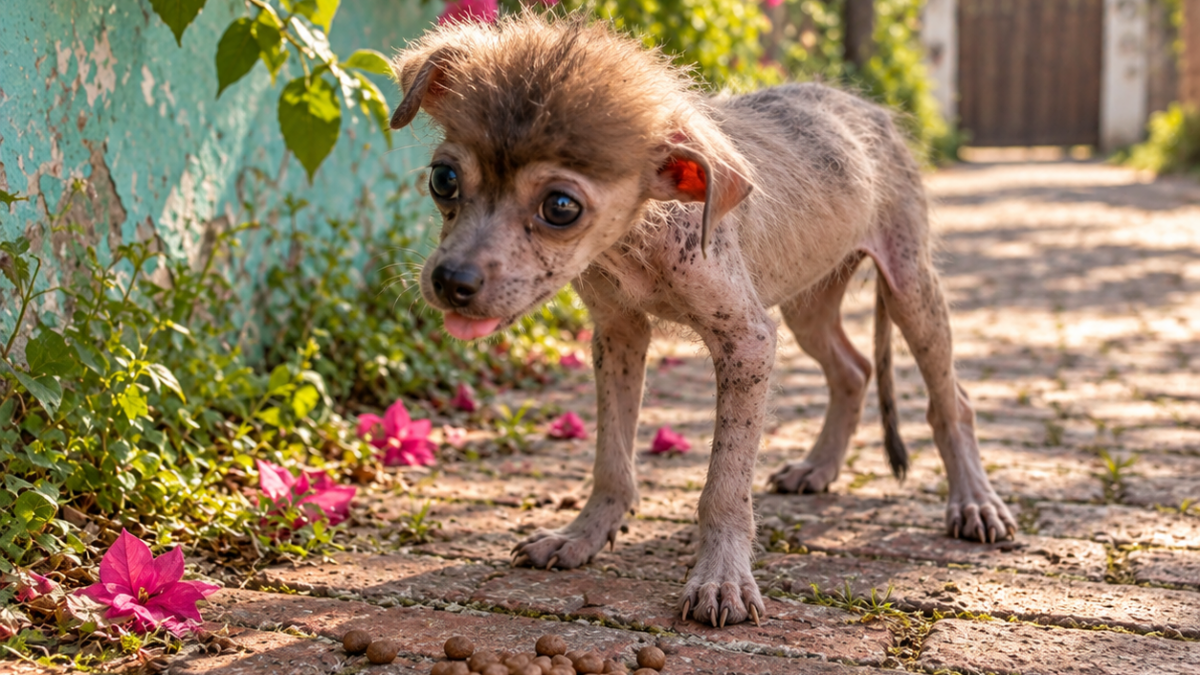
PART 2
The first night, Tiny barely slept.
Neither did I.
I had placed his bed in a quiet room near mine and left the door open so he would never feel trapped. Every time the house made a sound, his eyes opened.
The refrigerator clicked.
Tiny’s head rose.
A car passed outside.
His body stiffened.
I walked down the hallway to get water.
His eyes followed every step.
I stopped in the doorway.
“You can sleep.”
Of course, he did not understand the words.
But maybe tone mattered.
Maybe repetition mattered.
Maybe nothing mattered yet except that I did not move toward him too quickly.
I returned to my room.
Ten minutes later, I checked again.
His eyes were still open.
At two in the morning, the same.
At four, I found him with his chin resting on the blanket, but the moment my foot touched the floor, his eyes opened.
That was when I realized Tiny had probably learned to sleep without ever fully relaxing.
His body was exhausted.
His mind was still guarding him.
I sat down several feet away.
Tiny watched.
I leaned against the wall.
“You don’t have to watch me.”
His eyelids lowered.
Then opened.
“Fine. We can both be terrible at sleeping.”
Eventually, sometime before sunrise, Tiny stretched one leg.
Then another.
His head lowered completely.
His breathing became deeper.
I remained sitting there until my back hurt.
I did not want to risk waking him.
That first deep sleep felt like the beginning of something.
Not trust.
Not yet.
Relief.
Sometimes relief comes before trust.
Morning brought food.
Tiny had to eat carefully because his body had been deprived for too long.
I followed the veterinarian’s instructions exactly.
Measured portion.
Slow feeding.
Plenty of water nearby.
No overwhelming his system simply because every bone in his body made me want to fill ten bowls at once.
I placed breakfast several feet from him.
Tiny looked at the bowl.
Then at me.
I stepped backward.
He waited.
I moved farther.
Only then did he stand.
The weak leg touched the floor cautiously.
Tiny walked toward the food.
Sniffed.
Took a bite.
Then stopped and looked at me.
I stayed still.
He ate again.
Every few bites, he checked.
The bowl.
Me.
The doorway.
Then back to the bowl.
I wondered how many meals had disappeared from his life before he finished them.
How many times food had not come at all.
How long hunger had been ordinary.
By the end, Tiny had eaten everything.
He licked the bowl carefully.
Then the floor beneath it.
My throat tightened.
“There will be more.”
Tiny continued licking.
“Not right now.”
He glanced toward me.
“But there will be another meal.”
That became another promise he could not yet understand.
Meals return.
Water returns.
People return.
Nothing has to be believed the first time.
It can be proven through repetition.
For the first several days, our schedule was simple.
Food.
Medication and supplements as directed.
Short periods outside.
Rest.
Very gentle movement.
Veterinary rechecks.
No unnecessary pressure.
Tiny’s leg remained weak.
When he walked, he tried not to load it fully.
I worried constantly.
“What if we missed something?”
The veterinarian patiently showed me the X-rays again.
“No fracture.”
“Ligament?”
“We’re watching.”
“Nerve damage?”
“Possible weakness from malnutrition, maybe old soft-tissue pain, maybe deconditioning. But look at him.”
Tiny was standing beside the examination table.
For the first time, I noticed something.
His weak leg was touching the floor more than it had three days earlier.
The veterinarian pointed.
“He’s already using it differently.”
I crouched.
Tiny immediately lowered his eyes.
I stopped myself from reaching.
“Sorry.”
The veterinarian noticed.
“You’re doing the right thing.”
“What?”
“Letting him choose contact.”
I nodded.
“That part is harder than the medicine.”
“It often is.”
Bloodwork gave us another measure.
Tiny’s values were poor when he arrived.
Not catastrophic enough to require heroic intervention that day, but bad enough to show what neglect had taken from him.
Protein levels.
Red blood cell measures.
Signs that his body had been operating without what it needed.
The veterinarian explained everything.
I listened.
Wrote notes.
Asked too many questions.
Then went home and stared at Tiny as though I could see blood values changing through his fur.
My husband eventually said, “You know watching him won’t make his cells work faster.”
“I know.”
“You’ve been staring at him for ten minutes.”
“I’m observing.”
“You’re haunting the dog.”
I looked at Tiny.
Tiny looked away.
“Fine.”
I went to the kitchen.
Two minutes later, I peeked around the corner.
My husband laughed.
Tiny’s first week was made of microscopic victories.
He drank more willingly.
He finished meals.
His stool normalized.
The weakness in his hindquarters improved.
The struggling leg stayed down longer.
He began changing sleeping positions.
That last one mattered more than people might imagine.
On day one, Tiny curled tightly.
Body tucked inward.
Head low.
On day four, he slept on his side.
One leg extended.
The next night, I found him stretched almost completely across the blanket.
Belly exposed slightly.
Not much.
Enough.
I took a photograph.
Then immediately felt ridiculous.
It looked like a dog sleeping.
That was exactly why it mattered.
Tiny was beginning to sleep like a dog.
Not like an animal waiting for something bad to happen.
He still did not seek affection.
If I sat near him, he tolerated me.
If I offered my hand, he sniffed occasionally.
If I touched him without warning during necessary care, his muscles tightened.
So I warned him.
Every time.
“Hand.”
My fingers touched his shoulder.
“Good.”
“Leg.”
I checked the weak limb.
“Done.”
Maybe he did not understand the words.
He understood predictability.
That became the bridge.
By day seven, Tiny followed me with his eyes whenever I entered the room.
By day eight, his head lifted before I spoke.
By day nine, he stood when he heard the food container.
Not every time.
Enough to notice.
Day ten brought his first genuine surprise.
I entered carrying breakfast.
Tiny stood.
Then his tail moved.
Once.
I froze.
He stopped.
“No.”
Tiny stared.
“Do that again.”
Nothing.
I set the bowl down.
Tail movement.
There.
I smiled so hard my face hurt.
“You wagged.”
Tiny approached the food.
“Technically it might have been for breakfast, but I’m taking partial credit.”
He ate.
I texted my husband from twelve feet away.
TAIL.
He responded:
I am literally in the next room.
I wrote:
WAG.
He appeared in the doorway.
Tiny stopped eating and looked at him.
“What happened?”
“He wagged.”
My husband nodded solemnly.
“This is a major development.”
“Do not mock me.”
“I’m not.”
Tiny returned to breakfast.
His tail moved again.
My husband smiled.
“Okay. That’s pretty good.”
Tiny’s weight rose slowly.
At every veterinary appointment, I watched the scale as though it were announcing lottery numbers.
Up.
Not dramatically.
But up.
The veterinarian showed me the trend.
“This is what we want.”
“More?”
“Yes, but gradual.”
Tiny stood near my leg.
Not touching.
Closer than before.
The veterinarian examined him.
His coat remained dull, but the skin beneath it looked healthier.
His muscle tone had begun returning.
The weak leg still lacked confidence.
But it no longer floated uselessly above the floor.
“Walk him down the hall.”
I did.
Tiny followed.
Step.
Step.
Slight hesitation.
Then another.
The veterinarian watched.
“Better.”
“How much better?”
He smiled.
“You want a percentage?”
“Yes.”
“No.”
“Why?”
“Because bodies are not progress bars.”
I sighed.
“Fine.”
He crouched as Tiny returned.
Tiny stopped several feet away.
The doctor did not reach.
“His biggest improvement isn’t that leg.”
I looked at him.
“What is?”
“He came back toward us.”
That night I thought about it.
Tiny’s physical body was improving in measurable ways.
Weight.
Bloodwork.
Gait.
Appetite.
His emotional recovery was measured differently.
Distance.
How far from the wall.
How quickly he looked up.
Whether his muscles tightened when I entered.
Whether he chose to remain in the same room.
Those numbers mattered too.
On day twelve, Tiny left his recovery room by himself.
The door had always remained open.
He simply never crossed the threshold unless encouraged outside.
That morning, I was folding laundry in the hallway.
I heard nails against the floor.
Soft.
Uneven.
I looked up.
Tiny stood in the doorway.
I stayed still.
“Hi.”
He looked down the hall.
Then at me.
One step.
Another.
He walked perhaps four feet.
Stopped.
His weak leg trembled.
I wanted to rush forward.
I did not.
Tiny continued.
He reached the edge of the laundry pile.
Sniffed a towel.
Then turned around and went back to his blanket.
I laughed quietly.
“Big trip.”
The next day, six feet.
Then the kitchen doorway.
He did not enter.
Progress.
Day fourteen, Tiny entered the living room while I was reading.
He stood near the wall.
I continued reading.
I could feel him watching me.
I did not turn.
Five minutes later, he lay down.
Still near the wall.
But outside his safe room.
I read another chapter I barely understood because I was too aware of him.
The next morning was day fifteen.
I remember because I had written each day on the calendar beside his medication schedule.
Day 15.
Tiny ate breakfast.
Went outside.
Came in.
Nothing dramatic.
Around ten, I sat on the floor in the living room answering emails.
Tiny stood in the hallway.
By then, he often watched me from there.
I said nothing.
He stepped into the room.
I kept my eyes on the computer.
One step.
Another.
He stopped.
I could hear his nails.
Then silence.
I waited.
Tiny walked closer.
Five feet.
Three.
Two.
He had never voluntarily come that close without food.
My heart began pounding.
I placed my hands in my lap.
Tiny sniffed my knee.
I did not move.
He looked up at my face.
Those eyes were no longer empty.
Still cautious.
Still unsure.
But present.
Tiny stepped closer.
Then he lowered his head.
And rested it against my leg.
I stopped breathing.
Every instinct told me to touch him.
Hug him.
Pull him close.
I did none of those things.
I let him choose.
For perhaps ten seconds, Tiny stayed there.
His forehead pressed into my thigh.
Then fifteen.
Twenty.
Finally, very slowly, I lowered one hand.
My fingertips touched the side of his neck.
Tiny remained.
One stroke.
Then another.
His eyes closed.
I cried silently.
Not dramatic sobbing.
Tears simply rolled down my face.
Tiny opened his eyes.
I whispered, “You came to me.”
His tail moved.
He stayed.
That was the moment.
Not the weight gain.
Not the better bloodwork.
Not even the improving leg.
Day fifteen was when I saw the real Tiny return.
Because trust is not the absence of fear.
It is the decision to move closer despite having reasons not to.
Tiny had made that decision himself.
From that morning forward, the changes accelerated.
Not because trauma vanished.
Because he had found somewhere to place his trust.
He started following me.
At first, from a distance.
If I walked into the kitchen, Tiny appeared in the doorway.
If I went to the laundry room, he waited in the hall.
If I sat outside, he chose a spot several feet away.
Then three feet.
Then beside my chair.
Within another week, he became my quiet shadow.
My husband noticed first.
“You have company.”
I looked down.
Tiny stood behind me.
“Oh.”
I moved toward the sink.
Tiny followed.
I walked back.
Tiny followed.
My husband smiled.
“This seems familiar.”
Tiny sat beside my leg.
I scratched his neck.
He leaned into the touch.
That almost undid me all over again.
The dog who once accepted touch like something being done to him now asked for it.
There is a difference between tolerance and affection.
Tiny taught me exactly where that line was.
His leg improved too.
Nutrition gave his body material to rebuild.
Gentle movement became short walks.
Short walks became slightly longer ones.
His gait was not instantly perfect.
Some days he favored the leg again after too much activity.
We slowed down.
Rested.
Adjusted.
The veterinarian remained pleased.
“No heroics.”
“I know.”
“You say that like someone who will try heroics.”
“I will not.”
My husband coughed behind me.
I ignored him.
Tiny’s second blood panel showed improvement.
The veterinarian turned the paper toward me.
“Better.”
I scanned numbers I barely understood.
“How much?”
“Enough that I’m happy.”
“You don’t look happy.”
“This is my happy face.”
Tiny sniffed his shoe.
The veterinarian scratched his chin.
“And look at him.”
Tiny leaned into the hand.
I smiled.
“Yeah.”
That was bigger than the laboratory report.
Tiny became increasingly interested in food.
Then obsessed.
The cautious eater disappeared.
One morning, I prepared his measured breakfast.
Tiny sat beside the cabinet.
Tail wagging.
I placed the bowl down.
He ate.
Fast.
“Slow down.”
Tiny ignored me.
I eventually bought a slow feeder.
He stared at it.
“You’re welcome.”
He began working through the grooves.
My husband said, “He looks offended.”
“He should be grateful.”
Tiny looked at me.
“He is not grateful.”
Good.
I did not want gratitude.
I wanted entitlement.
Healthy entitlement.
The kind that says breakfast should happen.
Beds should be soft.
Humans should provide.
Doors should open.
Life should continue.
Tiny deserved to become demanding.
One afternoon, I found him standing beside the couch staring at me.
“What?”
Nothing.
“You went outside.”
Tail wag.
“You ate.”
More wag.
“What do you want?”
He looked at the couch.
“No.”
Tiny looked at me.
Then couch.
“No.”
He placed his front paws on the cushion.
“You have a bed.”
He pulled himself up.
His recovering leg worked hard, but it worked.
He settled beside me.
I stared.
Tiny curled against my hip.
“Fine.”
My husband walked into the room.
“You lost that argument quickly.”
“I’m rehabilitating him emotionally.”
“You’re making excuses.”
Tiny put his head on my lap.
“Case closed.”
By the end of the first month, Tiny had gained enough weight that people who saw his early photographs struggled to reconcile them.
His coat had more shine.
His eyes were brighter.
His muscles were returning.
His weak leg carried him confidently most of the time.
He still hesitated occasionally.
The veterinarian told me not to panic.
Bodies remember weakness too.
Rebuilding takes time.
Tiny also began playing.
The first toy was a soft blue ball.
I rolled it gently across the floor.
Tiny watched.
Nothing.
I rolled it again.
He looked at me as if questioning my intelligence.
“Fair.”
I left it.
Later, while washing dishes, I heard something hit the wall.
I turned.
The blue ball rolled from the hallway.
Tiny appeared behind it.
He nudged it.
The ball moved.
Tiny followed.
I whispered, “No way.”
He pushed it again.
Then caught me watching.
He froze.
I looked away dramatically.
“Definitely not watching.”
The ball moved again.
By evening, Tiny was chasing it several feet at a time.
His gait looked awkward but enthusiastic.
The weak leg kept up.
Then he made a sharp turn.
Slipped.
My heart jumped.
Tiny stood immediately.
Shook himself.
Went after the ball.
I started laughing.
The next morning, he brought it to me.
Not all the way.
Three feet away.
Dropped it.
Looked at me.
I rolled it.
Tiny ran.
That word mattered.
Ran.
Not limped.
Not struggled.
Ran.
A short distance.
But ran.
I took a video.
Watched it repeatedly.
Then compared it with the first clip from rescue.
In that one, Tiny barely placed the leg down.
Now it pushed his body forward.
I cried again.
Tiny’s story could have ended there.
Neglected dog rescued.
Body healed.
Trust restored.
Happy home.
But there was one question I could not let go.
Who had allowed him to become that way?
At intake, information had been incomplete.
Nobody had come to reclaim him.
No one had called.
Initially, he appeared to be another anonymous neglect case.
Then a shelter worker contacted me.
“We found something.”
My stomach tightened.
“What?”
“An old microchip record.”
I sat down.
“You scanned him.”
“We did. The number was registered to outdated information. We kept digging.”
“And?”
“There’s a veterinary clinic attached to an older account.”
I looked across the room.
Tiny was asleep on the couch.
Healthy enough now to snore softly.
“What does that mean?”
“It means he had an owner at some point.”
The words landed hard.
Of course I knew logically that Tiny had come from somewhere.
But “somewhere” had remained abstract.
Now there might be a person.
A name.
A timeline.
Animal control became involved.
The old veterinary clinic cooperated according to the proper process.
Records showed Tiny had once been healthier.
Not perfect.
But nowhere near the condition in which we found him.
At one visit, he had been a normal young dog.
His weight had been significantly better.
There had been no serious fracture in the leg.
No medical explanation for the severe wasting that later developed.
The investigator called me.
“We’re trying to determine when ownership changed.”
“Changed?”
“The registered person says Tiny was given to someone else.”
“Who?”
“That’s what we’re verifying.”
I felt anger rising.
“When?”
“They gave us a date.”
“Does it match?”
“Not yet.”
I hated those careful answers.
“Somebody starved him.”
“Tiny was clearly severely undernourished.”
“Somebody watched that happen.”
“That is what we’re investigating.”
I stood and began pacing.
Tiny woke.
His head lifted.
Immediately, I stopped.
“Sorry.”
He looked at me.
Then came over.
I sat.
Tiny put his head against my knee.
The investigation had just pulled me backward.
Tiny pulled me forward.
That became a pattern.
Every time I thought too long about whoever had failed him, Tiny demanded the present.
Food.
Walk.
Ball.
Couch.
Touch.
He refused to let the worst part of his life become the center of ours.
Animal control interviewed several people.
The original registered owner said Tiny had been rehomed months earlier.
The person they named initially denied having him.
Then admitted he had stayed at the property temporarily.
The timeline changed.
Neighbors were interviewed.
One remembered Tiny.
“He used to be outside a lot.”
Another had seen him getting thinner.
A third remembered the leg.
“He limped.”
“Did anyone take him to a veterinarian?”
“I told them they should.”
The investigator documented everything.
I wanted an arrest immediately.
What I got was paperwork.
Statements.
Records.
Dates.
Messages.
Photographs.
I complained to the investigator.
“You already know.”
“I know what the condition was.”
“You know where he lived.”
“We know places he was seen.”
“You know who had him.”
“We are establishing who was legally responsible during the relevant period.”
I wanted to scream.
Instead, I asked, “Why is this taking so long?”
“Because if we move forward, I want the case to survive more than anger.”
That shut me up.
I still disliked it.
But he was right.
A case cannot be built from the fact that I hated what happened.
It has to be built from evidence.
Tiny had already been failed by carelessness.
I did not want accountability to fail because we became careless too.
So we waited.
Meanwhile, Tiny graduated from short rehabilitation walks to real walks.
His first walk around the block took forever.
Not because he was weak.
Because he discovered smells.
Every mailbox.
Every patch of grass.
Every tree.
He stopped constantly.
My husband laughed.
“You wanted him curious.”
“I regret everything.”
Tiny sniffed a bush for nearly a minute.
“Tiny.”
Nothing.
“There are other bushes.”
He continued.
“We own a yard.”
No response.
Finally, he moved.
Ten feet later, another smell.
It took thirty minutes to go a distance I could walk in five.
It was perfect.
Tiny returned home exhausted.
He drank.
Climbed onto the couch.
Slept deeply.
That night, he stretched all four legs completely.
No guarding.
No stiffness.
I looked at the once-weak limb.
Strong enough now that I could barely identify which one had frightened us.
The next veterinary recheck confirmed it.
“Muscle tone is coming back nicely.”
“So the leg is okay?”
“The structure looks okay. Keep building gradually.”
“Can he run?”
The veterinarian looked at Tiny.
Tiny was trying to climb onto a chair.
“He seems to think so.”
I smiled.
By the second month, Tiny had zoomies.
His version began in the hallway.
One second he was standing.
The next, he exploded.
Living room.
Kitchen.
Hallway.
Around the coffee table.
Back again.
I yelled, “Tiny!”
He kept going.
My husband lifted his feet as Tiny passed.
“Your patient is healed.”
“He’s insane.”
Tiny slid slightly.
Recovered.
Ran again.
I grabbed my phone.
The video was terrible.
Mostly blurry dog.
I loved every second.
The two-year-old who had once struggled to remain standing was running because his body finally had extra energy to waste.
There are few things more beautiful than wasted energy in a rescued animal.
It means survival is no longer taking everything.
Some energy can be spent on nonsense.
Tiny became excellent at nonsense.
He stole socks.
He learned to open the bathroom door if it was not fully latched.
He discovered toilet paper.
One afternoon, I walked into the hallway and found white paper stretched from the bathroom to the living room.
Tiny stood in the middle.
A piece hung from his mouth.
I stared.
“Explain.”
Tail wag.
My husband walked in.
“What happened?”
I pointed.
He laughed.
“This is your emotional recovery project.”
Tiny ran.
Paper followed.
I chased him.
At some point, I started laughing too hard to be angry.
The dog who once tried to make himself invisible had decorated the entire hallway with toilet paper.
That felt like victory.
Tiny also started seeking affection openly.
He no longer waited for me to offer a hand.
He used his nose.
His paw.
His entire head.
If I stopped petting too soon, Tiny nudged my wrist.
“You’re demanding.”
Nudge.
“I remember when you wouldn’t come within three feet of me.”
Nudge.
“You have changed.”
Nudge.
I continued.
One evening, he climbed into my lap despite being far too large for that arrangement.
My husband took a picture.
Tiny looked completely relaxed.
Eyes closed.
His once-trembling leg hung over my knee.
I looked at the photo for a long time.
Day fifteen had been the first time he placed his head against me.
Now he climbed onto me as though personal boundaries had never existed.
Healing can become inconvenient.
I loved that.
The investigation eventually produced a stronger timeline.
Veterinary records.
Messages.
Witness statements.
Shelter intake condition.
A prior photograph.
Someone had sent a picture of Tiny weeks before he was surrendered or abandoned.
He was already painfully thin.
The investigator called.
“We have enough to move forward with a neglect complaint.”
I sat down.
“Against who?”
He told me.
A person who had been responsible for Tiny during the period in which his condition deteriorated.
My chest tightened.
“What happens?”
“There will be a legal process. Don’t assume an outcome.”
“Can they take him back?”
“No. Tiny’s disposition has already been resolved through the proper shelter and rescue process.”
I looked at Tiny.
He was asleep beneath the window.
“Good.”
That was the first thing that mattered.
Nobody was coming to reclaim him.
His safety was not temporary.
The second thing was accountability.
The hearing happened months later.
By then, Tiny looked so different that I almost felt guilty bringing the early photographs.
The dog in the pictures looked like another animal.
The dog waiting for me at home was healthy.
Confident.
Annoying.
Loved.
I attended with the records I had been asked to provide.
The veterinarian submitted documentation.
Shelter staff provided intake observations.
The investigator outlined the timeline.
I was not there to invent what I did not know.
I described what I had seen.
Tiny’s body condition.
The weak leg.
The first X-rays.
The lack of fracture.
The nutritional deficits.
His behavior.
His recovery.
At one point, I was asked whether Tiny had been aggressive.
“No.”
“Fearful?”
I considered the question.
“He wasn’t reactive.”
“What does that mean?”
“He mostly shut down.”
“Can you explain?”
I looked at the decision-maker.
“When I first met him, he did not run away and did not approach. He lowered his head and waited. It was as though he expected nothing from people.”
The room became quiet.
I continued.
“His physical recovery was faster than his trust.”
The other side gave explanations.
Financial problems.
Personal stress.
Confusion over who was responsible.
Claims that Tiny had always been thin.
The veterinary records contradicted part of that.
Witnesses contradicted more.
Nobody denied Tiny’s condition when he reached rescue.
The question was responsibility.
I felt anger rise when I heard excuses.
Then I remembered the investigator.
Evidence.
Not fury.
So I stayed quiet.
One part of me wanted the person responsible to look at Tiny’s recovery photos.
To see what food and basic care had done.
To see that the dog they allowed to disappear physically had not been “sick beyond help.”
He had needed ordinary things.
Meals.
Medical care.
Rest.
Attention.
That truth was devastating precisely because it was simple.
Tiny did not require a miracle surgery.
His leg had not been shattered.
No rare disease had consumed him.
He had been starving.
That was preventable.
The legal decision did not come immediately.
We went home.
Tiny met me at the door carrying his blue ball.
He dropped it at my feet.
I looked down.
“Court was awful.”
Tiny stared at the ball.
“You don’t care?”
Ball.
“I talked about you.”
Ball.
“Fine.”
I threw it.
Tiny ran.
Just like that, the entire emotional weight of the hearing lost some power.
He had become very good at reminding me what the story was actually about.
Not them.
Him.
Several weeks later, the final outcome came.
The person found responsible faced consequences under the applicable animal-neglect process.
There were penalties.
Conditions related to animal ownership and care were imposed for the period ordered.
The case became part of the official record.
It was not cinematic.
No one screamed.
No dramatic confession.
No television cameras.
No satisfying speech.
At first, I felt disappointed.
I had imagined revenge as something louder.
Then I looked at Tiny.
He had just finished breakfast.
He walked away from the bowl before licking it completely clean.
I stared.
Food remained.
Tiny did not care.
He went to find his ball.
That was the moment revenge changed meaning for me.
Someone had once made food uncertain.
Now Tiny could leave it behind.
Someone had made his body too weak to stand.
Now he ran down hallways.
Someone had taught him not to expect kindness.
Now he put his head under my hand and demanded affection.
Someone had allowed his world to become small enough that he tried to disappear.
Now Tiny occupied every room like he owned the mortgage.
Those consequences mattered.
The legal ones too.
But this was the ending I wanted most.
Neglect failed.
Completely.
Tiny’s third month with us looked nothing like the first.
He had gained healthy weight.
His blood values approached normal ranges.
His coat improved.
The weak leg became simply one of four legs.
He no longer watched every doorway.
He still liked knowing where I was.
But he did not panic when I disappeared.
That took work.
Tiny had become attached to me quickly after day fifteen.
At first, I loved it.
Then I noticed something.
If I closed the bathroom door, he waited outside.
If I walked to the mailbox, he stood at the window.
If I left the house, my husband said Tiny stayed near the door.
Not frantic.
Watchful.
I asked a behavior professional for guidance.
“He needs to learn departures are temporary.”
“I tell him I’m coming back.”
She smiled.
“Dogs learn patterns better than speeches.”
So we built patterns.
I walked out for thirty seconds.
Returned.
One minute.
Returned.
Five.
Returned.
Tiny eventually stopped standing at the door.
The first time I left for ten minutes and came back to find him asleep, I felt strangely emotional.
He looked up.
Tail wag.
Then put his head down again.
Trust.
Not following me everywhere.
Trusting me enough not to.
People often think attachment is the greatest proof of love.
Sometimes independence is.
Tiny knew I returned.
That freed him from watching every exit.
Another milestone.
He met other dogs carefully.
At first, he seemed unsure.
A playful younger dog approached too quickly.
Tiny froze.
I stepped between them.
“Slow.”
We tried again with distance.
Eventually Tiny relaxed.
He learned canine friendships the same way he learned human ones.
Choice.
Space.
Repetition.
His closest friend became a gentle dog named Maple.
Maple was bigger.
Calm.
She had no interest in overwhelming him.
The first afternoon together, she lay on the grass.
Tiny stood several feet away.
Maple ignored him.
Tiny approached.
Sniffed.
Retreated.
Returned.
Eventually he lay down near her.
Not touching.
The next visit, closer.
By the fourth, Tiny slept with his back against hers.
I took another photograph.
The dog who once feared taking up space now shared it.
Maple also taught him how to play roughly enough that I nearly had a heart attack.
One afternoon, she chased him.
Tiny ran.
Full speed.
His formerly weak leg pushing hard.
Maple turned.
Tiny followed.
They circled the yard.
I yelled, “Careful!”
My husband said, “They’re dogs.”
“I know.”
“You look like an anxious parent at a playground.”
Tiny tackled Maple.
Maple rolled.
Both jumped up.
More running.
I stared at the leg.
No hesitation.
No limp.
Nothing.
The veterinarian later confirmed what I already knew.
His gait was normal.
The leg had recovered.
Nutrition.
Strength.
Movement.
Time.
That simple.
That painful.
Because it meant Tiny had suffered in a body that could have been helped so much earlier.
I stopped allowing that thought to dominate.
Earlier was gone.
Now was ours.
Tiny’s first birthday with us happened several months after recovery.
We did not know his exact birthday, so we chose his rescue date.
My husband objected.
“That makes it an adoption day.”
“Then we celebrate both.”
Tiny received a small dog-safe cake.
He stared at it.
I took photographs.
My husband said, “You are making him wait for food so you can document how much we love him.”
I lowered the camera.
“Fair.”
Tiny ate.
Maple visited.
There were toys.
Too many.
Tiny destroyed one within eleven minutes.
Perfect day.
That night, after everyone left, he fell asleep beside me.
I looked at the calendar.
One year earlier, I had not known him.
A few months later, he had nearly disappeared.
Now he had a chosen birthday.
That mattered.
Neglect makes an animal anonymous.
Love records details.
Favorite toy.
Preferred sleeping position.
Foods disliked.
The exact place behind the ear that causes the back leg to kick.
Tiny became known.
Completely.
He loved chicken.
Hated bananas.
Feared vacuum cleaners.
Liked rain only if he could watch from indoors.
Preferred the left side of the couch.
Needed two circles before lying down.
Barked at delivery drivers.
Adored one particular neighbor.
Stole dish towels but ignored socks after his toilet-paper phase.
These ordinary facts became his biography.
The neglect case became smaller.
Not erased.
Smaller.
Years passed.
Tiny grew into adulthood.
The frightened two-year-old became a confident dog.
People meeting him for the first time struggled to believe the early story.
One visitor asked, “That dog?”
Tiny was standing with his paws against my knees because I held cheese.
“Yes.”
“The one who couldn’t walk?”
“He could walk. Barely.”
“He looks completely normal.”
I smiled.
“That’s the goal.”
Normal.
People underestimate that word.
A normal life is an extraordinary gift to an animal whose existence once revolved around survival.
Tiny got boring days.
Rainy days.
Days when nobody discussed trauma.
Days when the most upsetting event was a late breakfast.
Days when I worked and he slept.
Days when he chased Maple.
Days when he barked at nothing.
Days when nothing needed rescuing.
Those became my favorite.
The investigator occasionally checked in.
Years later, he called about another case.
“We have a dog in a similar situation. Owner says the dog has always been thin.”
My stomach tightened.
“What do you need?”
“Do you still have Tiny’s early veterinary documentation and progress records?”
“Yes.”
“With permission, we’d like to use the case history internally as an example of how severe nutritional neglect can affect gait.”
I agreed to share what was appropriate.
Afterward, I looked at Tiny.
He was outside sunbathing.
“You’re educational now.”
No response.
“You have a career.”
Tiny rolled onto his side.
The case reminded me that one rescue can improve the next one.
That became part of Tiny’s justice.
Not simply penalties for the person who failed him.
Better recognition for another dog.
Earlier intervention.
Less opportunity for someone to dismiss obvious suffering as “that’s just how he is.”
Tiny’s body had become evidence in more ways than one.
The rescue group started emphasizing documentation.
Weights.
Photos.
Gait video.
Bloodwork trends.
Body-condition scoring.
Not because animals are paperwork.
Because evidence protects them.
Emotion makes people care.
Documentation makes systems act.
Tiny taught us both.
He also became useful in a softer way.
New foster dogs sometimes stayed with us.
Tiny did not magically heal them.
I never liked pretending animals were therapists simply because their own past was difficult.
But he was calm around fear.
A new dog could hide.
Tiny did not force interaction.
He had once needed the same.
One foster named Rosie spent two days beneath a desk.
Tiny walked past her several times.
Ignored her.
On the third day, he lay several feet away with his blue ball.
Rosie watched.
Tiny rolled the ball accidentally.
It stopped near the desk.
Rosie sniffed it.
Tiny looked.
Did nothing.
An hour later, Rosie came out.
Tiny’s tail moved once.
I sat across the room and smiled.
Maybe he remembered.
Maybe not.
Either way, his calmness created space.
Rosie was adopted six weeks later.
Tiny watched her leave.
Then went to dinner.
That was another lesson.
Love does not always require holding on.
Tiny had taught me not to disappear.
Fostering taught me how to let others leave toward something better.
As Tiny aged, his blue ball wore out.
I replaced it.
He rejected every replacement for weeks.
I finally found one almost identical.
Tiny sniffed.
Accepted it.
My husband said, “We have spent more time sourcing a dog ball than buying furniture.”
“The ball matters.”
“Apparently.”
Tiny carried it to his bed.
Case closed.
His muzzle began graying earlier than I wanted.
One morning, sunlight hit his face.
I noticed white hairs around his nose.
“No.”
Tiny looked up.
“You’re two.”
My husband laughed.
“He is absolutely not two.”
“In my mind.”
Tiny came over.
I rubbed the gray fur.
Years.
That was what gray meant.
I had once wanted time so desperately for him.
Now I was offended by evidence that he had received it.
That was unfair.
The whole victory was aging.
Tiny eventually became older than the age at which his first neglect had almost destroyed him by several times over.
His leg, ironically, remained one of his stronger joints.
Later arthritis developed elsewhere.
The veterinarian smiled when I complained.
“He’s aging.”
“I object.”
“You don’t get a vote.”
Tiny stood beside us.
Gray face.
Healthy weight.
Bright eyes.
I looked at him.
“This is what we wanted.”
The veterinarian nodded.
Exactly.
An old Tiny.
Not a forever-young rescue photograph.
A dog with years on him.
His walks shortened.
Maple died before him.
That loss hurt.
Tiny searched for her during the first visits after she was gone.
He walked around her yard.
Sniffed.
Waited.
Maple’s family cried watching him.
I did too.
Tiny eventually stopped searching.
He kept living.
Another dog joined their home later.
Tiny tolerated him.
Never loved him quite like Maple.
That was okay.
Relationships do not need replacement.
Neither do losses.
Tiny became softer with age.
He slept more.
Still demanded affection.
Still believed dinner should happen at least thirty minutes earlier than scheduled.
Still barked at delivery drivers despite hearing them less clearly.
His eyesight remained good for years.
His hearing slowly faded.
I learned to approach where he could see me.
Hand signals replaced some words.
Touch became communication.
The dog who had once feared hands now relied on them.
One tap for outside.
A hand beneath his chest when stairs became difficult.
Gentle fingers around his collar.
Massage for stiff muscles.
Trust had become physical.
Complete.
One winter morning, Tiny slipped while standing.
His legs splayed.
I rushed over.
He looked embarrassed.
“You okay?”
He tried to stand.
I helped.
The old weak leg held.
Another joint seemed painful.
Veterinary visit.
Arthritis.
Nothing dramatic.
Medication helped.
Rugs appeared across the house.
My husband looked at the floors.
“We have become a carpet maze.”
“Tiny needs traction.”
“I know.”
Tiny walked across confidently.
Worth it.
I remembered his first days, when walking itself was uncertain.
Now we were adjusting the house so aging could not take mobility too quickly.
He deserved every adaptation.
Ramp.
Rugs.
Orthopedic bed.
Raised bowls.
Shorter walks.
Longer naps.
Nobody looked at the inconvenience and asked whether Tiny was worth it.
That question had already been answered.
One night, an accident happened near the back door.
Tiny had not made it outside in time.
He stood beside the puddle.
Head low.
The sight punched me back years.
Same posture.
Eyes down.
Waiting.
I crouched immediately.
“Hey.”
Tiny would not look up.
“Nothing happened.”
I cleaned the floor.
Then sat beside him.
“Floors wash.”
He finally looked at me.
I scratched his chest.
“You are allowed to get old.”
Tail movement.
That night he slept beside my bed.
I thought about whoever had neglected him.
Maybe inconvenience had been part of it.
Food cost.
Vet cost.
Mess.
Time.
Whatever their reasons, responsibility had collapsed.
I refused to let Tiny’s old age reopen the message of his youth.
Need does not reduce worth.
The more he needed, the more carefully we adjusted.
That was not sainthood.
That was the contract you make when an animal becomes dependent on you.
They give you their vulnerability.
You become responsible for what you do with it.
Tiny’s kidney values changed later.
Then his heart needed monitoring.
Old-dog problems accumulated.
The veterinarian and I became practiced at conversations neither of us liked.
“What is his quality of life?”
“Still good.”
“Eating?”
“Yes.”
“Interest?”
“Yes.”
“Pain controlled?”
Mostly.
We adjusted medication.
Tiny continued.
Some days he acted years younger.
One afternoon, he found the blue ball.
Picked it up.
Brought it to me.
I stared.
“You want this?”
Tail wag.
I rolled it gently.
Tiny trotted after it.
Not ran.
Trotted.
Picked it up.
Brought it halfway back.
Stopped.
Lay down.
I laughed.
“Fair.”
The old dog had rules.
One throw.
That was enough.
I sat beside him.
Tiny rested his head on the ball.
For a moment, I saw day fifteen.
The head against my leg.
That first voluntary touch.
Everything else had grown from it.
Trust is a quiet decision.
So is love.
Tiny’s final decline began slowly.
Less appetite.
More sleep.
Occasional confusion at night.
Difficulty rising.
Then good stretches.
I kept a calendar.
Good day.
Good.
Mixed.
Good.
Hard.
Recovery had once taught me not to panic over a bad day.
Old age taught me the opposite lesson too.
Do not let one good day hide a long worsening pattern.
Both truths can exist.
Tiny still wanted meals.
Then one morning he left breakfast.
I watched.
He returned later and ate some.
Fine.
Two days after that, he refused chicken.
That terrified me.
Chicken had survived every phase of Tiny’s life.
I called the veterinarian.
Bloodwork.
Examination.
His kidneys had worsened.
We treated nausea.
Adjusted support.
He rallied.
For several weeks, Tiny ate again.
Walked into the yard.
Slept in the sun.
Good time.
Borrowed, maybe.
Still real.
Then the pattern shifted again.
Hard mornings.
Less interest.
More assistance.
I carried him outside sometimes.
He was heavier than the nearly weightless dog I had first helped years earlier.
Even old and thin again, he had a real body beneath my arms.
Muscle accumulated over a lifetime.
History.
I placed him in the grass.
Tiny stood.
His formerly weak leg carried him.
I smiled through tears.
“That leg fooled all of us.”
He sniffed.
Took a few steps.
Then looked at me.
Ready to go in.
I lifted him.
Tiny rested his head against my shoulder.
The first time I had tried to hold him, his body stayed stiff.
Now he melted into me.
Years of proof.
I come back.
I feed you.
I do not hurt you.
I stay.
Eventually, the veterinarian came to our house.
Not for the final appointment yet.
For a quality-of-life evaluation.
Tiny lay on his bed.
The veterinarian examined him.
Then we sat in the kitchen.
“I don’t think he’s in uncontrolled suffering today.”
I nodded.
“But?”
“You’re approaching the point where the question isn’t whether we can keep him alive. It’s whether the life we’re maintaining is still his life.”
I hated that sentence.
Because it was right.
Tiny had once fought his way toward life.
I did not want to make him fight to remain simply because I feared losing him.
The veterinarian continued.
“Watch what he wants.”
Food.
Outside.
Affection.
Interest.
Comfort.
When most of those disappeared, the answer would become clearer.
For another ten days, Tiny gave me reasons.
He ate small meals.
Walked into the yard.
Pressed his head under my hand.
Carried the ball once.
Barked at a delivery driver.
I celebrated every one.
Then came a morning when he did none of them.
Tiny woke.
Looked at me.
Did not stand.
I brought chicken.
He sniffed.
No.
Water.
A little.
I opened the back door.
He did not lift his head.
I sat beside him.
Tiny’s eyes found mine.
I knew.
Knowing did not feel noble.
It felt like someone had torn the center out of me.
I called my husband.
He sat on the other side.
For a long time, nobody spoke.
Then Tiny slowly shifted.
His head moved toward my leg.
The same movement.
Day fifteen.
He rested against me.
I cried.
“You remember?”
Of course, I had no idea.
I remembered enough for both of us.
The veterinarian came that afternoon.
We placed Tiny’s bed near the open back door.
He liked the breeze.
The blue ball rested beside him.
I offered chicken one more time.
Tiny took a tiny piece.
I laughed through tears.
“You had to make me doubt myself.”
My husband rubbed his face.
“Still negotiating.”
Tiny swallowed.
Then rested.
The veterinarian gave us all the time we needed.
No rush.
No bright clinic.
No fear.
I held Tiny’s head in my lap.
The dog who once could barely use one leg had spent years running on it.
The dog who had once stopped expecting people now had three adults crying because we could not imagine the house without him.
That contrast contained an entire life.
I stroked his face.
“You don’t have to wait for me anymore.”
Tiny’s eyes stayed on mine.
“You don’t have to watch the door.”
His breathing remained slow.
“I’m not disappearing.”
The first medication made him sleepy.
His muscles relaxed.
I continued petting him.
“You came to me first.”
My voice broke.
“Remember?”
Tiny’s eyes became heavy.
“Day fifteen.”
My husband squeezed my shoulder.
“You put your head right here.”
I touched my leg.
“And I was terrified to move because I didn’t want to scare you.”
Tiny exhaled.
I kissed his forehead.
“You taught me.”
Another breath.
“You taught me that trust can’t be pulled out of anybody.”
His body softened.
“It has to be offered.”
I placed my forehead against his.
“And you gave me yours.”
The final medication was administered when we were ready.
Tiny died peacefully.
Head in my lap.
Blue ball beside him.
Open door letting afternoon air into the room.
No trembling.
No weak leg.
No waiting to see whether anyone would come.
Everybody who mattered was already there.
I stayed with him afterward.
His body became still.
That word had once frightened me.
Stillness had been the first thing I noticed.
The young Tiny standing with lowered eyes.
The quiet dog who did not fight.
The dog making himself small.
Now the stillness meant something else.
He had finished.
Not abandoned.
Not defeated.
Finished.
There is a difference.
The house felt enormous after Tiny died.
He had not been a large dog.
His absence was.
I walked into the kitchen expecting him.
Opened the refrigerator and looked down automatically.
Nothing.
Sat on the couch.
No head under my hand.
Went to the bathroom.
No shadow.
The very independence I had once celebrated became painful.
I wanted him following me again.
Grief is unreasonable.
It asks for the habits that once inconvenienced you.
His bed remained for months.
So did the ball.
I could not move either.
Eventually, I washed the bed cover.
The ball stayed untouched.
A small scratch remained on the hallway wall from one of his early zoomies.
My husband suggested repainting.
I said no.
He did not ask again.
The investigator from Tiny’s neglect case sent a message when he heard.
I had not spoken to him in years.
I called.
“He got old,” I said.
“I saw the pictures.”
“Really old.”
“That’s a good ending.”
I cried.
“It doesn’t feel good.”
“No.”
He paused.
“Good endings hurt too.”
That was true.
A good ending does not mean you avoid grief.
It means grief arrived after enough life.
Tiny had enough life.
Not infinite.
Enough to become himself.
Enough to trust.
Enough to run.
Enough to love Maple.
Enough to irritate us.
Enough to grow gray.
Enough to make old-dog problems feel like gifts.
The investigator told me something else.
“His case still gets discussed.”
“Why?”
“Training.”
I became quiet.
“Your records showed how severe malnutrition can affect gait even without fractures. The sequence matters.”
“So he’s still helping?”
“In a way.”
I looked toward the blue ball.
“That seems right.”
Tiny had arrived as a dog nobody seemed to see until damage became impossible to ignore.
Now the documentation of that damage helped people recognize it sooner elsewhere.
That became part of his legacy.
A few months later, our rescue received a call about another dog with a weak leg.
Young.
Thin.
No obvious trauma.
The volunteer on the phone said, “They think it could be broken.”
My heart tightened.
“Get X-rays.”
They did.
No fracture.
Severe weakness.
Malnutrition.
I sat in my kitchen reading the update.
Then looked toward Tiny’s photograph.
“You did it again.”
The new dog recovered sooner.
Because help came sooner.
No dramatic collapse.
No long shutdown.
Someone recognized the signs.
That mattered.
The dog found a home.
I received a photograph months later.
Running.
Four legs.
I placed the picture beside Tiny’s.
Not permanently.
Just for the afternoon.
Two dogs.
Same kind of beginning.
Different speed of intervention.
Proof that lessons can outlive the animal who taught them.
People often asked me what happened to the person responsible for Tiny.
I told them there had been accountability.
There had been legal consequences.
Restrictions.
A record.
Those things mattered.
But over time, I stopped remembering details as sharply.
The person faded.
Tiny did not.
That was the final revenge.
The person who neglected him had once controlled every important part of his life.
Food.
Care.
Shelter.
Whether pain was noticed.
Whether weakness was treated.
Then that control ended.
Tiny went somewhere else.
Became someone else’s responsibility.
Then someone else’s family.
The former caretaker became a case file.
Tiny became years.
That imbalance became satisfying.
Cruelty wants to dominate the story.
It does not deserve to.
The most important photograph of Tiny is not the first one.
Not the image of bones.
Not the trembling leg.
Not lowered eyes.
My favorite photograph came years later.
Tiny was old.
Gray face.
Lying in the yard.
The blue ball rested between his paws.
His eyes were closed because the sun was warm.
His body stretched openly across the grass.
Taking up space.
That phrase means everything to me.
Taking up space.
Young Tiny had tried to disappear.
Old Tiny sprawled.
Young Tiny waited for hands to move toward him.
Old Tiny shoved his head beneath them.
Young Tiny ate like food might vanish.
Old Tiny occasionally rejected meals because they did not contain enough chicken.
Young Tiny watched doors.
Old Tiny slept through my departures.
Young Tiny could barely use one leg.
Old Tiny wore out all four.
That is the transformation.
Not just health.
Ownership of a life.
His own life.
For years, I thought day fifteen was the day I rescued Tiny emotionally.
That interpretation was too flattering.
I did not rescue his trust.
He chose to risk it.
All I did was avoid punishing the choice.
That distinction matters.
You cannot force a frightened dog to believe.
You can create evidence.
You return.
You feed.
You wait.
You announce your hands.
You respect distance.
You do not use affection as a demand.
You make safety boring through consistency.
Eventually, if you are lucky, the animal decides the evidence is enough.
Tiny decided.
Head against my leg.
Eyes closed.
One quiet morning.
Everything after that grew from his decision.
Years later, when I speak to new foster families, I tell them about him.
Not as a formula.
No dog owes you a day-fifteen breakthrough.
Some take hours.
Some months.
Some never become physically affectionate.
The lesson is not to wait exactly fifteen days.
The lesson is to stop measuring love only by what you receive from the animal.
Tiny taught me to measure what I could reliably provide.
Food.
Care.
Safety.
Choice.
Time.
The rest belonged to him.
That principle changed every rescue after.
It changed me too.
I became less desperate for immediate proof that I was helping.
A dog hiding under a table but eating at night could be progress.
A frightened animal sleeping while someone sat nearby could be progress.
A single step toward a person could be enormous.
Tiny had made me fluent in small changes.
One evening years after his death, I found his blue ball while moving a cabinet.
It had rolled behind the furniture sometime before his final weeks.
I picked it up.
Dust covered one side.
Tiny’s teeth marks remained.
I sat on the floor.
My husband found me.
“Oh.”
I held it.
“I thought the other one was his last.”
“Apparently not.”
I laughed.
Then cried.
He sat beside me.
For a minute, neither of us spoke.
I turned the ball in my hand.
“You remember his first week?”
“Yeah.”
“I thought the leg was broken.”
“So did I.”
“I thought he might never trust us.”
My husband smiled.
“He took over the couch.”
“True.”
“He took over the house.”
“Also true.”
I looked at the ball.
“He got old.”
“He did.”
That sentence still felt miraculous.
I placed the ball beside his photograph.
Not as a shrine.
As evidence.
Love deserves evidence too.
Tiny’s evidence was everywhere.
A scratch.
A ball.
Thousands of photographs.
Veterinary files.
Training notes.
Stories shelter workers still told.
Another dog whose weak gait was recognized sooner.
A rescue policy emphasizing nutrition before assuming orthopedic injury in severely underweight animals.
A family changed by one dog who barely looked at us.
That is how Tiny stayed.
Not physically.
In the decisions that came afterward.
The last time I visited the shelter that had first handled part of Tiny’s case, one of the staff members remembered him.
“She had that leg, right?”
“He.”
“Sorry. Tiny.”
“Yes.”
She smiled.
“The quiet one.”
I nodded.
“Very quiet.”
“Did he stay quiet?”
I laughed.
“No.”
She looked relieved.
“What was he like?”
I considered everything.
The ball.
The zoomies.
The food demands.
Maple.
The couch.
The old age.
“Bossy.”
She laughed.
“Good.”
“Very.”
Before leaving, I walked past the kennel area.
Dogs barked.
Some jumped.
One sat silently in the back.
For a second, my body reacted before my mind did.
Tiny.
Not Tiny.
A different dog.
Different story.
I stopped.
The staff member noticed.
“He’s new.”
“What’s his situation?”
“Scared. Medically okay. Foster pending.”
I crouched several feet away.
The dog looked at me.
I did not reach.
I did not call repeatedly.
I simply sat.
After a minute, one ear moved.
I smiled.
“Take your time.”
Tiny had taught me those words.
I stayed until the foster arrived.
Then I went home.
That night, I stood beside Tiny’s photograph.
I finally understood his ending in a way I had not when he died.
Neglect had tried to shrink his life.
Everything we did afterward expanded it.
The person who failed him had taught him to lower his eyes.
Tiny learned to look up.
Hunger taught him food might disappear.
Routine taught him bowls return.
Weakness taught him his body could fail.
Nutrition taught him strength can rebuild.
Abandonment taught him people leave.
Years taught him some come back.
Fear taught him to stay small.
Love gave him permission to take up space.
And death?
Death eventually came.
It comes for every animal we save.
That does not make rescue temporary or pointless.
The purpose was never to defeat mortality.
The purpose was to change what happened before it.
Tiny had once been alive without really living.
We could not give him forever.
We gave him life.
Real life.
Messy.
Funny.
Expensive.
Inconvenient.
Ordinary.
Beautiful.
That was enough.
More than enough.
When I think of Tiny now, I no longer see the weak leg first.
I see him running with Maple.
I do not see ribs.
I see the dog who needed his dinner measured because he had become too enthusiastic about food.
I do not see lowered eyes.
I see the expression he used when I stopped petting too early.
I do not see the animal waiting silently for people to decide what happened next.
I see the old dog sleeping while I walked out the door because he knew exactly what happened next.
I came back.
That was our whole story in two words.
I came back.
Again.
Again.
Again.
Until he no longer needed to check.
And when the day came that Tiny could no longer stay, I did not treat his leaving as abandonment.
I stayed with him through it.
That completed the promise.
Nobody knew what Tiny had once hoped for when footsteps approached him during those early neglected days.
Maybe food.
Maybe rescue.
Maybe nothing by then.
I know what he eventually learned.
Footsteps could mean breakfast.
A leash.
Medicine.
A walk.
A friend.
Someone sitting quietly nearby.
Someone coming home.
A life does not always change because of one heroic moment.
Sometimes it changes because one terrible pattern is replaced with a better one.
Neglect.
Then care.
Hunger.
Then meals.
Fear.
Then choice.
Silence.
Then a bark.
Stillness.
Then running.
Alone.
Then family.
That was Tiny’s revenge.
Not violence.
Not hatred.
Transformation.
The people who reduced him to almost nothing did not get to decide what he became.
Tiny did.
And what he became was impossible to miss.
He became loud when dinner was late.
Fast when a ball moved.
Soft when Maple slept beside him.
Stubborn at the veterinarian.
Patient with frightened foster dogs.
Gray around the muzzle.
Safe enough to sleep deeply.
Loved enough to become inconvenient.
Old enough to leave a hole in a house that had once seemed too large for his tiny body.
Tiny entered my life trying to make himself invisible.
He left it having changed everything.
And whenever I remember that first quiet morning, I still feel the weight of his head against my leg.
A tiny decision from a dog who had every reason not to make it.
He moved closer.
I stayed still.
And from that moment on, neither of our lives ever went back to what they had been.








