PART 2: Thrown From a Speeding Pickup and Left to Di3, She Survived 27 Days in the Forest—Then I Found What She’d Been Protecting
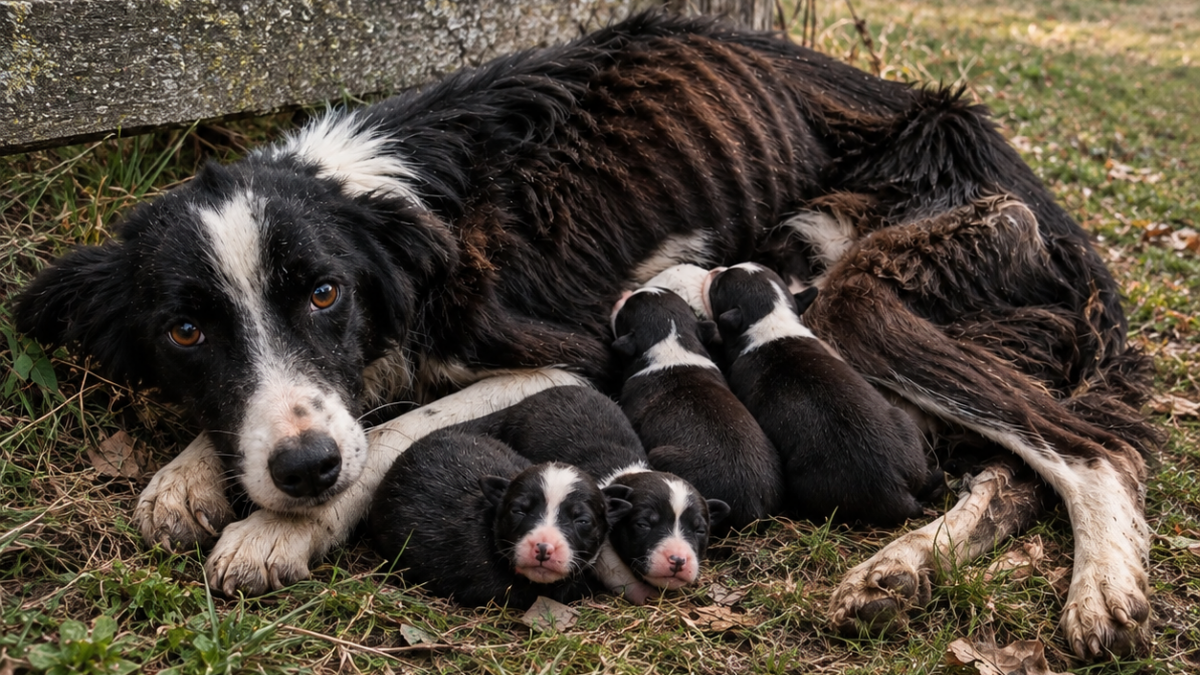
PART 2
I didn’t move for several minutes.
The first rule when approaching a frightened animal is simple: don’t make your urgency become their panic.
So I stayed on my knees.
I spoke quietly.
“You’ve done enough, sweetheart.”
Her ears twitched.
“You don’t have to do this alone anymore.”
She didn’t understand the words.
But maybe she understood the tone.
I slowly removed the sandwich from my backpack.
Turkey.
No mayonnaise.
Exactly the kind my doctor would describe as “better than what you usually eat, James, but still not great.”
I tore off a small piece.
Placed it on the ground.
Then backed away.
The Border Collie stared at it.
Then at me.
Then back at the food.
She didn’t move.
“Smart girl.”
I waited.
Eventually she leaned forward.
Sniffed.
Ate.
I placed another piece slightly closer.
She ate that too.
Then another.
By the fourth piece, she was trying to stand.
Her front leg buckled.
I nearly rushed toward her.
Stopped myself.
She dragged herself two steps.
A puppy cried.
She immediately turned around and limped back.
That told me everything.
She would starve beside those puppies before she willingly left them.
I pulled out my phone.
One bar of service.
I called the county animal rescue.
A woman answered.
“Cedar Ridge Animal Rescue.”
“My name is James McClintock. I’m down by Coldwater River, maybe three miles north of the old bridge.”
“Okay. What happened?”
“I found the Border Collie.”
Silence.
“What Border Collie?”
“The one from the pickup.”
Another silence.
Then her voice changed.
“The missing dog?”
“Yes.”
“Are you sure?”
“She’s black and white. Injured shoulder. Looks like she’s been out here for weeks.”
“James, don’t approach her too quickly. We searched for that dog for eight days.”
“There’s something else.”
“What?”
“She has puppies.”
The woman stopped breathing for a second.
“How many?”
“Four.”
“Oh my God.”
“She’s in bad shape.”
“We’re coming.”
“How long?”
“Twenty-five minutes if the road is clear.”
I looked at the mother.
“I don’t know if she has twenty-five minutes.”
The woman’s voice became firm.
“James, listen carefully. Do you have water?”
“Yes.”
“Put it near her. Not directly beside the puppies. Don’t force her to drink. Don’t feed too much at once. If she’s severely malnourished, too much food can make things worse.”
“Understood.”
“What’s her breathing like?”
“Fast.”
“Gums?”
“I haven’t gotten close enough.”
“Don’t risk a bite. We’ll handle her when we arrive.”
I gave her precise directions.
Then I hung up.
I poured water into the lid of my bait container.
Not ideal.
It worked.
The dog smelled it.
This time she came forward faster.
She drank.
Too fast.
“Easy.”
She ignored me.
I pulled the water back after several seconds.
She looked at me.
“Don’t hate me. You’ll get more.”
Her eyes stayed on mine.
I gave her another small amount.
When she finished, she lowered herself back beside her puppies.
For the first time, I saw how badly she was shaking.
Not fear.
Exhaustion.
I sat on the ground twenty feet away.
The fish could wait.
The river could wait.
Everything could wait.
Twenty-seven minutes later, I heard engines above the trail.
Two rescue workers came down first.
A woman in her forties named Dana and a younger man named Luis.
Dana stopped the moment she saw the dog.
“Oh, honey.”
The Border Collie lifted her head.
I whispered, “She’s protective but hasn’t shown aggression.”
Dana nodded.
“Good.”
She crouched.
“Hi, mama.”
Luis unpacked a blanket, slip lead, gloves, and a transport stretcher.
Dana spent nearly ten minutes getting close.
The dog accepted food.
Then a hand.
Then a loop of the lead.
When Dana finally touched her neck, the dog closed her eyes.
Not resistance.
Relief.
“She’s burning up,” Dana said.
“Fever?”
“Feels like it.”
She examined the puppies without separating them completely.
“They’re cold.”
Luis swore under his breath.
Dana looked at me.
“James, can you hold this blanket open?”
I did.
We lifted the puppies first into a padded crate.
The mother tried to stand.
Her leg folded.
She made a sound I will hear for the rest of my life.
Not pain exactly.
Panic.
She thought we were taking them.
Dana immediately brought the crate against her nose.
“See them? They’re here.”
The mother sniffed frantically.
The puppies squeaked.
She calmed.
“We move them together,” Dana said.
We lifted her onto the stretcher.
She weighed almost nothing.
A healthy Border Collie her size should have been close to forty-five pounds.
Dana guessed she was under thirty.
As we carried her up the trail, I walked beside the crate.
The mother kept trying to lift her head to see her babies.
“They’re right here,” I told her.
“They’re coming.”
At the truck, Dana asked, “Do you want to follow us?”
I looked down at my fishing gear.
I had left half of it by the river.
“I’m coming.”
“You can get your equipment first.”
“No.”
I looked through the open transport door.
“I’m coming.”
I retrieved the rod later.
That afternoon, I followed an animal rescue van instead.
At Cedar Ridge Veterinary Hospital, everything happened quickly.
The puppies went beneath warming blankets.
The mother went onto an examination table.
Dr. Rachel Kim met us in scrubs.
“How long missing?”
“Twenty-seven days,” Dana said.
Dr. Kim looked at the dog.
“And she gave birth out there?”
“Apparently.”
She exhaled.
“Unbelievable.”
They started IV fluids.
Antibiotics.
Pain medication.
Blood tests.
X-rays.
I waited in the hallway.
I had no reason to stay.
Technically, she wasn’t my dog.
I was simply the man who happened to find her.
But leaving felt impossible.
Dana sat beside me.
“You okay?”
“I’m fine.”
“You’ve said that four times.”
“Then I must really mean it.”
She smiled.
Then became serious.
“We searched for her.”
“I know.”
“We had volunteers everywhere.”
“What happened?”
“She kept moving.”
“Pregnant.”
“We didn’t know.”
I leaned back against the wall.
“Did anybody identify the truck?”
Dana’s face tightened.
“Not enough.”
“What does that mean?”
“A witness saw a dark blue pickup. Older model. Partial plate, maybe. Couldn’t read the whole thing.”
“Someone threw her out.”
“Yes.”
“While the truck was moving.”
“Yes.”
“And nobody found the driver?”
“Not yet.”
That last word mattered.
Not yet.
Dr. Kim came out nearly an hour later.
Her expression was serious.
“Are you James?”
“Yes.”
“You found her?”
“Yes.”
“She’s lucky you did.”
“How bad?”
“Bad.”
She sat across from me.
“The good news first. No spinal fracture. No internal bleeding that we can detect right now. The puppies are dehydrated but surprisingly stable.”
“And her?”
“Fractured scapula that appears partially healed. Significant soft tissue trauma. An old rib fracture. Severe dehydration. Severe malnutrition. Skin infection. Fleas and ticks. Her paw pads are badly damaged.”
I stared at her.
“She survived that for twenty-seven days?”
Dr. Kim nodded.
“While nursing.”
“How?”
“Animals are extraordinary.”
“That isn’t an answer.”
“No.”
She looked through the glass door.
“Sometimes there isn’t one.”
“What about her leg?”
“The shoulder fracture explains much of it. She may recover functional use, but we need repeat imaging once she’s stabilized.”
“Will she live?”
Dr. Kim paused.
“I think she has a chance.”
A chance.
Not a promise.
“What do you need?”
“Time.”
“Money?”
She raised an eyebrow.
“The rescue handles medical fundraising.”
“How much?”
“James—”
“How much?”
“We don’t know yet.”
“I can help.”
She studied me.
“Why?”
I looked through the glass.
The mother dog was lying on her side.
Four puppies pressed against her.
“Because somebody threw her away.”
That night I went home.
I showered.
I ate cereal for dinner.
Then I sat in my living room thinking about her.
At 11:40 p.m., I called Dana.
“You’re awake?” she asked.
“So are you.”
“I work here.”
“Excuse.”
She laughed.
“How is she?”
“Stable.”
“The puppies?”
“Still nursing.”
I closed my eyes.
“What are you calling her?”
“We haven’t.”
“Why not?”
“Usually we wait until morning.”
“What about Grace?”
Dana went quiet.
“Grace?”
“She shouldn’t be alive.”
“That doesn’t mean grace.”
“No.”
I looked at the dark window.
“But something about her does.”
Dana said softly, “Grace it is.”
The next morning, I was at the hospital before eight.
Grace survived the night.
So did all four puppies.
Over the next several days, I became a nuisance.
I visited every afternoon.
I brought blankets.
Then towels.
Then food for the staff.
On day three, Dr. Kim told me, “You know you don’t actually work here.”
“I’m considering it.”
“You have no medical training.”
“I can mop.”
“You’d complain about the mop.”
“Probably.”
Grace began responding to me.
At first she simply watched.
Then her tail moved slightly when I entered.
On the fifth day, she raised her head.
“Morning, girl.”
Her tail tapped once against the blanket.
That tiny sound nearly broke me.
The puppies were gaining weight.
We named them Flint, Willow, Pip, and Scout.
Scout was the smallest.
He had a black patch across one eye.
He also screamed whenever separated from Grace for more than ten seconds.
“Dramatic,” I told him.
Dana handed him to me.
“Like someone else I know.”
“I am not dramatic.”
She stared.
“You abandoned your fishing equipment in the woods.”
“I retrieved it.”
“Two days later.”
“Fish are patient.”
Grace’s story began spreading.
Someone posted that the missing Border Collie had been found alive.
Then a local television station called the rescue.
Reporters wanted photographs.
Dana was cautious.
“We don’t want strangers crowding her.”
But awareness mattered.
The person who threw her from the truck was still out there.
The rescue released only basic information.
**Border Collie missing 27 days found alive with four newborn puppies.**
The response was enormous.
Donations arrived.
So did tips.
Most were useless.
“My neighbor owns a blue truck.”
“I saw a Border Collie last summer.”
“My cousin hates dogs.”
Then one tip changed everything.
A man named Ethan called the sheriff’s office.
He worked at a gas station near Route 16.
He remembered a dark blue pickup from the morning Grace disappeared.
Why?
Because the driver had come inside yelling about a dog.
The station still had security footage.
The footage showed the truck.
Better still, the license plate was visible.
Dana called me that evening.
“They found it.”
I stood up.
“The truck?”
“Yes.”
“Who?”
“Sheriff’s office isn’t releasing the name yet.”
“But they know?”
“They know who owns it.”
I looked toward the kitchen.
My hands had started shaking.
“James?”
“I’m here.”
“Don’t do anything stupid.”
“What do you think I’m going to do?”
“You’ve asked me twelve times if we know who threw her.”
“Thirteen.”
“Exactly.”
“I’m not stupid.”
“Good.”
I meant it.
Mostly.
Three days later, the sheriff’s office announced that a local man named Tyler Brennan was being questioned.
Thirty-four years old.
Construction worker.
Owned a dark blue 2007 pickup.
Grace had belonged to his girlfriend.
At least officially.
The truth came out slowly.
Grace’s previous owner was a woman named Melissa.
She had adopted Grace when the dog was a puppy.
Years later, Melissa began dating Tyler.
According to statements eventually collected by investigators, Tyler disliked Grace.
Said she shed too much.
Said she barked.
Said Melissa “babied” her.
When Grace became pregnant after an accidental encounter with another dog, Tyler became furious.
Melissa planned to keep Grace through the pregnancy and find homes for the puppies.
Then one morning, while Melissa was working, Grace disappeared.
Tyler told her the dog had gotten loose.
Melissa believed him.
For a while.
Until the news story.
Until the truck.
Until the gas station footage.
When detectives questioned him, Tyler initially denied everything.
Then claimed Grace had jumped.
That was when I first met Melissa.
She came to the rescue.
I was sitting outside Grace’s recovery room.
A woman in her early thirties walked through the door crying.
“Is she here?”
Dana approached.
“Melissa?”
“Yes.”
“You need to slow down.”
“I need to see her.”
Grace heard the voice.
Her head lifted.
Melissa covered her mouth.
“Oh my God.”
Grace tried to stand.
Dr. Kim stopped her.
Melissa dropped to her knees outside the kennel.
“Grace.”
The dog whined.
Not fear.
Recognition.
Her tail moved rapidly.
Melissa cried harder.
“I’m sorry.”
Grace pressed her nose against the bars.
“I’m so sorry.”
I stepped away.
I had imagined the person connected to Grace’s past as an enemy.
This woman wasn’t.
She was broken.
After fifteen minutes, Melissa sat in the waiting room.
I offered her coffee.
She shook her head.
“You found her?”
“Yes.”
“Thank you.”
“You don’t have to thank me.”
“Yes.”
She looked at me.
“I do.”
She told me everything.
Tyler had always been jealous of Grace.
Not normal jealousy.
Possessive.
“He hated that she slept beside me.”
Her voice cracked.
“He said I cared more about the dog.”
“Did you?”
She looked down.
“Maybe I should have.”
That stayed with me.
Melissa had believed Tyler when he said Grace ran away.
She had searched.
Passed out flyers.
Joined volunteers.
For eight days.
Tyler helped too.
That detail made me sick.
He had walked through those woods pretending to search for a dog he knew he had thrown from a moving vehicle.
“Did he know she was pregnant?” I asked.
“Yes.”
I looked toward Grace’s room.
Melissa’s hands trembled.
“He knew.”
The criminal investigation accelerated.
Witness.
Security footage.
Veterinary injuries consistent with high-impact trauma.
The partially healed shoulder fracture.
And eventually, a confession.
Not a full one.
Tyler claimed he had been “angry.”
He said Grace wouldn’t stop whining in the truck.
He said he opened the door to “scare her.”
Then admitted he pushed her.
At approximately forty miles per hour.
Pregnant.
His defense attorney later called it “an impulsive act.”
I called it what it was.
Cruelty.
Grace didn’t care about court.
She cared about her puppies.
And chicken.
Very much chicken.
By week three, she could stand more comfortably.
Her shoulder would never be perfect.
But Dr. Kim expected her to walk normally enough for a good life.
The first time we took her outside, I walked beside her.
Dana held the leash.
Grace stepped onto grass.
Stopped.
She lifted her nose.
The breeze moved across her face.
For several seconds, she did nothing.
Then she walked.
Slowly.
One step.
Another.
Her puppies were safe inside.
She knew that.
She reached a patch of sunlight.
Then lay down.
I sat beside her.
“You beat him.”
Dana glanced at me.
“James.”
“What?”
“Don’t turn her healing into him.”
I looked at Grace.
Dana was right.
Tyler had taken enough from her.
He did not deserve to become the center of her recovery too.
So I changed the sentence.
“You made it.”
Grace put her head on my shoe.
That was better.
Melissa visited almost every day.
At first, I didn’t know how I felt about her.
Part of me blamed her.
She had brought Tyler into Grace’s life.
She had seen tension.
Maybe warning signs.
But blame becomes easy when you know the ending.
Reality is messier.
Melissa had not hurt Grace.
She had searched for her.
She had believed a lie.
And now she was cooperating fully with police.
One afternoon, she said, “I want her back.”
I was surprised by how much that hurt.
Of course she did.
Grace was her dog.
But somewhere along the way, I had begun imagining Grace in my kitchen.
Grace beside the river.
Grace sleeping near my chair.
I hated myself for it.
“You should,” I said.
Melissa looked at me.
“I don’t know if I deserve her.”
“That’s different.”
“She trusted me to protect her.”
“You didn’t know.”
“I knew Tyler hated her.”
“That doesn’t mean you knew he would do this.”
“No.”
She wiped her face.
“But I knew enough to know he shouldn’t have been alone with her.”
I had no answer.
The decision wasn’t mine anyway.
The rescue and authorities had placed Grace under temporary protective custody while the case proceeded.
The puppies would eventually be adopted.
Grace’s future would be evaluated afterward.
Then something happened that changed everything again.
Tyler was released pending court proceedings.
There were conditions.
He was not supposed to contact Melissa.
Not supposed to approach the rescue.
Not supposed to interfere with witnesses.
For ten days, he followed those rules.
On the eleventh, he drove past the rescue.
Twice.
The security camera caught him.
Dana called law enforcement.
He claimed it was coincidence.
The next night, someone cut part of the fence behind the facility.
Nothing was stolen.
No animals escaped.
But one section near the rear kennel had been opened with bolt cutters.
Grace’s kennel was thirty feet away.
Dana called me at six in the morning.
“We’re moving her.”
“Where?”
“Temporary foster.”
“I’ll take her.”
Silence.
“James.”
“I have a fenced yard.”
“You’ve never fostered.”
“I’ve kept myself alive for fifty-seven years.”
“That is not the qualification you think it is.”
“I’m taking her.”
She laughed despite herself.
“Dr. Kim has to approve it.”
Dr. Kim did.
Barely.
By that afternoon, Grace was in my house.
Her puppies remained at the rescue in a secure nursery because they were nearly weaned.
Grace walked through my living room cautiously.
Sniffed the couch.
Kitchen.
Hallway.
Then stopped beside the sliding door overlooking the backyard.
“You like it?”
Tail movement.
“Temporary.”
She looked at me.
“Don’t start.”
Tail.
“Temporary.”
Grace slept beside my bed that night.
At 2:13 a.m., I woke because she was growling.
Low.
Quiet.
Nothing like I had heard before.
I sat up.
“What?”
She was standing.
Facing the window.
Hair raised along her back.
Then I heard gravel outside.
Someone was in the driveway.
I reached for my phone.
Grace moved toward the front door.
“No.”
The porch light came on automatically.
A figure moved past the window.
Male.
Hood.
I called 911.
“My name is James McClintock. Someone is outside my house.”
The dispatcher asked if I was safe.
“Yes.”
Then the doorknob moved.
Grace exploded.
Not at the person.
At the door.
Her bark shook the hallway.
The figure outside ran.
I never opened the door.
Police arrived seven minutes later.
They found tire tracks.
Footprints.
Nothing else.
The next morning, I checked my security camera.
The man’s face was partly covered.
But his truck was visible at the edge of the frame.
Dark blue.
I sat there staring.
Tyler.
He had come to my house.
Why?
To scare me?
Take Grace?
Make evidence disappear?
Maybe all three.
This time, investigators moved quickly.
The truck connected him.
So did cell-location data.
His release conditions were revoked.
When Dana heard, she sat in my kitchen with both hands around a cup of coffee.
“You could have been hurt.”
“I wasn’t.”
“Grace could have been hurt.”
I looked at her.
That was different.
“I know.”
“We need to move her.”
I looked down.
Grace was asleep beneath the table.
“You really think he can get to her now?”
“No.”
“Then she stays.”
Dana studied me.
“You’re attached.”
“No.”
Grace’s paw rested on my boot.
Dana raised an eyebrow.
“Not at all.”
The puppies began going to their homes one by one.
Willow went to a family with two children.
Flint went to a retired couple who owned a farm.
Pip became the shadow of a veterinary technician.
Scout, the smallest, stayed with Dana.
“I’m fostering him,” she insisted.
Three months later, Scout was still sleeping in her bed.
Hypocrite.
Grace recovered.
Not completely.
Her right shoulder remained slightly stiff after long walks.
Cold mornings bothered her.
A small scar remained beneath her coat.
But she gained weight.
Her fur became glossy.
Her eyes changed.
That is the only way I can describe it.
When I found her, her eyes had contained nothing except endurance.
Later, they contained expectation.
She expected breakfast.
Walks.
The river.
My truck.
She expected me to come home.
That is one of the greatest gifts a rescued animal can give you.
Expectation means they believe tomorrow is coming.
The court case took almost a year.
By then, Grace had lived with me for eight months.
Temporary foster.
That was what the paperwork still said.
Dana made fun of me constantly.
“When are you returning her?”
“Soon.”
“You bought her a personalized bed.”
“It was on sale.”
“You installed a dog door.”
“Practical.”
“You have four pictures of her in your wallet.”
“Evidence.”
“For what?”
I had no answer.
The trial began in August.
I testified.
So did Melissa.
Dana.
Dr. Kim.
The gas station employee.
The original witness who had seen Grace hit the roadside.
The prosecution showed the truck footage.
Veterinary images.
Photographs of Grace when found.
I hated those photographs.
The ribs.
The infected wounds.
The exhausted eyes.
Then they showed something else.
A picture of Grace nursing four puppies beneath the rock.
My photograph.
I had taken it after the rescue team arrived.
The courtroom became very quiet.
Tyler’s attorney argued that he never intended for Grace to die.
The prosecutor answered, “He pushed a pregnant dog from a moving vehicle and drove away.”
That ended the poetry.
Sometimes facts are enough.
When Tyler took the stand, he made one mistake.
He blamed Grace.
“She was aggressive.”
I nearly stood up.
Melissa made a sound behind me.
The prosecutor asked, “Aggressive how?”
“She growled.”
“When?”
“When I tried to move her.”
“Was she pregnant?”
“Yes.”
“Did she ever bite you?”
“No.”
“Attack you?”
“No.”
“No?”
“No.”
“Then why did you tell investigators she was dangerous?”
Tyler shifted.
“I was angry.”
The prosecutor waited.
“At the dog?”
“At everything.”
“And because you were angry, you opened the door of a vehicle traveling approximately forty miles per hour?”
Silence.
“And pushed her out?”
Tyler looked down.
“Yes.”
There it was.
Not dramatic.
Not loud.
Just one word.
Yes.
I looked at Melissa.
She was crying silently.
I looked at the photographs.
Grace beneath the rock.
Grace protecting her babies.
Grace trying to stand.
Twenty-seven days.
For what?
Because a grown man was angry.
The conviction came quickly.
Animal cruelty.
Violation of release conditions.
Additional charges connected to the attempted nighttime approach to my property.
The sentence included incarceration, probation, financial restitution toward Grace’s medical care, and a long-term prohibition on owning or possessing animals under the applicable orders.
When the judge spoke, Tyler stared straight ahead.
I expected satisfaction.
I had imagined this moment many times.
I thought I would feel victorious.
I didn’t.
Because punishment does not repair a shoulder.
It does not return twenty-seven lost days.
It does not remove hunger from memory.
It does not erase the terror of giving birth alone in a forest while injured.
Justice mattered.
But it could not become Grace’s ending.
Outside the courthouse, Melissa found me.
“What happens now?”
“To Tyler?”
“No.”
She shook her head.
“To Grace.”
That was the question I had been avoiding.
Protective custody had ended.
Legally, Melissa could request Grace’s return.
I waited.
Melissa looked toward the parking lot.
“I’m not taking her.”
I stared.
“What?”
“She’s yours.”
“Melissa—”
“No.”
She smiled through tears.
“I loved her.”
“I know.”
“I still do.”
“I know.”
“But she belongs with you now.”
I shook my head.
“She remembers you.”
“I know.”
“She still gets excited when you visit.”
“I know.”
“Then why?”
Melissa took a breath.
“Because love is not always taking someone back.”
She looked at me.
“Sometimes it’s admitting where they’re safest.”
I couldn’t speak.
She reached into her purse.
Pulled out Grace’s original puppy collar.
Pink.
Tiny.
“I kept it.”
She placed it in my hand.
“I want you to have it.”
“Melissa.”
“Please.”
I closed my fingers around it.
She wiped her face.
“And James?”
“Yes?”
“Take her fishing.”
I laughed.
“I will.”
Two weeks later, I signed the adoption papers.
Officially.
Dana placed the document in front of me.
“Any questions?”
“Yes.”
“What?”
“Can I return her if she keeps stealing my socks?”
Grace was lying beneath the desk with one of my socks in her mouth.
“No.”
“Terrible organization.”
“Sign.”
I signed.
Grace McClintock.
Dana laughed when she saw what I had written.
“You gave her your last name?”
“She earned it.”
That fall, almost exactly one year after I found her, I took Grace back to Coldwater River.
Not to the exact spot.
I wasn’t sure what memories smells could awaken.
Instead, we walked a quieter trail farther upstream.
Her shoulder was stiff that morning.
We went slowly.
I carried my fishing rod in one hand.
Her leash in the other.
When we reached the river, Grace stopped.
Water moved over stones.
Mist hung above the surface.
She stared.
Then looked at me.
“You remember?”
Her tail moved.
I sat beneath a willow.
Grace settled beside me.
For an hour, I didn’t catch anything.
Best fishing trip of my life.
Eventually she stood.
Walked to the water.
Touched her nose to the surface.
Then stepped back.
I watched her reflection break apart in the current.
For months, people had called her a survivor.
I had used the word too.
But I started thinking maybe survivor was too small.
Survival is simply not dying.
Grace had done more.
She trusted again.
She raised four puppies in conditions that should have killed them.
She learned to play.
She learned my truck meant the river instead of terror.
She learned that an open door did not always mean someone was going to throw her through it.
That one took time.
The first month, she refused to sit near an open car door.
She froze.
So we stopped forcing it.
I sat beside the truck.
Gave her treats.
Touched the door.
Closed it.
Opened it.
Nothing happened.
Eventually she approached.
Then placed one paw inside.
Then two.
The first time she climbed into the truck by herself, I cried.
Of course Dana saw.
She said, “You cry a lot for a fisherman.”
I told her to mind her business.
Years passed.
Grace became famous locally.
I hated calling her famous.
She didn’t know.
She cared about tennis balls, chicken, squirrels, and finding the muddiest possible place to stand immediately after I washed her.
But her story mattered.
The rescue began using her case to educate people about reporting cruelty.
Local schools invited Dana to speak.
The sheriff’s office developed a better process for preserving video connected to animal-abuse cases.
And the gas station employee who saved the old security footage?
I bought him lunch.
He said, “I barely did anything.”
I told him, “Sometimes barely doing something is the difference between evidence and no evidence.”
One winter, three years after Grace’s rescue, I received a letter.
No return address.
Inside was a handwritten note.
It was from Tyler.
I almost threw it away.
I didn’t.
He wrote that he thought about Grace every day.
That he understood nobody owed him forgiveness.
That prison had given him time to replay what he had done.
There was one sentence I read three times.
**I was angry for less than a minute, and she paid for it for the rest of her life.**
I folded the letter.
Put it in a drawer.
I never answered.
People sometimes think forgiveness is required for healing.
I don’t.
Grace never needed Tyler’s apology to recover.
And I didn’t need to absolve him to move forward.
His consequences belonged to him.
Grace’s life belonged to Grace.
That distinction became important.
Because eventually her story stopped being about what Tyler had done.
It became about what she did afterward.
At six years old, Grace had become one of the calmest dogs I had ever known.
She visited the rescue occasionally.
Frightened dogs responded to her.
One afternoon, Dana brought out a young hound who had been seized from a neglect case.
The hound trembled near the wall.
People made him nervous.
Grace lay ten feet away.
Did nothing.
Five minutes passed.
Then ten.
The hound crept closer.
Grace remained still.
Eventually he lay beside her.
Dana whispered, “She knows.”
Maybe.
Or maybe animals are simply better at silence than we are.
Whatever the reason, Grace became useful in ways none of us expected.
Not as a therapy dog officially.
Not trained.
Just present.
The rescue started calling her Aunt Grace.
I pretended to hate it.
I secretly loved it.
Scout visited often.
He grew into a large, energetic Border Collie mix with exactly none of his mother’s patience.
Whenever he arrived, he ran circles around her.
Grace watched with the expression of a tired parent wondering where she had gone wrong.
“They all survived,” I sometimes reminded her.
Willow.
Flint.
Pip.
Scout.
Four puppies born beneath a rock.
All grown.
All loved.
Melissa stayed in contact too.
She eventually moved to another state.
Before leaving, she came to say goodbye.
Grace greeted her at the door.
Tail wagging.
No hesitation.
Melissa sat on my floor.
Grace placed her head in her lap.
For almost an hour, neither of us talked much.
Before leaving, Melissa kissed Grace’s head.
“I’m glad he found you.”
She looked at me.
“So am I.”
At the door, she stopped.
“I used to hate myself.”
I didn’t answer.
“I kept thinking if I had left Tyler earlier, none of this would have happened.”
“You can destroy yourself with sentences that start with if.”
She nodded.
“I know.”
She looked back at Grace.
“She forgave me faster than I forgave myself.”
“Dogs are smarter.”
Melissa smiled.
“Probably.”
Then she left.
Grace watched her car disappear.
Afterward, she came back inside.
Walked to her bed.
Slept.
No drama.
No confusion.
Just life continuing.
That taught me something else.
Healing does not require pretending the past never mattered.
It means the past no longer gets to decide what happens next.
By Grace’s ninth year, the old shoulder injury began bothering her more.
Dr. Kim showed me the X-rays.
“Arthritis.”
“I know.”
“We can manage it.”
“So manage it.”
She smiled.
“Still difficult.”
“I’m consistent.”
Medication helped.
We shortened walks.
Fishing trips became less frequent.
Eventually, I bought a collapsible wagon.
Dana laughed until she nearly fell over.
“You pull her to the river now?”
“She walks there.”
“And back?”
“She’s tired.”
“James.”
“She earned transportation.”
Grace sat in the wagon like royalty.
People on the trail stared.
I did not care.
At sixty-three years old, I had become the man pulling a Border Collie through the woods in a blue wagon.
Life takes unexpected turns.
One October morning, six years after I found her, we returned to the river.
The same season.
Same cold smell.
Same mist.
I brought no fishing rod.
Just Grace.
We reached the place near the rock.
The exact place.
I had avoided it for years.
That morning, I don’t know why, I felt ready.
Grace stopped.
Her body became still.
She sniffed.
The rock remained.
The trees had changed slightly.
A storm had taken one willow.
Leaves covered the ground.
Grace walked toward the rock.
I let the leash go slack.
She sniffed the earth.
Then stood there.
I wondered what she remembered.
Pain?
Hunger?
Puppies?
Fear?
Nothing?
We will never know how animals remember trauma.
Maybe that mystery is a kindness.
Grace turned.
Walked back to me.
Then leaned against my leg.
Exactly the way she had learned to do over the years.
I rested my hand on her head.
“You ready?”
She looked toward the trail.
We left.
No dramatic moment.
No trembling.
No attempt to hide.
She simply walked away from the place where she had nearly died.
That felt like victory.
Not the trial.
Not Tyler’s sentence.
Not headlines.
This.
A dog walking away.
Free.
Years later, when people ask what happened to the man who threw Grace from the truck, I tell them the truth.
He faced consequences.
The courts handled him.
But I rarely spend much time discussing him.
Because Tyler Brennan occupied maybe sixty seconds of Grace’s life when he made the decision that nearly killed her.
Grace lived thousands of days afterward.
Why should he get the larger part of the story?
He doesn’t.
The story belongs to the mother who crawled into the forest.
The mother who gave birth while injured.
The mother who kept four puppies warm with a body that was starving.
The mother who remained beneath a rock for twenty-seven days because leaving them was not an option.
It belongs to the volunteers who searched.
To the stranger at the gas station who remembered a truck.
To Dana.
Luis.
Dr. Kim.
Melissa, who had the courage to tell the truth even when the truth destroyed the life she thought she had.
And maybe, in a small way, it belongs to an old fisherman who happened to choose the right bend in the river one September morning.
Grace is older now.
Her muzzle has gone white.
She sleeps more.
On cold mornings, I help her stand.
Sometimes I look at her and remember the ghost beneath that rock.
It hardly seems possible they are the same dog.
Then I see the scar near her shoulder.
And I remember.
One morning last winter, she didn’t want to walk to the river.
So we sat in the backyard.
I drank coffee.
She lay in the sun.
Scout came for a visit and immediately stole her toy.
Grace barely opened one eye.
“Your son is annoying.”
Her tail moved.
Dana sat beside me.
“Do you ever think about what would have happened if you’d gone fishing somewhere else?”
“No.”
“That’s a lie.”
“Of course I think about it.”
“What do you think?”
I looked at Grace.
“I think there are questions you shouldn’t answer.”
Dana nodded.
We sat quietly.
After a while, Grace stood.
Slowly.
Stiffly.
She walked over.
Pressed herself against my leg.
Still doing that.
After all those years.
I scratched her ears.
People sometimes use the phrase “she never gave up.”
I understand why.
But Grace taught me that survival is not always a heroic decision.
Sometimes you survive because four small bodies are pressed against your stomach and need you.
Sometimes you survive because somewhere in the darkness there is no alternative except one more breath.
One more night.
One more step.
Grace did not know newspapers would write about her.
She did not know police would eventually identify the truck.
She did not know a veterinarian was waiting.
She did not know someone would adopt her.
She did not know her puppies would grow up safe.
She knew only that they were hungry.
Cold.
Alive.
So she stayed alive too.
That is courage in its purest form.
Not knowing whether rescue is coming.
And continuing anyway.
On the anniversary of the day I found her, I still go to Coldwater River.
Sometimes with Grace.
Sometimes, now, without her when her joints hurt too much.
I sit beneath the willows.
I listen to the current.
And I think about that morning.
The mist.
The rock.
Those exhausted brown eyes.
Four tiny puppies.
I think about how close I came to walking past.
How small choices become entire lives.
Turn left instead of right.
Fish upstream instead of downstream.
Look toward a sound.
Stop.
Pay attention.
Twenty-seven days after being thrown from a speeding pickup truck, Grace had every reason to be finished.
Her body was injured.
Her food was almost nonexistent.
Her puppies depended on her.
The people searching had gone home.
But she remained.
And when I finally found her, she did not ask for revenge.
She did not ask for punishment.
She asked for nothing.
She simply looked at me.
Stayed beside her babies.
And waited to see whether this human would be different.
I have spent the years since trying to deserve the trust she gave me that morning.
Tyler once threw her from a truck because he saw her as an inconvenience.
Years later, people across our county knew her name.
Children drew pictures of her.
Families adopted senior and injured dogs after hearing her story.
Four puppies grew up because she refused to die.
Other cruelty cases were taken more seriously because investigators learned from hers.
That was the revenge no courtroom could manufacture.
He tried to reduce her life to one violent moment.
She turned the years after it into something bigger than him.
He tried to throw her away.
She became unforgettable.
And every time Grace walks slowly beside me toward the river, every time she lowers herself into the grass beneath the willows, every time one of her grown puppies visits and presses a nose against hers, the ending becomes clearer.
He did not win.
The forest did not win.
Hunger did not win.
Pain did not win.
Grace did.
Not because she escaped without scars.
She didn’t.
Not because justice erased what happened.
It couldn’t.
She won because she got to live the part of her story he tried to take away.
She got mornings.
Warm beds.
Medicine.
River walks.
Chicken from my plate when I pretended not to notice.
She got to watch all four puppies grow up.
She got a home.
She got old.
There is something profoundly beautiful about watching an animal who almost died become old.
Gray fur is not sad when you once feared they would never see another sunrise.
Slow steps are not tragic when you remember the animal who once could not stand.
Every white hair around Grace’s muzzle feels like proof.
Proof that time continued.
Proof that violence failed to end her story.
And perhaps that is the lesson I carry most strongly from her.
Real revenge is not always making someone suffer.
Sometimes real revenge is living so completely that the person who tried to erase you becomes only a footnote.
Grace was thrown from a moving truck.
But that is not who she became.
She became a mother.
A survivor.
A companion.
A bridge between frightened animals and people.
My fishing partner.
My shadow.
My family.
And when her time finally comes—hopefully years from now—I know exactly where part of me will always picture her.
Not beneath that rock.
Not injured.
Not starving.
I will see her beside the river on an autumn morning, coat shining again, four healthy puppies somewhere safe behind her, lifting her face toward the wind.
Free.
That is the ending she earned.
And that is the ending the man who threw her away could never take from her.
There was one part of Grace’s recovery I rarely talked about because, compared with the courtroom and the rescue itself, it seemed too small to matter.
But looking back, I think it mattered more than almost anything.
Grace had to learn how to sleep.
Really sleep.
Not collapse from exhaustion.
Not doze with one ear lifted.
Not curl herself around her puppies so tightly that every movement in the darkness snapped her eyes open.
Sleep.
Safe, deep, ordinary sleep.
The first few weeks she stayed with me, I noticed she never completely relaxed.
Even when she lay on the thick bed I had bought for her, her body remained slightly tense.
Her head stayed raised.
Her ears moved at every sound.
A truck passing on the road.
A cabinet door closing.
A branch scraping the window.
Sometimes she would suddenly wake and stare toward the front door as though she expected someone to come through it.
I didn’t know what memories lived behind those eyes.
Maybe she remembered the truck.
Maybe she remembered falling.
Maybe she remembered dragging herself through wet leaves with a broken shoulder and a belly heavy with puppies.
Or maybe dogs don’t remember events the way we do.
Maybe the body remembers even when the mind doesn’t put pictures around it.
Whatever the reason, Grace did not trust sleep.
So I started sleeping in the living room.
Dana found out on the third day.
“You have a bedroom.”
“I’m aware.”
“And a bed.”
“I bought it in 2009.”
“So why are you sleeping on the couch?”
I looked at Grace.
She was curled tightly on the rug six feet away.
“She sleeps longer when I’m here.”
Dana stared at me.
“James.”
“What?”
“You’re going to ruin your back.”
“My back is already ruined.”
“You’re fifty-seven.”
“Exactly. Ancient.”
“You are impossible.”
But she understood.
Every night, I turned off the lights and lay on the couch with one hand hanging toward the floor.
At first Grace stayed across the room.
Then she began sleeping closer.
A few nights later, I woke around three in the morning and felt something warm against my fingers.
Grace had moved her bed beside the couch.
Her nose rested beneath my hand.
I stayed perfectly still.
That was the first time I heard her snore.
It wasn’t elegant.
It was a soft, ridiculous little whistle.
I smiled into the darkness.
“Finally,” I whispered.
She didn’t wake.
A month later, she slept through a thunderstorm.
That may not sound like victory.
To me, it was enormous.
While Grace learned to sleep, I was learning something too.
I had always believed rescue meant action.
Drive fast.
Call the veterinarian.
Lift the injured animal.
Stop the bleeding.
Find the person responsible.
But most healing happens after the emergency vehicles leave.
In quiet rooms.
On ordinary mornings.
In repeated moments that seem insignificant.
Food arriving at the same time every day.
The same hand clipping on the leash.
The same voice saying, “I’m back.”
The same door opening without danger behind it.
Trust is built through repetition.
So is fear.
We were trying to replace one with the other.
Grace also had a complicated relationship with pickup trucks.
The first time one passed us during a walk, she dropped flat to the ground.
Completely flat.
Her stomach pressed into the dirt.
I had never seen her do that.
The truck was fifty yards away.
It wasn’t even blue.
But the engine sound changed her.
Her breathing became fast.
Her eyes widened.
I crouched beside her.
“Okay.”
She pulled backward.
“Okay. We’re not going anywhere.”
I sat directly on the roadside.
A woman driving past slowed to stare at the grown man sitting in a ditch beside a Border Collie.
I waved.
Grace stayed frozen.
Eventually the sound disappeared.
Her breathing slowed.
She stood.
We went home.
The next day, I didn’t take her on that road.
A week later, I did.
Not because I wanted to force her.
Because I didn’t want fear deciding the size of her world forever.
We stood far from the road.
Every time a truck passed, I gave her a piece of chicken.
Truck.
Chicken.
Truck.
Chicken.
After twenty minutes she looked less frightened and more annoyed that trucks were not appearing quickly enough.
“Manipulative,” I told her.
Her tail wagged.
We repeated that exercise for weeks.
Eventually she could watch a pickup pass without dropping to the ground.
Then came the harder step.
My own truck.
Grace hated getting into vehicles.
At first I thought the injury made climbing difficult.
That was part of it.
But even with a ramp, she refused.
She would approach the open door.
Freeze.
Back away.
So I stopped trying.
I sat in the driveway beside the truck and read the newspaper.
Grace sat beside me.
The next day I put chicken on the ramp.
She ate the first piece.
Ignored the second.
Day after day.
No pressure.
No pulling.
No command.
Eventually one paw touched the ramp.
The next day, two.
A week later, she climbed halfway.
Then jumped backward and ran ten feet away.
“Still counts,” I told her.
The morning she finally climbed all the way into the truck, she stood in the back seat trembling.
I did not close the door.
I didn’t start the engine.
I simply sat beside her.
Five minutes.
Ten.
Then she lay down.
I felt tears in my eyes.
“You have no idea what you just did.”
Her ears moved.
“You got into the thing that nearly killed you.”
She licked my wrist.
For our first ride, I drove to the end of the driveway and back.
The second time, around the block.
The third time, to Dana’s house.
Scout saw Grace through the window and began jumping so violently that I thought he might break the glass.
Grace’s tail went crazy.
After that, the truck became easier.
Eventually, it became something good.
The truck meant the river.
It meant Scout.
It meant the veterinary clinic, which she never exactly loved, but Dr. Kim carried excellent treats.
Years later, Grace would hear my keys and run toward the door.
That transformation never stopped amazing me.
Something that once represented terror became transportation to places she loved.
Healing doesn’t always erase the trigger.
Sometimes it gives the trigger a new meaning.
The puppies developed personalities quickly.
Scout was trouble from the beginning.
He climbed everything.
Beds.
Crates.
People.
Once Dana found him asleep inside an empty laundry basket that had been sitting on a shelf.
“How?”
I asked.
“I don’t know.”
“You live with him.”
“I still don’t know.”
Willow was gentle.
She had Grace’s eyes.
Flint was fearless and threw himself at every new experience like the world had been built specifically for his entertainment.
Pip followed people everywhere.
If you stood up, Pip stood up.
If you went to the bathroom, Pip waited outside.
If you sat down, Pip climbed into your lap whether you invited him or not.
Before each adoption, Grace met the families.
I insisted.
Dana told me it was emotionally unnecessary.
I told her I didn’t care.
When Willow’s family arrived, their youngest daughter sat on the floor.
Willow crawled into her lap.
Grace stood nearby watching.
The girl stroked Grace’s face.
“We’ll take care of her baby.”
I had to walk outside.
Dana followed.
“You crying again?”
“Dust.”
“Outside?”
“Forest dust.”
“James.”
“Leave me alone.”
When Flint left, Grace walked to the door after him.
She watched the car disappear.
Then returned to her bed.
That night she searched the puppy room twice.
Pip left next.
Then Scout was supposed to leave.
Dana had found what she called “a possible home.”
I knew exactly what was happening.
“You’re keeping him.”
“I am not.”
“He sleeps in your bed.”
“Temporary.”
“You bought him a personalized collar.”
“Identification.”
“You enrolled him in obedience classes.”
“Responsible fostering.”
Three weeks later, I found her signing adoption papers.
I said nothing.
Just stood behind her smiling.
She looked up.
“Don’t.”
“I didn’t say anything.”
“You’re thinking loudly.”
Scout grew into a gorgeous dog.
Long legs.
Bright eyes.
Too much energy.
He visited Grace every few weeks.
Their relationship changed as he grew.
At first he tried to wrestle with her.
Grace corrected him once.
A single low growl.
Scout immediately lay down.
I laughed.
“Motherhood.”
After that, he treated her differently.
He still ran circles around her.
Still stole toys.
But whenever Grace struggled to stand, Scout stopped.
He would wait.
There was something deeply moving about watching the puppy who had once been helpless beside her become a strong adult dog who understood her limitations.
The first anniversary of the rescue, Dana organized a small reunion.
All four puppies came.
It was chaos.
They had grown so much that I could hardly believe they had once fit beneath Grace’s body.
Willow arrived first.
Then Flint.
Pip.
Scout.
Grace stood in the middle of the yard.
The four dogs surrounded her.
Sniffing.
Tails wagging.
Running.
Bumping into each other.
Grace looked overwhelmed.
Then Scout brought her a tennis ball.
He dropped it at her feet.
Grace stared at it.
Then at him.
Then she picked it up.
Everyone cheered.
Grace looked at us as if we were idiots.
Melissa came too.
She stood near the fence at first.
Uncertain.
I walked over.
“You can go to her.”
“I don’t want to confuse her.”
“She isn’t confused.”
“How do you know?”
I looked at Grace.
“Because she’s smarter than all of us.”
Melissa approached.
Grace saw her.
Tail wag.
Instantly.
Melissa dropped to her knees.
Grace went to her.
For several minutes Melissa simply held her.
I watched from a distance.
There was no jealousy.
Not anymore.
That surprised me.
Months earlier, part of me had wanted Grace’s loyalty exclusively.
That was insecurity.
Grace had enough love for more than one chapter of her life.
Acknowledging the good parts of her past did not threaten the home she had now.
Melissa looked over Grace’s shoulder at me.
“She looks good.”
“She eats like a criminal.”
Melissa laughed through tears.
“She always did.”
“What was her favorite food?”
“Cheese.”
I stared at Grace.
“Traitor.”
Melissa smiled.
“You didn’t know?”
“No.”
That evening I gave Grace a small piece of cheddar.
She nearly took my fingers with it.
“So that’s what you’ve been waiting for.”
Her tail swept the floor.
From then on, cheese became our special treat.
Not often.
Dr. Kim had opinions.
Very strong opinions.
“Grace needs to maintain a healthy weight.”
“She survived twenty-seven days in a forest.”
“That does not mean she needs half a block of cheddar.”
“I didn’t say half.”
“You were thinking it.”
Everybody in my life accused me of thinking too loudly.
The legal aftermath lasted longer than the trial.
Restitution payments came slowly.
Some months nothing arrived.
The rescue eventually stopped expecting full reimbursement.
But donations inspired by Grace’s story covered far more than her original veterinary bills.
That bothered me at first.
It felt strange that something terrible had produced something useful.
Dana understood.
“You don’t have to be grateful for what happened.”
“I’m not.”
“You can be grateful for what people did afterward.”
That helped.
Money from Grace’s case paid for an emergency surgery on a young shepherd.
Then medication for an elderly hound.
Then neonatal formula for abandoned puppies.
Pain had created attention.
Attention had created resources.
Resources saved lives.
None of that made Tyler’s act less evil.
But it meant the harm did not get the last word.
One afternoon, I visited the rescue and found a new dog in the medical room.
Small terrier.
Broken pelvis.
Hit by a car.
The family couldn’t afford surgery and had surrendered him.
He was shaking.
Grace walked into the room.
The terrier growled.
She stopped.
Sat.
Looked away.
Ten minutes later, the terrier stopped shaking.
Twenty minutes later, he crawled toward her.
Grace remained still.
He pressed himself against her side.
Dana looked at me.
“That’s the third time.”
“What?”
“She does this.”
“Does what?”
“Calms them.”
I watched Grace.
“Maybe they know she understands.”
After that, the staff occasionally asked me to bring her when a severely frightened dog arrived.
We never forced interaction.
Grace would simply exist nearby.
Sometimes nothing happened.
Sometimes everything happened.
A traumatized cattle dog who had refused human touch slept beside her.
A puppy rescued from a hoarding case followed her into the yard.
An old Labrador with cancer shared a bed with her during his last week.
Grace did not perform miracles.
She didn’t cure fear.
She didn’t fix bodies.
She just made frightened animals less alone.
I think that mattered because loneliness had almost killed her too.
The second time we visited the rock where I found her, she reacted differently.
The first visit had been short.
She sniffed.
Then left.
The second time, years later, Scout came with us.
Dana walked behind me.
When we reached the clearing, Scout ran ahead.
Grace followed slowly.
He disappeared around the rock.
Grace stopped.
Her ears lifted.
Scout barked.
Grace hurried forward.
Not fast.
Her shoulder no longer allowed fast.
But determined.
When she reached him, Scout was sniffing the hollow beneath the rock.
The place where he had been born.
Of course he didn’t know.
How could he?
To him, it was dirt.
Leaves.
Old smells.
But I knew.
Dana knew.
Grace knew something.
Maybe.
She stood beside Scout.
Then licked his face.
Dana turned away.
“You crying?”
“No.”
“You are.”
“So are you.”
“Forest allergies.”
“Those are mine.”
We laughed quietly.
Scout sprinted toward the river.
Grace followed at her own pace.
I stood beneath the trees thinking about how strange time was.
Once, that rock represented desperation.
Now one of the puppies born beneath it was racing through the same woods healthy enough to exhaust everyone around him.
That was revenge.
Not destruction.
Replacement.
Replacing fear with safety.
Replacing starvation with full bowls.
Replacing one horrible memory with hundreds of ordinary good ones.
As Grace aged, our routines became smaller.
At first, we walked three miles.
Then two.
Then one.
Eventually half a mile was enough.
People sometimes looked at her slow pace and felt sorry for her.
I didn’t.
Not usually.
Every slow step was a privilege.
Once you have seen an animal close to death, old age looks different.
A white muzzle is success.
Arthritis is proof of years survived.
Needing help into the truck means the animal lived long enough to become old.
I began noticing this with people too.
We spend so much time fearing aging.
Grace made me see it as evidence.
One morning, when she was nearly eleven, she slipped in the kitchen.
Nothing serious.
But she could not stand without help.
I slid a towel beneath her belly and lifted.
She looked embarrassed.
“Don’t start.”
Her ears flattened.
“I’ve fallen too.”
She leaned against my leg.
“Remember who pulled me through the woods emotionally?”
Tail movement.
“We help each other.”
I put more rugs down that afternoon.
The house became a patchwork of mismatched carpets.
Dana walked in and stared.
“This is hideous.”
“Functional.”
“Your living room looks like twelve yard sales collided.”
“Grace doesn’t slip.”
Dana nodded.
“Then it’s perfect.”
On warm afternoons, Grace still wanted the river.
So I bought the wagon.
At first she refused to sit in it.
Naturally.
This dog had opinions about transportation.
I placed a blanket inside.
Then cheese.
Grace climbed in.
Problem solved.
I pulled her down the trail.
People stared.
One boy asked, “Why is your dog in a wagon?”
“Because she’s smarter than I am.”
His mother laughed.
Grace looked dignified.
At the river, I helped her out.
She walked to the edge.
Drank.
Then returned to the wagon when she was tired.
We stayed for hours sometimes.
Fishing became less important.
I still brought the rod.
Often I never used it.
Grace watched the water.
I watched Grace.
There are worse ways to spend a life.
The hardest conversation came when Dr. Kim asked me what I wanted if Grace’s mobility eventually failed.
I hated her for asking.
Not really.
But for five minutes, yes.
“She’s fine.”
“She is.”
“Then why are we discussing this?”
“Because discussing it while she’s fine is kinder than making decisions during a crisis.”
I knew she was right.
I still hated the conversation.
We talked about pain.
Appetite.
Mobility.
Joy.
Good days.
Bad days.
Quality of life.
I drove home angry.
Grace slept in the back seat.
At a stoplight, I looked at her in the mirror.
“What am I supposed to do when you stop being happy?”
Her eyes opened.
“I know.”
I gripped the wheel.
“I’m supposed to love you enough.”
That was the cruel bargain of rescue.
We fight so hard to keep them alive.
Then someday love may require allowing them to leave.
I wasn’t ready.
Grace wasn’t asking me to be.
So I returned to the present.
That evening she ate dinner.
Stole one of my socks.
Barked at a squirrel.
Good day.
I marked it mentally.
Good day.
There were many more.
One spring, Willow’s family contacted me.
They were moving overseas for six months and asked whether I could keep her temporarily.
I agreed before asking any practical questions.
Grace was thrilled.
For half a year, mother and daughter lived together again.
Willow had inherited Grace’s quiet temperament.
They slept beside each other.
Walked side by side.
Grace seemed younger.
One afternoon, I found them in the garden.
Willow was licking Grace’s gray muzzle.
Grace closed her eyes.
I sat on the porch and watched.
I thought about the forest.
Grace had nearly died protecting that puppy.
Now that puppy was grown and caring for her.
Life sometimes makes circles so perfect they hurt.
When Willow eventually returned to her family, Grace searched the guest room that night.
But she adjusted.
She always adjusted.
That was another thing she taught me.
Loving something does not mean possessing it forever.
Some relationships stay.
Some visit.
Some leave.
Their value is not measured only by duration.
Melissa sent a photograph every Christmas after she moved.
Eventually she married someone else.
A quiet man named Andrew who apparently loved dogs.
The first year, she sent a picture of herself fostering an elderly shepherd.
The note said:
Grace changed what I will tolerate, what I will notice, and what I will never ignore again.
I kept that card.
Not because I thought Melissa needed redemption from me.
Because it reminded me that Grace’s survival kept spreading outward.
One dog.
One act of cruelty.
Then dozens of choices in the opposite direction.
A witness stopping.
A gas station employee saving video.
A rescuer answering the phone.
A veterinarian working late.
A woman telling police the truth.
Families adopting puppies.
People donating.
Other animals receiving treatment.
Melissa leaving an unhealthy relationship.
Me becoming the ridiculous man with a dog wagon.
Cruelty has consequences.
So does kindness.
We forget that.
We talk about how one bad decision can destroy lives.
True.
But one good decision can travel too.
The morning I found Grace, I could have kept walking.
Maybe someone else would have found her.
Maybe not.
Dana could have ignored the phone.
The gas station employee could have erased the footage.
Melissa could have protected Tyler.
The prosecutor could have treated the case as insignificant.
Every person had a moment where doing less would have been easier.
They chose more.
Grace survived because she refused to stop.
But her new life existed because many people refused to look away.
Years after the trial, a young deputy approached me at a community event.
“Mr. McClintock?”
“Yes?”
“You don’t know me.”
“That happens.”
He laughed.
“I was in training when Grace’s case happened.”
I looked down at her.
She was asleep beside my chair.
“What about it?”
“Our instructor used the case.”
“For what?”
“Evidence preservation. Animal cruelty investigations. How to connect veterinary findings with witness statements.”
I stared at him.
“They teach it?”
“Yes.”
I looked at Grace again.
She snored softly.
“Don’t tell her. Her ego is already unbearable.”
The deputy smiled.
Then he said something I never forgot.
“We had a case last year. Dog thrown from a vehicle.”
My stomach tightened.
“We got a conviction.”
He paused.
“Partly because we knew what evidence to collect.”
I put my hand on Grace’s back.
There it was again.
Another life touched.
Another case changed.
The terrible thing that happened to her could not be undone.
But perhaps fewer animals would disappear into forests without justice because people learned from her.
That mattered.
Grace woke.
Looked at the deputy.
Leaned against his leg.
He laughed.
“She does that?”
“All the time.”
“I thought maybe she liked me.”
“She likes anyone with snacks.”
He produced one from his pocket.
Grace immediately betrayed me.
Of course.
On the seventh anniversary of finding her, I went to the river alone first.
Grace was having a stiff morning.
I left her sleeping at home with Dana.
I sat beneath the same willow and looked toward the rock.
The forest seemed smaller than I remembered.
Maybe places connected to huge memories always do.
I thought about the fisherman I had been before Grace.
I liked solitude.
I still did.
But there was a difference between solitude and isolation.
Grace had taught me that too.
Before her, I went to the river to get away from everything.
After her, I went because I had something I wanted to share it with.
When I returned home, Grace was awake.
She looked toward the leash.
“You missed it.”
Tail wag.
“I know.”
I sat beside her.
“So I brought you something.”
I held out a smooth river stone.
Grace sniffed it.
Then looked at me.
Completely unimpressed.
“That cost me nothing.”
She walked away.
“Ungrateful animal.”
Dana laughed from the kitchen.
Grace settled on her bed.
I placed the stone beside her old pink puppy collar and the photograph of her four puppies beneath the rock.
Three pieces of one life.
Before.
During.
After.
That evening, Grace came to my chair.
She struggled slightly lowering herself.
I helped.
Her head rested on my foot.
I thought about how people had once assumed she died in those woods.
For twenty-seven days, Grace existed outside everyone’s knowledge.
The world had already begun moving on.
The volunteers packed up.
The flyers faded in the rain.
The newspaper stopped mentioning her.
Life continued.
Yet somewhere beneath the trees, Grace kept breathing.
Kept feeding four puppies.
Kept trying.
Sometimes hope exists even after everyone else has stopped seeing it.
Maybe that is why I still tell her story.
Not because cruelty deserves attention.
Because hidden survival does.
Somewhere, at any given moment, there is probably another Grace.
Another animal people assume is gone.
Another frightened creature surviving one more night.
Another person debating whether to stop and investigate a movement near the road.
Whether to call.
Whether to help.
Whether it is “their problem.”
I was lucky.
I stopped.
Grace was luckier.
She had already survived long enough for me to arrive.
And now, when she sleeps beside me with a white muzzle and stiff legs, I sometimes remember the first time I saw her.
Thin.
Dirty.
Broken.
Curled around four tiny bodies.
I remember thinking I had found the saddest thing I had ever seen.
I was wrong.
I had found one of the strongest.
Not because she was fearless.
Grace was afraid.
Not because she was unhurt.
She was badly injured.
Not because she knew help was coming.
She couldn’t possibly know.
She was strong because fear, injury, hunger, and uncertainty did not stop her from protecting what depended on her.
That kind of strength is quieter than people expect.
It doesn’t make speeches.
It doesn’t know anyone is watching.
It simply continues.
One breath.
One night.
One puppy cleaned.
One wound endured.
One more sunrise.
Twenty-seven days.
And then, finally, footsteps beside the river.
Mine.
I used to think I saved Grace when I made that phone call.
Now I know rescue began long before I arrived.
Grace had been rescuing herself and her puppies every hour she stayed alive.
All I did was make sure she no longer had to do it alone.
Maybe that is the best thing any of us can do for another living creature.
Not promise that pain never happened.
Not erase every scar.
Not pretend justice can restore lost time.
Just arrive.
Stay.
And say, in whatever language they understand:
You’ve carried this far enough.
I’m here now.
You don’t have to carry it alone anymore.








