PART 2: Three Fishermen Vanished in the Atlantic—11 Days Later, Rescuers Found Their Cat Tied to a Lifeboat With One Final Knot
PART 2
## The Knot
I’ve tied thousands of knots in my life.
Rescue knots.
Safety knots.
Training knots.
Knots around equipment.
Knots around people.
But there are moments when an ordinary object becomes something else entirely because of the circumstances around it.
That bowline was one of those moments.
The loop was properly formed.
The tail had been dressed correctly.
Even after eleven days of spray, wind and constant motion, it remained firm.
Whoever had tied it knew exactly what he was doing.
He hadn’t panicked his way through the knot.
He had made it the way a fisherman makes a knot after decades on the water.
Automatically.
Correctly.
Securely.
I touched the section of net around the cat.
“Easy.”
Her ears moved.
She tried to stand.
Her back legs trembled.
She collapsed again.
“Don’t.”
I opened a small water container from my rescue pack.
You have to be careful with severely dehydrated animals.
You don’t simply let them drink as much as they want.
I poured a little onto my gloved fingers.
Held them near her mouth.
The cat smelled.
Then licked.
Once.
Again.
Suddenly she became frantic.
Her tongue moved faster.
“Slow.”
I pulled my hand away.
She tried to follow.
That was when I understood how thirsty she really was.
## Eleven Days
Eleven days is not a long time if you’re sitting safely at home.
At sea, it is an eternity.
The cat had no bowl full of fresh water.
No dry food stored neatly within reach.
No person lifting her into shelter each night.
Yet she had survived.
Later, after inspecting the raft, we understood how.
The emergency tarp had probably saved her twice.
First from direct exposure.
Second from thirst.
Cold North Atlantic nights followed by slightly warmer daytime conditions can create condensation on plastic surfaces. Moisture gathers beneath tarps.
Tiny droplets.
Not enough for a human being trying to survive serious dehydration.
But a cat?
A small tongue.
A few drops.
Again.
Again.
Again.
Perhaps just enough.
When I looked upward, I could see moisture beading beneath one section of tarp.
The cat had licked the plastic clean in places.
That image bothered me more than the empty water containers.
Eleven days.
Licking a ceiling to survive.
## Where Were the Men?
That was the question nobody wanted to ask aloud while I was still on the raft.
If the cat was there, where were the three crew members?
The lifeboat had clearly been used by people.
Two water containers were empty.
One still held some water.
Emergency flares had been removed.
The protective tarp had been raised.
Supplies were disturbed.
This wasn’t a raft that had automatically inflated and drifted away untouched.
People had been aboard.
Then they weren’t.
I spoke into the radio.
“No persons located.”
The helicopter crew acknowledged.
I added:
“Evidence of occupancy. Emergency equipment used.”
Pause.
Then:
“Copy.”
That language sounds cold.
It has to.
You cannot transmit grief through a radio.
## Getting the Cat Free
I could have cut the net immediately.
I didn’t.
Something stopped me.
Maybe instinct.
Maybe the strange feeling that the knot mattered.
I photographed it first.
Several angles.
Bench.
Net.
Cat.
Bowline.
Then I slowly loosened the connection while keeping the loop around her supported.
The cat barely resisted.
She was weak enough that moving her required more care than freeing her.
When the knot finally came away from the bench, I held the short section of fishing net in my hand.
I almost threw it aside.
Instead, I placed it in an evidence bag.
That decision would matter later.
## The Photograph
Before we removed the cat, our Coast Guard photographer took a picture from the helicopter’s open side.
I didn’t see it until much later.
At the time, I was too busy preparing the cat for extraction.
But that photograph would eventually travel around the world.
Orange lifeboat.
Dark grey Atlantic.
Emergency tarp pulled partly back.
Aluminum bench.
Tiny black-and-white cat.
Fishing net wrapped around her body.
And beyond the raft?
Nothing.
No land.
No ship.
No people.
Just ocean.
People later told me it was one of the most human photographs they had ever seen.
There wasn’t a single human in it.
I understood what they meant.
Human beings were everywhere inside that photograph.
In the raised tarp.
The opened flare box.
The emptied water containers.
The knot.
Especially the knot.
## Leaving the Lifeboat
The cat fit inside the rescue carrier easily.
Too easily.
She had probably lost close to half of what her normal body weight should have been.
I lifted her.
She looked once toward the raft.
I know people like to assign meaning to animal behavior.
I try not to.
Maybe she was just disoriented.
Maybe the movement of the boat changed.
Maybe she smelled something.
Still, I remember her turning her head.
The raft had been the only world she’d known for eleven days.
Then she was lifted away from it.
I secured the carrier.
The winch started.
Sea dropped beneath us.
For the first time in eleven days, the little cat rose above the Atlantic.
## The Helicopter
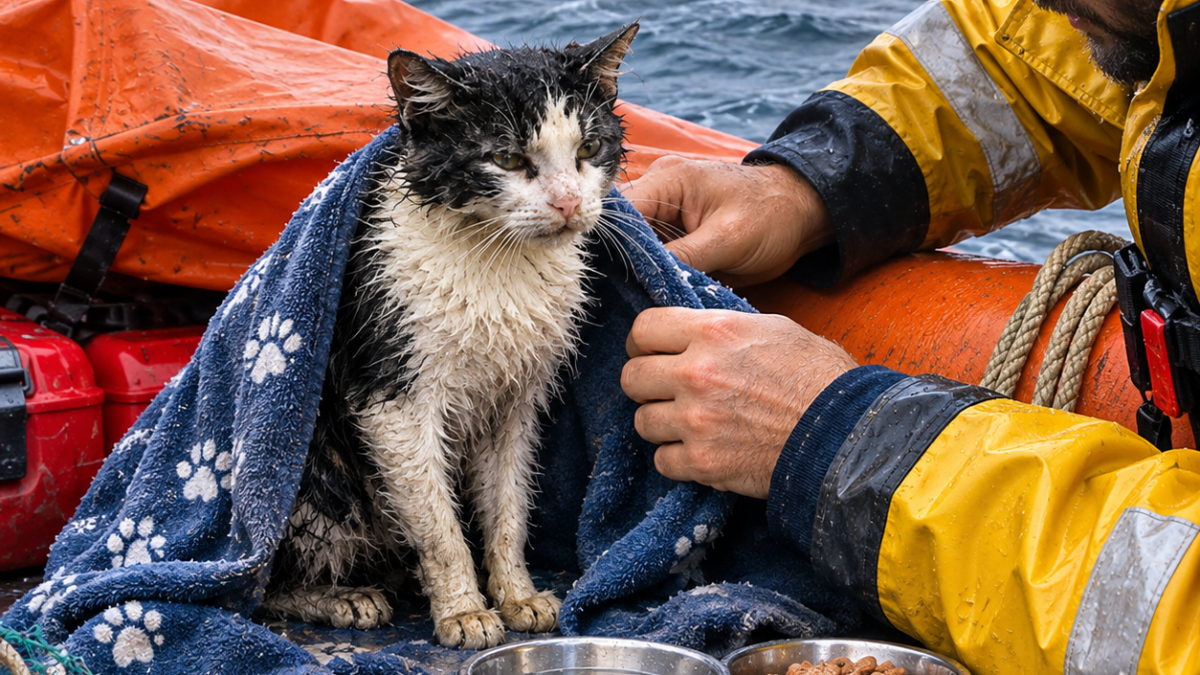
Inside the aircraft, we wrapped her in warm blankets.
She was badly dehydrated.
Sun damage across her ears and nose.
Salt irritation.
Weak pulse.
Exhaustion.
Our medical equipment was designed for human rescue, not veterinary care, so we did what we safely could until reaching shore.
One crew member offered water in tiny amounts.
Another warmed her gradually.
The photographer sat across from her.
He looked at the evidence bag containing the net.
“What kind of knot?”
“Bowline.”
He nodded.
“Fisherman.”
“Yes.”
“Could the cat have tangled it that way?”
“No.”
“You sure?”
“Completely.”
He stared at the carrier.
“So one of them tied her.”
“Yes.”
Nobody spoke after that.
## The Harbor Knew Her
By the time we contacted shore, people in the missing trawler’s home harbor had heard about the lifeboat.
Then someone mentioned the cat.
The reaction was immediate.
“What color?”
“Black and white.”
“Small female?”
“Yes.”
Silence.
Then:
“That’s their ship cat.”
Apparently nearly everyone around the harbor knew her.
She had spent about three years aboard the fishing trawler.
Walked the docks.
Slept in warm corners of the wheelhouse.
Watched fish being sorted with the seriousness of someone supervising an industry.
Sometimes stole food.
Sometimes disappeared into storage areas.
Always returned before sailing.
She belonged to the boat in the way working animals sometimes belong not to one person, but to an entire rhythm of life.
The fishermen had loved her.
That changed the meaning of the net even more.
## The Veterinary Hospital
A veterinary team met us after landing.
The cat was transported immediately.
Fluids.
Blood tests.
Eye cleaning.
Treatment for salt and sun damage.
Slow nutritional support.
Temperature monitoring.
Kidney values.
Everything you would expect after severe dehydration.
The veterinarian came to speak with us.
“She’s lucky.”
I looked at him.
“Lucky?”
He understood.
“Medically lucky.”
Better.
“She is severely dehydrated, but her organs are still responding.”
“Will she survive?”
“I think so.”
Those words mattered.
For eleven days, we had no good news connected to that trawler.
Now we had two words.
I think so.
## The Families
Then came the part I hated.
The families of the three missing fishermen had to be told the lifeboat had been found.
People sometimes imagine discovery brings closure.
Not always.
A lifeboat with no men can create new questions.
Were they ever all aboard?
How long?
What happened?
Did one fall first?
Did the raft overturn and right itself?
Were they swept away during a wave?
Did they enter the water trying to do something?
Search operations reviewed currents.
Weather.
Drift.
Timelines.
But the North Atlantic had already had eleven days to rearrange evidence.
## The Investigation
The most likely scenario was a catastrophic event involving the trawler—possibly sudden capsize or loss severe enough to force abandonment.
The crew deployed the lifeboat.
They used flares.
They opened water.
They raised the tarp.
They survived at least some time aboard.
Then something happened.
Perhaps heavy weather.
Perhaps raft instability.
Perhaps one man entered the water and others tried to help.
We will never know every minute.
That’s one of the cruelest things about the sea.
It doesn’t always return answers.
## Cold Water
People underestimate cold-water survival.
Water in the North Atlantic in November is not merely uncomfortable.
It is a biological emergency.
Cold shock.
Loss of useful movement.
Confusion.
Hypothermia.
Depending on temperature, clothing, body size and sea conditions, a person may lose meaningful ability to save himself very quickly.
Fifteen minutes can matter.
Forty-five can become impossible.
Once separated from the raft, chances collapse.
We continued searching.
Nothing.
## The Cat Wasn’t Evidence of Rescue
I need to say this because people later romanticized the story.
The cat surviving did not mean the men had had a comfortable eleven-day survival and simply disappeared moments before we arrived.
Probably not.
The raft had drifted alone for an unknown period.
The cat had survived because she required less water.
Because the tarp produced condensation.
Because her body was small enough to endure on what would have been useless to three adult men.
And because of the knot.
## Why Tie Her?
Imagine a lifeboat in rough seas.
Everything loose becomes dangerous.
Bags move.
Containers slide.
Bodies slam against surfaces.
Waves break over the sides.
A small cat could be swept overboard in seconds.
Even if she tried to claw the raft, wet material and violent motion could take her.
Somebody understood that.
So someone found a piece of fishing net.
Wrapped it around her body.
Not the neck.
Not painfully tight.
Around her middle.
Then secured her to a metal bench.
The loop allowed some movement.
Enough to sit.
Lie down.
Reach beneath the tarp.
But not enough to disappear over the side.
It was practical.
Professional.
Loving.
## What Were They Thinking?
This is where facts end and imagination begins.
I cannot tell you which fisherman tied the knot.
I cannot tell you exactly what he said.
I cannot tell you whether the other men were watching.
But I have spent enough time around fishermen to imagine the physical reality.
Cold fingers.
Wet clothes.
Wind.
Fear.
Maybe darkness.
Maybe dawn.
Cat frightened by waves.
A man reaching for net.
Working almost automatically.
Loop.
Around the body.
Rope through hand.
Bowline.
Pull.
Check.
Done.
Maybe someone said:
“She’ll get washed over.”
Maybe another answered:
“Tie her.”
Maybe nobody said anything.
Sometimes people who have worked together for years do not need many words.
## The Last Knot
The phrase came later.
“His last knot.”
I didn’t say it first.
The wife did.
But once she said it, nobody could forget it.
A fisherman may tie hundreds of knots in a week.
Thousands in a career.
Nets.
Lines.
Fenders.
Buoys.
Equipment.
Then, perhaps near the end of his life, one knot around a cat.
That’s why people couldn’t look away from the photograph.
It made sacrifice visible without showing the person who made it.
## The Cat’s First Night on Land
She slept almost continuously.
The veterinarian said that was normal.
Her body finally had warmth, fluid and safety.
No waves.
No need to lick condensation.
No salt spray.
No violent movement.
Just blankets.
When she woke, she ate a small portion.
Then another later.
She drank carefully.
Her kidney function improved.
Her eyes cleared.
The crust softened and disappeared.
The burns on her nose began healing.
## She Hated Closed Doors
One of the nurses told me that whenever they closed the kennel door and walked away, the cat became restless.
Was that trauma?
Maybe.
Was she simply a ship cat used to movement and people?
Maybe.
They began leaving a radio near her when possible.
Voices calmed her.
That detail stayed with me.
Eleven days of ocean silence changes the way you think about sound.
## The Missing Men
The search continued beyond the raft discovery.
Aircraft.
Vessels.
Drift calculations.
Shoreline checks.
Nothing.
Eventually, every search operation reaches a point where probability becomes too low to justify continuing at full intensity.
That decision is brutal.
Families hear:
The active search is ending.
What they feel is:
We’re leaving them out there.
Those are not the same thing.
But grief does not care about operational language.
## The Wife
One of the fishermen’s wives came to the veterinary hospital three days after the cat was found.
I was there because investigators wanted someone from the rescue crew to walk the family through the raft evidence.
She entered quietly.
No dramatic collapse.
No screaming.
She looked tired in a way sleep cannot fix.
The cat heard her voice before seeing her.
The woman whispered:
“Baby.”
The cat lifted her head.
Then stood.
Weakly.
Tail low.
Walked toward the edge of the kennel.
The woman placed both hands against the bars.
The cat pushed her face toward them.
The woman began crying.
That was the first moment I had to look away.
## “She Knows Me”
“She knows me,” the woman said.
“Yes.”
“She used to sleep on my husband’s coat when he brought it home.”
The cat rubbed against her fingers.
“She hated me when we first got her.”
I smiled.
“Cats are selective.”
“She loved him immediately.”
There it was.
Him.
The man who was missing.
## The Net
Investigators later allowed the family to examine the section of net once it was no longer needed as evidence.
The wife looked at it.
Then froze.
“What?”
She took the net carefully.
Turned the bowline.
Her fingers followed the loop.
Then she began to cry.
Not quietly this time.
“That’s his.”
I didn’t understand.
“The net?”
“The knot.”
She held it up.
“That’s his knot.”
One investigator said:
“A bowline is common among fishermen.”
She shook her head.
“I know.”
Then she pointed at the way the tail was finished.
“He always left it like this.”
She ran her thumb over the rope.
“Thirty years.”
“What?”
“He tied this knot every day for thirty years.”
She looked at me.
“I’d know it anywhere.”
## Could She Really Know?
Some people later questioned whether anyone could recognize another person’s bowline.
Fair question.
A bowline follows the same structure.
But people develop habits.
Tail length.
Direction.
How tightly they dress it.
Whether they add a stopper.
Where their hands naturally leave the line.
Think of handwriting.
The alphabet belongs to everyone.
The hand does not.
For the wife, there was no doubt.
## Her Husband
She believed her husband had tied the cat.
We could not prove it scientifically.
But he had spent decades at sea.
He cared deeply for the cat.
The finishing style matched what she remembered.
And the little animal had spent three years on his boat.
Sometimes certainty in grief does not come from laboratories.
It comes from intimacy.
## “He Knew”
The wife sat with the net in her lap.
Then said:
“He knew.”
I asked:
“Knew what?”
“That they weren’t getting home.”
I didn’t answer.
Maybe.
Maybe not.
People on lifeboats do practical things because survival requires them, not because they’ve surrendered.
But I understood what she meant.
She looked at the knot.
“If he tied her down, it was bad.”
“Because of the waves?”
“Yes.”
“He always let her move around the boat.”
Then:
“He wouldn’t tie her unless he thought she could be washed away.”
She knew him.
Better than I ever could.
## Anger
Grief often changes direction.
At first, she blamed the sea.
Then the weather forecast.
Then the boat.
Then herself.
“Why did I let him go?”
I remember answering:
“You didn’t send him.”
“He said weather wasn’t ideal.”
“He’d worked that sea for decades.”
“I should’ve told him to stay.”
Would he have?
Probably not.
Fishermen live inside decisions land people don’t understand.
Weather is always part of work.
Risk becomes ordinary until the day ordinary becomes catastrophic.
## The Cat Gets Stronger
One week after rescue, the cat had gained weight.
Not all of it.
Enough.
She groomed herself again.
That was a huge sign.
Cats who feel terrible often stop grooming.
She licked salt-stiff fur.
Cleaned paws.
Tried to remove the veterinary band.
Normal irritation.
Beautiful.
## The First Jump
She tried to jump from a low platform.
Missed slightly.
Nurses panicked.
The veterinarian laughed.
“She thinks she’s healthy.”
“Is she?”
“Not yet.”
Tell a cat that.
## The Photograph Reaches the Newspaper
A local coastal newspaper asked permission to publish the Coast Guard photograph.
Officials approved the version that didn’t compromise the investigation.
The image spread.
At first regionally.
Then nationally.
Then everywhere.
Millions of shares.
People wrote essays about it.
Sailors messaged from other countries.
Fishermen posted pictures of their own ship cats.
Some people saw survival.
Others saw sacrifice.
Most saw the knot.
## Why the Photograph Hurt
There is a particular kind of grief created by absence.
If a body is recovered, families know where to direct mourning.
An empty ocean gives you nothing to hold.
The photograph gave the families something.
Not their men.
Never enough.
But evidence of what they had done.
They had not simply vanished in chaos.
They had tried.
Flares.
Water.
Shelter.
Protection.
The raft showed decision after decision.
They had fought to survive.
And they had protected something weaker than themselves.
## The Internet Invents Stories
As the photograph spread, people added details that weren’t known.
One post claimed the men had gone into the sea voluntarily to save each other.
Not confirmed.
Another claimed the cat had watched them die.
We didn’t know.
Another said the husband whispered goodbye to her.
No evidence.
I hated those additions.
The truth was already powerful.
We didn’t need to decorate it.
Three men vanished.
A cat survived.
Someone tied her to safety.
That’s enough.
## The Cat Goes Home
After nearly three weeks of veterinary treatment, the cat was medically cleared.
The question became:
Where would she live?
Legally and emotionally, the answer quickly became obvious.
The fisherman’s wife.
She brought a carrier.
The cat refused it initially.
Typical.
Eventually entered after food persuasion.
Before they left, the veterinarian gave instructions.
Hydration.
Food.
Skin care.
Follow-up bloodwork.
Sun protection while ears healed.
The wife listened carefully.
Then asked:
“Can she go near the harbor?”
“Eventually.”
“Do you think the sound of boats will upset her?”
Nobody knew.
## First Night in the House
She slept on the missing fisherman’s coat.
Of course she did.
The wife sent a photograph to the rescue team.
Black-and-white cat curled inside dark waterproof fabric.
No caption.
Didn’t need one.
## The Waiting Chair
The husband had a chair near the kitchen window.
The cat began sleeping there.
The wife said sometimes she woke at night and found the cat staring toward the front door.
That was when grief became unbearable again.
Did the cat expect him?
No one could say.
The wife did.
“She waits.”
Maybe.
Or maybe the chair was warm.
Sometimes we let grief choose the explanation that helps us survive.
## The Net on the Wall
Once investigators formally released the piece of net, the wife asked to keep it.
She did not untie the bowline.
Important.
The entire piece went onto the kitchen wall.
A short length of weathered fishing net.
Salt marks.
Frayed sections.
Knot intact.
Visitors often asked what it was.
She’d say:
“The last thing I know my husband tied.”
Not:
The last thing he definitely tied.
The last thing I know.
That distinction held both love and uncertainty.
## The Memorial
Months later, the harbor held a memorial for the three fishermen.
No bodies.
Three photographs.
Flowers.
Fishing vessels sounded horns.
Families stood together.
The cat stayed home.
Good.
She didn’t need ceremony.
The people did.
## The Sea Was Calm
That day, the sea near shore was almost insulting in its calmness.
Blue-grey.
Gentle movement.
Sunlight.
People who have lost someone at sea sometimes say that calm water makes them angrier than storms.
How can something so beautiful be the same thing that took them?
I understood.
## The Bowline at the Memorial
The wife carried a photograph of the net.
Not the actual net.
She refused to risk losing it.
During the memorial, someone read:
“A sailor’s last duty may be to another life.”
I didn’t know who wrote it.
It was true enough.
## The Cat Returns to the Harbor
Several months after recovery, the wife brought the cat to the harbor in a secure carrier.
She opened it inside the old trawler’s storage shed area—not the missing vessel, obviously, but among familiar smells.
Diesel.
Rope.
Fish.
Salt.
Wood.
The cat stepped out.
Stopped.
Nose moving.
Then walked toward a pile of nets.
The wife cried.
“She remembers.”
Probably.
Scent memory in cats is strong.
The cat rubbed against one old rope coil.
Then sat.
## Revenge Against the Sea
People asked me whether I ever felt angry at the Atlantic.
Yes.
I know that sounds irrational.
The ocean isn’t a person.
It has no intention.
No guilt.
No regret.
You cannot punish weather.
You cannot arrest a wave.
You cannot put cold water on trial.
So what does revenge mean in a story like this?
For me, it meant this:
The sea took almost everything from that lifeboat.
Three men.
Their voices.
Their futures.
Their bodies.
Their families’ certainty.
But it did not take the cat.
Somebody made one knot.
The Atlantic pulled at that raft for eleven days.
Wind.
Waves.
Cold.
Salt.
Darkness.
That bowline held.
That was the only revenge available.
The sea didn’t get everything.
## The Missing Men Were Declared Lost
Eventually, official paperwork caught up with what families already feared.
Presumed dead.
Those words are administrative.
They change bank accounts.
Insurance.
Property.
Legal status.
They do nothing for grief.
The wife signed papers.
Then went home to the cat.
## Survivor Guilt
Yes, animals can change the shape of survivor guilt in human families.
The wife sometimes said:
“Why her?”
Not cruelly.
Never wishing the cat had died.
Just asking the universe its favorite useless question.
Why did a four-kilogram animal survive while three strong fishermen didn’t?
Because biology.
Because water needs.
Because the knot.
Because luck.
Because timing.
None of those answers satisfy grief.
## “He Saved Her”
Eventually, the wife stopped asking why.
Instead, she said:
“He saved her.”
That statement became a place she could stand.
Her husband might not have been able to save himself.
He had saved something.
That mattered.
## The Cat’s Name Becomes Known
For the purposes of this retelling, I’ll call her **Mara**, though the real ship cat’s private family name matters less than what she represented.
Mara became locally famous.
She hated photographers.
Loved warm fish.
Ignored almost everyone except the fisherman’s wife and several old harbor workers.
Normal cat behavior returned.
That’s what everyone wanted.
## Mara Hated Wind
One thing changed.
Strong wind through open windows made her hide.
Was that because of eleven days at sea?
Perhaps.
No one forced her to “overcome” it.
The wife closed the window.
Sometimes healing means removing the trigger, not demanding bravery.
## Rain on Plastic
Another strange detail.
The sound of rain on plastic tarps made Mara restless.
The veterinarian said trauma associations were possible.
The wife replaced one garden cover because of it.
Small accommodations.
Love becomes visible in inconvenient details.
## Her Weight Returns
Three weeks after rescue, nearly normal.
Two months later, full healthy weight.
Coat soft.
Ears healed.
Nose mostly recovered.
Eyes clear.
The crusted, salt-stiff animal from the raft became a sleek black-and-white cat again.
The photograph had frozen her at the worst moment.
Life didn’t.
## The Wife Refuses Money
People offered donations.
She accepted veterinary assistance initially through rescue arrangements.
But when strangers tried to send personal money later, she declined most of it.
“Give it to the rescue crews.”
That was her answer.
Or families of fishermen.
Or animal shelters.
Mara had a home.
## The Boat’s Locker
Some personal items from the missing trawler eventually came back through the investigation.
A waterproof bag.
A knife.
A cap.
Small equipment.
The wife placed the cap near Mara.
The cat smelled it.
Then lay beside it.
Again, interpretation is dangerous.
Still, everyone cried.
## The Bowline
I visited the wife almost a year after the rescue.
The net hung in the kitchen.
Exactly as she’d promised.
The bowline remained tied.
I stood beneath it.
Smaller than I remembered.
That’s often true of objects that carry enormous meaning.
“What happens when it falls apart?”
I asked.
She looked offended.
“It won’t.”
“Everything does.”
“Then I’ll keep the pieces.”
Fair.
## Why Not Untie It?
A visitor once asked.
The wife answered:
“Because he tied it.”
That was enough.
Untying it would not erase the memory.
Still, some objects become sacred through form.
The knot was a handprint.
## One Year
On the first anniversary of the trawler’s disappearance, the family did not go out to sea.
They stayed home.
Mara slept on the chair.
The wife cooked too much food because grief creates strange habits.
Three plates almost appeared before she stopped herself.
Instead, she fed Mara a piece of fish.
## The Photographer
The Coast Guard photographer told me later he almost hadn’t taken the image.
Why?
“It felt intrusive.”
I understood.
Then he said:
“But I thought somebody would need to see what was there.”
He was right.
A photograph can become evidence.
Memorial.
Testimony.
All at once.
## Six Million Shares
Numbers online are absurd.
Six million.
Maybe more eventually.
Most people who shared it would forget within a week.
That’s normal.
But some didn’t.
A sailing instructor in Canada reportedly began using the image when teaching safety knots.
A rescue organization used it to talk about animals aboard working vessels.
Fishermen discussed better emergency planning for ship animals.
Life jackets for cats and dogs became part of conversations.
The knot kept working long after it stopped holding Mara physically.
## Emergency Plans
Several Donegal fishermen started keeping animal flotation gear aboard after the story.
Not because ship cats were common everywhere.
Because the story forced a question:
What happens to the animal if we abandon ship?
Before Mara, many had never thought about it.
After?
They did.
That’s legacy.
## Was the Knot Painful?
People asked.
No.
Not in the way it was tied.
The net around Mara had been positioned to restrain rather than choke.
There were marks from prolonged contact and movement, but not evidence that someone had intentionally hurt her with it.
The knot likely saved her.
Could it have trapped her if the raft sank?
Yes.
That’s the horrible complexity.
A safety measure depends on the raft staying afloat.
The fisherman made the best decision he could with the danger in front of him.
The raft held.
So did the knot.
## The Water Container
One detail haunted the wife.
One container still had some water when we found the raft.
“Why didn’t they drink it?”
She asked investigators.
We don’t know.
Maybe it belonged to emergency reserve.
Maybe men disappeared before it was needed.
Maybe the raft had been empty for days.
Maybe the cat couldn’t reach it.
Evidence creates questions as often as answers.
## The Flares
Two missing flares.
Somewhere, sometime, the men had signaled.
Nobody saw them.
That thought hurt.
Imagine firing light into darkness and receiving no answer.
But the flares proved they tried.
Again.
Evidence of action.
Not surrender.
## The Tarp
Raised carefully.
Fastened.
Designed to block weather.
Condensation beneath it later saved Mara.
Did the men know it would?
Probably not as their main purpose.
They were protecting themselves and the cat from exposure.
But survival often depends on secondary effects.
A tarp becomes a water source.
A net becomes a seatbelt.
A knot becomes a memorial.
## The Last Hours
We will never know them.
I refuse to invent exact speeches.
But certain facts create boundaries.
They were aboard long enough to use equipment.
They considered the cat’s safety.
They faced severe conditions.
Then they disappeared.
Within those facts lies enough humanity.
## “He Didn’t Forget Her”
The wife said this often.
“He didn’t forget her.”
That became more important than whether the knot was literally his final act.
He had remembered the cat during an emergency.
That’s what she needed.
When everything becomes survival, compassion is often the first luxury people abandon.
He didn’t.
## The Cat Gets Older
Years passed.
Mara became heavier.
Then slightly too heavy.
The veterinarian recommended fewer treats.
The wife laughed when she told me.
“She survived eleven days on condensation and now I’m being told she eats too much.”
Best problem possible.
## She Became a House Cat
Mostly.
No more long fishing trips.
The wife would not allow it.
“She’s retired.”
Mara agreed.
Warm windows.
Kitchen chair.
Blankets.
Occasional harbor visits.
Enough.
## Storm Nights
On severe storm nights, the wife often found Mara under the bed.
She would sit nearby.
Not drag her out.
Just talk.
Sometimes grief recognizes itself in another creature even when we can’t prove the creature remembers the same thing.
## The Knot Collects Dust
Ordinary dust.
The wife cleaned around it carefully.
Never washed the net.
Salt remained in places.
A few strands faded.
The bowline stayed.
## Children Asked About It
Grandchildren.
Neighbors.
Visitors.
“What is that?”
She would tell the story.
Not always all of it.
Sometimes simply:
“Your grandfather tied it.”
And:
“It saved a life.”
Enough for children.
## The Fisherman’s Hands
The wife described her husband’s hands once.
Scarred.
Large.
Cuts around fingers.
Nails damaged from decades of rope, hooks and cold.
“He could tie a bowline without looking.”
Of course.
I imagined those hands in the lifeboat.
This is imagination, not evidence.
But it’s hard not to.
Fingers numb.
Still remembering muscle memory.
## The Last Knot Might Not Have Been Last
Important.
Maybe he tied another knot afterward.
Maybe someone else tied Mara’s.
Maybe the men survived hours longer.
We shouldn’t turn uncertainty into fact.
Yet symbolically, the bowline remains.
The last knot his wife recognized.
That is enough.
## The Sea Never Returned Them
Years passed.
No confirmed recovery of the three fishermen.
Sometimes fragments of lost vessels appear years later.
Sometimes bodies return.
Sometimes nothing does.
The North Atlantic keeps secrets without malice.
That may be worse.
## The Wife Stops Waiting
Not all at once.
There is no morning when a widow says:
Today I am done waiting.
It happens in pieces.
She stops looking at every unfamiliar car.
Stops interpreting every late phone call.
Stops imagining a knock.
The cat helps.
Routine.
Breakfast.
Litter.
Vet.
Chair.
Life demands small tasks even when grief wants stillness.
## Mara’s Illness
Years later, Mara developed kidney disease.
Common in older cats.
The wife panicked.
“She survived the Atlantic.”
The veterinarian smiled gently.
“The Atlantic doesn’t make her immortal.”
Hard truth.
They managed it.
Diet.
Fluids.
Monitoring.
## Another Kind of Survival
Mara lived several more years.
Not dramatic.
That’s good.
Warm home.
Kidney diet she hated.
Treats she wasn’t supposed to have.
Sunlight.
No sea.
## My Visit
The last time I saw her alive, she was sleeping beneath the bowline on the kitchen wall.
I stood there and realized the geometry.
Years earlier, the net had held her to a lifeboat bench.
Now the same knot hung over her while she slept freely.
Nothing attached.
That felt right.
## The Wife Says Something I Never Forgot
“She doesn’t need it anymore.”
I looked at the net.
“No.”
She smiled.
“But I do.”
That’s what memorials are.
Objects no longer needed for their original function becoming something humans need emotionally.
## Mara’s Final Year
She slowed.
Arthritis.
Kidneys.
Hearing slightly reduced.
Still opinionated.
Still black-and-white.
More white around the face.
The wife lifted her onto the favorite chair when jumping became difficult.
## The Ocean Photograph
Someone sent the wife a framed copy years earlier.
She kept it in a drawer.
Why not display it?
“I don’t want to remember her there every day.”
Good.
The net stayed on the wall.
The photograph didn’t.
Interesting difference.
The net represented her husband’s action.
The photo represented Mara’s suffering.
She chose which memory deserved daily space.
## The Last Winter
Mara stopped eating well.
Kidney disease progressed.
The wife sat through appointments.
Same fear.
Different emergency.
This time no helicopter.
No Atlantic.
Just old age.
## The Decision
Eventually the veterinarian explained quality of life.
The wife cried.
“She fought so hard.”
The veterinarian answered:
“She doesn’t have to fight forever.”
That is one of the kindest things medicine can say.
Survival isn’t an obligation.
## One Last Night
Mara slept on her husband’s old coat.
The coat was almost falling apart by then.
The wife sat beside her.
Wind outside.
Rain against the house.
No lifeboat.
No tarp.
No open ocean.
Just home.
## Morning
The veterinarian came to the house.
Mara was wrapped in a blanket.
The wife held her.
Before the final medication, she looked toward the bowline.
Then back at the cat.
“Your job is done.”
Maybe she meant Mara.
Maybe the knot.
Maybe both.
## Goodbye
Mara died quietly.
No dehydration.
No sunburn.
No eleven-day fight.
Warm.
Held.
The wife cried into her fur.
Years earlier, somebody had secured this cat because they could not guarantee they’d remain beside her.
At the end, someone remained beside her all the way.
## What Happened to the Net?
It stayed on the wall.
Of course.
The wife said removing it after Mara died would feel wrong.
The knot had outlived both the man who tied it and the cat it saved.
Objects do that.
## The Ashes
Mara’s ashes stayed in the house.
The wife did not scatter them at sea.
People assumed she would.
“No.”
That answer was immediate.
“The ocean had enough.”
I understood completely.
## Revenge
If there is revenge in this story, it is not against a person.
It is against disappearance.
The Atlantic erased three men physically.
But not completely.
One man’s habits survived in a knot.
His care survived in a cat.
His memory survived on a kitchen wall.
The sea took bodies.
It did not take evidence that they had loved.
## The Last Thing the Ocean Couldn’t Take
That became the phrase I used privately.
Not the cat.
Not exactly.
The ocean couldn’t take the choice.
A man chose to secure her.
Once made, that act became permanent history.
Even if the knot had failed, the choice would still have mattered.
But it didn’t fail.
For eleven days, rope held.
## The Cat Didn’t Know
Mara did not understand sacrifice.
She did not know millions of people saw her photograph.
She did not know men were missing.
She did not know a knot symbolized love.
She knew:
Thirst.
Cold.
Movement.
Fear.
Then rescue.
Food.
Warmth.
Home.
Perhaps that’s enough.
## People Need Meaning
Humans do.
We look at knots.
Photographs.
Empty lifeboats.
We ask what they mean.
Sometimes meaning is invented.
Sometimes it is already there.
## The Bowline Means This
A secure loop.
Easy to untie after load.
Reliable.
Ancient.
Practical.
Nothing sentimental about the knot itself.
Everything sentimental about what it held.
## Three Men
I don’t want the cat to erase them.
That is a danger in animal stories.
The cute survivor becomes the headline.
Three human beings disappeared.
Three families lost someone.
The cat matters partly because the knot leads us back to them.
Their decisions.
Their character.
Their final known actions.
## The Crew
They deployed the raft.
Opened water.
Used flares.
Raised shelter.
Protected the cat.
Those are acts of people who were trying.
I choose to remember that.
## The Wife’s Kitchen
Years later, after Mara’s death, I visited once more.
The house was quieter.
The chair empty.
The net still hanging.
The wife made tea.
We sat beneath it.
“Do people still ask?”
“All the time.”
“Tired of telling it?”
She thought.
“No.”
Then:
“Sometimes.”
Fair.
## “Would He Have Saved Himself Instead?”
Someone once asked the wife a cruel question.
If tying the cat cost time, could that time have saved him?
No.
That’s not how maritime survival works.
Seconds used tying a bowline around a cat did not cause three trained fishermen to disappear.
Compassion was not their fatal mistake.
The sea was already bigger than that.
## Compassion Under Pressure
That’s what continues to move me.
Anyone can be kind when kindness costs nothing.
The profound moments are when kindness survives crisis.
Cold.
Fear.
Uncertainty.
Limited water.
Limited time.
Someone still thought:
The cat.
## The Net as Evidence of Character
We often judge people by their final words.
At sea, we rarely receive those.
The knot became something similar.
A final visible decision.
## If I Could Speak to the Fisherman
I have imagined this too often.
I would tell him:
“It held.”
That’s all.
No speech.
No explanation.
“It held.”
The bowline stayed.
The raft stayed afloat.
The cat stayed attached.
Eleven days.
Helicopter found her.
She lived.
Your wife knew the knot.
She took her home.
She slept on your coat.
The net hangs in your kitchen.
People remember.
It held.
## If I Could Speak to Mara on Day One
I’d tell her nothing.
She wouldn’t understand.
I’d give water.
Warmth.
Then home.
Animals need action more than narrative.
## The Photo
I still have a copy.
I don’t look at it often.
Every time I do, I notice something different.
The emptiness.
The scale.
How tiny the cat looks.
How absurdly vast the sea is.
Then the line of net.
So thin.
That’s what strikes me now.
A thin piece of material against an ocean.
Objectively ridiculous.
Yet enough.
## The Human Scale
We are always small compared with nature.
Boats.
Ropes.
Flares.
Helicopters.
Knots.
Tiny things.
Still, we use them.
That’s what humans do.
We cannot control the sea.
We build things that might survive it.
## The Last Water
I still wonder about the partially filled container.
Always will.
Maybe the men disappeared earlier than investigators first estimated.
Maybe weather changed.
Maybe someone fell.
Uncertainty remains.
The cat cannot answer.
## That Is Okay
Not every mystery must be solved for a story to matter.
Sometimes the unsolved parts are the truth.
## Years Later
Young Coast Guard recruits occasionally heard the story.
I showed them the photograph.
Not to make them emotional.
To teach observation.
Empty raft?
Look closer.
Used equipment?
Document it.
Animal aboard?
Rescue it.
Knot?
Do not cut before recording.
Tiny details can become the only language missing people leave behind.
## Search and Rescue Is Sometimes Rescue Without Search Success
We never found the three men.
That failure stays.
People imagine rescue workers measure success only in lives returned.
We can’t.
Sometimes you bring back evidence.
Sometimes a pet.
Sometimes nothing.
You still fly.
## The Cat Was One Life
Not three.
We never pretended otherwise.
But one life is still one life.
The families understood that better than anyone.
No one said:
Why save the cat?
They said:
Thank God something came home.
## Something Came Home
That phrase belongs in the story.
Not because Mara replaced anyone.
She couldn’t.
But she carried smell.
Habit.
Memory.
A piece of boat life.
The wife said the house felt less completely empty when Mara entered.
That’s enough.
## The Final Knot
People often want to know if I truly think it was the husband’s final knot.
I don’t know.
Truthfully.
Maybe.
Maybe another crewman tied it.
Maybe he tied something later.
But I know this:
It was a knot made during the crew’s final known hours aboard that lifeboat.
It was tied by someone who knew the sea.
It was tied to keep a cat from being swept away.
It held eleven days.
Everything after that is interpretation.
And sometimes interpretation can be honest as long as we admit where fact ends.
## The Revenge Against Oblivion
That’s the part I believe most strongly.
People fear death.
But many fear being forgotten almost as much.
The sea gives families a particular version of that fear because it often returns no grave.
The bowline became a grave marker without a grave.
Not because death happened at the knot.
Because memory attached there.
## The Wife Grows Older
She kept the kitchen wall exactly the same for years.
Eventually the house needed repainting.
Workers asked whether to remove the old net.
“No.”
They painted around it.
I love that detail.
The room changed.
The knot stayed.
## A New Generation
Grandchildren learned bowlines.
Of course.
One of them asked:
“Is this how Grandpa did it?”
The grandmother corrected his fingers.
“No. Tail longer.”
There.
Memory becoming technique.
## A Knot Travels Through Time
The husband learned it decades ago from another fisherman.
Used it throughout life.
Tied one around Mara.
Wife recognized it.
Grandchildren learned it.
That’s how practical knowledge becomes family memory.
## The Sea Gives Nothing Back for Free
Even the raft came with grief.
Even the cat came with scars.
But she came.
## The Most Beautiful Part
Not the photograph.
Not six million shares.
Not newspaper articles.
Not even the adoption.
For me?
The wife saying:
“That’s his knot.”
Because suddenly three missing men were not abstractions in a maritime report.
One had hands.
Habits.
A way of finishing rope.
A wife who knew.
## The Most Painful Part
Same sentence.
“That’s his knot.”
Because recognition confirmed absence.
## Love Leaves Patterns
Handwriting.
Tool marks.
Recipes.
Knots.
We leave ourselves everywhere without realizing it.
## Eleven Days
People repeat the number because it sounds impossible.
Eleven days.
Think about each night.
Temperature dropping.
Wind.
Raft flexing.
Cat tied loosely to bench.
Condensation forming.
Tongue against plastic.
Morning.
Again.
No humans.
Perhaps after the first day.
Perhaps after several.
We do not know.
## The Bowline Never Tightened
That’s part of what makes it a good knot.
The loop maintains shape under load.
It doesn’t behave like a running noose.
Whoever tied it chose something appropriate.
Again:
Knowledge plus care.
## The Photographer’s Choice
Click.
One frame.
Maybe several.
One becomes history.
If he hadn’t taken it, the net still would’ve mattered to investigators and family.
But millions would never have seen it.
Photographs can extend witness.
## Witness
That’s what we became.
Witnesses to an act we didn’t see happen.
The knot made us witnesses afterward.
## What the Ocean Did Not Say
It never told us how the trawler went down.
Never returned the men.
Never explained the missing flares.
Never explained the final water.
The ocean was silent.
The knot wasn’t.
## The Knot Said:
Someone was here.
Someone knew the sea.
Someone was afraid enough to secure the cat.
Someone cared enough to do it carefully.
Someone expected violent water.
Someone wanted this animal to have a chance.
That’s enough testimony for me.
## The Ending the Men Never Saw
Mara recovering.
Eating.
Sleeping on the coat.
Growing old.
Becoming overweight.
Developing kidney disease.
Dying warm at home.
Maybe that’s the ending the fisherman wanted when he tied her.
Not fame.
Not newspapers.
Just:
She lives.
## The Last Night Aboard
I sometimes picture him checking the knot.
Pull.
Firm.
Cat secure.
Then turning back toward the others.
Again, imagination.
But plausible.
If I’m going to imagine, I choose restraint.
No grand speech.
Fishermen aren’t movie characters.
He probably just tied it.
Maybe said:
“Stay there.”
That’s enough.
## No Human in the Photo
Yet everyone sees one.
That’s why the image endured.
Absence can have a shape.
## The Cat’s Eyes
In the photograph, she appears to look toward the helicopter.
Maybe.
From that distance, hard to know.
But she was alive.
That’s the point.
## The Last Fight
The sea versus rope.
Eleven days.
Rope wins by enough.
## The Fisherman’s Wife
She never called it revenge.
That was my word.
She called it:
“A gift.”
Mara surviving.
The knot returning.
Something made by her husband’s hands coming back when he didn’t.
A terrible gift.
Still a gift.
## The Net
Short.
Cheap.
Ordinary.
Probably cut from working gear.
No monetary value.
Invaluable.
## What Happened to the Lifeboat?
It was recovered for investigation.
Inspected.
Documented.
Eventually became equipment again or evidence stored away depending on procedures.
I don’t know where it is now.
Doesn’t matter.
The net went home.
## The Difference
A lifeboat is built to save lives.
It didn’t save the men.
A scrap of fishing net wasn’t designed to save anything.
It saved the cat.
Life is cruelly inconsistent.
## The Wife’s Answer
A journalist once asked:
“Do you think your husband knew the cat would be found?”
She answered:
“No.”
Then:
“I think he hoped.”
Perfect.
Hope is action without guarantee.
He tied anyway.
## That’s Rescue Too
Not knowing.
Doing the next thing anyway.
## The Harbor Cats
After Mara became famous, people started noticing the other cats around working boats.
Some had life jackets.
Some had collars with emergency contact information.
Some crews prepared carriers near exits.
Mara changed practice.
Another legacy.
## The Boatmen
Old fishermen came to the wife’s house sometimes.
They would look at the net.
Touch the bowline.
One said:
“He always tied them neat.”
The wife nodded.
No one said much else.
Men who spend lives at sea often know when language isn’t useful.
## Silence
There is a kind of companionship in shared silence.
The cat understood that better than anyone.
## Her Final Ashes Stayed Ashore
I keep returning to that.
The wife refused the ocean.
“She spent enough time out there.”
Mara remained home.
The sea got none of her after death.
There.
Maybe that is revenge too.
## The Three Fishermen’s Names
In a real memorial, names matter.
In this dramatized retelling, I leave them private because the source text you gave me does not identify them.
That feels respectful.
Their absence is not an invitation to invent identities.
The story belongs to what is known.
## What Is Known
Three crew.
Fishing trawler.
County Donegal.
Missing eleven days.
Lifeboat discovered around 140 nautical miles off northwestern Ireland.
Black-and-white ship cat.
Severe dehydration and exposure.
Emergency tarp.
Used flares.
Water containers.
Fishing net.
Bowline.
Survival.
Recovery.
Wife.
Recognition.
Home.
That is already extraordinary.
## THE END
Eleven days after a fishing trawler disappeared into the North Atlantic, I climbed into an orange lifeboat expecting to find evidence of death.
Instead, I found evidence of love.
The three men were gone.
No bodies.
No voices.
No one waving.
No explanation.
But the raft carried traces of what they’d done after disaster struck.
They had opened water.
Used flares.
Raised a tarp.
Tried to protect themselves against weather.
And before they disappeared, someone looked at the smallest passenger aboard and realized she had almost no chance against the waves.
So he took a piece of fishing net.
Wrapped it carefully around the little black-and-white cat.
Secured it to the bench.
Then tied a bowline.
Nothing about that act guaranteed rescue.
The raft might have overturned.
The knot might have failed.
The cat might have died from dehydration.
Nobody might ever have found her.
The fisherman could not control any of those things.
He controlled one thing.
Whether she was tied safely when the next wave came.
So he tied her.
That’s what courage and love often look like during real emergencies.
Not speeches.
Not promises.
A practical task.
One thing you can still do.
Then another.
I don’t know which of the three men made that knot with scientific certainty.
The fisherman’s wife believed she did.
She had watched her husband tie bowlines for thirty years.
She knew the length of tail he left.
The way he dressed the loop.
The small habits hands develop after repeating the same movement thousands of times.
When she held the net and said, “That’s his knot,” there wasn’t a person in the room who needed a longer explanation.
For eleven days, that knot stayed firm.
Imagine the weather pulling at it.
Raft rising.
Dropping.
Spray.
Wind.
Darkness.
The cat shifting beneath the tarp.
The net tightening against the bench.
The bowline holding its shape.
Every hour the ocean tried to turn everything aboard into something loose.
The knot answered:
No.
Eventually our helicopter appeared above the raft.
The cat was still there.
Dehydrated.
Burned.
Half-starved.
Eyes crusted.
Fur stiff with salt.
Alive.
Alive because tiny drops of condensation gathered beneath a sheet of plastic.
Alive because the lifeboat stayed afloat.
Alive because her body kept going.
Alive because someone had thought far enough beyond his own fear to secure her.
People later shared the photograph millions of times.
I understand why.
There are no human beings in it.
Yet when I look at it, humans are all I see.
The person who raised the tarp.
The person who fired the flares.
The hands that opened water.
The hands that cut net.
The hands that made the bowline.
Human beings were absent from the picture physically.
Their choices remained.
That is why the photograph hurt.
And why it comforted.
The sea had erased so much.
The knot proved it had not erased everything.
The three fishermen never came home.
No happy ending can repair that sentence.
The cat’s survival did not balance three deaths.
Nothing could.
She was not a replacement for a husband, father, brother or friend.
But grief is not arithmetic.
Sometimes one surviving thing matters precisely because it cannot replace what was lost.
Mara—what I have called the ship cat in this retelling—came home carrying something the ocean could not translate into an official report.
Connection.
She knew the boat.
She knew the fishermen’s smells.
She knew one man’s coat.
When his wife brought her home, the cat slept on that coat.
Maybe because it smelled familiar.
Maybe because it was warm.
For the widow, it did not matter which explanation was scientifically correct.
Her husband had not come back.
Something he loved had.
The piece of net eventually went home too.
It was hung on the kitchen wall with the bowline untouched.
Years passed.
Paint changed.
Furniture changed.
The cat grew old.
The knot stayed.
Imagine that transformation.
At first, the bowline was equipment.
Then a restraint.
Then a lifesaving device.
Then evidence.
Then a memorial.
Finally, simply part of a kitchen.
That’s what love does to ordinary objects.
It gives them jobs they were never manufactured to perform.
A cheap piece of fishing net became more valuable than anything money could replace.
People liked calling it the fisherman’s final knot.
Maybe it was.
Maybe not.
We cannot know.
Perhaps he tied something afterward.
Perhaps another crew member tied Mara.
Perhaps the men survived several hours longer than investigators believed.
Facts matter, especially when the dead cannot correct our stories.
So I will say only what the knot allows me to say with confidence:
During the crew’s final known period aboard that lifeboat, someone who understood fishing and rope tied a bowline around the ship’s cat so the Atlantic could not easily sweep her away.
That is enough.
We do not need a invented goodbye.
We do not need him whispering dramatic final words.
The action itself speaks.
A cold man on a damaged lifeboat has a thousand things to fear.
His own life.
His friends.
Water.
Weather.
Flares.
Position.
Night.
Hypothermia.
Still, somewhere inside all of that, one thought remained:
The cat.
I think that’s why the story touched so many people.
We all hope that if the world strips everything else away—comfort, certainty, safety—some part of us will still remember what we love.
Years later, Mara became an ordinary old cat.
That is my favorite part.
Not the Atlantic.
Not the helicopter.
Not six million shares.
Ordinary.
She gained her weight back.
Her burned ears healed.
She slept in chairs.
Demanded food.
Developed preferences.
Eventually got slightly too heavy.
The animal who had survived by licking droplets from plastic became the animal whose veterinarian had to tell her family to cut down on treats.
Beautiful.
She grew old enough for kidney disease.
Old enough for arthritis.
Old enough to need help getting onto a favorite chair.
And when her body finally became tired, she did not die tied to a bench in rough water.
She died at home.
Warm.
Held.
With the bowline still hanging on the wall.
The wife refused to scatter her ashes at sea.
“The ocean had enough,” she said.
I have always loved that answer.
The ocean had taken three men.
It had held a cat for eleven days.
It had taken enough.
So Mara stayed ashore.
And the knot stayed too.
If you want revenge in this story, that’s where I find it.
Not anger at the Atlantic.
The sea cannot apologize.
Not blame.
Not courtroom justice.
There was nobody to prosecute.
The revenge was that disappearance failed to erase everything.
The sea took the men.
Their love survived them.
The sea separated the cat from every human being she knew.
A human-made knot kept her connected to life.
The sea gave the families no bodies.
A scrap of fishing net came back carrying the recognizable work of one man’s hands.
The sea made the photograph look empty.
Millions of people looked at it and saw exactly the opposite.
Presence.
That is the strange power of what happened.
An empty lifeboat became evidence that people had been there.
A silent cat became evidence that she had been cared for.
A simple knot became a voice.
If I could speak to the fisherman who tied it, I would not tell him about newspaper articles.
I wouldn’t tell him about millions of shares.
I wouldn’t tell him people called the photograph one of the most human images ever taken at sea.
None of that would matter in the moment he made the knot.
I would tell him only this:
**It held.**
The net stayed around her.
The bowline stayed secure.
The raft stayed afloat.
She found enough water to survive.
We found her.
She came home.
Your wife recognized your hands in the knot.
She kept it.
The cat lived for years.
She slept on your coat.
She grew old.
She died warm.
It held.
That’s all he would need to know.
There is an old belief among sailors that a good knot is one you can trust when you stop looking at it.
Someone tied one in the North Atlantic during the worst moments of his life and then disappeared.
For eleven days, nobody checked it.
Nobody tightened it.
Nobody stood guard beside it.
The knot simply did its job.
So did the cat.
So did the rescuers who finally found her.
And years later, when the net no longer held anything at all, the bowline remained tied on a kitchen wall.
A short piece of fishing net.
A simple loop of rope.
No longer protecting a body from waves.
No longer attached to a lifeboat bench.
But still holding something.
A husband’s memory.
A wife’s grief.
Three fishermen’s final fight.
A cat’s impossible survival.
And proof that even in the middle of an ocean large enough to swallow almost everything, one final act of love can remain tied in place.
For eleven days, that knot held a cat.
For everyone who came after, it held much more.
**THE END**








