PART 2: Three Families Returned Him for Being “Too Clingy”—Then a Lonely Widow Whispered, “That’s Exactly What I Need”
PART 2
Elizabeth stayed on the floor with Milo for almost fifteen minutes.
Other adopters usually wanted to walk around.
Meet several dogs.
Compare energy levels.
Ask about shedding.
Elizabeth didn’t ask about any of that.
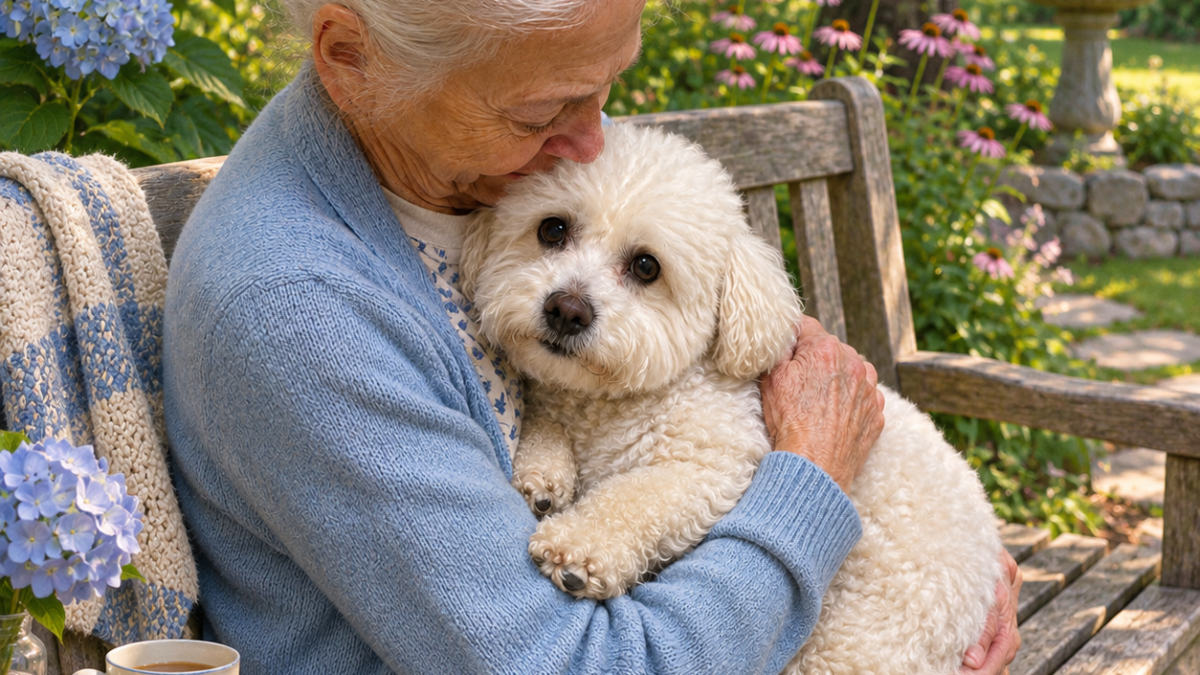
She simply sat with Milo tucked against her body while he rested his chin across her arm.
Eventually I crouched beside them.
“There are some things you should know.”
Elizabeth nodded.
“I assumed there would be.”
“He’s been adopted before.”
“How many times?”
“Three.”
That surprised her.
She looked down at Milo.
“Why?”
I took a breath.
“Because of what he’s doing right now.”
She frowned.
“Cuddling?”
“Attachment.”
I explained everything.
Following.
Whining.
Waiting outside doors.
Difficulty eating when left alone.
How intensely he bonded with one person in each household.
How quickly his anxiety rose when that person disappeared.
Elizabeth listened without interrupting.
When I finished, she asked:
“Does he hurt himself?”
“No.”
“Does he hurt people?”
“No.”
“Does he destroy things?”
“Not usually.”
“Usually?”
I smiled slightly.
“One family lost a throw pillow.”
“That’s survivable.”
“He does cry.”
“So do I.”
That stopped me.
Elizabeth looked back at Milo.
“My husband died three years ago.”
Her hand moved slowly through his fur.
“His name was Thomas.”
“I’m sorry.”
She nodded.
“We were married forty-one years.”
Forty-one.
I tried to imagine waking up after four decades beside someone and suddenly having half the bed remain empty.
Elizabeth continued.
“For months after Thomas died, people kept telling me I had to learn to enjoy my own company.”
Her mouth tightened slightly.
“As if loneliness were some sort of moral exam.”
I didn’t say anything.
“I learned how to grocery shop alone. Eat dinner alone. Watch television alone.”
She looked at me.
“I got very good at being alone.”
Then she looked down at Milo.
“I hate it.”
Milo shifted closer.
Elizabeth laughed through tears.
“So if your warning is that this dog wants to follow me into every room…”
“Yes.”
“Good.”
I smiled despite myself.
“If your warning is that he’ll sleep beside me…”
“Probably.”
“Even better.”
“He may cry when you leave.”
Her expression became more serious.
“That part we’ll work on.”
That answer mattered.
She wasn’t romanticizing his fear.
She understood that Milo’s attachment felt comforting to her, but fear still wasn’t something to encourage.
“What happens next?” she asked.
I told her we normally started with an adoption application and home review.
She nodded.
“Do whatever you need.”
Then she whispered to Milo:
“I’m not in a hurry.”
Milo licked her chin.
—
Our shelter director, Daniel, was less enthusiastic.
He had worked in animal welfare almost as long as I had, and he cared about Milo.
But three failed adoptions change how people think.
“Older woman living alone?” he asked after reading Elizabeth’s application.
“She’s sixty-seven, not ninety.”
“You know what I mean.”
“She’s healthy.”
“What if she has to leave him?”
“We teach him.”
“He’s failed three placements.”
“The placements failed too.”
Daniel raised an eyebrow.
“That sounds emotional.”
“It is emotional.”
“Margot.”
“I’m also right.”
He leaned back.
“What does the behavior team say?”
“Gradual desensitization. Same thing they said before.”
“And nobody did it.”
“Not consistently.”
Daniel stared at Milo’s file.
“We can’t keep putting him through returns.”
“I know.”
“If this fails…”
“It won’t.”
He looked at me.
“You can’t promise that.”
He was right.
I hated him for approximately four seconds because of it.
Then he said:
“Three-week trial.”
“Thirty days.”
“Three weeks.”
“Four.”
“Twenty-one days.”
“Daniel.”
“Fine. Thirty.”
I smiled.
“Thank you.”
“Don’t thank me yet.”
He pointed at the file.
“I want daily contact the first week.”
“You’ll get it.”
“And Margot?”
“Yes?”
“If something feels wrong, you tell me.”
“I will.”
I meant it.
Because my job was not to force a happy ending.
It was to recognize one when it was real.
—
Before Elizabeth left that day, I checked Milo’s old records again.
I had read them many times.
Transferred from another municipal shelter.
Approximate age six.
Owner unknown.
Microchip inactive.
No aggression.
Mild dental disease.
Severe separation distress during intake.
Nothing unusual.
Then I noticed an attachment scanned into the file from the original transfer.
A handwritten note.
**Previous chip registered to Ruth Hale. Owner deceased. Dog reportedly remained in residence with owner until welfare check.**
I froze.
Owner deceased.
I opened every attachment.
There wasn’t much.
The municipal officer had written that Ruth Hale, seventy-four, lived alone.
A neighbor became concerned after newspapers accumulated outside.
Police entered.
Ruth had apparently suffered a fatal medical event several days earlier.
Milo had been inside.
With her.
Alone.
Beside her.
The report stated that when officers tried to move Ruth, Milo panicked.
He barked.
Cried.
Tried to climb onto the stretcher.
Eventually animal control removed him.
He was transferred twice before reaching us.
I sat staring at the screen.
Fourteen months.
Three failed homes.
Dozens of behavior notes.
And there it was.
The beginning.
Milo had not simply learned that people left.
His entire world had once disappeared behind a door while he remained waiting beside someone who never woke up.
I closed my eyes.
Then called Elizabeth.
She answered on the second ring.
“Is everything okay?”
“Yes.”
I hesitated.
“There’s something about Milo’s history I think you should know.”
—
I told her everything.
When I finished, Elizabeth was quiet.
Very quiet.
“Her name was Ruth?”
“Yes.”
“How long was he with her?”
“We don’t know.”
“But she was older.”
“Yes.”
“And she died at home.”
“Yes.”
Another silence.
Then Elizabeth asked:
“Was Milo there?”
“Yes.”
I expected her to reconsider.
Instead she whispered:
“Oh, sweetheart.”
Not to me.
To Milo.
I could hear him moving near the phone.
Elizabeth said:
“So every time someone closes a door…”
“We can’t know exactly what he associates with it.”
“But maybe he thinks they’re gone.”
“Possibly.”
Her voice cracked.
“And then everyone keeps returning him.”
That was the part that hurt most.
“Yes.”
Elizabeth took a breath.
“What do we do?”
We.
Not what do *you* do.
Not what is wrong with him.
We.
I gave her instructions.
Start small.
Seconds, not minutes.
Step outside.
Return before panic.
Reward calm.
No dramatic departures.
No dramatic reunions.
Build predictability.
Teach Milo that absence does not mean disappearance.
Elizabeth wrote everything down.
Then she said:
“Margot?”
“Yes?”
“I’m taking him home tomorrow.”
I smiled.
“I know.”
—
Milo left the shelter at 10:17 the next morning.
I remember the exact time because I took a photograph.
Elizabeth stood beside her blue sedan.
Milo wore a new red harness.
His small white body looked almost ridiculous next to the giant bag of supplies Elizabeth had purchased.
Bed.
Food.
Toys.
Blankets.
Grooming tools.
Two different water bowls because she couldn’t decide.
Before getting into the car, Elizabeth turned.
“You think he knows?”
“Knows what?”
“That this is different.”
I looked at Milo.
“No.”
She seemed disappointed.
Then I added:
“Not yet.”
Her expression softened.
“That’s fair.”
“Show him.”
She nodded.
“I can do that.”
Milo jumped into the passenger seat.
Elizabeth laughed.
“I suppose I’m not sitting there anymore.”
“No.”
She closed the door.
And for the first time in fourteen months, Milo left our parking lot with someone who wasn’t hoping he would learn to need them less.
She was hoping he would learn that needing someone didn’t always end in loss.
—
I called that evening.
“How bad?”
Elizabeth laughed.
“He followed me into the bathroom.”
“Expected.”
“He watched me cook.”
“Expected.”
“He sat on my foot while I ate.”
“Very expected.”
“And he’s currently trying to sleep with his head on my ankle.”
I smiled.
“Any crying?”
“Only when I took the trash outside.”
“How long were you gone?”
“Thirty seconds.”
“Reaction?”
“He whined.”
“What did you do when you came back?”
“Walked in like nothing happened.”
“Perfect.”
“I wanted to hug him.”
“I know.”
“He looked betrayed.”
“He’ll survive.”
She laughed.
Then became quiet.
“Margot?”
“Yes?”
“I ate dinner at the table tonight.”
I didn’t understand at first.
“Okay.”
“I haven’t done that since Thomas died.”
My throat tightened.
“Where do you usually eat?”
“On the couch. Television on.”
“Why?”
She paused.
“The table had two chairs.”
I looked down at my desk.
“And tonight?”
“Milo sat beside me.”
Silence.
“I didn’t feel like there was an empty chair.”
That was the first moment I realized Milo wasn’t the only one being adopted.
—
The first week went unusually well.
Not perfectly.
Milo cried the first time Elizabeth showered with the bathroom door closed.
So she left it open.
Then gradually practiced closing it halfway.
Then for five seconds.
Then ten.
By day six, Milo could wait outside for almost a full minute without whining.
Elizabeth celebrated like he had graduated from college.
“Don’t make the reunion too exciting,” I reminded her.
“I’m not.”
“You sent me a photograph with a party hat.”
“That was unrelated.”
“You wrote ‘One Minute Champion.’”
“Completely unrelated.”
I laughed.
Milo began sleeping in Elizabeth’s bedroom.
Not on the bed.
At first.
Night three, I received a message.
**He’s on the bed. I have failed.**
I replied:
**You never had a rule against it.**
Three dots.
**Excellent point.**
—
At the end of the first week, I visited.
The difference in Elizabeth shocked me.
Not physically.
Something subtler.
The curtains were open.
There was music playing.
A half-finished cup of coffee sat on the porch.
Dog toys covered the living-room floor.
Milo met me at the door, barked once, then ran back to Elizabeth.
She smiled.
“He does that.”
“What?”
“Checks who arrived, then comes back to make sure I didn’t disappear.”
I watched him settle against her leg.
“How are you sleeping?”
“Better.”
“Eating?”
She rolled her eyes.
“You sound like my doctor.”
“Answer.”
“Yes.”
“Walking?”
“Twice a day.”
I looked at Milo.
“You got her exercising.”
Elizabeth pointed at him.
“He becomes unbearable around four.”
Milo wagged.
I sat across from them.
“How long can you leave now?”
“Three minutes.”
“That’s good.”
“It feels ridiculous.”
“It isn’t.”
“I stand outside my own front door with a timer.”
“That part is a little ridiculous.”
She laughed.
Milo lifted his head.
Then she said:
“You know what’s strange?”
“What?”
“I thought I wanted him to need me.”
She stroked his back.
“But I think I like that I need him too.”
There it was.
The truth.
Not dependence.
Reciprocity.
—
On day twenty-eight, I called Daniel.
“Finalize it.”
“You sure?”
“Yes.”
“No concerns?”
“Plenty.”
“That doesn’t sound reassuring.”
“Normal concerns.”
“And Milo?”
“Home.”
Daniel was quiet for a moment.
Then:
“Okay.”
Just one word.
But I knew what it meant.
He had worried about Milo too.
We all had.
The adoption became permanent two days later.
Elizabeth came to sign the papers.
Milo came with her.
He walked into the shelter, saw the hallway, and stopped.
His tail lowered.
I hated that.
Then Elizabeth crouched.
“We’re not staying.”
Milo looked at her.
She held up his leash.
“Home.”
He moved immediately.
I felt my eyes burn.
Three previous returns had taught him what this building might mean.
Elizabeth was going to teach him something else.
Leaving the shelter didn’t always end with coming back.
—
For the next three months, Milo improved.
Slowly.
He never became independent in the way his former families wanted.
That wasn’t the goal.
He could tolerate Elizabeth checking the mailbox.
Five minutes.
Then ten.
Eventually twenty.
She bought a small camera so she could watch him.
The first time she drove around the block, Milo waited at the front window.
No crying.
No scratching.
Just waiting.
When she returned, he wagged his tail and brought her a toy.
She called me immediately.
“He didn’t panic!”
“I know.”
“How?”
“You came back.”
Silence.
Then Elizabeth whispered:
“I suppose that’s the whole lesson.”
Yes.
It was.
—
Then Elizabeth’s daughter came to town.
Claire lived in Boston.
She was forty.
Successful.
Organized.
Protective.
And deeply suspicious of Milo.
I met her on a Thursday afternoon because she called the shelter directly.
“My mother is becoming dependent on this dog.”
I recognized the irony.
“What makes you say that?”
“She schedules her day around him.”
“Most dog owners do.”
“She doesn’t leave him alone.”
“She’s training him gradually.”
“She canceled dinner with friends because she said he wasn’t ready.”
“That may have been appropriate.”
Claire sighed.
“You don’t know my mother.”
“I know Milo.”
“That’s exactly my concern.”
Her tone wasn’t cruel.
It was frightened.
That mattered.
“Claire, what are you worried about?”
A long pause.
“That she’s using him instead of living.”
I understood.
“You should visit.”
“I’m here now.”
“Good.”
“Can I bring her in?”
“No.”
She sounded surprised.
“Why?”
“Because Milo isn’t a treatment plan we discuss behind Elizabeth’s back.”
Silence.
Then:
“Fair.”
I liked her slightly more after that.
—
Claire stayed with Elizabeth for two weeks.
The first few days were difficult.
She thought Milo’s constant proximity was unhealthy.
“He follows you everywhere.”
“Yes.”
“You let him.”
“Yes.”
“You talk to him like a person.”
Elizabeth stared at her.
“I talked to you like a person when you were sixteen. That was much less rewarding.”
Claire laughed despite herself.
But the tension remained.
One evening Claire called me.
“He cried when Mom walked next door.”
“How long?”
“Maybe a minute.”
“Then?”
“He stopped.”
“So what’s the issue?”
“He shouldn’t cry at all.”
I chose my words carefully.
“Claire, fear doesn’t disappear because it’s inconvenient.”
“I know.”
“No. I don’t think you do.”
She became quiet.
“Milo lived through the death of his first owner.”
“I know.”
“Then three homes sent him back.”
“I know.”
“He’s improving.”
“But Mom is reinforcing him.”
“How?”
“She lets him touch her.”
I almost laughed.
“That’s not reinforcement of panic. That’s affection.”
“You’re saying she should let him be clingy?”
“I’m saying closeness isn’t pathology.”
Claire exhaled.
“Why does everyone act like I’m the villain?”
“Because you keep trying to fix something that is already getting better.”
That landed.
I softened.
“You’re afraid your mother is replacing people with Milo.”
“Yes.”
“Then show up.”
Silence.
I regretted the bluntness for half a second.
Then Claire said:
“That was rude.”
“Yes.”
“It was also fair.”
“Yes.”
She hung up.
—
Two days later, Elizabeth called me laughing.
“What happened?”
“Claire is on the couch.”
“Okay.”
“Milo is asleep in her lap.”
I smiled.
“How?”
“She dropped a piece of chicken.”
“Powerful therapy.”
“Apparently.”
Claire stayed another week.
When she returned to Boston, Milo followed her to the front door.
She crouched.
“Don’t get too attached.”
Milo licked her face.
Elizabeth looked at her daughter.
“Too late.”
Claire laughed.
Then hugged her mother longer than usual.
Milo stood between them.
Touching both.
—
Six months after the adoption, everything changed again.
It was just after two in the morning.
Elizabeth woke with pain in her chest.
Not dramatic at first.
Pressure.
Nausea.
Sweating.
She later told me she thought it was indigestion.
So she sat on the edge of the bed.
Milo woke immediately.
He climbed into her lap.
She pushed him gently away.
“I’m okay.”
He came back.
She stood.
Nearly collapsed.
Milo began barking.
Elizabeth rarely heard him bark in the house.
That night he wouldn’t stop.
She tried to reach the phone.
Her legs gave out in the hallway.
She fell.
The phone landed several feet away.
Milo ran to her.
Licked her face.
Paced.
Barked.
Elizabeth remembers saying:
“Quiet, baby.”
He did not listen.
Thank God.
Milo ran to the front door.
Scratched.
Barked.
Returned to Elizabeth.
Back to the door.
Again.
Again.
Again.
Next door lived a retired teacher named Samuel Ortiz.
He woke to the barking.
At first, he ignored it.
Then it continued.
Ten minutes.
Samuel looked outside.
Elizabeth’s lights were on.
Something felt wrong.
He walked over.
Knocked.
No answer.
Milo went wild on the other side of the door.
Samuel tried the handle.
Locked.
He called Elizabeth.
Her phone rang inside.
No answer.
Then he called 911.
Paramedics arrived.
Milo barked until they forced entry.
They found Elizabeth unconscious in the hallway.
She was having a serious cardiac event.
The cardiologist later told Claire that another hour could have changed everything.
Maybe less.
Milo’s need to know where Elizabeth was had once gotten him returned.
That night, it saved her life.
—
I learned about it at six in the morning.
Claire called.
Her voice was shaking.
“Mom’s in the hospital.”
I sat upright.
“What happened?”
She told me.
Then:
“Milo’s at the house.”
“Alone?”
“Samuel is with him.”
“I’m going.”
“Margot?”
“Yes?”
“Please.”
Her voice broke.
“Don’t let anyone take him back to the shelter.”
That was the moment Claire finally understood.
Not because Milo had proven his value.
He never should have needed to.
But because she finally saw that what looked like dependence from outside was a relationship neither of them experienced as a burden.
“I won’t,” I said.
—
When I reached Elizabeth’s house, Milo was pacing.
The moment he saw me, he ran to the door.
Then back toward the hallway.
Then to the door again.
He was looking for her.
Samuel sat at the kitchen table.
“He hasn’t eaten.”
“How long?”
“Since last night.”
I crouched.
“Milo.”
He came to me.
Pressed his body against mine.
Trembling.
My heart broke.
The pattern was repeating.
Owner disappears.
Emergency workers.
Closed door.
No explanation.
To Milo, the past had returned.
“No,” I whispered.
He licked my wrist.
“Not this time.”
I called Claire.
“Can Elizabeth have visitors?”
“Not yet.”
“Can I bring Milo to the hospital parking lot?”
“What?”
“Not inside. I want her scent.”
Silence.
Then Claire understood.
“I’ll bring something.”
She met me outside the hospital with Elizabeth’s cardigan.
Milo smelled it.
His entire body changed.
Tail.
Whine.
He buried his face into the fabric.
I took it home with him.
That night, he slept on the cardigan.
—
Elizabeth underwent emergency treatment and remained hospitalized for eight days.
Milo stayed at my house.
Not the shelter.
I refused.
Daniel agreed.
Mostly because I didn’t give him much choice.
Milo struggled.
The first two days he ate only from my hand.
He slept near the front door.
Every time my phone rang, his head lifted.
Claire video-called from Elizabeth’s room on day three.
I held the phone near Milo.
Elizabeth looked tired.
Pale.
But alive.
“Hi, baby.”
Milo froze.
Then began whining.
He touched the screen with his nose.
Elizabeth cried.
“So did I.”
“I’m coming home.”
Milo stared at her.
“I promise.”
Claire watched.
When the call ended, she wiped her face.
Then looked directly into the camera.
“I get it now.”
I didn’t need to ask what she meant.
—
The real conflict began after Elizabeth was medically stable.
Claire wanted her mother to move to Boston.
Elizabeth refused.
“You nearly died alone.”
“I wasn’t alone.”
“Mom.”
“I had Milo.”
Claire’s face tightened.
“A dog cannot replace medical care.”
“No one said he could.”
“You need people.”
“I have people.”
“You have Samuel next door and Margot at the shelter.”
“And you.”
“You live eight hundred miles away.”
Elizabeth stared at her.
“That was your decision.”
Claire flinched.
I wasn’t in the room, but Elizabeth told me later exactly how the conversation went.
Claire said:
“There’s an assisted-living community near me.”
“No.”
“They have medical staff.”
“No.”
“You haven’t even looked.”
“Do they allow dogs?”
Claire went quiet.
Elizabeth knew.
“No.”
“Mom—”
“No.”
“Your life is more important than—”
“Finish that sentence.”
Claire stopped.
Elizabeth’s voice became cold.
“My life is more important than what?”
Claire looked away.
“Than a dog.”
Elizabeth nodded.
“There it is.”
“Mom.”
“You still think he’s something separate from my life.”
Claire started crying.
“I almost lost you.”
Elizabeth softened.
“I know.”
“I’m scared.”
“So am I.”
“Then why won’t you come?”
“Because surviving is not the same as living.”
Silence.
Elizabeth continued.
“I spent three years in this house after your father died learning how to exist without needing anybody.”
She looked toward the window.
“Milo brought me back into my own life.”
Claire said nothing.
“I walk because he needs walks. I get up because he needs breakfast. I know my neighbors because he wants to greet everyone.”
Her voice broke.
“And when my heart failed, the dog you think I depend on too much refused to stop making noise until someone came.”
Claire cried harder.
Elizabeth reached for her hand.
“I will make changes.”
“Which changes?”
“Medical alert system. Home monitoring. Samuel gets a key.”
“And?”
“And you call more.”
Claire laughed through tears.
“That’s not a safety system.”
“It is for me.”
—
Elizabeth came home on day nine.
I brought Milo.
We planned to keep the reunion calm.
That plan lasted four seconds.
Elizabeth stepped through the door.
Milo saw her.
He made a sound I had never heard before.
Half bark.
Half cry.
Then he ran.
Elizabeth dropped to her knees.
“Milo.”
He crashed into her chest.
She wrapped both arms around him.
He licked her face.
Her hands.
Her chin.
Then buried his head under her neck.
I looked away.
Claire didn’t.
She stood beside me crying openly.
For almost a full minute, Elizabeth said nothing except:
“I came back.”
Over and over.
“I came back.”
And maybe those were the most important words Milo had ever heard.
—
Recovery changed both of them.
Elizabeth took medication.
Started cardiac rehabilitation.
Samuel kept a spare key.
Claire installed a medical-alert system and three different smart devices Elizabeth complained about constantly.
Milo became part of the plan.
Not the plan.
Part of it.
That distinction mattered.
A behaviorist helped us work on emergency cues.
If Elizabeth lay on the floor intentionally and said “Help,” Milo learned to bark at the front door.
We never called him a service dog.
He wasn’t one.
But he could learn useful behaviors.
Within two months, he mastered the cue.
Claire watched one training session.
“He likes this.”
“He likes having a job,” I said.
She nodded.
Then smiled.
“Like Mom.”
“Exactly.”
—
The story might have ended there.
But local news heard about Milo.
Samuel had mentioned the incident to a friend.
The friend worked for a small paper.
A reporter called the shelter.
I almost declined.
Then Elizabeth said yes.
“Why?”
“Because of the three families.”
I looked at her.
“I don’t want to shame them.”
“Neither do I.”
“What do you want?”
She stroked Milo.
“I want people to understand that the thing they call too much in one home may be exactly right in another.”
That was worth saying.
The article ran with the headline:
**DOG RETURNED THREE TIMES FOR BEING “TOO ATTACHED” HELPS SAVE NEW OWNER**
It spread farther than anyone expected.
Thousands of shares.
Comments.
Messages.
Adoption inquiries.
People told stories about anxious dogs.
Senior owners.
Loneliness.
Grief.
One comment read:
**Sometimes the right home isn’t the one that changes the dog. It’s the one that understands him.**
I printed that one.
—
Then something unexpected happened.
The first family who had adopted Milo contacted me.
The father sounded embarrassed.
“I saw the article.”
“I figured.”
“We were one of the families.”
“I remember.”
“I wanted to say something.”
I waited.
“We thought we failed him.”
“You weren’t right for each other.”
“That sounds nicer.”
“It’s also true.”
He sighed.
“My kids feel guilty.”
“Don’t.”
“We returned him.”
“You returned him instead of resenting him.”
Silence.
“That matters.”
He sounded relieved.
Then:
“Can we send him something?”
I smiled.
“Probably.”
A week later, a box arrived.
Toys.
Treats.
And a card.
**We’re glad you found someone who understands you.**
Elizabeth cried when she read it.
Milo ate the treats.
He was less sentimental.
—
The second family wrote too.
They apologized.
Elizabeth sent back a note:
**You don’t need to apologize for not being his home. Thank you for bringing him back safely enough to find mine.**
That sentence ended up taped to my office wall.
Because adoption work teaches you something uncomfortable.
Not every return is cruelty.
Sometimes a mismatch is real.
Sometimes bringing a dog back is kinder than keeping him in a house where everyone is frustrated.
The problem wasn’t that Milo had been returned.
The problem was that everyone kept describing the same behavior as if it meant he was defective.
He wasn’t.
He was specific.
There’s a difference.
—
The third family didn’t contact us for months.
Then one Saturday, I saw the teenage daughter standing in the shelter lobby.
I recognized her.
Sophie.
Milo’s third attachment.
She looked nervous.
“Is Margot here?”
“That’s me.”
“I don’t know if you remember me.”
“I do.”
She stared at the floor.
“I saw Milo online.”
“He’s doing well.”
“I know.”
She swallowed.
“I was mad at my parents when we returned him.”
“I’m sorry.”
“They said he was unhealthy.”
“He was anxious.”
“I closed my door on him.”
The guilt in her face made me step closer.
“Sophie.”
Her eyes filled.
“He cried.”
“You were sixteen.”
“He loved me.”
“Yes.”
“I didn’t stop them.”
“You were sixteen.”
I repeated it.
She cried.
I handed her a tissue.
“Do you want to know something?”
She nodded.
“Milo doesn’t remember your family the way you’re imagining.”
“How do you know?”
“I don’t.”
That almost made her laugh.
“But dogs don’t sit around building moral cases against people.”
I smiled.
“He is busy living.”
Sophie wiped her eyes.
“Can I see him?”
I hesitated.
Then called Elizabeth.
Her answer surprised me.
“Bring her.”
—
The meeting happened at Elizabeth’s house.
Sophie stood near the doorway.
Milo walked into the room.
Stopped.
Sniffed.
His tail moved.
Sophie covered her mouth.
“Hi.”
Milo approached.
Slowly.
Then sat at her feet.
She dropped to her knees.
“I’m sorry.”
Milo climbed into her lap.
Of course.
Sophie cried into his fur.
Elizabeth watched from her chair.
Afterward, Sophie asked:
“Why is he okay with me?”
Elizabeth smiled.
“Because he doesn’t need you to be punished.”
That sentence silenced everyone.
Maybe that was the revenge the story needed.
Not humiliation.
Not cruelty returned for cruelty.
A dog thriving so completely that the people who once misunderstood him no longer had the power to define him.
—
The shelter changed because of Milo.
Daniel called a staff meeting.
“We need better language.”
I looked at him.
“What language?”
“Adoption profiles.”
He held up Milo’s old profile.
**Separation anxiety. Very needy. Requires constant attention.**
He grimaced.
“We wrote this.”
“Yes.”
“It sounds terrible.”
“It sounds accurate if you hate dogs.”
He ignored me.
“We need context.”
So we changed how we described certain animals.
Not dishonest.
Not softened.
Specific.
**Milo thrives with frequent companionship and physical closeness. He is best suited to a home where someone genuinely enjoys having a constant companion. He is working on confidence during short absences.**
Same dog.
Same needs.
Different frame.
Applications improved.
Returns declined.
Not to zero.
Nothing fixes everything.
But fewer people adopted dogs hoping to transform them into something else.
That was Milo’s second rescue.
He helped animals he never met.
—
A year after Elizabeth’s cardiac event, she and Milo returned to the shelter for an anniversary photograph.
He walked into the building.
Paused.
I watched his body.
No trembling.
No lowered tail.
He looked at Elizabeth.
Then at me.
Then trotted forward.
Progress.
Elizabeth wore a red scarf.
Milo wore a matching red bow tie.
“You did that on purpose,” I said.
“Obviously.”
We took the photograph near the window where Milo used to curl against me after being returned.
Elizabeth sat on the floor.
Milo climbed into her lap.
Exactly where he had first relaxed after each failed adoption.
But this time he wasn’t waiting to be chosen.
He had already been chosen.
—
Claire moved closer the following year.
Not because Elizabeth forced her.
Because life changed.
Remote work became permanent.
Claire found an apartment forty minutes away.
She started coming every Sunday.
Milo developed a routine.
At 3:45, he sat at the window.
Claire usually arrived at four.
“You turned him into a clock,” she told Elizabeth.
“He’s more reliable than you.”
“Rude.”
“Accurate.”
Milo adored Claire.
The irony pleased all of us.
The woman who once worried he was too attached became one of the people he waited for most.
One evening, Claire called me.
“Can I ask something weird?”
“Yes.”
“Do you think Milo fixed my mom?”
“No.”
She was quiet.
“Do you think Mom fixed Milo?”
“No.”
“Then what happened?”
I smiled.
“They stopped having to pretend they didn’t need anybody.”
Claire didn’t answer for a moment.
Then:
“Yeah.”
That was enough.
—
Two years after the adoption, Elizabeth began volunteering at the shelter.
One afternoon a week.
Nothing physically demanding.
She sat in the quiet room with frightened dogs.
Milo came too.
Officially, he wasn’t there as a therapy animal.
Unofficially, he was excellent at the job.
Nervous dogs watched him settle against Elizabeth.
Some relaxed.
People did too.
Elizabeth became especially good at talking to older adopters.
People who said:
“I’m too old for a dog.”
She would ask:
“Too old for which dog?”
That mattered.
A puppy might be wrong.
A calm senior dog might be perfect.
A high-energy shepherd might be wrong.
A twelve-pound lap dog might be ideal.
The right match.
Not the perfect animal.
The right match.
That became almost a philosophy around the shelter.
—
Then came a Tuesday that mirrored the day Elizabeth first arrived.
An older man named Arthur walked in.
Seventy-two.
Recently widowed.
His daughter had encouraged him to adopt.
He looked overwhelmed.
“What kind of dog are you looking for?” I asked.
He shrugged.
“Something easy.”
Elizabeth was sitting nearby with Milo.
She looked at me.
I looked at her.
We both smiled.
Arthur noticed.
“What?”
“Nothing.”
We introduced him to several dogs.
Eventually he met a senior spaniel named Daisy.
Daisy had been overlooked because she wanted to sit directly against people.
Arthur sat on the floor.
Daisy leaned against his chest.
He started crying.
Elizabeth handed him a tissue.
“I know,” she said.
He laughed through tears.
“How?”
She pointed at Milo.
“This one ruined me.”
Arthur adopted Daisy three days later.
The shelter staff began joking that Elizabeth was dangerous.
She wore that title proudly.
—
Milo’s separation anxiety never vanished completely.
I think it’s important to say that.
Stories often pretend healing means symptoms disappear.
Real healing is usually less cinematic.
At age ten, Milo could stay alone for about two hours comfortably.
Sometimes three.
Longer than that, Elizabeth arranged someone to visit.
Was that inconvenient?
Occasionally.
Did she resent him?
Never.
He still followed her to the bathroom most mornings.
Still slept touching her ankle.
Still waited outside the shower.
Still cried occasionally if she left unexpectedly.
But fear no longer controlled every absence.
Milo had learned something deeper than independence.
He had learned return.
That was enough.
—
The third anniversary of Elizabeth’s heart event was celebrated with cake.
Human cake for us.
Dog-safe cake for Milo.
Samuel came.
Claire came.
Daniel came.
I came.
Elizabeth raised a glass.
“To being difficult.”
Claire laughed.
“What?”
Elizabeth smiled.
“Thomas used to say all the best people are difficult.”
Then she looked down at Milo.
“And apparently so are the best dogs.”
Milo licked frosting from his nose.
I thought about all the words in his file.
Needy.
Dependent.
Separation anxiety.
Clingy.
Returned.
Each technically describing something real.
None describing the whole dog.
That is one of the dangers of labels.
They can be accurate and still be unfair.
—
The most dramatic moment after that came not from Milo.
It came from Elizabeth.
At seventy-one, she began having mobility problems from arthritis.
Claire worried.
Again.
This time, instead of arguing, Elizabeth listened.
She agreed to sell the two-story house.
That terrified everyone because change was difficult for Milo.
They found a small one-story home in a senior community.
Pet-friendly.
Fenced patio.
Walking paths.
Neighbors everywhere.
Claire helped.
Samuel complained she was stealing his best neighbor.
Milo hated the moving boxes.
The first night in the new house, he paced.
Elizabeth sat on the floor.
“I don’t like it either.”
Milo climbed into her lap.
She laughed.
“We’ll hate it together.”
Within two weeks, Milo claimed the sunny window.
Within a month, Elizabeth knew six neighbors.
Within three, she ran an informal morning coffee group.
Claire said:
“You’re more social than you were before Dad died.”
Elizabeth answered:
“No.”
She looked down at Milo.
“I’m just less afraid of needing people.”
That sentence stayed with me.
—
Years passed.
Milo’s face turned gray.
His white coat made it subtle.
But I saw it.
The eyes softened.
His movements slowed.
He developed a heart murmur.
Medication helped.
Then kidney disease.
More medication.
Elizabeth became obsessive about his schedule.
I teased her.
“You’ve become me.”
“Never insult me like that again.”
But she smiled.
Milo was nearly fourteen when I visited one winter afternoon and knew before she told me.
He was tired.
Very tired.
He still lifted his head when I entered.
Tail moved.
Once.
Elizabeth sat beside him on the couch.
“He stopped eating breakfast.”
My chest tightened.
“What did the vet say?”
“Kidneys.”
I sat.
“How bad?”
She looked at me.
“Bad.”
Silence.
“Claire knows?”
“Yes.”
“What do you want?”
Elizabeth’s eyes filled.
“I want what he gave me.”
I didn’t understand.
“What?”
“Someone staying.”
Then I did.
—
Milo had good days.
Then fewer.
Claire came constantly.
Samuel drove in from the old neighborhood.
Daniel visited.
Sophie, now an adult, sent a letter.
The first family sent another box.
People remembered him.
That surprised Elizabeth.
“He was just one little dog.”
“No.”
I touched his head.
“He was never just anything.”
The veterinarian recommended euthanasia when Milo stopped eating, stopped enjoying walks, and began struggling to breathe comfortably despite medication.
Elizabeth listened.
Asked questions.
Then chose a date.
Not because she was ready.
Because he was.
—
On Milo’s final morning, snow fell outside the window.
Elizabeth wore the same dark blue coat she had worn the day she first came to the shelter.
I noticed.
She did too.
“Funny.”
“What?”
“This coat.”
She looked at Milo.
“I met him wearing this.”
Milo rested on a blanket.
Claire sat on one side.
I sat on the other.
The veterinarian explained the process.
Elizabeth nodded.
Then asked for a minute.
Everyone waited.
She lifted Milo carefully into her lap.
He settled automatically.
Even then.
Even exhausted.
Contact.
Always contact.
Elizabeth stroked his ears.
“You know what they used to say about you?”
Milo breathed slowly.
“They said you needed too much.”
Her voice shook.
“You followed people everywhere.”
Another breath.
“You cried at doors.”
She kissed his head.
“You couldn’t stand being alone.”
Claire covered her mouth.
Elizabeth continued.
“Thank God.”
Milo’s tail moved.
Barely.
“Because neither could I.”
The veterinarian gave the first medication.
Milo relaxed against her.
Elizabeth smiled through tears.
“You were never too much.”
His eyes grew heavy.
“I just had too much empty space.”
I couldn’t see clearly anymore.
She whispered:
“You filled it.”
The second medication was given.
Milo took one slow breath.
Then another.
Elizabeth held him.
No panic.
No closed door.
No stranger pulling him away.
No waking beside someone who would never move again.
This time, the person he loved was there.
Holding him.
Telling him what he had spent his whole life trying to hear.
“I’m here.”
Another breath.
“I’m still here.”
Then he was gone.
And Elizabeth did not let go.
Not for a long time.
—
Milo’s ashes went into a small white urn.
Elizabeth placed it beside Thomas’s photograph.
Claire noticed.
“Dad gets competition now?”
Elizabeth smiled.
“Your father liked dogs.”
“He said they shed.”
“Milo didn’t shed much.”
“Then Dad would approve.”
The house felt quiet again.
But different.
Not empty.
There is a difference between silence after nobody has been there and silence after love has filled a place.
One feels abandoned.
The other feels like memory resting.
—
Elizabeth continued volunteering.
At first, without a dog beside her, she felt exposed.
Then one afternoon, a frightened terrier climbed into her lap.
She laughed.
I heard it from the hallway.
That laugh told me everything.
She wasn’t replacing Milo.
She was carrying forward what he taught her.
A year later, the shelter created a small program for senior adopters and companion-oriented dogs.
We called it the Milo Match Program.
Elizabeth hated the name.
“It sounds like a dating service.”
“That’s basically what adoption is.”
“Terrible.”
“You love it.”
“I do.”
The program focused on fit.
Not age alone.
Not activity alone.
Companionship style.
Some dogs wanted constant presence.
Some people wanted exactly that.
Instead of calling the dog needy, we asked:
**Who would consider this closeness a gift?**
Returns dropped.
Several senior dogs found homes.
Several lonely people did too.
I’m comfortable saying both sides were adopted.
—
One afternoon, Daniel brought me Milo’s old file.
“Found this in archives.”
I opened it.
The original notes.
**Too attached.**
**Difficulty with separation.**
**Returned three times.**
Then the new final status:
**Adopted permanently by Elizabeth Warren. Remained in home for life.**
For life.
Three words.
I ran my thumb over them.
Daniel leaned against the desk.
“You were right.”
“About what?”
“Milo.”
I smiled.
“I’m going to need more detail.”
He rolled his eyes.
“I thought repeated returns meant we needed to make him easier to place.”
“And?”
“We needed to find a harder-to-find placement.”
I nodded.
“The exact one.”
“Yes.”
Then he said:
“I used to think successful adoption meant the animal adapts to the home.”
I waited.
“Now I think sometimes the home adapts to the animal.”
“Careful.”
“Why?”
“You’re becoming emotional.”
He laughed.
I kept the file.
—
Sophie visited Elizabeth several years after Milo died.
She brought a framed photograph from their reunion.
Milo asleep in her lap.
On the back she had written:
**Thank you for giving him the home we couldn’t.**
Elizabeth read it.
Then said:
“You helped.”
Sophie shook her head.
“We returned him.”
“Yes.”
“And?”
“And that brought him back to Margot.”
Sophie cried.
Elizabeth took her hand.
“Not every goodbye is betrayal.”
I thought about Ruth.
Milo’s first person.
She had not chosen to leave.
Then three families who couldn’t meet his needs.
Then Elizabeth.
A life can contain many departures.
The ending depends partly on whether one arrival lasts long enough to teach you departures are not always the whole story.
Elizabeth lasted.
For the rest of his life.
That was enough.
—
People still tell Milo’s story as the dog who saved Elizabeth.
I understand why.
It’s dramatic.
A woman collapses.
A dog refuses to stop barking.
Neighbor calls 911.
Life saved.
Good headline.
But I think that happened much earlier.
Milo began saving Elizabeth the first night she ate dinner at her table again.
The first morning she walked because someone was waiting at the door.
The first afternoon she talked to a neighbor because Milo wanted to say hello.
The first time she laughed alone in her house and realized the sound did not disappear into silence.
And Elizabeth saved Milo long before she held him at the end.
She saved him every time she walked through a door and came back.
Every trip to the mailbox.
Every grocery run.
Every closed bathroom door that opened again.
Every ordinary absence followed by return.
She taught his nervous system something three homes had never given him enough time to learn.
People leave.
People come back.
People leave.
People come back.
Until one day, waiting stops feeling like abandonment.
That was their real miracle.
Not one saving the other.
Two lonely creatures repeatedly proving:
I’m still here.
—
I sometimes think about the sentence Elizabeth said the first morning.
“I don’t want an independent dog.”
At the time, it sounded unusual.
Now I think it was the most honest adoption request I have ever heard.
Most people arrive describing traits they want.
Low shedding.
Good with children.
House-trained.
Calm.
Young.
Small.
Elizabeth described a relationship.
She wanted to be needed.
She wanted permission to need.
Milo could give her that.
And she could give him something equally rare.
Someone who did not experience his closeness as pressure.
That is why I no longer use the phrase “too attached” casually.
Too attached for whom?
Too energetic for whom?
Too quiet for whom?
Too old for whom?
Dogs do not exist in a vacuum.
Neither do people.
Compatibility is context.
Milo had not failed three homes.
Three homes had shown us more clearly what the fourth needed to be.
—
The best revenge in Milo’s story was never against the people who returned him.
I don’t believe they deserved revenge.
Most were overwhelmed.
Some made mistakes.
But they brought him back safely.
The real revenge was against the idea that being deeply attached made him less worthy.
That idea lost completely.
The behavior that made him “unadoptable” became the reason a lonely widow chose him.
The barking people found excessive brought help when Elizabeth collapsed.
The refusal to leave someone alone became loyalty.
The constant following became companionship.
The dog who was described as dependent became the reason another person became independent enough to live fully again.
And the shelter file that once made adopters hesitate eventually became training material for how not to reduce animals to their hardest trait.
Milo never fought anyone.
Never proved anything intentionally.
He simply found the one place where his way of loving was understood.
Sometimes that is the most satisfying victory there is.
—
Elizabeth is older now.
So am I.
I still work at the shelter, though fewer hours.
There is a photograph on the wall near our adoption rooms.
Elizabeth sitting on the floor.
Milo in her lap.
His head pressed under her chin.
Below it is a small plaque.
Not dramatic.
Just one sentence:
**THE RIGHT HOME DOESN’T ALWAYS ASK YOU TO BECOME LESS.**
I watch people read it.
Some smile.
Some cry.
Occasionally someone asks:
“Who’s the dog?”
I tell them.
Milo.
Returned three times.
Loved for life the fourth.
Then I ask what kind of companion they’re actually looking for.
Not what kind of dog looks good on paper.
Not what they think they’re supposed to want.
What relationship fits their life.
That question has changed more adoptions than any checklist I ever used.
—
Not long ago, Elizabeth came in on a Tuesday.
Same day of the week she first met Milo.
She carried a box.
“What’s that?”
“His things.”
My heart tightened.
“You’re getting rid of them?”
“No.”
She opened the box.
Milo’s red harness.
His favorite blanket.
A little ceramic bowl.
Several photographs.
“I want the shelter to use what it can.”
I touched the harness.
“You sure?”
“Yes.”
Then she removed one item.
His collar.
“That stays with me.”
“Obviously.”
She smiled.
We sat in the old quiet room.
The same room where Milo used to curl against me after being returned.
Sunlight still came through the same window.
Elizabeth looked around.
“He waited here?”
“Many afternoons.”
“With you?”
“Yes.”
“Did you think he’d ever find someone?”
I considered lying.
“No.”
She nodded.
“I’m glad you were wrong.”
“Me too.”
We sat quietly.
Then she asked:
“Do you think Ruth would be angry that he loved me?”
The question surprised me.
“No.”
“How can you know?”
“I can’t.”
I looked at the sunlight.
“But if I loved a dog that much, and I had to leave before I was ready…”
Elizabeth’s eyes filled.
“I would want someone to make sure he never felt abandoned again.”
She looked down at Milo’s collar.
For a long time she didn’t speak.
Then she whispered:
“We did okay, didn’t we?”
“Yes.”
“You’re sure?”
I smiled.
“Elizabeth, you came to a shelter and deliberately chose the dog everyone warned you was too much.”
She laughed.
“Yes.”
“You did better than okay.”
—
Before leaving, she stopped by the photograph on the wall.
Touched two fingers to Milo’s face.
Then walked out.
No dog beside her.
But she didn’t look like the woman who had first entered years earlier.
That woman had held her purse with both hands as if she needed something to anchor her.
This Elizabeth waved to volunteers.
Stopped to greet Arthur and Daisy.
Promised to return Thursday.
Her life was full.
Not because Milo stayed forever.
He couldn’t.
Because while he was here, he reminded her she was still capable of attachment.
And when he left, she did not close herself again.
That may have been his greatest gift.
—
I stayed by the photograph after she left.
For a moment I remembered Milo exactly as he had been after the third return.
Small white body trembling against mine.
Eyes fixed on the door.
Waiting.
Always waiting.
If I could go back to that afternoon, I would tell him:
You are not broken.
You are not too needy.
You are not going to spend your life being returned.
There is a woman you haven’t met yet.
Her house is painfully quiet.
She eats dinner in front of the television because an empty chair hurts too much.
She has been told to become comfortable alone.
You have been told to become comfortable alone.
Neither of you is very good at it.
That is going to work out beautifully.
One day, she will fall in a hallway and you will refuse to be quiet until someone comes.
One day, she will hold you when you are old and tired and tell you that you never asked for too much.
Between those days, there will be thousands of ordinary moments.
Walks.
Meals.
Closed doors that reopen.
Hands resting on fur.
A warm body at someone’s feet.
Those ordinary moments will heal both of you far more than anyone understands.
You only have to wait a little longer.
Of course Milo wouldn’t understand any of that.
He would probably climb into my lap.
That would be enough.
Because the whole story can really be reduced to one simple truth.
Three homes looked at Milo and saw a dog who needed too much.
The fourth looked at him and saw someone who still had love left to give.
And for the first time in his life, nobody asked him to love less.








