PART 2: Three Days After My Brother Died, His Dog Still Guarded His Door—Then I Opened a Video He Never Meant Us to See
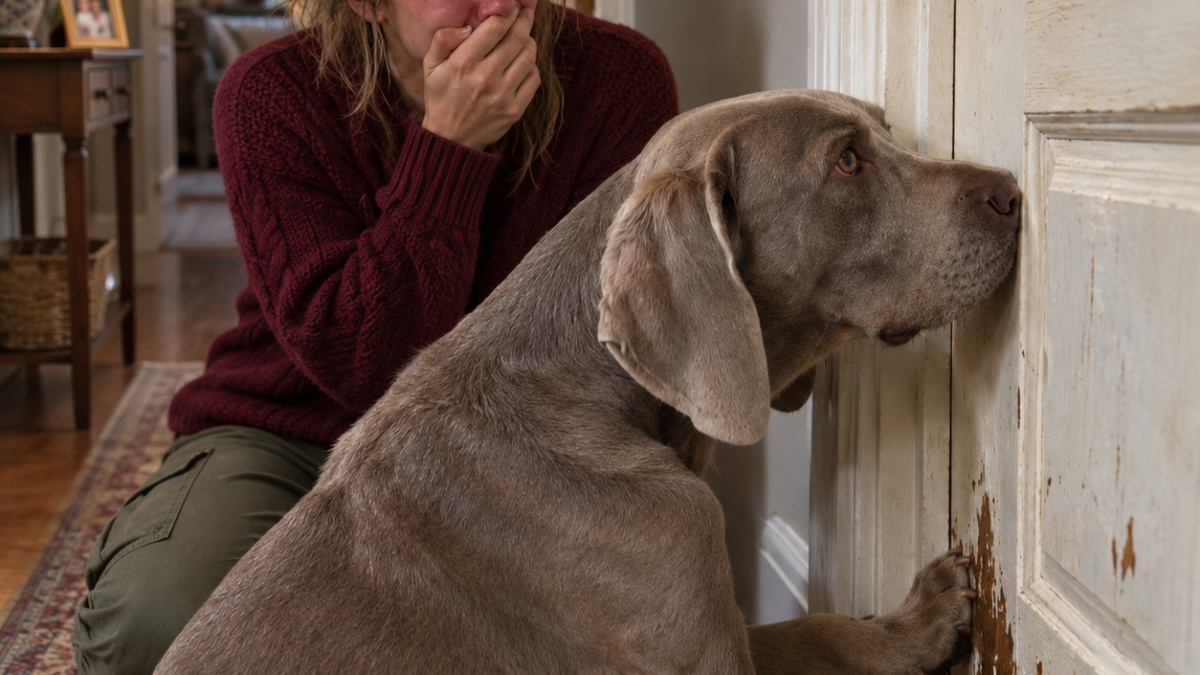
PART 2
It was Léo’s old leather wristband.
Nothing dramatic.
Nothing dangerous.
Just a strip of dark brown leather he had worn for years.
Our mother had given it to him when he turned eighteen, mostly because Léo had been impossible to shop for and she had finally surrendered to buying him something he could wear every day.
He wore it hiking.
At the gym.
At family dinners.
At Christmas.
Even when the leather cracked and the clasp began failing, he kept repairing it.
But in the video, it was lying on the floor beside him.
That detail bothered me because I remembered seeing the bracelet on his wrist in photographs taken only a week earlier.
I paused the frame.
Zoomed in.
Then looked at Sirius asleep on the sweatshirt behind me.
“What did you know?”
His ear moved.
I called Dad.
He answered downstairs.
“Elise?”
“Come up here.”
“What happened?”
“Just come.”
Maybe he heard something in my voice because he didn’t ask again.
A minute later he entered the bedroom.
He stopped when he saw Sirius.
Dad had barely looked at the dog since Léo died.
I think Sirius hurt him.
The dog belonged too completely to his son.
Everything about Sirius reminded Dad that Léo should have been following behind him.
“What are you doing in here?”
“I found a video.”
Dad’s shoulders stiffened.
“What kind of video?”
“I don’t know yet.”
That answer annoyed him.
“What does that mean?”
“Sit down.”
“I’m fine standing.”
“Dad.”
He sat.
I started the video again.
Léo walked into frame.
Locked the door.
Sat.
Covered his face.
Dad leaned closer.
When Sirius began pawing at Léo and repeatedly running toward the door, Dad’s breathing changed.
Then Léo lifted his face.
Dad whispered, “Oh.”
That single sound told me everything.
He had never seen our brother like that either.
Onscreen, Léo finally pulled Sirius toward him.
He wrapped both arms around the dog’s neck.
For almost a full minute, nothing happened.
Then Léo started speaking.
The microphone was weak.
I turned the volume up.
At first, only fragments.
“…don’t know…”
“…everyone thinks…”
“…tired.”
Dad reached toward the keyboard.
“Stop.”
I paused.
He stood immediately.
“I can’t.”
“Dad—”
“No.”
“You need to see it.”
“I said I can’t.”
He walked toward the door.
Then Sirius lifted his head.
Dad froze.
The dog looked directly at him.
For a moment, nobody moved.
Then Dad sat again.
“Play it.”
I did.
Léo’s voice came through more clearly this time.
“I don’t know how to tell them.”
Dad lowered his face into one hand.
Onscreen, Sirius licked Léo’s cheek.
My brother almost laughed.
Then said, “You’re the only one who knows, aren’t you?”
I stopped breathing.
Léo looked at Sirius.
“You know when it starts.”
Sirius pressed closer.
“I wish you could talk.”
The video ended five minutes later without anything obviously catastrophic happening.
Léo eventually stood.
Washed his face.
Opened the door.
Before leaving, he looked directly into the camera as though he had suddenly remembered it existed.
His expression changed.
The familiar Léo returned.
He smiled.
Not happily.
Automatically.
That frightened me more than the crying.
Dad stared at the black screen.
“What was that?”
“I don’t know.”
“Was he sick?”
“I don’t know.”
“Did he tell you anything?”
“No.”
Dad stood.
“Your mother cannot see this.”
I turned.
“What?”
“Not now.”
“She deserves to know.”
“She just buried her son.”
“So did you.”
“That’s different.”
“How?”
He couldn’t answer.
He walked toward the window.
Outside, our street looked offensively normal.
A neighbor was scraping frost from a windshield.
Someone walked a small white dog.
Garbage bins stood in straight lines along the curb.
Dad folded his arms.
“Police said there was no sign anyone else was involved.”
“I know.”
“They said—”
“I know what they said.”
He stopped.
Neither of us wanted to complete the sentence.
Léo’s death had already been classified as self-inflicted.
There was no dramatic mystery about who had been in the room.
No stranger.
No intruder.
No crime scene conspiracy.
The mystery was how our brother had reached that point while all of us believed we knew him.
Dad turned.
“Delete it.”
I stared at him.
“No.”
“Elise.”
“No.”
“Your mother cannot find that.”
“I’m not deleting the last honest thing he may have recorded.”
Dad’s face tightened.
“You think that was honest?”
“What do you call it?”
“I call it a private moment.”
“So private we should pretend it never happened?”
“I didn’t say that.”
“You asked me to delete it.”
He turned away.
I instantly regretted the sharpness in my voice.
We were both raw.
Grief turns ordinary conversations into exposed wires.
Touch the wrong one and everything sparks.
Dad rubbed his forehead.
“I just don’t want your mother believing she missed something.”
I looked at the computer.
“What if we all did?”
He closed his eyes.
That was the question nobody wanted.
My mother came upstairs twenty minutes later anyway.
She had noticed Dad was gone.
She entered holding a dish towel.
“What are you two doing?”
Neither of us answered fast enough.
Her eyes moved to the computer.
“What did you find?”
Dad said, “Nothing.”
I said, “A video.”
They spoke at the same time.
Mom looked at us.
“Which is it?”
Dad’s jaw tightened.
“Elise found something that can wait.”
Mom put the towel down.
“I have spent three days being told things can wait.”
“Claire—”
“No.”
My mother’s name was Claire.
She rarely interrupted Dad.
That afternoon she did.
“My son is dead. Nothing about him waits anymore.”
I swallowed.
Dad sat.
Mom looked at me.
“Show me.”
So I did.
She watched the whole thing without moving.
Not once.
When Léo said, “I don’t know how to tell them,” her hand tightened around the edge of the desk.
When he told Sirius, “You know when it starts,” she leaned closer.
Then the video ended.
Mom stayed still.
Dad reached for her.
She stood before he could touch her.
“What did he mean?”
“I don’t know,” I said.
“What starts?”
“I don’t know.”
“Why was the dog going to the door?”
“I don’t know.”
Her voice rose.
“Then what do we know?”
Nothing.
That was the truth.
We knew Léo had been suffering.
We knew Sirius had witnessed it.
We knew our brother had hidden enough of that suffering from us that the discovery felt like learning a second person had lived inside the first.
Mom looked at Sirius.
The dog had gotten up.
He stood in the doorway.
She walked toward him.
For the first time since Léo died, she touched him.
Sirius leaned against her legs.
Mom broke.
Not elegantly.
Not quietly.
She dropped to the floor and wrapped her arms around his neck.
“Why didn’t we know?”
Sirius stood still.
I sat beside her.
Dad stayed by the desk.
That was the first time all three of us cried in the same room.
Until then, we had been taking turns being functional.
Mom managed visitors.
Dad handled paperwork.
I answered messages.
That afternoon, none of us managed anything.
When the crying finally slowed, Dad looked at the computer.
“There might be more.”
I didn’t want there to be.
I also needed there to be.
We opened the folder again.
Most of the files were exactly what we expected.
Mountains.
Roads.
Friends.
A camping trip.
Léo laughing while Sirius chased something through snow.
For almost an hour, nothing.
Then another indoor video.
Dated six weeks before his death.
Same bedroom.
Same angle.
This time Léo was pacing.
Sirius followed him.
Back and forth.
Back and forth.
Léo kept rubbing his chest.
He sat.
Stood.
Sat again.
The dog nudged him repeatedly.
Then Léo said, “I know.”
He sounded irritated.
Sirius nudged again.
“I know, buddy.”
Dad leaned forward.
“What is he doing?”
Mom whispered, “He looks panicked.”
That word fit.
A panic episode.
I had seen people describe them online.
Racing breath.
Restlessness.
Hands trembling.
Feeling trapped.
I did not want to diagnose my brother from a home video.
But whatever it was, he looked overwhelmed.
Sirius seemed to recognize the pattern before Léo fully reacted.
He approached before my brother sat down.
He pushed his body into him.
When Léo’s breathing sped up, Sirius climbed partly across his lap.
Pressure.
Contact.
Then, slowly, Léo’s breathing changed.
Slower.
The dog stayed.
“He was helping him,” Mom whispered.
Nobody answered.
After about ten minutes, Léo looked toward the camera.
“I should probably talk to somebody.”
My heart stopped.
Mom covered her mouth.
Léo laughed weakly.
Then said, “Tomorrow.”
The video ended.
Tomorrow.
There are few words more painful after someone dies.
Tomorrow means intention.
Possibility.
A door that might have opened.
We started searching.
Not through everything.
Not yet.
I felt uncomfortable invading his messages.
Dad felt the opposite.
“He’s gone.”
“That doesn’t mean he has no privacy.”
“Elise, we need to know.”
“Need or want?”
His expression hardened.
“Do not do that.”
“Do what?”
“Turn this into an argument about ethics.”
“I’m not.”
“You are.”
Mom stepped between us emotionally if not physically.
“Stop.”
We did.
She looked at the computer.
“We look only for what helps us understand what happened.”
That sounded reasonable.
It also proved impossible.
Every folder contained pieces of a person.
Bank statements.
Gym schedules.
Photos.
Old university papers.
Memes.
Music.
Receipts.
A half-written job application.
There was no clean line between relevant and private.
We found an appointment confirmation from an online mental health service.
Three months earlier.
Léo had booked an initial consultation.
He canceled the morning of the appointment.
Reason:
Schedule conflict.
Dad stared at the screen.
“He tried.”
Mom said nothing.
I opened his email search.
There were two other appointment confirmations.
One attended.
One canceled.
Then an invoice.
So he had spoken to someone.
That gave us a new question.
Could the clinician tell us anything?
Legally, probably not much.
Confidentiality does not disappear casually after death.
We contacted the service anyway.
The response was kind and firm.
They could not disclose private clinical details without proper legal authorization.
Dad became furious.
“He’s dead.”
The woman on the phone answered softly.
“I understand.”
“Then who are you protecting?”
“Your son’s privacy.”
“He needed protecting while he was alive.”
I took the phone from Dad.
“I’m sorry.”
He walked out.
The woman remained silent for a second.
Then said, “I am very sorry for your loss.”
I believed her.
She added, “There are procedures for family requests. I can explain those.”
We followed them.
It took time.
Nothing in grief moves at the speed grief demands.
During those days, Sirius became a problem.
He refused to leave Léo’s room for long.
Food had to be brought upstairs.
If we closed the bedroom door, he scratched until we reopened it.
He slept on the gray sweatshirt.
At night, he sometimes stood at the door and whined.
My father could not tolerate it.
One evening he snapped.
“He’s making this worse.”
Mom looked up from the kitchen table.
“He lost him too.”
“He’s a dog.”
The room went still.
Dad immediately looked ashamed.
Sirius stood in the hallway.
He had heard the raised voice.
Dad pushed his chair back.
“I didn’t mean—”
“I know,” Mom said.
Dad walked away.
Ten minutes later, I found him upstairs.
Sitting on the floor outside Léo’s room.
Sirius beside him.
Dad’s hand rested on the dog’s back.
Neither moved.
Grief stripped all of us down.
Mom stopped wearing makeup.
Dad forgot meals.
I stopped sleeping.
Sirius stopped being “Léo’s dog” and became something closer to a witness we did not know how to question.
I began watching him.
Not obsessively.
At least that’s what I told myself.
He reacted to certain sounds.
Léo’s phone alarm made him stand instantly.
A notification tone from the computer made him enter the room.
The phrase “I’m fine,” spoken casually by Dad one evening, made Sirius look up.
That last one was probably coincidence.
I hated that I wondered.
The medical records we were eventually allowed to receive did not give us a perfect answer.
They never could.
Léo had reported severe anxiety.
Periods of hopelessness.
Difficulty sleeping.
Episodes where he felt unable to control his thoughts.
He had also told the clinician he did not want his family to know.
Mom stopped reading there.
She walked outside.
I followed.
She stood in the garden without a coat.
“Mom.”
“He told a stranger.”
“Yes.”
“But not me.”
I put my coat around her shoulders.
“He probably thought he was protecting you.”
“That is what people always say.”
Her voice was bitter.
“Maybe he didn’t trust me.”
“I don’t think that’s it.”
“You don’t know.”
“No.”
She looked at me.
“Everyone keeps telling me what he must have felt.”
“I know.”
“They don’t know either.”
“No.”
She pressed her lips together.
“I was his mother.”
“I know.”
“I should have known.”
There it was.
The sentence beneath every other sentence.
I should have known.
Dad had his own version.
I should have asked.
Mine:
I should have opened the door.
At three in the morning.
Sirius had looked at me.
I had closed my door.
That moment grew larger every night.
Eventually it became unbearable enough that I told my mother.
“I heard Sirius.”
She looked up.
“What?”
“That night.”
I had not told them.
Not fully.
The police knew I had been home.
They knew I heard the dog pacing.
But I had not described the look.
The scratching.
How Sirius had gone back toward Léo’s room.
Mom stared.
“When?”
“About three.”
Dad was in the kitchen.
He turned.
“And?”
“I opened my door.”
My throat closed.
“Sirius looked at me.”
Dad stepped closer.
“What did you do?”
I started crying before I answered.
“I told him to go to sleep.”
Nobody spoke.
“I closed my door.”
Mom said, “Elise…”
“If I had followed him—”
“No.”
Dad’s voice was immediate.
“You don’t know.”
“But if I had—”
“You don’t know.”
“He was trying to tell me.”
Dad’s face changed.
He crossed the kitchen and grabbed my shoulders.
Not harshly.
Firmly.
“You do not know what would have happened.”
“I could have checked.”
“Yes.”
The word hit me.
Dad did not lie.
He could have said it wouldn’t matter.
He didn’t.
“You could have checked,” he said. “And you didn’t know you needed to.”
I cried harder.
“That doesn’t make it better.”
“No.”
“Then what am I supposed to do with that?”
Dad’s own eyes filled.
“The same thing I’m trying to do with every conversation I didn’t start.”
Mom came closer.
“The same thing I’m doing with every time I believed him when he said he was tired.”
We stood there.
Three people building separate prisons from hindsight.
Sirius entered the kitchen.
He looked at us.
Then sat.
Mom laughed once through tears.
“Great. The dog is supervising again.”
For the first time in days, I laughed too.
Small.
Ugly.
But real.
That night I slept on Léo’s bedroom floor.
Not planned.
I sat there watching another video and woke at four in the morning with Sirius against my back.
The computer screen had gone dark.
His head rested near my shoulder.
I turned.
“You tried.”
His eyes opened.
“I know.”
He put his chin down again.
“You tried harder than I did.”
That thought stayed with me.
Then, over the next week, it changed.
Sirius had tried because Sirius understood one thing:
Something was wrong.
He did not understand consequences.
Psychology.
Privacy.
Fear of embarrassing someone.
He did not think:
Maybe Léo wants to be alone.
Maybe he’ll be annoyed if I wake Elise.
Maybe I’m overreacting.
He sensed distress and acted.
Humans are more complicated.
Sometimes too complicated.
We rationalize.
We protect boundaries.
We respect privacy.
We fear saying the wrong thing.
We convince ourselves tomorrow is soon enough.
That did not make us guilty of Léo’s death.
But it made me question how often we let discomfort keep us quiet.
The videos continued.
Not all were dark.
That mattered.
Léo had real joy.
The happy photographs were not lies.
He laughed with friends because he was happy in those moments.
He loved hiking.
He loved Sirius.
He loved us.
Pain did not erase love.
Love did not automatically erase pain.
Understanding that helped.
Before, I imagined two versions:
Happy Léo.
Secretly suffering Léo.
As if one had to be false.
They were both real.
Human beings can carry opposite things at the same time.
That was perhaps the hardest part to accept.
The next major discovery came from Léo’s phone.
We had avoided it.
Then one afternoon, Dad charged it.
There were hundreds of messages.
Most ordinary.
Friends.
Work.
Jokes.
A football group.
Family chat.
Then a conversation with someone named Maxime.
His closest friend from university.
We knew Maxime.
He had attended the funeral.
He had cried harder than almost anyone.
The messages changed about two months before Léo died.
Léo:
You ever feel like your brain just doesn’t shut up?
Maxime:
Every Monday.
Léo:
Serious.
Maxime:
Yeah. Sometimes. You okay?
Léo:
Probably.
Another week.
Léo:
Had one of those episodes again.
Maxime:
The breathing thing?
Léo:
Yeah.
Maxime:
Doctor?
Léo:
Not yet.
Maxime:
Dude go.
Then later:
Booked something.
Maxime:
Good.
Léo:
Might cancel.
Maxime:
Don’t.
The conversation stopped there.
Dad looked at me.
“He knew.”
My stomach tightened.
“Some.”
“He knew enough.”
“Dad.”
“He came to the funeral and said Léo seemed fine.”
“Maybe he didn’t know how bad it was.”
Dad stood.
“He knew about the episodes.”
“That’s not the same as knowing he was in danger.”
“How do you know?”
“I don’t.”
Dad picked up the phone.
“I’m calling him.”
“Wait.”
“No.”
“Dad.”
He called.
Maxime answered.
“Mr. Morel?”
“We need to talk.”
Silence.
“When?”
“Now.”
I put one hand on Dad’s arm.
“Put him on speaker.”
He did.
Maxime’s voice changed when Dad mentioned the messages.
“Oh.”
Dad said, “You knew he was struggling.”
“I knew he was anxious.”
“He told you about episodes.”
“Yes.”
“And you told us at the funeral he seemed fine.”
“I…”
“You what?”
“I didn’t know what to say.”
Dad’s voice sharpened.
“You say the truth.”
“I was scared.”
“Of what?”
Maxime started crying.
Not loudly.
“I thought you’d blame me.”
Dad stopped.
The anger in the room shifted.
Maxime continued.
“He told me not to tell anyone.”
Dad sat.
“He asked you?”
“Yes.”
“When?”
“After he booked the first appointment.”
“Why?”
“He said your mom was already stressed about work and your dad worried about everything.”
Mom had entered quietly.
She heard.
Maxime said, “He said if he told you, everyone would watch him.”
Dad closed his eyes.
“That would have been the point.”
“Mr. Morel, I didn’t understand.”
“Neither did we.”
The anger disappeared from Dad’s voice.
That was more devastating.
Maxime told us everything he knew.
It wasn’t much more.
Léo had panic episodes.
Periods of not sleeping.
Days when he withdrew.
Then stretches where he seemed completely himself.
Maxime had pushed him toward therapy.
Léo attended once.
Maybe twice.
Then said it felt awkward.
Maxime assumed he would try again later.
There was that word.
Later.
Dad asked, “Did he ever tell you he planned to hurt himself?”
“No.”
“Anything close?”
Maxime hesitated.
“Once he said he was tired of fighting his own head.”
Mom sat down.
“When?”
“About three weeks before.”
“And what did you say?”
“I told him to come over.”
“Did he?”
“Yes.”
“What did you do?”
“We played video games. Ate pizza. He seemed better.”
There was no villain.
That was the thing Dad had been searching for.
Someone who knew enough.
Someone who failed enough.
Someone we could blame.
Maxime was not that person.
He was twenty-three.
He had done what he understood to do.
Invite his friend over.
Push him toward help.
Believe him when he seemed better.
We all had.
Dad finally said, “I’m sorry.”
Maxime started crying harder.
“No. I’m sorry.”
They both meant it.
Neither apology could fix anything.
But perhaps they stopped one more person from building a prison.
Maxime came over the next day.
Sirius recognized him instantly.
The dog ran to the door.
Tail moving for the first time since the funeral.
Maxime dropped to his knees.
Sirius pushed into him.
The sound Maxime made broke all of us.
“He used to bring him to my apartment.”
I knew that.
But seeing Sirius remember someone from Léo’s life felt different.
Maxime sat with us for hours.
He showed us videos we had never seen.
Léo dancing badly.
Léo snoring on a couch while Sirius stared at the camera.
Léo attempting to cook.
Léo genuinely laughing.
Mom cried.
Then laughed.
Then cried again.
That became our new rhythm.
Grief stopped being one emotion.
It became dozens.
Anger.
Love.
Guilt.
Relief.
Resentment.
Humor.
Exhaustion.
Sometimes all in the same hour.
Sirius slowly began leaving the bedroom.
At first only to eat.
Then to follow Mom downstairs.
Then one afternoon he slept in the living room.
We noticed immediately.
Nobody said anything.
Mom covered him with a blanket.
Dad pretended not to notice.
The gray sweatshirt came with him.
He carried it downstairs in his mouth.
Placed it beside the couch.
Lay on it.
Dad had to leave the room.
Progress can hurt.
Two months after Léo died, Sirius stopped sleeping outside the bedroom door every night.
Sometimes he still did.
Mostly he slept outside mine.
I told myself it was because I gave better treats.
I knew better.
He had transferred part of his vigilance.
That responsibility frightened me.
Then one night, I woke around two.
Sirius was pacing.
Instant panic.
I sat up.
“What?”
He whined.
My heart raced.
I followed him.
He went downstairs.
Straight to Dad.
Dad was asleep on the couch.
I shook him.
“Dad?”
He opened his eyes.
“What?”
Sirius was pawing his chest.
My stomach dropped.
“Are you okay?”
Dad sat up.
“I think so.”
Then he pressed a hand against his chest.
No.
We called emergency services.
Dad had an irregular heart rhythm.
Not a heart attack.
Treatable.
But significant enough that the emergency physician said calling had been the right choice.
In the hospital waiting room, Mom looked at me.
Then at Sirius, who was not allowed inside and had stayed home with Maxime.
“You think…”
“I don’t know.”
We asked the doctor later whether a dog could detect heart rhythm changes.
He shrugged.
“Dogs detect all sorts of physiological changes. Smell, movement, breathing. Sometimes they react before humans do.”
That did not prove anything.
But it changed how we understood Sirius.
Perhaps Léo’s episodes had not been only emotional.
Maybe Sirius responded to physical changes.
Breathing.
Stress hormones.
Movement patterns.
Heart rate.
There was no way to know exactly.
The dog knew the pattern.
That was enough.
Dad came home after two days.
Sirius nearly knocked him over.
“Careful,” I shouted.
Dad laughed.
For the first time since Léo died, he laughed without guilt afterward.
That mattered.
We eventually consulted a veterinary behaviorist because Sirius’s vigilance became intense.
He followed us constantly.
Reacted to raised voices.
Paced when anyone stayed behind a closed door too long.
Waited outside bathrooms.
The behaviorist told us something I needed to hear.
“He may be grieving, but he also learned that changes in human behavior can predict something frightening.”
“So what do we do?”
“Give him predictable routines. Let him rest. Don’t reinforce every alert as an emergency, but don’t punish him for checking.”
I looked at Sirius.
“He thinks it’s his job.”
“Maybe.”
“How do we tell him it isn’t?”
“You don’t. You show him the house is safe enough that he can stop working all the time.”
That sentence could have applied to all of us.
We started walking Sirius more.
Long walks.
Not around the neighborhood where every corner reminded us of Léo.
Along the Loire.
Through wooded trails.
Sometimes Maxime came.
Sometimes Dad.
Sometimes just me.
On one of those walks, about four months after Léo died, Sirius stopped near the river.
He looked toward a group of young men laughing on the bank.
One had Léo’s build.
Same dark hair.
Same kind of jacket.
Sirius froze.
Then pulled.
I almost lost the leash.
“Sirius.”
He dragged me twenty feet.
The young man turned.
Sirius stopped.
Not Léo.
Of course.
His entire body seemed to collapse.
I crouched.
“I know.”
He looked at me.
“I know.”
I sat on the cold ground beside him.
The stranger watched from a distance.
He probably thought I was insane.
I didn’t care.
Sirius pressed his head into my shoulder.
That was when I understood he had been waiting too.
Maybe not intellectually expecting Léo to return from death.
But searching.
Smells.
Shapes.
Voices.
Doors.
The same impossible expectation I had felt in Léo’s bedroom.
He’ll come back.
Grief is not uniquely human.
We may explain it differently.
We may write books about it.
Dogs simply stand at doors.
Six months after Léo died, Mom asked whether we should clear his room.
Dad said no.
I said yes.
Then hated myself.
The room had become a shrine.
Nothing moved.
Dust collected around objects nobody touched.
Léo’s cookies were still on the desk.
Expired.
His laundry remained folded in a basket.
His hiking boots by the wall.
We were preserving absence.
Maxime offered to help.
We chose a Saturday.
Mom lasted fifteen minutes.
She left.
Dad took books.
I handled clothing.
Sirius watched from the bed.
Every object became a decision.
Keep.
Donate.
Throw away.
Impossible.
I found the leather wristband from the video inside the desk drawer.
I stared at it.
There was nothing special about it.
Mom’s handwriting on the original gift tag was still taped inside the small box:
For my impossible boy. Love, Mom.
I sat down.
Sirius came over.
I showed him the bracelet.
“You remember?”
He smelled it.
Then lay beside me.
I kept it.
I also found a notebook.
Not a diary.
Mostly hiking routes.
Training plans.
Lists.
One page contained names.
Mom.
Dad.
Elise.
Maxime.
Sirius.
Beside each name, one word.
Mom — worry.
Dad — questions.
Elise — notices.
Maxime — tries.
Sirius — knows.
I read the list three times.
Elise — notices.
It hurt.
Because I hadn’t.
Or I had, and not enough.
There is a particular cruelty in discovering someone believed you were perceptive after they successfully hid the thing you most wish you had seen.
Below the list was another line:
Need to stop making everyone responsible for moods I don’t explain.
That changed something.
Léo knew we could not read him.
He knew he was hiding.
He knew the isolation was partly self-created.
Not blame.
Context.
He was not silently testing us.
Not waiting for us to solve him correctly.
He was struggling with something he himself did not fully understand how to share.
That helped.
A little.
We later found an unsent email.
Addressed to me.
Drafted four days before his death.
No subject.
It began:
Elise, do you remember when you told me Sirius acts like security?
I stopped reading.
My hands shook.
I called Mom and Dad.
Then changed my mind.
This one was for me first.
I read.
Léo wrote that Sirius had started recognizing his panic episodes.
Sometimes before he did.
The dog would become restless.
Stand in doorways.
Push against him.
Once Sirius scratched at my bedroom door but stopped before I woke.
Léo wrote:
He keeps trying to tell on me.
I laughed and cried at the same time.
Then:
I think maybe I should let him.
The email ended there.
Unsent.
No explanation.
No goodbye.
Just unfinished.
I stared at the screen for almost an hour.
Then I called Maxime.
“I found something.”
He came over.
I showed him.
He sat beside me.
“He wanted to tell you.”
“Maybe.”
“He wrote it.”
“He didn’t send it.”
“Still.”
I looked at Sirius.
The dog was asleep.
For once.
“He was trying.”
Maxime nodded.
“So were you.”
“I closed the door.”
“Elise.”
“I know.”
He waited.
I said it myself.
“I didn’t know.”
That was the first time the sentence felt less like an excuse and more like truth.
I didn’t know.
Neither did Sirius, exactly.
He just knew distress.
He acted.
Humans need more information.
Sometimes that delay costs us.
But punishing ourselves indefinitely would not bring Léo back.
We needed to do something with what remained.
That question became important around the first anniversary.
What do we do with this?
Dad wanted privacy.
Mom wanted silence.
I wanted something practical.
Maxime suggested funding mental health support through the hiking club Léo loved.
Dad immediately rejected anything bearing Léo’s name.
“I don’t want him turned into a tragedy.”
I agreed.
So we didn’t.
No memorial campaign with his photograph.
No public explanation of how he died.
Instead, Maxime’s hiking group partnered quietly with a local nonprofit to offer mental health first-aid training for volunteer trip leaders.
Recognizing distress.
Asking direct questions.
Knowing when to involve professionals.
Knowing what not to promise.
Simple things.
Practical things.
Dad attended the first training.
He came home angry.
“What?”
“They said you should ask directly if someone is thinking about hurting themselves.”
“Yes.”
“I always thought asking would put the idea in their head.”
“So did I.”
“It doesn’t.”
“No.”
Dad sat at the table.
“Why don’t people know that?”
I had no answer.
Mom eventually attended too.
Not because she wanted to become an expert.
Because she wanted language she wished she’d had.
I went.
Maxime went.
Sirius, obviously, did not.
He had already understood the most basic rule.
When something changes, don’t ignore it.
The second year after Léo died was easier in ways that made me feel guilty.
I could go a day without thinking about him constantly.
Then two.
A song could play without destroying dinner.
Mom laughed more.
Dad stopped turning away from photographs.
Sirius developed a gray patch around his muzzle.
He was only five, but grief had aged him in my imagination.
Maybe not in reality.
He started sleeping on my bed.
Not every night.
Usually across my feet.
He remained serious.
Still checked doors.
Still watched faces.
But the frantic vigilance eased.
The house became safe enough.
One winter evening, I came home after a terrible day at work.
I had been hiding my own stress for weeks.
Long hours.
A relationship quietly falling apart.
Bills.
Nothing catastrophic.
Just accumulation.
I walked upstairs.
Closed my bedroom door.
Sat on the floor.
Covered my face.
Then I heard it.
Scratch.
I looked up.
Scratch.
A whine.
For one second, I was watching Léo’s video again.
Same behavior.
Same hallway.
I opened the door.
Sirius entered immediately.
He pushed his nose into my hands.
I started crying.
Not because I was in danger.
I wasn’t.
Because I understood the gift.
“Okay.”
He leaned against me.
“I’m opening the door.”
He stayed.
I called my mother from the floor.
“Can you come upstairs?”
She sounded alarmed.
“What happened?”
“Nothing terrible.”
“Then why—”
“I just need you.”
She came.
That was the difference.
Not that pain disappeared.
The door opened.
Years later, that became the memory I held beside the one that haunted me.
My hand on the doorknob the night Léo died.
Closing.
My hand on another night.
Opening.
Not redemption.
You cannot redeem one moment by reenacting it differently.
But you can learn.
Sirius grew old with us.
Technically, after probate, he became my parents’ dog.
In practice, he belonged to the whole family.
When I moved into my own apartment again, he stayed with Mom and Dad because that house was home.
I visited constantly.
He greeted me as though I had returned from war every time.
Dad’s heart condition remained controlled.
Mom planted too many roses.
Maxime married.
At his wedding, there was an empty chair near the back with Léo’s name on a small card.
Not at the main table.
Not dramatic.
Just present.
Sirius could not attend.
Probably for the best.
He would have eaten something inappropriate.
On what would have been Léo’s twenty-eighth birthday, we hiked one of his favorite trails.
Mom came halfway.
Dad complained about his knees.
Maxime carried snacks.
Sirius, older but determined, walked at the front.
At the overlook, he stopped.
Wind moved through his ears.
For one impossible second, I saw Léo beside him.
Not a ghost.
Memory.
A photograph.
My brother in hiking clothes, laughing.
Sirius young.
Everything ahead.
I cried quietly.
Dad came beside me.
“You okay?”
“No.”
He nodded.
“Me neither.”
That was enough.
We did not need to fix each other anymore.
Sirius turned eight.
Then nine.
His hips stiffened.
The veterinarian found arthritis.
Medication helped.
Walks shortened.
He stopped climbing stairs easily, so Dad built a ramp.
It was ugly.
Mom told him.
Dad said Sirius didn’t care.
He was right.
The gray sweatshirt remained.
By then it had lost most of Léo’s scent.
At least to us.
Sirius still slept on it occasionally.
Mom repaired a tear.
I almost told her not to.
Then understood.
Objects become bridges.
There is no need to destroy them simply because they cannot carry us all the way back.
When Sirius was ten, he developed a heart condition.
The irony was not lost on Dad.
“He alerts us about mine and then gets one himself.”
The veterinarian smiled.
“We’ll treat both of you.”
Medication.
Regular checks.
Slower days.
Then, one evening, Sirius collapsed briefly in the hallway.
Exactly outside Léo’s room.
Mom called me.
I arrived before the veterinarian.
Sirius had recovered enough to stand but looked tired.
We took him in.
His heart disease had progressed.
Not immediately terminal.
But serious.
The vet said months.
Maybe longer with medication.
I sat in the parking lot afterward with Sirius in the back seat.
He rested his head between the front seats.
“You’re not allowed.”
His ear moved.
“We already did this once.”
He sighed.
“I know.”
I took him to my apartment for a week so Mom and Dad could rest.
That week changed something.
Sirius no longer checked my closed doors.
He simply followed me.
If I showered, he slept outside the bathroom.
If I cooked, kitchen.
If I worked, under the desk.
Not vigilance.
Companionship.
Maybe I was projecting.
I didn’t care.
We were both old enough in our grief to stop analyzing everything.
The end came almost a year later.
Sirius was eleven.
His heart had worsened.
He tired easily.
Still ate.
Still wanted affection.
Then one morning, he refused breakfast.
Dad called.
We gathered at the house.
Mom.
Dad.
Me.
Maxime came later.
Sirius lay in Léo’s room.
We had changed it over the years.
Not a shrine anymore.
Guest bed.
Books.
Storage.
But the gray sweatshirt remained in a basket.
Mom placed it beside Sirius.
He lowered his head onto it.
I sat on the floor.
The same floor from the video.
The veterinarian came to the house.
She examined him.
Then spoke gently.
“We can hospitalize him.”
Mom asked, “Would that give him comfortable time?”
“Possibly very little.”
Dad looked at me.
Nobody wanted to decide.
Then Sirius began breathing harder.
The vet gave medication to ease it.
I put one hand on his chest.
His heart beat fast beneath my palm.
For years, that dog had listened to everyone else’s bodies.
Now we listened to his.
Dad whispered, “He’s tired.”
Mom started crying.
Maxime stood in the doorway.
The veterinarian waited.
I looked at Sirius.
His amber eyes were cloudy with age.
“Okay.”
My voice shook.
“You can stop checking.”
His ear moved.
“You hear me?”
I touched his face.
“Everyone’s here.”
Mom put her hand on him.
Dad did too.
Maxime knelt.
“No doors to scratch.”
I laughed through tears.
“You did your job.”
The veterinarian gave the sedative.
Sirius relaxed.
His head became heavy on Léo’s sweatshirt.
For one terrible second, I was back at twenty-nine.
Laptop open.
Video paused.
A young dog pawing at my brother’s chest.
Trying to reach the door.
Trying to tell someone.
I leaned closer.
“I’m sorry I didn’t understand.”
Then I stopped.
That was not the last thing I wanted to give him.
So I said something else.
“Thank you.”
Sirius breathed once.
Twice.
His body softened.
And then he was gone.
The house became quiet.
Not the frightening silence after Léo died.
A different one.
Completed.
Mom cried into Dad’s shoulder.
Maxime left the room.
I stayed beside Sirius.
His head remained on the sweatshirt.
The dog who had waited three days outside my brother’s door had finally stopped waiting.
We buried his ashes beside Léo’s at the cemetery.
Technically, putting animal ashes there required a little administrative creativity.
Dad handled it.
I asked no questions.
The small urn did not have Sirius’s name on it.
Just a silver paw engraved on the lid.
That was enough.
Years have passed now.
I am older than Léo ever got to be.
That sentence still feels wrong.
Sometimes someone asks what I learned.
I dislike that question.
Loss is not tuition.
People do not have to die so the rest of us can become wiser.
Léo should be here.
Sirius should have had more years with him.
No lesson balances that.
But there are things I do differently.
When someone I love says, “I’m fine,” and something in their voice feels wrong, I don’t interrogate them.
I also don’t automatically accept the exit.
I ask again.
Sometimes directly.
I don’t promise secrecy when safety is involved.
I don’t assume laughter proves someone isn’t hurting.
I don’t assume pain means every happy memory was fake.
And when someone knocks—literally or otherwise—I try to open the door.
My parents kept one photograph in the hallway.
Not Léo alone.
Léo sitting on the floor with Sirius leaning across his lap.
Neither looking at the camera.
Léo’s forehead against the dog’s head.
I later discovered it had been taken by Maxime during one of those nights when Léo went to his apartment because he was struggling.
For years, Maxime had kept it on his phone because it felt too private.
Eventually he gave it to us.
Dad framed it.
Underneath, nothing.
No quote.
No date.
No explanation.
It does not need one.
Sometimes I stand in front of it and think about the video Léo never sent us.
He had written:
Sirius keeps trying to tell on me.
I think maybe I should let him.
He never got to finish that thought.
But Sirius did.
He spent years teaching the rest of us what he had been doing all along.
Notice.
Stay.
Go toward the closed door.
And if it opens, don’t waste the chance.
Three days after my brother died, I thought Sirius was waiting because he didn’t understand Léo was gone.
Maybe part of him was.
But I know something else now.
For months before we understood there was anything to watch for, Sirius had been watching.
He knew Léo’s breathing.
His pacing.
His silence.
The way his body changed when fear arrived.
He did not know what anxiety was.
He did not know what hopelessness meant.
He did not understand death.
He only knew his person was hurting.
And every time that happened, Sirius did the simplest thing in the world.
He went closer.
The night Léo died, he came for me.
I closed the door.
For a long time, I believed that was the entire story.
It wasn’t.
The rest of the story was everything that came after I finally opened it.
[END OF STORY]








