PART 2: Thousands of Maggots Were Eating This Puppy Alive—But Elijah Refused to Let Cruelty Have the Last Word
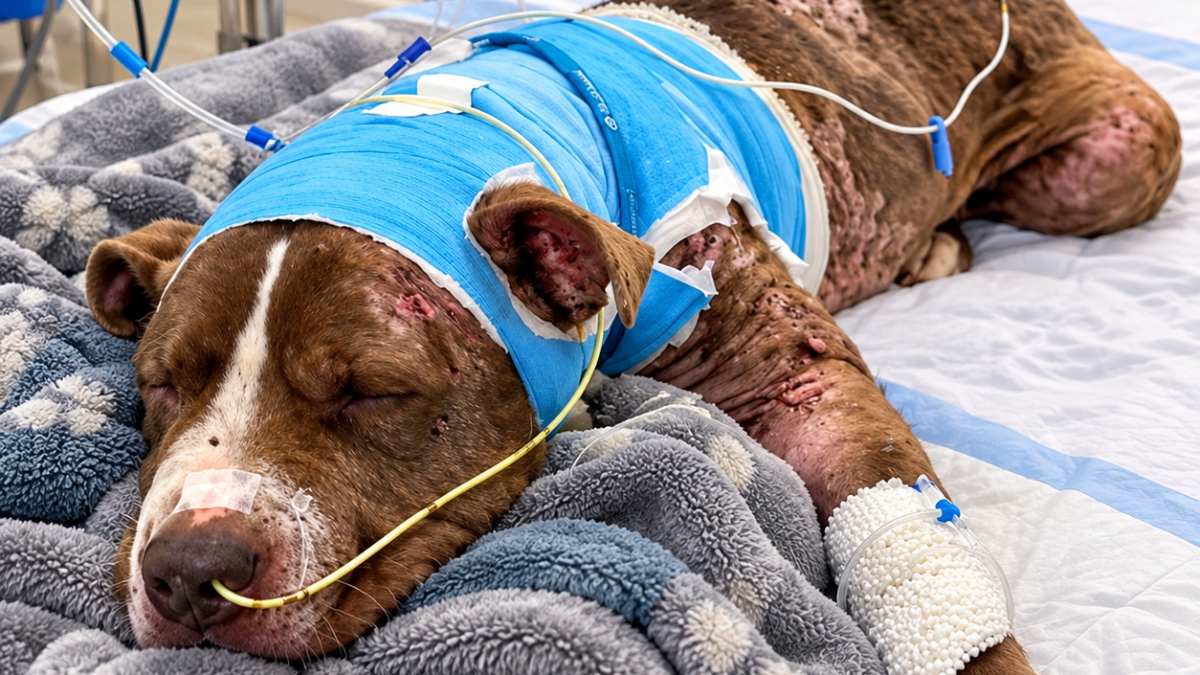
By the time I reached Elijah, thousands of maggots were crawling through wounds that should have killed a puppy long before sunrise.
He was too weak to cry, but when I slipped my hand beneath his head, he leaned into my palm as if kindness were the one thing he still recognized.
I thought the hardest part would be keeping him alive—until the veterinarian looked at the pattern of scars on his body and asked me a question that changed everything.
I had been with animal rescue long enough to believe I had learned how to keep my emotions under control.
Then Elijah opened his eyes.
The call had come in just after seven that morning.
“Puppy down,” our dispatcher said. “Severe wounds. Possible infection. Caller says there are insects all over him.”
I grabbed the emergency kit and drove faster than I should have.
When I reached the abandoned lot, I saw a small shape beside a broken section of fencing.
For one terrible second, I thought I was too late.
Then his chest moved.
Barely.
“Elijah?” I whispered, although he didn’t have that name yet. “Hey, little man. I’m here.”
He lifted his head less than an inch before it dropped again.
He was still a puppy.
That was what broke me.
He should have been destroying somebody’s slippers, learning how to chase a tennis ball, falling asleep upside down on a couch.
Instead, his tiny body was covered in puncture wounds.
Several had become badly infected. Parts of his skin were already dying, and maggots had filled some of the deeper injuries.
His ear was mangled.
He smelled of infection, dirt, and neglect.
But when I put on gloves and touched the side of his face, he didn’t snap.
He didn’t growl.
He leaned toward me.
I swallowed hard.
“You still trust us?”
His eyes closed.
I wrapped him carefully in a clean blanket and lifted him.
He weighed almost nothing.
During the drive to the emergency hospital, I kept one hand on the edge of his carrier whenever traffic stopped.
“Stay with me,” I kept saying. “You don’t know me yet, but stay anyway.”
The veterinary staff was waiting when I arrived.
Within seconds, Elijah disappeared through the treatment-room doors.
Then came the longest four hours I can remember.
The team removed maggots one by one.
They flushed wounds.
They cut away tissue that could no longer be saved.
They started antibiotics, fluids, pain medication, and nutritional support.
His damaged ear was examined repeatedly before the surgeon finally came to me.
“We can’t save all of it.”
I looked through the glass at the puppy lying beneath warming blankets.
“Save him,” I said. “Whatever that takes.”
Part of Elijah’s ear had to be amputated.
When the procedure ended, his body was covered in bandages.
A feeding tube was helping keep him alive.
A wound vacuum had been placed over one of the worst injuries.
And still, nobody could promise me he would survive the night.
I sat beside him after the staff finally allowed me into recovery.
His breathing was shallow.
I touched two fingers to the top of his head.
“You fought long enough by yourself,” I whispered. “You don’t have to do that anymore.”
His eye opened.
Then, impossibly, his tail moved once beneath the blanket.
One tiny thump.
The technician beside me covered her mouth.
“Oh, sweetheart,” she whispered.
That single movement destroyed every wall I had been holding up.
I turned away and cried.
But Elijah’s fight was only beginning.
Over the next twenty-four hours, more damaged tissue started dying.
His temperature fluctuated.
His bloodwork worried the doctors.
Another surgery became necessary.
Every procedure was a gamble because his body was already exhausted.
Then Dr. Lena Morales called me into a quiet consultation room.
She closed the door.
On her tablet were photographs of Elijah’s injuries.
She enlarged one image, then another.
“These wounds aren’t random,” she said.
I felt something cold settle in my stomach.
“What are you saying?”
She hesitated before looking directly at me.
“I need to know exactly where you found him.”
“Why?”
Her expression changed.
Not sadness anymore.
Anger.
Controlled, professional anger.
“Because I’ve seen patterns like this before.”
I stared at the screen.
Dr. Morales lowered her voice.
“Has anyone contacted law enforcement yet?”
And that was the moment I understood that saving Elijah might not be the end of this story.
It might only be the beginning.
PART 2
I looked at Dr. Morales for several seconds before I could answer.
“No,” I said. “Not yet.”
She nodded slowly.
“Then we need to.”
I glanced toward the treatment room.
Through the narrow window in the door, I could see the edge of Elijah’s kennel. A green blanket covered most of his body. Tubing ran from an IV pump beside him, and one of the veterinary technicians was checking the bandage near his shoulder.
I wanted to stay focused on that.
On medicine.
On survival.
On things we could measure.
Heart rate.
Temperature.
White blood cell count.
But Dr. Morales’s words had opened a door I didn’t want to walk through.
“What kind of pattern?” I asked.
She pulled the tablet closer.
“I can’t tell you exactly what happened to him,” she said. “And I won’t claim something I can’t prove. But there are wounds of different ages. Some are healing. Some are fresh. Several are consistent with repeated bites.”
My jaw tightened.
“He’s a puppy.”
“I know.”
“Maybe another dog attacked him once.”
“It’s possible.”
She paused.
“But?”
“There’s more.”
She showed me an older scar beneath his chest, another behind his shoulder, and a cluster of puncture marks along his neck.
“These didn’t all happen at the same time.”
I stared until the images blurred.
“So somebody kept putting him back into danger.”
“I’m saying we need investigators to determine that.”
That distinction mattered.
Especially if someone was going to be prosecuted.
But emotionally, I was already somewhere else.
I remembered Elijah lying beside that broken fence.
I remembered how he had leaned into my hand instead of pulling away.
And suddenly I couldn’t stop thinking about the possibility that the sweetest instinct in him—his willingness to trust—might have been exactly what somebody had exploited.
“What do you need from me?”
“Photographs of the location. Exact coordinates. Anything you noticed nearby. Tracks. Trash. Vehicles. Collars. Rope. Blood. Anything unusual.”
“I photographed everything before moving him.”
Dr. Morales looked relieved.
“Good.”
“I also have the blanket we found underneath him.”
“Bag it. Don’t wash it.”
I nodded.
Then I looked through the window again.
“Is he going to live?”
Her expression softened.
“I don’t know.”
That answer hurt more than anything else she had said.
“He survived surgery.”
“He did.”
“So that’s good.”
“It’s very good.”
“But?”
“Elijah is septic. He’s severely malnourished. There’s extensive tissue damage. His immune system is trying to fight more than one battle at a time.”
I stared at the floor.
Dr. Morales leaned forward.
“But he is fighting.”
I looked up.
“And that matters.”
It was the only promise she could honestly give me.
So I held onto it.
That afternoon, an animal-cruelty investigator named Detective Marcus Reed arrived at the hospital.
He was a broad-shouldered man in his late forties with tired eyes and a notebook that looked like it had been through several storms.
Before asking a single question, he stood outside Elijah’s kennel.
For almost a minute, he said nothing.
Then he turned to me.
“This the dog?”
“Yes.”
His mouth tightened.
“You found him?”
I nodded.
“Show me where.”
We drove back to the lot in separate vehicles.
In daylight, the place looked even worse.
An abandoned warehouse stood behind the overgrown field. The windows had been boarded years ago, although two boards on the eastern side were missing.
Discarded tires lay beside a rusted appliance.
Beer cans.
Fast-food bags.
A torn section of blue tarp.
The patch of ground where Elijah had been lying was dark with moisture from the night before.
Marcus pulled on gloves.
“Walk me through it.”
I showed him where my truck had stopped.
Where I had approached.
Where Elijah had been.
Where the blanket had been positioned.
He crouched beside the fence and examined the dirt.
“Did you touch this?”
“No.”
He pointed at a length of frayed nylon partly buried under weeds.
I hadn’t noticed it.
It looked like the broken end of a leash.
Marcus photographed it.
Then he found something else.
A cheap metal clip.
And another piece of nylon.
“This may be nothing,” he said.
But his voice had changed.
We kept looking.
Near the rear wall of the warehouse were paw prints.
Not one dog.
Several.
Most had been distorted by mud, but some were large.
Much larger than Elijah.
Marcus called another investigator.
Within an hour, the lot was being processed.
I stood beside my truck, arms folded, feeling useless.
“What happens now?” I asked.
“We see what the evidence tells us.”
“And if somebody did this?”
Marcus looked at me.
“Then we find them.”
That sentence stayed with me.
Not because it sounded dramatic.
Because of how quietly he said it.
There was no performance in his voice.
No fantasy about revenge.
Just procedure.
Evidence.
Names.
Charges.
Consequences.
It was exactly what Elijah needed.
Back at the hospital, things had gotten worse.
His blood pressure had dropped.
The doctors adjusted medication.
For the next several hours, every time the phone rang, my stomach turned.
At 1:17 in the morning, Dr. Morales called.
“Elijah’s going back into surgery.”
I sat upright in bed.
“What happened?”
“More tissue around one wound has become nonviable. We need to remove it before the infection spreads farther.”
“Can he handle anesthesia again?”
“We’re going to keep it as short as possible.”
There was silence.
Then I asked the question I hated.
“What are his chances?”
“I can’t give you a number.”
“Lena.”
“I know.”
“No. Tell me.”
She exhaled.
“He could die during surgery.”
I closed my eyes.
“But if we don’t do it?”
“He could die from the infection.”
There was no choice.
Only two different kinds of fear.
“Do it.”
I arrived at the hospital twenty minutes later.
Nobody told me I needed to come.
I simply couldn’t stay home.
The waiting room was almost empty.
A television mounted near the ceiling played a muted late-night program.
A man held a sleeping cat carrier beside him.
A woman was crying quietly into her phone at the far end of the room.
And somewhere beyond those double doors, a puppy who had never received a fair chance in life was fighting through another surgery.
I thought about all the dogs I had transported over the years.
The neglected ones.
The frightened ones.
The injured ones.
Some recovered.
Some didn’t.
You tell yourself that experience makes you stronger.
It does.
But people misunderstand what that strength looks like.
It doesn’t mean you stop hurting.
It means you learn how to keep moving while you hurt.
At 3:06 a.m., Dr. Morales came through the doors.
I stood so fast my chair scraped across the floor.
“He made it.”
My knees nearly gave out.
She caught my arm.
“He’s not stable yet.”
“But he made it.”
“Yes.”
I covered my face.
For several seconds, neither of us said anything.
Then I laughed.
I have no idea why.
Maybe because if I didn’t laugh, I was going to collapse.
Dr. Morales smiled for the first time that night.
“That puppy is stubborn.”
“Good.”
“He’s going to need it.”
The next three days were measured in tiny victories.
On Tuesday morning, Elijah lifted his head when I entered the room.
On Tuesday afternoon, his temperature dropped slightly.
On Wednesday, his bloodwork showed the infection might finally be responding.
On Thursday, he licked a veterinary technician’s finger after she dipped it into soft food.
Nobody celebrated loudly.
We had all become superstitious.
We didn’t want to scare hope away.
But then Friday morning arrived.
I was sitting on the floor beside Elijah’s kennel while a technician named Jenna prepared his medications.
She placed a shallow bowl of food near him.
Until then, the feeding tube had been doing most of the work.
“Elijah,” she said softly. “Want to try?”
He sniffed.
Stopped.
Sniffed again.
Then his tongue touched the food.
Jenna froze.
I leaned forward.
“Come on, buddy.”
He took one small mouthful.
Then another.
Then a third.
Jenna looked at me.
“Are you seeing this?”
“I’m afraid to blink.”
Elijah ate seven bites.
Seven.
I counted every one.
When he stopped, Jenna removed the bowl.
“That’s enough.”
I wanted to hand it back.
“He wants more.”
“He thinks he wants more.”
“He deserves a buffet.”
She laughed.
“His stomach disagrees.”
I reached through the kennel door and rubbed beneath Elijah’s chin.
“You hear that? Apparently, you’ve got rules now.”
His tail tapped the blanket.
Twice.
That afternoon, I received a call from Marcus.
“We found something.”
My mood changed immediately.
“What?”
“Can you come down?”
“Tell me.”
“I’d rather show you.”
An hour later, I sat across from him in a small office at the county sheriff’s department.
On the desk was a clear evidence bag containing the metal clip recovered near the warehouse.
Beside it was a photograph of a black nylon collar.
Marcus pushed the photo toward me.
“That wasn’t on Elijah.”
“No.”
“Then what is it?”
“Found inside the warehouse.”
I stared at it.
There were dried stains on the nylon.
A brass plate had been scratched almost beyond recognition.
Marcus placed another photograph beside it.
This one showed a wooden interior wall.
Several chains hung from metal rings.
My stomach turned.
“What was happening there?”
“We don’t know yet.”
“You know.”
“I know what it looks like.”
“Marcus.”
He studied me.
“We need evidence strong enough to survive defense attorneys, motions, and trial. What I think doesn’t put anyone in prison.”
I hated that answer.
I also knew he was right.
“So what do you have?”
He slid another photograph forward.
A small security camera mounted on the corner of a building across the road.
My heart started pounding.
“The tire shop?”
He nodded.
“Owner’s cameras record the access road.”
“Did they get anything?”
“Maybe.”
He turned his computer screen.
The footage was grainy.
Time-stamped.
Dark.
At 2:41 a.m. the night Elijah was found, headlights appeared.
A pickup truck entered the access road.
It remained near the warehouse for seven minutes.
Then it left.
The license plate wasn’t readable.
But the truck had a distinctive rear bumper.
One side hung lower than the other.
And across the back window was a large pale decal.
“What does that prove?”
“By itself? Very little.”
Marcus changed the image.
“But three weeks ago, an officer responded to a noise complaint two miles from that warehouse.”
A police body-camera still appeared.
A black pickup sat in a driveway.
Same damaged bumper.
Same rear-window decal.
I leaned closer.
“Whose truck?”
Marcus didn’t answer immediately.
Then he said a name.
Darren Cole.
I had never heard it before.
“Who is he?”
“Prior animal-cruelty complaint. Charges never filed because the witness recanted.”
My hands curled into fists.
“Go get him.”
“That’s not how this works.”
“He dumped Elijah.”
“We have a truck that resembles his.”
“At the warehouse.”
“We need more.”
“How much more?”
“As much as we can get.”
I stood and paced.
Elijah was lying in a hospital with part of his ear gone.
He had nearly died twice.
And the person who might have put him there was sleeping in his own bed because a camera couldn’t read a license plate.
Marcus watched me.
“You want justice?”
“Yes.”
“Then let us build the case correctly.”
I stopped.
“If we rush, he walks.”
That brought me back.
Because this wasn’t about satisfying my anger.
It was about making sure whoever had hurt Elijah could not simply do it again.
“What do you need?”
“A connection between Elijah and Cole.”
“How do we find one?”
“We’re working on it.”
The connection came from a place nobody expected.
Elijah’s damaged collar.
When I had first lifted him from the lot, there had been a dirty strip of faded red nylon around his neck.
No tag.
No identification.
I had assumed it was worthless.
The hospital had removed it during treatment and sealed it with his belongings.
One of Marcus’s evidence technicians examined it.
Beneath the grime, nearly invisible, were four numbers written in permanent marker.
Not a phone number.
Not a date anyone recognized.
Marcus searched prior animal-control reports associated with Darren Cole.
One report included a photograph from a welfare check the year before.
Three dogs stood behind a chain-link fence.
One wore a red collar.
The enlargement was poor.
But on the collar were black markings.
Numbers.
“Could be coincidence,” Marcus said.
“Could be.”
We both knew neither of us believed it.
Then a former neighbor came forward.
Her name was Mrs. Ellison.
Seventy-three years old.
Retired school secretary.
Five feet two.
And absolutely fearless.
She had lived beside Darren’s property for eleven years before moving away.
When Marcus showed her Elijah’s photograph, she stared at it for a long time.
Then she removed her glasses.
“I’ve seen that puppy.”
Every hair on my arms rose.
“Where?”
“At his place.”
Marcus leaned forward.
“You’re certain?”
“No.”
My stomach dropped.
Then she pointed to Elijah’s surviving ear.
“But I remember that white patch above his eye.”
She described a puppy she had seen being carried from a vehicle approximately two months earlier.
Small.
Thin.
Mostly brown.
White patch.
Red collar.
She had assumed Darren was fostering him.
“Did you ever see anything else?”
Mrs. Ellison’s mouth tightened.
“I heard things.”
“What things?”
“Dogs screaming.”
The room went silent.
She looked down at her hands.
“I called once.”
“You made the previous complaint?”
She nodded.
“What happened?”
“Animal control came. Everything was clean when they arrived.”
“Did you recant?”
Her face hardened.
“I got a dead rat nailed to my mailbox the next morning.”
Marcus stopped writing.
Mrs. Ellison looked straight at him.
“I was alone. My husband had already died. I got scared.”
Nobody judged her.
I certainly didn’t.
Fear is easy to criticize when it belongs to someone else.
“I moved six months later,” she said.
“Would you be willing to give a statement now?”
She looked at Elijah’s photograph again.
“Yes.”
That woman became the first crack in the wall.
The next came from a mechanic.
Darren had taken his pickup in for repairs the morning after Elijah was found.
He wanted the truck washed underneath.
Not unusual by itself.
But he had been agitated.
He asked twice whether the shop kept security footage.
The mechanic remembered because Darren offered cash to have the truck cleaned immediately.
Then investigators obtained a warrant for location data connected to his phone.
At 2:39 a.m., it had pinged near the warehouse.
At 2:49, it was moving away.
Marcus called me late that evening.
“We have enough to search his property.”
“When?”
“Tomorrow morning.”
“Can I come?”
“No.”
“I won’t interfere.”
“Still no.”
I hated him for approximately six seconds.
Then I understood.
This wasn’t rescue anymore.
It was law enforcement.
“What happens if you find dogs?”
“Animal control will be there.”
“Call me if they need placement.”
“I already gave them your number.”
At 5:30 the next morning, I was awake.
At 5:45, I made coffee and forgot to drink it.
At six, I checked my phone.
At 6:15, I checked again.
At 6:30, I drove to the hospital because sitting at home had become impossible.
Elijah was awake.
His eyes followed me as I approached.
“Morning, handsome.”
He had one ear partially bandaged, and his entire body still looked too fragile for the world.
But his eyes were different.
Present.
Curious.
Alive.
Jenna opened his kennel.
“Want to try standing?”
My heart jumped.
“Today?”
“Maybe.”
We fitted a support sling beneath his abdomen.
Elijah placed one paw on the floor.
Then another.
His legs trembled.
“It’s okay,” Jenna murmured.
He looked at me.
“Come on, buddy.”
He shifted his weight.
His back legs nearly folded.
I reached out instinctively, but Jenna stopped me.
“Let him find it.”
Elijah steadied himself.
One second.
Two.
Three.
Then he took a step.
It was barely six inches.
I started crying anyway.
“Look at you.”
Another step.
His claws clicked softly against the tile.
He made it four feet before his body became tired.
Jenna lifted him.
“That’s enough.”
“Elijah,” I whispered, laughing through tears. “You just walked.”
His tail moved.
And then my phone rang.
Marcus.
I stepped into the hallway.
“Tell me.”
His voice sounded different.
“We’re at Cole’s property.”
“And?”
He was quiet for half a second.
“We found dogs.”
My throat tightened.
“How many?”
“Eleven alive.”
I closed my eyes.
“Eleven?”
“Several injured. Animal control is removing them now.”
“And Darren?”
“In custody.”
I leaned against the wall.
“What did you find?”
“Enough.”
That single word carried more weight than a speech.
Later, I learned what the search team had uncovered.
Chains.
Veterinary medications that had never been prescribed to Darren.
Equipment used to restrain dogs.
Blood-stained flooring.
Records with dates and numbers.
Videos.
Those were the worst.
The investigators would not show them to me.
I was grateful.
They didn’t need to.
The evidence confirmed what Dr. Morales had feared.
Elijah had not simply wandered into a fight.
He had been deliberately placed in danger.
Again and again.
His identification in Darren’s handwritten records matched the numbers on his collar.
To Darren, Elijah had been four digits.
Not a puppy.
Not a life.
Not a frightened little creature who leaned into people when they touched him gently.
Four digits.
I sat in my car after Marcus told me and stared through the windshield for nearly twenty minutes.
I had imagined that if we found the person responsible, I would feel triumphant.
I didn’t.
I felt sick.
Because arresting one man couldn’t erase what had already happened.
It couldn’t restore Elijah’s ear.
It couldn’t give him back the weeks or months he had spent afraid.
It couldn’t explain to eleven other dogs why nobody had come sooner.
Justice matters.
But justice is not a time machine.
That lesson stayed with me through everything that followed.
The eleven dogs were distributed between emergency veterinary hospitals and experienced rescue organizations.
Three needed immediate surgery.
One elderly female had scars covering her face but still wagged her tail when offered chicken.
A black dog named Otis refused to leave the back corner of his kennel for nearly two days.
A brindle female fell asleep standing because she seemed afraid to lie down.
And suddenly Elijah’s rescue had become something larger.
People heard about the seizure.
Donations came in.
Food.
Blankets.
Crates.
Medical supplies.
One child mailed five dollars in an envelope with a handwritten note:
FOR THE DOGS.
We taped it to the wall of the rescue office.
Not because five dollars changed the medical bills.
Because the note changed us.
It reminded us that cruelty could spread.
But so could kindness.
Meanwhile, Elijah kept improving.
The infection retreated.
His bloodwork stabilized.
The wound vacuum was eventually removed.
Then came the day Dr. Morales removed his feeding tube.
I stood beside the table while Elijah watched us suspiciously.
“You know he’s going to blame me,” I said.
Dr. Morales laughed.
“He already knows I’m the villain.”
Elijah licked her wrist.
“Traitor,” I told him.
The tube came out quickly.
He blinked.
Then looked around as though waiting for something worse.
“That’s it,” Lena told him.
Elijah sneezed.
We laughed.
It was such an ordinary sound.
That was what made it beautiful.
For weeks, every sound associated with him had meant pain.
Monitors.
Surgical suction.
IV alarms.
Whimpering.
Now there was a sneeze.
A ridiculous puppy sneeze.
Normal life was beginning to push its way back in.
A few days later, he discovered toys.
Jenna brought him a soft blue octopus.
Elijah sniffed it.
Looked at us.
Sniffed again.
Then very carefully picked it up.
His tail wagged.
Not once.
Not twice.
Constantly.
“Oh no,” Jenna said.
“What?”
“We’ve created a monster.”
Elijah shook the toy.
Weakly at first.
Then harder.
The octopus hit him in the face.
He froze.
We froze.
Then he pounced on it.
I laughed so loudly another technician came through the door.
“What happened?”
“He’s playing.”
She smiled.
“That dog?”
“That dog.”
Within ten minutes, three people had gathered outside the kennel watching Elijah fight a stuffed octopus like it owed him money.
It was one of the happiest moments of my life.
And I have learned something since then.
People think recovery announces itself dramatically.
Sometimes it does.
But often healing is embarrassingly small.
A bite of food.
A steady temperature.
A tail wag.
A toy.
Five steps down a hallway.
You don’t always realize you are witnessing a miracle because the miracle is busy chewing a stuffed animal.
Two weeks after his rescue, Elijah walked outside.
The day was warm.
Jenna clipped a lightweight leash to his harness.
I crouched several feet away.
The grass seemed to confuse him.
He put one paw down.
Pulled it back.
Put it down again.
“First lawn?” I asked.
“Maybe.”
He sniffed.
Then stepped onto the grass.
Sunlight touched his face.
For the first time since I had found him, he was outside without being abandoned.
Without chains.
Without danger.
Without someone expecting him to suffer.
He walked toward me.
Slowly.
His body was still thin.
Several wounds remained covered.
His damaged ear gave his face a permanently uneven appearance.
I thought he was beautiful.
He reached me and pressed his head against my knee.
I rubbed his neck.
“You made it outside, buddy.”
He sat.
Then he noticed a butterfly.
His entire body changed.
His ears lifted—or one and a half of them did.
His eyes followed the movement.
The butterfly floated past.
Elijah took two quick steps.
Then three.
Jenna laughed.
“He wants it.”
“He’s a puppy.”
The words left my mouth before I understood why they hurt.
He’s a puppy.
Not evidence.
Not victim number 2714.
Not a bait dog.
Not a surgery patient.
A puppy.
For several seconds, I couldn’t speak.
Jenna touched my shoulder.
“You okay?”
I nodded.
“I forgot.”
She understood.
We all had.
Pain can become so large that it hides the person—or animal—beneath it.
That afternoon Elijah slept for three hours.
The next morning, he demanded breakfast.
Progress accelerated after that.
His bandages became smaller.
Then fewer.
His coat began filling in around shaved areas.
He gained weight.
He learned that opening the refrigerator in the hospital kitchen sometimes meant cheese.
This transformed him into a criminal.
He learned which technicians carried treats.
He learned which veterinarian could be manipulated with sad eyes.
That veterinarian was Dr. Morales.
“I know what he’s doing,” she insisted one afternoon while handing him chicken.
“Then why are you giving it to him?”
“He’s recovering.”
“He recovered from lunch eleven minutes ago.”
“He needs calories.”
“Elijah,” I said, “you’ve corrupted a medical professional.”
His tail wagged.
The trial process moved much more slowly.
Darren Cole was charged with multiple counts related to animal cruelty and organized animal fighting.
A second man, Victor Hale, was arrested after investigators identified him through records found on Darren’s property.
Then a third.
The case widened.
There were financial records.
Messages.
Videos.
Names.
Several dogs that investigators had previously been unable to trace.
A network that had existed partly because frightened people had looked away.
And partly because people who did report it lacked enough evidence to make charges stick.
This time was different.
The evidence was overwhelming.
That didn’t mean the process was easy.
Defense attorneys challenged the searches.
They questioned the condition of the warehouse.
They argued that some equipment had innocent uses.
They attacked witness credibility.
They questioned veterinary interpretations of injury patterns.
Dr. Morales spent hours preparing.
Marcus spent more.
Mrs. Ellison agreed to testify.
So did the mechanic.
So did the tire-shop owner whose camera had captured the pickup.
And then I was subpoenaed.
The night before I testified, I didn’t sleep.
I had spoken publicly about rescue cases dozens of times.
But court was different.
Every word mattered.
The prosecutor had warned me repeatedly.
“Answer only what you know.”
“I know what I saw.”
“Good.”
“Can I say what I think?”
“No.”
“What if they ask?”
“You explain what you observed. Let the jury draw conclusions.”
It frustrated me.
But that was justice.
Not anger.
Not revenge.
Evidence.
When I entered the courtroom, Darren was sitting beside his attorney.
I had seen photographs of him.
Still, seeing him in person made something in my chest tighten.
He looked ordinary.
That disturbed me more than if he had looked frightening.
Cruelty does not always wear a warning sign.
Sometimes it wears a clean shirt and sits quietly beneath fluorescent lights.
I took the oath.
The prosecutor began.
“Please tell the jury what happened on the morning you found the dog now known as Elijah.”
So I did.
I described the call.
The abandoned lot.
The broken fence.
The blanket.
The smell of infection.
The fact that Elijah was alive.
I did not exaggerate.
I didn’t need to.
The truth was unbearable enough.
“What did Elijah do when you touched him?”
I swallowed.
“He leaned into my hand.”
The prosecutor paused.
“Despite his injuries?”
“Yes.”
“Did he attempt to bite you?”
“No.”
“Growl?”
“No.”
“Escape?”
“He didn’t have the strength.”
Someone in the gallery began crying.
The judge looked up.
I continued.
The prosecutor showed photographs from the scene.
Then hospital photographs.
Then the red collar marked 2714.
When the defense attorney stood for cross-examination, he spoke politely.
That surprised me.
“Isn’t it true that you did not personally witness my client injuring Elijah?”
“Yes.”
“You did not personally witness him at the warehouse?”
“No.”
“You cannot say from your personal knowledge who caused those injuries?”
“No.”
“So when you first arrived, you had no idea how the dog had been injured.”
“That’s correct.”
He nodded as if he had won something.
Then he asked one question too many.
“And as an animal-rescue worker, you sometimes become emotionally attached to injured animals, correct?”
“Yes.”
“So your feelings regarding Elijah may affect how you interpret what happened.”
The prosecutor objected.
Before the judge ruled, I looked directly at the attorney.
“My feelings didn’t put the numbers on his collar.”
Silence.
The attorney stared at me.
The judge sustained the objection and instructed the jury to disregard my statement.
But they had heard it.
So had Darren.
When I stepped down, Marcus was waiting in the hallway.
“You weren’t supposed to argue.”
“I know.”
He tried not to smile.
“You’re terrible at court.”
“I know.”
“Never become a lawyer.”
“Wasn’t planning on it.”
The medical testimony came later.
Dr. Morales explained Elijah’s wounds in clinical terms.
She described necrotic tissue.
Infection.
Malnutrition.
Puncture wounds of varying ages.
The partial ear amputation.
The surgeries.
The feeding tube.
The wound vacuum.
The risk of septic shock.
She never raised her voice.
She never called Darren a monster.
She didn’t need to.
The medical record did the work.
Mrs. Ellison testified about the sounds from the neighboring property.
Her previous complaint.
The dead rat on her mailbox.
The puppy with the white patch above his eye.
When the defense suggested her memory might be unreliable because of her age, she sat straighter.
“Young man,” she said, looking directly at the attorney, “I worked forty-two years in a school office. I remember which children forged their mothers’ signatures in 1987. I remember that puppy.”
Even the judge had to hide a reaction.
The decisive evidence came from Darren’s own records.
Numbers.
Dates.
Payments.
Videos.
The prosecution connected 2714 to Elijah.
Not by emotion.
By documentation.
When the verdict came, I was at the rescue center.
I could not bring myself to sit in the courtroom waiting.
Marcus called.
“Guilty.”
I closed my eyes.
“How many?”
“All major counts.”
I sat down hard in the nearest chair.
Around me, dogs barked.
A dryer was running in the laundry room.
Someone dropped a metal bowl in the kennel area.
Ordinary noises.
“Are you there?” Marcus asked.
“Yes.”
“You okay?”
“I don’t know.”
“You wanted justice.”
“I did.”
“You got part of it.”
Part.
He understood exactly.
The sentencing hearing took place several weeks later.
This time, I attended.
Victim-impact statements in animal cases are strange things.
The victim cannot stand before the court and describe fear.
Cannot point toward the defendant.
Cannot explain the pain.
So other people carry the words.
Dr. Morales spoke about the medical suffering.
Animal control spoke about the eleven dogs recovered.
The prosecutor spoke about the organization behind it.
Then I was called.
I stood at the lectern with a photograph in my hand.
It was not a photograph of Elijah when I found him.
I chose something else.
Elijah standing in grass.
His head tilted.
His damaged ear visible.
A blue toy in his mouth.
“This is Elijah now,” I said.
Darren looked up.
“I could show the court what was done to him. Those photographs are already in evidence. But I want the court to understand something else.”
I held up the image.
“This is what survived.”
The courtroom was silent.
“Elijah trusted people when he had every reason not to. He ate again. He walked again. He learned to play. He learned sunlight did not always mean danger.”
My voice shook.
I stopped.
Breathed.
Continued.
“He will carry scars for the rest of his life. But those scars do not belong to the person who hurt him. They belong to Elijah now. They are evidence that he lived.”
I looked at the judge.
“I cannot tell you what sentence erases what happened, because no sentence can. I only ask that the consequences be serious enough that the people responsible never get the chance to create another Elijah.”
Then I sat down.
Darren received a substantial prison sentence, along with prohibitions on possessing animals and financial penalties connected to the care of the seized dogs.
Victor Hale and the others faced separate cases.
Several pleaded guilty.
One went to trial.
The network collapsed piece by piece.
It wasn’t the explosive revenge people imagine in movies.
Nobody chased anyone down an alley.
Nobody threw a punch.
There was no dramatic speech followed by instant punishment.
Real revenge—if I can even call it that—was slower.
It was evidence sealed in plastic bags.
Security footage copied onto drives.
Veterinary records.
Warrants signed at dawn.
Witnesses deciding they were no longer afraid.
A jury listening.
A judge sentencing.
Kennel doors opening.
Chains being removed.
Dogs being carried into sunlight.
That was enough for me.
Because the greatest defeat Darren suffered was not prison.
It was discovering that every animal he had treated as disposable had become evidence against him.
And Elijah, the puppy he apparently believed could be discarded and forgotten, became the one nobody would forget.
By then, Elijah had been medically cleared to leave the hospital.
That created a new problem.
Where would he go?
I wanted him.
Everyone wanted him.
Jenna wanted him.
Dr. Morales pretended she did not want him while keeping twelve photographs of him on her phone.
Two technicians were openly campaigning.
But Elijah needed more than affection.
He needed patience.
A secure home.
Another stable dog, if possible.
Someone comfortable with continued medical follow-up.
Someone who understood that trauma sometimes appears after the emergency ends.
Applications arrived.
Dozens.
Then hundreds.
Some were wonderful.
Some were not.
One person wrote that Elijah would be “great for social media.”
Application denied.
Another wanted him because his damaged ear looked “cool.”
Denied.
One family said they had no fencing but planned to teach him boundaries immediately.
Denied.
Then I opened an application from a woman named Rachel.
She was a pediatric nurse.
Her husband, Daniel, worked from home.
They had one dog: an eight-year-old Labrador mix named Maple.
Their yard was fenced.
Their veterinarian had been caring for their animals for fourteen years.
Under the question WHY DO YOU WANT TO ADOPT ELIJAH? Rachel had written:
We do not want the dog from the news. We want the dog he becomes when nobody is watching.
I read the sentence twice.
Then a third time.
I called her.
“Rachel?”
“Yes?”
“This is Sarah from the rescue.”
She inhaled sharply.
“Oh.”
“You applied for Elijah.”
“Yes.”
“Still interested?”
There was a pause.
“Very.”
“Come meet him.”
They arrived Saturday morning.
I watched from the lobby window.
Rachel got out first.
She carried nothing.
No giant gift basket.
No camera.
No special outfit.
Daniel followed.
Then they opened the back door and brought out Maple.
An ordinary yellow-brown dog with a graying muzzle and calm eyes.
That was exactly what I wanted to see.
We introduced the dogs outside.
Elijah noticed Maple immediately.
His body became stiff.
This was the moment I feared.
We had learned that Elijah was gentle with people.
But his history with dogs had been violent.
Not because of him.
Still, memory lives in the body.
Maple stood thirty feet away.
No pressure.
No pulling.
Daniel let her sniff the grass.
Elijah watched.
I crouched beside him.
“You decide, buddy.”
Rachel stayed back.
She understood.
Elijah took one step.
Maple looked up.
Then looked away.
Another step.
Maple sniffed a bush.
Elijah moved closer.
Twenty feet.
Fifteen.
Ten.
He stopped.
Maple sat down.
Elijah’s tail moved once.
Then he approached.
They touched noses.
My heart stopped.
Maple turned sideways and sniffed the grass again.
Elijah followed.
Within five minutes, they were walking parallel.
Within ten, Elijah tried to steal the tennis ball Daniel had brought for Maple.
Daniel laughed.
“That’s promising.”
Rachel’s eyes were wet.
She crouched when Elijah approached but did not reach for him.
He sniffed her hands.
Then leaned into her knees.
She closed her eyes.
“I’m not going to cry.”
“You can.”
“No, because then he’ll think he broke me.”
“You have no idea what he’s capable of.”
Elijah licked her chin.
Rachel burst into tears.
Daniel shook his head.
“Strong start.”
We did not approve the adoption that day.
People hated me for that.
Not Rachel.
Not Daniel.
They understood.
They visited again.
And again.
We did a home inspection.
We checked references.
We watched Elijah and Maple together.
We discussed medical expenses.
Behavioral support.
Fear responses.
Food guarding.
Nightmares.
Separation.
Everything.
Then came foster-to-adopt.
I drove Elijah to their home myself.
He sat in a secured crate in the back of the rescue vehicle with his blue octopus toy.
When we arrived, Rachel opened the front door.
Maple stood beside her.
Elijah recognized them.
His tail exploded.
“That’s a yes,” Daniel said.
I carried his medication inside.
Explained the schedule.
Again.
Rachel smiled.
“You already emailed it.”
“I know.”
“And printed it.”
“I know.”
“And put a copy in the medication bag.”
“I know.”
Daniel looked at her.
“She’s not ready to leave.”
“No,” Rachel whispered. “She really isn’t.”
I pretended not to hear.
The house was quiet.
No children screaming.
No television blaring.
No crowd waiting to meet the famous rescue dog.
Just home.
Elijah explored the living room.
Sniffed the couch.
Found Maple’s bed.
Tried to climb into it.
Maple stared at him.
Then moved to the other bed.
Elijah followed.
“Personal space,” I told him.
He ignored me.
Daniel opened the back door.
Sunlight poured across the floor.
Elijah hesitated.
Then ran outside.
Not fast.
Not yet.
But faster than I had ever seen him move.
He reached the grass.
Turned.
Looked at us.
And ran again.
Rachel laughed.
Maple chased him.
For perhaps ten seconds, Elijah forgot everything.
He was simply a puppy running through a yard.
I had promised myself I would not cry.
I failed immediately.
Rachel stood beside me.
“You saved him.”
I shook my head.
“No.”
She looked at me.
“We got him to the hospital. The doctors saved him. Elijah did the rest.”
I knelt when he came back.
He was panting.
Happy.
I held his face between my hands.
“You behave.”
He licked my nose.
“I mean it.”
Tail wag.
“You have a family now.”
The words nearly stopped me.
A family.
Something he should have had from the beginning.
I hugged him.
Then I stood.
And I left.
That was harder than finding him.
Nobody tells rescue workers about that part.
You spend weeks begging an animal not to die.
You memorize medication schedules.
You sleep beside kennels.
You celebrate bowel movements.
You cry over bloodwork.
You whisper promises into damaged ears.
Then, if everything goes right, your reward is saying goodbye.
I cried halfway home.
Then Rachel sent me a photograph.
Elijah was asleep on the couch.
His head rested against Maple.
Blue octopus beneath one paw.
Caption:
He stole her bed, her toy, and half my husband’s chicken. I think he’s settling in.
I laughed so hard I had to pull over.
The adoption became official three weeks later.
We took the usual photograph.
Rachel.
Daniel.
Maple.
Elijah.
Elijah’s damaged ear tilted sideways.
His tongue hung out.
Nobody would have mistaken him for the puppy I had found beside that warehouse.
But sometimes, late at night, I still remembered that first moment.
His body wrapped in my blanket.
His eye opening.
That tiny tail movement.
One thump.
As if he were saying:
I’m still here.
Months passed.
The legal case faded from the news.
That was fine with me.
Elijah’s real life began after people stopped watching.
Rachel sent updates.
Elijah discovered sprinklers.
Hated the vacuum cleaner.
Loved bananas.
Stole socks.
Slept with all four paws pointed toward the ceiling.
Barked at his own reflection once, then refused to enter that room for twenty minutes.
Maple taught him to wait by the kitchen every evening while Daniel cooked.
He learned car rides did not always end at hospitals.
He learned hands could reach toward him simply to scratch his chest.
He learned closed doors opened again.
Then, nearly a year after I found him, Rachel invited me to meet them at a lake.
“Bring clothes you don’t mind getting wet.”
“Why?”
“You’ll see.”
When I arrived, Elijah recognized my vehicle before I even parked.
He started jumping at the window.
Rachel opened the door.
He launched himself toward me.
“Elijah!”
He hit my legs with enough force to make me stumble.
I dropped to my knees.
He covered my face in kisses.
“You got heavy.”
Tail.
“Remember when you fit in one arm?”
More tail.
“You cost us approximately the national debt in veterinary bills.”
He sneezed in my face.
Rachel laughed.
“Still charming.”
Maple trotted over more politely.
Daniel carried towels toward the shore.
“What’s happening?”
Rachel smiled.
“Elijah learned something.”
“What?”
“Swimming.”
I stared at her.
“The dog who was afraid of wet grass?”
“The same.”
We walked to the water.
Elijah ran ahead.
Then stopped at the edge.
For just a second, I saw hesitation.
That old calculation.
Is this safe?
Maple stepped into the lake.
Elijah watched.
Then followed.
Ankle deep.
Chest deep.
And suddenly he was swimming.
His uneven ear flattened against his head.
His front paws churned.
Daniel threw a floating toy.
Elijah paddled after it.
I stood on the shore with both hands over my mouth.
Rachel watched me.
“I thought you’d like this.”
Elijah grabbed the toy and turned back.
Sunlight flashed across the water.
He reached the shallows.
Then burst onto shore, spraying everyone.
I was laughing and crying at the same time.
He dropped the toy at my feet.
“Again?”
Tail wag.
I threw it.
He ran.
No chains.
No warehouse.
No numbered collar.
No feeding tube.
No bandages.
He disappeared into the water beside Maple.
And for the first time, I understood something I had been too angry to see before.
The people who hurt Elijah had tried to decide what his life was worth.
They had reduced him to a number.
They had used his gentleness against him.
They had left him wounded and dying beside a broken fence because they believed that was where his story ended.
They were wrong.
Completely wrong.
Elijah had survived long enough for strangers to become protectors.
For veterinarians to work four hours removing thousands of maggots from his wounds.
For surgeons to cut away dead tissue and fight for what could still heal.
For technicians to celebrate seven bites of food.
For investigators to follow tire tracks, camera footage, phone records, and four black numbers on a dirty red collar.
For a frightened elderly witness to decide fear would not silence her anymore.
For eleven other dogs to be carried away from chains.
For a courtroom to hear his story.
For the people responsible to face consequences.
For Rachel and Daniel to find him.
For Maple to become his sister.
For Elijah to discover grass.
Toys.
Chicken stolen from kitchen counters.
Soft beds.
Car rides.
Lakes.
Swimming.
Home.
People sometimes ask me whether I hate Darren Cole.
I used to think I did.
Maybe part of me always will.
But hate is heavy.
Elijah taught me something better.
The most satisfying revenge was never watching a cruel man enter prison.
It was watching Elijah enter the lake.
It was knowing the puppy someone tried to destroy had become so completely loved that cruelty was no longer the biggest thing in his life.
His scars remained.
His ear never grew back.
There were nights when sudden noises still frightened him.
Sometimes another dog barking aggressively made him freeze.
Healing did not erase memory.
It gave memory competition.
For every terrible thing Elijah had experienced, his new family gave him something better.
A hand that touched gently.
A door that opened.
A bowl that was always filled again.
A leash that meant adventure instead of restraint.
A dog beside him who wanted to play instead of hurt him.
A bed waiting every night.
A family waiting every morning.
That was how Elijah won.
Not by becoming the dog he might have been if nothing bad had ever happened.
He became something more honest.
A dog who had known terrible things and still chose joy when joy was finally offered.
Before I left the lake that evening, I sat on a weathered wooden dock.
Elijah came over.
His coat was wet.
He leaned against me with his entire weight.
Exactly the way he had leaned into my hand the morning I found him.
I rested my palm on his head.
“You remember me?”
He looked up.
Of course, I had no way to know what he remembered.
Dogs live differently from us.
Maybe he remembered my scent.
Maybe my voice.
Maybe nothing about that day at all.
I hoped for the last one.
Rachel called from the parking area.
“Elijah!”
He stood.
Then looked back at me.
“Go home,” I said.
He hesitated.
I smiled.
“Go on.”
He ran toward Rachel.
Maple was waiting beside the vehicle.
Daniel opened the back door.
Elijah jumped inside.
Before the door closed, his face appeared at the window.
Damaged ear.
Bright eyes.
Tongue out.
Alive.
I stayed on the dock until their car disappeared.
Then I looked across the water.
I thought about the filthy blanket we had preserved as evidence.
The collar marked 2714.
The first surgery.
The second surgery.
The feeding tube.
The wound vacuum.
The nights when we thought he would die.
The tiny tail thump beneath the hospital blanket.
And I realized that Elijah’s story had never really been about what people did to him.
It was about what they failed to take from him.
They took part of his ear.
They damaged his body.
They stole months of his puppyhood.
They nearly took his life.
But they never managed to destroy the part of him that leaned toward kindness.
And in the end, that gentle heart became stronger than everything that had tried to break it.
Years later, the photograph I keep on my desk is not the one from the hospital.
It is not the evidence photograph.
It is not Elijah covered in bandages.
It is the photograph Rachel took at that lake.
Elijah is halfway out of the water.
His legs are splashing.
Maple is running beside him.
His mouth is open.
His eyes are bright.
His crooked ear is flying backward.
Nothing about the picture looks tragic.
That is exactly why I love it.
Because someday, someone may see Elijah’s scars and ask what happened to him.
And the answer will be true:
Something terrible happened.
But that is not the most important thing.
The most important thing is what happened next.
He lived.
He healed.
He was loved.
And after everything this world had done to him, Elijah finally got the life every puppy should have had from the beginning.
Not as number 2714.
Not as evidence.
Not as a victim.
Just Elijah.
A dog with a crooked ear, a stolen blue octopus, a best friend named Maple, a family waiting by the door—
and an entire life ahead of him.
For a while, I believed that was where I needed to leave his story.
A perfect photograph.
A lake.
A happy dog disappearing into a car with his family.
But rescue stories rarely stop neatly when the paperwork says they are finished.
A year after Elijah’s adoption, Rachel called me on a Sunday morning.
Her voice sounded strange.
Not frightened.
Emotional.
“Are you busy?”
“I can be unbusy.”
She laughed softly.
“Daniel and I want to show you something.”
“What?”
“No. You have to come.”
“Rachel, you know I hate surprises.”
“I know.”
“Is Elijah okay?”
“He’s more than okay.”
That was enough.
Two hours later, I pulled into their driveway.
The house looked the same.
Maple’s nose appeared in the front window.
Then Elijah’s face popped up beside hers.
Even from inside the car, I could see his entire body begin wiggling.
The front door opened.
Elijah shot across the porch.
I barely had time to kneel before he crashed into me.
“You still don’t understand brakes, do you?”
He covered my chin with kisses.
Maple arrived behind him, carrying herself with the dignity of an older dog who had long ago accepted that her younger brother was ridiculous.
Rachel stood on the porch.
“Come around back.”
Daniel was already there beside a new wooden structure near the rear fence.
It looked like a small shed at first.
Then I noticed the ramp.
The washable flooring.
The enclosed run.
The stainless-steel sink.
A sign hung above the door.
ELIJAH’S ROOM.
I stopped walking.
“What is this?”
Rachel folded her arms.
“We’re becoming an emergency foster home.”
I looked at her.
“For what?”
She glanced toward Elijah.
“For dogs like him.”
I didn’t answer.
Daniel opened the door.
Inside were clean kennels, blankets, medical storage cabinets, feeding supplies, and a quiet isolation area.
“We’ve been working with your rescue,” he said. “They approved us last week.”
Rachel smiled.
“Only short-term medical fosters at first.”
I ran my hand across one of the kennel doors.
“You built all this?”
“Mostly Daniel.”
Daniel shrugged.
“She designed it.”
Rachel pointed toward Elijah.
“He inspired it.”
Elijah was standing in the doorway with his blue octopus hanging from his mouth.
The same toy.
More repaired stitches than original fabric by then.
I laughed.
“You’re still carrying that disgusting thing?”
Rachel gasped.
“That is his emotional-support octopus.”
“It has one leg.”
“He likes it that way.”
I looked around the room again.
Something caught in my throat.
I had spent years watching cruelty create more cruelty.
Neglect passing from one household to another.
Fear creating silence.
People teaching children that suffering was somebody else’s problem.
But this was the opposite.
One rescued puppy had created another rescue space.
One life saved was about to become many.
“Elijah,” I whispered.
He dropped the octopus and walked toward me.
I scratched beneath his chin.
“You really don’t know what you started.”
The first foster arrived eleven days later.
Her name was Daisy.
She was a small brindle dog found beneath an abandoned trailer with a badly infected leg.
She wasn’t violent.
She wasn’t aggressive.
She was terrified.
When Rachel opened the transport crate, Daisy pressed herself against the back wall and trembled.
Nobody forced her out.
Rachel sat on the floor.
Daniel brought water.
And Elijah watched through a baby gate.
That part had been carefully planned.
No direct introduction.
No pressure.
No sudden contact.
Just presence.
Daisy noticed him.
Her eyes locked onto his scars.
Of course, she didn’t understand what they meant.
But she understood dogs.
Elijah lay down.
He didn’t stare.
He didn’t bark.
He simply rested his head on his paws.
After twenty minutes, Daisy crawled forward.
Then another few inches.
Eventually, she stepped out of the crate.
Rachel texted me a picture.
Daisy stood behind her while Elijah remained on the opposite side of the gate.
The message beneath it said:
HE WAITED FOR HER.
I stared at those four words for a long time.
He waited for her.
The dog who had once needed everyone else to wait for him had become the patient one.
Three days later, Rachel sent a video.
Daisy approached the gate.
Elijah stood.
Their noses touched through the bars.
Daisy flinched.
Elijah backed away.
He gave her space.
The next morning, they lay on opposite sides of the same gate.
A week after that, they walked together.
When Daisy eventually left for her permanent home, Elijah searched the foster room for nearly ten minutes.
Rachel told me he slept outside the empty kennel that night.
“He misses her,” she said.
“No.”
“What?”
“He knows.”
“Knows what?”
“That she went home.”
Maybe I was giving him too much credit.
Maybe I wasn’t.
The foster room stayed busy after that.
A senior beagle recovering from surgery.
A hound terrified of men.
A three-legged terrier found beside a highway.
A thin shepherd mix who wouldn’t eat unless another dog was nearby.
Elijah became especially attached to that one.
His name was Cooper.
Every evening, Elijah lay outside Cooper’s kennel while he ate.
If Elijah walked away, Cooper stopped.
So Elijah stayed.
One meal.
Then another.
For eleven days.
When Cooper finally ate by himself, Rachel called me crying.
“Elijah walked away halfway through, and Cooper just kept eating.”
I smiled.
“That’s what healing looks like.”
A year earlier, I had said the same thing while Elijah ate seven bites of food.
Now he was helping another dog reach his own version of seven bites.
That was when I began to understand the real scale of what had happened.
Saving Elijah had never saved only Elijah.
Mrs. Ellison was affected too.
The woman who had once been frightened into silence became one of the rescue’s most persistent volunteers.
She was seventy-five by then.
She refused to carry heavy crates.
She refused to clean large kennels.
She refused, according to her, “anything involving large quantities of dog vomit.”
But give her a telephone?
She was unstoppable.
She called witnesses.
Scheduled foster interviews.
Followed up on neglected-animal reports.
Raised money.
And once drove forty-three miles because a man refused to surrender a dog unless someone “older and sensible” came to speak with him.
Mrs. Ellison returned with the dog.
I asked what she had said.
She smiled.
“Older and sensible things.”
Marcus Reed retired from the sheriff’s department two years after Elijah’s case.
At his retirement party, someone handed him a framed photograph.
It showed Elijah standing in the lake.
Marcus stared at it.
Then at me.
“You did this?”
“Rachel sent the picture.”
He looked at the photograph again.
“Better than evidence photos.”
“Much.”
He placed it beside his retirement plaque.
For all the arrests he had made, all the investigations he had completed, that was the image he carried home.
Then there was the legal aftermath.
Darren’s appeals failed.
Several people connected to the operation served prison sentences.
Others received probation, fines, and permanent restrictions on animal ownership.
Properties were seized.
Equipment was destroyed under court order.
Money recovered from the investigation helped offset portions of the veterinary costs for the rescued animals.
No outcome felt sufficient.
There is no mathematical equation where prison years cancel suffering.
But something important had changed.
The operation was gone.
The warehouse was eventually demolished.
I went there once before it came down.
I don’t know why.
Maybe I needed to see the place powerless.
The broken fence had been replaced.
Weeds had swallowed most of the lot.
The building looked smaller than I remembered.
For months, that warehouse had existed in my mind like some enormous dark monument.
Standing there in daylight, I realized it was just rotting wood, rusted metal, and concrete.
That was all.
Elijah had become something far larger.
I walked to approximately the place where I had first found him.
The ground looked ordinary.
No stain.
No blanket.
No evidence tape.
Nothing to show that a dying puppy had once been lying there.
I crouched.
For a moment, I could almost feel his fragile body in my arms again.
“Stay with me.”
Those were the words I had repeated during the drive.
Stay with me.
He had.
Longer than I could possibly have imagined.
I picked up a small stone from the dirt.
I still keep it in my desk drawer.
Not as a reminder of cruelty.
As proof that places don’t get the final word about what happens inside them.
Three years after Elijah’s rescue, Maple began slowing down.
Her muzzle became whiter.
She stopped jumping into the car and waited for Daniel to help.
Elijah adjusted before anyone asked him to.
He stopped crashing into her during play.
He waited at stairs.
On walks, if Maple fell behind, Elijah turned around.
Rachel sent me a picture of them one winter afternoon.
Maple was sleeping in front of the fireplace.
Elijah lay with his body curved around her.
His head rested across her shoulders.
“She taught him how to be a dog,” Rachel wrote.
“He’s returning the favor.”
Maple died the following spring.
At home.
Rachel and Daniel beside her.
Elijah beside her too.
For days afterward, he looked for her.
He checked her bed.
Waited beside the door at walk time.
Stood near her bowl.
Grief in animals is quiet.
That doesn’t make it small.
Rachel called me because Elijah had stopped carrying the blue octopus.
“He just leaves it on the floor.”
I drove over.
Elijah greeted me, but the old explosion of energy was gone.
I sat beside him on the porch.
For a long time, we watched nothing together.
Then I picked up the octopus and placed it beside me.
“You miss her.”
Elijah rested his chin on my leg.
“I do too.”
I don’t know whether the words mattered.
The presence did.
A month later, a foster puppy arrived.
Tiny.
Black.
Oversized paws.
Completely incapable of respecting boundaries.
His name was Finn.
Finn climbed onto Elijah.
Stole his food.
Bit his tail.
Slept across his neck.
Elijah tolerated him with the exhausted expression of a middle-aged man trapped beside a screaming toddler on an airplane.
Then one morning Rachel walked into the foster room and found Finn asleep in Maple’s old bed.
Elijah was beside him.
The blue octopus lay between them.
It was the first time Elijah had touched it since Maple died.
Finn was eventually adopted.
The octopus stayed.
Life moved forward.
Not by replacing what had been lost.
By making room beside it.
That became Elijah’s pattern.
Scar beside healthy skin.
Fear beside trust.
Grief beside love.
Memory beside new experience.
People often talk about healing as though the bad thing disappears.
It doesn’t.
It becomes part of a larger story.
Elijah reached seven years old.
Then eight.
Gray appeared around his muzzle.
He became slower.
Rounder.
Far too skilled at persuading Daniel to share toast.
He still swam.
Not as far.
He still greeted visitors.
Not always at full speed.
He still leaned into hands.
That never changed.
One summer evening, Rachel sent me another photograph from the lake.
Elijah stood ankle-deep in the water.
Behind him was a younger foster dog.
Terrified of swimming.
Elijah looked back at her.
Waiting.
The next photograph showed the foster dog one step deeper.
Then another.
The final picture showed them both swimming.
I printed that one.
It sits beside the earlier photograph on my desk.
Young Elijah.
Older Elijah.
In the first, he is learning freedom.
In the second, he is teaching it.
If someone had told me that morning beside the warehouse what his life would become, I would not have believed them.
I only wanted him to survive the drive.
Then the surgery.
Then the night.
Then another surgery.
My hopes expanded one hour at a time.
Survive.
Eat.
Stand.
Walk.
Play.
Go home.
Be loved.
Grow old.
What an extraordinary privilege it is to watch an animal you once begged not to die become old.
People complain about gray fur.
Slower walks.
Expensive senior bloodwork.
Arthritis medication.
Dogs sleeping more.
I understand.
But when I look at Elijah’s gray face, I see something else.
Time.
The one thing somebody once tried to steal from him.
He got it back.
Not perfectly.
Not all of it.
But enough for summers at the lake.
Enough for Christmas mornings.
Enough for foster dogs.
Enough for Maple.
Enough for Finn.
Enough for thousands of ordinary evenings when nothing terrible happened.
And maybe ordinary evenings were the greatest victory of all.
No cameras.
No reporters.
No courtrooms.
No rescue updates.
Just Rachel reading on the couch.
Daniel cooking dinner.
Elijah asleep with his paws twitching in a dream.
A food bowl in the kitchen.
A leash hanging beside the door.
His medication on a shelf.
His old blue octopus nearby.
Home.
One evening, many years after I first carried him out of that abandoned lot, I visited again.
Elijah rose slowly when he heard my voice.
His legs were stiff now.
His damaged ear had gone almost completely gray.
But the tail started.
Thump.
Thump.
Thump.
I knelt.
He came toward me.
Then he did what he had done the first morning.
He pressed his head into my palm.
I stopped breathing for a second.
All those years disappeared.
The hospital.
The blanket.
The infection.
The tiny tail moving beneath bandages.
I placed both hands around his face.
“Still here,” I whispered.
His eyes closed.
Rachel turned away because she was crying.
So was I.
But they were good tears.
Because once, “still here” had been a desperate prayer.
Now it was a celebration.
Elijah had not merely survived cruelty.
He had outlived its power over his story.
Somewhere, official records will always describe what happened to him.
Case numbers.
Charges.
Evidence lists.
Medical terminology.
Necrotic tissue.
Partial auricular amputation.
Sepsis.
Multiple surgical debridements.
Those words are true.
But they are incomplete.
If I were allowed to write the final record myself, it would say something simpler.
Elijah was found dying.
People chose not to look away.
He survived.
Others were saved because he was found.
The people responsible were held accountable.
He found a family.
He found a sister.
He lost her and learned to love again.
He helped frightened dogs eat.
He showed injured dogs how to trust.
He swam in lakes.
He stole chicken.
He destroyed toys.
He grew gray.
He grew old.
He was loved far longer than he was hurt.
And that last line matters most.
He was loved far longer than he was hurt.
Cruelty had a chapter.
Love got the rest of the book.
And whenever I think of Elijah now, I no longer see the puppy lying beside that broken fence.
I see an old dog standing at the edge of a lake, sunlight on his gray muzzle, his crooked ear lifted toward the wind.
I see another frightened dog beside him.
Elijah steps into the water.
Then he looks back.
He waits.
Just as people once waited for him.
The other dog takes one step.
Then another.
And Elijah leads him forward.
That is the ending I choose to remember.
Not the maggots.
Not the wounds.
Not the man who gave him a number.
The dog who got his name back.
The puppy who was supposed to die but instead grew old.
The victim who became a guide.
The broken little body that once fit inside my arms becoming a safe place for other frightened animals.
And if there is any justice more satisfying than that, I have never seen it.
Elijah lived.
Elijah loved.
Elijah was loved.
And in the end, that was how he won.








