PART 2: Thousands of Maggots Covered Her Head—Her Owner Said Bigger Dogs Did It, But the Wound Told a Different Story
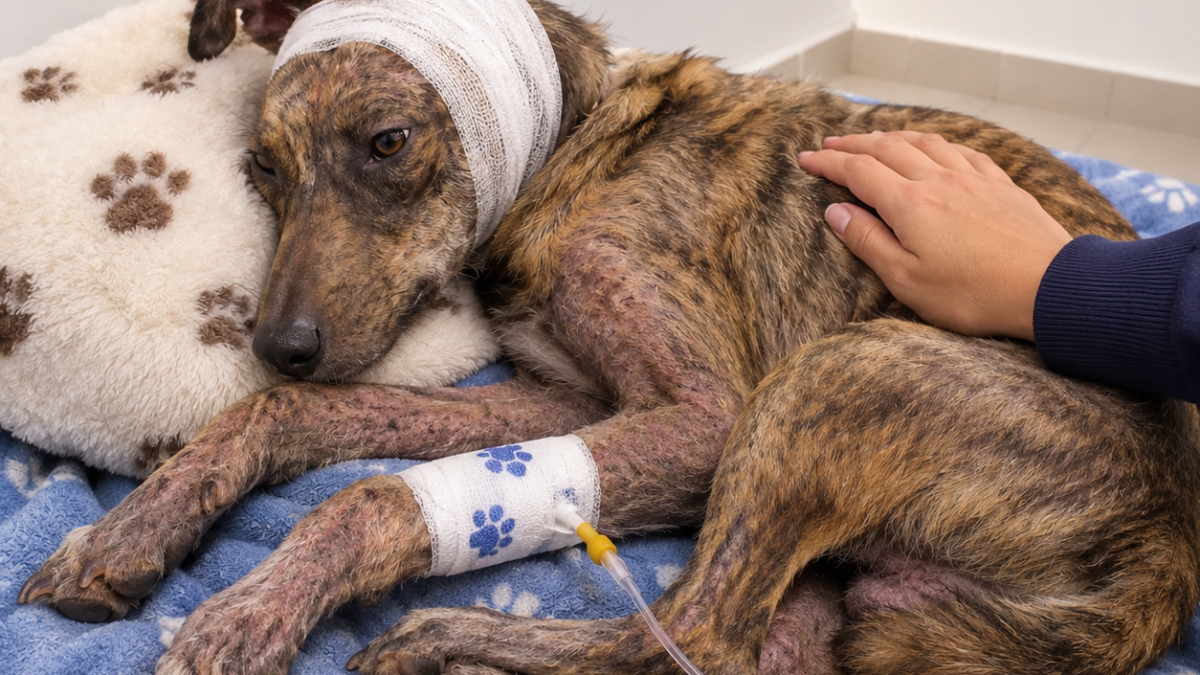
The first time I saw Solange, thousands of maggots were moving inside the open wound that had swallowed one side of her head, one ear was already gone, and yet the tiny dog was still breathing while the man who had owned her stood a few yards away insisting he had been “waiting to see if she got better.”
By the time we reached the emergency clinic, her fever was dangerously high, the infection had tunneled deep toward her skull, and the veterinarian warned us that another few days without treatment might have made the decision for all of us.
Then the ultrasound technician called me over to the screen, pointed to something none of us had known was there, and suddenly the case we thought we understood became far more complicated than a neglected wound.
My name is Rachel Morgan, and at the time I worked with a small rescue outside Tampa, Florida. The call came from a woman named Denise who lived two houses down from Solange’s owner.
“There’s a little dog here with a hole in her head,” she said. “Please don’t hang up. I know how that sounds.”
I didn’t.
“What do you mean by a hole?”
Denise started crying.
“There are bugs in it.”
Twenty-five minutes later, my partner Luis and I pulled into a sandy driveway behind a faded duplex. The smell reached us before I saw the dog.
Solange was lying beneath a plastic patio chair.
She was small, maybe twenty pounds when healthy, though she looked much lighter then. Her abdomen was strangely rounded, but the rest of her body was narrow. One side of her face was so swollen and damaged that I had to force myself not to react in front of her.
The wound began above her cheek and extended toward the place where her left ear should have been.
Inside it, larvae moved.
Luis stopped beside me.
“Jesus.”
The owner, a man named Curtis Hale, stood near the back door with his arms folded.
I looked at him.
“How long has she been like this?”
Curtis shrugged.
“She got attacked.”
“When?”
“Couple weeks ago.”
Denise made a sound behind us.
“That’s not true.”
Curtis turned.
“Stay out of it.”
I crouched near Solange.
“Hey, girl.”
Her eyes opened.
She tried to lift her head, then let it fall again.
I could feel heat radiating from her before I touched her.
“Luis, call the clinic. Tell them septic wound, possible skull involvement, severe fever.”
Curtis stepped forward.
“How much is all this going to cost?”
I stared at him.
“That’s what you’re asking?”
“I don’t have thousands of dollars.”
“You didn’t have to wait until there were maggots in her head.”
His jaw tightened.
“I said she got attacked by bigger dogs.”
“Did a veterinarian see her?”
“No.”
“Did anyone clean the wound?”
“I put peroxide on it.”
Denise whispered, “Once.”
Curtis shot her another look.
Solange tried to crawl toward the shade beneath the chair.
Her front legs shook.
I slipped a blanket under her.
She didn’t resist.
That frightened me more than if she had tried to bite.
Animals with this much pain usually protect themselves.
Solange seemed past protecting anything.
“We need a surrender,” I said.
Curtis frowned.
“What?”
“If you can’t authorize and pay for emergency treatment, sign her over to the rescue.”
“She’s my dog.”
“Then act like it.”
Luis said my name quietly.
A warning to stay calm.
Curtis looked at Solange.
For one second, I thought he might kneel beside her.
Instead he asked, “If I sign, I’m not getting a bill?”
“No.”
He held out his hand.
“Give me the paper.”
Ten minutes later, Solange belonged to the rescue.
Curtis went inside before we had finished loading her into the van.
He never said goodbye.
At the emergency hospital, the treatment team became silent when we unwrapped the towel around her head.
Dr. Evelyn Shaw examined the wound under sedation while nurses started fluids, antibiotics, pain medication, and cooling measures.
When Evelyn finally stepped out, her expression was tight.
“The infection is deeper than I hoped.”
“How deep?”
“Skull involvement is possible. We need imaging, and she may need reconstructive surgery once we control the infection.”
Luis asked, “Can she survive?”
Evelyn looked through the glass.
“She’s still fighting. That’s all I can promise.”
Then a technician called from the ultrasound room.
“Dr. Shaw? Rachel? You need to see this.”
I walked over expecting another complication from the infection.
The technician moved the probe across Solange’s swollen abdomen.
Several small shapes appeared on the monitor.
I stopped breathing.
Evelyn stared at the screen.
Then she whispered, “She’s pregnant.”
And before I could even process what that meant, her face changed as she looked more closely at the images.
PART 2
Evelyn leaned toward the monitor.
“Hold on.”
The technician moved the probe.
Once.
Twice.
She adjusted the settings and tried another angle.
I watched their faces instead of the screen.
“What?”
Neither answered.
“Evelyn.”
She finally looked at me.
“I’m not seeing fetal heartbeats.”
The room seemed to shrink.
“How many?”
“Give us a minute.”
They counted at least five.
Possibly six.
None appeared viable.
I stared at Solange lying sedated on the table.
Her swollen abdomen suddenly made sense.
“Oh, God.”
Luis stood behind me.
“Are you sure?”
Evelyn didn’t pretend certainty she didn’t have.
“I want another scan and radiographs once she’s stable enough. But right now, I’m very concerned the puppies are dead.”
I turned away.
I don’t know why that piece broke me.
Maybe because until that moment, Solange’s suffering had seemed contained inside one ruined little body.
Now there were more lives inside her that had never had a chance to ask for help.
Evelyn touched my shoulder.
“Rachel, we have to focus on her.”
I nodded.
“What happens if the puppies are dead?”
“Depending on her stability, we may need to remove the uterus. Retained nonviable fetuses can become another source of infection.”
“She already has sepsis.”
“I know.”
“Can she survive another procedure?”
“That’s what we’re trying to decide.”
Nothing about Solange was simple.
Every solution came attached to another danger.
—
The second ultrasound confirmed what we feared.
No viable puppies.
Evelyn showed me the screen.
I could make out shapes only because she pointed them out.
Tiny spines.
Rounded skulls.
Stillness.
“They probably died recently,” she said.
“Because of the infection?”
“Possibly. Fever, systemic illness, malnutrition, trauma—there are several potential causes. I cannot tell you which one.”
“Did Curtis know she was pregnant?”
“I can’t answer that.”
I remembered his face when we found her.
Not concern.
Not shock.
Mostly irritation.
I felt anger climbing into my throat again.
Evelyn saw it.
“Don’t build the story before we have the facts.”
I looked at her.
“You sound like Luis.”
“Then Luis is smarter than I thought.”
From the doorway, he said, “Thank you.”
Nobody laughed.
—
Solange’s fever reached 105.3.
Her blood pressure dropped.
The team placed her on IV antibiotics and fluids while carefully removing the larvae from the wound.
There were too many to count accurately.
Hundreds visible.
Likely thousands between the surface and deeper pockets.
Every time I thought they had cleared one area, another appeared beneath damaged tissue.
I had seen maggot-infested wounds before.
Never like that.
Evelyn irrigated the cavity while a technician used forceps to remove larvae one by one.
Solange was sedated.
Thank God.
Her missing ear wasn’t simply torn away at the base.
Much of the surrounding tissue had died.
The edges were blackened in places.
The infection extended into layers beneath the skin.
A CT scan later showed damage to part of the outer skull surface but no penetration into the brain cavity.
That was the first good news we received.
It didn’t feel like good news.
—
By evening, Solange’s packed cell volume had dropped.
She was severely anemic.
Evelyn came into the waiting room carrying a clipboard.
“We need blood.”
I stood immediately.
“How much?”
“We have a donor available.”
“Do it.”
“You need to understand why.”
I sat again.
She explained that Solange’s anemia was likely a combination of chronic malnutrition, inflammation, pregnancy, blood loss from the wound, and parasitic disease.
Her body was running out of reserves.
If they wanted her strong enough for major debridement and later reconstruction, they had to give her something to work with.
“Will she react to the transfusion?”
“We crossmatched. We’ll monitor closely.”
“And after that?”
“After that, we see whether she responds.”
I hated how often that phrase appeared.
We see.
We wait.
We hope.
There was nothing cinematic about saving Solange.
Mostly it was people standing beside machines and trying to keep numbers from moving in the wrong direction.
—
Her donor was a large, cheerful Labrador named Murphy whose owner worked at the hospital.
Murphy came into the blood-donation room wagging so hard his whole body moved.
I sat on the floor with him afterward.
“You have no idea what you just did.”
Murphy licked my chin.
Luis leaned against the door.
“Probably thinks he got peanut butter.”
“He did get peanut butter.”
“Then he considers this a successful transaction.”
For the first time that day, I smiled.
A dog who had never met Solange had just given her a better chance at seeing morning.
Sometimes rescue is built out of strangers making small decisions in the right direction.
—
At 1:40 a.m., Solange’s fever began dropping.
Not dramatically.
105.3 became 104.8.
Then 104.2.
I stared at the monitor as if I could force it lower.
A nurse named Keisha found me there.
“You should go home.”
“No.”
“You’ve been here fourteen hours.”
“I’m fine.”
“You’re wearing one shoe cover.”
I looked down.
She was right.
My brain had stopped functioning.
“I’ll leave at three.”
“You said that at midnight.”
“I meant three.”
Keisha handed me coffee.
“Sit.”
I did.
Through the ICU glass, Solange slept beneath warmed blankets.
Her head was wrapped in clean bandaging.
Without seeing the wound, she looked almost peaceful.
Almost.
—
At 2:15, she opened her eyes.
Keisha noticed first.
“Rachel.”
I stood.
Solange moved her head weakly.
Keisha let me enter after I scrubbed in and put on protective gear.
I crouched beside the kennel.
“Hey.”
Her eyes found mine.
“You’re still here.”
Her nose moved.
I slid my fingers close enough for her to smell but not touch.
Solange leaned forward.
Barely.
Her nose touched my hand.
That tiny movement felt bigger than anything else that night.
“You keep doing that,” I whispered. “Just keep doing one thing at a time.”
Her eyes closed again.
—
The next morning, Evelyn met with a surgical specialist.
The plan came in stages.
First, stabilize Solange.
Second, remove all remaining dead and infected tissue.
Third, address the nonviable pregnancy once anesthesia was survivable.
Fourth, allow healthy tissue to declare itself.
Then, if she remained strong enough, reconstruct the massive defect around her head.
“How many surgeries?” I asked.
“Possibly two major procedures. Maybe three.”
“And if we don’t reconstruct?”
Evelyn didn’t soften the answer.
“She has exposed tissue and bone. The wound is too large to simply granulate and close normally. We may get some contraction, but not enough.”
“So surgery is her only real path.”
“Yes.”
I looked through the window.
Solange had survived the night.
That was all we had.
One night.
We decided to spend it.
—
Animal Control arrived that afternoon.
Officer Dana Brooks had already spoken with Denise and Curtis.
Dana asked us not to publish Curtis’s name while the investigation was active.
We agreed.
Our rescue posted only that a critically injured dog had been surrendered and was receiving treatment.
Within hours, donations began coming in.
Five dollars.
Twenty.
Fifty.
A retired woman mailed a check for twelve dollars with a note:
**For the little dog with one ear.**
I kept that note.
—
Dana met me in the hospital cafeteria.
“What did Curtis tell you?”
I gave her the same account I had already written.
“He said larger dogs attacked Solange.”
“When?”
“He said a couple weeks.”
“Anything more specific?”
“No.”
“Did he say where?”
“Backyard, I assumed. I didn’t ask.”
Dana wrote.
“What did Denise say?”
“That Curtis was lying about how long it had been.”
Dana nodded.
“She told me too.”
“What does Curtis say now?”
“That the attack happened six days before you arrived.”
I stared at her.
“He told me weeks.”
“I know.”
“He changed it?”
“Yes.”
“Why?”
Dana closed her notebook.
“Because six days sounds better than weeks.”
I felt my jaw tighten.
“Does it?”
“No.”
That was why I liked Dana.
She rarely wasted words.
—
Denise came to the hospital the following evening.
She brought a grocery bag full of towels because she said she didn’t know what else to do.
When she saw Solange through the glass, she cried.
“I should’ve called sooner.”
“How long did you know?”
She rubbed her hands together.
“I saw the wound maybe three weeks ago.”
“Three?”
“I thought he was taking her somewhere.”
“Did he say that?”
“Yes.”
“When?”
“The first time I asked.”
“What exactly did he say?”
“That he had it handled.”
I felt sick.
“Then what happened?”
“A few days later, I saw her again.”
“Worse?”
Denise nodded.
“One ear was still there.”
I stopped.
“What?”
“Her ear.”
Denise touched the left side of her own head.
“The injured one. It was damaged, but it was there.”
“Are you sure?”
“Yes.”
I moved closer.
“When?”
“I don’t know. Maybe eighteen days before you came.”
“Do you have anything showing that?”
Her face changed.
“I might.”
—
Denise went home and searched her phone.
At 9:17 that night, she sent me a photograph.
I immediately forwarded it to Dana.
The image was taken through Denise’s fence.
Solange stood in Curtis’s yard.
Thin.
Dirty.
A wound visible near the base of her left ear.
But the ear was still attached.
Damaged.
Drooping.
There.
The date stamp was nineteen days before we rescued her.
Under the photo, Denise had attached a screenshot of a text exchange.
**Denise:** Your dog’s head looks bad. I’ll drive you to the low-cost clinic if money is the problem.
**Curtis:** She got bit. It will close.
**Denise:** It smells infected.
**Curtis:** Stop worrying about my dog.
Five days later, another message.
**Denise:** She needs a vet. I’m serious.
**Curtis:** I said I’m handling it.
He had been given transport.
He had been told about the wound.
He had been warned about infection.
He hadn’t misunderstood.
He had chosen to wait.
—
Dana called me.
“Do not send that screenshot around.”
“I won’t.”
“Not to social media.”
“I said I won’t.”
“Not to your rescue group chat.”
“Dana.”
“Rachel.”
I sighed.
“I won’t.”
“Good.”
“What does it mean?”
“It means his timeline is false.”
“And the ear?”
“It means the ear was present nineteen days before rescue.”
“So the attack didn’t remove it.”
“Careful.”
I stopped.
Dana continued.
“The initial attack may have badly damaged the ear. Infection and tissue death may have caused the rest. We need the forensic vet to say what is medically supportable.”
I knew what she was telling me.
Facts first.
Rage later.
Or preferably never.
—
Solange underwent her first major debridement the next morning.
The surgeons removed dead tissue around the head wound and portions of diseased outer bone.
They also removed her uterus and the deceased puppies because leaving them posed too great an infection risk.
I signed the authorization.
My hand shook while I did it.
Luis noticed.
“You okay?”
“No.”
He put his hand over mine.
“Me neither.”
We waited.
Three hours.
Then four.
At one point, Evelyn came out only long enough to say Solange was still stable.
That word became sacred.
Stable.
Not good.
Not safe.
Stable.
—
When surgery ended, Evelyn looked exhausted.
“She’s alive.”
I closed my eyes.
“Tell me everything.”
“The uterine surgery went well. There was no rupture, which helped.”
“And the wound?”
“We removed a lot of nonviable tissue.”
“How much?”
“Enough that reconstruction will be challenging.”
She showed me clinical photographs.
I looked once.
That was enough.
“What about the skull?”
“There was superficial bone necrosis that we debrided. No intracranial involvement.”
“Can you close it later?”
“Not yet.”
“Why?”
“I need to know the infection is controlled. If we close contaminated tissue under a flap, we can trap bacteria inside.”
“So she has to stay open?”
“Protected and bandaged, yes.”
“For how long?”
“Days. Maybe longer.”
I thought about Solange waking with even more of her head shaved, wrapped, altered.
“Will she be in pain?”
“We’ll manage it.”
That wasn’t the answer I wanted.
It was the answer medicine could give.
—
The puppies were brought out only as pathology specimens.
I never saw them.
I asked not to.
For days afterward, I found myself thinking about them anyway.
Five tiny bodies that never opened their eyes.
I knew assigning blame for fetal death would be medically dishonest.
Solange was severely ill.
Anything could have contributed.
Still, whenever I remembered Denise offering Curtis a ride nineteen days earlier, I wondered what might have been different.
Those are dangerous questions.
Rescue work gives you enough real grief.
You can destroy yourself with imaginary alternate endings.
—
On Solange’s third postoperative day, her fever returned.
103.9.
Then 104.4.
My stomach dropped.
Evelyn ordered cultures.
The wound looked cleaner, but one deeper pocket was still draining.
By evening, the culture preliminary suggested a resistant bacterial infection.
Her antibiotics changed.
Again we waited.
At midnight, Solange began shivering.
Not from cold.
Keisha increased monitoring.
I stood outside ICU feeling completely useless.
Luis sat beside me.
“She made it through everything else.”
“That doesn’t guarantee anything.”
“I know.”
“I keep thinking if we’d gotten there one week earlier—”
“Stop.”
I looked at him.
“Don’t do that.”
“Why?”
“Because then you’ll ask why not two weeks. Why not the day she got hurt. Why not before she got pregnant. You’ll build an entire life where nothing bad happens.”
His voice softened.
“We don’t live there.”
I hated him for being right.
—
The new antibiotics began working within forty-eight hours.
Her fever settled.
Her bloodwork stabilized.
She started eating.
The first meal was barely two teaspoons of softened food.
I took a video for the medical team.
Not social media.
Just us.
Solange licked the bowl carefully because opening her mouth still hurt.
Evelyn watched from the doorway.
“That’s the best thing I’ve seen today.”
“How much can she have?”
“Slow down.”
“She’s hungry.”
“She’s been through major illness. Small meals.”
Solange looked at me.
I said, “You heard the doctor.”
She licked the empty bowl.
I gave her one more spoonful.
Evelyn sighed.
“You’re terrible at following instructions.”
“Technically that was small.”
“Rachel.”
“Very small.”
Solange’s tail moved once.
It was the first wag I had seen.
I nearly cried into the food.
—
By the end of the week, she could stand.
Her legs trembled.
But she stood.
The first thing she did was walk toward me.
Three steps.
Then she pressed the right side of her face against my knee.
I froze.
Until that moment, almost every touch she’d experienced from us had involved treatment.
Needles.
Bandage changes.
Cleaning.
Pain.
Yet she still came closer.
I put one hand against her shoulder.
“You are either incredibly brave or terrible at judging people.”
Her tail moved.
Luis laughed.
“Probably both.”
—
Dana’s investigation continued.
A forensic veterinarian reviewed Solange’s records and Denise’s dated photograph.
She could not say exactly how the original injury occurred.
A dog attack remained plausible.
That part of Curtis’s story might have been true.
But the progression wasn’t.
In Denise’s photograph, Solange still had most of her ear.
The wound was serious but smaller.
By rescue day, necrosis and larval infestation had destroyed massive amounts of tissue.
The forensic report used careful language.
I preferred less careful language.
Dana didn’t.
“What does it mean?” I asked.
“It means we can support prolonged untreated injury.”
“Can they say the neglect caused the ear loss?”
“They can say the progression is consistent with untreated infection, tissue necrosis, and myiasis contributing to extensive tissue destruction.”
“That sounds like yes.”
“That sounds like the sentence we’re allowed to prove.”
Fair enough.
—
Curtis gave Dana a second interview.
He said he had planned to take Solange to a veterinarian the morning after we removed her.
Dana asked why he hadn’t gone the previous nineteen days.
He said the wound “didn’t look that bad.”
She showed him Denise’s photograph.
He said he couldn’t remember the date.
She showed him the text offering transportation.
He said Denise was always interfering.
She showed him the second warning.
He said he thought peroxide was enough.
Then Dana asked why he had told us the attack happened “a couple weeks ago” but told Animal Control it was six days.
Curtis stopped answering.
He requested a lawyer.
That was his right.
It also ended the interview.
—
Then he went online.
That complicated everything.
His first post did not name us.
He wrote:
**People will steal your dog, make up a story and raise money off your pain. Be careful who you trust.**
Someone recognized Solange.
Within hours, comments exploded.
Curtis replied to one person:
**I was treating her. Rescue people pressured me into signing.**
That wasn’t true.
He had asked whether signing meant he wouldn’t receive the bill.
But outrage online does not care about paperwork.
Some people believed him.
Others attacked him.
Both made me uncomfortable.
The rescue refused to release his name or the investigation evidence.
That made us look evasive to some people.
Maria, our director, didn’t care.
“We’re not trying this case on Facebook.”
“He’s calling us thieves.”
“Then let him.”
“What about donors?”
“Our records are clean.”
“What about Solange?”
Maria looked at me.
“She needs surgery. That’s our job.”
I hated how reasonable everyone around me was.
—
Solange’s reconstructive surgery was scheduled for day twelve.
A board-certified surgeon named Dr. Samuel Greene traveled from a specialty hospital to work with Evelyn.
He explained the plan to me in a quiet consultation room.
They would remove any remaining unhealthy tissue.
Then create a rotational skin flap using healthy tissue from the side and back of Solange’s head and neck.
The goal wasn’t cosmetic.
It was coverage.
Protection.
Closure.
“How will she look?”
Samuel considered the question.
“Different.”
“I know.”
“One side of her head will never be symmetrical. She has no left ear. The scar will be substantial.”
“Will she care?”
He smiled.
“Probably much less than humans will.”
“What could go wrong?”
“Flap failure. Infection. bleeding. anesthesia complications. Wound breakdown.”
“And if the flap fails?”
“We reassess.”
I looked through the glass toward Solange.
She was asleep.
Again, there was no clean road.
Only the next difficult choice.
“Do it.”
—
The night before surgery, I sat in her kennel.
By then she tolerated me leaning against her.
I had learned which parts of her body were safe to touch.
Chest.
Right shoulder.
Under the chin carefully.
Never surprise her on the damaged side.
“I need you to do one more stupidly difficult thing.”
Solange put her paw on my leg.
“I know. You’re tired of hearing that.”
Her tail touched the blanket.
“After tomorrow, maybe we get to start talking about normal dog problems.”
She closed her eyes.
“Shoes you destroy. Trash cans. Squirrels.”
Nothing.
“Maybe a couch you refuse to stay off.”
Her breathing slowed.
I sat beside her until midnight.
—
Surgery lasted almost five hours.
At hour three, I convinced myself something had happened.
At hour four, I was certain.
Luis took my phone away because I had checked the time every thirty seconds.
Then Samuel entered.
His surgical gown was gone.
He looked tired.
I stood.
“The flap is in place.”
“She’s alive?”
“Yes.”
“Stable?”
“Yes.”
That word again.
I almost hugged him.
I stopped myself.
He noticed.
“You can hug me.”
So I did.
—
The first photograph after reconstruction shocked me.
Not because it looked worse.
Because it looked possible.
A large curved line of sutures traveled from the top of Solange’s head toward the side of her neck.
Her left ear was gone completely.
The tissue around the former wound was clean.
Covered.
Protected.
For the first time since we found her, there wasn’t an open cavity.
Evelyn stood beside me.
“She has a head again.”
That sounds like a terrible sentence.
At the time, it was beautiful.
—
The next seventy-two hours were tense.
A skin flap lives or dies by blood supply.
We checked color.
Temperature.
Swelling.
Drainage.
Every few hours, I convinced myself part of it looked darker.
Every few hours, Evelyn told me to stop diagnosing patients with my eyes.
A small section along the edge did lose viability.
My heart sank.
Samuel wasn’t surprised.
“We can revise that.”
“Another surgery?”
“Minor compared with the last one.”
“Will the rest survive?”
“So far, yes.”
So far.
Another phrase rescue teaches you to respect.
—
Solange’s biggest problem by then wasn’t medical.
It was fear.
The moment she realized she was strong enough to resist, she began showing us how frightened she had been all along.
She flinched when men approached quickly.
She flattened herself if someone lifted a hose.
She panicked when a metal bowl clanged onto the floor.
Once, a large dog barked in the hallway and Solange tried to climb behind the kennel bed despite her bandages.
I sat on the floor until she stopped shaking.
“Okay.”
Her eyes stayed fixed on the door.
“Nothing’s coming in here.”
She leaned against the wall.
I stayed.
Twenty minutes later, she crawled toward me.
Then put her head in my lap.
That was the first time I thought about fostering her.
Not adopting.
I told myself there was a difference.
There usually isn’t.
—
Curtis’s online story became more aggressive after news outlets began covering Solange’s survival.
He claimed he had cared for her “for years.”
He said the rescue was exploiting her.
Then he posted something that surprised everyone.
A photograph of Solange before the injury.
She was sitting on a couch beside him.
Healthy.
Both ears intact.
Her coat shining.
The caption said:
**Don’t tell me I didn’t love my dog.**
I stared at it for a long time.
Not because it helped him.
Because it hurt.
Solange had known comfort.
She had sat on his couch.
She had probably slept near him.
Maybe followed him room to room.
People wanted me to say the photograph was fake.
It wasn’t.
Denise recognized the living room.
I showed it to Dana.
“He probably thinks this helps him,” I said.
“In one way, it does.”
I frowned.
“It shows a prior relationship.”
“And?”
Dana looked at me.
“Neglect isn’t always committed by people who never loved the animal.”
I looked at the photograph again.
That was harder to accept.
A monster is easy.
A person who once stroked the same dog and later watched her rot in a backyard is much more frightening.
—
Denise explained more of Curtis’s situation later.
His landscaping business had failed.
His girlfriend had moved out.
He was behind on rent.
He drank more than he used to.
None of that excused Solange.
But it explained part of how a person can keep postponing action.
One day becomes three.
Three becomes ten.
Shame makes asking for help harder.
Then the problem becomes so horrible that showing it to anyone means admitting how long you ignored it.
So you hide.
And the animal pays for your pride.
I could understand the mechanism without forgiving the result.
—
A week after reconstruction, Solange walked outside.
Just to the hospital courtyard.
She wore a soft protective wrap around her head and a harness around her chest.
Sunlight hit her face.
She stopped.
For almost a minute, she did nothing.
Then she smelled the grass.
Her nose moved.
She took three steps.
Four.
Then squatted and peed.
Luis applauded.
A nurse laughed.
Solange looked confused.
“Ignore them,” I told her. “Everyone here has very low standards now.”
She walked toward a patch of shade.
Then, after several minutes, she rolled onto her side.
Not the injured side.
The other.
She rubbed her back against the grass.
I laughed so hard I cried.
That was the moment I knew she was coming home with me.
Temporarily.
Of course.
—
My husband, Daniel, knew before I told him.
I walked through our front door carrying a bag of Solange’s medications.
He looked at the bag.
Then at me.
“How temporary?”
“Two weeks.”
He nodded.
“You said that about Rosie.”
Rosie was asleep on our couch.
“Different situation.”
“You said that about Max.”
Max was in the kitchen.
“He was medically complicated.”
“And Luna?”
“Our daughter took Luna.”
“After you kept her six months.”
I pointed at him.
“Are you saying no?”
Daniel sighed.
“No.”
“Good.”
“I’m asking whether I should assemble the spare crate or just build another bedroom.”
“Crate.”
“Sure.”
I loved him.
—
Solange arrived two days later.
She refused to leave the transport van.
I sat inside with her.
Ten minutes.
Then twenty.
Daniel brought me water.
“You living in there?”
“Maybe.”
Solange watched our front door.
Rosie appeared behind the glass.
A gentle twelve-year-old mutt with arthritis and the patience of a saint.
Solange’s nose moved.
Rosie sat.
No barking.
No scratching.
Just watching.
Solange stood.
Slowly.
She stepped out of the van.
Then stopped again.
Rosie remained seated.
Eventually Solange walked toward the house.
Not me.
Rosie.
They touched noses through the cracked door.
Daniel whispered:
“Well, apparently we weren’t consulted.”
—
The first night, Solange slept in the laundry room.
By choice.
We had made a soft recovery area with blankets and a low bed.
At 2:00 a.m., I woke and checked the camera.
She was awake.
Sitting.
Staring at the closed door.
I went downstairs.
She flinched when I entered.
Then relaxed.
I sat beside her.
“Can’t sleep?”
She lay down.
“So we have that in common.”
Five minutes later, she placed one paw against my leg.
I stayed until sunrise.
—
The hormonal effects of losing the pregnancy lingered.
Solange gathered small toys.
Not obsessively.
But enough that I noticed.
A stuffed rabbit.
One of Rosie’s old fabric bones.
A small squeaky lamb.
She carried them into her bed and placed them together.
The first time I saw it, my chest tightened.
Our veterinarian warned me not to assign a human story too quickly.
Dogs nest.
Hormones influence behavior.
Stress changes routines.
I knew.
Still, I couldn’t look at those toys without thinking about the silent ultrasound.
I never took them away.
—
Her recovery accelerated at home.
She gained weight.
Her coat filled in.
The skin flap healed.
The small failed edge was revised successfully.
Her remaining ear became ridiculously expressive.
One ear could apparently communicate everything two ears could.
Suspicion.
Joy.
Annoyance.
Interest.
Disapproval.
Especially disapproval.
Daniel gave her a bath once she was medically cleared.
Solange stood frozen in the tub.
Then shook water directly into his face.
He came downstairs soaked.
“She did that intentionally.”
“She has trauma.”
“That was revenge.”
“She has depth.”
He pointed upstairs.
“Your dog.”
“Foster dog.”
“Sure.”
—
Animal Control filed its case six weeks after rescue.
Curtis was charged under local animal cruelty and neglect provisions based on failure to provide necessary care.
The prosecutor did not charge him with intentionally inflicting the original head wound.
There wasn’t enough evidence.
That distinction mattered.
Online, people wanted the worst possible story.
They said Curtis had hacked off Solange’s ear.
Shot her.
Set dogs on her.
None of that was proven.
I refused to repeat it.
The truth was terrible enough.
Solange had been injured.
Curtis knew.
A neighbor offered transportation.
He refused.
The wound worsened.
The ear was still present nineteen days before rescue.
By the time help arrived, dead tissue and infestation had destroyed it.
Those facts did not need embellishment.
—
Then Curtis called me.
I don’t know how he got my number.
I almost didn’t answer.
“Is this Rachel?”
“Yes.”
“This is Curtis.”
My grip tightened on the phone.
“What do you want?”
“I want to see Solange.”
“No.”
He inhaled.
“She was my dog.”
“You surrendered her.”
“You people backed me into a corner.”
“No.”
“My head wasn’t right that day.”
“Solange’s head had thousands of maggots inside it.”
Silence.
I regretted the sentence immediately.
Not because it was untrue.
Because anger was deciding how I spoke.
Curtis said:
“I took care of her before that.”
“I saw your picture.”
He sounded surprised.
“What picture?”
“The couch.”
Another silence.
“She slept in my bed.”
That hit me unexpectedly.
“Then why?”
I didn’t mean to ask.
But the words were out.
“Why did you let her get like that?”
Curtis’s breathing changed.
“I thought it would heal.”
“Denise told you it was infected.”
“I didn’t have the money.”
“She offered to drive you.”
“I would’ve still had the bill.”
“You could have surrendered her.”
“I wasn’t giving away my dog.”
“But you did.”
“Because you showed up acting like I was some criminal.”
I closed my eyes.
“Curtis, why are you calling?”
“I want to know if she’s alive.”
“Yes.”
“Is she okay?”
“She’s recovering.”
“What about the puppies?”
I froze.
“You knew?”
“No. Somebody posted she was pregnant.”
I realized how quickly information traveled.
“They didn’t survive.”
Curtis went quiet.
For the first time, there was no defensiveness.
“No puppies?”
“No.”
He whispered something I couldn’t hear.
Then:
“I didn’t know.”
I believed him.
That didn’t help.
—
The preliminary hearing was scheduled two months later.
By then, Solange had become almost unrecognizable from intake.
The scar remained.
The missing ear remained.
One side of her face had a slight slope where reconstruction changed the contour.
But she was healthy enough to run.
Not far.
She preferred short bursts followed by dramatic rest.
Her favorite place became our back porch.
Her favorite person became Daniel.
I found this insulting.
I did all the medications.
He gave her cheese.
Apparently that decided everything.
—
One evening, I came home and found Daniel asleep on the couch.
Solange was curled against his chest.
The stuffed lamb was between them.
I stood in the doorway.
Daniel opened one eye.
“Don’t say it.”
“What?”
“You’re thinking this isn’t temporary anymore.”
“I wasn’t.”
“You were.”
Solange sighed.
I looked at her scar.
Then at the dog who had once been too weak to lift her head from a patio.
“What if she gets adopted?”
Daniel’s arm tightened slightly around her.
“By who?”
“Someone great.”
“Better than me?”
“Probably.”
He looked offended.
Solange kept sleeping.
I smiled.
“Fine.”
Daniel closed his eyes.
“Fill out the papers.”
I did the next morning.
—
Legally, we couldn’t finalize the adoption until any ownership questions were fully resolved.
Curtis’s surrender form should have ended them.
His lawyer nevertheless argued he signed under emotional pressure.
The rescue’s attorney wasn’t particularly concerned.
The form was clear.
There were witnesses.
No threats.
No deception.
But the challenge created delay.
Curtis wasn’t asking for Solange back in court yet.
Mostly he was trying to undermine the neglect case.
His defense was that we had coerced him, exaggerated the wound, and then benefited from publicity.
That argument became more difficult when financial records showed the rescue had spent substantially more on Solange’s treatment than her designated donations had initially covered.
Reality is less exciting than internet accusations.
Surgery is expensive.
—
Denise was terrified about testifying.
Curtis still lived two houses away.
“He already hates me.”
“You did the right thing.”
“That doesn’t make living near him comfortable.”
I couldn’t argue.
“Did he threaten you?”
“Not exactly.”
“What does that mean?”
“He stands outside sometimes when I leave.”
“That could mean nothing.”
“I know.”
“He says anything?”
“No.”
I thought about Dana’s rule.
Facts.
Not fear.
“Tell Dana anyway.”
Denise did.
No crime had occurred.
But the contact was documented.
—
Then Curtis made another mistake.
He left a note on Denise’s windshield.
It said:
**Hope ruining my life was worth saving one dog.**
Not a direct threat.
But angry enough that Dana photographed it.
Denise called me crying.
“I almost didn’t call you that day.”
“What?”
“When I found Solange.”
“Why?”
“I didn’t want trouble with a neighbor.”
I stared at my kitchen floor.
Solange was sleeping beneath the table.
“If you hadn’t called—”
“I know.”
“No.”
I stopped.
“We don’t know.”
“Yes, we do.”
Her voice broke.
“She would’ve died.”
I couldn’t honestly disagree.
—
The hearing began on a Monday.
I sat behind the prosecutor with Maria from the rescue.
Curtis sat across the aisle.
He looked older than I remembered.
Thinner.
Human.
I hated that part.
Anger is easier when the person you’ve built it around looks like a symbol.
Courtrooms turn symbols back into people.
That doesn’t erase what they did.
It only makes the truth more complicated.
—
Evelyn testified first.
She explained Solange’s condition without emotion.
High fever.
Severe myiasis.
Extensive necrotic wound.
Anemia.
Systemic infection.
Pregnancy with nonviable fetuses.
Blood transfusion.
Multiple surgeries.
The prosecutor asked:
“Doctor, could a larger dog attack have caused the original wound?”
“Yes.”
Curtis’s attorney visibly relaxed.
Then the prosecutor asked:
“Does that explain Solange’s condition when she reached your hospital?”
“No.”
“Why not?”
Evelyn looked at the judge.
“An attack can cause an initial wound. It does not, by itself, explain prolonged infestation, extensive necrosis, severe secondary infection, or the progressive loss of tissue over many days without treatment.”
The prosecutor displayed Denise’s dated photograph.
Solange stood in the yard with the damaged ear still attached.
“Is the ear present here?”
“Yes.”
“And on intake?”
“No.”
“Can you determine exactly how the tissue was lost?”
“I cannot identify every step.”
“What can you say?”
Evelyn’s answer was simple.
“The injury began the process. The untreated wound allowed the process to continue.”
The room became silent.
That was the story.
Not that Curtis had caused the attack.
We couldn’t prove that.
The attack hurt Solange.
Waiting nearly destroyed her.
—
Curtis’s attorney challenged Evelyn.
“You can’t tell this court my client intentionally allowed the ear to die, correct?”
“No.”
“You can’t prove he understood the medical seriousness.”
“I cannot testify to what he understood.”
“You can’t even prove every larva was present for more than a few days.”
“Correct.”
The attorney looked satisfied.
Then Evelyn added:
“I can say no reasonable caregiver should see a wound like the one documented nineteen days before admission and conclude no veterinary evaluation is needed.”
The attorney frowned.
“That’s your opinion.”
“Yes.”
“As a veterinarian.”
“Yes.”
That exchange mattered more than shouting would have.
—
Denise testified next.
Her hands shook.
She described seeing Solange after the alleged attack.
Offering a ride.
Sending the texts.
Watching the wound worsen.
The prosecutor displayed the messages.
**It smells infected.**
**Stop worrying about my dog.**
Then:
**She needs a vet. I’m serious.**
**I said I’m handling it.**
Curtis stared at the table.
His attorney asked Denise whether she disliked him.
“Yes.”
“Before this happened?”
“Not really.”
“So your dislike developed after?”
“Yes.”
“Because you believed he was neglecting Solange.”
“Yes.”
“Meaning your interpretation of events is biased.”
Denise looked at him.
“You’re asking if watching his dog rot made me like him less?”
The attorney paused.
The prosecutor said nothing.
Denise looked immediately horrified by her own wording.
The judge simply said:
“Answer the questions directly, ma’am.”
“Yes, Your Honor.”
Still, the damage was done.
Not to Denise.
To the illusion that this had been a minor disagreement between neighbors.
—
Then I testified.
I described the call.
The driveway.
Curtis asking about cost.
The surrender.
Solange’s condition.
His statement that bigger dogs attacked her.
His claim that it happened “a couple weeks” earlier.
Curtis’s attorney stood.
“Ms. Morgan, you were angry when you arrived, weren’t you?”
“Yes.”
“You told my client, ‘Then act like it,’ when he said Solange was his dog.”
“Yes.”
“That’s confrontational.”
“Yes.”
“You wanted him to surrender immediately.”
“Yes.”
“You told him he would not receive a bill if he signed.”
“Yes.”
“So financial pressure influenced his decision.”
“I explained his options.”
“That wasn’t my question.”
I stopped.
“Yes. Cost was clearly part of his decision.”
The attorney nodded.
“You work for an organization that solicits public donations.”
“Yes.”
“And Solange became a major fundraising story.”
“She became a major medical expense.”
A few people shifted.
The attorney continued.
“You benefited from photographs of her suffering.”
“No.”
“Your rescue received money.”
“Yes.”
“Because people saw how terrible she looked.”
“In part.”
“So the worse the story, the more donations.”
I felt anger rise.
Our attorney had warned me about exactly this.
Don’t argue.
Answer.
The defense attorney leaned closer.
“You had an incentive to portray Mr. Hale as cruel.”
I looked at him.
“We didn’t need to portray the wound as anything.”
He frowned.
“What does that mean?”
“It was already there.”
The prosecutor objected before he could continue.
The judge instructed me to answer only questions.
My hands were shaking when I returned to my seat.
Maria squeezed my wrist.
—
Curtis testified.
That surprised everyone.
He described the attack.
According to him, two loose dogs entered the yard while he was inside.
He heard barking.
When he went outside, Solange was bleeding near the ear.
He cleaned it with peroxide.
For several days, he said, she ate normally.
Then the wound worsened.
He had money problems.
He had recently lost work.
His truck needed repairs.
He believed a veterinarian would charge thousands.
He thought the wound could heal.
Then it began to smell.
He became embarrassed.
That word made me look up.
Embarrassed.
“I knew people would ask why I waited,” he said.
“So I waited more.”
The prosecutor let the silence sit.
Curtis’s voice grew quieter.
“I know how stupid that sounds.”
It didn’t sound stupid.
It sounded tragically believable.
The prosecutor asked:
“When your neighbor offered to drive you, why didn’t you go?”
“I couldn’t pay.”
“Why not tell the clinic that?”
“I didn’t want to beg.”
“Why not surrender Solange then?”
“She was mine.”
“Was keeping her more important than treating her?”
Curtis didn’t answer.
The prosecutor repeated the question.
“No.”
“Yet that’s what happened.”
Curtis looked down.
“Yes.”
That single word stripped away most of the defense.
—
The prosecutor then asked about the timeline.
Curtis claimed the wound became “really bad” only three days before rescue.
The dated photograph appeared.
Nineteen days earlier.
The ear injured but present.
Then a second photograph Denise had taken eight days later.
The ear swollen.
The wound larger.
Then intake.
Ear gone.
Massive tissue destruction.
Three stages.
Three dates.
Curtis closed his eyes.
“You saw this progression?”
“Yes.”
“And still did not seek veterinary care?”
“No.”
“Why?”
Curtis’s voice was almost inaudible.
“I kept thinking I could fix it myself.”
—
The pregnancy was not used as a weapon against him.
I was grateful for that.
There was no evidence Curtis knew Solange was pregnant.
There was no medically honest way to prove what killed the puppies.
The prosecutor focused on what could be established.
The wound.
The delay.
The warnings.
The refusal of help.
The photographs.
The outcome.
That was enough.
—
The case did not end with a dramatic jury verdict.
Curtis accepted a plea before trial on the most supportable neglect charges.
He received probation, fines, restitution toward investigative and veterinary costs, mandatory animal-care education, and a court-ordered prohibition on owning or having primary custody of animals for a period of time.
There were additional conditions requiring compliance with mental health and substance-use recommendations from his evaluation.
Some people online called the sentence too light.
Others said his life had already been destroyed.
I stopped reading.
The law had done what it could prove.
Solange was alive.
That mattered more.
—
The surrender challenge disappeared immediately after the plea.
Curtis signed a final relinquishment through his attorney.
Our rescue received the document on a Thursday morning.
Maria called me.
“You can officially adopt her.”
I looked toward the porch.
Solange was asleep beside Daniel.
“She’s already been adopted.”
“Legally, Rachel.”
“Oh.”
“Would you like paperwork?”
“Apparently I’m expected to care about that.”
Maria laughed.
—
We held the adoption signing at home because Solange hated the rescue office.
Daniel signed as co-adopter.
I signed beneath him.
Solange slept through the entire thing.
When we finished, Daniel placed the paper beside her.
“Congratulations. You’re trapped.”
Her remaining ear lifted.
I scratched her chest.
“You made terrible choices.”
She rolled onto her back.
“Like us.”
—
Her behavior continued changing.
At first, loud dogs terrified her.
Six months later, she could pass one across the street without flattening herself.
At first, she panicked when I cleaned near her head.
Eventually, she let me gently wipe around her scar.
At first, she carried the stuffed lamb everywhere.
Then one day she stopped.
I found it beneath her bed.
I expected that to make me sad.
Instead, I felt relieved.
Maybe it meant nothing.
Maybe it meant she simply preferred a different toy.
But recovery is made of ordinary changes.
I let myself enjoy that one.
—
Her greatest obsession became the back porch.
Every morning, she demanded the door open.
Rain?
Didn’t matter.
Cold?
Florida’s version of cold, anyway.
Didn’t matter.
She would sit in one patch of sunlight and watch lizards.
One ear up.
Scar bright against her growing fur.
Alive.
That word became enough for me.
Alive.
—
Seven months after rescue, Denise visited.
She hadn’t seen Solange since the hospital.
The moment Solange heard her voice, she froze.
Denise crouched.
“Hey, baby.”
Solange stared.
Then approached slowly.
Denise started crying before Solange reached her.
“I am so sorry.”
Solange sniffed her hands.
“You called,” I reminded Denise.
“Too late.”
“You called.”
“I should’ve done it the first day.”
“Maybe.”
She looked at me.
I wasn’t going to lie.
Then I added:
“But the day you did call is the reason she’s standing here.”
Solange pressed against Denise’s knees.
Denise sank onto the porch.
For twenty minutes, they sat together.
Sometimes forgiveness isn’t a dramatic declaration.
Sometimes it’s a dog leaning against you.
—
Curtis disappeared from our lives.
For almost a year.
Then I received a letter forwarded through the rescue.
I recognized his name on the envelope.
I nearly threw it away.
Daniel stopped me.
“You don’t have to read it.”
“I know.”
“Then why are you holding it?”
Because some part of me wanted him to explain the unexplainable.
I opened it.
The letter wasn’t long.
Curtis wrote that he had completed the court program.
He had stopped drinking.
He had moved in with his brother.
He said he still thought about Solange.
Then came the sentence I read three times:
**I kept telling myself I didn’t have money, but the truth is I was more afraid of admitting I needed help than I was afraid of what was happening to her.**
He wrote:
**That isn’t an excuse. It just took me too long to understand the difference.**
At the bottom:
**You don’t need to answer. I only want to know if she’s okay.**
I folded the paper.
Daniel watched me.
“What are you going to do?”
“I don’t know.”
Solange was sleeping at my feet.
I scratched her shoulder.
Finally, I took a photograph.
Not of her scars.
Not a medical picture.
Solange asleep in sunlight with her stuffed lamb under one paw.
I sent it through the rescue attorney with one sentence.
**She is safe and doing well.**
Nothing else.
No forgiveness.
No punishment.
Just truth.
—
I thought that would be the last time I heard about Curtis.
It wasn’t.
Months later, Maria showed me a donation receipt.
Anonymous donor.
Two hundred dollars.
Then another.
Same amount the following month.
No message.
The third month contained four words:
**For emergency surrender cases.**
Maria raised an eyebrow.
“You think it’s him?”
“Yes.”
“Want me to reject it?”
I looked at the receipt.
“No.”
“Why?”
“Because if his money helps someone ask for help before an animal gets to where Solange was…”
I didn’t finish.
Maria understood.
We created a small fund specifically for owners facing emergency care they couldn’t afford and for people who needed help surrendering animals before neglect began.
We called it the **Solange Safe Surrender Fund**.
Curtis’s name appeared nowhere.
It didn’t belong there.
Solange’s did.
—
The first animal helped by the fund was a six-year-old Terrier named Benny.
His owner, an elderly woman, had lost her housing.
She called us crying.
“I don’t want to give him up.”
We found temporary foster care instead.
Three months later, she moved into pet-friendly housing.
Benny went home.
The second case was different.
A young man called about his mother’s elderly dog.
The dog had a growing tumor.
He couldn’t afford surgery.
He said something that made me sit down.
“I keep putting off calling because I’m embarrassed.”
I looked across the office at Solange’s photograph.
“Don’t be.”
He went quiet.
“I should’ve called weeks ago.”
“You’re calling now.”
We arranged an examination that afternoon.
The tumor was removed before it ulcerated.
The dog survived.
That was the first moment I understood what justice could look like after the courtroom ended.
Not Curtis suffering forever.
Someone else making a better decision because we had built a door where he’d once seen only shame.
—
Solange turned out to be younger than we initially thought.
Probably four or five when rescued.
That meant we had years ahead of us.
She used them aggressively.
She learned to open the pantry door with her nose.
She stole socks.
She chased lizards she never caught.
She developed an irrational hatred of delivery trucks.
She slept upside down.
She snored.
She loved children.
She hated rain touching her scar.
She learned that Daniel would give her chicken if she stared at him long enough.
She learned that I would not.
Then she learned I was lying.
—
One summer, our rescue hosted a veterinary-care clinic for low-income pet owners.
Solange came with me because she had become surprisingly calm around people.
Not as a therapy dog.
Just my dog.
A little girl named Maya noticed her missing ear.
“What happened?”
I crouched.
“She got hurt a long time ago.”
“Did it grow back?”
“No.”
Maya studied Solange.
“Does she need another one?”
I laughed.
“No. She’s doing fine.”
The girl touched her own ear.
“Can she hear?”
“With the other one.”
Solange leaned toward her.
Maya smiled.
“She looks cool.”
That was all.
Children can make simple what adults complicate.
Solange didn’t look tragic.
She looked like Solange.
—
Years passed.
Her scar softened.
White fur grew around it.
The reconstruction remained obvious if you knew where to look.
Nobody who loved her cared.
That was the strange thing.
At first, all I could see was the wound.
Then the wound became one detail among hundreds.
The way she turned in three circles before sleeping.
The sound she made when dreaming.
The way her front paws crossed when she sat.
The way she pressed her remaining ear flat when I said “bath.”
Eventually, I had to look at old photographs to remember how overwhelming the injury once seemed.
That’s what healing does when you’re lucky.
It doesn’t erase.
It changes proportion.
—
The puppies remained the one part I never fully made peace with.
I knew better than to build a story around dogs who had never been born.
Still, every year around the rescue anniversary, I remembered the ultrasound.
The motionless shapes.
The technician’s face.
The silence.
For a long time, I wondered whether Solange remembered anything.
Then I stopped.
That question was for me, not her.
She had moved forward without asking permission from the past.
I tried to learn from her.
—
When Solange was nine, Rosie died.
Our old girl had been with us through Solange’s entire recovery.
She developed heart failure.
The final decline was gentle but unmistakable.
After Rosie died, Solange searched the house.
Bedroom.
Kitchen.
Porch.
She stood beside Rosie’s empty bed.
Then looked at me.
I sat on the floor.
“I know.”
Solange lay down beside the bed.
We stayed there together.
That night, she carried the stuffed lamb back into her own bed for the first time in years.
I cried when I saw it.
Not because I thought she was remembering puppies.
Maybe she was.
Maybe she wasn’t.
I just recognized the instinct.
When something disappears, we reach for what still feels familiar.
—
Daniel died three years later.
Not suddenly.
Cancer.
Eight months from diagnosis to goodbye.
That was the year Solange saved me.
I don’t mean dramatically.
She didn’t detect the cancer.
Didn’t summon help.
Didn’t perform miracles.
She simply refused to let me disappear into grief.
Every morning, she demanded breakfast.
Every afternoon, the porch.
Every evening, medication—hers by then, for arthritis.
Grief makes ordinary responsibilities feel cruel.
Then necessary.
Solange made me stand up.
Open doors.
Measure food.
Walk outside.
On the worst morning after Daniel died, I stayed in bed until almost noon.
Solange climbed up beside me.
She wasn’t supposed to because of her joints.
She did it anyway.
She placed the scarred side of her head against my chest.
I wrapped both arms around her.
Years earlier, I had told her to keep fighting.
That morning, she returned the favor without saying anything.
—
By then, Curtis’s court case felt like something from another lifetime.
I heard occasional updates through Maria.
He had never acquired another animal.
He continued donating small amounts to the surrender fund.
Whether from guilt, responsibility, or both, I didn’t know.
I didn’t need to.
Solange’s life was no longer organized around what he had done.
Neither was mine.
That, more than any punishment, felt like victory.
—
Solange reached twelve.
Then thirteen.
Her remaining ear went gray around the edges.
Her eyes clouded slightly.
She moved slower.
The porch steps became harder, so I built a ramp.
She refused to use it.
For three weeks, she climbed the steps beside the ramp purely out of principle.
Then one rainy morning she used it when she thought I wasn’t watching.
I said nothing.
Dignity matters.
—
Her final year began with kidney changes.
Nothing catastrophic.
Medication.
Diet.
Monitoring.
Then arthritis became worse.
I placed rugs throughout the house.
She still insisted on sleeping beside my bed.
One night, I woke because she was standing in the hallway.
“What’s wrong?”
Solange looked toward the porch door.
It was 2:00 a.m.
“You’re kidding.”
She remained there.
I opened the door.
Warm Florida air moved into the house.
Solange stepped onto the porch.
She walked to her sunlight spot even though there was no sun.
Then lay down.
I sat beside her.
Crickets buzzed in the yard.
She leaned against me.
For twenty minutes, we watched darkness.
I thought about the first night she spent at the hospital.
Fever.
Bandages.
Machines.
I had wanted desperately to know how her story would end.
Now, all these years later, I understood how little endings matter while you’re still living the middle.
—
A few months later, Solange stopped finishing breakfast.
Then she started losing weight.
Bloodwork showed progression of kidney disease.
We adjusted medication.
For a while, she improved.
Then didn’t.
One morning, she turned away from chicken.
That was when I knew.
Our veterinarian, Evelyn—still practicing, though with more gray hair—came to my house.
She examined Solange on the living-room rug.
When she finished, she sat beside me.
“We can hospitalize her.”
“Would it change where we’re going?”
Evelyn looked down.
“Probably not.”
“Would she hate it?”
“Probably.”
I laughed through tears.
“At least you’re honest.”
“I’ve learned from you.”
“No, you haven’t.”
Solange put her head on my foot.
Evelyn stroked her back.
“We can make her comfortable here.”
I nodded.
Not yet.
But soon.
—
The last week was quiet.
Maria came.
Luis came.
Denise drove almost two hours after moving away years earlier.
When Solange saw her, the remaining ear lifted.
Denise sat on the floor.
“You still remember me?”
Solange walked over.
Slowly.
She put her head against Denise’s knee.
Denise cried immediately.
“That’s not fair.”
I understood.
Some debts cannot be paid because the animal never kept a ledger.
—
On Solange’s final morning, she wouldn’t stand.
I carried her to the porch.
She was heavier than the dog I had first lifted from beneath that patio chair, but lighter than she had been in years.
I placed her on a blanket in the sunlight.
The stuffed lamb lay beside her.
I had found it in the bottom of her toy basket.
Evelyn arrived an hour later.
No clinic.
No bright lights.
No machines.
Just the porch.
I sat behind Solange and let her lean against me.
Her scar was almost completely white now.
I traced the edge gently.
“You know, everybody thought this was going to be the thing people remembered about you.”
Her ear moved.
“They were wrong.”
Evelyn prepared the sedative.
I kissed Solange’s head.
“You were a terrible foster dog.”
Her tail moved once.
“You stayed fifteen years.”
Another tiny movement.
“You stole my husband.”
I laughed and cried at the same time.
“Then you kept me alive after he left.”
My voice broke.
Evelyn touched my shoulder.
I nodded.
The sedative went in.
Solange relaxed.
No fever.
No maggots.
No open wound.
No one arguing about money.
No puppies her body couldn’t save.
No owner standing at a distance.
Just warmth.
Her blanket.
My hands.
The life she’d built after everyone thought her story was already over.
I whispered:
“You don’t have to fight anymore.”
Her breathing slowed.
Then stopped.
—
I buried the stuffed lamb with her ashes beneath a crepe myrtle in the backyard.
Not the whole urn.
Just a small amount.
The rest stayed inside.
A few weeks later, I found one of her old bandanas in a drawer.
It still had a single white hair caught in the fabric.
I sat on the kitchen floor holding it.
Grief arrived exactly the way it always does.
Without asking whether you’ve already survived enough.
—
The Solange Safe Surrender Fund continued.
By the time she died, it had helped more than three hundred animals receive treatment, temporary care, transportation, or humane surrender before crisis became catastrophe.
Three hundred.
I kept the number written inside a desk drawer.
Not on a plaque.
Not on her memorial.
Solange never knew numbers.
She knew kindness when it arrived.
That was enough.
—
Years after the original case, someone asked me whether I thought Curtis had gotten what he deserved.
I understood the question.
People wanted revenge.
They wanted the man who let a little dog suffer to experience some equal amount of suffering himself.
But pain doesn’t balance pain.
Curtis faced court.
He lost the right to own animals for years.
He paid restitution.
His lies about the timeline were contradicted by photographs and his own messages.
The woman he dismissed as nosy became the witness whose evidence made denial impossible.
The public story he tried to control eventually became a record of exactly what he had failed to do.
And for years afterward, money from his own pocket quietly helped animals whose owners asked for help before pride became neglect.
Was that revenge?
Maybe.
I preferred something else.
Consequence.
He had once told Denise to stop worrying about his dog.
In the end, the dog he wanted everyone to stop worrying about became the reason hundreds of other animals were noticed sooner.
He couldn’t undo that.
Neither could I.
—
The photograph I keep of Solange isn’t from the rescue day.
It isn’t the surgical picture.
It isn’t the famous before-and-after image that circulated online.
It’s a photograph Daniel took years later.
Solange is lying on the porch.
One ear.
Crooked scar.
White fur around her muzzle.
Her eyes are closed in the sun.
Nothing is happening.
That’s why I love it.
For an animal whose life once became an emergency measured in minutes, the greatest thing we ever gave her was time in which nothing happened.
No infection.
No surgery.
No fear.
No one asking whether she was worth the cost.
Just an old dog asleep in sunlight.
—
A few months after she died, our rescue received a call.
A young woman was crying so hard Maria could barely understand her.
Her dog had a wound.
She had lost her job.
She was afraid of the bill.
She had been cleaning it at home for two days.
Then she saw Solange’s fund listed on our website.
“I don’t want it to get bad,” she said.
Maria put her on hold and called me.
“We have enough to cover the exam.”
“Then do it.”
The dog arrived that afternoon.
The wound needed antibiotics and a few stitches.
Nothing more.
No hospitalization.
No tissue loss.
No maggots.
No emergency reconstruction.
The young woman sat in the waiting room crying.
“I was so ashamed to call.”
I sat beside her.
“I know.”
“I thought you’d judge me.”
“We might have if you’d waited another three weeks.”
She looked startled.
I smiled gently.
“But you didn’t.”
She looked toward the treatment room.
“No.”
“You called.”
When her dog came out, tail wagging, she buried her face against his neck.
I looked away.
On the wall behind reception hung a small photograph of Solange.
Not the wound.
The porch.
Sunlight.
One ear.
Peace.
Beneath it was a single sentence:
**ASK FOR HELP WHILE THERE IS STILL TIME TO HELP.**
That was the only memorial I ever wanted for her.
Because the day we found Solange, thousands of maggots covered her head and everyone was asking how any animal could survive something so terrible.
Years later, that isn’t the question I remember.
I remember how close we came to arriving too late.
And every time someone calls one day earlier because her story taught them not to wait, I look at that photograph and think about the tiny dog who entered our clinic with almost nothing left.
She lost an ear.
She lost her puppies.
She carried scars for the rest of her life.
But she did not lose the part of herself that could trust again.
And in the end, the wound that nearly killed her became the reason another animal never had to get one like it.
[END OF STORY]








