PART 2: They Were Too Weak to Run but Still Tried to Escape Every Hand—Then One Sister’s X-Ray Revealed Why
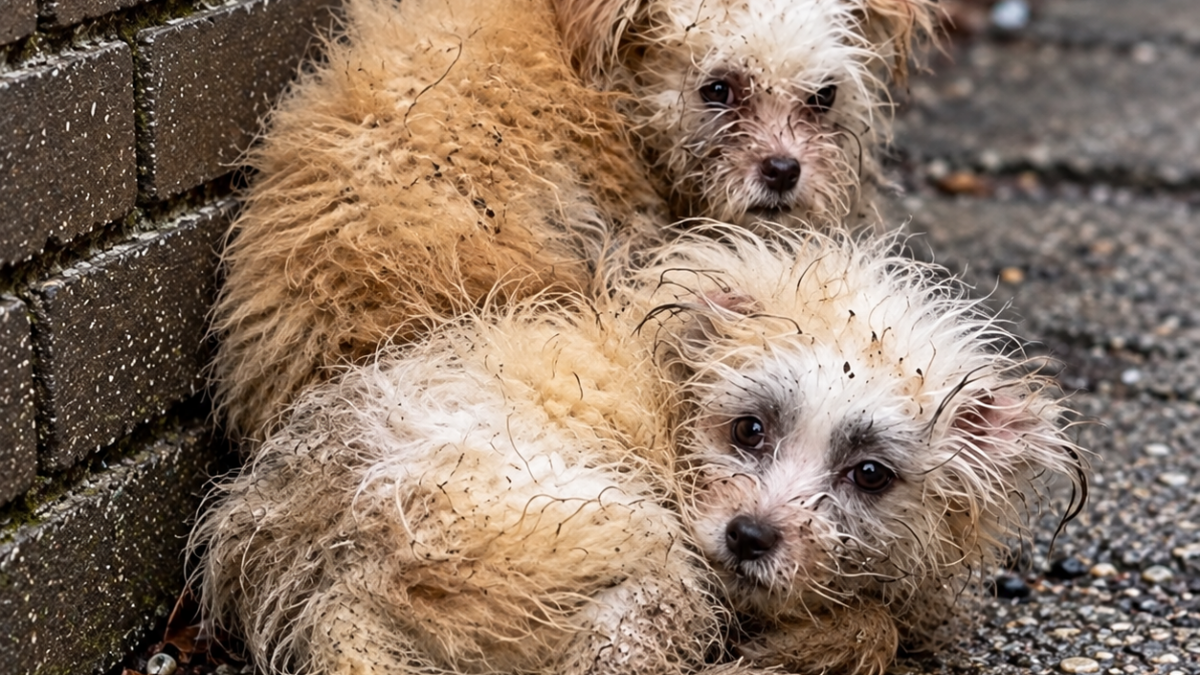
Vida and Danka were barely strong enough to stay on their feet, yet the moment they saw me coming, both little dogs tried to run. Their long coats hung from their bodies in filthy, hardened mats, but fear somehow gave them enough strength to keep backing away from the hand I was offering. And when they finally had nowhere left to go, the sound they made as I reached toward them told me there was far more hidden beneath that tangled fur than I could see.
I found them together on a street corner, pressed close enough that their bodies almost looked like one frightened animal.
Cars passed.
People moved around them.
Vida watched everything.
Danka kept her head lower.
Neither dog barked.
I crouched several feet away.
“Hey, girls.”
Vida immediately tried to move.
Danka followed.
Their steps were weak and uneven. The heavy mats around their legs made movement difficult, yet they kept retreating.
I stopped.
“I’m not chasing you.”
They couldn’t understand my words, but I hoped my voice might tell them something my hands had not earned yet.
I moved closer slowly.
Vida backed into a wall.
Danka pressed against her side.
When I extended one hand, both dogs lowered themselves toward the pavement.
Then came the sound.
Not barking.
Not growling.
A low, frightened moan.
I froze.
They were too tired to escape, but somewhere in their lives they had learned that a hand coming toward them was something to fear.
I pulled my hand back.
“All right.”
Vida stared at me.
“We’ll do this your way.”
I sat down on the pavement.
For several minutes, nobody moved.
Then Vida lifted her nose slightly.
Danka remained almost hidden behind her.
I let them smell the air around me.
When I finally moved closer again, I kept my hands low and visible.
Vida trembled.
Danka moaned.
“I know.”
My chest hurt.
“I know you don’t trust me.”
Eventually, I slipped one arm beneath Vida and lifted her.
She went rigid.
No bite.
No struggle.
Just terror.
Danka tried to crawl away, but she had almost no strength left.
I lifted her too.
“You’re staying together.”
At the clinic, the true condition of their coats became clear.
The mats were not simply dirty fur.
They had hardened around legs, bellies, and skin. Dirt and debris were trapped inside them, pulling whenever the dogs moved.
The team began shearing.
Slowly.
Carefully.
Vida shook through almost the entire process.
Danka’s breathing became fast every time the clippers moved close.
We paused repeatedly.
“You’re okay.”
A little more fur came away.
Then another heavy section.
For the first time, I could see the bodies that had been hidden beneath it all.
They were tiny.
Far thinner than they had looked.
When the final mats came off, we bathed them.
Dirty water ran away beneath them.
Vida stood quietly while a nurse supported her.
Danka kept leaning toward her sister.
I thought that once they were clean, the worst part might be behind us.
Then the examination began.
Vida was weak but stable.
She needed nutrition, rest, treatment, and time.
Danka was different.
Every time the veterinarian touched her lower abdomen, her body tightened.
“What is it?” I asked.
The veterinarian examined her again.
“She’s in pain.”
Bloodwork came first.
Then imaging.
I stood beside Vida while we waited.
Without Danka pressed against her, Vida looked smaller somehow.
She kept turning toward the door.
“She’ll come back.”
I said it before I knew whether that promise was safe to make.
Then the veterinarian called me into the other room.
An image was displayed on the screen.
She pointed toward Danka’s bladder.
“There.”
I stared.
“What am I looking at?”
“A stone.”
I moved closer.
It looked enormous inside such a small dog.
“How big?”
The veterinarian compared it carefully.
“Close to the size of a quail’s egg.”
I looked toward Danka lying on the examination table.
No one could tell me how long she had been carrying that inside her.
How many nights she had curled beside Vida while her bladder hurt.
How many times she had tried to urinate and felt pain.
How long she had been suffering while the two of them survived outside.
“Can you remove it?”
“Yes.”
“When?”
The veterinarian looked directly at me.
“As soon as possible.”
Vida was waiting in the next room.
Danka needed surgery.
And after fighting so hard to remain beside each other on that street, the two sisters were about to be separated for the first time since we found them…
PART 2
Vida knew the moment we carried Danka away.
I do not know how else to explain it.
She had been sitting on a folded blanket in the recovery room, still looking impossibly small without the heavy mats that had disguised her shape. The instant Danka disappeared through the treatment-room door, Vida stood.
Her head turned.
Then she walked to the edge of the blanket.
“Easy,” I told her.
She looked toward the hallway.
Danka did not come back.
Vida took another step.
Her freshly shaved body trembled.
I placed my hand near her, not touching yet.
“She’s getting help.”
Vida looked up at me.
Only hours earlier, the approach of my hand had made her lower herself to the pavement and moan.
Now she did not move away.
That small difference caught me by surprise.
I sat beside her.
“She’s coming back.”
This time I meant it as a promise.
I just prayed I would be allowed to keep it.
Danka’s surgery was being prepared urgently.
The bladder stone was so large compared with her tiny body that the veterinarian did not want to delay longer than necessary. There were risks with any operation, and Danka was not entering surgery as a strong, healthy dog.
She had been living outside.
Her coat had hidden poor body condition.
She was frightened.
She was already exhausted.
And no one knew how long pain had been draining her strength.
I signed the paperwork with a hand that felt strangely heavy.
The veterinarian spoke carefully.
“We’ll monitor her closely.”
“I know.”
“The stone needs to come out.”
“I know.”
“We’ll call you the moment she’s stable.”
I nodded.
Then I walked back to Vida.
She was still watching the door.
I sat on the floor beside her.
For the first time, I touched her without her making that terrible sound.
Just one finger beneath her chin.
She flinched.
Then stayed.
“That’s enough.”
I did not try for more.
Trust should never be taken just because fear has made resistance inconvenient.
Vida had given me one inch.
I respected it.
The clinic continued moving around us.
Phones rang.
Doors opened.
Other animals came and went.
But my attention stayed divided between the little dog beside me and the sister behind the surgical door.
Vida refused food at first.
That worried me.
I offered something softer.
Nothing.
Water.
A little.
Then she turned toward the hallway again.
“You’re waiting for her.”
Vida lay down.
I pulled the blanket around her without covering her completely.
She watched my hand but did not recoil.
Progress.
Tiny.
Almost invisible.
Still progress.
The surgery felt endless.
Realistically, it was not.
But time behaves differently when you are waiting for a door to open.
I imagined the stone.
A hard object the size of a quail’s egg inside the bladder of a dog small enough to fit easily beneath one arm.
How had she functioned?
How had she walked?
How had she survived on the street with that kind of pain?
And why had she still tried to run from us?
Pain teaches animals strange lessons.
If enough bad things happen without explanation, eventually everything becomes suspicious.
A hand.
A leash.
A door.
A human voice.
Vida and Danka had not known that we were different.
They knew only that humans had become part of a world they did not trust.
The surgery door finally opened.
The veterinarian stepped out.
I stood before she spoke.
“How is she?”
“The procedure went well.”
My knees nearly gave out.
“She’s okay?”
“She’s recovering from anesthesia now.”
“And the stone?”
“We removed it.”
“All of it?”
“Yes.”
I exhaled so hard it almost became a laugh.
Vida lifted her head at the sound of our voices.
The veterinarian showed me what had been removed.
Even seeing the imaging had not prepared me.
The stone looked enormous.
I stared.
“That was inside her?”
“Yes.”
“For how long?”
“There’s no way to know.”
I thought about Danka moaning when my hand came close.
Maybe some of that fear had been pain.
Maybe being touched anywhere had become something she expected to hurt because her body already hurt all the time.
I swallowed.
“What happens now?”
“Recovery. Pain control. Monitoring. We want to make sure she urinates normally and heals properly.”
“When can Vida see her?”
“Not immediately.”
I looked back at the little dog waiting on the blanket.
The veterinarian followed my gaze.
“Soon.”
Vida spent that night without her sister.
I stayed as long as I could.
She eventually ate a little.
Then more.
She drank.
She slept lightly.
Every time footsteps passed the room, her eyes opened.
I wondered how many nights she and Danka had slept side by side outside.
Had Vida always been the more watchful one?
Had Danka leaned against her when the pain became worse?
Had they been born together?
Abandoned together?
Had they ever known a home?
There were too many questions.
I knew better than to create answers simply because the truth was missing.
Their history belonged to them.
What I knew was what I had seen.
Two dogs on a corner.
Weak.
Matted.
Terrified.
Together.
Whatever had happened before, they had survived it side by side.
So separation hurt.
The following morning, Danka was awake.
Groggy.
Uncomfortable.
But awake.
When I entered, she watched me with the same guarded eyes from the street.
I stopped a few feet away.
“Hi, Danka.”
Her ears moved.
I crouched.
“You did it.”
She did not know what I meant.
I did.
The stone was gone.
The thing that had been hurting her was no longer inside her body.
For the first time in who knew how long, healing could begin without that constant source of pain.
I reached toward her slowly.
Danka tensed.
I stopped.
“Not yet.”
I sat instead.
After several minutes, she lowered her head.
That was enough.
Over the next days, the clinic became their world.
Vida continued recovering physically.
Her appetite improved.
The skin hidden beneath the mats received treatment.
Her body began adjusting to the absence of all that heavy, dirty fur.
She looked almost naked.
So small that visitors sometimes thought she was much younger than she was.
Danka remained under closer medical supervision.
Pain medication helped.
Her urination was monitored.
The surgical site was checked constantly.
The first time she urinated after surgery, a technician came to find me.
“She did it.”
I laughed.
“That’s what we celebrate now?”
“Yes.”
“Good.”
There is nothing glamorous about rescue.
Sometimes success is a dog urinating without a stone tearing at her bladder.
Sometimes it is a bowl emptied.
A normal temperature.
A peaceful nap.
A tail wag.
People like dramatic moments because they are easy to understand.
Recovery is built from boring things.
And boring things save lives.
Vida slowly began learning the clinic routine.
Morning meal.
Cleaning.
Medication.
Short walk.
Rest.
Another meal.
She stopped trembling constantly.
The first time she accepted food directly from my fingers, I nearly cried.
I held a tiny piece near her nose.
She smelled it.
Looked at me.
Backed away half an inch.
I kept my hand still.
“No pressure.”
Vida looked again.
Then stepped forward.
Very slowly.
She took the food.
Her teeth barely touched my fingers.
I smiled.
“That was brave.”
The next piece came easier.
By the fourth, she was looking for another.
I laughed.
“Now I see how this works.”
Food became our first language.
Not affection.
Not touching.
Food.
I offered.
She chose.
Nothing forced.
Choice matters to frightened animals.
If every interaction becomes something done to them, fear remains in control.
Vida needed to discover that she could say no.
Move away.
Return.
Try again.
That was how trust started.
Danka’s trust was slower.
Understandably.
The clinic meant surgery.
Needles.
Pain.
People touching the place that hurt.
Even when every treatment was necessary and gentle, her body did not know the difference between care and threat.
One nurse became especially patient with her.
She would enter and sit several feet away before doing anything.
No reaching.
No immediate handling.
Just presence.
After a while, Danka began watching her without trembling.
Then smelling her hand.
Then accepting food.
One afternoon, the nurse called me quietly.
“Come here.”
Danka was lying on her blanket.
The nurse’s hand rested several inches away.
Danka moved forward.
Not much.
She pressed her nose against the fingers.
Then withdrew.
The nurse did not chase her.
“That’s huge,” I whispered.
She smiled.
“I know.”
Those were the victories nobody outside rescue sees.
A frightened dog touching a hand by choice.
The world does not applaud.
No cameras.
No dramatic music.
But for us, it felt enormous.
Several days later, the veterinarian finally gave permission for the sisters to reunite.
We prepared carefully.
Danka still needed to remain calm.
No rough play.
No jumping.
No collision against the surgical area.
Vida was brought into a quiet room first.
She looked around.
Then Danka entered.
Everything changed.
Vida froze.
Danka froze.
For one second, neither moved.
Then Vida’s tail began to move.
Not a full wag.
A small tremble.
Danka took one step.
Vida moved forward.
I held my breath.
They touched noses.
Then Vida pressed her face against Danka’s neck.
Danka leaned into her.
No barking.
No dramatic jumping.
They were too weak for that.
They simply stood against each other.
The nurse beside me wiped her eyes.
I pretended not to notice because mine were wet too.
“They remember.”
“Of course they remember.”
Vida smelled Danka all over, particularly around the clinic odors on her coat.
Danka stayed close.
When we laid blankets side by side, they immediately settled together.
Vida curled toward her sister.
Danka placed her chin across Vida’s front leg.
Within minutes, both were asleep.
Deeply.
More deeply than I had seen either of them sleep alone.
I sat nearby for a long time.
That was when I realized something.
We had rescued two dogs.
But they had been rescuing each other long before we arrived.
Whatever the street had taken from them, they still had each other.
Warmth.
Warning.
Companionship.
A familiar smell.
A body to press against when the night became frightening.
Taking one sister away from the other permanently would have meant removing the last stable thing in a world that had already failed them.
The thought stayed with me.
At that point, adoption was still far away.
Both needed time.
Especially Danka.
But somewhere in the back of my mind, a rule began forming.
If possible, they would stay together.
Recovery accelerated after the reunion.
I do not mean some miraculous medical change happened overnight.
Danka’s incision still required care.
Vida still needed nutrition and skin treatment.
Both remained cautious with people.
But their spirits changed.
Vida ate better with Danka nearby.
Danka rested more peacefully when she could smell Vida.
During short walks, they wanted to move in the same direction.
If one stopped, the other stopped.
Sometimes they walked shoulder to shoulder.
Other times Vida moved half a step ahead, then looked back.
The street had taught them dependence.
Now we had to help that dependence become security rather than fear.
We introduced toys.
At first, neither understood.
A soft ball rolled across the floor.
Vida stared.
Danka looked at Vida.
The ball stopped.
Nothing.
I rolled it again.
Vida took one cautious step.
Then stopped.
“Go ahead.”
She smelled the ball.
Danka came closer.
Vida touched it with her nose.
The ball moved.
Both dogs jumped backward.
I laughed before I could stop myself.
“Sorry.”
They stared at me.
I rolled it more gently.
The next day, Vida nudged it.
A week later, Danka grabbed a small cloth toy and carried it three feet.
We celebrated like she had won a championship.
Play is not automatic for every rescued animal.
Play requires surplus.
Surplus energy.
Surplus trust.
Enough safety to waste effort on something meaningless.
Street survival leaves little room for meaningless things.
Everything is food.
Threat.
Shelter.
Escape.
When Vida and Danka began playing, I knew we were seeing something returning that the street had buried.
One afternoon, Vida bounced sideways.
It was awkward.
Almost accidental.
Danka stared.
Vida did it again.
Danka responded.
Two tiny shaved dogs hopped around each other for perhaps ten seconds.
Then stopped.
Everyone in the room laughed.
Vida froze at the sound.
My heart dropped.
Too loud.
Too sudden.
I immediately softened my voice.
“It’s okay.”
Danka moved closer to her.
Vida relaxed.
We learned with them.
Joy had to be gentle too.
Their coats began growing back.
At first, the new hair was soft and uneven.
They looked ridiculous.
I told them often.
“You two are not winning any beauty contests yet.”
Vida would stare.
Danka would turn away.
Eventually, the hair filled in.
The healthy coat underneath looked nothing like the filthy mats we removed.
We brushed them gently.
That became another challenge.
The first time a brush touched Vida’s back, she flattened herself.
I stopped.
“All right.”
Danka watched from nearby.
We tried with the brush placed on the floor first.
Let them smell it.
Then one gentle stroke.
Stop.
Treat.
Another day.
Another stroke.
Treat.
Weeks later, Vida stood while I brushed an entire section of her back.
Danka accepted several strokes too.
The same dogs who had moaned when a hand approached were learning that touching could be predictable.
That word again.
Predictable.
Animals damaged by fear do not always need grand affection.
They need consistency.
The same gentle motion.
The same calm voice.
The same person stopping when they become overwhelmed.
Trust grows because nothing suddenly changes.
Vida became the first to actively request affection.
One morning, I was sitting on the floor answering messages.
She walked toward me.
Stopped.
I continued looking at my phone.
She moved closer.
Then touched my knee with her nose.
I looked down.
“Hi.”
Vida stayed.
I put the phone aside.
Held out my hand.
She smelled it.
Then, slowly, pressed the side of her face against my fingers.
I almost stopped breathing.
No food.
No leash.
No medical reason.
She wanted touch.
I scratched gently beneath her chin.
Vida’s eyes softened.
The dog who once collapsed away from my hand was leaning into it.
“You changed the rules,” I whispered.
She leaned harder.
After that, affection became easier.
Not constant.
Vida still had moments when she wanted space.
We honored them.
Danka followed several weeks later.
Her first request came after an examination.
She had been nervous.
When the veterinarian finished, Danka moved toward me instead of away.
She stood between my feet.
I crouched.
She pressed into my chest.
I wrapped one arm around her loosely.
“You’re okay.”
Her body trembled once.
Then relaxed.
I felt tears against my own face before I realized I was crying.
Trauma does not disappear because someone loves an animal.
The nervous system remembers.
But new experiences can accumulate around the old ones until fear no longer occupies the entire world.
That was happening.
Month by month.
Vida and Danka grew stronger.
Their walks lengthened.
Their bodies filled out.
Their coats became beautiful.
Danka’s follow-up imaging and examinations were good.
Her bladder recovered well from surgery.
The fear of another emergency slowly receded.
Then came the first real run.
We were in a secure fenced area.
Vida had been walking farther each week.
Danka had recently been cleared for more activity.
I unclipped Vida.
Then Danka.
At first, they simply explored.
Smelling grass.
Checking corners.
Staying close.
Then Vida saw something move.
A leaf.
That was all.
The wind pushed a dry leaf across the grass.
Vida chased it.
Danka chased Vida.
For several seconds, both dogs ran.
Actually ran.
Their legs stretched.
Their ears flew backward.
Vida turned.
Danka cut across her path.
Then they circled each other.
The volunteers around me started cheering.
I raised one hand.
“Quiet.”
We had learned.
The cheering softened into laughter.
Vida and Danka did not stop.
They raced across the yard again.
I thought about the corner.
Two weak dogs barely able to get away from my hand.
Now I could not catch them if I tried.
That felt like justice.
Not revenge against whoever had failed them before.
We did not know enough about that history to build a villain honestly.
Their justice was simpler.
Fear had once told them to run from people.
Now they ran because running was fun.
That distinction contained an entire life.
The next major question arrived before I was ready.
Adoption.
They were medically stable.
Emotionally improving.
Healthy enough.
Ready.
I should have been happy.
I was terrified.
Not because I wanted them to remain at the rescue forever.
Because I knew what I wanted for them.
Together.
When people heard about two small dogs, many asked whether they could adopt one.
Vida alone.
Or Danka.
“We have another dog already.”
“We only have room for one.”
“Would they really mind being separated?”
I understood the practical questions.
But every time I imagined it, I saw the reunion after surgery.
Vida pressing into Danka.
Danka sleeping with her chin on Vida’s leg.
I spoke with the team.
“We should try to place them together.”
Someone asked the obvious question.
“What if that takes much longer?”
“Then it takes longer.”
“Bonded pairs are harder.”
“I know.”
“What if we find two excellent homes?”
I looked toward the yard.
Vida and Danka were sleeping beside each other in the sun.
“Excellent for whom?”
Silence.
I did not mean the question cruelly.
Adoption decisions are complicated.
There are situations where bonded animals can adjust separately.
There are situations where insisting on a pair placement may keep them waiting for a very long time.
We had to look at the actual dogs.
Not emotion alone.
So we observed.
Behavioral assessments.
Brief controlled separations.
How did each function without the other?
Vida became visibly more vigilant when Danka disappeared.
Danka searched.
Neither fell apart.
But both relaxed significantly when reunited.
The conclusion was clear enough.
They were deeply bonded.
Could they survive apart?
Probably.
Was there a compelling reason to make them?
No.
So we waited.
Applications came and went.
One family adored Vida but worried about Danka’s medical history.
Another liked Danka but felt two dogs were too much.
Someone wanted “the calmer one.”
Someone else asked whether the sisters could be separated “just for a trial.”
No.
We continued waiting.
Vida did not know.
Danka did not know.
They played.
Ate.
Slept.
Their world was already safe.
There was no deadline from their perspective.
Only from ours.
Then Marijana called.
At first, it did not sound dramatic.
“I heard you have two little sisters who need a home.”
“Yes.”
“Together?”
“Yes.”
“Good.”
I paused.
Most conversations did not begin like that.
“You’re specifically interested in both?”
“If they’re bonded, why would I separate them?”
I felt something inside me shift.
We talked.
Her home.
Schedule.
Experience.
Veterinary care.
Finances.
Safety.
What she expected.
What she could offer.
She asked about Danka’s bladder surgery.
Not with fear.
With practical questions.
“Any dietary recommendations going forward?”
“Yes.”
“Follow-up monitoring?”
“Yes.”
“Anything I should watch for?”
We explained everything.
Then she asked about fear.
“How are they with new people?”
“Much better. But I need you to understand where they started.”
I told her.
The street corner.
The moaning.
The way they lowered themselves when my hand approached.
Marijana was quiet.
Then:
“So I shouldn’t expect them to love me immediately.”
Relief washed through me.
“No.”
“Good.”
“Good?”
“I don’t want them performing gratitude for me. They can decide when they’re ready.”
That sentence stayed with me.
They can decide.
Exactly.
Marijana visited.
I watched more closely than she probably realized.
Vida noticed her first.
She approached halfway.
Stopped.
Marijana did not reach.
She sat down.
Danka stayed farther away.
Marijana spoke to me rather than coaxing them constantly.
That helped.
After ten minutes, Vida came closer.
Marijana kept her hand on her own knee.
Vida sniffed her shoe.
Then walked away.
Marijana smiled.
“Progress.”
Danka eventually came near enough to smell the air around her.
No contact.
Marijana did not seem disappointed.
“Next time.”
The next visit went better.
Vida accepted food.
Danka came closer.
Third visit, Vida allowed one touch beneath the chin.
Marijana stopped after one second.
Vida remained.
Then nudged the hand.
I looked away because my eyes were burning.
Danka watched everything.
She had always learned from Vida.
On the fourth visit, Danka accepted the same hand.
One touch.
Then another.
Marijana looked toward me but did not celebrate loudly.
She understood.
The adoption process moved forward.
Home check.
Secure environment.
Veterinary plan.
Food.
Beds.
Leashes.
Grooming.
Everything.
Marijana bought two beds.
Then sent me a photo.
“They may ignore these, but I’m ready.”
I laughed.
“They will probably share one.”
She sent another message.
“Then I’ll put them together.”
The night before adoption, I sat with Vida and Danka after everyone else left.
They were sleeping beside each other.
Their coats had grown enough that they finally looked like themselves.
Whoever “themselves” were.
I had only known them from suffering forward.
I never knew what they looked like as puppies.
Never knew whether they once belonged to someone.
Never knew who gave them names originally or whether our names were the first names that had ever meant safety.
Vida woke.
I touched the floor near her.
She came closer.
No fear.
My hand rested on her neck.
Danka opened her eyes.
Then crawled against my leg.
“You’re leaving tomorrow.”
Vida licked my finger.
“You don’t know that.”
Danka sighed.
“You’re going somewhere better.”
I swallowed.
“That’s what I’m supposed to say.”
The truth was, rescue adoptions hurt.
People imagine we want to keep every animal.
Sometimes we do.
But keeping every animal would mean eventually having no room to rescue the next one.
Love in rescue often ends with a leash passed into another person’s hand.
You spend months proving humans can be trusted.
Then ask the animal to trust a new one.
That is not easy.
I looked at them.
“You’re going together.”
That helped.
Whatever happened tomorrow, they would have the one thing they had carried through every previous transition.
Each other.
Adoption morning arrived.
Marijana was nervous.
I could tell.
“So what if they hide?”
“Let them.”
“What if they won’t eat?”
“Call us, but give them quiet first.”
“What if they don’t come near me?”
“They will eventually. Don’t force the timeline.”
She nodded.
Vida and Danka wore new harnesses.
They looked very small beside Marijana.
I knelt.
Vida came toward me immediately.
Danka followed.
That would have been impossible months earlier.
I kissed Vida’s head.
Then Danka’s.
“Be good.”
I laughed.
“No. Be whatever you want.”
Marijana took the leashes.
The sisters walked several steps.
Then stopped.
Vida looked back.
Danka looked with her.
My chest tightened.
I waved.
“Go.”
They did.
Together.
The first update arrived twenty-three minutes later.
A photograph.
Vida under a chair.
Danka beside her.
Marijana wrote:
“We made it home. I’m leaving them alone to watch everything.”
Good.
An hour later:
“They drank.”
Good.
Later:
“Vida took food from me.”
Then:
“Danka ate after Vida did.”
Of course.
That was how they worked.
The first night, they ignored both new beds and slept together on a blanket beneath a table.
Marijana did not move them.
She sent a photo.
“They chose this.”
I replied:
“Then tonight, that’s their bedroom.”
The next several days were slow.
Vida explored first.
Danka followed.
The hallway.
Kitchen.
Living room.
Yard.
Every new space became safe because the sisters entered it together.
Marijana remained patient.
She did not grab.
Did not insist.
Did not pull them into her lap.
She sat.
Talked.
Fed.
Waited.
On the fourth day, Vida approached her while she was sitting on the floor.
Marijana sent no video.
Only a message.
“Vida put her head on my knee.”
I stared at the words.
Then another message arrived.
“I didn’t move for ten minutes.”
I laughed.
“Correct.”
A week later, Danka did the same.
Then something unexpected happened.
Marijana became part of their pair.
Not replacing their bond.
Joining it.
They began following her from room to room.
Vida slept beside her feet.
Danka waited near the kitchen when she prepared food.
If Marijana sat on the couch, both eventually appeared.
At first, one at each end.
Then closer.
Then one evening came the photograph I had been waiting for.
Marijana sitting under a blanket.
Vida curled against her hip.
Danka asleep across her legs.
Caption:
“I guess I’m not allowed to move.”
I cried.
Not the painful kind.
The release kind.
They had chosen her.
Nobody could manufacture that.
You cannot force a frightened animal to trust.
You can only create enough safe moments that eventually trust becomes reasonable.
Marijana had done that.
Weeks turned into months.
Vida became playful in the house.
She developed a habit of carrying socks.
Not chewing them.
Collecting them.
Marijana would find three or four in one bed.
Danka discovered a squeaky toy and became obsessed.
The first time she squeaked it repeatedly, Vida barked at her.
Marijana sent me the video.
Two little dogs bouncing around the living room.
I watched it beside one of the clinic nurses.
She covered her mouth.
“Those are them?”
“Yes.”
“No.”
“Yes.”
“They look completely different.”
They did.
But they were not different dogs.
Safety reveals things suffering hides.
Danka’s bladder continued doing well.
Marijana followed every veterinary recommendation.
Good hydration.
Appropriate food.
Regular checkups.
Watching for changes.
The first follow-up after adoption made everyone nervous.
Then the veterinarian smiled.
“She looks good.”
Marijana called me afterward.
“I was terrified.”
“Welcome to caring about an animal.”
She laughed.
“I hate it.”
“No, you don’t.”
“No.”
She became serious.
“Thank you for trusting me with them.”
I looked at the latest photo she had sent.
Vida and Danka sleeping on either side of her.
“They trusted you themselves.”
That mattered more.
Then came their first winter in the home.
Both dogs hated cold rain.
Marijana bought little coats.
Vida tolerated hers.
Danka acted personally offended.
The video made me laugh harder than I had in weeks.
Danka stood frozen in the coat.
Vida walked around her.
Marijana called:
“Come on.”
Danka refused.
I sent back:
“The dog survived a bladder stone the size of a quail egg but has been defeated by fashion.”
Marijana replied:
“Apparently.”
Eventually Danka accepted the coat once she realized it meant walks.
Life became ordinary.
That is the best sentence I can write about them.
Ordinary.
Morning routines.
Food bowls.
Walks.
Toys.
Beds.
Veterinary checks.
Rainy days.
Sunny days.
Annoying habits.
Favorite treats.
None of it was dramatic.
Everything was miraculous compared with the corner where I found them.
A year after adoption, Marijana invited me to visit.
I wondered whether the sisters would remember me.
Vida answered first.
The moment I entered, she froze.
Then her tail moved.
She came forward quickly.
Danka followed.
I knelt.
“Hi.”
Vida pushed against my hands.
Danka smelled my face.
I laughed.
“You remember.”
Marijana stood behind them.
Vida greeted me.
Danka greeted me.
Then both went back to Marijana.
Vida leaned against her ankle.
Danka looked up at her.
That moment hurt and healed me simultaneously.
They remembered me.
But I was not home anymore.
Marijana was.
Exactly as it should be.
We sat together while the sisters played.
Vida stole one of Marijana’s socks.
Danka squeaked the same ridiculous toy.
I looked around the room.
Two beds.
Blankets.
Water.
Toys.
Photos on the wall.
A framed photograph showed Vida and Danka sleeping against each other shortly after adoption.
Another showed them running outside.
Then one with Marijana between them.
The story was everywhere without looking like a rescue story.
It looked like family.
That afternoon, Marijana told me something I had never considered.
“When I first met them, I was afraid they would always be afraid of me.”
I looked at Vida asleep with her head on Marijana’s foot.
“I think you got your answer.”
“Yes.”
“What changed?”
Marijana thought.
“I stopped trying to convince them.”
I smiled.
Exactly.
Trust does not come from persuasion.
It comes from repetition.
You put the bowl down.
You do not take it away.
You open the door.
They come back safely.
You touch gently.
You stop when they ask.
You leave.
You return.
Again.
Again.
Again.
Eventually, the animal stops asking whether this time will be different.
Vida and Danka had learned that with us.
Then learned it all over again with Marijana.
One evening during the visit, I reached toward Vida.
She leaned into my hand instantly.
No lowering to the floor.
No moan.
I remembered the street so vividly that my chest hurt.
I moved to Danka.
She lifted her chin.
I scratched beneath it.
Her eyes closed.
I whispered:
“You two used to be terrified of this.”
Marijana heard me.
“Of being touched?”
“Yes.”
She looked at them.
“They love it now.”
I nodded.
“That’s why this matters.”
Their bodies had recovered months earlier.
Their coats grew.
Danka’s stone was gone.
Weight returned.
Those were visible.
This was different.
Two dogs believing a hand could be good.
That was the deepest recovery.
Later, when I prepared to leave, both sisters followed me to the door.
I crouched.
“I’m not taking you.”
Vida wagged.
Danka looked toward Marijana.
I laughed.
“You already know.”
I hugged each gently.
Then stood.
Marijana opened the door.
I stepped outside.
Vida remained inside.
So did Danka.
No attempt to follow.
No panic.
The door closed.
I stood there smiling.
The first time I met them, they had run from a human because they believed distance meant safety.
Now they did not need to run.
Safety was behind the door.
Years passed.
We continued receiving updates.
Vida’s sock collection became legendary.
Danka remained obsessed with squeaky toys.
Both grew more confident around visitors, although Marijana never forced social interactions.
They made dog friends.
They learned favorite walking routes.
They developed completely different personalities once fear no longer dominated every behavior.
Vida was more adventurous.
Danka was more cautious but deeply affectionate once she chose someone.
Vida liked investigating first.
Danka liked watching.
Just as on the street.
Only now those traits were preferences rather than survival strategies.
Danka’s medical history remained something Marijana took seriously.
No complacency.
Regular checks.
Good hydration.
Immediate attention if anything looked wrong.
That was another form of justice.
Before, Danka may have carried terrible pain for weeks or months without help.
Now the smallest sign mattered.
Once she urinated more frequently than usual.
Marijana noticed the same morning.
By afternoon, Danka was at the veterinarian.
Nothing severe.
But that was the point.
No waiting until collapse.
No assuming.
No letting pain become normal.
I thought about how different her life had become.
A body once left to endure now lived with someone who noticed.
Vida too.
A small limp after an energetic play session?
Checked.
Skin irritation?
Treated.
Appetite change?
Noted.
That attention does not sound romantic.
It is.
Love is often less about grand emotion than noticing.
One year, Marijana sent a photograph from a grassy field.
Vida and Danka were running side by side.
Both in mid-stride.
Ears back.
Mouths open.
The photograph was slightly blurred because they were moving too fast.
I loved it.
I compared it with the image stored in my mind from the street.
Two dogs barely able to run.
Heavy mats pulling against their bodies.
Fear making them retreat.
Now they were running toward something.
Marijana stood farther ahead.
They were running to her.
That was the perfect reversal.
Once, a human approached and they fled.
Now a human called and they raced forward.
No punishment could have created a more satisfying ending.
Whoever or whatever had taught them to fear hands no longer controlled the meaning of a hand.
Marijana had rewritten that.
A hand meant food.
Leash.
Warm coat.
Medicine.
Scratch behind the ear.
A hand opening the door to the yard.
A hand waiting at the end of a run.
One ordinary day, Marijana called me laughing.
“What happened?”
“Danka stole Vida’s bed.”
“Okay.”
“And Vida is sitting in front of me complaining.”
“How?”
“She keeps making this little noise.”
I laughed.
“The dog who used to moan because she was terrified of us is now complaining about furniture?”
“Yes.”
“Perfect.”
That was healing.
Same voice.
Different reason.
Fear had once filled every sound.
Now they had enough security to be annoyed.
Let them complain.
Let them steal beds.
Let them become spoiled.
Let life become small enough that a missing sock or occupied bed feels important.
They had lived through enough large problems.
When the sisters began growing older, Marijana adjusted again.
Shorter walks when needed.
More comfortable beds.
Regular health checks.
No assumption that because they had survived before, they should tolerate discomfort now.
Vida developed a little stiffness after sleeping.
Danka’s bladder remained carefully monitored.
Their faces gained gray hairs.
Marijana sent me a close-up one day.
“They’re getting old.”
I stared.
My heart tightened.
Then I smiled.
Good.
Growing old is not a tragedy for animals who once nearly lost their future.
It is evidence that the future arrived.
Vida and Danka had earned gray faces.
Slow mornings.
Long naps.
I called Marijana.
“How are they really?”
“Happy.”
“That’s all I needed.”
“Vida is sleeping. Danka is eating.”
“So nothing has changed.”
“Exactly.”
We laughed.
I sometimes thought about that first day more as they aged.
Not because I wanted to trap them in the past.
Because time had made the distance astonishing.
Two little dogs on pavement.
No home.
Filthy fur.
Pain hidden beneath mats.
Danka carrying a stone almost the size of a quail egg.
Vida pressed against her.
And then all the years after.
That phrase became precious to me.
All the years after.
Rescue stories often focus on the moment of salvation.
The pickup.
The surgery.
The adoption.
But the greatest victory is the years after.
Breakfasts.
Walks.
Naps.
Birthdays.
Vet checks.
Rain.
Sun.
Visitors.
Favorite toys.
Thousands of safe touches.
That is where trauma loses its monopoly on the story.
Not because the past disappears.
Because life becomes larger than it.
Vida and Danka’s life became enormous compared with that street corner.
One afternoon, Marijana sent a photograph without explanation.
The sisters were asleep beside her.
Vida’s head rested across Danka.
Danka’s paw touched Marijana’s ankle.
Three bodies connected.
I stared at it.
That was the family.
Not a rescuer and two damaged dogs.
Not a woman who “saved” them forever.
Family.
Each had chosen the others.
That mattered.
People sometimes asked whether Marijana had been brave to adopt two traumatized dogs together.
I understood the compliment.
But I preferred something else.
She was patient.
Bravery can be one moment.
Patience is Monday morning.
Tuesday evening.
The tenth fearful reaction.
The hundredth slow introduction.
The day an animal regresses for no obvious reason.
The decision not to take fear personally.
Patience built that home.
Marijana never demanded that Vida and Danka become affectionate because she had adopted them.
She gave them reasons.
Again.
Again.
Again.
Eventually, they did.
That is why the first photograph of Danka asleep in Marijana’s lap still makes me emotional.
Not because lap dogs are unusual.
Because Danka had once moaned when a hand approached.
The distance between those two moments could not be measured in miles.
Only trust.
One day I found the old clinic photograph of Danka’s bladder stone.
I had not looked at it in years.
The size shocked me all over again.
I sent no one the picture.
I simply sat with the memory.
Danka had been carrying pain while trying to survive outdoors.
Now, somewhere else, she was probably lying on a blanket complaining because dinner was late.
I closed the photo.
I preferred the second image.
That evening, Marijana happened to send an update.
Danka curled under a soft blanket.
Vida beside her.
Caption:
“Cold day. Nobody is moving.”
I laughed.
Perfect timing.
I replied:
“Let them rest.”
They had run far enough.
Not physically.
Through life.
From fear to security.
From pain to comfort.
From street corner to home.
Years later, when their steps slowed further, Marijana told me Vida had begun waiting for Danka on walks.
Once Danka had often followed Vida.
Now Vida would move a few feet, stop, look back, and wait.
The sisters were still taking care of each other.
That broke me in the gentlest way.
Their bond had survived everything.
Street.
Clinic.
Surgery.
Recovery.
Adoption.
Age.
They had never needed us to create that bond.
We only had to respect it.
I was grateful we did not separate them.
Not because they could never have survived separately.
We will never know.
Because together, they had something no human could reproduce.
Shared history.
A familiar body in every unfamiliar room.
A sister.
Sometimes rescue means adding something an animal never had.
Sometimes it means protecting the one thing they managed to keep.
For Vida and Danka, that was each other.
And then Marijana.
Their world became three.
One final visit stays with me.
Vida and Danka were older.
Slower.
Their coats had gray around the faces.
I sat on the floor.
Vida came first.
Still the braver one.
She placed her head against my hand.
Danka came more slowly.
She settled beside Vida.
Marijana sat opposite us.
For a while, nobody said anything.
I touched Vida’s cheek.
Then Danka’s.
Neither flinched.
Neither lowered herself in fear.
Neither moaned.
I looked at Marijana.
“Do you remember what I told you about the first day?”
“Yes.”
“They tried to run.”
“I know.”
“And when I reached toward them…”
Marijana nodded.
“They were scared.”
“Terrified.”
Danka nudged my hand because I had stopped petting her.
I laughed.
“Look at you.”
She nudged again.
Marijana smiled.
“She’s demanding.”
“She earned it.”
Vida leaned into my other hand.
Now I had one dog under each palm.
That image replaced the street corner in my mind.
Hands once feared.
Hands now requested.
There it was.
The ending.
Not Danka’s surgery.
Not adoption paperwork.
Not the first run.
Those were chapters.
The ending was this.
Two old sisters sitting safely with a woman they trusted, asking to be touched.
Nothing hurt.
No one was chasing them.
No one was forcing anything.
They wanted the hands.
When it was time for me to leave, Marijana walked me to the door.
Vida and Danka remained on their blanket.
Too comfortable to follow.
I smiled.
“Once they tried to get as far away from me as possible.”
Marijana laughed.
“And now?”
“Now I’m not important enough to make them leave the blanket.”
“That’s progress.”
“It really is.”
I stepped outside.
Through the window, I could see Marijana return to them.
Vida lifted her head.
Danka shifted closer.
Marijana sat.
Both dogs leaned toward her.
The door closed.
And for the first time in a long time, I thought about that street corner without feeling only pain.
Because the corner was no longer the definition of their story.
It was simply where I happened to meet them.
Vida and Danka’s real life came afterward.
The clean beds.
The surgery that ended Danka’s pain.
The reunion.
The first toys.
The first run.
The patient woman who refused to separate them.
The first night under her table.
The first head resting on her knee.
The socks.
The squeaky toy.
The little coats.
The gray fur.
All those ordinary years.
The sisters who once used their last strength to escape a human hand had lived long enough to discover hands they could fall asleep beneath.
That was justice.
That was revenge against every frightened night.
Not anger.
Not punishment.
Trust.
And in the end, Vida and Danka did not need the world to explain what had happened before we found them.
They only needed the world to become different afterward.
It did.
They stayed together.
They became strong.
They learned to play.
They learned to ask for affection.
And when their legs eventually slowed with age, they had a home where nobody expected them to run anymore.
The running was over.
The fear was over.
There was only Marijana, a warm room, two sisters pressed close together, and the hands they had finally learned would never hurt them again.
And even after Vida and Danka had learned that Marijana’s hands were safe, their story kept unfolding in small ways that mattered far more than any dramatic rescue scene ever could.
For the first few months, Marijana still noticed moments when the past seemed to reach into the present.
A door would slam somewhere outside.
Vida would freeze.
Danka would look toward her sister.
A stranger might move too quickly.
Both dogs would take one step backward.
They no longer collapsed in fear the way they had on the street, but their bodies remembered things their new life had not caused.
Marijana never scolded them.
She never pulled them forward.
She never said, “You’re safe now, so stop being afraid.”
Instead, she gave them distance.
Time.
Choice.
Then, when they were ready, she offered a hand.
Sometimes Vida approached first.
Sometimes neither did.
That was okay.
Trust was not a debt they owed her because she had adopted them.
It was something she allowed them to build at their own pace.
One evening, a friend came to visit.
Vida hid behind the couch.
Danka followed.
Marijana’s friend looked concerned.
“Should I try to give them treats?”
“Not yet.”
“Should I sit closer?”
“No.”
“Will they always be like this?”
Marijana looked toward the two little faces peeking from behind the furniture.
“I don’t know.”
Then she smiled.
“But they don’t have to become different for me.”
That answer mattered.
Because people sometimes adopt frightened animals and secretly expect gratitude to erase trauma.
They imagine rescue means the fear should disappear quickly.
The animal has a warm bed now.
Food now.
Love now.
What else could they need?
Time.
That is what.
Time long enough for a nervous system to believe what the eyes keep seeing.
Nothing bad happened yesterday.
Nothing bad happened today.
Maybe nothing bad will happen tomorrow either.
The visiting friend sat on the floor across the room.
She stopped looking directly at the sisters.
Vida emerged first.
One step.
Then another.
Danka stayed behind.
Vida sniffed the air.
The friend remained still.
Five minutes later, Vida came close enough to smell her shoe.
Nobody reached.
Vida walked away.
“That’s all?” the friend whispered.
Marijana nodded.
“That’s enough.”
The next visit, Vida took a treat.
The visit after that, Danka appeared sooner.
Weeks later, both dogs slept in the same room while the friend was there.
That was how their confidence grew.
Not with one breakthrough.
With hundreds of uneventful encounters.
Nothing terrible happened.
Again.
Again.
Again.
Eventually, uneventful became normal.
Vida changed faster.
She had always been the one more willing to investigate.
Even on the street, she had watched first while Danka kept her head lower.
In the home, that old difference became personality rather than fear.
Vida wanted to know what every bag contained.
Every package.
Every new object.
Marijana could not put a grocery bag on the floor without Vida appearing beside it.
“What do you think is in there?”
Vida sniffed furiously.
“Vegetables.”
Vida continued searching.
“No treats.”
Search.
“I promise.”
Vida stuck her nose deeper.
Danka watched from several feet away.
Then, if Vida did not explode, Danka came closer.
That became their pattern.
Vida inspected the world.
Danka inspected Vida’s reaction to the world.
One morning, Marijana bought them a new bed.
A large one.
Soft.
Expensive.
She placed it near the window.
Vida walked around it three times.
Danka stood in the doorway.
Vida sniffed.
Stepped one paw inside.
Jumped back.
Marijana laughed.
“It is a bed, not a trap.”
Vida looked offended by the suggestion.
She approached again.
Put two paws inside.
Then four.
Turned.
Lay down.
Danka immediately came over and squeezed beside her.
Within twenty minutes, both were asleep.
Marijana photographed them.
The caption she sent me said:
“They needed a full investigation before approving it.”
I smiled.
That was a luxury too.
Being suspicious of furniture.
Being allowed time to inspect a new bed.
No one rushing.
No one grabbing.
No pain hidden beneath dirty fur.
Their concerns had become smaller.
I loved that.
The first year in Marijana’s home passed almost quietly.
There were no major medical emergencies.
Danka’s bladder remained stable.
Her veterinarian continued monitoring carefully because nobody wanted to assume the old problem could never return.
Hydration mattered.
Diet mattered.
Changes in urination mattered.
Marijana paid attention.
Not obsessively.
Carefully.
The first time Danka seemed to squat more frequently during a walk, Marijana called immediately.
“Maybe I’m overreacting.”
“Take her in.”
The exam showed mild irritation, nothing like the massive stone that had once required surgery.
Treatment began early.
Danka recovered quickly.
Afterward, Marijana called again.
“I keep thinking about what would have happened before.”
I knew what she meant.
Before rescue.
Before people watched.
Before anyone noticed.
A little discomfort might have grown.
Then more.
Then severe pain.
Maybe nobody would have acted until Danka could barely move.
But now a small change was enough.
“I saw it the same morning,” Marijana said.
“That’s the difference.”
“What?”
“She doesn’t have to become critically sick before someone believes her body matters.”
Silence.
Then Marijana said softly, “Never again.”
That promise became part of their home.
Not dramatic.
Just real.
Never again would Danka’s pain need to become enormous before someone responded.
Never again would Vida’s fear have to become collapse before someone gave her space.
Their lives were observed.
Known.
That is one of the most powerful gifts an animal can receive.
To be known well enough that a small change is visible.
As the sisters became more secure, their personalities expanded in directions none of us expected.
Vida became a thief.
Not food.
Fabric.
Mostly socks.
Occasionally small towels.
Once, Marijana spent twenty minutes looking for a glove before finding it beneath Vida’s bed with four socks and a soft cleaning cloth.
She sent me the evidence.
I called her.
“You have a criminal.”
“I know.”
“What does she do with them?”
“Nothing.”
“Chews them?”
“No.”
“Destroys them?”
“No.”
“So she steals them and stores them?”
“Yes.”
I laughed.
“Vida has a collection.”
Marijana lowered her voice.
“I think she likes my smell.”
That stopped my laughter.
Maybe.
We could never know for certain.
But it made sense that a dog who once feared people might eventually gather objects carrying the scent of the person she trusted most.
Marijana never stopped the harmless collecting completely.
She simply removed anything unsafe.
Old socks became Vida’s legal property.
Danka’s obsession was sound.
Squeaky toys.
The louder, the better.
Her favorite was an ugly stuffed duck that made an unbearable noise.
Marijana regretted buying it almost immediately.
Danka did not.
Squeak.
Squeak.
Squeak.
At 6:30 in the morning.
At noon.
Sometimes at night.
Vida occasionally barked at her.
Danka squeaked louder.
One afternoon, Marijana sent me a video.
Danka was on the rug, squeezing the duck repeatedly.
Vida sat several feet away staring with visible irritation.
Marijana could be heard laughing.
Then Vida walked over, grabbed the duck, and carried it away.
Danka followed.
They began tugging.
Within seconds, both were playing.
I watched the video over and over.
Not because tug-of-war was special.
Because their bodies were loose.
Their mouths open.
Tails moving.
No tension.
No shrinking.
No moaning.
Play requires vulnerability.
An animal distracted by fun is temporarily giving up vigilance.
Vida and Danka could do that now.
Home had taught them that somebody else was watching for danger.
They did not have to.
Their first holiday season with Marijana produced another lesson.
Visitors.
Noise.
Different schedules.
Food smells.
Doors opening and closing.
Marijana worried the change might overwhelm them.
So she created a quiet room.
Beds.
Water.
Soft music.
No visitors allowed unless the sisters chose to come out.
At first, both stayed inside.
Vida listened at the doorway.
Danka slept.
After an hour, Vida walked into the hall.
A guest saw her.
“Hi!”
Vida backed up.
Marijana raised a hand.
“Please ignore her.”
The guest immediately looked away.
Vida stopped retreating.
Several minutes later, she walked farther into the room.
Nobody touched her.
Nobody called.
Nobody leaned over.
She sniffed.
Then returned to Danka.
Later, both emerged together.
By evening, Vida accepted a treat from one guest.
Danka sat under Marijana’s chair.
Success.
Not because they became social butterflies.
Because they had options.
When they wanted space, space remained available.
Safety had a door they could walk through.
The next morning, after everyone left, both sisters slept half the day.
Marijana took a photograph.
“Holiday recovery.”
I wrote back:
“Same.”
That ordinary joke made me smile.
They were becoming part of ordinary family life.
Not special exceptions around whom every day had to revolve.
Accommodated, yes.
Protected, yes.
But also simply dogs.
Dogs who got tired after guests.
Dogs who wanted breakfast.
Dogs who stole laundry.
Dogs who argued over toys.
That was the goal.
People often thought rescue meant creating a perfect life.
It doesn’t.
No life is perfect.
It means creating a life where imperfection is safe.
Vida could be nervous.
Danka could be stubborn.
Marijana could be tired.
The weather could be terrible.
A toy could break.
A vet appointment could be stressful.
And none of those things threatened belonging.
That was new.
At the street corner, everything had been uncertain.
At home, almost nothing important was.
The sisters began learning that Marijana leaving did not mean abandonment.
That took time.
At first, when she picked up her keys, Vida became alert.
Danka stood.
If Marijana walked toward the door, both followed.
The first few absences were short.
Then longer.
A camera allowed her to check them without returning too early.
The first time she left for thirty minutes, Vida stayed near the door for eight.
Danka paced.
Then Vida moved to a bed.
Danka followed.
By twenty minutes, both were lying down.
When Marijana returned, they exploded with excitement.
She crouched.
“I came back.”
Of course those words meant nothing linguistically.
But repetition gave them meaning.
She left.
She returned.
Again.
Again.
After months, the keys stopped being a crisis.
Vida might lift her head.
Danka might watch.
But neither rushed to the door every time.
One day, Marijana returned from an errand and found both asleep.
“They didn’t even greet me,” she complained jokingly.
I laughed.
“That is excellent.”
“It felt rude.”
“It means they trusted you would come home.”
She became quiet.
Then:
“Okay. I’ll accept being ignored.”
Trust had advanced to the point where vigilance was unnecessary.
That might have been the greatest change of all.
The sisters who once slept outside with only each other could now sleep through the absence of the person they loved most because they expected her return.
Fear says, stay awake.
Trust says, rest.
Vida and Danka learned rest.
Deeply.
Completely.
Often in ridiculous positions.
Marijana sent photographs.
Vida upside down.
Danka under a blanket with only her nose visible.
Both dogs somehow occupying one small bed while the second identical bed remained empty.
I never understood why bonded animals did that.
Two beds.
Choose one.
Always.
One evening, Marijana separated the beds by several feet to see what would happen.
Vida chose one.
Danka stood between them.
Looked at Vida.
Then climbed into Vida’s.
The empty bed remained pristine.
Marijana gave up.
“They have spoken.”
Yes.
They had survived together.
Apparently they intended to sleep together too.
Their bond was not fear anymore.
That distinction mattered.
In the early months, I had wondered whether they were together only because everything else was frightening.
Perhaps once safety arrived, they might become more independent.
They did become more independent.
Vida explored without Danka sometimes.
Danka could rest in another room.
But when given free choice, they still returned to each other.
Not because they had nobody else.
Because they loved each other.
That was beautiful to witness.
One summer, Marijana rented a small cottage in the countryside and took the sisters with her.
She worried about the new environment.
I reminded her:
“Keep their blankets. Keep feeding times close to normal. Let them explore slowly.”
The first update arrived after they reached the cottage.
Vida had already inspected every room.
Danka was still near the luggage.
An hour later, both were in the yard.
Marijana sent a short video.
Grass.
Tall enough to brush their bellies.
Vida ran forward.
Danka followed.
Then both disappeared briefly behind a hedge.
Marijana’s voice:
“Vida! Danka!”
Two little heads appeared.
Then they ran toward her.
That video stayed with me.
They had once used running to escape a person.
Now a person called their names and they ran home to her.
That reversal never stopped hurting beautifully.
Later that evening, they sat beside Marijana outside.
Sunset.
Open space.
No traffic.
No pavement.
Vida leaned against her leg.
Danka slept.
Marijana wrote:
“They like vacation.”
Of course.
The sisters had learned another thing.
Home could travel.
Safety was not only walls.
It was a person.
A smell.
A routine.
Each other.
That realization expanded their world.
Trips became possible.
New walking routes.
New places.
They did not love every change.
But change no longer automatically meant danger.
That was enormous.
The years after rescue became full of firsts nobody had planned.
First time sleeping in a hotel.
First time seeing snow.
Vida hated snow.
Danka loved it for approximately three minutes, then decided it was cold.
Marijana bought little boots.
Both dogs refused.
The attempt lasted six minutes.
Marijana surrendered.
“Apparently we will just have short winter walks.”
I laughed.
There is a moment in many rescue stories when the animal stops being treated like fragile glass.
Not carelessly.
But normally.
Vida and Danka reached that point.
Marijana knew their triggers.
Their medical history.
Their boundaries.
But she also knew they could learn.
Adapt.
Be mildly uncomfortable without breaking.
That balance is difficult.
Overprotect frightened animals and the world stays small.
Push too hard and fear deepens.
Marijana became good at the space between.
One new thing.
Then rest.
One visitor.
Then quiet.
A slightly longer walk.
Then home.
She let confidence grow without demanding it.
The result showed itself in unexpected ways.
Vida began greeting certain neighbors.
Danka accepted petting from the veterinarian without hiding behind Marijana.
The first time that happened, the vet looked surprised.
“You’ve changed.”
Danka leaned into the scratch.
Marijana smiled.
“She has.”
But even then, nobody treated improvement as a promise that fear would never return.
One afternoon, construction began on the street.
Metal crashed.
Machines roared.
Danka panicked.
She ran inside and hid.
Vida followed.
For a moment, Marijana felt defeated.
Years of progress, and one sound had sent them backward.
Then she corrected herself.
Not backward.
Fear is not a reset button.
One frightening day does not erase a thousand safe ones.
She closed the curtains.
Turned on gentle background noise.
Sat nearby.
Did not pull them out.
Hours later, Vida emerged.
Danka came later.
By evening, both ate dinner normally.
The next day was easier.
That experience changed how Marijana thought about healing.
Progress does not mean never being afraid again.
It means fear no longer controls the whole life.
Vida and Danka could be scared and still recover.
Could hide and come back.
Could need reassurance without losing independence.
That is resilience.
Not fearlessness.
Years continued.
The sisters aged.
The changes came gradually.
Vida hesitated before jumping onto low furniture.
Danka slept longer.
Their black or brown hairs—depending on the light and coat growth—began mixing with gray around their faces.
The squeaky duck was replaced several times.
Vida’s sock habit never completely disappeared.
Marijana eventually kept a basket of old clean socks just for her.
I called it organized crime.
Vida called it life.
Their veterinary appointments changed too.
Not only monitoring Danka’s old bladder problem.
Now joints.
Teeth.
Senior bloodwork.
Weight.
Age.
I attended one checkup when the sisters were noticeably older.
The veterinarian examined Vida first.
Heart.
Lungs.
Joints.
Then Danka.
Marijana watched carefully.
“Everything okay?”
“For their age, yes. We’ll keep monitoring.”
For their age.
I looked at the sisters.
There had been a time I was not sure what their ages even were.
Their history before rescue was incomplete.
Now they had enough shared history with us that aging could be measured through photographs.
First clean coat.
First run.
First gray hairs.
Time had become something they possessed.
Not merely endured.
After the exam, Danka walked toward Marijana.
Vida followed.
Both expected treats.
The veterinarian laughed.
“They know the system.”
Marijana handed each one.
No hesitation.
No suspicious sniffing.
Food from a human hand had become normal.
I remembered the first clinic days.
Vida cautiously taking one tiny piece from my fingers as if the decision required enormous courage.
Now she took treats like a union employee receiving contractual payment.
Good.
I wanted them entitled to kindness.
That may sound strange.
But neglected animals often spend too long grateful for scraps.
A secure animal expects basic goodness.
Water.
Food.
Comfort.
Care.
No animal should have to earn those things through gratitude.
Vida and Danka stopped acting grateful for being alive.
They simply lived.
That was healthier.
One afternoon, Marijana called because Vida had stolen something unusual.
“What?”
“A slipper.”
“She upgraded.”
“I found it in her bed with three socks.”
“Evidence collection.”
“She doesn’t chew any of it.”
“She’s curating.”
Marijana laughed.
Danka squeaked something in the background.
I could hear the toy.
“Is that still happening?”
“Every day.”
“Some trauma remains forever.”
“Very funny.”
We laughed.
That laughter mattered too.
The sisters’ story no longer made us cry every time.
We could joke.
Memory had softened.
Not because what happened was less terrible.
Because what came afterward became larger.
Eventually, when someone asked me about Vida and Danka, I no longer started with the street corner automatically.
I sometimes said:
“They live with Marijana.”
“They’re sisters.”
“Vida steals socks.”
“Danka loves noisy toys.”
Then, if someone asked how we knew them, I told the rescue story.
That order felt better.
The worst thing that happened to them did not deserve first position forever.
One autumn, Marijana sent me a photo that looked ordinary at first.
Vida asleep.
Danka asleep.
Marijana’s hand resting between them.
Then I noticed something.
Danka’s face lay directly across the back of Marijana’s hand.
No tension.
No awareness.
Just sleep.
I enlarged the image.
Her cheek pressed into the palm.
The same species of object—the human hand—that once caused her to moan in fear had become a pillow.
I stared for a long time.
Then called Marijana.
“You realize what that picture is?”
“What?”
“Look at your hand.”
Silence.
Then her voice changed.
“Oh.”
We both remembered.
The street.
The reaching hand.
Danka lowering herself.
The sound.
Now this.
No speech could explain recovery better.
Hands had been rewritten.
Not every hand.
Danka remained selective.
Good.
Trust does not mean becoming careless.
But the hands she knew had become safety.
Food.
Medicine.
Leash.
Warmth.
Affection.
A place to rest her head.
That was enough.
When the sisters reached the stage where long runs became rare, Marijana adjusted without mourning them in front of the dogs.
Shorter walks.
More sniffing.
Less distance.
More time.
Vida still sometimes tried to move too fast when excited.
Danka preferred steady pace.
Their old pattern remained.
Vida first.
Danka following.
But one day, something reversed.
Danka stopped during a walk.
Vida continued several feet.
Then looked back.
Danka stood still.
Vida returned.
She walked back to her sister.
Then the two continued slowly.
Marijana filmed it.
I watched three times.
On the street, perhaps they had already done that for each other.
We would never know.
But here they were, years later, still refusing to leave the other behind.
That bond outlived everything.
Pain.
Fear.
Surgery.
Adoption.
Age.
No human had created it.
We only protected it.
I remained grateful for that decision.
Adopting them together had not been the easiest path.
It took longer.
Reduced the number of potential homes.
Required a person willing to accept double responsibility.
But when I watched Vida walk back for Danka, every difficult conversation became worth it.
Some rescue decisions are not about what is possible.
They are about what is kind.
Separation might have been possible.
Together was kinder.
Marijana gave them together.
And they gave her a family.
Years later, I visited again.
Vida did not rush to the door this time.
Age.
Danka stayed on the bed.
Marijana apologized.
“They’re slower.”
“Don’t apologize.”
I entered quietly.
Vida lifted her head.
Recognition took a second.
Then the tail moved.
Danka’s followed.
I sat on the floor rather than asking them to stand.
Vida came toward me slowly.
Danka remained where she was.
I went to her.
No need for anyone to prove mobility.
I touched Vida’s head.
Then Danka’s.
Both leaned.
Marijana sat beside us.
For a long time, we talked about ordinary things.
Medicine.
Food.
Sleep.
The neighbor.
Weather.
Old dogs.
Eventually Marijana looked at them and said:
“I wish I had known them as puppies.”
I understood.
“So do I.”
“What do you think they were like?”
I smiled.
“We don’t know.”
Vida nudged my hand.
I scratched her.
Marijana nodded.
“No invented stories.”
“No.”
We had learned to respect the blank spaces.
We did not need to imagine a specific villain.
Did not need to decide who had hurt them.
The evidence of fear was real.
So was Danka’s pain.
So was the neglect their bodies showed.
But the unknown past could remain unknown.
Their present was enough.
Marijana looked around her home.
“They became okay.”
I thought for a moment.
“More than okay.”
Vida had fallen asleep beneath my hand.
Danka was leaning against Marijana.
This was more than okay.
This was belonging.
Toward evening, Vida woke and wanted water.
She stood carefully.
Danka rose too.
Vida walked toward the bowl.
Danka followed.
Same rhythm.
Slower now.
Still together.
I watched them and realized how different their age felt from the weakness of rescue.
Back then, weakness came from suffering.
Now slowness came from time.
That distinction made all the difference.
They were not fading because nobody cared.
They were aging because years had passed in safety.
There is beauty in that.
A dog who survives hardship and grows old has defeated something enormous without ever knowing there was a contest.
Before I left, I sat beside them one last time.
Vida rested her head on my leg.
Danka placed a paw against my hand.
Marijana watched.
“Do you think they remember the street?”
I looked down.
“I don’t know.”
Part of me hoped not.
But memory in animals is complicated.
Maybe they remembered sensations.
Smells.
Fear.
Maybe none of it existed as a story the way it did for us.
What mattered was what their bodies knew now.
This floor was safe.
This person returned.
Food came.
Pain was noticed.
Hands stopped when asked.
The sister remained.
I answered:
“I think they remember this.”
Marijana smiled.
“This?”
“Home.”
When I stood, neither dog tried to follow.
Vida looked at me.
Danka put her head back down.
I laughed.
“No dramatic goodbye?”
Marijana smiled.
“They know you’ll come back.”
That sentence stayed with me all the way home.
They know you’ll come back.
Once, two little dogs ran because people approaching meant danger.
Now absence itself had become safe.
People left.
People returned.
Doors closed.
Doors opened.
Nothing terrible followed.
That is how deeply their world had changed.
And that is why I no longer think their most important transformation was physical.
Yes, the matted coats were removed.
Yes, Danka’s bladder stone was removed.
Yes, they gained weight.
Yes, they ran.
But the greatest change lived somewhere no X-ray could capture.
Expectation.
Vida and Danka learned to expect kindness.
Not from everyone blindly.
From the people who had proven it.
That is trust at its healthiest.
Earned.
Specific.
Real.
Years after the first rescue, Marijana sent one more photograph.
No explanation.
Vida and Danka were asleep beside each other.
Older.
Gray-faced.
Marijana’s hand rested lightly over both of them.
I looked at the picture.
Then I thought about the street corner.
Two frightened dogs lowering themselves because my hand was coming near.
Same sisters.
Same human gesture.
Completely different meaning.
That was enough.
I did not need revenge against an unknown past.
I did not need a villain brought into a courtroom.
I did not need someone else to hurt.
Vida and Danka had already won the only future that mattered.
They remained together.
Danka no longer carried silent pain.
Vida no longer needed to protect herself from every hand.
They had food.
Medical care.
Warmth.
Choice.
Time.
And Marijana.
Most of all, they had lived long enough for fear to become an old language they rarely needed anymore.
The world had once taught them one rule:
Run when a human comes close.
Marijana taught them another.
Sometimes a hand comes near because it loves you.
And eventually, Vida and Danka stopped running.
They stayed.
They leaned in.
They slept.
Together.
Exactly where they belonged.