PART 2: They Took His Name Off the Adoption List—Then One Photo Brought His Family Back After Years Apart
PART 2
The towels slipped from my arm and fell onto the hallway floor.
For a second, I forgot there were dogs barking around me.
Forgot that the front desk was already filling with the usual Thursday morning noise.
Forgot everything except the woman breathing unevenly on the other end of the line.
I looked through the glass toward Blue’s kennel.
“How do you know that name?” I asked.
The woman made a sound that was half sob, half laugh.
“Because we gave it to him.”
I sat down.
There was a plastic chair against the wall beside the supply closet. I sank into it without taking my eyes off Blue’s kennel.
“What’s your name?”
“Laura Bennett.”
“And your husband’s?”
“Ben.”
She took a breath.
“We had Blue when he was a puppy.”
I said nothing.
There are moments when your mind tries to reject what your ears are hearing because accepting it would change the entire shape of what you thought you knew.
This was one of those moments.
Laura continued.
“We got him when he was ten weeks old. He used to sleep underneath our kitchen table. He chewed the corner off one of my husband’s work boots. He was terrified of the vacuum cleaner and obsessed with tennis balls.”
I looked at Blue.
Laura was crying harder now.
“He had a white spot behind his left shoulder,” she said. “Not the big white collar. A tiny little patch under the black fur. It almost looks like a thumbprint.”
My stomach tightened.
I had seen it dozens of times while brushing him.
“Anything else?” I whispered.
“When he gets nervous, he taps his front paw three times.”
I closed my eyes.
Blue did that too.
Three taps.
Always three.
I had assumed it was an old habit caused by anxiety.
Laura said, “Please tell me it’s him.”
“I think it might be.”
She broke.
I could hear her husband in the background asking what I had said.
Then another voice came onto the line.
A man’s voice.
Rougher.
Controlled, but barely.
“This is Ben.”
“Sir.”
“Can you look at his right ear?”
I stood.
“What am I looking for?”
“A small notch near the tip.”
I walked toward Blue’s kennel.
He raised his eyes when he saw me.
“Hey, old man.”
I knelt.
His right ear had a small V-shaped notch in it.
My throat closed.
“There is one.”
The man stopped breathing for what felt like several seconds.
Then he said, “That’s our dog.”
I leaned against the kennel door.
“How long has he been gone?”
“Almost seven years.”
Seven years.
I looked at the old dog behind the bars.
Seven years was nearly half a lifetime for him.
Laura took the phone again.
“We didn’t abandon him.”
I heard the panic in her voice immediately.
“I need you to understand that. We didn’t just throw him away.”
“I didn’t say you did.”
“But someone will think it.”
Her words came fast now.
“We lost our house. Ben’s company closed. My mother had a stroke in Ohio, and I had to move there to take care of her. We were living in her tiny apartment, and the building didn’t allow dogs over twenty-five pounds. We tried everything.”
Ben spoke somewhere in the background.
Laura continued.
“We kept him with friends for weeks. Then months. We paid for food. We drove three hours every weekend to see him. But it wasn’t fair to him.”
Her voice cracked.
“A couple we knew through a friend offered to take him permanently. They had property. Another Border Collie. They sent us pictures for a while. Blue looked happy.”
“What happened?”
“The messages stopped.”
“When?”
“Years ago.”
She inhaled.
“We were embarrassed. We felt like we had no right to interfere because we’d signed him over. We called. We emailed. The number stopped working. The family moved.”
She paused.
“We tried searching microchip databases, shelters, Facebook groups, everything we knew how to do. But we never found him.”
I looked toward the director’s office.
Blue was scheduled to be transferred in less than an hour.
“Where are you now?”
“About an hour away.”
“Come.”
“We’re already in the car.”
I almost laughed.
“Drive safely.”
“We will.”
“Laura?”
“Yes?”
“I don’t want to promise anything until we confirm everything.”
“I understand.”
“But I won’t let them move him before you get here.”
She started crying again.
“Thank you.”
I hung up and ran.
Our director, Janet, was standing at the copier.
“We’re stopping Blue’s transfer.”
She looked over her glasses.
“Sloan—”
“Someone called.”
“That happens every time we post a senior dog.”
“They knew his name.”
Janet stopped.
“They knew the notch in his ear. The white patch behind his shoulder. The paw tapping.”
Now I had her attention.
“They say he was theirs years ago.”
Janet put down the papers in her hand.
“Do we have a microchip?”
“He scanned negative when he came in.”
“Old chips migrate.”
“I know.”
She sighed.
“Get the scanner.”
We scanned Blue again.
Nothing.
Then Janet made me scan his shoulders.
Nothing.
His chest.
Nothing.
His sides.
Still nothing.
I was starting to feel foolish when Blue shifted and the scanner passed near the inside of his left front leg.
Beep.
I froze.
Janet looked at me.
“No way.”
I scanned again.
Beep.
There it was.
A chip had migrated almost to his leg.
We ran the number.
The registration was old.
Very old.
And the contact information was outdated.
But the name was still there.
**BLUE BENNETT.**
Janet sat slowly in her chair.
“Well,” she said.
I covered my mouth.
The registered owners were Benjamin and Laura Bennett.
For years, that tiny chip had been inside Blue.
For months, we had never found it.
One inch.
Maybe two.
That was the distance between an old dog dying as a mystery and having a name.
Janet stared at the screen.
“How did we miss this?”
“The scanner was passed between his shoulders when he came in.”
“Procedure says full body.”
“I know.”
Neither of us said anything.
There would be time for that conversation later.
Right then, I only cared about Blue.
I went into his kennel.
He was still lying down.
I knelt beside him.
“Listen to me.”
His eyes opened.
“Somebody’s coming.”
One ear twitched.
“I don’t know if you understand any of this, but somebody remembers you.”
He lifted his head.
I smiled through tears.
“Yeah. That’s what I thought.”
I rubbed his chest.
“You’ve been staring at that door for months.”
Blue looked toward it.
“This time,” I whispered, “maybe you were right.”
—
Laura and Ben arrived at 12:46.
I know the exact time because I was watching the clock.
Every car that entered the parking lot made my heart jump.
Then a dark blue SUV pulled into a space near the entrance.
A woman got out first.
She looked to be in her early fifties.
She didn’t close the car door.
She just stood there.
A man stepped out from the driver’s side.
He walked around the front of the SUV and took her hand.
Neither of them moved toward the shelter immediately.
They looked terrified.
I understood.
For seven years, Blue had existed somewhere between memory and guilt for them.
Now they were about to discover whether the dog behind one photograph was really theirs.
I walked outside.
“Laura?”
She nodded.
“You’re Sloan?”
“Yes.”
Her eyes were red.
Ben stepped forward.
“Is he still here?”
“He’s here.”
Laura’s knees seemed to weaken.
Ben put an arm around her.
I led them inside.
I had imagined this moment several times during the hours we waited.
I imagined Blue hearing their voices and racing down the hallway.
I imagined barking.
Jumping.
Some perfect reunion people would share online with music behind it.
Real life wasn’t like that.
Blue was asleep.
He didn’t even raise his head when we entered the quiet wing.
Laura stopped outside his kennel.
Her hand flew to her mouth.
Ben froze beside her.
There he was.
Old.
Gray.
Thin.
Nothing like the athletic young dog they had known.
For a few seconds, neither of them spoke.
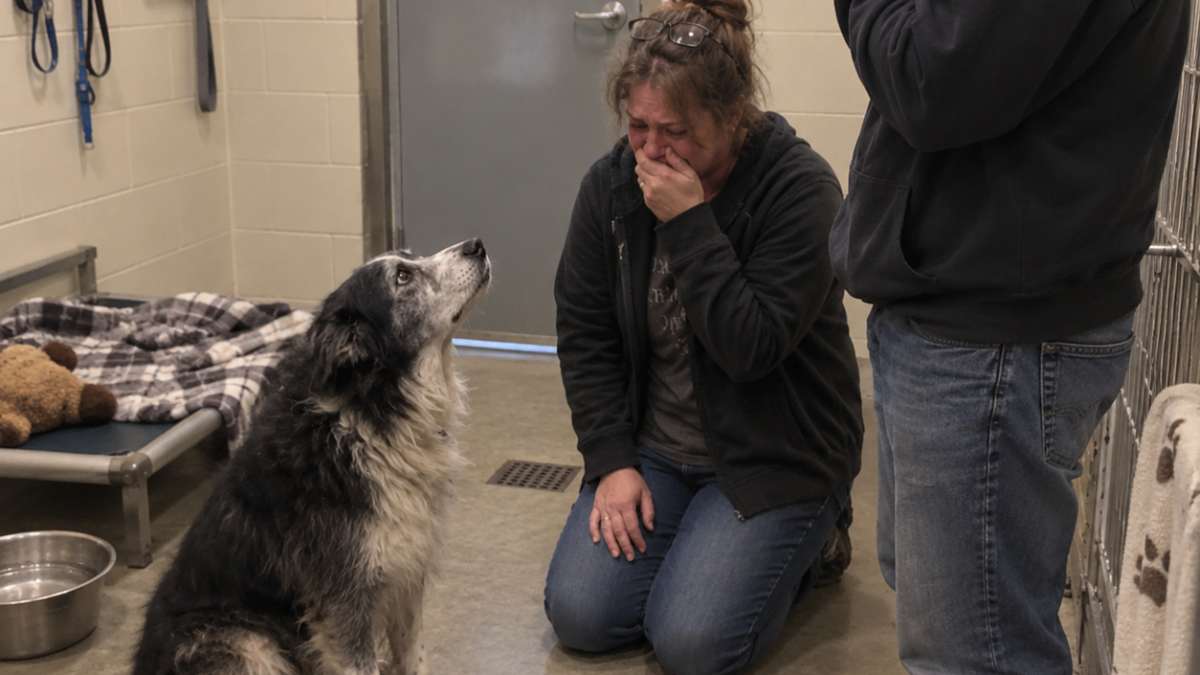
Then Laura whispered, “Oh, Blue.”
His ear moved.
That was all.
She knelt outside the kennel.
Ben stayed standing behind her, one hand gripping the bars.
“Blue.”
His eyes opened.
He looked toward us.
Laura was shaking.
“Hey, baby.”
The dog stared at her.
No reaction.
I felt something sink inside me.
Seven years.
Maybe it had been too long.
Maybe scent and voice could fade.
Maybe the Blue they remembered was gone.
Laura didn’t reach for him.
She simply sat on the floor.
“You don’t have to remember me,” she said.
Her voice broke.
“It’s okay.”
Ben looked away.
Laura pressed both hands against her knees.
“You used to steal my socks.”
Blue blinked.
“You’d hide them behind the couch.”
His head shifted.
Ben turned back.
Laura smiled through tears.
“And you hated thunderstorms, but you always pretended you weren’t afraid until the first loud crack.”
Blue’s head lifted slightly.
I stopped breathing.
Laura whispered, “Blueberry.”
Ben made a quiet sound behind her.
I learned later that nobody except Laura had ever called him that.
Blue’s ears rose.
Not much.
But they rose.
Laura’s face crumpled.
“Blueberry.”
The dog stared at her.
Then his front paw moved.
Tap.
Laura gasped.
Tap.
Ben covered his mouth.
Tap.
Three times.
Exactly three.
“Oh my God.”
Blue pushed himself upward.
His rear legs slipped.
I started forward, but Ben raised one hand.
“Let him.”
Blue tried again.
He stood.
His whole body trembled.
Laura didn’t move.
She barely breathed.
Blue took one step.
Then another.
His nails clicked against the floor.
He stopped in front of her.
Laura held out her hands.
He sniffed her fingertips.
Her wrists.
Her sleeve.
Then he leaned toward her hair.
His nose moved through it slowly.
Searching.
Remembering.
He looked into her face.
And his tail moved.
Once.
Laura sobbed.
Again.
Ben dropped to his knees.
Blue’s tail began sweeping across the floor.
Slowly at first.
Then faster.
His weak back legs almost gave out because his entire body was trying to wag.
Laura wrapped her arms around him.
Blue pressed his head beneath her chin.
Ben put both arms around them.
And there on the floor of a county shelter, three members of a family who had spent seven years apart collapsed into each other.
Blue made a sound I had never heard from him.
Not a bark.
Not a whine.
Something lower.
Almost like a groan.
Laura buried her face against his neck.
“I am so sorry.”
Blue licked her cheek.
“I am so sorry, baby.”
Ben was crying openly now.
“We should’ve found you.”
Blue turned and pressed his forehead into Ben’s chest.
That broke him.
He bent over the dog.
“I missed you, buddy.”
I stepped outside the kennel.
Janet stood at the end of the hallway.
She had tears running down her face too.
Neither of us spoke.
We didn’t need to.
For months, Blue had lifted his head for every person who walked through our door.
That afternoon, the people he had been waiting for finally walked back through it.
But the reunion wasn’t the end of Blue’s story.
In some ways, it was only the beginning.
—
The paperwork should have been simple.
It wasn’t.
Blue had entered our shelter four months earlier as an owner-surrendered dog.
At least, that’s what the intake file said.
His most recent recorded owner was a woman named Marcy Caldwell.
The form listed the reason for surrender as:
**Unable to provide adequate care.**
That was not unusual.
Older dogs were surrendered for financial reasons all the time.
What caught my attention was something Laura said while Janet prepared Blue’s release documents.
“Can I ask who had him?”
Janet hesitated.
“We usually protect surrendering-owner information.”
“We don’t want trouble,” Ben said quickly. “We just need to know what happened.”
Laura looked at Blue.
“He was healthy when we gave him up.”
“That was seven years ago,” I said gently.
“I know. I don’t expect him to still be young.”
She touched the thin fur along his spine.
“But this didn’t happen overnight.”
She was right.
Blue’s coat had severe matting when he arrived.
His nails were badly overgrown.
His dental condition had been neglected.
One untreated ear infection had become chronic.
His mobility problems had likely been present for some time.
Nothing indicated deliberate physical abuse.
But somebody had stopped trying.
Janet pulled up the intake record.
Then she frowned.
“What?”
She enlarged the scanned form.
Marcy Caldwell’s address was local.
Less than twelve miles away.
Laura leaned toward the screen.
She went completely still.
“Do you know that name?” I asked.
She shook her head.
But Ben did.
His face changed.
“Marcy.”
Laura looked at him.
“You know her?”
“I think so.”
“Who?”
Ben stared at the screen.
“She was friends with the couple who took Blue.”
The room went silent.
Laura looked from Ben to the computer.
“What?”
“Their names were Eric and Susan Caldwell.”
Laura stood so fast her chair scraped backward.
“Caldwell?”
Ben nodded slowly.
“Marcy was Eric’s sister.”
Laura stared at him.
“You never told me that.”
“I forgot.”
“How do you forget something like that?”
“It was seven years ago, Laura.”
Blue lifted his head at the tension.
Laura immediately softened and touched his neck.
“Sorry.”
Janet turned the monitor toward herself.
“This doesn’t necessarily mean anything.”
But we all knew it meant something.
Ben rubbed his forehead.
“Eric and Susan sent us updates for about a year and a half.”
Laura nodded.
“Then Susan got sick.”
“Cancer,” Ben said.
“They moved closer to her treatment center.”
Laura looked at Janet.
“They told us Blue was going with them.”
“Did you ever hear from them again?”
“For a while.”
“And after that?”
Laura shook her head.
“Eventually the email stopped working.”
Ben added, “Eric died a few years later. We found an obituary.”
“What about Susan?”
“Passed away before him.”
I looked at Blue.
That explained one chapter.
But not the last one.
Ben said, “If Marcy was Eric’s sister, maybe she took Blue after they died.”
Janet nodded.
“That seems possible.”
Laura’s face tightened.
“And then she brought him here.”
Nobody answered.
She looked down at Blue.
“Like this.”
“Laura,” Ben warned gently.
“No.”
Her voice stayed low.
“He couldn’t even stand properly when we walked in. Look at his nails. Look at his coat.”
“Sloan said he’s been here four months.”
“That doesn’t explain all of it.”
She looked at me.
I couldn’t lie.
“No.”
Laura wiped her face.
“I want to meet her.”
Janet shook her head immediately.
“We can’t arrange that.”
“I just want to ask her why.”
“I understand, but—”
“I gave this dog away because I thought I was saving him from a terrible situation.”
Her voice cracked.
“I spent seven years hating myself for that decision.”
Blue leaned against her leg.
Laura looked down.
“And now I find out somebody eventually decided he wasn’t worth the trouble.”
Ben put his hand on her shoulder.
“Take him home first.”
She closed her eyes.
After a moment, she nodded.
He was right.
Blue had spent enough time surrounded by human problems.
That day belonged to him.
—
We finished the paperwork just after three.
Technically, because Laura and Ben were listed on Blue’s original microchip registration, there were questions about ownership history.
But the current legal surrender meant the shelter had clear authority to place him.
Janet waived the adoption fee.
Ben objected.
“No.”
Janet blinked.
“No?”
“We’re paying.”
“You don’t have to.”
“I know.”
He pulled out his wallet.
“Then charge us.”
Laura looked at him.
Ben’s eyes were wet.
“We couldn’t protect him seven years ago.”
He looked at Blue.
“I can at least pay his way home.”
Janet quietly processed the fee.
Before they left, I gave Laura Blue’s medications, veterinary records, special food and the old green blanket he had used since arriving.
Laura took the blanket and pressed it to her chest.
“Was this his?”
“Here, yes.”
“We’ll keep it.”
Blue walked between them toward the lobby.
Slowly.
His steps were uneven.
But something had changed.
For four months, I had watched that dog move as if every hallway led nowhere.
Now his head was up.
When the automatic doors opened, sunlight fell across the floor.
Blue stopped.
He looked outside.
Then he looked back at me.
“Go,” I whispered.
His tail moved.
Ben opened the back door of the SUV.
“We brought a ramp.”
Of course they had.
A brand-new folding ramp stretched from the pavement to the back seat.
There was also a thick orthopedic bed, a water bowl and three tennis balls.
I laughed through my tears.
Laura looked embarrassed.
“We stopped at a pet store.”
“You bought half the store.”
“Pretty much.”
Blue sniffed the ramp.
Then, ignoring every expensive preparation they had made, he turned toward Laura.
She crouched.
“What?”
He pressed against her legs.
Laura looked at Ben.
“I think he wants me in the back.”
So Laura climbed into the rear seat.
Blue followed slowly up the ramp.
He turned once.
Twice.
Then lay down with his head in her lap.
She stroked his ears.
Ben closed the door gently.
Before getting into the driver’s seat, he shook my hand.
“You took that picture.”
“Yes.”
“If you hadn’t—”
“I know.”
He swallowed.
“Thank you.”
I watched them drive away.
Blue never looked back.
I thought that would be the moment I remembered most.
I was wrong.
—
Two days later, Janet called me into her office.
The intake file was on her desk again.
Beside it sat several printed records.
“Close the door.”
I did.
“What happened?”
“I called the veterinary clinic listed on Blue’s surrender paperwork.”
I sat.
Janet tapped one page.
“They treated him three years ago.”
“Okay.”
“Then again eighteen months ago.”
I waited.
“Marcy was listed as owner.”
“So she had him.”
“Yes.”
Janet looked grim.
“And according to the clinic, they repeatedly recommended treatment for his joints, dental disease and ear infections.”
“Did she refuse?”
“Sometimes.”
My stomach tightened.
“She said she couldn’t afford some procedures.”
“That happens.”
“I know.”
Janet pushed another document toward me.
“But six months before Blue came here, she brought in a new Labrador puppy.”
I stared at her.
“What?”
“Same account.”
“No.”
“Vaccinations. Wellness package. Training referral.”
I felt anger rising.
Janet wasn’t finished.
“The clinic’s notes say she asked whether Blue could be euthanized because he was having accidents in the house.”
I stopped breathing.
“They refused?”
“They said there was no medical reason for euthanasia at that time. They recommended pain management, bloodwork and mobility support.”
“What did she do?”
“She left.”
I looked through the pages.
“Then four months ago she brought him here.”
“Yes.”
I remembered Blue’s intake photograph.
His coat.
His nails.
His empty stare.
“She didn’t tell us any of this.”
“No.”
“Why?”
Janet folded her hands.
“We don’t know.”
I stared at her.
“You called me in here because there’s more.”
She sighed.
“There is.”
She pulled up Blue’s original intake form.
“When Marcy surrendered him, she didn’t identify herself as his owner.”
I looked closely.
The surrender category had been corrected in our electronic system afterward, but the original form said **found animal**.
“She claimed she found him?”
“On a rural road.”
“But her information is on the form.”
“She gave it as the finder.”
My stomach turned.
“How did we change him to owner surrender?”
“One of the intake technicians recognized her from an older vaccination record that came up under Blue’s name after she left.”
“Did anyone confront her?”
“No.”
“Why not?”
“Because we were slammed that day. The correction got entered. Nobody followed up.”
I stood.
“So she dumped her own senior dog here pretending she’d found him.”
“It appears that way.”
I started pacing.
“After refusing treatment.”
“Sloan.”
“After asking a vet to euthanize him because he was inconvenient.”
“Sloan.”
“And then she walks in here with him half-neglected and lies?”
Janet’s voice hardened.
“Yes.”
That stopped me.
She wasn’t defending it.
She was furious too.
“What can we do?”
“I’ve forwarded the records to animal control for review.”
“Will anything happen?”
“I don’t know.”
I hated that answer.
Janet did too.
“We need evidence, not anger.”
“I have both.”
“No. We have records showing poor follow-through on recommended care and a potentially false surrender statement. That’s not the same as proving criminal neglect.”
I dropped into the chair again.
“So she gets away with it.”
“I didn’t say that.”
“What else is there?”
Janet looked at me.
“She submitted an adoption application yesterday.”
For a second, I thought I had misunderstood.
“For what?”
“A dog.”
My voice went flat.
“What dog?”
“Poppy.”
I knew Poppy.
Ten months old.
Golden mix.
Healthy.
Friendly.
Exactly the kind of young dog people passed Blue to reach.
“You’re kidding.”
“No.”
“She’s trying to adopt another dog?”
“Yes.”
I stood again.
“Absolutely not.”
“She hasn’t been approved.”
“She better not be.”
“Sloan.”
“No.”
Janet almost smiled.
“Sit down.”
I did.
“We’re flagging the application.”
“Flagging?”
“She won’t be adopting from us.”
That helped.
Not enough.
But it helped.
“What happens when she asks why?”
Janet looked at Blue’s old file.
“That’s going to be an interesting conversation.”
—
Laura called that evening.
I almost didn’t tell her.
Blue had been home only forty-eight hours.
She sounded happier than she had at the shelter.
“He slept nine hours last night.”
“Straight?”
“Mostly.”
“That’s good.”
“He snores.”
I laughed.
“He absolutely does.”
“And Ben is pretending it doesn’t bother him.”
From somewhere in the background Ben shouted, “I never said that.”
Laura laughed.
It was the first time I had heard her laugh without tears hidden inside it.
“How’s he eating?”
“Everything.”
“Medication?”
“Wrapped in turkey.”
“Classic.”
“We took him outside this morning. Sloan, you should’ve seen him.”
“What did he do?”
“He just stood in the grass.”
Her voice softened.
“For ten minutes.”
I smiled.
“He likes being outside.”
“I think he was listening to the birds.”
She paused.
“Or maybe he was realizing nobody was going to call him back inside a kennel.”
That hurt.
After a moment she asked, “Did you find anything else?”
I could have lied.
I didn’t.
“Yes.”
Her tone changed immediately.
“What?”
I told her what Janet had found.
Not every detail.
Just enough.
By the time I finished, Laura was silent.
“Say her name again.”
“Marcy Caldwell.”
“I remember her now.”
“You do?”
“I met her once.”
“When?”
“At Susan’s house.”
Laura’s breathing changed.
“Blue was maybe four.”
“What happened?”
“Nothing. She barely noticed him.”
Then Laura gave a short, bitter laugh.
“No. That’s not true.”
“What?”
“She complained about his hair.”
I waited.
“She said she’d never own a dog that shed that much.”
Neither of us spoke.
Then Laura said, “And she ended up with him.”
“It appears so.”
“Because Eric and Susan died.”
“Probably.”
“She didn’t want him.”
“I can’t know what she wanted.”
“She asked a vet to put him down.”
“That was documented, yes.”
Laura’s voice became cold.
Not loud.
Cold.
“I want to see her.”
“Laura.”
“I need her to look at him.”
“I don’t think that would help Blue.”
“This isn’t for Blue.”
“I know.”
Silence.
Then I heard Ben.
“Laura.”
She said something away from the phone.
He answered.
A moment later, she came back.
“Ben says you’re right.”
“Ben sounds annoyingly reasonable.”
“He is. It’s one of his worst qualities.”
I smiled.
Then she said quietly, “I spent seven years believing I failed that dog.”
“You made a decision during a crisis.”
“I still made it.”
“You found him again.”
“Because you posted him.”
“And because you were still looking.”
She didn’t answer.
“Laura?”
“Yeah?”
“Don’t let the person who failed him most become the center of the days he has left.”
She started crying.
Softly this time.
“I don’t know how many days that is.”
“Neither do I.”
I thought of Blue staring at the door.
“So make them his.”
—
The first week at home surprised everybody.
Including Blue.
Laura sent photographs.
Blue asleep between their feet.
Blue lying in a patch of sunlight near the sliding door.
Blue beside a ridiculous mountain of toys he ignored.
Blue staring suspiciously at a robotic vacuum cleaner.
That one made me laugh so hard I had to sit down.
“He still hates vacuums,” Laura wrote.
Some memories survived everything.
The Bennetts took him to their veterinarian.
His condition was serious but manageable.
He had advanced arthritis, chronic ear inflammation, dental problems and general age-related weakness.
But his heart was relatively strong.
His bloodwork was better than anyone expected.
The vet changed his pain-management plan, treated the ear infection and designed gentle physical therapy for him.
There was no miracle cure.
Blue was old.
Love did not make him young again.
But pain medication made standing easier.
Good food helped his coat.
Regular movement rebuilt a little muscle.
And something else changed too.
His posture.
At the shelter, Blue always seemed folded inward.
At home, he began occupying space.
He stretched out in the middle of hallways.
He slept where people had to step around him.
He planted himself beside the refrigerator whenever Laura cooked chicken.
He barked at delivery drivers.
He rediscovered the backyard.
The first time he tried to run, he made it five clumsy steps before his rear legs failed and he rolled sideways into the grass.
Laura screamed.
Ben ran outside.
Blue stood up, shook himself and did it again.
That video became my favorite.
Ben could be heard laughing.
Laura was crying.
And Blue looked deeply offended that gravity still applied to him.
For the first time since I had known him, he looked stubborn instead of tired.
—
Three weeks after Blue left, Marcy Caldwell walked into the shelter.
I recognized her before Janet introduced us.
Late fifties.
Expensive handbag.
Hair perfectly styled.
She approached the front desk smiling.
“I’m here about Poppy.”
My hands went cold.
Janet stepped out of her office.
“Ms. Caldwell.”
“Yes.”
“Could we speak privately?”
Marcy glanced at me.
“Did my application get approved?”
“Let’s talk in my office.”
Her smile weakened.
“I was told there wouldn’t be a problem.”
“Who told you that?”
“The girl at the desk.”
“She told you we’d review the application.”
Marcy’s eyes narrowed.
“Fine.”
They went into Janet’s office.
I should have stayed away.
I didn’t.
The walls were thin.
At first, voices remained low.
Then Marcy said, “I don’t understand.”
Janet answered, “Your application has been denied.”
“Why?”
“Because of your previous animal-care history.”
There was a pause.
“I’ve never had a problem.”
“Blue.”
Silence.
Then Marcy said, “What about him?”
I stopped breathing.
Janet’s voice remained professional.
“You surrendered Blue here four months ago.”
“No. I found that dog.”
“We have veterinary records listing you as his owner for approximately three years.”
A chair moved.
“I took care of him temporarily.”
“Three years isn’t temporary.”
“He wasn’t mine.”
“Your veterinary account says otherwise.”
“So what?”
“So you represented him as a found dog when you brought him here.”
Marcy’s voice sharpened.
“I was trying to help him.”
I had to grip the counter.
Janet said, “You also requested euthanasia six months earlier.”
“That dog was suffering.”
“Your veterinarian documented that his conditions were treatable and manageable.”
“You weren’t living with him.”
“No.”
“He ruined my floors.”
There it was.
Not grief.
Not helplessness.
Floors.
“He couldn’t control his bladder.”
“He was elderly.”
“And I had a life.”
Janet didn’t respond.
Marcy continued, more defensive now.
“I fed him. I gave him a roof. I did more than the people who dumped him on my brother.”
I stepped toward the office.
One of my coworkers, Tasha, caught my arm.
“Don’t.”
I stayed.
Barely.
Janet said, “His former family did not dump him.”
Marcy laughed.
“Former family?”
“Yes.”
“What are you talking about?”
“Blue has been reunited with his original owners.”
The silence that followed felt enormous.
Then Marcy said, “That’s impossible.”
“It happened.”
“How?”
“His microchip.”
Another silence.
Then:
“That dog had a chip?”
My anger turned into something colder.
Of course she hadn’t known.
She had owned him for three years and apparently never bothered to check.
Janet said, “He did.”
Marcy lowered her voice.
“Do they know I had him?”
“We haven’t disclosed confidential information beyond what is legally appropriate.”
That wasn’t exactly an answer.
Marcy understood.
“Are they accusing me of something?”
“Animal control is reviewing the surrender.”
Her chair scraped back violently.
“You reported me?”
“We reported the records.”
“For what?”
“For review.”
“This is ridiculous.”
She opened the office door.
I was standing fifteen feet away.
She looked at me.
Recognition flickered.
“You’re the one who posted him.”
I said nothing.
“You started this.”
“No.”
My voice surprised even me with how calm it sounded.
“You did.”
Her face hardened.
“You people have no idea what that dog was like at home.”
I stepped closer.
“I know exactly what he was like here.”
“He was old.”
“Yes.”
“Sick.”
“Yes.”
“Messy.”
“Yes.”
“Expensive.”
“Yes.”
She stared at me.
“And?”
I asked.
“What?”
“And what?”
I pointed toward the adoption wing.
“Every animal in this building can become old, sick, messy and expensive.”
Her mouth tightened.
“That doesn’t mean everyone can handle it.”
“No. It doesn’t.”
For a second she seemed relieved.
Then I continued.
“But when you can’t handle it, you tell the truth. You ask for help. You surrender the animal honestly. You don’t pretend you found him beside a road so you don’t have to admit you stopped wanting him.”
Her face flushed.
“You don’t know anything about me.”
“I know Blue.”
“He’s a dog.”
The words came out casually.
Dismissively.
I think that was the moment I stopped being angry.
Because suddenly I understood her.
Not completely.
But enough.
To Marcy, Blue’s value had been conditional.
Young enough.
Easy enough.
Cheap enough.
Convenient enough.
When those conditions disappeared, so did her loyalty.
I said, “Yes.”
She blinked.
“He is a dog.”
I looked toward the kennel wing.
“And that’s exactly why he depended on you.”
Marcy looked away first.
Janet stepped into the hallway.
“Ms. Caldwell, you need to leave.”
“I’ll adopt somewhere else.”
“That will be their decision.”
Marcy grabbed her handbag.
“This place is unbelievable.”
She walked toward the exit.
Before reaching the doors, she stopped.
“Where is he?”
I didn’t answer.
“Is he even alive?”
That question hit harder than I expected.
“Yes.”
Marcy looked back.
I smiled for the first time.
“He’s home.”
Something changed in her face.
Maybe shame.
Maybe irritation.
Maybe nothing.
But she had no answer.
She left.
A month later, animal control completed its review.
Marcy received citations related to the false information on the surrender record and inadequate care documented during Blue’s final months with her.
It wasn’t dramatic.
There were no handcuffs.
No courtroom packed with reporters.
No enormous punishment.
Real consequences are often quieter than people imagine.
Her name was entered into our shelter’s internal adoption restriction system, and the regional shelters we legally shared welfare concerns with received the appropriate documentation.
She would not simply walk into our facility, choose a younger animal and erase Blue from the story.
For me, that was enough.
For Laura, it wasn’t.
Not at first.
When I told her the case had been closed, she asked, “That’s it?”
“That’s it.”
“She pays a fine and moves on?”
“Mostly.”
Laura was silent.
I waited.
Then she said, “I wanted her to hurt.”
“I know.”
“I wanted her to feel what he felt.”
“I know.”
“I hate that about myself.”
“Don’t.”
She exhaled.
Blue barked somewhere in the background.
“What is he doing?”
Laura sighed.
“Stealing Ben’s sandwich.”
I started laughing.
“Seriously?”
“I turned around for two seconds.”
Ben shouted, “He took the whole thing!”
Laura laughed too.
Blue barked again.
And just like that, Marcy disappeared from the conversation.
Not because what she had done no longer mattered.
But because Blue was alive.
Home.
Stealing sandwiches.
Sometimes justice doesn’t look like another person suffering.
Sometimes it looks like the one they discarded discovering that their life continued beautifully without them.
—
By October, Blue had gained seven pounds.
His coat began growing back soft and glossy in places where it had thinned.
The gray never disappeared from his muzzle.
The arthritis never vanished.
He still needed help on cold mornings.
But he developed routines.
At 6:15 every morning, he woke Ben.
Not Laura.
Ben.
Always Ben.
He stood beside the bed and breathed loudly into his face until Ben opened his eyes.
Then Blue walked toward the kitchen.
Breakfast.
At noon, he slept near the back door.
At four, he sat beside Laura while she worked.
At six, he waited for Ben’s car.
That one mattered most.
Every evening, five or ten minutes before Ben arrived, Blue somehow knew.
He walked to the front window.
He sat.
And he waited.
The first time Laura sent me a video of it, I cried.
At the shelter, waiting had been the saddest thing Blue did.
At home, waiting became something entirely different.
Because now the person always came back.
—
One Saturday, Laura invited me over.
“Blue wants to see you.”
“You mean you want me to see Blue.”
“No.”
She sounded offended.
“He specifically asked.”
“Really?”
“Yes.”
“What did he say?”
“Woof.”
“Compelling.”
Their home sat outside town on a quiet street with mature oak trees and wide lawns.
When I pulled into the driveway, Laura was standing on the porch.
Ben was behind her.
I opened my car door.
Then I heard barking.
Not the tired little bark Blue occasionally gave at the shelter.
A full Border Collie bark.
I looked toward the backyard gate.
Blue appeared.
For one second, I didn’t recognize him.
He was still old.
Of course he was.
But his head was higher.
His coat was cleaner.
His eyes were bright.
He moved faster.
“Blue?”
He barked again.
Then he ran.
Not gracefully.
Not quickly by the standards of a young dog.
But he ran.
Straight toward me.
I dropped to my knees.
“You’ve got to be kidding me.”
Blue crashed into my chest.
I wrapped both arms around him.
He licked my chin.
I laughed and cried at the same time.
“Look at you.”
His tail whipped wildly.
“You fraud.”
He barked.
“You could barely walk four months ago.”
Laura came down the steps.
“He has selective mobility.”
Ben added, “Especially when food is involved.”
Blue leaned harder against me.
I buried my face in his fur.
At the shelter, he had smelled like disinfectant, old blankets and medication.
Now he smelled like grass.
Sunlight.
Home.
Laura sat beside us.
“You saved him.”
I shook my head.
“No.”
“You did.”
“I took a picture.”
“You took the picture when everyone else had accepted that his story was over.”
“That doesn’t make me a hero.”
“I didn’t say hero.”
She looked at Blue.
“I said you saved him.”
I didn’t know what to say.
So I changed the subject.
“Show me his kingdom.”
They did.
Blue had taken possession of the entire house.
His orthopedic bed was in the living room.
Another bed was in the bedroom.
A third one was in Ben’s home office.
“He needs three beds?”
Ben shook his head.
“No.”
Laura said, “Yes.”
Blue ignored all three and lay directly in the middle of the kitchen.
I laughed.
“He remembers that spot.”
Laura smiled.
“He used to lie under our kitchen table when he was a puppy.”
She pointed to a small framed photograph on the wall.
Blue at maybe six months old.
Black-and-white coat shining.
Ears too large for his head.
A tennis ball in his mouth.
Beside it was another photograph.
Blue at three.
Blue at five.
Laura and Ben had rebuilt an entire wall of memories.
Then I noticed an empty space.
“What’s that for?”
Laura looked at Ben.
He smiled.
“We’re still making them.”
—
That afternoon, we sat in the backyard.
Blue wandered through the grass.
He stopped to sniff everything.
Sometimes he forgot what he was doing and simply stood staring into the distance.
Laura watched him constantly.
“You’re afraid,” I said.
She didn’t pretend otherwise.
“Yes.”
“Of what?”
She looked at me.
“You know.”
I did.
They had found him again.
Now they could lose him again.
Only this time there would be no mystery.
No search.
No hope that somewhere he was still young and running.
Age had already written the ending.
They just didn’t know the date.
Laura said, “Sometimes I wake up at night and put my hand on him to make sure he’s breathing.”
Ben looked down.
“I do too.”
“You never told me that.”
He shrugged.
Blue walked toward us.
Laura opened her hand.
He rested his chin in it.
“I wasted so much time.”
I shook my head.
“You didn’t know where he was.”
“I still wasted it.”
“You spent those years remembering him.”
“That doesn’t help.”
“Maybe it does.”
She looked at me.
I nodded toward Blue.
“He remembered you too.”
Laura’s eyes filled.
“How do you know?”
I thought of the paw taps.
The nickname.
The way his tail had moved.
“I was there.”
Blue climbed awkwardly beside her chair.
Laura helped him settle.
He put his head on her lap.
She stroked the white fur between his eyes.
“When we had to give him up, I promised him I’d come back.”
Her voice was barely above a whisper.
“I actually said those words.”
Ben looked at her.
“You never told me that.”
“I was embarrassed.”
“Why?”
“Because I didn’t.”
Blue’s eyes closed.
Laura whispered, “Seven years late.”
I said, “He doesn’t know calendars.”
She looked at me.
“He knows you’re here.”
Blue sighed.
“Dogs are better at the important parts.”
—
Winter arrived early that year.
Cold weather was hard on Blue.
His joints stiffened.
Some mornings, Ben carried him outside.
Blue hated being carried.
He would grumble under his breath, which made Laura laugh.
They bought traction mats for the floors.
A heated bed.
A lightweight support harness.
Ben built a small ramp from the porch to the yard.
He built it twice because Blue refused to use the first version.
“Too steep,” Laura explained.
“I measured it.”
“Blue disagreed.”
“Blue isn’t a structural engineer.”
Blue barked.
Laura pointed.
“See?”
Ben rebuilt the ramp.
Blue approved.
Christmas was their first together since he had been young.
Laura sent me a photograph.
Blue asleep beneath the tree wearing a red bandanna.
Beside him were six wrapped dog toys.
I texted:
*He can’t open those.*
Laura answered:
*You underestimate him.*
She was right.
Apparently Blue tore open every one.
—
In January, the shelter changed its senior-dog policy.
Janet called a staff meeting.
“We missed Blue’s microchip.”
Nobody spoke.
“We also nearly removed him from public adoption without exhausting every reasonable outreach option.”
She looked around the room.
“That can’t happen again.”
New procedures went into effect.
Full-body microchip scans on every intake.
A second scan for unidentified senior animals.
Mandatory social-media features before long-term senior dogs were moved from the adoption wing.
Direct review of previous veterinary records whenever available.
A volunteer photography team for elderly and medically complex animals.
We called it the Second Look Program.
Janet refused to let us officially name it after Blue.
So naturally, everyone called it Blue’s Rule.
Within six months, eleven senior dogs found homes after receiving Second Look posts.
One was a fourteen-year-old Beagle named Maggie.
Another was a blind terrier named Franklin.
One was a twelve-year-old shepherd whose owner had died.
Every time someone adopted one, I thought of Blue.
One photograph had saved one dog.
Then that dog quietly began saving others.
—
Spring came.
Blue turned thirteen.
At least, we believed thirteen.
Laura baked him a dog-safe birthday cake.
Ben put thirteen tennis balls in the backyard.
Blue ignored twelve of them and chose the oldest, dirtiest ball he already owned.
“He has no respect for money,” Ben told me.
That afternoon, Blue ran again.
Maybe twenty feet.
His legs were awkward.
His ears bounced.
Laura stood with both hands over her mouth.
Ben filmed.
When Blue reached the end of the yard, he turned.
For a moment, he looked young.
Not because the gray disappeared.
Not because his body changed.
But because joy has a strange way of making time irrelevant.
He lowered his front legs.
Play bow.
Ben stared.
“He hasn’t done that since—”
Laura was already running toward him.
Blue barked.
She pretended to chase him.
He turned and bounded away.
Three steps.
Five.
Seven.
Then slowed.
Laura dropped into the grass beside him.
Blue collapsed against her laughing body.
Ben joined them.
The camera fell sideways and recorded nothing but sky.
I watched that video dozens of times.
Not because Blue ran.
Because after everything, he still wanted to play.
—
The following August, Blue stopped eating breakfast.
Laura called me before seven.
“He won’t touch it.”
“One meal?”
“Yes.”
“Any vomiting?”
“No.”
“Drinking?”
“A little.”
“Call your vet.”
“We already did.”
Her voice told me what she wasn’t saying.
I went to their house after work.
Blue was lying beneath the kitchen table.
His old place.
Laura sat on the floor beside him.
Ben stood at the sink, staring outside.
“What did the vet say?”
Laura looked up.
“His kidneys.”
My heart dropped.
“How bad?”
“Bad.”
She wiped her face.
“They can give fluids. Medication. Maybe buy time.”
“How much?”
“They don’t know.”
Blue opened his eyes when he heard my voice.
I sat beside him.
“Hey, old man.”
His tail moved once.
I stroked his head.
He looked tired.
Not shelter tired.
Different.
At the shelter, Blue had seemed emotionally absent.
Now his body was simply exhausted.
Laura whispered, “I’m not ready.”
Nobody ever is.
Ben turned around.
“We promised we wouldn’t keep him here for ourselves if he’s suffering.”
Laura nodded.
“I know what we promised.”
She started crying.
“I hate our promise.”
Blue lifted his head and put it against her knee.
She laughed through tears.
“You always do that.”
That evening we sat together until after dark.
We talked about puppies.
Houses.
Mistakes.
Forgiveness.
The strange routes lives take before bringing people back to where they started.
Laura finally told me the full story of the day she had said goodbye to Blue seven years earlier.
She and Ben had lost almost everything within three months.
Ben’s manufacturing plant closed.
Their mortgage fell behind.
Laura’s mother suffered a severe stroke.
They sold most of what they owned and moved into her mother’s small apartment to provide care.
Blue couldn’t legally stay there.
For six weeks, they hid him.
They walked him before sunrise.
Kept curtains closed.
Whispered when he barked.
Then a property manager saw him.
They were given a choice.
Remove the dog or leave.
Leaving would mean abandoning Laura’s disabled mother too.
So they asked friends for help.
Eric and Susan Caldwell offered.
They had acreage.
Dogs.
A fenced yard.
Laura drove Blue there herself.
She stayed for four hours.
When it was time to go, Blue tried to follow her to the car.
She closed the gate.
He barked.
She got into her car.
He barked louder.
She started the engine.
He ran along the fence.
Laura couldn’t see the road through her tears.
She finally got out again.
She walked back to the fence.
Blue pushed his nose through.
Laura held his face.
“I’ll come back.”
Those were the words.
Then she left.
She visited.
Again and again.
For more than a year.
Then her mother died.
Ben found work in another state.
Life moved.
Susan became ill.
Visits became harder.
Then impossible.
Emails replaced them.
Then messages.
Then silence.
“I kept telling myself he had a good home,” Laura said.
“Maybe for a long time he did,” I replied.
She nodded.
“I hope so.”
I looked at Blue.
“I think he did.”
“How?”
“He still trusted people when he came to us.”
That mattered.
Dogs who had known only cruelty often entered the shelter differently.
Blue had been confused.
Sad.
Neglected.
But he still expected humans to matter.
Somebody, somewhere in those missing years, had loved him.
Maybe Eric.
Maybe Susan.
Maybe both.
Laura touched his ear.
“I don’t want his story to be about what went wrong.”
“Then don’t make it that.”
“What should it be?”
I looked at her.
“He came home.”
—
Blue rallied.
The fluids helped.
Medication helped.
For six more weeks, he ate.
Walked.
Barked.
Waited for Ben at the window.
Then one October morning, Laura called again.
This time she didn’t need to explain.
“Sloan.”
Her voice was enough.
“I’ll come.”
When I arrived, Blue was in the backyard.
They had carried his bed beneath the oak tree.
The morning was cool.
Leaves moved gently overhead.
Blue loved that yard.
Laura sat beside him.
Ben sat on the other side.
I knelt near his head.
His breathing was slow.
“Hey, Blue.”
His eyes opened.
His tail moved.
Barely.
But it moved.
Laura laughed and cried.
“He knew you.”
“Of course he did.”
Blue looked at us.
All three.
His people.
Because somewhere along the way, he had become mine too.
The veterinarian arrived at the house.
That had been Laura’s request.
No clinic.
No metal table.
No unfamiliar room.
Blue would leave this world beneath his tree.
On his blanket.
With the smell of grass around him.
The vet examined him quietly.
Then she looked at Laura and Ben.
“You’re making the right decision.”
Laura broke.
“I don’t want the right decision.”
Ben wrapped his arm around her.
“I want the selfish one.”
The vet nodded.
“I know.”
Blue lifted his head weakly.
Laura immediately leaned down.
“I’m here.”
She kissed his forehead.
“I’m here, baby.”
Ben placed his hand over Blue’s chest.
“You’re home.”
I sat behind them.
The veterinarian gave the first medication.
Blue relaxed.
His breathing became easier.
Laura whispered into his ear.
“You waited for us.”
Tears ran down her face onto his fur.
“You waited so long.”
Blue’s eyes were half closed.
“And I came back.”
His tail touched the blanket.
Once.
Laura pressed her forehead against his.
“I came back, Blueberry.”
Ben cried silently.
The veterinarian waited.
Nobody hurried us.
Laura kept talking.
She told Blue about the kitchen table.
The stolen socks.
The vacuum cleaner.
The tennis balls.
The house they had lost.
The years they had lost.
The backyard they had found.
Then she said the only words that mattered.
“You can stop waiting now.”
The final medication entered the line.
Blue exhaled.
His body became still.
Laura continued holding him.
Ben continued touching his chest.
I watched the leaves above us.
Somewhere beyond the fence, a lawn mower started.
A truck passed on the road.
Life kept moving with the terrible ordinary indifference it always shows when someone’s entire world has just changed.
Laura whispered, “Is he gone?”
The vet listened.
Then nodded.
“Yes.”
Laura closed her eyes.
Ben bent over Blue’s body.
And for a long time, none of us moved.
Blue had spent months in a shelter staring at a door.
In the end, he didn’t leave through one alone.
He left surrounded by the people he had waited for.
—
A week later, Laura came to the shelter.
She carried a small cardboard box.
I met her in the lobby.
“You okay?”
“No.”
“Fair.”
She smiled weakly.
“Ben couldn’t come.”
“I understand.”
We sat in Janet’s office.
Laura opened the box.
Inside was Blue’s old green shelter blanket.
Washed.
Folded.
I touched it.
“You kept it.”
“We kept everything.”
She reached deeper.
There was a framed photograph.
The photograph.
The one I had taken Wednesday night.
Blue lying on his shelter blanket.
Old.
Tired.
Looking toward the door.
Laura handed it to me.
“I want you to have this.”
“I can’t.”
“Yes, you can.”
“It belongs to you.”
“No.”
She shook her head.
“That version of him belongs here.”
I looked at the picture.
Laura pulled out another photograph.
Blue in the backyard.
Running.
Mouth open.
Ears up.
Eyes bright.
She placed it beside the first.
“This version belongs with us.”
I couldn’t speak.
Laura smiled through tears.
“You need to remember both.”
“Why?”
“Because if you only remember him happy, you’ll forget why you took the picture.”
She touched the shelter photograph.
“And if you only remember him like this, you’ll forget what happened afterward.”
I cried.
So did Janet.
We hung both pictures in the adoption hallway.
Underneath them, Janet added a small plaque.
No long story.
No dramatic language.
Just four words.
**Every Dog Deserves Another Look.**
—
A month later, something happened that I still think about.
An elderly man came into the shelter.
His wife had died.
He wanted a dog.
Not a puppy.
“Something old,” he said.
I showed him several.
He stopped in front of a thirteen-year-old mixed breed named Walter.
Walter had cataracts.
Heart medication.
A slow walk.
The man sat outside his kennel for twenty minutes.
Then he pointed toward Blue’s photographs.
“That dog get adopted?”
I looked at them.
“Yes.”
“What happened?”
“He went home.”
The man nodded.
Then he looked at Walter.
“I suppose that’s what this one needs.”
Three hours later, Walter left with him.
I stood at the entrance watching them walk toward an old pickup truck.
Walter moved slowly.
The man moved slowly too.
They matched.
I looked back at Blue’s photographs.
I thought about how close we had come to removing his name from the board.
How close Laura had come to never seeing the post.
How close our scanner had come to missing that migrated microchip forever.
Life is filled with distances measured in inches.
Seconds.
Decisions.
One more phone call.
One more photograph.
One more day.
—
People sometimes ask whether I believe Blue recognized Laura and Ben.
I don’t have to believe it.
I watched it happen.
I watched him hear a nickname nobody else knew.
I watched his paw tap the floor three times.
I watched him smell Laura’s hair.
I watched his tail begin moving before she ever touched him.
Dogs don’t understand our explanations.
They don’t know bankruptcy.
Housing rules.
Cancer.
Surrender forms.
Veterinary bills.
Microchip databases.
They understand presence.
Absence.
Voice.
Scent.
Safety.
Home.
Blue had lost all of those things more than once.
But somewhere inside him, beneath age and pain and confusion, the memory remained.
So did the capacity to trust again.
That was what humbled me most.
Not that he remembered Laura.
That he forgave the world enough to love her immediately.
—
Years have passed since Blue died.
I still work at the shelter.
The green blanket is folded in the cabinet behind my desk.
I could have thrown it away.
I never did.
Sometimes new employees ask why an old blanket has a label on it that says BLUE.
I tell them.
Not the entire story.
There isn’t always time.
I tell them enough.
I tell them about the old Border Collie whose name was almost removed from adoption.
The photograph.
The phone call.
The microchip.
The reunion.
Then I point toward the hallway.
His pictures are still there.
The first one is faded now.
We replaced the print twice, but sunlight from the window keeps bleaching it.
The second photograph still shows Blue running through Laura’s yard.
People stop sometimes.
They read the plaque.
Every Dog Deserves Another Look.
Most move on.
Some don’t.
Those are the people I notice.
The ones who turn away from the puppies for a moment and look toward the gray muzzle in the kennel at the end.
The dog with cloudy eyes.
The one who doesn’t jump against the bars.
The one whose card says ten years.
Twelve years.
Medication required.
Special diet.
Arthritis.
Hard of hearing.
Those dogs don’t need pity.
They need somebody capable of looking at limited time and deciding it still has value.
Blue taught me that.
—
Laura and Ben never adopted another Border Collie.
For a long time, they said they couldn’t.
Then almost two years after Blue died, Laura called.
“I need you not to say anything.”
“That sounds promising.”
“We’re coming to the shelter.”
“Why?”
“No comments.”
“Laura.”
“Sloan.”
“What are you doing?”
“Nothing.”
She hung up.
They arrived that afternoon.
I saw them standing in front of a kennel containing a twelve-year-old black Labrador named Rosie.
Rosie had been surrendered after her owner entered assisted living.
She was overweight.
Gray-faced.
Half deaf.
Laura was sitting on the floor.
Rosie’s chin was in her lap.
I leaned against the wall.
“You’re doing nothing?”
Laura glared at me.
“Shut up.”
Ben laughed.
Two hours later, Rosie went home with them.
Before they left, Laura stood beneath Blue’s photographs.
Rosie beside her.
She touched the corner of the frame.
“I thought loving another old dog would feel like replacing him.”
“Does it?”
“No.”
She looked down at Rosie.
“It feels like he left a door open.”
I never forgot that.
Blue had spent months watching a door.
Waiting for someone to walk through it.
In the end, maybe he became one.
—
I wish I could tell you that every senior dog gets Blue’s ending.
They don’t.
Some wait.
Some get sick.
Some die before the right person arrives.
That’s the part of shelter work nobody can turn into a perfect story.
But Blue changed the way I think about endings.
His story almost ended in a quiet room behind a closed door.
If we had followed the schedule without hesitation, he would have been moved Thursday morning.
Laura might have called Thursday afternoon.
He still would have been alive.
Maybe we still could have reunited them.
Maybe.
But life should not depend on maybe when one more effort is possible.
So now, whenever I feel myself becoming practical too quickly, I remember Wednesday night.
The old dog on his blanket.
The photograph I almost didn’t take.
The post I almost didn’t write.
The sentence I nearly deleted because it sounded too emotional.
*I just don’t want him to disappear believing nobody remembered him.*
He hadn’t been forgotten.
Not by Laura.
Not by Ben.
Not completely by the people who had once loved him.
And eventually, not by us.
For years, Laura carried the guilt of leaving him behind.
For months, Blue waited behind shelter bars.
For too long, another person treated his age as an inconvenience and his loyalty as something disposable.
That person faced consequences.
But that was never the victory.
The victory was Blue on the back seat with his head in Laura’s lap.
Blue stealing Ben’s sandwich.
Blue barking at the vacuum cleaner.
Blue waiting at the window every afternoon because he finally knew the person he loved would come back.
Blue running badly across the backyard as if thirteen years had suddenly become three.
Blue sleeping beneath the kitchen table again.
Blue under the oak tree, hearing Laura tell him one last time that she had returned.
That was the answer to everything done to him.
Not revenge.
A life reclaimed.
A promise finally kept.
A dog who had every reason to stop trusting people and somehow never did.
My name is Sloan.
I work at an animal shelter.
And there is one thing I know now that I didn’t know before Blue arrived.
Sometimes love is late.
Sometimes it gets lost.
Sometimes people make choices they regret for years.
Sometimes life separates those who belong together so completely that finding each other again seems impossible.
But late does not always mean too late.
Blue taught me that.
The morning Laura and Ben called, his name was hours away from disappearing from the adoption board.
By sunset, he was sleeping in the lap of the woman who had loved him as a puppy.
And when his final day eventually came, he wasn’t staring through bars wondering whether anyone would choose him.
He was lying beneath his own tree.
His family’s hands were on him.
His name was being whispered into his ear.
And the last thing Blue heard was the promise he had spent seven years waiting to hear fulfilled.
“You can stop waiting now, Blueberry.”
“I’m here.”
“I came back.”
“You’re home.”








