PART 2: They Tied Their Old Blind Cat to a Tree and Drove Away—But He Still Waited for Them in the Rain
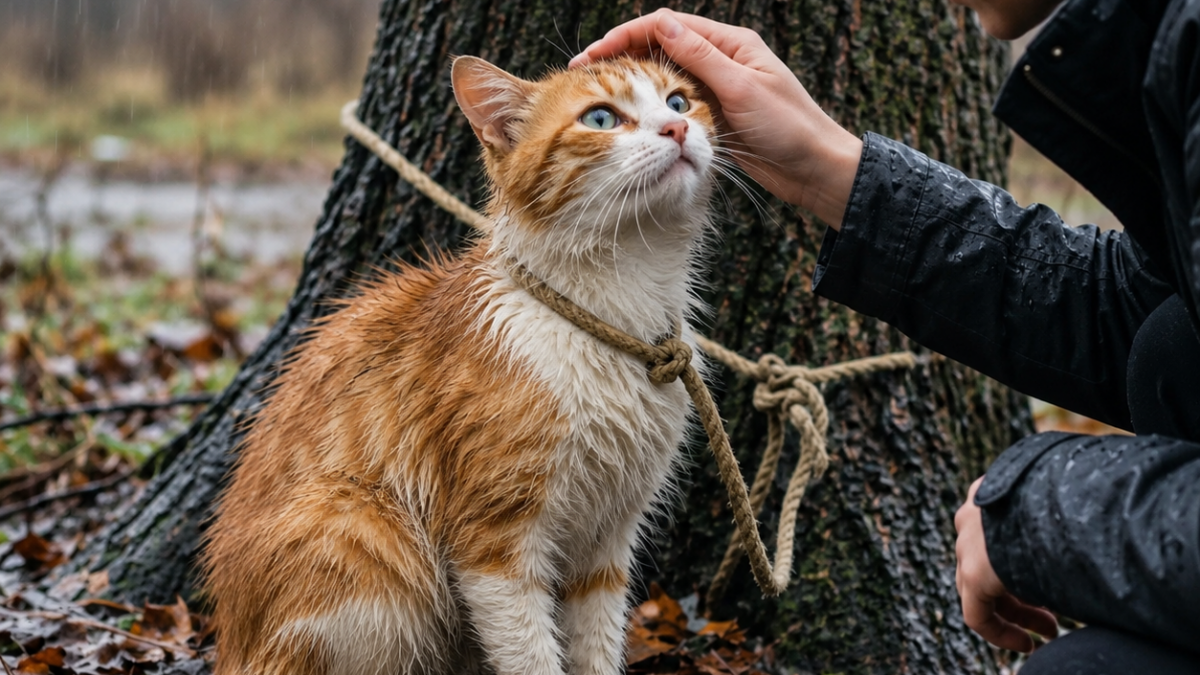
PART 2
The footsteps grew louder.
The old cat strained against the rope.
His weak body trembled as he tried to move toward the sound.
I stood and turned around.
A man in a dark rain jacket was jogging toward the bench.
For one irrational second, anger surged through me.
I thought this might be the person responsible.
“What happened?” he asked.
His face looked genuinely confused.
Then he saw the cat.
“Oh, no.”
The cat heard the man’s voice and stopped moving.
His tail dropped again.
Wrong person.
Again.
I felt something twist inside my chest.
“Did you see anyone leave him here?”
The man shook his head.
“No. I just saw you crouching behind the bushes.”
“He’s tied to the tree.”
“What?”
I stepped aside.
The man looked at the rope and swore under his breath.
“How long has he been here?”
“I don’t know.”
The man glanced at the rain.
“We need to get him somewhere warm.”
“I’m trying to untie this.”
The knot had tightened from the wet weather.
My fingers were already numb.
The man pulled out a small folding multitool.
“Here.”
He cut the rope.
The instant the tension disappeared, the old cat staggered forward.
I caught him before he fell.
He weighed almost nothing.
His wet fur made him look larger than he was, but under it I could feel every ridge of his spine.
“Oh, buddy.”
I pulled off my scarf and wrapped it around him.
He didn’t resist.
That worried me more than if he had fought.
Healthy frightened cats usually resisted strangers.
This one simply leaned against my chest.
“Do you have a car?” I asked.
The man nodded.
“It’s across the street.”
“There’s an emergency veterinary clinic about ten minutes from here.”
“I know where it is.”
He looked at the old cat.
“I’ll drive you.”
His name was Mark.
I learned that only after we were already running toward his car through the rain.
I climbed into the passenger seat with the cat wrapped in my scarf and jacket.
Mark turned the heat all the way up.
The cat lay silently against me.
Every few seconds, his ears moved.
Listening to the engine.
The windshield wipers.
My breathing.
Traffic.
Every sound seemed to matter because sound was how he understood where he was.
I kept one hand against his side.
His breathing was shallow.
“Stay with me.”
Mark glanced over.
“Is he conscious?”
“Yes.”
“Good.”
“I think.”
The old cat suddenly raised his head.
He meowed.
That same weak, broken sound.
“I’m here.”
I didn’t know why I kept saying it.
Maybe because someone needed to.
“I’m right here.”
When we reached the clinic, Mark stopped in the emergency lane.
I carried the cat inside.
A receptionist looked up.
“I found him outside,” I said. “He’s old, blind, freezing, and someone tied him to a tree.”
Everything changed immediately.
A veterinary technician appeared with a towel.
“Bring him here.”
They took him from my arms.
For one strange second, when his body left mine, I felt panicked.
I had known this cat for less than twenty minutes.
Still, I wanted to follow.
“Can I stay with him?”
“We need to stabilize him first.”
“Please.”
The technician looked at me.
“Give us a few minutes.”
Then the doors closed.
I stood there dripping water onto the clinic floor.
Mark entered behind me.
“You okay?”
“No.”
It was the simplest answer.
He nodded.
“Yeah.”
We waited.
Ten minutes felt like an hour.
Finally, a veterinarian came out.
She introduced herself as Dr. Patel.
“Are you the owner?”
“No.”
I explained again how I had found him.
Her expression hardened when I mentioned the rope.
“He’s severely dehydrated,” she said. “His body temperature is low. He’s underweight, and he has several health concerns we’ll need to evaluate.”
“Is he going to survive?”
“He’s stable enough that I’m optimistic, but he’s elderly and compromised.”
“What about his eyes?”
She sighed.
“He appears to have advanced cataracts, possibly with retinal disease. I don’t think the blindness is recent.”
Meaning whoever abandoned him had known.
That somehow made it worse.
“Was he out there long?”
“Hard to say. Several hours at minimum, possibly longer.”
“In that weather?”
“Yes.”
I clenched my jaw.
“What kind of person does that?”
Dr. Patel didn’t answer.
Maybe she had seen enough to know there was no satisfying answer.
“Is he microchipped?” I asked.
“We haven’t checked yet.”
“If he is…”
“We’ll contact the registered owner.”
Something inside me recoiled.
“What if the registered owner is the person who left him there?”
“Then we document everything.”
Her tone changed slightly.
More deliberate.
“We also report suspected abandonment.”
I nodded.
“Good.”
Dr. Patel studied me.
“Are you willing to be listed as the person who found him?”
“Absolutely.”
“And you may be contacted by animal control.”
“Fine.”
Mark raised his hand slightly.
“I saw the scene too. The rope. The tree.”
Dr. Patel nodded.
“We’ll document that.”
They let me see the cat before I left.
He was lying inside a heated enclosure on several thick towels.
An IV line had been placed in one front leg.
Without the cold rain flattening his fur, I could see just how old he was.
His muzzle was nearly white.
One ear had a tiny notch near the top.
His paws looked worn.
I placed my fingers against the enclosure.
“Hey.”
His ears moved.
Then he raised his head.
His cloudy eyes faced past me.
Still, he knew the voice.
He moved toward the sound.
Only a few inches.
But he moved.
My throat tightened.
“They’re going to take care of you.”
He gave a quiet meow.
“I’ll come back.”
I stopped after saying it.
The promise suddenly felt enormous.
Someone else had probably made promises to this cat.
Meals.
Warmth.
Home.
Maybe love.
Then they tied him to a tree.
I leaned closer.
“I mean it.”
The next morning, I called the clinic before breakfast.
“He made it through the night,” the technician told me.
I closed my eyes.
“How is he?”
“Warmer. Hydration is improving. He ate a little.”
“He ate?”
“Yes.”
That felt like a victory.
“Can I visit?”
“After ten.”
I arrived at 9:57.
Dr. Patel met me in an examination room.
The cat was wrapped in a soft blue blanket.
“Someone looks better,” I said.
His ears immediately turned.
Then he meowed.
Dr. Patel smiled.
“He recognizes you.”
“I doubt that.”
“He recognizes something.”
I sat down.
She handed him to me.
This time, his body had more warmth.
He immediately pressed his face into my elbow.
I stroked his head.
“Hi, old man.”
Dr. Patel sat across from me with a tablet.
“We found a microchip.”
My hand stopped.
“And?”
“It was registered.”
My stomach tightened.
“To who?”
“I can’t give you private information, but the registration is active.”
“So you contacted them.”
“We called the listed number.”
“What did they say?”
She hesitated.
“They said they no longer owned the cat.”
I stared at her.
“What?”
“They claimed they gave him away several months ago.”
“Did they say to whom?”
“No.”
“So maybe someone else abandoned him.”
“Possibly.”
But something in her expression told me she wasn’t convinced.
“Do you believe them?”
“I’m a veterinarian. My job is to document the animal’s condition. Animal control determines the rest.”
“That’s a very careful answer.”
“Yes.”
I looked down at the cat.
“Does he have a name?”
Dr. Patel glanced at the tablet.
“The chip record says Arthur.”
“Arthur.”
One ear twitched.
I said it again.
“Arthur?”
The reaction was immediate.
His head lifted.
His body shifted.
His tail gave a tiny movement beneath the blanket.
I looked at Dr. Patel.
“That’s his name.”
“Seems like it.”
“Arthur.”
He leaned into me.
For some reason, knowing his name hurt.
Before, he had been an abandoned cat.
Now he was Arthur.
He had history.
A home.
People.
Someone had once filled out paperwork, paid for a microchip, selected his name.
Someone had known him long enough for him to recognize their word for him.
And somehow he had still ended up tied to a tree.
“How old?”
“The chip was registered almost fourteen years ago.”
“Fourteen?”
“The estimated age matches.”
I looked at him.
“You’ve been with somebody almost your entire life.”
Arthur purred.
Very faintly.
The vibration against my arm nearly undid me.
Dr. Patel continued.
“His bloodwork shows early kidney disease, which is common at his age. He also has arthritis. Nothing immediately catastrophic.”
“And his eyes?”
“Permanent blindness is likely.”
“Can he live normally?”
“Blind cats can adapt extremely well, especially indoors.”
I smiled despite everything.
“So he’s not finished.”
Dr. Patel looked at Arthur.
“No. I don’t think Arthur got that message.”
He stayed in the clinic for two more days.
During that time, animal control contacted me.
Officer Ramirez met me at the park.
The rain had stopped, but the ground remained muddy.
The tree looked ordinary.
That bothered me.
Something terrible had happened there, yet the world had already returned to normal.
I showed her where I had found Arthur.
“The rope was tied here.”
She photographed the trunk.
Mark had saved the piece he cut.
He gave it to her in a plastic bag.
“There might be fingerprints?” I asked.
Officer Ramirez gave me a sympathetic look.
“This isn’t a television crime lab situation.”
I felt embarrassed.
“Right.”
“But the rope matters. Mostly because it supports your description.”
She photographed it.
“Did you see a vehicle?”
“No.”
“People?”
“No.”
“Anything else?”
I thought.
Then remembered.
“The bench.”
“What about it?”
“When I found him, the ground near the bench had deeper tire marks.”
Officer Ramirez walked over.
There were faint tracks near a maintenance entrance.
Probably useless.
Still, she photographed them.
“There may be cameras nearby.”
That gave me hope.
“Where?”
“Traffic camera at the intersection. Possibly a camera on the convenience store across the road.”
“Can you get it?”
“We can ask.”
I went home feeling both hopeful and ridiculous.
I had become emotionally invested in proving who abandoned a cat I hadn’t known two days earlier.
But every time I pictured Arthur turning toward those footsteps, believing his family had returned, the anger came back.
Three days after I found him, Arthur was discharged.
The clinic had contacted a local rescue because legally, I could not simply take ownership of a microchipped animal while the abandonment case was unresolved.
The rescue director, a woman named Susan, called me.
“We need a temporary foster.”
“I’ll do it.”
She laughed.
“I thought you might.”
I had never fostered a cat.
I had never owned a blind cat.
I had never cared for an animal with kidney disease.
None of that seemed important.
“What do I need?”
Susan gave me a list.
Low-entry litter box.
Food recommended by the veterinarian.
Water bowls that stayed in consistent places.
A warm bed.
No sudden furniture changes.
And most importantly, one small safe room where Arthur could learn the layout before exploring the rest of the house.
I transformed my spare bedroom.
I removed boxes.
Covered sharp corners.
Placed his bed near the wall.
Set his litter box in the opposite corner.
Put food and water between them.
Then I added an old blanket from my couch.
It smelled like my home.
When I brought Arthur inside, I placed the carrier on the floor and opened the door.
He didn’t come out.
I sat several feet away.
“It’s okay.”
His ears turned.
“You can take your time.”
Five minutes passed.
Then ten.
Finally, one paw appeared.
Arthur stepped forward carefully.
His whiskers moved constantly.
He lowered his nose.
Sniffed.
One step.
Pause.
Another step.
His shoulder bumped gently against the carrier.
He corrected himself.
Then he began making a slow circle around the room.
I watched him map it.
The walls.
The bed.
The chair.
The food.
The water.
When he reached me, he stopped.
He sniffed my knee.
Then pressed his forehead against it.
I didn’t move.
“There you are.”
That first night, I slept on the floor beside him.
Not because he needed me.
At least, that’s what I told myself.
At around two in the morning, I woke to a strange pressure against my chest.
Arthur had left his bed.
He was lying beside me.
One paw rested against my shirt.
I smiled in the dark.
“You found me.”
His purr started.
And suddenly I understood something.
Arthur wasn’t afraid of people.
After everything, he still trusted them.
That might have been the saddest thing about him.
Or the bravest.
The following week, he improved quickly.
His appetite increased.
He learned the room.
Then the hallway.
Then the kitchen.
I placed small textured mats near important locations so he could feel changes under his paws.
One mat near water.
Another near the litter box.
Another near the doorway.
Within days, Arthur moved through the house with astonishing confidence.
He occasionally bumped into something.
He didn’t panic.
He stopped.
Adjusted.
Continued.
The first time I saw him jump onto the couch, I nearly screamed.
“Arthur!”
He froze.
Then calmly turned in a circle and sat.
I stared.
“You’re blind.”
He began washing one paw.
Apparently that information was irrelevant.
He learned my schedule too.
Coffee at six-thirty.
Breakfast at seven.
Work at eight.
Dinner at six.
Arthur knew all of it.
At exactly 6:55 every morning, he appeared in the kitchen.
If breakfast was late, he meowed.
Not weakly anymore.
The dying little cry from the park disappeared.
Arthur had opinions now.
Strong ones.
“You were very polite when I found you.”
Meow.
“Now look at you.”
Meow.
“You’re becoming demanding.”
He walked directly onto my foot.
I laughed.
“Okay. Breakfast.”
A week later, Officer Ramirez called.
“We obtained video.”
I sat upright.
“From the park?”
“Convenience store camera.”
My hand tightened around the phone.
“Did it show Arthur?”
“It shows a vehicle pulling into the maintenance area late that morning.”
“And?”
“Two people exit.”
My heart started beating faster.
“One person carries what appears to be a pet carrier.”
I closed my eyes.
“Can you identify them?”
“The license plate is visible.”
There was a pause.
“It matches a vehicle registered to the same household as Arthur’s microchip.”
For several seconds, I said nothing.
So there it was.
Not a mystery.
Not some unknown person who had supposedly been given Arthur months earlier.
His family.
The people whose information was still connected to his chip.
The people who told the clinic they no longer owned him.
“They lied.”
“That appears likely.”
“What happens now?”
“We’re continuing the investigation.”
“I want them punished.”
The words came out before I could soften them.
Officer Ramirez remained quiet.
“I know how that sounds.”
“It sounds like you’re angry.”
“I am.”
“That’s understandable.”
“They tied a blind fourteen-year-old cat to a tree in freezing rain.”
“I know.”
“They left him without food or water.”
“I know.”
“And he waited for them.”
My voice cracked on the last sentence.
Officer Ramirez’s tone changed.
Softer.
“We’re going to handle it.”
I wanted immediate justice.
Instead, justice moved slowly.
Statements.
Veterinary records.
Video requests.
Interviews.
Reports.
The former owners denied everything at first.
According to Officer Ramirez, they claimed someone else must have borrowed their vehicle.
Then the video was enhanced enough to show clothing and faces.
Their story changed.
They said they intended to return.
Then they said Arthur had become difficult to care for.
Then they said they believed someone would find him quickly because the park was public.
Each excuse somehow made my anger worse.
Susan tried to calm me.
“Don’t contact them.”
“I wasn’t going to.”
“You looked up their address.”
I stared at her.
“How do you know that?”
“Because I know angry animal people.”
“I’m not going there.”
“Good.”
“I just wanted to know.”
“Know what?”
I couldn’t answer.
Maybe I wanted to see the house Arthur had lived in.
Maybe I wanted to understand how someone could share fourteen years with an animal and reduce him, in one final act, to an inconvenience tied to a tree.
Maybe I wanted them to see Arthur now.
Warm.
Fed.
Safe.
Sleeping on my couch.
I wanted them to understand what they had thrown away.
Susan leaned closer.
“The most useful thing you can do for Arthur is take care of Arthur.”
“I know.”
“The authorities will deal with them.”
“I know.”
“Do you?”
I sighed.
“Yes.”
That evening, I sat beside Arthur.
He climbed onto my lap.
His claws caught slightly in my sweater.
I adjusted him.
“You know, you’re causing a lot of paperwork.”
He purred.
“People are fighting over you.”
More purring.
“You don’t care.”
He put his head beneath my hand.
I stroked between his ears.
“You’re right. You shouldn’t.”
His past belonged to the investigators now.
His future belonged to him.
But the past wasn’t finished with us.
Two weeks later, the rescue received a call.
Arthur’s former owners wanted him back.
When Susan told me, I genuinely thought she was joking.
“What?”
“They’re claiming they never legally surrendered him.”
“They abandoned him.”
“I know.”
“They tied him to a tree.”
“I know.”
“They lied about giving him away.”
“I know.”
“And now they want him back?”
“Yes.”
“Why?”
Susan exhaled.
“Probably because they’re being investigated and their attorney thinks requesting the cat supports the argument that they didn’t intend permanent abandonment.”
My hands became cold.
“They are not getting him.”
“Calm down.”
“No.”
“They’re not getting him.”
“Arthur is being held under the rescue pending disposition of the case. Nobody is handing him over tonight.”
“What about tomorrow?”
“No.”
“What about next week?”
“Listen to me.”
I stopped.
“The evidence is strong. Their request doesn’t erase what happened.”
I looked toward the living room.
Arthur was asleep in his bed near the heater.
One paw covered his nose.
“They don’t get to do that twice.”
“They won’t.”
The case became the center of my life for several months.
I hated that.
I wanted Arthur’s story to stop being about abandonment.
But every new legal step pulled us back.
There was eventually an administrative hearing regarding custody.
I attended as the finder and foster caregiver.
Arthur stayed home with Susan’s daughter.
I felt guilty leaving him.
“He will sleep the entire time,” Susan told me.
“I know.”
“You’re more anxious than he is.”
“I know.”
The former owners sat across the room.
It was the first time I had seen them.
A middle-aged couple.
Ordinary clothes.
Ordinary faces.
That surprised me.
Some irrational part of me had expected people who looked cruel.
Instead, they looked like people I might have passed in a grocery store without noticing.
The woman kept her eyes down.
The man looked irritated.
The officer presented the timeline.
Arthur’s microchip.
Veterinary assessment.
My statement.
Mark’s statement.
The rope.
The video.
The vehicle.
The inconsistent explanations.
Then the former owners spoke.
The man said Arthur’s medical needs had become overwhelming.
He said the cat had started missing the litter box.
Crying at night.
Walking into furniture.
He said they were exhausted.
I understood exhaustion.
What I didn’t understand was the tree.
Their attorney argued that the couple had made a terrible decision under stress.
Then the woman began crying.
For one dangerous second, I almost felt sorry for her.
Then she said, “We thought somebody would take him.”
I stared at her.
The hearing officer asked, “Why didn’t you bring him to a shelter?”
“We were afraid they’d judge us.”
“Why didn’t you contact a rescue?”
“We didn’t know who to call.”
“Why was the animal restrained?”
The woman looked at her husband.
He answered.
“We didn’t want him wandering into traffic.”
The room went completely still.
I felt something hot move through my chest.
They had tied a blind cat to a tree supposedly for his safety while leaving him outside in freezing rain.
The hearing officer seemed to struggle with that too.
“You were concerned he might wander into traffic.”
“Yes.”
“So instead of placing him in a carrier and bringing him to a shelter, veterinary hospital, rescue organization, or animal control facility, you tied him to a tree and left?”
The man shifted.
“We knew people walked through the park.”
“The weather report that day showed temperatures near freezing.”
“We didn’t know it would get that cold.”
I almost laughed.
Not because it was funny.
Because sometimes anger had nowhere else to go.
When I was called to speak, my hands shook.
I told them exactly how I found Arthur.
The rain.
The mud.
The trembling.
The rope.
His cloudy eyes.
The weak meow.
Then I told them about the footsteps.
“How is that relevant?” their attorney asked.
I looked at the hearing officer.
“Because when someone approached, Arthur became excited.”
The attorney started to interrupt.
I continued.
“He couldn’t see who was coming. He heard footsteps and thought his people had returned.”
The woman covered her face.
I had imagined this moment.
I had imagined satisfaction.
Revenge.
A feeling that I had finally made them understand.
Instead, I felt tired.
“This cat didn’t know he had been abandoned,” I said. “He was still waiting.”
Nobody spoke.
I looked directly at them for the first time.
“He trusted you longer than you deserved.”
The attorney objected.
The hearing officer told me to focus on facts.
So I did.
Arthur had gained weight.
His kidney disease was manageable.
He used the litter box consistently.
He navigated my home.
He slept through most nights.
He showed no serious behavioral problems.
Most importantly, he was not suffering simply because he was blind and old.
He was living.
At the end of the hearing, custody was awarded to the rescue pending final transfer.
The former owners would not get Arthur back.
I sat in my car afterward and cried.
Not dramatically.
Quietly.
For five minutes.
Then I went home.
Arthur met me in the hallway.
He knew my footsteps.
That realization hit me harder than the hearing.
He had learned my footsteps.
“Hey.”
He walked toward me.
No uncertainty.
No desperate hope.
He knew.
I dropped to the floor.
Arthur pressed his forehead against my chin.
“You’re safe.”
He purred.
“They can’t take you.”
I buried my face in his fur.
“And I’m never tying you to anything.”
Arthur sneezed directly into my face.
I laughed through tears.
“Thank you.”
The criminal side of the case took longer.
There were citations related to abandonment and neglect under local animal welfare laws.
The exact penalties were less dramatic than some people expected.
Fines.
Court costs.
Mandatory animal welfare education.
A period during which the couple could not legally acquire another animal.
Some people online wanted harsher punishment after the case became public through a local rescue post.
I understood the anger.
But by then, I didn’t want violence.
I didn’t want humiliation for entertainment.
I wanted consequences.
And there were consequences.
Their names became part of an official record.
Their excuses failed.
Their attempt to reclaim Arthur failed.
They had to sit in a room and hear a veterinarian describe his hypothermia, dehydration, weight loss, blindness, arthritis, and fear.
They had to hear that he had not been beyond help.
They had to understand that the old cat they considered too difficult had adjusted beautifully once someone gave him stability.
Most of all, they had to walk away without him.
That was enough for me.
Because Arthur had already won.
He just didn’t know there had been a fight.
The day the rescue officially transferred ownership to me, Susan arrived carrying a folder.
“Congratulations.”
I took it.
“What is this?”
“Your paperwork.”
I opened the first page.
Arthur’s name appeared at the top.
OWNER: ME.
I stared at it longer than necessary.
Susan smiled.
“You okay?”
“I think so.”
“You look like you’re about to cry.”
“I am not.”
Arthur meowed from the kitchen.
Susan laughed.
“He disagrees.”
I knelt.
“Arthur.”
He came toward my voice.
I placed one hand on his back.
“You’re officially stuck with me.”
He sniffed the folder.
Then bit one corner.
“Perfect.”
Susan took a photograph.
I still have it.
Arthur with his cloudy eyes pointed toward the sound of my laughter, one tooth caught on his adoption paperwork.
That was the first day he was truly mine.
Or maybe I had been his since the park.
Winter arrived.
I worried about Arthur constantly.
His joints became stiffer in cold weather.
So I bought heated beds.
Plural.
One for the bedroom.
One for the living room.
One for my office.
“You have more beds than I do.”
He didn’t care.
I placed small ramps near the couch.
He ignored them and continued jumping.
“Arthur.”
Jump.
“You’re fourteen.”
Jump.
“You have arthritis.”
Jump.
“Why did I buy the ramp?”
Meow.
Eventually, he used it.
Only when he believed I wasn’t watching.
His favorite place became the living room window.
That seemed strange because he couldn’t see anything outside.
But the glass warmed in the afternoon sun.
He could hear birds.
Traffic.
Children.
Wind in the trees.
He would sit there for hours.
Sometimes his nose lifted toward scents carried through the slightly open window.
I wondered what he pictured.
Did blind cats build landscapes from sound and smell?
Did he remember colors?
Had he once seen?
Dr. Patel believed Arthur’s blindness had developed gradually.
Maybe he had watched birds through a window years ago.
Maybe he remembered.
I stopped feeling sorry for him.
That surprised me.
At first, every time I looked at his cloudy eyes, I felt sadness.
Then I realized Arthur didn’t spend his days mourning what he couldn’t see.
He spent them demanding breakfast.
Finding sunbeams.
Stealing my chair.
Listening to birds.
Bumping my bedroom door at four in the morning because he had decided it was time for company.
Arthur was not a tragedy.
What happened to him was tragic.
There was a difference.
One Saturday, Mark visited.
He hadn’t seen Arthur since the clinic.
The moment he walked through the door, Arthur froze.
His ears rotated.
Mark crouched.
“Hey, old man.”
Arthur sniffed.
Then walked toward him.
“You remember me?”
Maybe.
Maybe not.
But Arthur accepted the offered hand.
Mark scratched beneath his chin.
“He looks completely different.”
“He gained almost four pounds.”
“No way.”
“Yes.”
Arthur rolled slightly to one side.
Mark laughed.
“He’s asking for more.”
“He’s manipulative now.”
“That seems healthy.”
“It is.”
Mark became emotional when I showed him Arthur’s adoption paperwork.
“You know what’s weird?”
“What?”
“That day in the park, I almost went another direction.”
“So did I.”
He looked down at Arthur.
“Two people almost missed him.”
Arthur began purring.
Mark was quiet for a moment.
“Do you ever think about what would’ve happened?”
I did.
Too often.
“If we had arrived several hours later?”
“Yeah.”
I looked at Arthur.
“I try not to.”
The truth was obvious.
Cold.
Rain.
Age.
Dehydration.
He might not have survived the night.
There was no beautiful way to say it.
Arthur had come dangerously close to disappearing quietly beside that tree.
No one knowing his name.
No one knowing why he was there.
No one knowing he had waited.
That possibility haunted me.
So I made a decision.
I contacted the rescue.
“I want to do something.”
Susan sounded suspicious.
“What?”
“Something useful.”
“That narrows it down.”
I told her I wanted to help senior animals.
Not start some huge foundation.
Not become a public figure.
Just help.
Arthur had needed very little compared with what I imagined.
Warmth.
Medical care.
Food.
Patience.
A stable home.
But older animals were often overlooked because people feared medical expenses, shorter lifespans, or grief.
I understood those fears.
I also understood what they missed.
Susan invited me to volunteer with the rescue’s senior foster program.
The first animal I helped transport was a sixteen-year-old tabby named Lucy.
Her owner had died.
Completely different story.
No cruelty.
No abandonment.
Just life changing suddenly.
I brought Lucy to her foster home.
Arthur sniffed my jacket for ten minutes after I returned.
“Jealous?”
He turned away.
“Oh, definitely jealous.”
Over the next year, I helped with transport, fundraising, and occasional temporary fostering.
Arthur became the unofficial ambassador.
People saw his photograph on the rescue page.
THE CAT FROM THE PARK.
I hated that description.
Eventually, Susan changed it.
ARTHUR, SENIOR FOSTER AMBASSADOR.
Better.
One photograph showed Arthur asleep in his heated bed with his tongue slightly out.
The caption explained that senior and disabled cats could still live rich, comfortable lives.
Donations arrived.
Not thousands of dollars.
Nothing dramatic.
But enough to pay for bloodwork for one cat.
Dental treatment for another.
Medication for several more.
Arthur’s story started helping animals he would never meet.
That felt like justice too.
A better kind.
Nearly a year after I found him, I walked through the same park again.
I had avoided the tree.
Not intentionally at first.
Then very intentionally.
That afternoon, I decided to go.
The weather was completely different.
Sunlight.
Warm breeze.
Children riding bicycles.
People walking dogs.
I approached the old tree.
The bench had been repaired.
The mud was gone.
I stood where Arthur had been tied.
I could almost see him.
Wet fur.
Trembling paws.
Cloudy eyes.
Listening.
Waiting.
My chest tightened.
Then I noticed something attached to the nearby bench.
A small metal plaque.
I stepped closer.
It had been installed by the rescue with permission from the city.
It read:
IN HONOR OF ARTHUR
A REMINDER THAT OLD DOES NOT MEAN WORTHLESS,
DISABLED DOES NOT MEAN BROKEN,
AND TRUST SHOULD NEVER BE BETRAYED.
I hadn’t known Susan had done it.
I called her.
“You’re ridiculous.”
She laughed.
“You found it.”
“You could have warned me.”
“Would’ve ruined it.”
I touched the edge of the plaque.
“What if someone steals it?”
“Then we’ll replace it.”
I sat on the bench.
For a long time, I listened to the park.
Arthur’s world.
Footsteps.
Leaves.
Cars.
Birds.
Voices.
I finally understood why that first moment hurt so badly.
Arthur couldn’t see his family leave.
All he had was sound.
Maybe he heard the car door close.
Maybe he heard footsteps moving away.
Maybe an engine started.
But perhaps he had heard those things thousands of times before.
His family left and returned.
Doors closed and opened.
Cars drove away and came home.
Why would that day be different?
So he waited.
Because trust doesn’t disappear simply because the person you trust stops deserving it.
That night, I sat beside Arthur on the couch.
“You have a plaque.”
He slept.
“In a park.”
Nothing.
“You’re famous.”
One ear moved.
“I knew fame would change you.”
He stretched one paw across my leg.
I smiled.
“You know what I wish?”
Arthur lifted his head.
“I wish I could explain what happened.”
He turned toward my voice.
“I wish I could tell you they’re not coming back.”
My chest tightened.
“Not because you weren’t worth coming back for.”
Arthur shifted closer.
“Because they failed you.”
I stroked his cheek.
“And I wish you understood that none of it was your fault.”
He began purring.
Of course, Arthur didn’t need my explanation.
Animals don’t spend years arguing with their memories in the same way people do.
He lived in the present more honestly than I ever could.
The present had food.
Warmth.
My voice.
His bed.
The sun.
That was enough.
A few months later, something happened that tested me.
I was at the veterinary clinic with Arthur for routine bloodwork when I saw the woman from the hearing.
His former owner.
She stood near the reception desk.
Alone.
For a moment, neither of us spoke.
I felt my body become tense.
She recognized Arthur immediately.
Her face changed.
“Arthur?”
His ears moved.
That voice.
I watched him carefully.
Did he remember?
He lifted his head.
The woman took one step toward us.
“Arthur.”
I moved slightly between them.
Not dramatically.
Instinctively.
She stopped.
“I’m not going to take him.”
“I know.”
Her eyes filled.
“How is he?”
I could have ignored her.
Part of me wanted to.
“He’s good.”
“His kidneys?”
“Stable.”
“Does he still cry at night?”
“No.”
She looked down.
“He used to cry.”
“Maybe he was confused.”
“He started getting lost in the house.”
“He doesn’t get lost in mine.”
I regretted the sentence immediately.
It was meant to hurt.
It did.
She flinched.
For a second, I felt satisfaction.
Then disgust at myself.
Arthur didn’t need me to punish her in a hallway.
She looked at him.
“Can I touch him?”
Every instinct said no.
But Arthur was not an object belonging to my anger.
I crouched beside him.
I let him hear her.
She extended one hand.
Arthur sniffed.
Then something happened that surprised both of us.
He rubbed his cheek against her fingers.
The woman broke.
She covered her mouth.
Tears ran down her face.
“I’m sorry.”
Arthur purred.
I looked away.
She whispered his name repeatedly.
Arthur accepted her touch without hesitation.
No revenge.
No punishment.
No judgment.
That was Arthur.
After a minute, he turned away from her hand.
He walked back toward me.
Then sat on my shoe.
The woman stared.
“I don’t deserve that.”
I knew what she meant.
His forgiveness.
If that was what it was.
“I don’t think he thinks about deserve.”
She nodded.
“I do.”
I didn’t know what to say.
She wiped her face.
“My husband told me not to come here today.”
“Why are you here?”
“Our daughter has a cat. I was picking up medicine.”
I stiffened.
She noticed.
“The cat doesn’t live with us.”
I relaxed slightly.
She looked at Arthur again.
“I think about that day every day.”
I believed her.
That didn’t erase it.
“I should have brought him to a shelter.”
“Yes.”
“I should have called someone.”
“Yes.”
“I was ashamed that we couldn’t handle him.”
I said nothing.
“So we did something worse.”
“Yes.”
She nodded.
“I know.”
There was no excuse left.
For the first time, maybe that was enough.
“I’m glad you found him.”
“So am I.”
She stepped backward.
“Thank you for taking care of him.”
I looked down.
Arthur leaned against my leg.
“I didn’t rescue him alone.”
She looked confused.
“He did a lot of the work.”
For the first time, she smiled.
Barely.
Then she left.
I sat in the examination room afterward feeling strange.
Dr. Patel entered.
“You look like you saw a ghost.”
“Almost.”
I told her.
She listened quietly.
“How do you feel?”
“I don’t know.”
“Angry?”
“Yes.”
“Better?”
“Maybe.”
Arthur meowed.
Dr. Patel smiled.
“He has an opinion.”
“He always does.”
She picked him up for bloodwork.
Arthur complained loudly.
I laughed.
The ordinary sound of his protest grounded me.
He wasn’t the cat tied to the tree anymore.
He wasn’t waiting.
He had somewhere to go after this appointment.
Home.
Years passed differently when measured through an old animal.
Every month felt precious.
Arthur reached fifteen.
Then sixteen.
Dr. Patel called him “medically stubborn.”
His kidney disease progressed slowly.
His arthritis worsened.
We added medication.
More ramps.
Softer beds.
He continued eating.
Purring.
Complaining.
At sixteen, he stopped jumping onto the couch.
I built a wider ramp.
He used it without pretending not to.
At sixteen and a half, he began sleeping more.
Sometimes I sat beside him and watched his chest rise and fall.
The fear returned.
Not the fear that someone would hurt him.
The fear that time would.
There is no investigation for time.
No court.
No punishment.
No way to negotiate.
I had wanted justice for Arthur because what happened to him was preventable.
Aging wasn’t.
One evening, he struggled to find his water.
That frightened me.
The bowls hadn’t moved.
Arthur knew the house perfectly.
I guided him.
He drank.
Then sat beside the bowl looking tired.
The next day, Dr. Patel examined him.
“His kidney values have worsened.”
“How bad?”
She didn’t answer immediately.
That told me.
“We can adjust treatment.”
“For how long?”
“I don’t know.”
I looked at Arthur.
He was sniffing the examination table.
“Is he suffering?”
“Not right now.”
“Tell me when he is.”
“I will.”
I leaned closer.
“Promise.”
“I promise.”
We got four more good months.
Four months of warm beds.
Chicken he wasn’t technically supposed to have.
Afternoons in sunlight.
Slow walks through the house.
Loud demands for breakfast.
Then the bad days began to outnumber the good ones.
Arthur stopped finishing meals.
He lost weight.
He became restless at night.
Not the old confused crying his former owner had described.
Something different.
Discomfort.
I knew.
Still, I fought knowing.
One morning, Arthur walked toward me and collapsed against my foot.
I picked him up.
His head rested beneath my chin.
“You’re tired.”
He purred weakly.
“I know.”
I called Dr. Patel.
She came to my house that evening.
I had asked if she would.
I didn’t want Arthur’s final experience to be a car ride.
A clinic.
Unknown smells.
A metal table.
He had spent enough of his life confused about where people were taking him.
This time, he would stay home.
I placed his favorite bed near the living room window.
The window was cracked open.
Birds were calling outside.
Arthur could hear them.
Sunlight warmed his fur.
Dr. Patel sat on the floor.
“He looks peaceful.”
“He likes this window.”
“I know.”
“You remember?”
“You’ve shown me approximately four hundred photographs.”
“That seems low.”
She smiled.
Then her eyes filled slightly.
I hated that.
Veterinarians weren’t supposed to cry.
It made everything more real.
I sat beside Arthur.
My hand rested on his back.
His breathing was slow.
“You know something?” I whispered.
One ear moved.
“The first time I saw you, you were waiting.”
He lifted his head slightly.
“I thought that was the saddest thing I had ever seen.”
My voice shook.
“You kept waiting for people who weren’t coming.”
Arthur pressed his chin against my hand.
“But you never had to wait again.”
Dr. Patel looked away.
“I promised you that.”
I took a breath.
“And I kept it.”
Arthur started purring.
Very faintly.
Almost like the first time at the clinic.
I closed my eyes.
For years, I had imagined Arthur’s story ending triumphantly.
The bad people punished.
The abandoned animal saved.
Justice.
A new family.
Happy ending.
I finally understood that happy endings are not the same as endless endings.
Arthur was old.
He had been old when I found him.
Saving him had never meant making him immortal.
It meant making sure the rest of his life belonged to comfort instead of fear.
It meant giving him enough good days that the tree became one terrible chapter instead of the final page.
I leaned down.
“You did good, old man.”
His paw moved against my wrist.
“You trusted one more person.”
My voice broke.
“Thank you.”
Dr. Patel explained what she was doing.
I listened because I had to.
Arthur relaxed.
His body became heavier against the bed.
I kept talking.
Not because he understood every word.
Because he knew my voice.
The same voice from the park.
The same voice from the clinic.
The same voice that called him for breakfast.
The same voice he followed through a dark world he navigated without sight.
“I’m here.”
Those were the first words I kept telling him after I found him.
They became the last.
“I’m right here.”
Arthur’s breathing slowed.
Then stopped.
The room became impossibly quiet.
Outside, a bird continued singing.
For several minutes, I didn’t move.
Then I touched his face.
His cloudy eyes were closed.
I had rarely seen them that way while he was awake.
He looked younger.
Not fourteen.
Not sixteen.
Just peaceful.
Dr. Patel put a hand on my shoulder.
“I’m sorry.”
I nodded.
“Me too.”
But beneath the grief was something else.
Gratitude.
Arthur had been left beside a tree to disappear.
Instead, he had gotten more than two additional years.
Two years of heated beds.
Veterinary care.
Sunlight.
Arguments over breakfast.
Rescue events.
Visitors.
A plaque.
Home.
He had not died waiting.
That mattered more than I could explain.
The rescue held a small gathering a week later.
I almost didn’t attend.
Then Susan threatened to come drag me out of the house.
“You are terrifying.”
“Yes.”
At the park, maybe thirty people stood near Arthur’s bench.
Some had fostered senior cats.
Some had donated.
Mark was there.
Dr. Patel.
Officer Ramirez.
Several people I barely knew.
One woman brought a blind cat she had recently adopted after seeing Arthur’s story.
His name was Benny.
He wore a little blue harness.
I knelt.
“Hi, Benny.”
He sniffed my hand.
The woman smiled.
“I was afraid to adopt him.”
“What changed your mind?”
“Arthur.”
That one word nearly broke me.
Susan said a few things.
I don’t remember most of them.
Then she handed me a small box.
“What is this?”
“Open it.”
Inside was a new metal plate.
I read it.
ARTHUR
HE WAITED FOR THE PEOPLE WHO LEFT HIM.
THEN HE FOUND PEOPLE WHO STAYED.
I covered my mouth.
“You people really enjoy making me cry in public.”
Susan hugged me.
“Yes.”
They mounted the new plate beneath the first one.
I stood there after everyone left.
The park slowly became ordinary again.
A cyclist passed.
A child laughed.
Leaves moved overhead.
I sat on Arthur’s bench.
For a moment, I heard a cat meowing in my memory.
Weak.
Almost inaudible.
I thought about the person I had been that day.
Cold.
Wet.
In a hurry to get home.
One decision.
I stopped.
That was all.
I stopped long enough to listen.
People sometimes called me Arthur’s rescuer.
I never liked that.
It sounded too heroic.
I wasn’t heroic.
I heard something.
I looked.
Then I refused to walk away.
That should not be extraordinary.
Maybe the extraordinary part was Arthur.
He had every reason to fear me.
Someone he trusted had betrayed him.
Yet when I reached toward him, he didn’t scratch.
Didn’t bite.
Didn’t hide.
He tried to walk toward my voice.
He trusted again before I had earned it.
That was Arthur’s courage.
Not surviving the cold.
Not adapting to blindness.
Trusting after betrayal.
Months after his death, I received a letter.
No return address.
Inside was a short handwritten note.
It was from Arthur’s former owner.
The woman.
She wrote:
“I don’t expect forgiveness. I wanted you to know I completed the animal welfare course and now volunteer twice a month helping clean kennels at a shelter. I cannot undo what I did to Arthur. I know that. I’m trying to make sure shame never makes me choose cowardice again. Thank you for giving him the life I failed to give him at the end.”
I read it three times.
Then I placed it in Arthur’s adoption folder.
I never responded.
Not because I hated her.
Because there was nothing I needed to say.
Arthur had already answered everything.
Consequences mattered.
Accountability mattered.
But revenge had never healed him.
Warmth had.
Food had.
Safety had.
Consistency had.
Someone staying had.
That was the lesson I carried forward.
The most satisfying justice wasn’t watching the people who abandoned Arthur suffer.
It was watching Arthur stop waiting for them.
It was the morning he learned where his food bowl was.
The first time he climbed onto my couch.
The night he slept beside me without waking.
The day his ownership papers became mine.
The way he learned my footsteps.
The way he stopped turning toward every stranger’s voice hoping it belonged to someone from his past.
That was victory.
He chose the present.
Eventually, so did I.
I continued volunteering with senior animals.
A year after Arthur died, I fostered another old cat.
Her name was Millie.
Twelve years old.
Partially deaf.
Extremely opinionated.
The first night, she hid beneath the bed.
I sat on the floor.
I didn’t reach for her.
I simply talked.
“It’s okay.”
Silence.
“You can take your time.”
Nothing.
“You know, I knew another cat once.”
A small face appeared beneath the bed.
“He was terrible.”
Millie blinked.
“Demanding.”
She crept forward.
“Manipulative.”
Another step.
“He had three heated beds.”
Millie sniffed my fingers.
“Completely spoiled.”
She rubbed against my hand.
I smiled.
“You would have liked him.”
That night, I dreamed about the park.
But for the first time, Arthur wasn’t tied to the tree.
He was sitting beneath it.
No rope.
No rain.
No cold.
Then he stood and walked away.
I woke up crying.
Not from sadness.
Relief.
It was only a dream.
But it felt like my mind finally understood what my heart had been trying to learn.
Arthur was no longer waiting.
Neither was I.
Today, when I tell people about him, I rarely begin with the cruelty.
I could.
It gets attention.
“Old blind cat tied to tree.”
People become angry instantly.
But Arthur was more than the worst thing someone did to him.
So I tell them about his breakfast schedule.
His heated beds.
His stubborn refusal to use ramps until he thought nobody was looking.
His obsession with sitting in the sunny window even though he couldn’t see outside.
The way he recognized my footsteps.
The way he could locate a bag of treats from anywhere in the house.
I tell them how he bit his adoption paperwork.
How he sneezed in my face after the custody hearing.
How he once stole chicken directly from Mark’s plate.
How he learned a new home at fourteen years old as though nobody had told him old animals were supposed to resist change.
Then I tell them about the tree.
Because the tree matters.
But it doesn’t get to own the whole story.
The people who abandoned Arthur had fourteen years with him.
They failed him at the end.
For a long time, I thought that meant those fourteen years had been lies.
Maybe not.
People are complicated.
Weakness and love can exist in the same person.
Fear can turn into cowardice.
Shame can make people do unforgivable things.
Understanding that doesn’t excuse it.
It simply reminds me why accountability matters.
Arthur never needed me to decide whether his former owners had once loved him.
He needed me to love him now.
So I did.
And when loving him became difficult, I stayed.
When his medical bills grew, I stayed.
When he woke me at night, I stayed.
When he needed medication, ramps, special food, repeated blood tests, I stayed.
When he became old enough that every appointment frightened me, I stayed.
And when there was nothing more I could fix, I stayed through that too.
That was the promise.
Not that nothing bad would ever happen again.
I couldn’t promise that.
Not that he would live forever.
I couldn’t promise that either.
Only this:
He would never be left wondering whether I was coming back.
Sometimes, when I pass Arthur’s bench, I still stop.
I touch the plaque.
Then I listen.
Wind.
Footsteps.
Birds.
Distant traffic.
The same sounds Arthur heard while waiting in the rain.
But they mean something different to me now.
They remind me how thin the line can be between being unseen and being saved.
One person has to notice.
One person has to stop.
One person has to decide, “Not this time.”
I was lucky enough to be that person for Arthur.
But Arthur became that for me too.
He changed the way I looked at aging.
Disability.
Trust.
Responsibility.
He taught me that being needed is not always convenient.
That love becomes meaningful precisely when walking away would be easier.
And that an animal does not become disposable because caring for them becomes harder than it used to be.
Arthur’s former family learned that too late.
I learned it just in time.
And Arthur?
Arthur never needed to learn it at all.
He had known how to trust from the beginning.
Even after someone proved unworthy of that trust, he offered it again.
To me.
That is the part I will carry for the rest of my life.
Not the rope.
Not the rain.
Not even the anger.
The trust.
An old blind cat sitting beneath a tree, unable to see the stranger approaching him, choosing anyway to take two trembling steps toward my voice.
That was Arthur.
He had been abandoned.
But he was not finished.
He had been betrayed.
But he was still capable of love.
He had lost his sight.
But somehow, he taught me to see people—and responsibility—more clearly than I ever had before.
The last time I visited his bench, I sat there until sunset.
A woman walking a dog passed and stopped to read the plaque.
“Did you know this cat?” she asked.
I smiled.
“Yes.”
“What was he like?”
For a second, I considered telling her everything.
Then I looked at the tree.
“Stubborn.”
She laughed.
“That’s it?”
“Very demanding.”
She smiled.
“Sounds like a cat.”
“He was.”
Then I added, “He was also one of the bravest animals I’ve ever known.”
She looked at the plaque again.
“I’m glad someone found him.”
“So am I.”
After she left, I remained on the bench.
The park grew quieter.
Somewhere in the distance, a car door closed.
Years earlier, that sound might have made Arthur lift his head and wait.
Now it only echoed between the trees.
I stood.
Placed my hand briefly on the plaque.
And walked home.
There was no animal waiting beneath the tree anymore.
No rope.
No trembling body.
No desperate old cat wondering when his family would return.
Arthur had spent enough time waiting.
In the end, he didn’t need the people who left him to come back.
He needed someone else to arrive.
And stay.
I did.
And that became our real ending.
Not abandonment.
Not revenge.
Home.








