PART 2: They Tied a Pregnant Dog to the Railroad Tracks—Then I Saw What She Was Desperately Trying to Protect
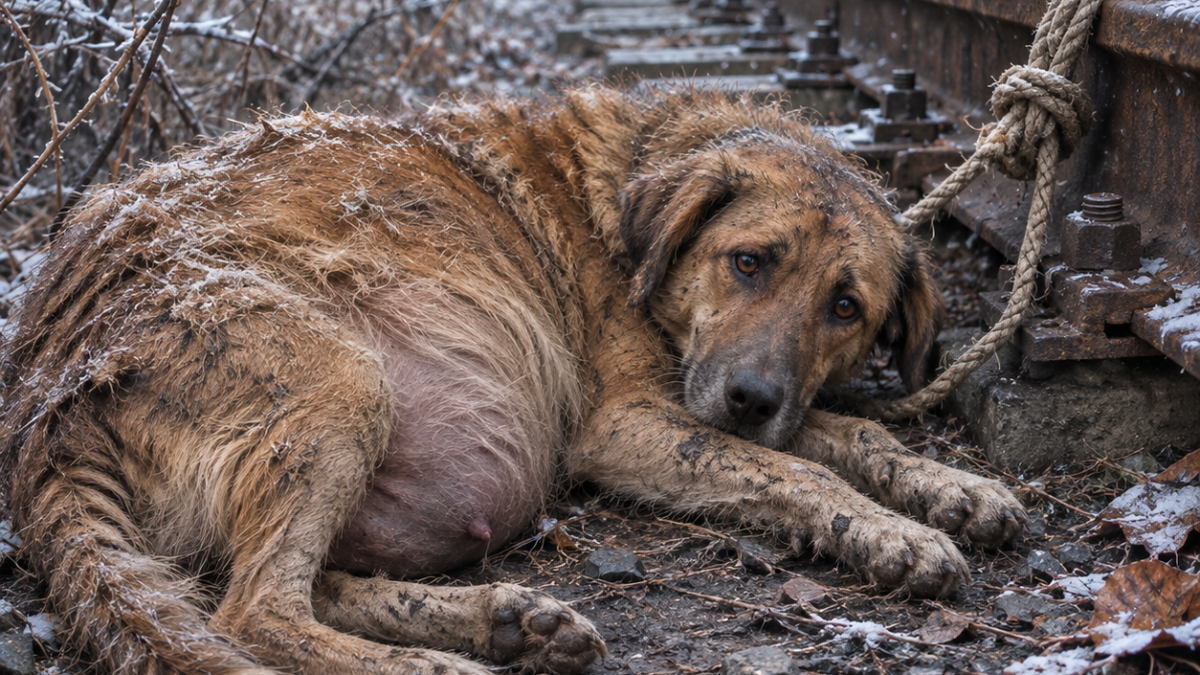
PART 2
“How long?” I asked.
Daniel was already looking toward the bend in the tracks.
“I don’t know. Maybe ten minutes. Maybe less.”
That was all I needed to hear.
I dropped back to my knees.
The dog felt my urgency immediately.
Her breathing quickened.
“No, no, sweetheart. Stay with me.”
I slipped two fingers beneath the rope again.
It was thicker than it had looked from a distance—coarse synthetic line, pulled into a knot that had tightened every time she struggled.
I sawed through it.
The first strands snapped.
Then more.
Daniel crouched beside me.
“Can I help?”
“Hold her shoulders, but don’t pin her down.”
He hesitated.
“Will she bite?”
“Maybe.”
I looked into her eyes.
“But I don’t think she will.”
Daniel placed his hands carefully against her shoulders.
She trembled.
“It’s all right, girl,” he said. “We’re getting you out.”
The metal sound came again.
Closer.
I cut harder.
The rope finally split.
For half a second, nothing happened.
Then the pressure disappeared from around her neck.
She lifted her head.
I expected her to scramble away.
Instead she remained completely still.
It was almost as though she didn’t understand she was free.
“Come on,” I whispered.
I slid one arm beneath her chest.
Daniel supported her back end.
The moment we tried to lift her, she cried out.
We stopped.
“Something’s wrong.”
Her hind legs were weak, and her abdomen tightened beneath my arm.
Then I felt it.
A contraction.
“Oh no.”
Daniel’s eyes widened.
“Is she having them now?”
“Maybe.”
Another contraction rolled through her.
She panted, opened her mouth, and leaned her head against my shoulder.
“We need to move.”
My vehicle was parked roughly a hundred yards away.
It felt like a mile.
We used a blanket as a sling and carried her between us.
Every few steps I checked her breathing.
The maintenance vehicle never appeared while we were on the tracks, but I heard its horn in the distance just as we reached the gravel lot.
I looked back.
That sound stayed with me for a long time.
Not because it came close to hitting her.
It didn’t.
What stayed with me was the thought that whoever tied her there could not possibly have known exactly when something might come through.
They had left her helpless in a place where steel wheels could eventually arrive.
They had accepted that possibility.
That was the part I couldn’t forgive.
At the veterinary hospital, a technician met us at the door with a stretcher.
“What happened?”
“Rope injury. Heavily pregnant. Possible labor. Exposure.”
The technician took one look at the dog’s abdomen.
“How long was she outside?”
“We don’t know.”
Within minutes, she was in an exam room.
Her temperature was low.
She was dehydrated.
The wound around her neck was worse than I had realized because the rope had been hiding part of it. Several areas of skin were torn, inflamed, and beginning to swell.
Dr. Patel, the veterinarian on duty, examined her while another technician placed an IV catheter.
“She’s full term,” he said.
“Are the puppies alive?”
“We’re checking now.”
He rolled the ultrasound machine closer.
The room became silent except for the dog’s breathing.
I stood beside her head.
She kept looking at me.
“You’re okay,” I whispered.
Dr. Patel moved the probe across her belly.
One heartbeat appeared.
Then another.
And another.
I started counting.
One.
Two.
Three.
Four.
Five.
Six.
Dr. Patel stopped.
His expression changed.
“What?”
He moved the probe.
“There’s another one.”
“Seven?”
He nodded.
But he didn’t smile.
“Heart rate is low.”
My chest tightened.
“The puppy?”
“Yes.”
He checked again.
“The others are stressed too, but this one concerns me.”
Another contraction tightened the mother’s abdomen.
She cried softly.
Dr. Patel looked at the technician.
“Get radiographs ready.”
Then he turned to me.
“We may be looking at an emergency delivery.”
“Can she handle surgery?”
“That’s the problem.”
Her body was exhausted.
She had likely gone without food and water for many hours, possibly longer. Her neck was injured. She was hypothermic.
And now seven puppies were depending on her.
I looked down.
She had placed one paw over my wrist.
“Do whatever gives them the best chance.”
Dr. Patel nodded.
“We will.”
The X-ray confirmed seven puppies.
One was positioned badly.
If labor continued without progress, both the puppy and the mother could be in danger.
For almost forty minutes, we waited to see whether she could deliver naturally.
She tried.
God, she tried.
She pushed through contraction after contraction, trembling from exhaustion.
Nothing.
Finally Dr. Patel looked at me.
“We can’t wait.”
They prepared for surgery.
As the staff wheeled her away, she lifted her head and searched the room.
I stepped beside the stretcher.
“I’m right here.”
Her eyes found mine.
“You do your job,” I whispered. “We’ll be here when you wake up.”
The doors closed.
And suddenly I had nothing to do.
That was when the anger returned.
I walked outside.
Daniel was sitting on a bench near the entrance.
He hadn’t left.
“How is she?”
“They’re doing a C-section.”
He rubbed both hands over his face.
“I keep seeing that rope.”
“So do I.”
He looked at me.
“Do you think somebody meant to kill her?”
I stared across the parking lot.
“I don’t know what they meant.”
That was the truth.
“But I know they didn’t care whether she lived.”
Daniel was quiet.
Then he reached into his pocket.
“I found something.”
He handed me a small object wrapped in tissue.
It was a broken piece of red plastic.
“What is it?”
“Tail light, maybe. It was in the mud beside the tracks. I didn’t touch it with my hands.”
I looked at him.
“Where exactly?”
“Near the tire marks.”
My pulse changed.
“What tire marks?”
“Behind the station.”
I hadn’t noticed them in my rush to reach the dog.
Daniel continued.
“There were fresh tracks coming off the service road. Somebody drove right up near where she was tied.”
That meant something.
Maybe nothing.
Maybe everything.
I immediately called the sheriff’s office.
An animal cruelty complaint had already been opened after Daniel’s first call, but now we had a possible vehicle trace.
A deputy arrived at the hospital less than an hour later.
His name was Deputy Ruiz.
He listened without interrupting as Daniel described exactly what he had found.
Then Ruiz placed the plastic fragment into an evidence bag.
“Don’t go back and move anything,” he said.
“We won’t.”
“I’ll photograph the scene.”
I asked the question that had been growing inside me.
“If you find who did this, what happens?”
Ruiz looked at me carefully.
“That depends on the evidence.”
“She’s in surgery because somebody tied her there.”
“I understand.”
“Seven puppies.”
His expression softened slightly.
“I understand.”
Then his voice became firm.
“But if you want this person charged, we have to do it correctly. Photographs. Statements. Evidence. No confronting anyone. No posting names online. No threats.”
I almost laughed.
“You think I’m going to threaten somebody?”
“I think you’re angry.”
He wasn’t wrong.
“Angry people sometimes make cases harder.”
That shut me up.
He started toward the door.
Then he turned back.
“The best revenge you can get for that dog is a case that doesn’t fall apart.”
I remembered those words.
Because over the next three weeks, they became a rule.
The best revenge was evidence.
At 11:47 that morning, the operating-room doors finally opened.
Dr. Patel walked out wearing surgical scrubs.
There was blood on one sleeve.
I stood so quickly my chair scraped the floor.
“Well?”
He pulled off his mask.
“Mom made it.”
My knees nearly gave out.
“And the puppies?”
He smiled.
“You’re going to need a lot of blankets.”
Seven puppies had been delivered.
Six were breathing normally after stimulation.
The seventh—the puppy whose heartbeat had been dropping—needed several terrifying minutes of intervention.
But he came back.
A tiny male with a dark muzzle and a white patch on his chest.
The technician had rubbed him vigorously while Dr. Patel worked on his mother.
At first he had been completely limp.
Then he gasped.
Then squeaked.
I didn’t realize I was crying until Daniel handed me a tissue.
“All seven?”
“All seven.”
“And her?”
“Very weak,” Dr. Patel said. “But stable.”
I exhaled.
The mother had suffered no uterine rupture, but one puppy’s position had prevented normal delivery. Without intervention, the outcome could have been catastrophic.
We placed the puppies beside her once she was awake enough.
At first she seemed disoriented.
Then the first puppy crawled toward her.
Her entire face changed.
She lifted her head.
Sniffed him.
And began licking him.
One by one, we placed the others beside her.
Seven tiny bodies pressed into her warmth.
The dog who had spent the morning trying to cover her belly with her paws finally wrapped herself around the lives she had been protecting.
Daniel stood silently at the doorway.
I saw him wipe his eyes.
“What are you going to call her?” he asked.
I looked at the reddish coat beneath the blankets.
“Ruby.”
“Ruby?”
“She needs something that sounds like she was always valuable.”
Daniel smiled.
“Ruby it is.”
The smallest male—the one who had almost died—earned his name a few minutes later.
He shoved two of his siblings aside with surprising determination to reach his mother.
Daniel laughed.
“That little guy’s a fighter.”
So we called him Chance.
Because that was exactly what all eight of them had been given.
A chance.
For the next three days, I lived between the shelter and the veterinary hospital.
Ruby recovered slowly.
Her neck wound had to be cleaned and dressed repeatedly. She hated when anyone approached it too quickly, and the first time a technician reached over her with a length of gauze, Ruby flattened herself against the kennel wall.
The technician stopped.
“It’s okay.”
Ruby shook violently.
I realized what she was seeing.
Something long.
Something white.
Something moving toward her neck.
A rope.
I stepped inside.
“Ruby.”
Her eyes moved to me.
I sat on the floor.
“No one is tying you again.”
The technician handed me the gauze.
I let Ruby smell it.
Then I touched her shoulder.
Slowly.
Patiently.
She allowed us to replace the bandage.
That became our routine.
Trust was never demanded.
It was negotiated.
A little food from my palm.
A hand resting on the floor instead of reaching from above.
A door left open while I sat several feet away.
Eventually Ruby began leaning against me when I entered.
But she never liked ropes.
She never liked being restrained.
And the sound of metal striking metal made her freeze.
On the fourth day, Deputy Ruiz called.
“We found a camera.”
My stomach tightened.
“Where?”
“Warehouse about half a mile from the station. It points toward the service road.”
“Did it catch anything?”
“Maybe.”
That one word followed me all afternoon.
By evening, he came to the shelter.
I met him in the office.
He placed several printed photographs on the desk.
The images were grainy.
Timestamped.
One showed a dark pickup entering the service road at 5:18 that morning.
Another showed it leaving at 5:31.
The right rear tail light was damaged.
A bright section of red plastic was missing.
I stared at the photo.
“Does the piece Daniel found match?”
“Looks possible.”
“Plate?”
“Partial.”
Three characters were visible.
Ruiz tapped the photograph.
“We’re working on it.”
I wanted the answer immediately.
Instead, I got three more days of waiting.
Then something unexpected happened.
Ruby’s story had begun circulating locally.
We had not released investigative details. No plate. No vehicle description. No location beyond “near the old station.”
We simply posted that a pregnant dog had been rescued and that law enforcement was investigating.
Two days later, a woman came into the shelter.
She looked nervous.
“I think I’ve seen that dog.”
I invited her into the office.
“Where?”
She pulled out her phone.
“At a house outside Bellwood.”
The photograph showed a fenced yard.
Several dogs were visible behind chain-link panels.
And near the back of the frame stood Ruby.
Same reddish coat.
Same white mark under the chin.
Same dark shading around the muzzle.
My pulse began to pound.
“When was this taken?”
“About six months ago.”
“Why were you there?”
“I bought a puppy.”
The woman looked down.
“I didn’t know what the place was like until I got there.”
She explained that the property belonged to a man named Calvin Mercer.
Cal Mercer.
He advertised puppies online.
Different breeds.
Different mixes.
Always cash.
Always “family raised.”
But when she arrived, she had seen dogs in outdoor kennels behind the house.
Some were barking frantically.
Others barely moved.
“I should have reported it,” she whispered.
“Why didn’t you?”
She looked ashamed.
“I took the puppy and left.”
I didn’t scold her.
Regret was already doing that job.
“Do you still have messages from him?”
“Yes.”
“Photos?”
“Some.”
“Address?”
She nodded.
I called Ruiz.
Within hours, he had what he needed to start checking the connection.
Cal Mercer owned a dark pickup.
The registration matched the visible portion of the plate.
And the right rear tail light?
Recently replaced.
But that still wasn’t enough.
Owning a truck wasn’t proof.
Knowing Ruby wasn’t proof.
A broken tail light wasn’t proof.
What changed the case was the rope.
The rope around Ruby’s neck was a distinctive marine-grade utility line with a black-and-yellow weave.
Deputies executing a search warrant at Mercer’s property found a large spool of the same type inside his workshop.
A section had recently been cut.
They also found something else.
Veterinary paperwork.
Ruby had a name before Ruby.
Mercer had called her “Red Girl Number Three.”
Not Ruby.
Not even a real name.
Red Girl Number Three.
She had been bred repeatedly.
According to records seized from the property, she had produced at least three previous litters.
Her age was estimated at only five.
Five years old.
Three documented litters.
Possibly more.
I sat in the shelter office staring at a copy of the report.
My anger felt completely different now.
Not hot.
Cold.
Organized.
I understood why Ruiz had warned me.
I didn’t want to scream at Mercer anymore.
I wanted every page documented.
Every photograph dated.
Every animal examined.
Every transaction traced.
I wanted him to experience the one thing Ruby had never been given.
Consequences.
But Mercer wasn’t finished.
The morning after authorities searched his property, he walked into our shelter.
I recognized him immediately from the driver’s-license photograph Ruiz had shown me privately.
Heavy jacket.
Gray beard.
Baseball cap pulled low.
He stood at the front desk.
“I’m here for my dog.”
My entire body went still.
The receptionist looked at me.
I stepped forward.
“Which dog?”
He smiled.
It wasn’t a friendly smile.
“Don’t play games.”
“Which dog?”
“The red female.”
Ruby was behind two locked doors in the medical wing.
Her puppies were with her.
“Do you have proof of ownership?”
His smile disappeared.
“You know damn well she’s mine.”
The words made something inside me burn.
But I remembered Ruiz.
Evidence.
Not anger.
“Do you have identification and veterinary records?”
“I don’t need to prove anything to you.”
“Then I can’t release an animal.”
He slammed his palm on the counter.
The receptionist jumped.
“That bitch is worth money.”
Silence.
Even he seemed to realize he had said too much.
I looked directly at him.
“She’s evidence in an active cruelty investigation.”
His face changed.
Only slightly.
But enough.
“You people are stealing from me.”
I didn’t answer.
He leaned toward me.
“You think because you put some cute story online that dog belongs to you?”
“No.”
I kept my voice calm.
“She belongs wherever law enforcement says she legally belongs while the case is active.”
He pointed at me.
“You don’t know what happened.”
“You’re right.”
I held his stare.
“That’s why the sheriff is investigating.”
He stepped closer.
The receptionist quietly reached beneath the desk.
We had a panic button.
Mercer’s voice dropped.
“Sometimes dogs run off.”
Ruby had not run off.
The rope had been knotted around metal.
I said nothing.
He continued.
“Sometimes people find dogs and make stories because they like attention.”
Still I said nothing.
Then he made his mistake.
“You better hope that dog doesn’t have complications.”
I felt every hair on my arms rise.
The public had been told Ruby survived.
We had not announced the C-section complications.
We had not said one puppy nearly died.
I looked at him.
“What complications?”
His mouth closed.
For one second, neither of us moved.
Then the front door opened.
Deputy Ruiz walked in with another officer.
Apparently the receptionist had hit the button.
Mercer turned.
Ruiz looked at him.
“Mr. Mercer.”
Mercer’s confidence disappeared.
“I was just picking up my property.”
Ruiz’s expression hardened.
“You’re not picking up anything.”
“They stole my dog.”
“That animal is being held under investigative authority.”
“You don’t have the right.”
“We can discuss your rights outside.”
Mercer looked back at me.
The hatred in his face was unmistakable.
“You’ll regret getting involved.”
Ruiz heard him.
“What did you say?”
Mercer immediately shook his head.
“Nothing.”
“No. I heard you.”
“I said nothing.”
Ruiz stepped between us.
“Leave.”
Mercer walked out.
The door closed behind him.
My hands began shaking.
I had kept them steady the whole time.
Only now did they betray me.
Ruiz looked at me.
“You okay?”
“Yes.”
“No, you’re not.”
I laughed once.
“No.”
He glanced toward the medical wing.
“He came here because he’s losing control.”
“Can you arrest him?”
“Not for being an idiot.”
“That’s unfortunate.”
Ruiz almost smiled.
Then he became serious.
“If he comes back, don’t engage him. Call us.”
I nodded.
“He’s scared.”
Ruiz picked up the visitor log.
“People like him often are when paperwork starts talking.”
And the paperwork was talking loudly.
The search of Mercer’s property revealed fourteen dogs.
Four were pregnant females.
Two had untreated skin infections.
One elderly dog had a mammary mass that had apparently never been evaluated.
Several lived in outdoor pens with inadequate shelter.
Investigators found stacks of handwritten breeding records.
Cash sales.
Litter dates.
Descriptions of females by coat color and number.
Ruby appeared repeatedly.
“Red Girl #3 — 8 pups.”
“Red Girl #3 — 6 pups.”
“Red Girl #3 — breed next heat.”
No name.
Just production.
One notation made my stomach turn.
Next to her latest pregnancy, someone had written:
**Too slow. Difficult. Cull after litter.**
I read it twice.
Then a third time.
“What does ‘cull’ mean here?” Daniel asked.
He had become one of Ruby’s most regular visitors.
I folded the photocopy.
“It means she wasn’t useful anymore.”
His jaw tightened.
“So he tied her to the tracks?”
“We still don’t know exactly what happened.”
But I knew what I believed.
Mercer’s defense would later be that Ruby had become “aggressive” and that he had given her to someone else days earlier.
He could not remember the person’s full name.
He could not produce a phone number.
He had no messages showing the transfer.
And when investigators asked why his truck had traveled toward the station on the morning Ruby was found, he claimed he had been looking for scrap metal.
At 5:18 in the morning.
With a pregnant dog he claimed he no longer owned somehow disappearing from his property at almost exactly the same time.
His story kept changing.
The evidence did not.
The plastic fragment recovered beside the tracks matched the missing portion of his old tail-light assembly closely enough to support the vehicle connection.
Mud from his tires was consistent with the service road.
The rope matched material from his workshop.
Ruby’s veterinary and breeding records were inside his home.
And a camera at a gas station six miles away captured Ruby’s head briefly visible above the side of the truck bed on the same morning.
That image became the piece I could barely look at.
She had been standing in the back.
Alive.
Pregnant.
Looking over the side.
Less than an hour later, she was tied to steel.
People ask sometimes whether animals understand betrayal.
I don’t know.
I can’t enter Ruby’s mind.
But I know this:
When she eventually saw a man wearing a baseball cap similar to Mercer’s, she crawled backward beneath a table and urinated from fear.
Whatever she remembered, her body remembered enough.
Her puppies grew.
And with every week, the shelter changed.
At first Ruby barely slept.
She would jerk awake whenever one puppy cried.
She constantly counted them in the only way a mother dog can—sniffing, nudging, licking, rearranging.
Chance remained the smallest.
But he was never the weakest.
At feeding time, he climbed over everyone.
We named the others Maple, Otis, Juniper, Finn, Rosie, and Bear.
Seven completely different personalities.
Bear slept on his back.
Rosie screamed whenever she was even slightly inconvenienced.
Finn discovered how to escape the puppy pen before any of the others.
Maple liked carrying pieces of blanket.
Juniper followed Ruby everywhere.
Otis was the calm one.
And Chance?
Chance wanted to fight furniture.
By five weeks, he had declared war on a mop.
By six weeks, the mop was losing.
Ruby watched them with a patience I could hardly understand.
Sometimes I looked at her surrounded by those puppies and remembered the tracks.
The rope.
The cold gravel.
The paw covering her belly.
She had protected lives she hadn’t even met yet.
Now she watched them stumble around the room as if they were the most obvious thing in the world.
One afternoon, Daniel sat on the floor while all seven puppies climbed over his legs.
He picked up Chance.
“I think he likes me.”
Chance immediately bit his shoelace.
“That’s love,” I said.
Daniel laughed.
Then Ruby walked over.
She stood in front of him.
Daniel became still.
Ruby had always tolerated him, but she was more attached to me and the veterinary staff.
That day, she leaned forward.
Daniel held out his hand.
She sniffed it.
Then rested her chin on his knee.
Daniel didn’t move.
His eyes filled.
“Well,” he whispered. “Hello.”
I looked away to give him privacy.
Later, over coffee, he told me something I hadn’t known.
His wife had died fourteen months earlier.
They had been married thirty-eight years.
After she died, he retired earlier than planned.
The old railroad station had once been part of his maintenance route, and he still occasionally volunteered with a historical group that monitored the abandoned property.
“That’s why I was there that morning,” he said.
I nodded.
“I’ve been thinking about getting a dog.”
I looked through the glass at Ruby.
She was asleep with three puppies draped across her.
“Are you asking me something?”
“Not yet.”
“Good.”
He smiled.
“I know.”
Because Ruby wasn’t ready.
And neither were we.
The criminal case took months.
That surprised people.
They expected the rescue to happen, the villain to be arrested, and justice to arrive before dinner.
Real cases aren’t like that.
There were reports.
Veterinary evaluations.
Forensic comparisons.
Interviews.
Hearings.
Continuances.
Defense motions.
Mercer hired an attorney.
Then he began insisting Ruby had attacked him.
No medical records supported it.
Then he claimed she had broken free from his property.
The video contradicted him.
Then he claimed another man had transported her.
Investigators could find no such man.
The stronger the evidence became, the more complicated his story became.
But one evening, the case took another turn.
I was closing the shelter when I noticed headlights across the road.
A truck sat in the parking lot of an abandoned convenience store.
I couldn’t see the driver.
I locked the front door.
The truck remained.
I turned off the lobby lights.
Still there.
I called Ruiz.
“Maybe I’m overreacting.”
“Describe the vehicle.”
“White pickup.”
Mercer’s was dark.
“Plate?”
“Can’t see it.”
“Stay inside.”
“I’m probably being paranoid.”
“Stay inside.”
Ten minutes later, a patrol car turned onto the road.
The white pickup drove away immediately.
Ruiz called me.
“Did you get the plate?”
“No.”
“Any idea who it was?”
“No.”
“Don’t leave alone tonight.”
That was the first night I became afraid.
Not for myself exactly.
For Ruby.
For the puppies.
For the shelter.
Mercer had already come inside once.
What if he wanted to destroy evidence?
What if he wanted Ruby back?
What if he simply wanted revenge?
We upgraded the locks.
Added cameras.
Staff stopped closing alone.
For several weeks, nothing happened.
Then one morning we found a dead animal dumped at the shelter gate.
Not one of ours.
A wild raccoon.
No note.
No proof of who left it.
Maybe coincidence.
Maybe cruelty.
Maybe intimidation.
Ruiz photographed it anyway.
“Don’t give him a reaction,” he said.
“I don’t even know that it was him.”
“Exactly.”
I looked toward Ruby’s kennel.
She was feeding her puppies.
“How do people live like this?”
“Like what?”
“Thinking they’re entitled to terrorize everything around them.”
Ruiz closed his notebook.
“They usually don’t think of themselves that way.”
“What do they think?”
“That everyone else is the problem.”
That answer stayed with me.
Mercer saw Ruby as property that failed.
He saw customers as money.
He saw investigators as enemies.
He saw the shelter as thieves.
He never seemed to consider the simplest possibility.
That the problem was him.
At eight weeks, the puppies were old enough to begin going to carefully screened homes.
I hated that day.
I also loved it.
Maple went first.
A couple with two older children sat on the floor for almost an hour while she climbed into their laps.
Otis went to a veterinary technician.
Rosie went to a woman who had recently lost her senior dog.
Finn joined a family with a fenced farm and another young dog.
Bear went to a retired firefighter.
Juniper was adopted by a quiet young teacher who cried when Ruby licked her hand before the puppy left.
And Chance?
Daniel filled out the application.
I stared at it.
He looked nervous.
“You said you’d been thinking about getting a dog.”
“I have.”
“One dog.”
“Plans change.”
I looked behind him.
Ruby was sitting by the office door.
Watching.
Daniel followed my gaze.
“I’d take her too.”
I stopped.
“Ruby?”
“If she wants me.”
That was the important part.
Not whether Daniel wanted Ruby.
Whether Ruby wanted Daniel.
We arranged several visits.
Daniel never forced contact.
He sat.
He waited.
Sometimes he brought a book.
Ruby would pace around the room before lying several feet away.
Next visit, three feet.
Next visit, against his shoe.
On the fourth visit, Daniel clipped a leash to her harness.
Ruby froze.
His hand immediately released tension.
“We don’t have to go.”
She looked at him.
Then at the open door.
Daniel waited.
Ruby took one step.
Then another.
They walked twenty yards.
The following week they made it around the building.
By the third week, Ruby began wagging her tail when Daniel arrived.
That decided it.
Ruby and Chance went home together.
Before they left, I knelt beside her.
Her neck had healed, though a thin scar remained beneath the fur.
I touched it gently.
“You remember the first thing I told you?”
Ruby licked my chin.
“I said you were leaving those tracks with me.”
She wagged her tail.
“I never promised you had to stay with me forever.”
Daniel wiped his eyes.
I hugged Ruby.
Then Chance.
Then Ruby again.
She walked toward Daniel’s truck.
Stopped.
Looked back at me.
For one terrible second, I thought she was afraid.
Then she ran back.
Pressed her entire body against my legs.
And stayed there.
I buried my face in her neck.
“Go home, Ruby.”
She stepped away.
Daniel opened the rear door.
Ruby climbed onto the blanket.
Chance jumped in after her.
The truck drove away.
I cried for twenty minutes.
Then the phone rang.
It was Ruiz.
“The prosecutor filed the final charges.”
I sat down.
“Against Mercer?”
“Yes.”
“How many?”
“Enough.”
The case included felony animal cruelty related to Ruby, additional cruelty and neglect counts connected with several dogs seized from his property, violations related to his breeding operation, and charges tied to falsified records investigators said had been submitted during the inquiry.
Not every allegation became a charge.
Not every charge survived.
That’s how the system works.
I had learned not to confuse justice with fantasy.
Fantasy gives you perfect punishment.
Justice gives you evidence, procedure, arguments, compromise, and occasionally something close to accountability.
Mercer’s attorney attempted to have the railroad evidence excluded.
The judge denied the motion.
He attempted to challenge the vehicle-camera footage.
The footage remained.
He attempted to claim the rope could have belonged to anyone.
Then investigators produced photographs from Mercer’s own phone.
In the background of several pictures taken months earlier, the same spool of rope was visible hanging inside his workshop.
The prosecutor showed me one before trial.
I stared at it.
A photograph Mercer had taken himself.
His own evidence.
“That’s almost poetic,” I said.
The prosecutor smiled slightly.
“Don’t say that on the stand.”
“I won’t.”
I was called to testify.
The courthouse felt strangely ordinary.
That bothered me.
There should have been something dramatic about the building.
Thunder.
Music.
Something.
Instead there were fluorescent lights, security trays, people drinking coffee from paper cups.
Mercer sat beside his attorney wearing a clean shirt.
No baseball cap.
No shouting.
No threats.
He looked smaller than he had in the shelter.
That surprised me.
When I took the stand, I was asked what I had seen.
I described Ruby.
The rope.
Her swollen belly.
The red wound around her neck.
The way she tried to stand and was pulled backward.
The way she placed her paws across her abdomen.
The emergency surgery.
Seven puppies.
“Did you see the defendant tie the dog to the railroad track?”
“No.”
“Then you don’t know who did it.”
“I know what I saw when I arrived.”
His attorney repeated the question.
“Did you see Mr. Mercer tie that rope?”
“No.”
“Thank you.”
For a moment, I felt frustrated.
Then I remembered.
My job wasn’t to win the case.
My job was to tell the truth.
Daniel testified.
The veterinarian testified.
Investigators testified.
The woman who had purchased a puppy testified.
A railroad employee authenticated the service-road camera timestamps.
A gas-station manager authenticated the video showing Mercer’s truck.
Then came one of the worst moments.
The prosecutor displayed the breeding records.
Red Girl #3.
The notation appeared on a large screen.
**Too slow. Difficult. Cull after litter.**
I heard someone in the courtroom inhale sharply.
Mercer looked at the table.
The prosecutor asked the investigator what “cull” could mean in the context of the records.
The defense objected.
The judge limited the testimony.
Again, procedure.
Again, reality.
But the words were already there.
Written in ink.
Mercer’s ink.
On the final day, the prosecution laid out the timeline.
5:07 a.m.—Mercer’s truck captured near his property.
5:12—gas station.
Ruby visible in the truck.
5:18—truck enters station access road.
5:31—truck exits.
6:54—Daniel finds Ruby tied to the track.
7:08—first call for help.
7:42—I arrive.
Later that morning—tail-light fragment recovered.
Matching damage documented on Mercer’s vehicle records.
Rope recovered from Ruby.
Matching rope found at Mercer’s workshop.
Breeding records establishing possession.
No credible evidence supporting Mercer’s claim that he had transferred Ruby to another owner.
No credible explanation for why his truck carried Ruby toward the station.
No credible explanation for why he returned to the shelter demanding her back.
Mercer did not testify.
The jury deliberated.
I hated waiting more than anything.
Daniel and I sat on a bench outside the courtroom.
He showed me a photograph.
Ruby asleep on his couch.
Chance was upside down across her back.
I laughed.
“She lets him do that?”
“She lets him do anything.”
“How is she with the train sounds?”
Daniel’s house was several miles from active tracks.
“Better.”
He paused.
“First week, she hid in the bathroom every time she heard a horn.”
My smile disappeared.
“But yesterday?”
“What happened yesterday?”
“Freight train sounded the horn.”
“And?”
“She lifted her head.”
He smiled.
“Then went back to sleep.”
I looked at the photograph again.
That felt like victory.
The courtroom doors opened.
We were called back inside.
My heart was pounding so hard I could hear it.
The first verdict was read.
Guilty.
I closed my eyes.
Second count.
Guilty.
Another count.
Guilty.
Not every count.
But enough.
Mercer didn’t look at us.
He stared straight ahead.
The sentencing took place several weeks later.
The judge spoke longer than I expected.
He talked about responsibility.
About suffering.
About the difference between owning an animal and having unlimited authority over a living creature.
Then he talked about Ruby.
He did not use the shelter name at first.
He used Mercer’s name for her.
“Red Girl Number Three.”
He looked down at the paperwork.
“I find that designation revealing.”
Mercer shifted.
The judge continued.
“The animal at the center of this case was tracked as inventory. Her reproductive history was documented with more care than her physical welfare.”
Nobody moved.
“She was not equipment.”
The judge paused.
“She was not disposable.”
I felt tears burn my eyes.
Mercer received incarceration followed by supervised probation.
He was ordered to pay restitution for veterinary costs and a portion of the expenses associated with the seized animals.
He was prohibited from breeding dogs.
The court imposed a long-term restriction on possessing animals during his supervision period, with additional local administrative restrictions following from the closure of his kennel operation.
Equipment connected with the breeding business was removed.
The remaining dogs seized from the property were transferred through legal proceedings to rescue organizations and qualified homes.
It wasn’t a movie ending.
No one applauded.
The judge didn’t slam the gavel and announce that evil had been defeated forever.
Mercer didn’t fall to his knees begging forgiveness.
He never apologized to me.
He never apologized to Daniel.
And as far as I know, he never apologized for Ruby.
But something more important happened.
He lost control of the animals he had treated as inventory.
His breeding operation closed.
The kennels emptied.
The dogs left.
And Ruby never went back.
Months later, I visited Daniel.
It was early spring.
The cold gray world from that October morning had disappeared.
Daniel’s yard was beginning to turn green.
Chance came flying around the side of the house before I had fully closed my car door.
He was enormous.
“That is not Chance.”
Daniel laughed from the porch.
“That’s what I keep telling him.”
Chance jumped against me.
I nearly fell over.
Then Ruby appeared.
She stopped at the top of the porch steps.
For one second, we stared at each other.
“Ruby?”
Her ears went up.
Then she ran.
Not slowly.
Not cautiously.
Ran.
She hit me in the legs so hard I staggered.
I dropped to my knees.
She pushed her face against my chest.
“There you are.”
She licked my chin.
Chance tried to join.
Soon I had two dogs on top of me and Daniel was laughing.
When Ruby finally settled down, I looked at her neck.
The scar was almost invisible.
Almost.
Daniel poured coffee while Ruby lay beside my chair.
Chance carried a shoe through the yard.
“That’s mine,” Daniel called.
Chance ran faster.
“He seems well trained.”
“Perfectly.”
We sat in the sun.
Then a train horn sounded somewhere in the distance.
Ruby’s head came up.
My body reacted before my mind did.
I looked at her.
She listened.
Her ears tilted forward.
For several seconds, she remained completely still.
Then Chance dropped the stolen shoe beside her.
Ruby sniffed it.
Stood.
And chased him across the yard.
I started crying.
Daniel noticed.
“You’re thinking about the station.”
I nodded.
“Every time.”
He watched Ruby run.
“I was too, at first.”
“What changed?”
He thought about it.
“Now I try to think about this instead.”
Ruby caught Chance.
They tumbled into the grass.
Daniel smiled.
“Maybe the tracks aren’t the end of her story.”
He was right.
They weren’t even close.
That summer, the last legal paperwork regarding the seized dogs was finalized.
Every surviving dog from Mercer’s property eventually entered an approved rescue or permanent placement.
The elderly female with the mammary mass received surgery.
Two of the pregnant dogs delivered safely in foster homes.
One terrified male who initially refused human contact spent months with a behavior specialist before being adopted by a quiet couple who owned several acres outside town.
There were setbacks.
There always are.
Rescue stories are rarely clean.
Some animals recovered faster than others.
Some carried fear for a long time.
But they were out.
That mattered.
One afternoon Ruiz stopped by the shelter.
He had no uniform jacket on, only his duty belt and a folder.
“More paperwork?”
I asked.
“Always.”
He handed me an envelope.
Inside was a reimbursement order connected to the restitution process.
It covered only part of what had been spent on Ruby.
I looked at the amount.
“That’s it?”
Ruiz shrugged.
“Reality.”
I laughed.
“Fair enough.”
Then he leaned against the counter.
“You still angry?”
I thought about it.
“Yes.”
“Good.”
I raised an eyebrow.
“Good?”
“Anger isn’t always useless.”
He pointed toward the medical wing.
“But yours turned into something.”
I looked at him.
“Evidence?”
He smiled.
“Work.”
After he left, I sat at the same desk where months earlier I had stared at photographs of Mercer’s truck.
The shelter was quiet.
I thought about revenge.
Real revenge.
Not the kind people imagine when they’re furious.
I had wanted Mercer to feel helpless.
I had wanted him to know fear.
I had wanted him to understand what Ruby experienced.
But eventually I realized there was no way to reproduce that suffering without becoming cruel myself.
And Ruby didn’t need that.
She needed something better.
She needed safety.
Her puppies needed homes.
The other dogs needed freedom.
The case needed evidence.
The community needed to know that animals could not be discarded simply because they stopped making someone money.
So in the end, our revenge was simple.
We took away his ability to do it again.
Every empty kennel on his property was revenge.
Every veterinarian who treated one of those dogs was revenge.
Every adoption photograph was revenge.
Every puppy asleep in a safe house was revenge.
Every morning Ruby woke beside Daniel instead of tied to cold steel was revenge.
And Chance?
Chance became the most ridiculous dog I have ever known.
He grew into a seventy-pound shadow with no understanding of personal space.
Daniel sent photographs constantly.
Chance sitting in a laundry basket.
Chance sleeping with his head inside a cardboard box.
Chance attempting to fit beneath a kitchen chair designed for a much smaller animal.
Ruby was always somewhere nearby.
Watching him.
Patient.
Calm.
Safe.
A year after the rescue, Daniel asked me to meet him near the old railroad station.
For a moment, I hesitated.
I hadn’t returned since the investigation.
But I went.
The place looked smaller than I remembered.
The weeds were taller.
The rails were rustier.
The piece of metal where the rope had been tied was still there.
I hated seeing it.
Daniel stood beside me.
Ruby was in his truck.
“I wasn’t sure whether to bring her out.”
“Don’t.”
He nodded.
“I didn’t think so.”
We walked toward the spot.
I could still picture everything.
Ruby on the gravel.
The rope.
Her shaking paws.
Her belly.
The sound of metal in the distance.
“I used to think this was the worst place I’d ever seen,” I said.
Daniel looked at me.
“And now?”
“I still do.”
He laughed softly.
Then I added, “But it also happens to be where you found her.”
That changed something.
Maybe that was what healing really was.
Not pretending something terrible had never happened.
Not forcing yourself to call it good.
Just refusing to let the worst thing be the only thing that place meant.
Daniel looked back toward his truck.
Ruby was watching us through the window.
Her face had gone gray around the muzzle even though she wasn’t old.
I walked over.
Daniel opened the door.
Ruby stepped down.
For a second, I worried.
She sniffed the air.
Her body stiffened.
The railroad smell was still there.
Oil.
Metal.
Old wood.
Stone.
Her tail lowered.
“Ruby.”
She looked at me.
“You don’t have to go any farther.”
Daniel crouched beside her.
Ruby turned toward the truck.
Then stopped.
She looked at Daniel.
Then me.
Then the tracks.
Slowly, she took one step.
Another.
We did not pull her.
The leash stayed completely loose.
Ruby walked perhaps twenty feet.
Then stopped.
That was enough.
More than enough.
Daniel knelt.
She leaned against him.
A train horn sounded very faintly in the distance.
Ruby’s ears moved.
She looked toward the sound.
Then back at Daniel.
Her tail wagged.
Once.
Twice.
I put my hand over my mouth.
The first time I had seen that tail move beside those tracks, she was tied down and freezing.
Now nothing held her.
No rope.
No chain.
No hand.
Nothing.
She could leave whenever she wanted.
And she did.
Ruby turned away from the tracks.
She walked toward Daniel’s truck.
Chance was waiting inside, bouncing wildly against the window.
Ruby climbed in.
Daniel looked at me.
“Ready?”
I glanced one last time toward the rusted metal fixture.
“Yeah.”
We left.
That night he sent me a photograph.
Ruby was asleep on the couch.
Chance’s head rested across her back.
Beneath the photograph, Daniel had written only four words:
**She chose to go home.**
I stared at that sentence for a long time.
Because that was the ending I wanted for her.
Not a courtroom.
Not a sentence.
Not revenge.
Choice.
The dog I found could not choose anything.
She couldn’t choose where to stand because the rope stopped her.
She couldn’t choose where to sleep.
She couldn’t choose whether to escape.
She couldn’t choose who came near her.
She couldn’t even move away while her unborn puppies depended on her.
Someone had reduced her entire world to the length of a rope.
But that wasn’t the dog who went home with Daniel.
That Ruby had choices.
She could sleep on the couch or the floor.
She could walk into the yard or stay inside.
She could approach strangers or move away.
She could follow Daniel from room to room.
She could steal Chance’s toys.
She could bark at squirrels.
She could ignore train horns.
She could decide when she wanted affection.
And when she had enough, she could simply walk away.
People sometimes asked me what happened to the seven puppies.
I kept a folder.
Maple grew into a gentle red-and-white dog who slept beside the family’s youngest child.
Otis became a clinic favorite and occasionally came to work with his owner.
Rosie still screamed whenever dinner was three seconds late.
Finn became an expert escape artist but never actually went anywhere once he escaped. He simply stood outside the puppy gate looking pleased with himself.
Bear developed an obsession with tennis balls.
Juniper slept every night beside the teacher who adopted her.
And Chance stayed with Ruby.
Every year, around the anniversary of the rescue, their families sent photographs.
Seven puppies.
Seven homes.
Seven lives that nearly ended before they had even taken their first breaths.
I kept those photographs beside one picture of Ruby.
Not the photograph from the tracks.
I stopped displaying that one.
The picture I kept was taken the following spring.
Ruby was standing in Daniel’s yard.
The grass was bright green.
Her mouth was open in a relaxed smile.
Chance was blurred behind her because he was running.
There was no rope.
No railroad.
No wound.
No fear.
Just Ruby.
That was the photograph I wanted people to remember.
Because cruelty was part of her story.
But it did not own the ending.
The man who treated her as disposable faced the consequences of his choices.
His breeding business disappeared.
The animals he controlled were removed.
The records he kept to measure their value became evidence against him.
The truck that carried Ruby toward the railroad became part of the timeline investigators used to expose what happened.
Even the rope he once controlled became evidence.
Everything he had used to reduce those dogs to possessions eventually helped prove they were victims.
There was something deeply satisfying about that.
But the most satisfying part happened far away from the courthouse.
It happened every ordinary morning.
Daniel would open his back door.
Chance would explode into the yard as though released from a cannon.
Ruby would walk out behind him.
Sometimes she ran.
Sometimes she stood in the sun.
Sometimes she returned inside immediately because the grass was wet and apparently she had developed standards.
No one forced her.
No one tied her.
No one decided when she had stopped being useful.
She was simply allowed to live.
A few months ago, Daniel sent me another message.
Ruby had been sleeping more.
Nothing serious.
She was getting older.
He had taken her for a complete examination, and apart from arthritis beginning in her hips, she was doing well.
That evening I drove to see them.
Ruby met me at the porch.
Slower now.
But still Ruby.
I sat beside her on the floor.
Chance, no longer a puppy himself, stretched out across the rug.
Daniel brought coffee.
For a while, none of us said much.
I scratched the fur beneath Ruby’s chin.
My fingers found the place where the rope scar used to be obvious.
I could barely feel it.
“Funny,” Daniel said.
“What?”
“You told her that morning you were taking her away from there.”
I smiled.
“You remember that?”
“I heard you.”
“I wasn’t sure she would survive.”
“Neither was I.”
Ruby placed one paw on my leg.
The same kind of gesture she had made years earlier.
But back then, that paw had covered her belly.
Protecting puppies she could not yet see.
Now it rested calmly on my knee.
I looked at her.
“You did it, girl.”
Daniel leaned back in his chair.
“Did what?”
I didn’t take my eyes off Ruby.
“She protected them.”
All seven.
Every one of those lives existed because she kept going.
Through the cold.
Through the rope.
Through contractions.
Through fear.
Through surgery.
Through everything.
People called us rescuers.
But sometimes I wondered whether we were giving ourselves too much credit.
We cut the rope.
The veterinary team performed the surgery.
Police gathered evidence.
The prosecutor built a case.
Families opened their homes.
Those things mattered.
But Ruby had done something before any of us arrived.
She had refused to stop protecting life.
Even while someone treated hers as worthless.
I leaned down and kissed the top of her head.
Her tail moved against the floor.
Once.
Twice.
Exactly like it had beside the tracks.
Only this time, there was no rope pulling her back.
And that, more than the guilty verdict, more than the closed breeding kennels, more than the restitution order or the judge’s words, was the ending I had wanted from the beginning.
They tied a pregnant dog to railroad tracks because they believed she had no value once she stopped being useful to them.
They were wrong.
Ruby was never disposable.
She was a mother.
A survivor.
The reason seven puppies got to grow up.
The reason fourteen other dogs were discovered.
The reason an abusive breeding operation finally closed.
And the dog someone once labeled **Red Girl Number Three** ended her story with something she had probably never been given before.
A real name.
A family.
A home.
And the freedom to choose where she wanted to go.
The last time I saw her, I stood at Daniel’s front door preparing to leave.
Ruby followed me outside.
For a second she stared toward my car.
Years earlier, I had placed her into a vehicle because she had no other choice.
Now I opened the passenger door jokingly.
“You coming with me?”
Ruby looked inside.
Then looked back at the house.
Daniel stood in the doorway.
Chance appeared beside him.
Ruby turned around.
She walked straight back to them.
I laughed through the tears.
“Okay. Message received.”
Daniel smiled.
Ruby climbed the porch steps.
Before going inside, she looked back at me.
Her tail wagged.
Then she disappeared through the doorway.
I closed my car door and sat there for a moment.
No dramatic music.
No courtroom.
No angry confrontation.
Just a dog choosing her home.
And I realized Daniel had been right all along.
The railroad tracks were never the end of Ruby’s story.
They were only the place where the person who wanted to throw her life away lost control of it forever.
Ruby got the final word.
She lived.








