PART 2: THEY TIED A NEARLY BLIND OLD SHEPHERD TO A TREE AND LEFT HER TO DI3—THEN HER FADED NAME TAG EXPOSED WHY
PART 2
I looked up from Lada.
“What do you mean she didn’t live alone?”
Sarah rotated the computer monitor.
The microchip registration was several years old, but the emergency contact listed beneath Helen Markham’s name had not been removed.
**Dale Markham — Son.**
There was also an address.
I knew the road.
Everyone around our town did.
Fox Hollow Road sat on the opposite side of the ridge, where older farmhouses had slowly been swallowed by new construction and expensive vacation homes.
“Call him,” I said.
Sarah hesitated.
“It’s almost ten.”
“If my mother’s dog was lying half-dead in the woods, I wouldn’t care what time somebody called me.”
She nodded.
The number rang six times.
Then a man answered.
“Yeah?”
Sarah identified herself.
“I’m calling from Green Valley Veterinary Clinic. We have a German Shepherd here named Lada.”
Silence.
Not shock.
Not confusion.
Just silence.
Sarah glanced at me.
“Mr. Markham?”
“I heard you.”
“This dog is registered to your mother, Helen.”
“My mother died.”
“I’m sorry.”
Another pause.
Then he said something that made the hair on my arms stand up.
“That dog ran away.”
Sarah looked directly at me.
“When?”
“I don’t know. Last week.”
“Where from?”
“My mother’s house.”
“Did you report her missing?”
“No.”
“Did you contact the shelter?”
“No.”
“Post online?”
“No.”
Dale exhaled loudly.
“Look, my mother was sick. Everything has been chaos. The dog got out. What do you want me to say?”
Sarah’s voice remained calm.
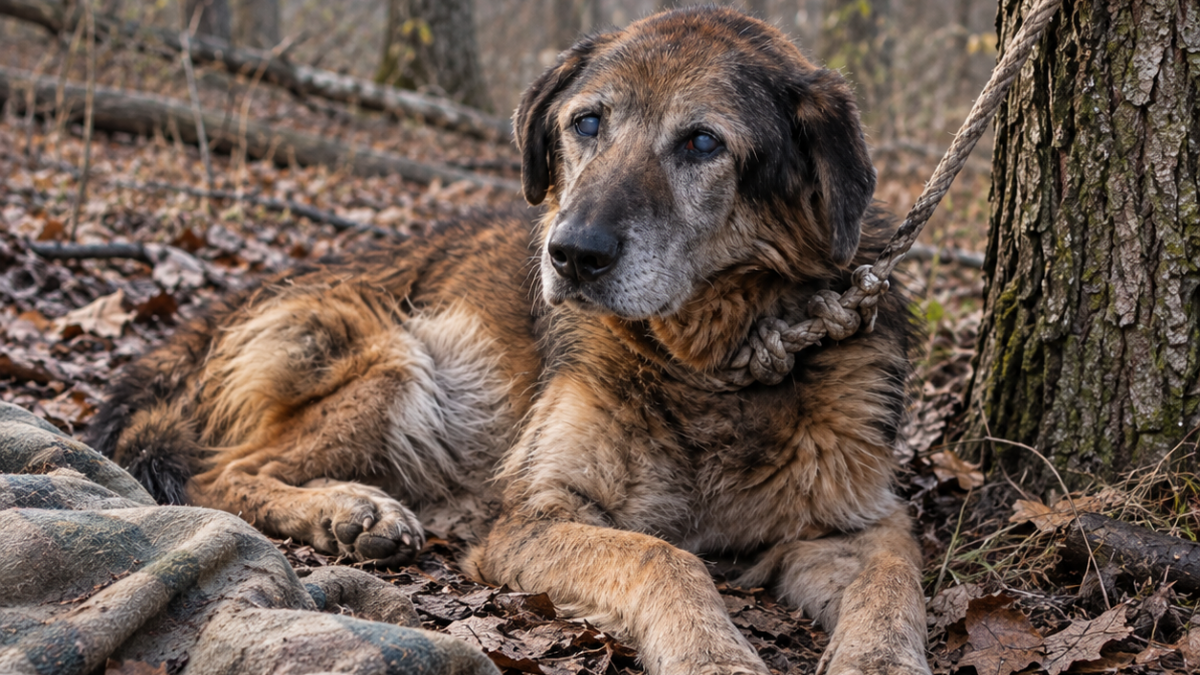
“Lada was found tied to a tree.”
This time the silence lasted longer.
“I don’t know anything about that.”
“There was a rope secured to her collar.”
“Then somebody found her after she ran away.”
I stepped closer to the phone.
Sarah raised one hand to stop me.
Lada shifted beneath the blanket.
Sarah asked, “Would you like to come here and identify her?”
“No.”
That single word carried more finality than anything else he had said.
“No?”
“I’ve got enough going on.”
Sarah’s jaw tightened.
“Mr. Markham, she is critically underweight and dehydrated.”
“Then give her to the shelter.”
“She may require hospitalization.”
“I’m not paying for it.”
I had heard enough.
“Give me that phone.”
Sarah shook her head.
Dale continued.
“My mother wanted that dog. I didn’t. I’ve got a house to clear, bills, lawyers, funeral expenses. I’m done dealing with it.”
Sarah’s expression changed.
“You are saying you do not want custody of Lada?”
“That’s what I’m saying.”
“Will you sign a surrender?”
“Send me whatever.”
Then he hung up.
I stood there staring at the phone.
Sarah slowly set it down.
Neither of us spoke for several seconds.
Finally I said, “He knew.”
“We don’t know that.”
“He knew.”
“We know he says she ran away.”
“She was tied to a tree with a rope.”
“I know.”
“You heard him.”
“I heard him.”
“Then call the police.”
Sarah folded her arms.
“We call animal control and document everything properly.”
I hated the word properly.
At that moment I wanted something immediate.
I wanted somebody pounding on Dale Markham’s door.
I wanted him standing under bright lights explaining why an old dog who could barely see had been tied in a forest.
But Sarah had worked enough cruelty cases to understand something I did not.
Anger is not evidence.
So we documented.
Every wound.
Every rib.
Every abrasion.
Every blood value.
Every photograph.
The rope stayed in a bag in the cab of my truck until county animal-control officer Rebecca Shaw arrived the next morning to collect it.
Lada stayed at the clinic.
I stayed too.
At least until Sarah finally told me I was making everyone nervous.
“You’re pacing.”
“I’m waiting.”
“For what?”
“I don’t know.”
“That’s the problem.”
I looked through the glass window.
Lada lay beneath a warming blanket with an IV line running into her leg.
Her eyes were closed.
“How bad is she?”
Sarah leaned beside me.
“Her kidneys are stressed from dehydration. She’s anemic. Her body condition is poor. She has severe arthritis in her hips, and her eyesight is probably down to light and movement.”
“Will she live?”
“I think she can.”
“You think?”
“She’s old, Walter.”
“I noticed.”
“She’s also tougher than she looks.”
That was the first thing anyone said that gave me real hope.
I returned the next morning before the clinic opened.
Lada heard my boots in the hallway.
Her head lifted.
Then her tail moved.
Once.
Twice.
Sarah caught me smiling.
“She knows you.”
“She knows the sound of an old man breathing too hard.”
“She was sleeping until you walked in.”
I opened the kennel.
Lada pushed her muzzle into my hand.
“Morning, girl.”
Her tongue brushed my wrist.
She ate three spoonfuls of soft food that morning.
Five that afternoon.
Sarah told me not to make too much of it.
I made too much of it.
By the third day, Lada could stand if someone supported her hindquarters.
By the fourth, she walked six unsteady steps across a rubber mat.
She could not see where she was going, so I stayed in front of her and talked.
“Come on.”
Step.
“That’s it.”
Step.
“Over here.”
Her ears followed my voice.
That became our system.
She did not need sight if she knew where I was.
Meanwhile, Rebecca began investigating.
She visited Helen Markham’s house.
Dale was there with his wife, Christine, sorting furniture into piles for donation, sale, and disposal.
According to Rebecca, Dale repeated the same story.
Lada had escaped through an open gate.
He had been busy.
He had assumed somebody would find her.
“Did your mother keep her outdoors?” Rebecca asked.
“No.”
“Was Lada able to navigate outside alone?”
“She knew the yard.”
“She is nearly blind.”
“She wasn’t completely blind.”
“When did you last see her?”
Dale hesitated.
“Six days ago.”
“What day?”
“Tuesday, maybe.”
“Was she wearing the collar she has now?”
“I guess.”
“Do you recognize this rope?”
Rebecca showed him a photograph.
Dale said no.
Then Christine walked through the room carrying a box.
She glanced at the image.
According to Rebecca, her face changed.
Only for a second.
But investigators are trained to notice seconds.
Rebecca asked, “Ma’am, have you seen this rope?”
Christine stopped.
“No.”
“You looked like you recognized it.”
“I didn’t.”
Dale interrupted.
“My wife doesn’t know anything about the dog.”
Rebecca ended the interview soon after.
But before leaving, she noticed something in the garage.
A spool of rope.
Yellow polypropylene.
The same color and thickness as the rope found around Lada’s collar.
That alone proved nothing.
Half the farms in our county had that kind of rope.
But it was something.
Then Rebecca found out about the blanket.
The old plaid blanket found beneath Lada had been photographed at the scene.
Marisol—Helen’s next-door neighbor—recognized it immediately after seeing a community notice about the abandoned dog.
“That was Helen’s porch blanket,” she told Rebecca.
“How are you sure?”
“She kept it on Lada’s bed every winter.”
Marisol found an old photograph on her phone.
Helen sat on the porch beside Lada.
Under the dog was the same red-and-green plaid blanket.
That photograph did not prove who put it in the woods.
But it proved that whoever took Lada there had access to Helen’s home.
Then came the part nobody expected.
Helen Markham had left a will.
I learned about it because an attorney named David Mercer called the clinic looking for Lada.
Sarah passed the phone to me.
“Mr. Mason?”
“Yes.”
“My name is David Mercer. I represented Helen Markham.”
“All right.”
“I understand you found her dog.”
“I did.”
“Is Lada alive?”
The urgency in his voice surprised me.
“Yes.”
He exhaled.
“Thank God.”
“Why are you looking for her?”
A pause.
“Because Lada is mentioned in Helen’s estate documents.”
I sat down.
“How?”
“Helen was very concerned about what would happen to Lada after her death.”
I looked through the clinic window.
Lada was sleeping.
“What did she arrange?”
“A pet trust.”
I had heard the term but never dealt with one.
David explained.
Helen had set aside forty thousand dollars specifically for Lada’s care.
Veterinary expenses.
Food.
Medication.
Housing.
Whatever remained after Lada’s death would pass to a local animal shelter.
I let out a slow breath.
“So Dale knew?”
“Yes.”
My stomach tightened.
“What else?”
David hesitated.
“Helen’s house and most of her remaining estate were left to Dale. But she included conditions about Lada’s placement.”
“What conditions?”
“Dale was not required to keep the dog himself. Helen knew he didn’t want her. But he was required to contact me after Helen’s death so I could arrange placement with one of three people she had named.”
“Did he?”
“No.”
“What did he tell you?”
“That Lada had run away.”
“When?”
“Four days after Helen died.”
“And you believed him?”
“At first.”
I stood.
“Why are you calling now?”
“Because I saw the county shelter notice.”
The room seemed to shrink.
A nearly blind old dog.
A trust worth forty thousand dollars.
A son who did not want the dog.
A claim that she conveniently disappeared.
I said the thought aloud.
“If Lada disappeared, what happens to the trust?”
“It depends.”
“Tell me.”
“If Lada were confirmed dead, remaining funds would pass to the shelter.”
“What if nobody could find her?”
“The trustee would hold the funds while making reasonable efforts to locate her.”
“So Dale couldn’t get the forty thousand.”
“No.”
That disappointed the ugly theory forming in my head.
Then David continued.
“But there’s another issue.”
“What?”
“Helen’s will contains a specific bequest to Dale for sixty thousand dollars contingent upon his cooperation with Lada’s transfer.”
I went quiet.
“He gets sixty thousand if he makes sure the dog is placed?”
“Yes.”
“And if he doesn’t?”
“The bequest passes to the same shelter.”
I gripped the phone.
“So if he says the dog escaped after his mother died?”
“That creates a legal dispute.”
“Could he still get the money?”
“He intended to argue that the condition became impossible because Lada disappeared through no fault of his own.”
There it was.
Not proof.
But motive.
I felt sick.
David must have heard something in my breathing.
“Mr. Mason, please understand. We still don’t know what happened.”
“I found her tied to a tree.”
“I know.”
“She was too weak to stand.”
“I know.”
“She can barely see.”
“I know.”
“And he said she ran away.”
David was quiet.
Then he said, “That is why I’m contacting the authorities.”
The investigation changed after that.
Rebecca obtained the estate documents.
She interviewed David.
She interviewed the neighbor.
She requested security footage from several businesses near Fox Hollow Road and the state forest.
There were no cameras on the forest trail itself.
But there was one at a gas station two miles away.
Dale drove a dark blue Ford pickup.
At 5:41 p.m. on the evening Lada likely disappeared, that truck passed the gas station heading toward the forest.
At 6:12, it passed again heading back.
The footage was grainy.
No dog was visible.
No rope.
No blanket.
But the timing fit.
Dale told Rebecca he had been at his mother’s house all evening.
Now there was a contradiction.
His lawyer quickly explained that Dale had gone to “dispose of household rubbish.”
That could be true.
The road to the county transfer station also branched from the same highway.
But the transfer station closed at five.
Rebecca kept digging.
And while she investigated, Lada came home with me.
Not permanently.
At least that was what I told everyone.
Sarah wanted her in a quiet foster environment.
The shelter kennels would be too loud, and Lada’s blindness made sudden sounds frightening.
My house was quiet.
Too quiet, according to my daughter.
So I became Lada’s temporary foster.
I drove her home on a Friday afternoon.
She stood in my kitchen and froze.
Her nose worked constantly.
New floor.
New air.
Wood smoke.
Coffee.
Old furniture.
Me.
I kept her leash loose.
“Kitchen,” I said.
Her ears turned.
“That’s the refrigerator.”
I tapped it twice.
“That’s important.”
Her tail moved.
I walked slowly.
“This way.”
She followed my voice.
“Hallway.”
Three steps.
“Living room.”
She bumped lightly against the couch.
I touched her shoulder.
“Easy.”
I placed rugs along every path she would use.
Kitchen to water.
Water to bed.
Bed to back door.
I moved the coffee table.
Covered sharp corners.
Put a gate across the basement stairs.
At seventy-one, I had never imagined spending Friday night crawling around my house checking furniture height for a blind German Shepherd.
Lada approved none of it.
She wanted my chair.
The first evening she walked directly to the old recliner where I had sat for twenty years.
She sniffed the cushion.
Then climbed onto my feet.
“You have an entire bed.”
She sighed.
“Expensive orthopedic bed.”
Nothing.
“You’re ignoring me.”
Her head settled across my slippers.
That was that.
The first night was difficult.
Lada woke every hour.
She would raise her head and whimper.
Each time I spoke.
“I’m here.”
She settled.
An hour later.
Whimper.
“I’m here.”
By three in the morning, I dragged a mattress pad onto the living-room floor beside her.
She slept five straight hours with one paw touching my arm.
The next night, I moved back to my bedroom.
At 1:17 a.m., I heard nails clicking across the hallway.
Slowly.
Carefully.
Lada appeared in the doorway.
She stood there, cloudy eyes pointed toward nothing.
“Lada?”
Her tail wagged.
I patted the rug beside the bed.
“This way.”
She followed my voice.
I helped her settle.
After that, she slept beside my bed every night.
My daughter, Rachel, came over Sunday.
She opened the front door.
“Dad?”
Lada barked.
Not aggressively.
One deep warning bark.
Rachel froze.
I laughed.
“What?”
“You have a dog.”
“Temporarily.”
Rachel looked at the dog bed.
The water station.
The rugs.
The bag of senior-dog food.
The bottle of arthritis medication on my counter.
“Temporarily?”
“Yes.”
She stared at me.
“Dad, you haven’t bought yourself a new coat in nine years, but that dog has a heated orthopedic mattress.”
“She’s old.”
“So are you.”
“That’s disrespectful.”
Lada walked toward Rachel.
Rachel crouched.
“Hey, beautiful.”
Lada sniffed her hand.
Then leaned into her.
Rachel’s expression softened.
“Oh.”
That sound told me I was not the only one already in trouble.
Over the following weeks, Lada improved.
Not dramatically.
She did not become young.
Her sight did not return.
Her arthritis remained.
But she gained eight pounds.
Then twelve.
Her coat thickened.
The rope wound healed.
She learned the house.
She knew the kitchen by smell.
The porch by texture.
The backyard by the sound of the wind against the fence.
She learned that three taps on my leg meant step closer.
Two taps meant stop.
A clap meant turn toward me.
At night she slept deeply.
Sometimes she dreamed.
Her paws moved.
Her muzzle twitched.
The first time she barked in her sleep, I woke with my heart hammering.
I rested my hand on her shoulder.
“Easy.”
She woke.
Sniffed.
Then pushed her face under my hand.
She trusted me completely.
That terrified me.
Because once an old dog gives you that kind of trust, you begin living with the knowledge that time is not on your side.
The investigation continued.
Rebecca called one afternoon.
“We found a witness.”
I sat straighter.
“Who?”
“A forestry worker.”
He had been repairing a damaged trail marker near the east access road on the evening Lada was abandoned.
He remembered a blue pickup parked where vehicles were prohibited.
“I saw a man walking into the woods,” he told Rebecca.
“Did you see the dog?”
“No.”
“Anything in his hands?”
“Something red.”
A blanket.
Maybe.
He described the man.
Middle-aged.
Heavyset.
Dark jacket.
Baseball cap.
Dale was middle-aged and heavyset.
So were hundreds of men.
Rebecca showed him a photographic lineup.
The worker identified Dale.
Not with absolute certainty.
But he said, “That’s the guy I think I saw.”
The case strengthened.
Then Christine called animal control.
Dale’s wife.
She wanted to change her statement.
Rebecca met her privately.
Christine cried through most of the interview.
According to her, she had not gone into the woods.
But she had seen Dale put Lada into the truck.
“Why?” Rebecca asked.
“He said he was taking her to a shelter.”
“Which shelter?”
“He didn’t say.”
“Did you ask?”
“No.”
“When did he return?”
“Maybe forty minutes later.”
“Was the dog with him?”
“No.”
“What did he say?”
“He said it was handled.”
“Did you know Lada was tied in the woods?”
“No.”
“Did you recognize the rope?”
Christine covered her face.
“Yes.”
That was why her expression had changed when Rebecca showed the photograph.
The yellow rope came from Helen’s garage.
Dale had used it to secure boxes in his truck.
“Why did you lie?”
Christine whispered, “Because he told me it was already bad enough.”
Rebecca asked, “Bad enough for whom?”
Christine did not answer.
The final piece came from Dale himself.
Not in an interview.
In a text message.
Christine gave investigators permission to review a conversation on her phone from that evening.
At 6:26 p.m., she had sent:
**Where did you take her?**
Dale replied:
**Out past Ridge Trail. Someone will find her.**
Christine:
**You said shelter.**
Dale:
**I’m not dealing with that dog anymore.**
Christine:
**Mom would hate this.**
Dale:
**Mom’s gone.**
That last message turned my stomach.
Helen was gone.
So Dale had decided her promise no longer mattered.
But Helen had left documents.
A lawyer.
A trust.
A plan.
And Lada had lived long enough for all of it to matter.
Dale was charged with animal cruelty and abandonment.
The estate dispute became separate.
His attorney argued that he had been overwhelmed by grief, the responsibility of closing his mother’s home, and the costs associated with the dog.
The prosecutor argued something simpler.
He had options.
He knew about the attorney.
He knew his mother had arranged for Lada’s care.
He had been specifically instructed to contact David Mercer.
He did not.
Instead, he drove a nearly blind elderly dog into the woods, tied her to a tree, left no food or water, and went home.
The sixty-thousand-dollar conditional bequest became the ugliest detail.
Dale insisted money had nothing to do with his decision.
Maybe that was true.
Nobody could prove what was in his mind.
The prosecutor did not need to.
The cruelty case was about what he did.
Not why.
But the probate judge had a different question.
Had Dale fulfilled Helen’s condition?
Obviously not.
David Mercer petitioned the court to deny the conditional bequest.
Dale fought it.
That was when things became ugly.
His lawyer argued that the condition only required reasonable cooperation and that Dale had intended to surrender Lada before she “unexpectedly escaped.”
David produced the text messages.
The room went silent.
Dale’s attorney asked for time to review them.
The judge read the printed page twice.
Then she looked at Dale.
“You represented to this court that the animal escaped.”
Dale shifted.
“My attorney—”
“I am speaking to you.”
He stopped.
“Did you take the dog to Ridge Trail?”
Dale looked toward his lawyer.
The judge said, “You may consult counsel.”
They whispered.
Then Dale answered.
“Yes.”
“Did you tie her to a tree?”
Another pause.
“Yes.”
I sat in the back row with Rachel.
My hands were clenched so tightly my knuckles hurt.
The judge asked, “Why?”
Dale swallowed.
“I didn’t know what else to do.”
David Mercer visibly stiffened.
The judge continued.
“Your mother’s attorney had instructions to place the dog.”
“I was overwhelmed.”
“You knew this?”
“I knew there was paperwork.”
“Did you call Mr. Mercer?”
“No.”
“Did you call an animal shelter?”
“No.”
“Animal control?”
“No.”
“A veterinarian?”
“No.”
“Any rescue organization?”
“No.”
The judge folded her hands.
“Yet you drove more than eleven miles into a forest.”
Dale looked down.
That sentence stayed with me.
He had claimed he did not know what to do.
Yet he had known how to load Lada into a truck.
Find a remote trail.
Carry a blanket.
Take rope.
Tie a knot.
Drive away.
Helplessness can explain hesitation.
It cannot explain preparation.
The court denied him the sixty-thousand-dollar bequest.
The money went to the local shelter under Helen’s will.
Dale also lost reimbursement he had sought from the pet trust for expenses he claimed to have incurred caring for Lada after Helen’s death.
There were no legitimate receipts.
The trust remained intact for Lada’s care.
When David told me, I said, “Good.”
Then I felt guilty.
Not because Dale deserved the money.
Because satisfaction over money seemed small compared with what Lada had endured.
David understood.
“Helen anticipated many things.”
“Did she anticipate her son tying Lada to a tree?”
“No.”
“Then why the condition?”
David sighed.
“She worried he would resent responsibility for the dog.”
“She was right.”
“Yes.”
“What was Helen like?”
That question changed the conversation.
David smiled faintly.
“Stubborn.”
“Like Lada?”
“Probably worse.”
He told me Helen had adopted Lada when the dog was four.
Lada had been surrendered after her original owner moved overseas.
Helen was already in her seventies.
Friends told her adopting a young German Shepherd was ridiculous.
She did it anyway.
Lada slept beside Helen during chemotherapy.
Later, when Helen’s eyesight began failing, Lada learned naturally to stay close on walks.
Then age reversed their roles.
Helen recovered enough vision after surgery.
Lada developed cataracts.
Helen became Lada’s guide.
“She loved that dog,” David said.
“I can tell.”
“She made me rewrite the trust language three times.”
“Why?”
“She thought the first draft sounded too clinical.”
I laughed.
“What did she want?”
“She wanted it clear that Lada was family.”
I looked across my living room.
Lada was asleep near the woodstove.
Family.
That word had become complicated.
The criminal case resolved several months later.
Dale entered a guilty plea to animal-cruelty and abandonment charges.
The court ordered probation, community service, restitution toward veterinary expenses not covered by the trust, mandatory counseling, and a multi-year prohibition on owning or possessing animals.
There was also a brief jail sentence under the agreement.
Some people wanted more.
Some wanted less.
For me, the most important part came when the judge spoke about responsibility.
“You were not ordered to keep this animal,” she said. “You were given options specifically designed to relieve you of that responsibility. You chose abandonment instead.”
Dale stared at the floor.
The judge continued.
“Age, blindness, illness, inconvenience, or expense do not erase an animal’s dependency on the person controlling its fate.”
I looked at Lada’s photograph in my hand.
She was not in court.
I refused to bring her.
She had spent enough time in places built around Dale’s choices.
She was home.
In my house.
Probably asleep in my chair.
That was where she belonged.
After court, reporters waited on the courthouse steps.
I had no interest in speaking.
One woman followed me.
“Mr. Mason, do you think justice was served?”
I stopped.
There were a hundred angry things I could have said.
Instead I answered, “Justice would have been him making one phone call before tying her to that tree.”
Then I walked away.
The legal fight was over.
But one question remained.
Who would keep Lada?
Technically the trust allowed David to choose among Helen’s designated placements.
Two of the three people on Helen’s list were no longer able to take a large elderly dog.
The third lived across the country and had recently entered assisted living.
David visited my house one afternoon.
He wore a suit entirely inappropriate for muddy Pennsylvania in March.
Lada met him at the door.
She sniffed his trousers.
Then his shoes.
Then she froze.
David crouched.
“Hello, Lada.”
Her ears lifted.
Something changed.
She stepped closer.
David’s eyes filled.
“She remembers me.”
“You knew her?”
“I handled Helen’s paperwork at the house many times.”
Lada pressed her muzzle into his chest.
He laughed quietly.
“Well, that answers that.”
We sat at my kitchen table.
David opened a folder.
“I have authority as trustee to determine placement.”
I knew what was coming and suddenly became afraid.
“Okay.”
“You’ve fostered her for nearly five months.”
“She’s doing well.”
“I can see that.”
“She knows the house.”
“Yes.”
“She knows the property.”
“Yes.”
“She sleeps through the night now.”
“Walter.”
“What?”
“Would you like to adopt her?”
I looked toward Lada.
She was standing at the kitchen doorway.
My throat tightened.
“She’s old.”
David smiled.
“So are you.”
“Everyone thinks that joke is funny.”
“It’s a little funny.”
“What happens if I die first?”
That was the question that mattered.
At seventy-one, I did not believe in pretending time belonged only to dogs.
David nodded.
“We plan for it.”
Rachel had already volunteered.
I had not asked her.
She told me.
“If anything happens to you, she comes with me.”
So we wrote it down.
Lada’s trust would cover her ongoing medical care.
If I died or became unable to care for her, Rachel would assume responsibility.
The remaining funds after Lada’s death would still go to the shelter.
David slid the adoption papers across the table.
“Sign here.”
I stared at the line.
“Is that it?”
“Legally, yes.”
I signed.
Lada was mine.
Or I was hers.
The distinction seemed pointless by then.
Rachel brought a cake that evening.
“For what?”
“Adoption day.”
“She can’t eat cake.”
“It’s for us.”
“Then why does it say LADA?”
“Because she can’t read.”
Lada barked from the living room.
Rachel laughed.
“She disagrees.”
We took a photograph.
I sat on the porch steps.
Lada stood beside me.
Rachel held the camera.
“Look this way.”
“I am.”
“I mean Lada.”
“She can’t see the camera.”
Rachel lowered it.
“Right.”
I laughed.
“Just take the picture.”
The photograph caught me looking down at Lada while she looked toward my voice.
It became the best photograph I owned.
Spring arrived.
Then summer.
Lada loved the yard.
At first I kept her on a long line because of her vision.
Eventually she learned the perimeter.
I placed wind chimes beside the porch.
A small bell near the back gate.
Gravel along the fence line.
Different textures helped her map the world.
She moved confidently.
Not quickly.
But with purpose.
Every morning we walked to the edge of the forest.
Never back to the tree.
I did not know whether she would remember.
I did not want to find out.
Instead we used the western trail.
I talked constantly.
“Root.”
Step.
“Left.”
Turn.
“Good girl.”
Sometimes hikers passed us.
People recognized her.
“Is that Lada?”
Her story had traveled farther than I expected.
They would crouch.
She would sniff them.
Usually accept a scratch.
Then continue.
She had no interest in becoming famous.
Her priorities were simpler.
Breakfast.
Me.
Shade.
Chicken.
Rachel.
Naps.
She developed a deep hatred of the vacuum cleaner.
She loved watermelon.
She snored loudly enough to wake herself.
She stole one of my socks every afternoon and carried it to her bed.
Not shoes.
Not towels.
Only socks.
I accused Rachel of teaching her.
Rachel accused my feet of being irresistible.
Life became ordinary.
That is the part of rescue stories people skip.
Everyone loves before and after photographs.
But the real miracle is what happens between them.
Medication at 7 a.m.
A muddy paw on clean pants.
A veterinarian bill.
A slow walk around the yard.
A dog waiting beside the bathroom because apparently privacy has ended.
Ordinary is what abandoned animals were denied.
Ordinary was everything.
One afternoon, almost a year after I found her, a letter arrived.
It was addressed to me.
The return address belonged to Dale Markham.
I almost threw it away.
Instead I placed it on the table.
It sat there for three days.
Finally Rachel saw it.
“You going to open that?”
“I don’t know.”
“Want me to?”
“No.”
“You want me to burn it?”
I considered that.
“No.”
That evening, Lada slept at my feet while I opened the envelope.
Dale’s handwriting was neat.
He did not ask forgiveness.
At least not directly.
He wrote that jail had given him too much time to replay the night in the woods.
He said his mother had loved Lada more openly than she had ever understood how to love people.
He admitted resenting the dog.
Especially during Helen’s final months.
Lada received patience from Helen that Dale believed he had never received.
I stopped.
That was not the explanation I expected.
Dale wrote that after Helen died, every object in the house made him angry.
Her clothes.
Her medicine.
Her photographs.
And Lada.
The old dog searched room after room for Helen.
At night she cried outside Helen’s bedroom.
Dale could not stand the sound.
Then David called about the trust and placement arrangements.
Dale interpreted it as one final command from his mother.
One more responsibility.
One more reminder that Helen had planned more carefully for her dog than for the relationship with her son.
He knew this was irrational.
He knew Lada had done nothing.
But resentment became cruelty.
He put her in the truck.
He drove.
He told himself someone would find her.
He chose the blanket because it was cold.
He chose the tree because it was near a trail.
He left without food or water because he planned to be gone “only a few hours before someone came.”
I had to stop reading.
That phrase made me furious.
People always imagine rescue arriving immediately.
As though suffering exists on a schedule.
As though the world guarantees a kind stranger before darkness.
It does not.
If I had taken my usual path that evening, Lada might have spent another night tied to that tree.
Maybe two.
Maybe she would have died before anyone came.
Dale continued.
**I told myself leaving the blanket meant I wasn’t a cruel person. I see now that I was using one small kindness to excuse something cruel.**
That sentence stayed with me.
Because it was honest.
Not enough.
But honest.
At the end, he wrote:
**I don’t expect you to answer. I only want to know whether she is okay.**
I looked down.
Lada was sleeping.
Her back paw twitched.
I could have ignored him.
Part of me wanted to.
Instead I took a sheet of paper.
I wrote:
**Lada is alive. She is safe. She gained weight. Her neck healed. She knows the house and yard even though she can barely see. She sleeps beside my bed.**
I stopped.
Then added:
**She still trusts people.**
That was the sentence I wanted him to carry.
Not because it forgave him.
Because it showed how little his cruelty had managed to take from her.
I mailed the letter.
I never expected a reply.
None came.
Another year passed.
Lada turned, according to Sarah’s best estimate, thirteen.
Then fourteen.
Her arthritis worsened.
We added medication.
A ramp replaced the porch steps.
Her hearing began fading too.
That frightened me more than the blindness.
Our system depended on my voice.
So we created a new one.
I tapped the floor.
She felt vibrations.
One stomp meant stop.
Two meant come toward me.
A gentle touch to her left shoulder meant turn left.
Right shoulder meant right.
People asked whether caring for her was difficult.
Yes.
Sometimes.
But difficult is not the same as regrettable.
My wife Ellen had needed help during her final year too.
Bathing.
Medication.
Appointments.
Lifting.
Waiting.
Loving someone vulnerable changes the mechanics of your life.
It does not reduce their value.
Lada taught me that twice.
The second lesson came from me.
After Ellen died, I had stopped doing many things.
I stopped fishing.
Stopped attending church regularly.
Stopped accepting dinner invitations.
I told myself I preferred quiet.
The truth was uglier.
Grief had turned my life into a waiting room.
I woke.
Collected wood.
Ate.
Slept.
Repeated.
Then I found an old dog tied to a tree.
Suddenly someone needed breakfast at seven.
Medication at eight.
A walk before rain.
A veterinarian appointment Thursday.
A bath Saturday.
There were reasons to look at the clock again.
Reasons to come home.
Rachel noticed.
“You’re different,” she said one afternoon.
“How?”
“You complain more.”
“That sounds worse.”
“You have more things to complain about.”
She smiled.
“You’re living again.”
I looked toward Lada.
She was asleep in sunlight.
Maybe the random trail choice had changed two lives after all.
Three years after her rescue, David Mercer called.
The shelter had used Dale’s forfeited bequest to renovate its senior-dog wing.
They wanted to name one room after Helen and Lada.
I laughed.
“What would Lada think?”
“She’d probably prefer chicken.”
“That’s accurate.”
We attended the opening.
I nearly skipped it because crowds tired Lada.
But Sarah told me, “Bring her for ten minutes. If she gets overwhelmed, leave.”
So we went.
The plaque read:
**THE HELEN & LADA SENIOR CARE ROOM
For animals who still have life left to live.**
I traced the words.
For animals who still have life left to live.
Helen’s money, which Dale had fought to receive, was now paying for heated floors, quiet kennels, orthopedic beds, and medical care for old dogs people often overlooked.
If someone insisted on calling that revenge, I would not argue.
But it was better than revenge.
It was repair.
A volunteer guided us into the room.
Four elderly dogs were already housed there.
One slept.
One barked.
One stared suspiciously at everyone.
The fourth was a skinny hound with cloudy eyes.
Lada stopped.
She smelled him.
The hound approached.
Their noses touched.
I had to look away.
Rachel whispered, “Dad?”
“I’m fine.”
“You’re crying.”
“Dust.”
“Inside a new building?”
“Construction dust.”
She let me lie.
Later that year, I received another letter from Dale.
This time he was out of jail and still under probation.
He had heard about the senior room.
He wrote only two paragraphs.
The first said he had started fulfilling his community-service hours at a food pantry rather than an animal organization because the court believed animal placement was inappropriate.
The second said:
**I used to think losing the money was punishment. It wasn’t. Seeing what my mother wanted that money to become is harder. She wanted care to continue after she was gone. I almost stopped that because I was angry at a dead woman.**
I did not answer.
I did not need to.
Forgiveness is not always a conversation.
Sometimes accountability is enough.
Sometimes distance is healthier.
Lada had no obligation to become the bridge between us.
She had already carried enough of his family’s pain.
Her job was to sleep.
Eat.
Walk.
Age.
Be loved.
At fifteen, Lada slowed dramatically.
Sarah warned me.
“We are entering a different stage.”
“I know.”
“You need to watch quality of life.”
“I know.”
“Walter.”
“I said I know.”
She reached across the exam table.
“I’m not accusing you of holding on too long.”
“Not yet.”
“No.”
I hated that conversation.
Every person who loves an old dog eventually learns that rescue is not the promise of forever.
It is the promise of never abandoning them when forever becomes short.
We made a list.
Eating.
Drinking.
Sleeping comfortably.
Interest in family.
Pain control.
Ability to toilet with dignity.
More good days than bad.
For months, Lada stayed comfortably on the good side of that list.
She still loved breakfast.
Still stole socks.
Still pushed against Rachel’s legs when she visited.
Still walked to the backyard on warm mornings.
Then winter came.
Cold was harder.
Some mornings I carried her down the ramp.
She weighed fifty-eight pounds.
My back objected.
Rachel told me to call her.
“I can do it.”
“You’re seventy-five.”
“Again with the age.”
“You threw your back out opening a window.”
“That window was stuck.”
Lada stood nearby, unimpressed.
We bought a lifting harness.
Problem solved.
Spring came again.
Lada reached sixteen.
Sarah called her “ridiculous.”
“What?”
“She’s ridiculous.”
“That’s your medical opinion?”
“She refuses to follow statistics.”
“Good.”
Her sixteenth birthday was invented, of course.
We had no exact date.
Rachel chose May 14 because it was Helen’s birthday.
That felt right.
We gave Lada a small plate of chicken and sweet potato.
No candles.
Her whiskers had turned almost completely white.
Her eyes were pale blue-gray.
She could hear almost nothing.
But when I placed my hand beside her nose, she knew me instantly.
That evening we sat on the porch.
I rested my hand on her shoulders.
“You remember the woods?”
She breathed slowly.
“Probably not.”
I hoped she did not.
“I remember enough for both of us.”
A breeze moved through the trees.
Lada lifted her nose.
Smelled spring.
Then rested her head on my boot.
The moment felt complete.
Not finished.
Complete.
There is a difference.
The final chapter began quietly.
One September morning, Lada did not eat.
That had never happened.
I offered chicken.
Nothing.
Water.
A little.
She tried standing.
Her legs failed.
I sat beside her.
“All right.”
I called Sarah.
We went to the clinic.
Bloodwork showed kidney failure.
Age had finally caught her.
We tried fluids.
Medication.
Two days.
She improved slightly.
Then declined.
On the third morning, Sarah sat with me in the same examination room where Lada had first been treated years earlier.
“I think she’s tired.”
I looked at Lada.
She lay on a blanket.
The rope scar was invisible beneath her fur.
Her body was old now for ordinary reasons.
Not starvation.
Not abandonment.
Time.
“I’m not ready.”
“I know.”
“She ate yesterday.”
“A little.”
“She walked.”
“With help.”
“She wagged her tail.”
Sarah waited.
“She still knows me.”
“I know.”
My voice broke.
“Then how do I do this?”
Sarah’s eyes filled too.
“You do what you’ve been doing since the night you found her.”
“What?”
“Don’t make her carry pain alone.”
That answer destroyed me.
Rachel came.
David came too after I called him.
I did not know why I called him.
Maybe because Helen could not be there.
Maybe because he was one of the last people alive who had known both of them.
We took Lada home.
I wanted her final hours in the place she knew.
Sarah agreed to come that evening if needed.
Lada rested beneath the living-room window.
Rachel sat on one side.
I sat on the other.
For several hours, we did nothing.
That was enough.
At sunset, Lada became restless.
I placed my hand near her nose.
She smelled me.
Her tail tapped once.
I whispered, “I’m here.”
The same words from our first night.
She relaxed.
Sarah arrived after dark.
She examined Lada.
Then looked at me.
I knew.
We moved her onto her favorite blanket beside my chair.
Not the plaid one from the forest.
I had burned that blanket years earlier after the court case.
Maybe that was childish.
I never regretted it.
This blanket was blue.
Clean.
Soft.
Ours.
Rachel held Lada’s paw.
I kept one hand under her muzzle.
Sarah administered a sedative.
Lada’s breathing slowed.
Her body softened.
For the first time in hours, she looked completely comfortable.
I leaned close.
“Good girl.”
Her nose moved.
“You did enough.”
My tears fell onto her fur.
“You don’t have to wait for anybody anymore.”
Her tail moved once.
Barely.
Then she slept.
Sarah gave the final medication.
Lada died with her head in my hands.
Not tied to a tree.
Not alone.
Not thirsty.
Not afraid.
Home.
For several weeks afterward, my house became unbearably quiet.
I removed the medication bottles.
Left the rugs.
Could not move the bed.
For days, I still woke at seven expecting breakfast time.
I would step carefully around the place where her water bowl had been.
Grief is habit continuing after the reason disappears.
Rachel came often.
One afternoon she found me sitting beside Lada’s empty bed.
“You okay?”
“No.”
She sat next to me.
“That’s allowed.”
“I found her for four years.”
Rachel looked confused.
“What?”
“I keep thinking I saved her.”
“You did.”
“No.”
I shook my head.
“I found her for four years.”
Rachel smiled through tears.
“That’s still pretty good.”
It was.
Four winters.
Four springs.
Hundreds of walks.
Thousands of meals.
A ridiculous number of stolen socks.
Four years somebody had tried to erase with one rope.
They failed.
Several months after Lada died, David called.
The pet trust had been closed.
After final veterinary bills, a little over twenty-six thousand dollars remained.
According to Helen’s instructions, it went to the shelter.
They expanded the senior wing again.
This time the director asked me to attend quietly, without press.
I agreed.
Inside the Helen & Lada room, I found six dogs.
One old Labrador.
Two mixed breeds.
A deaf Cocker Spaniel.
A three-legged terrier.
And an elderly German Shepherd.
Female.
Cloudy eyes.
Gray muzzle.
I stopped.
The volunteer beside me said, “Her name’s Molly.”
I could not speak.
Molly approached.
Sniffed my hand.
Then leaned against my leg.
Exactly like Lada.
“No,” I whispered.
The volunteer looked concerned.
“Are you okay?”
“Yes.”
I knelt.
Molly pressed harder.
I laughed through tears.
“No, no, no. I know how this ends.”
Her tail wagged.
The volunteer smiled.
“She’s been here six weeks.”
“Don’t tell me that.”
“Nobody’s interested because she’s twelve.”
“I said don’t tell me.”
“She’s mostly deaf.”
“Stop.”
“She likes older men.”
I looked at her.
“You people are criminals.”
The volunteer laughed.
I visited Molly three times.
Then four.
Rachel found out.
“How temporary is this one?”
“I haven’t adopted her.”
“Yet.”
“I’m seventy-six.”
“Oh, now age matters?”
“That was unnecessary.”
Molly came home the following Thursday.
I told myself Lada would have approved.
Maybe that was sentimental nonsense.
I did not care.
Molly never replaced her.
Nothing could.
Love does not work by substitution.
It expands.
The senior wing continued helping dogs.
The pet-trust story led our county shelter to start a planning program for elderly owners.
Attorneys volunteered.
People created emergency contacts.
Pet trusts.
Backup caregivers.
Written instructions.
The goal was simple.
No animal should be left behind because a human family failed to plan or honor a promise.
Helen had planned.
Dale had failed to honor it.
But in the end, Helen’s plan still reached farther than his cruelty.
Years later, I heard that Dale had completed probation.
He never owned another animal during the prohibited period.
I do not know whether he ever did afterward.
I did not search.
His life no longer belonged in Lada’s story.
That may be the most satisfying consequence of all.
He became a footnote.
Lada became the name on a room.
The face on the shelter’s senior-dog program.
The reason families made plans.
The reason old animals slept on heated floors instead of concrete.
The reason several nearly blind dogs found homes.
The reason I did not spend the final years of my life waiting alone in a quiet house.
People still occasionally ask me whether I hated Dale.
For a while, yes.
I imagined revenge.
I imagined him cold.
Alone.
Afraid.
I wanted him to understand exactly what Lada had felt.
Then I realized something.
If I spent the years Lada had left feeding hatred, I would give him more of her life than he had already taken.
So I chose something else.
I took her home.
I learned how to guide a blind dog.
I bought rugs.
I cooked chicken.
I spoke while walking so she could find me.
I woke at night when she was afraid.
I stayed.
Dale’s punishment belonged to the court.
My answer belonged to Lada.
And my answer was four years of not leaving.
That was enough.
More than enough.
I still walk the forest sometimes.
Not the eastern trail.
For years I avoided it.
Then one autumn morning, long after Lada was gone, I went back.
The oak tree was still there.
Of course it was.
Trees keep no record of what people do beneath them.
The bark had grown around the place where the rope once rubbed.
Leaves covered the ground.
Birds moved overhead.
Nothing remained.
I stood there for a long time.
Then I noticed something near the roots.
A small patch of sunlight had broken through the branches.
For some reason, I laughed.
The last time I had stood in that place, Lada had been too weak to walk.
Nearly blind.
Thirsty.
Waiting for someone who had already decided not to return.
But that was not how her story ended.
She walked hundreds of miles after that day.
Slow miles.
Crooked miles.
Guided by my voice.
She gained weight.
She slept warm.
She learned my house.
She learned Rachel.
She met strangers who were kind.
She became the reason other senior dogs were saved.
She grew older than anyone expected.
She died in a home where every person in the room wanted one more day with her.
I touched the tree once.
Then stepped away.
“No hard feelings,” I said.
The forest did not answer.
I started walking home.
Molly waited there now.
Breakfast would be late.
And old dogs, I had learned, are extremely unforgiving about breakfast.
Halfway down the trail, I thought about the first thing Lada had done when she heard me approaching all those years ago.
She wagged her tail.
That detail still breaks my heart more than the rope.
She had every reason to stop trusting us.
She did not.
Maybe she believed the footsteps belonged to the person who had left her.
Maybe she simply believed footsteps meant someone.
Someone was better than nobody.
Either way, she gave me trust before I had earned it.
So I spent four years earning it.
Every morning.
Every meal.
Every return through the front door.
Every whispered “I’m here.”
And when her final moment came, that was the one promise I had kept completely.
She was not waiting anymore.
She was not tied to anything.
She was not abandoned.
The almost-blind old shepherd somebody left beneath an oak tree had finally learned the sound every discarded animal deserves to know.
The sound of someone coming back.
[END OF FULL STORY]








