PART 2: They Tied a Brick to a Puppy and Set Him Adrift—But the Blue Ribbon Behind His Ear Exposed the Truth
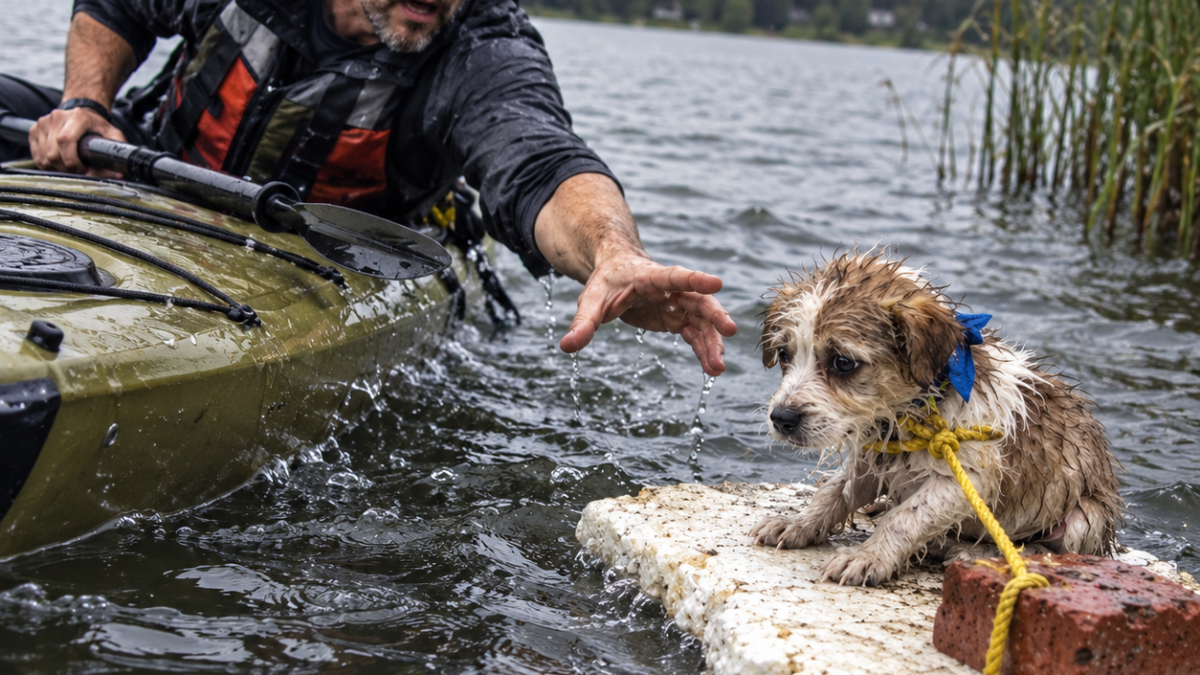
I thought the white shape drifting beside the reeds was a piece of trash until it lifted its head and looked straight at me.
Then I saw the yellow rope around the puppy’s chest, the red brick sliding toward the edge of the foam beneath him, and I realized someone had meant for that little raft to sink.
But it was the faded blue ribbon tied behind his ear—not the brick—that would eventually lead me to the part of the story nobody expected.
I had been paddling alone before sunrise on Lake Bourget, the kind of quiet morning when the water looked almost too peaceful to disturb.
My name is Julien Morel. I was forty-two that spring, living alone outside Aix-les-Bains and earning my living any way the lake allowed—repairing docks, maintaining small boats, guiding tourists in kayaks.
After years on the water, I knew what storms left behind.
Plastic bottles.
Broken foam.
Fishing line.
Pieces of dock.
That was why I almost paddled past the white slab near the reeds.
Then it moved.
Not with the current.
Against it.
A tiny beige-and-white head rose weakly above the edge.
I stopped paddling.
For several seconds, I could not make my mind accept what my eyes were seeing.
The puppy looked no more than three months old.
His fur was soaked flat against his ribs. His ears hung down. His oversized paws were spread wide on the foam as if he understood that one wrong movement could tip everything beneath him.
Then I noticed the rope.
Yellow nylon was wrapped around his chest.
The other end was tied to a red brick resting inches from the edge.
Each small wave shifted the brick.
Each time it moved, the foam dipped lower.
“No,” I whispered.
The puppy turned his face toward me.
He did not bark.
He barely made a sound.
Just a thin breath that somehow sounded more frightened than crying.
The slab tilted.
His back legs slipped into the water.
I threw my paddle across the kayak and jumped.
The cold hit my chest so hard I gasped.
Behind me, the kayak rocked wildly.
The puppy panicked when he saw me coming.
“Easy,” I said. “Easy, buddy. I’m coming.”
The brick scraped across the foam.
That sound still visits me.
I grabbed the slab with one hand and pulled the small rescue knife from my vest with the other.
The rope had swollen from the water.
My fingers were numb.
The knife kept slipping.
“Come on.”
The foam sank another inch.
The puppy’s paws clawed at the surface.
“Stay with me.”
I cut harder.
The rope finally snapped.
The brick disappeared beneath the water so quickly it barely splashed.
The puppy did not celebrate.
He did not jump into my arms.
He simply flattened himself against the foam as though his body still expected the weight to pull him under.
I lifted him carefully.
He was freezing.
And much too light.
I pressed one hand against his ribs because for a terrifying second I could not tell if he was breathing.
Then I felt it.
A heartbeat.
Fast.
Fragile.
Still there.
That was when I noticed something behind his right ear.
A small strip of blue fabric had been tied gently around a lock of fur.
It was dirty and faded, but the knot was deliberate.
Not tight enough to hurt him.
Not random enough to have gotten there by accident.
I touched it.
The puppy flinched.
“Who put this on you?”
He stared at me.
I carried him back toward the kayak, keeping him against my chest.
Halfway there, I looked once more at the spot where the brick had vanished beneath the lake.
Someone had tied that weight to him.
Someone had placed him on the foam.
Someone had pushed him onto open water.
But someone else, I was beginning to suspect, had touched him gently enough to tie a blue ribbon behind his ear.
At the time, I had no idea those two acts belonged to the same night.
I had no idea a frightened teenager was already hiding a secret about this puppy.
And I certainly did not know that the little blue ribbon in my hand would eventually force an entire family to answer one question they had tried desperately to bury.
I only knew the puppy was alive.
And I had arrived just before the lake took him.
PART 2
The veterinarian took one look at the puppy and stopped asking questions.
“Treatment room. Now.”
I stood in the hallway dripping lake water onto the tile while two technicians wrapped him in heated blankets.
One clipped fur from his front leg.
Another placed a catheter.
The puppy did not struggle.
That frightened me more than anything.
Healthy puppies fight inconvenience.
They squirm.
They cry.
They bite thermometers.
This one simply lay there.
Dr. Élodie Martin pressed a stethoscope against his chest.
“How long was he in the water?”
“I don’t know.”
“You found him floating?”
“On a slab of foam.”
She looked up.
“What happened?”
“There was a brick tied to him.”
Her hands stopped.
“A brick?”
“With rope.”
For a second, her professional expression disappeared.
Then she went back to work.
“Did you bring the rope?”
“Part of it is still around him. The rest went down with the brick.”
“Where exactly?”
I gave her the location.
She nodded toward a technician.
“Contact the authorities.”
Then she looked back at me.
“He’s cold, dehydrated, and exhausted. His breathing sounds clear, which is good. I don’t feel any obvious fractures.”
“Is he going to live?”
She hesitated only a moment.
“I think he has a good chance.”
My legs weakened so suddenly I had to sit down.
Good chance.
Two words.
That was all I needed.
They dried him.
Warmed him.
Gave him fluids.
Cleaned the skin beneath the rope, where yellow nylon had rubbed a raw line around his chest.
When Dr. Martin came back almost forty minutes later, I was still wearing wet shoes.
“He’s stable.”
I exhaled.
“He has mild hypothermia, dehydration, and some skin irritation. He’s underweight, but not dangerously so. No sign of water in his lungs at the moment.”
“So he’s lucky.”
She looked toward the treatment room.
“I’d say somebody found him in time.”
I thought about that brick sliding toward the edge.
One more wave.
Maybe two.
“I nearly paddled past.”
“But you didn’t.”
She handed me a plastic evidence bag.
Inside was the cut section of yellow rope.
“We’re preserving this. The police may want it.”
“What about the ribbon?”
Her eyes shifted toward the blue fabric.
“I left it in place.”
“Why?”
“Because I suspect it may matter.”
I stared through the glass.
The puppy slept beneath a heated blanket.
Behind his ear, that tiny blue ribbon looked absurdly bright against wet beige fur.
“Do you think whoever tied the brick put that there?”
“I don’t know.”
Neither did I.
But something about it bothered me.
Cruelty usually leaves ugly marks.
Knots pulled tight.
Ropes biting skin.
Fear.
The ribbon looked different.
It had been tied loosely.
Almost carefully.
As if whoever touched him then had wanted him to know something gentle before something terrible happened.
That thought stayed with me all day.
The clinic reported the incident.
A local officer named Laurent Besson arrived that afternoon.
He was in his fifties, broad-shouldered, calm, the kind of man who seemed incapable of raising his voice because he did not need to.
I explained everything.
He wrote slowly.
“You saw anyone nearby?”
“No.”
“Boats?”
“None close enough.”
“Vehicles near the shoreline?”
“I wasn’t looking.”
He glanced at the puppy.
“He have a chip?”
“No.”
“Collar?”
“No.”
“Anything else?”
“The ribbon.”
Laurent leaned closer.
Blue cotton.
Faded at the edges.
Hand-tied.
He did not touch it.
“Interesting.”
“That’s what everyone keeps saying.”
“It may mean nothing.”
“And it may not.”
He gave me the smallest smile.
“Exactly.”
The puppy stayed overnight.
I went home.
Or at least I tried.
My house felt wrong without him.
That made no sense.
I had known him for less than three hours.
Still, every time I closed my eyes, I saw the foam sinking.
The brick scraping.
Those enormous puppy paws spread desperately apart.
At midnight, I got out of bed and made coffee.
At two, I was still awake.
At four, I stopped pretending I would sleep.
At seven-thirty, my phone rang.
Dr. Martin.
“He ate.”
I smiled into the darkness of my kitchen.
“How much?”
“Enough to make himself unpopular with the technician who wanted to remove the bowl.”
I laughed.
That was the first moment I believed he might truly be okay.
When I picked him up that afternoon, he looked different.
Still weak.
Still cautious.
But awake.
His eyes followed me.
“Looks like you’ve been causing trouble,” I told him.
His tail moved once.
Dr. Martin handed me medications and instructions.
“Small meals. Keep him warm. No swimming.”
I stared at her.
She stared back.
“That was a joke.”
“I know.”
“Your face suggests otherwise.”
“I’ve had a long twenty-four hours.”
Then came the question.
“Where is he going?”
I looked at the puppy.
“I suppose that depends.”
“On?”
“Whether he lets me sleep.”
She smiled.
“He’ll be staying with you?”
“Temporarily.”
Every person who rescues animals learns the danger of that word.
Temporarily.
Three hours later, the puppy was asleep in a laundry basket beside my couch.
I had placed blankets inside because the high sides seemed to make him feel protected.
He circled twice.
Collapsed.
And slept.
For the first two days, he did not follow me.
He followed me with his eyes.
Kitchen.
Door.
Window.
Chair.
Wherever I went, his gaze moved.
But his body stayed inside the basket.
I began talking to him before approaching.
“Coming over.”
His ears would move.
“Just changing your water.”
No reaction.
“I’m going to touch your back.”
Then I would move slowly.
If I warned him, he allowed it.
If I forgot and reached too fast, every muscle in his body tightened.
On the fourth evening, I dragged an electrical extension cord across the terrace.
The sound of rubber scraping stone made him collapse instantly.
His stomach hit the floor.
His legs spread.
His water bowl rattled.
I froze.
The cord was yellow.
The same color as the rope.
I slowly let go.
“It’s okay.”
He trembled.
I sat down ten feet away.
Did not move closer.
“It’s just a cable.”
His eyes stayed fixed on it.
I waited.
After several minutes, he crawled toward me.
Not walked.
Crawled.
Then pressed his head against my ankle.
That was the first time he touched me by choice.
I reached down carefully.
“Okay.”
He shivered beneath my hand.
“You’re okay.”
That night, I named him Milo.
I did not put much thought into it.
The name simply came out.
“Come on, Milo.”
His head lifted.
And suddenly he had a name.
The police searched the area near the lake.
Divers eventually recovered the brick.
The foam slab was collected.
Nothing distinctive.
No fingerprints usable after immersion.
No obvious markings.
The rope was a common hardware-store product.
For two weeks, there was no progress.
Then the blue ribbon began to matter.
Officer Laurent called me.
“Can you bring the puppy in tomorrow?”
“For what?”
“We’ve had a report.”
“What kind of report?”
“A missing dog.”
My heart jumped.
“Someone says Milo is theirs?”
“Maybe.”
The next morning, Milo rode beside me wrapped in his blanket.
At the station, a woman and a man were waiting.
The woman stood when she saw him.
“Oh my God.”
Milo stopped.
Every hair along his shoulders seemed to rise.
The man stepped forward.
“There he is.”
Milo backed against my legs.
The woman started crying.
“That’s Biscuit.”
I looked down.
Milo was trembling.
Laurent raised one hand.
“Let’s sit.”
The man appeared around forty-five.
Heavy build.
Expensive jacket.
Hard expression.
His name was Marc Delorme.
The woman beside him was his wife, Claire.
Marc said they lived fifteen kilometers from the lake.
The puppy had belonged to their son.
“Went missing about three weeks ago,” Marc said.
“Three weeks?” I asked.
Laurent glanced at me.
I stopped.
Claire twisted a tissue between her fingers.
“Our son was devastated.”
“Where is he?”
Marc answered immediately.
“School.”
“What’s his name?”
“Théo.”
Milo—Biscuit, apparently—kept hiding behind my calf.
Laurent noticed.
“So you’re identifying this dog as your family’s puppy?”
“Yes,” Marc said.
“How?”
Marc pointed.
“White mark on the chest. Brown patch over the left eye.”
“A lot of dogs have similar markings.”
Claire spoke softly.
“The blue ribbon.”
The room changed.
I felt it.
Laurent felt it.
Even Marc turned toward her.
“What about it?” Laurent asked.
Claire swallowed.
“Théo tied those ribbons to everything.”
Marc’s jaw tightened.
“Claire.”
She ignored him.
“He had this old blue shirt from when he was small. He cut strips from it. Tied one to his bicycle. His backpack. The puppy’s collar.”
I looked at Milo.
The ribbon behind his ear.
“Why was it tied there?”
Claire’s eyes filled again.
“I don’t know.”
Marc leaned forward.
“It doesn’t matter. We’ve identified the dog. We’ll take him home.”
Milo pressed harder against me.
Laurent did not move.
“No.”
Marc stared.
“What?”
“This dog was found with a brick tied to his chest.”
“I heard.”
“He was placed on a floating piece of foam.”
Marc’s face remained still.
“That’s horrible.”
“Where exactly did he disappear from?”
“Our yard.”
“How?”
“Gate must’ve been left open.”
“By whom?”
“We don’t know.”
Laurent wrote something.
“Did your son see him leave?”
“No.”
“Your wife?”
“No.”
“What date?”
Marc hesitated.
Claire answered.
“Friday the twelfth.”
I looked at Laurent.
Milo had been found Sunday the fourteenth.
Not three weeks earlier.
Two days.
Laurent noticed too.
“You said three weeks.”
Marc frowned.
“I was estimating.”
Claire looked at him.
“No, you weren’t.”
“Claire.”
“He disappeared that Friday.”
Marc exhaled sharply.
“Fine.”
Laurent leaned back.
“What happened Friday evening?”
“Nothing.”
Claire looked down.
Marc continued.
“We had dinner. Went to bed. Puppy was gone the next morning.”
Milo suddenly whimpered.
Not because anyone touched him.
Marc had moved his hand across the table.
A quick gesture.
Nothing threatening to me.
But Milo dropped to the floor.
Claire covered her mouth.
Marc stared at the dog.
I stared at Marc.
Laurent’s expression became unreadable.
The interview ended without Milo leaving with them.
Marc was furious.
“That’s our property.”
Laurent stood.
“Not today.”
“You have no right.”
“This dog is evidence in an animal cruelty investigation.”
“My son is waiting for him.”
“Then your son can speak with us.”
Marc’s face changed.
Only slightly.
But I saw it.
Fear.
He covered it fast.
“He’s a minor.”
“Then he can speak with his mother present.”
Marc looked at Claire.
She did not look back.
They left separately.
Outside, I knelt beside Milo.
His body was still trembling.
“What do you know?”
He licked my wrist.
I wished dogs could testify.
Two days later, they brought Théo in.
He was fifteen.
Thin.
Dark hair falling over his forehead.
He wore a hooded sweatshirt even though the day was warm.
The moment he saw Milo, he stopped breathing.
I mean that literally.
His chest seemed to freeze.
Then he whispered, “Biscuit.”
Milo stared at him.
For the first time since I had rescued him, the puppy made a sound I had never heard.
A high, broken cry.
He pulled against the leash.
Not away.
Toward the boy.
Théo dropped to his knees.
Milo climbed into his lap.
The boy buried his face in the puppy’s neck and began sobbing.
“I’m sorry.”
The words came over and over.
“I’m sorry. I’m sorry. I’m sorry.”
I looked at Laurent.
He looked back.
Neither of us interrupted.
Then I noticed something.
Théo touched the ribbon.
Blue.
His fingers tightened around it.
“You kept it.”
Milo licked his chin.
Théo cried harder.
Claire entered behind us.
She stopped when she saw them.
Marc was not there.
Laurent waited until everyone sat.
Then he asked the boy gently, “Théo, do you know how Biscuit ended up on the lake?”
The boy stared at the floor.
His mother put a hand on his shoulder.
He flinched.
“I don’t know.”
Laurent waited.
“Did anyone in your house hurt him?”
“No.”
“Did you tie the blue ribbon behind his ear?”
Théo’s throat moved.
“Yes.”
“Why?”
Silence.
Claire whispered, “Honey?”
Théo looked at her.
“Because I thought someone might find him.”
The room became absolutely still.
I felt cold.
Laurent leaned forward.
“Find him where?”
Théo began shaking.
“The lake.”
Claire’s face drained of color.
“What are you saying?”
Théo covered his mouth.
“Dad said he was getting rid of him.”
Claire stood so quickly her chair scraped backward.
“What?”
“Mom—”
“No. What did you say?”
Théo started crying.
“That night you went to Aunt Sophie’s.”
Claire stared.
Marc had apparently told her the puppy escaped.
That was the first lie.
Not the last.
Théo told us everything in pieces.
Biscuit had chewed a pair of Marc’s expensive leather shoes.
Then he urinated on a rug.
Marc became furious.
Théo saw him grab the puppy by the scruff.
“Dad said he was done with him.”
“What did that mean?” Laurent asked.
Théo wiped his face.
“I asked where he was taking him.”
“And?”
“He said somewhere far away.”
Théo had followed his father into the garage.
There he saw the foam slab.
The rope.
A brick.
I felt my stomach tighten.
“Did your father say what he planned to do?” Laurent asked.
“No.”
“Did you understand?”
Théo nodded.
“When?”
“When I saw the brick.”
Claire started crying.
Théo continued.
He waited until Marc went inside to answer his phone.
Then he ran to Biscuit.
“I didn’t know how to save him.”
His voice cracked.
“I was scared Dad would catch me.”
The ribbon had come from the old blue shirt his mother had saved in a sewing box.
Théo tied it behind Biscuit’s ear.
“Why?”
Laurent asked softly.
Théo looked at Milo.
“So if he got away… somebody would know he belonged to someone.”
I felt tears in my eyes.
“But why not untie him?”
“I tried.”
He held up his hands.
“The knot Dad made was too tight. I couldn’t get it loose. I heard him coming back.”
“What did you do?”
“I pushed the brick farther onto the foam.”
I remembered finding it at the edge.
Théo continued.
“Dad had put it close to Biscuit. I thought if I moved it inward, maybe the foam would stay up longer.”
There it was.
The detail that changed everything.
Someone had tried to drown the puppy.
Someone else had been desperately buying him minutes.
The blue ribbon was not just identification.
It was a child’s message.
Please find him.
Théo had also loosened the rope slightly.
He had tried to remove it.
Failed.
Then Marc returned.
Théo hid behind stacked garden supplies in the garage.
He watched his father load everything into the van.
“Did you follow?”
Laurent asked.
“No.”
“Why not?”
“I’m fifteen.”
It was such a simple answer.
Such a devastating one.
He had no car.
No power.
No adult willing to believe him yet.
So he waited.
Marc came home without the puppy.
Théo asked what happened.
“He said Biscuit ran away.”
Claire stared at her son.
“And you didn’t tell me?”
Théo broke.
“You always tell me not to make Dad angry.”
Claire closed her eyes.
That sentence cut through the room harder than anything else.
There was more behind this than a puppy.
Laurent heard it too.
“What happens when your father gets angry?”
Claire immediately looked at the officer.
Théo said nothing.
Milo curled against him.
Laurent did not push.
Not then.
Marc was questioned again that afternoon.
He denied everything.
Then he changed his story.
Then changed it again.
First, he had never taken the puppy.
Then he had driven Biscuit away because Théo could not handle him.
Then he had left the puppy beside a rural road.
Then he claimed someone else must have found Biscuit afterward and tied him to the brick.
Laurent later told me the problem with lies is not merely that they are false.
It is that each one creates another thing that has to be explained.
Marc had security cameras outside his house.
He had installed them himself.
Apparently, he forgot that cloud storage retained deleted clips.
Police obtained the footage.
Friday night.
10:14 p.m.
Marc entered the garage carrying the puppy.
10:37 p.m.
He left carrying the foam slab.
The yellow rope was visible.
So was the red brick.
The puppy was already tied.
Théo appeared in the doorway for only a second before disappearing.
10:41 p.m.
Marc loaded everything into his van.
11:08 p.m.
Traffic surveillance captured his vehicle heading toward the lake.
11:46 p.m.
Another camera captured him returning.
Without the dog.
That should have ended it.
But Marc was not a man accustomed to consequences.
He hired an attorney.
He told neighbors police were persecuting him.
He told colleagues his son had invented the story because of “teenage resentment.”
Then he made the mistake that turned a local animal cruelty case into something much larger.
He threatened Théo.
Not directly.
Men like Marc are often careful when they realize other people are listening.
He sent a message from someone else’s phone.
“You destroyed this family. Fix what you said before court.”
Théo showed his mother.
Claire finally stopped protecting her husband.
She gave the police everything.
Messages.
Photographs.
Audio recordings.
Not of Biscuit.
Of years of intimidation.
Broken furniture.
Threats.
Control.
Money withheld.
Doors punched.
A wall cracked beside where Théo had once been standing.
The puppy had not created the fear in that home.
He had exposed it.
Claire took Théo and stayed with her sister.
Marc was ordered to have no contact with them while the investigations continued.
And Milo stayed with me.
Théo visited whenever he could.
At first, he still called him Biscuit.
I asked one afternoon, “Should I change his name back?”
Théo looked at the puppy.
Milo was lying upside down on my rug, paws in the air.
“No.”
“You sure?”
“Biscuit was his old life.”
He scratched the puppy’s chest.
“Milo fits him now.”
I understood.
So did Milo, apparently, because he wagged when he heard it.
Recovery changed quickly after that.
Fear softened.
Not vanished.
Softened.
Milo began following me into rooms.
Then he began following me everywhere.
Bathroom.
Garage.
Kitchen.
Dock.
I drew the line at the shower.
He disagreed.
At five months old, he discovered mud.
At six months, he discovered tourists carried sandwiches.
At seven months, he discovered my neighbor’s cat did not appreciate friendship.
The first time he voluntarily stepped into shallow lake water, I nearly stopped him.
My whole body tightened.
He walked to the edge.
Sniffed.
One paw in.
Then another.
He looked at me.
I said nothing.
He went deeper until the water touched his chest.
Then he came back.
That was enough.
Two weeks later, he swam.
Only six feet.
But when he climbed onto shore, Théo screamed louder than anyone.
“You did it!”
Milo shook water over both of us.
I laughed until my stomach hurt.
The court process took months.
Marc’s attorney argued the puppy incident had been emotional, impulsive, out of character.
The prosecutor produced the garage footage.
The rope.
The recovered brick.
Veterinary records.
Théo’s statement.
My testimony.
Claire’s testimony.
Then came the most powerful evidence.
The foam slab.
A forensic technician had examined it carefully.
There were marks in the surface.
Small cuts.
Scratches.
Two distinct sets.
One from the brick.
One from a small knife.
Théo had not mentioned using a knife.
When asked, he suddenly remembered.
His pocketknife.
He had tried to cut the rope before Marc returned.
The marks remained.
That mattered because it supported the part of his story nobody else could have known.
He had tried.
The defense attempted to portray him as a frightened teenager with an imagination shaped after the fact.
The knife marks answered for him.
During the hearing, Théo sat beside Claire.
Milo was not in the courtroom.
I refused to turn him into theater.
He spent the morning at Dr. Martin’s clinic eating treats and charming receptionists.
I testified first.
Marc would not look at me.
The attorney asked whether I personally saw his client place Milo on the lake.
“No.”
“Then you cannot say who tied the animal to the brick.”
“I can say how I found him.”
“So you cannot identify my client as the person responsible.”
“That is for the evidence to establish.”
He did not like that answer.
Then Théo testified.
His hands shook.
Claire reached for him before he took the stand.
He whispered something to her.
I later learned what it was.
“I’m done being afraid.”
Marc finally looked at his son.
Théo told the truth.
Everything.
The shoes.
The rug.
The garage.
The brick.
The ribbon.
The pocketknife.
His father’s footsteps.
The van disappearing.
The lie about Biscuit running away.
Then the attorney asked the question I think he regretted the moment it left his mouth.
“If you truly believed your father intended to kill the puppy, why did you not simply stop him?”
Théo stared at the man.
He was fifteen.
Marc was a grown adult who had controlled that household for years.
Still, the attorney waited.
Théo swallowed.
“Because you’ve never been fifteen and afraid of your father.”
Nobody moved.
The attorney tried another direction.
“Yet you had enough courage to interfere with the rope?”
“Yes.”
“So you could act when you chose to?”
Théo looked toward me.
Then toward his mother.
Then back at the attorney.
“I did everything I thought I could without him finding out.”
“And the ribbon?”
“I wanted someone to know Milo wasn’t garbage.”
I looked down.
That nearly broke me.
The courtroom was silent.
Marc’s lawyer stopped asking about the ribbon.
When the judgment finally came, there was no dramatic shouting.
Real consequences rarely arrive like movies.
They come as sentences read aloud.
Findings.
Restrictions.
Orders.
Marc was held accountable for the deliberate animal cruelty connected to Milo’s abandonment on the lake.
There were fines.
Court costs.
Restrictions regarding animal ownership.
Mandatory intervention programs.
And consequences related to violating the order protecting Claire and Théo.
The separate family matters continued through their own legal process.
I will not pretend every consequence felt equal to what Milo endured.
Nothing could recreate those minutes on the sinking foam.
But Marc lost the one thing men like him often believe is permanent.
Control.
Claire filed for divorce.
She moved into a smaller home.
She found work again after years away from her career.
Théo changed schools.
For the first few months, he checked the locks constantly.
Then less often.
Then almost never.
Milo became part of that healing.
Not because animals magically repair trauma.
They do not.
But they can become evidence.
Evidence that frightened creatures can survive.
Evidence that trust can return slowly.
Evidence that the thing someone tried to erase can still grow into something joyful.
Théo came every Saturday.
He helped me repair kayaks.
At first, he was terrible.
He once applied marine sealant to his own sleeve.
I laughed.
He did not.
A year later, he could repair a cracked paddle blade better than some adults I hired seasonally.
Milo supervised.
By supervising, I mean sleeping beneath the workbench.
One afternoon, Théo asked, “Do you ever think about giving him back to me?”
I put down the wrench in my hand.
I had known the question might come someday.
“Do you want him back?”
Théo stared at Milo.
“Yes.”
Then he added, “And no.”
I waited.
“Our apartment doesn’t allow big dogs.”
Milo had grown much larger than anyone expected.
His paws had not lied.
“And Mom’s working all day.”
Théo rubbed his hands together.
“He loves it here.”
“He loves you too.”
“I know.”
His eyes watered.
“I’m the reason he was there.”
“No.”
“I could’ve done more.”
“You were a child.”
“I was fifteen.”
“That is a child.”
“I knew what was happening.”
“And you tried to stop it.”
“I failed.”
I walked over.
“No.”
He looked at me.
“You moved the brick.”
Silence.
“You loosened the rope.”
He looked down.
“You tried to cut it.”
His shoulders tightened.
“You tied the ribbon.”
He wiped his face.
“Those things weren’t enough.”
“They were enough to buy time.”
He looked toward Milo.
“That slab stayed afloat long enough for me to see him.”
Théo’s face crumpled.
“If you had done nothing, I might have found an empty piece of foam.”
He cried quietly.
I let him.
Then I said, “You did not fail him.”
Milo chose that moment to wake up.
He stood, stretched, and walked straight to Théo.
Pressed his head into the boy’s chest.
Théo laughed through tears.
“Traitor.”
Milo wagged.
“No,” I said. “He has excellent timing.”
That summer, Théo started working with me officially.
Four mornings a week.
He guided beginner kayak groups.
The first time he had to paddle close to the reeds where Milo had been found, he froze.
I was in another kayak.
“You okay?”
He stared at the water.
“That’s where?”
“Yes.”
He stopped paddling.
For a long time.
Milo was not with us.
Dogs did not join tourist groups.
Usually.
I floated beside him.
“We can turn back.”
“No.”
“You sure?”
“No.”
That made me smile.
He took a breath.
Then paddled forward.
When we passed the location, he looked down into the water.
“What happened to the brick?”
“Police kept it until the case ended.”
“And after?”
“I asked for it.”
His head snapped toward me.
“What?”
“It’s in my shed.”
“Why would you keep that?”
“I don’t know.”
That evening, we stood inside my workshop.
The brick sat on a shelf in an evidence bag.
Red.
Ordinary.
That was the strange thing.
Objects connected to terrible memories should look evil.
They rarely do.
Théo stared at it.
“I hate it.”
“So do I.”
“Why keep it?”
“I thought maybe I needed to.”
He looked at me.
“Do you?”
I considered the question.
“No.”
The next morning, we took the brick to a local stoneworker I knew.
Not to destroy evidence—the case was finished and it had been legally released.
We asked him to cut it.
He thought we were crazy.
Maybe we were.
He sliced the brick into smaller pieces.
From one, he made a simple rectangular marker.
No ornate design.
No dramatic inscription.
Just four words.
MILO WAS FOUND HERE.
We placed it beside the shoreline.
Not exactly where he drifted.
Close enough.
Théo added something afterward.
A strip of blue ribbon tied around a small wooden post beside the marker.
I looked at him.
“Thought you said you hated seeing those ribbons.”
“I did.”
“And now?”
He watched Milo sniffing grass nearby.
“Now they mean he was found.”
That stayed with me.
People sometimes asked whether I hated Marc.
For a while, I did.
Completely.
I imagined him lowering that foam into the water.
Imagined hearing a puppy cry and pushing anyway.
Anger is easy when you can make someone one-dimensional.
Then Claire told me something that complicated it.
Marc had begun attending the intervention program ordered by the court.
At first only because he had to.
Later, apparently, he stayed after sessions to ask questions.
He apologized to Claire.
She did not take him back.
Good.
An apology does not require reconciliation.
He wrote Théo letters.
Théo returned the first three unopened.
The fourth he read.
Did not answer.
Years later, I asked if he ever had.
“No.”
“Do you want to?”
“I don’t know.”
“That’s an answer.”
He nodded.
There was no perfect revenge in our story.
No destroyed mansion.
No dramatic public humiliation.
No miraculous transformation that erased everything.
The revenge was quieter.
Claire built a life Marc did not control.
Théo grew into a young man who no longer lowered his voice when disagreeing with adults.
Milo grew into a seventy-pound dog who considered every dock on Lake Bourget his personal property.
And Marc lived with the knowledge that the puppy he had tried to make disappear became the reason everyone finally saw what was happening inside his home.
That was enough.
More than enough.
Three years after the rescue, Théo graduated.
He arrived at my house still wearing his graduation jacket.
Milo saw him through the window and lost his mind.
Barking.
Spinning.
Slamming his tail against furniture.
Théo knelt.
“Careful, idiot.”
Milo hit him in the chest.
They went down together.
I took a photograph.
Théo laughing on the grass.
Milo across his lap.
Blue ribbon tied loosely around Milo’s collar.
Not the original.
That one had been preserved in a box.
This was new.
Théo had started tying a blue ribbon to Milo’s collar every year on the anniversary of the rescue.
“What now?” I asked.
“Veterinary school.”
I stared.
“You hate blood.”
“I’m improving.”
“You almost fainted when Milo cut his paw.”
“I was sixteen.”
“You were eighteen.”
“Details.”
He smiled.
“I want to work with emergency animals.”
I looked toward the lake.
“You sure?”
“Yes.”
“Because of him?”
“Because nobody should have to wonder if a scared animal is worth saving.”
Milo licked his face.
Théo pushed him away.
“You smell terrible.”
Five years passed.
Milo learned every routine of my life.
He knew the sound of my truck.
The opening time of the bakery.
Which tourists carried snacks.
Which fishermen disliked dogs.
He knew when thunderstorms were coming.
He knew Claire’s new car.
And he knew Théo’s visits before I heard the engine.
The lake no longer frightened him.
By his fourth year, he swam farther than I wanted.
The first time he paddled twenty yards from shore, I followed in a kayak like an overprotective parent.
“Come back.”
Milo ignored me.
“Seriously.”
He turned.
Looked directly at me.
Then swam farther.
“You are unbelievably ungrateful.”
A fisherman laughed.
“That your dog?”
“Unfortunately.”
Milo eventually turned around.
When he reached shore, he shook water all over my legs.
I thought about the puppy flattened on the foam.
The contrast still hurt.
But it also healed.
One summer morning, Théo returned from university.
He was twenty-one.
Taller.
More confident.
He wore dark blue veterinary scrubs.
Milo almost knocked him down.
Théo hugged him.
“Still causing trouble?”
Milo sneezed into his face.
“I’ll take that as yes.”
We walked to the marker by the lake.
The small brick slab had weathered.
The blue ribbon had faded again.
Théo replaced it.
Then he said, “I finally wrote Dad.”
I looked at him.
“What did you say?”
“I told him I forgive him.”
I said nothing.
He continued.
“Not because he deserves it.”
I nodded.
“Because I’m tired of carrying him.”
That answer told me how much Théo had grown.
“Did he reply?”
“Yes.”
“What did he say?”
“Thank you.”
“Anything else?”
“He said he still thinks about Milo.”
We watched the dog sniffing reeds.
“Do you believe him?”
“Maybe.”
Then Théo smiled.
“But Milo doesn’t need him to.”
Exactly.
Milo’s life no longer depended on what Marc regretted.
That was freedom.
Years later, Milo began slowing down.
His face whitened.
His jumps became smaller.
He stopped climbing onto my bed and waited for me to lift him.
His swimming sessions became shorter.
Then one summer he stopped swimming altogether.
He would walk to the shoreline.
Stand there.
Watch the water.
But not enter.
I never forced him.
He had nothing left to prove.
Théo had graduated veterinary school by then.
Dr. Théo Delorme.
The first time I said it, he told me to stop.
So naturally, I said it constantly.
When Milo developed arthritis, Théo helped manage his treatment.
Pain medication.
Joint support.
Shorter walks.
Warm bedding.
One afternoon, Théo examined him in my kitchen.
“He’s getting old.”
“Don’t say that.”
“He is.”
“He was a puppy yesterday.”
“He’s almost twelve.”
“Fake mathematics.”
Théo smiled.
Milo slept beneath the table.
“He’s comfortable.”
“That’s what matters.”
I knew he was right.
Still, aging an animal you once rescued feels unfair.
You spend years protecting them from danger.
Then time arrives.
And time cannot be argued with.
Milo’s final summer was gentle.
He no longer chased kayaks.
He watched them.
Children recognized him because his story had become known around the lake.
Some had heard about the brick.
Most only knew he was “the lake dog.”
I preferred that.
One morning, a little girl knelt beside him.
“Was he really on the water by himself?”
“Yes.”
“Was he scared?”
“Very.”
“Did you save him?”
I looked at Milo.
Then toward the faded blue ribbon on the marker.
“Lots of people saved him.”
She seemed confused.
I explained.
“A boy tried first.”
“Did it work?”
I smiled.
“Yes.”
Because that was how I had finally come to see it.
Théo had not failed.
His rescue had simply taken longer than he expected.
It took a ribbon.
A few extra minutes.
A stranger in a kayak.
A veterinarian.
An investigator.
A mother finally willing to leave.
A court willing to listen.
And a puppy stubborn enough to keep breathing.
Rescue is sometimes like that.
Nobody does the whole thing.
Everyone carries one part.
Milo’s last morning came quietly.
He did not want breakfast.
That scared me.
Milo had never refused food voluntarily in his adult life.
Théo came over.
He examined him.
Listened.
Touched his abdomen.
Checked his gums.
Then looked at me.
That look.
The same kind of look Dr. Martin had given me years earlier.
Only this time, there would be no warm blanket and fluids leading back to puppyhood.
Milo had cancer.
Advanced.
We had missed it because the signs were subtle.
At his age, treatment would have been brutal.
Maybe weeks.
Maybe a few months.
Not good months.
I sat on the floor.
Milo placed his head in my lap.
“I found him once.”
Théo sat beside me.
“I know.”
“I’m supposed to do it again.”
“No.”
I looked at him.
“What?”
“You’re supposed to take care of him.”
“That means saving him.”
“Sometimes.”
Théo’s eyes filled.
“Not this time.”
I hated him for saying it.
For about ten seconds.
Then I knew he was right.
We gave Milo three more good days.
Chicken.
Sunlight.
Slow walks.
Everyone who loved him came.
Claire sat beside him and cried.
Dr. Martin, retired by then, visited.
Officer Laurent came too.
Milo remembered him.
Or at least pretended to for biscuits.
On the final evening, we took him to the lake.
Not onto it.
Beside it.
We carried his old blanket.
Théo brought a blue ribbon.
We sat near the marker.
Milo rested between us.
The water was completely calm.
Almost exactly like the morning I found him.
“You remember?” I whispered.
His ear moved.
“Worst introduction I ever had.”
Théo laughed softly.
Milo’s eyes opened.
He watched the lake.
No fear.
I thought that mattered.
The place where someone had tried to end his life had become simply water again.
Nothing more.
Nothing less.
Théo tied the ribbon loosely around Milo’s collar.
“I’m sorry,” he whispered.
I looked at him.
“Still?”
“Sometimes.”
Milo lifted his head and licked his wrist.
Théo smiled through tears.
“I know.”
The next morning, Milo died at home.
Not alone.
Not cold.
Not tied.
Not frightened.
He lay on the same old blanket beside the open terrace door.
He could smell the lake.
I held his head.
Théo held his paw.
Claire sat behind us.
The veterinarian gave him medication to relax.
His breathing slowed.
I pressed my forehead against his.
“You can go.”
That was one of the hardest sentences I have ever spoken.
“You don’t have to stay because I’m scared.”
His tail moved once.
Then stopped.
The room became quiet.
Théo cried against my shoulder.
For a long time, none of us moved.
Later, we carried Milo to the lake one final time.
His ashes were scattered legally in a private area beside the shore, with permission from the landowner.
We kept a small amount.
Théo placed some beneath the marker.
Then he tied one last blue ribbon to the post.
The wind moved it gently.
I watched it and remembered the first ribbon.
Dirty.
Wet.
Faded.
Tied behind the ear of a puppy somebody had tried to erase.
For years, I had thought that ribbon meant help.
Then I thought it meant hope.
Eventually, I understood it meant something even more important.
It meant resistance.
A fifteen-year-old boy had been afraid.
Powerless.
Trapped inside a home controlled by someone stronger than him.
He could not stop the van.
Could not overpower his father.
Could not untie the rope in time.
But he refused to do nothing.
He moved the brick.
He loosened the rope.
He tried his knife.
He tied the ribbon.
Small acts.
Desperate acts.
Enough.
Sometimes enough is not dramatic.
Sometimes enough is five extra minutes.
Sometimes enough is a strip of blue cloth.
Sometimes enough is being the person who notices movement in what everyone else would have mistaken for trash.
The year after Milo died, Théo returned to Lake Bourget with an idea.
“I want to start something.”
“What?”
“An emergency animal fund.”
I smiled.
“You’re a veterinarian. You’re already poor.”
“Very funny.”
“What kind of fund?”
“For animals found injured or abandoned near the lake. Especially cases where nobody knows the owner.”
I understood immediately.
“What will you call it?”
He looked toward the marker.
“The Blue Ribbon Fund.”
I had to look away.
The fund started small.
A donation box at the clinic.
Some money from local kayaking companies.
A few businesses.
Then the story spread.
Not Milo’s most painful details.
Théo never wanted to turn suffering into spectacle.
He told people only what mattered.
A puppy had been found.
A ribbon had helped tell the truth.
People had chosen to act.
The first animal helped by the fund was a brown spaniel hit by a bicycle near the promenade.
Broken pelvis.
No chip.
No owner found for nine days.
The fund covered emergency stabilization.
The owner eventually came forward.
An elderly man who had been hospitalized and had no idea his dog escaped from the person caring for him.
When they reunited, Théo sent me a photograph.
The message beneath it read:
Milo paid this one forward.
I sat in my kitchen and cried.
Then laughed at myself.
Years continued.
The marker remained.
The ribbons changed.
Visitors sometimes tied their own blue strips nearby.
We discouraged too many because we did not want to turn the shore into a memorial crowded with fabric.
Still, one ribbon always stayed.
Every spring, Théo replaced it.
And every spring, I watched the lake.
I still guided kayaks long after I should have retired.
Partly because I loved the work.
Partly because some irrational part of me kept looking at the reeds.
Just in case.
One morning, nearly fifteen years after I found Milo, I took a beginner group onto calm water.
A boy in the group pointed toward the marker.
“What does that say?”
“Milo Was Found Here.”
“Who’s Milo?”
I rested my paddle across my kayak.
There are stories you get tired of telling.
This was never one.
“He was a dog.”
“Did he fall in?”
“No.”
“Did you find him?”
“Yes.”
“What happened?”
I looked toward the ribbon moving in the breeze.
“A lot.”
The boy waited.
I smiled.
“But the important part is that he got out.”
We paddled on.
That evening, Théo visited.
He was thirty now.
Married.
A new father.
His daughter was six months old.
Claire came too.
She carried the baby.
We sat near the lake.
Théo’s wife placed their daughter on a blanket.
I pointed at her.
“She has your ears.”
Théo looked offended.
“My ears are excellent.”
“They’re enormous.”
Claire laughed.
For years, I had known that family first through fear.
Seeing them laugh together felt like another kind of justice.
Théo walked to the marker.
Changed the ribbon.
His daughter reached toward the bright blue fabric.
He let her touch it.
“What are you going to tell her someday?” I asked.
“About Milo?”
“Yes.”
He thought.
“That sometimes people you love can do terrible things.”
I nodded.
“And?”
“That being afraid doesn’t mean you’re weak.”
Claire looked at him.
He continued.
“And that if you can’t fix everything, you do the part you can.”
I smiled.
“That’s a good story.”
“It’s his story.”
“No.”
Théo looked at me.
“It’s yours too.”
He shook his head.
“Maybe.”
We stood there as evening settled across the lake.
There had been a time when I wanted revenge against Marc.
I wanted him to suffer enough to understand what he had done.
Life did something stranger.
Something more satisfying.
The puppy he tried to erase became impossible to erase.
His son escaped the fear that had controlled him.
His wife rebuilt her life.
The blue ribbon became the name of a fund that saved injured animals year after year.
Marc eventually became a footnote in Milo’s story.
Not the center.
That was the real victory.
Cruel people often imagine that their cruelty gives them ownership of the story.
It does not.
They may cause the wound.
They do not get to decide what grows around it.
Marc chose the brick.
Théo chose the ribbon.
I chose to jump into the water.
Dr. Martin chose to treat a nameless puppy.
Laurent chose to keep asking questions.
Claire chose to believe her son.
A judge chose to listen.
Milo chose, in all the ways animals choose, to keep trusting life.
When I think about that morning now, I no longer see the brick first.
I see the ribbon.
Small.
Blue.
Almost ridiculous beside something as heavy as a brick.
That is what makes it perfect.
Cruelty looked heavier.
Cruelty looked stronger.
Cruelty looked like it should win.
But it didn’t.
A tiny strip of cloth outlasted the brick.
A frightened boy outlasted the fear.
And a puppy who was supposed to disappear lived long enough to turn the place where someone tried to end his life into a place where other lives began again.
Sometimes that is the best revenge possible.
Not becoming crueler.
Not returning pain for pain.
Just surviving so completely that the person who tried to erase you becomes smaller and smaller in the story of who you became.
And whenever the wind lifts that blue ribbon beside Lake Bourget, I still think of Milo the way I remember him best.
Not cold.
Not trembling.
Not floating helplessly on sinking foam.
I see him grown.
Strong.
Wet from a swim.
Running along the shoreline with Théo chasing behind him.
And I hear myself shouting the same useless thing I shouted for years.
“Milo, slow down!”
He never did.
I’m glad.
Years passed, but I never stopped looking toward the reeds.
I wish I could tell you there came a morning when I climbed into my kayak and no longer remembered the first time I saw Milo drifting there.
That never happened.
Memory does not work that way.
Some moments become part of the landscape.
The bend in the shoreline where the foam had floated was still beautiful. The mountains still reflected across the water on clear mornings. Fishermen still complained about tourists. Children still splashed along the shallows every summer.
But whenever I passed that particular stretch, I could still see a tiny beige head lifting from what I had mistaken for garbage.
For a long time, I thought that memory would always hurt.
Eventually, it changed.
Not disappeared.
Changed.
Because the place where I had once found a puppy waiting to drown became the place where people began coming to remember why he survived.
The Blue Ribbon Fund grew faster than any of us expected.
At first, it was just a small emergency account at Théo’s veterinary clinic.
A few hundred euros.
Then a thousand.
Local kayaking businesses placed donation jars beside their registers.
A bakery sold blue-ribbon-shaped cookies one weekend and gave the proceeds to the fund.
A retired teacher donated enough to cover three emergency surgeries because, as she wrote in a note, “I had a dog once who needed one person to stop.”
Then the stories began arriving.
A kitten pulled from underneath a delivery truck.
A shepherd found with a fishing hook buried deep in his paw.
A senior terrier abandoned outside a campground after his family drove away.
A border collie struck by a bicycle near the promenade.
An injured swan that technically had nothing to do with Milo’s original mission but somehow ended up being helped anyway because Théo had never been good at saying no to anything with a heartbeat.
Every time the fund paid an emergency bill, Théo sent me a message.
Another one.
Sometimes there was a photograph.
Sometimes only a name.
Lola made it.
Bentley is home.
No owner found yet, but he’s eating.
The little black cat had surgery this morning.
I saved every message.
Not because I wanted proof that Milo’s suffering had been “worth it.”
I hated that idea.
Nothing makes cruelty worth it.
Milo did not have to suffer so other animals could eventually be helped.
What happened to him was wrong.
Full stop.
But after something wrong happens, you still get to decide what grows from the ground where it landed.
That became our choice.
Marc had chosen a brick.
We chose everything after it.
One September afternoon, almost a year after Milo died, Théo called me from the clinic.
“Are you busy?”
“Yes.”
“Doing what?”
“Drinking coffee.”
“That is not being busy.”
“At my age it’s a scheduled activity.”
“Come here.”
Something in his voice made me put the cup down.
When I arrived, he was standing in the treatment room beside a stainless-steel table.
On it lay a small tan puppy.
For one terrible second, my chest locked.
The coloring was different.
The ears were darker.
But the size—
The thin ribs—
The frightened eyes—
I stopped at the door.
Théo noticed.
“I know.”
“What happened?”
“Found beside the old railway access road.”
The puppy had a badly injured rear leg and a deep rope burn around the neck.
Not deliberate drowning.
Not the same case.
But close enough to pull open a door in my memory that I thought had finally begun to close.
“Who found him?”
“A delivery driver.”
“Owner?”
“No chip.”
“Police?”
“Already notified.”
I stared at the puppy.
He stared back.
The years disappeared.
I was forty-two again.
Wet.
Cold.
Holding Milo against my chest while wondering whether he was breathing.
Théo stepped closer.
“You don’t have to stay.”
“Yes, I do.”
“Julien.”
“I’m fine.”
He gave me the look veterinarians give people who are clearly not fine.
I walked to the table.
The puppy tried to pull away.
I stopped.
Then I remembered how I had learned to approach Milo.
Warn before touching.
Move slowly.
Give the frightened animal one thing it had probably been denied.
Choice.
“I’m going to touch your shoulder,” I said quietly.
Théo smiled.
“You still do that.”
“What?”
“Tell them first.”
“Works, doesn’t it?”
“Sometimes.”
I moved my hand closer.
The puppy sniffed.
Then allowed me to touch him.
His entire body shook.
“What’s his name?”
“Doesn’t have one.”
I looked at Théo.
“Don’t.”
“I didn’t say anything.”
“You were thinking it.”
“What?”
“That I’m going to take him home.”
“You’re seventy-one, Julien.”
“Exactly. I’m too old for a puppy.”
“Good.”
The puppy licked my finger.
Théo closed his eyes.
“Oh no.”
“What?”
“I know that face.”
“I don’t have a face.”
“You absolutely have a face.”
“I’m not taking him.”
Three hours later, the puppy was sleeping in my truck.
Théo leaned through the open window.
“Temporary?”
“Temporary.”
He laughed.
The puppy stayed.
I named him Marin.
Not because he replaced Milo.
No animal replaces another.
That is something people misunderstand.
Love is not a chair with only one seat.
Marin was different from Milo in almost every possible way.
Milo had been observant.
Marin was chaos.
Milo learned commands quickly.
Marin considered commands interesting suggestions.
Milo had eventually loved swimming.
Marin believed water was an insult.
The first time I tried to introduce him to the shoreline, he planted all four paws in the mud and stared at me as if I had personally betrayed civilization.
“You’re living beside a lake.”
He leaned backward.
“This is geographically inconvenient.”
He pulled harder.
“You know Milo used to swim out there.”
Marin barked.
“Yes, well, Milo also had manners.”
Another bark.
“Point taken.”
For the first few months, I caught myself comparing them.
Then I stopped.
Marin did not need to become Milo.
He only needed to become himself.
Théo understood that before I did.
One evening, he came over after work and found me sitting beside Milo’s marker while Marin dug an unauthorized hole nearby.
“He’s going to destroy your flower bed.”
“I know.”
“You’re not stopping him.”
“I’m tired.”
“You used to chase Milo halfway across the property.”
“I was younger.”
Théo sat beside me.
For a while, neither of us spoke.
Then he asked, “Do you feel guilty?”
I looked at him.
“For what?”
“For loving another dog.”
I started to deny it.
Then stopped.
The annoying thing about people who know you for decades is that lying becomes inefficient.
“A little.”
Théo nodded.
“I did too.”
“When?”
“When Mom got another dog.”
Claire had adopted a middle-aged spaniel two years after Milo died.
“She thought I’d be upset.”
“Were you?”
“For about a day.”
He picked a blade of grass.
“Then I realized Milo never asked us to stay sad.”
I looked at the marker.
The blue ribbon had been replaced that spring.
Still bright.
Still moving in the breeze.
“No,” I said. “He never did.”
Marin suddenly ran toward us with something in his mouth.
“My glove.”
Théo laughed.
“Your new dog’s a thief.”
“I noticed.”
Marin took off.
I stood slowly.
“My knees hate him.”
“But?”
I watched the puppy sprint toward the dock.
“But I’m keeping him.”
“I know.”
“You knew on day one?”
“I knew before you did.”
“That’s irritating.”
“I learned from you.”
Years kept doing what years do.
They moved.
The fund expanded.
Théo eventually became a partner in the veterinary clinic and created a formal nonprofit structure around the emergency program.
He hated fundraising.
His wife, Camille, was excellent at it.
Where Théo could spend twenty minutes explaining spinal stabilization to a terrified pet owner, Camille could walk into a room of business owners and leave with enough donations to fund six surgeries.
Their daughter, Emma, grew up knowing Milo only through stories.
She knew the photograph of him running along the shore.
She knew the old blue ribbon preserved inside a small frame.
She knew the brick had once been cut down into the memorial marker.
But children have a way of asking questions adults spend years avoiding.
Emma was eight when she asked me:
“Why did Milo’s first owner want him dead?”
We were sitting on my porch.
Marin, older and calmer by then, slept under her chair.
I considered giving her a softened answer.
Instead I said, “Because sometimes people get angry and choose cruelty instead of responsibility.”
“Was he a bad man?”
There it was.
Simple question.
Complicated answer.
“He did a very bad thing.”
“That’s not what I asked.”
She definitely had Théo’s stubbornness.
I looked toward the lake.
“He hurt people too.”
“So yes?”
“People can be more complicated than one word.”
She frowned.
Children hate answers that fail to organize the world.
“So did Grandpa Marc become good?”
I turned toward her.
She had never met him.
Claire and Théo had made that decision carefully.
Marc had respected the legal boundaries after years of therapy, probation requirements, and distance.
He had sent occasional letters.
He had never again tried to force contact.
“I don’t know,” I said.
Emma looked surprised.
“You don’t?”
“No.”
“Aren’t grown-ups supposed to know?”
“That’s a rumor.”
She laughed.
Then I added, “I know he regretted what he did.”
“Is that the same as becoming good?”
“No.”
“What is?”
I thought about Milo.
Then Théo.
Then Claire.
Then myself.
“What you do next.”
Emma considered that.
“That sounds hard.”
“It is.”
She pointed toward Marin.
“He ate my sandwich yesterday.”
“Yes.”
“He looked sorry.”
“He was not.”
“How do you know?”
“Because ten minutes later he ate mine.”
That ended the philosophy lesson.
But the question stayed with me.
What you do next.
Maybe that was the entire story.
Marc had done something terrible.
The courts punished him.
Claire left.
Théo grew up.
Milo survived.
But none of those facts alone decided the rest of their lives.
The rest came from what everyone did next.
Claire returned to school.
Finished the qualifications she had abandoned after marriage.
Eventually began working for a community organization supporting families trying to leave controlling homes.
She never became loud about her past.
Never turned it into an identity.
But she understood frightened people.
That mattered.
Théo became a veterinarian.
Not because trauma had magically assigned him a destiny.
He genuinely loved the work.
He was excellent at it too.
Calm under pressure.
Patient with animals.
Even more patient with owners, which I considered the harder skill.
And Marc?
For years, I knew almost nothing.
Then, when Théo was thirty-six, a letter arrived at the clinic.
Not for him.
For me.
My first reaction was irritation.
My second was curiosity.
The handwriting was unfamiliar.
The return address belonged to a rehabilitation housing program near Lyon.
Inside were three pages.
Marc was ill.
Not dying immediately.
But seriously.
He wrote that he had spent years working in maintenance after his previous career collapsed.
He had continued counseling voluntarily long after the court stopped requiring it.
He had never owned another animal.
Not because he hated them.
Because he did not believe he deserved one.
I stopped at that line.
It bothered me.
Punishment and accountability are not the same as permanent self-destruction.
I read on.
He wrote that he had seen a newspaper article about the Blue Ribbon Fund.
He knew Milo had died.
He knew what Théo had become.
Then came the part that made me put the letter down.
I know I do not deserve to be part of that story.
But I am grateful that my worst act did not become the end of his.
I sat at my kitchen table for a long time.
Marin was asleep near the radiator.
Rain tapped the window.
I could have thrown the letter away.
Nobody would have blamed me.
Instead, I called Théo.
“Your father wrote me.”
Silence.
Then:
“What does he want?”
“Nothing.”
“There’s always something.”
“He says there isn’t.”
“What did he say?”
I read parts of it.
Not everything.
The silence on the other end lasted so long I checked whether the call had disconnected.
Finally, Théo said, “Do you believe him?”
“I believe he regrets it.”
“That isn’t what I asked.”
Like daughter, like father.
“I believe the person who wrote this letter understands more than the man who put Milo on that foam.”
Another pause.
“Does that matter?”
“That’s yours to decide.”
Théo exhaled.
“I hate when you answer like that.”
“I learned from veterinarians.”
He laughed once.
Then his voice became serious again.
“I don’t want to see him.”
“You don’t have to.”
“I don’t want Emma to meet him.”
“Then she won’t.”
“I don’t hate him anymore.”
“I know.”
“That almost makes it worse.”
“No.”
“It does. Hate was easier.”
I understood.
Hate has structure.
Distance.
Forgiveness without reconciliation is harder because it requires accepting that someone can change without regaining access to your life.
Théo never visited Marc.
But he wrote back.
One letter.
He did not show it to me.
I never asked.
A few months later, Marc died.
Claire attended the funeral.
Théo did not.
Neither choice was wrong.
Afterward, Claire came to the lake.
She stood beside Milo’s marker.
Marin sniffed at her coat.
She bent to pet him.
“I thought I’d feel something bigger.”
“What?”
“Relief. Anger. Sadness.”
“And?”
“I mostly feel tired.”
I nodded.
She looked at the ribbon.
“He destroyed so much.”
“Yes.”
“But not everything.”
“No.”
She smiled faintly.
“Especially not that dog.”
We stood together until the light began fading.
Before leaving, Claire touched the marker.
“I’m glad he lived.”
“So am I.”
She shook her head.
“I don’t mean Marc.”
I laughed.
“I know.”
By then, Milo had been gone more than a decade.
Yet his name was still on veterinary invoices.
Blue Ribbon Emergency Assistance.
His photograph still hung in the clinic lobby.
Not the rescue photograph.
Théo insisted on that.
No brick.
No foam.
No wet, terrified puppy.
The picture showed Milo at five years old.
Running.
Mouth open.
Blue ribbon tied to his collar.
Alive.
Théo once explained why.
“If people only see what happened to him, Marc stays in the center of the story.”
“And this picture?”
“This is who Milo became after Marc stopped mattering.”
That may have been the wisest thing Théo ever said.
The fund eventually helped its thousandth animal.
The clinic wanted to hold an event.
Théo resisted.
Camille ignored him.
There were folding tables near the lake.
Food.
Veterinary staff.
Rescue volunteers.
Families who had received help.
Children wearing blue ribbons around their wrists.
I hated crowds.
Apparently nobody cared.
Emma was fourteen by then.
She stood on a small temporary platform with a microphone.
“I’m supposed to tell you about Milo.”
Théo whispered beside me, “Did you help her write this?”
“No.”
“Camille?”
“No.”
We listened.
“My dad was fifteen when Milo needed him.”
Emma paused.
“He thought what he did wasn’t enough.”
Théo looked down.
Emma continued.
“He couldn’t stop everything. He couldn’t rescue Milo by himself. But he gave him time.”
The crowd became quiet.
“Then Julien found him.”
She pointed directly at me.
I immediately regretted attending.
People turned.
Emma smiled.
“Julien hates attention, so please stare at him.”
Everyone laughed.
I shook my head.
“Terrible child.”
Théo grinned.
Emma continued.
“A veterinarian helped Milo. Police helped. My grandmother told the truth. Other people helped after that.”
She took a breath.
“The Blue Ribbon Fund exists because sometimes saving someone is not one big heroic thing.”
I looked at Théo.
His eyes were wet.
“It’s a lot of people each refusing to do nothing.”
There was applause.
I did not hear much of it.
I was remembering Théo at fifteen.
Thin shoulders.
Hooded sweatshirt.
Terrified eyes.
I remembered him kneeling when Milo ran toward him.
I’m sorry.
I’m sorry.
I’m sorry.
He had spent years believing he had failed that puppy.
Now his daughter stood beside the lake explaining to hundreds of people that he had done exactly the opposite.
I put my hand on his shoulder.
He wiped his face.
“Don’t.”
“I didn’t say anything.”
“I know what you’re thinking.”
“Dangerous assumption.”
“You’re thinking I should be proud.”
“You should.”
He looked toward Emma.
“I am.”
After the speeches, a woman approached us carrying an elderly mixed-breed dog.
The dog had one cloudy eye.
Gray muzzle.
Slow walk.
“This is Sadie.”
Théo knelt.
“I remember Sadie.”
The woman smiled.
“You should. Your fund saved her.”
Years earlier, Sadie had needed emergency surgery after swallowing part of a plastic toy.
Her owner had been between jobs.
Without the fund, treatment would have been delayed.
Sadie lived.
Now she was fourteen.
“She’s old,” the woman said.
“Old is good.”
Théo scratched beneath Sadie’s chin.
The woman looked at the photograph of Milo displayed near the table.
“I never met him.”
“Most people here didn’t.”
“But my dog is here because he was.”
Théo could not answer.
So I did.
“That’s a pretty good legacy.”
That night, after everyone left, we cleaned the shoreline.
Marin moved slowly beside me.
He was old now too.
His face had gone almost completely white.
I found a forgotten blue ribbon beneath one of the chairs.
I picked it up.
Théo stood near the marker.
“Another one?”
“Looks like it.”
We tied it beside the existing ribbon.
Two blue strips moved in the evening wind.
For a while, we watched without speaking.
Then Théo said, “Do you ever think about that first morning?”
“Every time I paddle there.”
“Still?”
“Probably always.”
“Does it still hurt?”
I considered the question.
“Yes.”
He nodded.
“Me too.”
Then I added, “But it’s not the first thing I feel anymore.”
“What is?”
I looked around.
At the clinic volunteers packing boxes.
At Emma laughing with her mother.
At Sadie disappearing toward the parking lot with her owner.
At Marin asleep near my feet.
At two blue ribbons moving beside the marker made from the same brick that had once been tied to Milo.
“This.”
Théo followed my gaze.
He understood.
Years earlier, Marc had taken a brick and tried to make it the final word in one small dog’s life.
He failed.
The brick became a marker.
The place became a memorial.
The frightened teenager became a veterinarian.
The frightened wife built another life.
The abandoned puppy grew old surrounded by people who knew exactly how precious he was.
And long after Milo was gone, animals who had never heard his name kept receiving treatment because once, a blue ribbon had been tied behind his ear.
That was the ending I could never have imagined on the morning I jumped into the water.
Back then, all I wanted was to cut one rope before a piece of foam sank.
I thought I was saving one puppy.
I did not know Théo was trying to save him too.
I did not know Claire would eventually save herself.
I did not know the truth would expose years of fear inside a house I had never seen.
I did not know Milo would grow into a dog who loved the lake.
I did not know his name would outlive him.
Sometimes one rescue becomes a chain.
Someone moves the brick.
Someone ties the ribbon.
Someone sees.
Someone stops.
Someone tells the truth.
Someone believes them.
Someone stays.
And eventually the thing that was meant to disappear becomes impossible to erase.
A few weeks after the fund’s thousandth case, I took my kayak onto the lake before sunrise.
I was old enough by then that getting into the kayak required considerably more strategy than dignity.
Marin stayed home.
He had reached the age where sleeping was preferable to adventure.
The lake was still.
Mist hovered above the surface.
I paddled toward the reeds.
Same shoreline.
Same mountains.
Same quiet.
When I reached the place where I had first seen Milo, I stopped.
No marker was visible from that angle.
No people.
No clinic.
No story.
Just water.
I rested the paddle across my knees.
For a moment I could see him again.
Tiny.
Wet.
Terrified.
Then the image changed.
Milo running.
Milo swimming.
Milo stealing food.
Milo shaking lake water over my clothes.
Milo lying beside Théo.
Milo old and white-faced, watching the same water without fear.
I smiled.
“You really made a mess of my life, buddy.”
A bird lifted from the reeds.
Water touched the side of the kayak.
That was all.
No sign.
No miracle.
I did not need one.
I turned toward shore.
From a distance, I could barely see the blue ribbon near the marker moving in the morning breeze.
The brick was still there too.
Cut down.
Changed.
No longer heavy enough to drag anything beneath the water.
I liked that.
Because when I think about Milo now, that is what I remember most.
Not that someone tried to drown him.
Not that fear almost won.
Not even that I happened to be there at exactly the right moment.
I remember what happened afterward.
The brick sank.
The ribbon remained.
And somehow, after all these years, it still does.
[END OF FULL STORY]








