PART 2: They Taped Her Muzzle Shut and Left Her in the Rain—What She Taught a Crew of Bikers Changed Them Forever
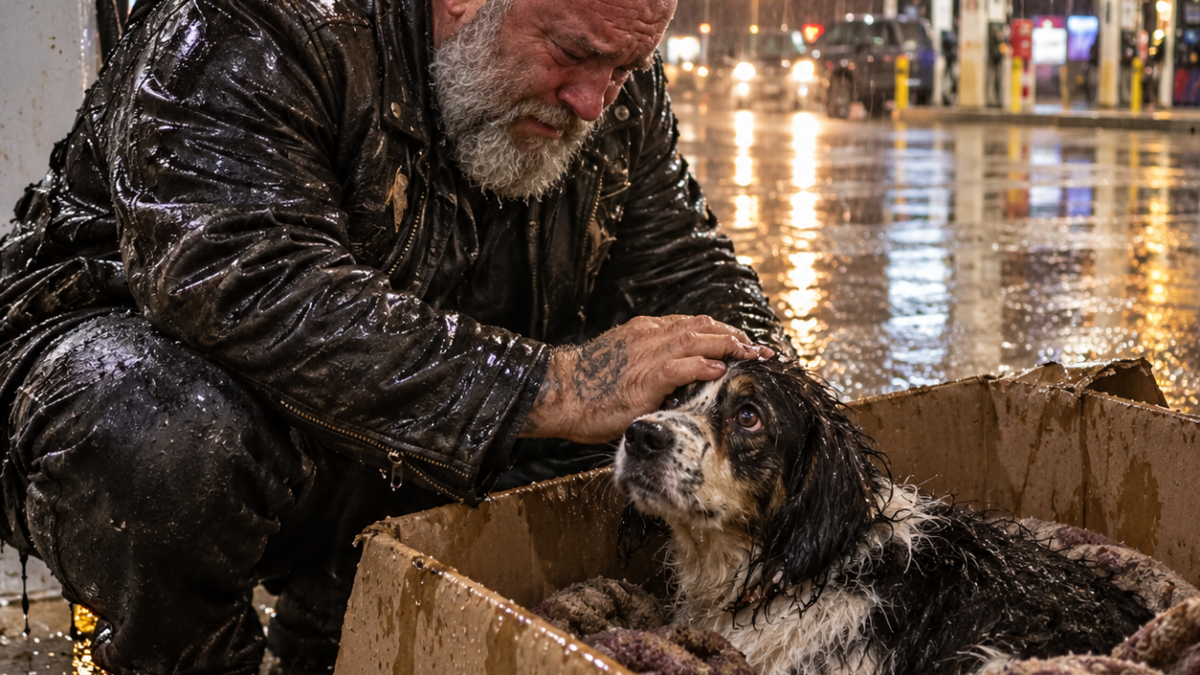
They had wrapped duct tape around the little dog’s muzzle and left her in a soaked cardboard box behind a gas station.
I thought the worst thing I would feel that night was rage at whoever had done it, but the look in her eyes hit me harder than anger ever could.
And when that terrified dog touched my wrist with the tip of her tongue, I had no idea she was about to change every man in our motorcycle club.
The box moved again behind the gas station, just enough to scrape wet cardboard across the concrete.
I froze under the metal awning while rain hammered the roof above me. My black motorcycle sat beside pump six, dripping water. I had stopped for coffee and ten minutes out of the storm before finishing the ride home.
Then I heard that soft scrape again.
My name is Marc Mercier. I was fifty-six that night, with a shaved head, a gray beard, tattooed arms, and knees old enough to predict weather better than any app. I rode with a small volunteer motorcycle group called the Asphalt Watch.
People noticed our leather jackets first. They rarely noticed the boxes of winter coats we hauled to struggling families, the toys we delivered to children’s wards, or the groceries we carried upstairs for elderly people who lived alone.
That night, I was coming back from a coat drive outside Clermont-Ferrand. I was cold, exhausted, and thinking mostly about the empty apartment waiting for me.
Then the cardboard box trembled.
I walked around the trash bins and crouched beside it.
“Easy,” I said. “What have we got here?”
One flap lifted, then dropped.
I pulled it back carefully.
A small black-and-white female dog was curled so tightly inside that her spine pressed against the cardboard. Mud covered her white chest. Her ears were pinned flat. Rain had soaked her coat through.
But it was her eyes that stopped me.
She did not look hopeful.
She looked like hope had already disappointed her too many times.
Then I saw why she made no sound.
Gray duct tape circled her muzzle again and again.
Tight.
Dirty.
Wet.
Her mouth was sealed shut.
For one second, anger rushed through me so violently that my hands curled into fists.
The dog saw it.
She shrank deeper into the box.
That brought me back faster than anything could have.
I opened both hands and lowered my voice.
“No. Not you. I’m not angry at you.”
I called the emergency veterinary clinic. The woman on the phone told me not to tear the tape off myself. The skin underneath could be injured. I needed to keep the dog warm, keep her calm, and bring her in immediately.
I took off my leather jacket, then the heavy overshirt underneath it, and wrapped her as gently as I could.
When I lifted her, she shook so hard I could feel every tremor against my chest.
She did not fight.
She did not growl.
She simply waited, as if she had learned that human hands always decided what happened next.
My motorcycle was useless for transporting her safely, so I called Luc, one of our riders, who lived fifteen minutes away.
He arrived in his battered van with two other men from the club.
The moment they saw her, all three went silent.
Luc was six-foot-four and built like a refrigerator. I had watched him argue with tow-truck drivers, drunk tourists, and one furious landlord without blinking.
Now he knelt in the rain and whispered, “Oh, sweetheart.”
At the clinic, a veterinarian named Dr. Élodie Bernard worked the tape loose with oil and tiny scissors while I held the dog against my chest.
When the final strip came away, the little dog opened her mouth but made no sound.
She just breathed.
One deep breath.
Then another.
The skin around her muzzle was raw. She was dehydrated, underweight, and bruised along one side.
But she was alive.
Dr. Bernard scanned her for a microchip.
Nothing.
“Someone may have dumped her recently,” she said.
Luc looked at me. “Then we find out who.”
I should have told him to leave that to the police.
Instead, I looked down at the dog.
She had fallen asleep with one paw resting across my wrist.
Before I could answer, my phone rang.
It was the gas station manager.
“Marc,” he said, his voice suddenly serious. “I checked the security cameras.”
I stood up.
He took a breath.
“You need to come see this. The person who left that box didn’t just drive away. They got out, looked straight at the camera, and I think one of your men is going to recognize the vehicle.”
PART 2
I looked at Luc.
He had heard enough through the phone to understand.
His jaw tightened.
“Stay here with her,” he said.
“No.”
“Marc—”
“I found her. I’m not leaving until the vet says she’s stable.”
Dr. Bernard, who was standing beside the examination table writing notes, glanced up at us.
“She’s going to stay overnight,” she said. “Possibly two nights. Her temperature is low, she’s dehydrated, and I want to watch her breathing after removing the tape.”
I looked back at the little dog.
She was lying on a folded blanket now.
Her eyes were half closed, but the second I moved away from the table, they opened.
That stopped me.
I stepped back.
Her eyes closed again.
Luc saw it too.
Something changed in his face.
“Okay,” he said softly. “We wait.”
So four tattooed men in wet motorcycle clothes sat in a veterinary clinic hallway after midnight and waited for a ten-kilogram dog who had known us for less than an hour.
None of us talked much.
There was nothing useful to say.
Karim, the youngest of us at forty-two, kept rubbing his palms together.
Pascal stared at the floor.
Luc drank three machine coffees without apparently tasting any of them.
I kept seeing the tape.
Every time I closed my eyes, I saw those gray layers wrapped around her muzzle.
I wondered how long she had been unable to drink.
I wondered whether she’d tried to bark.
I wondered whether she’d watched the person who did it walk away.
That was the thought I couldn’t get rid of.
At 1:17 in the morning, Dr. Bernard came back.
“She is stable.”
Four grown men exhaled at the same time.
“She has no fractures,” the veterinarian continued, “which is good. The bruising is concerning, and there are older marks on her neck. I also found wear around several teeth consistent with chewing on something hard. Wire, maybe a chain.”
Luc muttered something I won’t repeat.
Dr. Bernard looked directly at him.
“If you’re thinking what I think you’re thinking, don’t.”
Luc’s eyebrows rose.
“You don’t know what I’m thinking.”
“I work emergency veterinary medicine. I know exactly what you’re thinking.”
Despite everything, Pascal gave a short laugh.
The veterinarian didn’t.
“If someone abused this dog, the best thing you can do is document everything and let the evidence build. Anger destroys evidence. Patience preserves it.”
That sentence stayed with me.
Anger destroys evidence.
Patience preserves it.
At the time, I thought she was only talking about the investigation.
I would later realize she was talking about the dog too.
We left the clinic just before two.
The rain had slowed to a mist.
I rode in Luc’s van while Karim followed in his car.
The gas station manager, Alain, had stayed after closing.
He unlocked the side door when he saw us.
The place looked completely different with the pumps dark and the coffee machines silent.
Alain led us into a small office behind the counter.
A monitor sat on a cluttered desk.
“You said somebody would recognize the vehicle,” Luc said.
“Maybe.”
Alain pulled up the footage.
The first camera covered the rear parking area.
The timestamp read 10:41 p.m.
A white utility van entered the frame.
It stopped near the dumpsters.
The driver’s door opened.
A man stepped out.
Baseball cap.
Dark jacket.
Work pants.
He went around to the rear doors.
Then he pulled out the cardboard box.
Even without sound, I could see the box move in his arms.
My stomach turned.
The man carried it to the wall.
Set it down.
Then stood over it.
For six seconds.
Seven.
Eight.
He did not kneel.
He did not check the dog.
He simply looked down.
Then he turned and walked away.
At the van, he paused.
For reasons I will never understand, he looked directly toward the security camera.
The image wasn’t clear enough to identify his face.
But the van was better.
Karim leaned toward the screen.
“Go back.”
Alain reversed it.
“Stop.”
The van froze on the monitor.
White Renault utility van.
Rear right door dented near the hinge.
Dark scrape above the wheel.
Karim went very still.
“I know that damage.”
Luc looked at him.
“How?”
“My shop repaired it.”
There are moments when an entire room seems to shrink.
That was one of them.
“You’re sure?” I asked.
Karim pointed at the screen.
“See that crease? It looks like two dents, but it’s one long impact. I had to pull the metal from behind because the interior brace was bent.”
“Whose van?”
Karim didn’t answer immediately.
He stared at the image.
Then he sat back.
“Jean-Paul Valette.”
The name meant nothing to me.
It meant something to Luc.
I saw it instantly.
“You know him too?”
Luc nodded once.
“Runs a private dog-breeding place outside Riom.”
That made the room silent.
Alain looked from one of us to another.
“A breeder?”
Karim swallowed.
“Yeah.”
I felt something cold move through me that had nothing to do with the rain.
“How long ago did you repair the van?”
“Maybe eight months.”
“You have records?”
Karim turned toward me.
“Invoice. Photos. Registration. Everything.”
Luc stood up.
“Then let’s go.”
“Go where?” I asked.
He looked at me like the answer was obvious.
“To Valette.”
I stepped between him and the door.
“No.”
His face hardened.
“That dog had her mouth taped shut.”
“I know.”
“He breeds dogs.”
“I know.”
“And you’re telling me we’re going home?”
“I’m telling you we go to the police.”
Luc stared at me.
For fifteen years we had ridden together.
I had seen him angry.
I had never seen his eyes look like that.
“You really think some report is enough?”
“No.”
“Then move.”
I didn’t.
Karim quietly shut the office door behind us.
Luc looked over my shoulder at him.
“Seriously?”
Karim folded his arms.
“Marc’s right.”
That surprised Luc more than anything I could have said.
Karim owned a body shop, had hands like steel clamps, and possessed very little natural affection for bureaucracy.
But he pointed at the frozen security image.
“You want him punished?”
“Yes.”
“Then don’t warn him.”
Luc’s expression changed.
Karim continued.
“If that’s Valette’s van, he doesn’t know we can identify it yet. He doesn’t know Alain saved the footage. He doesn’t know I still have repair photos. You show up at his gate tonight, and by breakfast every dog, receipt, camera recording, and piece of evidence on his property could disappear.”
Luc looked at the monitor.
His shoulders slowly dropped.
That was the first lesson the little dog taught us.
We had always believed protecting something meant moving toward danger.
Sometimes protection means standing still long enough to think.
We called the police.
An officer arrived a little after three in the morning.
Then another.
They copied the security footage, photographed the area behind the station, took the cardboard box as evidence, and wrote down everything we knew.
Karim sent them his repair records.
The registration information confirmed that the van he had repaired belonged to Jean-Paul Valette.
It did not prove Valette had been driving it that night.
But it was a beginning.
Before sunrise, I returned to the clinic.
I don’t know why.
There was nothing I could do there.
Maybe I didn’t want to go back to the apartment.
My wife, Claire, had died four years earlier.
Cancer.
Eleven months from diagnosis to funeral.
Afterward, people told me time would make the apartment feel normal again.
It didn’t.
It simply taught me how to move through rooms without expecting another person to be there.
I learned to cook for one.
I stopped buying milk in large bottles because half of it spoiled.
I left the television on while I showered because silence traveled too well through the place.
The motorcycle club helped.
Charity runs helped.
Other people’s problems gave my hands something to do.
But helping somebody for an afternoon is different from being needed when you wake up.
I had forgotten that.
Until I walked into the veterinary clinic at 6:10 that morning.
Dr. Bernard was finishing her shift.
She smiled when she saw me.
“You came back.”
“Couldn’t sleep.”
She tilted her head.
“I don’t think that’s the reason.”
I ignored that.
“How is she?”
“Better.”
“Can I see her?”
Dr. Bernard led me into the treatment area.
The dog was awake.
She lay inside a kennel with a clean blue blanket beneath her.
For a moment she watched me without moving.
Then her tail tapped the blanket once.
Just once.
I sat down on the floor outside the kennel.
“Morning.”
Her nose twitched.
“You had a rough night.”
Another tiny tail movement.
I put my fingers against the metal door.
She crawled forward.
Slowly.
Her nose touched my knuckle.
Then she backed away.
That was all.
It felt like winning a medal.
Dr. Bernard crouched beside me.
“She’ll need somewhere to go if no owner comes forward.”
“Shelter?”
“Probably.”
I looked at the dog.
“No.”
The word came out too quickly.
Dr. Bernard smiled.
“No?”
“I mean… maybe I can foster her.”
“You live alone?”
“Yes.”
“Other animals?”
“No.”
“Secure place?”
“Apartment.”
“Time?”
I thought about the motorcycle shop where I worked three days a week, my volunteer schedule, my long rides, my complete lack of experience with traumatized dogs.
“Some.”
Dr. Bernard gave me a look that said she had heard exactly how unconvincing that sounded.
“I can learn.”
She nodded toward the kennel.
“So can she.”
The police contacted me that afternoon.
They had gone to Valette’s property.
He admitted the van was his.
But he denied driving it the previous evening.
He claimed an employee sometimes used it.
He also denied recognizing the dog from the gas station photographs.
That bothered me.
Not because it proved anything.
Because Karim had found something else.
Around noon, he called.
“Marc, I’ve got a question.”
“What?”
“Does she have a black patch over the base of her left ear?”
“Yes.”
“And a white mark on the chest shaped kind of like a crooked heart?”
I looked through the kennel door.
“Yes.”
There was silence.
Then Karim said, “I’ve seen her before.”
My stomach tightened.
“Where?”
“Online.”
He sent me a screenshot.
The image was three years old.
It had been saved on a local classified listing.
A younger version of the dog stood on a patch of gravel beside a chain-link kennel.
Same black ear.
Same white chest.
Same narrow stripe between the eyes.
The advertisement read:
FEMALE BORDER COLLIE MIX — BREEDING QUALITY — 18 MONTHS.
Seller: J.P. Valette.
I stared at that photograph for a long time.
The dog in it looked healthier.
But even then, something in her posture bothered me.
Her head was low.
Her tail was tucked.
The listing had been removed years earlier, but Karim had found an archived copy through an old customer forum where people discussed local breeders.
There were comments underneath.
Not many.
One said a puppy purchased from Valette had been sick.
Another mentioned poor conditions.
A third simply read:
Would not recommend. Ask to see where the adult dogs are kept.
I forwarded everything to the investigating officer.
Two hours later, Jean-Paul Valette changed his story.
Now he remembered the dog.
Her name, he said, had been Bella.
He claimed he sold her nearly two years earlier to a man whose name he could not remember.
No receipt.
No phone number.
No address.
Nothing.
The officer told me none of that automatically proved cruelty.
I understood.
But every time Valette spoke, his story moved.
I had known men like that.
They never told one giant lie.
They told ten small ones and hoped nobody placed them side by side.
Bella stayed at the clinic for three days.
By the second day, she drank normally.
By the third, she ate chicken from my fingers.
Dr. Bernard showed me how to offer food without reaching over her head.
“Hands coming from above can frighten dogs who’ve been hit,” she explained.
That sentence nearly broke something inside me.
Every movement had to be considered.
Don’t corner her.
Don’t grab her collar.
Don’t raise your voice.
Don’t block the exit.
Let her choose.
Choice.
Such a small word.
For Bella, it seemed to be everything.
When Dr. Bernard finally released her into temporary foster care, Luc drove us home.
The entire club wanted to come.
I said no.
Too many men.
Too many boots.
Too much noise.
Luc grumbled about it but agreed.
I carried Bella upstairs wrapped in the same overshirt I’d used the first night.
At my apartment door, she froze.
I stepped inside.
She did not.
I waited.
Five minutes.
Ten.
A neighbor passed and gave us a strange look.
I sat down on the hallway floor.
Bella stared at the doorway.
Then at me.
Then at the doorway again.
“I’m not carrying you,” I told her.
Her ears moved.
“You’ve had enough people deciding things.”
I placed a piece of chicken just inside.
She took one step.
Stopped.
Another.
At fourteen minutes, she crossed the threshold.
I didn’t understand then how important that moment would become.
Bella chose to enter my home.
Over the next several weeks, I learned that rescuing an animal and making it feel safe are two completely different things.
The dramatic part had happened at the gas station.
The real work happened quietly.
At 2:00 in the morning when she woke shaking from dreams.
At breakfast when the sound of tape tearing from a package sent her scrambling under the kitchen table.
When a raised umbrella made her urinate on the floor.
When a deliveryman knocked and she pressed herself into the space behind my sofa.
The first time I accidentally dropped a frying pan, she disappeared into the bedroom closet and wouldn’t come out for forty minutes.
I sat six feet away on the floor.
I didn’t touch her.
Didn’t coax.
Didn’t reach.
I just talked.
Mostly nonsense.
Motorcycle parts.
Weather.
What I had eaten for lunch.
Things Claire used to say.
After half an hour, one black nose appeared between my hanging shirts.
Ten minutes later, Bella lay beside my knee.
That became our routine.
Fear arrived.
I sat nearby.
She decided when to cross the distance.
The Asphalt Watch adjusted too.
That was almost funny.
Men who had spent decades making motorcycles louder began arguing about who had the quietest exhaust.
Luc started removing his heavy boots before entering my apartment.
Karim stopped wearing a chain wallet because the metallic sound frightened her.
Pascal learned that Bella disliked having people stand directly over her, so he sat on the floor whenever he visited.
One Sunday afternoon I walked into my living room and found three enormous bikers sitting cross-legged around a small dog, passing pieces of cooked turkey between them.
I leaned against the doorway.
“What happened to you people?”
Luc looked offended.
“We’re socializing her.”
“You’re using my good turkey.”
“She needs high-quality protein.”
“You ate half of it.”
Luc pointed toward Bella.
“Moral support.”
For the first time in months, I laughed so hard I had to sit down.
Bella watched us.
Her tail moved.
Not once.
Back and forth.
Slowly.
Then faster.
That was the first time I saw her wag properly.
All four of us stopped laughing just to watch.
“You see that?” Pascal whispered.
“Yes.”
“Nobody move.”
Bella wagged harder.
Luc’s eyes became suspiciously wet.
I looked at him.
He immediately frowned.
“Allergies.”
“In November?”
“Powerful allergies.”
Bella eventually got a different name.
The change happened by accident.
We were sitting in my kitchen one evening while a storm moved over the city.
Thunder shook the windows.
I expected her to hide.
Instead, she came to my chair.
I lowered my hand.
She pressed her forehead into my palm.
“You’re braver than you think,” I said.
Claire used to say something similar to me during her treatment.
A name surfaced from nowhere.
“Mira.”
Bella looked up.
I said it again.
“Mira.”
Her tail tapped the floor.
Luc, who was eating a sandwich across the table, raised an eyebrow.
“Mira?”
“Means miracle in enough languages for me.”
“You can’t just rename somebody because she wagged her tail.”
“Mira.”
The dog came to me.
Luc considered this.
“Okay. Apparently you can.”
The police investigation moved more slowly.
Much more slowly.
That nearly drove us crazy.
Valette’s property had been visited by animal-control authorities. He had legal paperwork for the dogs they saw. Conditions were described as poor but not immediately sufficient for emergency seizure.
No one found duct tape on a dog.
No one confessed.
Valette continued insisting Bella—Mira—had been sold long ago.
The security footage showed a man with similar height and build, but not enough facial detail for a certain identification.
The van was his.
He claimed employees used it.
When police asked for names, he provided two.
Both said they had not used the van that night.
One had a restaurant receipt proving he was elsewhere.
The other had been home with his family.
That narrowed things.
But it didn’t close them.
Then Valette made his first big mistake.
He called me.
I still don’t know how he got my number.
Maybe someone at the gas station knew someone who knew him.
Maybe one of his customers did.
Maybe he searched.
It doesn’t matter.
I answered at 8:22 on a Thursday evening.
“Marc Mercier?”
“Speaking.”
“This is Jean-Paul Valette.”
I stood very still.
Mira was asleep on the rug beside my chair.
“What do you want?”
“My dog.”
I looked down at her.
“You told the police you sold her.”
“I was mistaken.”
“That’s convenient.”
“I’ve been going through old records.”
“Records you couldn’t find last week?”
His voice changed slightly.
Not louder.
Colder.
“You have property that belongs to me.”
“She is evidence in an animal-cruelty investigation.”
“She is a dog.”
The way he said it made my skin crawl.
Not a name.
Not an animal.
Not a living creature.
A dog.
Property.
I glanced at my phone.
Recording calls without proper notice could create legal problems, and I wanted no mistake.
So I said, “I’m putting this on speaker. Luc is here with me.”
Luc wasn’t.
But Valette didn’t know that.
There was a pause.
“Why?”
“Because I want somebody else hearing this conversation.”
Another pause.
Then he laughed once.
“You motorcycle idiots think you’re heroes?”
Mira woke.
My voice remained quiet.
“No.”
“You stole my dog.”
“I found her in a box.”
“She escaped.”
“With tape around her muzzle?”
Silence.
It lasted maybe two seconds.
But I felt it.
Then Valette said, “You don’t know what she was like.”
My entire body became cold.
“What was she like?”
Another pause.
“She barked constantly.”
I closed my eyes.
There it was.
He heard himself too late.
His next words came quickly.
“I mean when I owned her. Years ago.”
I did not answer.
“Mercier?”
Still nothing.
“You listening?”
“Yes.”
“If you people keep posting lies about me, there will be consequences.”
“We haven’t posted anything about you.”
“You’ve been asking questions.”
“How do you know?”
Silence again.
Then the line went dead.
I called the investigating officer immediately and reported the conversation while every word was fresh.
The important part wasn’t a confession.
He had not confessed.
But until that call, Valette had insisted he barely remembered Mira.
Now he remembered that she barked constantly.
That changed things.
Two days later, another piece moved.
A woman named Sophie Lemaire contacted Karim’s shop.
She refused to speak on the phone.
She asked to meet somewhere public.
Karim called me.
We chose a café near the courthouse.
Sophie arrived wearing a red scarf and looking over her shoulder twice before she sat down.
She was thirty-something, thin, tired, and angry in a way that seemed older than she was.
“You have the dog?” she asked.
“Yes.”
“Black and white?”
“Yes.”
“White chest?”
“Yes.”
She swallowed.
“Bella.”
I leaned forward.
“You know her.”
“I fed her for almost a year.”
The café noise seemed to disappear around me.
“You worked for Valette?”
She nodded.
“Four years ago.”
“Why did you leave?”
Her mouth tightened.
“Because I couldn’t keep telling myself I wasn’t part of it.”
Karim and I said nothing.
Sophie looked down at her coffee.
“At first, it seemed normal. Kennels. Breeding. Training. He wasn’t gentle, but lots of people aren’t gentle. I told myself the dogs had food and shelter.”
“What changed?”
“Winter.”
She rubbed her thumb against the edge of her cup.
“There was one dog that barked at night. Old shepherd. He put a shock collar on him. Then another dog chewed her kennel door until her gums bled. He said anxious animals were bad for business.”
“And Mira?”
Sophie’s eyes filled.
“She was sweet.”
That nearly undid me.
“She wasn’t good with breeding,” Sophie continued. “She became frightened around males. Sometimes she wouldn’t eat afterward. Jean-Paul hated dogs he couldn’t control.”
“What did he do?”
Sophie looked directly at me.
“He used tape.”
Karim stopped breathing.
I don’t mean literally.
But his chest went still.
“What kind?”
“Gray duct tape.”
I felt my palms turn cold.
“On Mira?”
“I saw it once.”
My voice came out rough.
“You saw him tape her mouth?”
“Yes.”
“Did you report it?”
Her eyes dropped.
“No.”
I wanted to be angry.
For one second, I was.
Then I saw the shame already sitting on her face.
There was nothing I could add to it.
“Why not?”
“He threatened my job. My housing too. I lived in a small apartment on the property. My son was three. I had almost no money.”
She wiped her cheek quickly.
“I told myself I would find another job and report him after I left.”
“Did you?”
“I sent an anonymous complaint.”
“What happened?”
“An inspection. He knew it was coming. Everything looked fine that day.”
Of course it did.
“Do you have proof?”
Sophie reached into her bag.
She took out an old phone.
“I kept this.”
The screen was cracked.
“I don’t know if anything useful is still on it. Photos. Messages. Maybe videos.”
Karim stared at the phone like it was gold.
“Don’t give it to us.”
Sophie looked confused.
“Give it directly to the police.”
That was another thing Mira had taught us.
Months earlier, Karim might have copied everything immediately, posted it online, sent it to every person in the department.
Now we understood something.
Evidence needed clean hands.
Sophie met with investigators that afternoon.
The phone contained more than she remembered.
Photographs of overcrowded kennels.
Dogs with untreated skin problems.
Messages from Valette telling workers not to call veterinarians without permission.
One photograph showed Mira in a narrow run.
There was no tape on her muzzle.
But beside the kennel door sat a roll of gray industrial duct tape.
Still not enough by itself.
Then investigators recovered an old message.
Sophie had once texted Valette:
Bella’s mouth is bleeding where the tape pulled skin. She needs treatment.
Valette had replied:
Then stop her barking and there won’t be a reason to tape her.
When the officer read that message aloud to me later, my hands began shaking.
Not from helpless anger this time.
From relief.
Because cruelty leaves traces.
Sometimes not where the cruel person expects.
A message.
A photograph.
A repair invoice.
A security camera.
A scared former employee who finally decides she can live with fear more easily than silence.
The authorities obtained permission for a deeper investigation.
That’s when things became ugly.
Valette realized the circle was closing.
He started posting publicly.
He never used my full name at first.
He talked about “violent bikers harassing a legitimate local business.”
He claimed an organized group had stolen one of his dogs and was manufacturing accusations.
He described Mira as aggressive.
Dangerous.
Unstable.
That word enraged me more than almost anything else.
Unstable.
I had watched her tremble because I opened a roll of packing tape.
I had watched her crawl under furniture because somebody raised an arm too quickly.
I had watched her press herself against a wall when strangers entered a room.
She wasn’t unstable.
She had a memory.
There is a difference.
Then Valette came to my apartment.
It happened on a Saturday morning.
I was taking Mira outside.
She had improved enough by then to walk comfortably on quiet streets, though trucks still frightened her.
I opened the building door.
A man was standing across the sidewalk.
I knew him immediately.
Same height as the security footage.
Same broad shoulders.
Jean-Paul Valette.
For a moment neither of us moved.
Then Mira saw him.
Her reaction answered questions no witness could.
She collapsed.
Not sat.
Not crouched.
Collapsed.
Her belly hit the pavement.
Tail tucked so tightly it disappeared beneath her.
She urinated where she lay.
And then she made a sound I had never heard from her.
A low, broken whine.
Valette looked at her.
“Bella.”
She tried to crawl backward through the closed door.
Every part of me wanted to cross the pavement.
Every violent instinct I had ever carried woke up at once.
I pictured the tape.
The bruises.
The box.
The rain.
I took one step.
Then Mira’s leash tightened around my hand.
I looked down.
She was shaking.
And I understood.
If I hit him, she would not understand justice.
She would only see another angry man hurting someone.
So I stopped.
I knelt beside her.
“It’s okay.”
Valette scoffed.
“See? She’s always been nervous.”
I looked up.
“What are you doing here?”
“Getting my property.”
“No.”
“I have paperwork.”
“Then give it to the police.”
“You’ve made this ridiculous.”
Mira pushed herself against my leg.
I put one hand on her shoulder.
Valette stepped toward us.
“Bella. Come.”
She trembled harder.
I stood.
“Don’t take another step.”
He smiled.
It wasn’t a friendly smile.
“You threatening me?”
“No. I’m telling you the dog is under veterinary and investigative supervision, and you are not touching her.”
“She belongs to me.”
“You told police you sold her.”
“I corrected that.”
I heard a door open behind me.
My neighbor Madame Fournier stepped outside holding a grocery bag.
She looked at Valette.
Then me.
Then at Mira shaking against my leg.
“You want me to call the police, Marc?”
“Yes, please.”
Valette’s smile vanished.
“You people are insane.”
Madame Fournier, seventy-three years old and approximately five feet tall, put down her grocery bag.
“I don’t know who you are,” she said, “but the dog looks terrified of you.”
“Mind your business.”
She pulled out her phone.
“Now you’ve become my business.”
I almost smiled.
Valette backed toward his car.
Before getting in, he pointed at me.
“This isn’t finished.”
He was right.
But not in the way he hoped.
Madame Fournier had a doorbell camera.
It recorded the entire encounter.
Including him calling Mira “Bella.”
Including his demand for “my property.”
Including her visible terror.
An animal behavior specialist later explained that fear alone could not legally identify an abuser.
Dogs can fear people for many reasons.
But combined with Sophie’s messages, the old sales listing, the contradictory ownership claims, and the security footage, the encounter mattered.
Most importantly, Valette had now publicly and directly claimed ownership of the same dog he had previously told investigators he sold.
Every lie required another lie to support it.
Eventually the structure became too heavy.
The next major break came six weeks after I found Mira.
Police called Sophie again.
One of Valette’s former workers had heard about the investigation and agreed to speak.
His name was Denis.
Unlike Sophie, he had stayed longer.
Too long, he said.
Denis knew where Valette kept records inspectors were not supposed to see.
There was a locked storage room behind the main kennel building.
Inside were breeding records, veterinary supplies, medications, and notebooks tracking litters that never appeared on official paperwork.
Investigators obtained the authorization they needed.
The search happened on a Tuesday morning.
We were not allowed anywhere near the property.
That was probably wise.
Luc still had opinions.
At 9:40, my phone rang.
It was Sophie.
“They’re there.”
“How do you know?”
“Denis called me.”
I walked to my window.
Mira came beside me.
“How many?”
“Police. Animal-control people. Veterinarians. Several vehicles.”
I sat down.
“And Valette?”
“Apparently screaming at everyone.”
That sounded believable.
We heard nothing official for hours.
Those were some of the longest hours of my life.
By evening, local news reported that multiple dogs had been removed from a breeding property during an animal-welfare investigation.
No names.
No details.
Nine dogs were transported for veterinary examinations.
Three remained temporarily on the property under restrictions.
The report said authorities had found evidence that required further review.
Luc called immediately.
“Nine.”
“I heard.”
“You think—”
“I don’t know.”
“Marc.”
“We wait.”
He groaned.
“I hate what this dog has done to you.”
“What?”
“You’ve become reasonable.”
I smiled.
“Terrible, isn’t it?”
“Disgusting.”
The next afternoon Dr. Bernard called.
She had been asked to assist with one of the seized dogs.
She couldn’t tell me everything.
But she told me enough.
“Marc, you did the right thing.”
I sat at my kitchen table.
Mira was asleep under it, her head on my foot.
“How bad?”
A pause.
“Some are okay. Some need treatment.”
I closed my eyes.
“Any puppies?”
“Yes.”
“How many?”
“I can’t discuss details.”
“That means yes.”
Another pause.
“Yes.”
I rubbed my face.
“Élodie, if I’d confronted him that first night—”
“I know.”
“He could have moved them.”
“I know.”
I looked down at Mira.
Anger destroys evidence.
Patience preserves it.
She had saved dogs she would never meet simply by surviving long enough for us to control ourselves.
The case took months.
Real justice usually does.
There were interviews.
Veterinary reports.
Records.
Statements.
Arguments over ownership.
Arguments over intent.
Valette hired an attorney who attacked Sophie’s credibility.
He said she was a disgruntled former employee.
He claimed the messages were taken out of context.
He claimed Mira’s injuries could have occurred after she left his possession.
His attorney suggested somebody else had used the van.
But Valette had another problem.
The gas station video was not the only camera that had recorded his vehicle.
A traffic camera eleven kilometers away had captured the van shortly before the dumping.
Another private camera near a warehouse had captured it afterward.
Investigators could not see the driver’s face clearly.
But phone-location records, obtained through the proper process, placed Valette’s device along the same route.
Then came the detail that destroyed his story.
The cardboard box.
I had barely thought about it after that first night.
To me, it was simply the soaked thing Mira had been abandoned inside.
Police had taken it.
On one side, beneath torn tape and rain damage, was part of a shipping label.
Most of the print was unreadable.
But a business name remained.
Valette’s kennel.
The box had originally contained veterinary disinfectant delivered to his property.
His attorney argued that anyone could have taken it.
Technically, that was true.
Then Denis gave investigators a photograph taken three days before Mira was abandoned.
The photo showed supplies stacked inside Valette’s storage room.
On top was the same brand of disinfectant.
Same box size.
Same delivery batch.
Again, no single detail proved everything.
But cases aren’t always one dramatic fingerprint.
Sometimes they’re a wall built one brick at a time.
The van.
The box.
The old listing.
The text about tape.
The false sale story.
The phone location.
The workers.
The fear.
The veterinarian’s injuries.
And then Valette himself supplied the final brick.
He tried to bribe Denis.
I couldn’t believe it when the officer told me.
Neither could Luc.
“What kind of idiot does that?” he asked.
“A frightened one,” Karim said.
Valette apparently offered Denis money to “clarify” his statement and say workers had routinely borrowed the van without permission.
Denis saved the messages.
Then he gave them to investigators.
For the first time, I began to believe this might actually end.
Meanwhile, Mira was becoming somebody else.
Or perhaps she was finally becoming who she had always been beneath the fear.
She learned that keys did not always mean somebody was leaving her.
She learned that boots could walk past without kicking.
She learned that a hand could reach down to scratch her chest and then simply stop when she moved away.
She learned motorcycles.
That took time.
The first time Luc started his Harley outside my building, Mira nearly pulled out of her harness.
After that, we trained slowly.
Engine off.
Treat.
Engine on far away.
Treat.
Closer.
Treat.
Weeks later, she could stand near the motorcycles without shaking.
Months later, she would trot between them as if inspecting the lineup.
We bought her a ridiculous little black raincoat.
Luc wanted one with fake leather.
I told him absolutely not.
He bought it anyway.
The back had a small patch that said:
WATCH.
I made him remove it.
“Why?”
“Because she isn’t advertising.”
“She needs club colors.”
“She is a dog.”
“She is family.”
I looked at him.
He shrugged.
“What?”
Nothing.
He was right.
Mira changed Pascal too.
Pascal was the quietest member of our group.
Former firefighter.
Divorced.
Two adult sons living hours away.
He almost never talked about himself.
One afternoon we were sorting donated blankets in the club garage when a stack of metal folding chairs crashed in the back room.
Mira startled.
So did Pascal.
But Pascal didn’t recover.
He stood completely motionless.
His face went pale.
His breathing changed.
I started toward him.
He raised a hand.
“Don’t.”
So I stopped.
Mira didn’t.
She walked across the room.
Slowly.
No command.
No training.
She sat on his boot.
Pascal looked down.
She leaned against his shin.
He crouched.
For almost a minute, he simply rested one hand on her back.
His breathing slowed.
Nobody spoke.
Later, Pascal sat outside with me.
“She knew.”
“I think she knew you were upset.”
He stared across the parking lot.
“My ex-wife used to say I brought every fire home with me.”
I waited.
He had been a firefighter for twenty-eight years.
There were things he had seen that we never asked about.
“That dog gets scared,” he said, “but she comes back.”
I looked at him.
“So do you.”
He gave a dry laugh.
“Don’t start being wise. It doesn’t suit you.”
But after that day, Pascal began helping with Mira’s training.
And eventually he began talking to someone about the memories he had spent years burying.
He never credited Mira.
He didn’t need to.
We knew.
Then came the first court hearing.
Valette entered through a side door wearing a dark suit.
No cap.
No work clothes.
No kennel mud on his boots.
He looked smaller somehow.
Not physically.
Just less powerful outside his own property.
Sophie sat two rows behind the prosecutor.
Denis sat farther back.
I was there because I might be called later.
Luc came with me but had strict instructions.
“No gestures.”
“I know.”
“No staring.”
“I know.”
“No dramatic throat-cutting motions.”
He looked offended.
“I’ve never done that.”
“You did it at a football match.”
“That referee was corrupt.”
“Luc.”
“Fine.”
Mira remained with Dr. Bernard that morning.
I didn’t want her anywhere near Valette.
The hearing itself was less dramatic than television.
Paperwork.
Legal arguments.
Dates.
Requests.
But something happened afterward.
Valette walked past us in the corridor.
He stopped.
Looked at me.
Then at Luc.
“You happy?”
I didn’t answer.
“This is what you wanted?”
“No,” I said.
He smirked.
“Could’ve fooled me.”
“What I wanted was to finish my coffee and ride home that night.”
His expression shifted.
“You people destroyed my business.”
Luc’s hands tightened beside him.
I kept my eyes on Valette.
“No. Whatever you did before I found that box brought us here.”
He stepped closer.
“You think you’re some kind of savior because you picked up a stray?”
“No.”
“Then what are you?”
I thought about the gas station.
The clinic.
Sophie.
Nine dogs leaving his property.
Mira crossing my apartment doorway for the first time.
“I’m the guy who didn’t ride past.”
His face changed.
That sentence landed harder than any threat could have.
A court officer told us to keep moving.
We did.
Outside, Luc slapped me on the back.
“I’m the guy who didn’t ride past.”
“Stop.”
“That was good.”
“Stop.”
“You practiced that?”
“No.”
“You absolutely practiced that.”
“I hate you.”
He grinned.
It felt good to laugh.
The trial began months later.
By then, Mira had gained weight.
Her coat had become glossy.
The raw ring around her muzzle was gone, although thin patches of fur remained where the tape had damaged the skin.
The older neck marks would never completely disappear.
Neither would everything else.
Healing is not erasing.
That was another thing she taught me.
We like stories where pain disappears.
Where the rescued dog never flinches again.
Where the lonely man becomes happy every day.
Where the frightened witness stops being afraid.
Real life is different.
Mira still hated tape.
She still woke from nightmares sometimes.
Sophie still looked over her shoulder.
Pascal still had bad days.
I still missed Claire.
But scars are not proof that healing failed.
Sometimes they are proof that healing happened around something that could not be changed.
Sophie testified.
I watched her walk to the witness stand with trembling hands.
Valette’s attorney questioned why she had waited years.
She answered quietly.
“Because I was afraid.”
“Yet now you’re not?”
Sophie looked toward Valette.
“Yes,” she said. “I am.”
The attorney paused.
“Then why are you here?”
Her answer silenced the room.
“Because being afraid and being silent are not the same thing.”
I saw Valette look down.
Denis testified next.
Then veterinarians.
Then the officer who collected the gas station footage.
Karim explained the van damage and repair records.
Alain described finding the box and reviewing his cameras.
I testified about finding Mira.
The prosecutor asked me to describe her condition.
I thought I was prepared.
I wasn’t.
“Her muzzle was taped shut,” I said.
“How many layers?”
“I don’t know exactly.”
“More than one?”
“Yes.”
“Could she open her mouth?”
“No.”
“How did she react when you approached?”
“She made herself smaller.”
“What do you mean?”
I looked toward the judge.
“She was already curled against the side of the box. When she saw me, she tried to become smaller than that.”
My throat tightened.
The prosecutor waited.
“What did you do?”
“I called the emergency clinic.”
“And then?”
“I wrapped her in my clothes.”
“Did she attempt to bite you?”
“No.”
“Growl?”
“No.”
“Run?”
“No.”
“Why not?”
Valette’s attorney stood.
“Objection. Calls for speculation.”
The judge agreed.
The question was withdrawn.
I was relieved.
Because the answer I wanted to give was simple.
She believed resistance made things worse.
But that was something I could feel, not something I could prove.
Valette testified too.
That surprised us.
His version had changed again.
Now he claimed Mira had been difficult and aggressive while he owned her but that he had never injured her.
He suggested Sophie had used tape without his approval.
Sophie stared at him from the gallery.
I thought she might stand up.
She didn’t.
He claimed his text—“stop her barking and there won’t be a reason to tape her”—had been sarcastic.
He claimed the box could have been taken from his business.
He claimed his phone had been in his van but he might not have been driving.
He claimed he called me because he became convinced Mira was his after seeing photographs online.
One explanation after another.
Technically possible in isolation.
Ridiculous together.
Then the prosecutor showed the security footage.
The courtroom watched the white van arrive behind the gas station.
We watched the driver remove the box.
We watched him put it beneath the broken gutter.
I couldn’t look at the screen when the box moved.
I looked at Valette.
He watched himself.
I knew that much.
There was no sudden confession.
No dramatic shout.
No movie moment.
Just a man sitting very still while his own choices filled a screen in front of strangers.
Then the prosecutor displayed a photograph taken during the search of Valette’s property.
A work jacket hung inside the storage room.
Dark fabric.
Reflective strip near the lower pocket.
The gas station video showed the same unusual strip when the driver turned toward the camera.
The jacket was common enough that it wasn’t proof alone.
But again—
Another brick.
Then came the messages to Denis.
The attempted bribe.
That was when I saw Valette’s attorney close his eyes for half a second.
The final veterinary testimony mattered most to me.
Dr. Bernard described the raw skin beneath the duct tape.
The dehydration.
The bruising.
The older neck injuries.
She was careful.
Precise.
She did not exaggerate.
When asked whether she could determine exactly when every injury occurred, she said no.
When asked whether Mira’s condition was consistent with abandonment in a taped muzzle, she said yes.
When asked whether leaving a dog unable to drink properly in cold rain could create a serious medical risk, she said yes.
Then the prosecutor asked one final question.
“Doctor, when the tape was removed, what did the dog do?”
Dr. Bernard looked toward me.
“She breathed.”
That was it.
Two words.
She breathed.
For some reason, those two words broke me harder than everything else.
I lowered my head.
Luc put one hand on my shoulder.
The court ultimately found Valette responsible for multiple animal-welfare violations and for the abandonment and mistreatment connected to Mira.
There were additional consequences involving his breeding operation, records, and attempts to interfere with the investigation.
He was prohibited from operating the kennel and from keeping animals during the period ordered by the court.
He faced criminal penalties, fines, and restrictions that effectively ended the business he had spent years protecting at the expense of the animals inside it.
Was it enough?
I don’t know what enough means.
No sentence could give Mira back the nights she spent afraid.
No fine could explain to a dog why somebody had wrapped tape around her mouth.
Justice is not a time machine.
But when the ruling was read, I looked at Sophie.
She was crying.
Denis stared at the floor.
Karim exhaled.
Pascal closed his eyes.
Luc leaned toward me.
“You okay?”
I nodded.
But I wasn’t thinking about Valette.
I was thinking about nine dogs leaving that property.
I was thinking about puppies getting medical treatment.
I was thinking about the next frightened employee who might report something sooner because Sophie had spoken.
That was the revenge Luc had wanted on the first night.
He simply hadn’t understood its shape yet.
We could have ridden to Valette’s property angry.
We could have shouted.
Threatened.
Broken something.
Maybe even hit someone.
And for ten minutes, we might have felt powerful.
Instead, we waited.
We documented.
We listened.
We protected witnesses.
We let professionals build a case.
And the man who had treated animals like disposable objects had to sit in a courtroom while veterinarians, former employees, mechanics, police officers, and ordinary citizens placed every piece of his behavior under bright light.
He lost the business he had hidden behind.
He lost access to the animals he had controlled.
He lost the silence that had protected him.
That was better than a punch.
Much better.
But the most satisfying moment happened outside.
Mira was waiting with Dr. Bernard in a small park two streets from the courthouse.
I hadn’t planned to bring her.
Dr. Bernard had.
When I walked across the grass, Mira saw me from nearly fifty yards away.
Her ears lifted.
Then she ran.
Not away.
Toward me.
Full speed.
Leash trailing behind Dr. Bernard until she let it go.
Mira crossed that grass like nothing had ever chained her to anything.
I dropped to one knee.
She hit me in the chest hard enough to knock me backward.
I laughed.
She climbed all over me.
Licked my beard.
My nose.
My ear.
Luc arrived behind us.
“Control your animal.”
I looked up.
“You’re jealous.”
“She’s attacking a senior citizen.”
“I’m fifty-seven.”
“Exactly.”
Mira spotted him.
Then abandoned me completely and ran to Luc.
He pretended not to be delighted.
Failed badly.
That evening the Asphalt Watch met at our garage.
Nobody called it a celebration.
But there was food.
And coffee.
And Pascal brought a cake with terrible icing that was supposed to look like a motorcycle but resembled a lawn mower.
Mira received chicken.
Too much chicken.
Everyone blamed everyone else.
At one point I stepped outside alone.
Rain had begun.
Light rain.
Nothing like the night at the gas station.
I stood under the awning and listened to it.
A minute later the door opened.
Pascal came out.
Then Karim.
Then Luc.
Mira squeezed between Luc’s legs.
She walked into the rain.
I immediately expected her to turn back.
She didn’t.
She stood on the wet pavement.
Lifted her nose.
Let raindrops fall across her face.
Luc whispered, “Look at her.”
I couldn’t speak.
The first night I met that dog, rain had been part of the worst thing that ever happened to her.
Now it was just rain.
She sneezed.
Karim laughed.
Mira wagged.
Then she ran through a puddle and splashed all four of us.
Luc stared at his wet jeans.
“You know, I supported that animal.”
“She remembers.”
“This is betrayal.”
I laughed.
So did Pascal.
Mira ran another circle around us.
That should have been the ending.
It wasn’t.
Because rescue changes the rescuer too.
Over the next year, the Asphalt Watch changed almost without discussing it.
We still delivered coats.
Still collected food.
Still visited hospitals.
But animals became part of our work.
It started with one fundraiser for the clinic that saved Mira.
We expected a few hundred euros.
Instead, photographs of twelve rough-looking bikers standing beside bags of dog food spread across local social media.
People loved the contradiction.
Leather jackets.
Gray beards.
Tattooed arms.
Tiny puppies.
Donations arrived.
A pet store offered supplies.
A supermarket installed a collection bin.
A mechanic donated an old delivery van.
Karim repaired it for free.
Luc painted it.
Pascal handled paperwork.
We called the project Mira’s Route.
The name embarrassed me.
I lost the vote eleven to one.
Once a month, we transported food and blankets to shelters and foster groups around the region.
Then twice a month.
Then almost every weekend.
Mira came when appropriate.
She had become remarkably calm around people she trusted.
Children were different.
She loved children.
Dr. Bernard thought it might be because children usually crouched instead of towering over her.
Maybe.
Or maybe Mira simply recognized small creatures living in a world controlled by bigger ones.
We never forced interactions.
If she walked away, people let her go.
Choice remained the rule.
At a charity event the following spring, a little boy named Jules sat alone near the back wall.
He had come with his grandmother.
He wouldn’t join the other children.
Wouldn’t pet the dogs.
Wouldn’t speak to us.
Mira noticed him.
She walked over.
Stopped six feet away.
Lay down.
Jules looked at her.
Mira looked at Jules.
Neither moved.
Five minutes passed.
Then Jules shifted slightly closer.
Mira stayed where she was.
Another few minutes.
Jules reached out.
Not far enough to touch her.
Mira crawled forward one step.
By the end of the afternoon, his fingers rested on her white chest.
His grandmother cried.
Later she told me Jules had become frightened of dogs after being knocked down by a large one.
“He hasn’t touched one in almost two years.”
I looked at Mira.
She was asleep beneath a folding table.
“She’s patient.”
The grandmother smiled.
“So is he.”
That sentence stayed with me too.
Healing recognizes healing.
Pascal eventually suggested we ask whether Mira could take part in structured therapeutic visits.
I resisted.
“She doesn’t owe anybody anything.”
“No,” he said. “But she likes people.”
“She likes chicken.”
“Everybody likes chicken.”
The behaviorist agreed with me at first.
No expectations.
No pressure.
They evaluated Mira over several months.
She was never going to be the kind of dog who loved every crowded room.
That was fine.
But in quiet settings, with clear exits and calm people, she had a gift.
She approached distress without demanding attention.
She would sit nearby.
Wait.
Let the person decide.
Exactly what we had done for her.
Exactly what she now did for us.
Eventually, she began participating in small supervised visits at a rehabilitation center and a community support program.
Nothing dramatic.
Sometimes she just slept beside a chair.
But people talked while stroking her fur.
People who struggled to look at another human could look at Mira.
Pascal attended several visits.
One evening afterward, he stood beside his motorcycle and said, “You know what’s strange?”
“What?”
“She doesn’t fix anything.”
I smiled.
“No.”
“She just stays.”
“Yes.”
He nodded.
“Turns out that’s useful.”
I thought about Claire.
All the months she was sick, I had tried to fix everything.
Appointments.
Medicines.
Meals.
Schedules.
Second opinions.
I spent so much energy trying to defeat something I could not defeat that sometimes I forgot the thing she needed most was simply for me to sit beside her.
I carried guilt about that.
Mira didn’t erase it.
She taught me another way to hold it.
One night, almost eighteen months after the gas station, I opened the drawer where I kept Claire’s things.
Her watch.
A scarf.
Two handwritten recipes.
A birthday card she’d bought for me but never got to give me.
For the first time since she died, I read the card without immediately putting it away.
Mira lay beside my chair.
I cried.
Not quietly.
Not gracefully.
She didn’t panic.
She didn’t try to lick the tears away.
She placed one paw on my shoe.
And stayed.
That was all.
It was enough.
The gas station changed too.
Alain replaced the broken gutter.
Then he did something else.
He called us.
“I have an idea.”
Behind the station, near the exact place where I found Mira, he installed a weatherproof emergency animal box.
Not a place to abandon pets.
A supply station.
Water.
Disposable bowls.
Blankets.
Leashes.
A list of emergency veterinary numbers.
Instructions for contacting shelters and police.
Above it was a small plaque.
No photograph.
No dramatic slogan.
Just six words:
SOMEONE WILL STOP. SOMEONE WILL CARE.
The first time I saw it, I had to turn away.
Luc pretended he was checking his motorcycle.
Pascal suddenly became very interested in the sky.
Karim said there was dust in his eye.
Outside.
In the rain.
Apparently allergies were spreading through the club.
On the second anniversary of the night I found Mira, we rode back to the station.
Twelve motorcycles.
No parade.
No publicity.
Just us.
I parked near pump six.
Mira rode in the transport van with Pascal, secured safely in a travel crate.
When he opened the door, she jumped down.
She sniffed the pavement.
Walked toward the back of the station.
My stomach tightened.
I wondered whether she remembered.
People argue about how dogs remember trauma.
Smell.
Sound.
Association.
I don’t know.
But as she approached the wall where the cardboard box had been, she slowed.
Her ears shifted backward.
I stopped ten feet away.
I didn’t call her.
Didn’t pull the leash.
Didn’t tell her it was safe.
That decision belonged to her.
Mira stood there for almost a minute.
Then she looked back at me.
I crouched.
She walked toward me.
Halfway there, she stopped beside the emergency supply box.
Sniffed it.
Then continued.
When she reached me, I scratched the white patch on her chest.
“Ready to go?”
Her tail wagged.
We walked back to the others.
Luc opened a bag.
Mira immediately sat.
I stared at him.
“You brought chicken?”
“Anniversary.”
“You realize she has regular food.”
“This is ceremonial chicken.”
“There is no such thing.”
Mira barked.
One sharp, clear bark.
Everyone froze.
You have to understand.
Mira barked at home by then.
At squirrels.
At doorbells.
Occasionally at my vacuum cleaner, which she considered a personal enemy.
But standing there, behind that gas station, the sound meant something different.
The first night I found her, somebody had made sure she could not make a sound.
Now she stood in the same place and barked because she wanted chicken.
Luc’s face crumpled.
He gave her the entire piece.
I didn’t complain.
A few weeks later, I received a letter.
No return name I recognized.
Inside was a note from Sophie.
Marc,
I don’t know whether you realize what happened after the case.
Two people contacted me privately because they were afraid to report problems at other animal businesses.
I went with one of them to make a statement.
The other reported anonymously.
For years I thought staying silent once meant I would always be the kind of person who stayed silent.
Bella taught me I was wrong.
Please give Mira a hug from me.
I read the letter twice.
Then I folded it and put it beside Claire’s card.
Not because the two things were the same.
Because both reminded me that a life can divide into before and after without asking permission.
Before the box.
After the box.
Before Claire got sick.
After Claire died.
Before Mira entered my apartment.
After she made it a home.
People still sometimes ask me about revenge.
Usually they know a shortened version of the story.
Dog abused.
Bikers find dog.
Bikers identify man.
They expect a certain ending.
They grin and ask, “So what did you guys do to him?”
I know what they mean.
They imagine twelve motorcycles outside Valette’s house.
Men in black leather surrounding him.
Threats.
Maybe worse.
Years ago, maybe I would have liked that ending too.
But Mira taught us something harder.
Anybody can become frightening when they’re angry.
Strength is being angry and still choosing what protects the vulnerable person—or animal—in front of you.
If we’d attacked Valette, the story would have become about us.
Instead, it remained about what he had done.
His own records condemned him.
His own messages.
His own van.
His own contradictions.
His own attempt to silence witnesses.
We didn’t have to destroy him.
We simply stopped helping him hide.
That was enough.
The last time I ever saw Jean-Paul Valette was nearly three years after the gas station.
I was leaving a hardware store.
Mira was with me.
Valette came out of another shop across the parking lot.
He saw us.
Stopped.
Mira saw him too.
Her body stiffened.
For one terrible second, I thought she would collapse the way she had outside my apartment years earlier.
She didn’t.
She moved closer to my leg.
But she stayed standing.
Valette looked older.
He looked at Mira.
Then at me.
Neither of us spoke.
I wasn’t interested in victory speeches.
Mira wasn’t interested in him at all after the first few seconds.
A woman walked past carrying a small paper bag.
Mira sniffed the air.
Her ears lifted.
Probably food.
She tugged gently in the other direction.
I looked down.
“Come on.”
We walked away.
I never looked back.
That was the moment I knew she’d won.
Not because he had been punished.
Not because his kennel was gone.
Not because people knew what he had done.
Because he no longer controlled the direction she moved.
Four years have passed now.
I’m sixty.
The beard is grayer.
The knees are worse.
I still ride, though not as far in winter.
The Asphalt Watch has grown.
Mira’s Route now works with several clinics and foster organizations.
Luc remains convinced every dog should receive chicken for emotional development.
Karim still fixes everything.
Pascal talks more than he used to.
Sophie sometimes joins our supply drives.
Dr. Bernard refuses to admit she knew from the first morning that I was going to keep Mira.
I accused her recently.
She smiled.
“You sat on a veterinary-clinic floor at six in the morning.”
“So?”
“You were finished.”
She was probably right.
Mira has gray beginning around her muzzle now.
A different kind of gray than the tape.
Soft gray.
Earned gray.
Sometimes she sleeps so deeply on my couch that her legs move in dreams.
Sometimes she still wakes suddenly.
When she does, she looks for me.
I’m usually there.
And when I’m not okay, somehow she still seems to know.
She walks over.
Sits nearby.
Waits.
Never forces.
Never demands.
Just stays.
People once saw our motorcycle group and assumed toughness meant hardness.
Mira taught us otherwise.
She taught Luc that gentleness doesn’t make a strong man smaller.
She taught Karim that evidence can hit harder than fists.
She taught Sophie that fear and silence are different choices.
She taught Pascal that surviving something doesn’t require pretending it never happened.
And she taught me that after losing somebody you love, an empty home does not have to remain empty forever.
The first time Mira touched me, her mouth was still trapped beneath wet duct tape.
She managed to push the smallest edge of her tongue against my wrist.
One tiny lick.
At the time, I thought she was thanking me.
I understand it differently now.
She wasn’t promising to trust me.
Trust came later.
She wasn’t saying everything would be all right.
It wasn’t.
Not immediately.
I think she was doing the only thing she still had the freedom to do.
Choosing kindness after somebody had shown her cruelty.
Years later, that remains the bravest thing I have ever seen.
Because the men who wrapped tape around her muzzle believed power meant making another living thing silent.
Mira taught a group of bikers the opposite.
Real strength was giving her enough safety to find her voice again.
And sometimes, on rainy evenings, when she stands by the window and lets out one completely unnecessary bark at somebody walking below, I put down whatever I’m doing and listen.
I never tell her to be quiet.
Not once.
I don’t think I ever will.








