PART 2: They Starved Canelo Until He Was Almost Gone—Then the Dog They Tried to Erase Came Back to Life
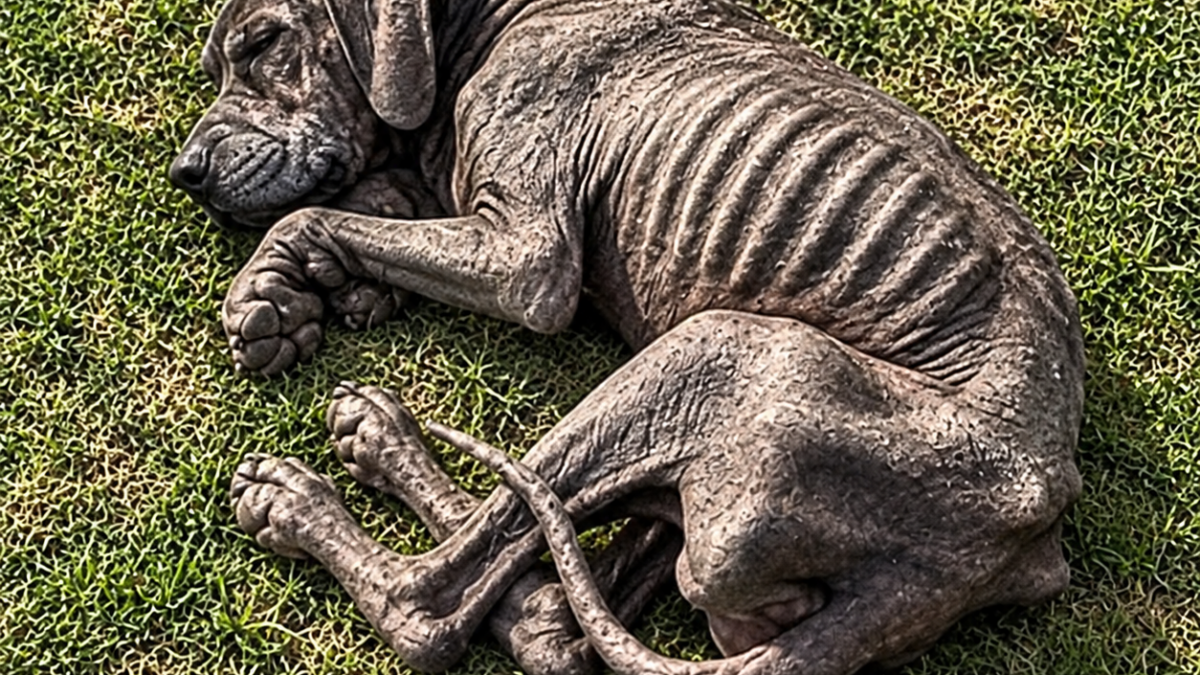
PART 2
The next morning, I arrived before the clinic fully opened.
Canelo was awake.
He lay on a folded blanket in the recovery kennel with his chin against his front paws.
For several seconds, neither of us moved.
Then his eyes followed me.
That was progress.
Tiny.
Almost meaningless to anyone else.
But I had watched him the previous evening avoid looking directly at people.
Now he was watching me.
“Morning, buddy.”
His ears shifted.
I sat on the floor outside the kennel.
I didn’t reach in.
I had already decided that Canelo would be allowed to control as many interactions as possible.
Too much of his life had apparently been controlled by other people.
When he ate.
Whether he ate.
Where he stayed.
What happened when he approached.
Whether anyone responded when he was hungry.
Now choice mattered.
The veterinary technician, Maria, arrived carrying a small bowl.
“Breakfast.”
Canelo’s head lifted.
I smiled.
“Well, look at that.”
Maria laughed.
“He remembers this part.”
She placed the bowl inside.
The meal looked ridiculously small.
Measured protein.
A carefully calculated amount of easily digestible food.
Supplements.
Nothing close to what a healthy dog his size would normally receive.
Canelo smelled it.
Then looked toward us.
Again, he waited.
Maria whispered, “He may have learned food isn’t really his.”
That sentence stayed with me.
Food isn’t really his.
Imagine learning that.
Imagine being hungry long enough that even when a bowl is placed directly in front of you, your first instinct is not to eat.
It is to wait and see whether permission disappears.
I moved back.
“No one’s stopping you.”
He took a bite.
Then another.
Within minutes, the bowl was empty.
He licked it carefully.
Every edge.
Every trace.
Then he looked up.
I had to turn my face for a second.
There are scenes you expect to break your heart.
A wounded animal crying.
A frightened dog hiding.
But sometimes it is an empty bowl.
A dog licking a clean surface because his body has learned that every calorie matters.
Maria touched my shoulder.
“He’ll get another meal in a few hours.”
“I know.”
“He’s going to feel hungry between them.”
“I know.”
“That’s intentional.”
I nodded.
The feeding schedule was strict because his body needed time to adapt.
Small meals.
Frequent meals.
Constant monitoring.
Blood values.
Electrolytes.
Heart rhythm.
Hydration.
The veterinarian explained refeeding complications in detail.
For Canelo, food was medicine.
And medicine has dosage.
The frustrating part was that Canelo did not understand.
When we removed the empty bowl, he stood.
Or tried to.
His legs shook.
He sniffed where the bowl had been.
Then he looked toward Maria.
More.
There was no mistaking the request.
She crouched.
“I’m sorry.”
Canelo approached the kennel door.
His nose pressed through the gap.
Maria closed her eyes.
“This is the worst part.”
I knew what she meant.
We finally had food.
Plenty of it.
Boxes.
Bags.
Refrigerators full of it.
And the kindest thing we could do was refuse to give him too much.
I sat beside the kennel until he gave up searching and lay down.
The first week became a series of measurements.
Meals.
Weight.
Temperature.
Blood.
Water.
Output.
Sleep.
Skin.
Every improvement was documented.
Every setback mattered.
Canelo gained a few ounces.
Then lost some.
His stomach reacted badly to one food.
We changed it.
He developed diarrhea.
We adjusted again.
His bloodwork showed slow improvement, then stalled.
The clinic treated his skin infection and began medicated baths.
Those baths became a second challenge.
The first time we tried, Canelo panicked.
Not violently.
That would have been easier in some ways.
He collapsed.
His legs folded beneath him and his entire body became rigid.
Maria immediately stopped.
“Canelo.”
His eyes were wide.
I knelt near the tub.
“Hey.”
He wouldn’t look at me.
Maria said, “We don’t have to finish this now.”
The medicated wash was important.
His skin was inflamed, painful and prone to infection.
But forcing him until he shut down would create another problem.
Trust.
I placed one hand on the edge of the tub.
Not on him.
Just where he could see it.
“Nothing bad is happening.”
His breathing remained fast.
“We can stop.”
Maria turned off the water.
Silence.
That mattered.
Canelo slowly lifted his head.
He looked toward the faucet.
Then at us.
Nothing happened.
No punishment.
No shouting.
No hand grabbing his collar.
We simply waited.
After several minutes, Maria used a damp cloth instead.
Small area.
Pause.
Another area.
Pause.
Canelo tolerated it.
That became our method.
Slow.
Predictable.
No surprise.
The first medicated bath took nearly forty minutes.
A bath that should have taken ten.
Nobody complained.
By the third session, Canelo no longer collapsed.
He trembled.
But he remained standing.
By the fifth, he allowed Maria to gently work shampoo through the damaged skin along his back.
I sat near his head.
“You’re doing fine.”
He glanced at me.
Maria whispered, “Look at his face.”
“What?”
“He believes you.”
I wasn’t ready to call it that.
Not yet.
He tolerated me.
Trusted was too big a word.
Trust is not the absence of running away.
Sometimes an animal is too tired to run.
I wanted evidence that Canelo had chosen us.
That came several days later.
I entered the recovery room carrying paperwork.
Canelo was asleep.
I sat outside his kennel.
He woke.
Looked at me.
Then stood.
He walked slowly toward the gate.
I expected him to stop a foot away.
Instead he continued.
His nose touched my fingers through the bars.
I held completely still.
Canelo sniffed.
Then moved his face slightly forward.
His forehead rested against my hand.
Not long.
Maybe two seconds.
Then he backed away.
I stared after him.
Maria had seen it from across the room.
“There.”
I swallowed.
“Yeah.”
“There it is.”
I opened the kennel door but remained outside.
Canelo looked back.
I placed my palm on the floor.
His choice.
He approached again.
One step.
Then another.
His legs were steadier than they had been a week earlier.
He lowered his head.
Sniffed my hand.
Then leaned against me.
Not much.
A few ounces of pressure.
But he leaned.
I gently touched the side of his neck.
His muscles tightened.
I stopped.
Waited.
They relaxed.
I moved my fingers again.
One slow stroke.
Canelo closed his eyes.
That broke me.
Not because he was afraid.
Because he wasn’t.
For the first time, a human hand was touching him and his body was not preparing for pain.
I sat there for a long time.
Canelo eventually lowered himself onto the blanket beside my leg.
His shoulder remained against me.
That afternoon, he ate his entire scheduled meal.
I joked that trust had increased his appetite.
The veterinarian corrected me.
“Calories increased his appetite.”
“Let me have one emotional interpretation.”
She smiled.
“Fine.”
Canelo continued improving.
But the case outside the clinic was also moving.
The animal welfare investigator, Luis Ortega, stopped by one afternoon.
He carried a folder.
I knew before he spoke that the visit wasn’t social.
“How is he?”
“Alive.”
“Better?”
“Slowly.”
Luis looked through the kennel window.
Canelo was asleep.
“Hard to believe that’s the same dog from those adoption photos.”
I turned.
“You found more?”
Luis opened the folder.
Inside were printed photographs from the rescue organization that had originally placed Canelo.
A puppy.
Round belly.
Healthy coat.
Oversized paws.
Bright eyes.
In one photograph, Canelo sat between the two people who later adopted him.
They were smiling.
One held a hand beneath his chin.
The caption from the old adoption post read:
FOREVER HOME FOUND.
I felt sick.
“Forever.”
Luis heard the bitterness.
“They signed a care agreement.”
“And?”
“And we documented enough to move forward.”
Animal cruelty charges.
Neglect.
Failure to provide adequate food and veterinary care.
The legal language sounded too clean.
There should have been a charge called watching a living thing disappear.
A charge for every meal not given.
Every day ignored.
Every time Canelo stood beside an empty bowl while people lived inside a house only yards away.
But law uses evidence, not rage.
Luis knew that better than I did.
“We have photographs.”
“Good.”
“Vet reports.”
“Good.”
“Neighbor statements.”
“Good.”
He closed the folder.
“And the adoption records.”
I looked at him.
“Will that matter?”
“It shows the condition he was in when they took custody.”
Healthy.
That mattered.
No one could claim they had adopted a chronically ill dog already near death.
They had received a healthy puppy.
Then something had happened over the following months.
Or rather, something had failed to happen.
Care.
One neighbor reported occasionally hearing Canelo barking near the back door.
Another said the dog had become thinner gradually.
One had seen him searching around trash bags.
The witness who finally called authorities had taken photographs across several weeks.
That person had kept asking themselves the same question too many people ask before making a report.
Is it really that bad?
Maybe the dog is sick.
Maybe they are treating him.
Maybe it is not my business.
Then Canelo collapsed near the fence.
The neighbor stopped wondering.
They called.
I asked Luis, “Why didn’t anyone call earlier?”
He gave me a tired look.
“You know the answer.”
I did.
People hesitate.
They are afraid of being wrong.
Afraid of conflict.
Afraid of becoming involved.
Sometimes they trust appearances more than instinct.
Sometimes the people responsible offer convincing excuses.
“He’s under veterinary care.”
“He won’t eat.”
“He has a condition.”
“He’s always been thin.”
Sometimes all of those explanations are legitimate.
Sometimes they are not.
Canelo had paid for the delay.
I looked at him sleeping.
“At least someone called.”
Luis nodded.
“That’s why he’s here.”
Weeks passed.
The scale became our favorite object.
Every weigh-in felt ceremonial.
The first time Canelo gained an entire pound from his rescue weight, Maria applauded.
Canelo immediately looked around for food.
“He thinks applause means snacks,” I said.
“It should.”
“He’d weigh a hundred pounds if you controlled his diet.”
Maria crouched beside him.
“He deserves all the food.”
“He deserves the correct amount of food.”
“That is less emotionally satisfying.”
We increased his portions gradually.
His body tolerated it.
His muscle began returning.
At first the change was almost invisible.
Then one morning I noticed his shoulders no longer looked sharp.
His spine was still obvious.
His ribs still showed.
But there was something between bone and skin now.
Life.
His coat remained damaged, though.
The skin treatment continued.
Baths.
Medication.
Topical therapy.
Nutrition.
Healing from starvation was not only about weight.
The body sacrifices everything it can when it is deprived long enough.
Skin.
Muscle.
Energy.
Immune function.
Canelo’s recovery had to happen system by system.
One afternoon, we took him outside for a short controlled walk.
It was the first time he had been allowed into the clinic courtyard.
I expected him to be excited.
Instead he froze at the doorway.
Sunlight stretched across the concrete.
Canelo stood behind the threshold.
I waited.
“Outside.”
He looked at me.
Then behind him.
I wondered if the doorway reminded him of the backyard.
Maybe not.
I had to be careful not to invent trauma for him.
Dogs react to the present even when the past influences them.
So I didn’t pull.
I stepped outside.
Sat down.
Maria joined me.
Canelo remained inside.
Five minutes passed.
A bird landed near the fence.
Canelo noticed.
His ears lifted.
The bird hopped twice.
Canelo took one step.
Then stopped.
The bird flew.
Canelo stared upward.
Another step.
His front paws crossed the threshold.
Sunlight hit his face.
He blinked.
Then he walked into the courtyard.
I smiled.
“Look at you.”
He sniffed everything.
A potted plant.
A chair.
A patch of grass.
A drain.
Maria laughed when he spent almost a minute investigating a leaf.
“He’s acting like he’s never been outside.”
“He was outside all the time.”
“Not like this.”
I knew what she meant.
This wasn’t confinement.
This was exploration.
No short boundary.
No empty bowl.
No one ignoring him.
Canelo reached the patch of grass.
He lowered his nose.
Then, unexpectedly, his tail moved.
Once.
Maria grabbed my arm.
“Did you see it?”
“Yes.”
“Again.”
Canelo sniffed.
The tail moved twice.
I laughed.
“There he is.”
That was the first real wag I had seen.
Not a reflex.
Not uncertain.
A dog responding to something interesting.
A dog emerging.
The next week brought another milestone.
A toy.
Until then, toys meant nothing to Canelo.
We had placed a soft rubber ball in his kennel.
He ignored it.
A rope.
Ignored.
A squeaky animal.
Ignored.
That didn’t surprise us.
Play requires energy beyond survival.
A starving dog does not care about entertainment.
Then one afternoon, I tossed a small stuffed fox onto the floor while reorganizing his area.
Canelo watched it land.
I continued working.
A minute later, I heard a faint squeak.
I turned.
Canelo had the fox between his front paws.
He bit it.
Squeak.
He jumped backward.
Maria laughed from the hallway.
Canelo stared at the toy.
Then approached.
Bite.
Squeak.
He jumped again.
I sat on the floor.
“Terrifying.”
Canelo looked at me.
He bit it once more.
Squeak.
This time he didn’t retreat.
His tail moved.
He grabbed the toy and shook his head.
The transformation in that single moment was shocking.
The fragile animal from the backyard disappeared.
For three seconds, Canelo was simply a young dog attacking something that squeaked.
Maria filmed him.
Later, she showed me the original intake photo beside the video.
I almost couldn’t look at them together.
Same eyes.
Same dog.
Different world.
By then, the legal case had reached its first hearing.
Luis asked whether I planned to attend.
“Do you need me?”
“Not yet.”
“Then why go?”
He studied me.
“Because I think you want to.”
He was right.
I wanted to see the people who had done this.
That is not noble.
I wish I could say my only concern was Canelo.
But anger is honest.
I wanted to look at them.
I wanted to know whether they were ashamed.
Whether they understood what they had almost killed.
Whether seeing the photographs made them feel anything.
The hearing was held in a small county courtroom.
I sat behind Luis.
The defendants entered with an attorney.
The same people from the adoption photograph.
They looked ordinary.
That bothered me more than I expected.
Cruelty would be easier to understand if cruel people looked different.
If they announced themselves.
If evil wore a uniform.
Instead, people who starve a dog can look like people you stand beside at a grocery store.
Their attorney argued that Canelo had suffered from a health problem that affected appetite.
The prosecutor requested supporting veterinary records.
There were none.
The attorney then claimed financial hardship had limited access to treatment.
The prosecutor produced evidence of repeated nonessential spending during the same period.
I felt heat rise into my face.
Luis quietly said, “Don’t.”
“I’m sitting.”
“Your expression isn’t.”
I looked down.
The judge ordered the case to proceed.
Canelo would remain in protective custody.
The defendants were prohibited from attempting to reclaim him during the proceedings.
That should have satisfied me.
It didn’t.
After court, I stood outside.
Luis approached.
“You expected something dramatic?”
“I don’t know.”
“Court is usually boring.”
“They nearly killed him.”
“And boring paperwork is how we make sure they answer for it.”
I understood his point.
Accountability is often disappointingly procedural.
Photographs.
Dates.
Forms.
Medical opinions.
Statements.
Not cinematic.
But durable.
One mistake in anger can destroy a case.
A hundred careful documents can build one.
I went back to the clinic.
Canelo was asleep with his head on the stuffed fox.
He woke when I approached.
Then stood.
His tail wagged.
I knelt.
“Your revenge is going much better than mine.”
Canelo licked my hand.
Of course, he wanted no revenge.
That was entirely human.
He wanted dinner.
Safety.
Maybe another squeak from the fox.
His indifference to the people who hurt him became one of the greatest lessons of the entire recovery.
Canelo did not wake thinking about them.
I did.
He did not imagine punishment.
I did.
He did not replay the backyard with moral outrage.
He sniffed grass.
He ate.
He slept.
He learned to play.
At first I thought that made dogs simple.
Eventually I realized it made them wise.
The past mattered.
But Canelo refused to spend the future serving it.
His next weigh-in showed another gain.
Then another.
The ribs disappeared one by one beneath muscle.
His face filled out.
The skin infection cleared.
New fur appeared in areas that had looked almost bare.
There were still scars.
Some physical.
Some behavioral.
He was protective of food at first.
Not aggressively toward us.
But he ate quickly.
Too quickly.
Then searched.
Under bowls.
Around corners.
Along counters.
Any crumb mattered.
We introduced food puzzles slowly.
They helped.
He learned meals arrived on schedule.
Morning.
Midday.
Evening.
Then another small meal.
Always.
At first he stood by the feeding area long before mealtime.
After several weeks, he stopped.
That felt important.
Hunger had once controlled his entire day.
Now his body began believing food would return whether he guarded the clock or not.
The first time Canelo left part of a treat unfinished, Maria almost cried.
“That’s healing.”
“It’s waste.”
She glared at me.
“You know what I mean.”
I did.
A starving dog never leaves food.
A safe dog can.
Canelo’s trust grew similarly.
One morning he rolled onto his side while I scratched his chest.
Not fully on his back.
Not yet.
But exposed enough that I understood what it meant.
I stopped.
He nudged my wrist.
More.
I laughed.
“You have become demanding.”
He nudged again.
“That is definitely not medically necessary.”
He disagreed.
Two months after rescue, we compared photographs.
I barely recognized him.
He had not reached ideal weight yet.
But he looked like a dog.
Not a skeleton.
His coat had developed a warm brown-gold tone that explained his name.
Canelo.
Cinnamon.
Maria said, “He finally looks like his name.”
I ran my hand along his shoulder.
“He finally looks alive.”
By then, people online had begun asking about adoption.
That created a new problem.
Canelo was popular.
His transformation photographs had circulated.
People loved dramatic before-and-after stories.
Applications arrived from everywhere.
Some sincere.
Some not.
One person wrote that they wanted “the famous skinny dog.”
Rejected.
Another wanted him as an outdoor guard dog.
Rejected immediately.
Someone asked whether he could become a breeding male.
I didn’t finish reading the application.
Maria watched my face.
“Bad?”
“Very.”
“Delete it.”
“Already did.”
Canelo was not a symbol.
Not a trophy.
Not content.
Not evidence that someone was compassionate.
He was a dog who needed a stable home.
That meant boring questions.
How many hours would he be alone?
Other pets?
Children?
Fenced yard?
Indoor sleeping?
Veterinary history?
Experience with resource insecurity?
Training methods?
Financial ability?
Backup care?
What would happen if he developed expensive medical issues later?
Anyone who became irritated by those questions eliminated themselves.
Canelo had already been promised forever once.
The second promise would have to mean something.
Then an application arrived from a woman named Elena Morales.
She was forty-three.
School counselor.
Divorced.
One teenage son, Mateo.
One elderly dog named Bruno.
Fenced yard.
Canelo would live indoors.
References excellent.
Veterinarian confirmed Bruno had received consistent care for eleven years.
Nothing dramatic.
That was exactly what I liked.
Elena didn’t write paragraphs about how she had “fallen in love with Canelo’s inspirational story.”
She wrote:
We understand that a dog recovering from severe neglect may need patience around food, touch and being left alone. We are willing to meet him several times and let him decide whether our home feels safe.
I read that sentence twice.
Let him decide.
I called her.
She answered on the second ring.
“This is Elena.”
“Hi. I’m calling about Canelo.”
A pause.
Then a careful, “Okay.”
Not screaming.
Not overexcited.
Good.
“I’d like to ask you some questions.”
“Of course.”
We talked for nearly forty minutes.
At the end, I asked, “Why Canelo?”
She thought before answering.
“My son showed me his photo.”
“That happens a lot.”
“I almost didn’t apply.”
“Why?”
“Because I assumed everyone would want him.”
That was true.
“Then Mateo said maybe wanting him wasn’t the point.”
I leaned back.
“What did he mean?”
“He said we should apply only if our home could give him what he needs, not because his story made us emotional.”
I liked Mateo already.
“When can you visit?”
Their first meeting happened on a Saturday.
I told Elena and Mateo not to bring gifts.
They arrived with nothing.
Another good sign.
Canelo was in the courtyard.
He saw them.
Stopped.
Mateo immediately looked away slightly instead of staring.
He sat on a bench.
Elena stood near the gate.
Neither called him.
Canelo looked toward me.
I sat.
“Your decision.”
He sniffed the grass.
Walked in a circle.
Then approached Elena first.
She held out a relaxed hand.
Canelo sniffed.
No tension.
Then he moved toward Mateo.
The boy remained seated.
Canelo sniffed his shoes.
His pants.
His fingers.
Then stepped away.
Mateo looked at me.
“Was that okay?”
“Perfect.”
He smiled.
Canelo returned.
This time he leaned against the boy’s knee.
Mateo’s eyes widened.
“Can I pet him?”
“Yes. Shoulder first.”
One stroke.
Canelo stayed.
Second.
Tail movement.
Elena covered her mouth.
Mateo whispered, “Hi, buddy.”
Canelo looked up.
That was the beginning.
We did not approve the adoption immediately.
There were more meetings.
Canelo met Bruno.
The elderly dog seemed completely unimpressed by him.
Canelo approached.
Bruno smelled him.
Then went back to sleep.
Maria whispered, “Relationship goals.”
We laughed.
The second meeting happened at Elena’s home.
Canelo entered cautiously.
He checked each room.
He found the water.
The back door.
Bruno’s bed.
The kitchen.
Of course the kitchen.
Then he found something surprising.
A basket of dog toys.
Bruno no longer played much.
Most had been untouched for years.
Canelo pulled out a blue rope.
Mateo sat on the floor.
“You want that?”
Canelo carried it toward him.
I felt my chest tighten.
Dogs don’t understand adoption interviews.
They understand spaces.
Smells.
Voices.
Tension.
Safety.
Canelo dropped the rope beside Mateo.
The boy picked up one end.
Canelo grabbed the other.
Gentle tug.
Elena looked at me.
I looked away.
I already knew.
Still, we completed everything properly.
Home inspection.
Final medical review.
Adoption contract.
Transition plan.
Food schedule.
Behavior notes.
No sudden diet changes.
No punishment around food.
No leaving meals unmonitored with Bruno at first.
Let Canelo choose physical contact.
Watch for signs of anxiety.
Predictable routine.
Elena took notes.
Actual notes.
Pages.
I joked, “There will be a test.”
She smiled.
“I’m ready.”
The adoption was scheduled three weeks later.
I should have been happy.
I was.
I also hated it.
That contradiction is familiar to anyone who fosters.
Success hurts.
Canelo had begun sleeping near my desk.
Following me outside.
Waiting when I arrived.
He recognized my truck.
He had learned that if I said “bath,” escape was worth attempting.
He had learned that Maria kept treats in the left pocket.
He had learned to lean his entire body against my legs when he wanted affection.
Now I would hand him to someone else.
One evening before the adoption, I sat beside him in the courtyard.
He had reached a healthy weight.
The difference was almost unbelievable.
Strong shoulders.
Steady legs.
Smooth coat.
Bright eyes.
His ribs no longer visible.
I ran my fingers through the fur along his neck.
“You know what everyone says?”
Canelo looked toward me.
“They say I saved you.”
His ears moved.
“People like simple stories.”
He put one paw over my shoe.
“I didn’t save you alone.”
I thought about the neighbor.
The officer.
Luis.
Veterinarians.
Maria.
Technicians.
Volunteers.
People who donated food.
People who documented evidence.
People who took photographs carefully enough to help a prosecutor later.
Recovery had been a chain of ordinary people doing their part.
Canelo was alive because eventually the chain had stopped breaking.
“I just happened to be there for some of it.”
He leaned against me.
“Okay.”
I smiled.
“A lot of it.”
On adoption morning, Elena and Mateo arrived early.
Mateo carried a new collar.
Simple brown leather.
A tag.
CANELO.
On the back:
HOME: MORALES FAMILY.
I had to turn away.
Elena noticed.
“Too much?”
“No.”
I cleared my throat.
“It’s perfect.”
We switched collars.
The old one had been preserved as evidence earlier and later returned after documentation.
I never liked it.
It belonged to a different Canelo.
This collar fit.
Two fingers beneath it.
Not hanging loose around a starving neck.
Mateo clipped on the leash.
Canelo looked at me.
For one terrible second, he didn’t move.
My chest tightened.
Then Bruno barked from Elena’s car.
Canelo’s ears went up.
He walked forward.
I laughed.
“Seriously?”
Mateo smiled.
“He likes Bruno.”
“Bruno barely acknowledges his existence.”
“Maybe that’s why.”
At the vehicle, Canelo turned back.
I crouched.
He came toward me.
I held his face gently.
“You’re okay.”
He licked my chin.
“Go home.”
That word caught in my throat.
Home.
He had had a home before.
At least a place people called one.
Now the word needed a better meaning.
Elena opened the door.
Canelo jumped into the back seat beside Mateo.
That surprised me.
Weeks earlier he had struggled getting into vehicles.
Now he climbed without hesitation.
Mateo fastened the safety restraint.
Canelo pressed his face to the window.
I stepped back.
The car pulled away.
Canelo watched me.
Then the vehicle turned.
Gone.
Maria stood beside me.
“You okay?”
“No.”
“Good.”
I looked at her.
“What kind of response is that?”
“The right one.”
She put an arm around my shoulder.
“If this doesn’t hurt, you stopped caring.”
I hated when she was wise.
The first update arrived twenty-seven minutes later.
A photograph.
Canelo lying beside Bruno.
Bruno looked annoyed.
Canelo looked thrilled.
Message:
Home safely. He drank water and inspected every corner.
The second came that evening.
Canelo asleep on a rug beside Mateo’s bed.
The next morning:
He ate all breakfast.
Then:
He found the toy basket again.
Then:
He stole one of Bruno’s beds. Bruno stole Canelo’s. Problem apparently solved.
I laughed.
Within a week, Canelo’s routine had settled.
Elena maintained his meal schedule.
Mateo handled evening walks.
Bruno taught him absolutely nothing except that couches were acceptable sleeping surfaces.
The first time Elena sent a photograph of Canelo asleep upside down with his legs against the couch, I stared for a long time.
Belly exposed.
Eyes closed.
Entire body loose.
Do you know what safety looks like?
Sometimes it looks like a dog sleeping in a position from which escape would be difficult.
A vulnerable stomach.
A neck exposed.
Legs uselessly in the air.
Canelo had once tensed at the movement of a hand.
Now he could sleep like that.
That photograph became my favorite.
While Canelo adjusted to his new life, the criminal case continued.
The prosecution contacted me several times for records and statements.
His former adopters eventually rejected an early plea offer.
They planned to contest the charges.
That meant trial.
Part of me was glad.
I wanted everything heard.
Another part was terrified.
Trials create uncertainty.
Evidence that feels undeniable in an exam room can become complicated in court.
Defense attorneys question timelines.
Medical causation.
Witness credibility.
Intent.
Ownership duties.
Alternative explanations.
The prosecution warned me.
“Do not expect the emotional reality of what you saw to carry the case.”
“What carries it?”
“Documentation.”
There it was again.
The unglamorous backbone of justice.
The trial began months after Canelo’s adoption.
By then, he looked so different that the prosecutor decided recent photographs should be shown only after the jury understood his intake condition.
I sat in court during portions of the testimony.
The veterinarian spoke first about severe malnutrition.
She explained that Canelo’s low body condition had not developed overnight.
His degree of muscle wasting reflected prolonged inadequate nutrition.
The defense attorney asked whether illness could produce weight loss.
“Yes.”
“Parasites?”
“Yes.”
“Cancer?”
“Potentially.”
“Organ disease?”
“Yes.”
The attorney looked satisfied.
Then the prosecutor stood.
“Doctor, did you test Canelo?”
“Yes.”
“For parasites?”
“Yes.”
“Results?”
“Not sufficient to explain his condition.”
“Evidence of cancer?”
“No.”
“Primary organ disease causing the weight loss?”
“No.”
“What happened to his laboratory abnormalities after controlled nutritional rehabilitation?”
“They improved.”
“And his weight?”
“Increased steadily.”
“His coat?”
“Recovered.”
“Muscle mass?”
“Returned.”
The prosecutor paused.
“In your professional opinion, what most likely caused his condition?”
The veterinarian looked at the jury.
“Prolonged inadequate nutrition and neglect.”
Silence.
The defense called one of Canelo’s former owners.
She testified that Canelo had been “difficult to feed.”
I felt my jaw tighten.
She said they had offered food but he sometimes refused.
The prosecutor asked what brand.
She couldn’t remember.
How often?
No consistent answer.
Had they taken him to a veterinarian when he became severely thin?
No.
Why?
Money problems.
Then came the financial records.
Not because poverty itself proves cruelty.
It doesn’t.
People struggle.
Good people struggle.
Responsible owners facing hardship seek help.
Food banks.
Shelters.
Rescue groups.
Rehoming.
Veterinary charities.
Family.
Neighbors.
They don’t simply watch an animal starve.
The prosecutor showed purchases made during the same period.
Electronics.
Entertainment.
Restaurant expenses.
None individually proved anything.
Together they destroyed the claim that absolutely no options existed.
Then Luis testified.
He described the backyard.
The empty food container.
The dirty water.
Canelo’s weakness.
The photographs were shown.
One juror looked away.
Another covered her mouth.
The defense objected to several images as prejudicial.
The judge allowed the medically relevant ones.
Then the prosecutor displayed the original adoption photograph.
Healthy puppy.
Same dog.
Same household.
Several months apart.
I heard someone behind me whisper, “Oh my God.”
The contrast was brutal.
Not because the prosecutor exaggerated.
Because no exaggeration was necessary.
The next witness was the neighbor who made the report.
Her name was Sharon.
She looked terrified on the stand.
The defense attorney asked why she had waited.
That was painful.
“You say you were concerned weeks earlier.”
“Yes.”
“But you did nothing.”
“I watched.”
“That wasn’t my question.”
“No.”
“You didn’t call.”
“No.”
“So perhaps the dog’s condition didn’t seem urgent.”
Sharon looked toward the prosecutor.
Then back.
“I was afraid of accusing someone wrongly.”
“But eventually you did.”
“Yes.”
“What changed?”
She swallowed.
“I saw him fall.”
The courtroom became still.
“He walked toward the fence.”
Her voice shook.
“He took maybe three steps, and his legs folded.”
She wiped one eye.
“He just lay there.”
The defense attorney waited.
Sharon continued.
“I went inside and called.”
“Why?”
“Because I realized being embarrassed about being wrong was less important than what would happen if I was right.”
That sentence mattered.
I saw it on the jurors’ faces.
The defense tried to suggest Sharon had personal conflict with the family.
She denied it.
There was no evidence of one.
Then it was my turn.
I described Canelo when we removed him.
His weight in my arms.
His reaction to touch.
The feeding plan.
The baths.
His progress.
The attorney attacked the emotional aspect.
“You became attached to Canelo.”
“Yes.”
“You were angry at my clients.”
“Yes.”
The prosecutor glanced toward me.
I knew admitting anger could be used against perceived objectivity.
But lying would be worse.
The attorney continued.
“So you wanted them punished.”
“I wanted the evidence investigated.”
“That wasn’t my question.”
I looked at him.
“Yes. I wanted consequences.”
He turned toward the jury.
“Because you had already decided they were guilty.”
“No.”
He stopped.
“No?”
“I had decided Canelo had been failed.”
“By my clients.”
“They were responsible for his care.”
The attorney approached.
“Yet you cannot testify to every meal they did or did not offer.”
“No.”
“You were not living there.”
“No.”
“You never personally saw my clients refuse food to Canelo.”
“No.”
He spread his hands.
“Then much of what you believe is assumption.”
I looked toward the exhibit screen.
The photograph of Canelo on intake was still there.
Then I answered.
“I can’t tell you what happened at every meal.”
I pointed carefully toward the image.
“But I can tell you what arrived at the clinic.”
The attorney objected.
The judge overruled.
I continued.
“And I can tell you what happened when adequate nutrition and medical care began.”
The prosecutor later told me I should not have pointed.
“Why?”
“Jurors notice drama.”
“That wasn’t drama.”
“I know.”
She smiled.
“That’s why it worked.”
The trial lasted four days.
The jury deliberated for nearly five hours.
Luis sat beside me in the hallway.
I kept checking my phone.
Elena had sent a photograph that morning.
Canelo and Mateo hiking on a shaded trail.
Healthy dog.
Brown coat glowing in sunlight.
Harness fitted properly.
Mouth open.
Happy.
Luis leaned over.
“That him?”
“Yeah.”
“Wow.”
I handed him the phone.
He looked at the rescue photo in his case folder.
Then at the recent picture.
“Doesn’t even look possible.”
“It is.”
“Good.”
The bailiff opened the door.
“Verdict.”
My stomach dropped.
We returned.
Everyone stood.
The jury entered.
Canelo’s former owners stared forward.
The clerk read the verdicts.
Guilty on the primary animal cruelty count.
Guilty on neglect-related charges.
Not guilty on one lesser count where the evidence did not satisfy the jury.
I barely heard the details after the first guilty.
Luis exhaled beside me.
No celebration.
No cheering.
Court does not work like that.
The defendants remained silent.
The judge scheduled sentencing.
Outside, reporters waited.
I avoided them.
Sharon stood near the courthouse steps.
She looked lost.
I approached.
“You okay?”
“I think so.”
“You did well.”
She shook her head.
“I waited too long.”
I knew she carried that.
“Maybe.”
Her eyes filled.
I wasn’t going to lie to make her feel better.
Earlier would have been better.
“But you called.”
She looked at me.
“That matters.”
“What if I’d waited another day?”
“We don’t know.”
“I keep thinking about it.”
“So do I.”
She stared toward the courthouse.
“I’ll never wait again.”
That was the only useful place guilt could go.
Forward.
I called Elena.
She answered immediately.
“What happened?”
“Guilty.”
Silence.
Then I heard her exhale.
Mateo’s voice in the background.
“What? What did they say?”
Elena repeated it.
I heard Mateo shout, “Yes!”
Then apologize for shouting.
I laughed.
“How’s Canelo?”
“Completely unaware.”
“Perfect.”
“He’s asleep.”
“Even better.”
At sentencing, the judge imposed penalties that included probation conditions, fines, restitution tied to some care costs, and a lengthy prohibition on owning or possessing animals under the applicable order.
The legal consequences were not as dramatic as some people wanted.
I received messages from strangers saying prison should be longer.
Fines should be larger.
Everything should be harsher.
I understood the anger.
But one part of the order mattered more to me than vengeance.
They could not simply acquire another dog and repeat the same pattern.
The judge spoke directly to them.
“When you adopted this animal, you accepted responsibility for a dependent life.”
She looked at the intake photograph.
“He had no ability to obtain food for himself. He could not leave the yard and seek veterinary treatment. He depended entirely on the people who accepted custody of him.”
One defendant began crying.
I felt nothing.
Then felt guilty for feeling nothing.
The judge continued.
“Ownership is not entitlement. It is obligation.”
That sentence stayed with me.
Ownership is obligation.
After the hearing, Luis found me outside.
“Feel better?”
I thought.
“Yes.”
“Because they were punished?”
“Partly.”
“What’s the bigger part?”
“They can’t take another dog.”
He nodded.
“That’s usually the part that matters.”
But Canelo’s real revenge was happening miles away.
He was gaining weight.
Running.
Sleeping beside Mateo.
Stealing Bruno’s toys.
His former owners had reduced his world to a backyard and an empty bowl.
Now his world kept expanding.
Elena sent a video a week after sentencing.
Canelo was at a park.
Mateo threw the blue rope toy.
Canelo ran after it.
Actually ran.
Four strong legs stretching across grass.
He reached the toy.
Grabbed it.
Then kept running away from Mateo instead of bringing it back.
I laughed so hard I replayed it.
The dog whose legs had once trembled under the weight of his own starving body now had enough strength to be deliberately annoying.
That was justice.
Months passed.
Canelo’s coat became thick.
His body filled out completely.
At his next annual examination, the veterinarian placed his old intake photo beside him.
Maria was there.
She stared.
“Same dog.”
Canelo tried to eat a treat from her pocket.
“Same appetite too.”
“Actually, dramatically different appetite.”
She laughed.
I knelt.
Canelo immediately leaned into me.
He had not forgotten.
That mattered more than I expected.
I visited the Morales family regularly.
Not too regularly.
I didn’t want to become the strange rescue person who refused to let go.
But Elena always invited me.
Canelo greeted me with full-body enthusiasm.
Bruno greeted me by opening one eye.
Mateo had become Canelo’s person.
That relationship was obvious.
If Mateo entered a room, Canelo followed.
Homework?
Canelo beneath the desk.
Video games?
Canelo beside the chair.
Backyard?
Canelo there.
When Mateo had friends over, Canelo moved among them collecting attention.
The boy who had asked whether his family could give Canelo what he needed instead of merely wanting him had become exactly what Canelo needed.
Reliable.
Patient.
Present.
One afternoon I found Mateo brushing Canelo in the yard.
The dog lay on his side.
Completely relaxed.
“You know he used to hate being touched like that.”
Mateo looked up.
“Really?”
“Baths too.”
“He still hates baths.”
“That may be personality now.”
Mateo laughed.
Canelo rolled slightly, exposing his stomach.
Mateo rubbed it.
I watched.
That image brought me back to the first week.
Canelo flattening himself.
Bracing.
Human hand approaching.
Now he pushed his own body toward a teenager because he wanted more affection.
“He trusts you,” I said.
Mateo shrugged.
“He knows I won’t hurt him.”
Simple.
For Canelo, it had once been complicated.
Now it wasn’t.
That was healing.
Bruno died the following year.
He was twelve.
Kidney disease.
Peaceful end at home.
The family was devastated.
Canelo behaved differently afterward.
For several days, he searched Bruno’s sleeping places.
The couch.
The bedroom.
The back door.
He ate normally but seemed unsettled.
Then he began sleeping in Bruno’s old bed.
Elena sent me a photograph.
“I think he misses him.”
Probably.
We cannot know exactly how dogs conceptualize death.
But they notice absence.
Canelo had already known too much absence.
Food.
Care.
Safety.
Now a friend.
Mateo slept near him for several nights.
Eventually, Canelo returned to routine.
Weeks later, Elena considered removing Bruno’s old bed.
Canelo immediately lay on it.
She left it.
Some things can stay.
A year later, the family adopted another rescued dog.
This time, Canelo was the established resident.
Her name was Lucy.
She was nervous.
Not starved.
But frightened.
The first meeting reminded me of Canelo’s early days.
Lucy stayed behind Elena.
Canelo approached.
She retreated.
He stopped.
Waited.
Then lay down.
No pressure.
No chasing.
Within fifteen minutes, Lucy came forward.
She smelled him.
Canelo remained still.
Mateo whispered, “He knows.”
Maybe.
Maybe not.
Again, we love giving human meaning to animals.
But Canelo had certainly learned that trust comes faster when nobody forces it.
Within a month, Lucy slept beside him.
The dog once afraid to lean into a human now became another dog’s source of calm.
Years passed.
Canelo matured.
The puppy energy softened.
His favorite activities became walking with Mateo, lying in sunny patches and monitoring the kitchen.
He never completely lost his sensitivity around food.
He no longer guarded.
No longer inhaled every meal.
But certain habits remained.
If a bag dropped on the floor, Canelo investigated immediately.
If someone threw away food, he watched.
If mealtime was late by more than fifteen minutes, he appeared.
Elena joked that he had an internal clock.
I understood.
Bodies remember scarcity.
Even when the mind feels safe.
One Christmas, I joined the Morales family for dinner.
Canelo lay beneath the table.
Lucy beside him.
Mateo was older now.
Preparing for college.
We talked about his plans.
At some point he dropped a piece of turkey.
Canelo caught it before it hit the floor.
Everyone laughed.
I looked at him.
Healthy.
Shiny coat.
Strong body.
Surrounded by people.
The old image of the backyard flashed through my mind.
Then disappeared.
That was happening more often.
For years, when I heard Canelo’s name, I first saw bones.
Now I saw this.
A dog under a dinner table stealing turkey.
Healing sometimes means changing which memory arrives first.
After dinner, Mateo sat beside me on the porch.
Canelo lay between us.
“I have a question.”
“Okay.”
“Do dogs know when they were rescued?”
I looked down.
“What do you mean?”
“Like, does he know this is better?”
“Yes.”
“You think?”
“I think he knows how he feels.”
Mateo scratched Canelo’s neck.
“But does he remember before?”
“Probably parts.”
“Food?”
“Likely.”
“People?”
“Maybe.”
He was quiet.
Then he said, “I hope he doesn’t remember everything.”
I understood.
“I don’t think remembering is the worst thing.”
Mateo looked at me.
“What is?”
“Believing it can happen again.”
He considered that.
Then looked at Canelo.
“He knows it won’t.”
That was the answer.
Whatever Canelo remembered, he no longer expected the past to repeat.
He knew breakfast would come.
Water would be clean.
Doors opening did not mean abandonment.
A hand reaching toward him probably carried affection.
If he became sick, someone noticed.
If he was hungry, someone cared.
If he rested, he was allowed to sleep.
The predictability of love became stronger than the unpredictability of neglect.
That was what we had been trying to give him from the first measured meal.
Not simply calories.
Certainty.
When Mateo left for college, Canelo struggled.
For days he waited beside Mateo’s bedroom door.
Elena sent updates.
“He keeps checking.”
Mateo video-called him.
Canelo recognized the voice.
He searched behind the phone.
That nearly broke everyone.
Two weeks later, Mateo returned for a weekend.
Elena filmed it.
The door opened.
Mateo stepped inside.
Canelo froze.
Then launched himself across the room.
He jumped against Mateo.
Mateo dropped his backpack and knelt.
“Hey! Hey, buddy!”
Canelo pressed against him so hard the boy almost fell.
Full-body wag.
Whining.
Licking.
Mateo laughed and cried at the same time.
I watched the video repeatedly.
Once, Canelo had been left in a backyard while people moved through the house without noticing him.
Now someone left for two weeks and came home specifically thinking about him.
That contrast had become his life.
As Canelo entered his senior years, he slowed.
Gray appeared around the muzzle.
He still loved food.
Some things remained sacred.
But runs became walks.
Then shorter walks.
Lucy, younger and more energetic, adjusted to him.
She stopped crashing into him during play.
She waited.
Canelo became the calm one.
The teacher.
The dog that made new foster animals less frightened when Elena temporarily helped the rescue.
That development surprised me.
Yes.
Elena became a foster volunteer.
“This is your fault,” she told me.
“No.”
“Canelo’s fault?”
“Absolutely.”
Her home became a temporary stop for dogs recovering from neglect.
Not constantly.
One at a time.
Carefully.
Canelo greeted them.
Some ignored him.
Some followed him.
One terrified little terrier refused to enter the kitchen for two days.
Canelo walked in.
Ate.
Walked out.
The terrier watched.
Next meal, Canelo repeated it.
On the third day, the terrier followed.
Elena sent me the video.
Caption:
Professor Canelo teaching advanced courses in meal security.
I cried when I watched it.
Not because it was sad.
Because life had created a strange circle.
The dog whose hunger once nearly killed him became evidence to frightened animals that bowls could be trusted.
Meal appears.
Dog eats.
Nobody takes it.
Meal appears again later.
The lesson Canelo had needed was now being demonstrated by him.
His former adopters had taught him scarcity.
His real family taught him abundance.
Canelo passed on the second lesson.
That was better revenge than anything I had imagined outside the courthouse.
Years after the trial, I unexpectedly saw Sharon again.
The neighbor who reported him.
She recognized me at a grocery store.
“Canelo?”
That was her first word.
I smiled.
“Good.”
“Still?”
“Very.”
Her eyes filled.
“Do you have a picture?”
I did.
Of course I did.
I showed her a recent photograph.
Canelo in the backyard.
Older.
Gray muzzle.
Healthy.
Lucy beside him.
Sharon put one hand over her mouth.
“Oh.”
“He turned out pretty well.”
She touched the screen.
“I thought he was going to die.”
“So did we.”
She looked at me.
“Can you send that to me?”
I did.
She stared at the image.
Then whispered, “I should have called earlier.”
Years later, still carrying it.
I remembered what I had told her at the courthouse.
“You called.”
She nodded.
“I know.”
“That changed everything.”
She looked at me.
“Did it really?”
I pointed to the photograph.
“That dog exists because you decided one afternoon that uncertainty wasn’t enough reason to stay silent.”
She cried in the produce aisle.
So did I, slightly.
We probably confused everyone nearby.
Before leaving, Sharon said something I never forgot.
“I’ve reported two other situations since.”
“Were they abuse?”
“One was.”
“And the other?”
“Just an old dog with cancer. The owners were treating him.”
“Any regret?”
“No.”
“Good.”
That was Canelo’s influence too.
Not dramatic.
Not visible in photographs.
One rescued dog had made one person less afraid to speak the next time.
That matters.
When Canelo was around ten, arthritis appeared.
Nothing severe at first.
Stiffness after sleeping.
Slower stairs.
Elena moved his bed downstairs.
Mateo, now out of college and working, visited often.
Canelo still treated each arrival like a national holiday.
His veterinary care became more frequent.
Weight management.
Joint medication.
Blood work.
Everything his first home had failed to provide now arrived almost excessively.
Elena apologized once for calling the veterinarian over what turned out to be a minor stomach upset.
The veterinarian said, “Never apologize for noticing.”
I loved that.
Notice.
So much suffering begins because nobody notices.
Or because they notice and convince themselves it can wait.
Canelo’s second life was built on the opposite principle.
Someone always noticed.
When he drank less.
Walked differently.
Scratched too much.
Ate slower.
Slept longer.
Somebody saw.
In his eleventh year, bloodwork showed kidney changes.
Mild.
Manageable.
Elena called me after the appointment.
Her voice sounded frightened.
“He’s okay.”
“Then why do you sound like that?”
“Because he’s getting old.”
I had no answer that would make that easier.
Canelo had once been so close to death that adulthood itself had felt miraculous.
Some part of us had assumed survival should make him exempt from aging.
It doesn’t.
Rescue does not stop time.
It gives time.
That is the gift.
Not forever.
More.
Canelo got more.
Years more.
Meals more.
Walks more.
Sleep more.
People more.
Love more.
We adjusted.
Diet.
Medication.
Shorter exercise.
Canelo handled everything with the dignity of an elderly dog who believed the entire household existed for his convenience.
He became selective about weather.
Rain?
No.
Too hot?
No.
Cold mornings?
Possibly later.
Perfect afternoon sunlight?
Acceptable.
Mateo bought him an orthopedic bed.
Canelo used it for one night.
Then returned to the couch.
Elena sent a message:
$180 bed. He prefers stolen furniture.
I replied:
Consistent personality is a good neurological sign.
She sent back:
I hate you.
Canelo kept going.
By twelve, his hearing weakened.
He didn’t always hear the door.
But he felt footsteps.
When Mateo visited, he learned to approach from the front so Canelo wouldn’t startle.
The reunion became quieter.
No sprinting.
No jumping.
Mateo knelt.
Canelo walked toward him.
Slowly.
Then leaned his entire body against Mateo’s chest.
Same affection.
Different speed.
One afternoon I visited.
Canelo was asleep in the yard.
Sunlight covered half his body.
I sat beside him.
He didn’t wake.
For a moment, panic hit me.
Then his chest rose.
I laughed quietly at myself.
Eventually his eyes opened.
He looked toward me.
No reaction.
My heart dropped.
“Canelo?”
His nose moved.
Then recognition.
Tail against grass.
Thump.
Thump.
I smiled.
“Your ears are terrible.”
He lifted his head.
“Your nose still works.”
He leaned toward me.
I put my hand against the side of his face.
His muzzle was almost completely gray now.
I remembered touching him in the clinic.
He had tensed.
Now his entire weight settled into my palm.
We sat like that.
I told him things he could barely hear.
“You caused a lot of problems.”
Tail thump.
“You made me attend court.”
Another.
“You made Maria cry constantly.”
Another.
“You made a whole family rearrange its life.”
He closed his eyes.
“Worth it.”
His breathing deepened.
Elena came outside carrying coffee.
“He still knows you.”
“I bribed him early.”
“Food?”
“Mostly.”
She sat.
For a while we watched him sleep.
Then she asked, “How do we know?”
I knew what she meant.
The question had arrived.
“When it’s time?”
She nodded.
I hated those conversations.
But avoiding them does not protect the animal.
It only protects us.
So we talked.
Appetite.
Comfort.
Mobility.
Interest.
Good days versus bad.
Pain.
Breathing.
Sleep.
Dignity.
Not one sign.
A pattern.
“You’ll know him better than anyone.”
“What if I choose too early?”
“Everyone fears that.”
“What if I wait too long?”
“Everyone fears that too.”
She looked at Canelo.
“I promised him forever.”
I understood why those words mattered.
His first family had supposedly made the same promise.
I said, “Forever doesn’t mean making him stay forever.”
Elena looked at me.
“It means staying with him for all of his.”
She cried.
So did I.
For another year, Canelo did well enough.
Slower.
But happy.
He ate.
Always important with Canelo.
He followed Elena from room to room.
He spent time with Lucy.
He sat near foster dogs.
He waited for Mateo.
Then one winter his kidneys worsened.
The decline was gradual.
At first, medication helped.
Diet adjustment helped.
Fluids helped.
Then appetite decreased.
That frightened us more than any laboratory number.
Canelo refusing food felt wrong at a spiritual level.
Elena tried chicken.
He ate some.
Then none.
Mateo came home.
Canelo stood to greet him but had difficulty.
Mateo sat on the floor instead.
Canelo walked the final few feet and rested his head in Mateo’s lap.
Elena called me that night.
“You should come.”
I drove over the next morning.
Canelo lay in the living room on a thick blanket.
Lucy rested nearby.
His body was thinner again.
Not like before.
Never like before.
But age and illness had removed some of his strength.
For a second, the sight brought the backyard rushing back.
Bones.
Weak legs.
Fear.
I had to remind myself.
This was different.
That dog had been denied care.
This dog had received everything.
That dog was starving because people had failed him.
This dog was nearing the end of a long life while surrounded by people desperately trying to keep him comfortable.
The bodies might both look fragile.
The meaning was completely different.
I sat beside him.
“Canelo.”
His eyes opened.
Nose moved.
Then the tail tapped the blanket.
Once.
I laughed through tears.
“Still there.”
Mateo sat opposite me.
“He ate a little last night.”
“What?”
“Chicken.”
“Of course.”
Canelo looked toward him.
“He trained you well.”
Mateo smiled.
“I know.”
The veterinarian came to the house that afternoon.
She examined him gently.
Canelo no longer feared hands.
Not hers.
Not ours.
He simply lay there.
When she finished, Elena asked, “Are we there?”
The vet did not pretend not to understand.
“Yes.”
Elena covered her mouth.
Mateo lowered his head.
Lucy stood and moved closer to Canelo.
The veterinarian continued.
“We could probably extend things a little.”
“How?”
“More supportive care. Possibly hospitalization.”
“Would he feel better?”
A pause.
“Probably not enough.”
That was all Elena needed.
She knelt.
Canelo looked at her.
“I promised you.”
Her voice broke.
“You are not going to suffer because I’m afraid.”
Mateo began crying.
I looked away.
Those were the hardest forms of love.
The ones that cost the person giving them.
We decided Canelo would remain at home.
His bed was moved near the patio door because he loved looking into the yard.
Mateo brought the blue rope toy.
The original one had been destroyed years earlier, but he had kept a piece of it.
I couldn’t believe it.
“You kept trash?”
Mateo laughed through tears.
“It was his.”
Canelo sniffed the frayed rope.
His eyes closed again.
Maria came.
When she entered, Canelo’s nose lifted.
She sat beside him.
“Oh, handsome.”
Tail tap.
“You remember who had the treats.”
Another tap.
Maria cried immediately.
“No fair.”
She ran her fingers along his head.
“You used to look at my left pocket every time I walked in.”
Canelo’s nose moved toward her jacket.
We all laughed.
Even then.
Food.
Of course.
Luis stopped by too.
He had retired from animal welfare enforcement two years earlier.
He stood in the doorway.
Canelo looked at him.
Luis crouched.
“I saw you on your worst day.”
He rubbed his ears.
“Glad I got to see this one too.”
No one called it the worst day.
Because it wasn’t.
Sad?
Yes.
Devastating?
Absolutely.
But not worst.
Canelo’s worst days had been spent unseen.
This day he was surrounded.
That distinction mattered.
The veterinarian returned in the evening.
We had deliberately given everyone time.
Elena sat against the couch.
Canelo rested between her and Mateo.
Lucy lay near his back.
Maria sat nearby.
I sat near his head.
The room was quiet.
No clinic lights.
No metal table.
No restraints.
Home.
The veterinarian explained the medication.
Elena nodded.
Then she leaned down.
“Canelo.”
His eyes opened.
“You were supposed to stay forever.”
Her tears fell into his fur.
“I know.”
She kissed his head.
“But this is your forever.”
She touched his chest.
“Not mine.”
Mateo leaned forward.
“You were the best dog.”
Canelo breathed slowly.
Mateo laughed through tears.
“Except for stealing food.”
Tail tap.
Everyone laughed.
I placed one hand beside Canelo’s face.
He moved toward it.
That destroyed me.
Years earlier, the first time he leaned into my hand had felt like a miracle.
Now, at the end, he still chose it.
I rubbed the fur beneath his ear.
“You did good.”
His eyes remained on me.
“You know that?”
One slow breath.
“You did everything.”
The veterinarian gave the sedative.
Canelo’s body softened.
No fear.
No trembling.
No tense muscles.
He became sleepy.
Elena whispered, “You’re safe.”
Mateo repeated it.
“You’re safe, buddy.”
I thought of the backyard.
The empty bowl.
The dog who once had no reason to believe those words.
Now everyone in the room knew they were true.
The final medication followed.
Canelo took one breath.
Then another.
Then none.
Elena kept one hand over his heart.
Mateo buried his face against Canelo’s neck.
Maria turned away.
Luis removed his glasses.
Lucy stayed beside him.
I kept my hand under Canelo’s cheek.
For a long time.
Nobody rushed us.
Eventually I whispered, “No one forgot you.”
That felt like the right final sentence.
Because neglect had been the original wound.
Not only hunger.
Being unseen.
Now Canelo left a world filled with people who could not imagine forgetting him.
The Morales family had him cremated.
Mateo kept the collar.
Elena placed Canelo’s ashes beneath a tree in the backyard where he had spent countless afternoons.
They planted rosemary and lavender around it.
Lucy slept near the spot for weeks.
A few months later, Elena called me.
“I’m doing something.”
“That sounds dangerous.”
“I’m applying to foster again.”
I smiled.
“You sure?”
“No.”
“Perfect qualification.”
She laughed.
Then became serious.
“I keep thinking about Canelo.”
“So do I.”
“He got another life because somebody reported him.”
“Yes.”
“And because all of you had somewhere to put him.”
“Yes.”
“I want to be somewhere for the next one.”
That was how Canelo’s life kept moving forward.
Through people.
The first foster dog arrived two weeks later.
A skinny black dog named Pepper.
Not critical.
Just frightened.
Pepper refused food the first evening.
Elena sat near the bowl.
She did not force.
Did not hover.
She remembered.
Small meal.
Quiet room.
Safety.
Pepper eventually ate.
Elena sent me a photograph of the empty bowl.
No caption.
None needed.
I stared at the picture.
Then found another photograph in my phone.
Canelo’s first empty bowl.
Two dogs.
Years apart.
One lesson carried forward.
That was legacy.
Not statues.
Not viral photographs.
Changed behavior.
Changed people.
More animals surviving because one animal taught us something.
A year after Canelo died, the rescue organization held a fundraiser.
They displayed several transformation stories.
Before and after.
Canelo’s was among them.
I almost asked them not to include his worst photograph.
I hated that image.
Then I saw the second one they had chosen.
Canelo running beside Mateo.
Healthy.
Brown coat.
Mouth open.
Eyes bright.
The photographs were placed side by side.
Underneath:
CONFISCATED FOR SEVERE NEGLECT. RECOVERED. ADOPTED. LOVED FOR THE REST OF HIS LIFE.
Nothing more.
A woman stood beside me staring at the images.
“Is that really the same dog?”
“Yes.”
“You knew him?”
“Yes.”
She looked again.
“How does that even happen?”
I wasn’t sure which part she meant.
The starvation?
Or the recovery?
Both were difficult to comprehend.
“Slowly,” I said.
“What?”
“Both things happened slowly.”
She looked at me.
“He wasn’t reduced to that condition in one day.”
I pointed toward the second photograph.
“And he didn’t become that dog again in one day either.”
Meal by meal.
Bath by bath.
Touch by touch.
Week by week.
Trust returned the same way neglect had destroyed it.
Gradually.
That became the clearest lesson Canelo left me.
We like dramatic rescue moments because they are easy to understand.
A gate opens.
A dog is removed.
Everyone applauds.
But removal is not recovery.
Recovery is repetition.
Food arrives tomorrow too.
The water is clean again.
The hand stays gentle.
The person returns.
The bed remains.
The door opens.
The dog is not abandoned.
Again.
Again.
Again.
Until the body stops expecting hunger.
Until the muscles return.
Until skin heals.
Until the mind stops asking when kindness will disappear.
Canelo had needed thousands of repetitions.
He got them.
Years later, I visited Elena.
The tree over Canelo’s ashes had grown.
Pepper, the former foster, had already been adopted.
A new foster dog slept on the porch.
Mateo was visiting.
Lucy had grown older.
We sat beneath the tree.
Mateo had brought Canelo’s collar.
He sometimes did that.
Not because he couldn’t let go.
Because remembering was allowed.
He held the tag.
HOME: MORALES FAMILY.
“Funny,” he said.
“What?”
“We wrote this before he knew us.”
I looked at the tag.
“True.”
“We were basically making a prediction.”
“Did pretty well.”
He smiled.
Then became quiet.
“I used to hate the people who had him before.”
“Used to?”
“I don’t think about them much now.”
I understood.
That was where I had eventually arrived too.
Not forgiveness exactly.
Consequences still mattered.
Responsibility mattered.
But they no longer deserved the center of Canelo’s story.
For a while, I had thought revenge meant a guilty verdict.
A prohibition on owning animals.
Court orders.
A judge making them listen.
Those things mattered.
They protected other animals.
But the most satisfying revenge happened without Canelo ever knowing there was a court case.
He became healthy.
He trusted again.
He was adopted again.
He learned toys.
Parks.
Couches.
Christmas turkey.
Bruno.
Lucy.
Mateo.
He became old.
That last part mattered enormously.
He became old.
The dog who once looked as though he might not survive another week lived long enough for his face to turn gray.
There is no better answer to someone who treated a life as disposable.
Canelo lasted.
Love lasted longer than their neglect.
I touched the tree trunk.
Mateo said, “Do you remember the first time he leaned on you?”
I looked at him.
“How do you know about that?”
“Elena told me. Maria too.”
“People talk too much.”
“What was it like?”
I thought about the kennel.
The weak dog.
The hesitation.
The forehead against my hand.
“It felt like being trusted with something expensive.”
Mateo laughed softly.
“He leaned on everyone later.”
“I know.”
“That was his thing.”
“Yes.”
Maybe that was why the first time mattered.
Canelo had transformed an act of fear into a habit of love.
At the clinic, leaning against me had been a risk.
At home, leaning against people became ordinary.
That is what recovery should do.
Turn miracles into routines.
Years after Canelo’s case, I was called to another neglect investigation.
Different dog.
Different people.
I arrived beside Luis’s replacement.
The dog was thin.
Not as severe.
But bad.
A young officer looked shaken.
“How do people do this?”
I remembered asking versions of that question.
I said, “We can argue about that later.”
“What now?”
“We document everything.”
Photographs.
Water.
Food.
Body condition.
Environment.
Veterinary exam.
Dates.
Witnesses.
Carefully.
The officer looked frustrated.
“That feels so small.”
“No.”
I thought about court.
The adoption photograph.
The veterinary testimony.
Sharon.
The guilty verdict.
“Small things become a case.”
We removed the dog.
At the clinic, someone offered him food.
I stopped them.
“Ask the veterinarian how much first.”
The young officer looked confused.
“He’s starving.”
“I know.”
Then I heard my own words from years earlier.
Food is medicine.
Dose matters.
Canelo had become part of my professional reflex.
That was another kind of survival.
He lived inside what we remembered to do for the next animal.
I sometimes revisit the first photograph.
Not often.
I don’t need pain as proof that compassion matters.
But once in a while, I look.
Every rib.
Thin neck.
Trembling legs.
Then I look at the later picture.
Canelo and Mateo in a field.
That image contains everything the first one doesn’t.
Strength.
Movement.
Choice.
Belonging.
If you only saw the first photograph, you might call Canelo a tragedy.
You would be wrong.
The tragedy happened to him.
It did not become him.
If you only saw the second photograph, you might never guess how difficult the road had been.
That is fine.
Survivors should not be required to display wounds forever just so the rest of us remember what they endured.
Canelo earned the right to look ordinary.
That may be my favorite part.
He became ordinary.
A dog who begged.
Shed hair.
Stole food.
Hated baths.
Loved people.
Slept on furniture.
Missed his boy when he went away.
Got arthritis.
Needed medicine.
Grew gray.
Died old and loved.
Ordinary became the victory.
I still speak to Sharon occasionally.
She volunteers now.
Not full-time.
Whenever she sees something concerning, she reports it sooner.
“I’d rather apologize for being wrong,” she told me once.
That sentence should probably be printed on every animal welfare hotline.
You do not need certainty to ask someone qualified to check.
You need a reasonable concern.
Let the investigators determine the rest.
Canelo existed long enough to grow old because one neighbor finally stopped telling herself there might be an explanation.
That fact remains uncomfortable.
It should.
Compassion sometimes requires the courage to be inconvenient.
To knock.
To call.
To ask.
To risk being wrong.
Canelo paid the price while people hesitated.
Then benefited from the moment somebody didn’t.
I wish the call had come sooner.
Nothing changes that.
But wishing backward does not feed the next hungry dog.
Acting forward might.
That is where I put the anger now.
Into speed.
Documentation.
Education.
Better foster networks.
Food assistance.
Veterinary resources.
Helping owners who genuinely want to care for their animals but are struggling.
And enforcement when care is intentionally or recklessly denied.
Compassion without structure can fail.
Structure without compassion becomes cold.
Canelo needed both.
Someone angry enough to intervene.
Someone careful enough to build a case.
Someone skilled enough to treat starvation.
Someone patient enough to rebuild trust.
Someone responsible enough to adopt him.
It took all of us.
Near the end of one visit to Elena’s house, I stood beneath Canelo’s tree alone.
The yard was quiet.
A foster dog barked inside.
Mateo and Elena were arguing affectionately about dinner.
Lucy was sleeping near the porch.
Life.
Canelo’s absence was still visible.
But so was everything he had changed.
I placed my hand on the tree.
“You know what?”
Wind moved through the leaves.
“I stopped being angry all the time.”
Not completely.
Some stories deserve anger.
But anger had lost its throne.
“That’s probably your fault too.”
I smiled.
“If you’d been a little less happy after all that, maybe I could’ve stayed bitter.”
Canelo had made bitterness difficult.
Every new photograph of him had contradicted despair.
Every pound gained.
Every tail wag.
Every nap.
Every year.
His life kept arguing that what happened before did not own what happened next.
I walked toward the house.
Before entering, I looked back.
For a second, memory placed him there.
Healthy coat.
Gray muzzle.
Standing in sunlight.
Then the image disappeared.
I didn’t chase it.
Memory doesn’t need to become hallucination to matter.
I opened the door.
The foster dog immediately approached.
Thin.
Nervous.
Not Canelo.
Never Canelo.
I sat on the floor.
The dog stopped several feet away.
Elena said, “He doesn’t trust men yet.”
“That’s okay.”
I placed my hand on the floor.
No reaching.
No pressure.
The dog watched.
Minutes passed.
Then one step.
Another.
A nose touched my fingers.
I smiled.
There it was again.
The beginning.
Not dramatic.
Just a small decision.
Trust.
I thought about Canelo.
The dog who had once been slowly erased in a backyard.
The dog who had looked at food as though it might disappear.
The dog whose body tensed beneath gentle hands.
The dog who eventually leaned.
A few ounces of pressure.
That tiny movement had been his declaration.
Maybe humans weren’t finished disappointing him.
He couldn’t know.
But maybe they weren’t all dangerous either.
He took the risk.
We tried to deserve it.
That is the promise rescue actually makes.
Not that nothing bad will ever happen again.
We cannot promise that.
Not that pain disappears.
It doesn’t.
The promise is smaller and more serious.
We see you now.
You will not face this alone now.
Food will come.
Medicine will come.
Someone will notice.
Someone will return.
Canelo spent the first chapter of his life learning that trust could be betrayed.
He spent the rest discovering trust could also be rewarded.
When people ask me what justice looked like in his case, I could tell them about the verdict.
The court order.
The ownership ban.
The restitution.
Those are valid answers.
But they are not the image that comes to mind.
I see Mateo walking through the front door after college.
Canelo, old and gray, struggling to stand because his boy has come home.
I see the dog moving toward him.
Slowly.
No trembling from starvation.
Only age.
No empty bowl behind him.
Only a full life.
Mateo kneels.
Canelo leans into him.
That is justice.
The people who once treated Canelo as if his life did not matter were proven wrong thousands of times.
Every meal proved them wrong.
Every veterinary visit.
Every toy.
Every photograph.
Every Christmas.
Every birthday.
Every afternoon sleeping beside someone who loved him.
Every gray hair.
Every year they never expected him to have.
They almost reduced him to bones.
Instead, he became a memory large enough to change how an entire group of people cared for the animals who came after him.
That is the ending I wanted for him.
Not revenge through pain.
Revenge through life.
A long one.
A safe one.
A wonderfully ordinary one.
Canelo had once stood beside an empty bowl waiting for people who never came.
Years later, when his strength finally left him for the last time, there were too many people in the room to fit comfortably around his bed.
That difference was his whole story.
And whenever I think about the first moment he leaned his forehead into my hand, I understand something I couldn’t have known then.
Canelo wasn’t asking us to erase what had happened.
He was giving us a chance to show him what could happen next.
We took that chance.
So did he.
And the dog they almost erased became impossible for any of us to forget.








