PART 2: They Said My Blind 20-Year-Old Cat Had One Month Left—So I Sold My House and Gave Her the World
They told me the blind twenty-year-old cat in the corner kennel probably had less than a month to live, and that the kindest thing I could do was make her final days comfortable.
Nobody had asked about her in sixty-three days, because most people walked into a shelter hoping to begin a long story—not volunteer to be there for the ending of one.
I went there believing I was adopting a dying cat, but by the time I understood what Willow had actually done to my life, the house, the job, and the man I used to be were already far behind us.
My name is Nate.
I was forty-four when I first saw Willow.
At the time, I had what most people would call a good life.
I worked in IT.
I owned a house in Tucson, Arizona.
My mortgage was manageable.
My refrigerator was full.
My retirement account moved quietly in the right direction every month.
Monday through Friday, I woke up at 6:30, showered, made coffee, drove to work, stared at screens, solved problems other people considered urgent, came home, reheated something for dinner, watched television, and went to bed.
Then I did it again.
Nothing was wrong.
That was the problem.
I kept waiting for some recognizable crisis that would explain why I felt so disconnected from my own life.
There wasn’t one.
No dramatic breakup.
No bankruptcy.
No terrible diagnosis.
I was simply moving through days that looked respectable from the outside and strangely empty from the inside.
Then, on a Tuesday night, I saw a shelter post.
I almost scrolled past it.
The photograph showed a tiny white cat sitting alone inside a kennel.
Her eyes were closed.
Not sleepy.
Closed.
There was something about the way she sat that stopped me.
She wasn’t pressed against the bars asking for attention.
She wasn’t hiding either.
She looked like she had simply accepted that the world would come or not come, and she had no energy left to argue with it.
I read the caption.
**WILLOW — 20 YEARS OLD.**
**COMPLETELY BLIND.**
**STAGE 4 KIDNEY DISEASE.**
Then the sentence that stayed with me:
**Our veterinarian believes she has only weeks left. Willow has been here for 63 days and has received no adoption interest.**
I read it again.
Sixty-three days.
Twenty years old.
Blind.
Dying.
Nobody wanted her.
I understood why.
Adoption is supposed to feel hopeful.
People imagine years.
Christmases.
Birthdays.
Lazy Sunday mornings.
Nobody walks into a shelter dreaming about subcutaneous fluids and hospice care.
I set my phone down.
Picked it up again.
Then looked around my house.
Three bedrooms.
One person.
A couch I barely sat on.
A guest room nobody used.
A life full of space.
The next morning, I drove to the shelter before I could talk myself out of it.
At reception, I said:
“I’m here for Willow.”
The woman behind the desk looked up.
“The senior cat?”
“Yes.”
Her expression changed.
Not excitement exactly.
Caution.
“You’d like to meet her?”
“I’d like to adopt her.”
She stared at me.
Then slowly closed the folder in front of her.
“Sir, before we go any farther, you need to understand Willow is hospice.”
“I know.”
“She has advanced kidney disease.”
“I know.”
“She’s completely blind.”
“I know.”
“Our vet doesn’t believe she has much time.”
“How much?”
She hesitated.
“Maybe a month.”
I looked through the glass toward the kennel room.
“Then I guess we shouldn’t waste it.”
That was when she asked me the question I still remember.
“Why her?”
I didn’t have some profound answer prepared.
So I told the truth.
“Because everybody else seems to be waiting for her to die.”
The coordinator’s eyes softened.
“And?”
I looked toward Willow’s kennel.
“I don’t think she should have to wait alone.”
A few hours later, I carried a tiny white cat out of that shelter.
Willow weighed almost nothing.
She didn’t look at me.
She couldn’t.
But when I placed her in the passenger seat and rested my hand beside her, she slowly leaned her head against my fingers.
I remember sitting there with the engine off, staring through the windshield.
The shelter had given me medication.
Special food.
Instructions.
Emergency numbers.
A list of symptoms that meant the end might be close.
I had adopted her expecting a goodbye.
I just had no idea yet that saying yes to Willow was about to force me to ask a much harder question about my own life.
PART 2
The first night with Willow was terrible.
There is no beautiful way to say that.
I had imagined carrying her into my quiet house, setting up a soft bed near the window, placing food and water nearby, and watching some immediate transformation happen.
Maybe she would relax.
Maybe she would purr.
Maybe she would somehow understand she was safe.
Instead, she walked directly into a wall.
Not hard.
Just enough to make me feel like the worst person alive.
“Oh, God. Willow.”
I crouched beside her.
She turned her head toward my voice.
Her eyes remained tightly closed.
The shelter staff had explained that she had been blind for years and navigated mostly through smell, memory, whiskers, vibration, and sound.
But this house had no memory for her.
Every wall was new.
Every chair was an obstacle.
Every sound meant nothing yet.
I spent the next two hours on the floor.
I blocked off most of the house.
Moved furniture.
Placed her litter box close to the guest room.
Food on one side.
Water on the other.
I made a small path between everything.
Then I sat beside her bed.
Willow stood in the middle of the room, nose moving.
She took three careful steps.
Stopped.
Another two.
Her whiskers touched the side of the bed.
She climbed in.
Then curled into a ball without acknowledging me.
“Great,” I whispered.
“Perfect.”
No response.
I sat on the floor anyway.
Around midnight, I woke up with my back against the wall.
Willow was still in the bed.
I reached toward her.
Then stopped.
The shelter coordinator had warned me not to force affection.
“She may not bond quickly,” she’d said.
“She’s old. She’s tired. Everything has changed.”
So I left my hand on the carpet.
Close enough for her to smell.
Not touching.
A few minutes later, I felt something brush my finger.
Her paw.
Then her nose.
Then, slowly, Willow rested her chin across the back of my hand.
That was it.
Maybe thirty seconds.
Then she moved away.
I cried anyway.
Not dramatic sobbing.
Just quiet tears while sitting on a guest-room floor next to a cat I had known less than twelve hours.
I had spent years believing I was fine because nothing in my life hurt badly enough to prove otherwise.
Willow didn’t care whether I was fine.
She simply needed me there.
That was easier.
The next morning, she refused breakfast.
My stomach dropped.
The shelter had told me appetite loss could mean her kidneys were worsening.
I warmed the food.
Nothing.
Added water.
Nothing.
Tried another flavor.
Nothing.
“Come on, Willow.”
She turned away.
By noon, I called the shelter.
The coordinator reassured me.
“Stress can reduce appetite.”
“She’s dying.”
“Yes.”
The bluntness hurt.
“But dying doesn’t mean every bad morning is the final morning.”
That sentence became important later.
I sat beside Willow with a little food on a spoon.
Held it near her nose.
She sniffed.
Ignored it.
I waited.
She sniffed again.
Then licked once.
“Good girl.”
Another lick.
Ten minutes later she had eaten maybe two tablespoons.
I celebrated like she had won an Olympic medal.
That became our first week.
Tiny victories.
She drank.
Victory.
Used the litter box.
Victory.
Ate half a meal.
Victory.
Walked from the guest room into the hallway without hitting anything.
Huge victory.
At night, I slept nearby.
Not because she asked.
Because the veterinarian’s list of possible crisis symptoms sat inside my head like a countdown.
Vomiting.
Collapse.
Refusal to drink.
Extreme weakness.
Confusion.
Difficulty breathing.
Every small noise woke me.
By the fourth night, I realized something strange.
I was paying more attention to four days with Willow than I had paid to the previous four years of my own life.
Everything mattered.
The way she turned toward sunlight.
The way she located her water bowl.
The tiny grunt she made before lying down.
The way she seemed to know exactly where I was if I stopped talking.
The shelter had told me one month.
That number began controlling everything.
Thirty days.
Maybe twenty-nine.
Maybe less.
Every morning felt stolen.
Every night felt like something closing.
About two weeks after the adoption, I took Willow to my regular veterinarian.
He reviewed the shelter records.
Ran tests.
Examined her.
Then sat down across from me.
“She’s very old.”
“I know.”
“Her kidney values are extremely poor.”
“I know.”
“She’s dehydrated.”
“What can we do?”
He explained fluids.
Diet.
Medication.
Supportive care.
Nothing was going to reverse Stage 4 kidney disease.
The goal was comfort.
Quality.
Time, if her body offered it.
I asked:
“How much?”
He shook his head.
“You can’t treat hospice like a calendar.”
“The shelter said a month.”
“They may be right.”
“And if they aren’t?”
He looked at Willow.
“Then she gets another day.”
That became our philosophy.
Another day.
Not another year.
Not a miracle.
Another day.
Three weeks after I brought Willow home, I was sitting at my desk working from home.
She had learned the layout of the office.
She walked slowly along the wall, turned near my chair, and climbed onto a small cushion I had placed beside the window.
Sunlight warmed her back.
She tilted her head toward it.
Blind eyes closed.
Completely content.
I stopped typing.
My computer screen was filled with problems.
A server migration.
A ticket queue.
An email marked urgent that absolutely was not urgent.
Willow sat in sunlight she couldn’t see.
I suddenly thought:
If she has only one week left, why is she spending it watching me work?
The thought sounded ridiculous.
Willow wasn’t thinking about bucket lists.
She didn’t know Arizona from Oregon.
She didn’t know what a road trip was.
Maybe she didn’t care.
But I cared.
I started looking around my office.
Two monitors.
Desk.
Bookshelf.
The same view through the same window.
Then I walked through the house.
Rooms.
Furniture.
Things I had bought because adults buy things.
I opened the garage.
Boxes I hadn’t touched in years.
Camping equipment.
Old electronics.
Furniture from an earlier apartment.
A bicycle with flat tires.
I owned an enormous amount of evidence that I had once believed I would need things later.
Later.
Willow didn’t have later.
Or so everyone believed.
That evening, I called my best friend, Mark.
“I’m thinking about selling the house.”
Silence.
Then:
“Did somebody scam you?”
“No.”
“Are you dying?”
“No.”
“Did you join a cult?”
“No.”
“Okay, because those were my first three.”
“I’m serious.”
“Why?”
I looked toward Willow.
She was asleep on the couch, one paw hanging over the edge.
“I want to travel.”
“You hate airports.”
“Driving.”
“For how long?”
“I don’t know.”
“What about work?”
“I might leave.”
Another silence.
“Nate.”
“I know.”
“You adopted that cat three weeks ago.”
“I know.”
“And now you’re selling your house?”
“When you say it like that, it sounds impulsive.”
“It sounds clinically concerning.”
I laughed.
First time in days.
Mark softened.
“What’s really going on?”
I took a long breath.
“I think I’ve been waiting for my life to start.”
He didn’t say anything.
“And I don’t know what I was waiting for.”
Still nothing.
“I own this house because I thought owning a house meant I had done life correctly.”
“Nate.”
“I have a job I don’t hate.”
“That’s better than most.”
“I know.”
“That doesn’t mean you have to burn everything down.”
“I don’t want to burn it down.”
“What do you want?”
I looked at Willow.
“To use it.”
“What?”
“My life.”
That sounded embarrassingly dramatic.
But it was true.
I had accumulated stability without ever asking what the stability was protecting.
The answer seemed to be more stability.
Willow had no savings account.
No future plan.
No vision.
She had sunlight.
Food.
A warm lap.
And whatever day was directly in front of her.
I was not going to become a cat.
But I could learn something.
I listed the house.
My real-estate agent thought I was downsizing.
Technically true.
I gave notice at work.
My manager stared at me.
“You’re leaving IT?”
“For now.”
“For what?”
“I’m traveling.”
“With the cat?”
News had spread.
“Yes.”
“The dying cat?”
I hated that phrase.
“Yes.”
He leaned back.
“You know remote work exists.”
“I know.”
“You could keep the job.”
“I know.”
“Then why resign?”
That question was harder.
Because a piece of me knew if I kept the job, I would build the road around the same life instead of building a different one.
“I need to find out who I am when I’m not fixing somebody else’s emergency.”
He studied me.
Then nodded.
“I hope you find out.”
I sold most of my furniture.
The television.
Dining table.
Extra bed.
Tools I didn’t need.
Electronics.
Boxes of things I had saved because throwing them away once felt wasteful.
Every sale made the house look emptier.
Strangely, I felt lighter.
Not euphoric.
Terrified.
There were mornings when I woke up thinking:
What am I doing?
One afternoon, Mark helped me carry my couch into a buyer’s truck.
When it was gone, he stood in my nearly empty living room.
“This is actually happening.”
“Yeah.”
“Still think you’re insane.”
“Helpful.”
He looked toward Willow.
She was lying in sunlight on the floor.
“Does she know?”
“Know what?”
“That you’re destroying capitalism for her.”
I laughed.
“She knows when dinner is late.”
I bought a used white Chevy Express conversion van.
It was not glamorous.
White paint.
A few scratches.
Old fabric seats.
A simple bed platform in back.
Small refrigerator.
Storage compartments.
Enough solar power to run basic equipment.
The previous owner had installed curtains.
I added insulation.
A better battery.
A small fan.
A heating option for cold nights.
Then came the most important design question.
Where does a blind cat poop in a moving van?
I built a secure litter-box area behind the driver’s seat.
Low entry.
Easy access.
Rubber mat underneath.
Then I spent several days letting Willow explore the van while it stayed parked in my driveway.
She hated it.
Immediately.
The first time I placed her inside, she crouched low.
Her nose worked rapidly.
She turned in a circle.
Then released one deeply offended meow.
“I know.”
Another meow.
“You’re right.”
She located the bed.
Climbed up.
Walked directly into a pillow.
Then hissed at it.
I laughed.
She hissed again.
“Okay. Serious problem.”
I placed familiar blankets everywhere.
The bed from my house.
A worn towel that smelled like me.
Her food bowls.
I kept the layout simple.
Nothing moved.
That became a rule.
Blind cats build maps.
If I changed the map, I became the problem.
Over several days, Willow learned.
Driver seat.
Passenger seat.
Bed.
Litter box.
Food.
Water.
She began moving with confidence.
Not quickly.
Willow never did anything quickly.
But intentionally.
The house sold.
Closing day arrived.
I stood in the empty living room holding Willow.
The sound echoed.
For eight years, I had called that building home.
I expected grief.
Instead, I felt gratitude.
It had been useful.
Now it belonged to someone else.
Mark came over.
We ate takeout on the floor because there was no furniture left.
He looked at me.
“When do you leave?”
“Tomorrow.”
“Where?”
“North.”
“That’s not a destination.”
“It is if you’re facing north.”
He stared.
“You have no plan.”
“I have some plan.”
“What?”
“Flagstaff first.”
“Then?”
“Maybe Utah.”
“Then?”
“Wherever.”
He shook his head.
“You spent twenty years planning everything.”
“I know.”
“And now your travel strategy is ‘maybe Utah.’”
“Growth.”
Willow climbed into my lap.
Mark watched her.
“She was supposed to have died already.”
It had been almost six weeks since adoption.
The shelter estimate had passed.
I looked down at her.
“Don’t tell her.”
The next morning, I locked the house for the last time.
Handed over the keys.
Then carried Willow to the van.
She settled into a padded carrier secured beside the passenger seat.
I started the engine.
She lifted her head.
I put my hand near her.
She leaned into it.
“Ready?”
She had no idea.
Neither did I.
We drove north.
At first, Willow hated motion.
The engine vibration confused her.
Road noise changed constantly.
She meowed.
I pulled over twice in the first hour.
At a rest area, I sat with her on my lap.
“I’m sorry.”
She pressed her forehead against my chest.
“I can turn around.”
That was true.
The house was sold, but I could rent somewhere.
Find another job.
Undo the biggest parts.
Willow started purring.
Very softly.
Not reassurance.
Probably comfort.
But I took it as permission.
We kept going.
Flagstaff became our first real stop.
I chose a campground outside town.
Pine trees.
Cooler air.
The elevation made nights cold.
Willow seemed interested in every new smell.
I carried her outside in a soft harness.
Placed her on a blanket beside the van.
She lowered herself immediately.
Nose moving.
Listening.
Wind through ponderosa pines.
Birds.
Footsteps on gravel.
A dog barking far away.
She could not see any of it.
Still, her face changed.
Alert.
Curious.
Alive.
That night she ate an entire meal.
I nearly called Mark to report it.
Instead, I sent a picture.
He replied:
**CAT STILL ALIVE. YOU STILL CRAZY. GOOD.**
Two days later, Willow became lethargic.
Suddenly.
She refused breakfast.
Then water.
My entire body went cold.
There it was.
The ending.
I had known it would come.
Knowing did nothing.
I found a veterinary clinic in Flagstaff.
They took us quickly.
Bloodwork.
Exam.
Fluids.
The vet came into the room carrying her chart.
“She’s severely dehydrated.”
“I give her water.”
“With kidney disease this advanced, drinking may not be enough.”
“What do we do?”
“Subcutaneous fluids.”
I had heard the term.
Never imagined doing it myself.
He explained the process.
A sterile fluid bag.
Line.
Needle beneath the skin.
Fluid absorbed slowly.
“Every other day,” he said.
“In the van?”
“If you’re comfortable learning.”
“I’m not.”
He smiled.
“That wasn’t the question.”
Fair.
He showed me.
Willow sat on a towel.
I held her gently.
The needle looked enormous.
“It goes where?”
“Under the skin. Not into muscle.”
“I’m going to hurt her.”
“You might annoy her.”
“That’s worse.”
Willow meowed.
The vet laughed.
“She agrees.”
He guided my hand.
Pinch loose skin.
Insert.
Start fluid.
A soft pocket formed beneath her skin.
It looked alarming.
“It’ll absorb.”
Willow remained remarkably calm.
Probably because she had suffered indignities from humans for twenty years and had lowered expectations.
Afterward, she ate.
Not much.
Enough.
The vet reviewed her numbers.
Then shook his head.
“She’s a tough old cat.”
“How long?”
He looked at me.
“Stop asking that.”
I laughed.
“I’ve heard that before.”
“Today she’s here.”
That became road rule number one.
Today she’s here.
We moved slowly.
There was no list of states at first.
No goal of thirty-eight.
No map covered in pins.
I drove where weather made sense.
Where vet clinics were available.
Where the van could park safely.
Willow set the pace more than geography did.
Some days she traveled well.
Some days I drove twenty miles and stopped.
Some days not at all.
I learned the signs.
Restless meant stop.
Repeated swallowing meant nausea.
Hiding her face meant she needed quiet.
Purring could mean contentment—but sometimes cats purr when they hurt.
Everything required attention.
For the first time in my adult life, slowing down wasn’t a failure.
It was the job.
We crossed into Utah.
Then Nevada.
Eventually California.
At the Pacific, I carried Willow onto an Oregon beach months later.
The morning was gray.
Cold.
Wind sharp enough that I wrapped her in a blanket.
I sat in the sand with her on my lap.
The ocean sounded enormous.
Willow’s ears moved constantly.
She sniffed the salt air.
A wave crashed.
She lifted her head.
Another.
She leaned forward.
“You like that?”
Obviously no answer.
I moved closer to the water but stayed well above the wet sand.
Sun broke through briefly.
Warmth hit her face.
Willow turned toward it.
That became one of her habits.
She could not see sunlight.
But she found it.
On dashboards.
Camp chairs.
Blankets.
My lap.
Any patch of warmth became hers.
The photographs people loved later always showed that.
Willow facing things she could not see.
Mountains.
Oceans.
Desert sunsets.
I understood why people found it poetic.
Living with her felt less poetic.
It involved litter.
Medication.
Vomiting.
Searching for veterinary food in unfamiliar towns.
Cleaning accidents at 2:00 a.m.
Panicking every time she slept too deeply.
Holding fluid bags from cabinet hooks.
Calculating hydration.
Calling clinics.
Budgeting fuel.
Changing bedding.
Learning where overnight parking was legal.
Worrying whether the next engine noise meant a mechanical failure I couldn’t afford.
Freedom is expensive in inconvenient ways.
I had sold the house.
Quit my job.
There were nights I wondered whether I had mistaken dissatisfaction for a calling and made an enormous midlife mistake.
One happened in Idaho.
Rain for three days.
Van smelled like wet fabric and cat food.
My battery system was acting up.
Willow had diarrhea.
I had slept maybe four hours.
I was parked behind a laundromat waiting for blankets to dry.
Mark called.
“How’s freedom?”
I looked through the windshield at a dumpster.
“Majestic.”
He laughed.
“What happened?”
I told him.
He listened.
Then:
“You can stop.”
“I know.”
“You keep saying that like stopping would mean failure.”
Wouldn’t it?
I didn’t answer.
Mark said:
“You sold a house. You didn’t sign a blood oath to Interstate 90.”
“Willow likes traveling.”
“Does she?”
I looked at her.
She was asleep beneath a towel.
“I think so.”
“You don’t know.”
“No.”
“So what do you like?”
That annoyed me.
“I don’t know.”
“That’s probably the question you’re actually traveling for.”
I hated when Mark accidentally said useful things.
After we hung up, I sat in the van listening to rain.
Willow woke.
Moved slowly toward me.
Climbed into my lap.
She rarely did that early on.
Usually I placed her there.
That night she chose it.
She circled once.
Settled.
Her body warm against my stomach.
I put my chin on her head.
“I don’t know what I’m doing.”
Purr.
“I could’ve stayed home.”
Purr.
“You were supposed to die in a month.”
She bit my thumb.
Not hard.
Enough.
“Okay.”
I laughed.
Maybe that was her answer.
Stop turning life into a problem that needs solving.
Tomorrow arrived anyway.
We moved east eventually.
Montana.
Wyoming.
The Dakotas.
The Badlands were one of the strangest places.
Wind.
Open sky.
Rock formations looking like another planet.
I parked at an overlook late in the day.
Willow sat on my lap near the open van door.
She couldn’t see the landscape.
I described it anyway.
“Everything is orange.”
Her ear moved.
“Pink too.”
Nothing.
“Honestly, I’m bad at describing geology.”
She sneezed.
“Fair.”
Other travelers sometimes noticed us.
An old man in South Dakota approached.
“Blind?”
“Yes.”
“How old?”
“Twenty-one.”
His eyes widened.
“She travels?”
“Apparently.”
He looked at Willow.
Then at the van.
“You doing this for her?”
I had heard variations of that question before.
“I think we’re both doing it.”
He nodded like that made perfect sense.
Then walked away.
Willow turned twenty-one without knowing.
I marked the date based on shelter estimates.
Bought her a small container of expensive senior-cat food.
She sniffed it.
Walked away.
I ended up feeding her the regular renal diet.
“Happy birthday.”
She slept seventeen hours.
Perfect celebration.
The first year passed.
That shocked me.
One year.
Not one month.
At a veterinary appointment, I said:
“The shelter gave her weeks.”
The vet replied:
“Animals don’t read prognoses.”
Her kidney values were still terrible.
Some worse.
Yet her weight had stabilized.
Hydration manageable.
Appetite inconsistent but present.
She kept going.
So did I.
I stopped explaining the trip as a temporary hospice adventure.
It had become my life.
Not forever.
Nothing is forever.
But real.
I learned to work occasionally as a contractor when I needed extra money.
Small IT projects.
Remote troubleshooting.
Enough.
Not enough to own another house.
Enough to fuel the van, buy food, vet care, insurance, repairs.
The irony made me laugh.
I had quit IT to escape staring at screens, then sometimes fixed servers from campground picnic tables.
The difference was I could close the laptop.
Willow taught me that too.
When work ended, it ended.
No climbing corporate ladder from the passenger seat.
We traveled through the Midwest.
Around the Great Lakes.
Michigan surprised me.
Willow loved one campground there.
Not because of scenery.
Because chipmunks moved beneath the van.
She couldn’t see them.
But she heard everything.
She would sit perfectly still, head tilted, tracking tiny movements beneath the floor.
“You know you’re ninety in cat years, right?”
Her ears rotated.
“Retirement.”
No interest.
At night, rain hit the metal roof.
Willow slept against my ribs.
That became common.
She learned the van so completely she could move through it faster blind than some sighted people could without hitting cabinets.
I stopped keeping her carrier closed except while driving.
When parked, the van was her territory.
Her map.
Her home.
That realization hit me somewhere near Wisconsin.
Home was no longer an address.
It was the arrangement of familiar things.
Her blanket.
My shoes.
Coffee smell.
The hum of the refrigerator.
My voice.
For me too.
The van began smelling familiar when I returned from a shower building.
Home.
Small.
Messy.
Alive.
The second year brought our first truly terrifying medical crisis.
We were in Tennessee.
Near the Blue Ridge Mountains.
Willow had been eating less for two days.
Not unusual.
Then one night she vomited.
Again.
Again.
She became weak.
I touched her.
Cold.
“No.”
I knew panic was useless.
I panicked anyway.
Nearest emergency veterinary hospital was almost an hour away.
I drove.
Willow in her carrier beside me.
One hand resting against the mesh whenever roads allowed.
“Stay.”
I kept saying it.
As though she had control.
“Just stay.”
At the clinic, they took her immediately.
I sat alone under fluorescent lights.
Two in the morning.
A vending machine buzzed.
Someone’s dog cried behind a door.
I realized I had no house to return to if she died.
That thought frightened me more than I expected.
The van had become ours.
Without Willow, would it just be a vehicle?
Was I traveling because I loved the road?
Or because she made the road mean something?
A veterinarian came out.
“We’ve stabilized her.”
I stood too quickly.
“What happened?”
“Dehydration. Nausea. Kidney disease is progressing.”
There it was.
Progressing.
The word I had been avoiding for nearly two years.
“Is this it?”
She looked tired.
Maybe from the hour.
Maybe from having this conversation too often.
“I don’t know.”
“What would you do?”
She sat beside me.
“I would ask whether Willow still has things she enjoys.”
“Sunlight.”
“Good.”
“Food sometimes.”
“Good.”
“My lap.”
“Good.”
“She likes hearing birds.”
“Good.”
“Car rides?”
I hesitated.
“Some.”
The veterinarian nodded.
“Then you’re not asking whether her kidneys are healthy. They aren’t.”
I swallowed.
“You’re asking whether her life still belongs to her disease.”
That line stayed.
Did Willow’s life belong to kidney failure?
No.
Not yet.
She came back to the van the next afternoon.
Weak.
Wrapped in a blanket.
I canceled every plan.
We stayed parked for nine days.
No sightseeing.
No state line.
No adventure.
I fed her tiny portions.
Gave fluids.
Medication.
Held her.
Sometimes I sat outside alone and cried where she couldn’t hear me.
Ridiculous thought.
As though my sadness would burden her.
On day six, Willow walked from the bed to the open side door.
Sunlight reached the floor.
She lowered herself into it.
I sat beside her.
She raised her head toward the warmth.
I knew.
Not yet.
We continued.
Slowly.
Blue Ridge Mountains.
Virginia.
Carolinas.
Georgia.
Then the Gulf Coast.
Willow’s twenty-second birthday came near Louisiana.
Twenty-two.
The veterinarian in Tucson had said maybe a month.
By then, Willow had lived two years beyond that.
People online began noticing us because of occasional photographs friends shared.
I never built some intentional social-media brand.
That wasn’t the point.
But strangers liked Willow.
Of course they did.
Tiny ancient blind cat traveling in a van.
Easy story.
People sent messages.
Some beautiful.
Some strange.
“Willow inspired me to adopt a senior dog.”
“My dad is in hospice and this gave me comfort.”
“I quit my job because of your cat.”
That one worried me.
I replied:
**Please don’t make major financial decisions because of my cat.**
People asked whether Willow had healed.
No.
She still had Stage 4 kidney disease.
Still blind.
Still old.
Very old.
Living longer wasn’t the same thing as being cured.
That distinction mattered.
I never wanted her story turned into:
Love fixes kidney failure.
It doesn’t.
Veterinary care mattered.
Fluids mattered.
Diet mattered.
Luck mattered.
Biology we didn’t understand mattered.
Love made the time meaningful.
It did not make her kidneys young.
At a clinic in Montana during our third year, a veterinarian reviewed Willow’s lab results.
He looked at the cat.
Then the numbers.
Then back at me.
“How long have you had her?”
“Almost three years.”
“With these values?”
“Not exactly these. But Stage 4 from the beginning.”
He leaned back.
“I don’t understand.”
“Good.”
He laughed.
“No, seriously.”
“So am I.”
“Cats with numbers like this sometimes don’t make six months.”
“She didn’t get the memo.”
He scratched Willow gently beneath the chin.
She leaned into him.
“Whatever you’re doing, keep doing it.”
“I drive her around in a van and stab her with fluids every other day.”
He laughed again.
“Maybe not the brochure version.”
That afternoon, I parked near a lake.
Willow slept on my lap.
I thought about all the times I had asked:
How long?
As though knowing would protect me.
Three years earlier, one month sounded unbearable.
If someone had told me that day:
She’ll live three years.
Would that have changed how I loved her?
Maybe.
I might have relaxed.
Taken days for granted.
Assumed tomorrow.
The uncertainty had been painful.
It had also forced presence.
I hated admitting that.
The road teaches you tomorrow is mostly a theory.
Weather changes.
Road closes.
Van breaks.
Cat vomits.
Campground full.
Perfect sunset appears.
Nothing holds still.
Maybe that was why Willow fit it so well.
She had always lived without visual certainty.
She couldn’t see what was ahead.
She went anyway.
Our thirty-eighth state was not dramatic.
No banner.
No crowd.
I crossed the state line.
Pulled into a rest area.
Checked Willow.
She was asleep.
“Congratulations.”
Nothing.
“Thirty-eight states.”
She stretched one paw.
“You’re impossible to impress.”
I took a picture.
Sent it to Mark.
He replied immediately:
**THREE YEARS. STILL CRAZY. PROUD OF YOU.**
Mark had become my anchor.
We talked weekly.
Sometimes he visited.
Once he flew to meet us in Colorado and spent four nights in the van.
After night two, he said:
“I understand why you’re single.”
“Get out.”
“There is cat litter six feet from my pillow.”
“Luxury.”
He loved Willow.
Would never admit how much.
When he left, he knelt beside her.
“Don’t die before I see you again.”
I stared at him.
“What?”
He looked embarrassed.
“She knows what I mean.”
Willow licked his hand.
He almost cried.
“Stupid cat.”
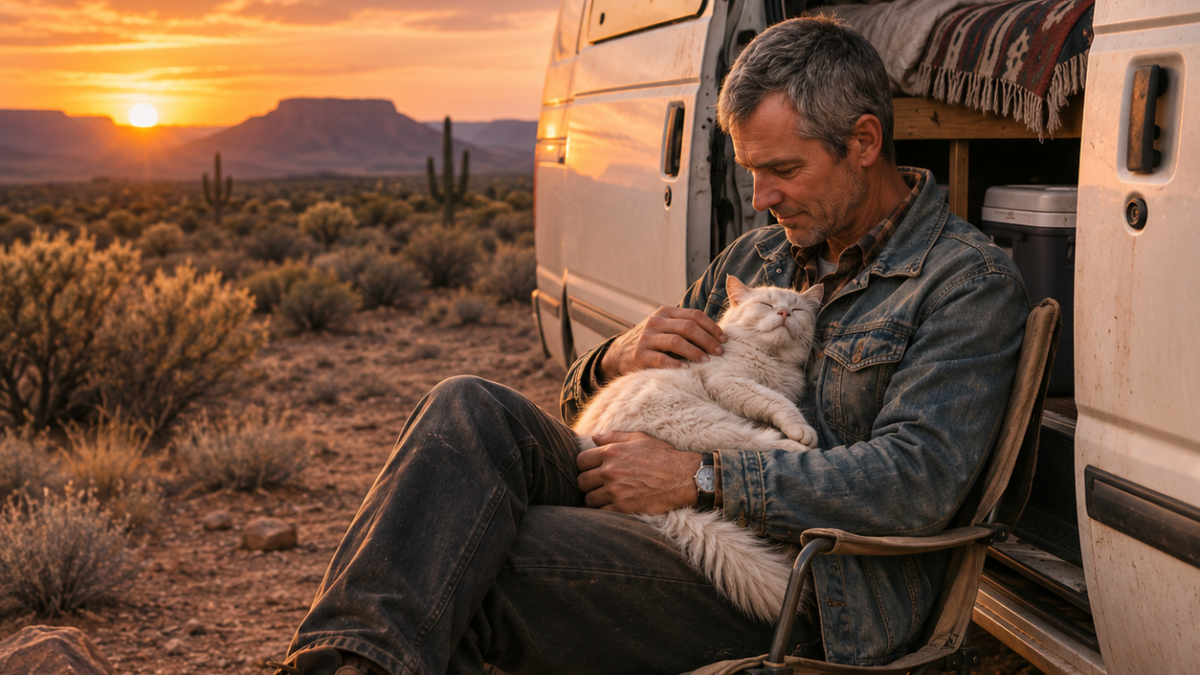
The photograph people shared most came from New Mexico.
An RV park outside a small desert town.
Late afternoon.
I had opened the side door because the van was warm.
Willow sat on my lap.
The desert sunset turned everything orange.
Someone across the park took a picture.
I didn’t know until later.
In the photograph, I’m looking toward the horizon.
Willow’s face is turned toward the sunset.
Her eyes closed, as always.
The light catches the white fur around her face.
When the stranger showed it to me, I stared.
“That’s beautiful.”
He asked:
“Can I send it to you?”
“Yes.”
Apparently he posted it too.
Then someone shared it.
Then another.
Eventually thousands of people saw it.
I didn’t understand why that image affected people so strongly.
Maybe because Willow couldn’t see the sunset.
People found that sad.
I didn’t.
She could feel it.
Warmth on her face.
Wind.
My hand against her side.
Maybe beauty doesn’t require understanding the whole scene.
Maybe enough of life is like that.
We don’t know what something means while we’re inside it.
We just feel warmth.
Years later, perhaps someone explains.
Or they don’t.
One evening at a campground in Colorado, a man recognized us.
Not famous-person recognized.
Willow recognized.
“That’s the cat?”
I laughed.
“Apparently.”
He sat nearby.
We talked.
He asked the usual questions.
Age.
Blindness.
Kidneys.
States.
Then:
“Can I ask something personal?”
“You already know my cat’s kidney values.”
“Fair.”
He hesitated.
“Why did you sacrifice your whole life for a dying cat?”
I had heard versions of that question.
This one bothered me.
Not because he meant harm.
Because the premise felt wrong.
“I didn’t.”
He looked confused.
“You sold your house.”
“Yes.”
“Quit your career.”
“Job.”
“Most of your stuff.”
“Yes.”
“Live in a van.”
“Very observant.”
“So…”
I looked at Willow.
She was asleep beneath my hand.
“I let go of things that weren’t making me happy.”
He said nothing.
“There’s a difference.”
“Still seems like sacrifice.”
“Maybe from outside.”
I thought about my old house.
Empty guest room.
Television.
Commute.
Screens.
I wasn’t miserable then.
That’s important.
I didn’t escape some terrible life.
I escaped a life I had stopped choosing consciously.
“I had a good job.”
I told him.
“A good house.”
“A stable life.”
“Those aren’t bad things.”
He nodded.
“They just weren’t enough for me anymore.”
“And the cat was?”
I smiled.
“No.”
He looked confused again.
“Willow didn’t replace my life.”
I scratched her head.
“She forced me to notice I wasn’t living it.”
That was the closest answer.
Then he asked:
“So you saved her?”
I shook my head.
“No.”
“She saved you?”
“No.”
He waited.
I looked down at her.
“We saved each other.”
It sounded sentimental.
Maybe it was.
Still true.
I gave Willow a home when she had none.
She gave me a reason to stop postponing my own life.
Equal exchange.
No hero.
No rescue fantasy.
Just two creatures who happened to need something at the same time.
The third year was quieter.
I traveled less aggressively.
Not because Willow couldn’t.
Because I stopped counting movement as success.
In the first year, every new place felt like proof I had made the right decision.
By year three, I no longer needed proof.
Sometimes we stayed somewhere for a month.
A forest campground.
A desert town.
A lake.
I learned names of grocery-store employees.
Found favorite coffee shops.
Let the van gather dust.
Willow loved routine even inside movement.
Morning food.
Nap.
Fluids on schedule.
Passenger-seat sunlight.
Evening lap.
The world changed outside.
Her world stayed understandable.
Maybe mine did too.
I learned to recognize her aging differently.
Twenty-three is difficult to describe in a cat.
She had always looked old to me.
Now she looked ancient.
Fur thinner.
Bones easier to feel.
Movements slower.
She slept deeply.
Sometimes I put one finger against her ribs just to make sure they moved.
When she woke, she often meowed as though accusing me of disturbing her.
“Good.”
I would say.
“Be angry.”
Angry meant here.
I had a conversation with a veterinarian about euthanasia before it was necessary.
That was one of the hardest things I ever did.
I wanted a plan.
Not because I wanted the end.
Because I didn’t want panic to make the final decision.
We discussed quality of life.
Pain.
Eating.
Hydration.
Mobility.
Interest.
Comfort.
Good days versus bad.
The veterinarian said:
“You’ll want one perfect sign.”
I nodded.
“There usually isn’t one.”
I hated that.
“What if I’m too early?”
“You might always wonder.”
“What if I’m too late?”
“You might always wonder.”
“That’s terrible.”
“Yes.”
“How do people do this?”
“They love the animal more than they love avoiding the decision.”
I wrote that down.
Not because Willow was ready.
She wasn’t.
But hospice is not denial.
It is accepting the ending exists while still respecting the life before it.
Every morning I began asking myself quietly:
Is she still Willow?
Not is she old?
Yes.
Not are her kidneys failing?
Yes.
Is she still interested in the world she knows?
Most mornings:
Yes.
She still turned toward my voice.
Still found sunlight.
Still protested fluid days.
Still demanded food at inconvenient times.
Still slept against me.
So we continued.
I stopped saying she was “fighting.”
Willow wasn’t fighting kidney disease.
That language never fit.
She wasn’t brave in the human sense.
She wasn’t determined to beat a prognosis.
She simply kept living because her body kept living.
There was dignity in that.
No pressure to inspire anyone.
No obligation to become a miracle.
If tomorrow became her last day, the previous three years did not become less meaningful.
That understanding gave me peace.
Some.
Not all.
There were still nights I cried.
One happened beside Lake Superior.
Cold outside.
Rain.
Willow had slept most of the day.
I held her.
She felt impossibly small.
I whispered:
“You don’t have to stay for me.”
That was important to say.
I had built so much of my life around her that I became afraid I was asking too much.
She couldn’t understand the words.
Maybe the tone.
“I’m okay.”
I wasn’t sure that was true.
“But you don’t have to keep doing this because I’m scared.”
Willow opened her mouth.
Yawned.
Then fell asleep.
Perfect.
No philosophical response.
Just a cat.
That saved me from making her into something she wasn’t.
People online sometimes called her an angel.
A warrior.
A miracle.
I loved the kindness.
But Willow was also a cat who once vomited directly into my shoe.
A cat who screamed during nail trimming.
A cat who stole chicken when she supposedly had no appetite.
A cat who woke me at 3:17 a.m. because she had forgotten where I was despite being on top of me.
I loved that Willow.
Not the symbol.
The difficult, stubborn, tiny animal.
That is what makes love manageable.
You don’t love an inspirational concept.
You clean the litter box.
At twenty-three, Willow became more vocal.
The veterinarian said some senior cats do.
Maybe cognitive change.
Maybe deafness creeping in along with blindness.
Maybe she simply had opinions.
She would wake and meow.
I answered.
“I’m here.”
Sometimes that was enough.
Other times another meow.
“I’m still here.”
Eventually, I realized we had developed a call-and-response.
Willow:
Meow.
Me:
“I’m here.”
At night in the van.
At rest stops.
In forests.
Near oceans.
Always the same.
I’m here.
Maybe that is all hospice care really promises.
Not cure.
Not forever.
Presence.
When we returned through Arizona during our third year, I debated visiting the shelter.
I didn’t want to disrupt anyone.
Eventually I called.
The coordinator who had handled Willow’s adoption still worked there.
When I gave my name, she paused.
“Nate?”
“Yes.”
“Willow?”
I smiled.
“Still here.”
Silence.
Then:
“No.”
“Yes.”
“No, seriously.”
“Seriously.”
She started crying on the phone.
So did I.
We visited.
I carried Willow inside.
Staff gathered.
Some had never met her.
Others remembered.
The coordinator knelt.
“Oh, sweetheart.”
Willow sniffed her hand.
The woman looked up at me.
“We thought she’d die here.”
“I know.”
“Twenty-three?”
“Approximately.”
“Still Stage 4?”
“Yes.”
She shook her head.
“This makes no sense.”
“I hear that a lot.”
We walked past the kennel section.
I found the area where Willow had sat in the original photograph.
Different cat there now.
Young tabby.
Bright eyes.
Paw through the bars.
I held Willow closer.
Sixty-three days.
Nobody interested.
That number still hurt.
The coordinator said:
“You changed her whole life.”
I shook my head.
“She changed mine too.”
She smiled.
“Still traveling?”
“Yes.”
“Planning to stop?”
I looked at Willow.
“I stopped planning that far ahead.”
Before we left, the shelter staff took a photograph.
No fanfare.
Willow asleep in my arms.
The coordinator beside us.
I keep that picture.
Not because it is beautiful.
Because three years earlier, that building represented the end.
Now it was just another place we had returned to.
The road took us east again.
There was no grand final destination.
That bothered people who expected a narrative.
“What’s the goal?”
No goal.
“How many states will you do?”
Don’t know.
“Will you hit all fifty?”
Maybe.
“What happens after Willow?”
That question always stopped me.
After Willow.
There will be an after.
I know.
I hate it.
But pretending otherwise would make the present dishonest.
I don’t know what I’ll do.
Maybe keep traveling.
Maybe buy land.
Maybe work full-time again.
Maybe foster senior cats.
Maybe park the van somewhere and finally stay.
I have learned not to make promises to a future version of myself.
He gets a vote.
The one promise I made concerns Willow.
When the day comes, I will not make her stay because I’m afraid to lose the life we built together.
That is the deal.
I adopted a hospice cat.
The word still means something.
Her comfort before my avoidance.
Some people find that sad.
I don’t anymore.
There is something sacred about being trusted with the end of a life.
Not because you control it.
Because you don’t.
You can only make the space around it softer.
We still travel.
Not quickly.
As I write this in my mind, Willow is twenty-three.
Blind.
Kidneys still terrible.
Every other day, I warm a bag of fluids slightly, hang it inside the van, prepare the line, and tell her:
“Sorry.”
She complains before the needle even touches her.
“Drama.”
More complaining.
I administer the fluids.
Then give her a treat she technically shouldn’t love as much as she does.
She forgives me instantly.
The van remains white.
More scratches now.
One cabinet door squeaks.
The refrigerator has been repaired twice.
There is a permanent cat-hair ecosystem in places no vacuum can reach.
I love it.
Not every day is profound.
Most are ordinary.
Gas station.
Groceries.
Laundry.
Veterinary pharmacy.
Find somewhere to park.
Check weather.
Make coffee.
Clean litter.
Drive.
Stop.
Feed Willow.
Work a little.
Drive again.
Then once in a while, something happens.
Sunrise over a lake.
Wind through redwoods.
Rain on the roof.
Willow turning toward warmth.
And I remember the old house.
The Tuesday nights.
The routine.
The feeling that something was missing.
I used to think I needed a dramatic purpose.
Something impressive.
Maybe purpose is smaller.
A blind cat needs fluids.
Drive to where the weather is warm.
Hold her in sunlight.
Answer when she calls.
I’m here.
That has been enough.
The strangest thing about Willow’s long survival is how the original countdown disappeared.
In the beginning:
Day one.
Day ten.
Three weeks.
One month.
Six weeks.
Then milestones.
Six months.
One year.
Two.
Three.
Eventually time became time again.
Not stolen.
Not borrowed.
Just lived.
Maybe all time is borrowed and we’re simply better at forgetting when nobody gives us a prognosis.
Willow never knew hers.
Lucky cat.
I did.
That changed everything.
If the shelter had told me:
She may live another three years.
Would I have sold the house?
I don’t know.
Maybe I would have decided I had plenty of time.
Maybe I’d have kept the job for another year.
Saved more.
Planned the van perfectly.
Waited until summer.
Waited until the market improved.
Waited until a project finished.
Waited.
That word defined my old life.
Willow’s supposed one month destroyed waiting.
For that, I am grateful even though the prognosis was wrong.
Or maybe not wrong.
Prognoses aren’t promises.
They are estimates based on bodies.
Willow’s body simply continued.
At a campground recently, a woman asked if she could pet Willow.
“Yes.”
She knelt carefully.
Willow sniffed.
Allowed one touch.
Then another.
The woman said:
“My cat died last year.”
“I’m sorry.”
“She was eighteen.”
“That’s a good long life.”
“Not long enough.”
“No.”
Never.
The woman cried.
Then laughed because crying beside a stranger’s van felt strange.
“I keep thinking I should’ve done more.”
I knew that feeling.
“What more?”
“I don’t know.”
“Then maybe there wasn’t more.”
She looked at me.
“I see stories like yours and think I should’ve taken her places.”
I shook my head.
“Willow doesn’t care about states.”
“What?”
“She cares about warmth.”
I smiled.
“Food.”
“My lap.”
“Knowing where I am.”
I pointed at the van.
“The road is my thing.”
The woman looked relieved.
“You don’t think cats need adventure?”
“I think cats need safety, comfort, care, and whatever makes their particular life good.”
Willow sniffed the woman’s fingers.
“My cat happened to tolerate my midlife crisis.”
The woman laughed through tears.
That conversation stayed with me.
Because the story people see from outside is:
Man gives dying cat the world.
Beautiful.
But Willow’s world is not America.
It is much smaller.
My smell.
My voice.
Her blanket.
The vibration of the engine.
Sunlight.
Food bowl.
The familiar path from passenger seat to bed.
That is her world.
I didn’t give Willow thirty-eight states.
I gave her one dependable person moving through thirty-eight states.
That is more accurate.
And she gave me something similar.
Not freedom in the abstract.
Not enlightenment.
A relationship stable enough that I could tolerate uncertainty around it.
For a man who had spent decades building security through schedules, salaries, property, and predictable routines, that was enormous.
I sold stability and discovered steadiness.
Different things.
Stability says nothing changes.
Steadiness says you can remain yourself while things do.
Willow became my lesson in that.
Every place changed.
She remained Willow.
Every plan changed.
I remained responsible for her.
The van moved.
Home remained.
There is a desert campsite I return to sometimes in New Mexico.
Not the same RV park where the famous sunset photograph was taken, but nearby.
Open sky.
Dry air.
Quiet.
On one visit, I parked facing west.
Opened the side door.
Willow was asleep.
As sunset approached, I picked her up.
She grumbled.
“Terrible service, I know.”
I sat in the doorway.
Placed her on my lap.
The desert turned orange.
Then red.
Then purple.
Willow lifted her face.
Warmth hit her fur.
I thought of that photograph.
Three years.
Twenty-three years old.
One month to live.
All those numbers.
Then I looked at Willow.
She didn’t know any of them.
That felt like wisdom, though it wasn’t.
She was simply a cat.
A cat doesn’t need a philosophy for sunset.
I did.
Maybe mine is this:
A life does not become meaningful because it lasts a certain length.
And a day does not become worthless because it may be the last.
The shelter staff thought they were giving me bad news when they said Willow had weeks.
They were.
But hidden inside that news was something I had spent years avoiding.
Urgency.
Not panic.
Urgency.
The understanding that if something matters, maybe do it now.
Call someone now.
Go somewhere now.
Sit in sunlight now.
Stop saving every good thing for a version of life that might never arrive.
I still save money.
I still plan.
I still carry insurance.
I’m not suggesting everyone sell their house because mortality exists.
That would be ridiculous.
I am saying I finally learned the difference between preparing for the future and living exclusively for it.
Willow lives exclusively in the present because she has no choice.
I live more there now because I finally understand I do.
Mark visited again recently.
He climbed into the van.
Looked around.
“Still smells like cat.”
“Still smells like judgment.”
He sat beside Willow.
She was asleep.
He touched her head.
“Twenty-three.”
“Yeah.”
“That’s ridiculous.”
“Yeah.”
“Remember when I said this was insane?”
“Yes.”
“I was right.”
“Yes.”
He smiled.
“Also maybe you were.”
“Careful.”
“Not saying sell-your-house right.”
“Thank you.”
“But you look different.”
“How?”
He thought.
“Like you’re actually wherever you are.”
That might be the best compliment anyone has ever given me.
My old life was spent physically present and mentally somewhere else.
At work thinking about home.
At home thinking about work.
Monday thinking about Friday.
January thinking about vacation.
Forty-four thinking about retirement.
Always later.
Now?
Sometimes I still do it.
I’m human.
But Willow interrupts.
Meow.
“I’m here.”
And I am.
There are signs that she is slowing down more.
I won’t pretend otherwise for a satisfying ending.
She tires.
Some mornings food takes persuasion.
Her steps are careful.
The good days still outnumber the truly bad ones.
For now.
I monitor.
I talk to vets.
I keep the fluids warm.
I make decisions one day at a time.
There will be a last sunrise.
Last meal.
Last time she presses her forehead into my hand.
I know.
That knowledge doesn’t ruin today.
It sharpens it.
Today she ate.
Today she found sunlight.
Today she complained about fluids.
Today she is here.
That is enough.
Sometimes strangers still ask:
“Did Willow save your life?”
I tell them no.
Because I wasn’t dying.
I was functioning.
That isn’t the same as living fully, but it also isn’t death.
And I don’t want to make my old self sound pathetic.
He worked.
Paid bills.
Tried.
He built the stability that later allowed me to make this choice.
I owe him something.
So no.
Willow did not rescue me from destruction.
And I did not rescue her from death.
Death is still coming.
For both of us.
What we did was rescue each other from one particular kind of loneliness.
She was waiting inside a kennel for an ending nobody wanted to witness.
I was living inside a life I had stopped witnessing myself.
Then we met.
That was enough.
The shelter asked:
Why her?
I have a better answer now.
Because she didn’t need me to promise forever.
She needed me to show up.
Maybe that was exactly what I needed too.
Three years later, I still show up.
Every morning.
I wake inside the van.
Sometimes ocean outside.
Sometimes mountains.
Sometimes a Walmart parking lot because adventure is less glamorous than Instagram suggests.
I check Willow before I check my phone.
Usually she is asleep.
Sometimes she hears me move and lifts her head.
Then:
Meow.
“I’m here.”
Coffee.
Food.
Medicine.
Fluids if it’s a fluid day.
Drive if she feels good.
Stay if she doesn’t.
That is our schedule.
No five-year plan.
No retirement projection taped to the wall.
Just the next responsible thing.
The next kind thing.
The next mile when there is a reason to drive it.
One morning in the Blue Ridge Mountains, fog covered everything.
I opened the van door.
Cold air entered.
Willow lifted her nose.
I wrapped her in a blanket.
Held her.
Nothing spectacular happened.
No dramatic sunrise.
No photographer.
No viral picture.
Just fog.
A blind old cat.
A middle-aged man drinking bad coffee.
I thought:
This might be my favorite place we’ve ever been.
Not because of the view.
Because nobody else knew.
Some moments don’t need to become stories.
Maybe that is another thing Willow gave me.
A life no longer needs an audience to feel real.
When that New Mexico sunset photograph went viral, people sent me screenshots.
Hundreds.
Thousands of shares.
Comments.
Articles.
Messages.
I appreciated them.
Then I closed the phone.
Willow needed dinner.
That felt perfectly appropriate.
The world could decide we were inspirational.
Willow decided I was late with food.
Her judgment mattered more.
I don’t know how our story ends.
That may sound strange after three years of expecting an ending.
But I truly don’t.
Maybe tomorrow.
Maybe months.
At twenty-three with Stage 4 kidney disease, pretending otherwise would be dishonest.
What I do know is that the ending cannot cancel what came before.
If Willow dies tomorrow, she still sat on an Oregon beach.
She still slept beneath the Blue Ridge Mountains.
She still heard waves.
Rain.
Birds.
Traffic.
Campfires.
She still crossed thirty-eight states.
She still found sun through a windshield.
She still made a cynical IT guy sell his furniture.
She still taught me how to insert a needle under cat skin without fainting.
She still met people who cried when touching her.
She still outlived a prognosis by years.
She still had a home.
Not one with an address.
One with me.
And if the end comes in this van, I think that will be okay.
Not easy.
Never easy.
But okay.
I have already chosen a blanket.
That sounds morbid.
It isn’t.
Hospice makes you practical.
Soft gray fleece.
Her favorite.
I know which veterinarian services to look for when we stay in a place.
I keep records organized.
Emergency contacts.
I know what I want for her remains.
I have thought about all of it.
Then I put those thoughts away.
Because she is alive.
That is the discipline.
Prepare for death.
Then return to life.
Willow does the second part better than I do.
One evening recently, we were parked near the Gulf Coast.
Warm breeze.
Windows open.
Willow sat on my lap.
The sun lowered.
She turned toward it.
Always.
I ran one finger along the ridge of her head.
“You know,” I said, “you were supposed to be easy.”
Her ear moved.
“One month.”
Nothing.
“Then grief.”
Nothing.
“I was going to do something noble.”
She started purring.
“Give some dying cat a peaceful ending.”
Purr.
“Instead I’ve spent three years cleaning litter out of a van.”
Louder purr.
“You scammed me.”
She pushed her head into my hand.
I laughed.
Then my throat tightened.
“Best scam of my life.”
The sun touched the horizon.
Willow couldn’t see it.
I could.
For once, that didn’t feel unfair.
I watched for both of us.
She felt what she could.
Warmth.
Wind.
My hand.
Maybe that is what love is sometimes.
Not giving someone your experience.
Making sure the experience available to them is good enough.
Willow will never know how many people have seen her picture.
She will never understand comments.
Shares.
Headlines.
She does not know that people call her inspiring.
She doesn’t know I sold a house because of her.
Doesn’t know I left my job.
Doesn’t know thirty-eight states is unusual.
Doesn’t know three years is medically improbable.
She doesn’t know what a prognosis is.
She doesn’t know she changed my life.
After all, she’s only a cat.
And maybe that is why I trust what happened between us.
She never asked me to become anyone.
Never told me to quit.
Never told me to travel.
Never told me I was wasting my life.
She simply arrived with very little time.
Or what we thought was very little time.
And by caring for her, I finally became honest about what I wanted from mine.
I wanted less stuff.
More movement.
Less pretending urgency belonged only to work.
More mornings that belonged to me.
More attention.
More sunlight.
More people I actually cared about.
More willingness to say:
This matters.
Now.
Willow didn’t give me those things.
She gave me the question.
I answered it.
That distinction matters.
Someday the van will be quiet without her.
I know.
The passenger seat will feel wrong.
Fluid bags will disappear.
No litter behind the driver’s seat.
No white fur on my clothes.
No tiny voice calling when she wakes confused.
I will probably hate the silence.
Maybe I will park somewhere for a long time.
Maybe I will go back to Tucson.
Maybe I will adopt another senior animal when I’m ready.
Maybe not.
I refuse to use the next cat as an answer to losing this one.
Willow is not replaceable.
Neither is anyone.
That doesn’t mean love only happens once.
It means every love occupies its own coordinates.
Willow’s are simple.
A Tuesday night shelter post.
A Tucson kennel.
A white van.
Thirty-eight states.
A thousand patches of sunlight.
My lap.
Three years nobody expected.
Whatever comes after belongs to after.
Today?
Today Willow is asleep beside me.
Her breathing is slow.
Steady.
I can hear it over the soft hum of the van refrigerator.
Outside, the evening is cooling.
Tomorrow, if she wakes hungry, I’ll feed her.
If it is a fluid day, she’ll complain.
If she feels good, maybe we’ll drive.
If not, we’ll stay.
There is nowhere we need to be badly enough to rush her.
That might be the biggest difference between the person I was and the person I became.
I used to think movement meant progress.
Now I know staying can be progress too.
If someone I met at a campground asked me again whether I sacrificed my entire life for a dying cat, I know exactly what I would say.
No.
I gave up a house.
A job.
Furniture.
A routine.
Those things were parts of my life.
They were never the whole thing.
Willow did not take my life away from me.
She returned my attention to it.
And attention, I’ve learned, is probably the closest thing we have to giving someone our life.
Where we put it.
Who receives it.
What we notice before time runs out.
For three years, a blind old cat has received more of mine than I ever expected.
I have no regrets about that.
None.
The shelter staff thought Willow needed someone willing to sit beside her while she died.
They were right.
They just got the timing wrong.
I’m still sitting beside her.
Maybe tomorrow.
Maybe later.
Whenever the day arrives, I’ll be there.
That was the promise from the beginning.
Not forever.
Just:
**You will not do this alone.**
She never understood the words.
She didn’t need to.
Every time she wakes in darkness and calls, I give her the same answer.
The answer I wish more of us heard when life became frightening.
The answer she gave me without ever speaking it.
“I’m here.”
And for today, so is she.








