PART 2: They Said Disney Was Dying Because She Wouldn’t Eat—Then We Put Food in Front of Her
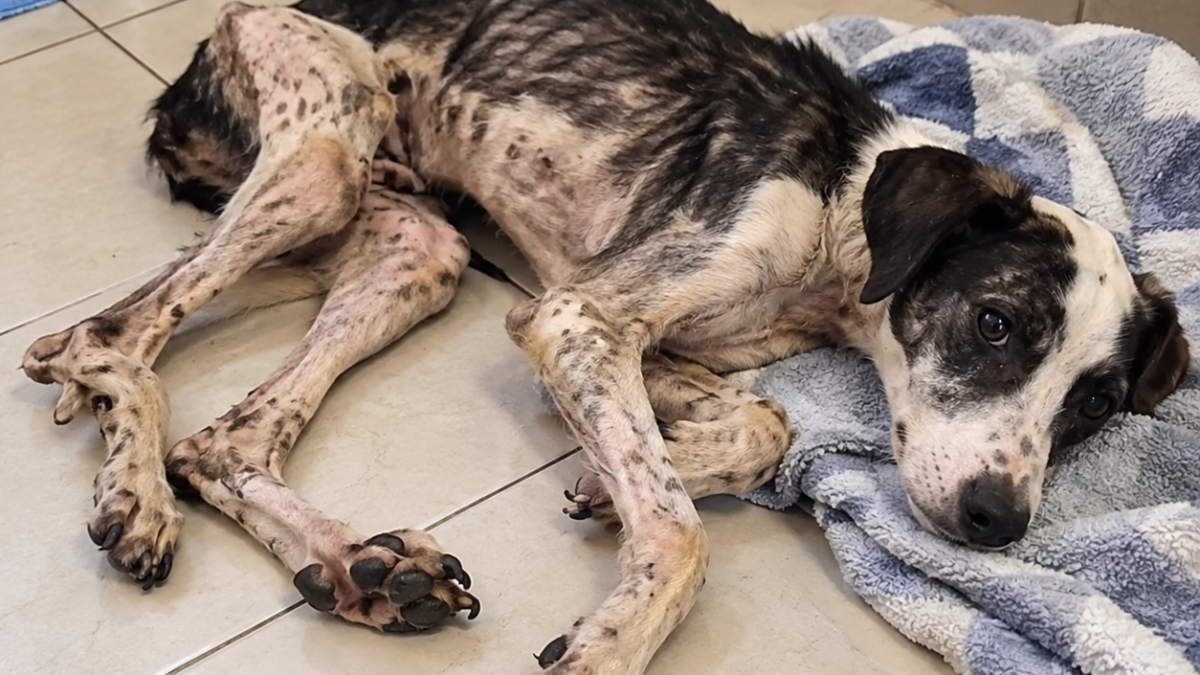
They told us Disney had become dangerously thin because she refused to eat, but when I knelt beside her outside that house, something about the explanation felt wrong. She was lying in her own filth, too weak to stand, with flies gathering over a body that looked like it had been disappearing for weeks. And when we finally carried her away and placed food in front of her, what happened next changed the entire story.
I could smell the yard before I reached her.
There was feces around the place where Disney had been lying, and the air was heavy with heat and flies. She barely reacted when we approached. Her head lifted an inch, then dropped again.
“Disney?”
One ear moved.
That was all.
I crouched beside her and put my hand near her face.
Her eyes followed me.
They were tired, dull, and frightened, but she was still watching.
Someone from the household told us, “She just won’t eat anymore.”
I looked at Disney’s ribs.
Then at her hips.
Then at the filth around her.
“How long has she been like this?”
The answer was vague.
I stopped asking questions for the moment because Disney did not have time for an argument.
“We’re taking her.”
When we lifted her, she offered almost no resistance.
That frightened me more than if she had struggled.
A dog with strength complains.
Disney simply folded into our arms.
On the drive to the clinic, I kept one hand against her side to feel her breathing.
“Stay with me,” I whispered.
Her body felt frighteningly light.
At the veterinary clinic, the staff moved quickly.
Before some of the testing began, someone brought a small amount of food.
Disney smelled it.
Then she ate.
Not reluctantly.
Not after coaxing.
She ate like a dog who had been waiting desperately for someone to offer her something she could reach.
I stared.
“Slow down.”
The veterinarian stopped me from offering more.
“Small amounts.”
“But they said she wouldn’t eat.”
The veterinarian looked at Disney, then at me.
“She’s eating now.”
Fresh water came next.
Disney drank eagerly.
For a few minutes, her eyes looked brighter.
I wanted to believe food and water were all she needed.
They weren’t.
A body starved and neglected for too long cannot simply be filled back up in one afternoon.
Disney was too weak to walk.
Her gums were almost white.
The veterinarian gently lifted her lip and immediately became serious.
“We need bloodwork.”
I stayed beside Disney while samples were taken.
Her head rested against the blanket.
When the first results returned, the room changed.
“What is it?”
The veterinarian looked at the paper again.
“Her hemoglobin is four.”
I did not immediately understand.
“Is that bad?”
“It’s critically low.”
I looked down at Disney.
The dog who had just eaten so desperately was fighting with almost no reserves left.
Further testing began.
Disease screening.
Organ function.
Anything that might explain what her body had endured.
We continued tiny meals because giving too much too quickly could make things worse.
Disney finished every one she was offered.
That detail stayed with me.
Every time she ate, I remembered the words:
She won’t eat.
Hours later, another blood test came back.
Her hemoglobin had fallen again.
3.4.
The veterinarian did not soften her voice.
“She needs blood.”
“How soon?”
“Now.”
I felt cold.
“What happens if she doesn’t get it?”
The veterinarian looked toward Disney.
“She may not make it.”
The foundation had other rescued dogs, and one of them was Waldito, healthy, calm, and strong enough to be considered as a donor.
The team began compatibility testing.
I sat beside Disney while we waited.
Her breathing was quiet.
Too quiet.
I rubbed the space between her ears.
“You ate for us,” I whispered. “You drank. Now you have to do one more thing.”
She opened her eyes.
Down the hall, someone called my name.
I stood.
The veterinarian was holding the compatibility results.
“Waldito can donate.”
For the first time that day, hope entered the room.
But Disney still had to survive the transfusion.
And as the line carrying Waldito’s blood was connected and the first drops began entering Disney’s weakened body, every one of us understood that the next few hours would decide whether we had reached her in time…
PART 2
I stayed beside Disney as the transfusion began.
Waldito had done his part.
Now all we could do was watch.
The blood moved slowly through the line.
A nurse checked Disney’s temperature.
Then her heart rate.
Then her breathing.
Again.
And again.
Everyone knew a transfusion could save her.
Everyone also knew reactions were possible.
The room had become strangely quiet.
Disney lay on her side beneath a thin blanket, her head resting on folded towels.
I kept looking at her gums.
They were so pale they barely looked pink at all.
“Come on, girl.”
The nurse glanced at me.
“She’s stable.”
“For now?”
She nodded.
“For now.”
I hated those two words.
They were honest.
But they left too much room for fear.
I leaned closer to Disney.
“You don’t know Waldito, but he’s helping you.”
Her eyes opened slightly.
“He gave you some of his blood.”
I almost laughed at myself.
What kind of conversation was that to have with a dog?
But talking kept me from imagining the worst.
Down the hall, Waldito was resting.
Healthy.
Unbothered.
Probably wondering why everyone had made such a fuss.
He had no way of knowing that part of him was now flowing into a dog who had been only hours from dying.
Rescue sometimes works like that.
One animal survives because another one happens to be strong enough to help.
One person notices.
One veterinarian refuses to give up.
One donor is compatible.
A life can hang on a chain of events so thin that later you wonder what would have happened if any single piece had been missing.
The transfusion continued.
No reaction.
Another check.
Still no reaction.
I allowed myself to breathe a little.
Then Disney shifted.
My heart jumped.
“Is she okay?”
The nurse examined her.
“She’s adjusting position.”
“That’s all?”
“That’s good.”
Good.
I held onto the word.
A few minutes later, Disney lifted her head.
Only briefly.
Then she lowered it again.
I smiled.
“There you are.”
The transfusion took hours.
By the time it finished, I felt as if an entire day had passed inside that room.
The veterinarian disconnected the line and checked Disney again.
“No immediate reaction.”
I closed my eyes.
“Does that mean she’s safe?”
“It means she completed the transfusion.”
I knew better than to ask for promises by then.
“So what happens now?”
“We watch her.”
Again.
Watch.
Wait.
Measure.
Hope.
Those words became our life with Disney.
She had survived the first emergency.
Her body was still deeply damaged.
The blood transfusion gave her a chance.
It did not repair everything starvation, dehydration, anemia, and neglect had done.
Her muscles were gone.
Her skin was unhealthy.
Her digestive system had to be treated carefully.
Her organs had been forced to function with too little nourishment and too little oxygen-carrying capacity.
Recovery was not going to happen because one bag of blood had entered her veins.
But the next morning, something happened that made the entire team smile.
Disney was hungry.
Not mildly interested.
Hungry.
When food arrived, she lifted her head before the bowl touched the floor.
I laughed.
“I knew it.”
One of the nurses smiled.
“You’ve been waiting to say that.”
“I have.”
We offered the measured portion.
Disney ate every bite.
She looked toward the empty bowl.
I could almost hear her asking for more.
The nurse shook her head gently.
“Not yet.”
I understood why.
After prolonged starvation, feeding had to be controlled.
Too much, too quickly, could overwhelm a body that had adapted to deprivation.
But knowing that did not make it easy to watch Disney stare at an empty bowl.
“She wants more.”
“I know.”
“She’s been hungry.”
“I know.”
I sat beside her.
“I’m sorry.”
Disney licked the bowl.
I touched her neck.
“You’re getting another meal. Just not yet.”
It felt cruel.
It was care.
Sometimes those two things feel dangerously close when an animal has been denied basic needs.
You want to compensate immediately.
A giant bowl.
Unlimited water.
Everything they should have had.
But damaged bodies require patience.
So we fed Disney carefully.
Small portions.
Regular intervals.
Monitoring every response.
She drank.
She rested.
She ate again.
The next bloodwork showed improvement, but nobody celebrated too early.
We had nearly lost her once.
The fear stayed in the room.
On the second day, Disney tried to rise.
Her front legs pushed.
Her chest came off the bedding.
Then her strength disappeared.
She sank back down.
I put one hand beneath her.
“Easy.”
Her eyes met mine.
“Not yet.”
She tried again several hours later.
Same result.
There are few things harder than watching an animal whose mind wants to move while her body cannot follow.
Disney seemed frustrated.
She shifted her paws.
Looked toward the doorway.
Then back at us.
She had spent too long lying helpless.
Now food was returning.
Blood was moving through her more effectively.
Something inside her wanted up.
But her muscles had almost nothing left.
We used support when repositioning her.
Soft bedding protected pressure points.
Her skin needed attention.
Flies had gathered on her outside because she had been too weak to keep them away.
Now every inch of her body was inspected.
Cleaned.
Treated.
Protected.
The first several days were filled with things most people would never call dramatic.
Temperature checks.
Meals weighed carefully.
Water measured.
Blood tests.
Cleaning.
Turning her body.
Watching urine.
Watching stool.
Checking gum color.
Feeling her pulse.
Listening.
Waiting.
But those quiet tasks were the difference between rescue and simply removing an animal from danger.
Getting Disney away from that yard took minutes.
Keeping her alive required everyone.
I spent too much time thinking about the sentence the household had given us.
She won’t eat.
Every meal made me angrier.
Disney never refused.
She ate carefully measured portions with focus.
Sometimes slowly because she was weak.
But she ate.
I began wondering how long the explanation had been used.
Had anyone offered appropriate veterinary care?
Had anyone looked at her gums?
Had anyone watched her lose pound after pound?
Had anyone asked why a dog who “wouldn’t eat” was lying outside surrounded by feces and flies instead of inside a clinic?
Anger is easy in rescue.
Useful anger is harder.
I could have spent hours imagining confrontations.
Disney needed those hours somewhere else.
So I wrote down what had been said.
We documented her condition.
Photographed what was medically relevant.
Preserved records.
Not because I wanted a dramatic revenge scene.
Because neglected animals cannot speak in hearings.
Their bodies become the testimony.
Disney’s hemoglobin level was testimony.
3.4.
Her pale gums were testimony.
The muscle wasting was testimony.
The condition in which she was found was testimony.
Her desperate appetite was not a legal conclusion, but it mattered to me because it directly contradicted the picture we had been given.
She wanted to eat.
Whatever else had happened, that was clear.
On the fourth day, Disney surprised us.
I entered with a nurse carrying her meal.
Disney’s head came up.
Then her tail moved.
Once.
I stopped.
“Did you see that?”
The nurse smiled.
“Yes.”
Disney’s tail moved again.
Two weak taps against the blanket.
I crouched.
“Are you happy about breakfast?”
She looked at the bowl.
“Okay. Definitely breakfast.”
The nurse laughed.
It was the first moment Disney made us laugh.
That mattered.
Until then, everything around her had felt heavy.
Emergency.
Blood.
Anemia.
Starvation.
Survival.
Now there was a tail wag.
Not much.
But enough to remind us there was a dog inside the medical crisis.
A personality.
A preference.
Someone.
Over the next days, Disney began recognizing routines.
She knew which footsteps usually meant food.
Her eyes followed bowls.
When I approached without food, she sometimes looked disappointed.
“You could at least pretend you’re happy to see me.”
Her tail moved.
I smiled.
“Better.”
Touch was more complicated.
At first, Disney accepted whatever we did because she barely had the strength to object.
As she grew stronger, she began showing us what she liked.
Gentle scratches behind the ears.
Slow strokes along the neck.
Hands approaching where she could see them.
She disliked sudden pressure near painful areas of skin.
We listened.
That is something neglected animals often teach you immediately.
Control has been taken from them for so long that giving choices back matters.
Where possible, we let Disney decide.
Did she want contact?
Did she want space?
Would she move toward us?
Would she turn away?
The first time she deliberately leaned her face into my hand, I went completely still.
“Hi.”
Her eyes closed.
I rubbed beneath her ear.
She leaned harder.
For a dog we had met while she lay beneath flies, being able to choose affection felt enormous.
About a week after the transfusion, Disney stood.
Not alone.
Not fully.
A technician supported her beneath the abdomen.
I steadied her chest.
Her paws touched the floor.
Her legs trembled violently.
“Easy.”
Disney looked down.
Then forward.
Her front legs straightened.
For one second, I could feel her taking some of her own weight.
“Good girl.”
Two seconds.
Three.
Her back legs shook.
We lowered her before she collapsed.
Everyone smiled.
Disney looked annoyed.
I laughed.
“You wanted longer?”
Her eyes went toward the doorway.
Maybe she did.
The next day, we tried again.
This time she held herself a little longer.
Then came one step.
One front paw.
Then the other.
Her back legs followed uncertainly.
I was walking backward.
“Come on.”
Disney stepped again.
It was barely walking.
It was enough.
Someone behind me whispered, “Look at her.”
I did.
And suddenly I saw the yard again.
The body on the ground.
Flies.
Feces.
A head too weak to lift.
Then I looked at the dog in front of me.
Standing.
Moving.
Supported, yes.
Weak, absolutely.
But moving.
That was when I understood the kind of revenge Disney was going to have.
Not revenge against a person.
Something better.
Every step would contradict the condition she had been left in.
Every pound gained would answer the body that had been starved.
Every tail wag would answer the loneliness.
Every run would answer the ground where she had once been too weak to rise.
Disney did not need anyone else to suffer.
She needed to live.
So we helped her do exactly that.
By the tenth day, her appetite was becoming almost comical.
She watched every food container.
Every rustle of packaging.
Every person who entered carrying anything remotely bowl-shaped.
One nurse brought paperwork into the room.
Disney lifted her head.
“No, sweetheart.”
The nurse held up the clipboard.
“Not food.”
Disney watched suspiciously.
I laughed.
“You’ve created expectations.”
The nurse put the clipboard down.
Disney relaxed again.
Food had become one of her strongest signs of recovery.
But we still controlled portions.
Her body needed rebuilding, not overwhelming.
Proteins.
Calories.
Hydration.
Supplements as directed.
Everything chosen to help her regain strength safely.
I began seeing changes in her face.
The hollows looked less severe.
Her eyes seemed more awake.
Her posture changed.
Even before significant muscle returned, there was an alertness that had not existed before.
She started lifting her head when voices entered the room.
Then turning her whole face.
Then trying to sit higher.
One afternoon I found her sitting upright with support beneath her chest.
“You look tall.”
She blinked.
“You have been hiding a dog in there.”
Her tail moved.
I sat beside her.
“Keep coming back.”
Those words became my private prayer.
Keep coming back.
Not only physically.
Emotionally.
Personality returning is one of the most beautiful parts of rescue.
At first, very sick animals seem defined by suffering because suffering uses all the space they have.
Then pain becomes smaller.
Hunger becomes manageable.
Strength returns.
And suddenly they have opinions.
Disney developed several.
She liked one nurse more than another.
She preferred a specific blanket.
She objected loudly to having one area of skin cleaned when it was tender.
She became impatient before meals.
She loved attention at certain times and wanted uninterrupted sleep at others.
She had survived long enough to become particular.
I adored it.
Around the end of the second week, the veterinarian told us she might be ready to leave the hospital and continue recovering at the foundation.
I stared at her.
“Already?”
The veterinarian smiled.
“Two weeks ago you wanted her to survive the night.”
“I know.”
“Now you think she belongs here forever?”
I looked through the glass at Disney.
She was standing with light support while someone changed her bedding.
“I’m scared to move her.”
“That’s normal.”
“Is she strong enough?”
“She doesn’t need intensive hospitalization in the same way anymore. She still needs monitoring and follow-up, but she’s stable enough.”
Stable.
Another word I had once been desperate to hear.
The day Disney left the hospital, I felt almost as nervous as the day we brought her in.
We prepared a quiet space at the foundation.
Soft bedding.
Easy access to water.
Controlled meals.
No overwhelming introductions.
Disney had spent two weeks surrounded by clinic sounds.
Now she entered a place with other rescued dogs.
She heard barking.
Her ears lifted.
A tail wag somewhere nearby.
Another dog passed at a distance.
Disney watched everything.
“Take your time.”
She walked a few steps.
Still thin.
Still cautious.
But walking.
No one carried her.
That detail hit me hardest.
She had arrived in our arms because she could not stand.
She left the hospital on her own feet.
Slowly.
Carefully.
But on her feet.
The foundation became the next chapter.
Disney was not ready to join energetic dogs immediately.
Her body needed more time.
So introductions happened gradually.
We let her hear them first.
See them from a safe distance.
Smell bedding.
Then meet the calmest dogs.
Disney watched more than she interacted.
That was fine.
She had lived through enough chaos.
One of the first dogs she met was older and gentle.
He approached slowly.
Disney froze.
He stopped.
Sniffed.
Turned his head.
Waited.
Disney leaned forward.
They touched noses.
The older dog wagged.
Disney’s tail answered.
I felt tears come again.
“Good.”
The dog walked away.
Disney watched him go.
No growling.
No panic.
Only curiosity.
The next meeting lasted longer.
Then another dog.
And another.
Soon Disney began looking toward the other dogs instead of away from them.
Curiosity was replacing fear.
Her body continued filling out.
The first time I ran my hand along her side and realized the ribs were less sharp, I stopped.
“Look at you.”
Disney leaned into my leg.
“You’re getting heavier.”
Her tail wagged.
I pretended it was pride.
Weeks passed.
Follow-up bloodwork improved.
The severe anemia that had nearly killed her was resolving.
Her gums became pinker.
Her energy rose.
Her skin still needed treatment.
There were rough areas.
Hair loss.
Places where neglect had left visible evidence.
But the veterinarian was pleased.
“She’s recovered from the crisis.”
I heard the sentence.
Then asked again.
“Recovered?”
“From the life-threatening condition, yes.”
I laughed.
Then cried.
The veterinarian gave me a tissue.
“I knew that was coming.”
“You could have warned me.”
She smiled.
“You wouldn’t have listened.”
I looked at Disney.
Healthy enough.
Not finished.
But healthy.
There had been a time when I thought hearing those words would feel like an ending.
It didn’t.
It felt like permission for the real life to start.
Disney needed movement now.
Muscle.
Confidence.
Play.
Routine.
She began taking longer walks around the foundation.
At first, we kept them slow.
Disney smelled everything.
Every tree.
Every patch of grass.
Every doorway.
For a dog who had lain helpless in filth, choosing where to stop and sniff seemed almost sacred.
I never rushed her.
If she wanted thirty seconds with one bush, she got thirty seconds.
If she wanted to watch dogs playing across the yard, we stopped.
She had spent enough time unable to choose.
One afternoon, a young rescue dog ran past her.
Disney startled.
Then watched.
The dog circled back.
Bounced.
Play bow.
Disney stood still.
The young dog bounced again.
Disney’s tail moved.
Then something happened.
Disney took three quick steps toward him.
The dog ran.
Disney followed.
Not far.
Maybe ten feet.
Then she stopped.
I stared.
The volunteer beside me laughed.
“Did she just chase him?”
“Yes.”
Disney looked back at us.
Her mouth was slightly open.
Her eyes were bright.
The other dog came back.
Disney moved again.
Another short burst.
We did not let her overdo it.
Her muscles were still rebuilding.
But later that evening, I sat with her and thought about what I had witnessed.
Disney had played.
The dog who had not been able to raise her head now had enough energy to waste some of it on joy.
That is what play is.
Energy spent for no survival purpose at all.
There is something beautiful about watching a formerly neglected animal discover that they can afford to waste energy.
Run without escaping.
Jump without fear.
Chase something they do not need.
Lie in the sun when there is nothing to guard.
Disney began doing all of it.
Her transformation accelerated.
Not medically.
Emotionally.
Once she realized the other dogs were companions, she began seeking them.
She preferred certain personalities.
Calm dogs when she was tired.
Playful ones when she felt energetic.
A couple of dogs became her regular yard partners.
The first time she ran more than a few yards, everyone stopped what they were doing.
Disney started slowly.
Another dog passed.
She accelerated.
Ten yards.
Twenty.
Her gait looked awkward at first because her muscles were still returning.
Then she stretched.
I felt my chest tighten.
“That’s enough!”
Not because I wanted to stop her.
Because I was terrified she would exhaust herself.
Disney slowed.
Turned.
Came back.
Her tongue hung slightly from her mouth.
I crouched.
“You scared me.”
She pressed into my hand.
“You also looked incredible.”
That evening, we reviewed her exercise plan and reminded ourselves not to let excitement override judgment.
Disney would run again.
There was no need to steal the entire future in one afternoon.
The former household disappeared from Disney’s daily life.
That was intentional.
The facts of her condition were documented.
What needed reporting was reported through the appropriate channels.
I will not invent a courtroom ending that did not happen in front of me.
The justice I saw was different.
The person who said Disney would not eat was no longer the person deciding whether she ate.
The people who left her lying outside were no longer deciding where she slept.
No one there controlled whether she received veterinary care.
No one there controlled whether she had clean water.
No one there controlled how long she was allowed to lie in filth.
Their power over her was over.
That was concrete.
That mattered.
At the foundation, Disney developed an expectation about meals.
Strong expectation.
One morning, breakfast was twelve minutes late because another dog required emergency care.
Disney stood near the feeding area staring at us.
“I know.”
Stare.
“We have an emergency.”
Stare.
“You ate dinner.”
Stare.
Another volunteer laughed.
“She looks personally betrayed.”
Disney gave one short bark.
We both froze.
I turned.
“Did you just complain?”
Disney barked again.
The volunteer started laughing.
“That dog who ‘wouldn’t eat’ is yelling because breakfast is twelve minutes late.”
The sentence hit us both at once.
We stopped laughing for a second.
Then I rubbed Disney’s head.
“Yell all you want.”
Food arrived.
Disney ate with great satisfaction.
The contrast never stopped affecting me.
Sometimes healing looks like a dog becoming demanding enough to complain.
Disney reached a healthy condition gradually.
Photographs changed.
At first, every image showed bones.
Then less.
Then one day, I scrolled through pictures and had to stop.
Disney standing in the field.
Her coat healthier.
Muscle on her legs.
Head up.
Eyes bright.
Behind her were three other rescued dogs.
No one had posed them.
Disney simply belonged in the group.
I compared it with the first photograph.
I almost could not.
The first one hurt too much.
She looked like a different animal.
But she wasn’t.
That is important.
The strong dog did not replace the weak one.
She had always been inside that body.
Starvation had hidden her.
Anemia had hidden her.
Dehydration had hidden her.
Neglect had pushed her so far down that all we could see was suffering.
Recovery revealed the dog who had been there the entire time.
Disney loved running.
Not constantly.
She also loved sleeping.
But when the energy came, she used it.
She would move through the field with the other dogs, sometimes chasing, sometimes being chased.
The first time she ran fast enough that I saw all four paws leave the ground, I stopped breathing.
For a fraction of a second, she was airborne.
Then down.
Then up again.
I remembered lifting her from the dirt.
Her head hanging weakly.
The flies.
The feces.
The pale gums.
3.4.
I whispered the number without meaning to.
A volunteer beside me heard.
“What?”
“Her hemoglobin.”
They understood.
We watched Disney cross the field.
“I can’t believe it.”
“I can.”
I smiled.
“I just couldn’t imagine it.”
There is a difference.
Hope believes something is possible.
Imagination sometimes cannot build the picture yet.
When Disney was lying in the hospital, I hoped she would run.
But I could not see it.
Now there she was.
The future had arrived before my mind had learned how to picture it.
Disney eventually no longer needed to be introduced as “the critical anemia case.”
New volunteers met her without knowing the story.
That became one of my favorite things.
Someone would come in and say, “Who’s the brown dog who keeps stealing the tennis ball?”
“Disney.”
“She’s funny.”
“Yes.”
“How long has she been here?”
Then we told them.
Their face changed.
“Her?”
“Yes.”
“That dog?”
“Yes.”
They would look across the yard again.
The story became unbelievable when attached to the healthy dog in front of them.
That was the best kind of unbelievable.
Disney’s skin took longer.
Recovery does not repair every system at the same speed.
The life-threatening problems had passed.
Her skin still showed areas that needed treatment.
We worked on nutrition.
Medication where appropriate.
Topical care.
Time.
Hair began returning.
Some areas were slower.
Disney did not care.
She never once looked in a mirror and worried about whether her coat was perfect.
Humans were the ones watching for visual completion.
Disney cared about breakfast.
Friends.
Shade.
Toys.
People.
She taught us again and again that animals often move emotionally faster than we do.
We keep staring backward.
They begin living forward.
Months after rescue, I had a conversation with one of the veterinarians who had seen Disney on the first day.
“Did you think she was going to survive?”
She paused.
“I thought she had a chance.”
“That isn’t what I asked.”
She smiled sadly.
“No.”
I waited.
“Her condition was extremely critical. The hemoglobin dropping to 3.4 concerned us enormously.”
“You thought we might lose her.”
“Yes.”
I looked out toward the yard.
Disney was asleep under a tree.
“Why didn’t you say that?”
“You knew.”
She was right.
I had known.
Not as a percentage.
Not as a prognosis.
But I had felt it in the room.
I remembered the transfusion line.
The monitors.
Everyone talking quietly.
The way the team watched for a reaction.
Then I looked at Disney again.
She rolled onto her side.
One paw twitched in sleep.
“You know what’s strange?”
“What?”
“Back then, I would have given anything just to know she would survive.”
“And now?”
“Now I’m thinking about who might adopt her.”
The veterinarian smiled.
“That’s how it’s supposed to work.”
Adoption.
The word changed the story again.
The foundation had been Disney’s recovery home.
Not necessarily her forever home.
She was healthy enough now for us to consider what came next.
I hated that.
I also knew it was right.
Rescue is full of contradictory emotions.
You want an animal to recover.
Then recovery means they may leave you.
You spend months teaching them to trust your hands.
Then hope they will place that trust in someone else.
Disney deserved a family of her own.
Not just people rotating through rescue schedules.
Not just a kennel, even a good one.
A house.
A bed.
Someone who knew her morning habits.
Someone who would notice if she skipped one meal.
Someone who would never say “she won’t eat” and leave the question there.
Applications eventually came.
Some people loved the dramatic before-and-after photographs.
That made me cautious.
Disney did not need someone adopting a story.
She needed someone adopting a dog.
I wanted people to ask:
How does she behave indoors?
What food does she eat?
How is she with other dogs?
Does she have remaining medical needs?
What makes her nervous?
What does she enjoy?
How much exercise is appropriate?
I did not want the only question to be:
“What happened to her?”
Her past mattered.
Her future mattered more.
One couple visited.
Disney greeted them politely.
They cried when they heard the story.
Kind people.
But they had no experience with dogs and a schedule that would leave Disney alone for very long days.
Not right.
Another family had children and another dog.
Disney liked them.
The resident dog interaction was less comfortable.
Not wrong.
Just not ideal.
We waited.
Some people asked, “Why not just keep her at the foundation?”
Because survival was never supposed to be the final goal.
Disney had learned to live in a rescue environment.
She deserved to know what it felt like to belong to a person.
Still, I found myself secretly relieved every time an application did not work.
One volunteer noticed.
“You know you’re doing that, right?”
“Doing what?”
“Finding reasons to keep her.”
“I am finding the correct home.”
“You are emotionally attached.”
“That does not make me wrong.”
“No.”
She smiled.
“It makes you obvious.”
I looked at Disney.
She was lying with two other dogs, head resting on one of them.
“What if nobody understands what she needs?”
“Then we wait.”
That answer helped.
Disney had waited long enough for everything else.
Now we could afford patience.
No more desperation.
She was safe.
The right family could take time.
While we waited, Disney became even more comfortable at the foundation.
She learned everyone’s routines.
She knew which volunteers carried treats.
She knew who would scratch her chest.
She knew when the yard opened.
She knew the sound of the food cart.
She also learned that if she stared at people long enough, they became weak.
This skill became dangerous.
One afternoon I saw a new volunteer giving her a second treat.
“What are you doing?”
The volunteer froze.
“She looked hungry.”
“She always looks hungry.”
Disney stared at me.
The volunteer said, “But after what happened to her…”
I understood.
I softened my voice.
“She is not starving anymore.”
They looked guilty.
“Sorry.”
“Don’t be sorry. Just remember that loving her now means keeping her healthy, not proving every day that food exists.”
That sentence stayed with me.
Neglect creates ghosts.
Sometimes caregivers spend years responding to them.
A starved dog becomes overweight because everyone fears saying no.
A frightened dog never learns independence because everyone is afraid to let them struggle.
A rescued animal can become trapped inside the story of what once happened.
Disney needed compassion.
She also needed normal rules.
Normal meals.
Normal exercise.
Normal boundaries.
Normal life.
We gave her those.
She thrived.
There was one night I stayed late at the foundation.
Most of the dogs were settled.
Disney was lying near the fence where she could see the field.
I sat beside her.
“You know, you almost didn’t get any of this.”
Her ears moved.
I immediately regretted the sentence.
Dogs do not need reminders of tragedy.
So I changed it.
“You have all of this.”
She placed her head on my leg.
“That’s better.”
We sat quietly.
The field was dark.
The same dog who had once been unable to lift her head now chose where to place it.
That small difference nearly made me cry.
Eventually, Disney’s perfect family did not arrive in a dramatic way.
No cinematic music.
No instant certainty.
A woman named Rachel came to meet another dog.
Disney wandered over.
Rachel crouched.
Disney sniffed her hand.
Then walked away.
Nothing remarkable.
Rachel spent time with the dog she had originally asked about.
They were a good match on paper.
But while we talked, Disney returned.
She sat near Rachel.
Not touching.
Watching.
Rachel looked down.
“Who is this?”
“Disney.”
“That’s a good name.”
“She’s a special dog.”
I said it before thinking.
Rachel scratched behind Disney’s ear.
Disney leaned.
“What’s her story?”
I hesitated.
Then told her the short version.
Found unable to stand.
Severe anemia.
Blood transfusion.
Long recovery.
Rachel became quiet.
She did not cry.
She did not say, “Poor thing.”
She asked:
“Does she still have medical issues?”
I looked at her differently.
“Mostly skin follow-up at this point. Her bloodwork recovered.”
“How is she when left alone?”
“Reasonable, but she likes company.”
“Other dogs?”
“Generally good with appropriate introductions.”
“Energy?”
“Moderate, with enthusiastic bursts.”
“Food issues?”
“She loves it. We monitor portions because of her history.”
Rachel nodded.
Disney put her chin on Rachel’s knee.
I felt something shift.
Rachel looked down.
“I came for someone else.”
Disney’s tail moved.
I laughed.
“She doesn’t respect appointments.”
Rachel smiled.
She did not adopt Disney that day.
Good.
I preferred it.
She went home.
Thought.
Asked more questions.
Returned.
Walked Disney.
Met with the veterinary team.
Read her medical history.
Visited again.
Each time, Disney seemed more comfortable.
On the third visit, Rachel sat on the floor.
Disney walked straight over and lay beside her.
No hesitation.
I looked away.
The volunteer who had accused me of finding reasons to keep Disney whispered:
“You’re in trouble.”
“I know.”
“You’re crying.”
“I am not.”
“You absolutely are.”
I wiped my face.
“Be quiet.”
The adoption moved forward.
Home check.
Planning.
Food instructions.
Medical records.
Emergency information.
Transition schedule.
Everything.
The night before Disney left, I barely slept.
I went back through photographs.
The yard.
The clinic.
The transfusion.
The first stand.
The first walk.
The field.
The running.
I stopped on one photo.
Disney looking directly at me while eating one of her first carefully measured meals.
Her body was skeletal.
But her eyes were alive.
She had already been returning to us.
I whispered to the photograph:
“You did all the hard parts.”
The next morning, Rachel arrived.
Disney was excited.
She did not understand why.
I did.
I knelt.
“You’re leaving.”
Disney licked my chin.
“I’m trying to be emotional.”
Another lick.
“Fine.”
I put my arms around her.
Healthy weight beneath my hands.
Muscle.
Warmth.
Life.
I could not feel sharp bones everywhere anymore.
“You know what I remember?”
Disney leaned against me.
“I remember carrying you because you couldn’t stand.”
My voice broke.
“And now I’m not carrying you out of here.”
Rachel stood a respectful distance away.
I appreciated that.
I clipped Disney’s leash on.
Then handed it to her.
That moment hurt.
Not because I doubted the decision.
Because I trusted it.
Disney walked beside Rachel toward the gate.
Halfway there, she turned.
Looked at me.
I froze.
Then she wagged.
Once.
Twice.
Rachel waited.
Disney turned back.
They walked out together.
I cried after the gate closed.
Completely.
Ugly crying.
No dignity.
Someone handed me tissues.
“I hate adoption days.”
The volunteer laughed softly.
“You also love them.”
“Yes.”
Both things were true.
Rachel sent the first update that evening.
Disney had explored the house.
Drank water.
Ate dinner.
Investigated every room.
Then fell asleep on a rug instead of the expensive bed Rachel had bought.
I laughed through tears.
Of course.
The next morning, another photo.
Disney stretched on a couch.
Rachel wrote:
“She has apparently decided this belongs to her.”
I replied:
“It does now.”
Days became weeks.
Disney settled.
Her remaining skin problems continued improving.
She learned the neighborhood.
Developed favorite walking routes.
Became obsessed with one window.
Discovered that Rachel sometimes dropped small pieces of carrot while cooking.
Disney began supervising meal preparation.
Then came the video that made every terrible memory worth carrying.
Rachel had taken Disney to a fenced field with another dog she trusted.
The video began shakily.
Disney stood in the grass.
Healthy.
Alert.
The other dog ran.
Disney watched.
Then launched.
Her body stretched.
Front legs reaching.
Back legs driving.
Fast.
Not racing-dog fast.
Just Disney fast.
Fast enough.
Free enough.
Strong enough.
Rachel laughed behind the camera.
Disney chased the other dog in a wide arc.
Then turned.
Ran back.
Her ears flew.
Her mouth was open.
Her eyes were bright.
I watched the video three times.
On the fourth, I stopped it halfway.
Disney was in the air.
All four paws off the ground.
I took a screenshot.
Then I opened the first photograph from the rescue.
Disney on the ground.
Flies.
Bones.
Helpless.
I placed the images side by side.
Same dog.
That was the revenge.
Not punishment.
Not shouting.
Not someone being publicly humiliated.
The dog who had been allowed to become so weak she could not stand had become strong enough to leave the ground entirely.
Nothing anyone could say about her past could erase that.
Rachel eventually learned the full story in detail.
One afternoon she called.
“I keep thinking about what they said.”
“What?”
“That she wouldn’t eat.”
I was silent.
Disney barked in the background.
Rachel laughed.
“She’s currently standing in the kitchen because dinner is twenty minutes away.”
I laughed too.
“That sounds right.”
“I don’t understand.”
“You don’t have to.”
“But how could anyone say that?”
I looked out the window.
There are questions in rescue without satisfying answers.
Sometimes explanations are denial.
Sometimes neglect becomes normalized.
Sometimes people wait too long, then create a story that protects themselves.
I did not know exactly which applied.
So I answered carefully.
“I know what we saw.”
“What?”
“A dog who ate.”
Rachel became quiet.
“That’s enough.”
“Yes.”
Facts were enough.
Disney did not need us to rewrite her past with speculation.
Her condition had been real.
Her recovery was real.
Her hunger was real.
Her future was now real too.
Months later, Rachel sent a photograph of Disney sleeping under a blanket.
Caption:
“She refused to get up because it’s cold.”
I smiled.
The dog who once lay outside because she had no choice now refused to leave a warm blanket.
Good.
Another photo arrived weeks later.
Disney staring at an empty dinner bowl.
“She would like management to know this portion was unacceptable.”
I laughed.
Good.
Then a video of Disney playing.
Another of her running.
Another of her asleep upside down.
Every update pushed the old yard farther into the past.
That is what a happy ending should do.
Not erase what happened.
Outgrow it.
One year after Disney’s rescue, we marked the date quietly.
I visited Rachel.
Disney recognized me.
That answered a question I had been secretly afraid to ask.
The moment I entered, her body changed.
Tail.
Eyes.
Then she ran toward me.
Ran.
I crouched.
She collided gently into my arms.
“Hi.”
She licked my face.
“You remember.”
Rachel smiled.
“Oh, she remembers.”
I held Disney.
But something was different.
She loved me.
I could feel it.
Yet after several minutes, she went back to Rachel.
Sat beside her.
Leaned against her leg.
My heart broke and healed in the same second.
That was exactly what I wanted.
Disney remembered me.
But Rachel was home.
We sat together.
Rachel told me stories.
Disney stealing socks.
Disney waking her early.
Disney refusing one brand of treats after happily eating it for months.
Disney making a dog friend three houses down.
Disney sleeping across the doorway when Rachel worked from home.
Every story was ordinary.
Perfectly ordinary.
I looked at Disney.
No one watching her would guess she had once had a hemoglobin level of 3.4.
No one would know a donor dog named Waldito had helped keep her alive unless we told them.
I thought about him.
Healthy dog.
Quiet contribution.
Part of Disney’s blood for a little while.
Without him, perhaps there would have been no ordinary stories.
I made sure Rachel knew his name.
“Waldito.”
She repeated it.
“He saved her?”
“He helped.”
“That matters.”
“Yes.”
Later, we arranged for Rachel to bring Disney back to the foundation on a calm day.
Waldito was still there.
The meeting was uneventful.
Of course.
Dogs do not understand symbolic reunions the way humans do.
Disney sniffed him.
Waldito sniffed her.
Then he walked toward someone holding treats.
Rachel laughed.
“That’s it?”
“That’s it.”
I scratched Waldito’s head.
“You donated blood to a woman who doesn’t even remember you.”
He stared at the treats.
We laughed.
But I still took a photograph.
Disney healthy.
Waldito beside her.
Two dogs standing.
One had needed blood.
One had given it.
Both alive.
That photograph mattered to me.
Years later, whenever I told Disney’s story, people focused on the worst image.
The flies.
The bones.
The feces.
The number 3.4.
I understood why.
Pain catches attention.
But if I had to choose one image to define Disney, it would not be that one.
It would be the field.
Disney running.
Because suffering may begin a rescue story, but it should not own the ending.
Disney’s ending belonged to strength.
To appetite.
To ridiculous enthusiasm for dinner.
To warm blankets.
To other dogs.
To Rachel.
To a body rebuilt one meal at a time.
And perhaps most importantly, to expectation.
Disney eventually expected good things.
Food.
Water.
Walks.
Affection.
A clean place to sleep.
Veterinary care when something was wrong.
At first, those things surprised her.
Later, they became normal.
That transformation is one of the most profound changes neglected animals can make.
Not merely receiving kindness.
Expecting it.
Disney had stopped living as though every basic need were uncertain.
One evening, Rachel sent me a message:
“She’s asleep and snoring so loudly I can hear her from the kitchen.”
I smiled.
I remembered the first night at the clinic when I had listened to every shallow breath and wondered whether another one would come.
Now she snored.
Loudly.
Carelessly.
Safe enough to make noise in her sleep.
I typed:
“Best sound in the world.”
Rachel replied:
“Absolutely.”
That was where Disney’s story eventually settled.
Not in emergency.
Not revenge.
Not anger.
Peace.
The justice was not that someone else suffered.
The justice was that Disney stopped suffering.
The victory was not dramatic punishment.
The victory was a dog who once could not stand becoming strong enough to choose where she wanted to go.
Sometimes the most satisfying ending is not watching the person who failed an animal lose everything.
It is watching the animal gain everything.
Weight.
Blood.
Strength.
Trust.
Friends.
A home.
Years.
Disney gained all of it.
And whenever I picture her now, I do not see her lying outside that house.
I see the field.
Rachel opens the gate.
Disney stands for half a second, looking ahead.
Another dog begins running.
Disney’s ears lift.
Then she goes.
Her paws strike the grass.
Her body stretches.
She moves faster.
Then faster again.
No one is carrying her.
No one is checking whether she can lift her head.
No flies gather around her.
No one is explaining why she has become thin.
She runs because she wants to.
Then she circles back toward the person waiting for her.
Home.
That is what healthy means to me now.
Not just good bloodwork.
Not merely a normal hemoglobin level.
Healthy means Disney has enough strength to waste some of it running for no reason.
Healthy means she can complain about dinner.
Healthy means she can sleep so deeply that she snores.
Healthy means her past is something humans remember more often than she seems to.
The last time I saw her, she walked toward me with the confidence of a dog who knew exactly what hands were for.
I reached down.
Disney pushed her head beneath my palm.
I rubbed behind her ears.
“You know, they once told us you wouldn’t eat.”
Her tail wagged.
“You made liars out of a lot of fear.”
Disney looked toward Rachel.
Then toward the bag of treats on the table.
I laughed.
“Still hungry?”
Of course she was.
Rachel handed me one.
I gave it to Disney.
She took it gently.
Chewed.
Then looked for another.
And I thought about that first bowl in the clinic.
How desperately she had eaten.
How badly I had wanted to give her everything at once.
I could not then.
Her body would not have survived it.
So we gave her tiny portions.
Tiny chances.
Tiny steps.
A little blood from Waldito.
A little food.
A little strength.
A little trust.
Until one day, all those small things had built an entire life.
That was Disney’s real recovery.
Not one miracle.
Thousands of careful acts stacked together.
Someone lifted her.
Someone drove.
Someone tested.
Waldito donated.
Veterinarians treated.
Nurses fed.
Volunteers cleaned.
The foundation waited.
Rachel chose her.
Disney kept eating.
Kept standing.
Kept moving.
Kept living.
And in the end, the dog who once lay helpless outside her own home did not merely survive long enough to leave that ground.
She lived long enough to discover what it felt like to belong somewhere no one would ever leave her there again.
And after Disney learned what it meant to belong, the story changed again.
For months, I had thought recovery meant numbers.
Her hemoglobin.
Her weight.
How many meals she finished.
How many steps she could take before tiring.
How long her skin needed to heal.
How much strength returned to her legs.
But once she was living with Rachel, those measurements slowly disappeared from our conversations.
Instead, Rachel sent messages like:
“Disney refused to go outside because it’s raining.”
Or:
“She stole my side of the couch again.”
Or:
“She has somehow convinced the neighbor to keep treats in his pocket.”
Those updates made me happier than any laboratory result ever had.
Because illness had stopped being the center of her life.
Disney was no longer waking up each morning to prove she was recovering.
She was simply waking up.
One Saturday, Rachel invited me to visit.
When I arrived, Disney was asleep near the window.
She did not hear the door immediately.
Rachel smiled.
“She sleeps hard now.”
That sentence caught me off guard.
I remembered the clinic.
Those first nights when every shallow breath made me look toward her.
When sleep had seemed less like rest and more like something dangerously close to slipping away.
Now Disney slept because she felt safe enough to disappear into it.
I walked closer.
“Disney.”
Her eyes opened.
For one second she looked confused.
Then recognition came.
Her tail began beating against the bed.
She pushed herself upright and came toward me.
Not slowly.
Not cautiously.
She trotted.
I crouched.
She pressed herself into my chest.
“You remember me.”
Rachel laughed.
“She remembers anybody who ever fed her.”
“That ruins the moment.”
Disney licked my cheek.
I wrapped my arms around her.
Her body felt solid.
Warm.
Strong.
I ran my hand over her side almost automatically.
No sharp ribs.
No terrifying hollows.
No fragile frame that felt as if it might disappear beneath my fingers.
I could feel muscle.
Life.
Rachel watched me.
“You always check her ribs.”
“Do I?”
“Every time.”
I smiled.
“I guess some habits stay.”
Disney turned and walked toward the kitchen.
Rachel followed.
“She probably thinks this visit means extra food.”
“It might.”
Rachel pointed at me.
“No.”
“Just one treat.”
“Absolutely not. She already had breakfast.”
Disney looked between us.
I laughed.
“See? She knows we’re negotiating.”
Rachel shook her head.
“This dog could run a government.”
That was Disney now.
Not helpless.
Manipulative.
Spoiled.
Secure.
All the things a dog is allowed to become when survival is no longer the first task of the day.
We sat at the table while Disney lay beneath us.
Rachel told me about a new habit.
Every evening at almost exactly the same time, Disney walked to the front door.
Not because she needed to go outside.
Because she knew that was when Rachel usually put on her shoes for their walk.
If Rachel was late, Disney waited.
Then stared.
Then sighed dramatically.
“She sighs?”
“Like an exhausted wife.”
I laughed.
“Are you sure?”
Rachel imitated it.
A long breath.
A look toward the door.
Another look toward Rachel.
Then Disney, as if summoned by the story, lifted her head and stared at us.
We both started laughing.
“She knows we’re talking about her.”
Probably not.
But Disney had learned something much more important.
She knew routines.
A dog whose food had once been uncertain could now predict breakfast.
A dog left lying in filth could now predict when her bedding would be washed.
A dog who had once needed blood to survive could now predict the sound of a leash being lifted from a hook.
Predictability is one of the quietest forms of safety.
We rarely notice it until we see an animal who has never had it.
Rachel had given Disney that.
Days followed one another in recognizable shapes.
Morning.
Food.
Walk.
Nap.
Play.
Dinner.
Another walk.
Sleep.
Again.
Again.
Again.
Each repetition told Disney the same thing.
Nothing terrible is about to happen.
You are staying.
That afternoon, Rachel took us to the field where Disney sometimes ran.
It was the same field from the video I had watched dozens of times.
The grass was longer than I expected.
Disney knew where we were the moment the car stopped.
Her whole body changed.
Ears up.
Eyes bright.
Tail moving.
Rachel clipped on the long lead until they reached the safely enclosed area.
Then she released her.
Disney stood still.
For a second, she only looked.
Then another dog appeared across the field.
A friend she knew.
Disney launched.
I had seen the videos.
Seeing it in person was different.
Her body stretched into the run.
For several seconds, she looked weightless.
Front legs reaching.
Back legs pushing.
Grass bending beneath her.
She chased the other dog in a wide circle.
Then the other dog turned.
Disney followed.
I felt tears before I knew they were coming.
Rachel stood beside me.
“You okay?”
“Yeah.”
“You’re crying.”
“I know.”
Disney ran past us.
Close enough that I heard her breathing.
Strong.
Fast.
Normal.
Not normal in the sense that nothing had happened.
Normal in the sense that she was no longer living under the weight of what had happened.
She stopped after a few minutes and came back to Rachel.
No collapse.
No panic.
Just a healthy dog who had decided she was finished running.
Rachel gave her water.
Disney drank.
Then leaned against her leg.
I watched them.
That was what healing looked like when enough time passed.
Not a dramatic before-and-after.
A relationship.
Disney trusted Rachel to carry water.
To notice when she was tired.
To bring her home.
The person waiting at the edge of the field mattered more than the field itself.
On the drive back, Disney fell asleep.
Her head rested against the seat.
Rachel glanced at her through the mirror.
“She always crashes after that.”
“Good.”
“There’s that word again.”
“What word?”
“You always say ‘good’ whenever she’s spoiled or lazy.”
I smiled.
“Because she had enough days when comfort wasn’t an option.”
Rachel nodded.
“I get that.”
Later that evening, Disney climbed onto the couch and occupied most of it.
Rachel squeezed into the remaining corner.
I laughed.
“You bought this couch?”
“Yes.”
“Does Disney know?”
“No.”
Disney stretched another leg.
Rachel moved farther.
“She definitely doesn’t know.”
I took a photo.
Not because the scene was extraordinary.
Because it wasn’t.
And that was why I loved it.
A dog stretched across a couch while the person who loved her made room.
No transfusion lines.
No flies.
No pale gums.
No emergency conversations.
Just a dog taking up more space than necessary.
Disney had earned every inch.
Months later, Waldito became sick with a minor infection.
Nothing life-threatening.
But hearing his name immediately pulled me back to the day of Disney’s transfusion.
I visited him at the foundation.
He was older now.
Still gentle.
Still interested in treats.
I sat beside him.
“You know somebody is alive because of you.”
Waldito sniffed my hand.
Of course he did not know.
That almost made it more moving.
Animals help without understanding the stories humans later build around those moments.
Waldito had simply been healthy enough to donate.
The veterinarians had simply done their jobs.
Disney had simply survived.
But when I looked at them as parts of one timeline, it felt enormous.
Disney’s heart beating in Rachel’s home.
Disney running.
Disney barking for dinner.
Disney stealing the couch.
All of it connected to one afternoon when Waldito’s blood moved through a line into her weakened body.
I gave him an extra scratch.
“You did good.”
He looked toward the treat jar.
Apparently gratitude was less interesting than snacks.
Fair enough.
I sent Rachel a photograph of him.
She replied:
“Our hero.”
I answered:
“He prefers ‘underpaid employee.’”
She sent laughing emojis.
Those little conversations reminded me that Disney’s life had become connected to many people.
Not in the tragic way rescue stories often connect strangers.
In a living way.
People remembered her.
Asked about her.
Sent toys.
Sent blankets.
The clinic staff wanted photographs.
The volunteers who had fed her during the first weeks still smiled when her name came up.
Disney had entered our lives as an emergency.
She remained as a memory of what could happen when enough people refused to give up at the same time.
As years passed, her body changed again.
This time the changes did not frighten me in the same way.
A little gray appeared around her muzzle.
Then more.
Her running sessions shortened.
She preferred sleeping after breakfast.
Rachel began giving her additional joint support after discussing it with the veterinarian.
One day she sent me a photograph of Disney wearing a soft coat in cold weather.
The face was grayer.
The eyes were the same.
I stared at it.
Disney was getting older.
For a moment, sadness rose.
Then something stronger replaced it.
Gratitude.
There was a time when we were not sure Disney would see another week.
Now she had enough years behind her for age to show on her face.
That was not tragedy.
That was victory.
I called Rachel.
“She looks old.”
Rachel laughed.
“Don’t tell her.”
“I’m serious.”
“She still thinks she’s three.”
“How is she?”
“Stubborn.”
“Good.”
“There it is again.”
I smiled.
“How long are her walks now?”
“Shorter. She still wants to go, but she chooses when she’s done.”
“Let her.”
“We do.”
Rachel told me that sometimes Disney simply stopped, looked back toward home, and turned around.
No hesitation.
No permission requested.
The dog who once could not stand now decided when she had walked enough.
Choice.
That word kept returning through every stage of Disney’s story.
Once, almost everything had been decided for her.
Where she lay.
Whether she had clean water.
Whether she got veterinary attention.
Whether someone removed the flies.
Whether food appeared.
Now Disney decided things every day.
Which bed.
Which toy.
Whether to continue walking.
Whether to sleep in Rachel’s room or on the couch.
Whether the rain was worth going outside.
Whether she wanted affection or space.
Those choices looked small only if you had never seen them taken away.
One rainy morning, Rachel sent me a video.
She stood by the open back door.
“Disney, come on.”
Disney looked outside.
Rain.
Then looked at Rachel.
Then walked away.
I laughed until I cried.
Rachel’s voice came through the video.
“You have to go out eventually.”
Disney disappeared around the corner.
The video ended.
I replied:
“Let her negotiate.”
Rachel wrote:
“She won. I got the umbrella.”
That was the kind of revenge I liked.
Not rage.
Comfort.
An animal who had once been left exposed to filth and flies now refusing bad weather because she expected someone to accommodate her.
Good.
Very good.
Around another anniversary of her rescue, I visited the foundation.
A young dog had arrived that morning in poor condition.
Not as severe as Disney had been.
But thin.
Weak.
Frightened.
I stood outside the treatment area and felt the old emotions return.
Anger.
Urgency.
Fear.
One of the newer volunteers saw my face.
“Have you seen cases like this before?”
“Yes.”
“Do they recover?”
Sometimes.
That was the truthful answer.
But I took out my phone.
I found the field video.
Disney running.
I showed it.
“This one did.”
The volunteer watched.
“Her?”
“Yes.”
“She looked like this?”
“Worse.”
They stared at the screen.
I realized Disney had become something I once needed myself.
Evidence.
Not proof that every animal survives.
That would be false.
But proof that when there is still a chance, the work matters.
Small meals matter.
Blood donors matter.
Cleaning matters.
Paperwork matters.
One more night of monitoring matters.
You do not know which weak animal might someday occupy an entire couch and complain about rain.
We treated the new dog.
And for the first time, I understood that Disney’s story had become larger than Disney.
Not because she had to become an inspiration.
She owed nobody that.
But because those of us who remembered her first day carried it into the next rescue.
Her survival changed how quickly some people reacted.
How carefully they documented.
How seriously they took pale gums.
How often they reminded new volunteers not to assume that a quiet, collapsed animal had “given up.”
Disney had not given up.
Her body had simply almost run out.
There is a difference.
One evening, years after the rescue, Rachel called me.
Her voice was softer than usual.
My heart tightened.
“What happened?”
“Nothing dramatic.”
I hated those words anyway.
“Tell me.”
“She’s slowing down.”
I closed my eyes.
“How much?”
“The vet says it’s age. Her bloodwork is okay. Heart looks okay. She just gets tired.”
I breathed.
“That’s allowed.”
“I know.”
“She earned tired.”
Rachel laughed quietly.
“She absolutely did.”
There was silence.
Then she said, “Sometimes I still see the old photos.”
“Me too.”
“I can’t connect that dog with this one anymore.”
I understood.
The Disney asleep in Rachel’s house had lived so many safe days that the suffering version almost seemed like someone else.
But she wasn’t.
The same heart.
The same eyes.
The same body rebuilt over time.
“You don’t have to connect them every day,” I said.
“What do you mean?”
“She doesn’t.”
Rachel became quiet.
Disney was not waking each morning thinking about her lowest hemoglobin.
She was thinking about breakfast.
Maybe we could allow ourselves the same kindness.
Remember the past when it mattered.
But do not force her to live inside it forever.
After that call, I went through my photographs again.
For years, the first image had always made me stop.
Disney lying outside.
Too weak to stand.
This time, I kept scrolling.
Clinic.
Transfusion.
First supported stand.
Foundation.
Field.
Rachel.
Couch.
Gray muzzle.
There were so many photographs after the terrible one.
That was the point.
Her story had become longer than her suffering.
I chose a recent photo and made it the first image in the folder.
Disney asleep on Rachel’s couch beneath a blanket.
That became how I wanted to see her.
Not because the first photograph should be erased.
Never.
It documented what happened.
It mattered.
But suffering did not deserve permanent control of the first page.
Life did.
Rachel eventually began sending more sleeping photos than running videos.
I loved them.
Disney under blankets.
Disney beside the heater.
Disney asleep with one paw hanging off the couch.
Disney occupying Rachel’s pillow.
One evening, she sent a photograph and wrote:
“She refused dinner for five minutes because she was too comfortable to get up.”
I stared at the message.
Then laughed.
Five minutes later, another arrived.
“Never mind. Hunger won.”
Of course.
Disney and food.
Some things were permanent.
I remembered that first bowl.
The desperate eating.
The way her appetite had immediately contradicted the explanation we were given.
Now food carried no desperation.
She knew another meal would come.
That difference mattered more than the amount she ate.
A starved animal often eats as if the food may vanish.
A secure animal can walk away and return.
One night Rachel told me Disney had left part of her dinner for ten minutes before finishing it later.
I almost cried.
That may sound absurd.
But I knew what it meant.
Disney trusted the bowl.
Trusted the house.
Trusted that nobody would remove everything and forget her.
Even hunger had become safe.
Eventually, when her walks became slower, Rachel took her back to the same field where she had once run so hard.
Disney stood at the gate.
The younger dogs took off.
She watched.
For a moment, Rachel expected her to follow.
She didn’t.
Instead, Disney walked into the grass.
Slowly.
She sniffed.
Moved several yards.
Stopped in sunlight.
Then lowered herself.
Rachel sat beside her.
The younger dogs kept running.
Disney watched them.
Rachel sent me a photograph.
Disney lying in the field where she had once flown.
I thought I would feel sad.
I didn’t.
Running had never been the ultimate proof of her freedom.
Choice was.
That day, she chose to lie in the grass.
No one forced her up.
No one demanded the old Disney.
No one needed one more dramatic sprint to prove the rescue succeeded.
She had already given us enough.
Rachel sat beside her until she was ready to go home.
That image became one of my favorites.
Because love changes with the body.
At first, love carried Disney.
Then supported her standing.
Then tried to keep up while she ran.
Later, love sat beside her when she preferred not to.
Same dog.
Same promise.
Different need.
That is what a forever home means.
Not loving only the recovered version.
Loving every version after.
One year, on the anniversary of Waldito’s donation, Rachel sent a photograph of Disney at breakfast.
The message said:
“Celebrating her donor by eating like she hasn’t been fed in weeks.”
I laughed.
I sent the photo to the foundation staff.
Someone replied:
“Waldito would approve.”
Another wrote:
“3.4 seems impossible now.”
It did.
But I never forgot the number.
Not because I wanted Disney’s life defined by crisis.
Because 3.4 was the point from which everything else became possible only because people acted.
There are moments in rescue when hesitation costs a life.
Disney’s pale gums told us to test.
The bloodwork told us to move.
Waldito’s compatibility gave us a chance.
The transfusion bought time.
Everything afterward grew from that time.
That is why, years later, I still tell new rescuers:
Look at the gums.
Do not dismiss weakness.
Do not assume a dog who is quiet is simply tired.
Do not believe explanations more than the animal in front of you.
Disney taught us all of that.
But if Disney herself could have chosen what lesson humans remembered, I suspect she would have selected something simpler.
Feed dinner on time.
Keep the couch soft.
Avoid rain.
Carry treats.
I liked that version better.
Her life was not a lecture.
It was a life.
One evening I visited again.
Disney was older now.
She rose slowly when I entered.
Her tail wagged immediately.
I knelt.
“Don’t get up for me.”
Too late.
She walked over.
Every step was steady, just slower.
I put both hands around her face.
“Hi, beautiful.”
Gray hair around the muzzle.
Bright eyes.
Rachel stood nearby.
“She heard your car.”
“She remembered?”
“Always.”
Disney pressed her forehead against me.
I rubbed behind her ears.
For a moment, the room disappeared.
I could see every version of her at once.
The body on the ground.
The dog on the transfusion table.
The first tail wag.
The supported steps.
The field.
The couch.
The old dog leaning into my hands.
All Disney.
One life.
I whispered:
“You did enough.”
Her tail moved.
“You don’t have to prove anything anymore.”
She leaned harder.
I realized the sentence was as much for myself as for her.
Rescuers sometimes become addicted to the dramatic recovery.
We love first steps.
First runs.
Before-and-after photographs.
Those moments keep us going.
But aging teaches another kind of love.
A dog does not owe us permanent improvement.
Disney had survived.
Then lived.
Now she was allowed to simply be.
Rachel gave her a treat.
Disney ate it.
I laughed.
“Still fast.”
“Some things are sacred.”
We sat together for a while.
Disney eventually lowered herself between us.
No one spoke.
The room was peaceful.
And that was when I realized the ending had changed one final time.
At first, I thought Disney’s happy ending was surviving the transfusion.
Then I thought it was running.
Then adoption.
Then years of ordinary life.
But the real ending was simpler.
Disney had become someone whose aging mattered.
Someone noticed when she was stiff.
Someone bought softer bedding.
Someone shortened the walk.
Someone checked her bloodwork before there was a crisis.
Someone adjusted food as her body changed.
Someone knew her normal behavior well enough to recognize when something was wrong.
That was the opposite of the yard where we found her.
Back then, her decline had been allowed to continue until she could barely lift her head.
Now the smallest change was noticed.
Her life was watched over.
That difference was everything.
Before I left, Disney followed me to the door.
Slowly.
I crouched one last time.
“You don’t have to come farther.”
She stopped.
Rachel stood behind her.
Home behind her.
I touched her cheek.
Disney closed her eyes for a second.
Then opened them.
I smiled.
“Go back.”
She looked toward Rachel.
Turned.
Walked back into the house.
I remained at the doorway and watched.
No sadness.
Only gratitude.
The dog we once carried away because she could not stand was walking away from me because she knew exactly where she belonged.
That was the ending I had wanted without knowing how to name it.
Not dependence on rescuers forever.
Not eternal gratitude.
Home.
Disney reached Rachel.
Rachel rested a hand on her back.
The door closed gently.
I stood outside for a moment.
Then I thought about the first day again.
The flies.
The feces.
The explanation.
“She won’t eat.”
I imagined answering now.
No.
Disney ate.
She stood.
She walked.
She ran.
She slept safely.
She demanded meals.
She made friends.
She grew gray.
She became loved enough for someone to notice the smallest change in her body.
There was no stronger answer.
No revenge could have been more complete.
The life that had once been neglected became a life carefully protected.
And somewhere inside that house, Disney was probably heading back to the couch, settling beneath a blanket, and waiting for the next meal she knew would come.
She no longer needed to fight for basic things.
She no longer needed anyone to prove she had survived.
She had already moved far beyond survival.
She had arrived at something quieter.
Something bigger.
A normal life.
And for Disney, that was the miracle that lasted.