PART 2: THEY RETURNED HER TO THE SHELTER TWICE—THEN I LEARNED WHY SHE WATCHED THE DOOR EVERY TIME I LEFT
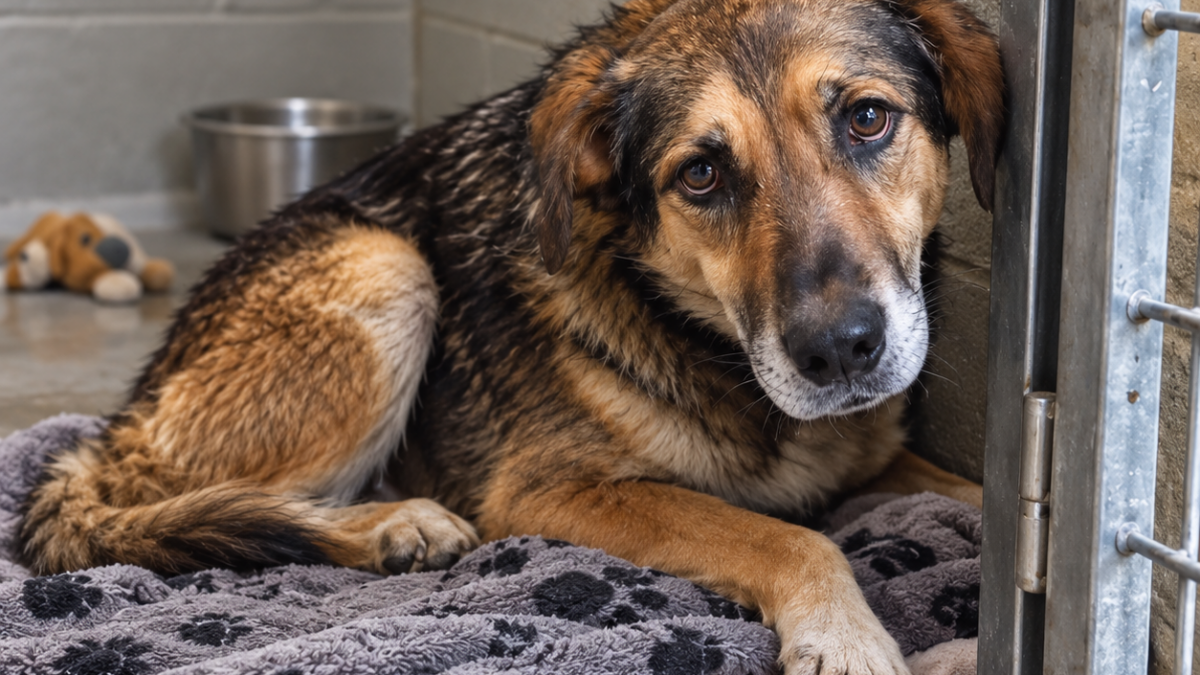
She had already been adopted twice, and both families had brought her back with the same exhausted sentence: “We can’t do this anymore.”
By the time I met her, she no longer ran toward people, wagged at visitors, or seemed to believe that anyone who opened her kennel door was actually coming back.
But the first night she spent in my house, she did something at the front door that made me realize her panic had started long before either of those adoptions.
My name is Claire Morgan, and I wasn’t looking for a dog.
I certainly wasn’t looking for one described to me as “a difficult foster.”
The call came from Hannah, an adoption coordinator at a county shelter outside Columbus, Ohio.
“Can I ask you something unusual?”
“That depends on how unusual.”
She hesitated.
“We need someone to take Luna for a few days.”
I knew the name.
Almost everyone who volunteered there did.
Luna was a six-year-old shepherd mix with a white patch on her chest, one ear that stood straighter than the other, and eyes that always seemed to be waiting for bad news.
She had been adopted twice.
The first placement lasted thirty-eight days.
The second lasted nineteen.
Both families returned her because of severe separation anxiety.
When left alone, Luna started by whining at the door.
Then she scratched.
Then paced.
Then panted so hard that foam sometimes collected around her mouth.
If she was crated, she tried to force herself through the bars.
She had broken two nails.
Rubbed the skin raw above her nose.
Once, she bent a metal crate door badly enough that the adopter thought she might injure herself permanently.
Neither family had abused her.
Neither family hated her.
They simply reached the point where they were afraid to leave their own house.
The second adopter cried while signing the surrender paperwork.
“I love her,” she said. “I just can’t keep watching her destroy herself every time I go to work.”
Luna changed after that return.
Before, she used to rise whenever someone stopped near her kennel.
Afterward, she became careful.
She still approached the bars.
Still looked at people.
But she no longer offered herself completely.
If a visitor walked away, Luna immediately sat beside the kennel door and watched until that person disappeared.
Hannah had noticed something else.
“She barely sleeps in here anymore,” she told me over the phone. “Every sound from the hallway wakes her up.”
“So what do you want me to do?”
“Nothing complicated. Just give her a break.”
I laughed without humor.
“You called the woman who works ten-hour shifts.”
“I know.”
“I live alone.”
“I know.”
“And you’re giving me a dog who panics when somebody leaves?”
Another pause.
“Just come meet her.”
That was how Hannah got people.
She never argued.
She just made them look.
An hour later, I was standing inside the shelter’s quieter adoption room.
Luna was in the corner.
Not hiding.
Just waiting.
Hannah opened the gate.
Luna stood.
Her tail did not move.
I crouched.
“Hey, girl.”
She looked at me.
Then at Hannah.
Then back at me.
I held out my hand.
Luna took one slow step forward.
Then another.
She sniffed my fingers.
For a second, nothing happened.
Then she leaned her forehead against my hand.
Not her cheek.
Not her shoulder.
Her forehead.
Like she was tired enough to let someone else hold the weight of it.
I swallowed.
Hannah said quietly, “That’s more than she’s done with anybody this week.”
I scratched beneath Luna’s chin.
“You’re setting me up.”
“Absolutely.”
I looked at the dog.
“Three days.”
Hannah smiled.
“Of course.”
I should have known then that neither of us believed me.
Because when I stood to leave the room and sign the foster paperwork, Luna followed me to the doorway.
Hannah gently held her back.
I took two steps into the hall.
Behind me came a sound so small I almost missed it.
Luna whimpered.
I turned.
She wasn’t pulling against Hannah.
She wasn’t barking.
She was sitting perfectly still, staring at me with terror already rising in her eyes.
As if two steps away were enough for her to believe I had left forever.
PART 2
I walked back immediately.
Luna’s whole body changed.
Her shoulders dropped.
Her mouth closed.
The frantic shine in her eyes softened.
I had been gone maybe four seconds.
Four.
I looked at Hannah.
“That fast?”
She nodded.
“Sometimes faster.”
“That isn’t separation anxiety.”
“It is.”
“No, I mean—that’s not normal anxiety.”
“No,” Hannah said quietly. “It isn’t.”
I crouched again.
Luna pressed close enough that her shoulder touched my knee.
“What happened to you?”
Of course she couldn’t answer.
Dogs rarely get to tell us the first chapter.
We only meet the consequences.
Hannah brought out Luna’s file.
It was thicker than I expected.
Shelter intake.
Behavior notes.
Veterinary records.
Adoption one.
Return one.
Training recommendations.
Adoption two.
Return two.
The page that mattered most should have been at the beginning.
Instead, it contained almost nothing.
Luna had been found wandering near an interstate service road eighteen months earlier.
No collar.
No microchip.
Underweight.
Paw pads worn.
A scar around her neck consistent with a collar that had once been too tight.
Someone reported seeing her for several days near a boarded-up rental house.
By the time animal control caught her, she was sleeping beneath the porch.
“That’s it?” I asked.
“That’s everything we know before the shelter.”
“What about the house?”
“Vacant.”
“Previous tenants?”
“Never followed up.”
“Why?”
Hannah looked uncomfortable.
“Because she was a stray dog, Claire.”
I knew what she meant.
Shelters are overwhelmed.
A frightened dog arrives.
You vaccinate her.
Feed her.
Check for a chip.
Photograph her.
Post her.
Wait through the legal hold.
You do not normally launch an investigation into every house she happened to sleep beside.
Still, I looked at Luna.
The dog was resting her chin on my shoe.
Something about that empty house bothered me.
“Three days,” I repeated.
Hannah smiled.
“Three days.”
We both lied again.
The ride home was uneventful.
That should have warned me.
Luna sat in the back seat, upright the entire way.
Every time I stopped at a red light, she leaned forward until her nose almost touched my shoulder.
When the car moved again, she settled back.
At my house, she inspected each room.
Living room.
Kitchen.
Bathroom.
Bedroom.
Spare room.
Then she found the front door.
She stood there.
Looked at it.
Looked at me.
Returned to the living room.
Five minutes later, she checked it again.
At first, I thought she wanted outside.
I took her into the yard.
She relieved herself, sniffed the fence, then hurried back toward the house.
The second we came inside, she checked the door.
Again.
I fed her.
She ate only while I remained in the kitchen.
When I carried my plate into the living room, Luna stopped chewing and followed.
I went back.
She ate.
I took one step toward the hallway.
She stopped again.
“This is ridiculous.”
Luna stared.
I dragged a chair into the kitchen.
“Fine.”
She ate the rest.
That evening, I took a shower.
Within thirty seconds, scratching started outside the bathroom door.
“Luna.”
Scratch.
Scratch.
“I’m still here.”
Whine.
I opened the door.
She was sitting with her nose almost pressed against it.
Her expression made irritation impossible.
“You could hear the shower.”
Her tail made one uncertain sweep.
“You knew I was in here.”
Another sweep.
I left the bathroom door open.
That became my first adjustment.
There were many.
The first night, Luna refused the dog bed I had placed beside the couch.
She lay between me and the front door.
Every time a car passed outside, her head lifted.
At 12:16 a.m., I got up for water.
Luna jumped to her feet.
At 1:03, I turned over on the couch.
Her eyes opened.
At 2:41, I woke and found her standing over me.
“You’re creepy.”
She stared.
“Go to sleep.”
She lay down.
At 3:10, I woke again.
Same position.
Watching me.
By morning, I understood what Hannah meant.
Luna wasn’t sleeping.
She was monitoring.
My movements.
The hallway.
The door.
Maybe every sound that might mean I was about to disappear.
I called in late to work.
Not because Luna needed me.
That was what I told myself.
I said I wanted to observe her behavior.
Really, I didn’t know how to leave.
Around ten, I decided I had to test it.
I put on my shoes.
Luna stood immediately.
I picked up my keys.
Her breathing changed.
That fast.
Keys.
That was the trigger.
She moved between me and the front door.
Not aggressively.
Just physically.
“Luna.”
Pant.
I stepped right.
She stepped right.
I stepped left.
She matched me.
“Come on.”
Her tail tucked.
I opened the door.
Luna began trembling.
I stepped onto the porch.
She pushed her nose into the narrowing gap.
I closed the door before she could injure herself.
From inside came one whine.
Then scratching.
I stood on my porch listening to claws scrape wood.
Five seconds.
Ten.
The scratching became frantic.
Then came the first slam.
Her body against the door.
I opened it.
Luna shot outside, almost knocking me down.
She circled me once.
Twice.
Then pressed against my legs.
Hard.
Her heart was hammering.
“I was outside for fifteen seconds.”
She pushed closer.
I bent down.
For the first time, I understood why the other adopters had failed.
Love wasn’t enough.
Good intentions weren’t enough.
You couldn’t explain a job to a dog.
Couldn’t explain grocery shopping.
Couldn’t say, “I’ll be back at five,” and expect the words to mean anything.
Luna’s body believed departure meant loss.
Her body didn’t care what I promised.
I called Hannah.
“I can’t leave.”
“I know.”
“That sounds very casual.”
“We warned you.”
“No, you said anxiety. This is panic.”
“Yes.”
“What do I do?”
“Start small.”
“How small?”
“Touch the doorknob.”
I waited.
“You’re joking.”
“No.”
So that afternoon, I touched the doorknob forty-seven times.
The first time, Luna stood.
The fifth time, she stood.
The tenth time, she only lifted her head.
The twentieth time, she sighed.
By the forty-seventh, she looked at me as though I had become the most boring person on earth.
Good.
Then I picked up my keys.
Instant panic.
We started over.
Keys down.
Treat.
Keys up.
Treat.
Walk toward door.
Walk away.
Sit.
Wait.
Repeat.
For hours.
I felt ridiculous.
Luna was exhausted.
So was I.
But near sunset, I picked up my keys and she remained lying down for three full seconds.
I almost celebrated.
Then my phone rang.
It was my manager.
“Claire, are you coming in tomorrow?”
I looked at Luna.
“Yes.”
I had to.
I had bills.
A mortgage.
A life that existed before this dog.
After I hung up, I sat on the floor.
Luna walked over.
Placed one paw on my knee.
“Don’t.”
She tilted her head.
“You don’t get to make this harder.”
Her paw stayed there.
I laughed.
Then cried.
“Three days, remember?”
Luna leaned her forehead against my shoulder.
The next morning, I tried to leave for work.
I made it to my car.
I heard her screaming from inside the house.
Not barking.
Screaming.
I ran back.
Luna had blood on one paw.
She had scratched the lower edge of the door until a nail split.
That was when I understood something important.
This wasn’t bad behavior.
She wasn’t punishing me.
She wasn’t stubborn.
She wasn’t manipulative.
She was terrified.
There is a difference.
A huge one.
Bad behavior can sometimes be corrected.
Terror has to be healed.
I called my manager again.
“I need another day.”
“Claire—”
“I know.”
“You’ve already missed half of yesterday.”
“I know.”
“Is somebody sick?”
I looked at Luna.
“Yes.”
That wasn’t exactly a lie.
My manager, Diane, exhaled.
“One day.”
“Thank you.”
I took Luna to Dr. Kevin Patel, a veterinarian who worked with the shelter.
He examined the injured paw.
Then he watched her behavior while I stepped behind a partition.
Within seconds, Luna began panting.
“Come back.”
I did.
She calmed.
Dr. Patel looked at me.
“She needs a structured behavior plan.”
“Can she get better?”
“Yes.”
“How sure are you?”
He smiled slightly.
“That’s not how behavior works.”
“Give me a number.”
“No.”
“Fifty percent?”
“No numbers.”
“Twenty?”
“Claire.”
I folded my arms.
He continued.
“She can improve. But improvement may mean management for the rest of her life.”
“Medication?”
“Possibly.”
“Training?”
“Yes.”
“How long?”
“Months.”
My stomach dropped.
“I agreed to foster her for three days.”
Dr. Patel smiled.
“I hear that a lot.”
“Why is everyone laughing at me?”
“Because you’re sitting on the floor so she can keep one paw on your shoe.”
I looked down.
Luna’s paw was indeed resting on my foot.
I hadn’t noticed.
Dr. Patel didn’t prescribe a miracle.
There wasn’t one.
He gave us a plan.
Predictable routines.
Gradual desensitization.
Departure cues practiced without leaving.
Short separations beneath Luna’s panic threshold.
Puzzle feeding.
Exercise.
Medication if necessary after baseline bloodwork.
No punishment.
No forced crating.
No “cry it out.”
“Why no crate?” I asked.
“Because she has already injured herself trying to escape one.”
“What if she destroys my house?”
“Then we manage the environment.”
“That sounds expensive.”
“Dogs are rarely impressed by mortgages.”
I laughed despite myself.
Then he said something I remembered for years.
“The goal isn’t to teach Luna that you will never leave.”
I looked at him.
“What is it?”
“To teach her that leaving doesn’t mean gone forever.”
That became our work.
One second.
Then three.
Then five.
I learned to step outside and return before panic started.
At first, five seconds was too much.
Then she managed eight.
Then twelve.
Then we had a setback because a delivery truck slammed its door while I was outside.
Back to three.
A week passed.
My three-day foster became ten days.
Then fourteen.
Hannah stopped asking when I was bringing Luna back.
I stopped pretending I had decided.
Work became complicated.
Diane allowed me to work from home temporarily, but not indefinitely.
“You need a plan,” she told me.
“I have one.”
“A real one.”
“I touch doorknobs for thirty minutes every morning.”
There was a pause.
“That is not what I meant.”
I arranged a dog sitter.
Luna panicked when I left even with the sitter present.
We tried again.
Then again.
On the fourth attempt, she whined but did not scratch the door.
Twenty minutes.
I sat in my car around the corner staring at the clock like someone waiting for surgery results.
The sitter texted.
Still pacing. No self-injury.
I cried.
Over pacing.
That was what Luna did.
She recalibrated victory.
A week later, I managed forty-two minutes.
Then an hour.
Then fifty minutes because improvement wasn’t linear.
One afternoon, Hannah came over with paperwork.
“What is that?”
“Nothing.”
“That is clearly paper.”
“Routine foster update.”
I narrowed my eyes.
She sat at the kitchen table.
Luna was asleep beneath it.
Actually asleep.
During daylight.
With people talking.
That alone would have been impossible a month earlier.
Hannah looked down.
“She looks different.”
“She gained six pounds.”
“Not what I mean.”
I knew.
Luna’s face was softer.
She still watched me.
But not every second.
Sometimes I walked into another room and she stayed where she was.
Sometimes.
Not always.
Hannah asked, “What are you thinking?”
“About?”
“Keeping her.”
“I work full time.”
“That’s not an answer.”
“She has medical expenses.”
“Still not an answer.”
“I wanted a normal dog.”
Hannah smiled.
“That’s definitely not an answer.”
I looked under the table.
Luna was asleep with one paw touching my shoe.
“I don’t know.”
That was the truth.
Because love can be real and still be frightening.
I loved Luna.
By then I knew it.
But loving a dog with severe separation anxiety meant reorganizing my life around a problem that might never disappear completely.
I was afraid.
Not of Luna.
Of failing her.
Being number three.
Another house.
Another door.
Another person who eventually said:
I can’t do this anymore.
I refused to become that sentence.
So I did something I hadn’t done before.
I started looking backward.
I wanted to know where Luna’s panic began.
The boarded-up house from her intake report still existed.
I drove there on a Saturday.
Without Luna.
She stayed with Hannah.
The house sat near an old frontage road, paint peeling, windows covered with plywood.
I expected nothing.
Instead, I found an elderly neighbor watering flowers.
Her name was Mrs. Evelyn Carter.
I showed her a photograph.
“Have you ever seen this dog?”
Evelyn stared for several seconds.
Then her hand went to her mouth.
“Lucy.”
My heart stopped.
“What?”
“Her name was Lucy.”
I looked at the photo.
“You know her?”
“I fed her.”
“When?”
“After those people left.”
Every hair on my arms rose.
“What people?”
“The renters next door.”
Evelyn pointed at the abandoned house.
“A man and woman. Maybe two years ago.”
“What happened?”
“They moved out.”
“And the dog?”
Evelyn’s eyes filled.
“They left her.”
I said nothing.
“They left her chained behind the house.”
My stomach turned.
“For how long?”
“I don’t know exactly. Maybe two days before I realized.”
“Two days?”
“I heard her crying at night.”
Evelyn set down the watering can.
“I thought somebody was still there. Then I walked around back.”
Luna—Lucy then—had been chained beneath a small porch.
No food.
One overturned water bowl.
The tenants’ truck gone.
House empty.
Evelyn brought food.
Called animal control.
But before officers arrived, the dog slipped the collar.
“She ran down the road,” Evelyn said. “I never saw her again.”
That explained the scar around Luna’s neck.
The boarded house.
The service road.
Maybe everything.
I struggled to keep my voice steady.
“Do you remember their names?”
Evelyn did.
Derek and Marissa Cole.
She remembered because mail still arrived for months after they disappeared.
I called Hannah.
Then Tessa Monroe at county animal services.
At first, I expected nothing.
Abandonment two years earlier.
No evidence except one witness.
No dog seized at the scene.
Maybe no record.
But there was a record.
Evelyn had called animal control.
The call had been logged.
An officer responded forty-three minutes later.
He found an empty chain.
Dog gone.
Photographs were taken.
A rusted collar remained attached to the chain.
And there was something else.
The rental owner had documented the tenants’ names after they left owing three months’ rent.
Derek Cole.
Marissa Cole.
Current address unknown.
I should have felt satisfaction.
Instead, I went home angry.
Luna met me at the door.
Not frantic.
Happy.
Different.
I knelt.
“Lucy?”
Her head tilted.
“Was that your name?”
Nothing.
“Lucy?”
One ear lifted.
Then her whole body went still.
My heart broke.
Not because she remembered the sound exactly.
Maybe she did.
Maybe it was coincidence.
But something passed through her expression.
A flicker.
I sat on the floor.
“They left you there.”
Luna approached slowly.
“I thought maybe you’d been lost.”
She placed her head against my chest.
“But you waited for them.”
My voice cracked.
“How long did you wait?”
She leaned harder.
Suddenly every returned adoption looked different.
Every front door.
Every key.
Every coat.
Every owner walking away.
To us, those were temporary departures.
To Luna, they were the beginning of the worst thing that had ever happened to her.
Once, people packed a house.
Walked out.
Started a vehicle.
And never came back.
Her body remembered even when nobody else did.
I held her for a long time.
Then something changed in me.
Until that day, I had been trying to train Luna to fit my life.
Afterward, I started asking what kind of life would help her feel safe.
That didn’t mean never leaving.
That would have made both of us prisoners.
It meant building trust deliberately.
I bought a small indoor camera.
Practiced departures every day.
Worked with Dr. Patel.
Started Luna on prescribed anti-anxiety medication after her medical evaluation.
The medication didn’t sedate her.
It didn’t erase her personality.
It simply lowered the volume of panic enough for learning to happen.
Progress accelerated.
Two minutes.
Five.
Eight.
Then one terrible day, fourteen minutes became a disaster.
A thunderstorm hit while I was gone.
I watched on the camera as Luna began pacing.
Then panting.
Then scratching.
I drove home so fast I barely remember the trip.
She had torn one curtain down.
Nothing else.
When I entered, she collapsed against me.
I sat on the floor.
“I know.”
My old fear returned.
Maybe I couldn’t do this.
Maybe everyone had been right.
Maybe love wasn’t enough.
That night, I called Hannah.
“I think I’m failing.”
“No.”
“You don’t know what happened.”
“I do. You texted me six times.”
“She panicked.”
“She had a setback.”
“Same thing.”
“No.”
“I left her.”
“You came back.”
I was quiet.
Hannah continued.
“That is the lesson, Claire.”
I stared at Luna sleeping beside me.
“You came back.”
Those three words became bigger than training.
They became the whole story.
I came back.
Again.
And again.
And again.
Until eventually Luna’s nervous system began believing me.
Three months after she arrived, I left for ninety minutes.
She paced twice.
Whined once.
Then lay on the couch.
I watched the camera from a grocery store parking lot.
Luna put her head down.
Closed her eyes.
Stayed asleep for seventeen minutes.
I started crying between a cart return and a minivan.
A man loading groceries looked at me.
“You okay?”
I held up my phone.
“My dog is sleeping.”
He stared.
“Congratulations?”
“Thank you.”
I meant it.
The shelter posted a progress photo of Luna.
Nothing dramatic.
Just her asleep on my couch.
The caption mentioned that she had been returned twice and was improving in foster care.
It spread locally.
People responded.
Mostly kind comments.
Some cruel ones.
Why would anyone return her?
Those people didn’t deserve dogs.
I disagreed.
The first two adopters had been overwhelmed, not evil.
I knew more now.
Without training, medication, flexibility, and support, Luna’s panic could consume a household.
Then I got a message.
From her second adopter.
Her name was Beth.
Claire, I don’t know if you remember me. I adopted Luna before you fostered her. I saw the shelter post. Is she really doing better?
I hesitated.
Then answered.
Yes.
Beth replied immediately.
I’m so glad.
Then:
I think about her every day.
We met for coffee.
Beth cried before I sat down.
“I failed her.”
“No.”
“I returned her.”
“You were scared she’d kill herself.”
Beth wiped her eyes.
“She ripped her nose open on the crate.”
“I know.”
“I couldn’t leave to buy groceries.”
“I know.”
“My boss threatened to fire me.”
“I know.”
She looked at me.
“How are you doing it?”
“Help.”
“What?”
“Lots of help.”
I told her about Dr. Patel.
Medication.
Gradual desensitization.
Cameras.
Sitters.
Remote work.
Beth stared at the table.
“Nobody told me medication was an option.”
That bothered me.
“Who did you ask?”
“The shelter trainer at the time.”
Different staff.
Different resources.
A year earlier, the shelter’s behavior program had been stretched thin.
Beth had been told to crate Luna and practice leaving.
Luna panicked in the crate.
Beth tried harder.
Luna panicked harder.
“I thought she hated being alone because I spoiled her.”
“She was abandoned.”
Beth looked up sharply.
“What?”
I told her.
She covered her mouth.
“Oh, God.”
For several minutes, neither of us spoke.
Then Beth said:
“I wish I’d known.”
“So do I.”
That conversation redirected my anger.
The story wasn’t simply:
Bad people leave dog.
Good person fixes dog.
Reality is rarely that clean.
Luna had been betrayed once.
Then misunderstood repeatedly.
Her first adopters lacked tools.
Her shelter lacked resources.
Everyone reacted to behavior without knowing its origin.
So I stopped wanting revenge against the families who returned her.
I wanted accountability for the people who had created the wound.
Tessa located Derek Cole first.
He had moved to Indianapolis.
Marissa had separated from him.
When contacted, she admitted owning Lucy.
Luna.
She claimed Derek decided to leave the dog because their new apartment did not allow pets.
“Did you object?” Tessa asked.
Marissa said she had.
“Did you call a shelter?”
No.
“Animal control?”
No.
“Neighbors?”
No.
“Did you know the dog was chained?”
Silence.
“Yes.”
That mattered.
Derek initially denied everything.
Then Tessa showed him the old rental record.
Photos.
Call log.
Neighbor statement.
Derek changed his story.
Lucy had “escaped.”
Before they moved.
Then Evelyn’s testimony contradicted him.
She had seen their loaded truck leave.
The dog was still chained afterward.
Derek changed the story again.
He claimed he intended to return.
“For what?” Tessa asked.
“The dog.”
“When?”
“Later.”
“How much later?”
He couldn’t answer.
Days?
Weeks?
Never?
Investigators discovered another detail.
Derek had paid a pet deposit at the new apartment two months later.
For a different dog.
That hurt more than I expected.
Luna had been disposable.
Not because he couldn’t have dogs.
Because taking her required effort.
The county prosecutor eventually filed an animal abandonment charge based on the archived report, witness testimony, and Derek’s inconsistent statements.
It wasn’t the dramatic felony case I imagined.
Time had passed.
Evidence had limits.
The legal consequences were modest compared with what Luna endured.
A fine.
Probation.
Animal ownership restrictions for a period.
Mandatory humane-education requirements under the disposition.
Marissa cooperated and faced lesser consequences.
At first, I was furious.
“That’s it?”
Tessa looked at me.
“You want the truth?”
“Yes.”
“The law can’t return two years of fear to a dog.”
I hated that.
She continued.
“But this record matters.”
“How?”
“If he abandons another animal, it isn’t a first incident.”
I looked away.
Tessa said:
“Accountability isn’t always proportional to the emotional damage.”
“That’s a terrible system.”
“Sometimes.”
“Doesn’t it bother you?”
“Every day.”
Then she leaned forward.
“But don’t confuse punishment with victory.”
I thought of Luna sleeping on my couch.
“What is victory?”
Tessa smiled.
“You already have it.”
At the four-month mark, Hannah came to my house again.
This time she brought a folder.
I pointed.
“No.”
She laughed.
“You don’t even know what’s inside.”
“Yes, I do.”
Luna trotted to greet her.
Actually trotted.
Tail wagging.
Hannah crouched.
“Hey, beautiful.”
Luna licked her chin.
I stared.
“That is betrayal.”
Hannah smiled.
“She remembers me.”
“She used to look at you like you were prison management.”
“Growth.”
We sat at the kitchen table.
Hannah opened the folder.
Adoption application.
I stared at it.
“I didn’t say yes.”
“You also didn’t say no.”
“I work full time.”
“You’ve said that.”
“I travel.”
“Twice a year.”
“She has behavioral needs.”
“You already handle them.”
“She might relapse.”
“Yes.”
I looked at Luna.
She was lying in sunlight.
Not touching my shoe.
Three feet away.
Sleeping.
“I could still fail her.”
Hannah’s voice softened.
“Claire.”
I looked at her.
“Keeping a dog doesn’t mean promising nothing will ever be hard.”
Silence.
“It means promising hard doesn’t automatically mean goodbye.”
That was it.
That was the sentence.
I looked at Luna.
The dog who had experienced every difficulty as a countdown to abandonment.
I picked up the pen.
“What’s her legal name?”
“Luna.”
I hesitated.
“Not Lucy?”
Hannah shook her head.
“She’s been Luna here for eighteen months.”
I looked at her.
“Good.”
I signed.
Luna Morgan.
My dog.
Not foster.
Not temporary.
Not difficult placement.
Mine.
When Hannah opened the door to leave, Luna stood.
My heart stopped.
She followed Hannah two steps.
Then stopped.
Hannah waved.
“Bye, Luna.”
The door closed.
Luna stared at it.
One second.
Two.
Three.
Then she turned.
Walked back into the living room.
And lay down.
I cried harder than I had at the signing.
Because that was the real adoption.
Not paper.
Not fees.
Not a microchip transfer.
A door closed.
Someone left.
And Luna stayed calm because she knew someone still remained.
Six months later, we faced our biggest test.
My mother had emergency surgery in Cincinnati.
I needed to leave overnight.
Not two minutes.
Not an hour.
Overnight.
My hands shook while packing.
Luna noticed.
Of course she did.
Anxiety is contagious when a dog spends her life reading human bodies.
Dr. Patel helped me make a plan.
Hannah would stay at my house.
Same environment.
Same routines.
Same bed.
Same medication.
I would leave calmly.
No dramatic goodbye.
“You’ll be back tomorrow,” Hannah said.
“I know.”
“She doesn’t.”
That was the problem.
I knelt beside Luna.
No speech.
No promises she couldn’t understand.
I scratched her chest.
Then I stood.
Picked up my bag.
Keys.
Luna watched.
Her breathing sped up.
I opened the door.
She stood.
I stepped outside.
Closed it.
Then I cried all the way to the car.
Hannah texted ten minutes later.
Pacing.
Twenty minutes.
Drank water.
Forty minutes.
Lying near door.
An hour.
Moved to couch.
Then a photograph.
Luna asleep.
Not deeply.
But asleep.
I sat in a hospital parking garage staring at that picture.
The next morning, I drove home.
I expected chaos.
When my key entered the lock, I heard movement.
The door opened.
Luna exploded.
Not with panic.
Joy.
She spun.
Barked.
Jumped once even though we discouraged jumping.
Ran a circle around the couch.
Returned.
Pressed against me.
I knelt.
“I came back.”
She licked my face.
“I came back.”
That was the first overnight separation Luna survived without injuring herself.
It wasn’t the last.
Over the following years, her world expanded.
She learned dog sitters were temporary.
Hannah could leave and return.
I could go to work.
I could grocery shop.
I could close a bathroom door.
Eventually.
That one took strangely long.
We kept routines.
Kept medication for several years under veterinary supervision.
Kept practicing.
Luna never became a dog who loved solitude.
She didn’t need to.
Healing doesn’t mean becoming someone entirely different.
She simply learned that being alone was survivable.
That doors reopened.
That footsteps returned.
That car engines coming and going did not predict permanent loss.
Three years after adoption, I moved to a different house.
That terrified me.
The last time Luna experienced moving boxes, people left her chained behind an empty home.
I didn’t know whether the sight of cardboard would trigger her.
It did.
The first box I taped shut made her restless.
By the fifth, she followed me continuously.
When movers arrived, she began panting.
I changed the plan.
Luna went to Hannah’s house during loading.
Then I drove her personally to the new home.
We entered together.
Before any furniture arrived.
I let her inspect.
Kitchen.
Hallway.
Bedroom.
Back door.
Front door.
She paced.
I sat on the bare living-room floor.
“I know.”
Luna stood near the entrance.
I waited.
After several minutes, she came to me.
Lay down.
Her body touched my thigh.
An hour later, the movers arrived.
I stayed with her.
That night, boxes surrounded us.
Luna slept beside my mattress.
At 2:00 a.m., I woke.
She was watching me.
Old habit.
I put my hand down.
“You’re home.”
Her eyes closed.
She never panicked in that house again.
That house became the setting for the rest of her life.
There was a fenced yard.
A maple tree.
A low window where Luna watched mail carriers.
A neighbor named Tom who kept dog treats in his garage.
A little girl named Avery who asked permission to pet Luna every single time even after knowing her for five years.
Luna adored her.
One afternoon Avery asked:
“Why does Luna always watch you leave?”
I thought about the answer.
“Because once, somebody left and didn’t come back.”
Avery frowned.
“That’s mean.”
“Yes.”
“Do you always come back?”
“I try very hard.”
Avery considered that.
Then she hugged Luna carefully.
“She knows now.”
I looked at the dog.
I hoped so.
Beth, Luna’s second adopter, stayed in our lives.
That surprised everyone.
She came to Luna’s adoption anniversary once a year.
The first visit was awkward.
Beth stood at my front door holding a bag of treats.
Luna approached.
Sniffed her.
Beth began crying immediately.
“Hi, baby.”
Luna’s tail moved.
Beth crouched.
“I am so sorry.”
I stayed quiet.
Luna sniffed her face.
Then licked her once.
Beth laughed through tears.
“She doesn’t hate me.”
“No.”
“I thought she would.”
“Dogs don’t write moral essays about us.”
Beth sat on the floor.
“I loved you.”
Luna leaned into her.
“I just didn’t know how.”
That sentence mattered.
Because sometimes good people fail when they don’t have support.
Beth later became one of the shelter’s foster volunteers.
She specifically took dogs with anxiety.
Not the most severe cases at first.
Then harder ones.
Every time she doubted herself, she called me.
“I’m becoming you,” she once said.
“Terrible news.”
“Doorknob training.”
“Condolences.”
We laughed.
Years later, one of the shelter’s new adopters tried returning a young hound after three days because he cried when left alone.
Beth offered to foster him.
She worked with the family.
The dog stayed in his adoptive home.
A return prevented.
Luna’s pain kept echoing outward in ways I never expected.
The shelter changed too.
Her case became part of staff training.
Repeat returns no longer automatically labeled dogs “failed placements.”
Behavior histories improved.
Adopters received clearer information about separation anxiety.
The shelter partnered with veterinarians and certified trainers.
They created a small fund for behavioral medication and consultations during the first months after adoption.
The fund was called the Home Again Program.
Hannah wanted to name it after Luna.
I refused.
“Why?”
“Because she’ll become unbearable.”
Hannah stared at me.
“She eats socks.”
“Exactly.”
Privately, though, I loved that Luna had helped change something.
Not through fame.
Not through being extraordinary.
Through surviving a problem people used to misunderstand.
Derek’s case ended quietly.
Probation.
Restrictions.
A record.
I saw him once.
Years later.
Not intentionally.
I was at a pet-supply store with Luna.
She was ten by then.
Gray around the muzzle.
Slower.
Confident.
I was comparing arthritis supplements when I heard a voice behind me.
“Lucy?”
Luna froze.
So did I.
I turned.
Derek Cole stood at the end of the aisle.
Older.
He looked at Luna.
Then me.
“Is that her?”
I said nothing.
He stepped closer.
Luna moved behind my leg.
That told me everything.
“Don’t.”
Derek stopped.
“I just wanted to see.”
“You’ve seen.”
His face tightened.
“I heard she got adopted.”
“She did.”
“I didn’t know she was going to end up like that.”
“Like what?”
“At the shelter. With all the anxiety.”
I stared at him.
“You left her chained outside an empty house.”
He looked down.
“I was younger.”
“Not that young.”
“I made a mistake.”
“Yes.”
“I paid for it.”
“No.”
His eyes came up.
“The court—”
“The court fined you.”
I put one hand lightly on Luna’s back.
“She paid for it.”
Silence.
People moved at the far end of the store.
A cart squeaked.
Luna remained pressed against me.
Derek looked at her.
“Does she remember me?”
I could have been cruel.
Part of me wanted to be.
Instead, I answered honestly.
“I don’t know.”
He swallowed.
“Can I pet her?”
“No.”
His face changed.
“Why?”
“Because she moved away from you.”
He looked at Luna again.
I continued.
“She gets to decide now.”
That was the revenge.
Not yelling.
Not humiliation.
Choice.
Once, Derek decided where Luna stayed.
When she ate.
Whether she mattered.
Whether she was left behind.
Now Luna had choice.
She chose to stay behind me.
I respected it.
Derek nodded slowly.
“Okay.”
He walked away.
I didn’t watch him go.
I looked down.
Luna looked up.
“You good?”
Her tail moved once.
“Let’s go home.”
At the register, Luna stole a treat from a low display.
I paid for it.
Justice sometimes costs $3.49.
Luna grew old gradually.
Her face turned silver.
She stopped jumping into the car.
I bought a ramp.
She refused it.
I lifted her.
She tolerated that.
Stairs became harder.
Walks shortened.
But one habit never disappeared completely.
Whenever I left, Luna watched the door.
Not panicked.
Just attentive.
When I returned, she met me there.
Every time.
Even when her hearing faded.
Even when her hips hurt.
Even when she had been asleep.
Somehow, she knew.
At thirteen, Luna developed kidney disease.
Manageable at first.
Special food.
Medication.
More frequent checks.
She hated subcutaneous fluids.
I hated giving them.
We negotiated.
Lots of chicken.
Dr. Patel, now grayer himself, kept saying:
“She has time.”
So we used it.
Slow mornings.
Short walks.
Sunlight.
Avery, now a teenager, still visited.
Beth came.
Hannah came.
Luna collected people without ever intending to.
One autumn afternoon, I found her beside the front door.
That wasn’t unusual.
But something was different.
She wasn’t waiting for me to leave.
She was simply lying there.
I sat beside her.
“You know you don’t have to guard this anymore.”
Luna rested her head on my leg.
I rubbed the white patch on her chest.
“I think we proved the point.”
Her eyes closed.
“We came back.”
That became something I said often near the end.
We came back.
All of us.
Hannah.
Beth.
Me.
Dr. Patel after every appointment.
Avery after school.
The world had once taught Luna that people disappeared.
We spent the rest of her life teaching the opposite.
The final decline happened fast.
One Friday, Luna refused breakfast.
Saturday, she ate half.
Sunday, nothing.
Monday morning, I knew.
I called Dr. Patel.
He came to the house.
Luna hated clinics by then.
I wanted home.
She was lying near the front door.
Of course she was.
I had placed blankets beneath her.
Sunlight stretched across the floor.
Hannah arrived.
Then Beth.
Avery came with her mother.
Nobody planned it.
Word simply traveled.
The dog once returned by families now had a living room full of people who didn’t want to leave her.
I almost laughed at the cruelty of that symmetry.
Beth sat near Luna’s rear paws.
She cried quietly.
“I wish I’d been better.”
I looked at her.
“You came back too.”
Beth wiped her face.
“So did she.”
Hannah sat beside me.
“Remember three days?”
I laughed.
“You’re evil.”
“Three days.”
“How long?”
She pretended to calculate.
“About eleven years.”
“Minor extension.”
Luna’s eyes opened at our voices.
I leaned down.
“Hey.”
Her tail moved weakly.
Dr. Patel listened to her heart.
Then looked at me.
No words needed.
I nodded.
My whole body felt hollow.
I had spent eleven years teaching Luna that departures weren’t forever.
Now I was the one facing a goodbye I couldn’t reverse.
I lay beside her.
Her face was inches from mine.
“Listen to me.”
Luna blinked.
“You did it.”
Her breathing was slow.
“You stayed.”
I swallowed.
“And I stayed.”
Tears blurred everything.
“You weren’t difficult.”
Beth started crying harder.
“You weren’t broken.”
I touched Luna’s cheek.
“You were scared.”
Her eyes stayed on me.
“And you learned.”
I pressed my forehead gently against hers.
“So did I.”
Dr. Patel prepared the medication.
I kept talking.
“No doors.”
My voice broke.
“No kennels.”
Another breath.
“No waiting.”
I kissed the top of her head.
“You can rest.”
The first injection relaxed her.
For years, Luna had slept lightly.
Always listening.
Always ready.
That afternoon, for the first time in her life with me, I watched every muscle release at once.
No monitoring.
No door.
No keys.
No fear.
Dr. Patel gave the final medication.
Luna exhaled.
Then she was still.
Nobody moved.
Minutes passed.
Maybe longer.
I kept my hand on her chest even after the heartbeat stopped.
Eventually, Hannah whispered:
“Claire.”
“I know.”
But I wasn’t ready.
Luna had spent so much of her life terrified that someone would leave before she was ready.
I would not do that to her now.
So we stayed.
All of us.
Until staying no longer mattered to her body.
Only to ours.
After Luna died, the house became painfully quiet.
For days, I automatically moved carefully around places where she used to sleep.
I reached for medication that no longer existed.
At 5:30, I expected dinner pacing.
At 7:00, I expected the slow click of nails toward the door.
The worst was leaving.
The first morning I returned to work, I stood at the front door with my keys.
For eleven years, those keys had meant something.
At first terror.
Then training.
Then routine.
Eventually trust.
Now they meant nothing.
I opened the door.
Stopped.
Looked behind me.
Empty hallway.
I cried.
Then I whispered:
“I’ll be back.”
Habit.
Promise.
Prayer.
I came home that evening.
No dog waited.
But something strange happened.
I realized the house still felt like hers.
Not haunted.
Held.
The routines she forced into my life had changed me permanently.
I called people now.
Accepted help.
Made plans.
Kept promises.
Returned.
Luna had trained me too.
Months later, the shelter invited me to a small ceremony.
The Home Again Program had expanded.
Behavioral support was now available to dozens of adopters each year.
Hannah uncovered a plaque.
I hadn’t approved the wording.
HOME AGAIN
For dogs who need time to believe goodbye is temporary.
Below it was a small photograph of Luna.
Not young.
Not sad.
Not in a kennel.
Old Luna.
Gray muzzle.
Sleeping on my couch.
I covered my mouth.
“Hannah.”
“What?”
“I said not to name it after her.”
“We didn’t.”
Her smile gave her away.
Beth stood beside me.
Avery too.
On the wall were photographs of dogs helped by the program.
A beagle whose family learned crate alternatives.
A shepherd who needed medication.
A pit bull who stopped tearing doors apart.
A terrier whose adopter almost returned him but stayed through training.
Lives that continued because somebody had resources Luna’s first adopters hadn’t.
I walked along the wall slowly.
That became the part of Luna’s story I loved most.
Not that I saved her.
That would be too simple.
Many people saved pieces of her.
And she saved pieces of us.
Beth transformed regret into service.
Hannah changed shelter protocols.
Dr. Patel taught people that anxiety was medical as well as behavioral.
I learned staying wasn’t the same thing as being trapped.
And Luna?
She learned the hardest lesson of all.
That a closing door could reopen.
That keys could jingle without disaster.
That a person could leave for work and still come home.
That love could include absence without becoming abandonment.
For years, people asked me why Luna had been returned twice.
I used to answer:
“Severe separation anxiety.”
Technically true.
But incomplete.
The better answer was:
Because she had once loved people who taught her that leaving could mean forever.
The rest of her life was spent learning a different ending.
Sometimes I think about that first day at the shelter.
Luna in the corner.
Me insisting on three days.
Hannah pretending to believe me.
I remember standing in the hallway after signing the paperwork.
Two steps away.
Luna staring through the doorway as if distance itself were betrayal.
If I could go back, I wouldn’t tell her everything would be easy.
It wasn’t.
I wouldn’t promise she would stop being afraid quickly.
She didn’t.
I wouldn’t say love would fix everything.
It didn’t.
I’d tell her something much smaller.
Something she could eventually understand because I would prove it thousands of times.
I would come back.
That was all.
And in the end, it was enough.
Luna had been adopted twice before me.
Twice returned.
Twice carried into a shelter by people who cared about her but couldn’t continue.
By the time she reached my house, she had every reason to believe people had expiration dates.
She watched doors because doors had taken everyone away.
She watched keys because keys predicted loneliness.
She watched my face because she needed to know whether I was becoming another person who had finally had enough.
For eleven years, I answered without words.
Every grocery trip.
Every shift.
Every hospital visit.
Every overnight absence.
Every closed bathroom door.
Every trip to the mailbox.
I left.
Then I returned.
Again.
And again.
And again.
Until one day she stopped scratching.
Then stopped screaming.
Then stopped pacing.
Then slept.
That was the miracle.
Not that Luna became fearless.
She didn’t.
The miracle was that fear stopped making every decision for her.
And when her life finally ended, she wasn’t in a kennel watching another person walk away.
She was at home.
On her blankets.
Surrounded by the people who had chosen to stay.
The dog who had once been returned twice became the reason other dogs got a third chance before being returned at all.
The man who abandoned her became a footnote.
Her fear became a program that helped families understand dogs like her.
And the front door she once watched in terror became the place she spent years waiting happily for the sound she eventually learned she could trust.
My key in the lock.
My voice in the hallway.
And the same words, every single time:
“Luna, I’m home.”
“Luna, I’m home.”
For eleven years, those three words had been ordinary.
I said them after work.
After grocery runs.
After doctor appointments.
After taking the trash to the curb.
After walking to the mailbox.
Sometimes I had been gone eight hours.
Sometimes eight minutes.
Luna greeted both absences as though I had returned from another continent.
At first she would race toward me, trembling with relief, pressing her entire body against my legs.
Later, when she finally understood that leaving did not mean abandonment, the greetings became calmer.
A wagging tail.
A stretch.
A sleepy walk from the couch.
Eventually, when age settled into her bones, she would simply lift her head from her bed and wait for me to come to her.
But she always waited.
That was why the first evening after she died hurt more than I expected.
I came through the front door carrying my work bag.
I closed it behind me.
Then, without thinking, I said:
“Luna, I’m home.”
Silence answered.
I stood there with one hand still on the doorknob.
For a few seconds, my mind did something cruel.
It expected nails clicking across the floor.
Expected the rustle of her bed.
Expected the low, impatient sound she made when I took too long removing my shoes.
Nothing came.
The hallway remained empty.
Her water bowl was gone.
Her leash no longer hung beside the door.
Her medication schedule had been removed from the refrigerator.
But a faint pale line remained on the hardwood where her bed had sat for years.
I put my bag down.
Then I sat on the floor in the exact place Luna used to wait for me.
I cried until the room became dark.
Not because her death had been unfair.
Luna had received something many abandoned dogs never do.
Time.
Eleven years of it.
Eleven birthdays.
Eleven winters curled beneath blankets.
Eleven summers lying in the shade beneath the maple tree.
Thousands of meals.
Thousands of walks.
Thousands of times hearing my key turn in the lock and discovering that the promise had been true again.
I had come back.
What broke me was realizing that I had spent more than a decade teaching Luna not to fear an empty house.
Now I was the one who had to learn how to live in one.
For the first week, I kept hearing her.
Not literally.
Habit creates ghosts.
The heating vent clicked, and I thought it was her nails.
A branch touched the window, and I looked toward the hallway.
I woke at 5:52 every morning because that was when Luna usually stretched, shook herself, and nudged my mattress.
At 6:00 I would sit up.
Then remember.
One morning, I carried her food bowl halfway to the kitchen before realizing there was nobody to feed.
I stood there holding it.
The bowl was stainless steel, scratched around the edges from years of use.
Luna had once been so anxious she would stop eating when I moved toward the door.
By the end of her life, she would stare at me while eating as if daring me to steal a piece.
I placed the bowl on the counter.
I couldn’t put it away.
Not yet.
Hannah came over that weekend.
She didn’t knock.
She had stopped knocking years ago.
She found me in the backyard sitting beneath the maple tree.
Luna’s favorite patch of grass was still flattened near the fence.
Hannah sat beside me.
Neither of us spoke for several minutes.
Finally she said:
“Three days.”
I laughed.
It came out broken.
“You’re going to keep using that against me?”
“For the rest of your life.”
“She was supposed to be temporary.”
“I know.”
“You knew exactly what you were doing.”
“I hoped.”
I looked toward the grass.
“I almost brought her back.”
Hannah turned.
“When?”
“The second week.”
“You never told me.”
“I didn’t tell anyone.”
“What happened?”
I remembered it perfectly.
Luna had panicked during a twenty-minute training separation.
She tore the curtain.
Split another nail.
Paced for hours afterward.
I had been exhausted.
Behind on work.
Scared that every improvement was temporary.
That night I had opened the shelter’s number on my phone.
My thumb hovered over the call button.
“I thought I wasn’t enough,” I told Hannah.
“What stopped you?”
“Luna fell asleep.”
Hannah waited.
“She fell asleep with her paw on my foot.”
My voice tightened.
“And I realized she trusted me enough to sleep.”
I wiped my face.
“It wasn’t much. But for her it was everything.”
Hannah nodded.
“She chose you early.”
“I think she chose anyone who stayed.”
“No.”
Hannah looked at me.
“She met a lot of people before you.”
That hurt in a different way.
I had spent years thinking Luna was lucky that I kept her.
Maybe the truth was less flattering.
Maybe I was lucky she gave me enough time to become the person she needed.
A month after Luna died, Beth came by.
She brought a small wooden box.
“What is that?”
“Open it.”
Inside was a blue leather collar.
Not Luna’s old collar.
A new one.
On the metal tag, Beth had engraved:
LUNA
SHE LEARNED WE COME BACK.
I ran my thumb over the words.
“I don’t have a dog.”
“I know.”
“Then why a collar?”
Beth sat across from me.
“Because the shelter wants to make a memorial display.”
I stared at her.
“No.”
She smiled.
“I knew you’d say that.”
“I don’t want people remembering her as some tragic shelter dog.”
“They won’t.”
“She hated attention.”
“She stole a sandwich from the shelter director during an adoption event.”
“That was different.”
“How?”
“She wanted the sandwich.”
Beth laughed.
Then her expression softened.
“They want her story because adopters are still returning dogs for separation anxiety.”
I looked down at the collar.
Beth continued.
“Not because they’re bad people. Because they’re overwhelmed.”
That part mattered to me.
For years, I had refused to turn Luna’s first two adoptive families into villains.
The first family had lasted thirty-eight days.
The second, Beth, nineteen.
Both had loved her.
Neither had been given enough information, support, or tools.
The real betrayal had happened before either adoption.
A chain.
An empty house.
A truck disappearing down the road.
That was the wound.
Everything afterward had been people trying, sometimes unsuccessfully, to understand the scar.
“What does the shelter want to do?” I asked.
“A small exhibit near the counseling room.”
“Not the lobby?”
“No.”
“No dramatic picture of her behind bars?”
“No.”
“No sad music?”
Beth laughed.
“I don’t think the shelter has sad music.”
“You know what I mean.”
“They want the couch picture.”
I knew the one.
Luna at eleven years old.
Gray around the muzzle.
Completely asleep.
On her back.
Front paws bent loosely over her chest.
Mouth slightly open.
No vigilance.
No door watching.
No fear.
Just sleep.
“Yes,” I said.
Beth smiled.
“Yes?”
“Use that one.”
The memorial went up two weeks later.
I almost didn’t attend.
Then Hannah threatened to come to my house and physically drive me.
“You’re five-foot-three,” I told her.
“I have volunteers.”
So I went.
The shelter looked different from the place where I had first met Luna.
Some kennels had been remodeled.
There were sound-dampening panels.
Better enrichment areas.
A behavioral consultation room.
A quiet space for decompression.
Changes made over years.
Some because of funding.
Some because of new research.
Some because difficult dogs like Luna forced people to admit the old system wasn’t enough.
The display was simple.
One photograph.
The blue collar.
A short paragraph.
LUNA WAS RETURNED TWICE FOR SEVERE SEPARATION ANXIETY. WITH MEDICAL CARE, BEHAVIOR SUPPORT, PATIENCE, AND TIME, SHE LIVED ELEVEN YEARS IN HER FINAL HOME.
Below it:
A CLOSING DOOR DOESN’T HAVE TO MEAN FOREVER.
I stood there unable to speak.
Hannah came beside me.
“Too much?”
“No.”
“You sure?”
I nodded.
Then I noticed another wall.
Photographs.
Dozens.
Dogs helped by the Home Again Program.
A yellow Lab named Cooper.
A brindle pit bull named Maya.
A terrier mix named Henry.
A shepherd named Atlas.
A beagle named June.
Each photograph had two dates.
INTAKE.
STILL HOME.
I walked closer.
“What does ‘still home’ mean?”
Beth answered from behind me.
“They’re checking in.”
“With adopters?”
“Every three months for the first year. Then twice the second year.”
“How many?”
Hannah handed me a sheet.
I read the number twice.
“Seventy-three?”
“Seventy-three dogs have received behavioral support since the program started.”
“And how many were returned?”
“Eight.”
My heart sank slightly.
Hannah touched my arm.
“Before the program, comparable high-risk placements had much worse outcomes.”
I looked again.
“Sixty-five stayed?”
“So far.”
I stared at the photographs.
Luna had never met any of them.
But in a strange way, she was in every home.
A veterinarian recommending medication instead of shame.
A trainer teaching gradual separation instead of “let them cry.”
A shelter employee warning an adopter honestly about what they were taking on.
A foster volunteer answering the phone at ten at night.
An overwhelmed owner being given help before reaching the sentence:
We can’t do this anymore.
That was Luna’s legacy.
Not perfection.
Not every dog saved.
Better odds.
More understanding.
More people staying.
The shelter director asked me to say something.
I refused.
Then Beth whispered:
“Do it for the people who think they’re failing.”
That changed my mind.
I stood in front of maybe thirty people.
Staff.
Volunteers.
Adopters.
Dr. Patel.
Hannah.
Beth.
Avery, who was home from college.
I hadn’t prepared anything.
So I told the truth.
“When Luna first came to my house, I thought her problem was that she couldn’t be alone.”
I looked around.
“I was wrong.”
“She could be alone. What she couldn’t handle was what she believed being alone meant.”
The room became quiet.
“Somebody had taught her that a door closing could be permanent.”
I swallowed.
“I spent eleven years teaching her another possibility.”
A woman in the back wiped her eyes.
I continued.
“I wish I could tell you I did everything right.”
I laughed softly.
“I didn’t.”
“I got frustrated. I cried. I missed work. I questioned the adoption. I thought about returning her.”
Several people looked surprised.
Good.
I wanted them surprised.
“I loved Luna. And sometimes love still wasn’t enough.”
That sentence felt dangerous.
But true.
“We needed veterinary help. Medication. Training. Sitters. A shelter willing to answer calls. Friends willing to change plans. Employers willing to give flexibility.”
I looked at Beth.
“Her previous adopters loved her too.”
Beth cried.
“They didn’t fail because they didn’t care.”
I paused.
“They ran out of tools.”
That was the reason the Home Again Program mattered.
We were not asking ordinary people to become behavior specialists overnight.
We were giving them somewhere to turn before love turned into exhaustion and exhaustion turned into surrender.
Afterward, a man approached me.
He was holding a leash attached to a nervous black dog.
The dog stayed pressed against his knee.
“Can I ask you something?”
“Sure.”
“We adopted Nova two months ago.”
The dog glanced at me.
“She destroys things when we’re gone.”
I nodded.
“My wife wants to keep trying.”
“And you?”
His eyes filled.
“I don’t know if I can.”
I recognized the shame immediately.
The same shame Beth carried for years.
The same shame I almost carried.
I did not tell him he had to keep the dog.
That would have been unfair.
Instead I asked:
“Have you talked to the behavior team?”
“Not yet.”
“Talk to them before you decide anything.”
“What if it doesn’t work?”
“Then you make the safest decision you can.”
He looked down at Nova.
“I don’t want to abandon her.”
“Returning a dog safely to a shelter is not the same as leaving one chained behind an empty house.”
His face changed.
“People will judge us.”
“People judge situations they’ve never lived.”
I crouched without moving toward Nova.
“Make the decision for the dog, not the audience.”
Six months later, Hannah sent me a photograph.
Nova asleep on a couch.
Under it:
STILL HOME.
I printed it.
Put it beside Luna’s collar tag.
The years after Luna’s death didn’t erase grief.
They changed its shape.
At first, I missed everything.
Even the difficult things.
The hair.
The medication alarms.
The slow walks.
The constant awareness of where she was.
Eventually I missed specific things.
Her ears.
The way one stood more upright than the other.
The dramatic sigh she made when dinner was late.
The way she refused to walk through puddles but would happily roll in mud.
Her habit of sleeping with one paw against something human.
Then the memories became warmer than painful.
Most of them.
Not all.
Every year on the date I brought Luna home, I still dreamed about the original house.
The abandoned rental.
The chain beneath the porch.
I had only seen it once, but my mind filled in everything I hadn’t witnessed.
Derek loading boxes.
Marissa closing doors.
Luna watching.
A truck leaving.
The sound disappearing.
Hours passing.
Night coming.
Luna waiting because dogs don’t understand leases, deposits, or apartments that prohibit pets.
She only understood that the people she belonged to were gone.
The first few years after learning the truth, I hated Derek.
I wanted him to understand every consequence.
Every shredded door.
Every bleeding paw.
Every returned adoption.
Every night Luna refused to sleep because sleep meant she might miss someone leaving.
When I encountered him years later in that pet store, part of me had wanted to hurt him with words.
But Luna stepped behind me.
She made the choice for both of us.
She didn’t move toward him.
That was enough.
He asked to pet her.
I said no.
Not because I wanted revenge.
Because Luna had finally earned the right to decide who touched her.
She spent the beginning of her life with too little control.
The end belonged to her.
That became more important to me than punishment.
Derek eventually disappeared from my thoughts.
Not completely.
But enough.
Luna didn’t.
Years later, Avery became a veterinary technician.
When she told me, I laughed.
“You blame Luna?”
“Completely.”
Avery had been a little girl when she first asked why Luna watched the door.
Now she worked with anxious dogs every day.
One afternoon she called me.
“I have one.”
“One what?”
“A Luna dog.”
I smiled immediately.
“What happened?”
“Four-year-old cattle dog. Third home. Panics when people put on shoes.”
“Shoes?”
“Shoes.”
“What does the family think?”
“They think he’s being stubborn.”
“And you?”
“I think he’s scared.”
I sat back.
“What are you going to do?”
“Slow everything down.”
I smiled.
“You already know.”
Avery was quiet.
Then she said:
“I remember what you told me when I was little.”
“What?”
“That once somebody left Luna and didn’t come back.”
I swallowed.
“I tell people that now.”
“You do?”
“Not her story exactly.”
Avery continued.
“I tell them behavior makes more sense when you ask what the dog thinks is happening.”
Dr. Patel used to say something similar.
Behavior is communication before it becomes a problem.
Luna had communicated loudly.
Scratching.
Panting.
Running.
Crying.
Breaking crates.
We kept asking:
How do we stop this?
The better question had been:
What is she trying to survive?
Once we understood that, everything changed.
On the fifth anniversary of Luna’s death, the shelter renamed its quiet counseling room.
Not after her.
I had made them promise.
The sign read:
THE RETURN ROOM.
I hated the name.
Then Hannah explained.
“This is where people come before they return a dog.”
Inside were two chairs.
No desk between them.
No judgment posters.
No adoption slogans.
Just a calm room where overwhelmed people could talk honestly.
Some still surrendered their dogs.
That had to remain allowed.
Keeping an unsafe or impossible placement out of guilt helps nobody.
But many didn’t.
Sometimes a trainer solved a problem.
Sometimes medication helped.
Sometimes temporary respite care gave exhausted owners enough room to think.
Sometimes the answer was simply being told:
You are not evil for struggling.
I sat inside that room one afternoon while Hannah finished paperwork.
“You know what I wish?” I asked.
“What?”
“That Beth had had this room.”
Hannah nodded.
“So does she.”
“And the first family.”
“Yes.”
I looked through the window at the kennel hallway.
“And maybe Luna never gets returned twice.”
“Maybe.”
Hannah didn’t promise more than the truth.
We couldn’t rewrite Luna’s life.
We could only make the next dog’s story slightly different.
That became enough for me.
When I eventually sold the house where Luna had lived, I thought packing would destroy me.
Every room contained her.
The scratch mark beside the old back door.
The corner where her bed had sat.
The maple tree.
I found one of her toys behind a cabinet.
A faded stuffed fox missing both ears.
I sat on the floor holding it.
For twenty minutes.
Then I packed it.
At the new house, I placed three things on a shelf.
Her collar.
The stuffed fox.
The photograph of her sleeping on the couch.
No sad photograph.
No shelter kennel.
No bleeding paws.
That wasn’t the dog I wanted frozen in time.
I wanted sleep.
Because sleep had been the hardest thing Luna learned.
To sleep, she had to believe she wasn’t responsible for monitoring every exit.
She had to trust that the world would still be there when she opened her eyes.
That photograph contained eleven years of work.
One completely relaxed dog.
Sometimes visitors asked about her.
I always told the story differently depending on who asked.
Children got the short version.
“She was scared people wouldn’t come back, but eventually she learned they did.”
Adults usually got more.
People who had returned an animal got the most important version.
“You are allowed to grieve a dog you couldn’t keep.”
That sentence made people cry.
Beth had taught me that.
She loved Luna.
Returning her had hurt both of them.
Years later, when Beth became one of the shelter’s best foster volunteers, she once said:
“I spent years wishing I’d been the person Luna needed.”
I answered:
“You became that person for other dogs.”
Beth smiled.
“Because of her.”
That was how Luna’s life kept moving outward.
Not magically.
Through changed behavior in humans.
People learned.
Programs changed.
Families stayed.
Some dogs returned safely instead of being dumped.
Some owners asked for help earlier.
Some veterinarians treated anxiety more seriously.
Some shelter workers stopped describing panic as “bad behavior.”
Tiny differences.
Luna would not have cared.
She would have preferred chicken.
But I cared.
Near the tenth anniversary of her death, I returned to the old rental house where Luna had once been left.
The building was gone.
A small duplex stood there now.
Fresh siding.
New porch.
Children’s bicycles near the steps.
I parked across the street.
I had no reason to be there.
Maybe I wanted to see whether the place still felt haunted.
It didn’t.
A family lived there.
A woman came outside carrying a laundry basket.
A little boy chased bubbles across the lawn.
Then a dog appeared.
Golden retriever.
Young.
Ridiculously happy.
The boy opened the front door.
The dog ran inside.
A minute later, the boy came back out.
The dog came with him.
Nothing dramatic.
Nobody knew I was watching.
I started crying anyway.
The last time Luna had known that property, a door had closed and the people behind it never returned.
Now a different dog ran through that doorway without fear.
The place had forgotten.
Maybe that was okay.
Not every wound requires a monument.
Sometimes healing means ordinary life returning.
I drove to the shelter afterward.
Luna’s photograph still hung near the Home Again Program.
The blue collar was still there.
The display had been refreshed, but the sentence remained:
A CLOSING DOOR DOESN’T HAVE TO MEAN FOREVER.
A woman stood reading it.
Beside her was a small white dog.
She saw me looking.
“Was Luna yours?”
I hesitated.
“Yes.”
Her face changed.
“Oh.”
“What?”
She pointed to her dog.
“This is Milo.”
Milo hid behind her leg.
“He was returned twice too.”
I smiled.
“Separation anxiety?”
“Bad.”
“How long have you had him?”
“Seven months.”
“And?”
She smiled.
“Yesterday I went to lunch for two hours.”
“That good?”
“He slept.”
We both laughed.
Only people who had lived it could understand why two hours of sleep was something worth celebrating.
She asked:
“Did Luna ever get completely over it?”
I thought carefully.
“No.”
The woman looked surprised.
“She got better.”
I continued.
“She got much better.”
“But she still worried?”
“Sometimes.”
I looked at Milo.
“She never became a dog who didn’t care whether I left.”
I smiled.
“She became a dog who trusted that leaving wasn’t the end.”
The woman nodded slowly.
“That sounds good enough.”
“It was.”
More than good enough.
Luna never needed to become fearless to have a beautiful life.
She only needed enough safety to stop fear from controlling all of it.
That is what I wish I had understood on the first day.
Healing is not erasing memory.
It is building enough new memories that the old one stops being the only answer.
Luna had one terrible lesson early in life:
People leave.
Then she collected thousands of corrections.
Claire leaves.
Claire returns.
Hannah leaves.
Hannah returns.
Beth leaves.
Beth returns.
Avery leaves.
Avery returns.
The door closes.
The door opens.
Keys mean absence.
Keys also mean return.
Again.
Again.
Again.
Until the frightened dog who once screamed after fifteen seconds alone could sleep while I went to work.
That was our victory.
When I think about Luna now, I no longer see the dog in the shelter corner.
I see the last years.
Gray face.
Slow legs.
Maple tree.
Sunlight.
I see her lying near the front door.
Not because she feared abandonment.
Because she liked the cool floor.
That difference contains her entire story.
She had been adopted twice.
Returned twice.
Abandoned once before that.
For a while, every goodbye confirmed what she believed about the world.
Then she reached me.
Not because I was special.
Not because I was infinitely patient.
I wasn’t.
I was simply the person who had enough support to keep returning.
Eventually, Luna believed the evidence.
And when her final day came, she was no longer watching the door.
She didn’t need to.
Everyone she loved was already in the room.
Hannah.
Beth.
Avery.
Dr. Patel.
Me.
Nobody walking away.
Nobody saying:
We can’t do this anymore.
Instead, we stayed until Luna was the one who left.
Maybe that’s why her ending still feels complete to me.
She spent the beginning of her life terrified that everyone would disappear before she was ready.
At the end, she was ready before any of us were.
And we gave her the thing she had asked for from the first moment I met her.
Not a promise that nobody would ever leave.
A better promise.
You will not be abandoned.
There is a difference.
Life requires leaving.
Work.
Errands.
Hospitals.
Trips.
Death eventually.
Love cannot eliminate every goodbye.
But abandonment is a choice.
For eleven years, I chose differently.
So did Luna.
She could have stopped trusting people.
Nobody would have blamed her.
Instead, painfully and slowly, she tried again.
That was her courage.
Not overcoming fear.
Risking trust after fear had once been proven right.
I still keep her collar on the shelf.
Sometimes I touch the metal tag when I pass.
LUNA.
SHE LEARNED WE COME BACK.
But privately, I think the engraving should have said something else.
Maybe:
SHE LEARNED SHE WAS WORTH COMING BACK TO.
Because that was the deeper wound.
Somewhere beneath the panic, I think Luna believed she had been left because she wasn’t worth staying for.
Every return corrected that too.
You matter.
I’m here.
You are not too difficult.
You are not too frightened.
You are not too much.
I’m home.
And if there is one memory of Luna I hope survives after everyone who knew her is gone, it isn’t the kennel.
It isn’t the abandonment case.
It isn’t even the Home Again wall.
It is that old photograph.
Luna asleep on my couch.
Gray muzzle.
Paws relaxed.
Front door twenty feet away.
Eyes completely closed.
A dog doing nothing remarkable.
And because of everything that came before it, doing the most remarkable thing she had ever learned to do.
Trusting the world enough to sleep.
[END OF FULL STORY]








