PART 2: THEY PACKED EVERY BOX—THEN PADLOCKED THEIR DOG TO THE FENCE AND DROVE AWAY
PART 2
It was a padlock.
Not a carabiner.
Not a clasp that had jammed.
Not an old hook someone had forgotten how to open.
A heavy brass padlock had been pushed through the last two links of Oslo’s chain and locked around the fence post.
I stared at it for several seconds because some truths take longer to enter your mind than your eyes.
Then I looked at Oslo.
He had finished drinking and was sitting about six feet away, watching me.
I remember thinking that if he had been snarling, barking, throwing himself against the chain, I might have found the situation easier to understand.
But he wasn’t.
He simply watched.
Quietly.
Patiently.
Still waiting for people who had deliberately made sure he could not follow them.
“Oh, sweetheart,” I said.
His ears lowered.
That nearly broke me.
I stood and took out my phone.
The first person I called was the property manager whose number was printed on the rental sign that had appeared near the driveway two days earlier.
A man named Daniel Mercer answered.
I explained what I had seen.
There was silence.
Then he said, “You’re telling me the Bernards left the dog?”
“Yes.”
“Are you sure they didn’t arrange for someone to pick him up?”
“If they did, they locked him to your fence without water.”
Another silence.
“I’m twenty minutes away,” Daniel said. “I’m coming.”
My second call was to animal control.
They told me an officer would respond.
While I waited, I sat in the gravel with Oslo.
I didn’t try to touch him.
Every few minutes, he looked toward the end of the street.
I could tell what he was listening for.
The truck.
The family car.
Camille’s voice.
Anything familiar.
Nothing came.
Daniel arrived first in a dusty pickup truck.
He was a thickset man in his late forties with work boots, a gray polo shirt, and the stunned expression of someone who had expected an ordinary property problem.
He walked to the fence, crouched beside the lock, and said something under his breath that I won’t repeat.
“You have a key?” I asked.
“No.”
“They didn’t leave one?”
“They didn’t leave anything.”
Daniel stood and looked at the empty house.
“They turned over the keys yesterday. Officially their lease ended this morning.”
“So you knew they were leaving?”
“I knew they were leaving. I didn’t know they were leaving him.”
He pulled out his phone.
“Did they ever tell you about Oslo?”
“Only that they had a dog when they applied. Paid a pet deposit.”
“Did they ask you to take care of him?”
“No.”
“Did they say somebody was coming?”
“No.”
He looked at me.
Then he looked at the padlock again.
“That’s deliberate.”
Exactly.
Daniel called Laurent.
No answer.
He called Sophie.
No answer.
He texted both.
Nothing.
Ten minutes later, an animal control vehicle pulled up.
Officer Rachel Kim stepped out carrying a clipboard and a small bag.
She had the calm voice of someone accustomed to arriving after human beings had failed animals.
She photographed Oslo.
The empty water bucket.
The chain.
The fence.
The padlock.
Then she scanned him for a microchip.
There was one.
Registered to Laurent Bernard.
“Good,” Daniel said.
Officer Kim looked at him.
“Good for identification. Not good for Mr. Bernard.”
She called the number associated with the chip.
We could hear it ringing from her speaker.
Straight to voicemail.
She left a message.
“Mr. Bernard, this is Officer Rachel Kim with Hanover County Animal Protection. Your dog has been located at your former residence, secured to an exterior fence without adequate access to water or shelter. Contact our office immediately.”
Then she hung up.
Oslo had begun panting heavily.
Officer Kim knelt sideways to him instead of approaching head-on.
“Hey, buddy.”
His eyes moved toward her.
“You’ve had a rough day, huh?”
She offered him a treat.
He didn’t take it.
Instead, he looked toward the street again.
Rachel noticed.
“They know,” she said quietly.
“What?”
“Dogs know when a routine changes. They may not understand why, but they know.”
Daniel had gone to his truck.
He returned with bolt cutters.
Rachel stopped him.
“Before you cut anything, let me get photographs of every connection point.”
She documented the chain from Oslo’s collar to the padlock.
Then she nodded.
Daniel positioned the cutters.
The first squeeze didn’t break it.
The sound made Oslo flinch.
I crouched nearby.
“It’s okay.”
Daniel repositioned them.
The second attempt snapped the link.
The chain dropped into the dirt.
Oslo stood.
For one extraordinary second, he was free.
Nobody held him.
Nobody blocked him.
He could have run anywhere.
He didn’t run toward me.
He didn’t run toward Rachel.
He ran directly to the driveway.
He stopped where the moving truck had been parked and stared down the street.
My throat tightened.
He was free, and the first thing he wanted to do with that freedom was find the people who had imprisoned him.
Rachel approached slowly and attached one of her slip leads.
This time Oslo allowed it.
“I need to take him for an exam,” she said. “He’s dehydrated, and I want his neck checked where the collar’s been rubbing.”
“Will he go to the shelter?”
“For now.”
I hated those words.
Not because the shelter was bad.
Because after watching Oslo spend an entire day waiting for his family, I couldn’t bear the idea of him spending the night in another unfamiliar place.
“Can I foster him?”
Rachel looked at me.
“Have you fostered before?”
“No.”
“Do you have other pets?”
“No.”
“Fenced yard?”
“Yes.”
She smiled faintly.
“We’ll still need the veterinarian to clear him first. And because he has a registered owner, there’s a legal process.”
“How long?”
“Depends whether the owner responds.”
I looked down the street.
“I don’t think he deserves to.”
Rachel’s expression hardened.
“That isn’t always the same thing as whether he legally can.”
Those words became the center of everything that happened next.
Because rescuing Oslo turned out to be the easy part.
Keeping him safe was harder.
And making the people who had left him face what they had done was harder still.
That evening I followed the animal control vehicle to the county shelter.
The veterinarian found mild dehydration, irritation beneath Oslo’s collar, worn paw pads, and several small sores where the chain had repeatedly dragged across his legs.
Nothing life-threatening.
Nothing dramatic enough for newspaper photographs.
Just the slow evidence of neglect.
That bothered me more.
A single terrible injury can happen in seconds.
What Oslo carried on his body had taken time.
When Rachel completed the intake forms, she let me sit with him in a quiet room.
I lowered myself onto the floor.
Oslo stood near the door.
For almost twenty minutes, neither of us moved toward the other.
Then he walked across the room.
He stopped beside my knee.
And leaned against me.
That was all.
No wagging tail.
No licking.
He simply pressed the side of his body against my leg as if he had finally become too tired to remain standing alone.
I put one hand on his shoulder.
“I’m here,” I whispered.
His eyes closed.
The next morning, I returned before the shelter opened.
Rachel met me outside.
“You’re early.”
“I didn’t sleep.”
“That makes two of us.”
She held a folder.
“What happened?”
“Mr. Bernard called.”
My stomach tightened.
“What did he say?”
Rachel studied my face before answering.
“He says Oslo wasn’t abandoned.”
I almost laughed.
“Then what does he call locking a dog to a fence and driving away?”
“He says a friend was supposed to pick Oslo up.”
“What friend?”
“He didn’t give a name.”
“Of course he didn’t.”
“He also claims he left water and food.”
“He didn’t.”
“We documented that.”
“And the padlock?”
“He says Oslo slips collars and runs.”
I stared at her.
“He locked him there because he was worried Oslo might run away?”
“That’s his explanation.”
“After he moved out?”
Rachel gave a tired sigh.
“I didn’t say it was a good explanation.”
“What happens now?”
“He’s been instructed to provide the name and contact information of the alleged caretaker.”
“Will he?”
“We’ll see.”
He didn’t.
By noon, Laurent had changed his story.
The unnamed friend became a coworker named Mark.
When investigators asked for Mark’s last name, Laurent couldn’t remember how to spell it.
When they asked for a phone number, he said he had deleted it.
When they asked where Mark lived, he said somewhere near Mechanicsville.
By late afternoon, Sophie called and offered a third version.
According to her, they had planned to return for Oslo themselves after unloading the truck.
Rachel asked why they had not returned.
Sophie said the move had taken longer than expected.
“How much longer?” Rachel asked.
“Several hours.”
“You were contacted yesterday afternoon.”
“Yes.”
“Why didn’t you return then?”
Silence.
Then Sophie said they had already driven to North Carolina.
They had moved four hours away.
When Rachel told me this, I sat in the shelter lobby staring at her.
“They drove four hours away while their dog was chained outside in ninety-degree heat.”
“Yes.”
“And now they say they were coming back?”
“Yes.”
“When?”
“They haven’t answered that.”
The legal hold on Oslo continued.
I was approved as an emergency foster, but the county still had to notify his registered owner formally and allow the required process to unfold.
So that afternoon, Oslo came home with me.
He climbed into the back seat of my old Subaru only after Rachel lifted his front paws and I guided his back legs.
For the entire drive, he stood facing the rear window.
Watching.
At my house, I had prepared a bed in the kitchen.
I had bowls, food, a new collar, a leash, toys, and more optimism than knowledge.
Oslo entered cautiously.
He sniffed the hallway.
The sofa.
Peter’s old recliner.
The kitchen cabinets.
Then he found the back door.
He stood there.
I opened it.
He walked into the yard and immediately went to the fence.
My heart dropped.
Across the street, the blue rental house stood empty.
Oslo stared at it.
He stayed there almost twenty minutes.
That became his routine.
For the first week, every morning after breakfast he walked to the fence and looked across the street.
Every afternoon around five, he did it again.
That must have been when Laurent used to come home from work.
At night, Oslo slept beside my front door instead of the expensive dog bed I had bought.
Any vehicle slowing in the street brought him to his feet.
Any diesel engine made him run to the window.
Once, four days after he came home with me, a white moving truck turned onto our block.
Oslo exploded from the kitchen.
He hit the front window so hard I screamed.
His tail was wagging wildly.
He whined.
He scratched the door.
The truck slowed.
Then continued past.
Oslo stood there long after it disappeared.
I sat on the floor beside him.
He wouldn’t look at me.
“I know,” I said.
And maybe I did.
Not exactly.
But enough.
After Peter died, I spent the first year hearing his truck in every engine outside my house.
I knew what it was like for your heart to recognize a sound before your mind remembered that the person you loved wasn’t coming back.
The difference was that Peter had not chosen to leave me.
Oslo’s family had.
That made his waiting crueler.
On the eighth day, someone knocked on my door.
I opened it.
Camille Bernard stood on the porch.
She was sixteen.
Her hair was tied back, and she wore the same gray sweatshirt she had worn on moving day.
For several seconds, neither of us spoke.
Then Oslo heard her.
He came running.
The sound he made still hurts me to remember.
It wasn’t a bark.
It was almost a cry.
His whole body folded with excitement.
He pushed against the screen door, tail whipping from side to side.
Camille covered her mouth.
“Oh my God.”
I opened the screen.
Oslo launched himself at her.
She dropped to her knees.
He licked her face, her hands, her hair.
Camille wrapped both arms around his neck and started sobbing.
“I’m sorry,” she said. “I’m sorry. I’m so sorry.”
I stood in the doorway.
For a moment I was angry.
Then I remembered she was sixteen.
“What are you doing here?”
“My aunt brought me.”
A woman waited in a car at the curb.
“Do your parents know?”
Camille shook her head.
“No.”
She buried her face against Oslo’s fur.
“He thought we were coming back.”
It wasn’t a question.
“Yes.”
Her shoulders shook.
I gave her time.
Eventually we sat on my porch.
Oslo lay across her feet.
Camille stroked his ears.
“My dad said we couldn’t take him.”
“Why?”
“The new place doesn’t allow dogs over thirty pounds.”
“So he decided to leave him?”
Camille swallowed.
“He said Mr. Mercer would find somebody.”
“Daniel Mercer says your father never told him that.”
Her hand stopped moving.
“I know.”
I looked at her.
“How?”
“Because I heard them arguing the night before we moved.”
“Your parents?”
She nodded.
“My mom wanted to call a rescue. Dad said rescues ask questions and it would take too long. She said we couldn’t just leave Oslo. Dad said someone would take him once they saw him.”
My stomach turned.
“Why the padlock?”
Camille looked toward the empty house.
“Oslo kept trying to get into the truck while we were loading.”
There it was.
The reason.
Not safety.
Not a caretaker.
Not confusion.
They had locked him there because he was trying to go with them.
Camille wiped her face.
“I asked if I could stay with him until someone came.”
“What did your father say?”
“He told me to get in the truck.”
“Did he tell you someone was actually coming?”
She shook her head.
Then she took out her phone.
“There’s something else.”
She opened a message thread.
“Mom texted Dad while we were driving.”
She handed me the phone.
I read the messages.
SOPHIE: We can’t leave him there all night.
LAURENT: Somebody will take him.
SOPHIE: What if nobody does?
LAURENT: Then Mercer will deal with it when he checks the property.
SOPHIE: Camille is crying.
LAURENT: She’ll get over it.
I read the last line twice.
Camille is crying.
She’ll get over it.
I handed the phone back carefully.
“Does Officer Kim know about these?”
“No.”
“She needs to.”
Camille’s eyes widened.
“My dad will kill me.”
The fear in her face stopped me.
Not literal fear, I hoped.
But fear of consequences.
Fear of her father’s temper.
Fear of becoming the reason his story collapsed.
“You don’t have to decide right now,” I said.
She looked at Oslo.
“Yes, I do.”
Rachel came to my house that afternoon.
Camille’s aunt stayed with her.
We sat around my kitchen table while Oslo slept beneath it.
Rachel photographed the messages.
Then she asked Camille if she was willing to give a statement.
Camille started crying again.
“I don’t want my parents arrested.”
Rachel kept her voice gentle.
“You are not responsible for what happens to your parents.”
“I’m the one showing you this.”
“You’re showing me evidence of a decision adults already made.”
Camille stared at her hands.
“What will happen?”
“I can’t promise you. The investigation goes to the county attorney. They decide what charges, if any, are appropriate.”
Camille looked at me.
I didn’t tell her what to do.
That mattered.
She needed one adult in the room who wasn’t making her carry somebody else’s decision.
After a long silence, she said, “I’ll tell you.”
Her statement took forty minutes.
When it was over, she hugged Oslo again.
Before leaving, she whispered into his ear.
I pretended not to hear.
But I did.
“I wanted to take you.”
Oslo licked her chin.
That evening, for the first time since he had come to my house, he did not sleep beside the front door.
He slept outside my bedroom.
Three days later, Laurent Bernard appeared on my porch.
He did not knock politely.
He pounded.
Oslo barked from the hallway.
I looked through the window and recognized Laurent immediately.
My hands began shaking.
I called Daniel, who lived only ten minutes away, and told him what was happening.
Then I opened the door but kept the storm door locked.
Laurent stood inches away.
“Where’s my dog?”
No hello.
No explanation.
Nothing.
“Oslo is under county custody.”
“He’s registered to me.”
“Then you should speak to animal control.”
“I already did.”
“Good.”
“They told me he’s here.”
I said nothing.
He leaned closer.
“I want him.”
Behind me, Oslo barked again.
Laurent heard him.
“Oslo!”
The barking stopped.
My heart sank.
Laurent smiled.
“See? He knows me.”
Of course Oslo knew him.
Betrayal does not erase recognition.
“Move away from my door,” I said.
“You stole my dog.”
“You left him chained to a fence.”
“For a few hours.”
“With a padlock.”
“So he wouldn’t run.”
“You drove to North Carolina.”
Laurent’s face changed.
Just slightly.
Enough.
“Who told you that?”
“Your wife told animal control.”
He looked toward the street.
Then back at me.
“This doesn’t concern you.”
“It became my concern when I spent six hours giving your dog water while he waited for you to come back.”
“I had an arrangement.”
“No, you didn’t.”
His jaw tightened.
“You don’t know anything about my family.”
“I know you loaded a broom onto your truck before you loaded your dog.”
For the first time, he had no answer.
Then Oslo moved into view behind me.
He saw Laurent.
His entire body changed.
His ears lifted.
His tail began wagging.
He made that same desperate little sound.
Laurent smiled.
“Come here, boy.”
Oslo rushed toward the door.
I stepped sideways so I wouldn’t block him, though the locked storm door remained between them.
Oslo pressed his nose against the glass.
Laurent crouched.
“There’s my boy.”
Watching Oslo love him made me angrier than watching Laurent hate him ever could have.
Because animals do not measure loyalty the way we do.
Oslo did not understand evidence.
He did not understand property rules.
He did not understand that the man outside had driven four hours away after locking him to a fence.
He remembered a voice.
A smell.
A family.
Laurent straightened.
“Open the door.”
“No.”
“That’s my dog.”
“Not while he’s on a legal hold.”
“You think some county employee gets to tell me whether I can have my property?”
“He isn’t property to me.”
“I don’t care what he is to you.”
I felt something in me settle.
The fear disappeared.
“Maybe that’s the problem.”
Laurent hit the storm door with his palm.
Oslo jumped.
That was his mistake.
Oslo backed away.
His tail dropped.
And for the first time since Laurent arrived, Oslo stopped trying to reach him.
I looked at Laurent.
“Leave.”
He pointed at me.
“You old women always think you can interfere in everybody’s business because you have nothing better to do.”
Maybe he thought mentioning my age would embarrass me.
Instead, I smiled.
“You left a witness across the street.”
“What?”
“Me.”
A pickup pulled behind Laurent’s SUV.
Daniel stepped out.
Laurent turned.
Daniel walked toward us.
“You need to get off her property.”
Laurent laughed.
“You too?”
“Especially me.”
“You holding my security deposit because of this?”
“No.”
Laurent blinked.
“I’m holding your security deposit because you broke two cabinet doors, left a hole in the bedroom drywall, and abandoned trash in the attic.”
“You said normal wear—”
“I said I’d inspect the house.”
Daniel stopped at the bottom of my steps.
“And then I found a dog padlocked to my fence.”
Laurent stared at him.
Daniel continued.
“I had to cut my property to free him. Animal control documented everything. So yes, we’re done having friendly conversations.”
Laurent looked from Daniel to me.
Then he said something revealing.
“This is getting completely out of control over a dog.”
Over a dog.
As if Oslo were the smallest part of what he had done.
Daniel’s expression hardened.
“Leave.”
Laurent left.
But before he reached his SUV, he turned toward my house and shouted, “You haven’t won anything.”
He was right.
Not yet.
The following week, the county attorney’s office contacted me.
They wanted my statement.
They also wanted any photographs or video from moving day.
I had photographs from after the family left.
But video?
I thought I had none.
Then Daniel called.
“Marianne, does your doorbell camera face the street?”
Peter had installed one years earlier after packages began disappearing from neighborhood porches.
I had forgotten about it.
“Yes.”
“Check the recordings.”
My hands trembled as I opened the app.
There it was.
Moving day.
The camera did not show Oslo clearly because the blue house stood diagonally across from mine.
But it showed the truck.
It showed Laurent.
And the microphone had caught pieces of conversation.
I turned the volume up.
At 11:46 a.m., Camille’s voice:
“Dad, what about Oslo?”
Laurent answered something muffled.
Camille again:
“Can’t we take him somewhere?”
Then Laurent’s voice became clear.
“Get in the truck.”
A few seconds later Sophie said, “At least leave the gate open so someone can get him.”
And Laurent answered:
“No. He’ll follow us.”
I stopped the recording.
My whole body went cold.
No. He’ll follow us.
Four words.
Four simple words that destroyed every story Laurent had told.
The lock was not to protect Oslo from running away.
It was to stop him from following the people abandoning him.
I sent the video to Rachel.
For two days, I heard nothing.
Then she called.
“The county attorney reviewed the file.”
“And?”
“They’re moving forward.”
Laurent and Sophie were both cited under the county’s animal abandonment and neglect provisions.
Laurent faced additional allegations because investigators believed he had personally secured the chain.
I wish I could say I felt triumphant.
I didn’t.
I felt tired.
Because punishment could not explain anything to Oslo.
The legal process belonged to humans.
Oslo’s recovery happened somewhere quieter.
It happened in inches.
The first time he ate without stopping every few seconds to listen for a vehicle.
The first time he slept on his side instead of curled tightly facing the door.
The first time he carried one of the toys I had bought him.
It was a yellow tennis ball.
I had chosen it without thinking.
When I tossed it across the yard, Oslo watched it land.
He looked at me.
I picked it up and tried again.
Nothing.
On the third throw, he trotted after it.
He picked it up.
Then he stood there as if uncertain what came next.
“Bring it here.”
He did.
I laughed.
It surprised me how strange my own laughter sounded.
I hadn’t heard much of it in six years.
“Again?”
Oslo’s tail moved.
I threw the ball.
He ran.
That became our evening ritual.
Neighbors began stopping by.
Daniel built Oslo a shaded platform near my back porch.
Rachel brought an old blanket from the shelter that smelled familiar to him.
Camille visited twice with her aunt.
And slowly, Oslo stopped staring at the blue house.
Not all at once.
Healing rarely gives you one dramatic moment.
One morning I realized he had gone outside, sniffed the grass, chased a squirrel along the fence, and returned to the kitchen without looking across the street once.
I stood at the sink and cried.
Two months after the abandonment, a certified letter arrived.
Laurent was formally demanding the return of Oslo.
I read the letter three times.
His attorney argued that because the criminal case had not yet been resolved, ownership remained disputed.
I called Rachel.
She sighed.
“I was afraid of this.”
“Can he take him?”
“Not today.”
“What does that mean?”
“It means we have to follow the process.”
I hated the process.
But we followed it.
The county scheduled an administrative custody hearing.
Laurent appeared with an attorney.
Sophie appeared without one.
I sat with Rachel and a county representative.
Daniel sat behind us.
Camille was not there.
I was relieved.
Then, five minutes before the hearing began, the doors opened.
Camille walked in with her aunt.
Laurent turned.
His face went pale.
The hearing officer reviewed the photographs.
The veterinary records.
The microchip registration.
The chain.
The padlock.
Laurent’s original claim about a friend.
Sophie’s claim that they planned to return.
The four-hour move.
The unanswered calls.
Then came the video from my doorbell camera.
“No. He’ll follow us.”
The room became very quiet.
Laurent’s attorney leaned toward him.
They whispered.
Then the hearing officer asked Laurent directly:
“Why was the dog secured with a padlock?”
Laurent shifted in his chair.
“He had a history of running.”
“Running where?”
“Around the neighborhood.”
“On the day you moved, where did you believe he would run?”
Laurent hesitated.
“I don’t know.”
The hearing officer looked at the transcript.
“Your recorded statement suggests you believed he would follow your vehicle.”
No answer.
“Did you arrange for a specific person to retrieve the animal?”
“Yes.”
“Name?”
Laurent repeated the first name Mark.
“Last name?”
Silence.
“Telephone number?”
“I don’t have it anymore.”
“Address?”
“I don’t remember.”
The hearing officer leaned back.
Then Sophie spoke.
“I want to say something.”
Laurent turned sharply.
His attorney whispered, “Mrs. Bernard—”
But Sophie kept going.
“There was no Mark.”
Laurent stared at her.
Sophie’s hands shook.
“There was never anyone coming.”
The hearing officer looked at her.
“Mrs. Bernard, understand that what you say here may be relevant to the pending case.”
“I understand.”
Laurent whispered angrily, “Sophie.”
She didn’t look at him.
“We found the new rental six weeks before the move. They wouldn’t allow Oslo. Laurent kept saying we’d figure it out.”
Her voice cracked.
“We didn’t.”
I looked at Camille.
Tears filled her eyes.
Sophie continued.
“The day before we moved, I called two rescues. One was full. One said we needed an appointment. Laurent said we didn’t have time.”
“Why not surrender Oslo to the county shelter?”
“He said they would charge a fee and ask why we waited so long.”
Rachel’s jaw tightened beside me.
The hearing officer said, “What was the plan when you left?”
Sophie cried silently for several seconds before answering.
“There wasn’t one.”
Laurent pushed back from the table.
“That’s not fair.”
Sophie finally looked at him.
“You told me somebody would see him.”
“And somebody did!”
The words came out too quickly.
Too loudly.
Everyone heard them.
Even Laurent seemed to realize what he had admitted.
Somebody would see him.
That had been the plan.
Not a friend.
Not a rescue.
Not a return trip.
Chance.
They had gambled Oslo’s life on somebody noticing.
The hearing officer called a recess.
Outside the room, Laurent confronted Sophie.
“You just ruined everything.”
Sophie wiped her face.
“No. We did that when we left him.”
It was the first time I saw accountability enter that family.
Not punishment.
Accountability.
There is a difference.
We returned to the hearing room twenty minutes later.
The decision was read into the record.
Oslo would remain under county custody pending final disposition, with continued placement in my home.
Laurent’s request for immediate return was denied.
I closed my eyes.
Daniel squeezed my shoulder.
But the most important thing happened after the hearing.
Camille approached me outside.
“Can I see him?”
“Anytime.”
Her father stood twenty feet away.
He heard me.
I didn’t care.
Three months after moving day, Oslo’s ownership was legally surrendered as part of the resolution.
Sophie signed first.
Laurent resisted until his attorney explained that continuing the fight could complicate the criminal case.
When Rachel called me, I was sitting on my back porch.
“Marianne?”
“Yes?”
“He’s clear.”
I couldn’t speak.
“He can be adopted.”
I looked at Oslo lying in the grass.
“By me?”
Rachel laughed softly.
“If you still want him.”
Oslo lifted his head because he heard my voice.
I covered my mouth.
For three months I had told myself I was fostering him.
Protecting him temporarily.
Giving him somewhere safe until the system decided what came next.
But somewhere between the first tennis ball and the first night he chose to sleep beside my bed, Oslo had already made the decision.
So had I.
“Yes,” I said.
The adoption became official on a Friday morning.
Rachel printed the certificate.
I signed my name.
Then she pushed another form toward me.
“Emergency contact.”
My pen stopped.
For six years, Peter’s name had been the answer to questions like that.
Then there had been nobody.
I thought for a moment.
I wrote Daniel Mercer.
That evening, I bought Oslo a new collar.
Blue.
No chain.
No metal links.
Just a soft collar with a tag containing his name and my number.
I kept the old chain.
Not because I enjoyed looking at it.
Because the county returned it after the case was resolved, and for a long time I could not decide what to do with it.
I finally hung one short section inside Peter’s old workshop.
The broken link Daniel had cut remained bent open.
Sometimes people thought that was strange.
Maybe it was.
But it reminded me that freedom often begins with one broken link.
The court proceedings concluded the following spring.
Laurent entered a plea to animal abandonment and neglect-related charges rather than take the case to trial.
Sophie accepted responsibility through a separate agreement reflecting her role and cooperation.
The judge imposed fines, restitution for Oslo’s veterinary care and county expenses, mandatory animal-welfare education, community service, and restrictions on owning animals for a period of time.
Laurent did not go to prison.
Some neighbors were disappointed.
I wasn’t.
I had never wanted his life destroyed.
I wanted him forced to look directly at what he had treated as disposable.
The judge made him do that.
At sentencing, she read part of the veterinary report.
Then she referenced the doorbell recording.
“You stated that the dog would follow you,” she told Laurent. “That statement is important because it establishes that you understood the animal remained bonded to you and wanted to remain with you. Your response to that bond was not to arrange responsible care. It was to physically prevent the animal from following.”
Laurent stared at the table.
The judge continued.
“A dog cannot understand lease restrictions, moving schedules, financial pressures, or inconvenience. He understands whether the people he trusts return.”
Nobody moved.
I looked at Sophie.
She was crying.
Laurent was not.
But he had stopped looking angry.
For the first time, he simply looked small.
Afterward, outside the courthouse, he walked past me.
Then stopped.
I expected an insult.
Instead he said, “How is he?”
I looked at him.
“Happy.”
Laurent nodded.
He started walking again.
“Mr. Bernard.”
He turned.
I had imagined that moment many times.
In some versions, I gave him a speech.
In others, I told him exactly what I thought of him.
But when the moment came, I said only one thing.
“He waited for you.”
Laurent’s face changed.
“That first day,” I continued. “Every car. Every truck. He kept thinking you were coming back.”
He looked away.
I didn’t need revenge beyond that.
He would carry the image.
Oslo waiting.
Oslo believing.
Oslo pulling against the chain.
Some truths are heavier than fines.
By then, the blue rental house had new tenants.
A young couple named Grace and Evan moved in with a baby and a sleepy old beagle.
The first afternoon their moving truck arrived, I became nervous.
I knew it was irrational.
Oslo noticed the truck too.
He stood at my fence.
My stomach tightened.
The back doors opened.
Furniture came out.
Boxes.
A crib.
A sofa.
Then Evan opened the passenger door of their SUV.
The old beagle climbed down wearing a red harness.
Grace gave him water before carrying a single box inside.
Oslo watched.
Then he looked at me.
I threw his tennis ball.
He chased it.
That was the day I knew he had finally stopped waiting.
Camille continued visiting.
Her parents eventually separated.
I never asked for details.
It wasn’t my business.
Sophie sent me one letter.
Only one.
She apologized.
Not the kind of apology filled with explanations.
She wrote:
“I kept telling myself that because I didn’t lock the padlock, I wasn’t the one abandoning him. I understand now that sitting in the truck while it happened was still a choice.”
I read that sentence several times.
Then I folded the letter and placed it in a drawer.
Camille graduated from high school the following year.
She came to my house afterward still wearing her blue graduation gown.
Oslo met her at the gate.
He was seven then, grayer around the muzzle but still strong.
Camille sat in the grass with him.
“I used to think he’d hate me,” she said.
“Dogs don’t keep score the way we do.”
“Maybe they should.”
I sat beside her.
“No. Then they’d become too much like us.”
She smiled through tears.
Before leaving, Camille took a photograph with Oslo.
It became one of my favorites.
Not because everyone in it was happy.
Because everyone in it had survived something.
Years passed.
Oslo became part of the architecture of my life.
His bowl beside the refrigerator.
His leash by the door.
His hair on furniture I pretended I didn’t allow him to climb onto.
His head appearing beside me whenever cheese was opened anywhere within a fifty-foot radius.
He learned Peter’s old recliner was the best place to sleep in the afternoon.
At first, seeing him there hurt.
Then it didn’t.
That surprised me.
Grief had convinced me that loving anything new would somehow replace what I had lost.
Oslo taught me the opposite.
The heart does not evict one love to make room for another.
It builds another room.
On summer evenings, I sat on the porch while Oslo lay at my feet.
Sometimes a moving truck passed.
Eventually he stopped lifting his head.
I always noticed.
He didn’t.
That was enough.
When Oslo was ten, arthritis began slowing him down.
Our walks became shorter.
We stopped going around the entire block.
Then we stopped going to the corner.
He still carried his yellow tennis ball, although he preferred holding it to chasing it.
Camille, now in college, visited during holidays.
Rachel occasionally stopped by.
Daniel remained my emergency contact and, somewhere along the way, one of my closest friends.
One evening in early October, five years after Oslo had been left at that fence, I sat with him beneath the maple tree in my backyard.
The leaves were beginning to turn.
Oslo rested his head on my shoe.
Across the street, children were laughing in the blue house.
The old beagle had died the previous winter, and Grace and Evan had recently adopted a young mutt from the same county shelter where Oslo had once spent his first night.
The puppy raced around their yard.
Oslo watched for a moment.
Then closed his eyes.
I rubbed the white fur beneath his chin.
“You did all right, buddy.”
His tail tapped the grass once.
That sound brought me back to moving day.
The truck.
The dust.
Camille standing beside the driveway.
Oslo’s hopeful steps.
Clang.
Clang.
Clang.
For years, I thought that was the sound I would always associate with him.
A chain tightening.
A dog being stopped.
But sitting beneath that tree, I realized another sound had replaced it.
The soft click of his tags when he followed me from room to room.
The thump of his tail against the kitchen floor.
His paws running across grass after a yellow ball.
The sigh he made every night before falling asleep beside my bed.
Those were Oslo’s sounds now.
Not the chain.
The chain belonged to the people who had left him.
Everything after it belonged to us.
And maybe that is the part of the story I understand differently now.
For a long time, I thought I had rescued Oslo because I happened to look across the street on the right afternoon.
I thought I gave him water.
I thought I found the lock.
I thought I called for help.
I thought I gave him a home.
But before Oslo came into my life, I had spent six years becoming smaller.
After Peter died, I stopped traveling.
Stopped inviting people over.
Stopped taking long walks.
Stopped planning very far ahead.
I told everyone I was comfortable alone.
That was easier than admitting I had become afraid of loving anything I could lose.
Then a dog across the street was abandoned by people he trusted.
And somehow that dog, who had every reason to stop trusting anyone, walked into my house and trusted me.
He made me go outside.
He made me meet neighbors.
He made me laugh.
He made my kitchen noisy again.
He gave me somebody to come home to.
The Bernards left him because they believed he had become an inconvenience.
They thought they were leaving behind a problem.
They had no idea they were leaving me a reason to begin living again.
There is one photograph from that first day that I almost deleted.
Rachel took it during the investigation.
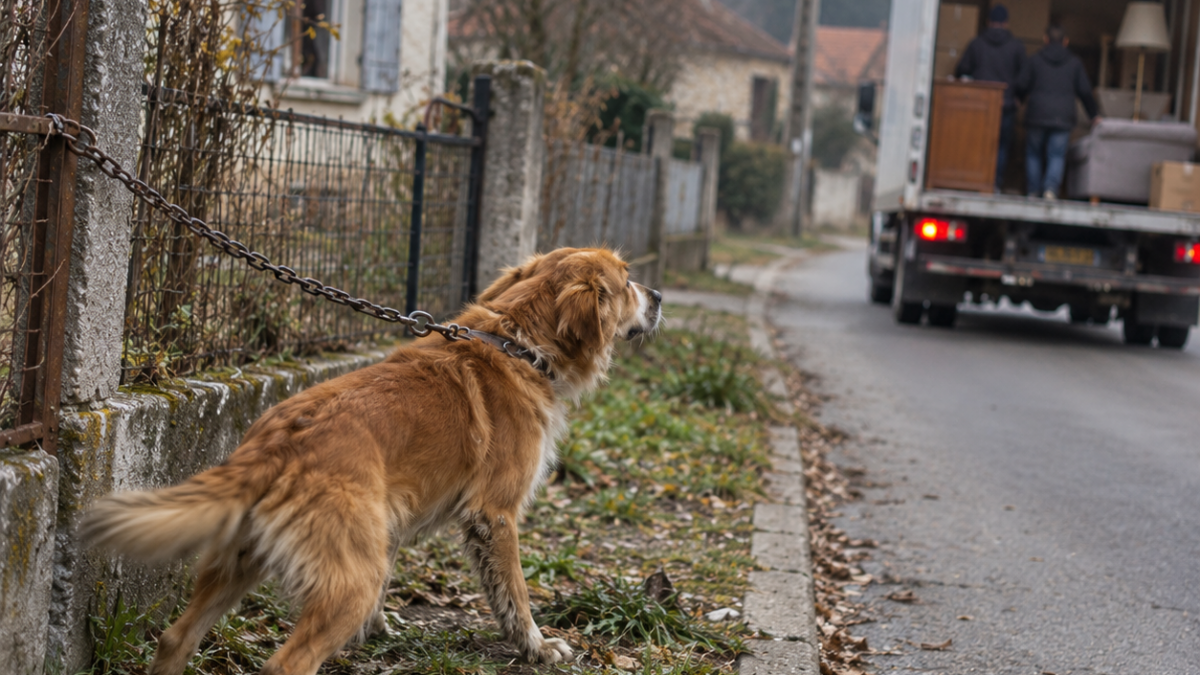
Oslo is standing beside the fence.
The chain stretches from his collar toward the post.
His body faces the street.
The moving truck is gone.
You cannot see his family.
You cannot see me.
You cannot see what happens next.
For years, I hated that picture.
Now I keep it beside another photograph.
In the second one, Oslo is asleep in Peter’s old chair, belly exposed, one paw hanging over the armrest, completely certain that when he wakes up, someone will still be there.
That is the photograph I prefer.
Because abandonment was something that happened to Oslo.
It was never who he was.
And the people who drove away that morning did not get the final word in his story.
Oslo did.
Every time he trusted again.
Every time he slept without listening for an engine.
Every time he walked past the fence without looking across the street.
Every time he chose my house instead of waiting for the one that had left him behind.
The last link in that old chain is still hanging inside Peter’s workshop.
Bent.
Broken.
Open.
And whenever I see it, I remember the dog who spent one terrible afternoon believing his family would return.
Then I look toward the kitchen, where Oslo is usually sleeping in a patch of sunlight.
And I remember something better.
They locked him to a fence so he could not follow them.
But they could never lock him to the life they had abandoned him in.
Once that chain broke, Oslo walked into a new home.
And, without either of us realizing it at the time, he brought me home too.
[FIRST COMMENT / EXPANDED ENDING — APPROX. 3,000 WORDS]
The last link in that old chain is still hanging inside Peter’s workshop.
Bent.
Broken.
Open.
For a long time, I thought I kept it because I needed proof.
Proof that the afternoon had really happened.
Proof that someone had once wrapped that chain around a fence post, closed a brass padlock through it, climbed into a moving truck, and driven away while a dog who loved them fought to follow.
But as the years passed, I understood that wasn’t why I kept it.
The photographs were proof.
The animal control report was proof.
The court record was proof.
The chain had become something else.
A reminder.
Not of what Laurent Bernard had done.
Of what happened after somebody finally cut the link.
Oslo was almost eleven when I first noticed he no longer ran to the front door when the mailman came.
He still raised his head.
Still listened.
But the explosion of paws against hardwood was gone.
At first I told myself he was simply becoming sensible.
Then one morning I saw him hesitate at the bottom of the three porch steps.
He looked at the first step, shifted his weight backward, and tried again.
His front legs made it.
His back legs didn’t.
He slid slightly, caught himself, and stood there embarrassed.
Dogs can look embarrassed.
Anyone who says otherwise has never loved one long enough.
I went down and put my arm beneath his belly.
“Come on, old man.”
Oslo looked at me as if the phrase offended him.
“You heard me.”
His tail moved once.
I helped him onto the porch.
That afternoon we went to the veterinarian.
Arthritis.
Nothing surprising.
Nothing immediately frightening.
Medication.
Joint supplements.
Shorter walks.
Carpet runners over the slippery floors.
A ramp beside the porch steps.
I bought everything the veterinarian suggested and several things she didn’t.
By the following weekend, Daniel was kneeling beside my porch with a drill, building Oslo a ramp wide enough for a small horse.
“You know he weighs sixty pounds, right?” I asked.
Daniel kept working.
“He deserves options.”
“You’ve built a loading dock.”
“He’ll appreciate the craftsmanship.”
Oslo sat in the yard watching him.
When Daniel finished, we tried to lead him up the ramp.
Oslo walked around it and climbed the steps.
Daniel stared at him.
I laughed so hard I had to hold the porch railing.
“That dog is ungrateful.”
“He learned from me.”
For another year, life became quieter but remained good.
Our walks shrank from a mile to half a mile.
Then to the end of the block.
Then sometimes only to Grace and Evan’s mailbox across the street.
Oslo no longer chased tennis balls.
He carried them.
His favorite was still yellow.
The first yellow ball had disappeared years earlier, probably beneath the shed, but I replaced it every time the rubber cracked.
At night he slept beside my bed.
He had stopped using Peter’s recliner because climbing into it hurt his hips.
So I moved an orthopedic dog bed beside the chair.
For the first three nights, Oslo ignored it.
The fourth night, I found him there, one paw resting against the base of Peter’s recliner as if touching the chair was enough.
By then Camille was twenty-two.
She had finished college and taken a job at a veterinary clinic outside Richmond.
When she told me, I smiled.
“Oslo did that, didn’t he?”
She looked embarrassed.
“Partly.”
“Partly?”
“All right. Mostly.”
She visited whenever she could.
The first thing she always did was kneel in front of Oslo and hold his face between her hands.
“You’re still here.”
And every time, Oslo licked her chin.
There had been a period when Camille stopped speaking to her father.
She never told me exactly when it began.
I never asked.
Later, when she was older, she told me that the abandonment had changed the way she saw both of her parents.
Her mother, Sophie, had eventually admitted what she had done.
Not just legally.
Personally.
That mattered to Camille.
Laurent was different.
For years he described what happened as a mistake that had been “blown out of proportion.”
He complained about the court.
About animal control.
About the fines.
About me.
About Daniel.
About everyone except himself.
Then something changed.
I learned about it from Camille.
She was sitting at my kitchen table one rainy afternoon, drinking coffee while Oslo slept against her shoe.
“My dad asked about him.”
I looked up.
“He’s asked before.”
“No. This was different.”
“How?”
Camille turned her coffee mug slowly.
“He asked if Oslo still waits at the window.”
I didn’t answer immediately.
“Why would he ask that?”
“I think he remembers.”
I looked toward Oslo.
His muzzle was nearly white now.
“No,” I said. “He doesn’t wait anymore.”
Camille’s eyes filled.
“I told him that.”
“What did he say?”
“He said, ‘Good.’”
That was all.
Good.
There are apologies made with words.
There are apologies made with changed behavior.
And there are people who never manage either one, but eventually become haunted enough by what they did that you can hear regret inside a single syllable.
I never forgave Laurent for Oslo’s sake.
Forgiveness was not mine to give for what happened to the dog.
But I stopped carrying Laurent around inside my anger.
That was different.
For years I had imagined punishment as something satisfying.
A courtroom.
A fine.
A judge speaking sternly.
His neighbors learning what happened.
His children seeing the truth.
All of those things came.
None gave me the feeling I expected.
The only thing that truly satisfied me was watching Oslo stop waiting.
That was the real victory.
The first time a moving truck came onto our street years later, I held my breath.
Oslo looked at it.
Then looked at me.
I opened the back door.
He walked into the yard, sniffed around the maple tree, and peed on one of Daniel’s flower pots.
He never looked at the truck again.
That was victory.
The first time I left Oslo overnight with Daniel because I had to attend my sister’s funeral in Maryland, I nearly canceled the trip.
I worried he would think I had abandoned him.
Daniel finally took my suitcase out of my hand.
“Marianne.”
“What?”
“Go.”
“He’ll watch the door.”
“Probably.”
“He might not eat.”
“He will.”
“What if—”
“Marianne.”
I stopped.
Daniel nodded toward Oslo.
“He knows you come back.”
The sentence hit me harder than it should have.
He knows you come back.
I knelt beside Oslo.
“I’ll be home tomorrow.”
He licked my wrist.
When I returned the next evening, he met me in Daniel’s driveway carrying the yellow tennis ball.
He was happy.
But he wasn’t frantic.
He hadn’t spent the night destroying himself with fear.
He knew.
That was victory too.
Oslo turned twelve in April.
We celebrated with Camille, Daniel, Rachel Kim, Grace, Evan, and their children.
Rachel had been promoted by then and rarely worked field calls anymore.
She brought Oslo a bag of expensive treats and shook her head when she saw him.
“I remember when this guy wouldn’t take one treat from my hand.”
Oslo was currently trying to steal hamburger from Daniel’s plate.
“Trauma recovery,” Daniel said solemnly.
Rachel laughed.
I had a photograph taken that afternoon.
Oslo sat in the center.
I was behind him with one hand resting on his shoulder.
Camille sat on the grass beside him.
Daniel stood holding the tennis ball.
Everyone was smiling.
I framed it.
But that winter, Oslo slowed down quickly.
Arthritis became more than stiffness.
He sometimes fell when turning too fast.
He began losing interest in breakfast.
Then he would eat normally for several days and I would convince myself everything was fine.
That is one of the quiet lies we tell ourselves when someone we love is getting old.
A good day becomes evidence that the bad days are temporary.
In January, I woke at three in the morning because I heard Oslo moving.
He was standing in the hallway.
Not walking.
Just standing.
“Oslo?”
He looked at me.
I turned on the light.
He tried to take a step and his back legs folded beneath him.
I reached him before he hit the floor.
“Hey. Hey, I’ve got you.”
I sat there in my nightgown with his head in my lap.
He wasn’t crying.
That frightened me more.
I called the emergency veterinary clinic.
Daniel drove us.
I sat in the back seat with Oslo’s head against my thigh.
Outside the windows, the city passed in long streaks of orange streetlight.
I kept talking.
I don’t remember everything I said.
I told him about the first chicken I had carried across the street.
I reminded him of the time he stole an entire roast from the kitchen counter.
I told him Peter would have loved him.
I told him Camille loved him.
I told him that whatever happened, I was right there.
The veterinarian found severe inflammation around his spine along with age-related degeneration in his hips.
She gave him medication.
We took him home.
For a few months, it helped.
Spring came.
Oslo spent afternoons beneath the maple tree.
I moved a blanket into the shade for him.
Sometimes I sat beside him and read.
Sometimes neither of us did anything.
There is an intimacy in doing nothing with someone you love.
Young love seems to need activities.
Plans.
Trips.
Conversations.
Old love can simply share the sunlight.
In early June, Camille came to see him.
She had heard my voice on the telephone and known I was worried.
Oslo was sleeping when she arrived.
She sat beside him.
He opened his eyes.
His tail moved once.
Camille put her forehead against his.
“Hey, buddy.”
Oslo breathed out slowly.
She stayed almost four hours.
Before leaving, she stood in my kitchen crying.
“I think he’s tired.”
I gripped the countertop.
“I know.”
“I don’t want him to hurt.”
“Neither do I.”
She looked toward the backyard.
“Do you think he knows what happened? Back then?”
“The fence?”
She nodded.
I thought about it.
“I think he remembers feelings more than events.”
“Then what does he remember now?”
I looked through the screen door.
Oslo was asleep beneath the tree.
“Being safe.”
That night I barely slept.
For years I had believed the hardest promise I made to Oslo was the first one.
I’m here.
It wasn’t.
The hardest promise would be making sure I did not keep him here only because I couldn’t bear to lose him.
Three weeks later, he stopped eating.
Chicken didn’t work.
Cheese didn’t work.
I cooked ground beef.
He sniffed it and turned his head.
When I opened the back door, he tried to stand and couldn’t.
I helped him outside with a towel beneath his belly.
He walked slowly to the maple tree.
Then he lay down.
I sat beside him.
His breathing was shallow.
I called Camille first.
Then Daniel.
Then the veterinarian.
By noon, everyone understood.
The veterinarian offered to come to the house the following afternoon if Oslo did not improve.
He did not improve.
That evening I carried his water bowl outside.
He drank a little.
The neighborhood was quiet.
A lawn mower ran somewhere in the distance.
Children were playing across the street.
A truck passed.
Oslo didn’t raise his head.
I rested my hand on his shoulder.
“You know,” I said, “the first day I met you, I thought you were the saddest creature I had ever seen.”
One ear moved.
“I was wrong.”
He looked at me.
“You weren’t sad. You were waiting.”
I swallowed.
“And I spent a long time waiting too.”
The tears came then.
“I just didn’t know it.”
Oslo’s head shifted onto my foot.
“You waited for people who weren’t coming back. I waited for a life I thought had ended.”
I rubbed the soft fur behind his ear.
“And somehow we found each other in the middle.”
I stayed there until after dark.
The next morning, Camille arrived at eight.
Daniel came at nine.
Rachel came before lunch.
Nobody planned it as a gathering.
It simply became one.
Grace brought coffee.
Evan carried over a cushion for me.
Their children made Oslo a card covered in badly drawn yellow tennis balls.
I placed it beside him.
Around two, the veterinarian arrived.
Her name was Dr. Harris.
She had treated Oslo for years.
She knelt beside him beneath the maple tree.
After examining him, she looked at me.
There are conversations where people use many words even though everyone already understands.
She explained his pain.
His mobility.
His appetite.
His age.
His quality of life.
I listened.
Then I asked one question.
“If he were yours?”
Dr. Harris looked at Oslo.
“I would let him go on a day when he still knows he’s loved.”
That answered everything.
We moved a blanket beneath the tree.
Camille sat on Oslo’s right.
I sat on his left.
Daniel remained behind us.
Rachel stood nearby crying openly.
I had never seen her cry before.
Dr. Harris explained each step.
I heard almost none of it.
Oslo looked at me.
I put both hands around his face.
His muzzle was completely gray.
“You don’t have to wait anymore.”
Camille broke down.
I kept looking into Oslo’s eyes.
“You hear me?”
His eyes stayed on mine.
“Nobody is leaving you.”
His breathing slowed.
“I’m right here.”
I kissed his forehead.
“So is Camille.”
She put a hand against his chest.
“So is everybody.”
Oslo exhaled.
Long.
Soft.
Peaceful.
And then he was gone.
For several minutes, nobody spoke.
The first sound I noticed was wind moving through the maple leaves.
Then a child laughing somewhere across the street.
Then Camille whispering:
“He knew we stayed.”
“Yes.”
I kept my hand on Oslo’s head.
“He knew.”
That mattered more than anything.
His story had begun, for me, with a truck pulling away while he fought a chain.
It ended beneath a tree with everyone he loved refusing to leave.
No engine.
No locked gate.
No disappearing family.
Just hands on his fur.
Voices he trusted.
And people staying until his last breath.
I had Oslo cremated.
A week later, his ashes came home in a simple wooden box.
I placed it beside Peter’s photograph for one night.
The next morning, I laughed at myself.
Peter would have hated being crowded.
So I moved Oslo to the bookshelf beside the yellow tennis ball Camille had kept from his last birthday.
For months I still woke expecting to hear his tags.
I dropped food on the kitchen floor and waited for paws that never came.
I opened the back door automatically.
Once, I drove halfway to the pet store before remembering I didn’t need dog food.
Grief returned to my house.
But it wasn’t the same grief I had felt after Peter died.
Back then, grief had closed every door.
This time, grief hurt just as deeply, but behind it were twelve years of proof that loving again had been worth the ending.
Camille visited one Sunday carrying something wrapped in an old towel.
“What is that?”
She set it on my kitchen table.
Metal clicked against wood.
My breath caught.
It was the broken section of Oslo’s chain.
The piece that had hung in Peter’s workshop.
“I thought we could do something with it,” she said.
“Like what?”
She smiled.
“Come outside.”
Daniel was waiting in the yard beside the maple tree.
He had built a small wooden plaque.
Nothing elaborate.
Just oak.
At the top, he had carved one word.
OSLO.
Below it was a simple sentence.
HE STOPPED WAITING.
I covered my mouth.
Daniel attached the broken chain beneath the words.
Not stretched tight.
Not closed.
The final link remained open.
We mounted the plaque on the fence near the maple tree.
Exactly where I could see it from the kitchen window.
The following spring, I did something I had resisted for months.
I returned to the county shelter.
Rachel met me in the lobby.
“You sure?”
“No.”
“That’s usually how it starts.”
“I’m not replacing him.”
“I know.”
“I mean it.”
“Marianne, nobody replaces anybody.”
That sounded familiar.
She led me through the kennels.
I walked slowly.
Some dogs barked.
Some jumped.
Some hid.
At the far end was a small black dog with white paws.
Female.
About three years old.
She was lying in the back of her kennel.
She didn’t come toward me.
“What happened to her?”
Rachel read the card.
“Owner died. Family couldn’t keep her.”
I crouched.
The little dog watched me.
“What’s her name?”
“Mabel.”
I held out my hand.
She didn’t move.
We stayed there.
One minute.
Two.
Then Mabel stood.
She came halfway.
Stopped.
I remembered a golden-brown dog in a shelter room years earlier.
A dog who stood near the door for twenty minutes before finally crossing the floor and leaning against my knee.
“Take your time,” I whispered.
Mabel took another step.
Then another.
Her nose touched my fingers.
Behind me, Rachel said nothing.
She knew.
I knew.
And somewhere inside my grief, something opened again.
Not because Oslo’s place was empty.
His place would never be empty.
Because he had taught me there was room beside it.
I adopted Mabel that afternoon.
When we arrived home, she hesitated at the front door.
I sat on the porch.
“Okay.”
She looked at me.
“We’ve got time.”
Eventually she entered.
She sniffed Peter’s recliner.
She sniffed Oslo’s old bed.
Then she walked to the back door.
I opened it.
Mabel ran into the yard.
She circled the maple tree.
Then stopped beside the plaque.
OSLO.
HE STOPPED WAITING.
The broken chain moved slightly in the breeze.
Mabel sniffed it.
Then ran back toward me.
For one impossible second, I could see Oslo behind her.
Not literally.
Memory plays tricks like that.
I saw the dog he had been on the first day.
Golden-brown fur.
White chest.
Hazel eyes.
Three hopeful steps toward a moving truck.
I heard the chain.
Clang.
Clang.
Clang.
Then Mabel reached me.
She jumped against my knees.
And the memory changed.
The chain broke.
Oslo ran free.
Years later, when people asked why I kept a broken chain hanging on my fence, I told them the truth.
“It belonged to a dog somebody threw away.”
Usually they looked sad.
So I always finished the story.
“But that isn’t the important part.”
Then I pointed toward the house.
Toward the porch where Oslo had spent summer mornings.
Toward Peter’s old recliner by the window.
Toward the maple tree beneath which he had fallen asleep for the last time surrounded by people who refused to leave.
“The important part is what happened after somebody noticed.”
Because cruelty likes privacy.
Neglect survives when people convince themselves it is not their business.
That first afternoon, I could have closed my curtains.
I could have told myself somebody else would come.
I could have assumed the family had a plan.
I could have decided a sixty-four-year-old widow had no business interfering with strangers across the street.
Instead, I carried a bowl of water over.
That was all.
One bowl of water.
One phone call.
One person refusing to look away.
Sometimes lives change through enormous acts of courage.
Sometimes they change because an ordinary woman crosses an ordinary street.
Oslo was not saved by revenge.
The court mattered.
The consequences mattered.
Laurent being forced to answer for what he did mattered.
But none of those things were the ending.
The ending was Oslo sleeping with his belly exposed because he knew nobody would hurt him.
The ending was Camille becoming a veterinary technician because a dog she once thought she had failed taught her to spend her life helping others.
The ending was Sophie admitting that silence had made her responsible too.
The ending was Laurent eventually asking whether Oslo still waited.
The ending was me opening my house again after grief had convinced me to close it.
The ending was an old dog beneath a maple tree, leaving this world with hands on his fur instead of a chain around his neck.
That is why I do not remember Oslo first as the dog tied to the fence anymore.
When I close my eyes, I see him running through my backyard with a yellow tennis ball.
I see his paws sliding across my kitchen floor.
I see him stealing Daniel’s hamburger.
I see him asleep beneath Peter’s chair.
I see him waiting beside the door when Camille visited.
I see him older, slower, grayer, but still lifting his head whenever I said his name.
Most of all, I see his last afternoon.
No fear.
No confusion.
No truck disappearing.
Just sunlight moving through leaves.
Camille’s hand against his chest.
Mine around his face.
And Oslo finally understanding the promise I had been making since the first bowl of water.
I’m here.
I came back.
I stayed.
The family who abandoned him had once believed leaving him behind would make him disappear from their lives.
They were wrong.
He became the decision their daughter never forgot.
The truth their mother eventually had to face.
The memory their father could never completely escape.
And for me, he became something even bigger.
He became proof that being abandoned does not mean being unwanted.
Being hurt does not mean being ruined.
And losing one home does not mean there isn’t another door somewhere waiting to open.
The plaque beneath the maple tree has weathered now.
The oak has darkened.
The letters are not as sharp.
The old chain has rusted again.
But the final link is still open.
I will never close it.
Some things should remain broken.
That chain is one of them.
And every evening when I stand at my kitchen window and watch Mabel run circles around the tree, I see that open link catching the last light of the day.
I think about a dog who once pulled desperately toward a truck because he believed love was driving away without him.
Then I remember the years that followed.
The porch.
The tennis balls.
The courthouse.
Camille.
The maple tree.
The quiet final breath.
The life he gave me after I thought mine had already become smaller than grief.
And I know exactly what that broken link means.
They locked Oslo to a fence because they wanted to leave him behind.
But the chain they used to imprison him became the first thing we broke together.
Everything after that was freedom.
Everything after that was home.








