PART 2: They Ordered Me to Leave the Scarred Dog to Drown—The Secret in His File Changed Our Town Forever
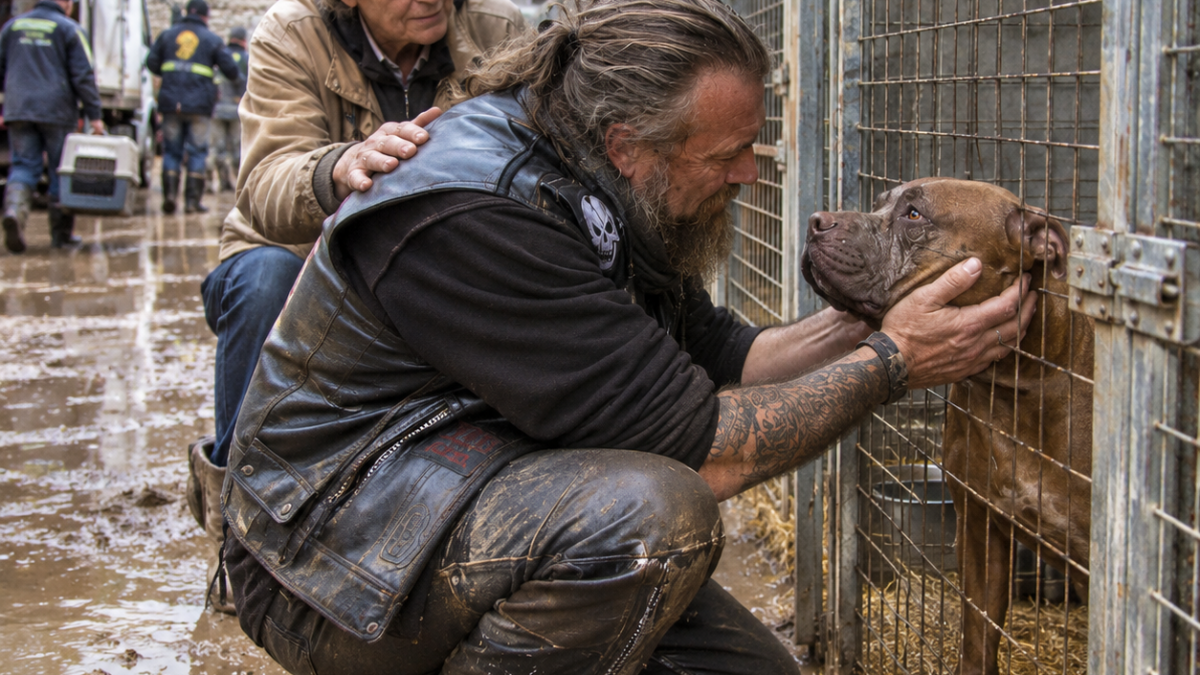
They told me the scarred dog in Cage 42 was too dangerous to save, even while muddy floodwater was rising around his throat.
The shelter director stood on dry pavement and threatened anyone who opened his cage, but the dog behind those bars wasn’t growling—he was shaking so violently his claws rattled against the steel.
And before that night was over, I would discover that the most dangerous thing inside that shelter wasn’t Rocco.
“Do not touch that cage!”
Françoise Delorme’s voice barely carried over the roar of the Loire.
She stood on the road above the municipal shelter with a folder pressed tightly against her chest. Her shoes were clean. Her beige coat was dry. Behind her, brown water surged through the lower buildings like something alive.
“Rocco is classified as dangerous,” she shouted. “Specialized animal control is coming. Nobody opens his enclosure without authorization.”
I stared at her.
Then I looked past her.
Dogs were screaming.
Not barking.
Screaming.
Floodwater had poured into the shelter faster than anyone expected. Plastic beds floated through hallways. Blankets twisted in the current. Metal food bowls slammed against doors and walls.
Volunteers and shelter workers had already carried roughly twenty dogs uphill, but several were still trapped.
My friends and I hadn’t come there looking for attention.
We’d been delivering sandbags and helping stranded families along the river when one of our riders heard the animals from the road.
So we stopped.
Around Nevers, most people called me Bear.
I was fifty-two, nearly six-foot-five, with tattooed arms, a gray beard, and an old scar through my left eyebrow. I knew what strangers sometimes thought when they saw six motorcycles and three vans full of large men in leather jackets.
That day, I didn’t care.
“What’s still inside?” I asked one of the shelter workers.
He was barely twenty-five. Water dripped from his hair.
“I don’t know. Maybe eight. Maybe ten.”
I pointed toward the building.
“Then we get them.”
Françoise stepped in front of me.
“I’ve ordered everyone to wait.”
I looked at the water rushing beneath the doors.
“Your dogs don’t have time to wait.”
“You don’t understand liability.”
“No, ma’am. I understand drowning.”
That ended the conversation for me.
We tied a climbing rope between one of our vans and the main entrance. Maxime anchored himself near the doorway. Thierry gathered blankets and cleared space in the heated vans.
Then we formed a human chain.
The water was already above my knees when I entered.
It was freezing.
By the second hallway, it reached my thighs.
We carried out a little white terrier first. He was shaking so hard I could feel it through my jacket.
Then two spaniels.
An old Labrador whose cloudy eyes told me he could barely see.
Two frightened mixed breeds wedged together on top of an overturned plastic kennel.
Every time we came back out, people on the road cheered.
Every time, I turned around and went back inside.
Then, on my fourth trip, I saw him.
At the far end of the last building was Cage 42.
A dark, broad-headed dog stood upright against the bars.
The water was almost at his jaw.
His front paws were hooked through the wire as if he understood that letting go might mean disappearing beneath the surface.
One ear was torn.
Old scars crossed his muzzle.
His eyes were locked on mine.
He didn’t bark.
He didn’t bare his teeth.
He just trembled.
“There’s another one!” I shouted.
The young shelter employee behind me stopped.
His expression changed immediately.
“That’s Rocco.”
“So?”
He swallowed.
“Delorme said nobody opens his cage.”
“Why?”
“He has a dangerous-animal notation.”
I looked back at Rocco.
The current slapped against his chest.
His paws slipped.
For half a second his head disappeared beneath the muddy water.
He fought his way back up.
That was enough for me.
“Get me the bolt cutters.”
The employee went pale.
“Sir—”
“Get me the cutters.”
Françoise must have realized what we were doing because I heard her screaming from outside.
“Perrin! Stay away from Box 42!”
Rocco’s eyes never left mine.
I moved toward him.
“I’m coming, big guy.”
The water rose another inch.
Behind me, the young employee whispered something I almost didn’t hear.
“There is something else you should know about his file.”
I turned.
He looked terrified.
Not of the dog.
Of what he was about to tell me.
And that was the moment I understood Cage 42 had never been only about Rocco being dangerous.
There was something inside that file someone desperately did not want us to discover.
PART 2
The young employee’s name was Julien.
He looked over his shoulder toward the entrance before speaking again.
“I saw a second report,” he said.
“What second report?”
“A behavior assessment. It disappeared from the active file about two months ago.”
Rocco slipped again.
I didn’t have time for the rest.
“Bolt cutters.”
Julien ran.
Seconds later, the steel handles were in my hands.
Rocco watched me approach.
People are wrong when they say you can’t see fear in a dog’s face.
You can.
You see it in the whites of their eyes.
In the tightness around the mouth.
In the way their bodies make themselves smaller even when there’s nowhere left to retreat.
Rocco had the body of a powerful dog and the face of one who had learned powerful people could hurt him.
I stopped several feet from his cage.
“Easy.”
He stared at the cutters.
I crouched despite the water pushing against my legs.
“I’m not going to hurt you.”
Outside, Françoise was still shouting.
“Stop him! That animal has attacked a person!”
I put the cutters around the lock.
Rocco flinched.
“Look at me.”
His eyes came back to mine.
“Good boy.”
The lock snapped.
The cage door immediately jerked outward under the pressure of the water.
Rocco fell forward.
I caught him underneath the chest.
For one terrifying second, he panicked.
His claws struck my shoulder.
His body twisted.
Julien backed away.
But I didn’t let go.
“Easy! Easy!”
Rocco froze.
His muzzle was inches from my face.
If he had wanted to bite me, there was nothing I could have done.
Instead, he did something I remember more clearly than almost anything that happened afterward.
He pushed his forehead against my chest.
And shook.
That’s all.
This supposedly uncontrollable, vicious animal pressed himself against the stranger who had opened his cage and trembled like a frightened child.
I slipped an arm under his belly.
At nearly seventy pounds, he wasn’t light.
But adrenaline can make a man stronger than he has any right to be.
“Let’s go home, big guy.”
We fought our way back through the corridor.
When we reached the doorway, cameras turned toward us.
Someone shouted.
People started applauding.
I hated it.
Not because they meant anything bad by it.
Because the dog in my arms hadn’t needed applause.
He had needed somebody to open a door.
Françoise came straight toward me.
“Put him down!”
Rocco’s body tightened.
I felt it immediately.
“Back off.”
“That dog is municipal property.”
“So were the other dogs we pulled out.”
“He is different.”
Rocco buried his head against my jacket.
I looked at her.
“Yeah. I can see that.”
“I am ordering you to place him in the animal control vehicle.”
There wasn’t an animal control vehicle.
There wasn’t even specialized rescue personnel yet.
The road had been partially cut off by the flooding.
She had been prepared to leave him there.
That’s when my anger changed.
Until then, I had been angry at the situation.
At the water.
At bad planning.
At hesitation.
Now I was angry at her.
“You knew how high the water was.”
“You don’t know what you’re talking about.”
“You knew he was still inside.”
“He couldn’t be safely handled.”
“I just carried him through waist-deep floodwater.”
“That proves nothing.”
Rocco lifted his head.
His eyes moved to her.
His body became completely still.
He didn’t growl.
But he pressed closer to me.
That reaction stayed in my mind.
Françoise pointed toward one of the transport kennels.
“Secure him immediately.”
“No.”
Her face changed.
“What did you say?”
“I said no.”
“You have no authority here.”
“Then call the police.”
She did.
It was one of the best decisions she made all day.
By the time officers arrived, every surviving dog we could reach had been evacuated.
Rocco was sitting inside my van wrapped in a thick red blanket.
Maxime sat beside him.
The supposedly savage dog had placed one paw on Maxime’s boot and refused to move it.
A police lieutenant named Arnaud Giraud listened to Françoise first.
She described me as reckless.
Aggressive.
Uncooperative.
She said I had illegally broken into a restricted enclosure containing a dangerous animal and removed him against direct orders.
Giraud listened without interrupting.
Then he walked over to me.
“Did you break the lock?”
“Yes.”
“Why?”
“The dog was drowning.”
He looked into the van.
Rocco looked back.
“That’s him?”
“That’s him.”
Rocco sneezed.
Maxime scratched carefully behind his ear.
Giraud stared for a moment.
Then he asked, “Where is the dangerous behavior?”
Françoise answered from behind us.
“His history is documented.”
“Then I’ll need the file.”
She became quiet.
It was subtle.
Most people probably wouldn’t have noticed.
I did.
Giraud noticed too.
“The file, Madame Delorme.”
“It may be inside the administrative building.”
Julien stepped forward.
“No, it’s not.”
Françoise turned so fast I thought she might slap him.
“What?”
Julien’s voice shook, but he kept going.
“You took Rocco’s paper file yesterday afternoon.”
Her face lost color.
“I moved several files because of the flood warning.”
“No,” he said. “Only his.”
Nobody spoke for several seconds.
Rain struck the roof of the van.
Rocco shifted underneath his blanket.
Giraud looked at Julien.
“Tell me exactly what you saw.”
Julien glanced at Françoise.
Then at me.
Finally, he looked toward the flooded shelter.
“There were two versions of Rocco’s intake report.”
Françoise snapped, “That is enough.”
Giraud’s voice hardened.
“No, I think we’re just getting started.”
Julien explained.
Rocco had arrived three months earlier after an incident at a house outside town.
The official intake summary said he had attacked an adult male without provocation.
The phrase “unprovoked human-directed aggression” appeared three times.
That phrase was the reason Rocco had been isolated.
The reason volunteers weren’t permitted to walk him.
The reason visitors weren’t allowed to meet him.
The reason his adoption profile had never appeared online.
But there had been another document.
A report prepared by veterinarian and canine behavior specialist Dr. Elise Martin.
According to Julien, that report reached a very different conclusion.
Rocco had not attacked without warning.
He had intervened during an assault.
And the person he protected was a sixteen-year-old girl.
Her name was Élodie Marchand.
When Julien said her name, Françoise closed her eyes.
Just for a moment.
But I saw it.
“So where is this report?” Giraud asked.
Julien shook his head.
“I don’t know.”
Françoise folded her arms.
“This is irresponsible speculation.”
Julien looked at her.
“You told me to shred the copy.”
Everyone went silent again.
I felt something cold that had nothing to do with the floodwater.
Giraud slowly turned toward Françoise.
“You instructed an employee to destroy part of an animal’s case file?”
“It was a duplicate.”
“It wasn’t.”
Julien’s voice was stronger now.
“It had Dr. Martin’s signature.”
Françoise stared at him with pure hatred.
“You are finished here.”
Julien almost laughed.
“Our shelter is underwater.”
Then his expression hardened.
“And you left a dog locked in Cage 42 because you were afraid of what people might discover about him.”
Françoise denied everything.
For the next hour she repeated that Rocco was dangerous and that anyone questioning her judgment was endangering the public.
But something had shifted.
The officers stopped treating the situation as an argument between an angry shelter director and a stubborn biker.
They began taking statements.
They photographed Cage 42.
They recorded the water level.
They collected staff names.
And most importantly, Giraud contacted Dr. Elise Martin.
She answered on the third call.
I stood near the van when he spoke to her.
I couldn’t hear her side.
I didn’t need to.
Giraud’s expression told me enough.
“Yes, Doctor.”
Pause.
“You’re certain?”
Pause.
“Do you still possess a copy?”
Longer pause.
“Please don’t delete or modify anything. An officer will contact you.”
When he hung up, Françoise looked like she had forgotten how to breathe.
Giraud walked toward her.
“Dr. Martin has the original report.”
Françoise said nothing.
“And she says she repeatedly objected to the dangerous classification.”
Still nothing.
He continued.
“She also says the dog showed no unprovoked aggression during her evaluation.”
I looked through the open van door.
Rocco had fallen asleep with his chin resting on Maxime’s leg.
That was the monster they had nearly allowed to drown.
But it was only the beginning.
Because Dr. Martin’s report didn’t simply say Rocco was afraid rather than vicious.
It explained where his scars had come from.
It explained why he reacted to raised male voices.
And it described what had happened inside the Marchand house on the night everything changed.
The story came out piece by piece over the next two days.
Élodie’s mother, Claire, had begun dating a man named Patrick Vasseur after her husband died.
At first Patrick had been charming.
Then came the shouting.
Then the drinking.
Then the bruises Claire explained away.
Rocco had belonged to Élodie’s father.
He’d been a clumsy, oversized puppy when Élodie was eleven. Her father had brought him home in an old laundry basket because he didn’t own a crate large enough.
After her father died in a workplace accident, Rocco became Élodie’s shadow.
He slept outside her bedroom.
Waited beside the door when she went to school.
Sat with his head across her knees whenever she cried.
Patrick hated him.
According to statements that later became public, he called Rocco filthy.
Dangerous.
Useless.
Neighbors heard him shouting at the dog.
One woman saw him kick Rocco away from the front steps.
Élodie later told investigators that several of Rocco’s scars had appeared after Patrick was left alone with him.
She couldn’t prove what happened.
Rocco couldn’t speak.
And every time Élodie confronted Patrick, he told her the same thing.
“One complaint and they’ll kill that dog.”
So she stayed quiet.
Until one night Patrick came home drunk.
The argument began in the kitchen.
Claire told him to leave.
He refused.
Élodie heard something break and came downstairs.
Patrick grabbed Claire.
Élodie tried to pull him away.
He shoved her against a cabinet.
Rocco came running.
According to Élodie, the dog first stood between them.
Patrick kicked him.
Rocco backed away.
Patrick moved toward Élodie again.
Rocco bit him once on the forearm.
One bite.
Then he released.
Patrick required stitches.
The police were called.
And by the time they arrived, Patrick had created a different story.
He claimed Rocco attacked him for no reason.
He demanded the dog be destroyed.
Françoise Delorme had been consulted because the municipal shelter handled dangerous-animal holds.
At first, everything should have worked exactly as the system was supposed to.
Police statements were taken.
The dog was examined.
Dr. Martin evaluated him.
Élodie described the assault.
Her mother confirmed parts of it.
A neighbor confirmed hearing the argument.
Dr. Martin wrote that Rocco’s behavior was consistent with defensive intervention under extreme stress.
She also documented old injuries suggesting repeated mistreatment.
She recommended rehabilitation.
Not euthanasia.
Not permanent isolation.
Rehabilitation.
So why had Rocco ended up behind Cage 42 with a file describing him as an unprovoked attacker?
That answer took longer.
And when we found it, the town exploded.
Patrick Vasseur’s older sister was Françoise Delorme.
The shelter director.
I found out while sitting in a small veterinary clinic two towns away.
Rocco was on the floor beside my chair.
After the flood, the municipal shelter couldn’t safely house him, and the police didn’t want him returned to Françoise’s control.
Dr. Martin agreed to keep him temporarily.
I had been there every day.
At first, Rocco wouldn’t eat if anyone stood too close.
He hated doors slamming.
If a man raised his voice in the hallway, his entire body stiffened.
But he liked cheese.
He liked soft blankets.
He liked Maxime.
And for reasons I didn’t understand, he had decided I belonged to him.
Whenever I stood up, he stood.
Whenever I crossed the room, he followed.
The first night I left the clinic, Dr. Martin called me thirty minutes later.
“He’s still staring at the door.”
“What do you want me to do about that?”
“You could come back.”
So I did.
I slept in a plastic chair.
Rocco slept with his head on my boot.
That became our arrangement.
On the second afternoon, Dr. Martin entered carrying a thick envelope.
“I made copies before I submitted the report,” she said.
“Why?”
She looked at Rocco.
“Because something about Delorme’s questions bothered me.”
“What questions?”
“She kept asking whether I could guarantee he would never bite again.”
“No vet can guarantee that.”
“Exactly.”
Dr. Martin sat down.
“When I refused to classify him as inherently dangerous, she became angry. Then she asked whether the wording could be changed to emphasize the bite rather than the circumstances.”
“Did you change it?”
“No.”
She handed me the report.
The photographs were difficult to look at.
Rocco had entered the shelter underweight.
There were healing wounds along his ribs.
A circular burn mark near his hind leg.
Old scars across his face.
One damaged ear.
I felt my hands tightening around the pages.
Dr. Martin pointed toward a paragraph.
“I documented all of it.”
I read.
She believed several injuries were inconsistent with ordinary accidents.
Some appeared older.
Some newer.
The implication was obvious.
“What did Patrick do to him?”
“We can’t prove every scar came from Patrick.”
I looked at Rocco.
He was sleeping.
“Élodie knows.”
Dr. Martin was quiet.
“Yes.”
“Where is she?”
“With an aunt near Bourges. Her mother entered a domestic violence support program after the incident.”
“And Françoise knew all this?”
“Yes.”
I looked back at the report.
At the signature.
At the dates.
At the recommendation.
“Then why wasn’t this in the file?”
Dr. Martin’s jaw tightened.
“That’s what I’d like someone to answer.”
I wanted to find Françoise immediately.
I wanted to walk into her office, put those photographs on her desk, and ask how she had slept at night.
But the shelter was still closed.
The flood had destroyed electrical systems and contaminated several rooms.
Françoise had stopped answering calls.
Her lawyer issued a statement saying she had “acted consistently with public safety obligations during an unprecedented natural disaster.”
Those words made me laugh.
Not because they were funny.
Because they were so polished they almost erased what I’d seen.
Public safety obligations.
I remembered Rocco’s nose barely above brown water.
I remembered his claws scraping against the cage.
I remembered Françoise standing uphill with dry shoes.
So I did something she wasn’t expecting.
Nothing.
At least not publicly.
My friends wanted to post everything immediately.
Videos were already spreading online.
Someone had filmed Françoise yelling at me not to open Cage 42.
Another video showed me carrying Rocco from the shelter.
Within twenty-four hours, hundreds of thousands of people had watched it.
Comments were vicious.
Some threatened Françoise.
I shut that down as fast as I could.
“This isn’t about hunting someone down,” I told our group. “Nobody contacts her house. Nobody threatens her. Nobody touches her property.”
Thierry looked at me.
“So what are we doing?”
I placed Dr. Martin’s report on the table.
“We’re going to make sure she answers every question in public.”
That was my kind of revenge.
Not broken windows.
Not fists.
Records.
Witnesses.
Dates.
Photographs.
Every quiet decision she thought nobody would ever examine.
For the next week, people started talking.
Once the first employee came forward, others followed.
A former volunteer said she had repeatedly asked why Rocco was never allowed outside the isolation corridor.
A kennel technician said he had never seen the dog attempt to bite anyone.
Another employee remembered Françoise personally instructing staff not to photograph Rocco.
A woman who worked weekend shifts said Rocco used to slide his food bowl toward her through the bars after he finished eating, then sit quietly waiting for her to take it.
“That’s his dangerous behavior,” she told a reporter. “He gives the bowl back.”
Then someone sent me a photograph.
It showed Rocco lying against his cage door while a volunteer read a book on the opposite side.
The volunteer had taken it weeks before the flood.
Her message said:
“He was scared of men in loud voices, but when I sat down, he would press his back against the bars so I could scratch him.”
I stared at that picture for a long time.
People had known.
Not everything.
But enough.
Enough to see the label didn’t match the dog.
Yet labels have power.
Dangerous.
Aggressive.
Unadoptable.
Once those words were attached to Rocco, most people stopped looking closer.
I understood that better than I wanted to admit.
People had done it to me for half my life.
Biker.
Tattooed.
Huge.
Intimidating.
I’d watched mothers pull children closer when I entered elevators.
I’d seen security guards track me through stores.
I’d watched people decide who I was before I opened my mouth.
Maybe that was why I couldn’t forget Rocco’s face behind those bars.
I knew what it felt like to have someone see the outside and believe they already knew the story.
The difference was that nobody had ever locked me in a cage because of it.
The town council announced an emergency public hearing twelve days after the flood.
Françoise would attend.
So would shelter employees, police representatives, Dr. Martin, and officials responsible for municipal animal services.
I planned to sit in the back.
That was it.
I wasn’t interested in giving speeches.
Then, the night before the hearing, Dr. Martin called.
“Someone is here asking about Rocco.”
I was on my motorcycle before she finished the sentence.
When I arrived, a thin woman stood outside the clinic beside a teenage girl.
The girl had dark hair tied behind her head.
She looked exhausted.
In her hands was an old red leash.
Rocco was inside.
He hadn’t seen them yet.
The girl looked at me.
“Are you Stéphane?”
I nodded.
Her lips trembled.
“I’m Élodie.”
For once in my life, I had absolutely nothing to say.
She looked past me toward the clinic door.
“Is he okay?”
“Yes.”
“Can I see him?”
Dr. Martin opened the door.
Rocco was standing about twenty feet away.
At first he didn’t move.
Élodie covered her mouth.
“Rocco?”
His ears lifted.
The change in him was instant.
He made a sound I had never heard before.
Not a bark.
Not a whine.
Something somewhere between both.
Then he ran.
Élodie dropped to her knees.
Rocco hit her so hard they nearly fell backward together.
She wrapped both arms around his neck.
He licked her face.
Her hands.
Her hair.
His entire body wiggled like a puppy.
Élodie was crying so hard she couldn’t speak.
Rocco began crying too.
Dogs can do that.
Not with tears the way we do.
But with sound.
With trembling.
With desperate little breaths that come from somewhere deeper than language.
Claire knelt beside them.
“Oh, God.”
Rocco turned toward her.
For one second, I saw uncertainty.
Then Claire opened her arms.
He crawled into them.
The three of them stayed on the floor for almost ten minutes.
Nobody interrupted.
I went outside.
I’m not embarrassed to say why.
I needed a minute.
Maxime found me beside the motorcycles.
“You okay?”
“Fine.”
“You’re crying.”
“Wind.”
“We’re indoors, Bear.”
“Shut up.”
He grinned.
Then his face changed when Élodie stepped outside.
She was still holding the old red leash.
“Stéphane?”
“Yeah?”
“My mother told me what you did.”
I shrugged.
“Anybody would’ve done it.”
She shook her head.
“No.”
One word.
That was all.
No.
Anybody would not have done it.
That was the problem.
She sat on the curb beside me.
“Patrick used to tell me Rocco was going to hurt someone.”
I listened.
“He wanted me to be afraid of him. But Rocco was the only one in that house I wasn’t afraid of.”
She looked at the leash.
“After they took him, Françoise told me I needed to accept what he was.”
My jaw tightened.
“What did she say he was?”
“A dangerous animal.”
Élodie swallowed.
“She said sometimes loving a dog means admitting he shouldn’t be alive.”
I looked away.
There are sentences a grown adult should never say to a grieving sixteen-year-old.
That was one of them.
“Did you know she was Patrick’s sister?”
“Yes.”
“Did the police?”
“Yes.”
“But she still controlled Rocco’s shelter case?”
Élodie nodded.
And suddenly this wasn’t merely bad judgment anymore.
It was a conflict of interest so obvious a child could understand it.
“Are you going to the hearing tomorrow?” I asked.
“My mother doesn’t want me to.”
Claire had good reasons.
The story was already attracting reporters.
Élodie had been through enough.
“You don’t owe anybody your pain,” I told her. “You don’t have to stand in front of strangers and prove what happened.”
She looked through the clinic window at Rocco.
“What if I want to?”
“Then make sure you’re doing it for yourself. Not for them.”
She thought about that.
Then she asked me a question I wasn’t prepared for.
“Will you stand with me?”
I looked at the sixteen-year-old girl Françoise had expected to disappear quietly from the story.
“Yeah.”
So the next evening, I wasn’t sitting in the back.
I was standing beside Élodie Marchand.
The council chamber was packed.
People filled every chair and lined the walls.
Reporters stood outside.
Françoise arrived through a side entrance with her attorney.
She looked completely different from the woman I’d seen beside the flooded shelter.
Professional suit.
Perfect hair.
No shouting.
No folder pressed against her chest.
Her lawyer began by describing the flood as “a rapidly evolving emergency.”
He emphasized the difficulty of evacuating frightened animals.
He reminded everyone that Rocco had a documented bite history.
Technically, all of that was true.
That’s how good lies work.
They hide inside selected pieces of truth.
Then the shelter employees testified.
Julien went first.
He described the evacuation.
He described Rocco’s cage.
He described the order not to open it.
Françoise’s attorney asked, “Did Director Delorme say she wanted the dog to drown?”
“No.”
“Did she say she wanted the dog harmed?”
“No.”
“So you are interpreting her safety decision based on your emotions.”
Julien hesitated.
The lawyer leaned forward.
“Correct?”
Then Julien did something beautiful.
He reached into his bag.
“No.”
He produced a printed email.
“Because three days before the flood, she emailed me instructions to schedule Rocco for euthanasia.”
The room erupted.
The council chair hammered the table.
Françoise turned toward her lawyer.
Her lawyer whispered something sharply.
Julien continued.
“The euthanasia was scheduled for the morning after the flood.”
My stomach dropped.
One day.
Rocco had been one day away from dying even without the water.
The lawyer objected that the euthanasia was legally authorized under dangerous-animal procedures.
Julien nodded.
“Based on the altered file.”
Then Dr. Martin testified.
She was devastating.
Calm.
Precise.
Clinical.
She explained defensive aggression.
Fear responses.
Trigger stacking.
The difference between a dog initiating an attack and a dog intervening during violence.
She described Rocco’s evaluation.
“At no point during my examination did Rocco attempt to bite me or my staff.”
Françoise’s lawyer asked whether she could guarantee he would never bite.
Dr. Martin looked directly at him.
“No ethical professional can guarantee that any dog will never bite.”
“Then he remained a potential danger.”
“So does every frightened animal under sufficient stress.”
She paused.
“So does every human being.”
A few people laughed.
She didn’t.
Then she displayed her original report.
The council members received copies.
So did the police.
So did Françoise’s attorney.
I watched his face as he read it.
That’s when I knew she had not told him everything.
He turned toward her.
She wouldn’t look at him.
Dr. Martin explained that her report recommended a rehabilitation plan.
She also confirmed she had received a phone call from Françoise two days after submitting it.
“What did she ask you?” the council chair said.
“She asked whether I would amend my conclusion.”
“To what?”
“Unprovoked aggression.”
“Did you?”
“No.”
“Why?”
“Because it wasn’t true.”
The room became completely silent.
Then it was Claire’s turn.
She described Patrick.
The drinking.
The intimidation.
The night Rocco intervened.
She spoke quietly.
Sometimes that is more powerful than shouting.
“I failed my daughter by staying too long,” she said. “I will carry that for the rest of my life. But that dog did not fail her.”
Élodie squeezed my hand.
Claire continued.
“When Patrick shoved Élodie, Rocco stood between them. Patrick kicked him. Rocco still didn’t attack. He bit only after Patrick reached for my daughter again.”
Françoise stared at the table.
Claire looked directly at her.
“You knew that.”
Françoise finally looked up.
“And you knew why.”
Her lawyer objected.
The council chair allowed Claire to continue.
“You told my daughter Rocco was dangerous because admitting what really happened would have meant admitting what your brother had done.”
That was the moment the whole room changed.
People had been angry before.
Now they understood.
This wasn’t only about flood evacuation.
It wasn’t only about a dog.
It was about how easily authority could be used to turn a victim into a threat.
The final witness was Élodie.
She walked to the front carrying the old red leash.
I went with her.
Françoise’s attorney objected to my standing beside the witness table.
Élodie answered before anyone else could.
“He stays.”
Nobody challenged her.
Her voice trembled during the first sentence.
Then it became steady.
She told them about her father bringing Rocco home.
About sleeping with the puppy on the floor when he cried during thunderstorms.
About Patrick kicking him.
About hiding food in her bedroom because Patrick sometimes refused to feed him.
About whispering apologies into Rocco’s torn ear.
Then she described the night of the bite.
“He saved me.”
Three words.
Françoise shifted.
Élodie looked at her.
“You told everyone he attacked Patrick because you knew people were more afraid of a scarred dog than they were of a man who hurt women.”
Nobody moved.
“You put him in the back of that shelter where nobody could see him.”
Her eyes filled with tears.
“You wouldn’t let me visit.”
Françoise finally spoke.
“I followed procedure.”
Élodie’s voice cracked.
“No. You hid him.”
Françoise’s lawyer touched her arm.
She shook him off.
That was her mistake.
Until then, he had controlled the damage.
Françoise stood.
“You have no understanding of what running a shelter requires!”
The council chair ordered her to sit down.
She ignored him.
“We receive aggressive dogs every month! We make decisions nobody else wants to make! Then people like him—”
She pointed at me.
“—walk into an emergency, break locks, make dramatic videos, and suddenly everyone thinks they’re an expert!”
I hadn’t posted a single video.
But I let that go.
Françoise kept talking.
“Do you know what would have happened if that animal attacked someone during the evacuation? Do you know who would have been responsible?”
I looked at her.
“Do you know what would’ve happened if I listened to you?”
She stopped.
“He’d be dead.”
The room went quiet.
She opened her mouth.
I didn’t raise my voice.
“You can dress it up with policies. You can call it risk management. But I was standing in that water.”
I pointed toward Élodie.
“And the girl whose life that dog protected is standing right here.”
Françoise’s face tightened.
I continued.
“You decided what Rocco was before anyone else could see him. Then you removed the report that proved you wrong.”
“I did not—”
“Your own employee saw you.”
“That report was incomplete.”
“The veterinarian says otherwise.”
“You don’t understand municipal procedure.”
“You keep saying that like procedure makes water stop rising.”
A murmur moved through the audience.
I leaned forward.
“You know what I understand?”
She stared at me.
“I understand that when I cut that lock, Rocco could’ve put his teeth through my face.”
Nobody laughed.
“He didn’t.”
I looked around the room.
“He pressed his head against my chest.”
Élodie started crying quietly beside me.
“That dog had every reason in the world not to trust people. Somehow, after everything people had done to him, he still did.”
I looked back at Françoise.
“And you were willing to let him drown because a dead dog couldn’t contradict his file.”
Her attorney immediately objected.
Maybe I had gone too far legally.
I didn’t care.
The council recessed for forty minutes.
Nobody left.
When they returned, Françoise Delorme was suspended pending investigation.
She was prohibited from accessing shelter records without supervision.
The municipality referred the destruction and alteration allegations to prosecutors.
An independent review of the shelter’s animal classifications was ordered.
And Rocco’s euthanasia authorization was frozen immediately.
People applauded.
I didn’t.
Élodie did something better.
She buried her face against my shoulder and cried.
Françoise walked past us on her way out.
For a second, she stopped.
I expected anger.
Instead, she looked exhausted.
“You think you’ve won,” she said quietly.
I shook my head.
“This was never about me winning.”
She glanced at Élodie.
Then toward the reporters.
“You have no idea what comes next.”
Actually, she was right.
None of us did.
Because the review found more.
A lot more.
Rocco’s file was not the only one that had been altered.
Investigators compared digital records, printed files, staff emails, veterinary assessments, and euthanasia authorizations from the previous three years.
Most cases were legitimate.
Some dogs had serious behavioral problems.
Some decisions had been heartbreaking but medically or legally defensible.
But seventeen files contained discrepancies.
Seven animals had been labeled with aggression classifications more severe than the original veterinary notes supported.
Four had already been euthanized.
One had belonged to an elderly man who repeatedly called asking why he wasn’t allowed to reclaim his dog after hospitalization.
Another had been surrendered after biting while severely injured.
A third had been described by staff as fearful but social.
Those discoveries turned anger into outrage.
Françoise’s lawyer released another statement insisting administrative inconsistencies did not prove malicious conduct.
Maybe not.
But investigators also found emails.
One of them was between Françoise and her brother Patrick.
It had been sent shortly after Rocco arrived.
Patrick wrote:
“Make sure that thing doesn’t come back.”
Françoise replied:
“I’m handling it.”
Those four words ended her career.
Patrick was already facing domestic assault proceedings.
The new investigation expanded into suspected animal cruelty after authorities examined photographs of Rocco’s old injuries and interviewed neighbors.
Police searched an outbuilding Patrick had used behind his property.
They found old chains.
A heavy collar.
A broken kennel.
Other evidence I don’t need to describe.
There was no grand dramatic arrest in front of a cheering crowd.
Real justice rarely looks that clean.
There were interviews.
Court dates.
Lawyers.
Delays.
Paperwork.
Months of it.
But eventually Patrick pleaded guilty to domestic violence-related offenses and one animal cruelty charge.
He was barred from owning animals for years and received a custodial sentence combined with supervised release conditions.
Françoise was charged over document tampering and animal welfare violations connected to the shelter investigation.
Some charges were later reduced.
Some were dismissed.
But she lost her position permanently.
She was also prohibited from serving in a managerial role involving animal welfare for a significant period.
People kept asking whether I was satisfied.
I never knew how to answer.
Four dogs identified in the review were already dead.
No court ruling could open their cages.
No apology could bring them back.
But Rocco was alive.
And sometimes one living thing is enough to remind you why fighting matters.
For several weeks, everyone assumed Rocco would eventually return to Élodie.
I assumed it too.
Then Claire asked to speak with me privately.
We met outside Dr. Martin’s clinic.
Rocco was chasing a tennis ball Maxime had thrown badly enough that it rolled under a bench.
Claire watched him.
“Élodie wants him back.”
“I know.”
“But we’re living in a small apartment with my sister.”
I waited.
“Élodie is starting therapy. We’re rebuilding everything.”
Her eyes filled.
“I don’t know if I can give him what he needs right now.”
I understood what she was saying.
I hated it for her anyway.
“Rocco needs stability,” she continued. “Space. Someone who understands his triggers.”
“I’m not exactly a dog trainer.”
“No.”
She smiled.
“But he chose you.”
I looked at him.
He had managed to wedge half his body underneath the bench after the tennis ball.
His rear legs were sticking out.
Very dignified.
“Your daughter chose him first.”
“She saved him for five years.”
Claire looked at me.
“You saved him when she couldn’t.”
I didn’t know what to say.
A few days later, Élodie came to my house.
It was an old stone place outside town with a workshop behind it and enough fenced land for a dog to run.
Rocco had already visited twice.
The first time, he had been terrified of my motorcycle.
The second time, he peed on Thierry’s helmet.
We considered that progress.
Élodie walked through the yard with him.
After an hour, she sat beside me on the steps.
“He likes it here.”
“He likes stealing my gloves.”
“He used to steal Dad’s socks.”
We were quiet.
Then she said, “I think he should stay with you.”
I looked at her.
“You sure?”
“No.”
I appreciated that answer more than if she’d pretended.
She twisted the red leash around her fingers.
“I want him. But wanting him isn’t the same as what’s best for him.”
She looked across the yard.
Rocco had found a patch of sunlight.
“He follows you the way he used to follow me.”
My throat tightened.
“You’ll still see him.”
“A lot?”
“As much as you want.”
She handed me the leash.
I didn’t take it immediately.
“That belongs to you.”
“Not anymore.”
“It can.”
She shook her head.
“Dad bought it for Rocco.”
Then she placed it in my hand.
“So it goes where Rocco goes.”
That afternoon, I signed the foster paperwork.
Three months later, after the legal restrictions were officially removed, I signed the adoption papers.
Name:
Rocco Perrin.
I laughed when I saw it.
Dr. Martin didn’t.
“Congratulations.”
“Sounds like a gangster.”
“It suits both of you.”
Life with Rocco wasn’t magical.
That’s important.
Trauma didn’t disappear because people started loving him.
He woke from nightmares.
He panicked the first time a repairman raised a wrench above his head.
He once destroyed an entire sofa after a thunderstorm.
For six months, nobody could touch his damaged ear except me, Élodie, and Dr. Martin.
But he learned.
So did I.
I learned that if Rocco stopped suddenly during a walk, forcing him forward made things worse.
I learned he preferred women with soft voices.
I learned he was afraid of broom handles.
I learned motorcycles became acceptable if he was allowed to inspect them before they started.
I learned he could detect cheese through three closed doors.
And I learned that the same dog people had labeled dangerous would gently carry injured birds in his mouth without biting down.
The town changed around him too.
Donations poured in after the flood.
At first, everyone wanted to rebuild the municipal shelter exactly as it had been.
We didn’t.
At the first planning meeting, Julien stood up.
“Why rebuild the same mistakes?”
That question became the foundation for everything that came afterward.
The new shelter had elevated kennels above the floodplain.
Emergency gates that could be opened quickly.
Backup generators.
Multiple evacuation routes.
Digital and physical record redundancy.
Independent behavioral assessments for serious cases.
No single administrator could alter an aggression classification without documentation.
Volunteers received training in fearful-dog handling.
And every dog eligible for adoption was required to receive regular enrichment instead of disappearing into a back corridor because somebody thought the animal looked intimidating.
Then something happened I never expected.
The bikers got involved.
Really involved.
Maxime began volunteering every Wednesday.
Thierry built raised dog beds.
Two of our members repaired the outdoor fencing.
One rider who everyone called Cobra turned out to be absurdly good with tiny Chihuahuas.
Watching a tattooed, 250-pound man whisper baby talk to a three-pound dog became one of the greatest things I had ever seen.
People started calling us whenever large or frightened dogs needed transport.
At first, I hated the nickname local reporters gave us.
The Cage 42 Riders.
Then Élodie laughed.
So it stayed.
We created a nonprofit fund.
No complicated mission statement.
We paid emergency veterinary bills.
Helped abuse victims temporarily board pets when they entered shelters.
Supported behavioral rehabilitation for dogs that otherwise might have been euthanized.
And every year, on the anniversary of the flood, we held a motorcycle ride along the Loire.
The first year, 114 bikes came.
The second, nearly 300.
By the third year, there were so many that police had to temporarily manage traffic.
Rocco attended every one.
Not on a motorcycle.
I’m not insane.
He rode in the van with Élodie.
She eventually moved back to the area with her mother.
She finished school.
Then she surprised all of us by studying veterinary nursing.
“Rocco’s fault,” she told me.
Years later, I watched her walk into the rebuilt shelter wearing scrubs.
Rocco was gray around the muzzle by then.
She knelt.
He recognized her immediately.
He always did.
The official dedication plaque at the entrance of the new shelter was supposed to carry the mayor’s name.
The mayor refused.
Instead, he asked Élodie what she thought should be written.
She chose one sentence.
**A FILE CAN DESCRIBE AN ANIMAL. IT SHOULD NEVER REPLACE SEEING THEM.**
Underneath it were the names of the four dogs whose cases had been identified too late.
At the bottom was one more name.
ROCCO — CAGE 42.
The shelter staff tried to add mine.
I made them remove it.
People still tell the story wrong sometimes.
They say I rescued Rocco.
It’s cleaner that way.
Big biker walks into flood.
Breaks lock.
Carries doomed dog to safety.
Good headline.
But the truth is more complicated.
Rocco rescued things too.
He forced a town to examine a system everyone had trusted.
He gave frightened employees the courage to speak.
He brought a mother and daughter back into each other’s lives after violence had nearly destroyed their family.
He turned men who had spent weekends polishing motorcycles into volunteers carrying bags of dog food.
He made people question what words like “dangerous” really meant.
And he changed me.
Before the flood, I was good at leaving things alone.
Not my business.
Not my problem.
Someone else’s responsibility.
I’d spent years believing that staying out of trouble was the same thing as being a good man.
Rocco taught me there are moments when doing nothing is a decision too.
Sometimes the person quoting procedure is wrong.
Sometimes the locked door should be opened.
Sometimes the creature everybody tells you to fear is the one most desperately waiting for someone to look closer.
I saw Françoise only once after the hearings ended.
It was almost four years later.
I was leaving a market in Nevers with Rocco.
He moved slower by then.
His joints bothered him in cold weather.
But his tail still lifted when somebody said his name.
Françoise came out of a pharmacy across the street.
She saw me.
Then she saw him.
Neither of us moved for several seconds.
I expected her to walk away.
Instead, she crossed the street.
Rocco noticed her.
His body stiffened slightly.
I rested my hand against his shoulder.
Françoise stopped several feet away.
“He’s gotten old.”
“So have we.”
She almost smiled.
Almost.
Then she looked at him.
“I made mistakes.”
I said nothing.
“I told myself I was protecting the shelter.”
Still nothing.
“And my brother.”
There it was.
She looked toward the road.
“I kept thinking if I could control the paperwork, I could control what happened.”
“You almost did.”
Her eyes returned to Rocco.
“I know.”
People imagine revenge as the moment the person who hurt you suffers.
I had imagined it too.
For months after the flood, part of me wanted Françoise humiliated.
I wanted her to understand the terror of being powerless while someone else decided your fate.
But standing there four years later, she didn’t look powerful.
She looked like a woman who had spent years living with the consequences of choices she couldn’t take back.
And I realized I didn’t need anything from her anymore.
Not anger.
Not an apology.
Not shame.
The best revenge was standing beside me with a gray muzzle and a red leash.
Alive.
Loved.
Known by name.
Françoise looked at me.
“Do you hate me?”
I thought about it.
“No.”
She seemed surprised.
“That doesn’t mean I forgive what you did.”
She nodded.
“I understand.”
“But hating you would take energy I’d rather spend on him.”
I scratched Rocco beneath his chin.
His tail thumped once against my leg.
Françoise looked at him.
“Can I touch him?”
“No.”
The answer came immediately.
She swallowed.
Then nodded again.
That was the only boundary he ever got to choose with her.
I intended to honor it.
We walked away.
Rocco didn’t look back.
Two winters later, he stopped eating.
Dr. Martin ran tests.
Cancer.
Advanced.
There are battles you cannot win by cutting a lock.
For three weeks, we spoiled him shamelessly.
Steak.
Cheese.
Car rides.
Long afternoons beside the workshop heater.
Élodie came almost every day.
Claire came too.
So did Maxime.
Thierry.
Julien.
Cobra brought a tiny Chihuahua named Napoleon who hated every living creature except Rocco.
The shelter staff visited in shifts.
On Rocco’s final morning, snow covered the yard.
He could barely stand.
I carried him outside wrapped in the same red blanket we’d used after the flood.
Not literally the same one.
That blanket had been ruined years before.
But Élodie found another exactly like it.
We sat beneath the old oak tree.
Rocco rested his head across my leg.
Élodie sat on his other side.
“You remember the flood?” she whispered.
I looked at her.
“He probably remembers the cheese afterward better.”
She laughed through her tears.
Rocco opened one eye.
His tail moved once.
Dr. Martin came to the house.
We didn’t make him go into a clinic.
He hated clinics less by then, but home was home.
Before Dr. Martin began, Élodie placed the old red leash beside him.
The same leash her father had bought when Rocco was a puppy.
The same leash she had given me after I adopted him.
Rocco breathed slowly.
I pressed my forehead against his scarred head.
“You did good, big guy.”
His eyes met mine.
For a second I was back inside Cage 42.
Brown water.
Steel bars.
A terrified dog trying to stay above the surface.
Except this time he wasn’t afraid.
He was warm.
Élodie’s hand was on him.
Mine was too.
People he trusted filled the room.
“You can let go,” I whispered.
Rocco took one final breath.
Then he did.
Nobody spoke for a long time.
I had thought the worst thing I ever saw was Rocco nearly drowning.
I was wrong.
The worst thing was having to say goodbye after discovering exactly how much life had been waiting inside that cage.
Three days later, the shelter lowered its flags.
I didn’t ask them to.
The mayor didn’t order it.
The employees simply did it.
The Cage 42 Riders planned a small memorial ride.
We expected maybe fifty motorcycles.
More than eight hundred showed up.
Families lined the road.
Former shelter dogs came wearing red bandanas.
People brought photographs of animals they had adopted because Rocco’s story convinced them to give a frightened or scarred dog a chance.
One man held a sign with a picture of a huge black mastiff.
“THEY SAID HE WAS TOO MUCH DOG. BEST FRIEND I EVER HAD.”
An elderly woman brought a three-legged shepherd.
A mother arrived with two children and the dog she had been able to keep while escaping domestic violence because our emergency boarding fund paid for six weeks of care.
That one nearly broke me.
Élodie stood beside me at the shelter entrance.
She was twenty-two now.
Almost the same age Julien had been during the flood.
“You ready?” she asked.
“No.”
“Good.”
I looked at her.
“Why good?”
“Because you always say people shouldn’t pretend.”
Fair enough.
The new shelter had built a small garden beside the entrance.
At the center was a simple stone.
No giant statue.
No dramatic quote.
Just:
**ROCCO**
**HE WAS LEFT BEHIND ONCE.**
**NEVER AGAIN.**
Underneath it was the date of the flood.
I stared at those words.
Then I noticed something.
Below the inscription were dozens of tiny metal tags.
Each carried the name of an animal rescued, rehabilitated, fostered, or adopted through programs created after Rocco’s case.
Hundreds more would eventually be added.
Élodie touched one.
“Look.”
The newest tag read:
**BOX 17 — MARCEL — ADOPTED**
A large shepherd mix who had spent fourteen months in the shelter because he was afraid of men.
The week before, Cobra had taken him home.
I laughed.
“Napoleon is going to kill him.”
“Napoleon weighs four pounds.”
“Napoleon doesn’t know that.”
The motorcycles began starting behind us.
One engine.
Then another.
Then another.
Soon the entire road vibrated.
Four years earlier, the sound of motorcycle engines had reached a flooded shelter while a scarred dog fought to keep his head above water.
This time, the sound wasn’t coming to rescue Rocco.
It was carrying what he had started forward.
Élodie handed me the red leash.
We had attached Rocco’s old identification tag to the handle.
“You should take it.”
I closed my fingers around it.
“You sure?”
She smiled.
This time, her answer was different.
“Yes.”
I climbed onto my motorcycle.
Before putting on my helmet, I looked back at the shelter.
Children were playing near the adoption area.
Volunteers walked dogs along the new elevated path.
Julien, now the shelter’s operations manager, was arguing with Thierry about where someone had put a box of donated blankets.
Cobra was holding Napoleon under one arm while trying to stop Marcel from stealing a sandwich.
Normal chaos.
Beautiful chaos.
Nothing like the hallway where I had first seen Cage 42.
For years, people asked me the same question.
Why did you ignore the director?
Why did you risk opening the cage?
How did you know Rocco wouldn’t attack you?
The answer is simple.
I didn’t know.
Courage isn’t knowing the outcome.
Sometimes it’s recognizing that the alternative is unacceptable.
I had no guarantee Rocco would trust me.
No guarantee he wouldn’t panic.
No guarantee I wouldn’t get hurt.
What I knew was that there was a living animal behind a locked door, the water was rising, and everybody with the authority to save him had decided waiting was safer.
Safer for them.
Not for him.
So I opened the door.
Everything after that came from one small decision.
Julien telling the truth.
Dr. Martin keeping a copy.
Claire finally leaving.
Élodie speaking publicly.
Employees refusing to stay silent.
Neighbors donating.
Bikers volunteering.
A town changing its shelter.
A frightened dog learning that hands could touch him without causing pain.
People like stories where one hero fixes everything.
This wasn’t one of those stories.
I cut one lock.
That’s all.
Hundreds of people opened the doors that came afterward.
Some were legal doors.
Some were bureaucratic.
Some were emotional.
Some existed only because fear had kept them closed for years.
Rocco opened more than anyone.
And maybe that’s why, whenever someone calls me the man who saved Cage 42, I correct them.
“No,” I say.
“I was only the guy holding the bolt cutters.”
Because the dog they ordered us to abandon didn’t just survive that flood.
He exposed a lie.
He reunited a broken family.
He changed how an entire shelter operated.
He gave frightened people the courage to speak.
He turned a group of rough-looking bikers into one of the strangest animal-rescue teams in the region.
And years after he was gone, dogs who would never know his name were still being saved because he had once refused to disappear quietly behind a locked door.
Françoise had tried to make Rocco’s story end in Cage 42.
Instead, Cage 42 became the place his real story began.
And in the end, that was the only revenge that mattered.
She had reduced him to one word in a file.
**Dangerous.**
The rest of the town remembered him with another.
**Loved.**








