PART 2: They Locked a Puppy Inside a Birdcage—When We Opened the Door, He Didn’t Know His Legs Could Stretch
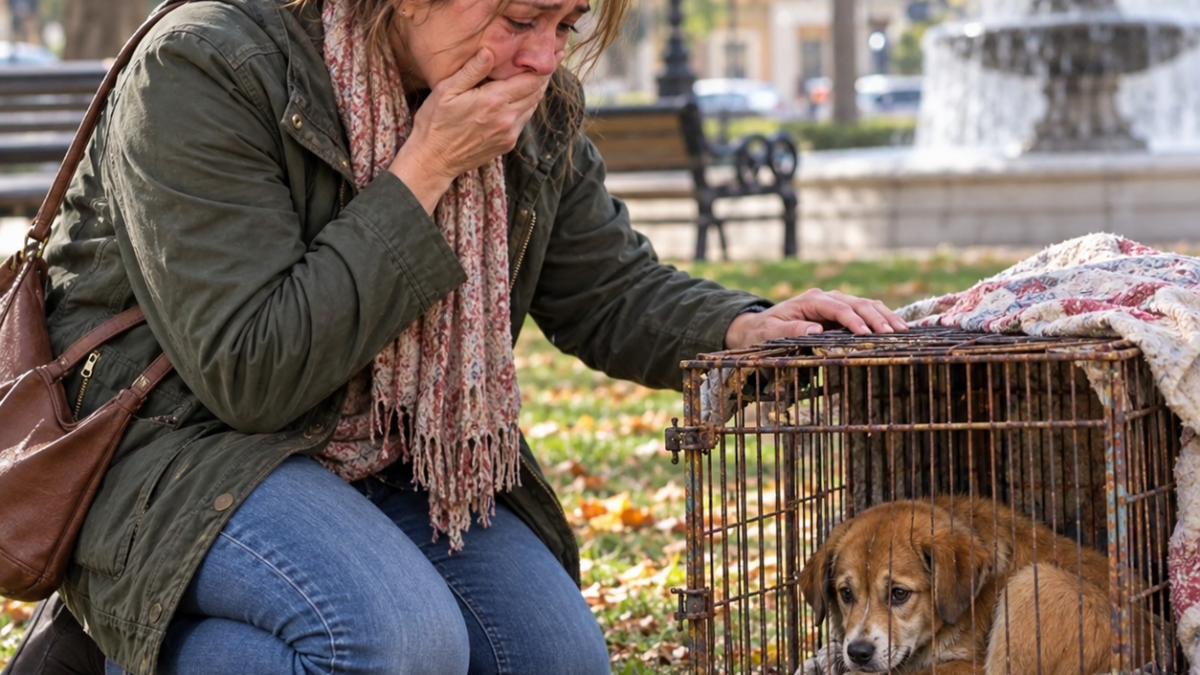
They had folded a puppy into a birdcage so small that when we finally cut the door open, he didn’t crawl out—he stayed curled in the back as if freedom were something his body no longer understood.
The rusted cage had been taped shut and abandoned beneath a tree in a Lyon park, but what frightened me most wasn’t how someone had trapped him there; it was how completely he had stopped expecting anyone to let him out.
And when we finally reached inside and tried to help him straighten one tiny front leg, the sound he made told us that whatever happened before that morning had lasted much longer than any of us wanted to believe.
My name is Claire Morel.
I was forty-six when I found him, and eighteen months earlier I had buried my husband, Étienne.
After that, mornings became unbearable.
The house was too quiet.
His coffee mug stayed in the cabinet.
His jacket remained behind the bedroom door because I couldn’t bring myself to move it.
So I walked.
Every morning before sunrise, I crossed Parc de la Tête d’Or and told myself that if my legs kept moving, maybe the rest of me would eventually follow.
That Tuesday looked ordinary.
The fountain ran softly.
Sparrows jumped through wet grass.
A jogger passed with headphones.
Then I noticed something beneath a faded towel near a maple tree.
At first, I thought someone had dumped an old basket.
Then it moved.
Barely.
I stepped closer.
Two brown eyes stared at me through thin white bars.
I stopped breathing.
It was a puppy.
Maybe ten or twelve weeks old.
Golden-brown coat.
White chin.
Ears too large for his head.
But his body looked wrong.
Folded.
That is still the only word that fits.
His spine followed the curve of the cage. His front legs were trapped beneath his chest. His back legs were pressed against his stomach.
Above him was a tiny plastic perch.
It really was a birdcage.
The sliding door had been twisted shut with wire and wrapped in gray tape.
Someone had not accidentally left him there.
Someone had secured him inside.
“Oh, sweetheart.”
His eyes followed my voice.
He didn’t bark.
Didn’t scratch.
Didn’t try to stand.
I almost wished he had panicked.
Panic means you still believe escape is possible.
This puppy looked as though he had stopped believing in anything beyond the bars.
A park worker named Gérard came toward me pushing his maintenance cart.
He was in his sixties, with thick gray eyebrows and hands that looked like they had repaired half the city.
“Madame… is that a dog?”
“Yes.”
His expression changed.
“I have cutters.”
He ran.
I crouched and slid two fingers between the bars.
The puppy stared at them for a long time.
Then his nose touched my skin.
Dry.
Warm.
Weak.
“I’m getting you out.”
I had no plan after that.
But that promise I could keep.
Gérard returned with pliers.
A jogger stopped.
Then an elderly woman walking a terrier.
Nobody spoke.
Gérard cut the first wire.
The puppy flinched.
Second wire.
He folded himself tighter.
We peeled away the tape slowly.
The little sliding door had rusted almost solid.
Gérard pulled.
Nothing.
He twisted the front panel carefully.
Metal squealed.
The puppy shook.
“Almost there.”
One last pull.
The door opened.
We all waited.
Nothing happened.
The puppy didn’t move.
I reached inside and placed one hand beneath his chest.
“Come on.”
His body stayed curled.
I tried to guide his front leg forward.
He gave a small cry.
Not loud.
Not frightened.
Pain.
I froze.
Gérard whispered, “Don’t force him.”
I didn’t.
Instead, I lifted the entire cage bottom away from the frame so we could remove him without straightening anything.
When his body finally touched the grass, he remained in the exact same shape.
Curled.
Compressed.
As if the cage was still around him.
And while everyone around me kept saying, “He’s free now,” I realized something none of us had understood yet.
Opening the door had been the easy part.
Teaching his body—and whatever was left of his trust—that he was allowed to take up space again was going to be much harder.
PART 2
Gérard took off his work jacket and folded it beneath the puppy.
The little dog did not try to stand.
He didn’t even straighten his neck fully.
He lay on his side with all four legs pulled inward, trembling in the cool morning air.
The old woman with the terrier was crying openly now.
“Call someone.”
“I already am.”
My hands shook so badly that I almost dropped my phone.
The nearest emergency veterinary clinic told us to bring him immediately.
Gérard looked at his maintenance cart.
“I’ll get the park vehicle.”
“No.”
He turned toward me.
“My car is closer.”
I didn’t know why I said it so quickly.
Maybe because I had already touched the puppy.
Maybe because I had made the promise.
Maybe because eighteen months earlier I had stood in a hospital corridor listening to doctors explain that there was nothing more they could do for Étienne, and some part of me had never recovered from being powerless.
This time, there was something I could do.
I wrapped the puppy in Gérard’s jacket without changing the position of his legs.
He weighed almost nothing.
That frightened me.
Puppies should feel awkward and warm and heavier than they look.
This one felt like bones wrapped in fur.
As I carried him toward the parking lot, his head rested against my wrist.
His eyes stayed open.
He watched everything.
Trees.
People.
Sky.
Too much space.
The world seemed enormous after that cage.
I placed him in a laundry basket in the back seat because I didn’t want him sliding during the drive.
Gérard followed in the park utility van.
At the first red light, I looked back.
The puppy was staring upward through the car window.
Not moving.
Just watching.
“You’re out.”
My voice broke.
“You hear me?”
His ears twitched.
“You’re out.”
At the veterinary clinic, the receptionist saw the basket and stood immediately.
“What happened?”
“Birdcage.”
She stared.
“What?”
“He was locked in a birdcage.”
That sentence brought three people from the treatment area.
A veterinarian named Dr. Sophie Bernard knelt beside the basket.
“Do not straighten his legs yet.”
“I didn’t.”
“Good.”
She examined him without removing him completely.
Temperature low.
Heart rate elevated.
Severe dehydration.
Body condition poor.
Then she touched one of his front legs gently.
The puppy whimpered.
Sophie’s face changed.
“How long could he have been like this?”
“We don’t know.”
She looked at the unusual positioning of the limbs.
“We’ll need imaging.”
They carried him away.
I stood there holding Gérard’s jacket.
There was a dark patch where the puppy’s body had been.
Urine.
I noticed the smell only then.
Not because it was strong.
Because everything had happened too fast.
Gérard arrived and saw my face.
“What?”
“He peed on your jacket.”
He looked at it.
“Good.”
I stared.
“That means his kidneys work.”
I almost laughed.
That was Gérard.
Practical even inside horror.
We waited nearly an hour.
The jogger who had stopped in the park had taken photographs of the cage before we moved it.
Gérard had secured the area and asked park security to preserve everything.
Someone from animal protection was already on the way.
I barely heard any of it.
I kept looking toward the treatment-room doors.
Eventually Sophie came out.
She sat beside us.
That frightened me more than if she had remained standing.
“Is he dying?”
“No.”
The answer came quickly.
I breathed.
“But he’s in poor condition.”
“How bad?”
“Malnourished. Dehydrated. He has pressure sores along both hips and part of the sternum. His muscles are severely underdeveloped.”
“And his legs?”
Sophie folded her hands.
“There are contractures.”
I had never heard the word.
“What does that mean?”
“His muscles and tendons have shortened because he’s been held in a flexed position for too long.”
I stared at her.
“You’re saying the cage did this?”
“Most likely prolonged confinement in a space that prevented normal extension and movement contributed significantly.”
“How long?”
“I can’t tell you precisely.”
“Days?”
She hesitated.
“Longer.”
“Weeks?”
“Possibly.”
I felt sick.
A puppy.
Growing.
Bones changing daily.
Locked inside something made for a bird.
Unable to stand properly.
Unable to stretch.
Unable to walk enough for muscles to develop.
Sophie continued.
“The good news is I don’t see obvious fractures.”
“So he’ll walk?”
“I didn’t say that.”
The room seemed to close.
“What are you saying?”
“We need more imaging, neurological assessment, bloodwork, and then rehabilitation. He’s young. That helps enormously. But his body has adapted to the cage.”
I looked toward the treatment room.
“Can you fix him?”
“We can give him a chance.”
That phrase again.
A chance.
So much of rescue begins there.
Not promises.
Not miracles.
Chance.
The puppy stayed overnight.
They gave him fluids slowly.
Warmth.
Pain control.
Small, carefully measured meals.
He ate.
That became our first victory.
Not greedily.
Not desperately.
He licked the soft food from a spoon while a technician held it near his mouth.
Then he fell asleep.
Animal protection arrived before noon.
The investigator introduced herself as Camille Roux.
She asked us to explain everything from the beginning.
Gérard answered most of the questions because my mind kept returning to one image.
The open cage.
The puppy staying inside.
Camille showed me photographs taken at the scene.
The wire.
Tape.
Rust.
Towel.
A small plastic dish attached inside the cage.
Dry.
Empty.
A second tiny dish containing only brown residue.
No identification.
No tag.
No microchip had been found.
“Could someone have left him this morning?” I asked.
“Possibly.”
“But he was kept in that cage before today.”
“That appears likely.”
“Can you tell from the sores?”
“Veterinary evidence will help establish duration.”
I swallowed.
“Are there cameras?”
“Some areas of the park.”
“That tree?”
“We’re checking.”
I wanted a face.
I wanted someone to blame.
That desire frightened me with its intensity.
For eighteen months after Étienne died, I had felt nothing strongly enough.
Then one puppy in a birdcage woke up rage I didn’t know I still had.
Camille must have seen it.
“Claire.”
I looked at her.
“Let us investigate.”
“I’m not going to do anything.”
“I know.”
“Then why say it like that?”
“Because people who care sometimes decide caring gives them permission to become reckless.”
I hated the sentence because it was true.
So I did what I could.
I went home.
The silence felt different.
For eighteen months, it had been grief.
That day, it felt like waiting.
I walked into the kitchen.
Étienne’s old mug was still in the cabinet.
He had loved dogs.
That was almost funny because we had never owned one.
Our jobs had involved too much travel when we were younger.
Then later, when life slowed, we kept saying:
Someday.
Someday we’ll adopt.
Someday we’ll get an old dog nobody wants.
Someday.
Cancer arrived before someday did.
I stood in the kitchen holding his mug.
“You would have brought him home.”
The room gave no answer.
“I know you would.”
I put the mug down.
That night, I barely slept.
At 6:10 the next morning, Sophie called.
“He ate breakfast.”
I smiled before she finished.
“And?”
“And he tried to move.”
My heart tightened.
“Walk?”
“Not exactly.”
“What happened?”
“He saw another puppy being carried past and tried to follow.”
“And?”
“He pushed forward using his front elbows and one rear foot.”
I closed my eyes.
“Did it hurt?”
“Probably some. We stopped him. But wanting to move is useful.”
“When can I see him?”
“Now, apparently.”
I was there fifteen minutes later.
He had been moved to a larger padded recovery enclosure.
I stopped at the door.
He was lying in the center.
Not the corner.
That mattered.
His legs were still folded.
But his head was raised.
When he saw me, his ears moved.
“Hi.”
I crouched.
He watched.
I put my hand on the floor.
No reaching.
No grabbing.
After almost a minute, he stretched his neck forward.
His nose touched my fingers.
Then he pulled away.
Sophie smiled.
“That’s better than yesterday.”
I stayed for an hour.
He ate from my hand.
Drank a little water.
Watched the hallway.
A golden retriever passed.
His whole body shifted.
Curiosity.
Life.
Sophie began gentle passive range-of-motion work later that day.
Millimeters.
Not dramatic.
One foreleg eased forward.
Stop before pain.
Hold.
Release.
Another.
The puppy trembled.
We gave breaks.
Food.
Touch if he wanted it.
Sometimes he cried.
Not loudly.
Each sound made me want to tell Sophie to stop.
She never pushed past safe limits.
Still, rehabilitation looked cruel when you didn’t understand it.
“You’re hurting him.”
“I’m preventing his body from deciding this position is permanent.”
I knew she was right.
Didn’t make it easier.
On day three, he managed to extend his right front leg almost halfway.
I nearly applauded.
Sophie laughed.
“You’re easy to impress.”
“He moved it.”
“I know.”
“He couldn’t yesterday.”
“I know.”
“That’s enormous.”
“It is.”
That was the beginning.
Every day gained a little space.
A shoulder opened.
A hip released.
One paw touched farther forward.
The cage had taught his body to become small.
Rehabilitation taught it expansion.
We needed a name.
The clinic staff had been calling him “the birdcage puppy.”
I hated that.
His identity should not belong to the object that imprisoned him.
One afternoon, Gérard visited.
He stood beside the enclosure.
The puppy sniffed his hand.
“What are we calling him?”
“I don’t know.”
Gérard thought.
“Atlas.”
I looked at him.
“Too dramatic.”
“He’s carrying the world.”
“He weighs four kilograms.”
“Still.”
I laughed.
The puppy yawned.
“What about Milo?”
Gérard shrugged.
“Why Milo?”
“No reason.”
The puppy lifted his head.
“Milo.”
His ear moved.
Gérard grinned.
“He chose.”
He had not.
But Milo stayed.
On day four, park security found something.
A camera near a service path had captured a figure entering the park at 4:52 in the morning.
Hood up.
Carrying something rectangular under a towel.
Birdcage.
The camera angle showed only part of the face.
A woman.
Medium height.
Dark coat.
She placed the cage beneath the tree.
Looked around.
Then walked away.
No attempt to hide it deeper in bushes.
No hesitation.
She knew exactly what she was doing.
Camille showed me only a still image.
“Recognize her?”
“No.”
The picture was blurry.
But one detail stood out.
She carried a bright red reusable shopping bag.
White logo.
Local pet-supply store.
Camille had noticed too.
“Common bag?”
“Common enough. But we’re checking.”
The cage itself offered more.
A faded manufacturer sticker.
Model discontinued years earlier.
Not useful.
The tape was ordinary.
Wire ordinary.
No fingerprints useful enough because multiple people had handled the cage before police fully secured it.
I blamed myself.
Camille stopped me.
“You were rescuing a live animal.”
“But we contaminated evidence.”
“You did exactly what mattered first.”
That sentence eased something.
Life before perfect evidence.
Always.
Milo’s bloodwork showed anemia from malnutrition and parasites.
Treatable.
He tested negative for major infectious diseases.
Good.
His biggest battle was orthopedic and neurological adaptation.
His joints themselves had not fused.
That was critical.
Soft tissues had shortened.
Muscles had weakened.
But the structure gave us hope.
Sophie brought in a veterinary rehabilitation specialist named Dr. Luc Martin.
Luc was tall, quiet, and spoke to Milo before speaking to any human.
“Hello, little man.”
Milo watched him.
Luc sat on the floor.
No touching.
Milo sniffed.
Then Luc looked at me.
“He likes people more than I expected.”
“Is that good?”
“Very.”
“Can he walk?”
Luc smiled slightly.
“Eventually is a dangerous word.”
“Why?”
“Because people hear promise.”
I folded my arms.
“What word do you use?”
“Possibly.”
I hated cautious professionals.
They were usually right.
Luc explained the plan.
Gentle stretching.
Supported standing.
Water therapy later.
Balance exercises.
Massage.
Nutrition.
Pain control.
Time.
“How much time?”
“Months.”
I stared.
“He’s a puppy.”
“That’s why I’m hopeful.”
Milo’s first supported stand lasted less than one second.
Luc placed a padded sling beneath his abdomen.
Sophie supported his chest.
They positioned his legs as close to natural as they could without forcing.
Milo’s paws touched the mat.
His body shook.
One.
Collapse.
I cried.
Luc didn’t.
“Again tomorrow.”
The next day:
Two seconds.
Then three.
By the end of the week:
Five.
His legs looked wrong when straightened.
Too narrow.
Muscles almost absent.
The back paws turned inward.
But they touched the ground.
That became our ritual.
Stand.
Rest.
Food.
Stand.
Rest.
Praise.
Milo learned quickly that effort produced chicken.
His motivation became suspiciously food-based.
Good.
Survival does not need noble motives.
Chicken works.
At the end of the first week, Camille called.
The red shopping bag had helped.
The pet store maintained sales records connected to loyalty cards.
Police could not simply browse every customer without justification, but investigators reviewed camera footage around likely dates after determining the cage appeared recently handled.
Three days before Milo was found, store security footage showed a woman matching the park-camera build buying puppy pads, cheap canned food, and gray duct tape.
The same red bag was visible.
Credit card transaction.
Name:
Sandrine Vautrin.
Address in Villeurbanne.
Animal-control records showed prior noise complaints involving dogs at the address.
Nothing severe enough to produce removal.
Until now.
Camille obtained authorization to investigate.
What they found changed everything.
There were five more dogs.
Not in birdcages.
But confined in stacked plastic carriers in a storage room.
Two adult females.
Three puppies.
The room smelled of urine.
Food bowls inconsistent.
Water limited.
One dog had untreated skin disease.
Another had badly overgrown nails.
No animal was as physically deformed as Milo.
Not yet.
That word stayed with me.
Not yet.
Sandrine claimed she bred small mixed-breed dogs “privately.”
No license where required.
No proper records.
No veterinary documentation for several animals.
Milo, investigators believed, had been born with a slightly unusual gait in one rear leg.
Instead of paying for evaluation, Sandrine had begun restricting him because he knocked over indoor pens and cried at night.
At first, a crate.
Then smaller containment.
A neighbor remembered seeing a birdcage carried into the apartment months earlier after Sandrine’s pet birds died.
The possibility formed slowly.
Then veterinary findings supported it.
Milo had likely spent repeated long periods in that cage over several weeks during a critical growth stage.
Maybe not every hour.
Enough.
When his legs stiffened and his body weakened, he became harder to sell.
Sandrine told investigators she “couldn’t deal with him.”
So she taped the cage shut.
Carried him into the park before dawn.
Left him.
The phrase “couldn’t deal with him” made me shake.
Gérard was beside me when Camille shared the basic findings.
He looked at me.
“Don’t.”
“I haven’t said anything.”
“Your face did.”
I stood.
“Five more.”
“They’re safe now.”
“She would have done it again.”
“Yes.”
Milo was sleeping on a blanket across the room.
I stared at him.
“Not with them.”
“No.”
That became the first satisfying part of justice.
Not punishment.
Interruption.
Five dogs removed before their conditions became Milo’s.
That mattered immediately.
The adult females went to veterinary care.
One needed dental treatment.
The skin disease dog started medication.
The puppies entered foster homes where they could move.
Run.
Stretch.
Take up space.
That last phrase became everything to me.
Take up space.
Milo’s second week brought a breakthrough.
Luc placed him in a shallow hydrotherapy tank.
Warm water supported most of his weight.
At first, Milo panicked.
His legs folded automatically.
Luc held him securely.
“Easy.”
Milo looked at me.
I stood beside the tank.
“You’re okay.”
His breathing slowed.
Luc encouraged one front leg forward.
The water reduced gravity enough that movement became easier.
One paw.
Then the other.
Milo’s rear legs floated awkwardly.
Luc guided them.
“Come on.”
Milo paddled.
Not gracefully.
But the body discovered a pattern.
Forward.
Extend.
Push.
Recover.
I laughed.
“He’s swimming?”
“Walking with water cheating.”
“Counts.”
“It counts.”
After the session, Milo slept for three hours.
The next day, his passive extension improved.
Then his supported standing.
By week three, Milo stood for twelve seconds.
Then twenty.
Thirty.
One morning, while Sophie changed his bedding, Milo saw the food bowl placed six feet away.
No sling.
No hands.
He pushed his front half up.
Paused.
Straightened both forelegs farther than ever.
His rear end followed partially.
Then he moved.
Not a walk.
A strange crawling shuffle.
Front paws reaching.
Rear legs pushing together.
But movement.
Toward food.
Sophie called me while I was buying groceries.
“He moved three feet.”
“What?”
“Without assistance.”
I abandoned my basket.
“You’re kidding.”
“I have video.”
“I’m coming.”
I drove like an idiot, then remembered Milo survived because someone helped him and slowed down.
When I arrived, he was asleep.
Of course.
I watched the video.
Again.
Again.
Again.
Three feet.
The cage had once allowed maybe eighteen inches of movement.
Milo had crossed three feet because he wanted breakfast.
I cried in the hallway.
A technician handed me tissues without saying anything.
By week four, the clinic said Milo could move into foster care with strict rehabilitation.
Claire’s rescue—another Claire, which confused everyone, so they called her Claire B.—offered several experienced homes.
I knew what I wanted before anyone asked.
I also knew I was afraid to say it.
My house had been frozen since Étienne died.
Nothing moved unless I moved it.
No toys.
No bowls.
No barking.
No one waiting.
Bringing Milo home would change the silence.
That frightened me more than I expected.
Sophie asked:
“Do you want to foster?”
I answered:
“I don’t know.”
Which meant yes.
Gérard came over that weekend and helped me prepare.
Rugs across tile.
Low padded pen—not closed tightly, only for safe rest.
A large orthopedic bed.
No small spaces where Milo could wedge himself.
A ramp at the garden step.
Wide food area.
Gérard looked at the enormous bed.
“He’ll take one corner.”
“He’s allowed the whole thing.”
“Dogs don’t understand symbolic furniture.”
“I do.”
“That’s the problem.”
Milo came home on a Thursday.
He froze at the doorway.
Open room.
Too much space.
I sat on the floor.
No pulling.
No coaxing.
Just waited.
Milo looked back toward Sophie.
Then me.
Then the hallway.
He took one awkward step.
Stopped.
Another.
Then he crossed the threshold.
I started crying.
Sophie sighed.
“You cry a lot.”
“I’m French.”
“That isn’t medical.”
Milo reached the rug.
Lay down.
He had entered.
That was enough.
The first night, I gave him the bed.
He chose to sleep beneath the kitchen table.
I let him.
At two in the morning, I woke and found him awake.
Curled tightly.
Same cage shape.
I sat nearby.
“Milo.”
His eyes opened.
“You don’t have to be small here.”
He didn’t understand.
So I didn’t repeat it.
Instead, I stretched my own legs on the floor.
Lay back.
Took space.
Milo watched.
Eventually, he lowered his head.
The next night, he slept slightly less curled.
Three nights later, one front leg extended while sleeping.
I photographed it.
One leg.
Straight.
Ridiculous thing to celebrate.
I sent it to Gérard.
He replied:
HE IS EXPANDING.
Yes.
That was exactly it.
Expansion.
Body.
Trust.
Life.
Rehabilitation consumed our routine.
Morning stretches.
Breakfast.
Rest.
Supported walking.
Short outdoor exposure.
Afternoon exercises.
Hydrotherapy twice weekly.
Medication.
Massage.
Milo learned that towels meant therapy and began hiding badly.
Half his body behind the sofa.
Rear end visible.
“You’re invisible.”
Tail wag.
“I can’t see you.”
Wag.
Therapy remained mandatory.
He objected loudly.
That was another victory.
The silent puppy in the birdcage had found complaints.
Meanwhile, Sandrine’s case advanced.
The seized dogs improved quickly.
One adult female named Poppy had probably been Milo’s mother.
Genetic testing later supported the relationship strongly enough for rescue records, though the legal case did not depend on it.
When Milo met Poppy under supervised conditions, nothing dramatic happened.
They sniffed.
Poppy licked his face once.
Milo tried to steal her treat.
Good.
I refused to turn every animal interaction into a human reunion.
Still, seeing them together hurt.
Poppy could stand.
Walk.
Stretch.
Milo should have had the same chance from the beginning.
The prosecution focused on animal cruelty, abandonment, improper confinement, failure to provide adequate veterinary care, and breeding violations supported by local law.
The five remaining dogs became powerful evidence of the environment.
So did Milo’s medical record.
Sophie testified that his contractures and muscle underdevelopment were consistent with prolonged movement restriction during growth.
Sandrine’s attorney argued congenital abnormality.
Possible.
But Luc explained that even if Milo had begun with a mild orthopedic issue, confinement dramatically worsened function.
The cage dimensions were measured.
Photographed.
Presented.
I attended the first major hearing.
I didn’t bring Milo.
He had done enough.
Sandrine sat across the room.
Mid-fifties.
Hair neatly tied back.
Glasses.
Blue coat.
Ordinary.
I expected rage.
Instead, I felt something colder.
Disbelief.
How could someone sit in a kitchen while a puppy folded himself into that cage nearby?
How many times had he cried?
How many times had she stepped past?
How many nights?
The prosecutor displayed the park footage.
Sandrine carrying the covered cage.
Leaving it.
Walking away.
No emergency.
No panic.
No confusion.
A deliberate abandonment.
Her attorney said she had been overwhelmed.
Financially stressed.
Caring for too many animals.
That may have been true.
But overwhelm can explain the beginning of failure.
It does not excuse wire.
Tape.
Weeks of confinement.
A park before dawn.
Gérard sat beside me.
My hands were clenched.
He whispered:
“Breathe.”
“I am.”
“Not convincingly.”
Sandrine eventually admitted abandoning Milo.
She denied intentional cruelty.
Said she believed someone would find him quickly.
That argument made my blood boil.
The prosecutor asked:
“Then why tape the door?”
Silence.
That question stayed in the room.
Why tape the door if you expected kindness?
Why wire it?
Why prevent the puppy from exiting even if the door slid loose?
There was no good answer.
The case ended months later with consequences substantial enough to matter.
Animal ownership and breeding restrictions.
Removal of all seized dogs.
Fines.
Restitution toward veterinary and rehabilitation costs.
Probationary supervision.
Court-ordered compliance.
Her breeding activity ended.
The home was subject to follow-up.
The record existed.
Five dogs remained safe.
Milo never knew.
Perfect.
But one moment outside court gave me more satisfaction than sentencing.
A reporter approached me.
“Do you feel justice was served?”
I looked at her.
I had rehearsed angry answers.
None felt right.
So I said:
“The cage is empty, and Milo isn’t.”
She paused.
“What do you mean?”
“He has a house. A garden. A bed too big for him. Five other dogs are safe. That’s the part I care about.”
That became the line people repeated.
I almost hated that.
But it was true.
The cage was empty.
Milo wasn’t.
At six months after rescue, Milo walked ten consecutive steps.
Real steps.
Ugly.
Wide-based.
Front legs slightly bowed from early underdevelopment.
Rear legs stiff.
But alternating.
One.
Two.
Three.
Luc counted.
By seven, I was crying.
“Stop crying.”
“I can’t.”
“Then count.”
Eight.
Nine.
Ten.
Milo stopped.
Looked toward me.
Then sat.
I dropped to my knees.
“You did it.”
He immediately searched my pockets.
Chicken.
Always chicken.
At eight months, he could cross the living room.
At nine, the garden.
At ten, he trotted three yards after a ball.
He fell.
Rolled.
Stood.
Tried again.
That fall terrified me.
Luc shrugged.
“Puppies fall.”
“He’s not normal.”
“He needs to be allowed to fail safely.”
That sentence hit me beyond Milo.
Allowed to fail safely.
After Étienne died, I had treated grief like a performance.
Walk correctly.
Work correctly.
Answer friends.
Pay bills.
Do not collapse.
Milo fell constantly.
Then got up.
No shame.
No narrative.
Maybe life did not need me to recover elegantly.
That realization came slowly.
So did everything good.
Milo turned one.
We had a ridiculous cake.
Dog-safe.
Gérard attended.
Sophie.
Luc.
Claire B.
Poppy’s foster family.
Too many people for one puppy.
Milo loved it.
Noise.
Food.
Attention.
The dog who once shrank from every metallic sound now barked because someone cut his cake too slowly.
Gérard raised a glass.
“To taking up space.”
Everyone repeated it.
I looked at Milo.
Standing.
Not perfectly.
But standing.
Taking up space.
That night, after everyone left, I sat in the kitchen.
Étienne’s mug remained in the cabinet.
For the first time in almost two years, I took it down.
Washed it.
Used it.
Not because I had moved on.
I hate that phrase.
Grief is not a train station.
I had moved with it.
Different.
Milo slept on the floor, front legs stretched straight in front of him.
I drank coffee from my dead husband’s mug and realized the house was no longer silent.
There was breathing.
Snoring.
A paw twitching against wood.
Life.
That was the first time I understood Milo had rescued something in me too.
I never told people that publicly at first because rescue stories often become unfair that way.
The animal suffers, and humans immediately make the suffering meaningful because it helped us.
Milo did not deserve the cage so I could heal.
Étienne did not need to die so Milo could enter my life.
Pain does not need a purpose.
But once pain exists, relationships can still grow afterward.
That is different.
I adopted Milo officially just after his first birthday.
Everyone pretended to be surprised.
No one was.
The paperwork asked for permanent owner.
I stared at the line.
Owner felt inadequate.
Still, I signed.
Claire Morel.
Milo Morel, Gérard called him.
Ridiculous.
I liked it.
His second year was the year he discovered running.
Not normal running.
Milo developed his own gait.
Front legs reached farther than the rear.
His hips remained tight.
One back leg rotated slightly outward.
He looked awkward.
Fast enough.
The first true run happened after a pigeon.
Of course.
We were in the garden.
The pigeon landed ten feet away.
Milo froze.
Bird.
Birdcage puppy.
Some cosmic joke.
The pigeon hopped.
Milo launched.
Three strides.
Then six.
Then ten.
The pigeon flew.
Milo continued another five yards before stopping.
I screamed.
He looked back.
“What are you doing?”
He barked.
“You ran!”
Another bark.
Gérard, who had been repairing the fence, shouted:
“He’s chasing birds now!”
We both laughed until we cried.
The symbolism was too obvious and therefore irresistible.
The puppy locked beneath a plastic perch now chased birds through open grass.
I hated how perfect it sounded.
I loved it anyway.
Milo became mildly famous locally after the court case.
I tried to protect him from being reduced to trauma.
People wanted photographs.
Fine.
They wanted to touch him.
Only if he approached.
They asked what happened.
I answered briefly.
Then told them what he liked now.
Carrots.
Pigeons.
Socks.
Mud.
Taking up the whole sofa.
That was Milo.
Not the cage.
I eventually used the attention for something practical.
Claire B.’s rescue created a small fund for confinement-related rehabilitation and orthopedic care.
Some animals arrived after hoarding situations.
Others after long chaining.
Others from tiny transport crates used improperly.
The fund paid for therapy.
Equipment.
Imaging.
Milo attended occasional events.
Luc refused the word ambassador.
“He is a dog.”
“Fine.”
“He can be a dog at an event.”
That kept us honest.
At one fundraiser, a woman approached me crying.
She had adopted a puppy from a breeder years earlier.
The dog had arrived frightened and unable to walk normally.
She had never reported the seller.
“I thought I would get in trouble.”
“For what?”
“For buying him.”
I understood the shame.
She showed me a photograph.
Adult dog now.
Healthy.
She whispered:
“I should have said something.”
“Yes.”
The word hurt her.
I continued:
“You can say something now when you see it again.”
She nodded.
No absolution.
Direction.
I had learned that from other rescuers.
Guilt only helps if it eventually moves forward.
Sandrine tried once to challenge parts of her ownership restriction after several years.
The court reviewed the record.
Milo’s case.
The seized dogs.
Compliance history.
Some conditions remained.
Others changed according to legal process.
I felt anger resurfacing.
Then Gérard asked:
“Is Milo safe?”
“Yes.”
“Are the other dogs safe?”
“Yes.”
“Can she legally breed again?”
“No.”
“Then what are you trying to win?”
I hated that question.
Because I didn’t know.
More punishment?
Permanent humiliation?
A guarantee she would understand?
Courts cannot produce remorse.
And if my satisfaction depended on Sandrine feeling exactly what I wanted her to feel, I had handed her too much of my life.
So I stopped following every update.
Accountability mattered.
Obsession did not.
Milo had moved on years earlier.
He had squirrels to insult.
I followed his example.
At four, his body reached a plateau.
Luc told me:
“This is probably his adult normal.”
I looked at Milo walking across the clinic.
He still looked different.
Legs slightly stiff.
Limited extension in one hip.
Odd rhythm.
No pain most days.
Good stamina.
Able to run short distances.
Could climb low stairs.
Could jump onto the sofa despite being told not to.
“Normal?”
“His normal.”
That phrase felt important.
His normal.
Not broken normal.
Not almost normal.
Not recovered enough.
His.
I stopped comparing his gait to other dogs.
Comparison is useful in medicine.
Cruel in love.
Milo lived.
That was enough.
At five, he started helping another dog without knowing it.
Claire B. rescued a young terrier from a hoarding case.
The terrier, named Olive, refused to leave the back corner of her room.
People frightened her.
Open space frightened her.
Doorways frightened her.
Milo came with me one afternoon.
He entered.
Sniffed.
Lay down.
Olive watched.
No magic.
After twenty minutes, Milo stood.
Walked toward the door.
Olive took two steps after him.
Stopped.
Next visit, four steps.
Then into the hallway.
Claire B. looked at me.
“Don’t say it.”
“I wasn’t.”
“Dogs helping dogs.”
“I said nothing.”
Milo did not heal Olive.
He modeled movement.
Sometimes another body makes possibility visible.
That stayed with me.
I wondered if the first open cage had been too abstract for Milo.
Door open.
Still curled.
He did not know what to do with freedom because freedom requires movement you believe is allowed.
Maybe we all need models.
People.
Animals.
Someone ahead of us occupying space without apology.
At six, Gérard retired from the park.
We threw him a party.
Milo attended.
Gérard kept the original wire cutters.
I discovered that when he produced them from a box.
“You kept those?”
“Of course.”
“Why?”
He looked offended.
“History.”
I touched the handles.
Rust marks still near the hinge.
Those cutters had opened the first wire.
Not freedom.
Just the first barrier.
Gérard handed them to me.
“No.”
“They’re yours.”
“You cut it.”
“You stayed with him.”
“So did you.”
He shrugged.
“Then we share custody.”
I laughed.
I eventually mounted them in my garage beside a photograph of Milo sleeping stretched completely straight across my bed.
That photograph mattered more than the cage pictures.
Body long.
Front legs extended.
Rear legs behind.
Taking up absurd space.
Freedom made visible through sleep.
His seventh year brought the first arthritis changes.
Too early, Luc said, but not surprising.
The abnormal growth pattern and years of compensating had consequences.
We adjusted.
Joint support.
Anti-inflammatory medication when needed.
Swimming.
Weight management.
Less jumping.
Milo objected to less jumping.
The sofa remained his mountain.
I bought a ramp.
He ignored it.
Gérard visited.
“Good ramp.”
“Don’t start.”
Milo eventually used it for cheese.
Everything has a price.
At eight, he became calmer.
Still chased pigeons occasionally.
Mostly barked at them from a comfortable distance.
He loved children.
Especially quiet ones.
He disliked bicycles for reasons nobody knew.
He slept beside me every night.
Not under the table.
Not curled tightly.
Across the bed.
Often sideways.
I got approximately thirty percent of the mattress.
Perfect.
One night I woke because his paw touched my face.
His front leg was fully extended.
I held it gently.
The same type of leg I once could not move without making him cry.
Now stretched across my pillow like he owned me.
Maybe he did.
I whispered:
“You remember the cage?”
Milo snored.
Good.
I hoped he didn’t.
At nine, Étienne’s sister visited from Marseille.
She had avoided staying with me for years because grief made our relationship difficult.
Milo loved her instantly.
Traitor.
She sat on the floor with him.
Then looked at the photograph of Étienne on the bookshelf.
“You’re different.”
“I’m older.”
“No.”
I knew what she meant.
For years after Étienne died, I had been surviving through routine.
Milo gave routine another direction.
Not purpose in some grand spiritual sense.
Obligation.
Morning stretches.
Vet visits.
Walks.
Food.
The present becomes unavoidable when someone depends on you.
That helped.
She touched Milo’s back.
“Étienne would have loved him.”
“Yes.”
We both cried.
Milo left.
Apparently emotional reconciliation was less important than a delivery truck.
Good dog.
He prevented the moment from becoming unbearable.
At ten, Gérard died.
Heart attack.
Fast.
Unexpected.
Milo and I attended the memorial gathering at the park.
The maple tree was still there.
The fountain.
The path.
The place where we found the cage.
Park management had changed landscaping, but I knew the spot.
I stood there with Milo.
He sniffed the grass.
No recognition.
Why would there be?
Ten years is huge in a dog’s life.
I touched his collar.
“Gérard got you out.”
Milo looked for squirrels.
Again, good.
We placed no memorial at the tree.
Gérard’s family kept the wire cutters.
They belonged with them now.
His granddaughter later joined the park service.
She told me Gérard had carried a photograph of Milo in his wallet.
Not the rescue photo.
A running photo.
That detail undid me.
People who truly help animals often prefer the after.
Not suffering.
Life.
Milo’s eleventh year was quieter.
Arthritis progressed.
His hips stiffened.
He needed warm-up stretches every morning.
Same exercises from puppyhood, now for age.
Circle.
Expand.
Extend.
The body returning to old lessons.
Sometimes I thought it was cruelly poetic.
Then I stopped trying to make everything poetic.
Bodies age.
That’s enough.
His annual bloodwork remained good.
Heart good.
Lungs good.
Weight stable.
He was old.
That word delighted me.
Old.
The puppy somebody left before he had even learned to walk properly reached old age.
I began celebrating gray fur.
Every white hair around his muzzle felt like defiance.
At twelve, kidney values shifted mildly.
Monitoring.
Diet adjustment.
Nothing dramatic.
Milo hated the new food.
He organized a hunger strike lasting eleven minutes.
I added approved topper.
Revolution ended.
At thirteen, his mobility declined more quickly.
The rear legs lost strength.
We used a support harness.
He accepted it.
The dog who once did not know how to extend his limbs now allowed me to help carry them.
Trust.
That was the whole story again.
He still wanted the garden.
Still wanted sunlight.
Still wanted food.
Still barked at pigeons.
Life narrowed but remained his.
Then one winter morning, Milo did not get out of bed.
I called Luc, who had mostly retired but still answered my messages.
“He’s thirteen.”
“I know.”
“Claire.”
“I know.”
“You’re hearing the cage again.”
That silenced me.
Yes.
Every weakness still pulled me back.
Curled body.
Unable to stand.
But this was different.
Milo was not trapped.
He was old.
Luc said:
“Do not confuse aging with what was done to him.”
That became my anchor.
The cage did not win because Milo became stiff again.
Time had simply reached him.
That was a privilege.
We managed pain.
Kidneys.
Mobility.
Milo continued another year.
Fourteen.
Ancient for what his early life had been.
He slept most of the day.
Sometimes fully stretched.
Sometimes curled.
The curl no longer frightened me.
He chose it.
Choice changes meaning.
One evening, I noticed him sleeping in almost the same folded shape as the birdcage.
My heart stopped.
Then Milo woke.
Stretched both front legs forward.
Long.
Slow.
Yawned.
Changed position.
I cried.
He had been allowed to curl without being trapped.
That was freedom too.
Freedom is not always taking up maximum space.
It is deciding how much space you want.
The final decline came in spring.
Kidney disease worsened.
Appetite fell.
Mobility became painful despite medication.
Luc visited.
Sophie, now gray-haired herself, came too.
We had known one another too long.
Sophie examined him on his bed.
“No hospital?”
I asked.
“Not unless there’s something reversible we need there.”
“Is there?”
She looked at me.
“No.”
I knew.
Still asked.
“Another week?”
“Maybe.”
“Good week?”
Silence.
That was the answer.
Milo ate chicken that evening.
Small amount.
Then slept.
The next morning, he walked into the garden with the support harness.
Sunlight.
Wet grass.
A pigeon landed on the fence.
Milo saw it.
His ears lifted.
He barked once.
The pigeon flew.
Milo watched.
I laughed so hard I cried.
“Still got it.”
Tail movement.
We stayed outside for an hour.
No agenda.
No exercise.
No rehabilitation.
He had spent a lifetime being asked to move.
That morning, he was allowed to simply be.
By afternoon, he could no longer stand comfortably.
I called Sophie.
“I’m ready.”
Lie.
No one is ready.
But I was willing.
Different.
Gérard’s granddaughter came by with something.
The original park towel.
I had no idea Gérard had kept it in a sealed evidence-return bag after authorities released it.
Faded.
Ugly.
I did not want it near Milo.
“No.”
She understood.
“Good.”
I was surprised.
She smiled.
“Grandpa said if Milo ever died, don’t put cage things around him.”
I started crying.
“What did he say to use?”
“His favorite blanket.”
Of course.
We used the green blanket Milo had slept on for years.
Large.
Soft.
Enough room.
Sophie came to the house.
Milo lay in the middle of the living room.
Not against a wall.
Not in a corner.
Center.
I noticed that.
For a dog who once made himself smaller than a birdcage, the center of a room felt right.
I sat beside him.
Put one hand near his chest.
“You know what I’m proudest of?”
His eyes moved toward me.
“Not the walking.”
I stroked his head.
“Not even the running.”
His breathing was slow.
“You learned you were allowed to exist at full size.”
My voice broke.
“You took my whole bed.”
Tail movement.
“You stole the couch.”
Another breath.
“You barked at delivery drivers like you paid taxes.”
Sophie laughed softly through tears.
“You became inconvenient.”
That was the highest compliment I had.
The first medication relaxed him.
His legs loosened.
Both front legs extended naturally in front of him.
I stared at them.
Long.
Straight.
No cage.
I touched one paw.
“The first time I tried to move this, you cried.”
Milo’s eyes closed.
“I’m sorry.”
Not for helping.
For what had already been done before I met him.
“For all of it.”
Sophie waited.
I leaned closer.
“Étienne would have loved you.”
That sentence took fourteen years to say without breaking completely.
“He probably would have let you on the furniture sooner.”
Tail twitch.
“Traitor.”
I kissed Milo’s head.
Then whispered:
“You don’t have to stretch for anyone anymore.”
The final medication went in.
His breathing slowed.
One breath.
Another.
Then stillness.
I kept my hand on his front leg.
Fully extended.
That mattered to me.
Not because death needed symbolism.
Because love does.
Milo died occupying more physical space than the cage had ever allowed.
Home.
Center of the room.
Legs stretched.
People around him.
Nothing taped shut.
Nothing wired closed.
No one walking away.
I remained beside him for a long time.
When Sophie finally asked whether I wanted help moving him, I said:
“Not yet.”
I lay down on the floor beside him.
Stretched my legs.
Same thing I had done his first night home.
Then I realized something.
Back then, I had shown Milo what taking up space looked like.
Now he had spent fourteen years teaching me the same thing.
After Étienne died, I had made myself smaller emotionally.
Fewer friends.
Fewer invitations.
No plans.
No dog because someday had already betrayed me.
Milo expanded my life through sheer practical necessity.
Veterinarians.
Rescue workers.
Gérard.
Luc.
Poppy’s family.
Events.
Neighbors.
Children.
Walks.
Noise.
Mud.
Beds.
Grief did not disappear.
My life simply grew around it.
Like Milo’s body learning to stretch around old contractures.
Slowly.
Painfully.
Never back to what it would have been.
Still larger.
That was enough.
After Milo died, the house became quiet again.
The silence resembled the one after Étienne.
But it was not the same.
The first silence had felt like a sealed room.
This one contained fourteen years.
That difference saved me.
I left Milo’s bed in the living room for months.
Then one afternoon, Claire B. called.
A foster family needed a large orthopedic bed for an elderly dog recovering from surgery.
I looked at Milo’s.
My first instinct was no.
Then I heard Gérard in my head.
People who spend their lives repairing things do not like useful objects becoming monuments.
I washed the cover.
Delivered the bed.
The elderly dog fell asleep on it within ten minutes.
I cried in Claire B.’s office.
She said nothing.
Good friend.
The rehabilitation fund continued.
We renamed nothing.
No “Milo Foundation.”
No permanent branding.
Milo had already had enough identity imposed by other people.
We simply expanded the program.
Part of it became dedicated to educating people about confinement.
Crates can be useful.
Necessary sometimes.
Safe when appropriately sized and used responsibly.
A cage that prevents an animal from standing, turning, stretching, and moving for prolonged periods is not training.
It is harm.
Simple.
That message mattered because people often confused confinement tools with confinement abuse.
Milo’s case made the distinction impossible to ignore.
The original birdcage eventually became evidence no longer needed.
Authorities asked what should happen to it.
I said destroy it.
Somebody suggested keeping it for educational display.
No.
I did not want children photographing themselves beside the object that had hurt him.
I did not want Milo frozen forever inside the shape of his suffering.
The cage was dismantled.
Metal recycled where possible.
Gone.
That felt right.
The cage ended.
Milo’s effects continued.
Years later, a young veterinary student contacted me.
She had seen Milo’s medical case in a rehabilitation lecture.
Not graphic photographs.
Imaging.
Contracture progression.
Treatment.
Outcome.
She wrote:
What stayed with me was not how restricted he was when found, but how much function he regained because everyone protected movement instead of forcing it.
I read that sentence several times.
Protected movement.
That described more than rehabilitation.
You cannot force a frightened body into freedom.
You create safety.
Then movement becomes possible.
I thought about grief.
Again.
Annoyingly.
Milo kept teaching after death.
One autumn morning, I returned to the park.
Same fountain.
Same maple.
Different bench.
Gérard gone.
Milo gone.
Étienne gone.
Too many absences.
A puppy played nearby.
Four legs everywhere.
Running badly.
Owner apologizing because the leash tangled around a bench.
I laughed.
The puppy saw me and came over.
Jumped against my knees.
I steadied him.
“Take up some space, why don’t you?”
The owner apologized again.
“No.”
I smiled.
“He’s doing exactly what he should.”
I sat beneath the tree where the birdcage had been.
For a long time, I expected sadness.
Instead, I remembered Milo chasing the pigeon.
That was better.
The place no longer belonged to the cage.
Memory had overwritten it.
Not erased.
Expanded.
I realized then that this was the final revenge.
Sandrine had tried to make Milo small enough to manage.
Small enough to silence.
Small enough to leave.
The rest of his life moved in the opposite direction.
He became larger.
Not physically huge.
Existentially unavoidable.
He filled my house.
Filled beds.
Filled schedules.
Filled veterinary records.
Filled Gérard’s wallet with photographs.
Filled Luc’s rehabilitation notes.
Filled court documents that prevented more animals from being confined.
Filled classrooms.
Filled conversations.
Filled fourteen years.
The person who tried to reduce him to the dimensions of a birdcage failed completely.
Milo became bigger than the cage.
That was justice no court could manufacture.
And the most satisfying part was how ordinary the victory eventually looked.
An old dog stretched across a bed.
A food bowl waiting in a kitchen.
Mud on a floor.
A barking argument with a pigeon.
A front leg extended in sleep.
Nothing dramatic.
Nothing viral.
Just a life allowed to occupy its full shape.
That was all Milo had ever needed.
Room.
Time.
Care.
And someone willing to leave the door open long enough for him to believe he was allowed to walk through it.
The first morning I found him, the cage door opened and Milo stayed inside because captivity had become the only shape his body understood.
Fourteen years later, when his life ended, there were no bars around him at all.
He was stretched across the middle of my living room, taking up more space than anyone would have believed possible.
And after everything someone had tried to teach him about how small he needed to be, Milo spent the rest of his life proving them wrong.
For months after Milo died, I kept waking in the middle of the night and instinctively moving my legs toward the edge of the bed.
For fourteen years, that had been necessary.
Milo slept wherever he pleased, and somehow the place he pleased most was always the place I needed.
Across my feet.
Against the backs of my knees.
Sideways through the middle of the mattress.
Sometimes completely stretched out, nose toward one wall and hind legs toward the other, as though a dog once imprisoned in a birdcage had decided that every available inch of my bed needed to be claimed personally.
After he was gone, I had the whole mattress.
I hated it.
The first week, I woke at 2:14 in the morning and reached down automatically.
Nothing.
I turned on the bedside lamp.
The room looked enormous.
For years I had complained about Milo leaving me twenty centimeters of space.
Now there was too much.
That was when I learned something grief teaches badly.
Absence is not empty.
It has weight.
It occupies rooms.
It sleeps beside you.
It follows you into the kitchen.
For almost two months, I continued stepping carefully around the place where Milo’s water bowl had been.
The bowl was gone.
My body remembered anyway.
One morning, I stopped in the hallway and laughed.
“You trained me well.”
Silence.
I expected that silence to feel like the house after Étienne died.
It didn’t.
That surprised me.
When my husband died, silence had felt sealed.
Airless.
Like every room had become another kind of cage.
After Milo, silence contained something else.
Movement remembered.
Fourteen years of nails clicking across floors.
Barking at delivery drivers.
Snoring.
The scrape of his support harness during his final years.
The ridiculous sound he made when someone opened cheese.
The house was quiet, but it had learned noise.
So had I.
I began opening the windows again.
Not because I wanted fresh air.
Because Milo had always loved lying near them.
At first, that hurt.
Then it didn’t.
Grief changes texture before it changes size.
One afternoon, Gérard’s granddaughter, Léa, visited me.
She carried a small cardboard box.
“I found these in Grandpa’s workshop.”
Inside were photographs.
Dozens.
Milo at two.
Milo running.
Milo beside Gérard’s park cart.
Milo wearing a ridiculous yellow raincoat.
Milo asleep with his front legs stretched completely straight.
I stopped at that one.
Gérard had written something on the back.
He forgot the cage today.
My hands began shaking.
Léa sat beside me.
“Grandpa took that after you visited the park one spring.”
“I remember.”
Milo had been about three.
We had returned to the same fountain.
Same maple tree.
Same path.
I had worried he might react.
He didn’t.
He spent fifteen minutes trying to reach a sandwich wrapper under a bench.
Then rolled in wet grass.
Then slept with both front legs extended.
Gérard had seen what I hadn’t.
Maybe forgetting is too strong a word.
We cannot know what dogs remember.
But his body no longer behaved as though the cage was still around him.
That was enough.
I held the photograph for a long time.
Then Léa handed me another.
Gérard and Milo.
Gérard sitting on the ground.
Milo half on his lap, far too big to fit.
Both looking away from the camera.
On the back:
The things people throw away are often the things worth stopping for.
“That sounds like him,” I whispered.
Léa smiled.
“He wrote it after retirement.”
I cried then.
Not violently.
Quietly.
Gérard had been one of the first people to see Milo as a dog instead of a horror story.
He never called him “poor thing” once Milo began recovering.
He called him thief.
Idiot.
Coward whenever Milo barked at bicycles.
King whenever he stole the entire sofa.
That mattered.
Pity can become another cage if we are not careful.
It can freeze someone forever at the moment they were weakest.
Gérard refused to do that.
So did Milo.
Years after his death, the rehabilitation fund continued growing.
We started receiving referrals from other cities.
Dogs from hoarding cases.
Cats kept in transport crates for months.
A young shepherd tied permanently beneath a staircase.
A bulldog surrendered after years in a pen so small his hips had become weak.
Every case was different.
We were careful not to pretend Milo’s treatment was a universal template.
Bodies adapt differently.
Trauma differs.
Age matters.
Disease matters.
But one principle remained:
Freedom is not simply opening a door.
Sometimes an animal has to relearn what the body is allowed to do after the door opens.
Stand.
Stretch.
Turn.
Walk.
Play.
Choose where to sleep.
Leave food unfinished.
Move away from a wall.
Take the center of a room.
That last one became important.
At the rescue center, we began watching where newly freed animals chose to rest.
Some pressed into corners.
Some crawled beneath furniture.
Some kept their backs against walls.
Nobody dragged them out.
We provided options.
Safe hiding places.
Open beds.
Space.
Then waited.
A small terrier named Lou arrived after spending most of his life confined in a bathroom.
For nearly three weeks, he slept under a table.
Then one afternoon, Claire B. sent me a photograph.
Lou asleep in the middle of the floor.
Completely exposed.
I stared at the picture.
Milo.
Different dog.
Same kind of victory.
I printed the photograph and placed it beside Milo’s.
Not because Milo deserved credit.
Because one animal’s history had taught us how to recognize another animal’s progress.
That is what legacy should be.
Not ownership of someone else’s recovery.
Better attention.
One winter, I was invited to speak to veterinary rehabilitation students.
I almost refused.
I wasn’t a veterinarian.
I didn’t want Milo transformed into a motivational prop.
Then Luc said:
“Tell them what you saw at home that we couldn’t see in the clinic.”
So I did.
I told them about the first night.
Milo curled beneath the kitchen table.
The way he slept in the shape of the cage even when no bars existed.
The first time one leg stretched during sleep.
The first time he chose the middle of the room.
The day he fell chasing a ball and immediately tried again.
I told them not to mistake function for the whole animal.
A dog can improve medically and still live inside learned fear.
A dog can remain physically imperfect and live an excellent life.
A crooked gait is not automatically suffering.
A normal-looking gait is not automatically recovery.
You have to look at appetite.
Choice.
Curiosity.
Rest.
Play.
Connection.
Comfort.
And whether the animal is allowed to say no.
One student asked:
“What was the most important part of his rehabilitation?”
I expected myself to say hydrotherapy.
Stretching.
Nutrition.
Instead I answered:
“Choice.”
The room became quiet.
“We spent months teaching him movement, but the thing that changed everything was when he understood nobody would force him back into a small space.”
That was true.
His first bed had been enormous.
His first pen stayed open whenever medically safe.
His food never required entering a crate.
We never used the old birdcage imagery during training.
No test.
No reenactment.
No dramatic “facing his fear.”
Recovery is not entertainment.
Milo did not owe anyone a confrontation with the object that hurt him.
That was one reason I insisted the cage be dismantled.
I have never regretted it.
A few people criticized that choice.
They said the cage could have educated others.
Maybe.
But Milo’s life educated more.
I didn’t need the instrument of suffering preserved so people could believe cruelty existed.
I had veterinary records.
Court evidence.
Photographs.
More importantly, I had fourteen years of contradiction.
The cage said:
Stay small.
Milo spent the rest of his life saying:
No.
The cage said:
You only get this much space.
Milo took my bed.
The cage said:
Movement is dangerous.
Milo chased pigeons.
The cage said:
You are inconvenient.
Milo became gloriously inconvenient.
The cage said:
You can be left.
Milo became someone an entire network of people reorganized themselves to protect.
That was enough evidence for me.
On the fifth anniversary of Milo’s death, I did something I had avoided.
I opened the closet where I kept his last support harness.
Green.
Faded.
One strap chewed slightly because Milo hated waiting while I adjusted it.
I held it for a long time.
Then carried it to Claire B.’s rescue.
She looked at it.
“You sure?”
“No.”
She smiled.
“That’s not what I asked.”
“Yes.”
The harness was cleaned, inspected and used later for an elderly shepherd recovering from spinal surgery.
The first photograph they sent showed the shepherd standing with help.
Green harness under his body.
I cried.
Then laughed.
Milo would have resented sharing.
He was possessive about equipment that came with treats.
But useful things deserve use.
I began letting go of objects after that.
Not memories.
Objects.
The old orthopedic bowl.
A ramp.
Blankets.
One unopened bag of training treats I had somehow never thrown away.
Each item went somewhere useful.
The house became less like a museum.
That helped me remain alive inside it.
Étienne’s belongings had taught me the danger of preserving every object because movement feels like betrayal.
Milo taught me something different.
Love is not stored in bowls.
Or harnesses.
Or cages.
It changes what you do next.
That was enough.
I kept three things.
His collar.
Gérard’s photograph with the words He forgot the cage today.
And a clay imprint of Milo’s front paw from his final week.
The paw fascinated me.
Large.
Normal-looking.
No evidence in clay of the contractures that once kept that leg beneath his chest.
You would never know.
That became one of my favorite objects.
Not because it remembered suffering.
Because it failed to.
Years continued doing what years do.
They removed people.
Added others.
Softened edges.
Claire B. retired.
Luc stopped practicing completely.
Sophie moved closer to her grandchildren.
I became the old woman in the park.
That amused me.
Once, I had seen elderly women walking little dogs while I crossed the park alone before sunrise.
Now I was the one with gray hair sitting near the fountain.
No dog.
But often a bag of approved treats because apparently I had become predictable.
One morning, a young woman came toward me with a newly adopted dog.
Large puppy.
Long legs.
Terrified.
She recognized me from Milo’s story.
“I think I’m doing everything wrong.”
The puppy stood behind her.
“What happened?”
“He was kept in a garage. Not a cage, but almost never outside. He’s afraid of open fields.”
I watched the dog.
Every few seconds, he looked toward the trees and then moved closer to her legs.
“Does he eat?”
“Yes.”
“Sleep?”
“Yes.”
“Come to you?”
“Yes.”
“Then you’re already doing some things right.”
“He freezes.”
“Let him freeze.”
She looked startled.
“I mean don’t drag him forward because you need proof he’s improving.”
The puppy sniffed my hand.
I kept it still.
“Give him time to decide the world is larger than what he knew.”
The woman sat beside me.
We talked for half an hour.
Before leaving, the puppy stepped onto the grass beyond the path.
Two feet.
Maybe three.
The woman almost cried.
I smiled.
“Don’t make a big deal.”
She laughed.
“I’m trying.”
Good.
Milo’s story had become quieter with time.
That was what I wanted.
Fewer people knew the details.
More people knew the principle.
Do not measure an animal’s worth by the inconvenience of caring for them.
Do not confuse confinement with control.
Do not force recovery for your own emotional satisfaction.
Make room.
Let time work.
One morning, fourteen years after Milo’s death, I walked through the park before sunrise.
Exactly as I had the day I found him.
The fountain still ran.
Birds moved in the wet grass.
A jogger passed.
For a few seconds, the years folded strangely.
I could almost see myself at forty-six.
Grieving.
Thin with exhaustion.
Walking because stopping felt impossible.
Then the towel under the tree.
The cage.
The eyes.
I stood near the spot.
Nothing there.
Just grass.
I closed my eyes.
The first memory came.
Curled puppy.
Then another replaced it.
Milo at one year, standing badly but proudly.
Then Milo chasing the pigeon.
Then asleep across my bed.
Then old.
Front legs extended.
Center of the living room.
That final image won.
I opened my eyes.
A sparrow landed near my shoe.
I laughed.
“Milo would’ve tried.”
The bird flew.
I stayed a few more minutes.
Then something became clear to me.
For years, I had thought the most beautiful thing about Milo was that he learned to stretch.
I was wrong.
The most beautiful thing was that eventually stretching stopped being an achievement.
It became unconscious.
He did it after waking.
During naps.
Before running.
Sometimes simply because his body wanted to.
Freedom had moved from lesson to reflex.
That is deeper than rescue.
That is belonging.
When safety becomes so ordinary the body no longer asks permission.
That was Milo’s final victory.
Not walking.
Not running.
Not growing old.
Those were part of it.
The deepest victory was that his body forgot to remain small.
And maybe mine did too.
After Étienne’s death, I had reduced my life to routines that required almost nothing from anyone.
Walk.
Work.
Home.
Sleep.
Repeat.
Milo interrupted that.
Veterinarians.
Friends.
Noise.
Birthday cakes.
Court dates.
Wet floors.
Rehabilitation appointments.
Fundraisers.
Pigeons.
Grief groups.
New people.
Laughter I hadn’t planned.
My life expanded alongside his legs.
Not because he suffered for me.
I will never say that.
Because once we found each other, neither of us had to remain shaped entirely by what had already happened.
That distinction matters.
On the way out of the park that morning, I passed a maintenance worker pushing a cart.
Young man.
Headphones around his neck.
For one second, I saw Gérard.
Not literally.
Memory again.
The worker nodded.
“Morning.”
“Morning.”
Then I continued walking.
My legs still worked.
Slower.
But they worked.
I thought about the promise I made to Milo before I knew his name.
“I’m getting you out.”
At the time, I thought that meant the cage.
Years later, I understood none of us gets out in one moment.
Gérard cut the wire.
Doctors helped his muscles.
Time helped his joints.
Routine helped his fear.
Love helped his sense of safety.
And Milo helped himself every time he chose one more inch.
One more step.
One more room.
One more year.
That is why, if someone asks me now what happened to the puppy in the birdcage, I do not say:
“He survived.”
Too small.
I say:
“He became enormous.”
Not in weight.
In presence.
In consequence.
In memory.
In the amount of life he occupied after someone tried to reduce him to a few inches of rusted metal.
The cage existed for weeks.
Maybe longer.
Milo lived for fourteen years afterward.
That is the arithmetic I keep.
A few terrible weeks.
Then thousands of days without bars.
Thousands of stretches.
Thousands of steps.
Thousands of naps in impossible positions.
Thousands of chances to choose where his body went.
No court sentence could have given me a more satisfying answer than that.
Sandrine tried to teach Milo that his body belonged inside boundaries she chose.
Milo spent the rest of his life learning the opposite.
And long after the cage was cut apart, the metal recycled, the case closed, and even Milo himself was gone, that lesson kept moving through every animal we helped afterward:
You are allowed to take up space.
You are allowed to need help.
You are allowed to heal imperfectly.
You are allowed to become more than the place where someone left you.
Milo did.
Completely.
And in the end, the birdcage became the smallest thing in his story.








