PART 2: They Left Magnolia on the Street With a 14.9-Pound Tumor—But They Didn’t Get to Decide How Her Story Ended
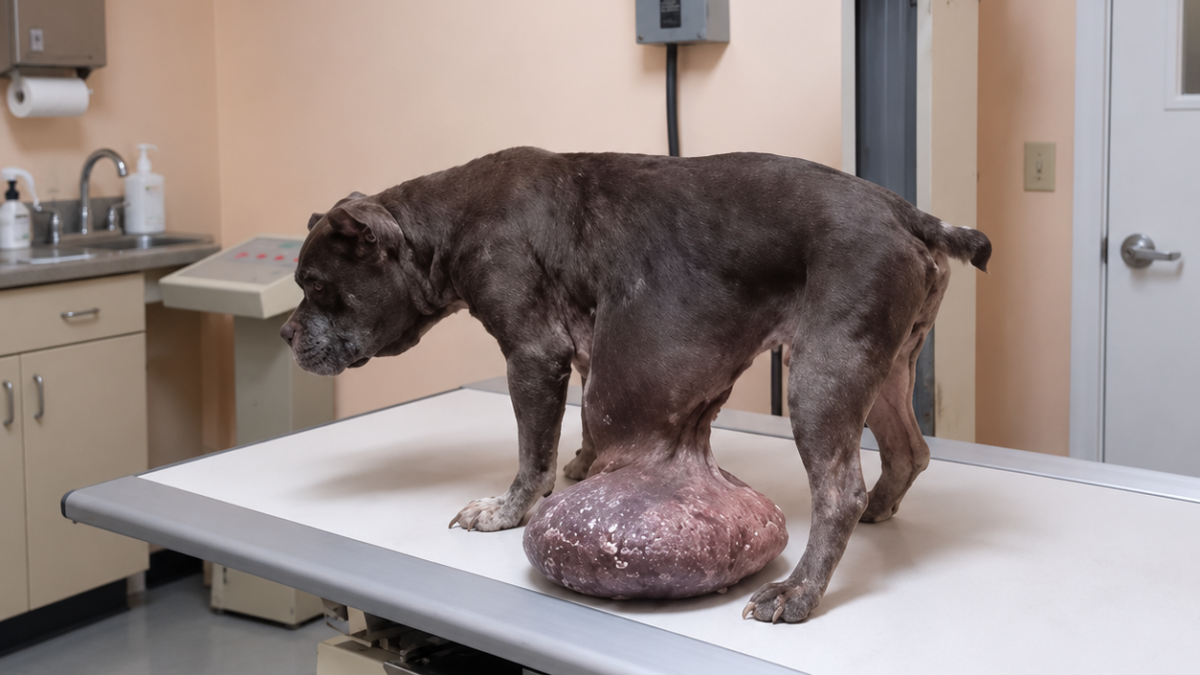
PART 2
The words hung between us.
A very big risk.
I had spent enough time around veterinary clinics to know that doctors rarely used language like that unless they were worried.
“What kind of risk?” I asked.
The veterinarian glanced through the glass panel in the treatment-room door.
Magnolia was lying on a thick blanket while two technicians worked around her. One was adjusting an IV line. The other was gently cleaning dirt from the skin surrounding the tumor.
“Her body is already under tremendous strain,” the veterinarian said. “Her blood pressure is lower than I’d like. We don’t know exactly how vascular that mass is until we get in there. A tumor this large can have a substantial blood supply.”
I looked at Magnolia.
“So she could bleed.”
“Yes.”
“How badly?”
The veterinarian met my eyes.
“Badly enough that we have to prepare for the possibility she may not make it through surgery.”
For several seconds I couldn’t speak.
We had found her only a short time earlier, yet I already felt responsible for what happened next.
Maybe that sounds strange.
But rescue does that to you.
The moment an animal who has been forgotten looks at you and allows you to help, some invisible agreement forms.
They don’t sign anything.
They don’t understand your promises.
But you do.
And I had already made one to Magnolia in the back of that vehicle.
Stay with us.
Now I had to decide whether asking her to stay meant putting her through an operation that might kill her.
“What happens if we don’t operate?” I asked.
The veterinarian’s expression answered me before her words did.
“She won’t have a normal life carrying that.”
“Could she have any life?”
“Not for long, in my opinion. The mass will continue interfering with movement. The skin could break down. Infection becomes a concern. Her circulation, mobility, appetite, everything will continue to suffer.”
I looked down.
There really wasn’t a choice.
There was only a chance.
“How soon?”
“As soon as we can stabilize her enough to take her in.”
I nodded.
“Then give her the chance.”
The veterinarian nodded once.
“We will.”
I stepped into Magnolia’s treatment room before they began preparing her.
She raised her head slightly when I approached.
That tiny movement seemed to cost her.
I sat on the floor beside her blanket.
“You have no idea what everybody is doing for you, do you?”
Her eyes stayed on mine.
I scratched gently between her ears.
Some dogs lean into affection immediately.
Magnolia didn’t.
Not yet.
She remained still, almost cautious, as if affection itself might be temporary.
“You don’t have to trust me today,” I whispered. “You just have to wake up tomorrow.”
Her eyelids lowered.
For a moment she looked peaceful.
Then one of the technicians came in.
“We’re almost ready.”
I stood.
The hardest thing about surgery is how ordinary the doors look when they close.
There is no dramatic music.
No warning bell.
No voice announcing that the next few hours will divide a life into before and after.
There is just a dog disappearing through a doorway.
And people left outside hoping she comes back.
Magnolia was wheeled toward surgery.
I watched until I couldn’t see her anymore.
Then we waited.
The team had estimated that the operation would be long.
It became longer.
At first I tried to stay busy.
I answered calls.
I cleaned supplies in the rescue vehicle.
I filled out paperwork.
I returned to the waiting area.
I left again.
Nothing helped.
Every few minutes I checked the clock.
Forty minutes.
An hour.
Two hours.
The clinic seemed unusually quiet even though it wasn’t.
Phones rang.
Doors opened.
Dogs barked from the back.
People came and went.
But my attention stayed fixed on the corridor leading toward surgery.
At one point a technician stepped through the doors.
I stood so quickly my chair scraped backward.
“How is she?”
“She’s still under.”
“Is she okay?”
“We’re monitoring her closely.”
That wasn’t the answer I wanted.
“Is she bleeding?”
The technician hesitated just enough to make my stomach turn.
“There’s blood loss, yes. They expected some. The team is managing it.”
“Can I do anything?”
“No.”
That might have been the hardest answer of all.
So I sat back down.
And I waited.
Inside the operating room, Magnolia’s world had been reduced to numbers on monitors, careful hands, and the enormous growth that had controlled her body for who knew how long.
The surgical team worked slowly around it.
They couldn’t simply cut it away.
Tissue had to be separated carefully.
Blood vessels had to be identified and controlled.
The tumor had stretched skin and altered the way Magnolia carried herself.
Every decision mattered.
At one point her blood pressure dipped.
The anesthetic team responded.
Fluids were adjusted.
The surgeon stopped long enough for Magnolia’s condition to stabilize.
Then the operation continued.
Later, the veterinarian told me there were moments when everybody in that room understood just how narrow the line was.
Nobody said it out loud.
They didn’t need to.
They could hear the monitor.
They could see the readings.
They knew that the dog on the table had already endured more than anyone could reasonably have expected from her.
And still her heart kept beating.
Hour after hour.
I thought about the street where we had found her.
I thought about those exhausted legs.
I thought about her eyes.
Mostly, I wondered how many people had seen her before we did.
Someone must have.
A tumor weighing almost fifteen pounds does not appear overnight.
There must have been a time when it was smaller.
A time when treatment might have been easier.
A time when Magnolia could still walk comfortably.
I would never know where she had lived before that day.
I would never know whether somebody had watched the tumor grow and convinced themselves that doing nothing was acceptable.
And that angered me.
But sitting in that clinic, anger was useless.
I couldn’t change yesterday.
All I could do was wait for Magnolia to have a tomorrow.
Late in the day, the surgery doors finally opened.
The veterinarian walked toward me.
Her surgical cap was still on.
There was exhaustion all over her face.
I stood but couldn’t make myself ask.
She pulled down her mask.
“We got it.”
I stared at her.
“The whole tumor?”
“Yes.”
“And Magnolia?”
“She made it through surgery.”
I think I stopped breathing.
“She’s alive?”
“She’s alive.”
My knees nearly gave out.
I grabbed the back of the chair.
The veterinarian allowed herself the smallest smile.
“She’s not out of danger yet.”
I nodded quickly.
“I know.”
“The next several hours matter. We need her blood pressure stable. We need her to recover from anesthesia. She has a significant surgical site, and her body has been through a major trauma.”
“But she made it.”
“She made it through the operation.”
I covered my face with both hands.
For the first time that day, I cried.
Not loudly.
Not dramatically.
I just stood there and let everything I had been holding inside come loose.
When I lowered my hands, one of the technicians was coming down the hallway pushing a cart.
On it sat the thing that had nearly stolen Magnolia’s life.
The tumor.
Even after seeing it attached to her, I wasn’t prepared for what it looked like separated from her body.
They placed it on a scale.
The numbers settled.
Fourteen point nine pounds.
I stared at the display.
“Fourteen point nine?”
The technician nodded.
Nearly fifteen pounds.
Magnolia had carried nearly fifteen pounds of diseased tissue with every step.
Every time she stood.
Every time she tried to find food.
Every time she tried to lie down.
Every time she moved from one patch of pavement to another because she had nowhere safe to stay.
I thought again about the day we found her.
The trembling legs suddenly made more sense.
So did the exhaustion.
So did the way she had simply allowed us to lift her.
She had not surrendered.
She was tired of carrying something no one should ever have asked her to carry.
I asked when I could see her.
“Not yet,” the veterinarian said. “Give us a little time.”
So I waited again.
When they finally allowed me into recovery, the dog on the blanket looked strangely smaller.
That is the only way I can describe it.
Magnolia herself had not suddenly shrunk.
But for the first time, there was no enormous mass beside her.
Her body looked almost incomplete because I had never seen her any other way.
She was still unconscious.
An IV ran into her leg.
Blankets covered her.
A monitor tracked her heart rate.
I sat near her but didn’t touch her immediately.
“You did it,” I whispered.
No response.
“You don’t know it yet, but it’s gone.”
I looked toward the area where the tumor had been.
The surgical site was substantial.
The veterinarian had warned me not to mistake successful removal for full recovery.
Magnolia had survived the first battle.
Now her body had to heal.
And there was one thing nobody could guarantee.
She still had to wake up.
Night came.
The clinic staff rotated through recovery checks.
I went home because they insisted.
I hated leaving.
Before I did, I crouched beside Magnolia one more time.
“You wake up,” I told her. “That’s the deal.”
I drove home in silence.
There was no celebration.
Not yet.
Every time my phone lit up, my chest tightened.
I slept with it beside me.
Actually, I barely slept at all.
At 5:47 the next morning, I was already awake when the call came.
I answered before the second ring.
“Hello?”
It was one of the veterinary technicians.
My brain immediately began preparing for the worst.
Then she said, “I thought you’d want to know Magnolia is awake.”
I sat upright.
“She is?”
“She opened her eyes a little while ago.”
“Is she stable?”
“So far.”
I closed my eyes.
“Can I come?”
The technician laughed softly.
“I had a feeling you’d ask.”
I was at the clinic as soon as I could get there.
Magnolia looked exhausted.
But awake.
Actually awake.
When I walked into the recovery area, one ear moved at the sound of my voice.
“Hey, girl.”
Her eyes found me.
I knelt beside her.
“You kept your end of the deal.”
She blinked slowly.
A technician walked in carrying a small bowl.
“She’s even eaten.”
I turned around.
“What?”
“Not much.”
She showed me what was left.
A few bites were missing.
To anyone else, it would have looked insignificant.
To us, it felt like a parade should have started outside.
“She ate by herself?”
“With a little encouragement.”
I looked back at Magnolia.
“Look at you.”
Her expression was still tired.
She had no idea why we were so excited about breakfast.
But those few bites meant her body was waking up.
It meant there was interest.
It meant there was strength.
It meant we were moving forward.
The first days were slow.
Pain medication kept Magnolia comfortable.
The surgical site had to be monitored constantly.
She received fluids and carefully planned nutrition.
We watched for infection.
We watched for swelling.
We watched her blood pressure.
We watched everything.
Magnolia mostly slept.
That was fine.
For once, nobody needed her to keep moving.
Nobody needed her to drag herself down another street.
Nobody needed her to survive alone.
Her only job was to rest.
On the third day, I noticed something that almost made me laugh.
I was standing near her enclosure talking to one of the technicians when Magnolia lifted her head.
I stopped talking.
Her nose twitched.
The technician looked at me.
“What?”
“I think she smells your food.”
The technician was holding a sandwich she had barely had time to eat.
Magnolia’s eyes followed it.
I stared.
“Are you hungry?”
Her nose twitched again.
The technician grinned.
“That may be the most judgmental look she’s given me.”
It was.
And it was beautiful.
Because judgment required interest.
Interest required energy.
The dog we found had looked like she was disappearing while still alive.
Now there was a tiny spark behind those eyes.
A few hours later she finished more of her meal.
The following day she ate even better.
Strength returned in fractions.
Not enough to impress somebody who didn’t know where she had started.
But we knew.
We celebrated everything.
An entire bowl of food.
A stronger attempt to rise.
A tail movement when someone spoke to her.
A longer period awake.
A calmer night.
Recovery is rarely one dramatic moment.
Usually, it is a hundred small victories that nobody outside the room understands.
Magnolia collected them one by one.
Then came the morning I walked into the clinic and heard someone shout my name from the back.
I hurried down the hallway.
“What happened?”
A technician stepped aside.
“Look.”
Magnolia was standing.
Actually standing.
Her legs were spread slightly for balance.
Her posture looked awkward.
But she was up.
My mouth fell open.
“You’re kidding.”
One of the technicians was crouched a few feet away with a leash loose in her hand.
“She decided she was tired of lying down.”
Magnolia took one step.
Then another.
Slow.
Uncertain.
Her body swayed.
Everyone instinctively moved closer without touching her.
“Easy,” the technician whispered.
Magnolia stopped.
She looked down at herself.
I know dogs don’t reason through physical changes the way humans do, but I swear there was confusion in her face.
For so long, every movement had included the pull of nearly fifteen extra pounds.
Her stance had adapted to it.
Her balance had adapted to it.
Her muscles had adapted to it.
Now the weight was gone.
Her body had changed overnight, but her brain and muscles still remembered the burden.
She took another step.
Her back end wobbled.
I reached forward, then stopped myself.
She corrected.
Another step.
Then another.
Five steps.
Six.
The room had gone completely silent.
Magnolia crossed a section of the clinic floor under her own power.
When she reached me, she stopped.
I knelt.
For the first time, she leaned her head against my chest.
I froze.
Until then, Magnolia had accepted affection.
That morning, she asked for it.
I put my arms around her carefully.
“Yeah,” I whispered. “I know.”
Her tail moved once.
Just once.
That was enough.
I cried again.
I had promised myself I wouldn’t.
I failed.
Over the next week, Magnolia’s rehabilitation became part science and part persuasion.
She needed movement to rebuild strength, but too much could hurt her.
We started with short walks.
A few steps down the hallway.
Rest.
A few more.
Rest.
Outside for a minute.
Back inside.
She was not the kind of patient who suddenly became energetic and fearless.
Magnolia had spent too long living inside discomfort.
Even without the tumor, she moved cautiously, as though she expected pain to return.
Sometimes she would stop halfway across a room and refuse to continue.
I learned not to pull.
Instead, I knelt several feet in front of her.
“Come on.”
She looked at me.
“You made it through surgery. You can make it six feet.”
Nothing.
I held out a small piece of food.
Her ears moved.
“Oh, now we’re interested.”
One step.
“Come on.”
Another.
“That’s it.”
By the time she reached me, the treat was hers.
Eventually she learned the game.
So did we.
Walk.
Reward.
Rest.
Repeat.
Her body changed quickly once it had the chance.
Muscle returned.
Her posture improved.
Her appetite strengthened.
And then something happened that no X-ray or blood test could measure.
Magnolia started becoming curious.
The first time I noticed it, she was outside on a patch of grass behind the clinic.
For several minutes she had simply stood there.
Then a leaf blew across the ground.
Magnolia watched it.
Her head turned.
The leaf skipped through the grass.
She followed it with her eyes.
Then she took two steps toward it.
I smiled.
There you are, I thought.
Not the patient.
Not the tumor.
Not the abandoned dog.
Magnolia.
A dog with opinions and curiosity and things she wanted to investigate.
She sniffed the grass.
Then a bush.
Then my shoes.
She spent almost thirty seconds investigating a spot beside the fence with the seriousness of a detective.
It was the most ordinary thing in the world.
And I could have watched it for hours.
One afternoon, as I sat outside with her, another rescuer joined me.
He looked at Magnolia.
“Remember the first day?”
“I try not to.”
“I honestly thought she wouldn’t survive the drive.”
“So did I.”
Magnolia lowered herself carefully onto the grass.
He shook his head.
“Almost fifteen pounds.”
“I know.”
“You ever find out who owned her?”
“No.”
“Nothing?”
“No chip that led us anywhere useful. No one stepped forward with an explanation.”
His expression hardened.
“Somebody knows.”
“Probably.”
He looked at Magnolia.
“Doesn’t that drive you crazy?”
It did.
For several days after the rescue, I had carried anger almost as heavily as Magnolia had carried that tumor.
I wanted an explanation.
I wanted someone to stand in front of me and explain how a dog reached that condition without getting help.
I wanted accountability.
But anger without answers eventually becomes a room you lock yourself inside.
Magnolia had already spent too much time imprisoned by something she couldn’t control.
I wasn’t going to let the person who abandoned her control the rest of her story too.
“If we ever get evidence, we’ll handle it,” I said. “But right now, she’s the part I can do something about.”
My friend nodded.
Magnolia lifted her head.
I scratched behind her ear.
“And I have a feeling she has plans.”
He smiled.
“What kind?”
I looked at her.
“The kind that involve eating everything in sight.”
That turned out to be accurate.
Once Magnolia’s appetite returned, it returned enthusiastically.
Meals became highlights.
The moment she heard a bowl being prepared, her entire expression changed.
Soon she began waiting near the front of her enclosure at feeding time.
One technician accused her of learning the clinic schedule.
Another insisted she could recognize the sound of a specific food container opening from three rooms away.
For the first time, we were joking about Magnolia instead of whispering around her.
That mattered.
She no longer filled the clinic with fear.
She filled it with personality.
Her surgical wound continued healing.
The veterinarian monitored her carefully.
There were no shortcuts.
Magnolia still needed time.
But eventually the question changed.
At first we had asked, Will she survive?
Then: Will she stand?
Then: Will she walk?
Now we were asking something entirely different.
Where does she go next?
The clinic was safe.
But it wasn’t a home.
Magnolia needed a quiet place where she could continue healing without constant medical noise.
She needed soft beds.
Normal household sounds.
A yard.
A routine.
More than anything, she needed to learn that humans could remain.
A foster volunteer named Sarah offered to take her.
Sarah had handled recovering dogs before.
Her house was quiet.
Her yard was secure.
And she had the patience Magnolia needed.
On moving day, I worried more than I expected.
Magnolia had finally started trusting us.
Now we were putting her in another vehicle and taking her somewhere unfamiliar.
Would she think she was being abandoned again?
That question sat heavily in my mind.
Sarah knelt beside her before we loaded up.
“Hi, Magnolia.”
Magnolia sniffed her hand.
Sarah did not immediately pet her.
Good.
She let Magnolia decide.
After a moment, Magnolia moved closer.
Sarah smiled.
“We’re going to take this slow.”
I looked at her.
“Very slow.”
“I promise.”
At Sarah’s house, Magnolia stood in the driveway for almost a full minute.
She looked toward the porch.
Then at the yard.
Then back toward the vehicle.
I kept the leash loose.
“No pressure.”
Sarah opened the front door and stepped inside.
Magnolia watched her.
Then she looked at me.
“You can go.”
Nothing.
I took one step toward the porch.
Magnolia followed.
We reached the first step.
She hesitated.
For an animal recovering from major surgery, physical obstacles were still real.
Sarah had prepared a small ramp.
We guided Magnolia toward it.
She placed one paw on the ramp.
Stopped.
Second paw.
Stopped again.
“Good girl,” I said.
Eventually she walked up.
When she reached the porch, Sarah opened the door wider.
Magnolia stepped inside.
Her nose immediately went to work.
The living room.
The rug.
A table leg.
The edge of the couch.
A water bowl.
Then a bed.
She approached the bed carefully.
It was thick and soft, covered with a washable blanket.
Magnolia sniffed it.
Stepped onto it.
Turned around twice.
Then lowered herself.
Sarah and I looked at each other.
Neither of us spoke.
Magnolia put her head down.
Within minutes, she was asleep.
Not collapsed from exhaustion.
Asleep.
There is a difference.
Over the following days, Sarah sent me updates constantly.
Magnolia ate breakfast.
Magnolia walked to the yard.
Magnolia slept through the night.
Magnolia discovered the kitchen.
Magnolia tried to follow Sarah into the bathroom.
Magnolia had decided that privacy was no longer allowed.
I loved every message.
Then one morning Sarah sent a video.
I opened it standing in the rescue office.
Magnolia was in the yard.
For the first few seconds, nothing unusual happened.
She walked across the grass.
Then Sarah tossed a soft toy a few feet away.
Magnolia watched it land.
She looked at Sarah.
Looked at the toy.
Then something changed.
Her front legs dipped.
Her tail lifted.
And Magnolia bounced.
Not far.
Not gracefully.
But unmistakably.
She tried to play.
I watched the clip three times.
Someone passing behind me asked, “What are you smiling at?”
I turned the phone around.
“Magnolia.”
They watched.
“Oh my God.”
“I know.”
“Play it again.”
We did.
That tiny bounce meant more to me than I could explain.
Pain teaches animals to conserve themselves.
Don’t run.
Don’t jump.
Don’t move unless necessary.
For Magnolia to play meant her body was beginning to believe movement no longer guaranteed suffering.
That evening I visited Sarah’s house.
Magnolia was lying near the couch.
When I entered, she lifted her head.
I expected her to watch me approach.
Instead, she stood.
Her tail began moving.
Once.
Twice.
Then faster.
I stopped in the doorway.
“Magnolia?”
She walked toward me.
The tail kept going.
Sarah laughed from the kitchen.
“She knows you.”
Magnolia reached me and pushed her head directly into my hands.
I knelt.
“Well, hello to you too.”
Her tail thumped against the wall.
For a dog who had once looked at people as if expecting nothing, Magnolia had started expecting good things.
That may have been the greatest transformation of all.
Over the next several weeks, her rehabilitation intensified.
Sarah took her on controlled walks.
At first they barely reached the end of the driveway.
Then the neighboring house.
Then farther.
Magnolia’s gait gradually became smoother.
She no longer braced herself as if compensating for a weight that wasn’t there.
Her shoulders relaxed.
Her head came up.
The world moved past her, and instead of enduring it, she started exploring it.
On one walk, a child across the street asked Sarah if he could pet her.
Sarah looked down at Magnolia.
The dog stood quietly.
“Slowly,” Sarah told him.
The little boy approached with one hand extended.
Magnolia sniffed his fingers.
Then she stepped closer.
The boy scratched gently beneath her chin.
“She’s soft.”
Sarah smiled.
“She’s getting healthy.”
“Was she sick?”
“Very.”
The boy thought about that.
“Is she better?”
Sarah looked at Magnolia.
“Getting better every day.”
I heard that story later.
For some reason, it stayed with me.
Maybe because Magnolia’s entire life had once been defined by how sick she looked.
People would have seen the tumor before they saw the dog.
Now a child saw soft fur.
A wagging tail.
A dog standing peacefully on a sidewalk.
That was progress nobody could put on a medical chart.
One afternoon I brought an old photograph from the day of the rescue to Sarah’s house.
I almost regretted it immediately.
Magnolia was stretched across the rug, sleeping in a patch of sunlight.
Her coat looked brighter.
Her face had filled out.
Her body was stronger.
Then I looked at the photograph.
Same dog.
Completely different life.
Sarah stood beside me.
“I don’t like looking at those.”
“Me neither.”
“She looks so defeated.”
“I know.”
We looked at Magnolia.
As if sensing our attention, she opened one eye.
Her tail tapped the floor.
Sarah smiled.
“Not anymore.”
No.
Not anymore.
The veterinarian eventually cleared Magnolia for more activity.
The news felt like another door opening.
Her walks became longer.
Her confidence grew.
Then came the first real run.
I was there for that one.
We had taken Magnolia into Sarah’s fenced yard.
The weather was mild.
The grass was dry.
Magnolia wandered near the fence while Sarah and I talked.
Then Sarah picked up Magnolia’s favorite toy.
It was nothing special.
A soft, ridiculous-looking stuffed animal that had already lost part of one ear.
Sarah waved it.
Magnolia noticed.
Her eyes sharpened.
Sarah tossed it.
Not far.
Maybe fifteen feet.
Magnolia moved.
At first it looked like a fast walk.
Then a trot.
Then, for three beautiful seconds, both of her front paws lifted together and her stride opened.
She ran.
I stopped talking mid-sentence.
Sarah covered her mouth.
Magnolia reached the toy and stood over it.
Then she turned around.
Her tail was flying.
“Did she just—”
“Yes,” Sarah whispered.
Magnolia grabbed the toy.
Then ran toward us.
This time there was no doubt.
Her legs stretched.
Her ears bounced.
Her whole body moved freely.
No giant mass dragging behind her.
No painful weight twisting her posture.
No street.
No abandonment.
Just a dog running across grass because she could.
When she reached us, she dropped the toy.
I knelt and grabbed her face gently in both hands.
“Do you have any idea how impossible you are?”
Magnolia licked my chin.
Sarah laughed.
“I think she knows exactly what she’s doing.”
We threw the toy again.
Magnolia ran again.
Not for long.
We were still careful.
But enough.
That evening, driving home, I thought about revenge.
It’s an ugly word in most stories.
We imagine someone getting even.
Someone suffering because they caused suffering.
For a long time, part of me had wanted that.
I had wanted whoever abandoned Magnolia to see an investigation coming toward them.
I wanted consequences.
I wanted them to understand what they had done.
Maybe that anger was justified.
Maybe it wasn’t useful.
But watching Magnolia run changed the way I thought about it.
Her best revenge was not another person’s pain.
It was that whoever had discarded her had failed to decide her ending.
They had left a suffering dog behind.
Magnolia became a running dog.
They had treated her as disposable.
Magnolia became precious to an entire group of people.
They had left her alone.
Now people organized their days around her walks, medications, meals, and playtime.
They had looked at that enormous tumor and apparently seen a reason to give up.
We looked at the same tumor and saw a reason to fight harder.
That was the answer.
Not cruelty returned for cruelty.
A life restored.
Magnolia’s foster period stretched longer than some.
Nobody wanted to rush her.
Her body had survived major surgery.
Her mind had survived something we could only guess at.
Healing deserved time.
Sarah told me Magnolia had developed one unusual habit.
“What kind?”
“She checks rooms.”
“What do you mean?”
“If I leave the living room, she waits maybe thirty seconds and comes looking for me.”
I smiled.
“That doesn’t sound unusual.”
“She does it every time.”
The smile disappeared.
We both understood.
Maybe Magnolia simply liked company.
Maybe she had learned Sarah was associated with food.
Maybe we were projecting human meaning onto a dog’s behavior.
But I couldn’t stop myself from thinking about abandonment.
About waking up and discovering nobody was there.
About learning to make sure the person you trusted hadn’t disappeared.
Sarah rubbed Magnolia’s shoulder.
“I always tell her where I’m going now.”
I laughed softly.
“What do you say?”
“Kitchen. Laundry room. Bathroom. Backyard.”
“And she understands?”
“Absolutely not.”
Magnolia looked up.
Sarah pointed toward the kitchen.
“I’m getting coffee.”
Magnolia stood.
We both laughed.
“See?” Sarah said.
“Clearly fluent.”
Those ordinary moments were what I had wanted for her.
Not just survival.
Normalcy.
A dog shouldn’t have to inspire people by surviving something terrible.
A dog should be allowed to be boring sometimes.
To sleep through an afternoon.
To beg for food.
To take up too much space on a rug.
To bark at absolutely nothing.
To steal a sock and make three adults negotiate for its return.
Magnolia eventually did all of those things.
Especially the sock.
Sarah called me one Saturday.
“We have a hostage situation.”
“What?”
“Magnolia has my gardening glove.”
“Is everyone safe?”
“Unclear.”
I could hear laughter in her voice.
“She won’t give it back.”
“Offer cheese.”
“I already did.”
“And?”
“She dropped the glove and took the cheese.”
“Crisis resolved.”
“She picked the glove back up afterward.”
I laughed so hard I had to sit down.
That was the dog I wanted people to know.
Not only Magnolia beneath the tumor.
Magnolia, criminal mastermind of the foster home.
Magnolia, destroyer of stuffed toys.
Magnolia, professional kitchen supervisor.
Magnolia, who had discovered the couch despite Sarah originally insisting she would never be allowed on furniture.
“How did that rule go?” I asked during one visit.
Sarah glanced at Magnolia sleeping across half the couch.
“We don’t discuss it.”
Magnolia snored.
“You’ve lost control of your home.”
“I know.”
“She owns you.”
“I know.”
The dog opened one eye.
Sarah lowered her voice.
“And apparently she knows.”
Eventually we had to discuss adoption.
It should have been exciting.
Instead, I felt protective in a way that bordered on unreasonable.
Every application made me suspicious.
Did they understand her history?
Did they have patience?
Would they follow veterinary guidance?
Would they treat her as family when the novelty of her story faded?
Magnolia had spent enough of her life being somebody’s temporary concern.
Her next home needed to be permanent.
One family seemed promising.
A couple with a quiet home, a fenced yard, and an older teenage daughter.
They had experience with large dogs.
Their previous dog had passed away after a long life, and they had waited before considering another.
On paper, they looked excellent.
Paper wasn’t enough.
They came to meet Magnolia.
I watched everything.
How they entered.
How loudly they spoke.
Whether they rushed toward her.
Whether they crouched over her.
Whether they listened when we explained her medical history.
The father, Daniel, sat in a chair instead of approaching.
His wife, Lisa, stayed beside him.
Their daughter, Emma, sat on the floor several feet away.
Magnolia remained near Sarah.
Emma didn’t call her.
She didn’t pat the floor.
She simply waited.
After a minute Magnolia sniffed the air.
Then she walked toward Emma.
One step.
Two.
Emma looked at me.
“Should I touch her?”
“Let her decide.”
Emma held out her hand.
Magnolia sniffed it.
Then moved closer.
Emma gently scratched her chest.
Magnolia’s tail started.
Daniel smiled.
Lisa’s eyes filled.
Sarah looked away.
I knew that look.
She was already in trouble.
After almost an hour, the family began asking questions.
Good questions.
How often should Magnolia be examined?
What activity was safe?
Did she fear cars?
How did she behave when left alone?
What food worked best?
How could they make a transition less stressful?
Nobody asked how many social-media views her story had gotten.
Nobody talked about having a “famous rescue dog.”
They talked about Magnolia.
That mattered.
At one point Daniel asked the question I had been waiting for.
“What happens if she has more medical problems later?”
I looked at him.
“What do you mean?”
“I mean we understand the surgery fixed the immediate problem, but nobody can promise the future. If we adopt her, whatever comes later is ours, right?”
“Yes.”
He nodded.
“Good.”
Just one word.
Good.
Not “How expensive?”
Not “Can we return her?”
Good.
Something in my chest loosened.
They visited again.
Then again.
Magnolia remembered them.
By the third meeting, she greeted Emma with a wagging tail.
Lisa brought a blanket that had been sitting in their home so Magnolia could learn its smell.
Daniel walked her around the property with Sarah.
Nobody rushed.
Nobody tried to force a fairy-tale moment.
They simply showed up.
That was probably why Magnolia trusted them.
People had failed her through absence.
These people kept returning.
The adoption day arrived quietly.
I had imagined feeling triumphant.
Instead, I felt sick.
Rescue is strange that way.
Success means saying goodbye.
Magnolia wore a simple collar.
Her coat looked beautiful.
The surgical area had healed.
Her body was strong.
She walked toward the family’s vehicle without needing anyone to lift her.
I remembered the first vehicle ride.
Magnolia barely able to move.
Me turning around every few seconds.
Stay with us.
Now Emma opened the back door.
A blanket covered the seat.
Magnolia looked inside.
Then back at me.
My throat closed.
I crouched beside her.
“Well, this is it.”
Her tail moved.
“You know I had this whole speech planned.”
Magnolia sniffed my jacket.
“Apparently you don’t care.”
She leaned into me.
I put both arms around her.
For several seconds, I couldn’t let go.
I thought about that street.
The tumor.
The surgery.
The morning phone call.
Her first steps.
Her first ridiculous little bounce after a toy.
The first time she ran.
All of it existed inside the dog standing against my chest.
I whispered into her ear.
“You were never what happened to you.”
Magnolia pulled back and licked my face.
Emma was crying.
Sarah was definitely crying.
Lisa had stopped pretending she wasn’t.
Daniel looked toward the sky with the expression of a man determined to maintain some dignity.
I stood.
“All right.”
Emma wiped her face.
“She can visit you.”
“She’d better.”
“We’ll send pictures.”
“Every day.”
Emma laughed.
“That’s a lot.”
“I wasn’t negotiating.”
Magnolia climbed into the vehicle.
By herself.
That mattered to me.
No one carried her.
No one dragged her.
She stepped inside because her own legs could take her there.
The door closed.
The family pulled away.
I stood in the driveway until the vehicle disappeared.
Sarah remained beside me.
“Well,” she said.
I nodded.
“Well.”
“You okay?”
“No.”
“Me neither.”
We laughed because otherwise both of us would have started crying again.
The house behind us felt too quiet.
Sarah looked toward the empty couch.
“I’m going to miss that enormous snore.”
“Give it twenty-four hours.”
“For what?”
“You’ll start fostering again.”
She stared at me.
“No.”
I waited.
She narrowed her eyes.
“Absolutely not.”
“Okay.”
“I mean it.”
“Sure.”
Four days later she sent me a picture of another rescue dog sleeping on Magnolia’s old bed.
I didn’t even respond.
I just sent a laughing emoji.
Magnolia’s new family kept their promise.
Pictures arrived constantly.
Magnolia sleeping on Emma’s bedroom floor.
Magnolia in the backyard.
Magnolia watching Daniel cook.
Magnolia sitting beside Lisa while she read.
Magnolia carrying a toy.
Magnolia asleep upside down with all four paws in the air.
That photograph stopped me.
I stared at it for a long time.
A dog sleeps like that only when she feels safe enough to make herself vulnerable.
Magnolia’s belly was exposed.
Her legs were loose.
Her head had slipped partly off the bed.
She looked completely ridiculous.
And completely safe.
I saved the photograph.
Months passed.
Her checkups remained encouraging.
She gained appropriate strength without becoming overweight.
Her endurance improved.
Her personality grew louder.
According to Emma, Magnolia had developed an obsession with tennis balls despite having no understanding of returning them.
She would chase one.
Pick it up.
Run away.
Then stare at whoever had thrown it as though they had made a serious tactical error.
Daniel sent me a video.
“Fetch,” he said from behind the camera.
Magnolia stood thirty feet away holding the ball.
“Bring it here.”
She turned around.
“Magnolia.”
She walked farther away.
Emma could be heard laughing.
“That’s not fetch, Dad.”
“I’m aware.”
Magnolia dropped the ball.
Daniel approached.
She grabbed it again and ran.
I laughed until tears filled my eyes.
This was the dog who had once barely been able to walk.
Now people had trouble catching her.
That felt like justice.
The kind I could live with.
Not revenge through another person’s suffering.
Revenge through joy.
Revenge through every step she took without pain.
Every meal.
Every nap.
Every stolen glove.
Every tennis ball she refused to return.
Every person who looked at her and saw a beloved dog rather than a medical tragedy.
We never got the explanation I once wanted.
No dramatic confession.
No moment when somebody walked into the clinic and admitted what had happened.
Maybe part of me will always wish we had.
Neglect should have consequences.
Abandonment should matter.
But I eventually understood something else.
Magnolia didn’t need me to spend the rest of her life staring backward.
She needed all of us to protect what came next.
Nearly a year after we found her, Emma invited me to visit.
I hadn’t seen Magnolia in person for several weeks.
When I arrived, the front door opened before I reached the porch.
Magnolia appeared behind Emma.
For half a second she froze.
Then her entire body changed.
Her ears lifted.
Her eyes widened.
Her tail started swinging so hard her back end moved with it.
“Magnolia!”
She charged.
Actually charged.
I barely had time to bend before she reached me.
She pushed against my legs.
I dropped to my knees.
“Oh, look at you!”
She licked my face.
I laughed and tried unsuccessfully to protect my glasses.
Emma stood in the doorway.
“I think she remembers.”
“You think?”
Magnolia ran into the yard.
Then back toward me.
Then away again.
She grabbed a toy.
She brought it halfway.
Changed her mind.
Ran another circle.
The late-afternoon light caught her coat.
Her legs looked powerful.
Her movements were effortless.
I stood in the grass and watched her.
There was no visible trace of the dog I had first met except the history we carried.
Emma joined me.
“She does this every evening.”
“Runs like a maniac?”
“Pretty much.”
Magnolia sprinted around a tree.
I laughed.
“Good.”
Emma became quiet.
“Was she really that bad when you found her?”
I looked at Magnolia.
“Yes.”
“I’ve seen the pictures.”
“The pictures don’t really show how hard it was for her to move.”
Emma watched her dog race across the yard.
“It’s weird.”
“What is?”
“I can’t imagine her not running.”
That sentence hit me harder than she knew.
I couldn’t imagine Magnolia running when I first saw her.
Now Emma couldn’t imagine Magnolia unable to run.
Somewhere between those two realities lay every person who had chosen not to give up.
The rescuer who helped lift her.
The technician who monitored her IV.
The surgeon who spent hours removing the tumor.
The staff who watched her through recovery.
The foster who taught her a house could be safe.
The family that kept returning until Magnolia understood they meant it.
And Magnolia herself.
Especially Magnolia.
She had done the hardest part.
She had stayed.
Magnolia slowed near us, panting happily.
Emma crouched.
The dog walked straight to her and leaned against her legs.
Emma wrapped her arms around Magnolia’s neck.
I saw then what rescue truly changes.
People often think saving an animal is a single action.
You pick them up.
You take them to a veterinarian.
You pay for surgery.
You find a home.
Finished.
But that’s not how it feels when you’re inside it.
Saving Magnolia was thousands of decisions.
Someone deciding to stop when they saw her.
Someone deciding the tumor was terrifying but not a reason to walk away.
A surgeon deciding the risk was worth taking.
A technician deciding to sit beside her through another check.
A foster deciding that progress could move slowly.
A family deciding that a dog with a complicated past was not a burden.
And a frightened, exhausted animal deciding over and over to trust one more human hand.
Magnolia rested against Emma.
I reached down and scratched her shoulder.
“You know something?” I said.
Emma looked up.
“What?”
“I used to think the best part would be seeing that tumor gone.”
“It wasn’t?”
“It was incredible. But no.”
“What was?”
I pointed toward the worn tennis ball lying in the grass.
“Watching her become a dog again.”
Emma smiled.
Magnolia noticed the ball.
She broke away from us and ran toward it.
There was my answer.
Later that evening, we sat on the porch while Magnolia slept at Emma’s feet.
Daniel brought drinks outside.
Lisa joined us.
The conversation wandered through ordinary things.
School.
Work.
A broken lawn sprinkler.
A neighbor’s noisy truck.
Magnolia snored quietly beneath the table.
Nothing dramatic happened.
And that was exactly why the evening meant so much to me.
Magnolia no longer needed every day to be a rescue story.
She was home.
At one point Lisa leaned down and touched Magnolia’s back.
“I still can’t understand how anybody left her.”
Neither could I.
Maybe I never would.
Daniel looked toward the sleeping dog.
“Well,” he said, “they lost.”
I turned toward him.
“What?”
“Whoever gave up on her.”
He shrugged.
“They lost.”
I looked down at Magnolia.
The words settled over me.
For months I had tried to put language around what her recovery meant.
Justice.
Survival.
Transformation.
Healing.
None had felt complete.
But Daniel was right.
Whoever had looked at Magnolia in her worst condition and decided she wasn’t worth saving had been wrong.
Completely wrong.
They did not get the last word.
They did not get to decide that her suffering was the only story she would ever have.
They did not get to define her by a tumor.
They did not get to decide she would die alone.
Magnolia had outlived that decision.
She had outrun it.
Literally.
I smiled.
“Yes,” I said.
“They did.”
Magnolia woke at the sound of our voices.
Her head rose.
She looked around the porch.
First at Emma.
Then Lisa.
Then Daniel.
Then me.
Her tail tapped against the boards.
Once.
Twice.
Then she rested her head again.
Safe.
Loved.
Home.
Before I left, Emma asked whether I wanted one more picture with Magnolia.
“Of course.”
We went into the yard.
I crouched beside her.
Magnolia had other plans.
The moment Emma raised the phone, Magnolia turned and licked the side of my face.
The photograph caught me laughing with my eyes closed while Magnolia’s tail blurred behind us.
It was not a perfect picture.
It was better.
That night I placed it beside the photograph taken on the day we found her.
I stared at both.
In the first image, Magnolia stood beneath a burden weighing 14.9 pounds.
Her legs were exhausted.
Her body looked defeated.
Her eyes seemed to be asking the world one final question.
Will anyone help me?
In the second photograph, the tumor was gone.
The street was gone.
The fear was gone.
Magnolia’s mouth was open in what looked almost like a grin.
Her body was strong.
And I was laughing because she had just covered my face in dog slobber.
Two photographs.
One dog.
Two entirely different lives.
That is Magnolia’s story.
Not a story about a tumor.
Not really.
It is a story about what can happen after the moment everyone assumes is the end.
Magnolia was abandoned while carrying nearly fifteen pounds of suffering on her body.
She had every reason to stop trusting people.
She had every reason to stop moving.
Instead, when help finally reached her, she gave us one more chance.
The veterinarians gave her one more chance.
Her foster gave her one more chance.
Her family gave her the life that chance was supposed to protect.
And Magnolia did something none of us could do for her.
She chose to keep going.
Today, when I remember the dog dragging that enormous tumor through the street, I don’t stay with that image for long.
I think about grass beneath her paws.
A battered toy in her mouth.
A tennis ball she refuses to return.
A couch she was never supposed to be allowed on.
A girl wrapping her arms around her neck.
A family laughing when she steals something from the garden.
And I think about Magnolia running.
Running with nothing dragging behind her.
Running because her legs are strong.
Running because movement no longer hurts.
Running because somewhere along the way, surviving stopped being the only thing she knew how to do.
She learned how to live.
Whoever abandoned Magnolia may have believed they were leaving behind a dog whose story was already finished.
They were wrong.
Her story had barely begun.
And in the end, Magnolia never needed revenge to make what happened to her disappear.
She found something better.
She became living proof that the worst thing someone does to you does not always get to become the final thing anyone remembers about you.
The tumor weighed 14.9 pounds.
But the life waiting on the other side of it was immeasurable.
And every time Magnolia runs across that yard, bright-eyed and free, I remember the promise I made beside her blanket before surgery.
“You just have to wake up tomorrow.”
She did.
Then she kept waking up.
Again.
And again.
Until one tomorrow became a whole new life.
Nearly a year after we found Magnolia, Emma invited me to visit.
By then, I had seen dozens of photographs and videos.
Magnolia sleeping on the couch.
Magnolia standing in the kitchen while Daniel cooked.
Magnolia stretched across Emma’s bedroom floor as if she had lived there her entire life.
Magnolia carrying the same worn tennis ball from room to room.
Magnolia running.
That was always the one that stopped me.
Running.
Every time I saw her legs stretched beneath her, every time I saw those ears bounce as she crossed the yard, some part of me went back to the street where we first found her.
I remembered the enormous tumor dragging beside her.
I remembered the way she had shifted her weight because standing normally had become impossible.
I remembered looking into her exhausted eyes and wondering whether we were already too late.
Photographs helped.
Videos helped.
But I needed to see her for myself.
When I pulled into the driveway, the front door opened before I reached the porch.
Emma stepped outside.
She smiled.
Then something moved behind her.
Magnolia appeared in the doorway.
For half a second, she froze.
I froze too.
She looked different from the dog I carried into the clinic.
Of course she did.
Her coat was healthy and clean.
Her body had filled out.
Her muscles were stronger.
The surgical site had healed.
There was no terrible mass pulling against her.
But it was her eyes that struck me hardest.
They were bright.
Alert.
Alive.
“Magnolia?”
Her ears lifted.
Then her tail moved.
Once.
Twice.
Suddenly her entire back end began swinging.
“Oh my God.”
She came down the porch steps faster than Emma could stop her.
Not recklessly.
Not painfully.
Just excited.
Running toward me.
I dropped to my knees in the grass.
Magnolia reached me and pushed her entire body against my chest.
I wrapped both arms around her.
“Hey, girl.”
She licked my cheek.
I laughed.
Then she licked my glasses.
“Okay. Okay. I remember you too.”
Emma stood a few feet away laughing.
“I think she missed you.”
Magnolia backed away just far enough to look at me.
Then she bounced forward again.
There was no hesitation in her.
No fear that I would hurt her.
No exhausted surrender.
She wanted attention, and she had no problem demanding it.
I scratched both sides of her neck.
“You’ve gotten bossy.”
Her tail beat against my arm.
“She’s extremely bossy,” Emma said.
“I heard she has a tennis ball problem.”
“That’s not a problem. According to her, that’s a lifestyle.”
Magnolia suddenly turned and ran toward the side yard.
I stood and watched.
For a few seconds, I forgot to breathe.
She accelerated across the grass.
Her front legs reached forward.
Her back legs pushed hard against the ground.
There was rhythm in her movement now.
Balance.
Confidence.
Freedom.
Emma looked at me.
“Are you okay?”
I nodded.
“I’m fine.”
I wasn’t.
Not really.
I was looking at a dog doing something so ordinary that no one passing the house would have thought twice about it.
But I knew what those legs had carried.
I knew what it had cost her to stand.
I knew there had been a morning when five steps across a clinic floor felt like a miracle.
Now she made a full circle around a tree, grabbed a faded tennis ball, and raced back toward us.
“She does that every evening,” Emma said.
“Runs like that?”
“Until she gets tired.”
Magnolia stopped halfway to us.
She dropped the ball.
Emma pointed.
“Bring it here!”
Magnolia stared at her.
“Come on.”
Magnolia picked the ball up.
Then turned and ran away again.
I laughed.
“So she still doesn’t understand fetch?”
“She understands it.”
Emma crossed her arms.
“She just disagrees with the rules.”
A few minutes later, Daniel and Lisa joined us.
Magnolia finally allowed Emma to trade the tennis ball for a treat, then stretched out in the shade.
Daniel shook my hand.
“Good to see you.”
“You too.”
Lisa hugged me.
“Thank you for coming.”
I looked down at Magnolia.
“You know I wasn’t going to say no.”
Lisa followed my gaze.
“She owns this house now.”
Daniel nodded seriously.
“I used to think the mortgage company did.”
Emma laughed.
Magnolia opened one eye.
Nobody would have guessed how fragile she had once been.
We sat on the porch while she rested near our feet.
For a while, nobody talked about the rescue.
That surprised me.
We talked about school.
About Daniel’s work.
About a sprinkler that had broken the week before.
About the neighbor’s truck that apparently woke half the street every morning.
About Magnolia stealing food from the counter.
Normal things.
Beautifully normal things.
That was when I realized how badly I had wanted this for her.
Not another dramatic chapter.
Not another emergency.
Not another room full of people holding their breath.
I wanted Magnolia’s life to become ordinary.
A dog sleeping on a porch.
A family arguing about who forgot to buy dog food.
A tennis ball under the couch.
A muddy pawprint on a clean floor.
A leash hanging beside the door.
Those were the things she had been denied.
At one point Magnolia rolled onto her side and fell asleep.
Lisa looked at her.
“I still can’t understand it.”
“What?”
“How somebody could have left her like that.”
The mood changed.
Daniel stopped smiling.
Emma looked down at her hands.
I stared at Magnolia.
“I’ve asked myself that a thousand times.”
“Did you ever find out who did it?” Emma asked.
“No.”
“Nothing?”
“Nothing we could prove.”
She frowned.
“That makes me angry.”
“I know.”
“It’s not fair.”
“No.”
I had spent plenty of nights thinking the same thing.
I had imagined someone being identified.
Confronted.
Charged.
Forced to answer for what Magnolia had endured.
Part of me had wanted a dramatic moment where the person responsible had to stand in front of us and look at the dog they abandoned.
I wanted them to see the scar.
I wanted them to hear the veterinarian describe the surgery.
I wanted them to understand that the tumor had weighed 14.9 pounds.
Nearly the weight of another dog.
I wanted them to explain why Magnolia had been allowed to reach that condition.
But no explanation came.
No confession.
No courtroom.
No apology.
For a long time, that had bothered me.
Then I looked at Magnolia sleeping beneath the table.
Her paws twitched slightly.
Probably dreaming.
Maybe about food.
Maybe about chasing something.
Maybe about nothing at all.
And suddenly the absence of an answer didn’t feel as powerful as it once had.
Daniel leaned back in his chair.
“Well,” he said, “whoever did it lost.”
I turned toward him.
“What?”
“Whoever abandoned her.”
He looked at Magnolia.
“They lost.”
The sentence stayed in the air.
Emma looked at her father.
Daniel shrugged.
“Think about it. Somebody decided she wasn’t worth helping. Somebody looked at her and walked away.”
He pointed toward Magnolia.
“Look at her now.”
Magnolia snored.
We all laughed quietly.
But Daniel wasn’t joking.
“They don’t get this,” he continued. “They don’t get to see her running in the yard. They don’t get her waiting at the door when we come home. They don’t get her waking Emma up at six in the morning because she wants breakfast.”
“Six fifteen,” Emma corrected him.
“Six fifteen. Very considerate.”
Lisa smiled.
Daniel looked at me again.
“They gave up on her.”
He paused.
“We didn’t.”
I felt something settle inside me.
Maybe that was the ending I had been searching for.
Not punishment.
Not revenge in the way people usually mean it.
Something stronger.
Whoever abandoned Magnolia had made a decision.
They had decided her life no longer mattered enough to fight for.
They had decided her suffering could be left on the side of a street.
They had decided her story was over.
And they had been wrong.
Magnolia had survived them.
She had survived the tumor.
She had survived the surgery.
She had survived the night when nobody could promise she would wake up.
She had survived those first weak steps.
Then she had done more than survive.
She had become difficult about tennis balls.
She had learned how to steal gardening gloves.
She had developed strong opinions about dinner schedules.
She had discovered couches.
She had learned that when a car pulled into the driveway, it usually meant someone she loved was coming home.
That was the kind of revenge I could believe in.
Joy where somebody had left pain.
Trust where somebody had created fear.
A home where somebody had left her homeless.
Life where somebody had expected an ending.
Magnolia woke and lifted her head.
Emma immediately leaned down.
“Hi, sleepy girl.”
Magnolia’s tail tapped against the porch.
Emma rubbed her ears.
I watched them together.
“Was she really that bad?” Emma asked me quietly.
I knew what she meant.
She had seen the photographs.
But pictures flatten suffering.
They can show you size.
They can show you injury.
They cannot show you effort.
They cannot show how long it takes a dog to shift her weight because moving hurts.
They cannot show the silence in a clinic when experienced veterinary workers see something they were not prepared for.
They cannot show the way you listen to every phone call after surgery expecting bad news.
“Yes,” I said.
“She was.”
Emma kept stroking Magnolia’s head.
“She doesn’t seem like that dog.”
“She isn’t.”
Emma looked at me.
“What do you mean?”
“She’s still Magnolia. But she isn’t only what happened to her.”
I had said something similar to Magnolia on adoption day.
Now I understood it better.
Pain becomes dangerous when everybody around you starts treating it like an identity.
For months, people had known Magnolia as the dog with the giant tumor.
That description had saved her life because it brought attention to how serious her condition was.
But eventually, she deserved to lose that label too.
She deserved to simply be Magnolia.
The dog who hated giving tennis balls back.
The dog who snored.
The dog who followed Lisa into the kitchen.
The dog who leaned against Emma during thunderstorms.
The dog who waited near the window for Daniel to come home.
Later that afternoon, Emma took Magnolia into the yard again.
The light had softened.
Long shadows stretched across the grass.
Emma picked up the tennis ball.
Magnolia immediately stood.
“Ready?”
Magnolia’s whole body tightened with excitement.
Emma threw it.
The ball bounced once.
Magnolia took off.
I watched her run.
There was no sign of the burden she had once dragged behind her.
Her legs moved freely.
Her body leaned into the turn.
She reached the ball, scooped it up, and kept going.
Emma called after her.
“You’re supposed to bring it back!”
Magnolia ignored her.
Daniel laughed.
“Told you.”
I smiled.
For some reason, tears filled my eyes.
Lisa noticed.
“You okay?”
I nodded.
“Yeah.”
I wiped my face.
“I was just remembering her first walk after surgery.”
“How far did she go?”
“Maybe six steps.”
Lisa looked toward Magnolia racing across the yard.
“Six?”
“Six.”
We both watched silently.
Sometimes recovery is so slow you don’t notice how far you have come until you compare the beginning to the present.
Six trembling steps.
Now this.
Magnolia returned eventually.
Not with the ball.
The ball remained somewhere near the fence.
She walked directly toward me instead.
I crouched.
She pushed her head against my chest.
I held her.
Her breathing was fast from running.
Her heart beat beneath my hand.
Strong.
Steady.
Alive.
“You did good,” I whispered.
She licked my chin.
“You did really good.”
We took a photograph before I left.
Emma insisted.
I knelt beside Magnolia in the yard.
I tried to make her look toward the camera.
She refused.
“Magnolia.”
Nothing.
Emma made a noise.
Magnolia looked at her for half a second.
Then turned and licked the entire side of my face.
The camera clicked at exactly that moment.
Everyone laughed.
Later, Emma sent me the picture.
I saved it immediately.
When I got home that night, I found the photograph from the day we rescued Magnolia.
I placed the two images side by side.
In the first, she looked exhausted.
The tumor hung from her body like an impossible weight.
Her stance was awkward because she had been forced to compensate for it.
Her eyes carried an expression I still struggle to describe.
Pain.
Confusion.
Resignation.
Maybe all three.
In the second photograph, I was laughing.
Magnolia was standing beside me with her tongue against my cheek.
Her tail was blurred because she had been wagging it too quickly for the camera.
Behind us was green grass.
A porch.
A home.
I stared at the pictures for a long time.
Same dog.
That was the part that felt impossible.
Same heart.
Same eyes.
Same life.
Only everything around her had changed.
And once everything around her changed, Magnolia changed too.
That taught me something I never forgot.
Sometimes an animal does not need to become stronger before life gets better.
Sometimes life has to become kinder before they finally have the chance to show how strong they always were.
Magnolia had not failed on that street.
She had been failed.
There is a difference.
When help finally arrived, she did everything we asked of her.
She endured examinations.
She survived anesthesia.
She made it through hours of surgery.
She woke up.
She ate.
She stood.
She walked.
She trusted.
Then one day she ran.
That was her answer to everything that had happened before.
Months later, I visited again.
Magnolia met me at the door carrying a tennis ball.
She dropped it at my feet.
I stared at her.
Emma shouted from the kitchen.
“Don’t get excited! She still won’t bring it back if you throw it.”
I laughed.
I picked up the ball anyway.
Magnolia backed toward the yard.
Her eyes locked onto my hand.
“Ready?”
Her tail started moving.
I threw it.
She ran.
And for a moment, I saw both versions of her.
The dog who could barely carry her own body down a street.
And the dog racing across a yard toward something she wanted.
That distance between them was everything.
Surgery.
Recovery.
Patience.
Food.
Medicine.
Foster care.
Trust.
Family.
Love.
Magnolia caught up with the ball and kept running.
I watched until my eyes blurred.
Whoever left her behind never got to decide what she became.
That was their loss.
Magnolia’s ending was never really about defeating the person who abandoned her.
It was about proving that abandonment had failed.
Pain had failed.
The tumor had failed.
The street had failed to become her grave.
And every person who had once looked at her and seen a hopeless dog would have been wrong.
Magnolia was not hopeless.
She had simply been waiting for someone to give hope a chance.
The first night after surgery, I had whispered one request beside her bed.
“You just have to wake up tomorrow.”
At the time, tomorrow was all I dared ask for.
I didn’t imagine a family.
I didn’t imagine the porch.
I didn’t imagine tennis balls or stolen gloves.
I didn’t imagine her running.
I only wanted one more morning.
Magnolia gave us that morning.
Then another.
Then another.
Eventually those mornings became weeks.
The weeks became months.
And those months became a life.
A real one.
Messy.
Funny.
Safe.
Loved.
When I think about her now, I rarely picture the tumor anymore.
I picture the yard.
I picture Magnolia running away with a tennis ball she has absolutely no intention of returning.
I picture Emma chasing after her.
I picture Daniel standing on the porch laughing.
I picture Lisa calling everyone inside for dinner.
And I picture Magnolia stopping in the grass for one second, looking back at the people waiting for her.
Then running home.
That is the Magnolia I choose to remember.
Not abandoned.
Not broken beneath the weight she was forced to carry.
Free.
Because someone finally stopped.
Someone finally helped.
And once Magnolia was given the chance to leave her suffering behind, she showed all of us exactly what had been hiding underneath it the entire time.
A dog who wanted to live.
A dog who wanted to trust.
A dog who wanted to run.
And now she could.
Nothing was dragging behind her anymore.








