PART 2: They Left Jacob to Di3 at the End of a Park—Then the Dog Who Couldn’t Even Stand Chose One Toy and Refused to Let It Go
PART 2
The first four days with Jacob taught me how slowly a body can come back from the edge.
Nothing happened dramatically.
There was no miraculous moment when he suddenly stood up and everyone cheered.
Recovery arrived in inches.
On the second morning, Jacob lifted his head higher.
That was our victory.
On the third afternoon, he shifted one front leg underneath himself instead of waiting for us to move it.
Another victory.
On the fourth morning, Maya walked into the treatment room carrying fresh bedding and froze.
“Claire.”
I looked up.
Jacob was trying to sit.
His front legs trembled violently.
His back end still wouldn’t cooperate.
But his chest was off the floor.
“Don’t touch him,” I whispered.
“I wasn’t going to.”
“Come on, Jacob.”
He looked at me.
His legs shook harder.
Then, somehow, he pushed.
For maybe six seconds, Jacob sat upright by himself.
Six seconds.
Then he collapsed gently onto the blankets.
I started laughing.
Maya put both hands over her face.
“You did it.”
Jacob’s tail began tapping.
Not one tiny movement anymore.
Three.
Four.
Five.
His whole body was still too weak to celebrate with him.
His tail did it anyway.
We took a photograph.
Not for social media.
Not for publicity.
For ourselves.
Because when you spend enough time in rescue, you learn to record the small victories.
Sometimes they’re all you get.
## The Rules of Feeding
Jacob wanted to eat more than we could safely give him.
That was one of the hardest parts.
Every time food arrived, his eyes changed.
He watched the bowl with absolute concentration.
When the portion was gone, he searched for more.
I hated taking the empty dish away.
“You’re going to get more.”
Jacob stared at me.
“Not right now.”
He licked the bottom.
“I know.”
The first few times, he looked genuinely frightened when the bowl disappeared.
That told me something.
He wasn’t just hungry.
He expected food to vanish.
Maybe he had spent months unsure when the next meal would come.
Maybe food had been withheld deliberately.
Maybe he’d scavenged whatever he could find.
We didn’t know.
All we knew was that hunger had become part of the way he understood the world.
Dr. Mercer wrote out his feeding plan carefully.
Small meals.
Measured calories.
Regular bloodwork.
Electrolytes monitored closely.
“You cannot feel sorry for him and double his portions,” she warned.
I crossed my arms.
“I know.”
“You absolutely look like someone who’s going to sneak him chicken.”
“I would never.”
Maya laughed from across the room.
“Hannah, she already asked me if one extra spoonful mattered.”
I stared at her.
“Traitor.”
Jacob watched us.
His tail moved.
Dr. Mercer pointed at him.
“Don’t manipulate her.”
Jacob’s tail moved faster.
That was the first time I remember seeing Hannah smile at him.
## The Sores
His skin hurt almost as much as his hunger.
The worst pressure wounds were over his hips and elbows.
Some had become infected.
Cleaning them required patience.
Jacob never snapped.
Not once.
Even when treatment hurt.
He would tense.
Sometimes he would pull away weakly.
But then he would look back at us with those enormous tired eyes as if he were apologizing for making our job difficult.
One afternoon, while I was changing a dressing, I whispered, “You know you’re allowed to be mad.”
Jacob blinked.
“You’re allowed to hate us a little when this hurts.”
His tail tapped.
I sighed.
“Apparently we’re not going to have that conversation.”
He rested his head on my arm.
There are gentle dogs.
Then there are dogs whose gentleness feels almost unbearable because you know how badly people failed them.
Jacob was one of those.
## We Started Asking Questions
The park where Jacob had been found wasn’t isolated enough for him to have wandered there unnoticed in his condition.
That bothered us.
A dog that weak doesn’t walk miles.
He had been placed there.
Someone had transported him.
We contacted animal control.
Officer Daniel Reeves came to photograph Jacob and document his condition.
He stood beside the kennel for nearly a minute without speaking.
Then he said, “This is neglect.”
Dr. Mercer answered, “Severe neglect.”
“How long would you estimate?”
“Months.”
Daniel photographed the sores.
The nails.
The ribs.
Jacob watched him.
Daniel crouched.
“Hey, buddy.”
Jacob’s tail moved.
Daniel looked at me.
“He does that for everybody?”
“Pretty much.”
“That’s depressing.”
“I know.”
We checked Jacob for a microchip.
He had one.
The registration information led to an address several miles away.
The phone number was disconnected.
Daniel wrote everything down.
“We’ll follow it.”
I asked the question even though I knew he couldn’t answer.
“Do you think we’ll find whoever did this?”
He looked at Jacob.
“If they owned him long enough to chip him, maybe.”
## The First Name
The microchip listed Jacob under a different name.
“Rex.”
I hated it immediately.
Not because there was anything wrong with the name.
Because Jacob didn’t react to it.
Daniel said it several times.
“Rex?”
Nothing.
“Rex.”
Jacob watched him blankly.
I said, “Jacob.”
His ears moved.
Maya laughed.
“He knows Jacob already.”
“Because you’ve said it approximately twelve thousand times.”
“Exactly.”
So Jacob stayed Jacob.
Whatever his old life had called him, he had begun answering to something new.
## The House Was Empty
The address on the microchip registration belonged to a small rental house.
Daniel went there.
Nobody lived inside.
The property manager told him the previous tenant had moved out nearly five months earlier.
“Did they have a dog?” Daniel asked.
“Yes.”
“Large male?”
“I think so.”
“What happened to him?”
“No idea.”
The tenant’s name was Eric Dalton.
Daniel called me.
“We have a person.”
I looked at Jacob, sleeping beside his food bowl.
“Was Jacob his?”
“Looks like it.”
“Can you find him?”
“We’re trying.”
“What do we know?”
“Not enough.”
That answer frustrated me.
But Jacob’s recovery mattered more.
So I forced myself to wait.
## The Night Everything Changed
It was 11:43 p.m.
I remember because I had looked at the clock and decided I would finish one last round before going home.
Jacob had eaten.
He had been resting.
His vital signs had looked stable.
I walked toward his kennel carrying fresh water.
Then I stopped.
Something was wrong.
His abdomen looked bigger.
Not slightly.
Noticeably.
“Jacob?”
He shifted.
Then whimpered.
My stomach dropped.
I opened the kennel.
His belly felt tight.
Too tight.
“Maya!”
She was in the supply room.
“What?”
“Get Hannah.”
She came running.
One look at Jacob and she turned.
“I’ll call.”
Within minutes, Dr. Mercer was there.
She examined him quickly.
“X-ray.”
“What is it?”
“We need imaging.”
“Hannah.”
“Claire, move.”
Jacob tried to stand.
His legs slipped.
I supported him.
He was breathing faster.
“What’s happening?”
Dr. Mercer looked at the technician.
“Prep for possible gastric dilation.”
The words hit me like cold water.
“Bloat?”
“We don’t know yet.”
“But you’re thinking—”
“Yes.”
I had seen bloat before.
A dog’s stomach fills with gas and can twist.
When it twists, blood supply is compromised.
Without immediate treatment, dogs can die very quickly.
Jacob had fought his way through starvation only to face another emergency that could kill a healthy dog.
He wasn’t healthy.
Not even close.
We rushed him into imaging.
The X-ray confirmed severe gastric distention.
The good news was that the stomach did not appear fully twisted.
The bad news was that Jacob was already medically fragile.
Dr. Mercer turned to me.
“We need to decompress his stomach now.”
“Do it.”
“I don’t need your permission.”
“Then why are you telling me?”
“Because you’re panicking.”
“I am not panicking.”
Maya looked at me.
I was crying.
Fine.
I was panicking.
## The Emergency
They sedated him carefully.
Every medication dose had to account for how weak his body still was.
I stood outside the treatment area.
For once, there was nothing useful I could do.
That is one of the worst feelings in rescue.
People imagine the hard part is blood.
Or wounds.
Or crying.
Sometimes the hardest part is a closed door.
Knowing something you love is on the other side and the only helpful thing you can do is stay out of the way.
Daniel happened to call while we were waiting.
“I found Dalton.”
I almost didn’t answer.
“What?”
“The registered owner. We located him.”
I stared through the treatment room window.
“Not now.”
“Everything okay?”
“No.”
“What happened?”
“Jacob’s stomach swelled. They’re treating him.”
Daniel became quiet.
“I’ll call tomorrow.”
“Wait.”
I don’t know why I stopped him.
Maybe anger needed somewhere to go.
“Did Eric admit Jacob was his?”
“Yes.”
My grip tightened around the phone.
“And?”
“He says he gave him away.”
“To whom?”
“He couldn’t provide a name.”
“Of course.”
“He says somebody answered an online ad.”
“Does he have messages?”
“Claims he deleted them.”
“Photos?”
“No.”
“Phone number?”
“No.”
I laughed once.
Nothing about it was funny.
“Claire.”
“What?”
“We’re investigating.”
I looked at Jacob through the glass.
“Do it faster.”
Then I hung up.
It wasn’t fair.
Daniel wasn’t the person who had starved Jacob.
But that night, fairness was difficult.
## Jacob Made It
The stomach was decompressed successfully.
The team monitored him through the night.
No surgery was required.
At 3:18 a.m., Dr. Mercer finally came into the hallway.
“He’s stable.”
I had been sitting on the floor against the wall.
I looked up.
“Stable stable?”
“Claire.”
“There’s emergency stable and normal stable. Which one?”
“Still fragile. But right now, he is stable.”
I put my face in both hands.
For several seconds, I couldn’t speak.
Then I asked, “Can I see him?”
She nodded.
Jacob looked terrible.
Exhausted.
Groggy.
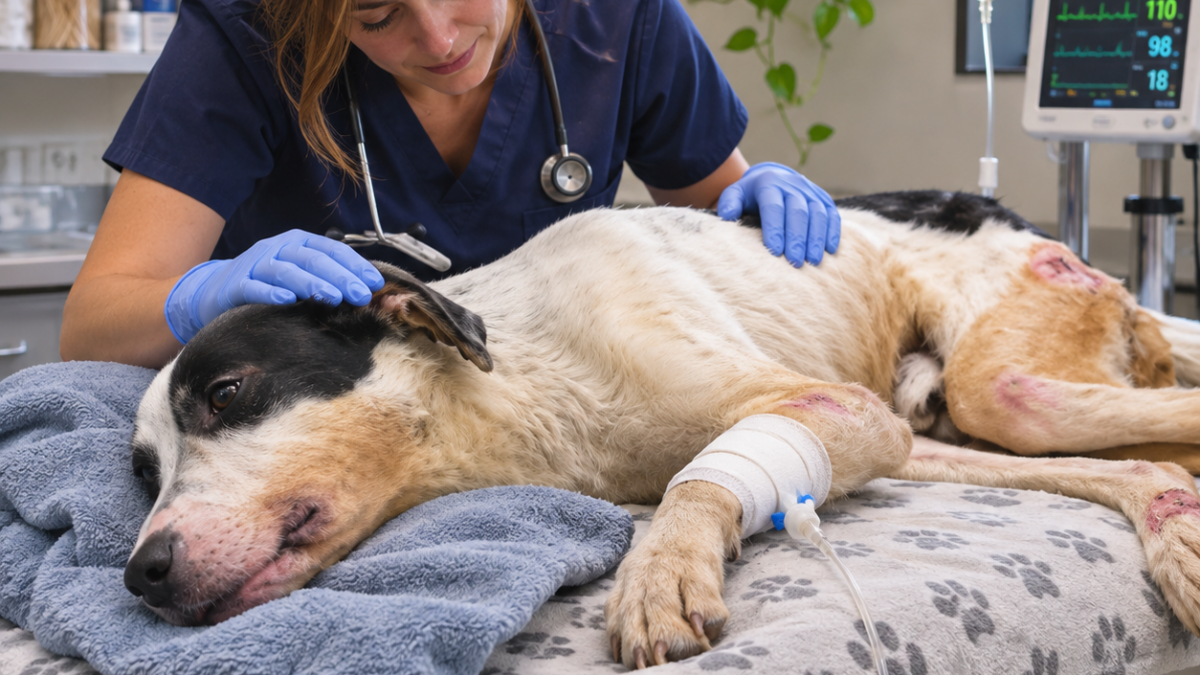
A catheter in his leg.
Monitoring wires attached.
But alive.
I sat beside him.
His eyes opened.
“Hey.”
The end of his tail moved.
Once.
I laughed through tears.
“You really need a new trick.”
It moved again.
## Why Did It Happen?
We never found one perfect explanation for the sudden distention.
His digestive system was still adjusting.
His body had been through extreme starvation.
Even controlled feeding can be complicated in severely neglected animals.
The team adjusted his meal schedule again.
Smaller portions.
More frequent.
Longer observation afterward.
For the next week, I watched his stomach after every feeding like it was a bomb.
Jacob didn’t understand.
He just knew food kept arriving.
And apparently that was enough to make him happy.
## The First Time He Stood
Three days after the emergency, Jacob surprised us again.
I was changing his bedding.
He was lying on his side.
I moved the blanket.
He rolled onto his chest.
Normal.
Then he planted both front paws.
“Jacob?”
He pushed upward.
His hind legs shook.
I froze.
Maya noticed.
“Oh my God.”
“Don’t distract him.”
“I didn’t say anything.”
“You literally just said something.”
Jacob struggled.
His hips rose.
His legs wobbled.
For one second, I thought he would fall.
Then he stood.
All four feet.
His back curved slightly.
His knees trembled.
But he was standing.
I had imagined that moment.
In my imagination, everyone cheered.
In reality, nobody made a sound.
We were afraid noise might startle him.
Jacob looked confused.
As if he had forgotten the world looked different from that height.
Then his tail began wagging.
His entire back end swayed.
“Careful,” I whispered.
He took one step.
His paw landed awkwardly.
Another.
His legs buckled.
Maya caught him before he hit the floor.
And then we screamed.
Not Jacob.
Us.
We cheered like he’d won a championship.
Jacob looked at us as if we had lost our minds.
His tail kept going.
## Walking Became His Job
Once Jacob discovered standing, he became obsessed.
He wanted to try constantly.
The problem was that his mind recovered faster than his muscles.
He believed he could walk across the room.
His legs strongly disagreed.
We used a support sling beneath his abdomen.
At first, I carried most of his weight.
“Left foot.”
Step.
“Right foot.”
Step.
“Good.”
Sometimes he crossed his front paws.
Sometimes his rear leg dragged.
Sometimes he got frustrated and sat down.
But every day, he went slightly farther.
Five feet.
Then eight.
Then across the treatment room.
The first time he walked from his kennel to the water bowl without collapsing, Maya filmed it.
Jacob took twelve slow steps.
His legs shook the entire time.
At the bowl, he drank.
Then looked back at us.
Tail wagging.
Maya started crying.
I said, “You film terribly when you cry.”
“Shut up.”
Jacob drank again.
## Eric Dalton
While Jacob learned to walk, Daniel continued investigating.
Eric Dalton eventually agreed to a formal interview.
According to him, Jacob had been his dog for nearly six years.
“He was healthy when I had him,” Eric said.
Daniel later showed us photographs recovered from an old social-media account.
Jacob was younger.
Heavier.
Standing in a backyard.
The markings matched.
Same dog.
Same face.
Same white patch on his chest.
“He looks good,” I said.
“He was.”
“Then what happened?”
Daniel exhaled.
“Eric lost his job. Moved. Says he couldn’t keep the dog.”
“And gave him to a stranger.”
“That’s his story.”
“Do you believe it?”
Daniel looked at me.
“No.”
“Why?”
“Because the timeline doesn’t fit.”
My stomach tightened.
“What timeline?”
“The landlord remembers Jacob being at the house until shortly before Eric moved out.”
“And?”
“The park where Jacob was found is less than two miles from the motel where Eric stayed afterward.”
I stared at him.
“Anything else?”
Daniel nodded.
“Traffic camera.”
“What traffic camera?”
“There is a municipal camera two blocks from the park.”
My heartbeat changed.
“Did it see Jacob?”
“Not directly.”
“Then what?”
“It saw Eric’s truck entering the street leading toward the park the night before Jacob was found.”
Silence.
I looked toward Jacob.
He was sleeping beside Maya’s desk.
“Can you prove Jacob was in it?”
“Not yet.”
“But you think—”
“I think we keep investigating.”
## The Dinosaur
The dinosaur appeared during Jacob’s third week with us.
Someone had donated a box of dog toys.
Most were ordinary.
Balls.
Ropes.
Rubber chew toys.
And one ridiculous green stuffed dinosaur with purple spikes.
Maya dumped the toys onto the floor.
Jacob was walking without the sling for short distances now.
He approached slowly.
Smelled a tennis ball.
Ignored it.
Smelled the rope.
Ignored it.
Then his nose touched the dinosaur.
He stopped.
Maya said, “No way.”
Jacob picked it up.
The toy was almost too large for his weak jaw.
He dropped it.
Picked it up again.
Then carried it back to his bed.
I laughed.
“Apparently that’s his.”
Over the next few days, the dinosaur went everywhere.
Physical therapy?
Dinosaur.
Quiet time in the office?
Dinosaur.
Walk down the hallway?
Dinosaur.
One evening I removed it because we needed to wash it.
Jacob watched me put it into the laundry bin.
Then he sat in front of the bin.
And stared.
“Seriously?”
Stare.
“It smells terrible.”
Stare.
“You have twenty other toys.”
He looked at the bin.
Maya walked past.
“You should give him his dinosaur.”
“It’s disgusting.”
“He’s suffered enough.”
“Don’t emotionally manipulate me.”
Maya shrugged.
“I’m not the one staring at you.”
I washed the dinosaur.
Jacob waited beside the dryer.
The moment I returned it, he carried it back to his bed.
That toy became part of his recovery.
I don’t know why.
Maybe it was soft.
Maybe he liked the shape.
Maybe there was no reason.
But after months when Jacob apparently owned nothing—not enough food, not a safe place to sleep, not even the strength to stand—the dinosaur was his.
And he knew it.
## The Video
Daniel called again near the end of week three.
“We found footage.”
I sat down.
“Of what?”
“A convenience store about half a mile from the park.”
My stomach dropped.
“The night before he was found?”
“Yes.”
“What does it show?”
“Eric’s truck.”
“And Jacob?”
Pause.
“Yes.”
My hand tightened around the phone.
“Tell me.”
“The truck stops at the edge of the camera view. Passenger door opens. A dog gets out.”
“Gets out?”
Daniel’s voice hardened.
“Falls out might be more accurate.”
I closed my eyes.
“He couldn’t walk.”
“I know.”
“What happens next?”
“Eric drives away.”
I couldn’t breathe for a moment.
“Jacob follows?”
“No.”
Of course not.
Jacob had been unable to stand when we found him.
Daniel continued.
“The dog remains there for several minutes. Then someone appears to drag or carry him farther toward the park.”
“Who?”
“Eric.”
My eyes opened.
“He came back?”
“He pulled him away from the road.”
“So people wouldn’t see him.”
“That would be one interpretation.”
I stood so quickly the chair rolled backward.
“He hid him.”
“Claire.”
“He didn’t give Jacob away. He dumped him where fewer people would see him.”
“We’re building the case.”
“That dog was too weak to stand.”
“I know.”
“He put him there alive.”
“I know.”
“Without water.”
“I know.”
I couldn’t speak.
Across the room, Jacob was sleeping with the dinosaur beneath his chin.
## The Charges
The veterinary report mattered.
Dr. Mercer documented that Jacob’s condition was consistent with prolonged severe neglect.
The sores showed he had spent excessive time lying down.
His body weight reflected chronic inadequate nutrition.
The state of his nails and skin told the same story.
Then the video connected Eric directly to the park.
His original story about giving Jacob away collapsed.
Eric changed it.
He claimed Jacob had run away from the motel.
Daniel showed him the footage.
Then Eric claimed he’d found Jacob near the convenience store and assumed he was dying, so he moved him somewhere “quiet.”
That sentence made me furious.
Somewhere quiet.
As though abandoning a dying animal became kindness if the place had trees.
Daniel asked, “Why didn’t you take him to a shelter?”
Eric said he didn’t have money.
“Why didn’t you call animal control?”
He didn’t answer.
“Why didn’t you call a rescue?”
Silence.
“Why didn’t you leave him in front of a veterinary hospital?”
Nothing.
Instead, he left Jacob where people rarely walked.
That was when neglect charges became abandonment charges too.
## Eric Came to the Shelter
I wish he hadn’t.
But he did.
Jacob had been with us twenty-six days.
I was at the front desk filling out medication records when the receptionist said, “There’s someone here asking about Jacob.”
I looked up.
Eric stood near the entrance.
I recognized him from the old photographs.
Older.
Tired.
Cap in his hands.
I stood.
“What do you want?”
He looked surprised by my tone.
“I wanted to see my dog.”
“Your dog?”
“Yes.”
“You mean the dog you left in the park?”
His face tightened.
“That’s not what happened.”
“We have video.”
“I know.”
“Then what part are you disputing?”
He glanced toward the hallway.
“Can I see him?”
“No.”
“I owned him six years.”
“And then you starved him.”
“I didn’t starve him.”
I walked around the desk.
“Jacob weighed less than half what he should have.”
“I was going through things.”
“So was he.”
His jaw tightened.
“You don’t understand.”
I felt every bit of restraint in my body stretch.
“You’re right.”
I stepped closer.
“I don’t understand how you can watch a dog you’ve had for six years lose enough weight that his ribs look like they’re trying to break through his skin and still not call someone.”
Eric stared at the floor.
“I thought he would get better.”
“From starvation?”
“I didn’t have money.”
“Food banks exist.”
He said nothing.
“Rescues exist.”
Nothing.
“Animal control exists.”
Still nothing.
“You had enough gas to drive him to the park.”
His face changed.
That landed.
Then he said, “I panicked.”
I laughed once.
“Jacob couldn’t stand.”
“I know.”
“You carried him away from the road.”
“I didn’t want him to get hit.”
That sentence almost broke me.
“You didn’t want him to get hit?”
I lowered my voice.
“So you dragged a dying dog farther into a park and left him there without water?”
The receptionist had gone completely silent.
Eric looked toward the hallway again.
“I just want to see him.”
“No.”
“Please.”
For one second, he sounded human.
And that made things harder.
Because cruelty isn’t always committed by monsters who look like monsters.
Sometimes it’s committed by weak people who make one selfish choice after another until another living thing pays for all of them.
Eric said, “I loved him.”
I looked directly at him.
“Then you should have acted like it.”
## Jacob Heard His Voice
From down the hallway came a sound.
A bark.
Jacob.
Eric’s head snapped up.
“That’s him.”
I froze.
Jacob rarely barked.
Eric stepped toward the hallway.
I blocked him.
“No.”
Then Jacob appeared.
Maya had been walking him toward the rehabilitation room.
He had the dinosaur in his mouth.
Eric stopped breathing.
“Rex.”
Jacob froze.
The dinosaur dropped.
For one terrible second, nobody moved.
Eric whispered, “Rex.”
Jacob’s ears went back.
His body lowered.
Not in excitement.
Not recognition filled with joy.
Fear.
Pure fear.
He took one step backward.
Then another.
Maya immediately crouched beside him.
“It’s okay.”
Jacob looked at me.
Eric said his old name again.
Jacob turned.
Picked up the dinosaur.
And walked away.
Slowly.
Shakily.
But away.
Eric’s face collapsed.
“Jacob,” I said.
Jacob’s tail wagged once without turning around.
Eric looked at me.
“You changed his name.”
“No.”
I kept watching Jacob.
“He changed his life.”
## Protective Custody
After that visit, we formally restricted Eric from contacting Jacob during the pending case.
I thought I’d feel satisfied.
Instead, I felt exhausted.
Jacob didn’t need revenge.
He needed calories.
Physical therapy.
Soft bedding.
Medication.
Time.
So I stopped thinking about Eric for a while.
I focused on the dog.
## Week Four
Jacob’s body began changing noticeably.
The hollows around his hips softened.
His ribs were still visible, but no longer looked razor sharp.
New skin formed over the pressure wounds.
Some fur started growing back.
He could walk from one end of the hallway to the other.
Slowly.
But without support.
The dinosaur came with him.
Everywhere.
People started visiting his kennel just to watch him carry it.
One volunteer brought him another dinosaur.
Blue.
Jacob sniffed it.
Walked away.
Green dinosaur only.
A third volunteer brought a dinosaur twice as large.
Ignored.
Apparently Jacob had standards.
## The First Run
Calling it a run might be generous.
It happened in the fenced exercise yard.
Jacob was trotting.
Maya stood twenty feet away.
I had the dinosaur.
“Jacob!”
His ears lifted.
I held up the toy.
He moved faster.
Three quick steps.
Almost a bounce.
Then two more.
His back legs wobbled.
He slowed.
But for five seconds, Jacob wasn’t walking like a sick dog.
He was running toward something he wanted.
I threw the dinosaur gently.
It landed in the grass.
Jacob reached it.
Picked it up.
His tail went crazy.
Maya yelled.
I cried.
Jacob looked delighted with himself.
## Weight Gain
At his one-month check, we put Jacob on the scale.
He had gained more than twenty pounds.
I stared at the number.
“Hannah.”
“I see it.”
“Twenty pounds.”
“I know.”
“Twenty.”
“Yes, Claire.”
She smiled.
“He still has more to gain.”
“Don’t ruin this.”
“I am literally his veterinarian.”
“Today you’re just the woman ruining my celebration.”
Jacob sat beside the scale.
With the dinosaur.
Tail wagging.
Dr. Mercer examined his skin.
“The sores are healing well.”
“And his bloodwork?”
“Much better.”
“Stomach?”
“Stable.”
“Heart?”
“Good.”
“Muscle?”
“Coming back.”
I looked at Jacob.
“Adoptable?”
Hannah paused.
That word hit differently.
We had been fighting to keep him alive for so long that I hadn’t let myself imagine the next step.
She nodded.
“Soon.”
## I Wasn’t Ready
The rescue director posted Jacob’s adoption profile.
I stared at it for ten minutes.
**Jacob — gentle adult male, recovering from severe neglect, affectionate, loves people, favorite toy: green dinosaur.**
I hated it.
Maya looked at me.
“What’s wrong?”
“They made him sound too good.”
“He is too good.”
“People are going to apply.”
“That is typically the idea.”
“I know.”
“You’re doing that thing.”
“What thing?”
“The foster-parent panic thing.”
“I am not.”
“You don’t even foster him. He lives at the shelter.”
“Exactly.”
“So what’s your problem?”
I looked toward the rehab room.
Jacob was asleep with the dinosaur between his paws.
“I just don’t want the wrong person.”
Maya’s expression softened.
“Neither do we.”
## The Applications
There were dozens.
Some people wanted Jacob because they had seen his transformation photos.
Those applications made me nervous.
We didn’t want someone who wanted a symbol.
We wanted someone who wanted a dog.
A dog who might have medical needs.
A dog who could become anxious around food.
A dog who had spent months neglected.
A dog who might never fully forget.
One applicant wrote:
**I want to show him what love is.**
Sweet.
But vague.
Another family had four young children and two high-energy dogs.
Probably too much.
Then an application arrived from a woman named Natalie Brooks.
She was forty-two.
Worked from home.
Owned a quiet house with a fenced backyard.
Had recently lost her senior dog after fourteen years.
No children.
One cat.
Excellent veterinary references.
And one sentence in her application caught my attention.
**I don’t need Jacob to become a different dog for me. I would like to become the kind of home he can feel safe in.**
I read it twice.
Then a third time.
## The Meet-and-Greet
Natalie arrived carrying nothing.
No treats.
No toys.
That impressed me.
People often walk into rescue meetings trying too hard.
She simply sat on the floor.
Jacob entered with me.
Dinosaur in mouth.
Natalie smiled.
“Hi.”
Jacob stopped.
She didn’t reach.
Didn’t call him.
Didn’t make kissing noises.
She waited.
Jacob walked closer.
Smelled her shoe.
Then her sleeve.
Natalie looked at me.
“Can I touch him?”
“Yes.”
She scratched gently beneath his chin.
Jacob leaned into her fingers.
Then something unexpected happened.
He dropped the dinosaur in her lap.
Maya, watching through the doorway, covered her mouth.
I whispered, “He doesn’t do that.”
Natalie looked down.
“Am I supposed to throw it?”
“You’ve been chosen.”
She laughed.
Jacob’s tail wagged.
Natalie tossed the toy three feet.
Jacob walked after it.
Picked it up.
Brought it back.
Dropped it in her lap again.
My chest hurt.
## The Home Visit
Natalie’s house was quiet.
Clean without being sterile.
The backyard was fenced.
She had already purchased a large orthopedic bed.
I pointed at it.
“You know he’s not approved yet.”
“I kept the receipt.”
“Good answer.”
There were two water bowls.
One in the kitchen.
One near the bedroom.
The cat had high escape areas where Jacob couldn’t reach.
Natalie had even spoken to her veterinarian about Jacob’s feeding history.
I hated how perfect everything looked.
Not because I wanted her to fail.
Because I knew what success meant.
He would leave.
## The Case Against Eric
While we prepared Jacob for adoption, Eric’s case moved forward.
He eventually entered a plea rather than force a full trial.
The evidence was difficult to challenge.
Veterinary documentation.
Microchip records.
His rental history.
Security footage.
His changing statements.
The condition in which Jacob was found.
The court imposed penalties related to severe neglect and abandonment.
He was prohibited from owning animals for a specified period and ordered to pay restitution toward Jacob’s medical care.
Some people at the shelter wanted more.
Longer restrictions.
More punishment.
I understood.
But I learned something during that case.
Justice rarely feels large enough when you’re comparing it to suffering.
Jacob had spent months starving.
How do you convert that into a number?
A fine?
Months?
Years?
You can’t.
The law can punish conduct.
It cannot restore time.
## Eric’s Statement
At sentencing, Eric asked to speak.
I almost didn’t attend.
Then I decided I needed to.
He stood before the judge.
His voice shook.
“I failed my dog.”
That surprised me.
No excuses at first.
“I kept thinking I would fix things the next day. Then the next week.”
He looked down.
“When I lost my job, everything fell apart.”
The judge asked, “Why didn’t you seek help?”
Eric swallowed.
“Pride.”
That word stayed with me.
Pride.
“I didn’t want people to know how bad things were.”
“So the dog suffered instead.”
Eric nodded.
“Yes.”
He began crying.
I didn’t feel sorry for him exactly.
But I didn’t feel triumphant either.
He continued.
“When he couldn’t stand anymore, I panicked. I thought if I took him somewhere public, someone would find him.”
The prosecutor replied, “You did not leave him somewhere public. You moved him to the far end of the park.”
Eric closed his eyes.
“I know.”
“Without food or water.”
“I know.”
The judge was quiet for a long moment.
Then she said, “Feeling shame does not relieve you of responsibility for what you did.”
That was exactly right.
## The Revenge I Thought I Wanted
When we first learned Eric had dumped Jacob, I imagined some dramatic confrontation.
I wanted him exposed.
Humiliated.
I wanted him to look at the dog he had abandoned and understand exactly what he had done.
Part of that happened.
He saw Jacob.
Jacob walked away from him.
He lost the right to own animals.
His neglect became part of the public court record.
But none of that felt like the real victory.
The real victory was happening somewhere else.
On a scale.
Twenty pounds gained.
In a hallway.
Forty steps without falling.
In a kennel.
Wounds closing.
In Jacob’s mouth.
One ridiculous green dinosaur.
## Adoption Day
Natalie arrived at 10:00 a.m.
I had been awake since five.
Ridiculous.
I packed Jacob’s medications.
Food.
Medical records.
Blankets.
The green dinosaur.
Then I unpacked the dinosaur because I thought he should carry it himself.
Maya watched me pacing.
“You’re making me nervous.”
“I’m fine.”
“You reorganized his file three times.”
“It wasn’t organized correctly.”
“It was alphabetized.”
“Different organizational philosophy.”
Jacob sat nearby.
Tail wagging.
Completely oblivious.
Natalie signed the papers.
Then came the part I hated.
The leash transfer.
I clipped Jacob’s leash on.
Walked him toward Natalie.
He looked at me.
I crouched.
“Okay, buddy.”
His tail wagged.
“You’re going home.”
He licked my chin.
I started crying.
“Rude.”
Maya cried too.
“Don’t look at me.”
Natalie knelt.
Jacob walked toward her.
Then stopped.
Turned around.
Went back to his bed.
My heart froze.
Then he grabbed the dinosaur.
Of course.
He carried it to Natalie.
Everyone laughed.
## The Car
Jacob had never liked vehicles much during recovery.
I understood why.
His last known ride before the rescue had ended with abandonment.
Natalie opened the rear door.
Jacob stopped.
His ears lowered.
We waited.
No pulling.
No forcing.
Natalie sat sideways on the seat.
“Take your time.”
Jacob looked at the car.
Then at me.
Then at Natalie.
He placed his front paws inside.
Stopped.
Backed out.
Tried again.
This time he climbed all the way in.
The dinosaur stayed between his teeth.
Natalie buckled his harness.
I leaned into the car.
“You’re okay.”
Jacob licked my hand.
The door closed.
I stood there as the car pulled away.
For several seconds, I couldn’t move.
Maya came beside me.
“You okay?”
“No.”
“Good.”
I laughed.
Then cried harder.
## The First Night
Natalie sent a photograph at 7:13 p.m.
Jacob was asleep on the orthopedic bed.
The dinosaur was under his chin.
The message read:
**He ate dinner, walked the backyard twice, met the cat through a gate, and is currently snoring loudly enough to concern the neighbors.**
I read it approximately twenty times.
At 10:46 p.m., another photo arrived.
Jacob on the couch.
Natalie wrote:
**I apparently misunderstood whose couch this was.**
I slept better that night than I had in weeks.
## Food
Jacob’s anxiety around food didn’t disappear immediately.
At Natalie’s house, he watched the pantry.
He followed her every time she walked toward the kitchen.
The first few weeks, he sometimes ate too quickly.
She followed his feeding plan.
Slow feeder.
Measured portions.
Routine.
Same times each day.
Then something changed.
One afternoon, Natalie sent me a video.
She filled Jacob’s bowl.
Placed it down.
Jacob smelled it.
Then walked away to get the dinosaur.
He returned.
Ate.
Paused halfway.
Drank water.
Then finished.
The video looked completely ordinary.
I cried.
Because ordinary was the goal.
Jacob had finally learned that food did not disappear if he stopped eating for thirty seconds.
He could walk away.
It would still be there.
That is what safety does.
It turns survival behaviors into unnecessary memories.
## The Dinosaur Nearly Died
Three months after adoption, Natalie called in what she described as “an emergency.”
My heart stopped.
“What happened?”
“The dinosaur has a hole.”
I stared at the phone.
“What?”
“Jacob’s dinosaur.”
“You nearly killed me.”
“Sorry.”
“Is Jacob okay?”
“He is sitting beside me staring at the dinosaur’s stuffing like someone died.”
I laughed.
Natalie sent a photograph.
The dinosaur had lost half its neck.
Jacob looked devastated.
“Can you sew?”
“Yes.”
“Fix it.”
“I am trying.”
An hour later, another photo arrived.
The dinosaur had an ugly patch across its neck.
Jacob was carrying it proudly.
**Crisis resolved.**
That toy survived three more years.
## Jacob’s First Winter
Snow terrified him at first.
Not because of the cold.
Because his feet slipped.
His weakened muscles still made him cautious on unstable surfaces.
Natalie walked slowly beside him.
The first snowfall, he stepped outside.
Stopped.
Smelled the ground.
Lifted one paw.
Then another.
Eventually, he discovered that snow could be kicked.
Five minutes later, Jacob was bounding through the yard.
Actually bounding.
Natalie sent me the video.
I watched it at work.
Maya came over.
“What?”
I pointed.
Jacob ran across the snow.
He turned.
Leaped.
Grabbed the dinosaur from the porch.
Ran again.
Maya put her head on my shoulder.
“Remember the park?”
“Yes.”
Neither of us said anything else.
## One Year Later
On the anniversary of Jacob’s rescue, Natalie brought him back to visit.
He had gained the rest of the weight he needed.
His coat was thick.
The sores were gone.
Muscle covered his hips.
He walked confidently.
Then he saw me.
His entire body began wagging.
Not his tail.
His body.
He ran toward me.
I dropped to my knees.
“Jacob!”
He hit me hard enough to knock me backward.
I laughed into his fur.
“You weigh too much now.”
His tail slapped the floor.
Maya came running.
Jacob greeted her too.
Then, naturally, he returned to Natalie.
That mattered.
He loved us.
But he knew where home was.
## Daniel Visited
Officer Daniel Reeves stopped by that afternoon.
He hadn’t seen Jacob since the investigation ended.
When Jacob walked into the lobby, Daniel stared.
“That is not the same dog.”
“It is.”
“No.”
“Yes.”
Jacob approached him.
Daniel crouched.
“Hey, buddy.”
Tail wag.
Daniel looked at me.
“Still everybody’s friend.”
“Unfortunately.”
He scratched Jacob’s chest.
“Good.”
Then he noticed the dinosaur.
“That thing still alive?”
“Technically.”
Natalie held it up.
Several repairs.
One missing spike.
Half a tail.
Jacob immediately took it back.
Daniel laughed.
## Eric Never Contacted Us Again
After the case, Eric disappeared from Jacob’s life.
That was probably best.
I sometimes wondered whether he thought about him.
Whether he saw the transformation photographs.
Whether he regretted what he had done.
I hoped so.
Not because I wanted him tortured by guilt forever.
Because regret can be useful if it prevents another failure.
But Jacob didn’t need Eric’s regret.
Jacob had moved on without it.
That was more powerful.
## The Park
Two years after Jacob’s rescue, Natalie asked me something.
“Do you think we should take him back there?”
I knew immediately what she meant.
The park.
I hesitated.
“Why?”
“I don’t know.”
“Then maybe not.”
She nodded.
A month later, she asked again.
“I keep thinking that place is part of his story.”
“It is.”
“But it shouldn’t belong only to the worst day.”
That made me stop.
We talked to a behavior consultant.
Jacob was stable.
Confident.
No major fear behaviors.
So one quiet spring morning, we went.
Natalie drove.
I met them there.
Jacob stepped out of the car.
The dinosaur stayed home.
He smelled the grass.
Tail relaxed.
We walked the front path.
Then the soccer field.
Then farther back.
My chest tightened as we approached the area near the fence.
The place where we’d found him.
Jacob slowed.
I watched carefully.
He sniffed.
Walked in a circle.
Then lifted his leg on the exact tree beside the spot where he’d once been unable to raise his head.
Natalie burst out laughing.
I laughed so hard I cried.
“That,” she said, “feels appropriate.”
Jacob finished.
Kicked grass behind himself.
And walked away.
No fear.
No collapse.
No waiting.
He didn’t know that place owned a piece of our memory.
Apparently, it didn’t own his.
## The Bench
A year later, our rescue placed a small bench near the walking path with the park department’s permission.
It wasn’t a memorial.
Jacob was alive.
We didn’t want anything that made his story sound finished.
The plaque simply read:
**For the animals who are still waiting for someone to stop.**
No name.
No photograph.
But we knew.
## Jacob Became a Therapy Dog
This part surprised everyone.
Natalie noticed Jacob was unusually calm around older people.
He liked leaning against legs.
Resting his head on laps.
Sitting quietly while someone touched him.
After training and evaluation, he began visiting a senior living center.
The first time, I went with them.
Jacob walked into the common room carrying—yes—the dinosaur.
An elderly man named Walter laughed.
“What’ve you got there?”
Jacob approached.
Dropped the toy at Walter’s feet.
Walter picked it up.
“Dinosaur?”
Jacob wagged.
Walter threw it approximately two feet.
Jacob retrieved it.
That became their routine.
Every visit, Walter asked for the dinosaur.
Jacob brought it.
One afternoon, Walter’s daughter told Natalie that her father had stopped participating in many activities after losing his wife.
“But he remembers Jacob’s days.”
That nearly destroyed me.
The dog someone had discarded because caring for him became difficult was now giving other people reasons to look forward to something.
## The Dinosaur’s Final Day
At nearly five years old, the toy finally became unsalvageable.
Its body had been stitched at least nine times.
Both purple spikes were gone.
One leg had been replaced with fabric from another toy.
The stuffing had been changed twice.
Natalie called me.
“I think we’ve reached the end.”
“No.”
“Claire.”
“We can rebuild him.”
“It’s mostly patches.”
“Franken-dinosaur is still dinosaur.”
She laughed.
We tried one final repair.
Jacob carried it for another month.
Then one morning, Natalie found it torn completely open.
Stuffing everywhere.
Jacob sitting beside the remains.
She took a photograph.
His expression was genuinely tragic.
We debated replacing it.
We found a similar green dinosaur online.
Not identical.
Natalie bought it.
Jacob sniffed the new toy.
Ignored it.
Of course.
So she kept a small piece of the original dinosaur’s fabric.
She sewed it into the new one.
Jacob smelled it again.
Picked it up.
Walked to his bed.
Natalie texted me:
**Apparently continuity has been restored.**
## Five Years After the Park
Jacob’s muzzle began turning gray.
Not much.
Just a little around the chin.
He slowed down slightly.
Still loved walks.
Still loved people.
Still followed Natalie into the kitchen.
But no longer worried about food.
His body had filled out so completely that new volunteers who heard his story often didn’t believe the early photographs.
I kept one image in my office.
Jacob on the first day.
Bones visible.
Head down.
Too weak to stand.
Beside it, another photograph.
Jacob five years later.
Standing in a field.
Dinosaur in his mouth.
Tail blurred because it was moving too fast.
Those two images explained rescue better than anything I could say.
## The Question People Asked
“Why was he still sweet?”
People asked that constantly.
After starvation.
Neglect.
Abandonment.
Why didn’t Jacob hate humans?
I never had a satisfying answer.
Dogs don’t process betrayal exactly as we do.
Maybe he separated one person’s actions from everyone else.
Maybe his temperament was simply gentle.
Maybe he wanted connection so badly that he took the first safe opportunity.
Or maybe kindness isn’t always something suffering destroys.
Sometimes kindness survives precisely because it refuses to become what hurt it.
I don’t know.
I only know Jacob never stopped wagging.
## The Small Wag
That first wag became famous among our team.
Every time Jacob visited, somebody mentioned it.
“You remember when he barely moved his tail?”
“Yes.”
“Now he could injure someone with it.”
That was true.
His tail knocked cups off coffee tables.
Hit walls.
Slapped people’s legs.
Natalie once texted:
**Jacob broke a wine glass with happiness.**
Good.
Let happiness be destructive for once.
## The Last Time I Saw Eric
Years after the court case, I saw Eric by accident.
Grocery store.
Different part of town.
I recognized him.
He recognized me.
For several seconds, neither of us spoke.
Then he said, “How’s he doing?”
I could have ignored him.
Instead, I answered.
“Good.”
Eric looked down.
“Still alive?”
The question angered me immediately.
Then I realized what it meant.
When Eric left Jacob in that park, he had probably assumed death was inevitable.
“Yes.”
I kept my voice steady.
“Very alive.”
Eric swallowed.
“Does he have a home?”
“He has a great home.”
“Good.”
I studied him.
He looked older.
Not dramatically ruined.
No cinematic punishment.
Just a man carrying the consequences of something he couldn’t undo.
He asked, “Does he ever…”
He stopped.
“What?”
“Does he remember me?”
I thought of the day Jacob heard his old name and backed away.
I could have hurt Eric with that memory.
Part of me wanted to.
Instead, I said, “I don’t know.”
He nodded.
Then quietly asked, “Is he happy?”
“Yes.”
Eric closed his eyes for a second.
“Good.”
I walked away.
That was the last time I saw him.
## What Revenge Really Looked Like
If you had asked me during Jacob’s first week what justice should look like, my answer would have been ugly.
I was angry.
I wanted the person responsible to hurt.
But years changed my answer.
The best revenge was Jacob becoming inconveniently healthy.
It was the veterinary bills turning into adoption photos.
It was a dog who couldn’t lift his head eventually knocking people over with affection.
It was food becoming boring enough that he could leave half a bowl for thirty seconds.
It was his old owner losing the right to decide what happened to him.
It was the park becoming somewhere Jacob could pee on a tree and leave.
It was that dinosaur.
Especially the dinosaur.
Because people underestimate what ownership means to a neglected animal.
That toy wasn’t valuable.
Probably cost ten dollars.
But it was Jacob’s.
Nobody took it because they were angry.
Nobody traded it for food.
Nobody made him earn it.
It belonged to him because we decided he deserved things that were simply his.
## Seven Years Later
Jacob grew old.
There is no way to write that sentence without feeling the weight of time.
He developed arthritis in his hips.
Not surprising after everything his body had endured.
Natalie managed it with medication, supplements, controlled exercise and absurdly expensive orthopedic beds.
He owned three.
One bedroom.
One living room.
One office.
“He has more beds than I do,” Natalie complained.
“Correct.”
The new dinosaur remained near whichever bed he chose.
He still visited the senior center, though less often.
Walter had passed away years earlier.
Jacob continued meeting other residents.
He had become the old one now.
There was something beautiful about that.
Once, he had needed people to help him stand.
Now he moved slowly beside elderly people using walkers.
Everybody took their time.
## The Day He Refused Breakfast
When Natalie called me one morning, I knew from her voice.
“He didn’t eat.”
My stomach tightened.
Jacob refusing food meant something.
“How long?”
“Since last night.”
“Vet?”
“We’re going now.”
I met them.
He was almost twelve.
Maybe older.
The exact age had never been certain.
He looked tired.
But his tail moved when he saw me.
Of course it did.
“Hey, buddy.”
I crouched slowly because my own knees were older now too.
Jacob rested his head against my chest.
The dinosaur lay beside him.
Bloodwork showed kidney changes.
Nothing immediately catastrophic.
But significant.
We adjusted food.
Medication.
Fluids.
Jacob improved.
Not back to young Jacob.
But enough.
He ate.
Walked.
Slept.
Stole one piece of chicken from Natalie.
A successful recovery by old-dog standards.
## Another Year
We got almost another year.
A year of slow walks.
Sunlight.
Car rides.
Soft beds.
Dinosaur repairs.
Tail wags.
Then Jacob’s body began telling us what his heart never would.
He was tired.
His hips hurt.
His kidneys worsened.
There were good days.
Then fewer good days.
Natalie called me.
“I don’t know how to know.”
Everyone who has loved an old animal understands that sentence.
I went to her house.
Jacob was lying on the porch.
He lifted his head.
Tail wag.
Still.
Always.
I sat beside him.
Natalie cried.
“How can I make the decision when he still wags?”
I looked at Jacob.
“Because the wag means he loves you.”
She covered her face.
“It doesn’t necessarily mean his body feels good.”
That was one of the hardest things I’ve ever said.
## His Final Morning
Jacob ate chicken.
Not veterinary diet.
Not carefully measured rescue portions.
Chicken.
As much as he wanted.
If Dr. Mercer had objected, I would have fought her.
She didn’t.
Jacob lay on his favorite bed near the window.
Natalie sat on one side.
I sat on the other.
Maya came.
Daniel came too.
He had retired from animal control, but Jacob’s story had stayed with him.
The dinosaur was between Jacob’s front paws.
Old.
Patched.
Different from the original but carrying that little piece of green fabric inside.
Jacob looked around at us.
Tail moved.
Daniel laughed through tears.
“There it is.”
“What?”
“That damn tail.”
Jacob wagged again.
## We Didn’t Let Him Be Afraid
Dr. Mercer came to the house.
That was important.
No sterile room.
No strange table.
No fear.
Jacob was home.
Natalie held his face.
“You were such a good boy.”
Jacob licked her wrist.
I stroked the white fur on his muzzle.
I thought about the park.
That first day.
The bones.
The sores.
The tiny tail movement.
All the meals.
The emergency.
The first time he sat.
The first steps.
The dinosaur.
The snow.
The therapy visits.
The park again.
A whole life.
A life we almost never got.
Jacob’s breathing slowed.
Natalie whispered, “You don’t have to keep trying for me.”
His eyes stayed on her.
Then closed.
The end of his tail moved once.
One final small wag.
Almost exactly like the first.
And then he was gone.
## I Thought the Story Ended There
For a while, I couldn’t look at the original photograph.
The one from the park.
It made me angry again.
Not because Jacob had died.
Old dogs die.
That wasn’t the injustice.
The injustice was realizing how close he had come to never having those extra years.
One phone call changed everything.
One person noticed a dog lying in weeds.
One person didn’t assume someone else would call.
Because of that, Jacob got years.
Years.
Not days.
## Natalie Brought Me the Dinosaur
A week after Jacob died, Natalie came to the shelter.
She was carrying a paper bag.
“I can’t keep this.”
I knew before she opened it.
The dinosaur.
I touched the patched fabric.
“You sure?”
“No.”
She laughed sadly.
“But I think it belongs here.”
We placed it in a shadow box.
Not because the toy was sacred.
Because of what it represented.
Beneath it, we put a photograph of Jacob walking with it in his mouth.
No photograph of his starved body.
We didn’t want suffering to be the first thing people saw.
The plaque read:
**Jacob — He learned to stand, then he never stopped moving forward.**
## The New Dog
Two months later, another dog came in.
Older female.
Underweight.
Frightened.
Not as severe as Jacob.
But close enough to hurt.
A new volunteer named Sophie stood beside her kennel.
“She won’t eat.”
I looked.
The dog was facing the wall.
“How long has she been here?”
“Three hours.”
I smiled slightly.
“Three hours isn’t very long.”
“What do we do?”
“Sit.”
“That’s it?”
“For now.”
Sophie sat on the floor.
I joined her.
We waited.
Ten minutes.
Twenty.
Eventually, the dog turned.
Smelled the food.
Took one bite.
Sophie smiled.
Then the dog’s tail moved.
Just a little.
I stopped breathing.
For one second, Jacob was everywhere.
## What Jacob Left Behind
Jacob didn’t become famous in any way that mattered to him.
Dogs don’t care about views.
Shares.
Comments.
Court records.
News stories.
He cared about food.
Natalie.
Warmth.
Walks.
Attention.
And that ridiculous dinosaur.
But his story changed the way our shelter worked.
We developed better protocols for severe starvation cases.
We trained more volunteers in slow refeeding and mobility support.
We created an emergency fund specifically for neglect survivors whose care might last weeks or months.
Daniel used Jacob’s case in training sessions for younger animal-control officers.
“Don’t assume a dog lying still is already lost,” he told them.
Sometimes a small tail movement is enough reason to keep going.
## The Park Bench Again
After Jacob died, Natalie and I returned to the park.
We sat on the bench.
The plaque was still there.
**For the animals who are still waiting for someone to stop.**
A family walked past with a healthy dog.
Children were playing near the soccer field.
Someone jogged down the path.
Ordinary life.
Natalie looked toward the far fence.
“That’s where he was?”
“Yes.”
“I’ve seen the pictures.”
“I know.”
“But standing here…”
She couldn’t finish.
I understood.
The distance from the road wasn’t huge.
But for a dog who couldn’t stand, it might as well have been miles.
“He was supposed to disappear there,” I said.
Natalie looked at me.
“What?”
“That’s what I think.”
She nodded slowly.
“Didn’t work.”
I smiled.
“No.”
It really didn’t.
## The Person Who Called
Years after everything, I finally tracked down the man who had made the original call.
His name was Harold.
He hadn’t followed Jacob’s story closely.
He had moved away.
When I reached him, I said, “You once called about a dog lying at the back of a park.”
There was silence.
Then, “That big brown dog?”
“Yes.”
“Did he make it?”
I almost laughed.
“You have no idea.”
I told him.
The recovery.
The dinosaur.
The adoption.
The therapy visits.
The years.
When I finished, Harold was quiet.
“I thought he was dying.”
“He was.”
“Wow.”
“You saved him.”
“No.”
“Yes.”
“I just called.”
“That was the thing nobody else had done yet.”
Harold became quiet again.
Then he said, “I’m glad I stopped.”
So was I.
## The Story I Choose to Remember
People naturally focus on the beginning.
Dog abandoned.
Starving.
Unable to stand.
It is shocking.
That’s why those photographs get attention.
But I don’t want the park to be Jacob’s defining image.
I don’t want Eric’s failure to become the most important thing that ever happened to him.
So when I think of Jacob now, I choose another picture.
He’s standing in Natalie’s backyard.
Healthy.
Broad-chested.
Gray beginning around his muzzle.
Sunlight on his coat.
The dinosaur hanging from his mouth.
Tail blurred.
Not because the camera was bad.
Because Jacob couldn’t stop wagging.
That is the dog I remember.
## What Happened to the Man Who Left Him?
People still ask.
Eric served the penalties imposed by the court.
He lost the right to own animals during the restriction period.
He paid restitution.
His actions became part of the record.
And then life moved on.
Some people think that isn’t enough.
Maybe they’re right.
But I stopped measuring Jacob’s justice by Eric’s punishment.
Because if I did that, Eric remained at the center of the story.
He didn’t deserve that position.
Jacob did.
Justice was not Eric’s worst day.
Justice was Jacob’s best years.
## The Difference Between Surviving and Living
On the day we found him, Jacob was surviving.
Barely.
Breathing.
Heart beating.
Technically alive.
That’s different from living.
Living was the first time he chose a toy.
Living was barking because Natalie took too long opening the back door.
Living was stealing chicken.
Living was running in snow.
Living was visiting Walter.
Living was taking up too much room on the couch.
Living was becoming old enough to have arthritis.
Even that mattered.
Jacob got to become an old dog.
Do you understand what a victory that was?
Someone had left him expecting him not to survive the week.
He got old.
He got gray.
He got slow.
He became expensive in all the ordinary senior-dog ways.
And Natalie loved him through every bit of it.
## The First Tail Wag and the Last
I think about those two movements more than anything.
The first.
Jacob lying on blankets, too weak to raise his body, eating a few careful bites while I held the bowl.
He looked up.
Tail moved.
Barely.
The last.
Jacob lying in his own home, surrounded by people who loved him.
Old.
Tired.
Safe.
Tail moved.
Barely.
The movements looked almost identical.
Everything between them was the life.
## If Jacob Could Have Understood
I sometimes wish I could go back to the park and speak to him.
Not rescue him differently.
We did the best we could.
I just wish I could tell that starving dog what was coming.
I would kneel beside him.
Probably avoid touching the worst sores.
And say:
“You’re going to eat again.”
“You’re going to stand.”
“You’ll scare us half to death once, but you’re going to survive that too.”
“You’ll walk.”
“You’ll run.”
“You’re going to pick a ridiculous dinosaur and make grown adults emotionally dependent on it.”
“You’ll have a woman who rearranges her entire life around you.”
“You’ll sleep on couches.”
“You’ll see snow.”
“You’ll make lonely people smile.”
“You’ll get old.”
“You’ll be loved so long that one day saying goodbye will break us.”
“And that is a beautiful thing.”
## The Real Ending
Jacob’s story did not end in that park.
It did not end in the emergency room when his stomach swelled.
It did not end when the person who abandoned him faced the court.
It did not even end on adoption day.
His story became years of ordinary mornings.
That is the ending neglect survivors deserve.
Ordinary mornings.
Breakfast.
Water.
A door that opens into a fenced yard.
A person who comes back.
A bed that remains in the same place.
A toy that belongs to them.
No fear that one mistake will make everything disappear.
No wondering whether the next meal will come.
No being carried into a quiet corner of a park because somebody is too ashamed to ask for help.
Jacob got those mornings.
Thousands of them.
## The Dinosaur Still Sits in My Office
The shadow box hangs across from my desk.
Visitors sometimes ask about it.
“Why is there an old stuffed dinosaur on the wall?”
I tell them about Jacob.
But I don’t start with starvation anymore.
I start with the toy.
“There was a dog who loved this dinosaur.”
Then I tell them he once couldn’t stand.
Then that he learned.
Then that he walked.
Then that he ran.
Then that he went home.
Sometimes people cry.
That’s okay.
I still do.
## The Dog Who Was Supposed to Disappear
Someone carried Jacob to the quietest end of a park because they wanted a problem out of sight.
That’s the part I’ll never completely forgive.
Not the poverty.
Not the fear.
Not even the shame.
People struggle.
People lose jobs.
People get overwhelmed.
There are reasons people fail.
But when Jacob became too weak to stand, somebody made a decision.
Not to call.
Not to ask.
Not to surrender him.
To hide him.
And Jacob’s entire second life became the answer to that decision.
He didn’t disappear.
He became impossible to forget.
## One Final Morning
Years after Jacob died, I arrived at the shelter early.
Sunlight was coming through the front windows.
The building was quiet.
I made coffee.
Walked past the shadow box.
Stopped.
The dinosaur’s fabric had faded slightly.
I looked at Jacob’s photograph.
Healthy.
Standing.
Tail blurred.
I smiled.
Then from the medical room, I heard a bowl move.
The new neglected dog we’d admitted the day before was eating.
I walked in.
Sophie sat beside her.
The dog looked up.
Tail moved.
Once.
Sophie whispered, “Did you see that?”
I laughed.
“Yes.”
She looked confused.
“Why are you crying?”
I wiped my face.
“Long story.”
The dog ate another bite.
Then another.
I sat down beside them.
And somewhere behind us, hanging on an office wall, was an old green dinosaur that had once belonged to a dog who taught all of us that sometimes survival begins with almost nothing.
A phone call.
A bowl of food.
A hand beneath a weak body.
One shaky step.
One small wag.
Jacob had started with less strength than any dog should ever have to find.
But he kept giving us one tiny sign after another that he was still there.
Still trying.
So we kept trying too.
And eventually the dog who had been left in the weeds because he could no longer stand walked out of our shelter carrying his favorite dinosaur in his mouth beside the woman who would become his family.
Years later, when his legs finally grew tired for the last time, he wasn’t alone.
He wasn’t hungry.
He wasn’t lying on cold ground wondering whether anyone would come.
He was home.
His person was holding him.
His dinosaur was between his paws.
And the tail that had once barely managed a single movement after his first meal moved one last time beneath a hand that had loved him for years.
Someone had once abandoned Jacob because caring for him had become too difficult.
Jacob spent the rest of his life proving that being difficult to save never meant he wasn’t worth saving.
That was his revenge.
That was his victory.
And that was the ending the dog at the far end of the park had deserved all along.
**THE END**








