PART 2: They Left Disney Outside to Di3—Then Another Rescue Dog Gave Her the Blood That Saved Her Life
PART 2
I sat beside Disney throughout most of the transfusion.
The room was quiet except for the monitor and the occasional movement of the veterinary staff checking her lines.
Waldito had already finished donating.
His handler stayed for a while, giving him water and rubbing his neck while he rested.
Disney never understood what he had done for her.
That thought stayed with me.
Animals do not need recognition to save each other.
Waldito had walked into a clinic healthy, donated blood to a dog he had never met, accepted a snack afterward, and then gone back to his ordinary life.
Disney’s life was no longer ordinary.
Not yet.
At that moment, every number mattered.
Her temperature.
Her pulse.
Her blood pressure.
Her respiration.
Whether her gums became slightly pinker.
Whether her body rejected the transfusion.
Whether her heart had enough strength left to use what it was being given.
I watched Sarah check Disney again.
“Well?”
“She’s tolerating it.”
“You said that before.”
“And I’m happy to say it again.”
I looked at the bag of blood.
“How long before we know?”
“We’ll reassess after the transfusion and repeat bloodwork.”
“Could it fail?”
“Yes.”
Sarah had a way of answering honestly without taking hope away.
I appreciated that.
Disney had already been failed by people who chose not to face reality.
The least we could give her now was truth.
I put my hand near her face.
She smelled my fingers.
Then closed her eyes.
“Rest.”
For the first time since we found her, she seemed able to.
The food she had eaten earlier remained on my mind.
I had never seen hunger like that.
Disney had not simply eaten quickly.
She had eaten with panic.
Her entire body had moved toward the bowl despite barely having strength to lift herself.
Sarah had stopped us from giving too much at once.
“She needs nutrition,” I had said.
“She does.”
“Then why are we taking the food away?”
“Because a body this malnourished has adapted to starvation. If we suddenly flood her system with calories, we can cause dangerous electrolyte shifts.”
Refeeding syndrome.
I had heard the term before.
It sounded almost cruel in Disney’s case.
She had been denied food long enough that feeding her improperly could now hurt her too.
So even kindness had to be measured.
Small portions.
Specific calories.
Slow increases.
Bloodwork.
Monitoring.
Everything controlled.
There would be no large celebratory meal.
Not yet.
Disney’s recovery would begin with tiny amounts of what she should have had all along.
Food.
Water.
Blood.
Warmth.
Rest.
The first transfusion ended without a major reaction.
Sarah repeated the blood test.
The numbers improved.
Not enough to relax.
Enough to breathe.
“She responded.”
I felt my knees weaken.
“How much?”
“Enough that I’m encouraged.”
“Does she need another transfusion?”
“Possibly. We’re going to watch her closely.”
Disney opened her eyes.
I leaned closer.
“Did you hear that?”
Nothing.
“You’re making progress.”
Her nose moved toward my hand.
I touched her cheek.
She did not pull away.
That night, Disney remained hospitalized.
I hated leaving.
Sarah eventually ordered me home.
“You’re exhausted.”
“She’s worse.”
“She has an entire medical team.”
“I know.”
“You staying awake in that chair doesn’t increase her hemoglobin.”
“I know.”
“Go sleep.”
I stood beside Disney’s bed.
“Will somebody call?”
“If anything changes.”
I bent down.
“I’ll come back.”
Her eyes were closed.
Maybe she heard me.
The promise was for me too.
I drove home still smelling the clinic disinfectant on my clothes.
I slept badly.
At 5:17 a.m., my phone rang.
I grabbed it before the second ring.
“Hello?”
“It’s Sarah.”
I sat upright.
“What happened?”
“Nothing bad.”
I closed my eyes.
“You can’t start a call like that.”
“I wanted to tell you Disney ate another small meal.”
I laughed from relief.
“How much?”
“Exactly what we gave her.”
“Still hungry?”
“Very.”
“That has to be good.”
“It is.”
I was dressed ten minutes later.
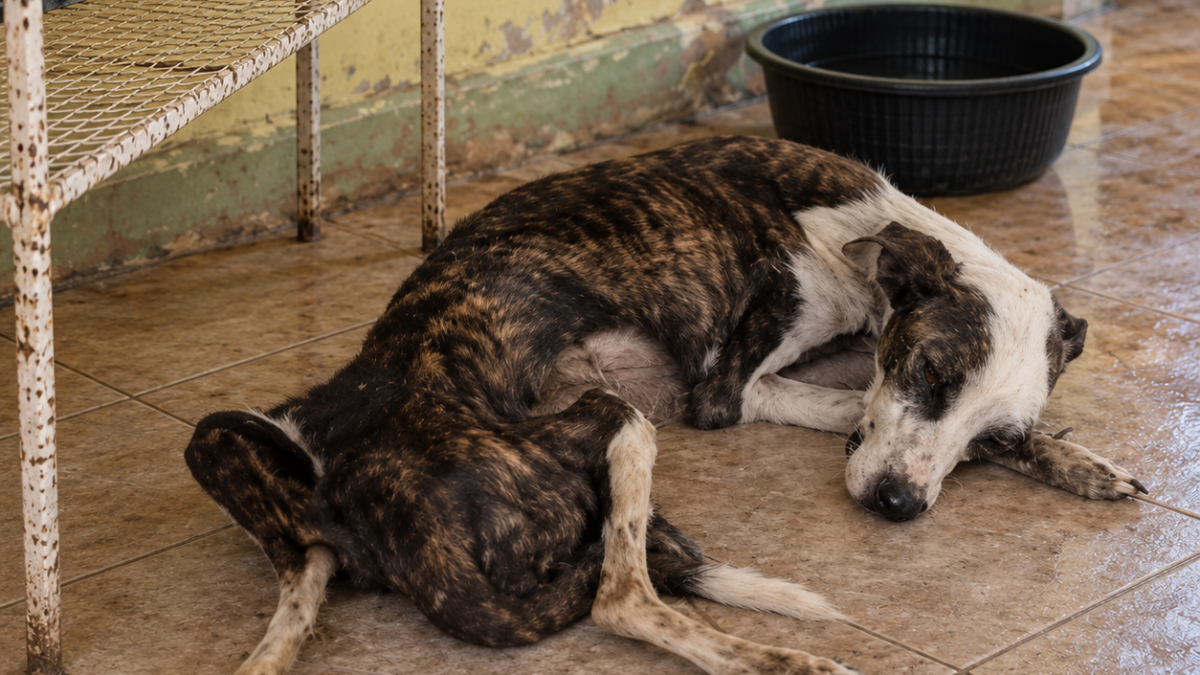
When I arrived, Disney was lying on a clean blanket.
For the first time, the flies were gone.
It sounds like such a small detail.
I noticed it immediately.
No insects crawling across her body.
No dirt beneath her.
No waste around her.
Just a dog resting in a clean bed.
Her coat was still dull.
Her bones still visible.
Her eyes still tired.
But she looked like a patient instead of something the world had discarded.
I knelt.
“Morning.”
Her tail moved.
Not a wag exactly.
A twitch.
I froze.
“Did you see that?”
A technician named Emma smiled.
“She did it when I brought breakfast too.”
“So I’m not special.”
“Food is currently winning.”
I laughed.
“Fair.”
Disney lifted her head.
That movement alone was stronger than yesterday.
Emma placed a small measured portion in front of her.
Disney ate immediately.
Then licked the bowl.
Then looked around for more.
“No.”
Disney continued searching.
“I know. Worst rescue ever.”
Emma smiled.
“She’ll forgive us.”
The first three days were the most frightening.
Disney’s body was so depleted that nothing could be assumed.
She could eat in the morning and look weaker by afternoon.
Her hydration improved, then needed adjustment.
Her red blood-cell values rose after the transfusion but remained below normal.
Every organ had been functioning under chronic stress.
The medical team screened for parasites, infection and other possible contributors to the anemia.
There were multiple problems, but severe neglect and malnutrition had clearly devastated her.
The physical evidence told a timeline.
Weight loss at that degree does not appear overnight.
Neither does the muscle wasting.
Neither does the condition of skin exposed to filth for long periods.
Disney had been deteriorating where someone could see her.
That fact became harder to ignore every day.
On the second afternoon, I asked Sarah:
“How long do you think she was like this?”
“I can’t give you an exact number.”
“Weeks?”
“At least enough time that this should have been obvious.”
“Months?”
“Possibly. The chronicity of the body condition suggests prolonged inadequate nutrition.”
I stared at Disney.
“How could anyone walk past her?”
Sarah did not answer.
Veterinarians see the result.
They do not always know the psychology behind it.
That question belonged to an investigation.
We filed the report immediately.
Animal-control officer Rachel Gomez arrived at the clinic that evening.
She photographed Disney.
Not casually.
Evidence photographs.
Body condition.
Visible ribs.
Hips.
Dirty coat as documented at rescue.
Medical records.
Initial hemoglobin.
Condition of the area where she had been found.
We had photographs from the rescue scene too.
Rachel looked through them quietly.
“This was outside the home?”
“Yes.”
“Owned dog?”
“That’s what neighbors said.”
“Anyone living there?”
“Yes.”
“Did they surrender her?”
“No. They weren’t there when we removed her.”
Rachel paused.
“Did they know you took her?”
“A neighbor contacted them.”
“And?”
“They said they didn’t want responsibility for the veterinary bill.”
Rachel looked at me.
“That’s useful.”
My jaw tightened.
“Useful?”
“For the case.”
I understood what she meant.
Still, the words made me angry.
Disney was fighting to survive.
The first thing the people responsible apparently worried about was cost.
Not:
Is she alive?
Not:
Will she make it?
Not:
Can I see her?
The bill.
Rachel gathered names.
Statements.
Ownership records.
Previous veterinary history if any existed.
The investigation would move separately from Disney’s medical care.
That was important.
I could not let anger distract from the dog in front of me.
Disney did not need revenge that evening.
She needed dinner measured in grams.
By the fourth day, she could sit upright without immediately collapsing.
I stood outside her enclosure watching.
Disney pushed with her front legs.
Her body trembled.
Then she sat.
Her head wobbled slightly.
Emma put one hand near her in case she fell.
“She did it.”
Disney remained upright for perhaps fifteen seconds.
Then lowered herself carefully.
I felt ridiculous celebrating.
Fifteen seconds of sitting.
But survival rebuilds from the smallest movements.
A head lifted.
A paw moved.
A meal finished.
A body sitting upright.
We celebrated all of it.
That afternoon, Waldito visited.
His handler had brought him for a routine recheck after the donation.
I asked if Disney could see him from a safe distance.
Sarah agreed as long as both dogs remained calm.
Waldito approached the doorway.
Disney lifted her head.
She smelled the air.
Waldito’s tail moved.
Disney watched him.
There was no magical recognition.
I did not expect one.
But I knelt between them and thought about what connected them invisibly.
Part of Waldito had entered Disney’s bloodstream and helped carry oxygen through a body that had almost run out.
“That’s the guy,” I whispered.
Disney looked at me.
“The reason everyone calls you dramatic when you don’t finish your food.”
Waldito sneezed.
His handler laughed.
Disney’s tail moved slightly.
We took a photograph.
Not because either dog understood.
Because I did.
I kept that photograph for years.
Waldito standing.
Healthy.
Disney lying under a blanket.
Thin.
But alive.
The donor and the survivor.
By the end of the first week, Disney attempted to stand.
The first effort failed.
Her legs simply could not support her weight.
She pushed up.
Her front half rose.
The rear legs shook.
Then she collapsed gently onto the bedding.
I moved forward.
“Easy.”
She looked at me.
“Again later.”
Disney tried again immediately.
I laughed.
“Apparently you disagree.”
Emma supported her under the abdomen.
Disney pushed.
This time, all four paws touched the floor.
Her entire body trembled.
I held my breath.
Three seconds.
Four.
Five.
Then down.
“Good girl.”
Her tail moved.
The next attempt lasted eight seconds.
By the following day, twelve.
Muscle had to be rebuilt.
Starvation had taken more than fat.
Disney’s body had consumed itself to survive.
Protein from muscles.
Energy reserves.
Everything nonessential had been sacrificed to keep the heart beating and lungs moving.
Standing now required rebuilding what hunger had stolen.
Physical rehabilitation began gently.
No forced exercise.
No long walks.
Controlled standing.
Weight shifts.
Short supported steps.
Rest.
A severely malnourished animal can look eager before the body is ready.
We had to protect Disney from her own improving enthusiasm.
Food created the funniest conflict.
Every time anyone entered carrying a bowl, Disney transformed.
The exhausted dog disappeared.
Her head lifted.
Eyes widened.
Tail tried to wag.
When the portion ended, she looked betrayed.
I sat beside her after one meal.
“That’s all.”
Disney licked the bowl.
“Seriously.”
She licked it again.
“There will be another one.”
She stared.
“You don’t believe me.”
Of course she didn’t.
Hunger had taught Disney something powerful:
Food disappears.
Eat now.
Tomorrow is uncertain.
We would spend months teaching the opposite.
Bowls refill.
Meals return.
No one steals them.
You do not have to panic.
That lesson could not be spoken.
It had to be repeated.
The investigation developed while Disney gained strength.
Rachel located the people listed as her owners.
A couple named Eric and Melissa Turner.
They claimed Disney had “stopped eating on her own.”
That explanation reached me through Rachel.
I stared at her.
“She didn’t stop eating.”
“I know.”
“She tried to swallow the bowl.”
“I know.”
“She was desperate for food.”
“That will matter.”
Eric claimed Disney had been sick.
Melissa said they believed she was “getting old.”
Disney was not extremely old.
They said veterinary care had been too expensive.
Then they claimed she had deteriorated only recently.
Neighbors told a different story.
A woman next door, Lorraine, had watched Disney become progressively thinner over several months.
“I asked them about her twice,” she told Rachel.
“What did they say?”
“The first time, that she was picky. The second, that they were handling it.”
“Did you see food outside?”
“Sometimes empty bowls.”
“Water?”
“I couldn’t always tell.”
Another neighbor, Mr. Jenkins, had taken photographs because he was worried.
Three weeks before rescue.
Disney was already extremely thin.
A week later.
Worse.
Those photographs created a timeline.
The decline was visible.
Not sudden.
Not hidden.
And Disney was often outside in the same filthy area.
Rachel asked Lorraine why she had not reported the situation earlier.
Lorraine cried.
“I thought they were treating her.”
That answer haunted me.
Assumption.
One of the most dangerous words in animal welfare.
I thought someone else knew.
I thought the owner had called.
I thought she was seeing a veterinarian.
I thought it wasn’t my place.
By the time certainty arrives, sometimes the animal is dying.
Lorraine later apologized to Disney directly.
She came to the clinic after Disney became stable enough for a short visit.
Disney was standing with support.
Lorraine knelt.
“I’m sorry.”
Disney smelled her hand.
Lorraine cried.
“I should have called sooner.”
I sat beside her.
“You’re calling next time.”
She nodded immediately.
“Yes.”
That was the only useful direction for guilt.
Forward.
Disney did not need Lorraine to punish herself forever.
She needed Lorraine to become the person who acted next time.
By day ten, Disney walked across the treatment room.
No sling for the first few steps.
Her knees looked unstable.
Her movement was slow.
But she walked.
I followed beside her.
“Look at you.”
Disney made it six feet.
Stopped.
Turned toward the food shelf.
Emma laughed.
“She knows where the important thing is.”
“Of course.”
Disney took two more steps toward it.
“No, ma’am.”
Her tail wagged.
That was the first full wag.
Not a twitch.
Not a small movement.
A real wag.
I stopped speaking.
For days, I had watched her body slowly return.
That tail was the first unmistakable sign her personality was coming with it.
Disney had survived long enough to become hopeful.
The second blood test after the transfusion showed steady improvement.
Her hemoglobin continued climbing.
Not normal yet.
But farther from the number that had frightened us all.
3.4.
I would remember that number for the rest of her life.
Years later, Disney could be perfectly healthy and I would still sometimes look at her gums.
Old habits.
Trauma belongs to rescuers too.
Sarah would catch me.
“You checking again?”
“No.”
“You’re looking at her gums.”
“Maybe.”
“Her bloodwork is normal.”
“I know.”
Disney would wag as if participating in the joke.
But in those first two weeks, checking mattered.
Every result felt like a verdict.
By day twelve, Sarah started discussing discharge.
I stared at her.
“Home?”
“Foster home.”
“I know what discharge means.”
She smiled.
“You look terrified.”
“I am.”
“She’s doing well.”
“What if she crashes?”
“You call.”
“What if she stops eating?”
“She won’t.”
“You don’t know that.”
Sarah looked toward Disney.
Disney was trying to reach a treat on the counter.
“I’m willing to bet.”
I laughed.
“When?”
“If the next bloodwork stays good, two days.”
Two days later, Disney left the hospital.
Exactly two weeks after we found her lying in filth.
The staff lined the hallway.
Waldito’s handler had sent a small bandanna for her.
It read nothing—no slogan, no dramatic message. Just a clean red bandanna that looked absurdly bright against Disney’s still-thin neck.
Sarah helped her stand.
Disney walked toward me.
Slow.
Careful.
But on her own.
I bent down.
“You ready?”
Disney wagged.
I opened the door.
Sunlight reached her.
For a second, she stopped.
Then stepped outside.
That moment remains one of the most emotional memories of my life.
The dog carried into the clinic because she could not stand walked out under her own power.
Not healed.
Not finished.
Alive.
Home recovery was another stage entirely.
I had prepared a quiet room.
Soft bedding.
Non-slip rugs.
Food schedule taped to the wall.
Medication chart.
Fresh water.
A scale.
I was determined to control everything.
Disney immediately ruined the plan.
She did not want the quiet room.
She wanted wherever I was.
If I went into the kitchen, Disney tried to follow.
If I sat in the living room, she appeared in the doorway.
If I went to the bathroom, she waited outside.
The first night, I placed her in the prepared room.
Five minutes later, I heard soft whining.
I opened the door.
Disney was standing.
“You’re supposed to rest.”
Tail wag.
“You have an entire room.”
She stepped toward me.
I surrendered.
Her bed moved beside mine.
That became home.
Recovery had rules.
Short walks only.
Measured meals.
Rest.
Follow-up bloodwork.
No overeating.
No strenuous play.
Disney considered the food restrictions deeply unjust.
At 6:30 every morning, she woke me.
Not with barking.
She stared.
I would open my eyes and find Disney beside the bed.
“You ate six hours ago.”
Tail wag.
“No.”
She licked my hand.
“That is manipulation.”
More wagging.
Disney had learned quickly.
The dog too weak to lift her head now had strategies.
I loved them.
Her weight increased gradually.
We tracked every pound.
The first two.
Then another.
Ribs softened beneath muscle and fat.
Her hips stopped looking sharp.
Her coat improved.
Her eyes became brighter.
Her stamina increased.
One evening, she performed what I can only describe as half a zoomie.
Disney suddenly ran from the living room to the hallway.
Stopped.
Turned.
Ran back.
Then sat because she was tired.
I stood there laughing.
“What was that?”
Disney panted happily.
“Absolutely not cleared for that.”
Tail wag.
“Sarah is going to blame me.”
The next morning I confessed.
Sarah smiled.
“One short burst?”
“Yes.”
“No collapse?”
“No.”
“Good.”
“Good?”
“She has energy to waste.”
That phrase stayed with me.
Energy to waste.
Starvation leaves no wasted energy.
Everything is reserved for survival.
A healthy dog can spend calories being ridiculous.
Disney had begun wasting energy on joy.
There are few better signs of recovery.
Then the legal case intensified.
Rachel called.
“We served a warrant for records and inspected the property.”
“What did you find?”
She hesitated.
“Evidence consistent with the rescue conditions.”
“What does that mean?”
“Empty food storage. Unsanitary outdoor area. No recent veterinary records. We’re documenting everything.”
“Any other animals?”
“One cat.”
My heart tightened.
“Condition?”
“Better than Disney. Thin, but ambulatory. We removed him for evaluation.”
That changed my anger immediately.
It was no longer only retrospective.
Another animal had been there.
The cat, later named Cooper, was underweight and had fleas but was not critically ill.
He entered foster care.
If Disney’s condition had not triggered the investigation, Cooper might have stayed.
That became another part of her story.
Her suffering exposed danger for somebody else.
Again, I refused to call that suffering meaningful.
Disney did not need to nearly die for Cooper to deserve rescue.
But once the damage existed, preventing more became essential.
Eric and Melissa’s stories shifted as investigators asked harder questions.
They said they had tried different foods.
No receipts.
They said Disney refused water.
Her clinic behavior contradicted severe ongoing refusal.
They said she had been under veterinary care.
No records supported recent treatment.
They said they planned to make an appointment “that week.”
Disney had hemoglobin of 3.4 when we found her.
Planning had run out of time.
The prosecutor accepted charges related to neglect and failure to provide adequate care.
The specifics mattered legally.
Emotionally, the timeline mattered most to me.
Several months of decline.
Visible.
Documented by neighbors.
No medical intervention.
No adequate response.
A dog eventually too weak to stand.
That was not one bad decision.
It was a chain of them.
One day of no action.
Then another.
Then another.
Neglect accumulates quietly.
That was what made it so dangerous.
Disney’s transformation became almost shocking by the time the first hearing occurred.
I did not bring her.
She had no need to see the people who failed her.
I carried updated photographs.
The prosecutor used veterinary images.
One photo from rescue showed Disney lying on the dirty ground.
Another at the clinic after stabilization.
Then one taken weeks later.
Standing.
The contrast silenced the room.
Sarah testified.
The prosecutor asked:
“Can a dog reach this body condition in one or two days?”
“No.”
“Would the condition have been visually obvious?”
“Yes.”
“What about severe anemia?”
“The number itself requires bloodwork, but lethargy, weakness, pale gums and collapse are clinical warning signs.”
“Would a reasonable caregiver have reason to seek veterinary treatment?”
“In my professional opinion, absolutely.”
The defense argued financial hardship.
That issue deserved acknowledgment.
Veterinary care can be expensive.
People struggle.
But Sarah answered carefully when asked whether lack of money meant no options existed.
“Surrender, rescue organizations, humane societies, payment discussions, emergency assistance programs—availability varies, but doing nothing while an animal deteriorates is not medical care.”
That sentence changed the room.
Financial hardship explained difficulty.
It did not explain abandonment of responsibility.
Eric’s attorney argued Disney had been offered food.
The prosecutor displayed the rescue images.
Then medical notes documenting desperate appetite.
The court did not need dramatic speeches.
Facts carried enough weight.
Melissa cried during one hearing.
I watched from the back.
For a moment, I felt something complicated.
Anger remained.
But seeing someone cry is different from imagining a villain.
Human beings can fail terribly without becoming simple characters.
That did not reduce responsibility.
It made the story more realistic.
At one point, Melissa said she had become overwhelmed and “didn’t know what to do anymore.”
The prosecutor asked:
“So you did nothing?”
She looked down.
That was the painful truth.
Overwhelm may explain paralysis.
The animal still suffers from it.
The case eventually resolved with penalties permitted by the charges: fines, restitution tied to Disney’s veterinary care, probationary conditions, animal-ownership restrictions, and requirements intended to prevent another similar situation.
Cooper was permanently removed and later adopted.
I expected the outcome to feel victorious.
It didn’t.
I walked outside and sat in my car.
Rachel found me.
“You okay?”
“Not really.”
“What did you expect?”
“I don’t know.”
“A bigger feeling?”
“Yes.”
She leaned against the car.
“Court can’t give Disney the months back.”
“I know.”
“It can create consequences.”
“I know.”
“And reduce future risk.”
I looked at her.
“Is that enough?”
“No.”
Her honesty surprised me.
“Nothing is enough if the standard is undoing what happened.”
She paused.
“The useful question is whether it matters.”
I thought about Cooper.
Disney.
Future animals Eric and Melissa would not be permitted to acquire under the restrictions.
“It matters.”
“Yes.”
That became my version of revenge.
Not seeing people humiliated.
Not wanting them hungry.
Not wanting suffering returned.
The most satisfying consequence was removing their ability to make the same choices with another vulnerable animal.
Disney had already experienced enough pain.
Repeating pain somewhere else would not honor her.
Preventing it might.
When I arrived home, Disney met me at the door.
She had gained enough strength to trot.
Her tail moved so hard her hips followed.
“There you are.”
She pushed her face into my hands.
I knelt.
“You have no idea what happened today.”
Disney licked my chin.
“And you don’t care.”
Another lick.
“Good.”
I wrapped my arms around her.
The courthouse disappeared.
That was the beginning of a different chapter.
Disney no longer needed daily medical updates.
Weeks became months.
Her weight normalized.
Bloodwork stabilized.
Hemoglobin returned to a healthy range.
The first time Sarah told me the number, I asked her to repeat it.
“Normal.”
“I need the actual value.”
She gave it.
I laughed.
“Three point four.”
“I remember.”
“I’m never forgetting that.”
“Neither am I.”
Disney was on the examination table attempting to steal a biscuit.
Sarah handed it to her.
“She apparently has.”
Good.
I wanted Disney to forget if she could.
Humans could remember for her.
Her relationship with food remained complicated for a while.
Even at a healthy weight, she ate too quickly.
She searched counters.
Checked trash cans.
Investigated grocery bags.
If food dropped, Disney moved with astonishing speed.
We worked on food security without punishment.
Predictable meal times.
Slow feeders.
Puzzle toys.
Trading objects.
Teaching her that giving up food did not mean hunger followed.
The first time Disney left part of a meal unfinished, I panicked.
I called Sarah.
“She left food.”
“How much?”
“Maybe a quarter.”
“Is she acting normal?”
“Yes.”
“Energy?”
“Yes.”
“Drinking?”
“Yes.”
“Any vomiting?”
“No.”
Sarah paused.
“She might be full.”
That possibility had not occurred to me.
Full.
Disney?
I watched her.
She walked away from the bowl and lay in the sun.
Twenty minutes later, she returned and finished the rest.
I stood in the kitchen crying.
A dog who once ate with desperate panic now trusted food to remain.
That was healing nobody could see in an after photograph.
Physical transformation gets attention.
The invisible transformations matter just as much.
Disney learned:
Meals return.
Water stays.
Beds remain clean.
People notice when you are sick.
Doors open.
Nobody leaves you outside to disappear.
Those lessons took longer than two weeks.
Some took years.
Disney had one strange habit.
Whenever I filled her water bowl, she watched.
Not the bowl.
My hand pouring.
At first, she drank immediately.
Over time, the urgency faded.
But she continued watching.
I often wondered whether dehydration had left that memory.
I could not know.
I simply kept the bowl full.
Reliability is the answer to many questions animals cannot ask.
Waldito remained part of our lives too.
His handler occasionally brought him to rescue events.
The first time Disney met him again after reaching healthy weight, the difference was astonishing.
She was strong enough to approach normally.
Waldito sniffed her.
Disney wagged.
Then tried to take his treat.
His handler laughed.
“So much gratitude.”
“Apparently blood donation doesn’t include snack rights.”
Waldito looked betrayed.
We took another photograph.
This one became even more important than the first.
Same dogs.
Different Disney.
In the first photo, Waldito stood beside a fragile animal under a blanket.
In the second, Disney stood shoulder to shoulder with him.
Healthy.
Bright.
Alive.
I framed both.
When people visited, they always asked about Waldito.
“That dog donated blood?”
“Yes.”
“Does Disney know?”
“No.”
I would smile.
“But I do.”
Rescue depends on networks people rarely see.
Donors.
Technicians.
Drivers.
Fosters.
Veterinarians.
Neighbors who finally call.
People who wash blankets.
People who donate food.
People who sit through the night.
Disney’s survival had one dramatic hero moment—a donor dog giving blood.
But hundreds of small acts carried her afterward.
That became important to me.
Heroism is rarely one person.
It is often a chain nobody notices until one link is missing.
Disney learned play slowly.
At first, toys confused her.
Food made sense.
Beds made sense.
Toys did not.
I rolled a ball.
She watched.
I threw it again.
Nothing.
I squeaked a plush duck.
Disney stared at me like I was unwell.
“You’re supposed to chase it.”
No response.
I tried another toy.
Still nothing.
Then one evening, she found an empty cardboard box.
That was apparently the greatest object ever created.
Disney put her head inside.
The box moved.
She backed up.
The box followed because it was stuck on her head.
She panicked.
I removed it.
Then she immediately shoved her head back inside.
I laughed until I couldn’t breathe.
“Of course.”
The expensive toys remained ignored.
Boxes became her obsession.
I ordered something online.
Disney got the packaging.
That felt fair.
Eventually, she learned tug.
Then fetch badly.
She would run after a ball, pick it up, then keep it.
“Bring it back.”
Disney stared.
“That is the game.”
She walked away.
I called it reverse fetch.
She was excellent.
The first true zoomies happened about four months after rescue.
Disney launched across the yard.
Full speed.
Circle.
Turn.
Another circle.
Her entire body moved with confidence.
I stood on the porch.
My eyes filled before I could stop them.
The rescue image flashed back.
Disney unable to stand.
Flies.
Filth.
Head barely lifting.
Now she was running so fast she overshot a turn and slid across the grass.
She jumped up immediately.
Tail wagging.
“You okay?”
Disney ran again.
I laughed.
“Apparently.”
That evening, she slept for hours.
I watched her chest rise and fall.
Strong breaths.
Easy.
Nothing like the exhausted breathing on rescue day.
Every ordinary breath became something I noticed for a while.
Then, thankfully, I stopped noticing.
That was progress too.
You know an emergency has truly moved into the past when you stop monitoring every breath.
Disney became adoptable around six months after rescue.
I hated the conversation.
The rescue coordinator asked:
“Are you ready for us to post her?”
“Why?”
She stared at me.
“For adoption.”
“I know what you meant.”
“You’re fostering.”
“I remember.”
“Do you?”
Disney was lying against my legs.
The coordinator pointed.
“She sleeps in your bed.”
“Temporary behavioral support.”
“You bought her a birthday cake.”
“Nutrition.”
“You put her picture on your Christmas card.”
“Marketing.”
She laughed.
“You’re keeping her.”
I looked down.
Disney opened one eye.
The truth had been obvious for months.
I signed the paperwork.
Disney became legally mine.
I wondered how ownership had failed her so badly before and could now mean something different.
The word itself was not enough.
Ownership without responsibility means nothing.
Family was built through action.
Feeding.
Veterinary care.
Presence.
Consistency.
Disney did not care about paperwork.
Her life had already decided.
She was home.
The first anniversary of her rescue came on a hot afternoon.
I almost forgot the date.
Then Lorraine sent a message.
One year.
I opened the old rescue photograph.
Immediately, I regretted it.
The filth.
The flies.
The bones.
Disney lying nearly motionless.
I looked toward the couch.
Disney was upside down.
All four legs in the air.
A cardboard box destroyed beside her.
Completely asleep.
I put the phone down.
That image deserved more attention.
I walked over.
She opened one eye.
“Do you know what today is?”
Tail thump.
“Exactly.”
I sat beside her.
Disney rolled closer.
There was a scar on one hip from an old pressure sore.
Small.
Mostly hidden by fur.
I touched it.
“You made it.”
Disney yawned.
That was her opinion of anniversaries.
Good.
Animals do not need to commemorate suffering.
People can do that work.
Disney preferred dinner.
The legal restrictions from the neglect case became relevant two years later.
Rachel called.
“You remember the ownership condition?”
“Yes.”
“Eric attempted to obtain a dog through a local listing.”
My stomach tightened.
“What happened?”
“The transfer was flagged after someone recognized the name and contacted us.”
“Did he get the dog?”
“No.”
I sat down.
“Good.”
One word.
Enough.
The system had worked before another animal entered uncertainty.
That was the moment the court case finally felt tangible.
Not when the judge spoke.
Not when fines were imposed.
When a future dog stayed safe.
That was consequence.
Disney was outside sunbathing while I took the call.
She knew nothing.
Perfect.
Justice should not require the victim to remain emotionally connected to the person who caused the harm.
Disney had moved on.
Her world had grown.
So should mine.
Years passed.
Disney matured into a strong, affectionate dog with an enormous appetite and absolutely no respect for personal space.
She believed laps existed for her.
All laps.
Any human sitting down had implicitly invited her.
At sixty pounds, this became physically unreasonable.
Disney disagreed.
Visitors learned.
“Does she always do this?”
“Yes.”
“She’s heavy.”
“Yes.”
Disney settled more deeply.
“You’re encouraging her.”
“I’m not.”
I absolutely was.
Her favorite person besides me became Sarah.
The veterinarian who had once warned us Disney might not survive.
At annual appointments, Disney pulled toward the clinic door.
Sarah would appear.
Disney exploded with joy.
The first time, Sarah nearly cried.
“She remembers me.”
“She remembers your treat jar.”
“I choose to interpret it differently.”
Disney leaned against her.
Sarah rubbed her chest.
“I remember when you couldn’t stand.”
Disney tried to climb onto her lap.
“Apparently mobility is no longer an issue.”
Routine medical appointments became one of my favorite milestones.
Normal bloodwork.
Normal heart.
Normal lungs.
Healthy weight.
I sometimes asked for the hemoglobin number unnecessarily.
Sarah always told me.
Then one year, she refused.
“No.”
“What?”
“You don’t need it.”
“I absolutely do.”
“Her CBC is normal.”
“I want the number.”
Sarah laughed.
“You need therapy.”
“Probably.”
Disney wagged.
Eventually, I stopped asking.
The number 3.4 remained in my memory.
It no longer controlled me.
That was my healing.
Disney had hers.
I had mine.
At six years after rescue, Waldito died.
Old age.
His handler called me personally.
I sat down.
For a long time, I did not know what to say.
Disney was lying nearby.
She had no idea a dog she barely knew had once given her the blood that bought enough time for her body to recover.
I sat beside her.
“Waldito’s gone.”
Disney lifted her head.
I put my hand on her chest.
Strong heartbeat.
Steady.
I thought about the transfusion tubing.
The blood moving toward her.
How close everything had been.
That evening, I sent Waldito’s handler the two photographs.
The fragile Disney.
The healthy Disney.
I wrote:
**Part of his life kept moving through hers.**
She answered:
**Then he gave exactly what he was meant to give.**
I cried.
We created a small donor fund in Waldito’s name through the rescue.
Not because every story needed a memorial.
Because blood donors save animals quietly, and many people do not realize clinics sometimes depend on donor networks.
The first dog helped through that fund survived emergency surgery.
Then another.
Waldito’s act continued beyond Disney.
Again, suffering did not create purpose.
Kindness created consequence.
That distinction mattered.
Disney aged beautifully.
Her muzzle began turning gray around eight.
The first white hairs made me emotional.
I called Sarah.
“She’s gray.”
“That happens.”
“You sound very casual.”
“She’s aging.”
“She almost died.”
“I know.”
“I’m happy about gray hair.”
“I know.”
Sarah had learned to tolerate me.
Disney developed arthritis in later years.
Nothing dramatic.
Medication helped.
We added rugs.
A ramp for the car.
A lower bed.
She still tried to climb into laps.
Age did not improve her judgment.
One afternoon, she attempted to jump onto me while I sat in a patio chair.
I nearly fell over.
“Disney!”
Tail wag.
“You are an elderly woman.”
More wagging.
“No dignity.”
None.
That was the dog starvation had almost erased.
Disney had lived long enough to become ridiculous.
Old enough to be inconvenient.
Old enough to need joint supplements.
Those were victories nobody imagined on rescue day.
Sometimes people who remembered the original photographs met her years later.
“That’s Disney?”
“Yes.”
“No way.”
Every time, I loved hearing it.
Not because transformation photographs made a good story.
Because disbelief meant suffering no longer dominated what they saw.
They saw a dog.
Healthy.
Loved.
Gray.
That was enough.
Lorraine remained in our lives.
Her guilt changed into action.
She became the person neighbors contacted when an animal looked wrong.
One summer, she called me about an elderly dog left outside during extreme heat.
This time, she did not wait.
Animal control responded.
The dog was moved into shade and water immediately, then evaluated.
The owner received instructions and follow-up monitoring.
The situation improved before it became a rescue emergency.
Lorraine called afterward.
“I kept thinking about Disney.”
“That’s okay.”
“I didn’t want another photograph where I knew I should have called earlier.”
“You called.”
“Yes.”
That was the point.
Disney’s story had changed behavior.
Not because Disney needed people to feel guilty forever.
Because memory can become responsibility.
At ten years after rescue, Disney’s bloodwork showed the first mild age-related kidney changes.
I panicked.
Sarah did not.
“We monitor.”
“Is this because of what happened when she was starved?”
“Possibly some history contributes to long-term health, but we cannot say that with certainty. She’s also older.”
“Can we treat it?”
“We manage it.”
Disney looked toward the treat shelf.
“She doesn’t appear concerned.”
“Disney is never concerned when snacks are available.”
We adjusted diet.
Monitored values.
She continued.
One year.
Then another.
Her walks shortened.
Her naps lengthened.
She still loved boxes.
At twelve, she could no longer comfortably climb onto the couch without help.
I bought steps.
Disney stared at them.
Then looked at me.
“You use them.”
Nothing.
“Those cost eighty dollars.”
Disney waited.
I sighed and lifted her.
Her tail wagged.
“I see the scam.”
Every day.
She had trained me beautifully.
By thirteen, the gray had spread across her entire face.
Her eyes became softer.
Her hearing declined slightly.
She slept harder.
But the food obsession remained.
Some mornings, I woke to Disney standing beside the bed at 5:45.
“You’re old. Sleep.”
Tail wag.
“Breakfast is at seven.”
Wag.
“No.”
She stared.
I lasted five minutes.
Disney won.
A survivor does not owe us gratitude.
I loved that she became demanding.
It meant she expected care.
Expectation is one of the greatest signs of security.
Disney knew breakfast should happen because breakfast always happened.
The frightened hunger of her youth had transformed into entitlement.
That made me smile even when I complained.
Then, late one winter, Disney refused breakfast.
Every old fear returned immediately.
I offered chicken.
She smelled it.
Turned away.
My hands went cold.
“Disney?”
She lay down.
I called Sarah.
Tests showed worsening kidney disease.
We adjusted medication and hydration support.
For a while, appetite returned.
I relaxed slightly.
Then several months later, she began losing weight.
Not dramatically.
Slowly.
Still, every visible rib frightened me.
Sarah saw it.
“You’re seeing the old photograph.”
“Yes.”
“This is different.”
“I know.”
“She is being fed.”
“I know.”
“She is receiving medical care.”
“I know.”
“You are not failing her.”
I stared at Disney.
The words mattered because my mind had begun mixing two stories.
Young Disney lost weight because people withheld what she needed.
Old Disney lost weight because a body eventually reaches limits even when surrounded by care.
Those were not the same.
One represented neglect.
The other represented mortality.
Love cannot defeat mortality.
It can change how someone arrives there.
That became our final job.
Comfort.
Food she enjoyed.
Hydration as tolerated.
Pain control.
Warmth.
No unnecessary stress.
I stopped worrying about perfect nutrition.
If Disney wanted chicken, Disney got chicken.
If she wanted to sleep in the sun, we stayed outside longer.
If she wanted to climb into my lap despite being too heavy and awkward, I let her.
Old dogs earn unreasonable privileges.
One afternoon, I took out the photographs of Waldito.
Disney came over.
She sniffed the frame.
“That guy saved your life.”
No reaction.
“He gave you blood.”
Disney looked toward the kitchen.
“Still no gratitude.”
Tail wag.
I laughed.
Perfect.
Her story did not belong to the emergency anymore.
In the final weeks, Disney stopped following me from room to room.
Instead, I followed her.
If she moved to the bedroom, I went.
If she wanted the porch, I sat outside.
The relationship had reversed.
Years earlier, she refused to be alone because safety was new.
Now I refused to let her be alone because time had become precious.
One evening, we sat outside as the sun went down.
Disney rested her head on my shoe.
I looked at her gray face.
“You know what I’m glad about?”
Ear movement.
“You got old.”
Her eyes opened.
“I know that sounds strange.”
I stroked her head.
“But there was a day I thought you might not get tomorrow.”
Disney breathed slowly.
“Then tomorrow kept coming.”
One day.
Two.
Two weeks.
A year.
Ten years.
Thirteen.
Each tomorrow had added something.
Boxes.
Walks.
Waldito reunions.
Birthdays.
Veterinary appointments.
Lap invasions.
Gray hair.
Arthritis.
Kidney medicine.
A life.
The people who neglected Disney had nearly reduced her entire existence to a dying body outside a house.
Time defeated that definition.
They had controlled months.
Disney got years.
That became the most satisfying ending I could imagine.
The final decline happened without drama.
Disney stopped eating consistently.
Her legs weakened.
She slept most of the day.
Sarah came to the house because I did not want Disney’s final memory to involve a stressful clinic visit.
She examined her quietly.
Disney lay on her favorite blanket.
Not the same blanket from the hospital.
A newer one.
Soft.
Blue.
Somehow all my rescue animals seemed to choose blue blankets.
Sarah sat beside me.
“We’re close.”
“I know.”
“Could be days.”
“I know.”
“She’s comfortable right now.”
I looked at Disney.
“Is she suffering?”
“Not significantly at this moment. But her quality of life is narrowing.”
I hated that phrase.
Because it was true.
The next morning, Disney refused even chicken.
She drank only a little water.
I carried her outside.
Not because she could not walk at all.
Because she was tired.
The same body that once felt frighteningly light in my arms was now old and warm against my chest.
I placed her bed beneath a tree.
Sunlight reached her.
Disney lifted her face.
Wind moved through the gray fur around her ears.
I sat beside her.
“I remember the first time I carried you.”
Her eyes turned toward me.
“You were covered in flies.”
I swallowed.
“You were so hungry.”
Her breathing remained calm.
“And somebody had left you in your own waste like you didn’t matter.”
I wiped my eyes.
“They were wrong.”
Disney’s tail moved once.
“You mattered so much.”
I put my hand against her chest.
Heart beating.
Slower.
Still there.
“Waldito knew.”
I laughed softly.
“He probably didn’t know. But he helped anyway.”
The tail moved again.
“Sarah knew.”
Another breath.
“Everyone at the clinic knew.”
I pressed my forehead to hers.
“And eventually you knew.”
That part mattered.
Disney had eventually behaved like a dog who knew her needs mattered.
She demanded food.
Touch.
Beds.
Car rides.
Attention.
Space on couches.
She expected love.
That was the opposite of the dying animal we found.
Sarah arrived later.
No rush.
No emergency.
No monitor.
No desperate transfusion.
That contrast hurt and comforted me at once.
The first time Sarah stood over Disney, she had been trying to keep a critically anemic dog alive.
Now she sat on the grass beside an elderly dog whose life had reached its natural closing chapter.
“You remember 3.4?” I asked.
Sarah smiled sadly.
“I will never forget.”
“I used to hate that number.”
“I know.”
“I don’t anymore.”
She looked at me.
“Why?”
“Because it wasn’t the ending.”
Sarah nodded.
That was it.
3.4 had been a beginning.
A terrible one.
But still only a beginning.
I lay beside Disney.
She put her chin against my arm.
I whispered:
“You don’t have to fight this one.”
For years, rescue language had been about fighting.
Fight the anemia.
Fight starvation.
Fight dehydration.
Fight infection.
Fight weakness.
Sometimes love means knowing when the fight has changed.
Disney had nothing left to prove.
She had survived.
Lived.
Grown old.
That was enough.
Sarah gave the first medication.
Disney relaxed.
I kept stroking her face.
“You’re clean.”
My voice broke.
“You’re warm.”
Tears ran down my face.
“You’re not hungry.”
Disney breathed slowly.
“You’re not alone.”
Those four things felt like the answer to the rescue photograph.
Clean.
Warm.
Fed.
Loved.
Everything denied at the beginning present at the end.
Sarah asked quietly if I was ready.
I wasn’t.
I nodded anyway.
Disney died with her head on my arm beneath the tree.
No flies.
No filth.
No empty water bowl.
No abandoned yard.
Home.
The word became enormous.
For a long time, I stayed beside her.
A bird landed on the fence.
Wind moved the leaves.
Normal life continued around something that did not feel normal at all.
Eventually, I touched Disney’s gums one final time.
Pink.
I laughed through tears.
Sarah knew immediately.
“You checked.”
“One last time.”
She smiled.
“Normal.”
That word broke me completely.
Normal.
Disney left the world with normal color in the gums that had once revealed how close she was to dying.
After she was gone, the house changed.
Her bowls remained for a while.
Boxes suddenly lasted longer.
Nobody tried to climb into my lap during television.
I hated how spacious the couch became.
Grief arrived inside ordinary inconveniences that had disappeared.
No early breakfast demands.
No nails on the floor.
No dog staring while I opened food.
No heavy body leaning against my legs.
The first grocery delivery after her death came in three cardboard boxes.
I stood in the kitchen looking at them.
For years, Disney would have been inside one before I finished unpacking.
Now they remained empty.
That was when I cried hardest.
Not the final day.
The boxes.
Loss is strange.
Months later, Waldito’s handler visited.
We sat with the two photographs.
Disney fragile beside her donor.
Disney healthy years later.
“She got a long life.”
“Yes.”
“Then he gave her time.”
I nodded.
“And everyone after him helped her use it.”
That became how I understood the whole story.
Waldito did not single-handedly save Disney forever.
He gave her an opening.
A transfusion.
A bridge.
Then veterinary medicine carried her farther.
Nutrition.
Care.
Rehabilitation.
A foster home.
Consistency.
Years.
Rescue is rarely one miracle.
It is one chance followed by enough ordinary care to make the chance matter.
Disney got both.
The neglect case eventually became old paperwork.
The ownership restrictions remained.
Cooper lived happily with a retired couple.
Lorraine continued reporting animals in distress.
Waldito’s donor fund helped other dogs.
Those were consequences radiating outward.
Disney never knew.
She only knew her bowl.
Her boxes.
Her people.
That was as it should be.
I never wanted her life to become a lifelong argument with the people who failed her.
They did not deserve that much space.
When people ask me now what happened to Disney, I never begin with the court case.
I say:
“She lived long enough to become gray.”
That is the sentence that contains everything.
The dog too weak to lift her head became strong enough to run.
The dog desperate for food learned she could leave some in a bowl.
The dog without clean water became picky about which bowl she preferred.
The dog lying in waste became offended if her blanket was not arranged properly.
The dog whose hemoglobin was 3.4 lived long enough for me to stop asking the veterinarian for the number.
The dog somebody abandoned outside her own home found a home so completely that leaving it became almost unimaginable.
That is the revenge I believe in.
Not suffering returned to the people who caused suffering.
Proof that their decision did not define the victim.
They treated Disney like she was disposable.
She became irreplaceable.
They stopped feeding her.
For years, we argued with her about eating too much.
They left her without water.
She spent summers beside three full bowls because I became paranoid about hydration.
They left her in filth.
She became a dog who slept on clean blankets I washed more often than necessary.
They left her alone.
She died with a hand on her body.
Every failure at the beginning was answered by something ordinary at the end.
That is why I do not remember Disney as the dying dog anymore.
I remember the cardboard-box thief.
The food negotiator.
The lap invader.
The gray-faced old lady who refused to use expensive dog steps because being lifted was easier.
The dog who loved Waldito’s treats more than Waldito.
The dog who made Sarah laugh every annual exam.
The dog who survived long enough that survival itself became boring.
That is the goal.
Not an animal spending life as an inspirational story.
An animal becoming ordinary enough that nobody thinks about the rescue every day.
Disney achieved that.
Years after her death, I still keep the first rescue photograph.
I do not display it.
It lives in a folder beside medical records.
The photograph I display is different.
Disney is older.
Gray muzzle.
Healthy body.
Standing in sunlight beside an open cardboard box.
Her mouth is slightly open.
Tail blurred because it was moving.
Nobody looking at it would know she once had a hemoglobin level of 3.4.
Nobody would know Waldito donated blood.
Nobody would know about the court.
They would see a happy old dog.
Perfect.
That is exactly what Disney earned the right to become.
One day, a visitor saw the photograph.
“She looks loved.”
I smiled.
“She was.”
That answer mattered more than explaining anything else.
Sometimes I wonder whether Disney remembered the old house.
The hunger.
The flies.
The empty bowls.
I hope not.
But memory in animals is complicated.
Perhaps she remembered feelings instead of scenes.
Perhaps the panic around food came from there.
Perhaps the way she followed me room to room came from there.
Perhaps none of it could be separated cleanly.
What I know is that new memories accumulated.
Thousands of meals against the few months of hunger.
Thousands of bowls of clean water.
Thousands of safe nights.
Thousands of touches.
Good experience cannot erase the bad.
It can outnumber it.
That is enough.
If I could return to the rescue day, I would kneel beside Disney again.
Flies everywhere.
Her body too weak to rise.
I would not tell her about court.
She would not care.
I would not tell her how angry I was.
She would not understand.
I would not promise everything would be easy.
It wasn’t.
I would tell her only this:
“A dog named Waldito is coming.”
I would probably laugh through tears because the sentence would sound ridiculous.
“He has something you need.”
Then I would tell her:
“After that, you have to do the rest with us.”
Eat the tiny meals.
Accept the treatment.
Stand.
Walk.
Gain weight.
Learn that the bowl comes back.
Learn that hands bring food.
Learn that a house can mean safety.
Learn that old age is waiting somewhere far ahead.
And eventually, one day, Disney would no longer need anyone to tell her she was safe.
She would know.
That is where the story ended.
Not in the filthy yard.
Not with hemoglobin 3.4.
Not even with Waldito’s transfusion.
It ended years later beneath a tree, when an old dog rested her head on the arm of the person who stayed.
Disney had once been abandoned outside a home that never truly protected her.
She died inside a life built entirely around protecting her.
And if cruelty expected the starving dog on the ground to be the final image, it lost.
Disney got up.
She ate.
She healed.
She ran.
She loved.
She became gray.
And after everything that was denied to her at the beginning, she lived long enough to discover the simplest truth of all:
She had never been disposable.
She had only been waiting for someone who knew her life was worth saving.








