PART 2: They Left a Rope Rotting Into His Neck—But Armando Refused to Let Cruelty Have the Last Word
PART 2
I don’t remember putting on my shoes.
I don’t remember locking the front door.
I remember the drive because every red light felt personal.
Every empty intersection felt too large.
Every second felt like something being stolen from him.
Three days earlier, Armando had wagged his tail.
It had been small, barely enough to move the blanket beneath him, but I had seen it.
Everybody in that room had seen it.
For a few hours, we had allowed ourselves to believe that tiny movement meant the worst was behind us.
Now I was driving toward the clinic wondering if that tail wag had been goodbye.
When I pushed through the front doors, Elena was waiting near the hallway.
She didn’t give me false comfort.
That was one of the things I respected about her.
“How bad?” I asked.
“He’s critical again.”
I looked through the glass.
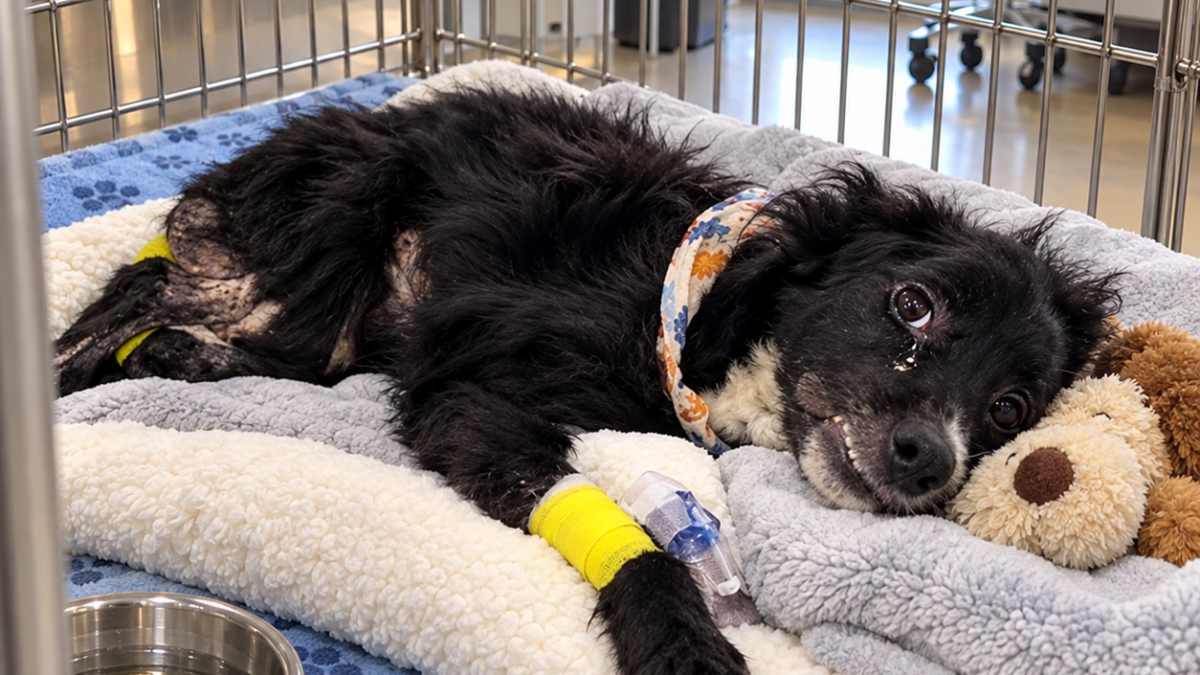
Armando lay beneath a warming blanket with an IV line taped to one front leg and another line ready for transfusion.
He looked smaller than he had the day before.
“How does that happen?”
“His body has almost no reserves,” Elena said. “He’s been surviving at the edge for a long time. Sometimes you correct one problem and another appears because the body finally has enough support to show you what else is wrong.”
“He ate yesterday.”
“I know.”
“He wagged his tail.”
“I know.”
“So tell me what changed.”
She took a breath.
“Severe gastrointestinal inflammation. Possibly secondary infection. His blood values dropped again. His temperature has been fluctuating. He lost more fluid overnight than his body can tolerate. We’ve adjusted his medications and started additional supportive care.”
I looked at Armando.
“Is he suffering?”
“We’re controlling his pain.”
“That wasn’t what I asked.”
Elena’s expression softened.
“He’s very sick. But right now I don’t think he has given up.”
I didn’t realize until then that I had been waiting for permission to hope.
“Can I sit with him?”
“Yes.”
I pulled a chair beside his kennel.
For nearly an hour, nothing happened.
I talked anyway.
I told him about the weather outside.
I told him Daniel had called twice to ask how he was doing.
I told him the technician who had helped clean his wound had brought him a blue blanket because she thought the clinic’s gray blankets were depressing.
I told him things a dog could not understand because silence felt too much like surrender.
Around seven in the morning, his nose moved.
That was all.
A small twitch toward my hand.
I stopped speaking.
“Hey.”
His eyes opened.
Barely.
“You remember me?”
One ear moved.
I smiled.
“Good.”
I put my fingers against the bars.
“You’re allowed to be tired, Armando. But you’re not alone.”
The day dragged forward in increments.
His temperature improved.
Then fell again.
His blood pressure stabilized.
Then dipped.
He received another transfusion.
He slept through most of it.
A technician named Casey came in every hour to check his lines.
At lunchtime, she crouched beside me.
“You should eat.”
“I’m fine.”
“You’ve been here since five.”
“I’m fine.”
“You’re no use to him if you pass out.”
I almost told her I wasn’t hungry.
Then Armando opened one eye as though taking Casey’s side.
She laughed.
“See? Even he thinks you’re being ridiculous.”
So I ate half a sandwich from the vending area and came back.
By late afternoon, Elena brought me the first piece of good news.
“His temperature has held steady for two hours.”
“That’s good?”
“That’s very good.”
“And his blood?”
“Still low. But not falling.”
I nodded.
Not falling.
Those two words became enough.
That evening, before I finally went home, I put my hand near Armando’s face.
He moved his nose against my fingers.
Not much.
Enough.
The next morning, he was still alive.
On the third morning after the crash, I walked into the treatment room carrying a small container of the soft food he had begun eating before everything went wrong.
His head lifted.
Slowly.
But it lifted.
Casey smiled.
“He’s been watching the door.”
“For me?”
“Probably for the food.”
I laughed for the first time in days.
“That sounds more like a healthy dog.”
I opened the container.
Armando’s nose twitched.
I held a spoon near him.
He sniffed.
Turned away.
My hope sank.
Then he turned back.
One lick.
I froze.
Another.
“Good boy.”
A third.
Casey covered her mouth.
He ate less than a quarter of what a normal dog his size would have finished in seconds.
We celebrated like he had won something enormous.
Maybe he had.
Recovery began again, but this time I understood it differently.
I stopped expecting progress to move in a straight line.
Armando would have better days and worse days.
There would be moments that looked like miracles and moments when I would think we had lost everything we had gained.
The only thing I could do was stay.
His neck wound remained ugly for weeks.
Each dressing change showed new tissue forming beneath damaged edges, but the healing was slow.
What frightened me almost as much were his legs.
Months of hunger and confinement had stripped away his muscle.
When we supported him under the belly with a towel and tried to help him stand, his entire body shook.
The first time, he lasted three seconds.
Then his knees folded.
I caught him against my chest.
“That counts.”
Elena smiled.
“For exactly three seconds.”
“Write it down.”
She laughed.
“You want three seconds in the medical chart?”
“Absolutely.”
She pretended to pick up a pen.
“Patient stood for approximately three heroic seconds.”
“That’s more accurate.”
A week later, he stood for six.
Then ten.
Then he took one step.
It wasn’t really a step.
More like an accident caused by his front half moving before his back half knew what was happening.
I counted it anyway.
The first time I saw him intentionally put weight on his left hind leg, I had to leave the room for a minute because I didn’t want anyone to see me cry.
By the time Elena finally said he could leave the clinic, Armando had spent almost two weeks living under fluorescent lights, surrounded by people who had fought for him every hour of every day.
“He’s not recovered,” she warned me.
“I know.”
“This is going to be intensive.”
“I know.”
“Medication several times a day. Wound care. Small controlled meals. Physical rehabilitation. Monitoring for infection. Follow-up bloodwork.”
“I know.”
She stared at me.
“I haven’t actually asked if you’ll foster him.”
“I’m taking him.”
“You might want to hear the rest.”
“I’m taking him.”
That made her smile.
“All right.”
I had already prepared my living room.
A low orthopedic bed sat beside the window.
I put towels beneath it in case he had an accident.
Water was close enough that he wouldn’t need to walk.
I borrowed a support harness.
I moved furniture so there were no narrow corners where he might panic.
I bought more bandages than I thought any dog could possibly need.
Then I brought Armando home.
The first thing he did was stare at the window.
I carried him to the bed and lowered him slowly.
Sunlight spilled across the floor.
Outside, a sparrow hopped along the fence.
Armando watched it with absolute concentration.
For ten minutes, he didn’t move.
I wondered how long it had been since he had been allowed to simply look at something without pain demanding all his attention.
That became his place.
Every afternoon, when the sun shifted through the glass, Armando turned his body toward it.
At first I thought he was cold.
Later I realized he simply loved the warmth.
Our days became a schedule.
Medicine.
Breakfast.
Wound cleaning.
Rest.
Gentle exercises.
Lunch.
More rest.
Supported standing.
Dinner.
Medication again.
Everything took longer than expected.
The neck dressing was the hardest.
Whenever I brought the supplies near him, his body went rigid.
He didn’t growl.
He didn’t snap.
He froze.
That reaction broke my heart because I understood it.
At some point, Armando had learned that struggling made painful things worse.
He had learned to disappear inside himself.
The first few times, I rushed because the wound needed cleaning.
Then one evening I stopped.
I sat on the floor with the gauze beside me.
Armando stared.
I let him sniff it.
I touched his shoulder.
Then his chest.
Then the healthy skin near his neck.
When he tensed, I pulled my hand away.
“You get a say now.”
He watched me.
I waited.
Five minutes later, he leaned toward my hand.
The next dressing change took almost forty minutes.
The one after that took thirty.
Two weeks later, Armando rested his head against my knee while I cleaned his neck.
Trust, I learned, could be rehabilitated just like muscle.
Slow pressure.
No force.
Repetition.
Consistency.
And time.
The first sound that changed Armando’s entire personality was the clink of his food bowl against the counter.
The first time it happened, his head shot up.
His ears lifted.
His tail thumped.
I stared at him.
“So that gets a reaction?”
Another thump.
“You nearly died four weeks ago, but apparently dinner is urgent.”
His tail wagged faster.
I laughed.
That little ritual became one of my favorite parts of the day.
Armando never had to wonder whether a meal was coming.
Breakfast came.
Dinner came.
Water was always full.
At first he ate as if somebody might steal the bowl.
Fast.
Desperate.
Almost panicked.
Elena warned me to slow him down.
I started feeding smaller portions and sitting beside him.
“Easy.”
He would pause.
Look at me.
Then continue.
Eventually, urgency became expectation.
That change was enormous.
A starving dog eats as though every meal could be the last.
A safe dog complains because dinner is five minutes late.
I wanted him to become that dog.
About a month after he came home, I began carrying him outside in the afternoons.
He was still too weak to walk farther than a few supported steps, but he loved the yard.
I spread a blanket under a tree.
The first time, he lay stiffly, eyes scanning everything.
Cars.
Birds.
Leaves.
A neighbor closing a door.
Then the sunlight reached his face.
He closed his eyes.
For almost an hour, he slept.
His paw rested on my shoe.
I didn’t move.
Not because I couldn’t.
Because I wanted him to wake up and find me exactly where I had been.
That was around the time Daniel called again.
He had checked on Armando regularly since the rescue.
“How’s the warrior?”
“Standing for almost twenty seconds.”
“You’re serious?”
“Very serious.”
“That’s incredible.”
Then he went quiet.
“What?”
“I keep thinking about where I found him.”
“So do I.”
“The business has cameras.”
I sat upright.
“What kind?”
“Security cameras. Back lot. Loading entrance. Parking area.”
“How long do they keep footage?”
“I don’t know.”
“Find out.”
Daniel contacted the property owner.
The system stored several weeks of footage.
Not months.
We nearly missed it.
One camera showed the rear lot at an angle.
The picture was grainy at night, but the timestamp was clear.
Daniel and I sat in the manager’s office watching hours of boring footage at increased speed.
Delivery trucks.
Employees.
Cars.
Cats crossing the lot.
Nothing.
Then, at 11:43 one night, a pickup appeared.
“Stop.”
Daniel froze the video.
Two men got out.
One walked toward the back.
The second lowered the tailgate.
Something moved.
My chest tightened.
“Play it.”
The video continued.
A dog appeared.
Thin.
A rope hanging from his neck.
I leaned toward the screen.
The white marking on his chest.
The slope of his shoulders.
The way he moved.
Armando.
Daniel whispered, “That’s him.”
One man held the rope.
The other opened the rear gate of the property.
They disappeared briefly beyond the camera’s main view.
Minutes later, the men returned.
Without the dog.
The truck left.
We sat in silence.
Daniel finally said, “They dumped him.”
I couldn’t answer.
The footage didn’t show every detail.
It didn’t prove when the rope had first been tied around him.
It didn’t show who had failed to feed him or how long he had been neglected before arriving there.
But it showed something undeniable.
Armando had not simply wandered into the property by accident.
People had brought him there.
And left him.
“Can you read the plate?” I asked.
“Part of it.”
That became the beginning of an investigation.
Animal Control Officer Ray Collins met me at the clinic the next morning.
I gave him everything.
Photos from the day of rescue.
Veterinary records.
Bloodwork.
Treatment notes.
The rope itself, which the clinic had preserved.
Copies of the security footage.
Statements from Daniel.
Statements from the property owner.
Ray watched the video twice.
“Don’t post this anywhere,” he said.
“I wasn’t planning to.”
“Good. Give us a chance to work.”
“Can you identify them?”
“We’ll try.”
“What happens if you do?”
“That depends on what the evidence supports.”
I hated that answer because I wanted something immediate.
I wanted someone to see what had happened to Armando and react the way I had.
I wanted certainty.
Consequences.
A door kicked open somewhere.
Handcuffs.
Answers.
Real life does not move at the speed of anger.
Investigations are slower.
Evidence has to connect.
Ownership has to be established.
Timelines matter.
Witnesses matter.
Every assumption has to become something that can survive being challenged.
I understood that.
I still hated waiting.
During that waiting, Armando took his first three real steps.
My neighbor Susan stood about six feet away with a tiny piece of chicken.
I had the support sling under his belly.
“Come on, handsome,” she said.
Armando stared at the chicken.
“Betrayal,” I told him. “I feed you every day and suddenly she’s your favorite person.”
His front paws moved.
One.
Two.
His back legs trembled.
Then his right hind paw lifted and came down ahead of the left.
A step.
Another.
His entire body shook.
Then a third.
His legs folded.
I lowered him gently to the grass.
Susan started crying before I did.
“You saw that?”
“I saw it.”
“Three.”
“Three.”
Armando ate the chicken while we celebrated around him.
That evening, Ray called.
“We identified a possible registered owner.”
I stopped washing dishes.
“Who?”
“I can’t give you the name yet.”
“Is it one of the men in the footage?”
“Possibly.”
“Ray.”
“I know.”
“How long?”
“We’re moving.”
“What does that mean?”
“It means let us move.”
Three days later, he called again.
“We served a warrant today.”
I gripped the phone.
“At the owner’s house?”
“At a property connected to him.”
“And?”
He paused.
“We found five dogs.”
For a moment, I heard nothing except Armando’s breathing from the bed behind me.
“Alive?”
“Yes.”
“Condition?”
“None are in Armando’s condition. But there are serious welfare concerns.”
I closed my eyes.
“Chained?”
“Four were restrained outside.”
“Ropes?”
“Chains and collars. Two have neck irritation. One is significantly underweight. Water conditions were poor. Shelter was inadequate.”
“What happened to them?”
“They’ve been removed pending the investigation.”
I sat down at the kitchen table.
Armando lifted his head.
“Five?”
“Five.”
I looked at the scar around his neck.
“If Daniel hadn’t found him…”
Ray understood without my finishing.
“We might not have found the others.”
That was the moment my anger changed shape.
Until then, I had thought of justice almost entirely in terms of Armando.
Someone had done this to him.
Someone needed to answer for it.
Now there were five more dogs.
Armando’s survival had become evidence that opened a gate.
His pain had exposed something larger.
I walked over to him and crouched beside the bed.
“They got them out.”
His tail moved.
“You don’t know what I’m saying, do you?”
Another small wag.
“Probably better that way.”
The seized dogs went to different rescue partners because no single shelter had enough space.
I learned their names later.
Poppy.
Red.
Milo.
June.
And a huge-eared brown dog the shelter temporarily called Tucker.
Poppy was terrified of doorways.
Red guarded food.
Milo had pressure sores.
June flinched when anyone touched her collar.
Tucker leaned his entire body against people as though he couldn’t get close enough.
None had suffered exactly what Armando had suffered.
That didn’t make their condition acceptable.
The investigation widened.
The man listed as Armando’s registered owner initially claimed the dog had escaped months earlier.
Then investigators showed him the security footage.
His version changed.
He said someone else had been responsible for the dog.
Then he argued that Armando had been given away.
The other man in the footage said he had only been helping transport him.
One blamed the other.
Neither explanation changed the physical evidence.
Elena documented everything carefully.
The depth and age of the wound.
The severe anemia.
The muscle wasting.
The dehydration.
The infection.
In her professional opinion, Armando’s condition had developed over a substantial period and required prolonged neglect.
That sentence mattered.
People can argue about memory.
They can argue about who said what.
A body tells its own timeline.
Armando continued healing while adults argued about responsibility.
He didn’t care about legal strategy.
He cared about squeaky toys.
The first one confused him completely.
I rolled a blue rubber toy across the floor.
He watched it stop.
I nudged it with my foot.
Nothing.
I squeezed it.
Squeak.
Armando jumped backward so fast his weak hind legs slid out from under him.
I grabbed him.
“You’re okay.”
He stared at the toy as though I had introduced a dangerous animal into his house.
I squeezed it again.
Squeak.
He barked.
It was the first proper bark I had ever heard from him.
I laughed so hard I had to sit down.
Armando looked offended.
“You have a voice.”
He barked again.
“At a rubber chicken.”
Another bark.
Twenty minutes later, he discovered he could make the noise himself.
By sunset, I regretted everything.
Squeak.
Squeak.
Squeak.
From the living room.
Squeak.
From the kitchen.
Squeak.
From beside my chair while I tried to read.
That ridiculous sound meant more to me than I could explain.
Dogs in survival mode don’t play.
Play requires safety.
It requires enough food in the stomach.
Enough confidence that nobody is about to hurt you.
Enough energy left over after staying alive.
The squeaky toy told me Armando had begun spending energy on joy.
Weeks passed.
He gained weight.
His coat improved.
The open wound closed slowly from the inside out.
Fresh skin formed where the rope had once cut.
Some fur returned.
Some never did.
A thick irregular ring remained around his neck.
The first time I saw the entire wound closed, I stood in Elena’s examination room staring at it.
“That’s it?” I asked.
“That’s skin.”
“No bandage?”
“No bandage.”
I didn’t trust it.
“What if he scratches?”
“We watch him.”
“What if it opens?”
“We call.”
“What if—”
Elena put both hands on the table.
“Healing is happening whether you trust it or not.”
I laughed nervously.
“That obvious?”
“You still look at him like he’s going to die every ten minutes.”
“He almost did.”
“I know.”
“Twice.”
“I know.”
She looked toward Armando.
He was sniffing a cabinet, trying to figure out where she kept treats.
“You’re watching him like he’s still dying.”
“What should I do?”
“Start noticing that he’s living.”
I followed her gaze.
Armando stretched his neck toward a drawer.
His back legs supported him.
Not perfectly.
But without a sling.
He had gained nearly fifteen pounds.
His eyes were clear.
His tail was moving.
He looked nothing like the dog behind the boxes.
Elena opened the drawer.
Armando immediately sat.
She raised an eyebrow.
“Did you teach him that?”
“No.”
“He’s manipulating us.”
“Definitely healthier.”
That afternoon, something shifted in me.
I stopped measuring every day by how far Armando remained from death.
I started measuring it by how much life he was gaining.
The first time he walked from the living room to the kitchen without stopping.
The first time he climbed one shallow step onto the porch.
The first time he barked at a delivery truck.
The first time he slept on his back.
That one nearly broke me.
I walked into the living room and found him sprawled across the bed with his belly exposed, all four legs loose, completely unconscious.
A dog does not sleep like that when he expects danger.
I sat down quietly.
He snored.
Loudly.
I laughed.
Then cried.
Then laughed because I was crying over a dog snoring.
By the time the first court hearing arrived, Armando could walk the length of my driveway.
I went alone.
I did not bring him.
He had already given enough.
The courtroom was smaller than I expected.
Wooden benches.
Fluorescent lights.
A seal behind the judge.
The two men connected to the case sat with attorneys.
One was the registered owner.
I recognized him from the grainy security video even though he looked different in daylight, wearing a pressed shirt and clean shoes.
That bothered me.
I had spent months imagining somebody who looked like cruelty.
There is no such face.
People who neglect animals can look ordinary.
They can have jobs.
Neighbors.
Families.
They can stand in court with combed hair and speak politely.
The prosecutor introduced records.
Photographs.
Statements.
The defense challenged the timeline.
One attorney argued that responsibility for Armando had shifted among several people.
The other argued that the condition of the seized dogs had been exaggerated.
Then the prosecutor displayed the first photograph of Armando.
The room changed.
Even people who had no connection to the case reacted.
One woman in the back covered her mouth.
A man beside her looked down.
I kept my eyes on the photograph.
I hated it.
I also needed it seen.
Cruelty survives easily in places nobody wants to look.
The image showed Armando on the examination table.
Thin.
Exhausted.
The rope wound visible.
I remembered the smell.
The heat.
The sound of his shallow breathing.
I remembered whispering that I would stay.
The defense attorney said, “There are circumstances concerning ownership and the period during which the animal was allegedly in my client’s control.”
Circumstances.
I wrote that word on the notebook in my lap.
Then drew a line through it so hard the pen tore the paper.
Outside the courtroom, Ray found me near the stairs.
“You okay?”
“No.”
“That’s fair.”
“I wanted one of them to look ashamed.”
“Court isn’t always where people show you what you want to see.”
“Did they ever ask about him?”
Ray understood immediately.
“No.”
“Not once?”
“Not through me.”
I looked across the parking lot.
“He almost died.”
“I know.”
“Three blood transfusions.”
“I know.”
“He couldn’t stand.”
“I know.”
“And they never asked if he lived?”
Ray shook his head.
Something in me settled.
I had been waiting for remorse.
I stopped.
Armando didn’t need it.
His healing would not depend on whether somebody else became a better person.
Back home, he met me at the door.
Not gracefully.
His back feet slipped slightly on the floor and he corrected himself.
Then he came straight to me.
I knelt.
He pushed his forehead into my chest.
“You have no idea where I was.”
His tail wagged.
“That’s probably for the best.”
The legal case lasted months.
There were continuances.
Requests.
Negotiations.
Additional veterinary reports.
Photographs of the seized dogs.
Statements from neighbors.
Some people had noticed dogs chained at the property before.
A few admitted they had been uncomfortable.
One said he had considered calling.
That sentence stayed with me.
Considered calling.
I did not judge him as harshly as I might have before.
People hesitate for many reasons.
They doubt themselves.
They don’t want trouble.
They assume somebody else knows better.
They think the dog belongs to somebody, therefore somebody must be handling it.
But I kept thinking about Daniel.
He had been getting into his truck when he heard a scratching sound inside the business.
He could have ignored it.
He did not.
Armando was alive because somebody checked.
That became a lesson I carried long after the court case ended.
If something seems wrong, checking costs less than regret.
Meanwhile, Armando discovered rain.
He hated it.
The first rainy morning after he became strong enough to walk outside alone, I opened the door.
He stepped onto the porch.
One drop hit his nose.
He stopped.
Another hit his head.
Armando looked at me.
“No.”
He backed into the house.
“You have to go outside.”
He stared.
“Seriously.”
Nothing.
I put on my jacket.
He walked away.
“You survived a rope wound and three transfusions, but rain is where you draw the line?”
Armando sat on his bed.
I eventually carried a patio umbrella into the yard and stood under it while he handled his business.
I realized while standing there that I had become exactly the kind of person I used to make fun of.
I didn’t care.
He had earned unreasonable accommodations.
He also discovered cheese.
That was my fault.
One evening, I dropped a small piece while making dinner.
Armando got there before I did.
His eyes widened.
I watched something profound happen inside him.
Cheese became religion.
From that day forward, the opening of the refrigerator brought him running.
Not walking.
Running as much as his recovering legs allowed.
“You cannot live on cheddar.”
Armando disagreed.
“No.”
Tail wag.
“No.”
Faster wag.
“You have medication in ten minutes.”
Head tilt.
“You’re shameless.”
Eventually, I learned to hide pills inside tiny pieces of cheese.
Armando believed this was an excellent medical system.
His physical therapy became harder as he grew stronger.
We practiced controlled walking.
Weight shifting.
Standing from a seated position.
Stepping over low obstacles.
At first, he hated exercises that demanded effort from his hindquarters.
He would sit down and look at me.
“Nice try.”
He looked away.
“You’re still doing it.”
He sighed.
I swear he sighed.
Susan often helped.
She stood at the opposite end of the yard with treats.
Armando adored her.
“I’m beginning to think this entire rehabilitation program is just bribery.”
Susan smiled.
“Whatever works.”
The day Armando walked twenty feet without the support harness, Susan screamed.
Armando jumped.
I yelled, “Don’t scare him!”
“I’m sorry!”
Then we both started laughing.
He stood between us, looking deeply embarrassed by the humans assigned to his recovery.
As the weather cooled, his strength accelerated.
Muscle returned along his shoulders first.
Then his thighs.
His weight reached the low end of Elena’s healthy target.
His bloodwork normalized.
The anemia that had almost killed him disappeared.
I kept copies of every laboratory result.
Sometimes I laid the old and new ones side by side.
Numbers can tell a story too.
At rescue: danger.
Weeks later: fragile.
Months later: normal.
I framed nothing.
There was no need.
The proof walked around my house stealing socks.
The first rope incident happened in early winter.
I was helping Susan tie down branches after a storm.
A coil of utility rope lay near the porch.
I didn’t think anything of it.
Armando came outside.
Saw it.
Stopped.
His tail disappeared beneath his body.
His ears flattened.
His legs began shaking.
I dropped everything.
“Armando.”
He backed away.
I picked up the rope.
“Gone.”
He stared at my hand.
I carried it to the garage.
When I returned, he had pressed himself beside the wall.
I sat on the ground ten feet away.
“It’s gone.”
He didn’t move.
I waited.
Five minutes.
Ten.
Finally, he crossed the distance and put his nose against my shoulder.
I wrapped one arm around him.
That night, I walked through the garage and threw away every loose piece of rope I could find.
Somebody could argue it was unnecessary.
Maybe.
But Armando had spent enough time living in a world built around other people’s convenience.
My house could adapt to him.
Months later, we began carefully introducing him to normal leash equipment with the help of a trainer.
A wide harness was easy.
A collar took longer.
I never attached anything directly around the scarred area.
Armando learned that a leash meant walks.
That changed his opinion quickly.
The first time we reached the end of the block, he stopped and stared at everything.
A bicycle.
A barking terrier behind a fence.
A garbage truck.
A child bouncing a basketball.
The world was enormous.
I let him stand there.
For years, perhaps, his world had been measured by the length of whatever restrained him.
Now the leash was loose.
He could sniff.
Choose direction.
Stop.
Move again.
Freedom does not always mean having nothing attached to you.
Sometimes it means the thing connecting you to another person is there to keep you safe instead of keep you trapped.
By spring, Armando could walk half a mile if we took breaks.
His gait remained uneven.
Elena believed some weakness might be permanent.
I didn’t care.
Neither did he.
He walked.
One Saturday morning, a butterfly crossed the yard.
Armando noticed.
He followed.
Walking.
Then trotting.
The butterfly dipped.
Armando accelerated.
For perhaps four seconds, all four legs found a rhythm.
He ran.
I stood on the porch with my mouth open.
The butterfly disappeared over the fence.
Armando stopped.
Turned.
Looked at me.
“You ran.”
His tail wagged.
“You actually ran!”
He trotted back.
I dropped to my knees.
He crashed into me.
I laughed into the fur beside his scar.
That evening, I sent Elena a video from my security camera.
She responded with three words.
I’m not crying.
She was absolutely crying.
The case reached its most important hearing shortly afterward.
This time, Elena testified.
She explained Armando’s initial condition in clinical language.
Severe malnutrition.
Dehydration.
Profound anemia.
Advanced infected neck injury.
Muscle atrophy.
She explained that the wound could not have developed overnight.
She explained that any reasonable observer would have recognized the need for veterinary care long before Armando reached the condition in which he was found.
The defense asked whether it was possible that Armando’s condition worsened after he was abandoned.
“Yes,” Elena said.
The attorney seemed encouraged.
Then she continued.
“But the wound and degree of muscle wasting clearly predated the period shown on the security footage. The dog was already severely compromised.”
The room went quiet.
She did not dramatize.
She didn’t need to.
Facts were enough.
Daniel testified next.
He described finding Armando behind the boxes.
The scratching sound.
The smell.
The condition of the dog.
The security video.
One defense attorney asked whether Daniel was certain the dog in the footage was Armando.
Daniel answered, “I carried him into the light the day we found him. I saw the white mark on his chest from six inches away. Yes, sir. I’m certain.”
I looked down at my hands.
For the first time, I understood what justice really looked like.
Not revenge.
Not shouting.
Not humiliation.
A veterinarian explaining blood values.
A worker describing a white marking.
A timestamp.
A license plate.
A rope in an evidence bag.
Ordinary details lined up until denial had nowhere comfortable to stand.
The case did not end dramatically that day.
Real court cases rarely do.
But the path became clearer.
Eventually, both men accepted responsibility through the legal process for offenses related to the neglect and abandonment.
The court imposed penalties allowed by the applicable charges, including fines, restitution connected to animal care, probationary conditions and restrictions involving future animal ownership.
I had imagined feeling triumphant.
I didn’t.
I felt tired.
Outside the courthouse, Ray asked, “Is that enough?”
I thought about it.
“No.”
He nodded.
“I know.”
“But nothing would be enough.”
“No.”
“No punishment can give him those months back.”
Ray looked toward the street.
“No.”
I took a breath.
“But the other dogs are safe.”
“They are.”
“They can’t just go home and collect five more tomorrow.”
“No.”
“Then it matters.”
“It matters.”
That was enough for me.
Not because it erased anything.
Because consequences do not need to restore the past in order to protect the future.
The five dogs removed from the property continued recovering.
I visited the rescue caring for Poppy and Tucker.
Poppy hid behind a volunteer when I arrived.
She was a brindle dog with careful eyes and a white stripe down her nose.
I sat on the floor.
Didn’t approach.
After fifteen minutes, she moved closer.
After twenty, she smelled my shoe.
After thirty, she touched my knee.
The volunteer whispered, “That’s huge for her.”
I smiled.
“I know a dog like that.”
Tucker had no such hesitation.
The moment his kennel opened, seventy pounds of brown dog leaned against my legs.
I nearly fell.
“Apparently personal boundaries are not your issue.”
His tail beat against a cabinet.
The volunteer laughed.
“He wants to live inside people.”
Three months later, Tucker was adopted by a young couple.
Poppy went to a retired teacher named Martha.
Milo found a home with an older man who walked him every morning before sunrise.
June was adopted by a family with a quiet yard and no other pets.
Red took the longest because his food guarding frightened inexperienced adopters.
Eventually, a behavior specialist adopted him herself.
Six dogs.
Six futures.
All because one dog survived long enough for people to ask where he came from.
Armando knew none of this.
His concerns remained more practical.
He had become obsessed with blankets.
Every blanket.
Mine.
Susan’s when she visited.
Laundry waiting to be folded.
One winter night I walked into the bedroom and found him dragging a comforter down the hallway.
“Armando.”
He froze.
Half the blanket was in his mouth.
“What are you doing?”
He stared.
“You already have two.”
No movement.
“Drop it.”
He turned and continued dragging.
I laughed so hard I let him keep it.
That was the dog nobody had met at the business.
Not the victim.
Not the evidence.
Armando.
Stubborn.
Funny.
Food obsessed.
Suspicious of rain.
Terrified of rope.
In love with sunlight.
A thief of blankets.
A terrible runner.
A world-class snorer.
I began realizing that trauma had almost swallowed his identity.
Everybody first knew him by what had been done to him.
The wound.
The rope.
The starvation.
The rescue.
But dogs are more than the worst thing that happened to them.
People are too.
Armando’s story gradually became less about the rope and more about what came after it.
The first anniversary of his rescue arrived on a warm morning.
I considered taking him somewhere special.
A park.
A trail.
Maybe the beach.
Then Daniel called.
“I know what day this is.”
“So do I.”
“How’s he doing?”
I looked across the yard.
Armando was lying in sunlight chewing a toy.
“Come see.”
Daniel hadn’t seen him in months.
When he pulled into my driveway, Armando stood.
Daniel stopped beside his truck.
“That can’t be him.”
I smiled.
“That’s him.”
Armando approached cautiously.
Daniel crouched.
“You probably don’t remember me.”
Armando sniffed his hands.
Then leaned against him.
Daniel’s face collapsed.
He buried both hands in Armando’s shoulders.
“Hey, buddy.”
I looked away.
Some moments belong partly to somebody else.
When Daniel stood again, he wiped his eyes.
“I really thought he was going to die.”
“So did I.”
“You know something I never told you?”
“What?”
“The day I found him, I almost went home without checking.”
I stared at him.
“I was already in my truck. Shift was over. I heard that scratching noise.”
“What kind of noise?”
“Barely anything. Like cardboard moving.”
Armando looked up at him.
“I thought it was probably a rat.”
“But you checked.”
Daniel nodded.
“I don’t know why. I just thought, if it’s something, I’m going to feel like an idiot tomorrow if I ignore it.”
I looked at Armando.
One tiny sound.
That was all that separated his life from another ending.
Daniel scratched beneath Armando’s chin.
“So what happens now?”
“What do you mean?”
“Are you still fostering him?”
I had been asked that question for months.
At first, the answer had been yes.
Then maybe.
Then I stopped answering.
I looked toward the living-room window where Armando’s bed sat in its permanent patch of sun.
His medications had once occupied an entire shelf.
Now only a few supplements remained.
His harness hung by my front door.
His toys covered half the floor.
There was a dog bed in my bedroom too.
There were bowls in my kitchen.
A bag of cheese in my refrigerator bought almost entirely because of him.
I laughed.
“I think the fostering period got out of control.”
Daniel smiled.
“So he’s yours?”
I looked down.
Armando had placed one paw on my shoe.
“No.”
Daniel raised an eyebrow.
I scratched Armando’s head.
“I’m his.”
That evening, I filled out the adoption paperwork.
It felt ridiculous because no paper could make him more permanent than he already was.
Still, when I signed my name, I felt something settle.
Armando had a legal home.
A family.
A person.
The dog who had once belonged to somebody only on paper now belonged somewhere in every way that mattered.
Years moved faster after that.
The first year had been measured in grams of food, blood values and steps across the yard.
Later years were measured in ordinary things.
Walks.
Vet visits.
Christmas mornings.
Visitors.
Rainstorms Armando still refused to tolerate.
He became well known in the neighborhood.
Children knew him as the dog with the funny walk.
Older neighbors knew him as the dog who loved sitting in the sun.
Nobody needed to know his entire history.
I liked that.
One afternoon, a little boy asked, “Why does he have that mark on his neck?”
His mother looked embarrassed.
“You don’t have to answer.”
I looked at Armando.
“It’s an old scar.”
“Did it hurt?”
“Yes.”
“Does it hurt now?”
“Not anymore.”
The boy thought about that.
Then he patted Armando’s shoulder.
“Good.”
That was enough.
Not every retelling needed darkness.
Sometimes the only important part was that it did not hurt now.
Armando aged.
Gray appeared around his muzzle.
His runs became even less convincing.
Stairs became difficult again, this time because of years rather than starvation.
I installed a ramp.
Susan laughed when she saw it.
“You built him a retirement ramp.”
“He has standards.”
Armando walked past us carrying one of my socks.
“He has your sock.”
“I know.”
“You’re not taking it?”
“No.”
“You’ve surrendered.”
“Years ago.”
Elena continued seeing him for routine appointments.
Every visit began the same way.
She opened the treat jar.
Armando forgot all previous medical betrayal.
One afternoon, she ran her fingers over the scar.
“Do you remember the first night?”
“Every minute.”
“I didn’t think he’d make it.”
“I know.”
“You knew?”
“Your face told me.”
She sighed.
“I tried to hide it.”
“You’re terrible at hiding things.”
Armando pushed his nose into her coat pocket.
She laughed.
“This dog received multiple transfusions and now he’s mugging his veterinarian.”
“He’s making up for lost time.”
Elena became serious.
“That’s actually what I think about every time I see him.”
“What?”
“Lost time.”
I looked at Armando.
“You can’t give it back.”
“No,” she said. “But look how much he got afterward.”
That stayed with me.
We talk about rescue as saving a life.
But a life is not just whether the heart continues beating.
It is what fills the days after survival.
Armando got years.
Years of breakfast.
Years of windows.
Years of walks.
Years of cheese.
Years of naps.
Years of people saying his name kindly.
Years when nobody tightened anything around his neck.
Years when every door he walked through led somewhere safe.
One evening, long after the court case had ended, I received a letter.
It came from one of the men involved.
I recognized the name immediately.
For an hour, I left the envelope unopened on the counter.
I didn’t know what I wanted it to contain.
An apology?
An excuse?
A denial?
I almost threw it away.
Then I opened it.
The letter was short.
He wrote that he had completed court requirements and counseling.
He wrote that he understood I had no reason to believe anything he said.
He wrote that he had spent months blaming other people and circumstances before admitting he had failed an animal who depended on him.
He did not ask forgiveness.
He asked one question.
Is Armando alive?
I read the sentence several times.
Then I looked toward the living room.
Armando was asleep in the sunlight.
Alive.
More than alive.
I did not answer immediately.
For two days, the letter remained on my desk.
Finally, I wrote three sentences.
Armando survived. He has a permanent home. He is safe.
Nothing else.
No photograph.
No absolution.
No anger.
I mailed it.
That was the last contact I ever had with anyone involved in his neglect.
Some people might have wanted to say more.
I didn’t.
Armando’s life did not need to become a courtroom continuing forever inside my head.
Consequences had happened.
The animals were removed.
Restrictions were imposed.
The case was over.
My responsibility was no longer to remain angry enough.
It was to give Armando the ordinary life cruelty had almost taken from him.
And ordinary life became beautiful.
His favorite season was spring.
Not because of flowers.
Because the patch of sunlight in the living room grew larger.
Every afternoon he repositioned himself with almost mathematical precision.
If a cloud moved over the sun, he opened one eye as though personally offended.
If I stood in the light, he stared until I moved.
“Sorry.”
Tail thump.
“Your house, apparently.”
Another thump.
One spring afternoon, I fell asleep on the floor beside him.
When I woke, his paw was across my wrist.
The scar on his neck was inches from my face.
I traced the edge carefully.
The fur there would never grow evenly.
For years, I had hated that scar.
Eventually, I stopped seeing it as evidence of what someone did to him.
The rope was gone.
The scar belonged to Armando now.
It was living tissue.
Warm.
Healed.
Part of a body that had refused to stop.
That difference mattered.
When Armando was old enough that his back legs began weakening again, I panicked.
The first time he stumbled, I called Elena.
She examined him.
“This is arthritis and age.”
“Not the old injury?”
“The old injury contributes. But mostly, he’s getting older.”
I laughed from relief.
She looked at me.
“Most people aren’t happy when I tell them their dog is old.”
“I am.”
“Why?”
“Because there was a time I didn’t think he’d get the chance.”
Her expression changed.
“That’s fair.”
We adjusted his exercise.
Added medication.
Used the ramp more.
The walks shortened.
But Armando still insisted on going.
Some mornings, he took ten minutes to travel the distance he once covered in two.
I let him.
He sniffed every mailbox.
Inspected every tree.
Accepted attention from neighbors.
A rescue is not complete when a dog survives the emergency.
A rescue continues for as long as that life needs care.
Sometimes that means heroic medicine.
Sometimes it means walking at an old dog’s pace.
Daniel visited occasionally.
The first question was always the same.
“Still stealing socks?”
Armando usually proved the answer before Daniel left.
On the fifth anniversary of the rescue, Daniel brought him a blue blanket.
“I figured he’d steal yours otherwise.”
Armando immediately climbed onto it.
Daniel smiled.
“I’ll take that as approval.”
We sat on the porch.
After a while he said, “I still think about that day.”
“Me too.”
“Do you ever think about what would’ve happened if I hadn’t gone back?”
“Yes.”
“All the time?”
“Not anymore.”
He looked at me.
“How?”
I watched Armando sleeping.
“Because the other version didn’t happen.”
Daniel nodded slowly.
“We got this one.”
“Yeah.”
We got this one.
That became how I thought about it.
There were endless possible endings hidden inside that afternoon.
Daniel could have left.
The clinic could have been closed.
The transfusion could have failed.
The infection could have won.
Armando could have crashed and never recovered.
Any of those endings were possible.
None became his story.
He got this one.
Years later, there came a morning when Armando didn’t want breakfast.
That frightened me more than anything.
Armando refusing food was like the sun refusing to rise.
I offered cheese.
He turned away.
We went to Elena.
Tests showed age-related problems that were manageable but serious.
We adjusted medications.
He improved.
For another year, he did well.
Then came another decline.
Slower.
Gentler.
Nothing like the violent crisis of his rescue.
This time, his body was not fighting neglect.
It was simply old.
I struggled with that.
Saving him had taught me to fight.
Age required something different.
Acceptance.
Elena reminded me, “You promised him care, not immortality.”
I hated the sentence.
I also knew she was right.
We focused on comfort.
Soft beds.
Short walks.
Warm afternoons.
Favorite foods.
One evening, I carried his bed into the backyard.
The sunset was orange.
Armando lay with his head raised.
His paw found my shoe.
That habit had never changed.
I sat beside him.
“You know what I used to think?”
His ear moved.
“I thought surviving was the ending.”
Armando breathed slowly.
“But that was just the beginning, wasn’t it?”
He looked toward me.
I put my hand against his chest.
The heartbeat beneath it was steady.
Older.
Slower.
Still there.
“You stayed.”
His tail tapped the blanket once.
I smiled.
“Yeah. Me too.”
Armando lived long enough for his muzzle to turn almost completely gray.
Long enough for the scar around his neck to become something new people barely noticed.
Long enough to become the oldest dog on our street.
Long enough that children who had first met him as toddlers grew tall enough to walk him.
Long enough for Poppy, Tucker, June, Milo and Red to build lives of their own.
Long enough for the court case to become a file in a cabinet rather than the center of our days.
That was the revenge I never knew I wanted.
Not hurting the people who had hurt him.
Not screaming louder than they could.
Not making them suffer.
Armando’s revenge was time.
Every year he lived safely was another year cruelty failed to own.
Every meal was a refusal.
Every nap was a victory.
Every ridiculous squeak from a toy was proof.
Every stolen sock.
Every rainy morning he refused to step off the porch.
Every ordinary afternoon when sunlight reached his bed.
Cruelty had tried to reduce Armando to pain.
He answered by becoming a dog again.
And when the final season of his life eventually arrived, he did not face it behind boxes in an abandoned corner.
He did not face it hungry.
He did not face it tied to anything.
He faced it at home.
On a soft bed.
With my hand resting where the rope once had been.
The last full afternoon we spent outside was warm.
I brought his blanket beneath the tree.
Armando settled slowly.
He could no longer walk to the spot without help.
That hurt.
But then the sun reached him.
His eyes closed.
His breathing changed into the familiar rhythm of sleep.
His paw rested against my shoe.
I sat there for two hours.
Neighbors passed.
Cars moved.
Birds landed on the fence.
Ordinary life continued around us.
At some point Armando opened his eyes.
I leaned closer.
“There you are, warrior.”
His tail moved.
Once.
Just once.
It was almost exactly like the first tail wag I had seen in the clinic years earlier.
Small.
Weak.
Enough.
I laughed through tears.
“You really like doing that to me, don’t you?”
He rested his head again.
The next morning, Elena came to the house.
I had asked her to because I didn’t want Armando’s last memory to be a clinical room if we could avoid it.
She examined him.
We talked quietly.
Then she gave me time alone.
I lay beside him on the floor.
For years, I had imagined this moment and feared it.
When it came, all I could think about was the first night.
The clinic kennel.
The blood transfusion.
His eyes opening when I whispered that I would stay.
I placed my hand beneath his chin.
“You didn’t know me then.”
Armando’s eyes moved toward me.
“But I meant it.”
His breathing was calm.
“I stayed.”
My voice broke.
“And you stayed too.”
I pressed my forehead against his.
“You stayed so long.”
Elena came back when I was ready.
Armando was comfortable.
There was no panic.
No rope.
No fear.
Just the people who loved him.
My hand remained on his chest until the heartbeat stopped.
For a long time afterward, I sat on the floor.
The house became unbelievably quiet.
No nails against the hallway.
No bowl moving across the kitchen.
No snoring.
No squeaking toy.
I looked toward the window.
The sunlight had reached his empty bed.
That was the moment I finally cried without stopping myself.
Grief is the price of getting the ending we once begged for.
I had begged for Armando to live.
He did.
Not forever.
Long enough.
Long enough to know safety.
Long enough to become annoying.
Long enough to be loved.
Long enough to grow old.
I would never call that loss a failure.
A week later, Daniel came over.
He stood inside the doorway.
His eyes went immediately to the empty bed.
“I’m sorry.”
“Me too.”
We sat in the living room.
Neither of us talked much.
Before leaving, Daniel placed something on the table.
A small framed photograph.
It was Armando lying in the yard, sunlight across his face, the scar visible around his neck.
I remembered the day.
Daniel had taken the picture during one of his visits.
Below it, on a simple white card, he had written:
I went back to check.
I stared at those words.
Then I shook my head.
“That’s not the whole story.”
Daniel looked confused.
I found a pen.
Beneath his sentence, I wrote:
And Armando stayed.
That frame still sits near the window.
Sometimes people ask me about him.
I tell them the truth.
Yes, someone hurt him.
Yes, the neglect was terrible.
Yes, there were consequences.
Yes, the people responsible were held accountable through the legal process.
But that is not where I end.
I tell them about the transfusions.
The first spoonful of food.
The three seconds standing.
The first three steps.
The first squeaky toy.
The cheese.
The rain.
The blanket stealing.
The butterfly he chased.
The ramp I built when he became old.
The sun.
Always the sun.
Because the people who hurt Armando do not deserve to own the longest part of his story.
They owned months.
Armando owned years.
That is the ending.
Not the rope.
Not the wound.
Not the courtroom.
A dog sleeping safely beside a window.
A dog learning meals come twice a day.
A dog trusting that the person who leaves the house will return.
A dog growing gray.
A dog reaching old age when once he was expected to die before morning.
For a long time, whenever I pictured Armando, I saw him behind those boxes.
I saw the rope.
The trembling legs.
The lowered head.
I saw a dog who had learned human hands meant pain.
Now, when I close my eyes, I see something else.
Armando in the backyard.
Older.
Heavier.
Scar around his neck.
Face turned toward the sun.
One paw touching my shoe.
Nothing tied to him.
Nothing pulling him backward.
Nothing he had to survive that day.
Just warmth.
Just grass.
Just home.
That is how I remember my warrior.
And after everything that was done to him, I can think of no better revenge than the life he got to live.








