PART 2: They Left a Paralyzed 2-Month-Old Kitten Dragging Himself Beside Traffic—A Year Later, Wasim Got the Last Word
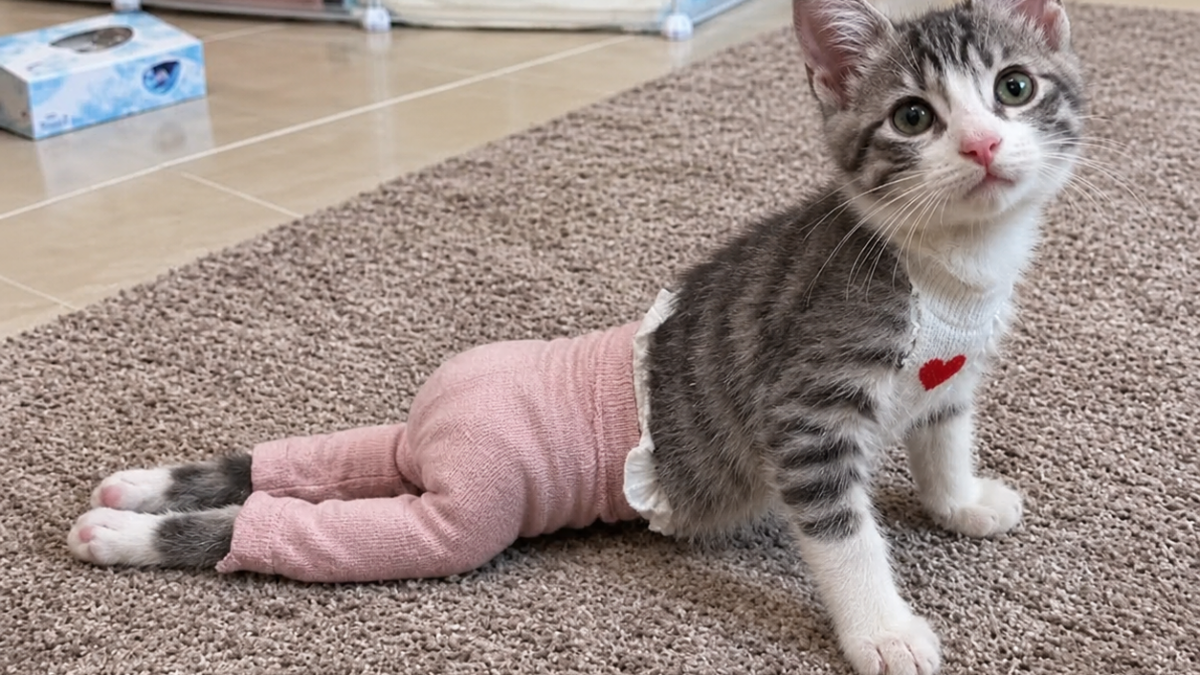
PART 2
The first week was harder than I expected.
Not because Wasim cried.
He barely did.
That was almost worse.
He accepted everything with a strange little seriousness that didn’t belong on a kitten his age.
Every morning, before I even made coffee, I checked his bedding.
Then I helped him empty his bladder.
Then medication.
Breakfast.
Massage.
Cleaning.
More massage.
Rest.
Lunch.
Another bladder check.
And every time he moved from one side of the room to the other, he dragged himself with his front legs.
At first, I put thick blankets everywhere.
I thought soft flooring would protect him.
But Wasim hated getting caught in them.
His claws snagged.
He became frustrated.
So I rearranged the entire room.
Yoga mats.
Smooth washable pads.
Low-sided beds.
Nothing with loose loops.
Nothing he could get tangled in.
My living room slowly stopped looking like a living room.
It became Wasim’s world.
And I built it around what his body could do.
Not what I wished it could do.
That distinction took me time to learn.
For the first few days, I kept staring at his back legs.
Waiting.
Looking for movement.
A twitch.
A jerk.
Anything.
Nothing came.
I would pinch lightly between his toes the way the veterinarian had shown me.
Sometimes he’d turn his head.
Sometimes not.
I couldn’t tell whether he was feeling pressure or simply reacting to my movement.
Every evening, I massaged his thighs.
His knees.
His little ankles.
I flexed each joint carefully.
Forward.
Back.
Forward.
Back.
“Come on, Wasim.”
Nothing.
“Just give me something.”
Nothing.
Then I would hate myself for asking.
He wasn’t failing me.
His body was injured.
He didn’t owe me a miracle.
So I stopped saying it aloud.
But inside?
I still begged.
—
At night, Wasim slept in a small bed beside my own.
The first three nights, I woke every hour.
Sometimes because he moved.
Sometimes because I thought I heard him.
Sometimes for no reason at all.
At 2:13 one morning, I opened my eyes and saw him staring at me.
“What?”
He blinked.
“You okay?”
No answer.
Obviously.
I reached down.
He pushed his head beneath my fingers.
That was the first time he asked me for affection.
Not food.
Not help.
Just touch.
I scratched behind his ears.
He closed his eyes.
Then came the smallest sound.
A purr.
I froze.
Wasim opened one eye.
“Was that you?”
The purr started again.
Soft.
Uneven.
But unmistakable.
I smiled in the dark.
“All right. I’ll take that.”
That became our first victory.
Not walking.
Not standing.
Trust.
—
At the end of the first week, I brought him back to the clinic.
Dr. Harris examined him.
She watched him drag himself across the padded table.
“Front end is getting stronger.”
“That isn’t exactly what I wanted to hear.”
She looked at me.
“I know.”
“What about the back?”
She tested reflexes.
Flexed his knees.
Pressed between his toes.
Wasim tried to bite her stethoscope.
She smiled.
“Attitude is healthy.”
“His legs?”
She became serious again.
“Still very limited response.”
“So nothing has changed.”
“Not enough for me to promise anything.”
I swallowed.
“Could he stay like this forever?”
“Yes.”
That answer hurt even though I already knew it.
I looked at Wasim.
He had successfully captured the end of her stethoscope and was chewing it.
Dr. Harris rescued it.
“Listen to me.”
I looked up.
“If he never walks normally, that does not mean he can’t have a good life.”
“I know.”
“Do you?”
I didn’t answer.
She continued.
“He may need bladder expression long-term. He may need mobility support. He may eventually benefit from a cart. But cats adapt incredibly well.”
I stroked his head.
“I just want him to be okay.”
“He doesn’t need to become physically perfect to be okay.”
That stayed with me.
Because I realized I’d been measuring hope in steps.
Maybe hope needed to be bigger than that.
—
Week two brought a new problem.
Wasim’s back legs began getting stiff.
The muscles weren’t being used normally.
Some mornings, when I tried to flex his knees, he resisted.
Not consciously.
His body simply felt tighter.
I called Dr. Harris.
“Keep doing range-of-motion work.”
“I’m scared I’m hurting him.”
“You’d know if you’re forcing too far. Slow. Gentle. Consistent.”
So every morning I warmed my hands first.
Then I wrapped Wasim in a towel.
He hated the towel.
“You’re very dramatic.”
He stared at me.
“Your medical chart says nothing about being offended by towels.”
He attempted to bite the corner.
“Fine. Make your complaint.”
I moved his left leg.
Bend.
Extend.
Bend.
Extend.
Then the right.
Massage.
Circles with my thumbs.
Tiny motions.
Five minutes.
Then ten.
Wasim eventually stopped trying to escape.
By the third week, something strange happened.
He started falling asleep during massage.
The first time, I thought something was wrong.
“Wasim?”
Nothing.
“Wasim!”
His eyes opened.
He looked furious.
Then he closed them again.
I laughed.
“You scared me.”
His front paws stretched forward.
The purring started.
From that day on, massage stopped being something I did to him.
It became something we did together.
—
The hardest part remained his bladder.
People don’t talk much about that part of caring for a paralyzed animal.
They imagine wheelchairs.
Tiny carts.
Inspirational videos.
They don’t imagine standing over a sink at six in the morning trying to feel a bladder the size of a small plum through a kitten’s abdomen.
Some days I found it immediately.
Other days I couldn’t.
I’d reposition him.
Try again.
Nothing.
Then panic.
“Come on.”
Wasim would squirm.
“Please stop moving.”
He would move more.
Once he peed directly onto my shirt.
I stared at him.
He stared at me.
Then he purred.
“You did that on purpose.”
He licked one paw.
I had no evidence.
But I remained suspicious.
On the bad mornings, I called the clinic.
“I’m not sure I emptied him.”
“Bring him in.”
So I did.
Eventually my hands learned.
Not perfectly.
But enough.
I learned what “full” felt like.
What “empty” felt like.
How Wasim positioned his body when he was uncomfortable.
How his appetite changed when he needed help.
How to notice cloudy urine.
How much water he normally drank.
All the details nobody imagines when they say, “I could never do that.”
Neither could I.
Until there was a kitten who needed someone to.
Then I did.
—
A month passed.
Wasim grew.
Not much.
But enough that his body started looking less fragile.
His front shoulders became strong from dragging himself.
Too strong, honestly.
He learned to climb things I thought were impossible.
One afternoon, I walked into the room and found him on the couch.
I stopped.
He looked at me.
“How?”
The couch was nearly two feet high.
He licked his paw.
“Wasim.”
Nothing.
I checked the cushions.
No ramp.
No stool.
He had apparently hooked his front claws into the fabric and hauled himself upward.
I put him on the floor.
Ten minutes later, he was back on the couch.
“All right.”
I built a ramp.
He ignored it.
Climbed the side again.
“Why do I buy things for you?”
He didn’t care.
That was another lesson.
Wasim didn’t spend every day thinking about what his back legs couldn’t do.
I did.
He thought about couches.
Food.
Sunlight.
Shoelaces.
Things worth knocking off tables.
He had no interest in being tragic.
—
Still, rehabilitation continued.
Every day.
Massage.
Stretching.
Supported standing.
I used a folded towel beneath his belly first.
Then the soft harness.
I held his hips upright while placing his back paws flat.
At the beginning, they folded underneath.
I corrected them.
“Feet down.”
Nothing.
I positioned them again.
He ate while I held him.
Some days his legs felt like two pieces of string.
Other days they became rigid.
Neither felt like progress.
Then came the morning I almost quit hoping.
It had been nearly six weeks.
I was tired.
Not physically.
Emotionally.
Hope can exhaust you when it gives nothing back.
I sat on the floor with Wasim between my legs.
He was purring.
I began the left-leg massage.
Nothing.
Right leg.
Nothing.
I pressed my thumb gently into the muscle near his paw.
And I thought:
Maybe this is it.
Maybe he never gets more than this.
Then I felt something.
So small I almost missed it.
A flicker.
I stopped.
Wasim stopped purring.
I stared at his paw.
“What was that?”
Nothing.
I pressed again.
Nothing.
My heart sank.
Maybe my hand had moved.
Maybe I’d imagined it.
I waited.
Then lightly touched one toe.
The paw twitched.
I stopped breathing.
“Wasim?”
He looked at me.
I touched it again.
A tiny movement.
Not the whole leg.
Barely the paw.
But it came from him.
Not me.
“Oh my God.”
I grabbed my phone.
Then stopped.
No.
I needed to be sure.
Again.
Touch.
Twitch.
I started crying.
Wasim stared at me like I had lost my mind.
“You moved.”
He tried to bite my sleeve.
“You moved your foot.”
I laughed and cried at the same time.
I called Dr. Harris.
She answered.
“What happened?”
“He moved.”
“What moved?”
“His paw.”
“Voluntarily?”
“I don’t know. Maybe reflex. I touched him and it twitched.”
“Which paw?”
“Left.”
“Bring him in.”
“Right now?”
“Right now.”
I didn’t even change clothes.
—
Dr. Harris repeated the neurological exam.
I stood beside the table gripping the edge.
She touched the toes.
The paw responded.
Again.
She tested the other side.
Less response.
But something.
She looked up.
“Well.”
“Well what?”
“That is new.”
My eyes filled.
“Does it mean he’ll walk?”
She immediately shook her head.
“I didn’t say that.”
“But it’s good?”
“Yes.”
“How good?”
“It tells us there may be some preserved nerve function.”
“So he could walk.”
“Possibly.”
I hated that word.
I loved that word.
Possibly.
Dr. Harris looked at me.
“Don’t turn one paw twitch into a deadline.”
“I know.”
“I mean it.”
“I know.”
“He may improve slowly. He may plateau. Neurological recovery can be unpredictable.”
I looked at Wasim.
He was trying to shove a pen off the table.
“So what do we do?”
“What you’ve been doing.”
Massage.
Range of motion.
Support.
Time.
The same things that had seemed pointless the day before suddenly felt different.
I wasn’t rubbing two silent legs anymore.
Somewhere inside them, something had answered.
—
After that, I became unbearable.
Every movement meant something.
Wasim stretched?
I analyzed it.
A toe curled?
I photographed it.
His tail moved strangely?
Video.
I sent so many clips to Dr. Harris that she finally texted:
Not every wiggle is neurological recovery.
I replied:
But some are.
She answered:
Fair.
The progress stayed painfully small.
A twitch one day.
Nothing the next.
Then two toes.
Then a slight pull of one leg when I scratched his belly.
Weeks passed.
Wasim kept growing.
His personality grew faster.
He learned his name.
He learned the sound of the refrigerator.
He learned that my footsteps toward the kitchen meant opportunity.
He learned that if he screamed loudly enough while I prepared chicken, I would eventually surrender.
He learned how to launch himself onto my lap with only his front legs.
And he learned something else.
He stopped tensing when I reached for him.
At the beginning, hands had meant restraint.
Medical care.
Bladder expression.
Being lifted.
Now when I reached down, sometimes he rolled onto his side before I even touched him.
Massage time.
Purring time.
Safe hands.
That change mattered more than I knew how to explain.
—
Three months after rescue, we began hydrotherapy.
The first session was a disaster.
Wasim hated water.
Not mild dislike.
Personal betrayal.
The therapist lowered him into warm water while supporting his chest.
Wasim spread his front legs wide and stared at me.
“You’re okay.”
He screamed.
“I know.”
Another scream.
The therapist laughed.
“He has lungs.”
“He’s been practicing.”
The idea was simple.
Water reduced the amount of weight his legs needed to support.
Sometimes animals could produce movement in water before they could manage it on land.
The first session?
Nothing.
Except fury.
The second?
More fury.
Third?
Wasim figured out the water wasn’t going to kill him.
He started paddling with his front legs.
His back legs floated.
Then one moved.
Not much.
A little backward kick.
The therapist saw it too.
“There.”
I almost climbed into the tank.
“That was real?”
“Yes.”
Wasim screamed.
“Yes, I know,” I told him. “You’re being tortured.”
Another tiny movement.
I cried again.
At this point Wasim probably believed humans cried whenever cats moved their feet.
—
Recovery never happened the way inspirational stories make it look.
There wasn’t one magical day when Wasim woke up and walked across the room.
It came in pieces.
A paw twitch.
A muscle tightening.
A weak kick in warm water.
A second of weight bearing.
Then failure.
Progress.
Then nothing for a week.
Then something new.
One afternoon I had him standing in the harness while he ate.
Normally, if I loosened my support, his hips immediately collapsed.
That day, I relaxed my hand.
Just slightly.
Wasim kept eating.
One second.
Two.
Three.
I stared.
Four.
His back legs shook.
Five.
Then he dropped.
I caught him.
Food scattered.
Wasim looked annoyed.
I didn’t care.
“You stood.”
He immediately returned to the bowl.
“You stood!”
Nothing.
“Wasim!”
He chewed.
Apparently he had more important things to do.
I called everyone.
Dr. Harris.
The therapist.
My sister.
A rescue volunteer.
My mother.
“Five seconds.”
My mother said, “That’s wonderful.”
“Five.”
“I heard you.”
“Without me.”
“Yes.”
“Five seconds.”
She laughed.
“Do you want me to say it again?”
“Yes.”
“Five seconds.”
I smiled for the rest of the day.
—
Then came a setback.
Wasim developed a urinary infection.
I noticed because he stopped eating breakfast.
That alone scared me.
Wasim considered breakfast sacred.
He also became restless.
I expressed his bladder.
The urine looked cloudy.
Clinic immediately.
Antibiotics.
Urine culture.
More fluids.
For several days, all rehabilitation stopped.
I sat beside his bed feeling as though we’d been pushed backward months.
He slept.
Didn’t play.
Barely purred.
One night I whispered:
“I can’t lose you over this.”
His eyes opened.
I regretted saying it immediately.
Fear wasn’t useful.
But after spending months fighting for every tiny improvement, the thought of something as ordinary as an infection taking him away felt unbearable.
Dr. Harris called that evening.
“His culture shows the antibiotic should work.”
“So he’ll be okay?”
“I expect so.”
“You’re sure?”
“I never say sure.”
“I hate veterinarians.”
She laughed.
“No, you don’t.”
She was right.
Within four days, Wasim’s appetite returned.
By day six, he stole chicken off my plate.
I almost applauded.
“You’re horrible.”
He swallowed the evidence.
“Best sign all week.”
—
When rehabilitation restarted, his legs seemed weaker.
That crushed me.
“Did we lose progress?”
The therapist shook her head.
“He was sick and inactive. Give him time.”
“But he was standing.”
“He will build strength again.”
I hated hearing “time.”
Time had become both my greatest ally and my worst enemy.
I wanted proof.
Wasim wanted dinner.
Again, he was probably wiser.
Two weeks later, he reached his previous level.
Then passed it.
Seven seconds.
Nine.
Twelve.
Sometimes with both back paws correctly positioned.
Sometimes one folded.
Sometimes he’d fall immediately.
But he kept trying.
Or maybe I kept putting him in situations where his body had the chance to try.
Either way, the pattern changed.
His back half was no longer completely absent from his movement.
—
Around five months after I found him, Wasim discovered playing while upright.
He had always played.
People assume disabled animals just lie around sadly.
Wasim had been attacking toys from the floor since his second week.
But this was different.
I held him supported in his harness while dangling a feather toy.
He reached.
Missed.
Reached again.
Then, instead of leaning entirely into the harness, he pushed through one back leg.
His body rose.
Just a little.
He swatted the feather.
I stopped moving it.
He stared.
I moved it again.
Push.
Swat.
Push.
Swat.
The therapist smiled.
“He’s using play as motivation.”
“I’ve been trying food for months.”
“Maybe revenge against feathers is stronger.”
Wasim attacked again.
That became our training.
Not therapy.
Not rehabilitation.
Hunting.
He didn’t know he was strengthening muscles.
He just wanted to murder a feather.
Perfect.
—
At six months, we introduced a small mobility cart.
I had mixed feelings.
Part of me worried using wheels meant giving up on walking.
Dr. Harris corrected me quickly.
“A cart is not surrender.”
“I know.”
“Do you?”
Apparently everyone enjoyed asking me that.
She explained that giving Wasim mobility could build confidence, independence, and even muscle use.
He didn’t need to earn freedom by walking naturally.
That sentence changed me.
He didn’t need to earn freedom.
The first time we placed him in the cart, Wasim froze.
Two little wheels behind him.
Harness supporting his hips.
Front paws free.
He looked backward.
Then forward.
Then at me.
“You look ridiculous.”
He took one step.
The cart rolled.
He stopped.
Another.
Roll.
His eyes widened.
Then he took three fast steps.
The cart followed.
Something clicked.
Wasim ran.
Not elegantly.
Not straight.
He crashed into a pillow.
Turned.
Ran again.
I laughed so hard I had tears in my eyes.
“Slow down!”
Absolutely not.
Within ten minutes, he was chasing a toy down the hallway.
He had never moved that fast in his life.
That night I cried after he fell asleep.
Not because he had failed to walk.
Because I finally understood what Dr. Harris had been trying to teach me.
Success wasn’t Wasim becoming the kitten he might have been without his injury.
Success was helping him become as free as possible in the body he had.
If natural walking came later?
Wonderful.
If not?
He was already living.
—
The cart changed him.
He became bolder.
Faster.
More curious.
Dangerous, honestly.
I learned not to leave drinks near table edges.
Wasim could now build speed.
He once rolled directly into a stack of folded laundry.
Another time he chased a ball under a chair and got one wheel stuck.
He yelled until I rescued him.
“You drove yourself there.”
He yelled again.
“Fine.”
I freed the wheel.
He immediately repeated the exact mistake.
Some lessons require maturity.
Wasim had none.
—
The strange thing was that as his independence grew, so did the movement in his legs.
Not dramatic.
But real.
When I removed the cart, he started trying to push himself forward using his right back leg.
The left remained weaker.
His hips wobbled.
Sometimes he’d get his feet underneath him.
Sometimes not.
But the dragging changed.
It wasn’t pure front-leg pulling anymore.
There were little pushes.
Awkward.
Uneven.
Beautiful.
I began recording short videos once a week instead of every day.
Daily progress was impossible to see.
Weekly?
Different.
In the first video, his legs lay motionless.
Month three, tiny movement.
Month five, supported standing.
Month seven, little pushes.
When I put the clips side by side, I covered my mouth.
Wasim was behind me chewing cardboard.
“You have no idea what you’re doing, do you?”
He ripped off another piece.
Probably not.
—
I also stopped hiding from the possibility that he might need lifelong care.
We developed a routine that was so ordinary it barely felt medical anymore.
Morning bladder expression.
Food.
Massage.
Exercise.
Play.
Afternoon check.
Evening care.
Wasim didn’t resent it.
Some days he purred through the entire process.
Other days he tried to bite the towel.
A healthy relationship has disagreements.
I learned to read his body faster than I read most people.
If his ears tilted back a certain way, enough.
If his abdomen tightened, reposition.
If his tail flicked twice, annoyance.
Three times?
Prepare for violence.
Tiny violence.
But still.
—
At eight months, Wasim took what I call his first real step.
Not in water.
Not supported by the harness.
Not using the cart.
He was on the kitchen floor.
I had placed his food bowl three feet away.
Normally he would drag himself over.
Instead, he pushed his chest up.
His right back foot came underneath him.
Then the left.
His hips rose.
I froze.
He wobbled.
One front paw forward.
Then the right back foot slid.
Not graceful.
But forward.
Then another front paw.
A tiny push from behind.
He collapsed.
I didn’t move.
Neither did he.
Then he dragged himself the rest of the way to breakfast.
I sat on the floor.
“Did you just take a step?”
Wasim ate.
I started crying.
He kept eating.
“Again?”
Nothing.
Of course.
For the next three days, he refused to repeat it.
I began wondering if I’d imagined the whole thing.
Then he did it again.
Two steps.
Collapse.
Then four.
Then none.
Recovery was still a negotiation.
But now there was no question.
His back legs weren’t silent anymore.
—
The biggest change wasn’t physical.
It was emotional.
When I first found Wasim, he braced himself whenever someone picked him up.
He had learned early that being handled meant something frightening or painful.
Months later, he climbed into my lap voluntarily.
He slept on my chest.
He put his forehead beneath my chin.
During massages, he rolled over and offered his legs as though saying, all right, do your thing.
At the clinic, he stopped flattening himself against the carrier.
He started trying to explore the examination room.
Dr. Harris once opened his carrier and said:
“Well, hello.”
Wasim climbed directly onto her keyboard.
“He’s improved.”
“He’s a menace.”
“Also that.”
She checked his reflexes.
“More response.”
I smiled.
“How much?”
“Enough.”
“I hate vague answers.”
“Neurology hates giving neat answers.”
“Can he keep improving?”
“Yes.”
“For how long?”
“Potentially a long time.”
“Will he walk normally?”
She looked at me.
“We’ve been over this.”
“I know.”
“He may never move like an uninjured cat.”
I looked at Wasim.
He had discovered a cup of pens.
One hit the floor.
Then another.
“Normal may not be his thing anyway.”
Dr. Harris laughed.
“No. I don’t think it is.”
—
Around ten months after rescue, the question of adoption became real.
Until then, I had officially been his foster caregiver.
Officially.
Everyone else knew better.
My sister called him “your cat.”
I corrected her.
“Foster.”
She ignored me.
The clinic wrote “Mom” beside my phone number.
I crossed it out.
They wrote it again.
The rescue coordinator finally called.
“We need to update Wasim’s adoption status.”
My chest tightened.
“Okay.”
“We’ve had two inquiries.”
Silence.
“About him?”
“Yes.”
I looked across the room.
Wasim was asleep in a patch of sunlight.
His cart sat near the wall.
His bladder-care supplies filled a drawer in my bathroom.
His harness hung by the kitchen.
There were rugs chosen specifically for his traction.
A ramp beside my couch.
A low-sided litter area even though he couldn’t use it normally.
My entire life had quietly rearranged around him.
The coordinator continued.
“Both applicants have experience with disabled animals.”
“That’s good.”
“Very good.”
I hated how terrible “good” felt.
“One has a cat with cerebellar hypoplasia.”
“Okay.”
“The other works from home.”
“Okay.”
“You don’t sound happy.”
“I’m happy.”
“No, you’re not.”
I swallowed.
“This was always supposed to be foster care.”
“Yes.”
“And the goal is adoption.”
“Yes.”
“So that’s good.”
“Yes.”
Silence.
Then she said:
“Do you want to apply?”
I stared at Wasim.
My eyes burned.
“That feels unfair.”
“To whom?”
“Other families.”
“Why?”
“Because I already know everything about him.”
“Exactly.”
“I mean—what if someone can give him better care?”
“Can they?”
“I don’t know.”
She waited.
I hated her patience.
Finally I said:
“I need to think.”
Wasim woke.
He saw me.
Then dragged himself toward my chair.
Not quickly.
One front paw.
A weak push behind.
Another.
He reached my foot.
Put one paw on it.
Then looked up.
The coordinator heard me laugh through tears.
“Still thinking?”
“Shut up.”
“I’ll give you twenty-four hours.”
“You’re enjoying this.”
“Very much.”
—
That night I couldn’t sleep.
Wasim could.
Of course.
He slept beside me.
I thought about the roadside.
Those trembling front paws.
The fear in his face.
The clinic.
The first bladder expression.
The first purr.
Six weeks of nothing.
The twitch.
Hydrotherapy.
The cart.
The first step.
The infection.
The setbacks.
The chicken theft.
The couch.
Everything.
I had spent months telling myself that loving a foster animal meant being willing to let him go.
That was true.
But sometimes loving a foster animal also meant admitting he’d already become home.
At 3:17 a.m., I turned toward him.
“Wasim.”
One eye opened.
“Do you want to stay?”
He yawned.
“That isn’t legally binding.”
He put one paw on my arm.
I laughed.
“All right.”
The next morning I submitted the adoption paperwork.
—
The rescue coordinator called.
“You’re approved.”
“Obviously.”
“Excuse me?”
“I’ve been caring for him for almost a year.”
“We still checked your references.”
“Who did you call?”
“Your veterinarian.”
“She knows.”
“Your landlord.”
“I own the house.”
“Exactly. Excellent reference.”
“You’re ridiculous.”
She laughed.
“Congratulations.”
I looked at Wasim.
He was sitting strangely upright against the couch.
Not standing.
Not exactly.
But balanced.
“Thanks.”
Then she became softer.
“Really. Congratulations.”
I sat beside him.
“Hey.”
Wasim looked at me.
“You’re stuck with me.”
He pushed his head against my hand.
That was it.
No dramatic music.
No miracle.
Just a piece of paper making official what months of ordinary care had already decided.
Wasim had a home.
His home.
Forever.
—
A few weeks later came the one-year anniversary of the day I found him.
I almost didn’t realize it until my phone showed me an old photograph.
Wasim.
Two months old.
Dusty.
Thin.
Back legs stretched uselessly behind him.
I stared at the picture for a long time.
Then I looked across the room.
Wasim was playing.
Not politely.
Not gently.
Playing like a disaster.
He had one paw wrapped around a stuffed mouse.
His back legs were underneath him.
Not perfectly.
One angled outward.
He pushed forward.
Fell.
Got up again.
Attacked.
I opened the old video.
There he was on the roadside.
Front paws trembling.
Dragging himself.
I couldn’t watch more than ten seconds.
I looked at him now.
His coat was thick.
His body strong.
His eyes bright.
He still needed help emptying his bladder.
He still used his cart on long play sessions.
His left back leg was still weaker.
He still couldn’t jump normally.
But he didn’t know he was supposed to be disappointing.
He had gained so much.
—
That afternoon, I took him outside into our enclosed yard.
For safety, I stayed beside him.
The grass made movement harder.
Wasim planted his front paws.
Pushed.
One back leg moved.
Then the other.
He made it maybe two feet before falling onto his side.
I expected frustration.
Instead, he attacked a blade of grass.
I laughed.
“Priorities.”
He rolled.
Then pushed himself upright again.
The sun hit his face.
He closed his eyes.
For a moment, I saw both versions of him at once.
The kitten beside traffic.
And the cat in my yard.
Same eyes.
Same stubbornness.
Completely different life.
That was when I understood his revenge.
Not revenge against a person.
I still didn’t know exactly who had abandoned him.
Maybe I never would.
And eventually I realized I didn’t need their name.
Whoever had left him had made a decision.
They looked at a tiny disabled kitten and decided he wasn’t worth the trouble.
They left him beside a road.
Maybe they expected nature to finish it.
Maybe they told themselves somebody would find him.
Maybe they didn’t think about him at all.
But Wasim answered that decision every day he lived.
Every purr.
Every meal.
Every time he chased a toy.
Every awkward step.
Every night he fell asleep safe.
That was the answer.
You were wrong about me.
—
I used to think the happiest ending would be Wasim suddenly walking like nothing had ever happened.
For months, I wanted that so badly that I almost missed what was actually happening.
He didn’t need his past erased.
He needed a future.
There is a difference.
If his legs became perfect, wonderful.
They didn’t.
He continued improving, but unevenly.
At fourteen months old, he could sometimes take six or seven unstable steps.
At sixteen months, he began lifting himself higher when excited.
At eighteen months, he could cross a short rug without the cart on good days.
On bad days?
He dragged himself.
And life continued.
That’s important.
A bad day didn’t mean the whole story had reversed.
A setback wasn’t failure.
A disabled body wasn’t a tragedy every morning.
Some days Wasim was simply a cat.
A loud cat.
A demanding cat.
A cat who believed the kitchen counter represented a personal challenge.
A cat who woke me at five because he wanted food.
A cat who hated one specific blue blanket for reasons I never discovered.
A cat who purred during leg massage.
That mattered.
—
One morning, nearly two years after his rescue, I was preparing his breakfast.
Wasim sat behind me.
I heard a strange scratching noise.
I turned.
He was standing.
No harness.
No cart.
Standing.
His back legs shook.
I froze.
“Wasim.”
He looked at the bowl.
Of course.
Food.
He took one step.
Then another.
His hips swayed wildly.
Third step.
Fourth.
He fell.
Then screamed at me because breakfast was late.
I started laughing.
“You don’t even care, do you?”
He screamed again.
I put the bowl down.
He dragged himself the last few inches and ate.
I sat beside him.
Maybe that’s why his story never became one dramatic miracle.
Wasim never needed drama.
He needed consistency.
Thousands of small acts.
Hands helping his bladder.
Hands supporting his hips.
Hands massaging legs that didn’t answer.
Hands cleaning him.
Hands holding him after setbacks.
And one day those same hands felt a paw twitch.
Then watched him stand.
Then watched him take steps.
There was no single moment that saved him.
There were hundreds.
—
People sometimes asked:
“How did you keep doing it when nothing changed?”
The truth?
I almost didn’t.
There were mornings I felt defeated.
I would massage his legs and feel nothing.
Weeks of nothing.
I would see videos of disabled animals making incredible recoveries and wonder why Wasim wasn’t doing the same.
Then I stopped comparing him.
That was one of the best things I ever did for him.
Wasim wasn’t a before-and-after video.
He was a living animal.
His recovery belonged to him.
His pace.
His body.
His limits.
His victories.
Once I accepted that, everything became easier.
Not physically.
Emotionally.
The goal stopped being:
Make Wasim normal.
The goal became:
Give Wasim every chance to live well.
And he did.
—
He developed preferences.
Strong ones.
Chicken over fish.
Warm blankets over expensive beds.
Window seat over couch.
Cardboard boxes over toys I paid money for.
My pillow over his own.
When I bought him a beautiful orthopedic pet bed, he ignored it for three weeks.
Then used the shipping box.
I sent a picture to Dr. Harris.
She replied:
Good neurological progress. Terrible financial judgment.
Fair.
—
He also became protective of me.
Which was ridiculous.
A delivery man once knocked loudly.
Wasim dragged himself toward the door making a noise I’d never heard.
Half growl.
Half yowl.
I opened the door.
The delivery man looked down.
Wasim hissed.
The man stepped back.
“Is your cat okay?”
“He thinks he’s security.”
Wasim hissed again.
The man handed me the package from farther away.
“Good cat.”
The door closed.
Wasim looked proud.
“You weigh nine pounds.”
He walked—three shaky steps—toward the kitchen.
Apparently undefeated.
—
Years passed.
His care became part of life.
Not a burden.
Life.
There were expenses.
Vet visits.
Occasional infections.
Equipment changes.
Cleaning.
Extra planning if I traveled.
But there were also mornings when he climbed onto my chest and purred before I opened my eyes.
There were evenings when he sat in his cart and chased reflections across the floor.
There were afternoons when he made it from the rug to the couch ramp without help.
There were thousands of ordinary moments that outweighed the difficult ones.
That’s what people don’t always understand when they look at disabled animals.
They see care.
They don’t always see relationship.
Wasim gave back constantly.
Not because he owed me.
Simply because that is what companionship is.
—
One winter afternoon, Dr. Harris showed me Wasim’s original chart.
She was cleaning old files.
At the top:
Approximately 8 weeks old.
Abandoned.
Bilateral hind-limb paralysis.
Unable to urinate independently.
Prognosis guarded.
Guarded.
I read the word twice.
“Do you remember telling me that?”
“Yes.”
“You could’ve been more encouraging.”
“I was honest.”
“Annoyingly.”
She smiled.
“How do you think he did?”
I looked toward Wasim.
He was standing beside a cabinet.
His right leg trembled.
His left slipped.
He corrected himself.
Then sat.
“How do you think he did?”
Dr. Harris watched him.
“Better than the chart could predict.”
I smiled.
“No.”
She looked at me.
“Better than that.”
Wasim shouted for a treat.
We both laughed.
—
I kept the first harness.
The tiny one.
Soft fabric.
Barely bigger than my hand.
The one I used to lift his hips so he could eat.
Years later, I found it in a drawer.
Wasim was sleeping nearby.
I held the harness beside him.
He had grown far too big for it.
I remembered his little body hanging inside it.
Front paws beside the bowl.
Back legs useless.
Me trying not to cry because I didn’t want to scare him.
I put the harness into a box with his first collar and a few photographs.
Not because I wanted to remember suffering.
Because sometimes objects prove how far you’ve traveled.
—
The roadside where I found him remained busy.
I drove past it occasionally.
For a long time, I avoided looking.
Then one day I pulled over.
Not in the exact place.
Somewhere safer nearby.
Wasim was with me in his carrier.
I parked.
Opened the window.
Traffic passed.
I looked toward the shoulder.
Nothing marked the place.
No sign.
No memorial.
Just pavement.
Dust.
Grass.
I thought about how small he had been.
A little body dragging itself forward while cars passed.
I wondered how many people saw him.
Maybe none.
Maybe dozens.
I wondered who left him.
That question still had teeth.
For a while, I had wanted to know.
I imagined finding them.
Showing them Wasim.
Saying:
Look what you threw away.
Look what you almost killed.
Look what you were wrong about.
But sitting there years later, I realized something.
Wasim didn’t need that confrontation.
Neither did I.
The person who abandoned him had already lost.
They missed everything.
The first purr.
The paw twitch.
The cart race.
The first supported stand.
The first real step.
The food screams.
The stolen chicken.
The mornings in sunlight.
The trust.
The adoption.
All of it.
They got one moment.
They left.
I got a lifetime.
There was nothing to avenge anymore.
—
I opened Wasim’s carrier.
He looked around.
“No, you’re not getting out.”
He objected.
“Busy road.”
Another complaint.
“You’ve already had enough adventures here.”
He stared through the window.
I reached inside.
He put his forehead against my hand.
“You won, you know.”
He purred.
“Not because you walked.”
That mattered.
“Because you stayed.”
His eyes narrowed comfortably.
“You stayed alive long enough for somebody to find you.”
I swallowed.
“And then you taught me the rest.”
—
When Wasim became older, the neurological damage caused arthritis to develop differently in his body.
We adjusted.
More pain management.
Shorter exercise.
Gentler massage.
Warm pads in winter.
His cart was modified.
I learned again that caring for someone means changing the plan as they change.
There is no final routine.
Bodies age.
Needs move.
Love keeps adjusting.
On difficult days, Wasim moved less.
I carried him more.
Sometimes I worried those days erased the progress we’d celebrated years earlier.
Then I remembered what Dr. Harris had told me at the beginning.
He doesn’t need to become physically perfect to be okay.
She had been right.
From the beginning.
Annoyingly.
—
One evening I found Wasim beside his old cart.
He hadn’t used it in several days.
I placed him in it.
He rolled forward.
Slowly.
Then faster.
He chased a ball down the hallway.
For maybe thirty seconds, he looked like the kitten he had been years ago.
Except that kitten had never been able to run.
This one could.
Not because his body became perfect.
Because somebody built him wheels.
There was something beautiful in that.
Sometimes freedom doesn’t look like fixing what was broken.
Sometimes freedom is creating another way forward.
—
Wasim lived far beyond the frightened two-month-old kitten I first carried away from traffic.
And every year on his rescue anniversary, I took one photograph.
Not posed.
Just him living.
Year one: attacking a toy on the living room rug.
Year two: standing crooked beside his food bowl.
Year three: asleep upside down on the couch.
Year four: sitting in his cart in the yard.
Year five: stealing chicken.
Year six: sleeping in sunlight.
I put them beside the original roadside picture.
The first photograph hurt.
The others answered it.
That became our real before-and-after.
Not paralysis versus walking.
Abandoned versus loved.
Terrified versus safe.
Surviving versus living.
—
If I had to choose one memory that mattered most, it wouldn’t be his first step.
People expect me to say that.
It was dramatic.
I cried.
Everyone celebrated.
But no.
The moment I remember most clearly happened much earlier.
Six weeks after rescue.
The massage.
My fingers around his little paw.
That tiny twitch.
Barely anything.
Why did it matter so much?
Because until then, I had been giving care into silence.
No proof it was changing anything.
No guarantee.
Just repetition.
Then his body answered.
Once.
Enough to say:
Something is still here.
Keep going.
I think about that whenever life feels stuck.
Not every change announces itself.
Sometimes progress is a movement so small only the person who has been paying attention every day can see it.
—
Wasim taught me patience.
Not the pretty kind.
Real patience.
The kind that cleans messes without applause.
The kind that repeats the same exercise after six weeks of no visible change.
The kind that celebrates five seconds of standing.
The kind that accepts a wheelchair without calling it defeat.
The kind that stops demanding a miracle and starts noticing a life.
He taught me that recovery and cure are not the same thing.
He taught me that a body can remain disabled and still belong to a happy animal.
He taught me that care isn’t heroic when you’re doing it at six in the morning with urine on your shirt.
It is simply care.
And sometimes simple care, repeated long enough, becomes extraordinary.
—
I don’t know what Wasim remembered about the road.
Maybe nothing.
He was so young.
Part of me hoped he forgot.
But his body remembered things for a while.
He tensed when unfamiliar people grabbed too quickly.
He startled at loud traffic.
He hated being placed on rough concrete.
Those reactions softened over time.
Eventually hands meant massage.
Cars meant vet appointments or trips.
Floors meant traction mats and toys.
His world rewrote itself.
That may be the most satisfying ending I can imagine.
Not pretending the past never happened.
Teaching the body that the future is different.
—
There was one afternoon when all of that came together.
Wasim was older.
I was sitting on the floor sorting laundry.
He was nearby.
A toy rolled away from him.
Usually he would drag himself or wait for me.
Instead, he lifted his chest.
Back legs underneath.
One step.
Two.
Three.
Four.
He wobbled violently.
I didn’t move.
Five.
Six.
He fell beside the toy.
Then grabbed it.
I laughed.
“That was your plan?”
He bit the toy.
Six ugly, crooked, beautiful steps.
No camera.
No therapist.
No vet.
Just us.
I was glad.
Some victories don’t need witnesses.
—
Later that night, Wasim slept beside me.
I thought about how easily his story could have ended differently.
A tire.
A car.
Heat.
Dehydration.
Infection.
A bladder nobody emptied.
One person deciding a disabled kitten wasn’t worth stopping for.
Instead, somebody saw him.
Then somebody called.
Then somebody picked him up.
Then many people helped.
That chain mattered.
Wasim never needed the whole world to care.
He just needed enough people to care at the right moments.
—
When people met him for the first time, they often said:
“Poor baby.”
I understood.
They meant well.
But I eventually stopped liking it.
Wasim wasn’t “poor Wasim.”
He was Wasim.
He happened to be paralyzed.
He also happened to be bossy.
Funny.
Greedy.
Affectionate.
Stubborn.
Brave when he felt like it.
Cowardly around the vacuum cleaner.
Completely unreasonable about food.
He contained more than his injury.
Every animal does.
That’s another thing his story taught me.
Don’t turn someone’s hardest thing into their entire identity.
—
His one-year anniversary remains the turning point I love most.
Not because everything was fixed.
It wasn’t.
I remember watching him play in the home that had officially become his.
His front paws struck at a toy.
His back legs tried to help.
His body tipped.
He rolled.
Got up.
Went again.
I thought about those same front paws trembling beside traffic.
They had once carried the weight of his entire body because his back legs couldn’t.
Now those paws were batting at toys on a clean floor.
No cars.
No dust.
No abandonment.
Just home.
That’s when I understood something simple.
The best revenge against being discarded is not becoming perfect.
It’s becoming loved.
—
Wasim never knew the word abandoned.
He never understood paperwork that said rescue.
He didn’t know adoption meant forever.
He didn’t know what prognosis meant.
He didn’t know people considered his recovery inspiring.
He only knew routines.
My voice.
His food.
Warm floors.
Gentle hands.
Massage.
The cart.
Sunlight.
Safety.
Maybe that’s better.
Humans need stories to make suffering understandable.
Animals need life to become safe again.
Wasim got that.
—
And I got something too.
I had thought I was rescuing a helpless kitten.
Instead, he changed the way I understood strength.
Strength wasn’t dragging yourself until your front paws trembled.
Though he did that.
Strength wasn’t moving a paralyzed leg.
Though he eventually did that too.
Strength was waking up every day inside a body that worked differently and still being interested in breakfast.
Still wanting toys.
Still trusting hands.
Still purring.
Still trying.
Strength was ordinary.
Wasim made it visible.
—
If I could go back to the woman I was on the first night, sitting beside a tiny kitten whose legs didn’t move, I wouldn’t tell her:
Don’t worry. He’ll walk.
Because that would make walking the point.
Instead I’d say:
Don’t measure his life only by what his legs do.
You’re going to see him play.
You’re going to hear him purr during massages.
You’re going to curse when he pees on your shirt.
You’re going to watch him race in wheels.
You’re going to cry over a paw twitch.
You’re going to watch him stand for five seconds like it’s the greatest thing you’ve ever seen.
You’re going to sign papers one day and realize that somewhere along the way, foster care became family.
And years from now, when you remember the road, the first thing you will see won’t be the paralysis.
It will be everything that happened after.
—
Wasim’s story never became a fairy tale.
I prefer it that way.
His legs didn’t magically become normal overnight.
His bladder didn’t suddenly fix itself.
He needed help.
For a long time.
In some ways, forever.
But dependence is not the opposite of dignity.
Needing care is not the opposite of having a good life.
That truth may be the most important thing he taught everyone who met him.
He had limitations.
He also had joy.
Both could be true.
—
One morning, many years after that first day, I woke before Wasim.
That almost never happened.
He was curled against my side.
His back legs rested crookedly beneath him.
The same legs I had massaged thousands of times.
I put one hand around his paw.
No need to test reflexes anymore.
No need to search for proof.
I knew exactly what his life had become.
He opened his eyes.
I whispered:
“Do you remember when you made me wait six weeks for one tiny twitch?”
Wasim yawned.
“Very dramatic.”
He stretched.
One back foot moved against my palm.
I smiled.
That tiny movement would once have made me call a veterinarian in tears.
Now it was just Tuesday morning.
And somehow, that was even better.
Because miracles are wonderful.
But normal life after the miracle?
That’s what we had been fighting for.
—
I sometimes imagine the person who left him hearing about him years later.
Not because I want revenge anymore.
I just wonder.
Would they recognize him?
The dusty little kitten dragging himself beside traffic?
Would they understand what they threw away?
Maybe not.
It doesn’t matter.
They don’t get to define the story.
Their part ended when they left.
Mine began when I stopped.
Wasim’s began long before either of us.
And his life became bigger than that one terrible afternoon.
—
If there was revenge in his story, it looked like this:
They left him unable to walk.
He learned another way to move.
They left him dirty.
He learned what warm blankets felt like.
They left him hungry.
He became the loudest voice in the house whenever dinner was three minutes late.
They left him afraid of hands.
He learned to fall asleep during massages.
They left him without a home.
He got one for life.
They treated his body like proof that he wasn’t worth saving.
That same body became proof that worth was never measured by physical perfection.
That was Wasim’s answer.
Not anger.
Not punishment.
A life.
A very full one.
—
And the last time I looked at the old photograph from the roadside, I noticed something I had never noticed before.
Wasim was exhausted.
His front paws were trembling.
His back legs were lifeless.
But his head was up.
He was looking forward.
Not back.
Maybe I’m reading too much into one photograph.
Maybe not.
Either way, that’s how I remember him.
Always finding some way forward.
Sometimes dragging.
Sometimes rolling.
Sometimes wobbling.
Sometimes standing.
But forward.
—
The abandoned kitten beside the road never became a perfect cat.
He became something better.
He became Wasim.
The cat who needed help to eat but learned to love mealtime.
The cat who couldn’t pee by himself but trusted someone enough to let them help.
The cat whose legs stayed silent for weeks, then answered with one tiny twitch.
The cat who used wheels without shame.
The cat who learned to stand for five seconds, then ten, then long enough to chase a toy.
The cat who turned a temporary foster room into his permanent home.
The cat who proved that being disabled never made his life disposable.
And when I think of that tiny body pulling itself along the edge of traffic, I no longer see the saddest moment of his life.
I see the beginning of everything that came after.
Because Wasim didn’t need someone to promise him a miracle that day.
He needed someone to pick him up.
To take him home.
To keep showing up.
To massage the legs that didn’t move.
To hold his hips when he ate.
To help his bladder when his body couldn’t.
To celebrate the twitch.
To survive the setbacks.
To understand that wheels were freedom, not failure.
To give him enough time to become himself.
That’s what he got.
And in the end, the kitten somebody abandoned beside a busy street didn’t just survive.
He grew up.
He played.
He trusted.
He learned to move in his own way.
He found a home that belonged to him.
And every night, when he fell asleep somewhere warm and safe, the world gave him back another small piece of what had been taken from him.
That was the ending I wanted for him.
Not perfect legs.
Not a miracle designed to impress strangers.
A real life.
A safe life.
A loved life.
Forever.
And for Wasim, that was more than enough.








