PART 2: They Left a 4-Pound Puppy in the Rain for Three Days—Then Grace Gave Me One Tiny Reason Not to Give Up
PART 2
I didn’t move.
I was afraid even breathing too loudly might interrupt whatever was happening.
Grace licked the food once.
Then stopped.
Her head trembled from the effort.
I crouched beside her blanket with my hands on my knees.
“Okay,” I whispered. “That’s enough. You don’t have to prove anything.”
She looked at the bowl again.
Another lick.
Then another.
I covered my mouth.
For anybody watching from outside that little room, it would have looked ridiculous.
A puppy had eaten perhaps half a teaspoon of food.
That was all.
But for days, Grace’s body had rejected almost everything we tried to give her.
Food meant vomiting.
Water ran through her.
Her intestines were inflamed.
Her strength was disappearing so quickly that sometimes I was afraid to pick her up because I could feel every bone beneath my fingers.
Half a teaspoon felt like a miracle.
“Good girl.”
Grace looked toward me.
Her tail moved.
Just once.
I laughed and cried at the same time.
“You know exactly what you’re doing to me, don’t you?”
She took another lick.
I immediately called Dr. Rachel Morgan, the veterinarian who had been overseeing her treatment.
“She ate.”
Rachel had heard enough desperate phone calls from me that week to know I wasn’t calling casually.
“How much?”
“Almost nothing.”
“That’s fine.”
“Maybe a teaspoon.”
“That’s not nothing.”
“She stopped again.”
“Don’t push her. Let her stomach rest. Offer a small amount later if she remains stable.”
I looked down at Grace.
“Is this good?”
“It’s very good.”
“Does it mean she’s out of danger?”
Rachel paused.
“No.”
The word hurt, but I appreciated that she never lied to me.
“It means she still wants to fight,” she continued. “That matters.”
I spent that night on the floor beside Grace.
I had made a small quarantine area in a spare room because parvo was dangerously contagious to other vulnerable dogs. Everything had to be disinfected constantly.
Shoes stayed outside the room.
Blankets went directly into hot washes.
Bowls were cleaned separately.
The floor smelled permanently of disinfectant.
I changed clothes so often that my washing machine seemed to run more than it stopped.
Grace knew none of this.
Her world was a blanket, a bowl, my voice and the short drive back to the veterinarian every morning.
Around midnight, she lifted her head again.
I offered food.
Two licks.
Then she lay back down.
At two in the morning, she vomited.
My heart crashed.
I cleaned everything, changed her bedding and called the emergency number.
Rachel told me what signs to watch.
Gum color.
Alertness.
Temperature.
Hydration.
Breathing.
Grace remained weak but stable.
I sat beside her again.
By four, I was too exhausted to keep my eyes open.
I rested my head against the wall.
A soft sound woke me.
Grace was trying to crawl toward me.
Not walking.
Crawling.
Her front paws pulled while her back legs slid against the blanket.
“Hey, hey, don’t.”
I moved closer.
The instant I sat beside her, she stopped trying.
She rested her chin against my leg.
That was the moment I understood something about Grace.
Food mattered.
Medicine mattered.
Fluids mattered.
But she was fighting for connection too.
For three days, she had been outside in the rain while people passed.
Someone had seen her.
Someone had photographed her.
Someone knew she was suffering.
And still she had been alone.
I would spend years being angry about that if I let myself.
That night I made Grace a promise.
“Whatever happens from here, you won’t be alone again.”
Her eyes were closed.
Maybe she heard me.
Maybe she didn’t.
I meant it anyway.
The next morning, she went back to the clinic.
Her weight had dropped dangerously close to one kilogram.
Rachel frowned at the scale.
“I hate this number.”
“So do I.”
“We need to stop the losses.”
Grace received fluids again.
Her medication was adjusted.
Her wounds were cleaned.
The largest injury was along her back, where repeated pecking had broken the skin.
Another was near one hip.
Several smaller punctures dotted her body.
When the wounds had first been discovered, they almost seemed secondary compared with the parvo.
Now infection became another concern.
Rachel clipped the fur around the worst areas.
Grace shivered.
I held her head carefully while the veterinary technician cleaned the damaged skin.
“I’m sorry,” I whispered.
Grace tried to lick my thumb.
The technician looked at me.
“She really likes you.”
“I think she just likes whoever isn’t poking her.”
Grace’s tail moved.
The technician smiled.
“No. That one was for you.”
Those tiny tail wags became our measurement of hope.
Some days Grace could barely lift her head, but if I entered the room and spoke, her tail tapped the blanket.
Once.
Twice.
As though her body had decided all available energy should be spent making sure I knew she recognized me.
On the sixth day, she ate nearly a tablespoon.
The seventh day, she ate twice.
The eighth morning, I opened the quarantine-room door and discovered Grace sitting upright.
Sitting.
Not standing.
Not walking.
But sitting.
I froze.
“Grace?”
Her ears moved.
I dropped to my knees.
“What are you doing?”
She looked offended by the question.
“You’re sitting.”
Tail wag.
“You’re actually sitting.”
That morning at the clinic, I told everybody before they even asked.
“She sat up.”
Rachel smiled.
“Good.”
“For almost a minute.”
“Even better.”
“She also yelled at me.”
Rachel raised an eyebrow.
“She what?”
“I took the bowl away after she ate because you told me not to overfeed her. She made this tiny angry noise.”
Rachel laughed.
“That may be the best clinical update you’ve given me.”
It was.
Anger required energy.
Complaint required expectation.
Grace was beginning to expect things.
That meant she was beginning to believe there would be a next meal.
A next morning.
A next day.
Her stool gradually improved.
The vomiting slowed.
Her hydration became easier to maintain.
Then, almost two weeks after she had been rescued, Grace tested well enough that Rachel finally said the sentence I had been waiting for.
“I think we’re past the most dangerous stage.”
I stared at her.
“You think?”
“I’m a veterinarian. We don’t like guarantees.”
“But you’re less worried.”
“Much less.”
I bent over Grace and kissed the top of her head.
She immediately tried to bite my chin.
Rachel laughed.
“Definitely improving.”
Grace had discovered teeth.
Not aggressive teeth.
Puppy teeth.
There was a difference.
For the first time, she acted her age.
She grabbed the corner of a towel.
She chewed my shoelace.
She attacked the plastic cap from an empty water bottle until I took it away.
She barked at her reflection in the stainless-steel cabinet at the clinic.
One week earlier, I had begged her just to keep breathing.
Now I was telling her not to eat my socks.
That transition happened so quickly it almost felt unreal.
The first time she stood completely on her own, her legs looked absurdly thin.
She planted all four paws apart for balance.
Her body swayed.
I held my hands near her without touching.
“Easy.”
One step.
She stopped.
Another.
Her rear end tilted sideways.
I caught her.
“That counts.”
Grace licked my nose.
Two days later, she walked across the room.
Five days after that, she trotted.
The problem with feeling relieved was that anger finally had room to come back.
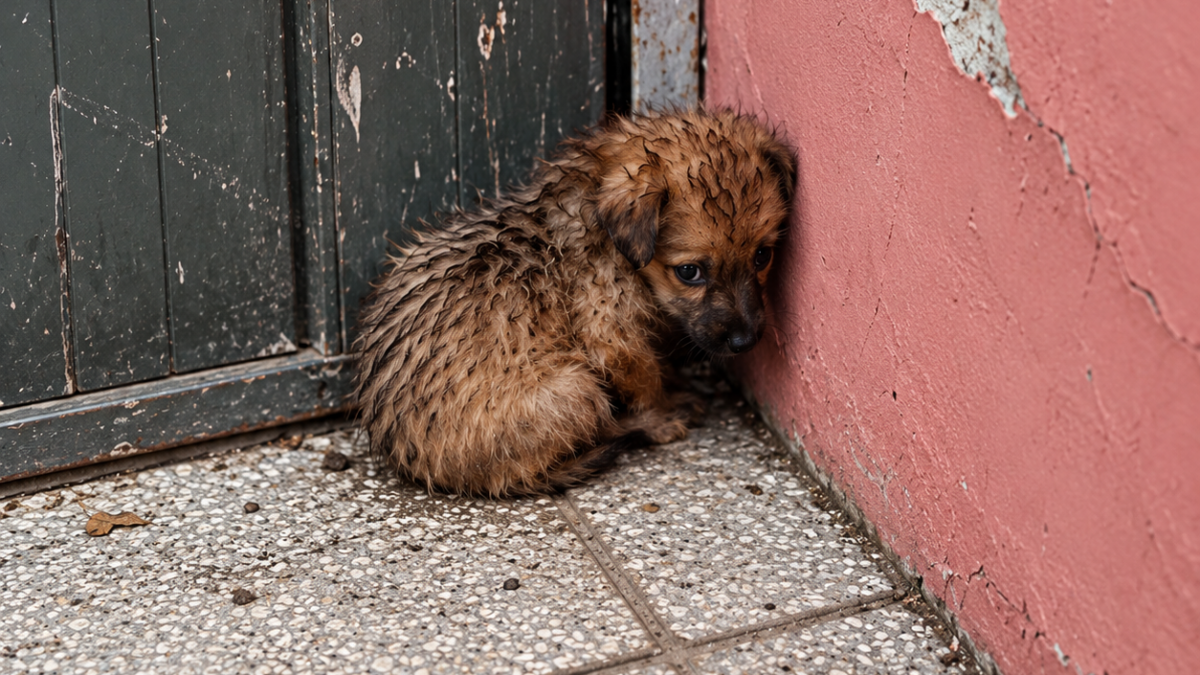
During the crisis, I had been too busy keeping Grace alive to think about the photograph.
Afterward, I looked at it again.
Rain.
Concrete.
Grace folded into the corner.
And whoever had taken that picture had apparently stood close enough to photograph her.
Close enough to see she was tiny.
Close enough to see her wounds.
Close enough to recognize that birds were attacking her.
Then they had left.
I wanted to know who.
Not because I planned to scream at them.
Not because I wanted some dramatic confrontation.
I wanted to understand how a person could see a two-kilogram puppy in that condition and decide a photograph was enough.
I went back to the area where Grace had been found.
It was behind a row of small workshops and storage units on the edge of a neighborhood.
The wall she had sheltered against was still stained from rain.
I stood in the corner.
From there, Grace would have been visible from the parking area.
People had passed.
There was no way nobody had noticed.
A mechanic named Luis worked two buildings down.
I showed him the photo.
“Have you seen this puppy?”
His expression changed.
“Yeah.”
My chest tightened.
“When?”
“Couple days before somebody got her.”
“Did you call anyone?”
“No.”
He immediately looked embarrassed.
“I thought somebody else had.”
“Why?”
“There were posts online.”
I stared at him.
“Posts?”
“People were sharing pictures. Saying there was a puppy back here.”
I felt sick.
Grace hadn’t been invisible.
She had been content.
A suffering animal had become something people photographed and passed from phone to phone while she remained exactly where she was.
“Do you know who took the first photo?”
Luis shook his head.
“But the security shop next door has cameras.”
There it was again.
Cameras.
I walked next door.
The owner, a woman named Marisol, listened while I explained.
“Oh, the puppy.”
“You saw her too?”
“From the camera. I didn’t know she was still there.”
“How long?”
She opened her computer.
“I can check.”
The footage went back two weeks.
We started watching.
The angle showed part of the concrete structure and the parking lot.
The image wasn’t close enough to show Grace clearly at first.
But we could see people.
A man stopped.
He looked toward the corner.
Walked closer.
Took out his phone.
Stayed less than one minute.
Then left.
Later, a woman approached.
She placed something on the ground.
Possibly food.
Then walked away.
Grace did not appear to touch it.
Another person drove slowly past.
Someone else stood under an umbrella and took a photograph.
I counted.
At least seven people visibly noticed the puppy before I arrived.
Seven.
Marisol whispered, “Oh my God.”
I didn’t answer.
At first, I felt furious at every person on the screen.
Then I noticed something.
At 2:13 on the second afternoon, the woman who had left food returned.
She brought another person.
They searched around the corner.
Grace was deeper beneath an overhang then, barely visible.
They left again.
Later that evening, the woman returned alone.
She crouched near Grace for almost ten minutes.
Then walked away.
“Who is she?”
Marisol leaned closer.
“I think she works at the bakery across the road.”
I found her the next day.
Her name was Emily.
When I showed her Grace’s recent picture, she started crying.
“She lived?”
“Yes.”
“Oh, thank God.”
“You saw her.”
“I did.”
“Why didn’t you take her?”
Emily wiped her face.
“I tried.”
I waited.
“She wouldn’t let me close. Every time I reached toward her, she crawled farther into that opening. I brought food. I called two shelters.”
“What did they say?”
“One said they were full. The other told me animal control would have to collect her.”
“Did you call animal control?”
“Yes.”
That changed everything.
“Do you have the call record?”
She pulled out her phone.
There it was.
A call placed two days before I received the photograph.
Then another.
She had also sent messages to a local rescue page.
The same page where someone eventually forwarded the picture to me.
I felt my anger shift.
Emily had not walked away because she didn’t care.
She had tried within what she understood how to do.
“Why didn’t you tell people online you had called?”
“I did.”
She showed me.
Buried among dozens of comments were hers.
“I called. They said they would check.”
“Please, someone take her.”
“She’s still there this morning.”
I had misjudged at least one person.
That mattered.
I apologized.
Emily shook her head.
“You don’t owe me that. I should’ve stayed there until somebody came.”
“You tried.”
“I could’ve done more.”
We both looked at Grace’s photograph.
That question—how much more could someone have done—would become more complicated than I expected.
Animal control records showed a call had indeed been made.
An officer had been dispatched.
But the address entered into the system was wrong by two blocks.
The officer checked an empty alley and reported no dog located.
A second call was marked as a duplicate.
Nobody corrected the address.
Grace remained in the rain.
That made me angry in a different way.
Not cruelty.
Failure.
A missed detail.
A wrong location.
A box clicked on a screen.
A job technically completed while a puppy continued suffering within walking distance.
I requested a meeting with the supervisor.
His name was Michael Harris.
He had already reviewed the case by the time I arrived.
“We made a mistake.”
I expected excuses.
He didn’t give them.
“The address was entered incorrectly on the first call. The second dispatcher saw the prior report and did not create a new field visit.”
“So Grace sat there another day.”
“Yes.”
“In the rain.”
“Yes.”
“While birds were attacking her.”
Michael looked down.
“Yes.”
I had rehearsed an angry speech.
His willingness to admit what happened took some of the force out of it.
“What changes?”
He looked at me.
“What?”
“You said you made a mistake. What changes because of it?”
That question became more important than blame.
Michael implemented a policy requiring repeat animal-distress calls to be reviewed rather than automatically labeled duplicates.
Addresses would be verified with callers.
Photos could be attached directly to reports.
If an animal wasn’t found, dispatchers would contact the original caller before closing certain welfare cases.
Small procedural changes.
Not dramatic.
But perhaps the next Grace would be found on the first day.
That felt like a better form of revenge against what had happened than shouting at somebody who already knew the mistake mattered.
Grace did not care about any of it.
By then, she had doubled her weight.
She had developed a round puppy belly that made me absurdly happy.
Her wounds closed.
The scabs fell away.
New fur began filling the bare patches.
Rachel finally cleared her to spend controlled time outside the quarantine area.
That led to Felix.
Felix was a foster kitten who had been found alone weeks earlier.
He was orange, confident and convinced every object in the house existed for his entertainment.
I introduced them carefully through a baby gate.
Grace stared.
Felix stared.
Grace wagged.
Felix puffed up until he looked twice his actual size.
“Be nice,” I told Grace.
She pressed her nose against the gate.
Felix smacked it.
Grace jumped backward.
I laughed.
“You survived parvo. Apparently the kitten is where you draw the line.”
Grace approached again.
Another smack.
This time Grace barked.
Felix sat down and began cleaning one paw as if the matter had been settled.
For three days, their relationship consisted of Grace begging for friendship and Felix pretending she did not exist.
Then I walked into the room one afternoon and found Felix sleeping against Grace’s stomach.
I stopped.
Neither moved.
Grace opened one eye.
Her tail began tapping.
“Don’t wake him.”
The tail moved faster.
Felix lifted his head, irritated.
Grace licked his face.
Felix smacked her once.
Then lay back down against her.
From that day on, they became inseparable.
Grace followed Felix.
Felix stole Grace’s bed.
Grace stole Felix’s toys.
They chased each other down the hallway.
Felix taught Grace to climb onto furniture I had specifically forbidden both of them from using.
Grace taught Felix that dog food was apparently worth stealing.
One morning, I found them sharing Grace’s water bowl.
I stood in the doorway remembering the tiny puppy who had once been unable to lift her head.
Now she was arguing with a kitten over a cardboard box.
Life had become ordinary.
That was what I wanted.
But there was one question I still couldn’t answer.
Where had Grace come from?
Nobody in the area recognized her as belonging to a nearby family.
No microchip.
No collar.
No missing-dog reports matched her.
At first, I assumed she had been abandoned.
Then one of the businesses nearby produced another piece of footage from several days before the rain.
A car stopped at the far end of the service road.
A door opened.
Something small was placed near the curb.
The vehicle left.
The camera was too distant for a clear plate.
But the shape on the ground moved.
Grace.
She had not wandered there.
Someone had left her.
I watched the clip four times.
Each viewing made my stomach tighter.
Marisol stood beside me.
“That’s her.”
“Yes.”
“Can police identify the vehicle?”
“Maybe.”
The footage went to animal-control investigators.
The car was an older silver sedan.
Partial plate.
One broken rear light.
The search took time.
In the meantime, Grace grew.
One kilogram became two again.
Then three.
Her ribs disappeared beneath healthy weight.
Her paws looked too large for her body.
Rachel predicted she would remain a relatively small dog, but apparently Grace had plans to become bigger than any of us expected.
At four kilograms, she discovered zoomies.
The first time, I thought something was wrong.
Grace exploded from the living room.
Down the hallway.
Around the table.
Back into the living room.
Felix chased her for three seconds, reconsidered his life choices and jumped onto a chair.
Grace completed another lap.
“What happened to the weak puppy?”
She slid on the rug.
I caught the lamp before it fell.
“Grace!”
She stopped.
Looked at me.
Then ran again.
I laughed until my stomach hurt.
Those moments slowly replaced the photograph in my mind.
When I thought of Grace, I no longer saw rain first.
I saw her skidding around a corner with Felix behind her.
Still, the investigation mattered.
About six weeks after the vehicle footage surfaced, Officer Daniel Reeves called.
“We think we found the car.”
My grip tightened around the phone.
“Who owns it?”
“A man named Curtis Bell.”
“Does he know Grace?”
“We’re finding that out.”
The investigators interviewed Curtis.
He initially denied owning a puppy.
Then they showed him the video.
His explanation changed.
He said Grace had belonged to his girlfriend’s relative.
Then he said she had become sick.
Then he claimed they believed someone near the businesses would take her.
“You left a sick puppy beside a road because you thought somebody would take her?”
That was what I wanted to ask.
I didn’t get the opportunity.
The legal process moved without needing my confrontation.
Another person was identified.
Curtis’s former girlfriend, Megan.
She admitted Grace had been living at the house.
According to her statement, Grace became sick several days before she was abandoned.
She stopped eating.
She had diarrhea.
Instead of seeking veterinary care, the two argued about the cost.
Neither wanted responsibility.
Finally, Curtis drove Grace away and left her near the businesses.
Megan said she believed he was taking her to a shelter.
Curtis said Megan knew exactly what he intended to do.
Again, blame moved from one person to another.
The physical reality did not change.
A sick puppy was placed beside a road.
No food.
No treatment.
No protection.
Then came days of rain.
Then crows.
Then infection.
Then parvo nearly killed her.
The prosecutor did not need me to invent revenge.
The facts already carried enough weight.
The case resulted in charges related to abandonment and neglect.
There were no dramatic police chases.
No courtroom confession.
No movie-style moment where someone fell to their knees asking forgiveness.
Real consequences were quieter.
Court dates.
Evidence.
Veterinary records.
Statements.
Fines.
Probation.
Restrictions on future animal ownership.
Responsibility for portions of the veterinary cost.
I attended one hearing.
Grace stayed home with Felix.
Curtis looked younger than I expected.
That surprised me for no good reason.
People who make cruel choices do not come with a particular face.
Megan sat separately.
Her attorney argued that she had not physically abandoned Grace.
The prosecutor replied that evidence showed she knew the puppy was ill before the abandonment and failed to obtain care.
There were arguments over degree of responsibility.
I listened.
At one point, a photograph of Grace from the rescue day appeared on a screen.
The room went quiet.
Two kilograms.
Wet fur.
Wounds.
Eyes half closed.
Then another photograph was shown.
Grace days later.
One kilogram.
IV line.
Wrapped in a blanket.
I had forgotten that particular photograph.
My throat closed.
The prosecutor asked Rachel to explain how close Grace had been to dying.
Rachel answered clinically.
“That puppy was critically ill. Severe gastrointestinal disease in an animal that small can lead to fatal dehydration extremely quickly.”
“Was treatment optional?”
“No.”
“Would a reasonable person have recognized she needed help?”
“In my opinion, yes.”
Curtis looked down.
I wanted him to look at the screen.
Then I stopped caring whether he did.
Grace’s recovery did not require his remorse.
That realization freed me.
For weeks, I had imagined revenge as making the people responsible truly understand what they had done.
But understanding cannot be forced.
Consequences can.
Protection can.
Rules can.
Future animals can be kept out of their care.
Grace could have a life so full that the people who abandoned her became a small chapter rather than the title.
That would be enough.
When the judge imposed the final conditions, I felt no victory.
Only relief.
Outside the courthouse, Rachel found me.
“You okay?”
“I thought I’d feel better.”
“You expected something dramatic?”
“Maybe.”
She smiled sadly.
“Go home.”
“To Grace?”
“To the dog who’s probably eating your furniture right now.”
I laughed.
“She prefers shoes.”
“There you go.”
When I opened my front door, Grace came flying down the hallway.
She had grown enough that her feet made real noise now.
Felix followed at a dignified distance, pretending he was not also excited.
Grace launched herself against my knees.
I crouched.
“There she is.”
She licked my face.
“You have no idea where I was.”
More licking.
“And you don’t care.”
Her tail hit the wall.
Felix meowed.
“Fine. You too.”
I sat on the floor between them.
That was my justice.
Not the courthouse.
Not the fine.
Not seeing anyone punished.
Grace, warm and healthy, pushing her head beneath my hand.
The animals we fail do not need us to hate forever.
They need us to build something better afterward.
A few months passed.
Grace reached six kilograms.
Her coat became soft and glossy.
A faint irregular patch on her back marked where the worst bird wounds had healed.
Everything else looked almost normal.
Almost.
Rain remained strange for her.
The first heavy storm after her recovery began one evening around six.
The sound on the roof became loud.
Grace froze in the hallway.
Her ears dropped.
Felix ran toward the window, fascinated.
Grace backed away.
I noticed immediately.
“Hey.”
Thunder sounded.
Grace moved toward the corner of the room.
Not under furniture.
Into the corner.
Exactly the way she had been positioned when she was found.
My chest tightened.
I sat several feet away.
“You’re home.”
She trembled.
I resisted the urge to grab her.
Choice mattered.
I put a blanket beside me.
“Come here if you want.”
Rain hit the windows harder.
Grace stared.
Minutes passed.
Then she moved.
One step.
Another.
She crawled onto the blanket and pushed herself against my leg.
I covered her lightly.
Felix jumped beside us.
For the next hour, we sat on the floor while rain hammered the roof.
Every few minutes I said the same words.
“You’re inside.”
Eventually, Grace fell asleep.
The storm continued.
She slept through it.
That night was more important to me than the court decision.
Trauma remembers things the mind cannot explain.
Sounds.
Corners.
Smells.
Rain.
But memories can acquire new endings.
The first rain meant exposure.
The next rain meant a blanket.
Warmth.
Felix.
Home.
Over time, Grace became less afraid.
She never loved storms.
But she stopped running into corners.
When rain began, she usually found me.
That was enough.
Felix remained her closest friend.
They grew into an absurd pair.
Grace would carry toys to him.
Felix would steal them.
Grace would chase him.
Felix would leap onto a table and stare down smugly.
At night, I often found Felix sleeping on Grace’s back.
She tolerated it.
One afternoon, Felix became sick with a minor stomach problem.
Nothing dangerous.
Still, he spent most of the day sleeping.
Grace refused to leave him.
I moved her bowl into another room.
She ate quickly, then returned.
When Felix shifted, Grace licked his ear.
I sat nearby thinking about the first weeks of her life.
A puppy nobody stayed beside had become an animal who refused to leave her friend alone.
That felt like healing.
People began asking whether I planned to adopt Grace.
I always answered the same way.
“She’s still recovering.”
That was true at first.
Then she recovered.
I changed the answer.
“She needs more socialization.”
Then she became wonderfully social.
“She and Felix are bonded.”
That was also true.
Eventually Rachel stopped pretending not to notice what I was doing.
At Grace’s six-month checkup, she looked at me across the table.
“When are you admitting she’s yours?”
“She’s a foster.”
Grace was sitting on my foot.
Rachel looked down.
“She sleeps in your bed?”
“Sometimes.”
“You cooked chicken for her birthday.”
“She has a sensitive stomach.”
“You bought matching Christmas collars for her and Felix.”
“Coincidence.”
“You have approximately nine hundred pictures of her on your phone.”
“That proves nothing.”
Rachel folded her arms.
I looked at Grace.
Grace looked at me.
Felix was at home because he objected strongly to veterinary offices.
I sighed.
“Fine.”
Rachel smiled.
“Fine what?”
“She’s mine.”
Grace’s tail began wagging.
“That easy?”
“No. She’s actually adopted me through psychological warfare.”
I completed the paperwork that week.
Grace became officially mine.
I thought signing would feel dramatic.
Instead it felt like confirming something that had already happened months earlier.
Her home was the place where she knew every sound.
Her person was the one whose voice had made her tail move when she was too weak to stand.
Her family included one orange cat who still pretended he had not chosen her.
One year after Grace was found, Emily visited.
She had asked about Grace several times but had never seen her in person.
When she arrived, Grace barked once.
Then approached.
Emily knelt.
“Oh my God.”
Grace sniffed her.
Emily began crying.
“I’m sorry.”
Grace licked her hand.
Emily pressed both hands to her face.
“I should’ve done more.”
I sat beside her.
“You called.”
“It wasn’t enough.”
“No. But you called.”
“She still stayed there.”
“Yes.”
“If I had just taken her…”
“You tried to get close.”
“I should’ve waited.”
“Maybe.”
Emily looked at me.
I wasn’t going to offer false absolution.
Sometimes we can do more.
Sometimes that realization should change how we behave next time.
But guilt is useful only if it becomes action.
“You know what matters now?”
“What?”
“The next time.”
She frowned.
“The next animal you see. The next person who needs help. The next situation where you’re wondering whether someone else will handle it.”
Emily looked at Grace.
“I won’t leave.”
“Then Grace changed something.”
Emily nodded.
Months later, she began volunteering with a local rescue.
The first dog she personally helped transport was an elderly beagle found wandering near a highway.
She sent me a photograph.
Beneath it, she wrote:
I stayed until they came.
I showed the message to Grace.
She tried to eat my phone.
Not every lesson needs to be appreciated by the one who inspired it.
The procedural changes at animal control stayed too.
Michael sent me an update six months after our meeting.
Repeat distress calls were now flagged automatically.
Location verification had prevented several dispatch errors.
One case involved an injured cat officers located only because they called the original reporter after failing to find the animal at first.
Another involved puppies under an abandoned house.
Grace would never know that either.
Her suffering had created changes that protected animals she would never meet.
I found that strangely comforting.
I still wished none of it had happened.
People sometimes romanticize survival.
They say everything happens for a reason.
I never believed that.
Grace did not need to be abandoned so somebody could learn compassion.
She did not need to nearly die so procedures could improve.
Cruelty and failure do not become good simply because somebody builds something useful afterward.
The meaningful part is what we choose to do with damage that has already occurred.
We could not undo Grace’s three days in the rain.
We could make sure they were not wasted.
Two years after her rescue, Grace weighed nine kilograms.
Rachel had been wrong about her staying tiny.
I reminded her regularly.
“You said small.”
“I said probably small.”
“She takes up half my couch.”
“She’s medium-small.”
“That is not a real category.”
Grace lay across three cushions.
Felix occupied the fourth.
Rachel shrugged.
“She seems comfortable.”
Grace had become athletic.
Not elegant.
Athletic.
Her legs were slightly too long for the rest of her, and when she ran too fast around corners, her rear end often passed her front end.
She loved grass.
She loved car rides.
She loved chicken.
She hated baths with deep moral conviction.
She was fascinated by crows.
That surprised me.
The first time one landed on our fence, I expected Grace to panic.
Instead, she stared.
The crow called.
Grace barked.
The bird flew away.
Grace strutted around the yard afterward like she had defeated an ancient enemy.
“You’re very brave behind a fence.”
Tail wag.
“Heroic.”
Another crow landed days later.
Grace chased it away too.
Eventually crows became nothing more than birds.
That felt significant.
The things that once hurt her lost their power.
One autumn afternoon, Grace and I returned to the place where she had been found.
I had avoided taking her there.
I wasn’t interested in forcing some symbolic confrontation with her past.
Dogs do not need human ideas of closure.
But the property owner had asked me to come because they were installing a small covered feeding and water station for stray animals near the workshops.
They had also posted rescue contact numbers.
Emily helped organize it.
Michael from animal control attended.
Marisol came from the security business.
Several people who had seen Grace during those three days showed up.
I brought Grace because the event was outdoors and calm.
When we arrived, she jumped from the car.
She sniffed the pavement.
Her tail stayed neutral.
Then she walked toward the concrete corner.
I held the leash loose.
She stopped several feet away.
For a moment, nobody spoke.
I wondered if she remembered.
There was no way to know.
Memory in dogs works differently.
Perhaps the smell meant something.
Perhaps it meant nothing.
Grace walked closer.
Sniffed the ground.
Then found an old leaf.
She picked it up.
Ran in a circle.
Felix would have been embarrassed.
Everybody laughed.
I felt tears come anyway.
The place that had once held so much horror had become completely unimportant to Grace.
It was just another place with an interesting leaf.
I envied that.
Before leaving, I stood beside the corner alone.
Rain stains still marked the wall.
I could picture her there.
Wet.
Tiny.
Unable to defend herself.
For a long time, I had wanted revenge against everyone connected to that image.
The people who abandoned her.
The system that missed her.
The strangers who photographed instead of acting.
Time complicated that anger.
Some people truly failed.
Some made selfish choices.
Some tried badly.
Some assumed somebody else had acted.
Some called and trusted a system that failed.
There was no single villain large enough to contain the entire story.
Curtis and Megan were held responsible for abandoning and failing Grace.
That mattered.
But the deeper enemy was indifference.
The belief that somebody else would step in.
The habit of turning suffering into something observed rather than interrupted.
Against that, Grace had created an unusual kind of revenge.
Emily became a volunteer.
Animal control changed procedures.
Businesses posted rescue numbers.
People in the neighborhood became more likely to call.
Several animals were later helped through the little network formed after Grace’s case.
And Grace?
Grace got a couch.
I preferred her version.
Her third birthday became a neighborhood event by accident.
I planned something small.
Susan brought treats.
Emily brought a toy.
Luis from the repair shop stopped by.
Marisol brought a ridiculous pink bandanna.
Rachel arrived after work.
Michael sent a bag of dog biscuits.
By noon, my yard contained twelve people, one dog and an orange cat watching everybody with contempt from the window.
I put a small dog-safe cake on a table.
Grace stared at it.
“You have to wait.”
Her entire body vibrated.
“Wait.”
She whined.
People laughed.
Felix scratched the window from inside.
“Fine.”
I removed the candle.
Grace inhaled half the cake before I could cut it properly.
“So much for dignity.”
Her tail blurred.
Emily stood beside me.
“Look at her.”
“I know.”
“You couldn’t even tell.”
“What?”
“That she was the same puppy.”
I knew exactly what she meant.
Grace’s fur had covered most of the old wounds.
Her body was strong.
Her eyes bright.
The tiny puppy from the photograph seemed impossible to reconcile with the dog in front of us.
But I could tell.
Not from scars.
From small habits.
Grace still checked where I was when she woke.
She still became uneasy when a meal was unusually late.
During thunderstorms, she slept close enough that one paw touched me.
And whenever she was sick, even mildly, she searched for my voice.
Those were the echoes.
Healing doesn’t always erase them.
It teaches them a different ending.
One winter, Grace developed a stomach infection.
Nothing like parvo.
Still, when she refused breakfast, panic hit me instantly.
My hands shook while I called Rachel.
We went to the clinic.
Grace sat on the examination table looking annoyed.
Rachel reviewed the tests.
“This is treatable.”
“You’re sure?”
“Yes.”
“Her stool—”
“I know.”
“She wouldn’t eat.”
“I know.”
“What if—”
Rachel touched my arm.
“This is not that.”
I looked at Grace.
My mind had gone immediately back to one kilogram.
IV fluids.
Bloody diarrhea.
Critical.
Grace nudged my hand.
Rachel said quietly, “You have trauma too.”
I laughed once.
“Apparently.”
Grace recovered within days.
That episode taught me something I had overlooked.
Rescue changes the rescuer.
People celebrate the happy ending.
They rarely talk about the way your body remembers every near-loss.
A dog skips a meal and suddenly you are back on a clinic floor.
Rain starts and you remember wet fur.
A crow lands and you see blood.
Healing belonged to both of us.
Over the years, Grace became my proof that fear could loosen its grip without disappearing completely.
I learned not to check whether she was breathing every time she slept deeply.
I learned that diarrhea did not always mean death.
I learned to watch storms without reliving the first photograph.
Grace learned that bowls refill.
Doors reopen.
People return.
The first photograph still existed on my phone.
For years, I never deleted it.
I wasn’t sure why.
Maybe I feared forgetting.
Then one evening, while looking for another picture, I came across it unexpectedly.
Grace lay in that corner.
Rain.
Wounds.
Exhaustion.
I stared for a long time.
Then Grace jumped onto the couch beside me.
She was six years old by then.
Healthy.
Slightly overweight despite Rachel’s repeated warnings.
Her muzzle showed the first tiny hints of gray.
Felix was sleeping on the armrest.
Grace pushed her nose under my elbow.
I looked from the photograph to the dog beside me.
Then I finally moved the picture into a folder instead of keeping it among my favorites.
I didn’t delete it.
History should remain honest.
But it did not need to greet me every day.
That night, Grace slept with her head on my leg.
Rain started after midnight.
She lifted her ears.
Listened.
Then sighed and went back to sleep.
I lay awake smiling.
That was the moment I realized the rain no longer belonged to her past.
It was just weather.
Years moved.
Grace slowed slightly.
Felix became an enormous orange cat whose confidence remained completely unjustified.
Their friendship never changed.
Even as Grace aged, Felix slept beside her.
When arthritis eventually began bothering her rear legs, he seemed to understand.
He stopped ambushing her around corners.
Mostly.
One afternoon, I found Grace asleep in the sun with Felix curled inside the curve of her belly.
It looked almost identical to the first photograph I had taken of them years earlier.
Except Grace’s face was gray now.
I took another.
Two lives.
One beginning.
One later chapter.
I sent it to Rachel.
She replied:
The hand-sized puppy.
I wrote back:
Not so hand-sized anymore.
Grace had become something larger than the rescue story people originally knew.
When strangers heard about her, they focused on the dramatic parts.
Three days in rain.
Crows.
Parvo.
Coronavirus.
One kilogram.
I understood why.
Those details shocked people.
But they were not the parts I treasured most.
I treasured the first time she realized the refrigerator contained chicken.
The day she learned how to climb stairs.
The afternoon she and Felix destroyed an entire roll of paper towels.
Her first trip to the beach, where she barked at waves and then ran from them.
The year she stole a sandwich from Michael during a rescue fundraiser.
The night she crawled under my blanket during a storm and snored against my ribs.
That was her life.
The cruelty was an opening paragraph.
It did not deserve every page.
When Grace was eight, Emily called me.
She was now coordinating foster placements for a small rescue group.
“We have a puppy.”
“That sounds dangerous.”
“She reminds me of Grace.”
I went quiet.
“Why?”
“Found outside in heavy rain.”
I looked toward Grace.
She was sleeping beside Felix.
“Is somebody with her?”
“Yes.”
“Already at the vet?”
“Yes.”
“Good.”
Emily laughed softly.
“You trained me well.”
“No. Grace did.”
The puppy survived.
Emily fostered her.
Eventually, she adopted her too.
When she sent me the adoption photo, I stared at it for a long time.
The next animal had not waited three days.
That mattered.
Maybe that was the fullest answer to everything Grace endured.
Not that her suffering had a purpose.
It didn’t.
But because she survived, people behaved differently afterward.
One rainy afternoon years after Grace’s rescue, I drove past the old workshop area.
I wasn’t planning to stop.
Then I saw a woman crouched near the covered feeding station.
Beside her was a thin black dog.
Another person stood nearby calling someone.
I parked.
“Need help?”
The woman looked up.
“We already called a rescue. They’re coming.”
“Good.”
She had a towel around the dog.
A bowl of water nearby.
She wasn’t leaving.
I looked at the concrete corner across the lot.
Then at the dog.
This time, somebody stayed.
I sat in my car afterward and cried.
Not because the scene was sad.
Because it was different.
That was Grace’s revenge.
A place where seven people once saw a suffering puppy without successfully getting her out had become a place where one injured dog immediately had three strangers standing beside him until help arrived.
No judge could order that.
No fine could create it.
Stories can.
Memory can.
Regret can, if people let it teach them something.
Grace grew old slowly.
Her face became white around the muzzle.
Her once endless zoomies became short bursts followed by long naps.
She still disliked baths.
Still loved chicken.
Still bullied Felix away from the warmest blanket even though Felix usually reclaimed it five minutes later.
At ten, she developed arthritis.
At eleven, her hearing weakened.
At twelve, she occasionally stood at the wrong side of a door waiting for it to open.
Every new sign of age hurt me.
Then I remembered the clinic.
One kilogram.
Critical.
A veterinarian unsure whether morning would come.
Old age was not an insult to Grace.
It was the prize.
She had earned every gray hair.
Every stiff morning.
Every slow walk.
Every afternoon nap.
When she turned twelve, Rachel came to our house because Grace disliked long car trips by then.
She examined her on the living-room floor.
“Heart sounds good.”
“Good.”
“Weight is…”
“Don’t.”
Rachel laughed.
“She likes food.”
“She almost starved once.”
“That excuse expired ten years ago.”
Grace wagged.
“She agrees with me.”
“Of course she does.”
Felix, equally old and even heavier, watched from the couch.
Rachel scratched Grace behind the ears.
“You know, I still remember when she fit in my hands.”
“So do I.”
“I genuinely wasn’t sure she would survive.”
“You never told me how unsure.”
“You had enough to worry about.”
I looked at Grace.
“Was it really that close?”
Rachel became quiet.
“Yes.”
“How close?”
“The night she dropped toward one kilogram? Very.”
Grace rested her head against my leg.
I swallowed.
“Then every year was extra.”
Rachel shook her head.
“No.”
“What?”
“Not extra.”
She smiled.
“Hers.”
I never forgot that.
Grace’s years were not borrowed.
They belonged to her.
Nobody gets to define a survivor’s life as borrowed time simply because death came close once.
Grace had survived.
After that, the days were hers.
At thirteen, storms barely bothered her anymore.
One summer night, rain began pounding the roof.
I looked toward Grace automatically.
She was asleep.
No shaking.
No corner.
No searching for me.
Felix was beside her.
Thunder rolled.
Grace opened one eye.
Then closed it.
I sat in the dark listening to rain and remembered the first sentence of her story.
For three days, a tiny puppy huddled in a corner while rain soaked her fur.
Thirteen years later, rain fell outside a warm house while Grace slept through it.
That was the ending I wanted.
Not perfect.
Not untouched.
Safe.
There came a point when age began taking more than medication could return.
Grace’s hips weakened.
Her appetite became unpredictable.
She slept longer.
Some mornings she needed help standing.
I knew where the road was going.
Knowing did not make it easier.
Rachel helped us manage pain.
We added rugs so Grace would not slip.
I moved her bed closer to the back door.
Raised her bowls.
Made ramps.
Adjusted everything.
Just as I had when she was a puppy.
One evening I realized our lives had formed a circle.
At the beginning, I carried Grace because she was too weak to walk.
At the end, I sometimes carried her because her old legs could not manage the stairs.
The difference was everything in between.
Thirteen years.
Felix.
Christmases.
Birthdays.
Beaches.
Storms.
Cheese.
Chicken.
Walks.
Warm beds.
Thousands of ordinary mornings.
The people who left Grace beside that road had given her almost nothing.
They did not get to claim what came after.
One afternoon, Emily visited.
Grace was sleeping near the window.
Emily sat beside her.
“Hey, little girl.”
Grace opened her eyes.
Her tail moved against the bed.
Emily cried immediately.
“Still doing that.”
“Always.”
She stroked Grace’s head.
“I’ve helped more than two hundred animals since her.”
I looked at her.
“Two hundred?”
“Probably more.”
Grace sighed.
Emily smiled through tears.
“All because I never wanted to feel like I did when I left her there.”
I understood.
Grace’s life had sent ripples farther than either of us knew.
Michael’s policy changes.
Emily’s rescue work.
The businesses.
The neighbors.
The people who heard the story and chose differently the next time.
Again, I would never say Grace suffered for a reason.
I would say people had a responsibility to make something better after suffering had occurred.
Grace deserved that.
The final winter of her life was gentle.
She ate less.
Moved slowly.
Spent most afternoons in sunlight.
Felix stayed close.
He had always treated affection like something embarrassing, but with Grace he stopped pretending.
Sometimes he groomed the fur between her ears.
Grace closed her eyes.
I took too many photographs.
I knew what I was doing.
Trying to keep time.
Time doesn’t cooperate.
One morning, Grace refused chicken.
That was when I knew.
Not because a single missed meal meant the end.
Because I knew her.
The way she looked at me was different.
Tired.
Not frightened.
Just tired.
Rachel came that afternoon.
We talked quietly.
Grace lay on her favorite blanket.
Rain began outside.
Of course it did.
For a moment, I hated the sound.
Then I looked at Grace.
She wasn’t afraid.
Her head rested in my lap.
Felix lay beside her.
Rachel gave us time.
I stroked the scarred patch along Grace’s back where the crows had once injured her.
The fur there had grown thin again with age.
“You know what I promised you?”
Grace opened her eyes.
“I said you’d never be alone again.”
Her tail moved faintly.
I cried.
“You made that very expensive, by the way.”
Another small movement.
“You needed a lot of food.”
I laughed through tears.
“And veterinary care.”
Grace breathed slowly.
“And an unreasonable number of blankets.”
Outside, rain struck the window.
“You beat it.”
I touched my forehead to hers.
“You hear that?”
The rain continued.
“You beat the rain.”
She closed her eyes.
Rachel returned when I nodded.
Grace remained in my arms.
She was warm.
Safe.
No hard concrete.
No birds.
No hunger.
No strangers photographing her and leaving.
Her family was there.
My hand rested against her chest until her breathing stopped.
The rain continued after she was gone.
For a long time, I sat beside her.
Felix smelled her face.
Then curled beside her one final time.
That broke me.
The house was different immediately.
Too quiet.
No nails against the floor.
No bowl scraping.
No old-dog sigh from the bed.
No soft thump of a tail when I entered the room.
For days, I kept expecting Grace to appear around corners.
Grief creates habits the world can no longer satisfy.
One morning, I found myself reaching for her food bowl.
I stood there holding it.
Then I sat on the kitchen floor and cried.
Felix came over.
He was ancient by then.
He climbed awkwardly into my lap.
We grieved together.
Weeks later, Emily brought me something.
A framed photograph.
Not the rescue picture.
I was grateful for that.
It showed Grace as an adult standing in the yard after a summer rainstorm.
Her fur was wet.
Her mouth open.
Tail raised.
Behind her, sunlight was breaking through the clouds.
Emily had written a small line beneath the image.
**Someone once left her in the rain. She spent the rest of her life knowing someone would always come back for her.**
I put the frame near the window.
Beside it, I placed Grace’s collar.
For months, I could not tell her story without starting with the terrible parts.
Then, gradually, the order changed.
When people asked about Grace, I started saying:
She was the dog who loved chicken.
The dog whose best friend was an orange cat.
The dog who hated baths.
The dog who once ate half her own birthday cake before I could cut it.
The dog who lived to thirteen even though a veterinarian once feared she would not live through the week.
Sometimes I mentioned the rain later.
Sometimes I didn’t.
Because the people who abandoned Grace already took three days from her.
I refused to give them the remaining thirteen years.
Those belonged to Grace.
The court case had been one kind of justice.
The policy changes were another.
The animals helped afterward were another.
But the revenge that satisfied me most was embarrassingly ordinary.
Grace grew old.
That was it.
She grew old.
The puppy somebody discarded because she was sick lived long enough to get arthritis.
The puppy who dropped to nearly one kilogram lived long enough to become slightly overweight.
The puppy crows attacked because she could not defend herself lived long enough to chase birds out of her own backyard.
The puppy who trembled whenever rain fell lived long enough to sleep through thunderstorms.
The puppy photographed and left alone lived long enough to become the center of a family.
I can think of no punishment more complete for cruelty than watching it fail to define the life it tried to destroy.
Grace did not spend thirteen years being a victim.
She spent them being Grace.
And that is the only ending she ever deserved.
Years after Grace was gone, I still noticed the rain before anything else.
Sometimes it began as a soft tapping against the kitchen window, barely loud enough to hear over the refrigerator. Other nights it came suddenly, hammering the roof the way it had during those first three days of her life when she had nowhere warm to go.
For a long time, rain carried me backward.
I would see the photograph again.
That tiny body pressed into concrete.
Wet fur flattened against skin.
The wounds.
The crows.
The look in her eyes that seemed far too old for a puppy who had barely begun living.
Then one evening, something changed.
A storm rolled over the neighborhood, heavy enough to shake the windows. I was sitting near the place where Grace’s bed used to be when I looked toward the framed photograph Emily had given me.
Grace was standing in our backyard after a summer storm, soaked from head to tail, looking ridiculously proud of herself.
I smiled.
That was when I realized rain no longer belonged to the worst part of her story.
Grace had taken it back.
She had lived through hundreds of rainy days after the one that almost killed her.
Some she hated.
Some she tolerated.
Some she slept through with Felix pressed against her side.
And on a few, once she became confident enough, she had actually run through the yard while I stood on the porch yelling, “You’re going to make me dry you off!”
She never cared.
That was the image I chose to keep.
Not the puppy trapped by the storm.
The dog who eventually learned she could run through it and come home whenever she wanted.
After Grace died, the small rescue network that had formed around her story continued growing.
Emily stayed involved.
Michael remained with animal control and kept improving the welfare-call procedures.
Marisol kept the emergency rescue numbers posted near the businesses.
The little covered station where Grace had once been found was maintained by people from the neighborhood.
Water was changed.
Food was checked.
And more importantly, nobody assumed a bowl of food was enough when an animal clearly needed help.
One afternoon, nearly two years after Grace was gone, Emily called me.
“You need to come down here.”
My stomach tightened automatically.
“What happened?”
“There’s a dog.”
That was enough.
I drove to the old workshop area.
A young black-and-white dog was curled beneath the covered station.
But unlike Grace, he wasn’t alone.
Luis was sitting several feet away with a towel.
Marisol had brought water.
A teenage boy stood near the road watching for the rescue van.
Emily was on the phone with the veterinary clinic.
Five people were there.
Nobody was taking pictures and leaving.
Nobody was saying, “Someone else will handle it.”
They were staying.
I parked and walked toward them.
Emily looked up.
For a second, neither of us said anything.
Then she smiled.
“Different this time.”
I looked at the dog.
“Yes.”
Completely different.
The rescue van arrived less than fifteen minutes later.
The dog had a fractured leg and was badly underweight, but he recovered.
A family adopted him several weeks afterward.
His name became Jasper.
I met him once after his adoption.
He came running toward me with a blue harness and more confidence than good manners.
His new owner laughed.
“He thinks everybody is his friend.”
I knelt and scratched his chest.
“That’s not a bad way to live.”
On the drive home, I cried.
Not because Jasper reminded me of Grace.
Because he didn’t.
His story had changed before it could become hers.
That was the legacy I had never expected.
Grace could not be rescued earlier.
We could not rewrite her first three days.
But another dog could receive help in fifteen minutes because people remembered what happened when everyone waited.
That mattered.
Over time, Grace’s name appeared in places I never imagined.
Emily’s rescue group created a small emergency medical fund for abandoned puppies.
They called it the Grace Fund.
I argued against the name at first.
“She doesn’t need a memorial fund.”
Emily smiled.
“It isn’t a memorial.”
“What is it?”
“A promise.”
The fund paid for IV fluids for a puppy with parvo.
Then antibiotics for a dog found with an infected wound.
Then emergency treatment for three puppies abandoned beside a highway.
I kept every update Emily sent me.
Each time, I looked at Grace’s collar near the window.
“You’re still expensive,” I would say.
I could almost imagine the tail wag.
The strangest thing about losing Grace was how ordinary grief eventually became.
At first, her absence occupied every room.
Then it became smaller.
Not weaker.
Just quieter.
I stopped expecting to hear her nails in the hallway.
I stopped reaching automatically for two bowls in the morning.
Eventually, even Felix was gone, leaving the house quieter than I believed a house could be.
But there were still reminders everywhere.
A scratch on the bottom of the kitchen cabinet where Grace had once tried to reach a bag of treats.
A stain on the porch from a plant she knocked over during one of her ridiculous zoomies.
A tiny chew mark on the leg of a chair.
For years, I considered repairing that chair.
I never did.
Some damage deserves repairing.
Some becomes proof that somebody was here.
One summer evening, I sat outside while a storm approached in the distance.
The air smelled like wet grass.
Thunder rolled far away.
For the first time in years, I found myself thinking not about the day Grace almost died but about her final afternoon.
Her head in my lap.
Felix beside her.
Rain against the glass.
No fear.
That was when I finally understood the full shape of her life.
She had begun in a corner because nobody stayed.
She had ended surrounded by people and animals who refused to leave.
Everything between those two moments was the story.
The first meal after days of refusing food.
The tiny tail wag.
The kitten who smacked her nose.
The birthday cake she stole.
The birds she eventually chased from her own yard.
The storms she learned to sleep through.
The gray hair.
The arthritis.
Even the final goodbye.
None of those moments erased what happened to her.
They overwhelmed it.
That is different.
Cruelty had three days.
Grace had thirteen years.
Three days made people notice her.
Thirteen years made us know her.
And there is an enormous difference between being remembered for how you suffered and being remembered for how you lived.
Whenever somebody asks me now what happened to the puppy in that old photograph, I don’t begin with the crows.
I don’t begin with the parvo.
I don’t begin with the people who left her beside the road.
I say:
“She survived.”
Then I tell them the important part.
She became stubborn.
She became funny.
She loved chicken.
She hated baths.
She had an orange cat named Felix who became her best friend.
She grew bigger than the veterinarian expected.
She learned that bowls refill.
She learned that storms end.
She learned that a person leaving through the front door can come home again.
And finally, after a lifetime that once seemed impossible, Grace became old.
That will always be my favorite part.
Not that she survived being abandoned.
Not that the people responsible faced consequences.
Not even that her story helped other animals.
My favorite part is that Grace eventually became so safe that survival stopped being the most interesting thing about her.
She simply lived.
And somewhere along the way, the tiny puppy everyone once feared would not make it through another night became an old dog sleeping peacefully while rain fell outside.
That is how Grace won.
Not by forgetting what happened.
Not by making the people who hurt her hurt in return.
She won because what they did became smaller and smaller inside the enormous life she built afterward.
They left her in the rain.
But they did not get to decide where her story ended.
Grace did.
And she chose home.








