PART 2: They Left a 2-Month-Old Puppy Broken Beside the Street—But Chiquitin Refused to Stop Reaching for Love
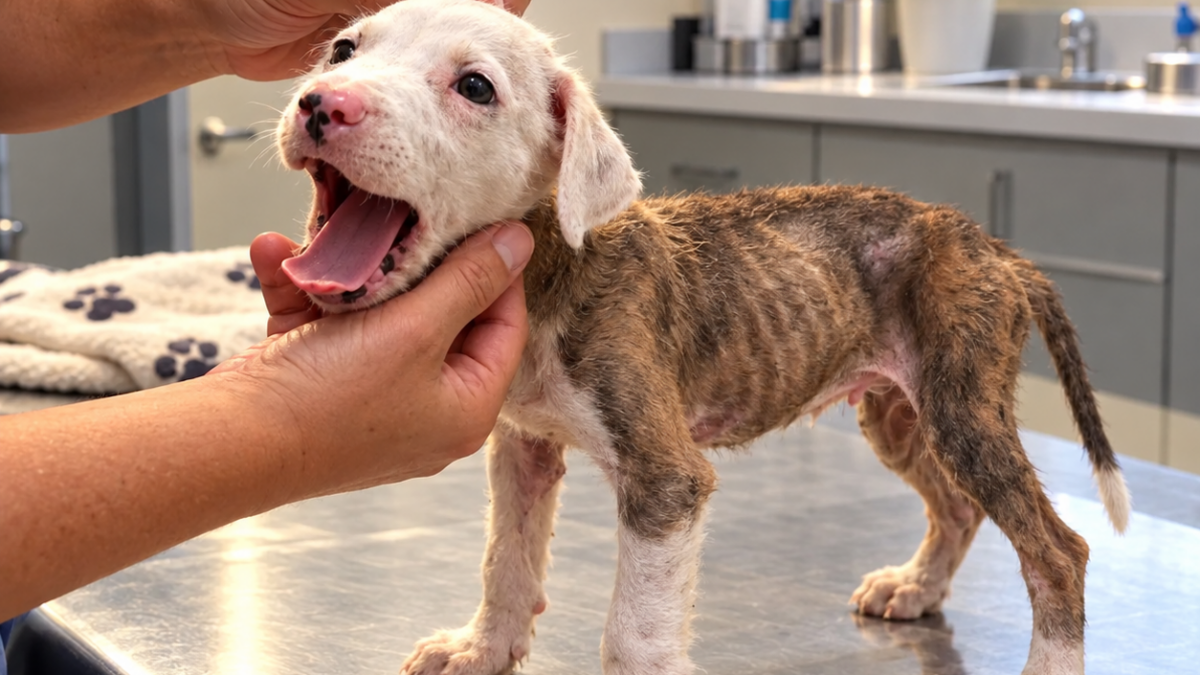
The puppy was so small that people kept walking past him without realizing the trembling shape beside the sidewalk was still alive.
One of his legs was fractured, another paw had been twisted since birth, and yet every time someone slowed down near him, his tail tried to move.
But when I finally knelt beside him and reached out my hand, that tiny puppy did something I still can’t explain without feeling my throat tighten.
He tried to crawl toward me.
“Easy, sweetheart,” I whispered.
His front legs barely supported him.
One paw bent at an unnatural angle. Another leg seemed too painful for him to use at all. His belly was tight, his fur dirty, and his body felt far too light when I carefully slid my hands underneath him.
He couldn’t have been more than a few weeks old.
Later we would estimate he was around two months.
Two months.
That was the part I couldn’t get out of my mind.
He had barely begun living, yet somehow he was already lying beside a crowded street as if the world had finished with him.
People passed behind me.
Cars moved through traffic.
The city carried on.
And this tiny puppy looked at me as though I might be the first person he had seen all day who intended to stay.
I touched his head.
His tail tapped the pavement.
Once.
Then again.
That was when I decided on his name.
“Chiquitin,” I said.
Little one.
It fit him.
I wrapped him carefully in a towel and carried him to the vehicle.
He didn’t cry.
That worried me more than crying would have.
Animals in severe pain sometimes become frighteningly quiet.
During the drive to the clinic, I kept looking down at him.
“Stay with me.”
His eyes opened slightly.
Then closed again.
At the veterinary clinic, everything moved quickly.
A technician took him from my arms.
Blood was drawn.
Fluids were started.
His temperature was checked.
X-rays were ordered.
I stood near the treatment area listening to pieces of conversation I didn’t fully understand.
“Severely anemic.”
“Parasites.”
“Diarrhea.”
“Reflux.”
“Possible fracture.”
Then the veterinarian called me over.
She pointed at the X-ray.
One leg had indeed been fractured.
But the twisted paw was something different.
“He was born this way,” she explained.
I stared at the image.
“Can you fix it?”
“Maybe. But that isn’t our biggest concern tonight.”
Chiquitin’s anemia was severe.
His body was fighting parasites.
His digestive system was irritated.
He was dehydrated and exhausted.
The veterinarian looked toward the tiny puppy lying beneath warm blankets.
“Right now, we need to stabilize him.”
“Is he going to survive?”
She didn’t answer immediately.
“I hope so.”
Those three words were all I got.
That night, we wrapped him in warmth and gave him fluids, medication, and the first real care his little body may have received in days.
He barely moved.
But whenever I touched him, that tail made the smallest sound against the bedding.
Tap.
Tap.
“You still want people after everything?”
Tap.
I sat beside him long after there was anything useful for me to do.
At one point, the veterinarian joined me.
“We need to talk about the paw.”
I looked at her.
“If the deformity becomes painful as he grows, amputation may eventually be the kindest option.”
The word hit me.
“Amputation?”
“Possibly. Not now.”
I looked down at Chiquitin.
He was sleeping.
Two months old.
One broken leg.
One deformed paw.
Anemia.
Parasites.
A sick stomach.
And now we were discussing whether he might someday lose a limb.
I rubbed the space between his ears.
“You’ve had enough bad news,” I whispered.
The veterinarian sighed.
“There is something else.”
I looked up.
She had been watching the way Chiquitin shifted beneath the blanket.
And what she told me next completely changed the way I saw his future.
PART 2
“He’s already compensating.”
I looked at her.
“What does that mean?”
The veterinarian crouched beside Chiquitin and gently repositioned the blanket.
“Watch his body.”
For several seconds, nothing happened.
Then Chiquitin woke.
His eyes opened.
He saw my hand near the edge of the bed.
And, just as he had done beside the sidewalk, he tried to move toward it.
His twisted paw folded awkwardly.
His fractured leg barely touched the bedding.
But somehow he shifted his weight onto the other limbs and dragged himself a few inches.
“There,” the veterinarian said.
I felt my throat tighten.
“He’s figuring it out?”
“He has probably been figuring it out since he first learned to move.”
I looked down at him.
Chiquitin reached my fingers and immediately pressed his nose against them.
His tail tapped again.
The veterinarian smiled.
“That doesn’t mean we ignore the deformity. It doesn’t mean he won’t need surgery later. But his body has already adapted more than you realize.”
I touched his head.
For the first time since finding him, I allowed myself to imagine something beyond the next hour.
Not a perfect future.
Just a future.
That night, Chiquitin remained at the clinic.
I went home with his smell still on my clothes.
My hands felt strange without him in them.
I kept seeing the sidewalk.
People walking.
Traffic moving.
His small body curled beside the dirt.
I wondered how long he had been there.
I wondered whether anyone had noticed him before I did.
And I wondered how a puppy barely old enough to understand the world had ended up injured and alone.
There were no answers.
No collar.
No identification.
No witness waiting to explain.
Only a puppy.
Sometimes rescue begins without a villain you can name.
There is only the damage left behind.
That can be harder in its own way.
Anger likes a target.
Without one, it simply sits inside you.
I slept badly.
At five in the morning, I woke and checked my phone.
No messages.
At six, I called the clinic.
A technician answered.
“How is Chiquitin?”
“He made it through the night.”
I closed my eyes.
“Is he eating?”
“Not much yet.”
“Is that bad?”
“He’s very weak. Give him time.”
Time.
That became the most important thing anyone could give him.
Time to respond to fluids.
Time for the medication to work.
Time for his blood values to improve.
Time for his stomach to settle.
Time for his body to understand that food might keep coming.
When I arrived later that morning, Chiquitin looked almost exactly the same.
That scared me.
In rescue stories, people sometimes imagine improvement as something visible from hour to hour.
It usually isn’t.
Recovery can be frustratingly quiet.
A number on a blood test.
A little more hydration.
A slightly better temperature.
A little less diarrhea.
A little more awareness.
I sat beside him.
“Good morning.”
His eyes opened.
His tail moved.
Tap.
I smiled.
“There you are.”
A technician named Elena walked over with a syringe of medication.
“He likes you.”
“He likes everybody.”
“That’s what worries me.”
She said it gently.
I knew what she meant.
Some dogs who have suffered become fearful.
Others remain painfully trusting.
Chiquitin seemed to believe every human approaching him might bring comfort.
That innocence made his condition harder to look at.
He had no bitterness.
No defensive growl.
No attempt to hide.
He simply wanted someone close.
Elena gave him the medication.
Chiquitin made a face.
“Drama,” she whispered.
His tail moved again.
I laughed.
“He’s allowed.”
Over the next two days, his condition remained serious.
The anemia was the biggest concern.
His gums were pale.
His energy was almost nonexistent.
Parasites had taken what little strength a puppy his age should have been using to grow.
The digestive problems made feeding difficult.
If he ate too much, his stomach became upset.
If he ate too little, his body had nothing to work with.
Every choice felt like a balance.
I began visiting morning and evening.
Each time, I asked the same question.
“Is he better?”
And each time, the answer was careful.
“A little.”
“Stable.”
“Still fragile.”
“Responding.”
Those words became treasures.
One afternoon, Elena placed a tiny bowl of soft food beside him.
Chiquitin lifted his head.
That alone felt enormous.
“Come on,” she whispered.
He sniffed.
Then turned away.
My heart sank.
“Maybe later.”
Elena nodded.
We waited.
A few minutes passed.
Chiquitin raised his head again.
Sniffed.
Then took one small bite.
I froze.
Another.
Then another.
Elena looked at me.
“Don’t celebrate yet.”
I whispered, “Too late.”
Chiquitin kept eating.
Slowly.
Tiny bites.
He finished almost everything.
I covered my mouth.
“That’s all?”
Elena laughed.
“What do you mean, all?”
“That looked tiny.”
“For him, that was a feast.”
I looked at Chiquitin.
His eyes were closing.
Eating had exhausted him.
He rested his chin beside the empty bowl.
I touched his back.
“You did good.”
His tail moved once.
That meal became the first moment I genuinely believed he might survive.
Not because the veterinarian had promised anything.
She hadn’t.
Because Chiquitin had begun doing something his body needed desperately.
He was participating in his own recovery.
Over the following days, he ate again.
Then again.
His diarrhea slowly improved.
The medications began clearing the parasites.
His stomach became less irritated.
The reflux episodes decreased.
His gums remained pale, but not quite as frighteningly pale.
His eyes began following people around the room.
And Chiquitin developed a habit.
Whenever he recognized a familiar voice, he tried to move toward it.
It didn’t matter that movement was awkward.
He tried.
Elena would walk into the treatment area and say, “Where’s my little man?”
Chiquitin’s head lifted.
Tail wag.
Body shift.
Tiny crawl.
Sometimes he moved six inches.
Sometimes two.
Sometimes none.
But his entire body seemed determined to participate in the greeting.
One morning, I found him sitting more upright than I had ever seen.
“You’re sitting.”
He tilted his head.
I called Elena.
“Was he doing this earlier?”
She smiled.
“For about ten seconds at a time.”
“Why didn’t you tell me?”
“I wanted you to see.”
I knelt.
Chiquitin tried to stand.
His stronger legs pressed against the bedding.
The twisted paw folded.
He wobbled.
Then collapsed gently onto his side.
My instinct was to stop him.
Elena stopped me.
“Let him figure it out.”
“He’ll hurt himself.”
“Not here. We’re supporting him.”
Chiquitin tried again.
Wobble.
Fall.
Again.
Wobble.
Fall.
On the fourth attempt, he remained upright.
Not gracefully.
Not evenly.
But upright.
His tail began wagging.
That made his balance worse.
He fell sideways.
I laughed.
“So your happiness is sabotaging you.”
Chiquitin rolled onto his belly.
Tail still going.
That was the first time I saw the dog he would become.
Not the sick puppy.
Not the injured puppy.
Chiquitin.
Joyful.
Clumsy.
Persistent.
Completely unaware that anyone else might consider his body unusual.
The broken leg still needed time.
The deformed paw still concerned us.
The veterinarian continued discussing the possibility of amputation if pain developed later.
I hated hearing it.
Every time she mentioned surgery, I looked at him and imagined his body losing something else.
One afternoon, I finally asked the question bothering me.
“If the paw looks bad, why not remove it now?”
The veterinarian looked at me carefully.
“Because we don’t amputate for appearance.”
I felt embarrassed.
“That’s not what I meant.”
“I know.”
She softened her voice.
“Chiquitin is adapting. If the paw is not causing pain, sores, recurrent injury, or interfering significantly with movement, we have no reason to rush.”
“So we wait.”
“We watch.”
That distinction mattered.
We were not doing nothing.
We were observing.
Tracking discomfort.
Checking bone development.
Repeating imaging when appropriate.
Learning how Chiquitin used his body.
His future would be decided by his quality of life, not by whether his leg looked normal.
I began to understand something I had not understood before.
Humans can become obsessed with fixing visible differences.
Sometimes support is better than correction.
Chiquitin didn’t care whether his paw matched the others.
He cared whether he could get to food.
Whether he could reach a toy.
Whether someone would pick him up.
Whether there was a lap available.
Those were his priorities.
Gradually, he became strong enough to leave the clinic for foster care.
The day I carried him out, I remembered carrying him in.
The contrast was almost unbelievable.
His body was still small.
His leg still needed protection.
His paw was still twisted.
But now his eyes were bright.
When we reached the car, he sniffed the air.
“You remember this?”
His tail wagged.
I placed him in a padded carrier.
He immediately tried to climb out toward me.
“No.”
Tail wag.
“Stay.”
He put one paw on the edge.
“Chiquitin.”
He tried again.
I laughed.
“We are going to have problems.”
At the foster home, everything became new.
Grass.
Toys.
Other dogs.
Carpet.
Bowls.
Doors.
Sunlight.
Chiquitin approached the world as if every object might become a friend.
The first time he saw a squeaky toy, he froze.
I squeezed it.
Squeak.
He jumped backward.
Then his ears lifted.
I squeezed it again.
Squeak.
He leaned forward.
One step.
Wobble.
Another.
Then he lunged.
His body rolled sideways.
He got up.
Tried again.
The toy squeaked.
Chiquitin barked.
I laughed so hard I had tears in my eyes.
Ten minutes later, he was exhausted.
He slept with one paw resting on the toy.
That became his routine.
Try.
Fall.
Rest.
Try again.
His fractured leg healed steadily.
His anemia improved with nutrition and treatment.
His parasite load cleared.
His digestive system settled.
He gained weight.
His coat became softer.
His belly looked healthier.
He began to look like a puppy instead of a patient.
But movement remained unusual.
Chiquitin discovered his own style.
He placed most of his weight on the stronger legs.
The deformed paw helped with balance sometimes and floated awkwardly at other times.
When he moved slowly, he looked careful.
When he became excited, all technique disappeared.
He bounced.
Wobbled.
Skidded.
Recovered.
And continued.
One afternoon, I took him into the yard.
A small stuffed toy lay several feet away.
Chiquitin saw it.
His entire body tensed.
“You want it?”
Tail wag.
“Go.”
He started toward it.
One step.
Two.
Wobble.
His chest touched the grass.
He pushed up.
Three more steps.
Then he fell again.
I almost picked him up.
Something stopped me.
Chiquitin looked at the toy.
Then looked at me.
Then tried again.
He reached it.
Grabbed it.
Turned.
And began the journey back.
That return trip took even longer.
The toy was nearly as large as his head.
He tripped over it twice.
At one point he stopped and rested with the stuffed animal still clenched in his mouth.
I sat in the grass.
“Come on.”
Chiquitin’s ears lifted.
He got up.
Made the final few feet.
And climbed into my lap.
Not gracefully.
He essentially collapsed there.
But once he reached me, his entire body started shaking with that familiar wag.
I held him against my chest.
That was the moment I understood what his real recovery looked like.
It wasn’t walking perfectly.
It wasn’t repairing every abnormal bone.
It was choice.
The choice to move toward something he wanted.
The ability to explore.
To play.
To seek people.
To participate in life.
Chiquitin had that.
And every week he gained more.
At his next veterinary examination, I was nervous.
The veterinarian watched him move across the floor.
Chiquitin immediately attempted to greet her.
She knelt.
“Well, hello.”
He climbed against her leg.
“Someone has confidence.”
“Too much.”
She laughed.
Then the examination became serious.
She checked the deformed paw.
Flexed what she could.
Examined the pads.
Looked for sores.
Pressed gently around the abnormal joints.
Chiquitin remained relaxed.
“No reaction?”
I asked.
“Not yet.”
Then came new X-rays.
Waiting for those results felt familiar.
I sat with Chiquitin in my lap while he chewed the corner of my sleeve.
“You are ruining my shirt.”
Chew.
“Expensive shirt.”
Chew.
“It wasn’t actually expensive.”
Chew.
The veterinarian returned.
I searched her face.
“Well?”
She placed the images on the screen.
“The deformity is still there.”
My heart dropped.
Then she continued.
“But he is not showing signs of pain.”
I stared at her.
“What does that mean?”
“It means I would not recommend amputation right now.”
I felt all the tension leave my shoulders.
“Really?”
“Really.”
“Could that change?”
“Yes.”
The honest answer.
“If his growth changes the mechanics, if he develops pain, skin injury, pressure wounds, arthritis, or begins losing function, we reassess.”
“But for now?”
“For now, Chiquitin gets to be Chiquitin.”
I looked down at him.
He was still chewing my sleeve.
I laughed.
“You hear that?”
He did not care.
That follow-up visit became one of the happiest days of the entire rescue.
Not because every problem had disappeared.
Because we had learned not to demand certainty before celebrating progress.
Chiquitin still had a deformed limb.
He still moved differently.
He might someday need surgery.
But today he was comfortable.
Today he could play.
Today he could reach the people he loved.
Today mattered.
That philosophy became the center of his life.
We stopped counting what he lacked.
We began watching what he could do.
And Chiquitin could do a lot.
He could chase toys.
Slowly at first.
Then surprisingly fast.
He could climb onto low cushions.
He could wrestle gently with another puppy.
He could locate food from impossible distances.
He could fall asleep in the most inconvenient part of the hallway.
He could bark at his reflection.
He could steal socks.
He could identify the sound of a treat bag from another room.
He could also manipulate every adult in the house.
That might have been his greatest talent.
Because of his medical history, people felt sorry for him.
Chiquitin noticed.
If he wanted to be held, he tilted his head.
Someone picked him up.
If he wanted food, he sat near the kitchen.
Someone found a snack.
If he wanted attention, he produced a tiny whine.
Within weeks, he had trained everyone.
“He’s spoiled,” I said one day.
The caregiver holding him looked offended.
“He almost died.”
“That was weeks ago.”
Chiquitin licked her chin.
“See?”
She hugged him.
“You leave him alone.”
I pointed at Chiquitin.
“This is exactly what I mean.”
His tail wagged.
I had never been happier to see an animal become spoiled.
Spoiled meant he had enough.
Enough food.
Enough warmth.
Enough attention.
Enough safety to demand more.
An abandoned puppy does not complain about boredom.
A sick puppy does not choose toys.
A frightened puppy does not sleep belly-up in the middle of a room.
Chiquitin did all three.
One evening, I found him asleep with his legs in the air.
His twisted paw rested against his chest.
For months I had looked at that paw and seen danger.
Now I looked at it and saw part of him.
Not tragedy.
Not failure.
Not something ugly.
Just Chiquitin.
That shift happened slowly.
I wish I could say I had understood from the beginning.
I hadn’t.
At first, I looked at him through the lens of everything that was wrong.
Anemia.
Parasites.
Fracture.
Reflux.
Congenital deformity.
Possible amputation.
Those were necessary medical facts.
But they were not identity.
The puppy did not wake up thinking, I am the dog with the twisted paw.
He woke up thinking, Where is breakfast?
Then, Who is awake?
Then, Where is my toy?
Then, Can I climb into that lap?
That was his identity.
Curiosity.
Affection.
Determination.
Joy.
As he grew, we continued monitoring the limb.
There were moments when I feared his increasing weight would make things worse.
Sometimes he tired faster than other puppies.
Sometimes after hard play, he rested for longer.
We took those signs seriously.
There was no romanticizing disability.
If Chiquitin hurt, we wanted to know.
If his quality of life decreased, we were prepared to act.
That promise mattered.
Love does not mean refusing difficult medical decisions.
Love means making them for the animal rather than for ourselves.
But month after month, Chiquitin continued showing us the same answer.
He was comfortable.
He was active.
He was happy.
The veterinarian would watch him trot across the exam room.
“He doesn’t read his medical file.”
I laughed.
“Clearly.”
One day, Chiquitin met another dog with three functional legs after an amputation.
The older dog moved quickly and confidently.
Chiquitin followed.
At first he struggled to keep up.
Then he adapted.
The two dogs circled the yard.
Chiquitin stumbled.
Recovered.
Continued.
I watched them and thought about all the times we use the word “normal” as though it is the same thing as “good.”
Neither dog moved normally.
Both were having an excellent afternoon.
That was enough.
The mystery of how Chiquitin ended up beside the sidewalk never fully disappeared.
We asked around.
Shared information locally.
Checked whether anyone was looking for him.
No reliable owner came forward.
Nobody provided an explanation we could verify.
Part of me wanted answers.
I wanted someone to say what happened.
Had he been born unwanted because of the paw?
Had someone abandoned him after the fracture?
Had he wandered from somewhere?
How long had he been sick?
Who had fed him last?
Who had seen the parasites and diarrhea and done nothing?
Questions accumulated.
Evidence did not.
Eventually, I had to accept that not every rescue comes with accountability.
That frustrated me.
I wanted a person responsible.
I wanted justice.
I wanted somebody to look at Chiquitin thriving and understand what they had failed to see.
But there was no confirmed person to confront.
No security footage.
No license plate.
No witness.
Nothing solid enough to turn anger into action.
For a while, that bothered me more than I admitted.
Then one evening, Chiquitin changed my mind without knowing it.
He was in the yard.
The grass was bright from afternoon sun.
Someone tossed his favorite toy.
He launched himself after it.
Wobble.
Run.
Stumble.
Recover.
Run again.
His ears bounced.
His mouth opened in what looked almost like a grin.
He reached the toy.
Picked it up.
Then turned toward us.
For a moment, his body seemed too excited to organize itself.
He fell.
Rolled.
Got back up.
And kept coming.
Everyone laughed.
Chiquitin reached the group and climbed directly into the lap of the nearest person.
His tail shook his entire body.
I looked at him.
And suddenly the revenge I had imagined felt unnecessary.
If someone had discarded him because he was imperfect, this was the answer.
If someone had believed his life would be difficult and therefore worthless, this was the answer.
If someone had seen the twisted paw and decided he had no future, this was the answer.
Chiquitin alive.
Chiquitin loved.
Chiquitin running after a toy.
Chiquitin taking up space in somebody’s lap as if he had always belonged there.
Sometimes the most complete revenge against cruelty is a life cruelty failed to destroy.
I stopped needing a confrontation.
I wanted something better.
I wanted Chiquitin to keep winning.
His adoption process began after the veterinarians were confident he was medically stable.
That terrified me.
I had become attached.
Everyone had.
The idea of handing him to another family felt wrong even though finding a permanent home had always been the goal.
We received inquiries.
Some people focused immediately on his paw.
“Will it get worse?”
“Will he need surgery?”
“How expensive could it be?”
Those were fair questions.
But I listened carefully to how people asked them.
Chiquitin needed a family who saw the medical reality without seeing him as a problem to manage.
Then one couple came to meet him.
They sat on the floor.
Chiquitin approached them immediately.
Wobble.
Wag.
Climb.
The woman laughed when he tried to crawl directly into her lap.
Her partner asked the veterinarian thoughtful questions.
“What signs of pain should we watch for?”
“What surfaces are easiest for him?”
“What kind of exercise is safe?”
“If he eventually needs amputation, what would rehabilitation look like?”
Not, “How do we avoid inconvenience?”
Instead, “How do we care for him if his needs change?”
I noticed.
Then the woman asked something that made me look at her differently.
“What does he love most?”
I smiled.
“People.”
Chiquitin licked her hand.
“And food.”
Her partner laughed.
“Anything specific?”
“Soft treats. Chicken. Anything someone else is eating.”
They stayed almost two hours.
They watched him play.
Watched him fall.
Watched him get up.
Nobody gasped.
Nobody rushed to rescue him from every wobble.
They learned when to help and when to let him solve the problem.
That mattered.
Before leaving, the woman picked Chiquitin up.
He tucked his head under her chin.
“I think he already decided.”
I looked away for a moment because my eyes were filling.
A few days later, the adoption was approved.
The night before he left, I sat with Chiquitin longer than usual.
He was bigger now.
Still small.
Still very much a puppy.
But nothing like the nearly lifeless body from the sidewalk.
“You know you’re leaving tomorrow?”
He chewed a toy.
“I’m going to miss you.”
Chew.
“You could at least pretend to care.”
Tail wag.
I laughed and lifted him into my lap.
He curled against me.
For a while, neither of us moved.
I thought about the first time he crawled toward my hand.
That tiny body.
That faint tap of the tail.
I had wondered whether he was reaching for someone because he was afraid to be alone.
Now I understood.
Chiquitin had always moved toward life.
People were simply part of it.
The next morning, his new family arrived.
They brought a bed.
Toys.
A harness recommended by the veterinarian.
Medication instructions had already been reviewed.
Follow-up appointments were scheduled.
The woman crouched.
“Hey, little man.”
Chiquitin exploded with happiness.
There was no hesitation.
No dramatic goodbye.
He went to them.
That hurt.
And healed me at the same time.
His new family held him while I went through the final instructions.
“Watch his paw for redness.”
“Got it.”
“Check the pads.”
“Yes.”
“Don’t let him overdo it even when he thinks he can.”
They laughed.
“We already noticed that.”
“If he starts limping differently, licking the paw constantly, refusing activity, or showing pain, call the vet.”
“We will.”
I looked at Chiquitin.
He was trying to chew the zipper on his new carrier.
“And don’t trust him around zippers.”
They laughed again.
Finally, there was nothing left to say.
I kissed his head.
“Be good.”
Chiquitin licked my chin.
Then he left.
The house felt too quiet afterward.
That is the strange cruelty of successful rescue.
You fight to make an animal strong enough to leave.
Then they leave.
I reminded myself that adoption was not losing him.
It was completing the promise.
Chiquitin had never needed me forever.
He had needed somebody until forever arrived.
His new family became that forever.
Updates came quickly.
The first night:
Chiquitin asleep in a soft bed.
The second day:
Chiquitin sitting beside his food bowl looking offended that dinner was late.
The third:
A video of him trying to chase a ball across the living room.
Wobble.
Slide.
Recover.
Run.
I watched it repeatedly.
A week later, his family sent a picture of Chiquitin sleeping across both of them on the couch.
The caption read:
“He has decided personal space is unnecessary.”
I laughed.
Exactly right.
At his next veterinary check, his new family invited me.
I tried not to interfere.
He belonged to them now.
But I wanted to see.
The moment Chiquitin heard my voice in the waiting room, his head snapped around.
His tail began moving so hard his whole body shook.
He tried to run toward me.
The leash tangled.
His new owner laughed and released enough slack.
Chiquitin reached me and climbed against my legs.
I picked him up.
“You remember me?”
His tongue hit my face.
“Yes. Apparently.”
His family smiled.
There was no jealousy.
Only happiness.
That told me I had chosen well.
Inside the exam room, the veterinarian watched Chiquitin walk.
Then trot.
Then attempt to chase a treat.
She palpated the deformed paw.
No pain response.
Checked the skin.
Healthy.
Reviewed new imaging.
Then she smiled.
“He’s doing great.”
His owner asked, “Still no surgery?”
“Still no surgery.”
I watched their faces relax.
“But we continue monitoring.”
“Of course.”
Chiquitin tried to climb onto the examination table by himself.
The veterinarian caught him.
“You, meanwhile, need fewer ideas.”
His tail wagged.
Months became a year.
Chiquitin grew.
The tiny puppy became a compact young dog with a bright expression and the same crooked paw that once frightened all of us.
He adapted even more as his body matured.
He learned which surfaces were slippery.
He learned how to turn without losing balance.
He developed a strange little hop when excited.
He became fast.
Much faster than anyone expected.
His family sent me a video from the yard.
A toy flew.
Chiquitin launched after it.
He stumbled once.
Recovered immediately.
Reached the toy.
Then sprinted back.
Three legs doing most of the work.
One deformed paw helping when it could.
Tail everywhere.
I watched with tears in my eyes.
I remembered the doctor warning us that amputation might be necessary.
That possibility still existed.
Medicine had not become magic.
But today, Chiquitin was pain-free.
Today, he was running.
That was enough.
His family never treated him like glass.
That may have been one of the greatest gifts they gave him.
They protected him when needed.
They adapted his environment.
They monitored him carefully.
But they let him be a dog.
Mud.
Toys.
Grass.
Barking.
Mess.
Naps.
Play.
That balance turned him into a confident adult.
One afternoon, his owner called.
My heart jumped.
Whenever someone with a medically complicated rescue calls unexpectedly, fear arrives first.
“What happened?”
She laughed.
“Nothing bad.”
I exhaled.
“Don’t do that to me.”
“Sorry.”
She paused.
“I wanted to tell you something.”
“What?”
“We took him to the park today.”
“Okay.”
“A little girl saw his paw.”
I waited.
“She asked whether he was hurt.”
I smiled.
“What did you say?”
“I told her he was born different.”
“And?”
“The girl said, ‘He runs funny.’”
I laughed.
“That sounds about right.”
“Then she ran with him for twenty minutes.”
I became quiet.
His owner continued.
“She never asked another question.”
That stayed with me.
Children can sometimes understand acceptance faster than adults.
Different.
Okay.
Can he play?
Yes.
Then play.
No tragedy required.
No speech.
No pity.
Just Chiquitin running his strange little run beside a child who didn’t need him to move any other way.
Years passed.
We continued receiving updates.
Every veterinary examination told the same basic story.
The deformity remained.
Pain did not.
The skin stayed healthy.
His mobility remained functional.
Surgery remained unnecessary.
One day the veterinarian said, “At this point, his body knows exactly what it is doing.”
I smiled.
“He knew before we did.”
She laughed.
“Probably.”
I still thought about the sidewalk sometimes.
Not often.
But enough.
Whenever I saw crowded streets and people moving quickly, I remembered how easy it had been for such a tiny life to disappear in plain sight.
Chiquitin was not hidden deep in a forest.
He was beside people.
That fact bothered me.
How many had walked past?
Maybe nobody saw clearly.
Maybe some thought someone else would help.
Maybe everyone was busy.
I tried not to judge strangers I could not identify.
But the lesson remained.
Notice.
That was the beginning.
Notice the animal curled beside the road.
Notice the weak dog beneath the car.
Notice the cat hiding behind the dumpster.
Notice when something living has become part of the background.
Rescue often begins with attention.
Someone sees.
Someone stops.
Someone acts.
Chiquitin lived because that chain happened in time.
His life after that became bigger than I had imagined.
One year, his family brought him to a rescue event.
Not as a medical case.
Just as Chiquitin.
He wore a small harness.
People asked about his paw.
His family answered calmly.
Born that way.
No pain.
Monitored.
Doing great.
Then Chiquitin would greet them as if their questions were irrelevant.
He climbed into laps.
Accepted treats.
Tried to steal a sandwich.
At one point he spotted a toy across the room and took off after it.
A volunteer who had known him from the clinic stared.
“That’s him?”
I laughed.
“That’s him.”
“No way.”
Chiquitin grabbed the toy.
The volunteer crouched.
“I remember when he couldn’t lift his head.”
Chiquitin brought the toy directly to her.
Her eyes filled.
“He has no idea what we remember.”
“Probably better that way.”
She threw the toy.
Chiquitin ran after it.
That moment felt like the ending I had wanted.
Not a dramatic confrontation with whoever might have failed him.
Not punishment.
Not revenge in the way anger once demanded.
This was better.
The people who had seen him at his weakest were now watching him play.
The suffering had not vanished.
It had become the beginning instead of the conclusion.
That distinction meant everything.
Sometimes people asked whether I wished we knew who left him.
Yes.
Part of me still did.
Accountability matters.
Animals should not be discarded.
Medical neglect matters.
Abandonment matters.
But I refused to invent certainty where none existed.
We did not know every detail of Chiquitin’s past.
We knew only what his body told us.
He had been sick.
He had parasites.
He was severely anemic.
His leg was fractured.
His paw had been deformed since birth.
He had been found alone.
Everything beyond that remained unanswered.
Chiquitin did not need us to create a villain to make his story meaningful.
His survival was enough.
Years after I first met him, I visited his home.
He recognized the sound of my voice before I entered.
His family opened the door.
I heard nails against the floor.
Then the familiar uneven rhythm.
Tap.
Tap.
Hop.
Scrape.
Tap.
Chiquitin appeared around the corner.
He was no longer tiny.
His face had matured.
But the eyes were the same.
The tail was definitely the same.
He launched himself toward me.
I knelt.
He collided with my chest.
“You still do that?”
His body shook with wagging.
His owner laughed.
“He does it to everyone he loves.”
I held him.
For one second, I was back beside the sidewalk.
A tiny puppy crawling toward my hand.
Then the memory disappeared beneath the weight of the healthy dog in my arms.
His owner brought out an old photo.
The first clinic picture.
Chiquitin wrapped in blankets.
Eyes barely open.
We placed it beside him.
I stared at the difference.
The old puppy looked exhausted.
The dog beside me looked annoyed because nobody was feeding him.
I laughed.
“Do you know that’s you?”
Chiquitin sniffed the photograph.
Then walked away.
His family smiled.
Again, he refused to be impressed by his own story.
We sat in the yard.
Chiquitin found a toy.
His owner tossed it.
He ran.
Not perfectly.
Never perfectly.
But with complete confidence.
He reached the toy.
Turned too fast.
Tumbled.
For a fraction of a second, everyone tensed.
Chiquitin immediately stood.
Picked up the toy.
Kept going.
His family laughed.
I did too.
Years earlier, every fall terrified me.
Now we understood the difference between danger and simply living.
You cannot protect a dog from every stumble without protecting him from his own life.
Chiquitin had taught us that.
Help when needed.
Watch closely.
Treat pain.
Respect limits.
But leave room for joy.
He brought the toy back.
Dropped it against my foot.
“Again?”
Tail wag.
I threw it.
He ran.
Watching him, I realized the most beautiful part of his story had never been that he survived.
Survival was only the doorway.
The beautiful part was everything he did after.
He learned to trust.
He learned to play.
He learned to balance.
He learned that bowls get refilled.
That people return.
That hands can lift without hurting.
That beds can belong to him.
That a twisted paw does not prevent a dog from owning an entire household.
That falling does not mean the game is over.
That somebody will wait while he gets back up.
Chiquitin’s family had given him something medicine could not.
Ordinary certainty.
He knew where he would sleep.
He knew whose voices would wake him.
He knew where his food came from.
He knew which couch cushion was his.
He knew who would take him to the veterinarian if something hurt.
He knew where home was.
That certainty changed the frightened, weak puppy more than anything else.
One evening during that visit, Chiquitin climbed into his owner’s lap.
He was almost too large now.
She shifted to make room.
“He still thinks he’s two months old.”
I smiled.
“Let him.”
Chiquitin placed his head against her chest.
His tail made a slow movement against the couch.
Tap.
My breath caught.
That sound.
So small.
So familiar.
The first night at the clinic, his tail had made the same faint tap against the blankets.
Back then, I had treated it as evidence he was still fighting.
Now it meant something different.
He was comfortable.
Safe.
Content.
Same tail.
Different life.
I reached over and rubbed his head.
“You made it.”
Chiquitin closed his eyes.
His family looked at me.
“You saved him.”
I shook my head.
“No.”
They frowned.
“We helped him survive.”
I looked at Chiquitin.
“He did the rest.”
That was the truth.
We could provide fluids.
Medicine.
Food.
Warmth.
X-rays.
Monitoring.
A foster home.
An adoption.
But Chiquitin had to keep trying.
He had to take the first bite.
Lift the first weakened head.
Attempt the first step.
Fall.
Try again.
Learn his own balance.
Trust his own body.
Accept love.
His recovery belonged to him too.
Before I left, his family showed me a drawer.
Inside were veterinary records.
Old medication instructions.
The original photographs.
A tiny collar Chiquitin had worn during foster care.
And one worn stuffed toy.
I recognized it immediately.
“The first one?”
His owner nodded.
“He destroyed most of it.”
The toy was barely recognizable.
One ear missing.
Fabric torn.
Stuffing repaired several times.
I picked it up.
I remembered Chiquitin wobbling across the yard toward it.
Falling.
Getting up.
Dragging it into my lap.
His owner smiled.
“We couldn’t throw it away.”
“Don’t.”
I put it back.
Some things deserve to survive too.
When I drove home that evening, I thought about the title people often give rescue stories.
They say a dog was given a second chance.
I understand why.
But Chiquitin had barely received a first chance.
At two months old, life had already nearly closed around him.
What he received wasn’t simply another opportunity.
It was the beginning he should have had.
Food.
Medical care.
Safety.
Play.
A family.
The chance to grow into himself.
Maybe that is the most satisfying ending I can give his story.
There was no miraculous transformation into a perfectly built dog.
His paw remained different.
There was no dramatic punishment for an unknown person whose role we could not prove.
There was no magical day when every medical concern disappeared forever.
Real life is rarely that clean.
What Chiquitin got was better than a fairy tale.
He got enough health to enjoy his days.
Veterinarians who watched carefully instead of operating unnecessarily.
A family willing to adapt if his needs changed.
A yard where falling was safe.
Toys worth chasing.
Food worth hurrying toward.
Hands he wanted to reach.
A lap waiting when he arrived.
And years after he had been found curled beside a dirty sidewalk, unable to lift his head easily, Chiquitin could cross a yard under his own power.
Wobble.
Stumble.
Recover.
Run.
That became the rhythm of his life.
Not perfection.
Persistence.
One afternoon, his family sent me another video.
No explanation.
Just Chiquitin.
The camera showed the backyard.
He stood near the porch.
Someone called his name.
“Chiquitin!”
His ears lifted.
Tail wag.
He started running.
The deformed paw swung awkwardly.
His stronger legs carried him.
Halfway across the yard, he stumbled.
His chest touched the ground.
For one second he disappeared behind the grass.
Then his head popped up.
He stood.
And came faster.
At the end of the video, he reached the person holding the camera and jumped into their lap.
The image shook.
Someone laughed.
Chiquitin’s tail thumped wildly against them.
I watched it again.
And again.
Then I remembered the first time he crawled toward my hand.
He had been weak.
In pain.
Alone.
But he still wanted someone.
That part of him never changed.
Only the distance did.
On the sidewalk, reaching a human took everything he had.
Years later, he could cross an entire yard to do it.
That was his victory.
The world had once left Chiquitin lying beside the street.
His body could have become the reason people gave up.
Instead, it became the body he learned to trust.
The paw some of us feared would have to be removed became something we monitored rather than mourned.
The puppy who barely ate learned to demand dinner.
The puppy too weak to raise his head became the dog who chased toys until everyone else was tired.
And the little tail that once made one faint tap against a clinic bed eventually shook his whole body whenever his family came home.
If there was any revenge in Chiquitin’s story, it was this:
Whatever happened before we found him did not get to decide what came after.
Pain did not get the final word.
The sidewalk did not get the final word.
His fractured leg did not get the final word.
His twisted paw did not get the final word.
Fear did not get the final word.
Love did.
And every time Chiquitin falls, gets back up, and runs toward the people waiting for him, he proves it all over again.
That became the rhythm of Chiquitin’s life.
Fall.
Recover.
Keep going.
For a long time, I thought the greatest miracle in his story was that he survived those first terrible days.
I was wrong.
Survival was only the beginning.
The real miracle was watching him grow old enough to forget that survival had ever been uncertain.
Years passed, and Chiquitin’s family continued sending me updates.
Sometimes they were important.
Veterinary appointments.
New X-rays.
Questions about his paw.
A small skin irritation after he played too hard.
A week when he seemed more tired than usual.
But most of the messages were wonderfully ordinary.
Chiquitin asleep upside down on the couch.
Chiquitin sitting beneath the kitchen table waiting for food nobody intended to give him.
Chiquitin stealing a sock.
Chiquitin barking at a delivery box.
Chiquitin standing in the rain and refusing to come inside because he had discovered a smell in the grass that apparently mattered more than being dry.
Those were the updates I loved most.
The boring ones.
Because boring meant safe.
Boring meant nobody was measuring his breathing.
Nobody was calculating whether he had enough strength to survive another night.
Nobody was looking at a blood test and wondering whether his tiny body could withstand one more complication.
He was simply being a dog.
One afternoon, his owner called me laughing so hard she could barely speak.
“What happened?”
“You need to see this.”
A video arrived.
Chiquitin had somehow dragged a blanket from the bedroom into the hallway.
His twisted paw caught the edge.
He stumbled.
Recovered.
Grabbed the blanket again.
Dragged it farther.
“What is he doing?”
His owner laughed.
“He decided the living room bed isn’t comfortable enough.”
The video continued.
Chiquitin pulled the blanket all the way to his favorite corner near the window.
Then he turned in three circles and collapsed on top of it.
I watched twice.
Then once more.
I remembered wrapping him in blankets at the clinic.
Back then, warmth had been medicine.
Now he was stealing blankets because he was spoiled.
That felt like justice.
Not punishment.
Transformation.
Everything that had once been given to Chiquitin because he was fragile eventually became something he expected because he was loved.
Blankets.
Food.
Hands.
Attention.
Comfort.
He no longer reacted to care like it might disappear.
He demanded it.
That confidence was something I never took for granted.
His veterinarian continued monitoring the deformed paw every few months.
Each appointment brought the same routine.
Chiquitin entered the clinic as if he owned it.
He greeted everyone.
He tried to inspect cabinets.
He accepted treats from technicians.
Then came the examination.
Pressure points.
Skin.
Range of motion.
Gait.
Muscle development.
Any signs of pain.
Any new compensation that might cause trouble elsewhere.
We took his condition seriously because love does not mean pretending everything is fine.
But appointment after appointment, the news remained encouraging.
“He’s still comfortable.”
That sentence always relaxed something inside me.
One year, the veterinarian showed us two X-rays side by side.
One from the beginning.
One current.
The deformity was still obvious.
His paw had not magically corrected itself.
But the surrounding structures had strengthened as he grew.
His body had adapted.
“He has built his own mechanics around it,” she explained.
I smiled.
“That sounds like him.”
His owner laughed.
“He refuses to do anything the normal way.”
The veterinarian looked at Chiquitin.
He was standing with his weight shifted in the strange position he preferred.
“No,” she said. “He does it his way.”
That became another lesson.
For years, I had believed recovery meant restoring something to the way it should have been.
Chiquitin showed me another form.
Sometimes recovery means building a life around what cannot be changed.
That is not surrender.
It is intelligence.
Adaptation.
The body finding a route nobody planned.
One spring, Chiquitin’s family built a small ramp leading from the back door into the yard.
Not because he could no longer manage the step.
He could.
But he sometimes slipped when excited.
His owner sent me a photo of the finished ramp.
A few hours later came the second picture.
Chiquitin standing beside the ramp.
Not on it.
Beside it.
Then a video.
He deliberately jumped off the edge rather than use the carefully constructed path.
I laughed until my stomach hurt.
His owner wrote:
“Money well spent.”
Eventually he learned to use it.
Mostly.
There were still days when he looked at the ramp, looked at the step, and chose chaos.
That stubbornness was one of the things I loved about him.
He had spent the first months of his life being defined by what his body could not do.
Then he built a personality around trying anyway.
His family learned the difference between encouraging him and protecting him too much.
At first, every stumble made them nervous.
Then they learned his body.
They learned the stumble that meant nothing.
The stumble that meant fatigue.
The slight change in posture that meant his paw needed checking.
The look in his eyes that meant he was done playing and wanted to be carried.
That knowledge is part of loving a disabled animal.
You do not stop seeing limitations.
You stop fearing them.
You learn them.
Respect them.
Work with them.
Chiquitin’s family became experts in a body no textbook could describe exactly.
One evening, his owner told me, “I used to watch every step he took.”
“And now?”
“Now I usually watch what he’s trying to steal.”
I laughed.
That was progress.
Years after his rescue, the neighborhood knew Chiquitin.
He had regular friends.
An elderly man who walked each morning always carried an extra treat.
A woman two houses down kept a bowl of water near her porch.
One little boy had grown up seeing Chiquitin’s unusual walk and never thought anything of it.
The first time another child pointed at Chiquitin and asked, “What’s wrong with him?” the boy answered before any adult could.
“Nothing. That’s just how he walks.”
I heard about that later.
The sentence stayed with me.
Nothing.
That’s just how he walks.
Simple.
Accurate.
Kinder than many explanations adults invent.
There was nothing wrong with noticing Chiquitin moved differently.
He did.
There was something wrong with assuming difference automatically meant tragedy.
His life was not tragic.
His beginning had been.
That distinction mattered.
One summer, his family took him to a lake.
They were careful.
The veterinarian had approved the trip.
Chiquitin wore a small flotation vest.
His owner sent me the video.
At first, he hated the water.
He stood at the edge and stared.
One paw touched the surface.
He pulled it back.
His family laughed.
“Come on, Chiquitin.”
No movement.
A toy floated a few feet away.
His ears lifted.
I knew exactly what was going to happen.
He stepped forward.
Wobbled.
Then entered.
For several seconds, he seemed confused.
His legs moved instinctively.
The vest kept him supported.
Then he began paddling.
Not elegantly.
Nothing Chiquitin did was elegant.
But he moved.
He reached the toy.
His family cheered.
He turned toward shore.
When he reached the shallows, he stumbled, shook water everywhere, and ran directly into somebody’s lap.
I watched the video with tears running down my face.
Not because swimming was important.
Because experience was.
At two months old, Chiquitin’s world had been pain, weakness, pavement, hunger, parasites, and hands trying to keep him alive.
Now the world contained lakes.
Grass.
Cars going somewhere fun.
People calling his name because they wanted him near.
He had not merely survived.
His world had expanded.
That may be the most important part of rescue.
We often focus on what we save an animal from.
Sometimes we forget to ask what we are saving them for.
For Chiquitin, we saved him for mornings in the yard.
For toys.
For naps.
For summer water.
For a family that laughed when he stole blankets.
For veterinary checkups that ended with good news.
For birthdays nobody had expected him to reach.
His family celebrated the estimated date of his rescue instead of pretending they knew his exact birthday.
Every year, they called it Chiquitin Day.
There was always chicken.
Always a new toy.
Always too many photographs.
By the fifth celebration, his owner sent me a picture of him wearing a ridiculous little bandana.
I called immediately.
“You have humiliated him.”
“He likes it.”
Chiquitin looked deeply offended in the picture.
“He absolutely does not.”
Her husband laughed in the background.
“We gave him steak.”
“Then he forgave you.”
“Immediately.”
Another year.
Another ordinary miracle.
His medical file became thick.
Not because he was constantly ill.
Because he had lived long enough to accumulate history.
That detail made me emotional in a way I could not explain to most people.
A thick medical file means years.
Vaccinations.
Checkups.
Weight changes.
Dental cleanings.
Minor infections.
Preventive care.
Things animals only receive when somebody expects them to be around.
Chiquitin had once been treated as though he might not have a tomorrow.
Now he had records proving years of tomorrows had arrived.
His twisted paw remained part of every exam.
As he entered middle age, the veterinarian became more watchful for arthritis.
That possibility had always been there.
His unusual weight distribution could eventually strain other joints.
We added supplements under veterinary guidance.
Adjusted exercise.
Used rugs on slippery floors.
His family learned to shorten play sessions before he became exhausted.
Chiquitin did not approve.
When they stopped a game, he stared at the toy.
Then at them.
Then back at the toy.
One evening, his owner called me.
“He’s mad at me.”
“Why?”
“I stopped fetch.”
“How long were you playing?”
“Twenty minutes.”
“How long did the vet say?”
“Ten.”
I laughed.
“You are both the problem.”
Chiquitin barked in the background.
“See?”
We learned.
Again.
That was life with him.
Constant adjustment.
Not because his life was difficult.
Because every life changes.
His just required us to pay closer attention.
One winter morning, Chiquitin woke limping differently.
His family noticed immediately.
They did not panic.
They did what years of care had taught them.
Limited activity.
Called the veterinarian.
Scheduled an exam.
The visit found mild inflammation, not catastrophic damage.
No emergency surgery.
No amputation.
Rest and treatment.
Still, when they called me from the clinic, fear moved through me instantly.
The old fear.
The one from the beginning.
“What did she say?”
“He’s okay.”
I sat down.
“You’re sure?”
“Yes.”
I heard laughter.
Then his owner said, “He’s currently trying to steal a treat bag from the technician.”
I closed my eyes.
“Then he’s definitely okay.”
The incident passed.
Within weeks, Chiquitin was back to his usual routines.
But it reminded all of us that his body deserved continued respect.
Love is not just emotion.
It is maintenance.
Appointments.
Observation.
Medication when needed.
Knowing when joy should slow down.
The glamorous part of rescue lasts minutes.
The real part lasts years.
Chiquitin’s family never complained.
Not once.
At least not seriously.
They complained about stolen socks.
Ruined toys.
Barking.
The fact that he somehow occupied ninety percent of a bed despite being a small dog.
But never about the responsibility.
One night his owner told me, “We thought we were adopting a dog with a problem.”
I became quiet.
“And?”
“We adopted a dog. The problem was mostly our fear.”
That was beautifully said.
I wrote it down later.
Because fear can make us imagine an animal’s future is smaller than it actually is.
We see a disability.
A chronic condition.
A deformity.
And we assume limitation before life has had a chance to answer.
Chiquitin answered.
Repeatedly.
With food stolen from a kitchen counter.
With toys carried across a yard.
With lake water flying from his coat.
With his head pressed into the lap of whoever sat down first.
With every ridiculous, ordinary act.
There was never a dramatic day when we could say, “Now he is healed.”
That was not his story.
Healing came in layers.
First his body stabilized.
Then he ate.
Then he gained strength.
Then the fracture healed.
Then the parasites cleared.
Then trust became routine.
Then movement became play.
Then play became confidence.
Then confidence became a life.
No single moment completed him.
Time did.
Safety did.
Consistency did.
One autumn, I visited again.
Chiquitin was slower than the young dog I remembered.
Not old yet.
Just mature.
His face softer.
His movements more deliberate.
He still raced toward me when he recognized my voice.
Halfway there, he slipped on the floor.
Before I could react, he stood.
Continued.
Reached me.
Same Chiquitin.
I sat down.
He climbed into my lap.
His owner shook her head.
“He weighs too much for that now.”
Chiquitin settled deeper.
“Apparently not.”
We talked for hours.
His family showed me pictures from the years.
Chiquitin asleep in hotel rooms.
Chiquitin at the lake.
Chiquitin beside a Christmas tree.
Chiquitin wearing a raincoat he hated.
Chiquitin asleep beside his owner during an illness.
That picture stopped me.
His head rested against her leg.
“She was sick for several weeks,” her husband explained. “He barely left her.”
His owner touched Chiquitin’s back.
“He knew.”
I looked down.
The puppy who had once crawled toward anyone offering comfort had grown into the dog providing it.
That felt like another circle closing.
Someone had once sat beside Chiquitin while he was weak.
Now he sat beside someone else.
Maybe dogs remember kindness not as a story, but as a behavior.
What they receive becomes what they give.
Chiquitin certainly gave it freely.
He became especially gentle around frightened dogs.
His family fostered briefly on occasion.
Whenever a nervous newcomer arrived, Chiquitin was curious but not pushy.
He would lie nearby.
Wait.
Let the other dog approach.
I watched him do it once.
A small terrier had been rescued from a neglect case and refused to leave a corner.
Chiquitin entered the room.
He looked at her.
Then lay down several feet away.
Nothing happened.
Five minutes.
Ten.
Eventually the terrier sniffed the air.
Chiquitin remained still.
She moved closer.
Chiquitin’s tail tapped the floor.
Once.
My chest tightened.
That sound again.
The same faint tap.
The little signal that once told me Chiquitin was still reaching toward somebody.
Now he used it to tell another frightened animal the same thing someone had told him.
You’re safe here.
The terrier eventually lay beside him.
I had to leave the room because I was crying.
His owner followed.
“You okay?”
“Yes.”
I laughed through tears.
“He’s doing what people did for him.”
She looked through the doorway.
Chiquitin and the terrier were nearly touching.
“He’s a good dog.”
“Yes.”
That simple statement carried years.
He was a good dog when he lay on the sidewalk.
Good when he was sick.
Good when his body looked broken.
Good when he needed everything.
Good when he could give nothing back.
We simply had to keep him alive long enough for the rest of the world to discover it.
That idea became one of the deepest lessons Chiquitin left with me.
Worth does not begin after recovery.
An animal does not become deserving once it becomes easy.
The hardest version of Chiquitin deserved exactly the same compassion as the joyful dog sleeping on somebody’s couch years later.
Maybe more, because that version could not ask clearly for what he needed.
We had to notice.
Years continued moving.
Eventually Chiquitin entered seniorhood.
Slowly.
A little gray near the muzzle.
Longer naps.
Less interest in chasing every toy.
More interest in watching life from a soft bed.
His family modified the ramp again.
Lower angle.
Better traction.
Rugs covered more of the floor.
The veterinarian checked his joints carefully.
There was some arthritis now.
Not surprising.
Medication helped.
Warm bedding helped.
Short walks helped.
He still had good days.
Many.
His owner called them “Chiquitin days.”
“What’s a Chiquitin day?” I asked.
“He wakes up thinking he’s two.”
I laughed.
On those days he played.
Demanded attention.
Tried to run.
Then slept for hours.
Nobody stopped him completely.
They adjusted.
Freedom and safety.
Again.
One afternoon, I visited during one of those days.
Chiquitin was in the yard.
His owner tossed his old stuffed toy.
Not the original one.
That one had finally become too fragile.
A replacement.
Chiquitin looked at it.
For a second, I thought he wasn’t going to move.
Then his ears lifted.
He started.
Slowly at first.
Wobble.
Step.
Hop.
Step.
His body no longer had the speed of youth.
But the determination was familiar.
He reached the toy.
Picked it up.
Turned back.
Halfway toward us, he stopped to rest.
Nobody called him.
Nobody rushed.
We waited.
After a moment, Chiquitin continued.
He reached the porch.
Dropped the toy against my shoe.
I looked at him.
“You want me to throw it?”
His tail moved.
I hesitated.
His owner nodded.
“One more.”
I threw it gently.
Chiquitin went.
Watching him, I saw every version of him at once.
The puppy beside the sidewalk.
The patient under blankets.
The first tiny meal.
The first attempt to stand.
The first toy.
The first fall.
The first return.
The young dog crossing a yard.
The adult dog swimming.
The senior dog moving more slowly but still choosing the same thing.
Toward life.
Always toward life.
That was Chiquitin’s instinct from the beginning.
Even when his body was failing, he moved toward people.
Even when movement hurt, he moved toward comfort.
Even when he fell, he moved toward the toy.
Age changed the speed.
Never the direction.
That afternoon, Chiquitin eventually fell asleep beside my feet.
His owner brought me the old clinic photograph again.
We compared.
The tiny body wrapped in blankets.
The gray-muzzled dog sleeping peacefully now.
“I used to think his story was about the paw,” I said.
His owner looked at me.
“What do you think it’s about now?”
I watched him breathe.
“Time.”
She smiled.
I continued.
“The time somebody gave him when they stopped. The time the doctors gave him. The time his body needed. All these years nobody knew he would get.”
She looked down at Chiquitin.
“That’s true.”
We sat quietly.
Then she said something I have never forgotten.
“I’m glad nobody decided for him that his future would be too hard.”
That was it.
That was everything.
The first veterinarian had never promised Chiquitin a perfect body.
She had promised observation.
Compassion.
Decisions based on pain, not appearance.
His foster caregivers had not demanded he walk normally before they celebrated him.
His family had not required certainty before adopting him.
Everyone had simply left room for his future to reveal itself.
And it had.
Far larger than any of us imagined.
One year later, his arthritis progressed.
The veterinarian adjusted medication.
Some days he needed to be carried into the yard.
He accepted that with surprising dignity.
Or perhaps laziness.
His owner would place him in the grass.
Chiquitin would sniff.
Take a few steps.
Then look back as if asking for transportation home.
“He has become royalty,” I said.
“He always was.”
We laughed.
He still ate well.
Still loved people.
Still had more good days than difficult ones.
That became the measure.
Not age.
Not X-rays.
Good days.
Comfort.
Interest.
Appetite.
Connection.
We had learned years earlier that quality of life mattered more than appearance.
Now we applied the same principle again.
As Chiquitin aged, I became afraid of another ending.
Not because I believed death would make his story sad.
Because I loved the life that came before it.
There is a difference.
One evening his owner called.
Her voice was quiet.
“He’s okay.”
I sat down anyway.
“But?”
“He’s slowing down a lot.”
I closed my eyes.
“What did the vet say?”
“We’re not there yet.”
The phrase we all understood.
Not there yet.
Good.
Another day.
Another week.
Another piece of chicken.
Another afternoon in the sun.
We did not talk about tragedy.
We talked about comfort.
His family moved his bed closer to the window.
Placed water nearby.
Carried him when needed.
Let him choose.
One day, Chiquitin stopped chasing toys.
Then a week later, he surprised everyone by grabbing one.
His owner sent me the video.
He barely ran.
Mostly walked.
But he carried it across the room.
Dropped it in her lap.
Tail wag.
I watched with tears.
Still reaching.
Years before, his body had dragged itself toward a gentle hand.
Now an old dog crossed a living room carrying a toy toward the person who had become home.
Same story.
Different chapter.
When I visited next, Chiquitin slept for most of the afternoon.
I sat beside him.
His paw rested near my hand.
The twisted paw.
The one we had once feared would have to be amputated.
The one that had shaped so many early conversations.
It looked smaller somehow.
Less important.
I touched it gently.
Chiquitin opened his eyes.
“No pain?”
His tail moved once.
I smiled.
“You kept it.”
His owner laughed softly.
“He did.”
The paw had never become normal.
It had become familiar.
That was better.
It carried history.
Not of suffering alone.
Of adaptation.
Years.
Thousands of steps nobody predicted.
I thought about every time it had touched grass.
Carpet.
Lake water.
Veterinary floors.
The couch.
A child’s lap.
All the places that paw had reached after the sidewalk.
That was its story.
Not deformity.
Distance.
Eventually, Chiquitin’s final chapter came the way we always knew it would.
Not suddenly.
Not cruelly.
His body simply became tired.
The veterinarian helped his family monitor him closely.
Appetite decreased.
Sleep increased.
Mobility became harder.
Medication still helped, but not enough forever.
The question was no longer whether he could continue.
The question was whether continuing still felt good to him.
That is the hardest question love asks.
His family did not avoid it.
Neither did the veterinarian.
Neither did I.
One evening, we all sat together.
Chiquitin lay on his favorite blanket.
His owner stroked his ears.
His husband held one of his paws.
I sat nearby.
The room was quiet.
Someone had cooked chicken.
Chiquitin ate a few bites.
Not much.
But enough to make us smile.
His tail moved.
Tap.
I had heard that sound at the beginning.
I heard it now.
For a moment, time folded.
Two months old.
Senior dog.
Clinic bed.
Living room.
Same heart.
Same reaching.
His owner cried.
“I don’t know how to do this.”
I moved closer.
“You already did.”
She looked at me.
“You gave him the whole life between then and now.”
She cried harder.
Chiquitin looked at her.
I touched her shoulder.
“The ending doesn’t erase any of it.”
That mattered.
People sometimes talk about losing an animal as though death reaches backward and turns joy into tragedy.
It does not.
Chiquitin’s life remained good because it had been good.
Nothing could undo that.
When his final day came, it was peaceful.
At home.
On his blanket.
With familiar voices.
With the family who had learned every rhythm of his strange little walk.
With the people who had never asked him to become easier.
He was tired.
Not frightened.
His owner held him.
I rubbed the space between his ears.
The same place I had touched beside the sidewalk years before.
“Hey, little one.”
His eyes opened.
Chiquitin.
Little one.
The name still fit somehow.
No matter how old he became.
His tail moved once.
Then rested.
I whispered, “You did enough.”
That was important too.
All his life, we had praised him for trying.
Get up.
Keep going.
Reach the toy.
One more step.
But there comes a moment when love must say something different.
You do not have to keep fighting for us.
You already made it.
Chiquitin left surrounded by the people he had spent his life moving toward.
There was no dirty sidewalk.
No traffic.
No loneliness.
No pain nobody noticed.
Only home.
His family cried for days.
So did I.
His bed remained near the window.
His bowls stayed where they had always been.
The little ramp still led into the yard.
Grief turns ordinary objects into evidence.
He was here.
He used this.
He slept there.
He waited here.
For a while, his owner said she could still hear his uneven steps in the hallway.
Tap.
Tap.
Hop.
Scrape.
Tap.
She knew the house was silent.
Memory supplied the sound anyway.
Months later, we gathered a few of his things.
The old clinic photo.
The first collar.
The almost-destroyed stuffed toy.
Veterinary records.
Pictures.
The worn blanket.
His owner held the toy and laughed through tears.
“He never learned to be gentle with anything.”
“No.”
“Except people.”
That was true.
Chiquitin had been hard on toys.
Hard on rugs.
Hard on our nerves.
But gentle with people.
Maybe because a gentle hand had once been the first good thing he could still reach.
His family placed one photograph near the window.
Not the clinic photograph.
Not the sidewalk.
A later one.
Chiquitin running across the yard.
One ear lifted.
Mouth open.
Body slightly crooked.
Tail high.
The picture captured exactly who he had been.
Not perfectly built.
Perfectly alive.
I looked at it for a long time.
“That’s the one.”
His owner nodded.
“We thought so too.”
Years earlier, I had believed the ending Chiquitin deserved would be some dramatic medical victory.
A normal paw.
Perfect walking.
A clean X-ray.
Instead, he received something far better.
Time.
A whole lifetime.
A family.
Years of being known beyond his diagnosis.
That was the victory.
Not that his body became different.
That his body carried him long enough to experience everything waiting beyond the sidewalk.
Sometimes I still pass crowded streets and look carefully toward the edges.
Habit.
Maybe memory.
I think about Chiquitin.
How close the world came to never knowing him.
Then I think of everything that existed because someone stopped.
A little dog learning to eat.
A toy crossing a yard.
A family building a ramp.
A child saying, “That’s just how he walks.”
A frightened foster dog lying beside him.
Lake water.
Chicken.
Birthdays.
Gray fur.
A peaceful final day.
All of that was contained invisibly inside the tiny puppy beside the sidewalk.
Nobody could see it yet.
That is why we stop.
Not because we know the ending.
Because we don’t.
You cannot look at an injured animal and know how much life is still waiting inside.
You can only give that life the chance to answer.
Chiquitin answered for years.
Wobble.
Stumble.
Recover.
Run.
Eventually the running ended.
But the meaning did not.
His family still tells stories about him.
The stolen blankets.
The ramp he refused to use.
The lake.
The destroyed toys.
The way he would lean his entire body into a person once he trusted them.
They do not begin with the sidewalk anymore.
Neither do I.
The sidewalk is part of his history.
It is not who he was.
When I think of Chiquitin now, I see the yard.
Someone throws a toy.
He watches it.
His ears lift.
Then he starts toward it.
Not fast enough for some dogs.
Not straight enough for others.
But completely himself.
Halfway there, he stumbles.
For one moment his chest touches the grass.
Then he gets up.
Of course he does.
He keeps going.
He reaches the toy.
Turns toward home.
And comes back to the people waiting for him.
That is the memory I keep.
Not weakness.
Return.
Because Chiquitin spent his whole life doing one thing better than almost anyone I have ever known.
He kept finding his way back toward love.