PART 2: They Heard a Child Crying Beneath the Concrete for Four Days—When We Finally Lifted the Slabs, My Heart Stopped
PART 2
The hardest part of waiting was knowing exactly where he was.
If we hadn’t found him, I could have imagined he had moved somewhere safer.
Once I had seen those eyes beneath the concrete, there was no escape from reality.
Every minute mattered.
We tried to get small amounts of water toward him without flooding the cavity further.
That sounds strange because he was already surrounded by water, but none of us knew whether the water around him was clean enough to drink.
The puppy licked weakly when moisture reached his mouth.
That was encouraging.
At least he was still responsive.
But he was exhausted.
Flies kept landing on him.
He no longer had enough energy to react every time.
One worker stood beside me looking down into the crack.
“How does a puppy even get in there?”
“I don’t know.”
“He had to fall somehow.”
“Probably.”
“And nobody saw?”
I shook my head.
There were too many things we didn’t know.
Where had he come from?
Was his mother nearby?
Had someone abandoned him?
Had he wandered in alone?
Had rainwater pushed him deeper?
None of those questions could help him in that moment.
So we focused on the only question that mattered.
How do we get him out alive?
When the crane finally arrived, I felt relief for about ten seconds.
Then I looked at the concrete again.
Moving it was dangerous.
The puppy was directly below.
If a slab shifted the wrong way, we could crush the very animal we had spent hours trying to save.
The operator studied the site.
Workers examined the angles.
We discussed where the puppy was positioned.
Nobody wanted to rush.
I crouched again.
“Hold on.”
His eyes opened.
“You’ve waited long enough.”
I don’t know why I kept speaking to him.
Maybe for him.
Maybe for me.
The crane operator began positioning the equipment.
Metal chains were secured.
Workers stepped back.
The machine groaned.
The first slab moved.
Only slightly.
We stopped.
Everyone looked toward the gap.
The puppy cried.
“He’s alive,” someone said.
“Keep it slow.”
The slab lifted another inch.
Then another.
Dirt dropped around the cavity.
My heart was pounding so hard I could hear it.
Every sound felt dangerous.
Metal.
Concrete.
Engines.
Rock scraping against rock.
And somewhere beneath all of it was a puppy who probably weighed less than a small bag of groceries.
The first slab cleared enough space for workers to begin digging.
But we still couldn’t simply reach in.
The cavity was deeper than we had expected.
So they began removing soil by hand.
No shovels near the puppy.
Hands.
Small tools.
Slow movements.
Hour after hour.
—
## HE KEPT CRYING
People often imagine rescues as dramatic moments.
Someone arrives.
Someone reaches down.
Animal comes out.
Everyone cheers.
That is not how this one happened.
This rescue was slow.
Painfully slow.
Every few minutes someone checked the puppy.
Sometimes he cried.
Sometimes he didn’t.
When he went quiet, we became more afraid.
“Can you see him?”
“Yes.”
“Is he breathing?”
“Yes.”
“Did he move?”
“A little.”
That became our rhythm.
Dig.
Stop.
Check.
Dig.
Stop.
Check.
One worker scraped his knuckles against the concrete.
Blood appeared.
He wrapped his hand and kept going.
Another person brought more water.
Someone else held a light over the cavity.
Nobody left.
At one point the crane operator looked at me and said, “I’ve moved houses that were less stressful than this.”
I almost laughed.
Almost.
Then the puppy whimpered again.
The sound pulled everyone back into focus.
—
## FOUR DAYS
While we worked, someone from the neighborhood approached.
“They tried before.”
I looked at her.
“What?”
“The puppy. People knew he was there.”
“How long?”
“Maybe four days.”
I felt my stomach drop.
“Four?”
She nodded.
“They couldn’t reach him.”
“Why didn’t anyone call sooner?”
She lowered her eyes.
“I don’t know.”
That answer stayed with me.
I don’t know.
Three words responsible for too much suffering.
Maybe people assumed someone else would handle it.
Maybe they thought the puppy would climb out.
Maybe they didn’t have money.
Maybe they didn’t know who to contact.
Maybe they were afraid of damaging the concrete.
Maybe.
Maybe.
Maybe.
But the puppy did not live in maybes.
He lived in cold water.
I looked at the workers.
“Keep going.”
One man nodded.
“We’re getting him out.”
—
## THE FIRST TOUCH
Eventually, the opening became wide enough for one of us to reach farther down.
I stretched my arm carefully.
My fingertips touched wet fur.
The puppy flinched.
“It’s okay.”
I touched him again.
Tiny body.
Cold.
Mud-covered.
He tried to turn his head toward my hand.
That almost broke me.
After four days of people above him, he still leaned toward touch.
“I have him.”
“Can you lift?”
“No.”
His body was still wedged.
We needed more room.
So the digging continued.
Another hour.
Maybe longer.
Time had stopped behaving normally.
All I remember is dirt under fingernails.
Sweat.
Concrete dust.
The crane idling.
And that tiny face.
—
## THE MOMENT HE CAME FREE
Someone said, “I think his back leg is clear.”
Another worker reached down.
“Wait.”
We all froze.
He adjusted his hand.
“Okay. Now.”
I slid one hand beneath the puppy’s chest.
Another person supported his body from the side.
We lifted.
At first, nothing.
He was still caught.
“Stop.”
We lowered him again.
More dirt was removed.
Another attempt.
This time his body moved.
One inch.
Two.
Then suddenly the resistance disappeared.
The puppy came free.
I lifted him against my chest.
For one second, nobody spoke.
Then several people exhaled at once.
“We got him.”
The words sounded unreal.
After all those hours.
After the crane.
The concrete.
The digging.
The fear.
We had him.
But the celebration ended almost immediately.
Because the puppy did not stand.
He didn’t even try.
I placed him carefully on a clean cloth.
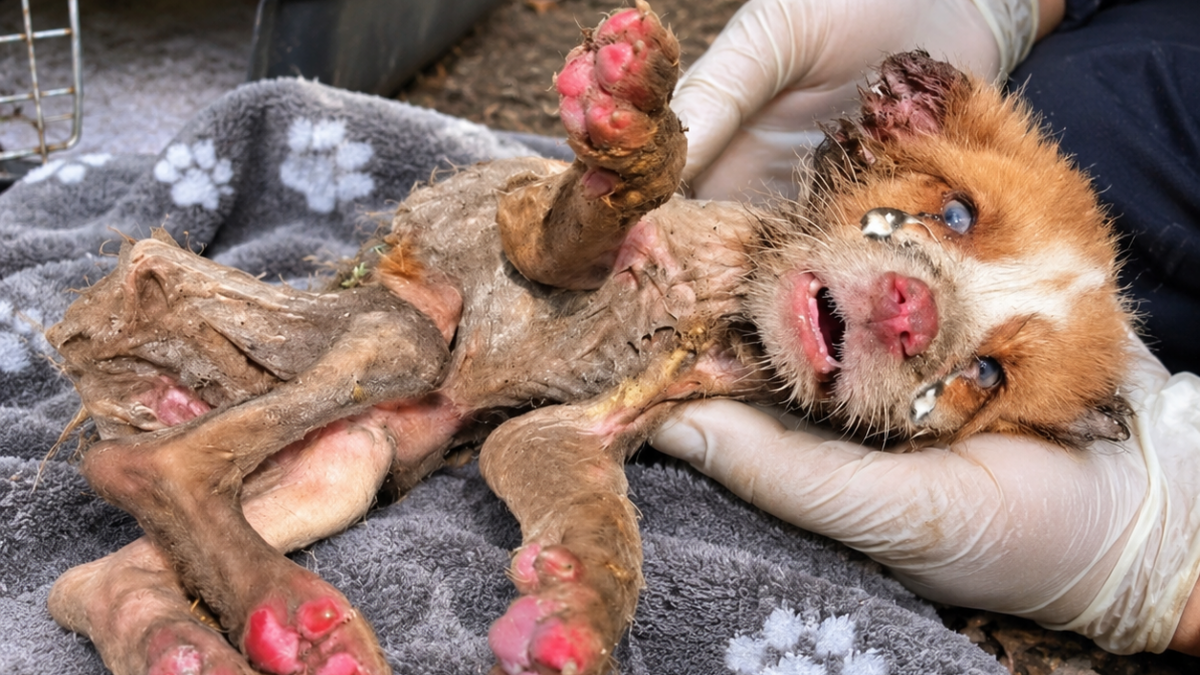
His body collapsed sideways.
Mud clung to his skin.
Flies lifted from his fur then landed again.
He was trembling violently.
His eyes were open, but unfocused.
He let out a faint cry.
Someone whispered, “Is he dying?”
I looked down at him.
“Not if we can help it.”
—
## OUT OF THE HOLE WAS NOT THE SAME AS SAFE
We gave him small amounts of water.
Not too quickly.
His tongue moved weakly.
Good.
He could swallow.
I cleaned some mud from around his face.
His entire body was exhausted.
Four days of cold water had taken its toll.
He had been unable to move normally.
Unable to sleep properly.
Unable to stay dry.
Unable to search for food.
Unable to escape the flies.
Freedom had come.
But his body did not understand yet.
I picked him up.
This time there was nothing around him.
No concrete.
No water.
No narrow walls.
He was so light.
I expected him to panic in my arms.
Instead he went limp against me.
I carried him toward the car.
One worker called after us.
“Let us know if he makes it.”
I turned.
“I will.”
He nodded.
There was dirt all over his clothes.
The crane operator lifted a hand.
Several of the men who had spent hours digging simply stood watching.
They had arrived to move concrete.
They left invested in one tiny life.
—
## THE DRIVE
The puppy cried intermittently during the drive.
Soft sounds.
Almost apologetic.
I kept talking.
“You’re okay.”
Cry.
“You’re out.”
Cry.
“No more hole.”
His eyes opened.
“You hear me?”
He shifted slightly.
“No more concrete.”
I placed my hand near him.
He rested his chin against my fingers.
I had no name for him yet.
No history.
No idea where he would go if he survived.
All I knew was that for four days, the world above him had been unreachable.
Now he was in my car.
And I was not going to let him disappear again.
—
## THE CLINIC
The veterinary team took him immediately.
Temperature.
Hydration.
Heart.
Lungs.
Skin.
Legs.
Wounds.
Every inch had to be examined.
The veterinarian shook her head at his condition.
“How long?”
“About four days.”
“In the water?”
“That’s what people said.”
She looked at the puppy again.
“That’s a long time for something this small.”
“I know.”
He had several wounds.
Nothing about his tiny body suggested he had experienced comfort recently.
The staff cleaned him carefully.
They removed the mud.
Treated damaged skin.
Checked for parasites.
Started intravenous fluids.
Then came another fear.
Viruses.
A vulnerable puppy with an unknown history could be carrying a serious infectious disease.
Tests were run.
We waited.
Again.
That entire day felt like waiting.
First for the crane.
Then for the slab.
Then for enough space.
Then for him to come out.
Now for test results.
I sat near his treatment area.
The veterinarian eventually walked over.
“The initial virus tests are negative.”
I closed my eyes.
“Thank God.”
“That’s good news.”
“Is he going to be okay?”
She looked at him.
“He’s exhausted and dehydrated. But right now, I’m more optimistic than I was when you brought him in.”
That was enough.
More optimistic.
We could build from that.
—
## HE FINALLY SLEPT
After fluids had been running for a while, something changed.
The trembling slowed.
His breathing became deeper.
His muscles softened.
The puppy stretched one front leg.
Then another.
For the first time since we found him, he looked as though his body had stopped fighting the environment around him.
He lay on a clean surface.
Dry.
Warm.
Nothing underneath him but bedding.
Nothing on either side of him.
No concrete inches from his face.
No water around his belly.
No flies covering him.
He slept.
Deeply.
I sat watching him.
One technician asked, “You going home?”
“Not yet.”
“He’s stable.”
“I know.”
“You look worse than he does now.”
I laughed quietly.
Maybe I did.
But I wanted to see him wake up.
—
## WHEN HE WOKE
It happened later.
His head moved.
Eyes opened.
For a moment he looked confused.
Then he tried to lift himself.
Weak.
But intentional.
I moved closer.
“Hey.”
His ears twitched.
“No hole.”
He looked around.
“Remember me?”
Obviously he didn’t understand.
But his eyes settled on my face.
I offered a little water under guidance.
He drank.
More confidently than before.
Then he lowered his head.
Not collapsed.
Rested.
There was a difference.
The first time he lowered his head after rescue, his body had failed him.
Now he was choosing to lie down because he was tired.
That choice felt enormous.
—
## A NAME
One of the technicians asked, “What are we calling him?”
I looked at the puppy.
Mud was gone from his face.
He was still tiny.
Still fragile.
But alive.
“Lucky?”
Someone suggested.
I shook my head.
Too obvious.
“Concrete?”
Absolutely not.
Someone laughed.
“Crane?”
“No.”
The puppy opened one eye as if judging all of us.
Finally I said, “Milo.”
I don’t know where it came from.
It simply fit.
“Milo?”
The puppy’s ear moved.
“There. He approves.”
So Milo he became.
Not “the puppy under the slabs.”
Not “the dog in the hole.”
Milo.
A name meant he had a future tense.
Milo will eat.
Milo will heal.
Milo will grow.
Milo will go home.
I liked that.
—
## THE FIRST MEAL
The next major test was food.
Milo had been without normal food for days.
We started carefully.
A small amount.
Soft.
Easy.
He sniffed it.
That alone made me smile.
“Interested?”
His nose moved again.
Then his tongue.
The first lick was cautious.
The second was faster.
Then he ate.
Not much.
But enough.
When the bowl moved away, Milo tried to follow it with his head.
The technician laughed.
“That’s a good sign.”
I looked at him.
“Four days in a hole and now you’re demanding seconds?”
Milo stared at the bowl.
Excellent.
Demand things.
Demand food.
Demand warmth.
Demand care.
A puppy should expect the world to provide basic kindness.
He had spent enough time learning the opposite.
—
## THE WORKERS CALLED
That evening, one of the men from the rescue site called.
“How is he?”
“He’s alive.”
A pause.
“Really?”
“Really.”
“And the tests?”
“Negative so far.”
I heard him exhale.
“Thank God.”
“He’s eating.”
“No way.”
“He is.”
The man laughed.
Then his voice changed.
“Can you send a picture?”
I did.
Minutes later, a message came back.
“That doesn’t look like the same puppy.”
He was right.
Clean and dry, Milo already looked different.
Still thin.
Still tired.
But no mud.
No concrete.
No panic.
I imagined the group of workers passing the photo around.
That thought made me happy.
They deserved to see what their hours of labor had accomplished.
—
## WHAT ANGER LOOKED LIKE AFTERWARD
Once Milo was stable, my anger arrived.
During the rescue, there had been no room for it.
Every emotion had been pushed aside by logistics.
Crane.
Ropes.
Concrete.
Digging.
Clinic.
Fluids.
Tests.
When the emergency faded, questions returned.
Four days?
People knew?
Why had nobody found a way sooner?
Why did a tiny puppy have to cry until someone finally refused to ignore the sound?
I thought about confronting people.
Demanding explanations.
But explanations would not return four days to Milo.
And I did not know enough to accuse individuals of cruelty.
Maybe people really had tried.
Maybe they lacked equipment.
Maybe they were frightened of crushing him.
The facts were enough without inventing villains.
Milo had been trapped.
Milo had suffered.
Help eventually arrived.
The lesson was not about finding someone to hate.
It was about how quickly “someone else will do it” can become four days.
—
## THE SECOND DAY
By the following day, Milo looked stronger.
Not strong.
Stronger.
His eyes followed people.
His head remained upright longer.
He ate several small meals.
His IV fluids continued.
The veterinarian checked his wounds.
“He’s responding.”
Those words became our victory.
“How long before he can leave?”
“Don’t rush.”
“I know.”
“He needs rest.”
“I know.”
“He’s very young.”
“I know.”
She looked at me.
“You’re terrible at waiting.”
“Yes.”
Milo yawned.
For the first time, I noticed how enormous his yawn looked compared with his tiny face.
I laughed.
He looked offended.
Good.
Another normal puppy behavior.
—
## HIS FIRST STRETCH
I had not expected a stretch to make me emotional.
But then Milo did it.
He woke from a long sleep.
Extended both front paws.
Lifted his little rear end.
Arched.
Stretched.
A completely ordinary puppy stretch.
I stared.
The veterinarian saw me.
“What?”
“He stretched.”
She smiled.
“Yes.”
“He couldn’t move down there.”
“I know.”
I looked at Milo.
Inside the hole, concrete had dictated every position his body could take.
Curl.
Crouch.
Stay.
Now he had room.
He could stretch until his toes pointed.
Freedom can be measured in inches.
That morning, Milo used every one.
—
## THE FLOOR
Later, we placed him on a soft mat.
He stood.
Wobbled.
Sat down.
Tried again.
His legs were weak from inactivity and exhaustion.
He managed three steps.
Then four.
Then returned to the blanket.
Nobody pushed.
Walking could wait.
Milo had already done enough.
But that evening, he rose again without encouragement.
Walked toward the edge of the bed.
Sniffed.
Moved farther.
A technician sat several feet away.
Milo approached her.
She held out a hand.
He sniffed.
Then climbed clumsily into her lap.
She looked at me.
“Oh no.”
“What?”
“I’m attached.”
“Join the club.”
—
## THE FIRST NIGHT WITHOUT FEAR
The clinic lights dimmed.
Milo had a clean blanket.
Another puppy in a separate area made a noise.
Milo lifted his head.
Then lowered it again.
He did not cry.
That mattered.
For four nights, crying had been his only connection to the world above.
Now he didn’t need to call for help.
Help was already in the room.
—
## HIS WOUNDS
The wounds took time.
Some were superficial.
Others required cleaning and treatment.
His skin had been exposed to dirty water far too long.
The staff monitored closely for infection.
Every dressing change reminded me what the rescue had prevented.
Another day down there could have meant something very different.
Skin infection.
Severe dehydration.
Hypothermia.
Exhaustion.
Maybe drowning if the water level rose.
Maybe simply giving up.
Milo had survived because his body was stubborn.
But stubbornness has limits.
The crane had arrived before those limits ran out.
That was the part I couldn’t stop thinking about.
Timing.
A few hours later.
A little more rain.
One wrong movement of concrete.
His story could have ended beneath the slabs without anyone ever knowing his name.
Instead, Milo was stealing pieces of gauze from the treatment tray.
—
## YES, STEALING
By day three, Milo discovered crime.
The target was gauze.
A technician placed a clean piece beside her.
Milo grabbed one corner.
She turned.
“Hey.”
Milo pulled.
The gauze slid.
“Milo.”
He pulled harder.
I laughed.
The technician retrieved it.
“No.”
Milo stared.
She placed it farther away.
Two minutes later, he tried again.
“That’s the dog who couldn’t stand?” she asked.
“Apparently.”
“Terrible patient.”
“Excellent sign.”
Milo wagged his tiny tail.
The movement was small.
But there it was.
A wag.
—
## THE TAIL
That first wag became another milestone.
I had spent hours looking down into a hole where almost nothing could move.
Now Milo’s tail had space.
At first, one little twitch.
Then a slow wag when food arrived.
Then a faster wag when familiar people entered.
His body began learning joy.
That phrase sounds sentimental until you see it happen.
Fear is physical.
So is relief.
So is trust.
Milo’s muscles had spent days tight with survival.
Now they were learning something softer.
—
## THE CRANE OPERATOR VISITED
A few days later, the crane operator came to the clinic.
He stood awkwardly near the door.
“I was nearby.”
He wasn’t.
The clinic was well out of his normal route.
But I didn’t say anything.
Milo was resting.
I picked him up carefully.
“Want to meet your heavy-equipment specialist?”
The man smiled.
“You look different, little guy.”
Milo sniffed his hand.
The operator’s expression changed.
He rubbed the puppy gently between the ears.
“I thought we were going to crush him.”
“So did I.”
“I’ve been thinking about it.”
“I know.”
He looked at Milo.
“You caused a lot of trouble.”
Milo licked his finger.
The man laughed.
“Worth it.”
That word mattered too.
Worth it.
A crane.
Workers.
Hours of labor.
Medical care.
Money.
Time.
For one tiny puppy.
Yes.
Worth it.
—
## THE PEOPLE WHO SAID IT WAS TOO MUCH
Not everyone understood.
Someone later asked why anyone would rent a crane for a stray puppy.
I stared at them.
“What was the alternative?”
They shrugged.
“It just seems like a lot.”
A lot.
I thought about that phrase.
A lot compared with what?
A machine can be rented again.
Concrete can be replaced.
Money can be earned.
Time passes regardless.
Milo had one life.
One.
If we had decided his life was too small to justify the effort, then the size of our compassion would have been smaller than the gap trapping him.
I looked at the person and said:
“He was alive.”
That was enough explanation.
—
## LEAVING THE CLINIC
When the veterinarian finally said Milo could continue recovery outside the hospital setting, I felt nervous.
He was medically stable.
Eating.
Drinking.
Tests reassuring.
Wounds improving.
But part of me wanted to keep him inside a clinic forever.
Safe.
Monitored.
Protected from holes, concrete, water and apparently the entire planet.
The veterinarian laughed.
“He needs to be a puppy.”
“I know.”
“You can’t bubble-wrap him.”
“Could I?”
“No.”
Milo wagged.
Traitor.
—
## THE FIRST HOME
A foster home took him in.
Quiet.
Clean.
Secure.
The foster had experience with vulnerable puppies.
The first photograph showed Milo on a blanket several times larger than him.
No cage.
No concrete.
No water.
He lay completely stretched out.
Front legs forward.
Back legs behind.
Belly flat against the soft fabric.
I stared at that photograph.
That was the image I had wanted from the moment I saw him trapped.
Space.
His body occupying as much room as it wanted.
Nobody squeezing him.
Nothing holding him.
—
## HE WAS AFRAID OF NARROW SPACES
We noticed something after the rescue.
Milo did not like tight gaps.
If a toy rolled under furniture, he would approach but hesitate.
If two objects created a narrow passage, he sometimes went around instead.
We could not know exactly what he remembered.
But we respected it.
Nobody forced him.
He had spent enough time without choice.
The foster rearranged furniture to keep open paths.
Milo gradually became more confident.
Some fears faded.
Others remained.
Healing did not require deleting memory.
It required giving memory less control.
—
## HIS FIRST REAL RUN
Several weeks after rescue, Milo was outside in a safe enclosed yard.
His wounds had healed well.
His strength had returned.
He had put on weight.
The foster unclipped his leash.
Milo stood still.
Grass beneath his paws.
Open sky above him.
No ceiling of concrete.
He took three steps.
Then five.
Then suddenly:
Run.
He crossed the yard.
Turned.
Ran back.
His ears bounced.
His mouth opened.
His tail curved upward.
I watched the video in silence.
The foster laughed behind the camera.
“Milo!”
He turned at his name.
Ran toward her.
I paused the video when all four paws left the ground.
The puppy who once had no room to turn around was airborne.
That frame became one of my favorite images of him.
—
## THE FOUR-DAY HOLE BECAME A STORY OTHER PEOPLE HEARD
Word about the rescue spread.
People saw footage of the crane.
The concrete.
The hole.
Then Milo.
Some could not believe such a small puppy had survived four days.
Others focused on the workers.
“How did you know where to dig?”
“Weren’t you afraid the slab would fall?”
“Who paid for the crane?”
I understood the curiosity.
But the question I thought mattered most was different.
Why did the crying continue for four days before the right combination of people and resources came together?
Not to blame.
To learn.
Because emergencies involving animals often become invisible when everyone assumes someone else is responsible.
Milo’s story became a reminder.
When you hear distress, check.
When something looks wrong, ask.
If you cannot solve it, call someone who can.
And if bare hands are not enough, sometimes you rent a crane.
—
## ADOPTION QUESTIONS
As Milo became healthier, people started asking:
“Can I adopt him?”
The messages came quickly.
A tiny puppy rescued from a dramatic situation attracts attention.
But the foster and rescue team wanted to be careful.
Milo was not a trophy.
He was not “the crane puppy.”
He was not a viral story.
He was a dog who needed a permanent family.
People were screened.
Questions asked.
Home environments considered.
Milo needed safety.
No unsecured construction areas.
No dangerous gaps.
Proper veterinary care.
Patience.
And above all, someone who wanted him after the attention faded.
—
## THE FAMILY WHO DIDN’T CARE ABOUT THE VIDEO
One family stood out.
They had heard about the rescue.
But during the meeting, they barely mentioned it.
They asked:
“What food does he eat?”
“How does he sleep?”
“Is he nervous around loud equipment?”
“How is he with other dogs?”
“Does he need more medical treatment?”
“What scares him?”
“What does he enjoy?”
Those were the right questions.
Not:
“How many views did his rescue get?”
Not:
“Can we post him?”
They wanted Milo.
Not the story.
When they met him, Milo approached cautiously.
A woman sat on the floor.
A man stayed several feet away.
Their daughter held a small toy but did not push it toward him.
Milo sniffed.
Walked around.
Returned.
The little girl rolled the toy gently across the floor.
Milo watched.
Then chased it.
Everyone laughed softly.
Milo grabbed the toy.
He did not bring it back.
A promising start.
—
## HE CHOSE THEM
The second meeting went even better.
Milo recognized them.
His tail wagged.
He went directly toward the daughter.
Then climbed into the woman’s lap.
I looked at the foster.
She looked at me.
Neither of us needed to say much.
Sometimes an animal makes part of the decision.
Milo settled there as though he had known her for months.
The woman stroked his back.
“You comfortable?”
Milo closed his eyes.
Apparently yes.
—
## ADOPTION DAY
The day Milo left foster care was strange.
Happy.
Sad.
Perfect.
His new family arrived with a bed, harness, bowls and toys.
Too many toys.
I approved.
Milo ran between familiar people.
No idea why everyone was emotional.
He was placed in a proper carrier for the drive.
At first, he objected.
Loudly.
Healthy puppy outrage.
I laughed.
“This is the same dog we begged to cry louder so we could locate him.”
Now nobody had trouble finding him.
His voice worked extremely well.
—
## HIS FIRST NIGHT HOME
The first update came quickly.
Photo:
Milo asleep.
Not curled tightly.
Not trembling.
Stretched across the center of a large bed.
His new family wrote:
“He has taken over.”
I replied:
“Good.”
Then another photograph.
Milo on the couch.
Another.
Milo with the little girl.
Another.
Milo carrying a shoe he was not supposed to have.
The puppy trapped four days beneath concrete was now creating ordinary household problems.
Beautiful.
—
## A DIFFERENT KIND OF REVENGE
People sometimes asked whether anyone was punished for leaving Milo there so long.
I could not give them the dramatic answer they wanted.
We did not know that a specific person had intentionally trapped him.
We did not have proof that one individual deliberately refused to rescue him.
There was no villain I could honestly manufacture.
But I understood why people wanted revenge.
They had heard about a puppy crying for days.
They wanted someone to pay.
I wanted something too.
Then I saw Milo running through his new family’s home.
I watched him grab a sock.
I watched a child chase him.
I watched his tail wag.
And I realized:
This was the satisfying ending.
The hole did not get him.
The cold water did not get him.
Exhaustion did not get him.
The concrete did not get him.
Four days did not get him.
He had walked out into a life larger than that hole could ever contain.
That was enough revenge for me.
—
## RETURNING TO THE SITE
Months later, I went back.
The concrete area looked different after repairs.
The opening that had trapped Milo was no longer accessible in the same way.
I stood nearby.
For a moment, I heard his cries in memory.
Tiny.
Desperate.
I remembered kneeling.
Seeing eyes in darkness.
Calling the crane.
Watching tons of material move inches at a time.
Then I took out my phone.
A new video from Milo’s family was waiting.
He was in a park.
Running.
I looked from the repaired concrete to the screen.
Same dog.
Two worlds.
I smiled.
“You won.”
—
## THE SOUND THAT USED TO HAUNT ME
For weeks after the rescue, I sometimes heard Milo’s cry in my head.
Especially at night.
A small sound beneath something too heavy to move.
Over time, that memory changed.
Because I had new sounds to replace it.
Milo barking at a toy.
Milo growling playfully during tug.
Milo whining because breakfast was late.
Milo’s family laughing.
The little girl calling:
“Milo!”
And paws running across a floor.
The old cry never disappeared entirely.
But it was no longer the last sound in the story.
—
## ONE YEAR LATER
One year after his rescue, Milo was nearly unrecognizable.
Not tiny anymore.
Healthy.
Strong.
Bright-eyed.
His coat looked beautiful.
His body had filled out.
His personality had become ridiculous.
He loved food.
Hated baths.
Enjoyed sleeping on his back.
Stole socks.
Barked at delivery boxes.
And had developed a habit of stretching across doorways, forcing everyone to step over him.
The irony was not lost on me.
A dog once trapped by concrete had grown up believing every open space belonged to him.
I loved that.
—
## THE REUNION
His family brought him to visit.
I knew it was Milo immediately.
Not because he looked the same.
Because of his eyes.
He saw me.
Stopped.
Head tilted.
“Milo?”
His tail moved.
Then he ran.
I barely got my arms down before he hit me.
I laughed.
“You remember?”
He licked my face.
I held his head.
“You’re huge.”
His family smiled.
“He thinks he’s tiny.”
“Of course.”
Milo tried climbing halfway into my lap.
Definitely not tiny.
I scratched his chest.
Then I thought about the first time my fingers touched him through the crack.
Cold wet fur.
No room.
Now I could wrap both arms around him.
There was nothing between us.
—
## THE CRANE OPERATOR CAME TOO
By coincidence—or perhaps not—the crane operator came to the reunion.
When Milo saw him, he approached normally.
No idea this man had once operated several tons of machinery inches above his body.
The operator knelt.
“That him?”
“That’s him.”
He stared.
“No way.”
Milo sniffed him.
Then sat on his foot.
The man laughed.
“You nearly gave me a heart attack.”
Milo wagged.
The operator looked at me.
“I still tell people about that job.”
“I bet.”
“Most expensive puppy lift I’ve ever done.”
“Worth it?”
He looked down at Milo.
“Every penny.”
—
## IF MILO COULD SPEAK
Sometimes I imagined what Milo might say about those four days.
Probably nothing profound.
Dogs live closer to the present than we do.
He might remember the cold.
The darkness.
The inability to move.
Then hands.
Light.
Warmth.
Food.
But if I could tell him anything, I would tell him:
You cried long enough for someone to hear.
And once we heard you clearly, we were not leaving.
That is the promise every vulnerable creature deserves.
Not that bad things will never happen.
We cannot promise that.
But that suffering will matter when someone sees it.
—
## THE LITTLE GIRL ASKED WHAT HAPPENED
Milo’s family eventually explained his story to their daughter in age-appropriate terms.
She looked horrified.
“He was under concrete?”
“Yes.”
“For four days?”
“Yes.”
“Was he scared?”
“Probably.”
“Why didn’t he leave?”
“He couldn’t.”
She thought about it.
Then wrapped both arms around Milo.
He tolerated the hug for three seconds before becoming interested in something else.
Later she asked:
“Who saved him?”
Her mother said:
“A lot of people.”
That was the right answer.
Not me.
Not the crane operator.
Not one worker.
A chain of people.
Someone heard.
Someone searched.
Someone called.
Someone paid.
Someone operated the machine.
Someone dug.
Someone carried him.
Someone treated him.
Someone fostered.
Someone adopted.
Milo survived because eventually enough people decided his life belonged on their list of things that mattered.
—
## THE MOST IMPORTANT PHOTO
People often preferred the dramatic rescue image.
Milo coming from the hole.
Mud-covered.
Tiny.
That picture got attention.
My favorite was taken much later.
Milo asleep in sunlight.
Nothing dramatic.
His body stretched completely straight.
Front paws extended.
Back legs relaxed.
His belly exposed.
No tension.
No fear.
No boundaries.
The entire photograph was about space.
He used as much as he wanted.
That was beautiful to me.
Once, his world had been narrower than his own body.
Now he stretched until he took up half the floor.
—
## THE QUESTION I STILL ASK
How long would he have lasted?
Another night?
Another day?
Two?
I don’t know.
I’m glad I never had to find out.
But the question changed the way I respond when someone says:
“It’s only been a day.”
Or:
“Someone else will probably help.”
Or:
“It’s just a stray.”
For a puppy trapped in cold water, one day is enormous.
For an animal unable to escape, “later” can mean never.
Milo’s rescue taught me urgency without recklessness.
Do something.
But do the right thing.
We could have tried pulling him through the gap.
We might have injured him.
We could have forced the concrete.
We might have crushed him.
Instead we brought equipment.
Took hours.
Moved slowly.
Urgency does not mean panic.
It means refusing to give up while doing the work correctly.
—
## HIS SECOND BIRTHDAY
Milo’s family celebrated the date they adopted him like a second birthday.
There was a dog-safe cake.
He ate far too enthusiastically.
A party hat lasted six seconds.
Photos showed him surrounded by people.
I looked at the images and remembered another circle of people around him.
Workers surrounding a hole.
Different day.
Different circle.
Same dog.
In the first, everyone wanted to know:
Will he survive?
In the second:
Will he stop trying to steal the cake?
Progress.
—
## THE HOLE COULD HAVE BEEN HIS WHOLE STORY
That thought stayed with me.
If he had died there, he would have been remembered—if at all—as a tiny puppy found beneath concrete.
No name.
No family.
No personality.
Nobody would know he loved socks.
Nobody would know he slept upside down.
Nobody would know he became obsessed with chicken.
Nobody would know he grew into an affectionate dog.
Nobody would know anything beyond the suffering.
Rescue does more than prevent death.
It protects all the future details that have not happened yet.
Milo’s future was hiding beneath those slabs with him.
We just couldn’t see it.
—
## YEARS LATER
Milo grew into a handsome adult dog.
The family periodically sent updates.
Not as often as before.
That was fine.
Eventually a rescue story should become ordinary enough that constant updates are unnecessary.
Milo had become part of a family.
School mornings.
Weekend walks.
Holiday photos.
Vet appointments.
Couch naps.
Normal life.
That was success.
One Christmas photo showed Milo wearing antlers.
His expression suggested deep betrayal.
I laughed for several minutes.
Four days beneath concrete, and apparently fake antlers were where he drew the line.
—
## DID HE EVER GO NEAR CONCRETE GAPS AGAIN?
Not willingly.
His family noticed he preferred open routes.
If there was a narrow space between objects, Milo often chose a wider path.
Maybe memory.
Maybe personality.
It didn’t matter.
They respected him.
Choice was part of healing.
He had spent four days with none.
Now, if Milo wanted to go around instead of through, everyone waited.
Such a small privilege.
Such an important one.
—
## THE REAL “REVENGE”
If someone had asked me on rescue day what revenge I wanted, I might have answered angrily.
I was exhausted.
Frustrated.
Terrified.
I hated imagining anyone hearing him and deciding his life wasn’t worth the trouble.
Years later, the answer feels different.
Milo’s revenge was expansion.
The hole tried to make his world tiny.
His life became huge.
The concrete held him still.
He ran.
The water kept him soaked.
He slept warm and dry.
Flies covered his body.
Hands later stroked a healthy coat.
His cries went unanswered for too long.
Eventually his smallest sound could bring an entire family into the room.
That is the kind of ending cruelty never expects.
—
## THE WORKERS STILL REMEMBERED HIM
I ran into one of the workers long afterward.
He recognized me first.
“How’s the concrete dog?”
I laughed.
“Milo is doing great.”
“You got a picture?”
Of course.
I showed him.
He stared.
“That’s him?”
“Yes.”
He shook his head.
“Look at that.”
There was pride in his voice.
He had spent only one day with Milo.
But one hard day can bind people to an animal forever.
“I thought we’d lose him,” he admitted.
“So did I.”
He handed the phone back.
“Glad we didn’t.”
Me too.
—
## THE SOUND OF MACHINERY
Interestingly, Milo remained nervous around some loud machinery.
Construction sounds could make him stop and look around.
His family never pushed him through it.
They gave distance.
Treats.
Reassurance.
Over time the fear softened.
One day they passed roadwork on a walk.
A large machine moved nearby.
Milo paused.
Looked.
Then continued walking beside his owner.
No panic.
No attempt to run.
Just awareness.
I saw the video and thought about the crane.
The enormous machine that must have sounded terrifying above him.
Strange thing:
The machine he may have feared was also part of what saved him.
Life contains contradictions like that.
—
## THE DAY I STOPPED THINKING OF HIM AS THE PUPPY FROM THE HOLE
It happened without ceremony.
Someone asked me about Milo.
For a second, I didn’t immediately think of concrete.
I thought of him stealing cake.
I smiled.
That was when I knew his story had finally grown larger than his trauma.
He would always have been rescued from that hole.
But he was no longer defined by it.
That was the real goal.
—
## EPILOGUE
For four days, Milo’s world was a narrow crack between slabs of concrete.
Dirty water beneath him.
Heavy stone around him.
Flies covering his body.
No space to climb.
No room to escape.
Only darkness above interrupted by small pieces of light.
He cried until someone heard.
Then cried again while they searched.
People had known there was a puppy trapped somewhere.
But knowing and reaching him were two different things.
Bare hands could not move the slabs.
Reaching into the gap was not enough.
Pulling blindly could hurt him.
So we did something that sounded absurd to some people.
We rented a crane.
Not for a building.
Not for expensive equipment.
For one tiny puppy.
Workers came.
Concrete moved.
Dirt was removed by hand.
Hour after hour, people worked around a body small enough to fit in two hands.
Every movement had to be precise.
One bad shift could end his life.
Then finally:
He moved.
His body came free.
I lifted him from the hole.
He did not stand.
He collapsed.
Mud covered him.
His body trembled.
His eyes were terrified.
And for a moment I wondered whether we had rescued him too late.
But we gave him water.
Carried him.
Drove.
The veterinarian treated his wounds.
IV fluids entered his exhausted body.
Tests were performed.
The virus results came back negative.
He was warm.
Dry.
Safe.
Then something happened that should have been completely ordinary.
Milo slept.
That was all.
He stretched his body on a clean surface and slept.
No water beneath him.
No concrete pressed around him.
No need to cry loudly enough for strangers to find him.
Later he ate.
Then stood.
Then wagged.
Then walked.
Then ran.
His wounds healed.
His fear softened.
A foster home taught him what open rooms felt like.
A family taught him that a door could lead somewhere good.
He discovered grass.
Toys.
Beds.
Socks.
Cake.
Children.
Couches.
Sunlight.
He grew.
And the narrow hole that had once contained almost his entire body eventually became only one small chapter of a much larger life.
People sometimes ask whether I was angry that it took four days for Milo to get out.
Yes.
I was.
Part of me still is.
But I learned something from him.
Anger is useful only if it moves your hands.
If it makes you call.
Search.
Dig.
Rent equipment.
Carry.
Treat.
Protect.
Anger that does nothing is just another spectator.
Milo needed action.
And eventually he got it.
I think about that whenever I see his later photographs.
In one, he is running across grass.
His body is stretched forward.
His ears are back.
His paws are off the ground.
There is nothing around him.
Nothing above him.
Nothing holding him.
Just open space.
That photograph is the ending I wanted.
Not someone punished.
Not someone humiliated.
Not some invented villain begging forgiveness.
Just Milo.
Running farther in a few seconds than he had been able to move in four days.
That is justice enough.
The concrete said:
You cannot move.
Milo ran.
The water said:
You cannot rest.
Milo slept warm.
The darkness said:
Nobody sees you.
A whole team came.
The four days said:
Maybe it is too late.
Milo grew up.
And every time his family opens the door and he races through it, the puppy who once had nowhere to go is answering the past in the only way that matters.
He is still here.
Still loved.
Still moving.
Still choosing where to put his feet.
Still taking up as much space as he wants.
And after spending four days trapped in a hole barely wider than his own tiny body, Milo finally has an entire life with room to stretch.








