PART 2: THEY GAVE WOLF A 10% CHANCE TO LIVE—BUT THE DOG EVERYONE LEFT BEHIND REFUSED TO DIE
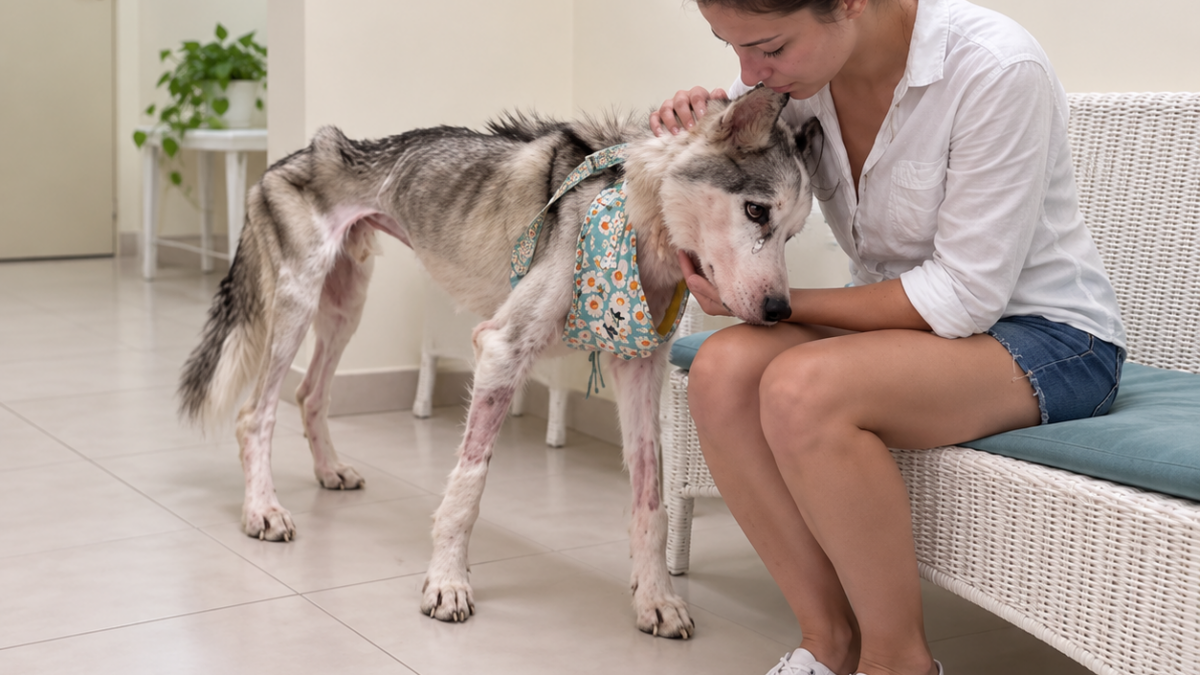
PART 2
The surgeon pulled his mask down slowly.
For one terrible second, I tried to read his face before he spoke.
I couldn’t.
Doctors learn how to carry difficult news without letting every emotion show. It is part of surviving a profession where people ask questions whose answers can break them.
So I stared at him and waited.
Finally, he said four words.
“He made it through.”
Nobody moved.
I think we had prepared ourselves so completely for the opposite answer that relief felt impossible to process.
I blinked.
“What?”
“He survived the surgery.”
Someone beside me inhaled sharply.
Another person covered her face and started crying.
I just stared at him.
Wolf was alive.
The surgeon continued speaking, explaining what they had done and how fragile Wolf remained, but for several seconds all I could hear was that first sentence.
He made it through.
Ten percent.
Wolf had found a way into it.
“Can I see him?”
“Not immediately,” the doctor said. “He needs very close monitoring. The next twenty-four to forty-eight hours are still critical.”
Of course they were.
There would be no miraculous leap from operating table to healthy dog running through a yard.
Wolf’s body had been starving for months.
He had been sick.
He had collapsed.
And now he had endured major surgery.
Survival had earned him another chance.
It had not finished the work.
Still, I sat down because my legs suddenly felt unreliable.
One of the rescuers beside me whispered, “He did it.”
I nodded.
“He did.”
She wiped her eyes.
“He really did.”
I thought about the first time I had touched Wolf’s back.
All those bones.
That sunken body.
The way he had simply stood there and allowed my hand to settle on him.
At that moment, I had no idea how much fight remained inside him.
Apparently, Wolf had plenty.
When we were eventually allowed to see him, nothing about the sight was easy.
He looked smaller beneath the hospital blankets.
There were lines connected to him.
Bandages.
Monitoring equipment.
His breathing was steady but shallow.
His eyes remained closed.
I pulled a chair close and sat.
“Hey, Wolf.”
No reaction.
I put two fingers lightly against his paw.
“It’s me.”
His paw remained still.
“You did the hard part.”
I stopped.
That wasn’t true.
He had done one hard part.
There would be others.
So I corrected myself.
“You did this part.”
The room hummed quietly around us.
Hospital sounds become strange when you are waiting for someone you love to wake up.
Each machine has its own rhythm.
Every beep seems important.
Every footsteps outside the door make you look up.
You start watching things you barely understand because doing nothing feels unbearable.
I watched Wolf breathe.
In.
Out.
In.
Out.
For nearly a year, nobody had sat beside him watching every breath.
Now several people cared about every single one.
That fact stayed with me.
Whatever happened next, Wolf’s life had already changed in one important way.
He mattered to someone.
Hours passed.
At one point, I felt movement beneath my fingertips.
I looked down.
Wolf’s paw shifted.
Just a little.
“Wolf?”
His eyelids moved.
I leaned closer.
“Hey.”
Slowly, he opened his eyes.
Not fully.
Just enough.
His gaze drifted toward me.
I smiled despite the tears already coming.
“There you are.”
He looked exhausted.
Confused.
But alive.
“You scared everybody.”
His eyes closed again.
I kept my hand against him.
“That’s okay. Sleep.”
I don’t know how long I sat there after that.
Time becomes strange around critically ill animals.
Meals are forgotten.
Phones die.
Coffee goes cold.
People speak in whispers.
Hours become measured by medications and vital signs instead of clocks.
The first night, I went home only because the veterinary team insisted Wolf needed rest and promised they would call if anything changed.
I drove home with the radio off.
My hands stayed tight on the steering wheel.
Every stoplight felt too long.
When I finally reached my driveway, I remained in the car.
The silence was different there.
No monitors.
No footsteps.
No Wolf.
For the first time that day, the full weight of what had happened caught me.
I leaned my forehead against the steering wheel and cried.
Not because Wolf was dying.
Not because he had survived.
Because both possibilities had existed only hours apart.
I thought about how close we had come to saying goodbye.
The doctors had not been wrong to suggest it.
They were looking at a dog whose body had already suffered more than it should have.
They had to ask whether surgery would save Wolf or simply make his final hours harder.
That question mattered.
Choosing surgery had been terrifying precisely because there was no guarantee we were choosing correctly.
Love does not make uncertainty disappear.
Sometimes love makes uncertainty worse because suddenly every decision matters more.
That night, I barely slept.
My phone stayed beside me.
Every time I woke, I checked the screen.
No missed calls.
At five in the morning, I finally called the hospital.
The technician recognized my voice.
“He’s stable.”
My eyes closed.
“Stable?”
“Yes. Still very weak, but stable.”
“Has he eaten?”
“Not yet.”
“Is that bad?”
“Not necessarily. Give him time.”
Give him time.
Wolf had needed that from the beginning.
Time to trust.
Time to heal.
Time to become more than what starvation had reduced him to.
I arrived as soon as visitors were allowed.
Wolf was awake.
Barely.
But awake.
“Morning.”
His eyes moved toward me.
I sat.
“You and I are going to have a conversation about dramatic behavior when you’re stronger.”
His tail did not move.
His head did not lift.
But his eyes stayed on me.
That was enough.
The medical team tried a small amount of food later.
Wolf sniffed it.
Then turned away.
My heart sank.
One of the technicians touched my shoulder.
“Don’t panic.”
“I’m trying not to.”
“His body has been through major surgery.”
“I know.”
“He may need a while.”
I nodded.
Wolf had lived on hunger for so long that watching him refuse food felt especially cruel.
Food represented everything we wanted to restore.
Weight.
Strength.
Normalcy.
Life.
But his body did not care about our emotional symbolism.
His body was tired.
So we waited.
A few hours later, they tried again.
Wolf sniffed.
Licked once.
Stopped.
The technician smiled.
“That’s something.”
I stared.
“One lick?”
“One lick.”
I laughed weakly.
“I’ll take it.”
Later he ate a little more.
Not enough to celebrate by ordinary standards.
But Wolf’s standards were different.
Every mouthful mattered.
When your body has been reduced to twenty pounds, calories are not just food.
They are building materials.
Muscle.
Blood.
Energy.
Repair.
Everything Wolf needed had to enter him bite by bite.
The next few days became a collection of tiny victories.
A little more food.
A little more alertness.
A stronger attempt to stand.
His first careful steps after surgery.
His first real drink.
The first time his ears lifted when someone said his name.
We celebrated everything.
Then, just as quickly, fear would return.
One morning he seemed weaker.
Another afternoon he refused part of a meal.
A blood value would concern the medical team.
Someone would say, “We need to watch this.”
And my stomach would drop.
Recovery was not a staircase.
It was uneven ground.
Forward.
Sideways.
Sometimes backward.
Then forward again.
Wolf taught us patience because there was no other option.
One afternoon, I sat beside him while he stared at his food without touching it.
“Come on, buddy.”
Nothing.
I slid the bowl slightly closer.
“You have to help us.”
His eyes moved toward me.
I immediately regretted the frustration in my voice.
Wolf was not failing us.
He was sick.
There is a difference.
I lowered my voice.
“I’m sorry.”
I moved the bowl away.
“We’ll try again.”
Wolf relaxed his head onto the blanket.
I stroked his cheek.
“You don’t owe anybody anything.”
That became important for me to remember.
Rescued animals do not owe rescuers inspirational recoveries.
They do not owe us gratitude.
They do not owe us miraculous endings.
We choose to help because their lives matter regardless of what story follows.
Wolf did not need to perform courage for us.
He simply needed the freedom to heal if his body could.
So we stopped expecting every day to look better than the one before.
We started meeting him where he was.
That helped all of us.
Especially Wolf.
Several days after surgery, I entered the room carrying his food.
Wolf lifted his head immediately.
I froze.
“Well, that’s new.”
His nose moved.
I lowered the bowl.
Wolf sniffed.
Then ate.
Not a lick.
Not one tiny bite.
He ate.
Slowly.
Carefully.
But with genuine interest.
I stood there staring.
The technician behind me laughed.
“You look like you just won the lottery.”
“I think I did.”
Wolf continued.
When he finished the small portion, he licked the bowl.
I looked at the technician.
“Can I give him more?”
“Not yet.”
“He wants more.”
“I know.”
“He’s staring at me.”
“Let him stare.”
Wolf looked between us.
For the first time since surgery, I saw a hint of attitude.
I laughed.
“Oh, now you’re offended?”
His tail moved.
Only once.
I stopped laughing.
“Did you see that?”
The technician looked.
Wolf’s tail tapped the blanket again.
Twice.
My throat tightened.
“There you are.”
That tail wag changed the entire room for me.
Wolf had enough energy left over for an emotion.
He was no longer spending everything simply staying alive.
He had enough for anticipation.
Enough for recognition.
Enough for joy.
From there, his progress became easier to see.
Not easy.
Easier.
He started lifting his head whenever familiar people entered.
Then he tried standing before anyone asked.
His legs trembled at first.
We supported him.
He took a few steps.
Rested.
Tried again later.
The day he walked down the hallway without assistance, everyone tried to act professional.
We failed.
“There he goes.”
Wolf walked slowly, his body still painfully thin.
I stayed near him but did not touch unless necessary.
Five steps.
Six.
Seven.
Wolf paused.
“You can stop.”
He looked forward.
Then took another step.
I laughed.
“Of course.”
That was Wolf.
He had survived nearly a year alone.
He had survived starvation.
He had survived surgery with a ten-percent chance.
Apparently he was not interested in being told when enough was enough.
Still, rehabilitation had to be careful.
His body needed nutrition before ambition.
We could not let his personality push him faster than healing allowed.
So we limited activity.
Encouraged rest.
Followed veterinary instructions.
And fed him according to a structured plan.
A starving dog cannot simply be given unlimited food and expected to recover safely.
His system had been through too much.
Everything had to be measured.
Wolf disagreed with this concept almost immediately.
Once his appetite returned, he became convinced that medical nutrition plans were a personal injustice.
I walked into his room one morning.
Wolf was staring toward the food preparation area.
“Breakfast is coming.”
His tail moved.
I sat beside him.
“You know, there was a time when we celebrated one lick.”
Wolf stared past me.
“Now apparently service is too slow.”
His tail moved faster.
“You’re becoming difficult.”
He looked at me.
I smiled.
“Good.”
I meant it.
There is something profoundly beautiful about watching an animal who once accepted deprivation develop expectations.
Wolf had spent months taking whatever he could find.
Now he expected breakfast.
Expected clean water.
Expected affection.
Expected a comfortable place to lie down.
Those expectations were signs of healing.
His life had become reliable enough for him to notice when something arrived five minutes late.
I loved every second of it.
Eventually, Wolf became stable enough to move from intensive veterinary care into a foster environment.
That transition frightened me more than I expected.
The hospital had machines.
Medical staff.
Immediate intervention.
A foster home had ordinary rooms and ordinary nights.
But Wolf needed ordinary.
Medical care could save his body.
Routine would help save the rest of him.
The first time he entered the house, he stood near the doorway and looked around.
He sniffed.
One room.
Then another.
His movements were slow.
Not fearful exactly.
Cautious.
Everything was new.
The refrigerator humming.
The television.
Footsteps upstairs.
A door closing.
The smell of food from the kitchen.
Another dog in the distance.
Human life filling spaces around him.
I showed him a soft bed.
“This is yours.”
Wolf sniffed it.
Walked around.
Looked at me.
“Yes. Yours.”
He placed one paw on it.
Then another.
He turned twice before lowering himself.
His body almost disappeared into the softness.
I sat several feet away.
For a while Wolf kept his head raised.
His eyes tracked movement around the room.
Then his head lowered.
His eyes closed.
Five minutes later, he was asleep.
I watched his breathing.
No monitor beside him.
No tube.
No hospital blanket.
Just a dog sleeping inside a house.
That scene should have felt ordinary.
It didn’t.
It felt like a miracle.
That night, his foster caregiver sent me a picture.
Wolf was still in the bed.
The message read:
“He hasn’t moved except for dinner.”
I replied:
“Good.”
Then another message arrived.
“He ate everything.”
I smiled.
“Even better.”
The first several weeks in foster care built Wolf’s new life through repetition.
Morning arrived.
Food appeared.
Water stayed clean.
People spoke gently.
Nobody disappeared permanently.
Night arrived.
Wolf slept.
Morning returned.
The people were still there.
Again.
Again.
Again.
You can tell an abandoned dog he is safe.
But safety is not a sentence.
It is a pattern.
Wolf needed to experience that pattern enough times that his body stopped waiting for the exception.
At first, he followed people constantly.
If his foster caregiver stood up, Wolf stood.
If she went into the kitchen, he followed.
Bathroom?
Wolf waited outside.
Laundry room?
Wolf appeared.
Another room?
Wolf came too.
Once she sent me a picture of him standing outside the shower.
I called.
“He’s supervising hygiene now?”
“He supervises everything.”
“Separation issues?”
“Maybe. Mostly I think he wants to know where everyone is.”
That made sense.
Wolf had once lost people.
He had no reason yet to assume people always came back.
So he checked.
Again and again.
Still here?
Yes.
Still here?
Yes.
Still here?
Yes.
Weeks passed.
Eventually, the checking decreased.
His foster caregiver could leave the room and Wolf stayed asleep.
That change moved me more than I expected.
Trust sometimes looks like following someone.
But deeper trust can look like not following.
You leave.
The dog remains.
Because he believes you will return.
Wolf was learning that.
His body changed too.
Twenty pounds became twenty-two.
Then twenty-five.
Then more.
Every weigh-in became an event.
I remember one veterinary visit when the technician read the number and smiled.
“You’re gaining.”
I leaned toward Wolf.
“You hear that?”
Wolf was more interested in the treat jar.
The technician laughed.
“He knows.”
“He thinks the goal is infinity.”
Wolf stared at the treats.
His ribs slowly became less prominent.
His hips softened.
Muscle began returning to his legs.
His coat improved.
His face filled out.
His eyes changed most dramatically.
When we first found him, those eyes had been tired.
Not empty.
But tired.
Now there was curiosity.
Interest.
Expectation.
Sometimes mischief.
The dog who had seemed too exhausted to react to life was developing opinions about it.
One morning his foster caregiver called me laughing.
“He stole breakfast.”
“What?”
“Not his breakfast.”
I waited.
“Mine.”
“What did you leave out?”
“Toast.”
“Wolf stole toast?”
“I turned around for three seconds.”
“Is he okay?”
“He’s very pleased with himself.”
I laughed.
“I refuse to discipline a dog for developing criminal ambition after everything he’s been through.”
“You can clean the kitchen next time.”
“Fair.”
Of course, we still had to teach boundaries.
Recovery did not mean Wolf got to become uncontrollable.
But small moments of mischief delighted us because they required energy.
Confidence.
Curiosity.
Wolf had enough life now to get himself into trouble.
That was progress.
He also began playing.
At first, he did not seem to understand toys.
He sniffed them.
Occasionally picked one up.
Then dropped it.
Another dog in the foster home changed that.
The other dog grabbed a toy and bounced backward.
Wolf watched.
The dog repeated the invitation.
Wolf took one uncertain step forward.
Then another.
The other dog ran.
Wolf followed.
Slowly at first.
Then faster.
Not far.
His body was still rebuilding.
But something changed in his posture.
His tail lifted.
His ears shifted.
He wanted to participate.
That desire mattered.
For so long Wolf had used movement only for necessity.
Searching.
Surviving.
Getting through another day.
Now movement could become play.
We had to stop him before he exhausted himself.
His foster caregiver laughed while guiding him inside.
“You’re not ready to be an athlete.”
Wolf looked toward the other dog through the door.
“You’ll get there.”
And he did.
Weeks later, I visited on a bright afternoon.
Wolf greeted me at the door.
Not by standing several feet away.
Not by watching cautiously.
He walked directly toward me.
Tail wagging.
I crouched.
“Well, look at you.”
Wolf leaned against me.
I ran my hands along his sides.
The change startled me even though I had seen photographs.
There was weight beneath my palms.
Warm muscle.
A body coming back.
“You’re getting heavy.”
His foster caregiver laughed.
“He thinks he is starving.”
Wolf looked toward the kitchen.
“Of course he does.”
We went outside.
The other dog was already in the yard.
Wolf saw him.
The play invitation came immediately.
Then Wolf ran.
I stopped walking.
The first few strides were awkward.
Then his body stretched out.
He crossed the yard.
Turned.
Ran back.
I stood still.
The foster caregiver looked at me.
“You okay?”
I nodded.
“I remember carrying him emotionally from meal to meal.”
Wolf ran past us again.
“Now look.”
The other dog chased him.
Wolf accelerated.
I started laughing.
Not because anything was funny.
Because sometimes joy escapes through whatever door it can find.
My eyes filled anyway.
The dog who had once barely stood at twenty pounds was running because running felt good.
There is no medical test that captures what that means.
No number.
No scan.
Just motion.
Freedom.
Life spending energy for pleasure instead of survival.
Eventually Wolf tired.
He walked toward us and collapsed dramatically in the grass.
I sat beside him.
“You are going to regret that tomorrow.”
His tail tapped the ground.
I scratched behind his ear.
“You know, doctors gave you ten percent.”
Wolf rolled slightly onto his side.
“You apparently heard one hundred.”
His foster caregiver smiled.
“He’s stubborn.”
“He needed to be.”
That stubbornness had kept him alive on the street.
Now we needed to teach him that life did not always require fighting.
Sometimes food came without searching.
Sometimes doors opened for him.
Sometimes another dog simply wanted to play.
Sometimes a hand reached down only to pet him.
Learning safety was not about becoming less resilient.
It was about no longer needing resilience every minute.
Wolf deserved that.
His follow-up medical appointments continued.
Every one made me nervous.
Even after he looked better.
Even after he played.
Even after he gained weight.
Trauma teaches humans habits too.
You become suspicious of good news.
You remember how quickly Wolf had gone from improving to collapsing.
So every time blood was drawn, I waited for something terrible.
Every time the veterinarian listened longer than expected, I watched their expression.
Wolf, meanwhile, worried mostly about treats.
At one appointment, the veterinarian looked over his results.
“He’s doing well.”
I leaned forward.
“Well?”
“Yes.”
“No terrible surprise?”
The vet smiled gently.
“Not today.”
I exhaled.
Wolf accepted a treat.
Then stared at the jar again.
The veterinarian laughed.
“Appetite seems fine.”
“That may be our biggest medical problem now.”
Wolf’s weight continued improving.
His energy increased.
His personality became impossible to miss.
That was when adoption conversations began.
I hated them.
Not because I did not want Wolf adopted.
Because they meant something we had once barely dared imagine had become real.
Wolf might have years ahead of him.
He needed a permanent family for those years.
That thought should have been purely happy.
It wasn’t.
Love rarely cooperates with clean emotions.
His foster caregiver had slept near him when he was weak.
Measured meals.
Tracked medications.
Driven to appointments.
Cleaned accidents.
Celebrated weight gain.
Worried through quiet nights.
Now success meant saying goodbye.
She called me after we posted that Wolf would eventually be ready for the right home.
“I feel terrible.”
“Why?”
“I’m already worried about him leaving.”
“That’s normal.”
“What if he thinks he’s being abandoned again?”
I stayed quiet.
That was the question everyone feared.
Wolf could not understand foster care.
He did not know he had been temporarily placed somewhere for rehabilitation.
To him, homes were simply places where people existed.
How would another move feel?
“We make the transition carefully,” I said.
She sighed.
“I know.”
“And we choose the right people.”
“I know.”
“He’s not going from safety to uncertainty.”
Silence.
“He’s going from one safe place to another.”
“I keep telling myself that.”
“You taught him something important.”
“What?”
“That people can be reliable.”
She became quiet.
“He knows that now.”
I continued.
“He didn’t know it when we found him.”
The applications began.
Some people wrote emotional messages about Wolf’s survival.
They had seen his before-and-after photographs.
They knew about the ten-percent chance.
They wanted to be part of his story.
But wanting to participate in an inspirational ending is different from wanting the daily responsibility of a dog.
So we asked questions.
Schedules.
Other animals.
Veterinary history.
Fencing.
Exercise.
Expectations.
Long-term plans.
What would happen if Wolf developed another medical problem?
What if he became anxious?
What if he needed more time than expected?
Some potential adopters lost interest once the conversation became practical.
That was okay.
Wolf did not need the most emotional family.
He needed the most reliable one.
Then an application arrived from a family who already had experience with rescued dogs.
Their first questions stood out.
Not:
“How bad was he?”
Not:
“Was he really twenty pounds?”
Instead:
“What routine is helping him now?”
“What food is he doing well on?”
“Does he feel more secure with another dog?”
“What situations make him uncomfortable?”
I called his foster caregiver.
“I think we should meet these people.”
The meeting was arranged.
I arrived early.
Wolf sensed something different immediately because several humans were acting casually in the very unnatural way humans act when they are secretly nervous.
He wandered between us.
Then the family arrived.
A couple.
Calm.
Soft-spoken.
They brought their dog for a controlled introduction.
Nobody rushed Wolf.
That mattered immediately.
The woman sat down.
The man remained a few feet away.
Their dog sniffed the yard.
Wolf stood near his foster caregiver.
He looked at the newcomers.
Then at their dog.
Then back at us.
The woman smiled.
“Hi, Wolf.”
No reaching.
No grabbing.
No high-pitched excitement.
Just an invitation.
Wolf took one step.
Then stopped.
She waited.
Another.
The other dog noticed him.
Both dogs approached.
Sniffed.
Moved apart.
Returned.
Wolf’s tail began wagging.
I watched carefully.
Within minutes, the other dog bounced backward.
An invitation.
Wolf followed.
Then suddenly they were running.
Not wildly.
Not perfectly.
But comfortably.
The couple laughed.
“He likes him.”
“He likes playing,” I said.
The man watched Wolf closely.
“That’s good.”
Wolf eventually returned.
He walked toward the woman.
Stopped.
She held her hand low.
Wolf sniffed.
Then leaned his shoulder against her knee.
I looked at the foster caregiver.
Her eyes were already wet.
The woman glanced at us.
“Can I pet him?”
“Yes.”
She touched his neck gently.
Wolf leaned harder.
That was the moment.
No grand music.
No dramatic announcement.
Just Wolf choosing closeness.
The man asked practical questions.
How often did Wolf eat?
Did smaller meals still work better?
How was his stomach?
What medications remained?
How frequently did he need veterinary follow-up?
What kind of exercise could he handle now?
Where did he prefer sleeping?
Did sudden noises bother him?
How did he react when left alone?
Every question was about the life Wolf would actually live.
I found myself relaxing.
At one point Wolf sat between them and their dog.
The woman rubbed his chest.
The man smiled.
“He looks comfortable.”
His foster caregiver whispered, “He does.”
After the meeting, nobody wanted to declare anything too quickly.
But once the family left, we stood in the kitchen.
The foster caregiver looked at me.
“I hate them.”
I laughed.
“No, you don’t.”
“I know.”
“You like them.”
“That’s why I hate them.”
I understood.
The right family makes goodbye real.
The process moved carefully.
References checked out.
Veterinary history looked responsible.
Their home environment fit Wolf’s needs.
Their dog had behaved well with him.
Follow-up conversations only made the match seem stronger.
Eventually the adoption date was scheduled.
The night before, I visited Wolf’s foster home.
His belongings were gathered.
Food.
Medication instructions.
Medical records.
Blanket.
Leash.
Toys.
Wolf watched the packing with interest.
He stole one toy from the bag.
His foster caregiver laughed.
“You need that tomorrow.”
Wolf walked away with it.
I sat on the floor.
“He’s making an executive decision.”
She picked up another toy.
“I haven’t slept.”
“I figured.”
She sat beside me.
Wolf returned and lay down nearby.
“What if he panics tomorrow?”
“We slow everything down.”
“What if he won’t leave?”
“Then we slow everything down.”
“What if—”
I interrupted gently.
“He trusts you.”
“That makes it worse.”
“No. It makes tomorrow possible.”
She looked at Wolf.
I continued.
“He learned safety here. You’re not taking that away from him.”
Her eyes filled.
“I wish I could explain it.”
“So do I.”
Wolf lifted his head.
She touched his face.
“You’re going somewhere good.”
He licked her wrist.
She laughed through tears.
“Great. Make this harder.”
I looked around the room.
This house had been part of Wolf’s recovery.
The floor where he learned toys.
The bed where he slept.
The kitchen where he developed unreasonable expectations about meal service.
The yard where he ran.
Leaving did not erase any of that.
He would carry the lessons with him.
Morning came.
His new family arrived.
Their dog came too.
Wolf recognized them almost immediately.
His tail started.
The second dog entered.
Wolf bounced forward.
His foster caregiver covered her mouth.
“Oh, he remembers.”
Of course he did.
Dogs remember people.
Places.
Smells.
Patterns.
Wolf’s world had become filled with good things worth remembering.
The final paperwork was completed.
Then came the hardest moment.
His foster caregiver clipped on Wolf’s leash.
She knelt.
Wolf looked at her.
She placed both hands around his face.
“Listen to me, okay?”
Wolf’s tail moved.
“You were supposed to stay temporary.”
I looked away.
She continued.
“You were very bad at temporary.”
Wolf licked her.
She laughed.
“You’re going to have a good life.”
Her voice broke.
“And if they don’t spoil you enough, I have their phone number.”
The new family laughed gently.
The woman said, “We’ll spoil him.”
“Not too much.”
Wolf looked toward the door.
His foster caregiver sighed.
“Apparently he’s ready.”
We walked outside.
Wolf climbed into the vehicle beside his new canine companion.
He turned around.
For one brief moment, everyone stopped.
A dog leaving in a vehicle.
People standing behind.
I knew what his history made us fear.
But this was not abandonment.
Nobody was moving away and leaving Wolf behind.
Wolf was the one being taken home.
His foster caregiver leaned through the open door.
“Bye, baby.”
Wolf touched his nose against her hand.
Then the door closed.
The vehicle drove away.
She cried before it reached the corner.
I put my arm around her.
“I hate this part,” she said.
“I know.”
“Tell me we did the right thing.”
“We did.”
“How do you know?”
“Because you’re crying and he isn’t.”
She laughed through tears.
“That’s terrible.”
“It means he felt safe enough to leave.”
We went inside.
His empty bed sat against the wall.
The house felt different immediately.
Rescue leaves absences behind.
A quiet bowl.
A missing set of footsteps.
The absence of a body that used to follow you from room to room.
But those empty spaces mean an animal has moved forward.
That is what foster families endure for the sake of the next one.
The first update came less than two hours later.
Wolf was asleep in the back seat next to the other dog.
Then another.
Wolf exploring the house.
Then one of him standing near the kitchen.
I laughed.
“Of course.”
His foster caregiver typed back:
“He already found the important room.”
That evening came the picture we had been waiting for.
Wolf was stretched across a rug.
His new dog bed sat nearby.
Unused.
The message said:
“Apparently the rug won.”
I replied:
“Give him twenty-four hours. He’ll find the couch.”
I was wrong.
It took four.
The photograph arrived on the fourth evening.
Wolf was lying on the couch with his legs extended across one cushion and his head on another.
The family’s other dog occupied what little space remained.
Caption:
“Wolf has discovered furniture.”
I laughed.
His foster caregiver cried again.
But this time differently.
“That’s his home,” she whispered.
“Yes.”
The updates continued.
Wolf learned the sound of his new family’s car.
Learned their walking route.
Learned which person dropped food most often.
Learned that his new canine sibling liked to steal toys.
Learned that he could sleep in one room while people occupied another and nobody disappeared.
That last part took time.
At first, Wolf followed.
Bedroom.
Kitchen.
Hallway.
Living room.
He needed visual proof that everyone was still there.
But eventually his family reported something important.
“He stayed asleep when we went upstairs.”
I read the message twice.
That might not mean much to someone who had never watched an abandoned dog rebuild trust.
It meant everything to me.
Wolf believed they would return.
Abandonment had stopped controlling every room.
Months passed.
Wolf’s body continued changing.
He reached a healthy weight.
His shoulders filled out.
His legs strengthened.
The hollows around his face disappeared.
His coat looked better.
People who had not seen the original photographs had trouble believing them.
One afternoon his adopter called.
“Can I send you something?”
“Of course.”
A picture arrived.
Wolf stood in the backyard.
His posture was tall.
Tail raised.
Body filled out.
Sunlight on his coat.
I stared.
Then another image arrived.
The original rescue photo.
Twenty pounds.
Bones.
Exhaustion.
Two photographs.
Same dog.
I called back.
“I hate you.”
The man laughed.
“Why?”
“You made me cry.”
“I figured.”
I looked between the images.
“If I didn’t know him, I wouldn’t believe it.”
“Neither do we.”
Wolf barked somewhere in the background.
I smiled.
“What’s he doing?”
“Demanding dinner.”
“What time is dinner?”
“Thirty minutes from now.”
“He disagrees.”
“He always disagrees.”
“That means he’s healthy.”
Then came the anniversary of his rescue.
I thought about the year before.
At nearly the same time, Wolf had been starving somewhere without a home.
Nobody watching his breathing.
Nobody measuring his food.
Nobody worrying whether he was warm.
Nobody knew whether he would make it to morning.
Now a family was planning a small celebration.
Nothing elaborate.
A special dog-safe meal.
A new toy.
Extra time outside.
They invited me and his foster caregiver.
When we arrived, Wolf recognized us.
His reaction was immediate.
Tail.
Movement.
Excited circling.
He ran toward his foster caregiver first.
She dropped to her knees.
“Wolf!”
He leaned into her.
She buried her face against his neck.
“Oh my God, you’re heavy.”
I laughed.
“That’s the best complaint you’ve ever had.”
Wolf moved toward me.
I rubbed his sides.
Nothing sharp.
Nothing frightening.
Just a healthy dog.
I whispered, “Twenty pounds.”
His tail moved.
His adopter heard me.
“He’s definitely not twenty anymore.”
“Good.”
We went into the yard.
Wolf’s canine brother ran ahead.
Wolf followed.
I watched him cross the grass.
One year.
I tried to understand the distance between the two versions of him.
Street.
Hospital.
Collapse.
Ten percent.
Surgery.
Recovery.
Foster home.
Adoption.
And now this yard.
Maybe survival is sometimes measured less by how far you go than by how ordinary your destination becomes.
Wolf did not end up somewhere extraordinary.
He ended up home.
That was enough.
His adopter brought out the new toy.
Wolf immediately grabbed it.
The other dog wanted it too.
A chase began.
Everyone laughed.
Wolf ran around us carrying the toy.
At one point he nearly collided with a chair.
His foster caregiver shouted, “Careful!”
I looked at her.
“You realize we are now worried about him running too fast.”
She laughed.
“A year ago we were worried about him standing.”
That sentence stopped me.
Exactly.
Once we had feared Wolf would not stand.
Now we feared he would run into furniture.
That was healing.
Later, Wolf fell asleep near our feet.
His body stretched across the floor.
I sat beside his foster caregiver.
She looked down.
“Remember the first night?”
“Yes.”
“I thought he might die in his sleep.”
“I know.”
“I checked him constantly.”
“He probably hated you.”
She smiled.
“No. He followed me everywhere after that.”
We sat quietly.
Then she said, “Do you ever think about his old owners?”
The question surprised me.
“Sometimes.”
“Do you get angry?”
“Yes.”
“So do I.”
We both watched Wolf sleep.
She continued.
“I keep thinking about how they reported him missing and then moved.”
“We don’t know every detail.”
“I know.”
“But the outcome was the same.”
She nodded.
“He was alone.”
“For a long time.”
She looked at him.
“I used to imagine confronting them.”
“Me too.”
“What would you say?”
I thought.
At one time, I would have had a long answer.
I would have wanted to describe every rib.
Every test.
Every frightening possibility.
The collapse.
The surgeon.
The ten-percent chance.
The weeks of rehabilitation.
All the people who had to step in after Wolf had been left without them.
But sitting there beside a healthy Wolf, anger felt less urgent.
“I’d probably show them this.”
She looked at me.
“Him sleeping?”
“Yes.”
“Why?”
“Because this is what they missed.”
Wolf shifted slightly.
His paws twitched in a dream.
I continued.
“They missed him getting strong. They missed his personality. They missed the way he follows people into kitchens. They missed him learning to play. They missed every morning he woke up happy.”
She smiled sadly.
“That’s worse than yelling.”
“Maybe.”
The truth was, revenge had never been what Wolf needed.
The most satisfying answer to abandonment was not another person suffering.
It was Wolf thriving.
Every healthy pound became an argument against the life he had almost lost.
Every morning with a family became a response to every night alone.
Every full bowl answered every hungry day.
Every nap answered every unsafe night.
Every person who returned through the front door answered every person who had disappeared.
That was justice Wolf could actually feel.
He did not understand punishment.
He understood breakfast.
He understood warm hands.
He understood his favorite spot on the couch.
He understood another dog sleeping beside him.
He understood that when darkness came, he did not need to search for shelter.
That was enough.
Wolf woke later and moved toward his family.
He leaned against the woman.
She rubbed his neck automatically without interrupting her conversation.
I watched that tiny gesture.
She did not make a ceremony of loving him.
She simply loved him.
That may have been what moved me most.
At the beginning, everything Wolf received had felt enormous because he had so little.
Food became a victory.
Touch became proof.
Sleep became healing.
Now affection had become casual.
Automatic.
Wolf walked past someone and a hand touched him.
He entered a room and someone said his name.
He rested near the couch and a foot reached down to rub his side.
Nobody thought these moments were remarkable anymore.
That meant Wolf had truly become family.
Love no longer had to announce itself.
It lived in habit.
Before leaving the anniversary gathering, I took one photograph.
Not posed.
Wolf stood in the yard looking toward the house.
His family was inside.
The door was open.
He could have remained outside.
He could have wandered.
Instead he walked toward the doorway.
Toward them.
That photograph became my favorite.
Not the dramatic before-and-after comparison.
Not the hospital image.
Not even the first picture of him looking healthy.
Wolf simply choosing home.
Months later, his family called again.
This time the voice sounded serious.
My stomach tightened immediately.
“What happened?”
“He’s okay.”
I exhaled.
“You cannot start phone calls like that.”
“Sorry.”
“What’s wrong?”
“Nothing. We had a vet visit today.”
“And?”
“He got a clean report.”
I leaned against the wall.
“Really?”
“Really.”
There was laughter in his voice.
“The vet said he looks great.”
I closed my eyes.
There had been a time when veterinary conversations about Wolf included words like cancer.
Lymphoma.
Emergency surgery.
Ten percent.
Now:
He looks great.
I repeated it quietly.
“He looks great.”
The man laughed.
“You sound surprised.”
“I’m never going to stop being surprised.”
Wolf barked in the background.
“What does he want?”
“Dinner.”
“Of course.”
“He’s already eaten.”
“Wolf disagrees.”
“He has gained enough weight to survive missing second dinner.”
I smiled.
“Tell him I’m proud of him.”
The man paused.
“I think he knows people love him.”
That sentence stayed with me.
Wolf knows people love him.
A year earlier, I would not have dared hope for such a simple outcome.
Not just alive.
Loved.
Those are different things.
Wolf had mastered survival long before we met him.
He had survived almost a year without us.
What we gave him was something beyond survival.
A reason to stop living as though every resource might disappear tomorrow.
He could leave food crumbs in a bowl.
He could sleep deeply.
He could waste energy chasing another dog.
He could ignore someone leaving the room.
He could expect.
Expectation is a luxury when you have been abandoned.
Wolf learned it.
One evening I visited again.
His family was cooking dinner.
Wolf lay in the middle of the kitchen floor.
Directly in everyone’s way.
I stepped over him.
“You realize there are about fifteen better places to lie?”
Wolf did not move.
His adopter laughed.
“He likes being where the people are.”
“Apparently he also enjoys creating obstacles.”
Wolf lifted his head.
I crouched and touched his face.
“You’re trouble now.”
His tail moved.
“I’m proud of you.”
We ate at the table while Wolf rested nearby.
Nobody told his rescue story.
Nobody discussed surgery.
Nobody mentioned his old owners.
We talked about work.
Weather.
Plans for the weekend.
A broken appliance.
Normal human things.
Wolf occasionally looked up.
Then went back to sleep.
I realized something.
This was the ending.
Not a dramatic scene where everyone stood around Wolf discussing how miraculous he was.
A dinner table.
A dog sleeping nearby.
A family talking about tomorrow.
That was it.
That was everything.
Wolf had become ordinary enough that his tragedy did not need to enter every conversation.
After dinner, I went outside with him.
The air had cooled.
Wolf walked through the grass sniffing.
He stopped near the fence.
Looked around.
Then returned to me.
I sat on the porch step.
He pressed against my knee.
I scratched his neck.
“There’s something I never told you.”
Wolf looked toward the yard.
“The day the doctor said ten percent, I thought maybe we were being selfish.”
His ear moved.
“I wondered if fighting was for you or for us.”
Wolf sat.
“I still don’t know if there was a perfect decision.”
His head turned toward me.
“But I’m glad we gave you the chance.”
He leaned closer.
I smiled.
“You made us look smarter than we were.”
Wolf rested his head against my leg.
Maybe that was enough of an answer.
The decision had been uncertain then.
It remained uncertain in retrospect because survival does not retroactively make every risk correct.
What mattered was that Wolf had been given a chance consistent with the medical information, the people caring for him, and the possibility still left inside his body.
He used it.
Completely.
I thought about the ten-percent number.
People hear numbers like that and translate them into endings.
Ninety percent chance of failure.
Ten percent chance of survival.
Same statistic.
Different sentence.
Wolf lived inside the smaller sentence.
He became the exception somebody had to become for the percentage to exist at all.
But I never wanted his story turned into a message that odds do not matter.
They do.
Medical expertise matters.
Compassionate euthanasia can be merciful.
Sometimes love means letting go.
Wolf’s story was not proof that every animal should be pushed through every procedure regardless of suffering.
His story was simply his.
One dog.
One impossible decision.
One small remaining chance.
One body that somehow endured.
That made the outcome precious rather than instructive.
Wolf did not defeat medicine.
Medicine helped save him.
Surgeons.
Technicians.
Tests.
Medication.
Monitoring.
Nutrition.
Foster care.
All of it mattered.
So did the people who refused to disappear.
That combination carried him forward.
One morning, much later, his family sent me a video.
Wolf was outside in fresh snow.
The dog who had once endured weather without shelter stepped cautiously onto the white ground.
He sniffed.
Jumped.
Then suddenly ran.
His canine brother chased him.
Wolf spun around.
Snow scattered beneath his paws.
I watched the clip three times.
Then again.
I remembered wondering how many cold nights he had spent outdoors alone.
Now he ran in snow because a warm house waited behind him.
That distinction almost broke me.
The weather had not changed.
Wolf’s life had.
Cold was no longer something he had to survive until sunrise.
It was something he could play in for ten minutes before going back inside.
His family sent another message.
“He lasted seven minutes. Then demanded the couch.”
I laughed.
Perfect.
Summer came.
More photographs.
Wolf lying in shade.
Wolf riding in the car.
Wolf on a trail.
Wolf asleep beside his canine brother.
Wolf staring through a window.
Wolf occupying more than his fair share of a couch.
Every image pushed the starving dog farther into history.
Not erased.
Repositioned.
The past became one chapter.
Not the entire book.
That was all I wanted for him.
Eventually, I stopped checking on Wolf as often.
At first, that made me feel guilty.
Then I realized it was another sign of success.
Emergency creates constant contact.
Stability does not.
Wolf no longer needed daily updates because nothing was wrong.
Weeks could pass without anyone calling because he was simply living.
No crisis.
No collapse.
No new terrifying diagnosis.
Just Wolf.
When I did receive an update, it might be:
“Wolf stole a sock.”
Or:
“Wolf refused to come inside because he wanted to keep playing.”
Or:
“Wolf somehow occupies the entire bed.”
These were wonderful problems.
One day the foster caregiver—the woman who had once cared for him while his body was still rebuilding—sent me a message.
“I saw Wolf today.”
I called.
“How was he?”
She laughed.
“He ignored me for twenty seconds because someone had food.”
“That sounds healthy.”
“Then he remembered me.”
“And?”
“He knocked me over.”
I laughed.
“You cried?”
“Obviously.”
“What did his family say?”
“They apologized.”
“For what?”
“For him knocking me over.”
I smiled.
“They should be proud.”
“I told them the same thing.”
Wolf had once weighed twenty pounds.
Now there was enough of him to knock somebody over with affection.
Some transformations do not need poetic language.
That fact was enough.
Years later, I would still occasionally see someone describe Wolf as “the dog with a ten-percent chance.”
I understood why.
The number made people stop.
It captured the danger.
But I came to dislike it as his identity.
Wolf was more than the percentage attached to one terrible day.
He was the dog who loved food.
The dog who wanted company.
The dog who followed people through the house until he learned they came back.
The dog who rediscovered play.
The dog who apparently believed every couch had been purchased specifically for him.
The dog who ran.
The dog who slept.
The dog who belonged.
If you met him after recovery without knowing the history, you might never guess any of it.
I loved that.
He did not carry his tragedy like a sign.
One evening, I looked again at the first rescue picture.
The skeletal body.
The exhausted face.
Then I found the newest photo his family had sent.
Wolf standing beside them during a walk.
Healthy.
Confident.
Leash loose.
Tail up.
I placed the pictures side by side.
For a moment, anger returned.
How could the first image ever have happened?
How had a dog who once belonged to people ended up surviving almost a year alone?
Why had it taken so long for help to reach him?
There were questions we would never answer completely.
But then I looked at the second photograph.
And the anger changed.
Not disappeared.
Changed.
Wolf’s life no longer needed an explanation from the past to have meaning.
His future had already answered it.
Someone had left.
Others stayed.
Someone had failed to protect him.
Others built their days around protecting him.
Someone had disappeared.
Others kept coming back.
The balance would never be mathematically perfect.
You cannot return a lost year to a dog.
You cannot undo hunger after it happens.
But you can make sure hunger is not what comes next.
You can make sure loneliness is not what comes next.
You can make sure abandonment is not what comes next.
Wolf’s rescuers had done exactly that.
And Wolf did something too.
He allowed himself to believe the new pattern.
That may have been the bravest part.
Trust after neglect is not naïveté.
It is risk.
Wolf took that risk.
He trusted hands again.
Rooms again.
Cars again.
Homes again.
People again.
His reward was not perfection.
It was belonging.
The last time I visited Wolf, he was older.
Not dramatically.
Just enough that I noticed he settled sooner after playing.
He still greeted me enthusiastically.
Still leaned into my legs.
Still stared at food like he had personally invented hunger.
But there was a calmness to him now.
He knew the house.
He knew the yard.
He knew the people.
His life did not feel temporary.
We went outside.
Wolf walked with me instead of running immediately.
I sat on the grass.
He lowered himself beside me.
His family remained near the porch.
I ran my hand along his back.
No bones pressing sharply against my palm.
I smiled.
“You know something?”
Wolf breathed slowly.
“I used to be terrified every time you slept too deeply.”
He did not care.
“Now look at you.”
His eyes closed.
“You’ve gotten very comfortable.”
His tail moved once.
I looked toward the porch.
His family was laughing about something.
Wolf heard them.
His eyes opened.
His head lifted.
Then relaxed again.
He knew they were there.
He did not need to check.
That was trust in its final form.
Not constant reassurance.
Certainty.
They’re there.
They’ll still be there later.
I sat quietly beside him.
The yard was nothing special.
Grass.
Fence.
A few toys.
Water bowl.
Normal things.
But once, Wolf’s entire existence had been controlled by what he could find before his body ran out of strength.
Now everything he needed was within a short walk.
Food inside.
Water nearby.
Shelter behind him.
Family on the porch.
A dog friend somewhere near the door.
I whispered, “This is what you were fighting for.”
Of course Wolf had not known that.
On the street, survival does not come with a vision board.
He had simply made it through each day because living creatures try to live.
One more night.
One more morning.
One more search for food.
One more step.
He could not know those steps were taking him here.
That made the scene feel almost impossible.
A twenty-pound starving dog cannot imagine a future yard.
But the future can exist anyway.
Wolf eventually stood.
He walked toward the porch.
Halfway there, he stopped and looked back at me.
I smiled.
“Go ahead.”
He turned.
His family opened the door.
Wolf went inside.
No hesitation.
No looking around for permission.
His home.
His door.
His people.
I remained outside for another minute.
Years before, someone had moved away and Wolf had remained.
Now Wolf entered a house knowing the people inside were not planning to vanish from his life.
That was the ending.
Not revenge in the way people usually imagine it.
No confrontation.
No shouting.
No dramatic punishment could have given Wolf back the year he lost.
But there was another kind of reckoning.
The life abandonment tried to reduce became larger than abandonment itself.
Wolf grew stronger than the photograph people remembered.
He became heavier than twenty pounds.
Louder than the silence around him.
More loved than forgotten.
More secure than abandoned.
More alive than anyone had dared predict.
That was enough.
The people who disappeared became part of his history.
The people who stayed became his life.
And if Wolf ever thought about the past, he gave no sign.
Dogs have a mercy humans often struggle to learn.
They do not build homes inside yesterday.
They live where they are.
Wolf was home.
Years earlier, I had knelt in front of a body so thin I could hardly believe it was alive.
I had touched his back and felt bone.
I had whispered something I desperately hoped was true.
“You don’t have to do this alone anymore.”
At the time, it was only a promise.
Now it was history.
Wolf never had to do it alone again.
Not the tests.
Not the collapse.
Not the surgery.
Not the rehabilitation.
Not the first uncertain nights in foster care.
Not the transition into his permanent home.
Not the ordinary years that followed.
Someone was always there.
People sometimes ask what saved Wolf.
Surgery?
Yes.
Veterinary care?
Absolutely.
Food?
Of course.
Foster care?
Without question.
But if I had to describe the thread running through every stage, it would be simpler.
Presence.
Someone stayed.
When Wolf could not understand his diagnosis, someone stayed.
When he could not eat, someone stayed.
When he collapsed, someone stayed.
When the doctors said ten percent, someone stayed.
When the operating-room doors closed, people waited outside.
When he woke up, someone’s hand was there.
When rehabilitation became slow, nobody disappeared.
When he entered a foster home, morning kept bringing the same people back.
When he entered his permanent home, they stayed too.
Wolf had already proven he could survive without anyone.
The gift was finally teaching him that he no longer had to.
That may be the greatest transformation in his entire story.
Not twenty pounds becoming healthy weight.
Not a ten-percent chance becoming years.
Not bones becoming muscle.
A dog who expected abandonment learning permanence.
The final photograph I keep of Wolf is not dramatic.
He is asleep.
That is all.
No surgery scar visible.
No hospital.
No before-and-after comparison.
He is stretched across a couch with his head against a pillow and one paw hanging over the edge.
His canine brother is nearby.
Part of a human leg appears at the side of the frame.
Wolf looks completely unaware that anyone is photographing him.
Completely unguarded.
That is why I love it.
The starving dog had needed every sense alert.
The abandoned dog had needed to monitor where people went.
The sick dog had been surrounded by machines.
The recovering dog had needed us to watch every meal.
But the Wolf in that photograph needed nothing.
He was asleep because he expected the world to remain safe while his eyes were closed.
There is no greater proof of what changed.
If I could go back to the beginning, I would kneel beside that twenty-pound dog again.
I would feel those ribs.
I would see the exhaustion.
And this time, I would know.
I would know about the operating room.
I would know about the ten percent.
I would know about the terrifying night.
The tiny bites of food.
The first tail wag.
The first walk.
The foster bed.
The stolen toast.
The running.
The new family.
The couch.
The snow.
The clean veterinary report.
The quiet yard.
The deep sleep.
I would want to tell Wolf all of it.
But I wouldn’t.
A starving dog does not need a speech about the future.
He needs the next safe thing.
A hand.
A meal.
A ride.
A doctor.
A person who stays.
So I would do exactly what I did.
I would touch him gently.
And I would whisper:
“You don’t have to do this alone anymore.”
Then I would spend the rest of his story proving it.
Because Wolf’s miracle was never simply that he survived with ten-percent odds.
His miracle was what survival eventually became.
Not another emergency.
Not endless fighting.
A life in which fighting was no longer necessary.
A full bowl.
A safe house.
A friend running beside him.
People calling his name.
People returning home.
A place where he could close his eyes without wondering what would disappear before he opened them again.
Wolf spent nearly a year surviving because he had no choice.
Then, finally, people gave him another choice.
He could live.
And Wolf chose that with everything he had left.
One bite.
One breath.
One step.
One tail wag at a time.
The dog we found was almost gone.
Almost.
That word mattered.
Almost is not gone.
Almost is not zero.
Almost means something remains.
In Wolf, what remained was enough.
Enough for one more day.
Enough for surgery.
Enough for recovery.
Enough for trust.
Enough for a family.
Enough for years.
The doctors gave him ten percent.
Wolf took every piece of it.
Then he built an entire life.








