PART 2: They Gave This 6-Week-Old Puppy Only a 30% Chance to Live—Then Rico Woke Up to a World He Could No Longer See
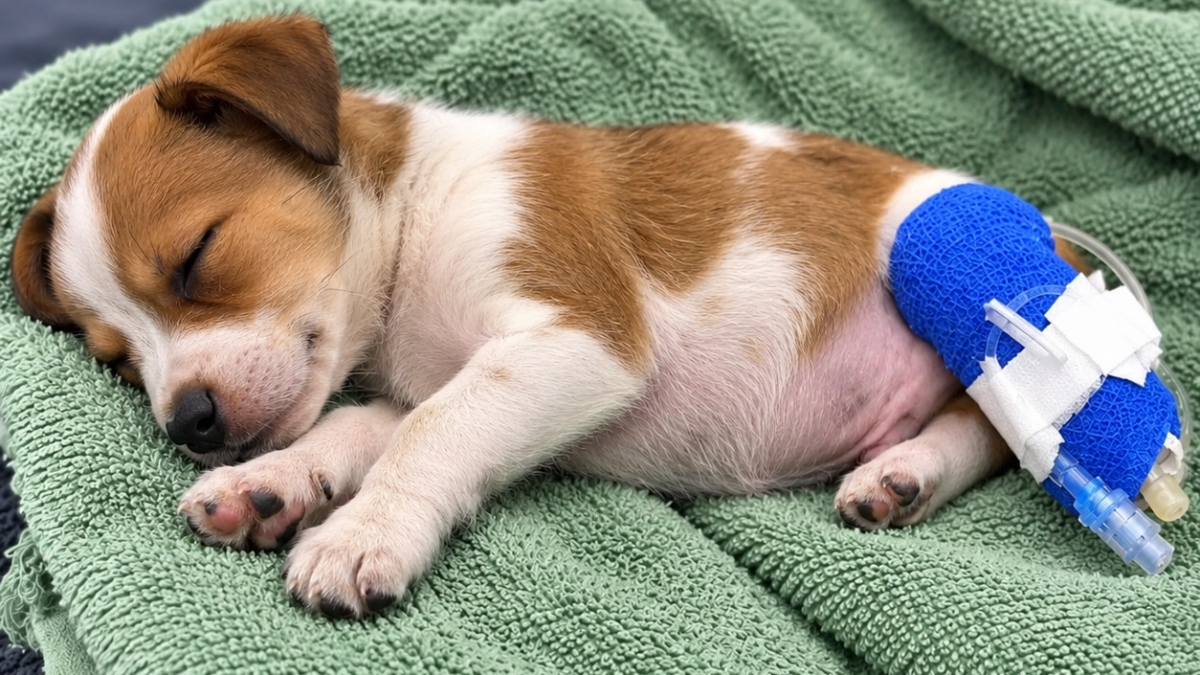
PART 2
I had imagined Rico waking up so many times that the real moment almost didn’t feel real.
I thought I would cry immediately.
I thought I would pick him up.
I thought I would feel relief.
Instead, I stood beside his bed and stared.
His eyes were open.
That was enough to make my chest tighten.
“Rico?”
His head shifted slightly.
Not much.
Just enough to tell me that somewhere inside the swelling and damage, he was present.
I leaned closer.
“Hey.”
His eyes did not focus on me the way I expected.
At the time, I didn’t understand why.
I thought he was disoriented.
He had been unconscious.
His brain had been injured.
Of course he was confused.
I put my hand near him.
His nose moved faintly.
“There you are.”
A technician adjusted one of his lines.
“He’s still very weak.”
“I know.”
“The catheter stays for now.”
I nodded.
“What about the pneumonia?”
“Still treating it.”
“And the brain swelling?”
The technician’s expression changed slightly.
“Still significant.”
I looked at Rico.
“So waking up doesn’t mean we’re safe.”
“No.”
That became one of the hardest things about his recovery.
Every milestone looked like a finish line until we reached it.
Wake up.
He woke up.
Then we realized waking up was not enough.
Sit.
He sat.
Then we discovered sitting was only the beginning.
Stand.
He tried.
Then his movement revealed another problem.
Again and again, hope arrived carrying another question.
On day five, we celebrated consciousness.
On day six, we were still monitoring whether his body could handle being awake.
His breathing remained a concern.
The pneumonia had not disappeared just because his eyes opened.
His brain remained swollen.
His nervous system had taken a massive blow.
His organs had been injured.
Rico was alive, but alive was still fragile.
I sat beside him.
“You don’t know what you did, do you?”
His head moved.
“You scared everyone for five days.”
Nothing.
“You owe us an apology.”
Still nothing.
I smiled.
“Fine. Later.”
Those little conversations became part of our routine.
I talked because I wanted him to hear something gentle.
I wanted Rico’s world, from that point forward, to contain voices that did not come with pain.
Even if he could not understand the words, he could understand tone.
Soft.
Patient.
Predictable.
Safe.
That mattered.
His care continued around the clock.
IV fluids.
Antibiotics.
Medication.
Monitoring.
Support for a body that had almost nothing in reserve.
He had survived the initial trauma.
Now we had to see what the trauma had left behind.
By day ten, Rico was more alert.
Still tiny.
Still weak.
But no longer completely disconnected from the world around him.
I watched him try to move his front legs.
“Easy.”
He shifted.
“Don’t rush.”
He shifted again.
The nurse laughed.
“He doesn’t seem interested in your advice.”
“He’s six weeks old.”
“Exactly.”
I smiled.
That was the first time I let myself think of Rico as a puppy instead of a patient.
Not a head trauma case.
Not a thirty-percent survival chance.
A puppy.
He deserved that identity.
By day fifteen, the situation remained serious.
His brain was still swollen.
The pneumonia was still being treated.
He still needed significant care.
But then he did something we hadn’t expected.
He sat up.
Not gracefully.
Not for long.
But he did it.
I saw his front legs push against the bedding.
His body lifted.
His head wobbled.
The nurse moved closer.
“Rico.”
He held.
One second.
Two.
Three.
I covered my mouth.
“He’s sitting.”
“Yes.”
“He’s actually sitting.”
Rico swayed.
Then settled back down.
I laughed through tears.
“You did it.”
His head tilted slightly.
“You have no idea why we’re all emotional.”
He didn’t.
And that was fine.
For us, sitting meant something enormous.
The puppy found unconscious in the street had enough strength, enough neurological function, enough control to lift himself.
It was not a guarantee.
It was evidence.
Something inside his damaged body was beginning to reconnect.
I started imagining standing.
I tried not to.
Hope had already taught me to be careful.
But I imagined it anyway.
What would it look like if Rico stood?
Would his legs hold?
Would his balance work?
Would his brain know where the floor was?
Would he ever walk?
The veterinarians didn’t promise anything.
That was honest.
Brain injuries are unpredictable.
Some deficits improve.
Some remain.
Some become visible only when the patient tries to do more.
So we waited.
Rico kept trying.
Days later, he began pushing harder with his legs.
His front paws found the floor.
His hind legs trembled.
Sometimes he got halfway up and collapsed.
I would move my hand toward him instinctively.
“Come on.”
He tried.
“That’s it.”
His body rose a little higher.
Then down.
“You’re allowed to be tired.”
He tried again.
That stubbornness made everyone smile.
Not because struggle is beautiful.
I don’t believe suffering becomes good just because an animal survives it.
Rico should never have had to be strong.
But since the damage had already been done, I was grateful for every bit of determination his body could find.
Eventually, Rico stood.
Only briefly.
His legs shook.
His head moved strangely.
His body seemed unsure how to organize itself.
I was so excited at first that I barely noticed.
“He’s standing!”
Then he took a step.
Another.
And turned.
At first, I thought he had lost balance.
Then he turned again.
And again.
Circle.
Circle.
Circle.
My smile disappeared.
“Why is he doing that?”
The veterinarian watched.
“Let’s evaluate him.”
Rico continued moving in a small circular pattern.
It wasn’t playful.
It wasn’t random.
Something neurological was wrong.
I felt the old fear return.
“What does that mean?”
“It can be related to the brain injury.”
“Can it improve?”
“Possibly.”
“Possibly isn’t an answer.”
“I know.”
The vet examined him carefully.
We watched his pupils.
His responses.
His movement.
Then another concern emerged.
Rico wasn’t tracking things visually.
A hand moved.
His eyes did not follow normally.
A light.
No useful response.
I felt cold.
“Can he see?”
No one answered immediately.
That pause again.
Always the pause.
“Can he see?”
The veterinarian finally looked at me.
“We’re concerned that he may be blind.”
I looked at Rico.
He was standing.
Wobbling.
Alive.
And suddenly the world he had awakened into changed completely.
“Blind?”
“We need more evaluation.”
“From the brain injury?”
“That’s one possibility.”
“Both eyes?”
“We need to confirm.”
I sat down.
For weeks, I had been begging his body to survive.
I had imagined walking.
Eating.
Growing.
I had never imagined blindness.
Maybe that sounds foolish.
The veterinarians had told me the brain damage was severe.
Nerves had been affected.
There were no guarantees.
But hope has a way of creating its own picture.
In my picture, Rico recovered.
He ran.
He looked at people.
He played.
He grew up.
Now someone had removed sight from that future.
Not life.
Sight.
I looked at him.
He was moving in circles again.
He had no idea what diagnosis we were discussing.
“Can it come back?”
The veterinarian was careful.
“We need specialists to evaluate him.”
That became our next mission.
More opinions.
More examinations.
More hope.
We took Rico to multiple veterinarians.
Each time, I carried the same question.
“Is there anything we can do?”
His eyes were examined.
His neurological responses evaluated.
The damage was traced back to the severe trauma.
Important nerves had been badly injured.
The answer did not change.
His sight could not be restored.
The first time someone said it plainly, I cried.
Not in front of Rico.
I stepped away.
I hated feeling as if survival had somehow not been enough.
That thought made me feel guilty.
He had beaten a seventy-percent chance of dying.
He had woken after days unconscious.
He had survived pneumonia.
His brain was still healing.
He had learned to sit.
He was trying to walk.
And I was grieving because he could not see.
Both feelings could exist.
Gratitude and grief.
I was grateful beyond words that Rico lived.
I was devastated by what had been taken from him.
The people who had hurt him had not only caused pain in one moment.
The damage would follow him.
That is what cruelty does.
Sometimes the action lasts seconds.
The consequences last years.
I sat beside him later that day.
He smelled my hand before I touched him.
Then leaned slightly toward it.
“You know something I don’t.”
Rico stayed close.
“You already know how to live like this.”
His nose moved.
“I’m the one who has to learn.”
That became another turning point.
I stopped asking how to make Rico see again.
The doctors had answered.
We couldn’t.
So the question changed.
How do we help a blind puppy live well?
That question had answers.
Dogs do not rely on vision the way humans do.
Smell.
Hearing.
Touch.
Memory.
Texture.
Routine.
These things could become Rico’s map.
The world was not gone.
It was simply going to reach him differently.
I started paying attention to sounds.
My footsteps.
My voice.
The sound of food being prepared.
The direction of a door opening.
I noticed how quickly Rico turned toward noise.
His ears became part of the way he oriented himself.
His nose worked constantly.
I would put my hand near him before touching.
Let him smell.
Then contact.
Predictable.
Safe.
“It’s me.”
He would relax.
Soon, I began announcing movements.
“Up.”
I supported him.
“Forward.”
He stepped.
“Easy.”
Another step.
“Good.”
Rico did not understand English in the way a person does, but repetition created meaning.
Tone and context.
The same sound before the same action.
He learned.
Maybe I was learning faster.
The circling continued for some time.
Sometimes it was worse when he was tired.
Sometimes excitement made his movement less controlled.
The neurological damage was real.
There was no clean transformation where one morning everything became normal.
We had to stop expecting normal.
Then I realized something important.
Rico did not care about normal.
He cared about function.
Can I find the food?
Can I find the person?
Can I stand?
Can I move?
Can I rest safely?
Can I eat?
Those questions mattered more.
So we worked there.
Food became one of Rico’s strongest motivations.
The puppy who had once lain unconscious began showing real enthusiasm when meals appeared.
I remember one particular meal clearly.
The bowl was prepared specially for him.
Soft enough.
Easy to eat.
I placed it near his nose.
His entire expression changed.
“Oh, you know that smell.”
Rico leaned forward.
He started eating eagerly.
I laughed.
“There he is.”
For weeks, medical charts had defined his life.
Brain swelling.
Pneumonia.
Catheter.
Neurological damage.
Blindness.
Now, for a few minutes, none of that mattered.
He was a puppy eating.
Hungry.
Interested.
Present.
That felt like victory.
Every meal helped him gain strength.
Strength meant more attempts to stand.
Standing meant movement.
Movement meant learning the shape of the world.
We began creating safe spaces.
No sudden obstacles.
No objects moved unnecessarily.
Consistent pathways.
A blind dog learns through memory.
If the water bowl is always in the same place, the body remembers.
If the bed stays there, the nose and paws learn.
If a doorway has a texture or sound cue, orientation becomes easier.
Rico started building an internal map.
At first, he bumped into things.
Sometimes lightly.
Sometimes enough to make me wince.
I would rush toward him.
Then I learned not to panic.
A blind puppy has to explore.
Overprotecting him would not build confidence.
So I stayed close.
Close enough to prevent danger.
Far enough to let him discover.
One step.
Pause.
Nose working.
Another step.
The wall.
Turn.
Good.
He learned corners.
Learned surfaces.
Learned that the floor changed under his paws.
Learned the smell of his bed.
Learned my voice.
There were days when progress felt beautiful.
Then days when the neurological damage reminded us it was still there.
Circling.
Balance problems.
Fatigue.
Sometimes Rico would seem confused.
Those moments hurt.
But they no longer made me think he was failing.
His path was different.
That was all.
I started celebrating things other people would barely notice.
Rico finding his water without help.
Rico turning toward my voice correctly.
Rico standing longer.
Rico eating without needing encouragement.
Rico walking several steps without circling immediately.
Rico settling down after locating his bed.
Tiny things.
To us, enormous.
One veterinarian told me something that stayed with me.
“Blind dogs don’t know they’re missing a life they used to have if they adapt young. They learn the life they have.”
Rico was only weeks old.
His world had barely formed.
Maybe that was one small mercy.
He would grow into blindness.
Not as a loss he remembered every morning.
As the way the world worked.
Sound meant direction.
Smell meant information.
Touch meant reassurance.
Routine meant freedom.
I decided that if Rico could accept that, I had no right to spend his life mourning for him.
I could grieve what happened.
But I would not teach him that his life was lesser.
That became my promise.
“You’re not broken.”
I caught myself.
No.
I changed the words.
“You’re Rico.”
That was better.
Not defined by what was missing.
Defined by himself.
His personality began emerging more clearly as his body improved.
He liked food.
A lot.
He liked being close to familiar people.
He responded strongly to voice.
He had stubborn moments.
He wanted to move before his balance was ready.
He sometimes ignored rest because he smelled something interesting.
In other words, he was becoming a puppy.
That made me unbelievably happy.
One day, he was standing and trying to move toward me.
I moved a little farther away.
“Come on.”
His ears turned.
He stepped toward my voice.
One step.
Another.
His body swayed.
I resisted reaching immediately.
“That’s it.”
Another step.
He turned slightly off course.
“Here.”
My voice guided him back.
Rico adjusted.
Then reached my leg.
I crouched.
“You found me.”
His tail moved.
I froze.
“Was that a wag?”
Another movement.
I laughed.
“You found me.”
That moment mattered more than I can explain.
Rico had not regained sight.
He had gained something else.
Orientation.
Confidence.
Trust in the fact that the world could be navigated.
He didn’t need eyes to find me.
He had ears.
Nose.
Memory.
And the certainty that when he reached the voice, hands would be gentle.
That is when I began thinking less about disability and more about adaptation.
Rico’s life would require changes.
Yes.
But changes are not the same as tragedy.
The tragedy was the violence.
Blindness was the consequence.
Life afterward could still contain joy.
That distinction became important.
People sometimes pity disabled animals so intensely that they accidentally reduce them to the disability.
Rico did not need pity every minute.
He needed guidance.
Safety.
Consistency.
Love.
Food.
Lots of food, apparently.
And room to learn.
So we gave him that.
Weeks became months.
His body grew.
The one-pound puppy slowly became stronger.
The swelling improved.
The pneumonia receded.
The catheter disappeared from his life.
Medications decreased.
Hospital routines gave way to rehabilitation routines.
The question was no longer, “Will he live?”
It became, “What can he learn next?”
That was a beautiful question.
He learned to eat with confidence.
Stand.
Walk.
Orient toward voices.
Navigate familiar spaces.
Use smell to locate people.
Follow sound.
Eventually, he moved with more certainty.
Not perfect certainty.
He was still blind.
He still had nerve damage.
But the hesitating puppy began trusting his body.
There was a day when I watched him move across a room with almost no assistance.
He paused at an obstacle.
Smelled.
Adjusted.
Continued.
I said nothing.
I didn’t want my voice to alter the moment.
He reached the other side.
Then turned toward me when I made a sound.
I smiled.
“You did that yourself.”
His tail moved.
I thought about the street.
Six weeks old.
Unconscious.
One pound.
Thirty percent.
Then this.
A dog building his own map of the world.
The contrast was almost impossible to hold in one thought.
I still felt anger toward the person who had failed him.
His owner had later said Rico was always sick and he no longer wanted him.
That sentence stayed with me.
I wondered what “always sick” even meant in the life of a six-week-old puppy.
Six weeks is barely enough time to become anything.
Maybe Rico had been weak.
Maybe he needed medical care.
Maybe he had cried.
Maybe caring for him was inconvenient.
None of that justified what happened.
But I eventually stopped giving that person much space in my thoughts.
Rico had already lost enough to him.
I didn’t want to give him the rest of the story too.
The future belonged to Rico.
And the most powerful answer to what had been done to him was not retaliation.
It was survival.
The hard-soled shoe had been used to hurt a one-pound puppy.
Months later, those little legs were working to hold him up.
The blows had damaged the nerves that carried vision.
Rico learned to use sound.
Smell.
Touch.
His owner had said he no longer wanted him.
Someone else looked at the blind puppy and said, essentially, I do.
That was the answer.
You didn’t want him?
We did.
You treated his life like a burden?
We built our lives around helping him navigate.
You left him with darkness?
We became his eyes.
That was enough.
More than enough.
One evening, I sat beside Rico after he had eaten.
His belly looked pleasantly full.
He was tired from practicing movement.
He curled near me.
I ran my hand gently along his back.
“You know, I used to think your story was about surviving.”
His ears moved.
“It’s not.”
He rested his chin.
“Survival was only the beginning.”
That realization had taken months.
At first, all we wanted was a heartbeat.
Then consciousness.
Then less swelling.
Then pneumonia controlled.
Then sitting.
Then standing.
Then walking.
Then adapting.
Each stage felt like the whole goal.
Eventually I understood there was no single finish line.
Life was the accumulation.
Rico didn’t need one dramatic victory.
He needed days.
Lots of them.
Days where he ate.
Days where he bumped into something and tried again.
Days where he found me by sound.
Days where he slept safely.
Days where he learned a new corner.
Days where nothing medically important happened at all.
Those ordinary days became my favorite.
A normal day for Rico still looked different from another dog’s day.
But normal is personal.
Rico’s normal meant checking space with his nose.
Listening before moving.
Remembering where furniture was.
Turning toward familiar voices.
Finding food by smell.
It worked.
And because it worked, his confidence grew.
One morning, I entered the room without saying anything.
Rico lifted his head immediately.
His nose worked.
Then his tail moved.
I stopped.
“You know I’m here?”
He turned toward me.
I walked quietly a little closer.
His ears adjusted.
Tail again.
“You absolutely know.”
I crouched.
He came toward me.
That destroyed the part of me that still worried sight was the only meaningful way to know someone.
Rico knew me.
Not visually.
Completely.
Smell.
Sound.
Pattern.
Presence.
Recognition doesn’t require eyes.
Love doesn’t either.
That may sound obvious.
It did not feel obvious until Rico taught it to me.
I had spent weeks grieving what he couldn’t see.
Rico kept showing me what he could know.
The difference matters.
He couldn’t see the person standing beside him.
He could know that person was safe.
He couldn’t see the bowl.
He could find dinner.
He couldn’t see the room.
He could learn it.
He couldn’t watch another dog run.
But he could hear paws and follow.
He couldn’t see sunlight.
But he could feel warmth.
Once I started seeing his life through that lens, the future felt larger again.
Not perfect.
Larger.
I promised him something quietly.
“I’ll be your eyes.”
His ear moved.
“For as long as you need.”
That promise was not about making him dependent.
The opposite.
Good guidance should create independence.
I wanted Rico to rely on me enough to learn, then rely on his own skills as much as safely possible.
So I helped.
Then stepped back.
Guided.
Then let him try.
Warned him when something dangerous appeared.
But didn’t interrupt every small mistake.
Confidence requires experience.
And Rico became experienced.
At first, every unfamiliar surface stopped him.
Later, he investigated.
At first, a sudden sound startled him badly.
Later, he oriented.
At first, he moved in uncertain circles.
Later, he found pathways.
The neurological damage did not vanish.
But his brain learned around what remained.
That is one of the remarkable things about young animals.
Adaptation can be astonishing.
Not magical.
Not complete.
But astonishing.
Rico’s body grew stronger as his appetite improved.
The sight of him eating always brought me back to the unconscious puppy.
That body had once been so injured that food was irrelevant.
Now meal preparation brought excitement.
The smell reached him.
His head lifted.
He moved toward it.
“Slow.”
He ignored me.
Of course.
Blindness had not reduced his interest in eating even slightly.
I laughed.
“You can’t see the bowl, but you somehow know exactly when I’m holding it.”
His nose moved rapidly.
“Right.”
I placed it down.
Rico ate.
Healthy enthusiasm.
That simple scene made me happier than almost anything.
He had become strong enough to care about things beyond survival.
Food.
People.
Comfort.
Movement.
That is how recovery announces itself.
Not always through lab results.
Through desire.
Rico wanted things.
Wanting is a kind of future.
The old version of Rico on the street had no visible future.
He was motionless.
The Rico in front of me wanted dinner.
Then maybe another step.
Then touch.
Then rest.
Those wants accumulated into life.
Sometimes people asked whether he would ever see again.
I answered honestly.
“No.”
The word stopped hurting as much.
Not because I stopped wishing the injury had never happened.
I will always wish that.
But Rico made “blind” feel less like an ending.
He was blind.
And alive.
Blind and hungry.
Blind and affectionate.
Blind and stubborn.
Blind and learning.
Blind and wanted.
The conjunction mattered.
Not blind instead of living.
Blind while living.
There is a huge difference.
One day, someone watched Rico navigate and said, “He doesn’t even seem to know he’s blind.”
I understood what they meant.
But I thought about it later.
Rico knew the world through the senses available to him.
There was no reason for him to frame himself by absence.
We did that.
Humans think about what is missing.
Rico thought about what was present.
Smell.
Voice.
Floor.
Food.
Hand.
Warmth.
That was enough to build a world.
Maybe we could learn something from that.
I stopped saying things like, “Poor Rico.”
Not because what happened wasn’t terrible.
Because he wasn’t living a poor life.
The injury was tragic.
Rico wasn’t.
He was a puppy.
That distinction mattered.
There were still difficult moments.
Sometimes he became disoriented in a new space.
Sometimes the circling returned.
Sometimes his balance failed.
Sometimes I felt the old fear that the nerve damage had taken too much.
Then Rico would smell me.
Turn.
Find me.
And the fear softened.
We didn’t need perfect neurological function to have meaningful life.
We needed enough function, enough adaptation, enough support.
He had those things.
His world expanded slowly.
A larger room.
Another safe space.
New textures.
Different sounds.
Each new environment required patience.
I would guide him with my voice.
“Here.”
He turned.
“Good.”
Step.
“Easy.”
Another.
When he reached me, praise.
Touch.
Consistency.
Eventually, I could stand farther away.
Rico still came.
One day, I realized he had crossed almost an entire room toward my voice.
I knelt.
“You’re getting good at this.”
Tail wag.
“Very good.”
I thought about the phrase “I’ll be your eyes.”
At first, it sounded like a promise of constant help.
Later, I understood its deeper meaning.
Being his eyes sometimes meant doing nothing.
Letting him use the world he had.
Intervening only when necessary.
Trusting his nose.
His ears.
His memory.
That was harder than holding him.
Love often is.
We want to protect.
Sometimes protection means space.
Rico grew more independent.
He learned familiar layouts quickly.
He began moving with speed that made me nervous.
“Rico.”
He continued.
“Careful.”
Nothing.
“You are blind.”
Tail wag.
“I know you don’t care.”
He didn’t.
His confidence occasionally outran his accuracy.
He bumped into something.
Stopped.
Recalculated.
Continued.
I would wince.
He would move on.
Puppies are resilient in ways humans overthink.
One bump did not create a philosophy.
It created information.
Wall there.
Turn.
Next.
That was Rico.
The more I watched him, the less I wanted to control his world.
I wanted to make it accessible.
There is a difference.
Control says, “Don’t move because you might get hurt.”
Accessibility says, “Move. I’ll make sure the environment gives you a fair chance.”
Rico deserved the second.
So his spaces stayed predictable.
Sharp hazards removed.
Food and water consistent.
Voice cues clear.
Then freedom within that structure.
He thrived.
The puppy who had once needed intensive care began needing something much more ordinary.
A life.
There was a day when he ate, walked, found his bed, slept, woke, and came toward me when I called.
Nothing dramatic happened.
I remember thinking it might have been the best day of his recovery.
No hospital crisis.
No terrifying news.
No specialist verdict.
Just routine.
That is what critically injured animals fight to reach.
Boring days.
Safe days.
Days nobody posts because nothing happened.
Those are gold.
Rico had enough of them that the initial emergency slowly stopped dominating every conversation.
People no longer asked only, “How is his brain?”
They asked, “What does he like?”
That transition made me smile.
What did Rico like?
Food.
Warm blankets.
Familiar voices.
Gentle touch.
He liked being close.
He liked knowing where people were.
He learned to relax when he heard us moving nearby.
He did not need to see love to recognize it.
Eventually, the question of who would stay with Rico for life became real.
He could survive.
He could adapt.
Now he needed permanence.
His owner had said he didn’t want him.
That sentence still hurt.
But now it had competition.
Someone else wanted him.
That changed everything.
Rico did not need everyone to choose him.
He needed one person willing to keep choosing him.
Every day.
That is what forever care means.
Not one rescue moment.
A thousand ordinary decisions.
Keep the pathways consistent.
Speak before touching.
Guide him in unfamiliar places.
Protect him without making him helpless.
Feed him.
Love him.
Laugh when he does something stubborn.
Be patient when he circles.
Be there.
Someone promised to do that.
To be his eyes.
Not because Rico had no capability.
Because partnership makes capability larger.
The first time I heard those words spoken as a real commitment, I nearly cried.
“I’ll be his eyes for the rest of his life.”
There it was.
The answer to the owner who didn’t want him.
Not argument.
Commitment.
The owner had looked at a sick six-week-old puppy and decided care was too much.
Another person looked at a blind puppy with nerve damage and decided lifelong care was worth it.
That contrast said everything.
Rico had not changed his value.
The people around him had changed.
That is an important distinction.
He was worthy while unconscious.
Worthy at one pound.
Worthy before he sat up.
Before he ate.
Before anyone knew whether he would walk.
His recovery did not create his value.
It only gave us time to see more of him.
I thought about that often.
If he had died on the second day, he would not have been less worthy because we never saw his personality.
If he had never learned to stand, he would not have been less worthy.
If he required more care, still worthy.
Survival stories can accidentally suggest an animal earns love by fighting.
Rico didn’t have to earn anything.
He deserved care because he was alive and suffering.
Everything after was a gift.
His willingness to fight was one.
His appetite another.
His trust another.
The first time Rico moved through a familiar area with almost no hesitation, I stood behind him and said nothing.
He knew the floor.
He knew the turn.
He knew where the bed was.
His nose guided part of it.
Memory guided the rest.
He reached the destination and settled.
I laughed quietly.
“You don’t need me as much as you used to.”
His ears moved.
That made me proud.
A dependent puppy becoming capable.
Not sighted.
Capable.
Those are different things.
People confuse them.
Rico taught us not to.
His blindness remained.
His future still needed accommodations.
But capability was growing every day.
One afternoon, he heard food preparation from another room.
His head came up.
I watched.
He turned toward the sound.
Started moving.
Paused at the doorway.
Adjusted.
Continued.
I started laughing.
“You can find food from anywhere.”
He reached the bowl area.
“Unbelievable.”
His tail moved.
That was a normal puppy victory.
Not neurological.
Not medical.
Motivational.
Food wins.
I loved it.
Months earlier, the only question had been whether his brain would keep him alive.
Now I was joking that his stomach had better navigation than the rest of him.
That is how far life had moved.
We received updates on his progress.
Standing more strongly.
Walking with greater confidence.
Eating eagerly.
Using smell and sound.
Learning routines.
The puppy who once lay unconscious became busy.
Busy is a wonderful word after critical illness.
Rico had things to do.
Find dinner.
Follow voices.
Explore safe spaces.
Rest.
Repeat.
He no longer belonged to the emergency.
He belonged to life.
I wish I could say I stopped feeling anger about how he got there.
I didn’t.
There were moments when I remembered the injuries were linked to blows from a hard-soled shoe and felt sick.
Rico weighed one pound.
That fact alone made the violence difficult to comprehend.
How much force does it take to injure a body that small?
I didn’t want to imagine.
So I stopped.
I focused on the opposite image.
A hand placed near Rico’s nose.
He smells.
Recognizes.
Moves closer.
That became the image I wanted.
Hands no longer meant impact.
Hands meant guidance.
Food.
Warmth.
Connection.
You cannot undo trauma by pretending it didn’t happen.
You answer it with repetition.
Safe touch.
Again.
Kind voice.
Again.
Meal.
Again.
Help.
Again.
The nervous system learns.
The heart, in whatever way dogs understand trust, learns too.
Rico’s world became predictable.
Predictability is powerful for a blind dog.
It is powerful for a traumatized dog too.
No surprises that hurt.
The same voice.
Same placement of objects.
Same gentle approach.
He could anticipate what came next.
That reduced fear.
He began living less cautiously.
More confidently.
I watched his tail more.
At first, tail movement was rare.
Later, familiar voices brought it easily.
“Rico.”
Wag.
“Dinner.”
Bigger wag.
I laughed.
“Your priorities are clear.”
That tail meant something to me.
It showed that his body was no longer spending every resource on survival.
There was room for emotion.
Expectation.
Excitement.
A dog who almost died had enough spare energy to be happy.
That is never small.
Rico became stronger.
Not instantly.
Not perfectly.
He still had limitations.
But strength accumulated.
The first time he managed to stand without collapsing immediately, everyone celebrated.
Later, standing became normal.
Then walking became the challenge.
Later, that became more normal.
This is the pattern of recovery.
Today’s impossible becomes tomorrow’s routine.
And once something becomes routine, you forget how extraordinary it once was.
I tried not to forget.
Sometimes I would watch Rico standing and remember the street.
Not to trap him in the past.
To remind myself what each ordinary movement represented.
His legs were carrying him.
His brain was sending enough signals.
His muscles were responding.
A whole chain of systems that had almost failed were working together.
I didn’t need perfect sight to feel grateful for that.
Eventually, I stopped watching every step.
That might have been the final stage of my own recovery.
At first, I hovered.
Every wobble.
Every turn.
Every bump.
Then I trusted him.
He knew more than I realized.
He could navigate.
He could solve little problems.
He could ask for help by orienting toward my voice.
I could let him be.
That is what every caregiver hopes for.
Not permanent vigilance.
Confidence.
Rico reached it in his own way.
One evening, he finished eating and settled close by.
I said quietly, “Do you know you were only given thirty percent?”
His ears moved.
“Thirty.”
Nothing.
“Very rude number.”
He rested.
“You beat it.”
Then I corrected myself.
“No.”
He hadn’t beaten a number in some magical way.
Medicine mattered.
Timing mattered.
The young man who intervened mattered.
Veterinary care mattered.
Rico’s physiology mattered.
Chance mattered.
Still, he had survived.
That fact did not need mythology.
He was here.
That was enough.
I touched his back.
“You stayed.”
His body relaxed.
“That’s what matters.”
The happy ending of Rico’s story isn’t that his eyes recovered.
They didn’t.
I think that honesty matters.
Not every rescue ends with everything restored.
Sometimes the body keeps a scar.
Sometimes a limb is lost.
Sometimes an eye.
Sometimes sight.
A happy ending does not require pretending those losses are insignificant.
Rico’s blindness mattered.
It changed his life.
But it did not end his life.
That distinction is the heart of his story.
He couldn’t get his sight back.
He got something else.
People who stayed.
A routine.
Safety.
Food.
Guidance.
A future.
Someone willing to be his eyes.
Maybe that does not sound like a replacement.
It isn’t.
Nothing replaces sight.
But life is not one ability.
It is a collection of ways of connecting with the world.
Rico had many left.
We built around them.
His nose became powerful.
His ears became compass points.
His paws read surfaces.
Memory drew maps.
Voice became direction.
Love became something he could recognize without seeing the face attached to it.
That last part stays with me most.
Rico never needed to see someone’s expression to know whether they were safe.
He knew from touch.
Tone.
Consistency.
How they held him.
Whether they came back.
Dogs may understand reliability more clearly than words.
Rico had once known a person who did not want the responsibility of him.
Then he learned another kind of person.
Someone who stayed when care became more difficult.
That is trust earned honestly.
Not demanded.
One day, I stood in a room and called him.
“Rico.”
He turned.
“Here.”
He started toward me.
His path wasn’t straight.
A small curve.
Correction.
Another step.
I didn’t move.
He kept coming.
When he reached me, I knelt.
“You did it.”
His tail moved.
I hugged him carefully.
“You found me.”
That felt like the perfect answer to blindness.
Not restoration.
Connection.
He could still find what mattered.
Maybe that is why his story touched me so deeply.
The world had taken sight.
But the world still had sound.
Smell.
Touch.
And people.
People had caused his pain.
People also became part of his recovery.
Both truths can exist.
I didn’t want Rico growing up believing every person was danger.
So we gave him examples.
Again and again.
Kindness is not one big gesture.
It is consistency.
The person feeding you tomorrow too.
The voice that stays calm when you make a mistake.
The hand that guides without forcing.
The home that doesn’t disappear when you’re inconvenient.
Rico eventually had that.
That was his real victory.
If I think of revenge at all, I think of it this way.
The shoe was supposed to break him.
His legs learned to stand.
The trauma took his sight.
He learned another way to navigate.
His owner said he no longer wanted him.
Someone else promised a lifetime.
Cruelty said, “You are too much trouble.”
Love answered, “We’ll learn how to care for you.”
That is the only revenge Rico needed.
A life bigger than the moment that almost ended it.
I hope he grows old.
I think about that often.
I hope one day his muzzle turns gray.
I hope his hearing eventually softens with age and someone adapts again.
I hope he becomes stubborn.
I hope he knows every corner of his home so well that people forget he can’t see.
I hope dinner is late one day and he complains.
I hope he steals something by smell.
I hope people laugh.
I hope blindness becomes one fact among a thousand others.
Rico likes this food.
Rico sleeps here.
Rico knows that voice.
Rico hates that sound.
Rico loves this blanket.
Rico is blind.
Rico is funny.
Rico is loved.
That is how identity should work.
No single wound gets all the space.
Months after the worst days, Rico’s life no longer revolved around survival percentages.
Nobody said “thirty percent” every morning.
Nobody watched the clock waiting for consciousness.
Nobody talked about whether he would wake.
He had already answered.
Yes.
Then he kept answering.
Can you sit?
Yes.
Can you stand?
Eventually.
Can you walk?
Yes, differently.
Can you find food?
Absolutely.
Can you learn a room?
Yes.
Can you trust?
Yes.
Can you live blind?
Yes.
Can you be loved?
Completely.
Those answers built the ending.
Not one miracle.
A sequence of yeses.
Rico’s owner had offered a no.
I don’t want him.
The rest of his life answered with yes.
We want you.
We’ll help.
We’ll wait.
We’ll adapt.
We’ll stay.
That is why the ending feels satisfying to me.
Not because every damage was reversed.
Because the rejection was.
Rico was wanted.
Finally.
There is something powerful about a blind dog moving toward a voice he trusts.
No visual proof.
No face.
Just faith built from repetition.
The voice has been safe before.
So move toward it.
That is what Rico did.
Step.
Pause.
Listen.
Step.
Find.
I sometimes wondered whether humans deserve that kind of trust.
Then I remembered that trust isn’t given to humanity in general.
Rico gave it to specific people who earned it.
That felt fair.
His first owner failed.
Others did not.
One human action did not get to define every human in his world.
Recovery made room for new evidence.
That is how trauma can loosen its grip.
Not through forgetting.
Through accumulation.
More safe experiences.
More meals.
More gentle hands.
More successful movement.
More ordinary days.
Eventually the old event becomes one chapter.
Still important.
No longer the entire book.
Rico’s book had more chapters ahead.
That mattered most.
I would sometimes sit beside him when he was asleep and think about the first two days.
Unconscious.
Still.
Thirty percent.
I had watched his chest because movement was the only reassurance.
Now I could hear him moving around before I saw—before I remembered he couldn’t see.
Paws.
Nails on the floor.
A little bump.
Then a correction.
Life making noise.
The quiet puppy had become a noisy one.
I loved that.
Noise meant activity.
Activity meant energy.
Energy meant body.
Body meant life.
“Rico.”
He turned.
I smiled.
“Nothing. Just checking.”
He moved again.
I stopped checking as often over time.
That was good.
A healthy relationship with a recovering animal eventually requires you to stop treating them like an emergency.
Rico deserved not to feel like one forever.
So the monitoring softened.
The protection remained.
The fear reduced.
One day, I realized I hadn’t thought about the thirty-percent statistic in weeks.
Instead, I was thinking about what Rico would eat later.
That is recovery.
When probability gets replaced by routine.
Rico had made it all the way from being a percentage to being a puppy again.
I never forgot the neurological damage.
Neither did the people caring for him.
But accommodations became normal.
A consistent layout.
Voice cues.
Safe pathways.
Things that once felt complicated became automatic.
That’s what families do.
They absorb needs.
At first, you think, “We need to remember this because Rico is blind.”
Later, you just put the bowl there because that’s where the bowl goes.
You say his name before touching because that’s how you greet him.
You keep walkways clear because that’s home.
Disability stops feeling like a project.
It becomes part of the rhythm of love.
That is the life Rico deserved.
Not being treated as a permanent medical burden.
Being known.
One person told me, “He’s so brave.”
I agreed, but later I thought about the word.
Brave animals are often just animals continuing because continuing is what bodies do.
Rico did not choose blindness.
He did not sign up for rehabilitation.
He did not wake up thinking, Today I will inspire people.
He smelled food.
So he moved toward it.
He heard a voice.
So he followed.
He got tired.
So he slept.
Maybe that is more beautiful than bravery.
It’s life without performance.
Rico didn’t need to be inspirational.
He just needed to be allowed to live.
The story became inspiring because we watched what life can do when given a chance.
I try to keep that distinction.
He did not owe us a transformation.
We owed him care.
He transformed anyway.
In the end, Rico’s most powerful moments were small.
Sitting up on day fifteen while his brain was still swollen.
Trying to stand.
Eating eagerly.
Following sound.
Finding a person.
Those were not cinematic feats.
They were biological and emotional milestones.
But they meant everything.
I can still picture his tiny legs trying to organize themselves beneath him.
That body had been hit.
That brain had been injured.
Those nerves had been damaged.
Still, the legs pushed.
Not perfectly.
But enough.
When he eventually moved more confidently, I thought:
This is what persistence looks like.
Not a grand comeback.
A nervous system relearning.
A puppy adapting.
A caregiver saying the same cue a hundred times.
A meal placed in the same spot.
A room learned by repetition.
Recovery is often boring work.
The results are extraordinary.
Rico’s world may always be dark visually.
But dark is not the same as empty.
His world contains smell.
Sound.
Warmth.
Texture.
Taste.
Memory.
People.
That is not nothing.
It is a life.
And once I understood that, I stopped wishing for an ending where Rico became the dog he would have been without the injury.
We would never meet that dog.
The real Rico was here.
Blind.
Adapted.
Wanted.
That was the dog who deserved our love.
Not an imaginary version with perfect nerves.
Real Rico.
I think sometimes people delay happiness because they’re waiting for perfect restoration.
Rico taught me not to.
Celebrate function.
Celebrate comfort.
Celebrate appetite.
Celebrate a safe nap.
Celebrate finding the bowl.
Celebrate the first confident turn.
Life does not have to return exactly as it was to be worth living.
That may be the deepest truth in his story.
He did not get everything back.
He got enough to build forward.
And people helped.
The promise to be his eyes became real in ordinary ways.
A voice before a step.
A hand near an obstacle.
A person walking beside him in a new area.
Someone ensuring he never had to face uncertainty alone.
That is what love looks like when it adapts to the individual.
Not sympathy.
Practical devotion.
Rico deserved that from the beginning.
He finally got it.
If I could go back to the street where he lay motionless, I would want to tell the tiny puppy something.
Not that he would recover his sight.
He wouldn’t.
Not that everything would return to normal.
It wouldn’t.
I would say:
“You’re going to wake up.”
Then:
“You’re going to sit.”
“You’re going to stand.”
“You’re going to eat.”
“You’re going to learn.”
“You’re going to find people without seeing them.”
“And one day, someone is going to promise that you never have to navigate the world alone again.”
That would be enough.
Maybe he wouldn’t understand.
That’s okay.
He lived the answer.
The puppy whose owner didn’t want him finally had someone who did.
Not temporarily.
Not while he was cute.
Not while care was easy.
With blindness.
With nerve damage.
With history.
With every accommodation.
Wanted.
That word matters.
Rico could not see the person who chose him.
But he could feel the hand.
Hear the voice.
Smell the familiar presence.
That was enough to know.
The world had once reached him through violence.
Later, it reached him through care.
That contrast is why I remember him.
One pair of hands caused damage.
Other hands held him through recovery.
A hard sole had injured his brain.
Soft footsteps became sounds he learned to follow.
Cruelty had taken sight.
Consistency gave him direction.
I don’t think there is a cleaner emotional ending than that.
Not revenge.
Transformation.
The person who gave up on Rico expected him to become someone else’s problem.
Instead, he became someone else’s family.
That is the answer.
Rico’s life was never restored to the version he might have had.
It became something new.
Still valuable.
Still joyful.
Still his.
And every time I watched him move toward food, toward a voice, toward a safe hand, I thought about the one-pound puppy who once lay completely still.
Then I looked at the dog in front of me.
Standing.
Eating.
Navigating.
Living.
Rico couldn’t see the life ahead of him.
But for the first time, he had people who could.
And they stayed beside him long enough to guide him into it.








