PART 2: They Found Sugar Snap Dying Beside the Road at 19 Pounds—Twenty Days Later, He Walked Out of the Hospital on His Own
PART 2
I did not leave Sugar Snap that first night.
The hospital was bright in the way emergency hospitals always are, even after midnight. Machines hummed. Doors opened and closed. Shoes crossed the floor in quick, purposeful steps. Somewhere down the hallway, another dog cried once and then became quiet.
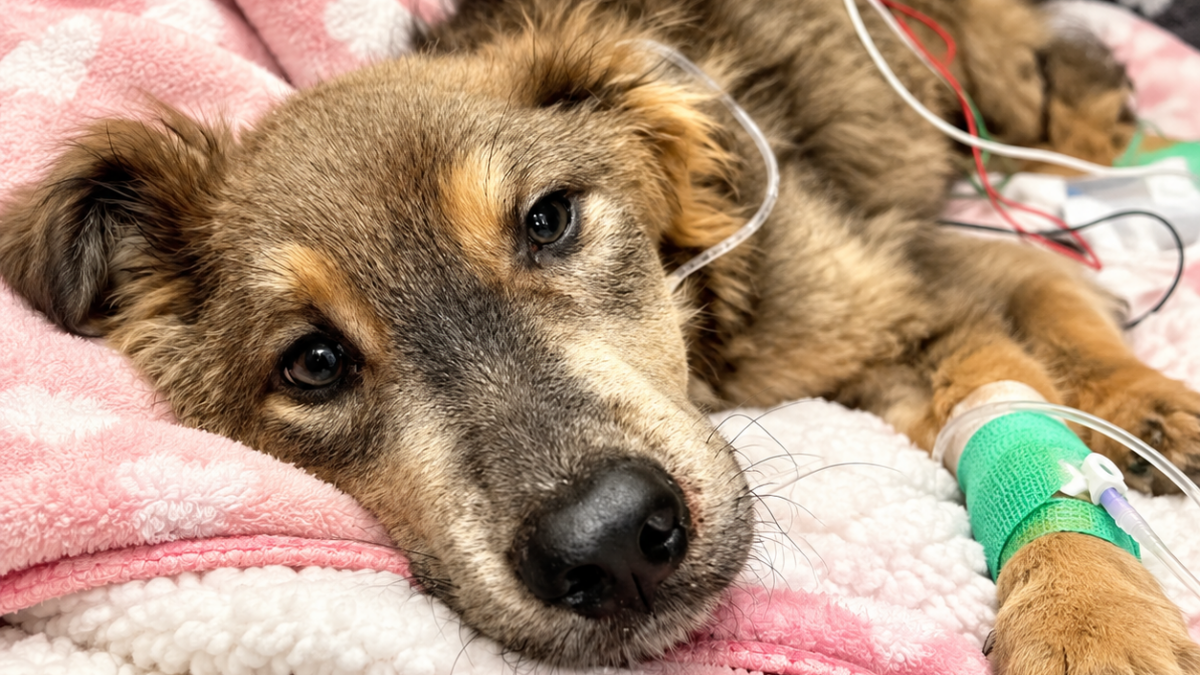
Sugar Snap lay beneath blankets with an IV line running into one leg and a blood-transfusion line secured carefully into another.
He looked impossibly small inside the kennel.
Nineteen pounds.
I kept thinking about that number.
Nineteen.
A dog built to weigh more than fifty had somehow been reduced to less than half of what his body needed just to look like himself.
The veterinarian, Dr. Ellen Parker, came to check him again.
“How’s his pressure?”
“Better than before.”
“Better enough?”
She didn’t lie.
“Better enough for right now.”
I looked at Sugar Snap.
“Right now seems to be all we get.”
“In cases this critical, sometimes that’s exactly how we work.”
Right now.
Not tomorrow.
Not next week.
Right now.
His blood sugar had stabilized temporarily.
His temperature remained concerning.
The severe anemia meant his body had been trying to deliver oxygen with too few healthy red blood cells.
The suspected sepsis frightened me most.
Sepsis is not one simple infection.
It is the body’s dangerous response when infection begins affecting systems everywhere.
For Sugar Snap, whose reserves were already almost gone, there was very little room for another crisis.
We gave him the second transfusion.
Again, there was nothing dramatic about the moment itself.
A bag.
A line.
Careful monitoring.
Numbers.
But I had already learned that life-saving medicine often looks ordinary from across a room.
Nobody screams, “Miracle.”
They check heart rate.
They adjust medication.
They document urine output.
They watch for reactions.
They stay.
That night, staying became our job.
Around two in the morning, Sugar Snap opened his eyes.
I was sitting on the floor outside the kennel.
“Hey.”
His gaze shifted toward me.
“You’re still here.”
His nose moved.
I held my fingers close enough for him to smell.
He didn’t have the strength to move forward.
I didn’t ask him to.
“You don’t have to do anything tonight.”
His eyes closed.
“I’ll handle the waiting.”
He slept.
I didn’t.
By sunrise, his pressure had improved.
The second transfusion appeared to be helping.
His glucose had become easier to maintain.
His gums looked slightly less pale.
Ellen came in holding new results.
“Numbers are moving the right direction.”
I almost smiled.
“Don’t say that if you’re going to add a ‘but.’”
She smiled tiredly.
“There is a but.”
“Of course.”
“His red count is still fragile. Infection markers are still concerning. And we need to start nutrition carefully.”
Sugar Snap’s head lifted at the word nutrition as though he somehow understood.
Ellen laughed.
“See? He votes yes.”
“Can he eat?”
“Yes. Small amounts. Frequently. We have to be cautious.”
The danger of feeding a severely malnourished animal too aggressively is one of the most difficult things to explain to someone watching a starving dog.
Every instinct says feed him.
Give him everything.
Fill the bowl.
But a body that has been starving adapts to starvation.
When nutrition suddenly returns too fast, shifts in phosphorus, potassium and other electrolytes can create life-threatening problems.
Refeeding syndrome.
So Sugar Snap, whose entire body screamed hunger, had to receive food in portions that looked almost insulting.
The technician brought the first measured meal.
Sugar Snap smelled it.
His eyes changed.
That sparkle I had noticed even in the emergency returned.
The bowl went down.
He ate every bite.
Then he licked the bowl.
Then the floor.
Then stared at us.
I crouched beside him.
“That’s it.”
Sugar Snap looked toward the food cart.
“No.”
His ears moved.
“There will be more.”
He licked the bowl again.
I felt something inside me crack.
He did not know meals returned.
Why would he?
Whatever had happened before we found him had taught him the opposite.
Food disappears.
Eat whatever exists.
Tomorrow is not guaranteed.
I placed my palm against the outside of the kennel.
“It comes back.”
He looked at me.
“Every time.”
He had no reason to believe that yet.
So we showed him.
Three hours later, another meal.
Then another.
Always measured.
Always enough for the plan.
Never enough to satisfy the fear inside him.
On the second day, he tried to stand.
I was talking to a nurse when I saw movement.
Sugar Snap planted both front paws beneath his chest.
His shoulders shook.
He pushed.
His back legs followed.
For less than two seconds, he was upright.
Then he collapsed gently onto the blanket.
I rushed forward.
“Easy.”
The nurse smiled.
“He wanted up.”
“He’s not ready.”
“No.”
Sugar Snap tried again.
I laughed despite everything.
“Apparently nobody asked you.”
The second attempt lasted three seconds.
The third never got fully off the blanket.
Exhaustion won.
Still, that night I wrote three seconds on a piece of paper beside his medical notes.
People thought I was joking.
I wasn’t.
Three seconds mattered.
The next morning, his blood values fell again.
The progress vanished as quickly as it had arrived.
Ellen stood beside me with the laboratory report.
“He may need another transfusion.”
I looked toward Sugar Snap.
“How many can he need?”
“As many as his condition requires and his body can tolerate.”
“Is he losing blood?”
“Not obviously. His system is severely compromised. We’re still investigating all contributors to the anemia.”
“Is he worse?”
“He’s not as stable as yesterday.”
That answer frightened me.
For several hours, Sugar Snap became quieter.
His head stayed down.
He did not respond immediately when I entered.
Then the food arrived.
His nose moved.
He ate.
Slowly this time.
But he ate.
That appetite became one of the few things I trusted.
The third transfusion began that afternoon.
Another donor.
Another bag.
Another group of strangers helping a dog whose name they had only just learned.
I began realizing how expensive his survival was becoming.
Emergency hospitalization.
Multiple transfusions.
Intensive monitoring.
Imaging.
Medication.
Antibiotics.
Bloodwork repeated again and again.
Nutrition.
Everything.
Someone from the rescue pulled me aside.
“We’re going to need help.”
“How much?”
She gave me the current estimate.
I stared at her.
“That’s only the first few days?”
“Yes.”
“What if he stays two weeks?”
“We don’t know.”
“What if we can’t raise it?”
She looked through the glass.
Sugar Snap was sleeping.
“We raise it.”
I nodded.
No other answer.
The rescue shared his story.
Not as tragedy for entertainment.
As a request for help.
We expected a few donations.
Instead, people responded from everywhere.
Ten dollars.
Twenty.
Five.
One hundred.
Messages attached.
For Sugar Snap.
Keep fighting, little guy.
Lunch money this week. He needs it more.
My dog survived sepsis. Please use this for him.
I cried reading them.
Most donors would never meet Sugar Snap.
They would never hold him.
Never hear him bark.
Never watch his first steps.
Yet they contributed to hours of hospitalization they would never see.
That became another form of rescue.
Not dramatic.
Collective.
One person could not pay for everything.
Hundreds could carry pieces.
Sugar Snap slept while strangers built a bridge beneath him.
The fourth day brought the first truly good morning.
His temperature normalized.
His pressure stayed steady overnight.
His glucose remained controlled.
The anemia was still present but not crashing as aggressively.
And when I entered, Sugar Snap lifted his head before the food arrived.
“Hey.”
His tail moved.
Once.
I froze.
“Was that for me?”
Another movement.
The technician laughed.
“Could be.”
“Do it again.”
Sugar Snap looked toward the door.
The food cart entered.
His tail moved faster.
“Never mind. Betrayal.”
We laughed.
That laughter mattered.
Hospitals can become places where everybody speaks in low voices because fear controls the room.
Sugar Snap began changing that.
His appetite created jokes.
His attempts to stand created excitement.
His eyes became more alert.
Personality was beginning to appear beneath the medical crisis.
On day five, physical rehabilitation began.
Very gently.
A support sling beneath his abdomen.
Two people beside him.
One short stand.
Rest.
Another.
His muscles had been consumed by starvation.
The body uses fat stores first.
Then it begins sacrificing muscle to survive.
Sugar Snap had almost no hindquarter strength left.
The first assisted stand lasted five seconds.
Then seven.
He looked furious about the sling.
I smiled.
“Good.”
The therapist looked at me.
“Good?”
“He’s annoyed.”
She laughed.
“Fair.”
Annoyance requires energy.
The dog found beside the road had not had enough energy to object to anything.
Now Sugar Snap had opinions.
That was progress.
The next day, we attempted steps.
His front paw moved.
Then the other.
The rear legs trembled.
One foot dragged.
We corrected gently.
Another step.
Then he sat.
“Two.”
The therapist nodded.
“Two.”
I wrote it down.
Day six: two steps.
Day seven: six.
Day eight: nine.
Not smooth.
Not pretty.
But forward.
Then came another setback.
His blood pressure dipped again overnight.
The infection markers rose slightly.
Ellen adjusted antibiotics.
We tested for additional infectious causes.
Sugar Snap looked exhausted.
For the first time in several days, he left some food.
My stomach tightened.
“He didn’t finish.”
The technician glanced at the bowl.
“He ate most.”
“He always finishes.”
“He’s tired.”
“Is he crashing?”
“We’ll check.”
I hated how quickly fear returned.
Progress in critically ill animals can fool you into believing the emergency is over.
Then one number changes.
One meal remains unfinished.
One fever appears.
Suddenly you are back at the beginning emotionally even if medically you are not.
Ellen eventually came out.
“He’s not crashing.”
“You’re sure?”
“I’m never sure in the way you want me to be.”
I almost laughed.
“He’s having a harder day. That’s different.”
Sugar Snap ate the rest of the food an hour later.
I watched every bite.
He looked at me when the bowl was empty.
“Okay.”
Tail movement.
“You scared me.”
Another wag.
“Rude.”
By the tenth day, Sugar Snap could stand without the sling for short periods.
His body remained frighteningly thin.
When people saw progress videos, they sometimes assumed he had gained much more than he had.
Strength can return before appearance catches up.
His ribs were still visible.
Hips still sharp.
But he carried himself differently.
He no longer looked folded inward.
He looked interested.
He watched doors.
People.
Food.
Everything.
The world had started becoming worth noticing.
One morning, a volunteer rolled a soft toy near his bed.
Sugar Snap stared.
The toy stopped.
Nothing.
She rolled it again.
Sugar Snap’s ears moved.
Third time.
His paw reached.
Barely.
The volunteer covered her mouth.
“Did you see that?”
“Yes.”
She rolled it closer.
Sugar Snap touched the toy.
Then ignored it.
We celebrated anyway.
Play is luxury.
An animal focused entirely on survival does not care about toys.
Interest meant something inside him was expanding beyond food and medical discomfort.
By day twelve, Sugar Snap had become known throughout the hospital.
Staff who were not assigned to him visited.
“Is this the roadside boy?”
“That’s him.”
“Did he walk today?”
“Twelve steps.”
“Seriously?”
“Very seriously.”
People brought treats that had to be approved by the medical team.
Someone brought a fleece blanket.
Another person printed a sign with his name for the kennel.
He had become loved before he had even left intensive care.
That struck me.
The dog nobody had stopped for—until one father did—now had people checking his updates before work.
Sometimes one person’s decision changes who the world gets the chance to know.
If that father had driven past, Sugar Snap would probably have died anonymously beside the road.
Because he stopped, Sugar Snap became someone.
Not property.
Not a case number.
Someone.
The father returned with his child on day thirteen.
They had not seen Sugar Snap since rescue.
The child stood behind the glass.
“That’s him?”
I smiled.
“That’s him.”
“He’s bigger.”
“Not much yet.”
“But he’s standing.”
Sugar Snap was indeed standing.
Shaky.
But standing.
The father looked away for a moment.
His eyes had filled.
“I thought he was dead when we stopped.”
“You saved his life.”
He shook his head.
“We just picked him up.”
“That was the part nobody else had done.”
The child asked if Sugar Snap remembered them.
I didn’t know.
Dogs recognize scent.
Voices.
Associations.
But I refused to invent certainty.
“Maybe.”
They entered quietly.
The father crouched.
Sugar Snap sniffed his hand.
Then took a step forward.
The child held a small approved treat.
Sugar Snap ate it.
Tail wag.
The child laughed.
“He remembers.”
Maybe.
Maybe not.
The result was beautiful either way.
A rescued dog accepting food from the child who first asked whether he was dying.
By day fourteen, the intensive-care bill had crossed the number everybody feared.
Donations kept coming.
Some from people who gave only once.
Others sent another ten dollars after each update.
A school class sent money from a small fundraiser.
One message read:
We skipped Friday treats and sent the money to Sugar Snap.
I stared at that note for a long time.
The world can be cruel.
It can also be absurdly kind.
Sometimes on the same day.
Sugar Snap had experienced both.
Around the two-week mark, he began walking the hallway with assistance nearby but no sling.
His steps were narrow.
Back legs weak.
He tired after short distances.
But he moved.
The first full trip from his kennel to the end of the hall took almost five minutes.
Everybody pretended to be working.
Everybody was watching.
Sugar Snap reached the end.
Stopped.
Looked around.
Then turned toward the food station.
The hospital erupted in laughter.
“Priorities.”
He wagged.
That wag had become bigger too.
His entire rear half began participating.
The dog was returning.
Another blood panel came back.
Ellen entered holding the paper.
I braced myself automatically.
“Tell me.”
“Better.”
“How much better?”
“Better enough that I’m smiling.”
I looked at her face.
She actually was.
“The anemia?”
“Improving.”
“Sepsis?”
“Responding.”
“Pressure?”
“Stable.”
“Glucose?”
“Stable.”
I waited.
“No ‘but’?”
Ellen laughed.
“There’s always a but.”
“Of course.”
“He’s still severely underweight. Still weak. Still needs monitoring. But if he continues like this, we can start talking about leaving intensive care.”
I put both hands over my face.
“Leaving?”
“Eventually.”
The idea felt dangerous.
Sugar Snap had become attached to machines and nurses in my mind.
Home seemed impossible.
Then day sixteen arrived.
Then seventeen.
Each day less dramatic.
That was exactly what we wanted.
No emergency calls.
No sudden transfusion.
No crash.
Food.
Walking.
Rest.
Bloodwork.
Repeat.
Ordinary medical progress.
By day eighteen, discharge planning became real.
A foster family had volunteered.
Their names were Anna and David.
They had another dog named Fitz and a cat named Noodle.
I met them at the hospital.
Anna knelt beside Sugar Snap.
No reaching.
She waited.
Sugar Snap approached.
Sniffed.
Then immediately searched her pockets for food.
David laughed.
“He has his priorities.”
“He has trauma around food.”
Anna nodded.
“We read everything.”
That mattered.
They understood recovery would not end at the hospital door.
Sugar Snap needed controlled feeding.
Monitoring.
Physical rehabilitation.
Follow-up appointments.
Patience.
A dog who had experienced severe deprivation may carry habits long after the body begins improving.
Counter surfing.
Scavenging.
Guarding.
Panic around empty bowls.
We could prepare.
Day nineteen felt endless because everyone knew what day twenty might mean.
One final round of bloodwork.
One examination.
One decision.
Sugar Snap ate breakfast.
Walked farther than ever.
Slept.
At four in the afternoon, Ellen came toward me.
“He can go tomorrow.”
I stared.
“Say that again.”
“He can go to foster care tomorrow.”
“You’re sure?”
“No.”
I laughed.
She smiled.
“I’m medically comfortable enough.”
“That’s the closest thing to sure you ever give me.”
“Correct.”
I walked to Sugar Snap’s kennel.
He stood when I approached.
No sling.
No help.
Still thin.
Still weaker than he should be.
But standing.
“You’re leaving.”
Tail wag.
“You have no idea what that means.”
He did not.
That was okay.
The next morning, twenty days after arriving unable to stand, Sugar Snap walked toward the hospital doors.
Staff gathered.
Someone cried before he reached the hallway.
A technician who had placed one of his early transfusion lines covered her mouth.
Ellen stood near the exit.
Sugar Snap walked.
Slowly.
One step.
Another.
I remembered the roadside photographs.
His body curled.
Head down.
Nineteen pounds.
Now the automatic doors opened.
Sunlight spilled across the floor.
Sugar Snap stopped.
Everyone waited.
Then he crossed the threshold.
Alive.
I cried so hard I could barely see.
Anna opened the car.
A soft bed waited inside.
Sugar Snap sniffed.
David lifted him carefully because we did not want him wasting energy climbing.
Before the door closed, Sugar Snap looked back toward us.
Tail wag.
Then he was gone.
For the first time in twenty days, the hospital kennel was empty.
I went back inside.
The blue blanket remained.
One technician folded it.
Nobody spoke.
Sometimes success hurts too.
You become attached to the animal you are trying not to lose.
Then one day, leaving you is proof you succeeded.
Foster life began quietly.
Sugar Snap slept.
For hours.
Anna sent a photo.
He was curled on a dog bed beside the couch.
Fitz, a medium-sized dog with gentle eyes, lay several feet away watching.
Noodle the cat was on the back of the couch looking deeply offended by the entire arrangement.
The message read:
**He’s home and already has an audience.**
I laughed.
The first days were about routine.
Measured meals.
Medication.
Short walks.
Rest.
Sugar Snap discovered carpet.
That mattered because smooth hospital floors had been difficult for his weak legs.
On carpet, he moved with more confidence.
Anna sent video of him walking from the living room to the kitchen.
No assistance.
His tail wagged.
When he reached the kitchen, he checked every corner.
Food search.
The old fear remained.
David began feeding at exact times.
Breakfast.
Midday portion.
Dinner.
Small snacks approved by the veterinarian.
Same place.
Same bowl.
Predictable.
Sugar Snap learned the schedule within days.
At first, he began waiting thirty minutes early.
Then twenty.
Then ten.
By the third week, he still waited, but he no longer paced.
That was progress.
His weight climbed.
Nineteen became twenty-two.
Then twenty-five.
At thirty pounds, I visited.
I had not seen him for almost three weeks.
Sugar Snap came around the corner.
I stopped.
He was still thin.
But he looked like a dog now rather than a skeleton.
“Hey.”
His tail moved.
Then he walked directly toward me.
I crouched.
“You remember?”
He smelled my hands.
Then pushed his head into my chest.
I lost it.
Anna smiled.
“I think that’s a yes.”
Maybe it was.
Maybe he remembered the hospital smell, my voice, the countless hours.
I didn’t need scientific certainty.
The moment belonged to us either way.
Fitz approached next.
Sugar Snap immediately followed him.
“They’re friends?”
Anna laughed.
“Depends on who you ask.”
Fitz tolerated Sugar Snap’s obsession with his toys.
Sugar Snap believed everything belonged to him.
Noodle disagreed more violently.
The first time Sugar Snap approached the cat’s bed, Noodle raised one paw.
Sugar Snap stopped.
Smart dog.
By the second month, Sugar Snap weighed thirty-four pounds.
His body filled from the inside out.
Shoulders first.
Then hips.
Muscle gradually returned to his hind legs.
The sharp outline of his spine softened.
His coat became healthier.
Eyes brighter.
And his personality exploded.
The quiet dog in intensive care had apparently been hiding a comedian.
He barked at the vacuum.
Stole socks.
Carried shoes without chewing them.
Demanded food.
Rolled off the couch because he slept too close to the edge.
The first time that happened, Anna panicked.
Sugar Snap fell onto a pile of blankets.
He stood.
Looked around.
Then climbed back up.
David sent me the security-camera clip.
I watched it ten times.
The dog who once couldn’t stand had become clumsy enough to fall off furniture by choice.
That was recovery.
At thirty-eight pounds, Sugar Snap discovered running.
Fitz started it.
They were in the fenced yard.
Fitz ran toward the far side.
Sugar Snap watched.
Then followed.
Not fast.
Not gracefully.
But running.
Anna screamed from behind the camera.
“Sugar!”
He kept going.
Reached Fitz.
Turned.
Ran back.
His rear legs looked stronger with every stride.
I watched the video with tears streaming down my face.
People often think recovery is weight gain.
It is.
But it is also excess.
Enough energy to run when walking would be sufficient.
Enough strength to play.
Enough confidence to fall asleep on a couch.
Enough security to be annoying.
Sugar Snap was collecting excess.
Joy lives there.
Then came the fries.
David made the mistake of leaving a takeout bag on the coffee table.
Sugar Snap had been fed dinner.
This was important later during the defense.
David stepped into the kitchen.
He returned less than a minute later.
Sugar Snap was standing with his face inside the bag.
“Sugar!”
The dog froze.
A French fry hung from his mouth.
Anna started laughing.
“Drop it.”
Sugar Snap swallowed.
“Of course.”
The rest of the fries were moved.
Sugar Snap spent the evening searching for another opportunity.
I heard the story the next day.
“You have created a criminal.”
David said, “He came that way.”
Fair.
Food insecurity is complicated.
We worked with a behavior specialist.
No harsh corrections around food.
No chasing.
No grabbing things from his mouth unless dangerous.
Trading.
Predictability.
Teaching that human hands near food did not mean starvation.
One afternoon, Sugar Snap picked up an empty wrapper.
Anna offered an approved treat.
“Trade.”
Sugar Snap looked at the treat.
Dropped the wrapper.
Reward.
That became a game.
Over months, scavenging decreased.
Not disappeared.
He would probably always notice food more intensely than Fitz.
But panic softened.
One evening, Sugar Snap left three pieces of kibble in his bowl and walked away.
Anna immediately took a picture.
She sent it to me.
**LOOK.**
I knew exactly what she meant.
The dog found at nineteen pounds had walked away from food because he was full.
Full.
That word made me cry.
He returned later and ate the last pieces.
But the fact that he had trusted them to remain was enormous.
Weight eventually reached forty pounds.
Then forty-two.
The goal wasn’t speed.
Healthy rebuilding takes time.
Muscle.
Not just fat.
Controlled exercise.
Good nutrition.
Regular bloodwork.
Sugar Snap’s anemia resolved.
His infection cleared.
There were no more transfusions.
No more IV lines.
The medical crisis moved into the past.
A year earlier, nobody could have known whether he would survive the night.
Now his veterinarian complained that he was too excited in the waiting room.
Beautiful.
Then adoption applications began.
The rescue had always described Anna and David as fosters.
Sugar Snap had recovered enough to find a permanent home.
The coordinator called Anna.
“We’re ready to list him.”
Silence.
“Anna?”
“Yes.”
“You okay?”
“Yeah.”
Another pause.
“When?”
“As soon as we have updated photos.”
That evening, Anna told David.
Sugar Snap was asleep between them on the couch.
Fitz was on the floor.
Noodle occupied the highest available position, as usual.
David looked at Sugar Snap.
“Someone’s going to adopt him.”
Anna nodded.
“Probably.”
They sat quietly.
Sugar Snap rolled over and kicked David with one paw.
David laughed.
“This dog?”
Anna’s eyes filled.
“He’s healthy enough.”
“Yeah.”
“That’s good.”
“Yeah.”
Neither sounded happy.
Over the next week, they took adoption photos.
Sugar Snap in the yard.
Sugar Snap sitting beside Fitz.
Sugar Snap wearing a simple bandanna.
Sugar Snap smiling.
They submitted them.
Then an application arrived.
Excellent family.
Fenced yard.
Dog experience.
Good veterinary references.
Another.
Also excellent.
Anna read both.
Didn’t respond.
The coordinator called again.
“You’re doing it.”
“Doing what?”
“Foster failing.”
“I am not.”
“Anna.”
“He has special needs.”
“Not really anymore.”
“He likes Fitz.”
“So?”
“Noodle tolerates him.”
“That’s apparently a high honor.”
Anna looked across the room.
Sugar Snap was sleeping with his head on Fitz’s back.
She started crying.
The coordinator softened.
“You don’t have to give him up just because you planned to.”
“But then we can’t foster another.”
“Maybe not immediately.”
“There are more dogs.”
“There always will be.”
That is one of the hardest truths in rescue.
You cannot save every animal personally.
Sometimes keeping one means losing a foster space.
Sometimes letting one go creates room for another.
There is no universal right answer.
Anna and David talked for days.
Then Sugar Snap made the decision emotionally impossible.
One night, David got home late.
Sugar Snap heard the garage.
He ran to the door.
Not walked.
Ran.
Tail moving wildly.
When David entered, Sugar Snap jumped.
Actually jumped.
Front paws off the floor.
David dropped his keys.
“Look at you.”
Sugar Snap pushed against him.
Anna stood in the hallway watching.
David looked up.
“He’s home.”
That was it.
They completed the adoption.
Officially.
Sugar Snap was not leaving.
He had a mother.
A father.
Fitz.
Noodle.
A couch he fell off.
A yard he ran through.
A kitchen where fries had to be guarded.
A family.
The rescue posted the adoption update.
People who had donated to his hospital care celebrated from places hundreds of miles away.
Some remembered their ten-dollar gift.
Others their five.
Nobody had bought Sugar Snap’s life alone.
Together, they had purchased time long enough for him to find home.
That became the revenge part of his story for me.
Not revenge against one identified person.
We never found a confirmed owner who could be proven responsible for abandoning him.
There were inquiries.
Reports.
No reliable evidence.
For a while, I hated that.
I wanted someone to answer for nineteen pounds.
For anemia.
For sepsis.
For a dog lying on a road too weak to lift his head.
But rage needs a target.
Facts did not give us one.
So I refused to invent one.
Sugar Snap deserved truth more than he deserved a fictional villain.
What we knew was enough.
Somewhere before that morning, people had failed him.
Maybe one person.
Maybe several.
Maybe abandonment.
Maybe prolonged neglect before he became lost.
We could not prove every step.
What we could prove was what happened afterward.
A father stopped.
A child cared.
Police helped connect him to rescue.
Veterinarians acted.
Donors paid.
A foster family stayed.
Sugar Snap lived.
That became the answer to whatever cruelty came before.
Someone had allowed him to become nineteen pounds.
The world responded by helping him double his weight.
Someone had left him without safety.
Anna and David made him family.
Someone had given him reason to expect hunger.
His bowl now returned every day.
Whatever happened on the road lost.
That was revenge enough.
Sugar Snap’s first trip to the beach happened the following summer.
He hated the ocean.
At first.
The wave came toward him.
Sugar Snap jumped backward.
Fitz ran into the water.
Sugar Snap barked.
Another wave.
Another retreat.
Anna laughed.
“You survived sepsis and this is your enemy?”
Sugar Snap disagreed with the ocean for almost twenty minutes.
Then Fitz came back soaked.
Sugar Snap sniffed him.
Followed.
One paw into water.
Then another.
A small wave reached his ankles.
He ran back.
Progress.
By the end of the day, he was chasing foam along the edge.
No deep water.
No heroic swimming.
Just a dog playing where sand met the sea.
Anna sent me a photograph.
Sugar Snap running.
Mouth open.
Ears back.
Healthy body.
Strong legs.
I placed it beside the intake photograph.
Nineteen pounds beside the road.
Running at the beach.
Same dog.
There are some contrasts words cannot improve.
His second year became wonderfully boring.
Routine veterinary exams.
Normal bloodwork.
Healthy weight.
No medical emergency.
He learned new tricks.
Sit.
Down.
Touch.
Wait.
Leave it, reluctantly.
Come, unless something smelled better.
He became a favorite at the neighborhood park because he greeted nearly everyone.
The shy, silent patient from emergency care had found his voice.
Literally.
Sugar Snap talked.
Not constant barking.
Strange conversational noises.
Groans.
Whines.
Tiny howls.
If Anna asked, “Do you want dinner?”
Sugar Snap answered.
If David said, “No fries.”
Sugar Snap delivered a long complaint.
If Fitz received attention first, Sugar Snap objected.
Noodle remained unimpressed.
The cat ruled him completely.
One afternoon, Sugar Snap attempted to take Noodle’s sunny spot.
Noodle looked at him.
That was enough.
Sugar Snap backed away.
David filmed it.
Caption:
**Survived sepsis. Defeated by 11-pound cat.**
I laughed for several minutes.
That was the life Sugar Snap had earned.
Not endless solemnity.
Comedy.
His past did not need to be present in every room.
There were still echoes.
Food remained emotionally important.
He did not like being left outside alone, even in the fenced yard.
If everyone went indoors, Sugar Snap followed immediately.
He slept near people.
He sometimes startled when awakened suddenly.
We respected those things without turning them into a tragedy.
Trauma can leave habits.
Safety gives those habits somewhere harmless to exist.
Sugar Snap learned people returned.
The first time Anna left for a full workday after adoption, she worried.
A camera showed Sugar Snap pacing for several minutes.
Then lying beside Fitz.
Sleeping.
When Anna returned, he celebrated.
The next day, less pacing.
Weeks later, almost none.
Leave.
Return.
Leave.
Return.
Trust is repetition.
Sugar Snap learned.
By the third anniversary of his rescue, his weight had stabilized near forty pounds.
For his frame and individual condition, the veterinarian was satisfied.
Not every dog must reach the estimate people first imagine.
The important thing was healthy body condition, muscle, energy and stable labs.
Sugar Snap had all of them.
His early photos became almost unbelievable.
Anna once showed one to a friend.
“That isn’t Sugar.”
“It is.”
“No way.”
Sugar Snap walked into the room carrying a sock.
Anna pointed.
“Same dog.”
The friend stared.
I loved hearing stories like that.
Disbelief meant the emergency no longer lived on his body.
His transformation had become complete enough that new people could meet him without seeing the past first.
That is a gift.
At four years after rescue, Sugar Snap attended a fundraiser for the emergency hospital.
The father and child who found him were invited.
The child was older now.
When Sugar Snap saw them, he wagged.
Again, we could not know exactly what he remembered.
The father crouched.
Sugar Snap approached.
The child touched his chest.
“I knew you’d make it.”
The father looked at his child.
“You did not.”
The child smiled.
“I hoped.”
Sugar Snap leaned into both of them.
Around us were photographs from his journey.
Roadside.
Hospital.
Transfusions.
First steps.
Discharge.
Foster home.
Adoption.
Beach.
The entire story visible in one room.
The fundraiser raised enough to help several new emergency cases.
Sugar Snap spent most of the event trying to obtain snacks.
Appropriate.
I stood beside Ellen.
“Do you remember the second transfusion?”
“Yes.”
“I thought he was going to die.”
“So did I.”
I looked at Sugar Snap.
He was attempting to steal food from a volunteer.
“Now look.”
Ellen smiled.
“This is why we do it.”
The medical bills that once seemed impossible had become years.
That is what donations bought.
Not a receipt.
Not one procedure.
Years.
By six, Sugar Snap began showing slight stiffness after long activity.
Nothing serious.
The veterinarian recommended joint support and sensible exercise.
Anna panicked.
“He’s too young to get old.”
David laughed.
“That isn’t how time works.”
Sugar Snap still ran.
Still chased Fitz.
Still begged.
Still stole fries when opportunities arose.
But the first hints of aging affected the humans more than the dog.
Every gray hair around his muzzle felt sacred.
A dog found dying beside the road had reached an age where gray existed.
What a privilege.
Fitz aged too.
The dog brother who had once guided Sugar Snap through foster life slowed first.
Sugar Snap adjusted.
He stopped crashing into Fitz during play.
Waited for him on walks.
Lay beside him more.
The relationship had matured.
Then Fitz became seriously ill.
His final months were difficult.
Sugar Snap stayed close.
When Fitz stopped wanting long walks, Sugar Snap often turned back early with him even though he could have continued.
Animals notice weakness in their own ways.
We should be careful not to turn every behavior into human-style understanding, but the pattern was clear.
Sugar Snap chose proximity.
When Fitz died, Sugar Snap searched the house.
Room to room.
Bed.
Yard.
Door.
For several days, he ate more slowly.
Slept near Fitz’s old blanket.
Anna cried watching him.
Sugar Snap had survived physical starvation years earlier.
Now he experienced absence.
This time, he did not experience it alone.
Anna stayed.
David stayed.
Noodle, now older too, remained nearby.
The family grieved together.
That distinction mattered.
Loss is unavoidable.
Abandonment is not.
Sugar Snap learned that someone can disappear because life ends without love having been false.
Months passed.
His old energy returned.
Not completely.
Fitz remained missing.
But grief became part of life rather than the end of it.
Later, another rescue dog entered the home as a temporary foster.
A nervous little female named Ruby.
Sugar Snap behaved with her in a way that reminded me of Fitz.
He approached slowly.
Did not crowd.
Lay nearby.
Ruby watched.
Then moved closer.
I smiled when Anna sent the video.
Love travels.
Fitz had helped Sugar Snap understand family.
Sugar Snap now offered something similar to another frightened dog.
Ruby was eventually adopted elsewhere.
Sugar Snap watched her leave calmly.
Maybe he understood people leaving differently by then.
Maybe not.
What mattered was that his own foundation remained.
At eight years after rescue, Sugar Snap’s muzzle had turned noticeably gray.
He still loved the park.
Still greeted strangers.
Still believed couches belonged to him.
Still stole food if humans became careless.
One Thanksgiving, he stole an entire dinner roll.
David caught him.
“Drop.”
Sugar Snap froze.
Roll in mouth.
“Sugar.”
He swallowed.
Anna laughed from the kitchen.
“Trade failed.”
Sugar Snap licked his lips.
Criminal to the end.
His medical care became routine but attentive.
Because of his severe early history, every weight change still made Anna nervous.
A lost pound triggered phone calls.
The veterinarian reassured her.
“He’s healthy.”
“I know what he used to weigh.”
“So do I.”
“Nineteen.”
“We all remember.”
That number never disappeared completely from the humans.
Sugar Snap did not carry it.
Good.
He carried the present.
At nine, arthritis appeared.
Mild.
Manageable.
Rugs appeared across slippery floors.
A ramp beside the car.
A step near the couch.
Sugar Snap initially refused the couch step.
Instead, he stared at Anna until she helped him up.
“You can use the step.”
Tail wag.
“It’s right there.”
More wagging.
David laughed.
“He’s trained you.”
Apparently.
Old rescue dogs become masters of household management.
At ten, Noodle died.
Very old cat.
Sugar Snap had spent years respecting his authority.
After Noodle was gone, Sugar Snap walked to the cat’s favorite chair and sniffed it repeatedly.
Then lay beneath it.
Another absence.
Another safe grief.
Anna sat beside him.
“Everybody gets old, buddy.”
Sugar Snap put his head on her leg.
He did too.
The once skeletal dog grew broad, then mature, then gray.
His walks shortened.
His naps lengthened.
He became selective about weather.
Rain?
No.
Extreme heat?
Absolutely not.
Cool sunny morning?
Perfect.
He loved slow walks where he could inspect everything.
Every tree.
Mailbox.
Patch of grass.
The dog who once lay motionless beside one road eventually walked thousands of ordinary miles beside people who loved him.
No one counted.
That was the beauty.
The first steps were documented because they were extraordinary.
Later steps became too numerous to matter individually.
That is successful recovery.
Miracles becoming mundane.
Around his eleventh year after rescue, Sugar Snap began showing early kidney changes.
Anna called me.
Her voice shook.
“The veterinarian says we can manage it.”
“Then manage it.”
“I’m scared.”
“I know.”
“I keep seeing him in the hospital.”
“I know.”
“I thought we were done being scared.”
I understood.
Rescue leaves people vulnerable to history repeating even when the current situation is completely different.
Young Sugar Snap almost died because his body had been denied what it needed.
Older Sugar Snap was experiencing something natural bodies eventually experience.
One was neglect.
The other was age.
We reminded ourselves.
Medication.
Diet adjustment.
Monitoring.
Hydration.
Sugar Snap continued.
A year.
Then another.
He became the oldest dog in his immediate circle.
That sentence would have been unimaginable on the roadside.
Oldest.
The dog nobody expected to survive became old enough to outlive friends.
Gray enough that strangers called him “sweet old man.”
He accepted the title as long as snacks followed.
One winter morning, Sugar Snap did not want breakfast.
That terrified everyone.
Food had always been the constant.
Anna offered chicken.
Sugar Snap sniffed.
Turned away.
The veterinarian saw him immediately.
Kidney disease had progressed.
There were treatments.
Fluids.
Medication.
Appetite support.
Sugar Snap improved temporarily.
Ate again.
Enjoyed another spring.
Another summer.
Another Christmas.
Time became something everyone noticed now.
We had once begged for hours.
Now we counted seasons.
That seemed unfair until I remembered how extraordinary it was.
The final year was quiet.
Sugar Snap no longer ran.
He walked.
Then strolled.
Then took slow trips into the yard.
He still liked fries but rarely got them.
On his birthday, David gave him half of one.
Anna objected.
“He’s old.”
David shrugged.
Sugar Snap ate it.
“Worth it.”
The last time Sugar Snap visited the emergency hospital, most of the original staff had moved on.
Ellen still worked there part-time.
She came into the room.
Sugar Snap was lying on a blanket.
Gray-faced.
Thin from age, not starvation.
Ellen stopped.
“Oh, buddy.”
Sugar Snap lifted his head.
Tail movement.
She knelt.
“Do you know how much trouble you caused me?”
Sugar Snap sniffed her pockets.
She laughed.
“Some things never change.”
Anna showed her the old intake weight.
Nineteen pounds.
Ellen shook her head.
“I thought we were going to lose him.”
“So did everyone.”
Sugar Snap leaned against her.
Ellen’s eyes filled.
“But we didn’t.”
Not then.
Eventually every life ends.
The goal was never immortality.
The goal had been a chance.
Sugar Snap used his.
The final decline came months later at home.
He stopped finishing meals.
Then stopped wanting them.
Walking became difficult.
Kidneys worsened.
Pain from arthritis increased despite management.
The veterinarian helped Anna and David assess quality of life honestly.
Good moments.
Bad.
Interest.
Comfort.
Mobility.
Appetite.
There is no equation that makes the decision easy.
Only responsibility.
Sugar Snap had once fought because his body still wanted life.
Now his body was tired from having lived it.
That was different.
His final morning was sunny.
Anna carried his bed into the yard.
Sugar Snap lay where he could feel warmth.
David sat beside him.
I came too.
The father and child who had found him had remained loosely connected over the years.
They could not arrive that day, but they sent a message.
**Tell Sugar we’re glad we stopped.**
Anna read it aloud.
Everyone cried.
Sugar Snap lifted one ear.
“He agrees,” David said.
I laughed.
We talked about nineteen pounds.
Then thirty.
Thirty-four.
Thirty-eight.
Forty.
The numbers that once measured survival eventually stopped mattering.
We talked about fries.
The beach.
Fitz.
Noodle.
The couch incident.
The fundraiser.
The first run.
All the ordinary pieces that had become larger than the medical crisis.
Anna put her hand on Sugar Snap’s chest.
“You know what you gave us?”
Sugar Snap breathed slowly.
“A lot of vet bills.”
David laughed through tears.
“A ruined couch.”
“Stolen food.”
“Zero privacy.”
Sugar Snap’s tail tapped once.
Anna cried harder.
“And everything else.”
The veterinarian arrived at the house later.
No emergency.
No machines.
No transfusion.
No blood-pressure crash.
That contrast broke me.
The first medical team had fought desperately to prevent his death.
Now medicine had a different job.
Prevent unnecessary suffering.
Sugar Snap rested on his bed.
Anna lay beside him.
David held his paw.
I touched the top of his head.
“You remember the road?”
Of course I didn’t know.
Maybe he did.
Maybe not.
“Doesn’t matter.”
His eyes moved toward me.
“That was such a small part.”
That was true.
The road had been one morning.
The hospital twenty days.
Then years.
Thousands of days after.
Thousands.
That ratio mattered.
One terrible morning did not get to own an entire life.
The veterinarian gave the first medication.
Sugar Snap relaxed.
His breathing became slow.
Anna whispered:
“You’re home.”
David added:
“We’re right here.”
I thought of the child in the car years earlier asking:
“Dad, is he dying?”
Not that day.
Because they stopped.
Not that week.
Because doctors fought.
Not that year.
Because strangers donated.
Not for many years.
Because a family stayed.
Eventually, yes.
But not alone.
Not unknown.
Not beside traffic.
Sugar Snap died in the yard with sunlight on his face and hands touching him.
No hunger.
No sepsis.
No fear.
Old.
Loved.
Home.
For a long time afterward, nobody moved.
Then David said quietly:
“Twenty days.”
Anna looked at him.
“What?”
“He spent twenty days in the hospital.”
She nodded.
“And all these years here.”
I understood.
The math again.
Crisis was not the life.
Recovery was.
After Sugar Snap died, Anna found one of the old hospital invoices.
The total amount made her stare.
Years earlier, strangers had paid pieces of that number.
Five dollars.
Ten.
Twenty.
She wrote an update to the rescue community.
Not a request.
A thank-you.
She included no graphic rescue photograph.
She used one of Sugar Snap as an old dog lying on the couch with gray fur around his muzzle.
The message was simple:
**This is what you paid for. Not twenty days in a hospital. Years at home.**
People responded.
Some remembered donating.
One person wrote:
I sent $10 when I was in college. I’m crying knowing he got old.
That comment stayed with me.
He got old.
That was Sugar Snap’s most beautiful accomplishment.
Not surviving one night.
Not walking out on day twenty.
Not doubling his weight.
Getting old.
The roadside dog became an elderly family dog.
Every gray hair was time the road did not take.
Months after his death, the father and child visited Anna and David.
The child was nearly grown.
They brought the jacket Sugar Snap had been wrapped in on rescue day.
The father had kept it.
“I don’t know why.”
Anna held it.
“This carried him?”
“From the road to the car.”
They sat together looking at old photographs.
The child stared at Sugar Snap at nineteen pounds.
“I barely remember him like that.”
Good.
The father looked toward the empty place beside the couch.
“I remember.”
He paused.
“I almost didn’t stop.”
Anna looked up.
Traffic had been heavy.
School was starting.
He had been late.
For several seconds, he considered calling someone after dropping his child off.
Then the child said:
“Dad, we have to go back.”
So they stopped immediately.
That decision became years.
The father looked at his child.
“You made me stop.”
The child shook his head.
“We both did.”
Maybe rescue sometimes begins like that.
Not with perfect knowledge.
Not training.
Not money.
A decision.
I won’t keep driving.
The child later began volunteering with animals.
Not because Sugar Snap’s suffering “happened for a reason.”
We never said that.
Sugar Snap should never have suffered.
But having seen suffering once, the child became less able to ignore it.
That is different.
Pain does not gain moral purpose.
People gain responsibility after witnessing it.
Several years later, the emergency hospital created a small critical-care assistance fund partly inspired by cases like Sugar Snap.
It helped families and rescue organizations bridge emergency costs.
The first dog supported by the fund needed a transfusion.
I thought of Sugar Snap immediately.
Blood pressure.
Anemia.
Waiting.
Another dog survived.
That became part of Sugar Snap’s wider story even though he knew nothing about it.
His fight had taught people how expensive survival can be.
And how powerful shared help can become.
The medical bills that once frightened us had led to a system designed to help the next animal sooner.
Again, not redemption of suffering.
Response to it.
Important difference.
At Anna and David’s house, Sugar Snap’s things slowly changed place.
The bowl was washed.
Stored.
The old leash hung for months.
His favorite blanket stayed on the couch until Noodle’s successor—another adopted cat years later—eventually slept on it.
Anna almost removed the cat at first.
Then stopped herself.
“Sugar would hate that.”
David laughed.
“He would absolutely want the blanket used.”
Maybe.
Grief softened.
Not disappeared.
Photographs became easier to see.
The funny videos returned.
Sugar Snap rolling off the couch.
Sugar Snap barking because dinner was late.
Sugar Snap stealing fries.
Sugar Snap attempting to jump into a car and missing.
Sugar Snap at the beach.
One terrible intake photograph remained in the folder.
They did not display it.
They didn’t need to.
The dog’s history was true even if tragedy did not hang on the wall.
The photograph displayed in the living room showed Sugar Snap and Fitz asleep together.
Healthy.
Ordinary.
That was the family’s version of him.
I eventually stopped introducing his story with:
“This dog was found dying on the side of the road.”
That was accurate.
It was also incomplete.
I started saying:
“Sugar Snap was a dog who lived long enough to become ridiculously spoiled.”
Then the road could come later.
Because an animal deserves to be remembered for more than the moment humans first noticed his suffering.
Sugar Snap deserved the fries.
The couch.
The beach.
Fitz.
Noodle.
Gray hair.
He deserved the whole sentence.
The road was punctuation at the beginning.
Not the title of his entire life.
Years afterward, I still think about the first time he stood.
A few seconds.
We called it a miracle.
Then the first steps.
Another miracle.
Hospital discharge.
Miracle.
Thirty pounds.
Miracle.
Running.
Miracle.
Adoption.
Miracle.
Then something changed.
The miracles became normal.
He stood every day.
Walked every day.
Ate every day.
Slept safely every day.
That was the goal all along.
To make survival boring.
There is no better rescue ending.
Some people still ask who abandoned him.
I tell the truth.
We never proved exactly what happened before the father and child found him.
We refused to manufacture certainty.
Maybe Sugar Snap had an owner who knowingly failed him.
Maybe he had been lost after prolonged neglect.
Maybe several people had seen him decline.
We know only what his body told us.
He had been severely underfed for a long time.
He was critically ill.
Somewhere, human responsibility failed.
What matters next is not a fictional revenge scene.
It is what actually happened.
The dog everyone believed might die became a living contradiction of whatever had happened before.
If somebody believed he was disposable, they were wrong.
If somebody believed leaving him meant his story was over, they were wrong.
If somebody had allowed him to waste to nineteen pounds, strangers rebuilt him.
If he had ever known hunger as normal, his family taught him that meals return.
If the roadside was supposed to be the end, it became only the place where the right people finally found him.
That was the revenge.
Life.
A long one.
A ridiculous one.
A deeply loved one.
The people who failed Sugar Snap—whoever they were—got a few terrible chapters.
His family got the rest of the book.
And Sugar Snap got the ending.
An old dog in the sun.
No sirens.
No road.
No blood transfusion.
No fear.
Just people beside him who already knew the answer to the question a child had once asked:
“Dad, is he dying?”
Not then.
Not for a very long time.
Because somebody stopped.
Because Sugar Snap fought.
Because strangers helped.
Because a family stayed.
And by the time his heart finally rested years later, he was no longer the dog nobody believed would survive.
He was the dog nobody who loved him could imagine living without.
Years after Sugar Snap was gone, Anna told me there was one moment she still thought about more than the day he died.
It wasn’t the hospital.
It wasn’t the first transfusion.
It wasn’t even the morning he walked through the emergency-room doors on his own.
It was an ordinary Tuesday afternoon, years after his rescue, when she came home carrying groceries and found Sugar Snap asleep upside down on the couch.
One front paw hung over the edge.
His gray muzzle was pressed into a cushion.
A half-chewed toy was wedged beneath his back.
He was snoring so loudly she could hear him from the hallway.
Anna had stood there holding two grocery bags and started crying.
David found her several minutes later.
“What happened?”
She pointed toward the couch.
Sugar Snap continued snoring.
David looked confused.
“Is he okay?”
“He’s perfect.”
That was all she could say.
Because there had been a time when none of us knew whether Sugar Snap would ever leave the hospital.
Now he felt safe enough to sleep with his belly exposed, completely unaware of the world around him.
No monitor.
No IV.
No blood-pressure cuff.
No nurse standing nearby.
Just a ridiculous old dog taking up too much space on a couch that he had somehow decided belonged entirely to him.
That was what survival eventually became.
Not dramatic.
Not heroic.
Ordinary.
And after Sugar Snap died, those ordinary moments became the ones Anna and David missed most.
The first few weeks were brutal.
David still woke early expecting to hear Sugar Snap walking toward the kitchen.
Anna still looked automatically toward his bed whenever she entered the living room.
Once, she dropped a French fry on the floor and immediately reached down to grab it before Sugar Snap could steal it.
Her hand stopped halfway.
There was no dog.
She sat down and cried.
For years, keeping food away from Sugar Snap had been a running joke.
He could hear a takeout container open from three rooms away.
He could identify a French fry by smell with what David called “military-grade precision.”
Now the fries stayed where they fell.
Nobody wanted that victory.
Months later, Anna called me.
“I think I’m ready to move his bed.”
“You sure?”
“No.”
We both laughed sadly.
The bed had remained beside the couch since Sugar Snap’s final weeks.
They had cleaned it.
Changed the blanket.
But neither could bring themselves to remove it.
That afternoon, they finally picked it up.
Underneath was one of Sugar Snap’s old toys.
A small rubber bone.
Chewed at both ends.
Anna held it.
David smiled.
“He hid that there.”
“Apparently.”
They put the bed away.
They kept the bone.
Healing often happened that way.
Not through one decision.
One object at a time.
A bowl.
A leash.
A blanket.
A bed.
You move something when you can.
Leave the rest until later.
Nobody gets a schedule for grief.
The father and child who had originally found Sugar Snap stayed connected too.
The child, now much older, began volunteering at a local shelter on weekends.
One Saturday, a severely underweight dog arrived.
Not as critical as Sugar Snap had been.
But frightened.
Weak.
Dirty.
The teenager helped prepare a kennel.
Placed blankets inside.
Filled water.
Then sat several feet away while the veterinary team worked.
Another volunteer asked why they were so quiet.
The teenager answered:
“Because sometimes the first thing they need is for somebody to stay.”
That sentence eventually reached me.
I knew exactly where it came from.
Not from any training manual.
From Sugar Snap.
The child had once stood beside a road asking whether a dog was dying.
Years later, that same child knew how to sit quietly beside another frightened animal and wait.
That was how Sugar Snap’s life kept moving after his death.
Not as a legend.
As behavior.
People stopped.
People checked.
People donated.
People stayed.
The emergency-care fund created partly from stories like his continued helping animals too.
One case involved a young shepherd mix with internal bleeding.
Another required emergency surgery after a car accident.
A third was a senior dog whose family loved him desperately but could not afford the entire cost of hospitalization.
Each time, a little money came from the fund.
Enough to start treatment.
Enough to buy time.
I used to think about Sugar Snap whenever those updates arrived.
He had once needed strangers to believe that five dollars mattered.
Ten dollars mattered.
Twenty mattered.
Years later, those small amounts were still doing the same thing for other animals.
Buying hours.
Buying tests.
Buying one more chance.
That is what people sometimes misunderstand about rescue.
They think the miracle is a single event.
A surgery succeeds.
A transfusion works.
A dog stands.
But the real miracle is often accumulation.
A father stops the car.
A police officer makes a call.
A technician starts an IV.
A donor gives twenty dollars.
A veterinarian stays late.
A foster opens a door.
A family says, “He’s not leaving.”
Nothing alone is enough.
Together, it becomes a life.
Sugar Snap was proof.
On the second anniversary of his death, Anna and David went back to the road where he had been found.
They had never returned before.
There was nothing special about it.
Grass.
Gravel.
Traffic.
A ditch.
No marker.
No sign.
Cars passed without knowing that years earlier a dog had been curled there at nineteen pounds, too weak to lift his head.
Anna stood quietly.
“This is it?”
David checked the location again.
“Yeah.”
She looked around.
“It’s smaller than I imagined.”
Trauma often feels larger in memory.
Places rarely match it.
They stood there only a few minutes.
Then Anna smiled.
“I don’t want to leave anything.”
David understood.
No flowers.
No plaque.
No memorial.
That road did not deserve ownership of Sugar Snap.
His life belonged elsewhere.
The couch.
The beach.
The park.
The kitchen where fries disappeared.
The yard where he ran with Fitz.
The bedroom where an old gray dog slept safely through the night.
So they drove home.
Before leaving, David looked once in the mirror.
Then he said:
“That road got one morning.”
Anna nodded.
“We got the rest.”
That became one of my favorite ways to think about Sugar Snap.
The road got one morning.
The hospital got twenty days.
His family got years.
Years of meals.
Years of walks.
Years of holidays.
Years of veterinary appointments that eventually became boring.
Years of ruined toys.
Years of stolen snacks.
Years of photos where nobody could count his ribs.
Years of gray hair appearing one strand at a time.
Years long enough that the frightened dog from the rescue photographs became almost difficult to recognize.
And perhaps that was the greatest revenge against whatever had happened before he was found.
Time.
Cruelty had nearly reduced Sugar Snap to nineteen pounds.
Time rebuilt him.
Neglect had made food uncertain.
Time taught him bowls refill.
Fear had left him motionless.
Time gave him enough confidence to run.
The road had almost become the final place his heart ever beat.
Instead, years later, that heart stopped at home while people who loved him held him.
Nothing could make the beginning acceptable.
Nothing should.
But the ending did not belong to the beginning.
That mattered.
I still have one photograph of Sugar Snap that I look at more than any other.
He is old.
His muzzle is almost completely gray.
He is lying on the couch.
One back leg is hanging off the edge.
His mouth is slightly open.
He looks completely ridiculous.
Nothing about the picture says rescue.
Nothing says sepsis.
Nothing says anemia.
Nothing says nineteen pounds.
You would never guess strangers once wondered whether he would survive until morning.
You would simply see an old family dog sleeping badly on expensive furniture.
Perfect.
That is exactly how I want people to remember him.
Not as the dog who almost died.
As the dog who lived.
The dog who discovered beaches.
The dog who bullied humans into sharing fries.
The dog who followed Fitz.
The dog who learned that Noodle controlled the household.
The dog who became gray.
The dog who got enough ordinary days that the extraordinary rescue eventually became something the family did not have to think about every morning.
That is success.
When someone asks me now what Sugar Snap’s story was really about, I never say survival alone.
Survival was only the doorway.
His story was about what came after people refused to let him die.
It was about belonging.
And maybe the most beautiful thing about belonging is that eventually you stop questioning whether tomorrow will come.
You fall asleep.
You leave food in the bowl.
You roll off the couch.
You complain when dinner is late.
You grow old.
Sugar Snap did all of it.
The dog nobody thought would survive became the dog whose family eventually had to face the heartbreak of saying goodbye after years they once never believed they would get.
That heartbreak was terrible.
It was also proof.
They had been given something worth losing.
Sugar Snap began beside a road where nobody knew whether he had another hour.
He ended inside a family where everyone wished for one more year.
Between those two moments was his real rescue.
And whatever happened before that father stopped his car never got to decide who Sugar Snap became.
Love did.








