PART 2: They Found My Old Cat Frozen to the Porch—Then They Realized He Had Saved My Three Children All Night
PART 2
I can’t tell you the exact moment Bear crawled out of his shelter.
No one saw him do it.
That is one of the parts of the story that still haunts me, because I have imagined it hundreds of times.
I imagine him lifting his old head from the straw when the wind changed.
Bear knew that porch better than I knew some rooms in my own house.
He had lived there for fourteen years.
He knew where snow piled first.
He knew which corner stayed dry during spring storms.
He knew where sunlight touched the boards in the afternoon.
He knew the sound of each of my children’s footsteps.
And apparently, he knew exactly where that terrible stream of cold air was coming from.
The vent was beneath the rear porch, close enough to Bear’s shelter that he would have felt the air moving whenever the furnace ran.
When the power disappeared, the warm air stopped.
Then the wind began forcing freezing air the other direction.
Straight through the vent.
Straight into the ductwork.
Straight beneath the floor of the room where I had placed my children because I thought it was the safest room in the house.
The room I had carefully sealed with towels.
The room where I had covered the window.
The room where I had piled every blanket I owned.
Without knowing it, I had put them directly above the place where the cold was entering fastest.
Later, someone explained it to me simply.
“It was like leaving a window open underneath them.”
I remember hearing those words and feeling sick.
Because all night, I had been trying to stop the cold from coming through the door and the window.
I never thought to look beneath us.
Bear did.
Sometime during those darkest hours, my fourteen-year-old cat stepped out of his straw-filled shelter and walked across the porch.
He was already an old animal.
He wasn’t strong the way he had been when he was five.
He had a tail permanently bent from frostbite years earlier. His ears were rough and split along the edges. His joints had begun to stiffen. On cold mornings, I sometimes watched him take his first few steps carefully before his body loosened.
He had nothing left to prove to anyone.
He could have stayed inside that wooden shelter.
It was not warm in the way a heated house is warm, but it was dry, packed with straw and protected from the worst of the wind.
He had survived thirteen brutal winters by knowing when to stay there.
But that night, he came out.
Bear weighed about seventeen pounds.
He walked to the metal vent.
And he lay down on top of it.
Not beside it.
Not near it.
Directly over it.
His body covered almost the entire opening.
His thick winter coat pressed against the metal grille.
His chest and belly sealed the gaps.
The wind kept blowing.
Bear stayed.
Inside, I knew none of this.
I was sitting on the bedroom floor with my back against the wall and my two-year-old pressed against my chest.
I kept touching his face.
His ears.
His fingers.
His feet.
Anything that would tell me he was still warm enough.
My eight-year-old was trying to be brave in the way older children sometimes do when they realize their parents are scared.
She watched me too closely.
Every time I looked at my phone, she looked at my face.
Every time I stood up, she asked where I was going.
At some point she whispered, “Mom, why isn’t anybody coming?”
I tried calling again even though I knew I had already tried eleven times.
The battery was nearly dead.
The call wouldn’t go through.
I lowered the phone.
“They’re helping people,” I told her. “There are probably lots of people who need help tonight.”
“What about us?”
I didn’t have an answer.
So I crawled under the blankets with them.
“All right,” I said. “Everybody close together.”
My five-year-old pressed against my side.
My oldest wrapped herself around her little brother.
I put my arms around all three.
For several minutes, none of us spoke.
Then my five-year-old asked, “Can Bear come inside?”
The question hit me harder than it should have.
Normally, Bear did not want to live indoors.
I had tried more than once over the years.
He would tolerate being inside for a while, then sit at the back door and complain until I let him return to his porch.
He liked people.
He loved my kids.
But he belonged outside in his own mind.
The porch was where he slept.
It was where he watched birds.
It was where he waited for us every afternoon.
It was where he had grown old.
“I wish I could bring him in,” I said.
“Is he cold?”
I looked toward the bedroom door.
“I hope he’s in his house.”
That answer has stayed with me.
I hope he’s in his house.
He wasn’t.
While I was hoping he was protecting himself, Bear was lying on frozen steel.
The wind that night reached close to thirty-five miles per hour.
With the air temperature around thirty-one below zero, the wind chill pushed toward fifty-one below.
At temperatures like that, exposed skin can freeze frighteningly fast.
A human would never have chosen to lie on metal in those conditions.
An animal should have moved away from it instinctively.
Bear didn’t.
The veterinarian later estimated he may have remained there for six to eight hours.
Six to eight hours.
I still struggle with that number.
Try sitting in one uncomfortable position for ten minutes.
Then imagine twenty.
Imagine one hour.
Then imagine lying motionless on a metal grate while a wind colder than almost anything you have ever felt tears across your body.
Bear could have stood up at any moment.
No door held him there.
No leash.
No fence.
Nothing.
If instinct alone controlled him, he should have left.
But he stayed.
And slowly, his body began losing heat.
First his ears.
Then his paws.
Then his tail.
Then his chest and belly where they touched the metal.
His thick coat became his last defense.
It also became part of the seal over the vent.
Inside the bedroom, something changed.
I didn’t notice it immediately.
The room was still terribly cold.
Our breath still fogged the air.
The floor still felt frozen.
But the vicious stream of air that had seemed to rise through the boards weakened.
I remember moving my bare hand across the floor sometime before dawn and thinking the draft didn’t feel as strong.
I did not understand why.
I assumed the wind had shifted.
So I concentrated on the children.
My youngest had become lethargic.
He wasn’t unconscious, but he no longer complained about being cold.
That frightened me.
Everyone thinks shivering is the worst sign.
That night I learned there are things more frightening than shivering.
Quiet is worse.
A child who stops saying, “I’m cold,” when you know he is colder than before is worse.
I kept waking him.
“Open your eyes.”
His eyelids moved.
“Look at Mommy.”
He looked at me for a second.
“That’s it. Good boy.”
Then he tried to close them again.
“No. Stay awake a little longer.”
“I’m tired.”
“I know.”
“I want to sleep.”
“You can sleep soon.”
“When?”
“Soon.”
It became the word I used for everything.
Soon the power would return.
Soon help would come.
Soon it would get light.
Soon we would be warm.
I had no evidence for any of it.
But my children needed the word.
So I gave it to them.
Soon.
Outside, Bear gave them something else.
Time.
Every minute his body remained over that vent was another minute the wind wasn’t blowing freely beneath us.
Every minute was one more minute before the bedroom temperature dropped further.
One more minute before my youngest child’s body temperature fell lower.
One more minute before the night could take something from me that I would never get back.
Around five in the morning, I started watching the window.
Not because I expected anyone.
I was waiting for daylight.
That was my entire plan by then.
Survive until daylight.
The glass was feathered with ice on the inside.
I rubbed a small clear circle with the sleeve of my sweater, but frost returned quickly.
My oldest asked, “Is it morning?”
“Almost.”
It wasn’t.
But the darkness had begun to soften.
I could see faint gray beyond the window.
I hugged them tighter.
My arms were exhausted from holding them.
My back hurt.
My fingers felt stiff.
I remember thinking about stupid things.
I thought about dishes in the sink.
I thought about laundry I had left unfolded.
I thought about a permission slip on the kitchen counter.
Fear does that.
Sometimes when reality becomes too enormous, your mind reaches for something tiny because tiny things feel manageable.
Then my five-year-old said, “I can’t feel my toes.”
Everything became enormous again.
I pulled his feet against my stomach.
“Wiggle them.”
He tried.
“Again.”
He moved them slightly.
“Good. Keep doing it.”
My oldest started rubbing his legs.
She didn’t wait for me to ask.
I looked at her and felt something crack inside me.
Eight years old.
She should have been asleep.
She should have been dreaming about school or cartoons or breakfast.
Instead she was helping me keep her brother warm because no adult was coming through that door.
I wanted to tell her to stop worrying.
I wanted to promise her everything would be fine.
But children know when promises are empty.
So I said the only thing I could still say.
“You’re doing great.”
She nodded.
Her eyes were wet.
“So are you,” she whispered.
I turned my face away because I couldn’t let myself fall apart.
The sky slowly brightened.
Morning should have felt like victory.
It didn’t.
There was still no power.
No heat.
No answer from emergency services.
The children were weaker.
My phone had almost no battery left.
And for the first time, I began to think that maybe daylight would not be enough.
I didn’t know that a neighbor had already gone looking for help.
Road crews were struggling to clear the main routes.
Snow and blowing ice made some roads nearly impossible to travel.
At some point that morning, one of our neighbors managed to intercept a road-maintenance crew on the main road and tell them there were children trapped in a freezing house.
That decision changed everything.
At 7:40 in the morning, I heard something outside.
An engine.
For a second, I thought I had imagined it.
I raised my head.
My oldest heard it too.
“Mom.”
“Quiet.”
We listened.
There it was again.
A diesel engine.
Then another sound.
Voices.
Boots.
A knock.
Not a gentle knock.
Someone pounded on the front door.
“Hello?”
I don’t remember standing.
I only remember suddenly being in the hallway.
My legs were so stiff that I nearly fell.
I reached the door and struggled with the lock because my fingers would not cooperate.
“Ma’am?”
“I’m here!”
The door opened.
Cold air rushed inside.
And behind it came people.
Real people.
Heavy coats.
Work gloves.
Ice on their boots.
Faces red from the wind.
One of them stepped inside and looked around.
“Where are the kids?”
“Back here.”
He followed me.
The moment he entered that bedroom, his expression changed.
He saw the frost.
He saw the blankets.
He saw my children.
He crouched beside my youngest.
“Hey, buddy.”
My son barely responded.
The man looked over his shoulder.
“We need to move.”
Everything after that happened quickly.
Coats appeared.
Blankets.
Radios.
Someone carried my two-year-old.
Another worker helped my five-year-old walk.
My oldest tried to insist that she was fine.
“I can walk.”
“I know you can,” one of the men told her. “But let me help anyway.”
They moved us toward warmth.
Someone kept telling me that an ambulance was being arranged.
Someone asked how long the power had been out.
Someone asked whether we had another heat source.
Someone asked whether the kids had eaten.
I answered whatever I could.
Then one of the workers asked, “You got a cat?”
My heart stopped.
“Bear.”
He nodded toward the back.
“There’s a cat on the porch.”
I moved toward the kitchen.
A worker blocked me gently.
“Stay with the kids.”
“Is he okay?”
The man didn’t answer immediately.
That silence told me everything I thought I needed to know.
“Oh, God.”
I tried to move past him.
“Ma’am—”
“Bear!”
I called his name.
Nothing came back.
No scratch at the door.
No deep, annoyed meow.
No thump of that crooked tail against the porch boards.
One of the workers went around to the rear of the house.
Then another followed.
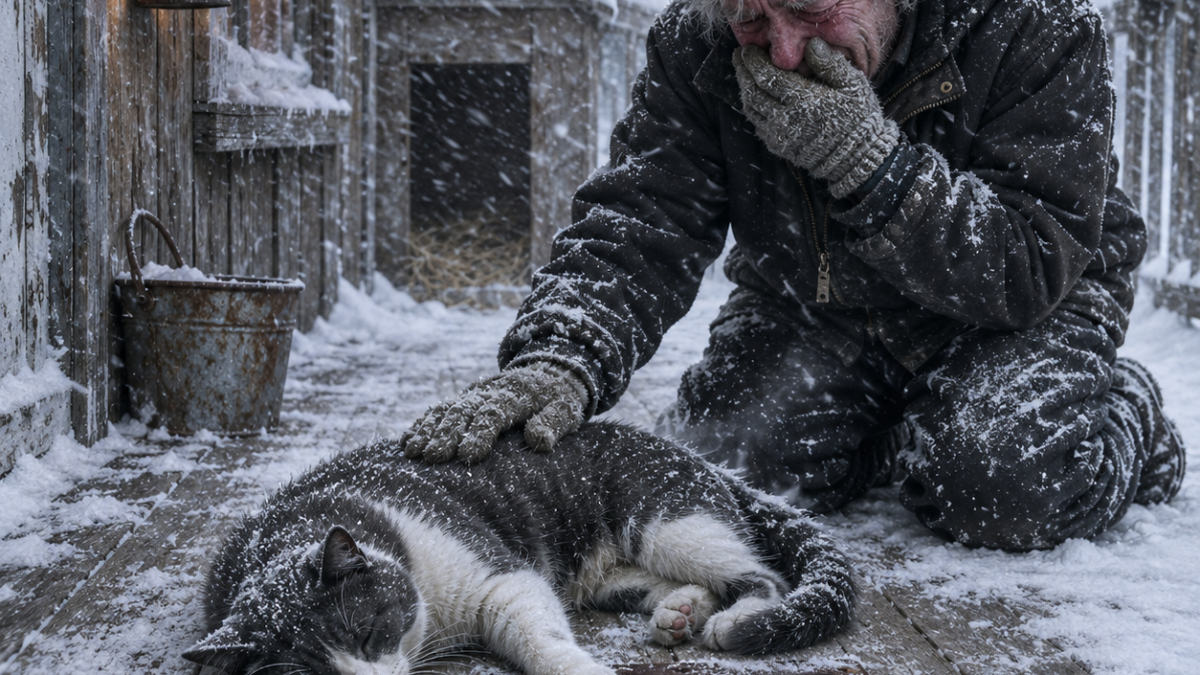
They found Bear exactly where he had been through the night.
On top of the vent.
He was lying flat against the metal grille.
His entire body was stiff.
His paws were frozen in place.
His already crooked tail was curled beneath him.
His eyes were closed.
The fur on his chest and belly had frozen to the steel.
They couldn’t simply pick him up.
They had to separate him carefully from the grille because parts of his coat had adhered to it.
That was when they understood what he had been lying on.
The vent.
One of the men looked through the grate.
Then he followed the duct.
It ran beneath the house.
Toward the bedroom.
Toward my children.
I did not understand any of that yet.
All I knew was that they carried Bear around the house and he wasn’t moving.
The man holding him looked to be in his sixties.
Later I learned he had spent roughly thirty years working around rural rescue operations.
He had seen wrecks.
Exposure.
Storm emergencies.
People pulled out of ditches.
Animals lost in winter.
He knew what death looked like.
And Bear looked dead.
“Is he breathing?” I asked.
The man looked down.
“No.”
The word nearly dropped me.
My five-year-old began crying.
“Bear?”
I grabbed him before he could run toward the cat.
My oldest stood absolutely still.
“He’s dead?”
I could not answer.
The worker didn’t answer either.
He looked down at the frozen old cat in his arms.
Then he did something he later told me he could never fully explain.
He took off his own heavy jacket.
He wrapped Bear inside it.
Then he climbed into the heated truck, pulled the cat against his chest, and turned the heater as high as it would go.
Someone told him there was no point.
He ignored them.
Maybe after thirty years around emergencies, you learn that sometimes the difference between life and death is refusing to make the decision too early.
Maybe he did it because my children were watching.
Maybe he did it because he understood what Bear had done before the rest of us did.
Or maybe, as he later told me, he simply could not leave him frozen on that porch.
Whatever the reason, he held Bear.
One minute passed.
Five.
Ten.
The rest of us were being moved and evaluated.
My youngest needed urgent medical attention.
His body temperature would later be measured at 95.7 degrees Fahrenheit.
He was hypothermic.
But alive.
That word mattered more than every other word anyone said that morning.
Alive.
My three children were alive.
Cold.
Exhausted.
Frightened.
But alive.
Fifteen minutes passed.
The worker holding Bear felt nothing.
Bear remained limp inside the jacket.
His fur was beginning to thaw.
His body was still terribly cold.
Then, nineteen minutes after the man had lifted him from the vent, something happened.
A movement.
So small the worker thought he imagined it.
He looked down.
Bear’s chest moved.
Once.
The man froze.
Then Bear inhaled again.
A weak, shallow breath.
But a breath.
“Hey!”
Someone turned.
“He’s breathing.”
Those words traveled through the people around us like electricity.
“He’s breathing?”
“He took a breath.”
Another.
Then another.
When someone told me, I didn’t believe them.
“What?”
“Your cat’s alive.”
“No.”
“He’s breathing.”
I stared at Bear.
His body still looked lifeless.
But then I saw it.
The smallest rise beneath the jacket.
His chest lifted.
Dropped.
Lifted again.
My eight-year-old began sobbing.
Not crying.
Sobbing.
The kind that shakes your whole body.
“Bear!”
The worker tightened the jacket around him.
“Easy,” he said. “He’s not out of trouble.”
Neither were we.
But for the first time all night, hope entered that house.
My children were taken to the hospital.
Bear was taken for emergency veterinary care.
I felt as though my family had been split in half and sent in two directions.
Every instinct in me wanted to follow my children.
Every other part of me wanted to go with Bear.
I chose my children because I had to.
That choice still hurt.
At the hospital, nurses began warming them slowly.
Warm blankets.
Monitoring.
Fluids.
Questions.
I answered the same things again and again.
When did the power go out?
Around nine.
How long were they exposed?
All night.
Any loss of consciousness?
No.
Vomiting?
No.
Confusion?
Some.
How many emergency calls?
Eleven.
That question made me angry.
Not at the nurse.
Not even at one particular person.
At the night.
At the storm.
At the power outage.
At the fact that I had been sitting inside a freezing house with three children and a phone in my hand, begging an overloaded system to hear me.
Eleven calls.
Eleven times I believed maybe this time someone would answer.
Eleven times no one did.
My youngest was the greatest concern.
At 95.7 degrees, his body temperature was low enough to be classified as hypothermia.
The doctor explained that we were fortunate.
Fortunate.
At first I hated the word.
There had been nothing about that night that felt fortunate.
Then I looked at my son.
He was sleeping under warmed blankets.
His cheeks were slowly regaining color.
A monitor beeped beside him.
His heart was beating.
My other two children were nearby.
They were alive.
I understood what the doctor meant.
We were fortunate.
What I didn’t understand yet was why.
Later that morning, someone from the road crew contacted us.
They told me about the vent.
I thought I misunderstood.
“What vent?”
“The one under your porch.”
“There’s a vent?”
“Yes.”
I had lived in that house and never paid attention to it.
Why would I?
It was beneath the porch.
Part of the old ventilation system.
Nothing I had ever needed to think about.
The worker explained that Bear had been lying directly on it.
“He covered the whole thing.”
I said nothing.
“The duct runs toward the room where the kids were.”
Still nothing.
My brain refused to connect the facts.
Then he said, “He blocked the air.”
I sat down.
The hospital chair felt hard beneath me.
“What?”
“That wind was coming through there. Your cat was covering it.”
I looked at my children.
My two-year-old’s hand was visible outside the blanket.
Tiny fingers.
Alive fingers.
I thought of Bear.
Seventeen pounds.
Fourteen years old.
Crooked tail.
Scarred ears.
Lying on steel.
“No,” I whispered.
The worker misunderstood me.
“We checked it.”
“No, I mean…”
I couldn’t finish.
I pressed my hand over my mouth.
The tears came without warning.
My oldest saw me.
“What happened?”
I tried to answer.
Nothing came out.
She sat up.
“Mom?”
I went to her bed.
I held her.
Then I told her.
“Bear was covering something outside.”
“What?”
“A vent.”
She stared at me.
“The cold was coming underneath the room.”
She looked toward her brothers.
“And Bear stopped it?”
There are moments when a child understands something before an adult is ready to say it aloud.
I nodded.
She started crying again.
“He knew?”
That question became the question everyone asked.
Did he know?
I can’t prove what was happening inside an animal’s mind.
No one can.
But I had known Bear for fourteen years.
And I knew this much.
He knew that porch.
He knew the house.
He knew my children.
And when something changed that night, he left the safest place available to him and lay directly over the place where the freezing air was entering.
He did not lie there for ten minutes.
He stayed long enough to freeze to the metal.
The veterinarian estimated six to eight hours.
You can call that instinct.
You can call it coincidence.
You can call it whatever makes sense to you.
I know what I call it.
He knew.
The call from the veterinary clinic came later.
A woman asked if I was Bear’s owner.
“Yes.”
“I’m the veterinarian treating him.”
I gripped the phone.
“Is he alive?”
“He is.”
Just those two words nearly broke me.
“But he’s extremely critical.”
I closed my eyes.
“How bad?”
“His temperature when he arrived was 87.3 degrees Fahrenheit.”
I didn’t understand immediately.
“What should it be?”
“A healthy cat is usually around 100 to 102.5.”
My stomach turned.
She explained that anything below 89.6 was a life-threatening emergency.
Below roughly 85 degrees, survival becomes extremely unlikely.
Bear had arrived at 87.3.
And he was fourteen years old.
His body had already lived through more hard winters than many outdoor cats ever see.
The veterinarian told me they were warming him carefully.
Too quickly could create other problems.
They were monitoring his heart.
His circulation.
His breathing.
His organs.
“What are his chances?”
There was a pause.
“I don’t want to give you false hope.”
I stared through the hospital window.
Snow whipped across the parking lot.
“Please.”
“He survived long enough to get here. That matters.”
It wasn’t an answer.
But it was enough.
She added, “I’ve treated hypothermia before. I’ve never seen a cat his age come in this cold and still be alive.”
I cried after we hung up.
Quietly.
My five-year-old noticed.
“Bear?”
“He’s alive.”
“Is he coming home?”
“I don’t know.”
He looked down.
Then he asked, “Can we give him my blanket?”
I smiled through tears.
“He has lots of blankets.”
“My blue one is warmer.”
That nearly destroyed me.
“Okay,” I said. “When he comes home, you can give him the blue one.”
When.
Not if.
I needed that word now.
The children remained in the hospital.
Gradually, their temperatures stabilized.
Their color returned.
My youngest started asking for juice.
That was the first moment I truly believed he would be all right.
He was holding the cup with both hands when he asked, “Where Bear?”
“At the animal hospital.”
“Cold?”
“He was very cold.”
He frowned.
“Give him blanket.”
“We will.”
The children were able to return home within forty-eight hours.
None of them suffered permanent damage from the hypothermia.
That sentence still feels impossible.
No permanent damage.
Three children in an unheated house through one of the coldest nights our region had seen.
A two-year-old whose temperature had fallen to 95.7 degrees.
No permanent damage.
But Bear did not leave his night behind so easily.
Over the next three days, the tips of both ears began turning black.
The tissue had died.
There was no circulation left.
They had to be surgically removed.
Two toes on his front left paw were lost.
Another toe on his right rear paw had to be removed.
His tail—the same tail already permanently crooked from an old frostbite injury—was damaged beyond repair from the midpoint down.
There was no blood flow.
Half of it had to be amputated.
Then there was his chest.
The fur on his chest and belly had frozen directly to the metal vent.
When he was removed, the damage beneath the coat became visible.
The skin never healed normally.
A thick, pink, hairless rectangle remained across his chest.
The pattern matched the vent.
You could see the lines.
The grid.
The exact place where the steel had pressed into him while he lay there.
I hated that scar.
And I loved it.
I hated what it represented.
I loved what it had protected.
The first time I was allowed to see Bear after he stabilized, I almost didn’t recognize him.
His head was bandaged.
One paw was wrapped.
His tail had been shaved and treated.
He looked smaller.
That surprised me.
Bear had always seemed enormous.
He was the kind of cat who filled a porch chair when he climbed onto it.
The kind people noticed immediately.
But in the veterinary cage, beneath blankets and medical equipment, he looked old.
Terribly old.
I stood outside for a moment because I was afraid touching him would hurt.
The veterinarian opened the cage.
“You can talk to him.”
I crouched.
“Hey, Bear.”
Nothing.
My throat tightened.
“It’s me.”
One ear twitched beneath the bandage.
I put my hand near his face.
He smelled it.
Then his eyes opened.
Only halfway.
But they opened.
“Hi, old man.”
His head moved perhaps an inch.
He pressed the side of his face weakly into my fingers.
That was all.
I lost control.
I started crying so hard I had to lower my head.
“I’m sorry.”
Bear’s eyes closed.
“I’m so sorry.”
The veterinarian stood nearby.
“You don’t need to apologize to him.”
“Yes, I do.”
“For what?”
“I should have brought him inside.”
“You had three children in a freezing house.”
“I should have checked.”
“You couldn’t know.”
“I should have known about the vent.”
“You didn’t.”
I shook my head.
None of those reasonable answers mattered to guilt.
Guilt is not reasonable.
It builds a world in which you knew everything before it happened.
In that world, I knew the vent existed.
I knew the power would fail.
I knew the emergency line would be overwhelmed.
I knew exactly how cold the bedroom would become.
I knew Bear would leave his shelter.
In the real world, I knew none of it.
But standing beside his cage, seeing what the night had done to his body, I wanted desperately to invent some way that it could have been my fault.
Because if it was my fault, then maybe I could believe I had control.
The truth was more frightening.
Sometimes terrible things happen faster than anyone can control.
And sometimes the one who saves you is the last one you expected to need saving from afterward.
The veterinarian showed me the injury on his chest.
Even cleaned, it was painful to see.
I recognized the shape instantly.
The vent.
A rectangle.
Straight lines crossing.
A permanent map of where he had been.
“How long would he have had to stay on it for this to happen?”
She looked at me carefully.
“We can’t know exactly.”
“The worker said maybe six to eight hours.”
“That would be consistent with what we’re seeing.”
Six to eight hours.
I touched Bear’s paw.
He had always hated anyone touching his feet.
That day, he didn’t pull away.
“Why didn’t he move?”
The veterinarian didn’t try to answer something no one could know.
But after a moment she said, “Animals sometimes do extraordinary things.”
I laughed once, though nothing was funny.
“He was always stubborn.”
She smiled.
“That may have helped.”
It probably did.
Bear had survived thirteen winters because he was stubborn.
He had survived his first frostbite injury because he was stubborn.
He survived nineteen minutes without an obvious breath because some part of that old body had still refused to quit.
The man from the road crew visited the clinic later.
I recognized him immediately.
He looked embarrassed when I hugged him.
“You saved him.”
He shook his head.
“I just warmed him up.”
“You held a cat you thought was dead for nineteen minutes.”
He looked through the cage door at Bear.
“I didn’t know what else to do.”
“You could’ve left him.”
“I know.”
“Why didn’t you?”
He was quiet for a moment.
Then he shrugged.
“I’ve been doing this a long time.”
“How long?”
“About thirty years.”
“And?”
“I’ve seen enough things left in the cold.”
He looked down.
“Didn’t feel right leaving him there.”
That sentence has stayed with me almost as much as anything else from that night.
Didn’t feel right leaving him there.
Bear survived because one living creature refused to leave another living creature in the cold.
Maybe that was the whole story.
Bear refused to leave my children exposed to the cold.
The worker refused to leave Bear there.
The neighbor refused to assume somebody else would find us.
One choice connected to another.
None of them looked enormous in the moment.
A neighbor stopping a truck.
An older man wrapping a cat in his jacket.
A seventeen-pound animal lying down over a vent.
But sometimes survival is built from small decisions made by someone who could have walked away and didn’t.
Bear stayed at the clinic for days.
When he finally came home, he came home different.
The children had been waiting by the window.
My five-year-old really did bring the blue blanket.
He had folded it himself.
Badly.
One side hung almost to the floor.
He carried it to Bear’s bed and spread it over the cushion.
When I brought Bear inside, all three children rushed toward him.
“Slow,” I warned.
They stopped.
That was difficult for them.
Bear looked strange without the tips of his ears.
His head seemed rounder.
His shortened tail looked wrong.
His bandaged paws made him step carefully.
But he was Bear.
My youngest pointed.
“Bear hurt?”
“Yes.”
“Cold hurt him?”
I swallowed.
“Yes.”
He touched the blue blanket.
“Bear sleep here.”
Bear looked toward the back door.
For fourteen years, that door had meant his porch.
His territory.
His place.
I thought he might ask to go out.
He didn’t.
He lowered himself onto the blue blanket.
My five-year-old sat beside him.
Very gently, he placed one hand on Bear’s back.
“Warm now.”
I walked into the kitchen because I knew if I stayed there, the children would watch me cry.
For the first time since the storm, those tears weren’t only fear.
They were grief.
Relief.
Guilt.
Gratitude.
All of it together.
Bear recovered slowly.
The word “recovered” needs explaining.
He survived.
That does not mean he returned to the cat he had been before the storm.
He never fully regained strength in his hind legs.
His steps became deliberate.
Careful.
Sometimes his rear paw dragged slightly before he corrected it.
He developed a limp.
There were mornings when standing seemed difficult.
He would push himself up with his front legs, pause, then straighten his back end.
I would watch him and feel the same pain every time.
The children didn’t see weakness the way I did.
They saw Bear.
My two-year-old didn’t care that his ears were shorter.
My five-year-old didn’t care that his tail was half gone.
My eight-year-old understood more.
One afternoon, she sat beside him and traced the air above the rectangular scar on his chest without touching it.
“Is that from the vent?”
“Yes.”
“Will the fur grow back?”
“The vet doesn’t think so.”
She stared at the pink skin.
“Good.”
I looked at her.
“Good?”
“So we can remember.”
I almost told her we would never need a scar to remember.
Then I realized she meant something different.
To her, the scar wasn’t ugly.
It was proof.
Proof that something had happened in the darkness while we were trapped inside.
Proof that Bear had been there.
Proof that he had stayed.
The story reached a local journalist.
At first, I didn’t want to talk about it.
I was exhausted.
The children were still waking at night.
If the house made a strange sound, my oldest asked whether the power was going out.
My five-year-old became nervous whenever the weather forecast mentioned snow.
For weeks, my two-year-old wanted to sleep with extra blankets even when the room was warm.
And Bear needed care every day.
I did not feel like the person at the center of an uplifting story.
I felt tired.
I felt guilty.
I felt angry.
But eventually I agreed to speak.
The reporter asked about the storm.
The calls.
The rescue.
Bear’s injuries.
Then she asked the question.
“Do you believe he understood what he was doing?”
I looked at Bear.
He was sleeping nearby.
His shortened tail curled close to his body.
The missing tips of his ears had healed.
His chest scar was visible when he shifted.
I thought about fourteen years.
Fourteen years of that porch.
Fourteen years of hearing the furnace.
Fourteen years of feeling warm air move through that vent.
Fourteen years of watching our family from the same boards.
Fourteen years of knowing every sound that house made.
I said, “He knew.”
The reporter waited.
I continued.
“He lived on that porch for fourteen years. He knew where the cold was coming from.”
My voice broke.
“So he just went and stopped it.”
That became the sentence people remembered.
But there is something I wish I had added.
Bear didn’t know what the temperature was.
He didn’t know the wind chill.
He didn’t understand emergency phone systems or electrical grids or hypothermia.
He did not know there would be a veterinarian waiting.
He did not know someone would hold him inside a heated truck.
He did not know he would breathe again.
He simply knew something was wrong.
And he put himself between it and us.
That was Bear.
People sometimes imagine heroic acts as something dramatic.
A moment of decision.
A leap.
A charge.
A rescue.
Bear’s heroism was quieter.
He lay down.
And then he did not get up.
The hard part was not making the decision once.
The hard part was making it again every second.
When the metal began hurting.
Stay.
When his paws started losing feeling.
Stay.
When the wind lifted his fur.
Stay.
When his ears began freezing.
Stay.
When his body told him to move.
Stay.
When the shelter filled with straw sat only a short distance away.
Stay.
Hour after hour.
Stay.
The winter eventually loosened its grip.
Snow melted from the edges of the porch.
Water dripped from the roof.
The roads cleared.
Electricity became something I stopped thinking about every second.
Life resumed because life always does.
School.
Meals.
Laundry.
Bills.
Appointments.
The children argued again about toys and television.
That ordinary noise became precious to me.
I had spent one night listening to them grow quieter and quieter.
Afterward, every ridiculous argument felt like evidence that they were alive.
Bear spent more time indoors.
I did not force him.
I didn’t have to.
Sometimes he still sat by the back door, and on mild days I let him onto the porch.
He would walk slowly across the boards.
He always paused near the vent.
The first time he did it, my chest tightened.
I watched through the window.
Bear sniffed the metal.
Then he sat beside it.
Not on it.
Beside it.
For several minutes, he stared into the yard.
I wondered what animals remember.
Did he remember the pain?
Did he remember the wind?
Did he remember why he had lain there?
Did he understand what his body had paid?
I will never know.
Then he stood carefully, limped back to the door, and looked at me.
I opened it.
“Come on, old man.”
He walked inside.
Spring arrived.
Bear seemed stable for a while.
Not healthy in the way he had been before.
But stable.
We adjusted.
I placed food where he didn’t need to walk far.
I put softer bedding in the warmest part of the house.
The kids learned not to pick him up.
My oldest became the one who reminded everyone.
“Be careful with his back legs.”
My five-year-old still gave Bear the blue blanket every night.
Sometimes Bear ignored it and slept somewhere else.
My son would carry it after him.
“Bear, your blanket.”
Bear would look annoyed.
It made me laugh.
That familiar irritation was comforting.
He might have lost part of his ears, part of his tail and three toes, but he had not lost his personality.
Then summer came.
And something started changing.
At first, it was small.
Bear drank more water.
He slept more.
He ate less.
I blamed his age.
He was nearly fifteen.
After everything his body had survived, slowing down seemed normal.
Then he began losing weight.
I could feel his spine when I touched him.
I took him back to the veterinarian.
She ran tests.
I sat in the same clinic where months earlier I had first seen him after the storm.
The room smelled the same.
I hated that.
Some places hold memories inside their walls.
When the veterinarian came back, I could tell from her expression that the news wasn’t good.
“His kidneys are declining.”
I looked at Bear.
He sat on the examination table with his paws tucked beneath him.
“How bad?”
She explained the numbers.
I listened.
I understood almost none of them.
There are moments when language becomes noise because you are waiting for one answer.
“Is this from the hypothermia?”
She was careful.
She said severe hypothermia could place enormous stress on the organs.
His age mattered too.
There was no simple way to separate one cause from another.
But in her opinion, his body had never completely recovered from what it had endured.
I looked at him.
Seven months earlier, that body had been pressed against a frozen vent while my children slept above him.
“What do we do?”
“We keep him comfortable.”
I knew what that meant.
I hated her for saying it.
Not really.
But grief needs somewhere to go.
“What about treatment?”
“We can support him.”
“For how long?”
She didn’t answer immediately.
That was answer enough.
I took Bear home.
I did not tell the children everything at once.
How do you explain to an eight-year-old that the animal who may have saved her life is dying because his body was damaged doing it?
How do you explain that survival sometimes comes with a bill that arrives months later?
I told them Bear was sick.
My oldest understood before I finished.
“Is he going to die?”
My five-year-old looked at me.
The room became painfully quiet.
I wanted to lie.
I had lied the night of the storm.
The heat is coming back soon.
Help is coming soon.
Everything is okay.
Those lies had been necessary.
This one wouldn’t be.
“Yes,” I said.
My five-year-old began shaking his head.
“No.”
I pulled him close.
“No, Mom.”
“I know.”
“No. Bear already got better.”
“I know.”
“He came home.”
“I know.”
“So he’s better.”
I held him tighter.
My oldest was crying silently.
The youngest climbed onto the couch beside Bear and placed one hand on his back.
“Bear stay.”
That was the worst.
Bear stay.
We all wanted the same thing.
September came.
Bear turned fifteen.
By then, he barely went onto the porch.
He slept most of the day.
His appetite faded.
His walk became slower.
Some days his back legs seemed to forget what they were supposed to do.
Still, if one of the children sat near him, he tried to move closer.
That part never changed.
One evening my oldest lay on the floor beside him.
“Do you think he knows he saved us?”
I was washing dishes.
I stopped.
“I don’t know.”
“We should tell him.”
She moved closer to Bear’s face.
“Bear?”
His eyes opened.
“Thank you.”
His eyes slowly closed again.
My daughter looked at me.
“Now he knows.”
I turned back to the sink so she wouldn’t see me cry.
The day came sooner than I wanted.
It always does.
Bear stopped eating almost completely.
He drank very little.
When he tried to stand, his legs trembled.
I called the veterinarian.
She came to the phone herself.
I told her what was happening.
She was quiet.
Then she said, “I think it may be time.”
There are sentences you understand before the final word.
I sat on the kitchen floor after the call.
Bear was lying a few feet away.
The same cat who had once filled the porch with his presence now seemed impossibly small.
I crawled over to him.
He opened his eyes.
“Hey, old man.”
His head moved.
I put my hand beneath his chin.
“You really made this difficult, you know that?”
His eyes remained on me.
“You were supposed to just be the grumpy porch cat.”
He breathed slowly.
“You weren’t supposed to make everybody love you this much.”
I laughed and cried at the same time.
Then I said something I had needed to say since February.
“You can stop now.”
My voice broke.
“We’re okay.”
Bear blinked.
“The kids are okay.”
I pressed my forehead gently against his.
“You did it.”
For months, some part of me had wondered whether he had kept fighting because that was simply who he was.
Maybe I needed him to know he no longer had to.
“We’re warm,” I whispered. “We’re safe. You can rest.”
Bear died in September 2023.
Seven months after the night he lay across that vent.
He was fifteen years old.
There was no dramatic final moment.
No last heroic act.
He had already given us that.
His ending was quiet.
And I think that was fair.
After everything, he deserved quiet.
The children helped me choose where to bury him.
There was only one place that made sense.
Behind the porch.
Beside the vent.
The same patch of ground where the story had nearly ended for all of us.
I stood there with my three children.
They were wearing jackets even though the day was not particularly cold.
Maybe that was habit now.
Maybe it always would be.
My five-year-old carried Bear’s blue blanket.
He wanted to bury it too.
At first I almost said no.
Then I realized it belonged with him.
We wrapped part of it around Bear.
My oldest touched the place where his ear used to have a full tip.
“Bye, Bear.”
My youngest didn’t fully understand death.
He asked, “Bear sleeping?”
I knelt beside him.
“Yes.”
“Outside?”
“Yes.”
He looked toward the porch.
“Bear likes outside.”
I smiled through tears.
“Yes, he does.”
We buried him there.
Close enough to the house that I could see the place from the kitchen window.
Close enough to the porch that, in my mind, he was still where he had always been.
Watching.
Waiting.
Guarding his family.
For a long time afterward, I couldn’t look at the vent without seeing him.
The steel had been repaired and insulated properly after the storm.
It no longer poured freezing air beneath the floor.
It was just a vent.
Metal.
Screws.
Nothing remarkable.
But I knew what had happened there.
Sometimes people ask whether I think Bear truly saved the children.
I answer carefully.
No one can tell me exactly what would have happened if he had stayed in his shelter.
No one can rerun that night.
No one can know how much lower the bedroom temperature might have fallen, or how much colder my youngest child might have become.
But I know this.
The vent was allowing freezing wind into the ductwork beneath the room.
Bear covered it completely.
His thick winter coat formed insulation over the opening.
His body blocked the airflow.
He remained there for hours.
My children survived.
That is enough for me.
I also know something else.
Bear didn’t survive unharmed.
The cold took the tips of his ears.
It took three toes.
It took half his tail.
It scarred his chest permanently.
It weakened his back legs.
And months later, his failing kidneys finally took what remained of his strength.
Sometimes I become angry when I think about that.
It feels unfair.
He won the night and still paid for it.
But then I look at my children.
My youngest is older now.
He runs.
He laughs.
He complains when his brother takes his toys.
My five-year-old grew out of the blue blanket phase, though for months he refused to let anyone replace it.
My oldest still remembers more than I wish she did.
They all grew.
That is what Bear purchased with those hours.
Time.
Not some abstract kind of time.
Real time.
Birthdays.
School mornings.
Lost teeth.
Arguments.
Christmases.
Scraped knees.
Bedtime stories.
Everything that would not exist if a freezing night had ended differently.
People sometimes call Bear a hero.
I understand why.
But the word almost feels too polished for him.
Bear was not polished.
He had torn ears even before that storm.
A crooked tail.
Mud on his paws.
A temper when dinner was late.
He stole food if you left it unattended.
He once scratched a new porch post so badly I considered replacing it.
He ignored expensive cat beds and slept in cardboard boxes.
He did not look like the kind of animal anyone would put on a monument.
He looked like an old farm cat who had spent fourteen years outdoors.
That is exactly what made what he did so extraordinary.
He had already survived enough.
He had nothing left to prove.
No one would have blamed him for staying inside his shelter.
No one would even have known.
But something pulled him into that wind.
Something made him find that vent.
Something made him lie down.
And something made him stay.
If you want to call that instinct, call it instinct.
If you want to call it loyalty, call it loyalty.
If you want to call it love, I won’t argue with you.
I know what I saw afterward.
A rectangular scar on an old cat’s chest.
A pattern matching the metal grille beneath my children’s room.
I know where they found him.
I know how cold he was.
I know that it took nineteen minutes of warmth before he breathed again.
And I know three children walked out of the hospital within forty-eight hours without permanent injury.
That is enough.
For months after Bear died, winter frightened me.
When the first cold weather returned, I checked every window.
Every door.
Every vent.
I bought emergency supplies.
Extra blankets.
Backup power.
Anything that made me feel less helpless.
But the first truly freezing night was still difficult.
The wind began around sunset.
It struck the porch in the same direction it had that February.
I stood in the kitchen listening.
My chest tightened.
Then my youngest came running through the room.
My five-year-old chased him.
My oldest shouted at both of them to stop.
The house was warm.
Loud.
Alive.
I looked out the back window.
Snow was collecting along the porch.
Beyond it was Bear’s grave.
For a moment I saw that old orange-and-white shape in my memory.
Seventeen pounds of fur stretched across a metal vent.
Wind screaming around him.
His old paws slowly freezing.
His scarred ears pressed flat.
His crooked tail tucked beneath him.
Staying.
Always staying.
I opened the back door just long enough to step onto the porch.
The cold hit my face.
Nothing like that night.
Not even close.
Still, I could feel how quickly the warmth left my skin.
I looked down at the vent.
Then at the place where we had buried him.
“You stubborn old man,” I whispered.
The wind carried the words away.
I thought about revenge then.
Not the kind people usually mean.
There was no villain to punish.
No person to destroy.
No enemy Bear could chase down.
The enemy that night was the cold itself.
It had come through the walls.
Through the floor.
Through the darkness.
It had tried to take everything I had.
And an old cat stood in its way.
Maybe that was Bear’s revenge.
The winter took pieces of him.
But it did not get my children.
It tried for eight hours.
And Bear told it no.
Not with teeth.
Not with claws.
Not with noise.
With his body.
With his warmth.
With every remaining heartbeat he had.
The cold left him without the tips of his ears.
He still came home.
It took his toes.
He still walked.
It took half his tail.
He still sat beside my children.
It damaged his legs.
He still followed them through the house.
It scarred his chest.
He carried the scar.
And when his body finally failed seven months later, the three lives he had protected were still moving forward.
That is the ending I choose to remember.
Not Bear frozen to the vent.
Not Bear on a veterinary table.
Not Bear losing pieces of himself one surgery at a time.
I remember my children on the floor beside him after he came home.
My five-year-old covering him with that ridiculous blue blanket.
My youngest whispering, “Warm now.”
My oldest looking at his scar and understanding what it meant.
And Bear closing his eyes among them.
Safe.
Warm.
Home.
People say animals don’t understand sacrifice the way people do.
Maybe they’re right.
Maybe Bear never thought, I will suffer so they don’t have to.
Maybe he never understood mortality.
Maybe there was no grand decision inside his head.
Maybe all he knew was that cold air was entering the place where his family slept.
And he knew how to stop it.
Sometimes love does not need to understand everything.
Sometimes it simply moves toward the problem.
That is what Bear did.
Fourteen years on that porch had taught him where every sound came from.
Where every draft moved.
Where his family slept.
And when the night turned deadly, that old cat used everything those fourteen years had taught him.
He found the cold.
Then he lay down on top of it.
Thirty-one degrees below zero.
A wind chill near fifty-one below.
Nearly thirty-five-mile-per-hour winds.
Six to eight hours on frozen metal.
Seventeen pounds.
Fourteen years old.
Already scarred by thirteen hard winters.
And somehow, when the sun came up, Bear was still there.
My children were still breathing.
Nineteen minutes later, so was he.
He gave us seven more months after that.
Seven months to feed him.
Seven months to hold him.
Seven months for my children to thank him without fully understanding what they were thanking him for.
Seven months for me to stop seeing him only as the animal I had almost lost and start seeing him again as Bear.
Grumpy.
Stubborn.
Scarred.
Beloved.
When we buried him beside the vent, I thought I was choosing that place because it was where he had saved us.
Over time, I realized there was another reason.
That vent marked the boundary between two things.
On one side was the cold.
On the other side were my children.
And for one terrible night, Bear placed himself directly between them.
That was where he belonged.
Not because that was where he suffered.
Because that was where he chose us.
So when people ask me what I remember most about February 2023, I don’t remember the power going out first.
I don’t remember the frozen windows.
I don’t remember eleven unanswered calls.
I don’t even remember the fear as clearly as I once did.
I remember an old orange-and-white cat.
I remember the rectangle on his chest.
I remember being told where they had found him.
And I remember looking at my three children and finally understanding why they were still there.
Bear had lived on our porch for fourteen years.
He knew exactly where the cold was coming from.
So when it came for my children, he did the only thing he could.
He went outside.
He found the opening.
And he stopped it.
Even when stopping it meant giving everything he had left.








