PART 2: They Found Him Starving in a Garbage Dump—Six Months Later, Phoenix Made Everyone Who Thr3w Him Away Look Wrong
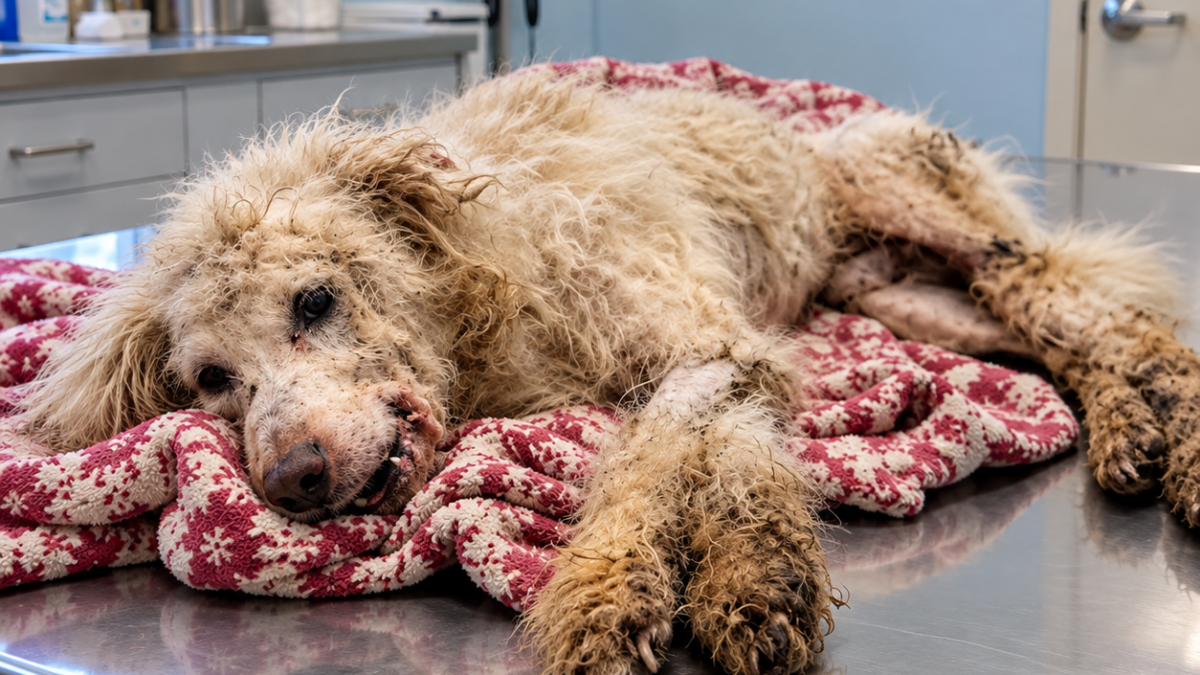
The little dog was standing knee-deep in garbage when I first saw him, searching through plastic bags for something—anything—he could eat.
His back legs shook every time he took a step, but he kept moving because hunger was stronger than the pain.
I thought the hardest part would be getting him out of that dump, but before the day was over, we discovered something that made me promise I would find out how he ended up there.
The smell hit me before I saw him.
Rotting food.
Wet cardboard.
Burned plastic.
Trash stretched across the ground in uneven mountains, scattered by wind and stray animals.
I had come with two volunteers after a sanitation worker reported seeing a badly injured dog wandering through the dump for several days.
At first, I couldn’t find him.
Then something moved beside a torn black garbage bag.
A small brown dog lifted his head.
My chest tightened.
He looked ancient.
His spine rose sharply beneath his thin coat. His hips looked like they might push through his skin. Patches of fur were missing, and angry sores covered his sides and legs.
Ticks clung everywhere.
But it was his eyes that stopped me.
They weren’t wild.
They weren’t aggressive.
They were tired.
“Hey, buddy,” I said softly.
He stared at me.
I crouched.
My friend Lena whispered behind me, “Oh my God.”
The dog tried to take one step toward us.
His hind legs buckled.
He almost collapsed.
I instinctively moved forward.
He flinched.
So I stopped.
“All right,” I said. “You set the rules.”
I placed a bowl of water on the ground and backed away.
For several seconds he didn’t move.
Then his nose lifted.
One trembling step.
Another.
He reached the bowl and drank.
Not fast.
He didn’t have the strength.
He lowered his mouth to the water and took several slow laps, then stopped to breathe.
Lena turned away and wiped her face.
I understood.
There are rescue cases where you feel anger immediately.
This one was different.
Looking at him, I mostly felt shame that a living animal could become this broken while people went on with ordinary life around him.
We offered food next.
He sniffed it.
Then looked at us as though he expected it to disappear.
“It’s yours,” I whispered.
He took one bite.
Chewed.
Then another.
Soon he was eating steadily.
No dog should ever be so hungry that a simple bowl of food feels like something sacred.
When I moved closer, I could finally see how bad his condition was.
His nails were overgrown.
The pads of his feet were cracked.
Several wounds were raw.
His gums were nearly white.
When I gently touched his side, I felt ribs beneath almost nothing.
“How old do you think?” Lena asked.
“Ten? Maybe older.”
The veterinarian would later estimate he was closer to six.
Neglect had added years to his face.
We wrapped him in a blanket and lifted him carefully.
He didn’t fight.
That worried me almost more than if he had.
He simply rested his head against my arm as though he had no energy left to object.
On the drive to the clinic, I kept one hand beneath the blanket.
Every few minutes, I checked that his chest was still rising.
Lena looked back from the passenger seat.
“What are we calling him?”
I stared down at the little dog.
His body looked ruined.
But he had survived.
Days in the dump.
Hunger.
Ticks.
Pain.
Whatever came before all of it.
“Phoenix,” I said.
Lena turned around.
“Phoenix?”
“If he gets through this, he deserves a name that means something.”
At the clinic, Dr. Alvarez examined him immediately.
His expression became more serious with every minute.
“Severe malnutrition.”
He listened to Phoenix’s heart.
“Significant anemia.”
He moved one of Phoenix’s hind legs.
Phoenix whimpered.
“Muscle wasting. Weak hips. Possibly long-term calcium deficiency.”
Then came the bloodwork.
We waited nearly an hour.
When Dr. Alvarez returned, he held the results in one hand.
“His calcium is dangerously low.”
My stomach dropped.
“And the ticks?”
“We’re testing for ehrlichiosis and other tick-borne disease.”
“Can he make it?”
Dr. Alvarez looked through the glass toward Phoenix.
“I’m not going to lie to you. He’s in very bad shape.”
I swallowed.
Then he added, “But he’s eating. And that matters.”
A technician entered carrying another sheet.
Dr. Alvarez read it.
For the first time, his expression softened.
“Ehrlichiosis is negative.”
Lena exhaled.
It was one small piece of good news.
We took it.
Then my phone rang.
It was the sanitation worker who had first reported Phoenix.
His voice was tense.
“You asked me to call if I remembered anything.”
“Yes.”
“I do.”
I stepped into the hallway.
“What?”
“There’s a camera pointed toward the dump entrance.”
My grip tightened around the phone.
“And?”
He paused.
“I think we may have footage of the person who left your dog there.”
PART 2
For a second, I forgot where I was.
The sounds of the veterinary clinic faded behind me.
“What did you say?”
“There’s an old security camera over the maintenance shed,” the sanitation worker repeated. “It covers part of the entrance road. We use it because people illegally dump construction trash at night.”
“Does it record?”
“Yes.”
“How long do you keep the footage?”
“Usually thirty days.”
My heart started pounding.
“When did you first see the dog?”
“Three days ago.”
“Don’t delete anything.”
“I won’t.”
“What’s your name?”
“Marcus.”
“Marcus, please make a copy before anybody touches that system.”
“I already called my supervisor.”
I looked through the treatment-room window.
Phoenix lay beneath a warming blanket while a technician carefully removed ticks one by one.
He had no idea that a camera might have captured the moment his life was discarded.
“Can I come see it?”
“Tomorrow morning.”
“I’ll be there.”
When I hung up, Lena was waiting.
“What happened?”
“There may be video.”
Her expression changed.
“Of Phoenix?”
“Of whoever dumped him.”
She glanced toward the treatment room.
“You think someone actually drove him there and left him?”
I didn’t answer.
Because I already knew what I thought.
Dogs in Phoenix’s condition don’t simply decide to move into garbage dumps.
His rear legs could barely carry him across a room.
The dump was several miles from the nearest residential area.
He hadn’t walked there.
Someone had brought him.
Dr. Alvarez stepped into the hallway.
“Come with me.”
The anger disappeared for a moment.
Phoenix mattered first.
Everything else could wait.
We followed him into a consultation room.
He placed Phoenix’s blood results on the table.
“I want to explain exactly what we’re dealing with.”
I sat.
Lena remained standing.
Dr. Alvarez pointed to several values.
“His red blood cell count is dangerously low. That’s the anemia. There are multiple possible causes, but with this degree of malnutrition, parasite burden, and overall neglect, they’re likely contributing heavily.”
“Blood transfusion?” I asked.
“Possibly, if he declines. Right now, he’s stable enough that I want to support him and monitor closely.”
“And the calcium?”
“Also concerning. His bones and muscles have not been getting what they need for a long time.”
“Can his legs recover?”
Dr. Alvarez hesitated.
“I don’t know.”
I hated those words.
“Could he walk normally again?”
“If there is no irreversible neurological damage, maybe. But it will take months. Nutrition. Supplements. Controlled exercise. Rehabilitation.”
“He’s only six?”
“That’s my best estimate.”
I looked through the window again.
Six.
He looked like an exhausted old dog.
“What about the wounds?”
“Mostly pressure sores, abrasions, skin infection, and damage from parasites. They’re treatable.”
“So the biggest problem is weakness?”
“The biggest problem is everything happening at once.”
I nodded.
Dr. Alvarez softened his voice.
“But he has something going for him.”
“What?”
“He ate.”
That sounded too small.
Then I remembered the dump.
Phoenix standing among the garbage.
The careful first bite.
The way he continued eating even when his body shook.
Dr. Alvarez continued.
“Animals that have completely given up sometimes refuse food. Phoenix hasn’t.”
I looked at him.
“You like the name?”
He smiled.
“I think he may earn it.”
That first night, Phoenix stayed at the clinic.
I went home with his smell still on my clothes.
Trash.
Infection.
Dog shampoo.
Clinic disinfectant.
I should have showered immediately.
Instead, I sat at my kitchen table and watched the thirty-second video Lena had taken of Phoenix eating at the dump.
I watched it once.
Then again.
Then again.
Every time, I noticed something new.
How carefully he placed his back feet.
How his left hind leg trembled more than the right.
How he glanced around between bites.
How his ears lifted whenever a car passed in the distance.
Waiting, perhaps.
For what?
Someone returning?
Someone who never did?
At midnight, I finally closed my phone.
I barely slept.
At 7:15 the next morning, Marcus met us at the sanitation office.
He was a tall man in his fifties wearing steel-toed boots and an orange safety vest.
“You’re the rescue people?”
“That’s us.”
He shook my hand.
“I’m glad you got him.”
“So am I.”
“He alive?”
“Yes.”
Marcus nodded slowly.
“Good.”
Then his face hardened.
“You should see this.”
He took us into a cramped office behind the maintenance shed.
A computer sat beneath a wall covered in route maps and inspection forms.
Marcus pulled up a video file.
The footage was black-and-white and grainy.
A timestamp appeared at the bottom.
2:13 a.m.
The dump entrance was empty.
Then headlights appeared.
An older light-colored pickup truck entered the frame.
My stomach tightened.
The truck stopped near the side access road.
A man got out.
The camera was too far away to show his face clearly.
He walked around to the passenger side.
Opened the door.
Then waited.
Nothing happened.
He leaned inside.
A few seconds later, he pulled something out.
Not carried gently.
Dragged.
A small dog.
Phoenix.
Even in the grainy footage, I recognized the narrow body and the way his back legs failed beneath him.
“Oh God,” Lena whispered.
The man set Phoenix on the ground.
Phoenix collapsed.
The man returned to the truck.
Phoenix tried to follow.
He made it only a few feet.
The truck door closed.
The engine started.
Phoenix dragged himself toward it.
The pickup drove away.
Phoenix stopped in the middle of the road.
For several seconds, he simply stood there.
Then he turned toward the garbage piles.
The video continued.
Nobody spoke.
I felt something cold settle in my chest.
Not the explosive anger people expect.
Something heavier.
More focused.
“Can we identify the truck?”
Marcus zoomed the footage.
The license plate was partially visible.
Three characters were clear.
Maybe four.
“It’s not enough,” Lena said.
Marcus clicked another file.
“Camera at the fuel shed caught it coming in from a different angle.”
A second image appeared.
This one was slightly clearer.
Enough to see the rear plate.
Not perfectly.
But enough.
I wrote it down.
“Did you call animal control?”
“My supervisor did.”
“Police?”
“They said animal control would coordinate.”
I nodded.
“Can we have copies?”
“I’ve already saved them.”
Marcus handed me a flash drive.
I didn’t touch it immediately.
I stared at the frozen image.
Phoenix was barely visible in the background.
The truck was leaving.
The dog was staying.
“What kind of person does that?” Lena asked.
Marcus leaned against the desk.
“Someone who figured nobody would ever know.”
I looked at the license plate.
“They may know now.”
That morning, we met Officer Elena Ruiz from county animal services.
She watched the footage twice.
Then she paused on the clearest image of the truck.
“We can request registration information through law enforcement.”
“How fast?”
“As fast as we can lawfully do it.”
I knew what that meant.
Not fast enough for my anger.
But Phoenix had already taught me something.
Survival sometimes happened one slow step at a time.
So did accountability.
Back at the clinic, Phoenix had eaten breakfast.
All of it.
The technician, Maya, smiled when I walked into the room.
“Your guy has an appetite.”
“How much?”
“Every bite.”
I knelt beside him.
“Four meals a day,” Maya said. “Small portions. We have to increase calories carefully.”
Phoenix looked at me.
For the first time, his tail moved.
Barely.
One little tap against the blanket.
I froze.
“Did you see that?”
Maya grinned.
“I did.”
I extended one hand.
Phoenix sniffed my fingers.
He didn’t flinch.
“Good morning, handsome.”
Lena came in behind me.
“Handsome?”
“Yes.”
“He looked like a hundred-year-old goblin yesterday.”
Phoenix lifted his head.
I looked at her.
“He heard that.”
“I love him.”
“He still heard it.”
Phoenix’s tail tapped again.
The medical routine began immediately.
Tick removal.
Wound cleaning.
Iron support.
Calcium supplementation.
Antibiotics where needed.
Careful feeding.
Pain management.
Hydration.
Every procedure seemed to exhaust him.
By afternoon, he would sleep so deeply I sometimes found myself watching his chest just to reassure myself.
On the third day, his blood count remained low but stable.
That was considered good news.
On the fifth day, he tried to stand for breakfast.
His back end collapsed.
Maya caught him.
Phoenix growled softly.
Not at her.
At the situation.
Maya laughed.
“Oh, now we have opinions.”
Phoenix gave another little growl.
“You’re mad because your legs won’t cooperate?”
His ears tilted forward.
“That’s fine,” I said. “Be mad.”
The fact that he was frustrated rather than resigned thrilled me.
Anger required energy.
Phoenix was getting some back.
A week after we found him, Officer Ruiz called.
“We identified the registered owner of the pickup.”
My pulse jumped.
“Who?”
“A man named Daniel Crowe.”
“Is he Phoenix’s owner?”
“We don’t know yet.”
“You spoke to him?”
“Yesterday.”
“And?”
“He says he loaned the truck to his brother that night.”
“Do you believe him?”
“That’s not something I’m going to answer yet.”
I understood.
“What’s the brother’s name?”
“Eric Crowe.”
“Did he admit leaving the dog?”
“No.”
“What did he say?”
“He says he dropped off trash and never saw a dog.”
I closed my eyes.
“There is literally video.”
“Yes.”
“Of him pulling Phoenix out of the truck.”
“The footage supports that interpretation.”
I almost laughed.
Animal-control officers develop careful language for a reason.
“So what happens?”
“We’re continuing the investigation.”
“Can he be charged?”
“If we can establish ownership or custody and intent, abandonment and neglect charges are possible. There may also be illegal dumping violations.”
I looked at Phoenix sleeping in the recovery pen.
“Please don’t let this disappear.”
Officer Ruiz’s voice softened.
“I watched the video.”
That was all she said.
It was enough.
Phoenix left the hospital after eleven days.
He wasn’t healthy.
Not remotely.
But he was stable.
And that was when the real work began.
Our rescue had a rehabilitation room with thick rubber flooring, low beds, and enough space for physical therapy.
I became his foster.
Not because I intended to adopt him.
That is what I told everyone.
Lena laughed the first time I said it.
“You already talk about him like he’s your dog.”
“He needs specialized care.”
“Sure.”
“And my house has one level.”
“Sure.”
“And I can give the supplements on schedule.”
“Sure.”
“You’re annoying.”
“Sure.”
Phoenix came home on a Monday afternoon.
The first challenge was getting him from the car to the house.
He wanted to walk.
His body disagreed.
I put a support sling beneath his hips.
“Easy.”
He took one step.
Then another.
His front legs did most of the work.
His back paws dragged.
But he kept trying.
The distance from my driveway to the front door was maybe twenty feet.
It took seven minutes.
When Phoenix finally crossed the threshold, he stopped.
The house was quiet.
He sniffed.
A soft bed waited near the living room wall.
A bowl of water stood beside it.
He stared at the bed.
Then at me.
“You can use it.”
He didn’t.
Instead, Phoenix lowered himself directly onto the floor.
I sat beside him.
“You spent your whole life being difficult, didn’t you?”
His tail moved.
That first night, I woke at 1:40 a.m. and found him on his back.
Four legs in the air.
Belly completely exposed.
I thought something was wrong.
I rushed over.
“Phoenix?”
His eyes opened.
He stared at me.
Then yawned.
I laughed from pure relief.
“You scared me half to death.”
He closed his eyes again.
That sleeping position became his favorite.
And every time I saw it, I felt something catch in my throat.
A dog who feels vulnerable sleeps curled tightly.
A dog who believes danger might come protects his belly.
Phoenix slept like the world had finally become safe enough for him to stop guarding himself.
Physical therapy started three days later.
Our rehabilitation therapist, Dana, was gentle but relentless.
She examined his hips.
His knees.
His spine.
His muscle tone.
Then she looked at me.
“This will be slow.”
“How slow?”
“Months.”
“Will he walk?”
“I think he can improve significantly.”
“Can he run?”
Dana smiled.
“One miracle at a time.”
The first exercises looked almost ridiculous.
Standing for five seconds.
Shifting weight.
Placing front paws against a low therapy ball.
Supporting his hips while he tried to maintain balance.
Phoenix hated it.
He would look at me as though I had betrayed every promise I had ever made.
“I know.”
Dana positioned his rear feet beneath him.
Phoenix immediately tried to sit.
“Nope,” she said.
He sat anyway.
Dana lifted him.
“Phoenix.”
He gave her a warning nip in the air.
Not contact.
Just a tiny snap.
Dana burst out laughing.
“There he is.”
I apologized.
She shook her head.
“Don’t. That’s communication. We respect it.”
Phoenix stared at her.
Dana stared back.
“We’re still doing therapy.”
His expression said very clearly that he disagreed.
The first week, he managed three minutes of supported work before becoming exhausted.
Then five.
Then eight.
At home, I followed Dana’s schedule.
Four meals daily.
Medication.
Calcium.
Short supported walks.
Rest.
Wound care.
Repeat.
My life revolved around alarms.
6:00—food.
6:30—medicine.
9:00—exercise.
10:00—small meal.
Noon—rest.
2:00—therapy.
4:00—food.
8:00—food and medication.
Phoenix loved the food portions.
He considered the therapy a personal insult.
But he got stronger.
At two weeks, he could hold himself standing for nearly fifteen seconds.
At three weeks, he could take four unsupported steps.
Then one morning I walked into the living room carrying his breakfast and stopped.
Phoenix was sitting.
By himself.
No wall.
No sling.
No human hand beneath him.
Just sitting.
Upright.
Waiting.
The bowl nearly slipped out of my hands.
“Phoenix?”
He looked at me.
I shouted toward the hallway.
“LENA!”
She wasn’t there.
I had forgotten.
So I grabbed my phone with shaking fingers.
Phoenix continued sitting, apparently unimpressed by the historic nature of the moment.
I recorded seven seconds.
Then he slowly lowered himself onto his side.
I called Dana.
“He sat up.”
“What?”
“By himself.”
“How long?”
“Almost twenty seconds.”
“Did you video it?”
“Yes.”
“Send it.”
I sent the clip.
She called back thirty seconds later.
She was crying.
“I told you.”
“You said significant improvement.”
“I was trying not to scare you with hope.”
I sat on the floor beside Phoenix.
He licked food from my fingers.
“Is this really as big as it feels?”
“Yes,” Dana said. “It means he’s rebuilding core and hip stability.”
I looked at him.
“He did it.”
“He did.”
When Lena arrived that afternoon, she brought a ridiculous paper crown she had made from yellow construction paper.
PHOENIX: KING OF SITTING.
I stared at it.
“You have too much time.”
She put it on his head.
Phoenix immediately shook it off.
“Unappreciative.”
He walked three steps toward her food bag.
We both stopped.
“Did he just—”
“Yes.”
Phoenix took another step.
Then his back legs folded.
I caught him.
But he wasn’t frightened.
He looked annoyed.
“Good,” I whispered. “Get mad.”
He tried again.
That became our relationship.
Phoenix failed.
Phoenix got angry.
Phoenix tried again.
Meanwhile, Officer Ruiz kept calling with updates.
The registered owner of the truck maintained that his brother had been driving.
The brother maintained that he had not abandoned any dog.
Then investigators found something neither man expected.
Phoenix had once been seen at their property.
A neighbor had photographs.
Not because she was trying to document abuse.
She had taken pictures of her own backyard, and Phoenix happened to be visible behind the adjoining fence.
The dates stretched back more than two years.
Officer Ruiz showed me one.
Phoenix was healthier then.
Thicker.
Standing normally.
“That’s him,” I said.
“We believe so.”
“Who lived there?”
“Eric Crowe.”
The brother.
The same man who claimed he had never seen Phoenix.
Another image showed Phoenix lying beneath an outdoor table.
Another showed him beside the same pickup truck captured at the dump.
I felt the old cold anger return.
“Does he still say he doesn’t know him?”
“His attorney is advising him not to make further statements.”
“Good.”
Officer Ruiz gave me a look.
“I mean—good for the investigation.”
“I know what you meant.”
“What happens now?”
“The prosecutor is reviewing abandonment, neglect, and illegal dumping evidence.”
“Will I have to testify?”
“Possibly.”
I looked toward Phoenix.
He was chewing the corner of his new bed.
“Will it change anything for him?”
“No.”
“Then I’ll do whatever you need.”
The case moved slowly.
Phoenix did not.
At least, not by his standards.
At six weeks, he began walking fifteen feet without support.
His gait was awkward.
His back legs turned outward.
He stumbled.
But he walked.
At seven weeks, he followed me from the kitchen to the living room.
At eight weeks, he stole a piece of chicken that fell on the floor and escaped with enough speed that I could not catch him immediately.
I considered that an important medical milestone.
At ten weeks, Dana introduced water therapy.
Phoenix hated the pool.
His first expression when we lowered him into the warm water looked like betrayal on a spiritual level.
“No,” I said. “You are not drowning.”
He paddled desperately.
Dana supported his chest.
“Easy.”
His back legs moved.
Weakly.
Then more strongly.
Something changed in his face.
He realized the water was carrying part of his weight.
His legs could move without collapsing.
Phoenix began paddling.
Really paddling.
Dana looked at me.
“Look at those hips.”
I was already crying.
Under the water, the dog who once couldn’t support himself on land was moving all four legs.
Phoenix swam for twelve seconds.
Then twenty.
Then nearly a minute with rests.
When we lifted him out, he shook water across all three of us.
I laughed.
Dana wiped her face.
“He enjoyed that.”
“He absolutely did not.”
Phoenix tried to climb back toward the pool.
Dana raised an eyebrow.
“Really?”
I sighed.
“Fine.”
Swimming became his favorite therapy.
He learned the sound of the pool gate.
He would start wagging before we even entered the rehabilitation center.
By the third month, Phoenix had gained seven pounds.
His wounds had closed.
His fur was growing back.
His gums were pinker.
Bloodwork showed his anemia improving.
His calcium was approaching normal.
And something else changed.
His face.
I had always thought Phoenix looked sad.
Now I realized he had simply been exhausted.
As his strength returned, his eyes became bright.
Curious.
Mischievous.
He discovered squeaky toys.
He hated one shaped like a pig.
Every time it squealed, Phoenix attacked it with extraordinary personal offense.
He discovered blankets.
He liked dragging them off the couch.
He discovered that my bathroom trash can contained tissues.
He also discovered that I became very animated when he stole them.
This apparently made the activity more fun.
One Tuesday, I came home and found a trail of tissues from the bathroom to his bed.
Phoenix was lying on his back in the middle of them.
“Really?”
His tail thumped.
“You lived in an actual garbage dump. Haven’t you had enough trash?”
He rolled farther onto his back.
I laughed despite myself.
“You are impossible.”
That was the best word I could imagine for him.
Impossible.
Because three months earlier, standing had seemed impossible.
Walking had seemed impossible.
Healthy bloodwork had seemed impossible.
Trust had seemed impossible.
Now Phoenix was stealing tissues and refusing to apologize.
The hearing took place during his fourth month of rehabilitation.
Eric Crowe appeared with an attorney.
I sat behind the prosecutor beside Officer Ruiz.
The courtroom was small.
No dramatic audience.
No television cameras.
Just a judge, clerks, files, and fluorescent lights.
The prosecutor described the evidence.
The dump footage.
The truck.
The neighbor photographs.
Veterinary records indicating prolonged neglect.
Phoenix’s extreme malnutrition.
Ticks.
Open wounds.
Anemia.
Low calcium.
His inability to stand properly.
The defense argued that Phoenix had been sick for some time and that Eric could no longer afford care.
The judge interrupted.
“Did he contact a shelter?”
The attorney paused.
“No evidence indicates that he did.”
“A rescue?”
“No.”
“Animal control?”
“No.”
“Veterinarian?”
“There may have been informal inquiries.”
“Records?”
“No.”
The judge looked at Eric.
“Why did you take the dog to a garbage dump?”
His attorney stood.
“My client is not admitting—”
The prosecutor placed still images from the security footage on the screen.
The courtroom went quiet.
The truck.
The man.
Phoenix being pulled from the passenger side.
Phoenix collapsing.
The vehicle driving away.
I had already seen the footage.
Seeing it enlarged in a courtroom felt different.
It turned what had happened into something undeniable.
The judge stared at the images.
Then at Eric.
His attorney whispered to him.
After a long pause, negotiations resumed.
Eventually, a plea agreement was reached.
Eric admitted responsibility for abandoning Phoenix and accepted penalties connected to neglect and illegal dumping.
He was ordered to pay restitution toward Phoenix’s medical care and fines, prohibited from owning or keeping dogs for a period imposed by the court, and required to comply with follow-up conditions.
The truck’s registered owner received separate dumping-related penalties where applicable.
It wasn’t a movie ending.
Nobody was dragged away in handcuffs while people cheered.
No punishment could restore the years Phoenix lost.
But the record now said what mattered.
Phoenix had not wandered into that dump by accident.
He had been abandoned.
And the person who did it could no longer pretend otherwise.
Outside the courtroom, Eric passed me.
He stopped.
For a moment, neither of us spoke.
Then he said, “You people turned this into something huge.”
I looked at him.
“You left a living animal in a garbage dump.”
“I couldn’t afford him.”
“There are shelters.”
He looked away.
“He was sick.”
“There are rescues.”
“You think everyone has money for thousands in vet bills?”
“No.”
That surprised him.
I continued.
“I know they don’t. I see it every week. People call us crying because they can’t pay. Some surrender animals they love because surrendering them gives them a chance.”
He said nothing.
“You had choices.”
His jaw tightened.
“He was already dying.”
That sentence stayed between us.
I thought of Phoenix swimming.
Phoenix stealing tissues.
Phoenix sitting up for breakfast.
Phoenix snapping at Dana because he hated therapy.
Phoenix sleeping on his back with his stomach exposed.
“No,” I said. “He wasn’t.”
Eric looked at me.
“You should see him now.”
He walked away.
That was the closest thing to revenge I ever wanted.
Not making him hurt.
Not humiliating him.
Not destroying his life.
Just knowing he would have to live with the fact that the dog he had thrown among garbage had survived him.
Phoenix was waiting when I got home.
He came down the hallway on four legs.
Slow.
Uneven.
But completely unsupported.
I dropped my bag.
He wagged.
“How did it go?” Lena asked from the kitchen.
I knelt.
Phoenix walked straight into my arms.
“It’s over.”
“Really?”
I nodded.
She exhaled.
“Good.”
I buried my face against Phoenix’s neck.
He smelled like shampoo now.
Not garbage.
Not infection.
Not fear.
Just dog.
The best smell in the world.
“Come on,” Lena said. “We have bigger news.”
“What?”
She smiled.
“Phoenix gained another pound.”
I laughed.
Of course that mattered more.
By the fifth month, adoption questions started.
Our rescue posted Phoenix’s progress photos.
People barely recognized him.
The original picture showed a skeletal dog among trash.
The new one showed a healthy brown dog standing beside me near the rehabilitation pool.
Applications came in.
A lot of them.
Lena brought me the first stack.
“You need to review these.”
I didn’t look.
“Later.”
“You said that yesterday.”
“I’m busy.”
“You’re feeding Phoenix.”
“He requires concentration.”
Phoenix looked up from his bowl.
Lena folded her arms.
“You know he’s adoptable now.”
I hated the word.
“Dana hasn’t discharged him.”
“She said he can continue therapy with an adopter.”
“He needs swimming.”
“Several applicants have pools.”
“He needs four meals.”
“He’s down to three.”
“He needs experience.”
“There’s a veterinary technician applying.”
“Too busy.”
“She works four days a week.”
“Exactly.”
Lena sat across from me.
“You’re doing the thing.”
“What thing?”
“The foster-parent thing where suddenly nobody on Earth is good enough.”
“I am evaluating responsibly.”
“You rejected one application because the living room had slippery floors.”
“He could fall.”
“They said they’d buy rugs.”
“That sounds reactive.”
Lena stared at me.
Phoenix finished eating.
Then walked over and rested his chin on my knee.
Traitor.
Lena pointed at him.
“He has already adopted you.”
“That’s not how rescue works.”
“It is sometimes.”
I looked down.
Phoenix’s eyes had changed completely since the dump.
The sadness was gone.
In its place was something worse for my objectivity.
Trust.
Still, I forced myself to review applications.
One stood out.
A woman named Megan Harper.
Forty-two.
Worked from home.
Owned a one-story house.
Fenced yard.
No children.
One calm senior dog.
Previous experience with mobility-impaired rescues.
A pool.
She had even volunteered at an animal rehabilitation center years earlier.
Perfect.
I despised her immediately.
When Megan came to meet Phoenix, I told myself I would be professional.
Phoenix ruined that too.
She sat on the floor.
Didn’t rush him.
Didn’t wave treats in his face.
She let him approach.
Phoenix sniffed her hand.
Then walked away.
Good.
Five minutes later, he returned.
Megan scratched beneath his chin.
Phoenix leaned into her.
Traitor.
Her senior dog, Molly, came for the second meeting.
Molly was eleven and apparently viewed all excitement as unnecessary.
Phoenix sniffed her.
Molly sniffed him.
Then lay down.
Phoenix lay beside her.
Lena whispered, “Perfect.”
I pretended not to hear.
Megan visited three times.
She learned Phoenix’s supplements.
His exercises.
How to support his hips if he became tired.
How to position the therapy ball.
How long he could swim.
How to recognize when he was overdoing it.
She asked good questions.
Too many good questions.
On the fourth visit, she said something that finally made me stop fighting.
“I don’t want to rescue him from you.”
I looked at her.
“What?”
“You keep watching me like I’m taking something away.”
I opened my mouth.
She smiled.
“It’s okay.”
I looked toward Phoenix.
He was sleeping on his back between us.
“I found him.”
“I know.”
“I carried him out of the clinic.”
“I know.”
“I taught him to walk.”
“You helped him learn.”
That correction mattered.
Megan continued.
“You don’t have to let him go because somebody says fostering means letting go.”
I looked at her.
“What are you saying?”
“I’m saying I can adopt another dog.”
I stared.
She laughed softly.
“You love him.”
“That isn’t the question.”
“It might be.”
“I love all my fosters.”
“Do you sleep beside all their beds when they have bad nights?”
I said nothing.
“Do you schedule your day around their swimming?”
Nothing.
“Do you keep their first empty food bowl from the day they were rescued?”
I looked at Lena.
She raised both hands.
“I may have told her.”
“Traitor.”
Phoenix opened one eye.
Megan stood.
“I came because I thought Phoenix needed a home.”
She looked around my living room.
“I was wrong.”
My throat tightened.
“He already has one.”
She adopted a different dog from us two weeks later.
A three-legged shepherd mix named Lucy.
Phoenix stayed.
Officially.
I signed his adoption papers at the same table where I had once watched that video of him starving among garbage.
The contrast wasn’t lost on me.
Lena placed the form in front of me.
“Name?”
“Phoenix.”
“Owner?”
I looked at her.
“You know my name.”
“I want to hear you say it.”
I laughed.
“Me.”
She smiled.
I signed.
Then we stamped Phoenix’s paw onto a separate keepsake card.
He immediately tried to lick the ink.
“Absolutely not.”
He looked offended.
That night I removed his foster tag.
I replaced it with a new one.
PHOENIX.
MY PHONE NUMBER.
HOME.
The word on the back nearly broke me.
Six months after we found him, Phoenix returned to the rehabilitation pool for a progress evaluation.
Dr. Alvarez came.
Dana came.
Lena came.
Marcus, the sanitation worker who first reported him, drove over too.
He hadn’t seen Phoenix since the dump.
When Phoenix walked into the room, Marcus stared.
“That’s not the same dog.”
I laughed.
“It is.”
“No.”
Phoenix approached him.
Marcus crouched.
“You’re kidding me.”
Phoenix sniffed his hands.
Marcus’s eyes filled.
“You were dying.”
Phoenix wagged.
Marcus looked at me.
“He was dying.”
“I know.”
“How much weight?”
“Twelve pounds.”
Marcus shook his head.
“Unbelievable.”
Dana put Phoenix into the water.
The difference from his first session was almost absurd.
No panic.
No stiff body.
Phoenix launched forward.
His legs moved in smooth rhythm.
Sunlight poured through the high windows and reflected across the water.
He swam toward me.
I walked beside the pool.
“Come on, Phoenix.”
His tail moved behind him beneath the surface.
He reached the shallow ramp.
Climbed out.
Shook himself directly onto Marcus.
Marcus burst out laughing.
Phoenix turned.
And tried to get back into the pool.
Dana smiled.
“Remember when he hated this?”
“I remember everything.”
Afterward, we took Phoenix outside.
The morning was warm.
We walked along a trail behind the center.
Molly and Lucy joined us with Megan.
Phoenix explored every smell.
Every bush.
Every patch of grass.
His gait would never be perfect.
Dana had warned me.
There was long-term damage.
He tired more easily than other dogs.
He still needed supplements.
He might develop arthritis earlier.
None of that mattered in the way it once would have.
Phoenix could walk.
Phoenix could swim.
Phoenix could choose where he wanted to go.
At one point, he stopped beside a patch of sunlight.
He looked back at me.
Then trotted.
Not fast.
Not graceful.
But unmistakably trotted.
Lena gasped.
I laughed.
“Phoenix!”
He went another twenty feet.
Then stopped.
He turned around.
His tail wagged furiously.
That evening, I printed two photographs.
The first was from the dump.
Phoenix standing among black plastic bags, thin enough that every bone showed.
The second was from that morning.
Phoenix stepping out of the pool, water flying from his fur, body solid and strong.
I placed them side by side.
Then I put them away.
Not because I wanted to forget where he came from.
But because I no longer wanted his worst day to be the picture that defined him.
Phoenix had become much more interesting than his suffering.
He loved scrambled eggs.
He hated thunderstorms.
He liked women faster than men.
He disliked dogs who invaded his personal space.
He would give exactly one warning snap if another dog ignored him.
He preferred sleeping on his back.
He stole tissues.
He believed swimming pools were invented for him personally.
He understood the sound of the refrigerator opening from three rooms away.
He sat by the front door every afternoon at 4:30 because that was when we usually walked.
He snored.
Loudly.
He had a life.
And that became the real revenge.
Not the courtroom.
Not the fines.
Not the restrictions.
Those mattered because they created accountability.
But Phoenix’s greatest answer to the person who had thrown him away was that he refused to remain what that person had made him.
A year after his rescue, Marcus invited us back to the dump.
At first I said no.
I didn’t want Phoenix anywhere near it.
Marcus explained.
“We’re doing an awareness event. New cameras. New fencing. Stray-animal reporting information. The county wants to talk about illegal abandonment.”
I hesitated.
“Phoenix doesn’t need to go.”
“I know.”
But something inside me changed.
Maybe I needed to.
So we went.
Not into the garbage area.
We stayed near the maintenance entrance.
The place looked different.
Cleaner.
New security cameras were mounted on poles.
Signs warned against illegal dumping and animal abandonment.
A covered water station had been placed near the office for strays until animal services could respond.
Marcus met us.
Phoenix recognized him instantly.
Or recognized the treats in his pocket.
Either way, his tail wagged.
A county official spoke briefly.
Officer Ruiz attended.
Dr. Alvarez came.
Local volunteers set up information tables about low-cost veterinary care, surrender options, and rescue contacts.
That mattered to me.
Because punishment alone does not prevent every abandonment.
Sometimes people need to know where help exists before they decide they have no choices.
A reporter asked me, “Do you think Phoenix remembers this place?”
I looked down at him.
He was sniffing a patch of grass.
“I hope not.”
“Does bringing him back feel like closure?”
I hated the question at first.
Then I considered it.
“No.”
She waited.
“I don’t think closure means returning to the place where something bad happened and pretending it no longer matters.”
“What does it mean?”
I looked toward Phoenix.
“Maybe it means that place no longer controls what happens next.”
She wrote that down.
Phoenix pulled toward Marcus.
The interview was over as far as he was concerned.
Before leaving, I walked to the edge of the access road.
The exact spot where the truck had stopped was visible beyond the fence.
I remembered the footage.
Phoenix collapsing.
Trying to follow.
Watching the vehicle leave.
My throat tightened.
Then the leash tugged.
Phoenix wanted to move.
Of course he did.
I looked down.
“All right.”
We walked away together.
Phoenix did not look back.
Neither did I.
Years passed.
His muzzle slowly turned gray.
The dog everyone thought was more than ten when we found him eventually became more than ten for real.
I considered every gray hair a victory.
He still swam, although shorter distances.
He still walked, although slower.
The tissue theft mostly stopped.
Mostly.
His favorite therapy ball eventually became a normal toy.
Sometimes he would put his front paws on it and look at me as though remembering the battles of his younger years.
“You hated that thing.”
Tail wag.
“You tried to bite Dana because of that thing.”
Tail wag.
“Do not rewrite history.”
Phoenix lay down.
By then, we had fostered seven dogs together.
Phoenix was not nurturing in the traditional sense.
He did not cuddle frightened newcomers.
He did not share toys generously.
He believed boundaries were sacred.
But he taught them something anyway.
He showed them routine.
Breakfast comes.
Then lunch.
Then dinner.
Nobody takes the bowl away forever.
Doors open.
People return.
Beds remain where you left them.
Hands can touch without hurting.
A home can be predictable.
One foster, a young black dog named Sparrow, refused to sleep unless hidden behind the sofa.
For three nights, she disappeared there.
On the fourth, Phoenix lay six feet away.
Sparrow watched him.
Phoenix rolled onto his back.
Belly exposed.
Completely unconscious.
Sparrow stared.
Twenty minutes later, she crawled out.
She lay down near him.
The next night, she slept in the open.
I stood in the hallway watching them.
“You did that.”
Phoenix snored.
Maybe he did.
Maybe he didn’t.
But I liked believing he understood.
The little dog who had once searched garbage for food was now teaching another dog how to sleep without fear.
That felt like a circle closing in the right direction.
One autumn morning, years after his rescue, Phoenix struggled to rise.
I helped him.
He looked embarrassed.
“You’re allowed to be old.”
He stared at me.
“You earned it.”
Dr. Alvarez, who had become as invested in Phoenix as any veterinarian could reasonably pretend not to be, examined him that afternoon.
Arthritis.
Expected.
Muscle weakness.
Expected.
Nothing catastrophic.
“We adjust,” he said.
More joint support.
Shorter walks.
Warmer bedding.
Swimming instead of long-distance walking.
Phoenix accepted these accommodations as though they were overdue luxury.
I bought an orthopedic bed.
He ignored it for two weeks.
Then I moved it into a patch of morning sun.
Suddenly it became acceptable.
Every morning, he slept there.
On his back.
Always on his back.
That posture never stopped affecting me.
Sometimes I would stand in the kitchen with coffee and just look at him.
The exposed belly.
Loose paws.
Open mouth.
No defense.
No fear.
The dog I met in the dump would never have slept like that.
The dog in my living room had forgotten he needed permission.
One evening, Officer Ruiz sent me a message.
She was retiring.
Her note was short.
I STILL USE PHOENIX’S CASE WHEN TRAINING NEW OFFICERS. TELL HIM HE DID GOOD.
I laughed.
Then cried.
I sat beside Phoenix.
“You’re teaching cops now.”
He opened one eye.
“Apparently you have a career.”
He went back to sleep.
I saved the message.
Over the years, people asked me repeatedly what I thought saved Phoenix.
Medicine?
Food?
Rehabilitation?
Swimming?
Love?
The answer was all of it.
There was no single miracle.
Phoenix survived because many ordinary things happened in the correct order.
Someone noticed him.
Someone called.
Someone stopped.
Someone brought water.
Someone offered food.
A veterinarian ran tests.
A technician removed ticks.
A rescue paid bills.
A therapist moved weak legs.
A sanitation worker saved security footage.
An officer investigated.
A prosecutor followed through.
Volunteers donated.
People cooked food.
Someone cleaned wounds.
Someone woke up at two in the morning to make sure he was breathing.
Healing was not one heroic moment.
It was a thousand small decisions not to give up.
Phoenix made his own decisions too.
He kept eating.
Kept standing.
Kept trying after falling.
Kept paddling.
Kept trusting.
That part belonged entirely to him.
On the anniversary of his rescue one year, I took him swimming at sunrise.
The rehabilitation center opened early for us.
The water reflected pale gold from the windows.
Phoenix entered slowly.
Older now.
Stiffer.
Dana, who still worked there, supported him beneath the chest.
“Ready, old man?”
Phoenix paddled.
His movements were slower than years before.
But his eyes lit up.
I walked alongside.
“That’s it.”
He swam one length.
Rested.
Then another half.
When he climbed out, he was tired.
I wrapped him in a towel.
He pressed his wet head against my chest.
I remembered lifting him from the garbage dump.
Back then, there had been almost nothing to hold.
Bones.
Skin.
Ticks.
Fear.
Now my arms wrapped around a solid old dog who had lived long enough to become tired for ordinary reasons.
I kissed the top of his head.
“You became everything they said you wouldn’t.”
Dana looked at me.
“Nobody said that.”
“I did.”
She smiled.
“You never believed yourself.”
She was right.
Deep down, even on the first day, I had seen him eat.
That first bowl had been Phoenix’s declaration.
I am still here.
I still want something.
Feed me.
Help me.
Give me a chance.
We did.
And he took every inch of it.
When Phoenix eventually reached the age where walking became difficult again, I bought a small mobility cart.
The first time we strapped him into it, he refused to move.
He stared at me with profound insult.
“It has wheels.”
No response.
“You’ll be faster.”
Nothing.
“You can chase squirrels.”
His ears lifted.
Dana laughed.
“Found the selling point.”
We rolled a treat three feet ahead.
Phoenix moved.
The wheels followed.
He stopped.
Looked behind him.
Moved again.
Within ten minutes he understood.
Within twenty, he was moving down the hallway.
Within thirty, he nearly took out a side table.
I laughed until I cried.
“You menace.”
His tail wagged.
The cart gave him another year of exploring.
Short neighborhood walks.
Trips to the park.
Visits to the rehabilitation center.
The same world that had once seemed inaccessible opened again beneath four little wheels.
People stared sometimes.
Children asked questions.
“Why does that dog have wheels?”
“Because his back legs are weak.”
“Does he like them?”
Phoenix would usually answer by dragging me toward the next smell.
“Yes,” I’d say. “Very much.”
As Phoenix aged, I thought more often about the dump.
Not with anger anymore.
The anger had burned down years before.
What remained was perspective.
If Marcus had ignored him.
If the call had come one day later.
If Phoenix had tested positive for severe tick disease.
If his kidneys had failed.
If he had refused food.
If.
If.
If.
Rescue stories are filled with invisible doors.
One opens.
Another closes.
Sometimes an animal slips through the right one by inches.
Phoenix had.
One rainy night, nearly seven years after I first found him, he lay beside me in the living room.
His muzzle was white.
His hearing wasn’t what it used to be.
His eyes had begun clouding.
But his appetite remained scandalous.
I was eating chicken.
Phoenix knew.
He stared at me.
“You already had dinner.”
Stare.
“You had a snack.”
Stare.
“You have gained enough weight.”
Tail thump.
I laughed.
That sentence had once been unimaginable.
I tore off a tiny piece.
“Last one.”
He took it delicately.
Then rested his head on my foot.
Rain struck the windows.
The room was warm.
His old orthopedic bed was nearby.
His mobility cart stood folded by the wall.
A framed photograph from his first swimming session sat on the shelf.
I looked down at him.
“You know what I remember most?”
His ear moved.
“Not the courtroom.”
Nothing.
“Not the dump.”
He sighed.
“The first time you ate.”
His eyes opened slightly.
“That was when you told me.”
Tail movement.
“You weren’t done.”
I placed my hand against his side.
His heartbeat was steady beneath my palm.
Once, I had looked at that same body and wondered whether it would survive the night.
Now I was touching years.
Thousands of meals.
Hundreds of walks.
Dozens of swims.
Seven foster dogs.
One court case.
Countless naps on his back.
A whole life.
A life that almost ended beneath garbage.
Phoenix eventually fell asleep.
His paws twitched.
Maybe he was swimming.
Maybe chasing something.
Maybe dreams don’t need explanations.
I stayed beside him long after my leg went numb.
Because one lesson Phoenix had taught me better than anything else was that ordinary time is never ordinary when you almost lose it.
Morning would come.
He would demand breakfast.
I would complain.
He would ignore me.
We would do it again.
That was enough.
And when people ask me today whether Phoenix ever got revenge on the person who abandoned him, I tell them yes.
But not in the way they expect.
He didn’t need anger.
He didn’t need cruelty returned with cruelty.
His revenge was twelve pounds.
His revenge was healthy bloodwork.
His revenge was the first unsupported sit.
The first four steps.
The first full lap in the therapy pool.
His revenge was sleeping belly-up because he no longer expected anyone to hurt him.
His revenge was growing old.
That may have been the greatest victory of all.
Someone once looked at a sick six-year-old dog and decided his remaining life had no value.
Phoenix answered by living long enough for his face to turn white.
He answered with years.
He answered with joy.
He answered every morning he opened his eyes in a warm house and discovered breakfast waiting.
He answered every afternoon he rolled through the park.
Every evening he slept without fear.
Every time his tail moved when I entered a room.
The person who abandoned him had left him beside mountains of trash.
But Phoenix never belonged there.
He never was trash.
He was wounded.
Hungry.
Forgotten.
But not worthless.
There is a difference.
A very important difference.
The last picture I keep on my desk is not the photograph from the garbage dump.
That one remains stored away.
The picture on my desk was taken years later.
Phoenix is standing chest-deep in water beneath bright morning sunlight.
His ears are back.
His eyes are focused on me.
Water sparkles around him.
His legs—those same legs that once could barely carry him through a garbage pile—are moving beneath the surface.
And he is coming toward me.
That is how I choose to remember him.
Not abandoned.
Not starving.
Not waiting beside a road for a truck that would never return.
Moving forward.
Always moving forward.
Because that was Phoenix.
The world threw him away.
He rose anyway.
Years after Phoenix first learned how to walk again, people still asked me the same question.
“Does he remember the dump?”
I never knew how to answer.
Maybe he remembered the smell.
Maybe certain sounds stayed buried somewhere in him.
Maybe the grinding noise of a truck engine at night still meant something I couldn’t understand.
But Phoenix never behaved like a dog who wanted to live in the past.
He behaved like a dog who had discovered the present and decided it was too good to waste.
Every morning started the same way.
At 6:02, Phoenix would wake up.
Not 6:00.
Not 6:05.
6:02.
I never understood how.
He would lift his head from the orthopedic bed beside my bedroom door, stare at me, and wait.
If I didn’t move, one paw would hit the floor.
Tap.
Then again.
Tap.
“Phoenix, it’s too early.”
Tap.
“You ate yesterday.”
His tail would move once.
“You are not starving.”
That word always made me stop.
Starving.
Once, it had been true.
Now it had become ridiculous.
Phoenix had filled out into a solid, healthy dog. His ribs were covered. His shoulders had muscle. His coat was thick and warm beneath my hands.
Still, breakfast remained sacred.
I think part of him never stopped being amazed that food arrived on schedule.
So I got up.
Every morning.
Even when it was raining.
Even when I was sick.
Even when I had been awake until two.
Because there are promises you make without ever saying them aloud.
His first promise was simple.
The bowl will be full tomorrow.
I kept it.
After breakfast came the backyard.
Phoenix would step carefully down the small ramp we had built for him and stand in the morning light.
As he aged, those steps became slower.
But his nose still worked like he was conducting a criminal investigation.
He checked the fence line.
The flower bed.
The bird feeder.
The place where a squirrel had once crossed three years earlier and apparently remained under suspicion.
Then he would look back at me.
“Anything?”
His tail moved.
“Dangerous neighborhood?”
Another wag.
Sometimes he would trot.
That was the word we used, even when it was more of an uneven shuffle.
To me, every time Phoenix moved forward on his own was still a kind of miracle.
One spring morning, a new foster arrived.
His name was Milo.
He was a young mixed-breed dog, barely a year old, rescued from a hoarding property.
Milo was terrified of everything.
Doorways.
Food bowls.
Leashes.
Raised voices.
Even the ceiling fan.
The first night, he hid behind the washing machine.
I tried food.
Nothing.
Water.
Nothing.
Soft talking.
Nothing.
I eventually sat on the kitchen floor and stopped trying.
Phoenix watched from the hallway.
He was older by then.
His face was gray.
His hips were stiff.
He didn’t waste energy unnecessarily.
After about ten minutes, he walked into the kitchen.
Slowly.
Milo froze.
Phoenix didn’t approach him.
He simply lay down halfway across the room.
Then rolled onto his back.
All four paws in the air.
Completely vulnerable.
Completely unconcerned.
Milo stared.
I stared too.
Phoenix fell asleep.
Actually fell asleep.
Within twenty minutes, Milo moved.
One step.
Then another.
He came out from behind the washing machine.
Sniffed the air.
Watched Phoenix.
Phoenix snored.
Milo moved closer.
By midnight, the two dogs were sleeping six feet apart.
The next night, four.
By the end of the week, Milo slept beside Phoenix’s bed.
I started noticing this pattern with almost every foster.
Phoenix wasn’t affectionate in the obvious way.
He didn’t groom them.
He didn’t curl around frightened dogs like some heroic movie dog.
He just existed.
Calmly.
Confidently.
He showed them what safety looked like.
Food arrived.
Doors opened.
Humans came back.
Nobody dragged you somewhere when you slept.
Nobody kicked your bowl away.
Nobody threw you into a truck.
Phoenix never had to explain any of that.
His body explained it.
Especially when he slept on his back.
That vulnerable position had once been one of the earliest signs that he was beginning to trust me.
Years later, it became something younger rescue dogs seemed to study.
If Phoenix could expose his belly and sleep deeply, perhaps the room really was safe.
Watching that happen changed the way I thought about his entire story.
At first, I believed Phoenix’s victory was survival.
Then walking.
Then gaining weight.
Then swimming.
Then growing old.
But now I realized something else.
Phoenix had become evidence.
Living evidence.
Proof for frightened animals that life could change.
That mattered more than I ever expected.
When Phoenix turned eleven, Dr. Alvarez called him “our miracle old man.”
Phoenix hated the clinic less than he used to, mostly because the staff had learned to bribe him shamelessly.
“Don’t let him manipulate you,” I told Maya one afternoon.
She handed him another piece of chicken.
“He survived a garbage dump. He can have chicken.”
“He uses that story constantly.”
Phoenix swallowed.
Maya gave him another.
“Good.”
His bloodwork was surprisingly strong for his age.
His anemia had been gone for years.
His calcium levels remained stable.
His joints were the bigger issue now.
Long-term weakness in his rear legs had left him vulnerable to arthritis.
So we adapted.
The long walks became shorter.
The hard floors disappeared beneath rugs.
A second ramp went beside the porch.
His food bowl was raised slightly.
Swimming remained the one exercise he could still enjoy almost without limitation.
The first time we took him back to the rehabilitation pool after his eleventh birthday, I worried he might have lost interest.
I was wrong.
The moment he heard water splashing, his ears lifted.
Dana laughed.
“He knows.”
Phoenix pulled toward the pool.
“You barely moved this fast getting out of bed.”
His tail started beating.
We fitted his flotation support.
Dana lowered him gently into the warm water.
For one moment, Phoenix floated.
Then his legs started moving.
Slowly.
Rhythmically.
The years disappeared from his face.
I walked beside him along the pool edge.
“That’s it, buddy.”
He paddled toward me.
His back legs, weak on land, moved more freely in the water.
Each stroke looked like a memory of the dog he had become after rescue.
Not the dog we found.
The dog he rebuilt.
One length.
Rest.
Half a length.
Rest.
Phoenix put his chin on the edge and breathed.
Dana stroked his wet head.
“Enough?”
Phoenix turned toward the water again.
I laughed.
“One more.”
He swam again.
That morning, sunlight poured through the high windows and broke across the surface around him.
For a second, I saw the first swimming video we had ever taken.
Phoenix was younger then.
Stronger.
Faster.
But the expression was the same.
Joy.
Pure, uncomplicated joy.
I don’t know why water became so important to him.
Maybe because the water carried his weight.
Maybe because his legs could move without failing.
Maybe because his body finally felt capable.
Whatever the reason, swimming became one of the things that defined him.
That and food.
Always food.
One summer afternoon, almost seven years after I found him, Marcus came to visit.
He had retired from sanitation work.
His hair was grayer.
Phoenix’s muzzle was almost completely white.
The last time they had seen each other, Phoenix had still been strong enough to trot through the yard.
Now he walked carefully.
Marcus crouched.
“Hey, survivor.”
Phoenix sniffed him.
Then pushed his head against Marcus’s knee.
Marcus looked at me.
“He remembers.”
“Or you smell like treats.”
Marcus reached into his pocket.
Phoenix immediately became more interested.
“I knew it.”
Marcus laughed.
We sat on the porch.
For a while, we talked about ordinary things.
Then Marcus became quiet.
“I almost didn’t make that call.”
I turned toward him.
“What?”
“The first day I saw him.”
He looked toward Phoenix.
“I was busy. We had trucks coming in. Somebody said there was a stray dog near the trash. I figured animal control would eventually pass through.”
My chest tightened.
“What changed your mind?”
Marcus rubbed his hands together.
“I watched him try to stand.”
Phoenix was asleep beside us.
Marcus continued.
“He fell. Then got back up. Fell again.”
He swallowed.
“I thought, if that dog can keep trying, I can make one phone call.”
For several seconds, neither of us spoke.
I had spent years thinking about all the people who helped Phoenix.
The veterinarians.
The therapist.
The volunteers.
The officer.
The prosecutor.
The donors.
But everything had started with one man deciding not to ignore him.
“You saved his life.”
Marcus shook his head.
“No. I made a call.”
“That was enough.”
Phoenix opened his eyes.
Marcus reached down.
“You hear that, old man? You caused trouble.”
Tail thump.
After Marcus left, I stayed on the porch with Phoenix.
The sun was setting.
I thought about how fragile rescue really was.
Phoenix had not needed the whole world to notice him.
He had needed one person.
One person to stop.
One person to call.
Then one more.
Then another.
A chain of ordinary people making one decent choice after another.
That was how his life had been rebuilt.
Not through a miracle falling from the sky.
Through people.
And Phoenix.
Mostly Phoenix.
He had been the one who kept eating.
Kept standing.
Kept paddling.
Kept trusting.
A few months later, Phoenix began using a mobility cart more regularly.
At first, he considered it insulting.
I had expected that.
Dana helped fit him into the support harness.
His rear legs rested properly while two wheels carried the weight his hips could no longer manage.
Phoenix stood there.
Motionless.
“Come on.”
Nothing.
Dana placed a treat five feet away.
Phoenix stared at it.
Then at me.
“Don’t look at me.”
He looked at the treat.
Took one step.
The wheels moved.
He froze.
Then another step.
Roll.
His ears lifted.
Dana smiled.
“He gets it.”
Within ten minutes, Phoenix crossed the room.
Within fifteen, he discovered turning.
Within twenty, he attempted to follow a squirrel outside and nearly dragged me into a flower bed.
“PHOENIX!”
Dana laughed so hard she had to lean against the doorway.
The cart gave him freedom again.
For almost another year, we walked the neighborhood that way.
People recognized him.
Kids waved.
Neighbors came outside.
One little boy named Evan saw Phoenix rolling past and asked his mother, “Is he a robot dog?”
I nearly choked.
“No,” I told him. “His back legs need some help.”
Evan stared at the wheels.
“Is he sad?”
Phoenix was currently attempting to reach a discarded hamburger wrapper near a trash can.
“No.”
The boy watched.
“Does he like being alive?”
I looked at Phoenix.
His nose was practically vibrating.
“Yes.”
I smiled.
“He really does.”
That question stayed with me.
Does he like being alive?
Phoenix had answered that from the beginning.
In the dump.
With the first bowl of food.
The first drink of water.
The first stubborn attempt to stand.
He had always wanted life.
Even when life had given him very little reason to.
As Phoenix entered his final years, I became more protective of ordinary days.
I stopped saving special things for later.
If the weather was good, we went outside.
If Phoenix wanted chicken, sometimes he got chicken.
If he wanted to spend thirty minutes smelling one tree, I stood there.
Time had become visible.
Gray hair.
Cloudy eyes.
Slower mornings.
Longer naps.
I could see the years moving through him.
But instead of making me sad all the time, something unexpected happened.
I became grateful.
Not because I didn’t know what was coming.
Because I did.
Every old dog is a countdown we pretend not to hear.
But Phoenix had already received so many days that once seemed impossible.
At the clinic, Dr. Alvarez once looked at him and said, “You know, the first night, I wasn’t sure he’d make it to morning.”
“I know.”
“He’s thirteen now.”
“I know.”
Dr. Alvarez smiled.
“That’s a pretty good answer.”
It was.
One winter morning, Phoenix didn’t get up for breakfast.
I knew immediately.
Not because he looked frightened.
He didn’t.
He looked tired.
Deeply tired.
I knelt beside him.
“Hey.”
His eyes opened.
His tail moved once.
I brought water.
He drank a little.
Food.
He sniffed it but turned away.
Phoenix had never turned away food.
My stomach dropped.
Dr. Alvarez saw us within an hour.
The examination took longer than usual.
Bloodwork.
X-rays.
Ultrasound.
I sat on the floor beside Phoenix while we waited.
His head rested on my leg.
When Dr. Alvarez returned, his eyes told me before his words did.
Phoenix had a large internal mass.
Likely cancer.
There were complications.
His age.
His heart.
His mobility.
Treatment might buy time.
Or it might take away the comfort he still had.
I stared at the wall.
“How much time?”
“No one can tell you exactly.”
“Days?”
“Maybe.”
“Weeks?”
“Possibly.”
“Months?”
Dr. Alvarez hesitated.
“I wouldn’t count on it.”
I lowered my head.
Phoenix slept.
The same dog who had fought so hard for years was resting while two humans discussed the end.
I hated it.
I hated every part of it.
Then Dr. Alvarez said something I will never forget.
“He spent his life fighting because he had a life worth fighting for.”
I looked at him.
“When that changes, you don’t have to ask him for one more battle.”
That was the hardest lesson Phoenix ever taught me.
Sometimes love means fighting.
Sometimes love means stopping.
We took him home.
For ten more days, Phoenix ate special meals.
Chicken.
Eggs.
Rice.
Anything he wanted.
We sat in the sun.
Marcus came.
Dana came.
Lena came.
Maya came.
Even Officer Ruiz visited.
Everybody brought treats despite my warnings.
Phoenix approved.
On the seventh day, I took him to the rehabilitation center one last time.
Not for therapy.
Just the pool.
Dana dimmed the lights.
We lowered Phoenix into the warm water.
He floated.
For a few seconds, nothing moved.
Then his front paws paddled.
Slowly.
His back legs barely followed.
I walked beside him.
“That’s it.”
Half a length.
That was enough.
Dana lifted him out.
I wrapped him in a towel.
Phoenix rested his head beneath my chin.
I cried into his wet fur.
“No more fighting, buddy.”
His tail moved once.
Three days later, Dr. Alvarez came to the house.
Phoenix was lying in his favorite patch of morning sunlight.
His old bed beneath him.
I sat on the floor.
One hand rested against his chest.
His breathing was slow.
Lena sat across from me.
Nobody said much.
There was nothing useful left to say.
I put one final piece of chicken in front of Phoenix.
He opened his eyes.
Ate it.
Of course he did.
I laughed through tears.
“Still Phoenix.”
His tail moved.
Dr. Alvarez gave him the first medication.
Phoenix relaxed.
I bent over him.
“You were never garbage.”
My voice broke.
“You hear me?”
His eyes were half closed.
“You were never worthless.”
I touched his gray face.
“You were wanted.”
One slow breath.
“You were loved.”
Another.
“You were home.”
Phoenix’s breathing softened.
Then stopped.
My hand stayed on his chest.
For a long time.
The room became impossibly still.
I expected the moment to feel like defeat.
It didn’t.
It felt devastating.
But not like defeat.
Defeat would have been the dump.
Defeat would have been nobody calling.
Defeat would have been Phoenix dying hungry and alone beneath plastic bags.
This?
This was grief.
Grief was different.
Grief meant there had been something worth losing.
Years worth losing.
Thousands of meals.
Swimming sessions.
Fosters.
Walks.
Tissue theft.
Court hearings.
Old friends.
Gray hair.
Sunlight.
Phoenix had not been defeated.
He had finished.
Weeks later, I returned to the rehabilitation center.
Dana handed me a small box.
Inside was Phoenix’s worn therapy harness.
She had cleaned it.
Folded carefully.
I touched the fabric.
“He hated this.”
Dana smiled.
“He hated everything that made him stronger.”
“That sounds right.”
She gave me something else.
A photograph.
Phoenix in the pool.
Not young.
Not old.
Somewhere in the middle.
His body strong.
Eyes bright.
Swimming toward me.
I took it home.
That became the photograph on my desk.
Not the dump.
Not the hospital.
Not the final morning.
The water.
Phoenix moving forward.
Months later, another dog came into rescue.
Thin.
Weak.
Found beside an abandoned warehouse.
His hind legs trembled.
The volunteer who called me sounded frightened.
“I don’t know if he’s going to make it.”
I looked at Phoenix’s photograph.
“Is he eating?”
“A little.”
I stood.
“Then start there.”
The words came out before I realized where I had learned them.
Start there.
That was Phoenix’s legacy.
Not just a rescued dog.
A lesson.
Never decide the ending while the animal is still trying.
Never confuse broken with worthless.
Never confuse weak with finished.
And never underestimate what can happen when someone finally chooses to stay.
That evening, I placed Phoenix’s old yellow collar beside his photograph.
His tag still read:
PHOENIX.
HOME.
I ran my thumb across the word.
He had spent his first years searching for scraps among people who treated him like he could be discarded.
He spent the rest of his life proving them wrong.
He gained twelve pounds.
He learned to walk.
He learned to swim.
He slept on his back.
He helped frightened dogs trust.
He grew gray.
He became old.
And when his life finally ended, it ended in sunlight, with people around him, a full stomach, and my hand resting on the body we once thought might not survive a single night.
That was his revenge.
That was his victory.
Phoenix had been left in a garbage dump because someone decided his life was no longer worth the trouble.
But he rose from that place.
Not quickly.
Not magically.
One meal.
One treatment.
One exercise.
One step.
One swim.
One ordinary day at a time.
And eventually, the dog who had once crawled through trash searching for enough food to survive became the reason other dogs got another chance.
The world threw Phoenix away.
He spent the rest of his life showing us what the world had almost lost.








