PART 2: They Found Her Chained Behind an Abandoned House With 11 Newborn Puppies—But Aura Refused to Stop Being Their Mother
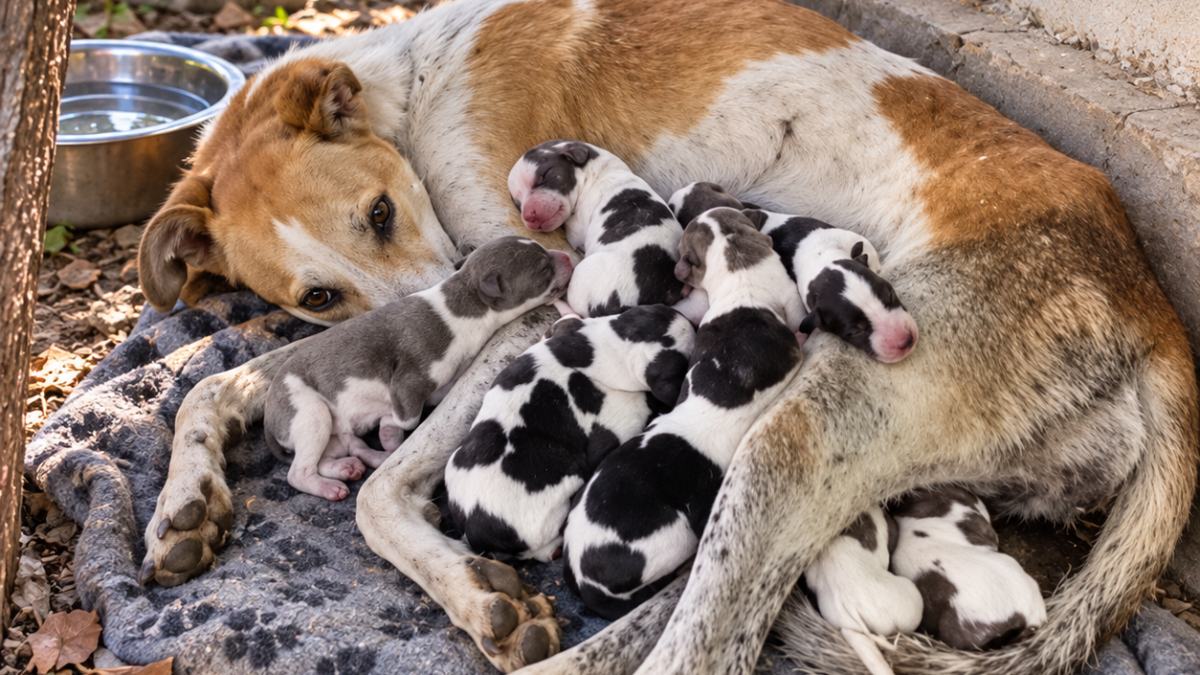
PART 2
The first puppy died at 2:17 the next morning.
I know the exact time because I was sitting in the plastic chair outside the neonatal room staring at the clock when one of the technicians quietly stepped through the door.
Her name was Rebecca.
She did not have to say anything.
I had seen that expression too many times.
“Which one?”
“The little brown male.”
I closed my eyes.
He had been the smallest.
Eighty-six grams lighter than the next smallest puppy.
He had struggled to maintain his temperature from the moment we arrived.
We had warmed him.
Tube-fed him.
Rubbed him.
Changed his position.
Checked him every few minutes.
Sometimes effort is not enough.
That is one of the cruelest lessons in rescue.
People like to believe that if you care hard enough, stay awake long enough, spend enough money, or find the right doctor, everything can be saved.
It is not true.
Sometimes you arrive too late.
Sometimes the damage happened hours before anyone knew there was a life to protect.
Rebecca sat beside me.
“Do we let Aura see him?”
That question hurt.
I looked through the glass at her.
She was receiving oxygen through a mask.
An IV line ran into her front leg.
Her body was wrapped partly in blankets because despite the fever, she could not regulate her temperature correctly.
“She can barely lift her head.”
“I know.”
“She’s still looking for them.”
“I know.”
We decided not to place the dead puppy beside her.
But we let her smell the towel he had been wrapped in.
Aura lifted her nose.
Sniffed once.
Again.
Then rested her head.
I do not know what she understood.
No one does.
But her eyes moved toward the incubator immediately afterward.
Ten puppies remained.
By sunrise, I had gone thirty hours without real sleep.
Miguel returned carrying coffee and a clean sweatshirt for me.
“You look terrible.”
“Thank you.”
“Hospitality is my gift.”
I took the coffee.
“How’s she doing?”
“Still here.”
“That’s good.”
“It’s not enough.”
“It’s what we have.”
He was right.
Dr. Patel updated us at seven.
Aura’s infection was severe.
The medical team believed she had retained infected material after delivering the puppies.
Her platelets remained dangerously low.
She was anemic.
Her blood pressure had improved slightly with fluids but was still unstable.
“If she doesn’t respond to medication,” he said, “we may have to operate.”
“Can she survive surgery?”
“That’s the problem.”
I looked through the glass.
Aura was awake now.
Not fully alert.
But watching.
“What would happen if you don’t?”
“Sepsis could kill her.”
“And if you do?”
“She could bleed.”
There was no good choice.
Only less terrible ones.
“Give the antibiotics more time,” Dr. Patel said. “A few hours. We’ll repeat blood work.”
“And the puppies?”
He glanced toward neonatal care.
“We support them.”
That phrase became the shape of the next week.
Support them.
Warm them.
Feed them.
Hold them.
Count them.
Lose them.
Try again.
Aura could not nurse safely.
Her body had almost nothing left to give, and we could not risk the puppies depending entirely on milk production that was failing.
So every two hours, volunteers fed them.
Eleven became ten.
Ten became nine before lunch.
The second puppy was a pale female with a white stripe over her chest.
She stopped breathing during feeding.
Rebecca tried to revive her.
For several minutes, the room filled with quiet urgency.
Tiny compressions.
Oxygen.
Warm hands.
Nothing.
When Rebecca finally stopped, nobody spoke.
I wrote a number on the chart.
Nine.
There is something horrible about reducing loss to arithmetic.
But when you are caring for a litter that fragile, numbers matter.
Weight.
Temperature.
Milliliters.
Blood glucose.
Hours between feeding.
How many still breathing.
Nine.
Aura’s numbers were not good either.
Her platelets dropped again.
Her breathing became faster.
Dr. Patel repeated imaging.
“There’s fluid beginning to accumulate.”
“Where?”
“In her chest.”
My stomach tightened.
“From the infection?”
“Possibly inflammation. Possibly another complication. We’re monitoring.”
“Can you drain it?”
“If we need to.”
“If?”
“Hannah, every procedure has a cost for her right now.”
I hated how reasonable that was.
By the second night, Aura had begun responding to medication.
Barely.
Her temperature decreased half a degree.
Her blood pressure stabilized.
She ate four bites of boiled chicken from my fingers.
I almost cried over four bites of chicken.
“Good girl.”
She chewed slowly.
Then stopped.
I offered another.
She turned away.
Four bites were enough.
I learned not to demand miracles from animals who had already spent everything surviving.
When I moved to stand, Aura lifted her head.
Her eyes went toward the incubator.
“I know.”
I carried two of the strongest puppies to her.
The medical team allowed them against her for five minutes under supervision.
Aura transformed.
Her entire face changed.
She sniffed each puppy from nose to tail.
She licked them.
Weakly.
Carefully.
One squeaked.
Aura pulled her front leg closer around it.
For those five minutes, she was not a critical patient.
She was simply their mother.
When Rebecca returned the puppies to the incubator, Aura watched.
But she did not panic.
Maybe she was beginning to learn that when we carried them away, we brought them back.
That night, another puppy died.
Then two more before the following evening.
We were down to six.
I stopped going home.
Technically, I slept.
Twenty minutes here.
Forty there.
My husband, Ben, brought clothes and sandwiches.
“You can’t save them by collapsing too.”
“I know.”
“You’re saying that while sitting on the floor.”
“There were no chairs.”
“There are six chairs behind you.”
I looked.
He was right.
“I prefer the floor.”
“Hannah.”
“I’m fine.”
He gave me the same look Dr. Patel used when I lied.
Then he sat on the floor beside me.
We watched Aura through the glass.
“Is that her?”
“Yes.”
“She looks smaller than the pictures.”
“She feels smaller.”
Ben was quiet.
“How many puppies?”
“Six.”
His face tightened.
“You started with eleven.”
“Yes.”
He did not say he was sorry.
I appreciated that.
Sorry had become unbearable.
I knew everyone meant well.
But every time someone said it, my mind translated it into another tiny body.
Instead, Ben asked, “Which one is strongest?”
I pointed.
“Black female. Green collar.”
“And weakest?”
“Tan male. Yellow collar.”
“What are their names?”
“They don’t have names.”
“Why?”
“We use colors.”
“That’s terrible.”
“It helps medically.”
“You still name everybody.”
I looked at him.
“I’m trying not to.”
“Because?”
I didn’t answer.
He understood.
“You think it’ll hurt less.”
“Yes.”
“Will it?”
“No.”
He nodded.
“Then name them.”
I hated him a little for being right.
The six became Hazel, Blue, Pip, June, Benny, and Rose.
Pip died the next morning.
Then Benny.
Four.
Four puppies remained.
Aura had started eating half a bowl at a time.
Her gums looked slightly better.
Her fever had come down.
She could raise herself onto her chest.
Progress.
Every improvement in Aura happened beside loss.
It felt cruel.
At 10:30 that morning, she was strong enough to sit upright for eleven seconds.
At 11:05, Rose crashed.
At 11:22, Rose was gone.
Three puppies.
Aura heard the commotion.
She began trying to rise.
I ran to her.
“No, mama.”
She pushed with her front legs.
Her body trembled.
“Stay down.”
She looked toward the neonatal room.
“I know.”
She whined.
The sound cut straight through me.
I placed one hand against her shoulder.
“They’re working.”
Her eyes searched my face.
I have spent years telling myself not to put human language into animal expressions.
Dogs do not ask questions in English.
They do not understand explanations about infection or neonatal mortality.
But they do understand absence.
Aura had arrived with eleven bodies pressed against her belly.
Then ten.
Then nine.
Eight.
Six.
Four.
Three.
Every time we brought the remaining puppies back to her, she sniffed the spaces around them.
She looked past us.
Under blankets.
Toward the carrier.
She counted differently than we did.
But she counted.
That afternoon, we let her see the three survivors together.
Hazel.
Blue.
June.
Aura licked them.
Then lifted her head.
She looked toward the doorway.
Once.
Twice.
Then at me.
I had no answer.
“I’m sorry.”
There it was.
The word I hated.
Now I was saying it to a dog.
Two days later, June died.
Two remained.
Hazel and Blue.
Nine puppies gone.
Nine.
There are numbers that never become ordinary.
Aura’s physical condition had improved enough that Dr. Patel should have been optimistic.
Instead, he walked into the treatment room at six that evening and listened to her chest for a long time.
Too long.
“What?”
He moved the stethoscope.
“Her lung sounds are worse.”
“How much worse?”
He did not answer immediately.
He ordered new imaging.
The results showed a large amount of fluid in Aura’s chest cavity.
It was compressing her lungs.
Her breathing had already accelerated.
Now I could see the effort.
Chest up.
Pause.
Chest down.
Again.
Again.
Each breath required thought.
“We need to drain it,” Dr. Patel said.
“Now?”
“Yes.”
“What are the risks?”
“She’s weak. Platelets are still low.”
“But if you don’t?”
“She could stop breathing.”
There are moments when decisions are easy because there is only one road left.
We signed the consent.
Aura was moved into procedure.
I stood outside.
Miguel arrived ten minutes later.
“You called?”
“They’re draining her chest.”
He looked toward the door.
“How bad?”
“Bad.”
He leaned against the wall.
We waited.
I hated waiting more than blood.
More than emergencies.
More than angry owners.
More than carrying injured dogs into clinics.
At least when something is happening, you can act.
Waiting makes you useless.
Forty-one minutes later, Dr. Patel came out.
“She’s alive.”
I breathed.
That was all.
Not good.
Not stable.
Not cured.
Alive.
For that moment, it had to be enough.
They had removed significant fluid.
Aura was exhausted afterward.
Her body lay almost completely still beneath a gray blanket.
Only her chest moved.
Slowly.
More evenly.
I sat beside her.
“You’re making this very difficult.”
One ear shifted.
“You know that?”
Nothing.
“You could just recover normally.”
Her eyes opened a fraction.
“That’s better.”
I put my hand near her paw.
She did not pull away.
That mattered.
Aura had never tried to bite us.
But she had flinched from sudden touch.
Especially around her neck.
If someone reached too quickly toward her collar area, she lowered her body.
Sometimes she shut her eyes.
That reaction told me more than scars ever could.
Someone had taught her hands could hurt.
Now we had to teach her they could mean something else.
The criminal part of Aura’s story began because of the chain.
When animal control collected it from the abandoned property, they found something attached beneath the rust.
A small metal tag.
Not Aura’s name.
A phone number.
The number belonged to a man named Travis Coleburn.
Thirty-four.
Owner of a small hauling and property-cleanout company.
The abandoned house had belonged to his late uncle.
County records showed Travis was responsible for the property while the estate waited for sale.
An officer called him.
He said he had no dog.
Then he said he knew the dog but she was a stray.
Then he said he might have fed her “once or twice.”
Then he said another man had tied her there temporarily because she kept getting into garbage.
Four explanations.
One conversation.
That caught attention.
The officer asked when Travis last visited the property.
“Months ago.”
A neighbor had security footage.
Travis’s truck had been there nine days before we found Aura.
Then again five days before.
Then the morning before the rescue.
Now he changed his story again.
He said he had only gone there to retrieve tools.
He claimed he did not see Aura.
The neighbor’s camera showed him walking behind the house.
Not enough to prove what happened.
But enough to keep looking.
Miguel was more interested than I was.
At that point, revenge was the last thing on my mind.
I wanted Aura alive.
I wanted Hazel and Blue alive.
I wanted one morning where nobody died.
But Miguel could hold two thoughts at once.
“He knew she was back there.”
“We don’t know that.”
“He walked behind the house.”
“Maybe he didn’t see her.”
“She was chained six feet from the shed.”
“Maybe.”
“Hannah.”
“What?”
“You know.”
I did.
But knowing and proving are different things.
I had learned that painfully.
So I said, “Let animal control prove it.”
They did.
Slowly.
First came photographs.
Not ours.
Older ones.
A former tenant contacted investigators after seeing Aura’s rescue mentioned in a local neighborhood group.
Her name was Sherri Wallace.
She had rented the abandoned house from Travis’s uncle two years earlier.
When investigators showed her Aura’s photograph, Sherri said immediately:
“That’s Queenie.”
We had been calling her Aura because the clinic needed a name and I refused to label her “Mom Dog.”
“Queenie?”
“That’s what Travis called her.”
My stomach tightened.
“You’re sure?”
“One ear folds when she’s nervous.”
Same dog.
Sherri had photographs.
Aura—then Queenie—standing beside a blue pickup.
Aura wearing a red collar.
Aura lying on a porch with another dog.
Healthy.
Full weight.
Bright-eyed.
Not a stray.
Not unknown.
Not some animal Travis had fed once or twice.
She had lived on the property.
Sherri told investigators the dog originally belonged to Travis’s cousin, who moved out of state and left her behind temporarily.
“Travis said he’d take her.”
“When?”
“About a year ago.”
“Did he?”
“At first.”
“What changed?”
“He stopped caring.”
That was not evidence.
Then Sherri produced text messages.
One from Travis:
QUEENIE KEEPS GETTING OUT. I’M DONE WITH THAT DOG.
Another:
IF SHE GETS PREGNANT AGAIN SHE CAN HAVE THEM IN THE YARD FOR ALL I CARE.
Again.
That word made me cold.
Again.
Investigators asked Sherri about it.
Aura had previously delivered one litter.
Most of those puppies had been given away.
No veterinary records existed.
No spay appointment.
No medical care.
The male dog from the property had disappeared months later.
Nobody knew what happened to him.
Then came the message that mattered.
Sent three weeks before Aura’s rescue.
Travis to a friend:
I CHAINED HER OUT BACK UNTIL I FIGURE OUT WHAT TO DO. DON’T LET HER LOOSE IF YOU GO OVER THERE.
That was enough to destroy the “stray” story.
But the worst message came four days before we found her.
The friend asked:
DOG HAD PUPPIES. YOU KNOW THAT RIGHT?
Travis replied:
YEAH.
One word.
Yeah.
He knew.
The friend wrote:
SHE LOOKS ROUGH.
Travis:
SHE’S A DOG. SHE’LL FIGURE IT OUT.
I read that sentence in the clinic hallway while Aura fought to breathe fifteen feet away.
For the first time since the rescue, anger became stronger than exhaustion.
“She’ll figure it out?”
Miguel stood beside me.
“Hannah.”
“She was dying.”
“I know.”
“Eleven newborn puppies.”
“I know.”
“No water.”
“I know.”
“He knew she had given birth.”
Miguel took the phone from my hand before I dropped it.
“He’ll answer for it.”
I looked through the glass at Aura.
“Will he?”
“Yes.”
“How?”
“Evidence.”
I almost laughed.
“You sound like me.”
“I’ve been around you too long.”
He was right.
The next morning, Aura ate an entire bowl.
Not half.
Not four bites.
All of it.
Rebecca came to get me.
“You need to see this.”
I walked into the treatment room.
Aura was licking the empty bowl.
“You’re joking.”
Rebecca smiled.
“I offered more.”
“And?”
“She accepted.”
I crouched.
“You hungry now?”
Aura looked at me.
Then the bowl.
“Good answer.”
Hazel and Blue were gaining weight.
Slowly.
Both still required supplemental feeding.
But their temperatures were stable.
Their cries were stronger.
Their tiny bellies rounded after meals.
For the first time, I let myself think the word.
Survive.
I did not say it aloud.
Rescue workers become superstitious in strange ways.
We know science.
We respect medicine.
We also refuse to say “quiet night” in a hospital.
We do not say “easy case.”
And when a newborn animal has been near death, we do not say “out of danger” until danger has packed its bags and driven across state lines.
Three days after the chest procedure, Aura tried to stand.
I was not expecting it.
Neither was Rebecca.
Aura had been lying on her side after eating.
Then she rolled onto her chest.
Placed one front paw beneath herself.
Then the other.
Her hind legs tucked awkwardly.
“Wait.”
Rebecca stopped moving.
Aura pushed.
Her legs shook so violently I almost reached for her.
Rebecca caught my wrist.
“Let her.”
Aura rose.
Not gracefully.
Not fully.
But she stood.
Three seconds.
Maybe four.
Her back legs trembled.
Her head lowered.
Then she eased herself down.
No collapse.
No panic.
Just down.
I realized I was holding my breath.
Rebecca whispered, “Good girl.”
Aura looked at us.
Her tail moved.
Once.
That tiny tail movement hit harder than any dramatic rescue I had ever witnessed.
Because the first day, Aura had no movement to spare.
Every calorie had gone to surviving.
Every instinct had gone to her puppies.
Now she had one little piece left for herself.
A tail wag.
Two days later, she walked seven steps.
The next day, twelve.
Then from one side of the treatment room to the other.
Hazel and Blue were placed beside her twice daily.
Aura still checked them obsessively at first.
Nose.
Back.
Belly.
Again.
Then something changed.
She stopped searching the corners afterward.
That broke my heart in a different way.
She understood the family had become smaller.
Maybe not why.
Maybe not where.
But she no longer expected nine missing puppies to return through the door.
Loss had become part of what she knew.
I hated that.
At the same time, I saw something else.
When Hazel squeaked, Aura responded immediately.
When Blue crawled too far from the blanket, Aura gently pulled him back with her nose.
She was not living only in what she had lost.
She was beginning to protect what remained.
That became our goal too.
Travis Coleburn was charged three weeks after the rescue.
Animal cruelty.
Failure to provide necessary food, water, shelter, and veterinary care.
Additional counts related to the puppies.
His attorney immediately argued that Aura had access to the property and could have been fed by anyone.
Then photographs of the chain went into evidence.
The chain had not broken.
Aura could not leave.
Its length gave her access to exactly three things:
Dirt.
A collapsed wall.
And an empty plastic bucket.
No shade during much of the afternoon.
No reliable shelter from rain.
No way to search for food.
No way to move her puppies.
Travis claimed somebody else must have taken the food bowl.
We had photographs of the bowl.
Empty.
He claimed he filled the water bucket the day before.
The bucket contained a thick layer of dry dirt at the bottom.
A forensic veterinary consultant estimated it had been empty considerably longer.
He claimed he did not know Aura was sick.
His friend’s messages destroyed that.
SHE LOOKS ROUGH.
YEAH.
He claimed he believed dogs could deliver puppies without human intervention.
That part was true.
Most can.
But giving birth naturally does not mean being abandoned while septic afterward is acceptable.
Dr. Patel wrote a veterinary report that was twenty-three pages long.
He documented Aura’s weight.
Temperature.
Blood work.
Platelets.
Uterine infection.
Chest fluid.
Dehydration.
Pressure sores.
Neck abrasions.
Paw condition.
Milk production.
Every complication.
Then he documented the puppies.
Eleven admitted.
Nine dead.
Two survivors.
No drama.
No adjectives.
Numbers.
I learned something during that case.
Facts can be more brutal than anger.
The defense could call us emotional rescuers.
They could say social media made the case bigger than it was.
They could call it a misunderstanding.
What they could not do was argue with platelet counts.
They could not argue with eleven neonatal weights.
They could not argue with a chain measured to the inch.
They could not argue with a text saying:
SHE’S A DOG. SHE’LL FIGURE IT OUT.
Aura was discharged from the hospital twenty-six days after we found her.
Hazel and Blue remained in foster neonatal care another week.
Aura left first.
That caused a problem.
The moment we carried the puppies into another room, she became anxious.
Not the wild panic from the beginning.
But she paced.
Whined.
Checked the door.
So Dr. Patel changed the discharge plan.
The puppies went with her.
We had a medical foster home experienced with nursing mothers.
Her name was Carol Bennett.
Sixty-two.
Retired veterinary technician.
Fierce enough to frighten most adult men.
Exactly what Aura needed.
Carol arrived with a minivan full of blankets, crates, medication charts, and opinions.
“You’re Hannah?”
“Yes.”
“You’re too thin.”
“Excuse me?”
“You rescue people never eat.”
“I eat.”
“Coffee isn’t food.”
“I didn’t say coffee.”
“You were thinking it.”
I liked her immediately.
Aura did not.
At first.
Carol never forced contact.
She opened the back of the minivan.
Placed a ramp.
Sat twenty feet away.
Aura stood with me.
“Come on, sweetheart.”
She looked at the van.
Then at me.
Hazel and Blue were already inside in a secure carrier.
Aura heard them.
One cry.
That was enough.
She walked up the ramp.
Carol smiled.
“Good mother.”
I rode with them to the foster home.
Aura’s new room had soft bedding, temperature control, clean water, food, toys, and a small covered patio.
When we opened the puppy carrier, Aura counted.
Hazel.
Blue.
Sniff.
Sniff.
Then she walked around the room.
Bed.
Door.
Water.
Window.
Back to puppies.
She drank for nearly a full minute.
I watched the water disappear from the bowl.
Such a simple thing.
Water.
Unlimited.
Clean.
Always there.
I thought about the dry bucket behind the abandoned house.
Carol noticed my face.
“She won’t ever have to wonder again.”
I nodded.
“I know.”
“You can go home.”
“I know.”
“Hannah.”
“I’m leaving.”
“You’re sitting down.”
“Temporary.”
Carol pointed at the door.
I laughed.
Aura looked at me.
I crouched beside her.
“You’re okay here.”
Her ears shifted.
“I’ll come back.”
She watched me stand.
When I reached the doorway, I looked back.
Aura had already turned toward Hazel and Blue.
That was the first time I left her without feeling guilty.
The puppies opened their eyes at Carol’s house.
Hazel first.
Blue the next morning.
Aura watched.
Maybe coincidence.
Maybe not.
She had become deeply attached to Carol.
Not in a dramatic way.
Trust came quietly.
At first, Aura accepted food only after Carol stepped away.
Then she ate while Carol stood in the room.
Then from a bowl Carol held.
One evening, Carol sent me a photograph.
Aura asleep with her head on Carol’s slipper.
Message:
YOUR GIRL IS USING ME AS FURNITURE.
I replied:
GOOD.
A week later:
SHE STOLE MY CHAIR.
Then:
SHE BARKED AT THE MAILMAN.
Then:
SHE WAGGED WHEN I CAME HOME.
That one made me sit down.
Aura had wagged for us.
But this was different.
She was beginning to expect someone to return.
That means something to an abandoned dog.
Expectation requires trust.
Hazel and Blue grew.
By six weeks, the quiet neonatal bundles had become criminals.
They climbed over Aura.
Chewed Carol’s pant legs.
Stole each other’s toys.
Bit everything with the conviction that the world existed specifically for puppy teeth.
Aura tolerated almost all of it.
When Blue bit her ear too hard, she corrected him.
When Hazel climbed into the water bowl, Aura looked offended.
When both puppies attacked her tail at the same time, Aura simply walked away.
Carol called me.
“They’re monsters.”
“Healthy monsters?”
“Unfortunately.”
“Then I’ll take it.”
The trial was scheduled for early winter.
By then, Aura’s case had received attention around the county.
I disliked that.
Not because attention was bad.
It brought donations.
It encouraged people to report neglect.
It helped the shelter place animals.
But public stories simplify everything.
“Mother Dog Saves Puppies.”
“Abused Dog Fights to Live.”
“Monster Owner Faces Court.”
Reality was more uncomfortable.
Aura did not save nine puppies.
We did not either.
They died.
No beautiful ending could erase that.
And Travis was not a monster in the mythical sense.
He was worse in a more ordinary way.
He was a man who saw suffering and decided it was inconvenient.
He had not built a torture chamber.
He had not stood over Aura every hour hurting her.
He had simply chained her out of sight.
Then stopped caring what happened.
Neglect is often quiet.
That is why it lasts so long.
At the hearing, Travis’s attorney asked Dr. Patel whether Aura’s infection could have developed even with proper care.
“Yes,” he said.
“So the infection itself does not prove neglect?”
“No.”
The attorney seemed pleased.
“Could newborn puppies die even when receiving excellent veterinary care?”
“Yes.”
“So the puppy deaths do not prove my client caused them.”
“Not individually, no.”
I felt anger rise.
Then Dr. Patel continued.
“But severe maternal starvation, dehydration, untreated infection, environmental exposure, and lack of neonatal support dramatically reduce the likelihood of survival.”
The attorney paused.
Dr. Patel did not.
“If Aura had been examined when labor complications first appeared, her infection could have been treated earlier.”
Silence.
“If she had clean water, adequate nutrition, and shelter, her body would have been better able to support the litter.”
Silence.
“If the puppies had been kept warm and monitored from birth, several conditions we treated might have been identified sooner.”
The attorney changed direction.
“Doctor, can you guarantee all eleven puppies would have survived?”
“No.”
“Then—”
“I can guarantee they deserved the chance.”
The courtroom went completely still.
The judge looked at Dr. Patel.
The attorney sat down.
Miguel whispered beside me, “I love that man.”
“So do I.”
Travis eventually accepted a plea instead of taking every charge to trial.
Some people were angry about that.
They wanted maximum punishment.
Years in prison.
A dramatic sentence.
Something that felt equal to nine dead puppies.
The law rarely works that way.
He received jail time, probation, substantial fines and restitution, mandatory evaluation, and a long-term prohibition against owning or possessing animals.
His business also lost a municipal cleanout contract after the case.
The abandoned property was seized through the estate process and later sold.
Part of the restitution went toward Aura’s veterinary bill.
It did not come close to covering it.
That didn’t matter.
Donors had already stepped in.
The most important condition, to me, was the animal prohibition.
Travis stood before the judge while the restrictions were read.
No dogs.
No cats.
No livestock.
No animals placed in his care.
Mandatory inspection compliance.
If he violated it, probation consequences could follow.
He looked angry.
Not sorry.
That bothered me at first.
Then Carol said something useful.
“You don’t need his remorse.”
“Would be nice.”
“Nice isn’t necessary.”
“What is?”
“He can’t do it again.”
That became enough.
Not emotionally.
Emotionally, nothing was enough.
Nine puppies were still dead.
Aura had still almost died behind that house.
But justice is not resurrection.
Its job is prevention.
Accountability.
Record.
Consequence.
You take what is possible.
Then you build something with it.
We did.
The shelter established an emergency maternity response fund using donations that came after Aura’s case.
It paid for foster equipment.
Formula.
Heating pads.
Emergency veterinary care.
Transport.
Within the first year, it supported eighteen nursing mothers and more than ninety puppies and kittens.
One of those mothers was a white pit bull named Daisy who arrived during obstructed labor.
The fund covered emergency surgery within forty minutes.
All six puppies survived.
Carol sent me a photograph.
Caption:
AURA PAID THIS BILL WITHOUT KNOWING IT.
I cried over my phone.
That felt closer to revenge than Travis’s sentence ever had.
He had treated one mother and her puppies as disposable.
Aura’s story made dozens of other litters harder to discard.
Hazel and Blue were adopted at ten weeks.
Not together.
I struggled with that.
Aura had lost nine.
Separating the last two from her felt cruel.
But puppies eventually leave their mothers.
Healthy mothers allow it.
Our feelings are often messier than theirs.
Hazel went to a family with two teenagers and a fenced backyard.
Blue went to a retired couple who had recently lost an older dog.
Both families agreed to regular updates.
Carol cried after Hazel left.
Then denied it.
“Dust.”
“Inside your house?”
“Extremely aggressive dust.”
Blue left two days later.
Aura watched him go.
She paced for fifteen minutes.
Then lay down beside Carol’s chair.
That night, she ate dinner.
The next morning, she brought Carol a toy.
Not a puppy.
Not a blanket.
A blue rubber ball.
Carol threw it.
Aura stared at her.
“You have to chase it.”
Aura remained still.
Carol retrieved the ball herself.
“You’re terrible at this.”
The second throw went better.
Aura ran three steps.
Stopped.
Looked confused.
Then chased the ball.
That was the day her life stopped being only about survival and motherhood.
She played.
It sounds small.
It was enormous.
A dog who had spent every resource protecting newborns finally had enough safety to be silly.
Aura stayed with Carol permanently.
Nobody planned it.
Carol insisted she was fostering.
For five months.
Then eight.
Then eleven.
I finally brought adoption paperwork.
Carol looked offended.
“What’s this?”
“Temporary foster update.”
She narrowed her eyes.
“You’re lying.”
“Yes.”
“I don’t appreciate dishonesty.”
“Sign.”
“I’m sixty-three.”
“Congratulations.”
“I travel.”
“Aura likes cars.”
“I have stairs.”
“She uses them.”
“I wasn’t planning another dog.”
“Aura wasn’t planning you.”
Carol looked down.
Aura was lying across both of her feet.
I placed the pen on the table.
Carol signed.
“Fine.”
“Fine?”
“She can stay.”
Aura lifted her head.
Carol scratched behind her ear.
“You manipulative animal.”
Aura’s tail hit the floor.
I drove home smiling.
For two years, Aura lived the life she should have always had.
Then three.
Then four.
Her coat thickened.
Her ribs disappeared beneath muscle.
The ring of scar tissue around her neck remained.
Fur grew over most of it but never completely.
Carol stopped using collars.
Aura wore a soft harness instead.
“She doesn’t need anything around her neck again,” Carol said.
Nobody argued.
Every morning, Aura walked a wooded trail behind Carol’s house.
Every afternoon, she slept in a patch of sun near the kitchen door.
Every evening, she checked the back fence before dinner.
She remained suspicious of chains.
Not just chains on her.
Any metal chain.
One day, a contractor came to repair the gate carrying several feet of chain over his shoulder.
Aura froze.
Her body dropped low.
Carol immediately moved between them.
“Put that outside.”
The contractor looked confused.
“Why?”
“Because I said so.”
He saw Aura.
Understood.
Set it down.
Aura recovered after a few minutes.
Trauma does not disappear simply because life improves.
It becomes something you learn around.
Carol never forced her.
That was part of why Aura trusted her.
Hazel and Blue visited on Aura’s adoption anniversary.
The first visit was chaos.
Aura smelled Hazel first.
Her body became completely still.
Hazel was nearly full grown.
Longer legs.
Darker face.
Different smell.
But something remained.
Aura approached.
Sniffed her neck.
Her ears.
Her back.
Then Hazel licked Aura’s mouth.
Aura wagged so hard her entire body bent sideways.
Blue arrived ten minutes later.
The three dogs ran around Carol’s yard for nearly an hour.
Aura corrected Blue twice.
Hazel stole Aura’s ball.
Blue dug in a flower bed.
Carol threatened everyone.
It was perfect.
At the end, both younger dogs fell asleep against Aura.
Just for a few minutes.
The same position they had known as newborns.
Carol took a photograph.
Aura in the middle.
Hazel on one side.
Blue on the other.
Her two survivors.
Not replacements.
Never replacements.
The nine lost puppies still mattered.
But grief and joy can occupy the same room.
That is something Aura taught me.
A year later, we created a small memorial garden behind the rescue center.
Nine stones.
No dramatic monument.
Each stone carried one of the temporary names we had used or assigned afterward.
Pip.
Rose.
Benny.
June.
And the others.
At the center was a larger stone.
FOR THE ONES WE COULDN’T KEEP,
AND THE MOTHERS WHO KEPT TRYING.
Carol brought Aura.
I worried it would mean nothing to her.
Probably it did.
Dogs do not need monuments.
Humans do.
Aura sniffed the grass.
Walked around the stones.
Then lay beneath the maple tree.
Hazel’s family came.
Blue’s family came.
Dr. Patel.
Rebecca.
Miguel.
Ben.
Even the utility worker who had found Aura.
His name was Thomas Reid.
I had not seen him since the rescue.
He stood near the edge of the group.
Quiet.
I walked over.
“You okay?”
He nodded.
“I almost didn’t go behind the house.”
That surprised me.
“What do you mean?”
“I was checking the electric box.”
He looked toward Aura.
“I heard scratching.”
I waited.
“Thought it was a raccoon.”
“But you checked.”
“Almost didn’t.”
His eyes filled.
“I think about that.”
I understood.
Rescue stories often begin with tiny choices no one recognizes as important.
Turn around.
Look again.
Follow the sound.
Stop the car.
Open the door.
Make the call.
Thomas made one small choice.
Eleven puppies were found.
Aura was freed.
Two survived.
A case was built.
A fund was created.
Dozens of animals were later helped.
People call that luck.
Maybe.
I call it attention.
Years passed.
Aura became gray around the muzzle.
Carol became even more opinionated.
I became rescue director.
Miguel moved into cruelty investigations full-time.
Dr. Patel opened a second clinic.
Rebecca became a veterinary nurse.
Hazel grew into a confident, affectionate dog who slept in one teenager’s bed despite supposedly not being allowed upstairs.
Blue became obsessed with tennis balls and terrified of vacuum cleaners.
They were healthy.
They were loved.
That mattered.
Travis completed probation.
I received notice because our organization had been listed as the victim representative for restitution.
I stared at the letter for a long time.
Ben saw me.
“What?”
“He’s done.”
“With probation?”
“Yes.”
“How do you feel?”
I thought about it.
“Nothing.”
He smiled slightly.
“That’s probably good.”
He was right.
For years, Travis had occupied a corner of Aura’s story.
The chain.
The empty bucket.
The messages.
The courtroom.
Eventually, he became smaller.
That is another thing nobody tells you about justice.
The best outcome is not always watching the person who caused harm suffer forever.
Sometimes it is reaching the point where they no longer matter.
Aura did not wake up every morning thinking about Travis.
She thought about breakfast.
Carol.
Squirrels.
Sunlight.
The mail truck.
Hazel visiting.
Blue stealing her ball.
Her life expanded until the abandoned house became only one terrible chapter.
That was the victory.
Seven years after we found her, Aura developed a heart murmur.
Not severe.
Manageable.
Medication helped.
Two years later, arthritis appeared.
Carol installed rugs through the hallway so Aura would not slip.
A ramp replaced the back steps.
Aura accepted these accommodations with the dignity of an aging queen.
She still walked daily.
Just slower.
She still checked the yard.
Just less seriously.
She still slept near Carol.
Closer now.
By eleven or twelve—her exact age had always been uncertain—Aura spent more time resting.
But every spring, when Hazel and Blue visited, something changed.
Aura rose.
Smelled them.
Wagged.
For a few minutes, she looked younger.
The final reunion happened on a warm April afternoon.
Hazel was gray around the eyes.
Blue had gained too much weight.
Carol told his family.
They denied everything.
Aura lay beneath the maple tree.
Hazel approached first.
Aura lifted her head.
Their noses touched.
Then Blue came.
Aura tried to stand.
Her hind legs slipped.
I moved forward.
Carol stopped me.
“Wait.”
Aura tried again.
Hazel stood beside her.
Not touching.
Just close.
Aura pushed.
Stood.
Three old dogs.
All gray now.
For several seconds, they simply smelled one another.
Then Aura’s tail moved.
Once.
Twice.
The same small motion I had seen in the hospital when she first stood.
Carol started crying.
This time she did not blame dust.
Aura lived another six months.
Her decline was slow.
Kidneys.
Heart.
Age.
Nothing dramatic.
No villain.
No emergency rescue.
Just a body reaching the end after fighting far longer than anyone expected.
One October morning, Carol called.
“Hannah.”
I knew.
“I’m coming.”
“Bring Miguel if he can.”
“He can.”
“And Dr. Patel.”
“I’ll call.”
We gathered at Carol’s house.
Aura was lying on her favorite blanket near the kitchen door.
Sunlight fell across her front paws.
She had not eaten since the day before.
She no longer wanted to stand.
Her breathing was calm.
That mattered most.
Carol sat on the floor beside her.
“I promised her no more suffering.”
Dr. Patel listened to Aura’s heart.
Checked her gums.
Looked at Carol.
“It’s time.”
Carol nodded.
Then shook her head.
Then nodded again.
There is no contradiction in that moment.
You can know something is right and still hate every part of it.
I sat beside Aura.
The scar around her neck was barely visible now.
I touched the fur near it.
“Remember me?”
Her eyes opened.
Her tail moved once against the blanket.
Miguel laughed softly.
“She does.”
“Of course she does.”
Carol leaned down.
“You were supposed to be temporary.”
Aura breathed.
“You ruined my furniture.”
Another breath.
“You hated the mailman.”
Tail movement.
“You stole my bed.”
Carol’s voice broke.
“And you were the best thing that ever happened in this house.”
Aura looked at her.
There are moments when words fail so completely that silence becomes more honest.
Dr. Patel gave the first medication.
Aura relaxed.
Her head grew heavier in Carol’s lap.
I kept my hand on her shoulder.
Miguel touched one paw.
Carol whispered into her ear.
“You don’t have to count anymore.”
That sentence destroyed me.
For years I had remembered the hospital.
Aura lifting her head.
Searching the corners.
Looking for puppies who were gone.
Counting movement against her belly.
Trying to be a mother while her own body shut down.
Now she had spent nearly a decade being more than that moment.
She had been a mother.
Then a patient.
Then a foster dog.
Then a family dog.
A trail walker.
A ball chaser.
A professional mailman critic.
A couch thief.
A survivor.
She did not need to count anymore.
Dr. Patel gave the final medication.
Aura took one deep breath.
Then another.
Then she was still.
Carol pressed her face into Aura’s neck.
Nobody moved.
Outside, leaves shifted in the yard.
A car passed somewhere down the road.
Life continued with the indecency life always has after a death.
We stayed.
No one hurried.
Later, Hazel and Blue were brought over.
Some people dislike letting animals see a companion after death.
Carol wanted them to have the chance.
Hazel approached first.
She smelled Aura’s face.
Then her paws.
Blue stood farther back.
Eventually, he came closer.
Neither panicked.
Neither made a dramatic scene.
After several minutes, Hazel lay beside Aura.
Blue sat near the door.
I thought about the eleven newborn puppies pressed against their mother behind that abandoned house.
Only two had survived.
Now those two were old.
Healthy.
Loved.
And they were saying goodbye to the mother who almost died bringing them into the world.
It was unbearable.
It was also beautiful.
Aura was cremated.
Carol kept most of her ashes.
A small amount went beneath the maple tree at the rescue center near the nine stones.
We added one more marker.
AURA
SHE KEPT BEING THEIR MOTHER UNTIL SHE LEARNED SHE WAS ALLOWED TO LIVE FOR HERSELF.
Somebody told me it was too long for a stone.
I did not care.
Years after Aura’s death, the maternity fund still carries her name.
AURA’S SECOND CHANCE FUND.
Every time it pays for emergency treatment, the receipt carries her photograph.
Not the one from behind the abandoned house.
I refused that.
No chain.
No bones.
No suffering.
The photograph shows Aura in Carol’s yard.
Healthy.
Thick coat.
Mouth open.
Eyes bright.
A blue ball between her paws.
That is the image I want attached to her name.
Not what someone did to her.
What she became after.
People sometimes ask me if I think Travis ever understood what he caused.
I don’t know.
Maybe.
Maybe not.
I stopped needing the answer.
His punishment was never the most satisfying part.
The satisfying part was that he failed.
He treated Aura like she was disposable.
She became unforgettable.
He left her behind an abandoned house.
Her name ended up on a program that saved animals across the county.
He gave her no food.
No water.
No shelter.
Years later, donations made in Aura’s name filled shelves with formula, blankets, medicine, food, and emergency equipment.
He assumed eleven newborn puppies did not matter.
Two grew old in loving homes.
Nine were remembered by name.
He tried to make Aura disappear behind a house nobody used.
Instead, hundreds of people learned her story.
And more importantly, hundreds learned what neglect actually looks like before an animal reaches the edge of death.
That was the revenge.
Not hatred.
Not humiliation.
Not destroying a man.
Making what he tried to ignore impossible to ignore.
Turning abandonment into awareness.
Turning evidence into consequences.
Turning loss into a system that gave the next mother a better chance.
A few months after Aura died, we received another call.
Nursing dog.
Eight puppies.
Vacant industrial lot.
I went.
Of course I went.
The mother was frightened but standing.
Thin, but not critical.
The puppies were cold.
Not dying.
We transported them.
The emergency fund covered everything.
At the clinic, Rebecca—now head nurse—looked at the paperwork.
“Aura fund.”
“Yes.”
“Again.”
“Yes.”
The mother received fluids.
Food.
A warm bed.
All eight puppies survived.
Every one.
When they were old enough, I stood in the adoption room and watched families choose them.
One little female climbed directly into a boy’s lap.
Another puppy fell asleep in a woman’s arms.
The mother went to a home with a fenced yard and another gentle dog.
Nobody knew Aura.
Not really.
But she was there.
In the paid invoice.
In the incubator.
In the stocked formula.
In the volunteer schedule.
In the fact that we knew exactly what to do because we had once learned the hard way.
That afternoon, I drove to Carol’s house.
She still kept Aura’s blue ball on a shelf.
“Good day?” she asked.
“All eight lived.”
She stopped.
“Eight?”
“Eight.”
Carol looked toward Aura’s photograph.
“About time.”
We sat on the porch.
For a while, neither of us spoke.
Then Carol said, “Do you ever think about the first day?”
“Too often.”
“I don’t.”
I looked at her.
“No?”
“I think about the last years.”
That surprised me.
“I used to picture the chain,” she said. “Then one day I realized I was giving that backyard more space in my head than Aura ever did.”
I smiled.
“That sounds like something you’d say.”
“It’s intelligent.”
“It’s obnoxious.”
“Same thing.”
She picked up her coffee.
“She loved this porch.”
I looked at the empty place beside her chair.
“Yes.”
“She loved chicken.”
“Yes.”
“Hated thunderstorms.”
“Yes.”
“Snored.”
“Loudly.”
“Stole blankets.”
“Constantly.”
Carol smiled.
“That’s my Aura.”
Not the chained dog.
Not the dying mother.
Aura.
That distinction matters.
Rescue stories often freeze animals at the worst moment of their lives.
The emaciated photograph.
The wound.
The cage.
The chain.
Those images make people care.
But if that is all we remember, cruelty gets the final portrait.
I don’t want that.
Aura’s real story was not the chain.
The chain was where we met her.
Her story was everything that came after.
The first full bowl.
The first quiet sleep.
The first time she stood.
The first tail wag.
Hazel and Blue growing strong.
Carol becoming home.
The first ball.
The first walk.
The first night she stopped searching the room.
The years when she could close her eyes without guarding eleven tiny bodies.
That was her life.
Not twenty-six days in a hospital.
Not one abandoned backyard.
Years.
Safe years.
Ordinary years.
The greatest luxury for a rescued animal is often ordinary life.
Nothing dramatic.
Breakfast at seven.
Walk at eight.
Nap in sunlight.
Bark at delivery truck.
Dinner.
Sleep.
Repeat.
Nobody writes headlines about ordinary days.
Aura got thousands of them.
I am grateful for every one.
Hazel died at thirteen.
Peacefully.
Blue made it to fourteen.
His family sent us his final tennis ball.
It now sits beside Aura’s blue ball in the rescue center.
Three objects are displayed beneath their photograph.
Aura’s harness.
Her blue ball.
Blue’s tennis ball.
We never displayed the chain.
It remained evidence until the case closed.
Afterward, animal control asked whether we wanted it for education.
I said no.
“Why?”
Because I did not want the thing that held Aura to become the thing that represented her.
We photographed it.
Measured it.
Documented it.
Then disposed of it.
That felt right.
The chain did not deserve a memorial.
Aura did.
Every year, new volunteers ask about the photograph above the maternity supply cabinet.
“Who’s that dog?”
I tell them.
Not all fifteen years of the story.
Just enough.
Found chained after giving birth.
Eleven puppies.
Severe infection.
Nine lost.
Two survived.
Aura survived.
Then I point to the shelves.
“That’s why this room exists.”
Formula.
Heating discs.
Scales.
Gloves.
Bedding.
Emergency transport crates.
Everything ready.
No mother waiting days because we were unprepared.
No litter losing time while people figured out funding.
That is Aura’s legacy.
Preparedness.
Second chances.
Attention.
One evening, a young volunteer asked me the question I have heard more than any other.
“How did she keep going?”
I almost gave the easy answer.
Mother’s instinct.
Love.
Strength.
But those words are too clean.
Aura kept going because living bodies often keep going until they cannot.
Because puppies moved against her belly.
Because she responded to them.
Because instinct does not stop when conditions become cruel.
Because somewhere inside that starving, infected body, one need remained stronger than collapse.
Check them.
Warm them.
Pull them closer.
Count again.
Eleven.
Then later, ten.
Nine.
Six.
Four.
Two.
And eventually, after the losses, something else happened.
Aura learned to count differently.
One full bowl.
One safe bed.
One woman coming home every evening.
Two grown puppies visiting the yard.
One blue ball.
One porch.
One life.
Her own.
That was the part that mattered most.
Aura had spent so long living only for babies who needed her that recovery required something more than medicine.
She had to discover she was worth saving even when no puppy was pressed against her.
Carol taught her that.
Not with speeches.
Food.
Routine.
Patience.
A harness instead of a collar.
A door that always opened.
A person who always came back.
Safety repeated until Aura believed it.
Maybe that is what healing is.
Not one miracle.
A thousand ordinary proofs that the terrible thing is over.
I still visit the memorial garden.
The maple tree is much larger now.
The nine small stones sit beneath it.
Aura’s marker is beside them.
In spring, flowers grow around the edges.
Visitors sometimes leave toys.
I usually move them to the shelter afterward so another dog can use them.
Aura would have preferred that.
The last time I went, a mother dog from one of our current foster homes was lying in the grass nearby.
Six puppies climbed all over her.
Healthy.
Round.
Annoying.
She looked exhausted.
I sat several feet away.
One puppy rolled off the blanket.
The mother stretched a paw toward him.
Pulled him closer.
Simple movement.
I felt my throat tighten.
For a moment, I saw Aura again.
Not dying.
Not searching.
Not chained.
Standing.
Shaky legs.
Then stronger.
Then walking.
Then running after a blue ball while Carol yelled that she was tearing up the grass.
That is the Aura I choose.
And whenever someone asks whether her story had a happy ending, I tell them the truth.
It had a painful ending.
Nine puppies died.
Nothing changes that.
It had an unjust beginning.
Nothing changes that either.
But in between those two truths, there was something larger.
Aura lived.
Hazel lived.
Blue lived.
Travis was held accountable.
The chain was cut.
The house was sold.
The fund was created.
Other mothers were treated sooner.
Other puppies survived.
Carol got years with the dog she never intended to adopt.
Aura learned what clean water looked like when it never ran out.
She learned that hands could touch without hurting.
She learned doors did not always close behind people forever.
She learned babies could grow up and leave without disappearing into death.
And eventually, she learned something nobody behind that abandoned house had ever taught her.
She mattered even when she had nothing left to give.
That is enough of an ending for me.
More than enough.
Because the person who chained Aura had reduced her life to a patch of dirt and the length of a rusted chain.
Aura answered by living long enough to become bigger than everything he tried to reduce her to.
A family.
A legacy.
A rescue fund.
A lesson.
And a name people still say years after the chain itself was thrown away.
Aura.
The mother who arrived with eleven.
The survivor who left with two.
And the dog who finally learned she did not have to lose everything before someone decided she was worth saving.








