PART 2: They Found Bianca Broken Beside the Road—But One Frightened Eye Refused to Give Up
PART 2
The first surgery lasted almost four hours.
I spent every minute in the waiting room.
Miguel lasted forty-three minutes before he stood up and started pacing.
“You’re making me nervous,” I said.
“I’m already nervous.”
“Then sit down.”
“I can’t.”
“You’re wearing a groove into the floor.”
“Good. Maybe they’ll name it after me.”
Nobody laughed.
Not even him.
The hospital was quiet except for phones, rolling carts, and the soft mechanical sounds coming through the swinging doors.
Every time a technician walked toward us, my chest tightened.
Most rescue work is action.
Drive.
Lift.
Carry.
Call.
Clean.
Feed.
You are always doing something.
Surgery leaves you with nothing but waiting.
At 11:26, Dr. Patel finally came through the doors.
He pulled off his surgical cap.
“She made it.”
Miguel sat down so suddenly his chair scraped the floor.
I exhaled.
“What did you fix?”
“The worst jaw fracture first. We stabilized two sections and repaired part of the soft tissue damage.”
“And the legs?”
“Not today.”
I stared at him.
“She needs another surgery?”
“At least two.”
My relief vanished almost immediately.
“She can handle that?”
“Not now.”
“When?”
“If she stabilizes.”
There was that word again.
If.
I hated it.
Dr. Patel continued.
“We also had to remove the damaged eye.”
I had known that might happen.
Knowing did not make hearing it easier.
“There was no way to save it?”
“No. It was causing pain and the structures were too damaged.”
I nodded.
“Will she adapt?”
“If we get her through everything else, yes. Cats usually adapt remarkably well to one-eye vision.”
If.
Again.
“Can I see her?”
“Briefly.”
Bianca looked smaller after surgery.
That seemed impossible.
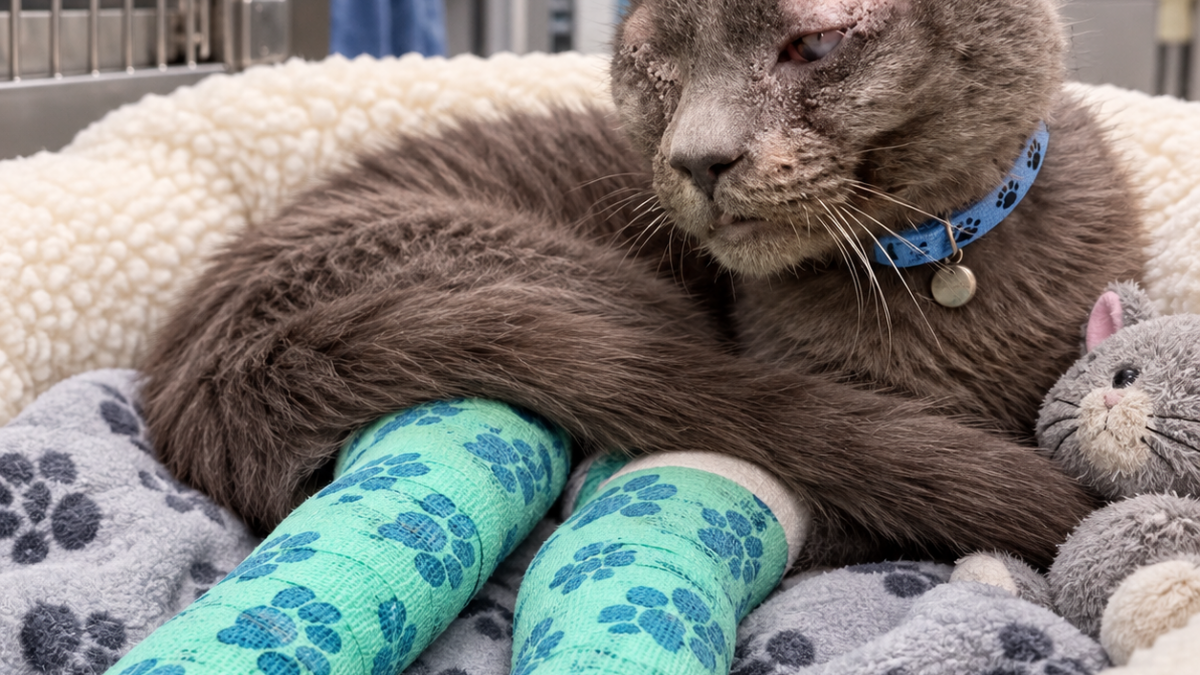
A padded wrap covered part of her face.
An IV line ran into one front leg.
Her damaged limbs were supported in temporary splints.
A feeding tube had been placed because her jaw needed complete rest.
She looked like a collection of bandages with one black ear sticking out.
Her remaining eye was closed.
I sat beside her.
“Hey.”
Nothing.
“That was terrible.”
Still nothing.
“I complained about waiting. You had the harder job.”
Her ear twitched.
I leaned closer.
“Bianca?”
The eye opened.
Not fully.
Just a narrow green line.
Then it closed again.
I smiled.
“Fine. Ignore me.”
Miguel stood in the doorway.
“She hear you?”
“Apparently she’s already tired of me.”
“That’s a good sign.”
It was.
We measured recovery in ridiculous things.
An ear twitch.
A swallow.
A stable temperature.
Urine output.
Blood pressure.
How long she slept without waking in panic.
Nobody outside veterinary medicine would call these miracles.
We did.
Bianca’s second surgery was scheduled three days later.
Before that happened, we had to get her stronger.
Because her jaw was immobilized, food entered slowly through the feeding tube.
The first feeding took almost forty minutes.
Five milliliters.
Pause.
Another five.
Pause.
Watch for nausea.
Check breathing.
Continue.
She hated the tube at first.
Not because it hurt.
Because everything frightened her.
Hands.
Metal bowls.
The opening of a cabinet.
Shoes crossing the room.
One technician dropped a clipboard, and Bianca tried to jerk away so violently that we had to steady her casts.
That told me something important.
The car crash was not the beginning of her fear.
Maybe she had been living outside.
Maybe people had chased her.
Maybe she had never belonged to anyone.
We had no chip.
No collar.
No missing-cat report that matched her.
She was about nine months old, according to Dr. Patel.
Not even fully grown.
The second surgery addressed her rear leg.
The femur fracture was ugly.
The bone had broken at an angle, and the surrounding tissue was badly bruised.
Dr. Patel called in an orthopedic specialist named Dr. Elena Morris.
She studied the images.
“We can repair it.”
“You sound confident.”
“I said we can repair it. I didn’t say it’ll be easy.”
“What happens if you don’t?”
“She may never use the leg.”
“And with the other leg injured too?”
“That’s why we need this one.”
It was another long procedure.
Pins.
Plates.
Tiny pieces of metal holding together a tiny life.
When it ended, Bianca woke badly.
Disoriented.
Painful despite medication.
Her heart rate jumped.
She tried to move.
Couldn’t.
I sat outside the recovery kennel while a technician monitored her.
“Bianca.”
Her eye opened.
“Don’t fight the casts.”
She tried anyway.
“You’re stubborn.”
Her breathing slowed a little.
Maybe because of my voice.
Maybe because medication was taking effect.
I told myself it was the medication.
Rescue workers can become arrogant about emotional connections.
Sometimes an animal is simply tired.
Still, I stayed.
The third surgery happened six days after the first.
Front leg.
Lower rear leg.
Two teams.
One room.
Dr. Morris warned us that the front wrist joint might never have full mobility.
“I care about functional,” I said. “Not perfect.”
“So do I.”
By then, the rescue’s emergency medical fund was almost empty.
Bianca’s bills had already passed eleven thousand dollars.
More procedures were coming.
Follow-up X-rays.
Medication.
Hospitalization.
Physical therapy.
I spent half my time worrying about Bianca and the other half trying to figure out how we were going to pay for saving her.
Miguel came into the waiting room carrying his phone.
“We got the highway camera footage.”
I looked up.
“What footage?”
“From the road.”
Until that moment, the hit-and-run part of Bianca’s story had been almost an afterthought.
Not because it did not matter.
Because keeping her alive mattered more.
The delivery driver who found her had estimated she was hit sometime before sunrise.
There were no houses directly near the spot.
But there was a convenience store at an intersection about a quarter mile away.
Their outside camera captured part of the road.
A sheriff’s deputy had asked for the footage.
Miguel sat beside me.
“Deputy just called.”
“And?”
“There’s a vehicle.”
My chest tightened.
“Can they see it hit her?”
“No. Wrong angle.”
“Then what?”
“They have a white pickup coming through at 5:18.”
“So?”
“Same truck comes back fourteen minutes later.”
I frowned.
“That doesn’t prove anything.”
“No.”
He turned the phone.
A still image showed an older white Ford pickup with a landscaping trailer.
On the second pass, the right front bumper looked different.
“What am I looking at?”
“Zoom.”
I did.
Something dark hung beneath the bumper.
Plastic.
Maybe.
Maybe not.
“The deputy wants the original video enhanced.”
“Plate?”
“Partial.”
I looked toward the surgery doors.
“Good.”
“You don’t sound happy.”
“I’m not thinking about the truck.”
“I know.”
Neither was Bianca.
She had other battles.
After the third surgery, her body seemed to decide it had enough.
Her temperature rose.
White blood cell count changed.
She stopped tolerating feedings as well.
For twelve hours, nobody used the word progress.
Then Dr. Patel found a small infection around one surgical site.
Antibiotics changed.
Dressings changed.
More monitoring.
I stood outside her kennel that night feeling helpless.
“Come on.”
Bianca did not look at me.
“Don’t do this after everything.”
Nothing.
“You survived the road.”
Her ear flicked.
“You survived three surgeries.”
Her eye opened.
“Now you’re going to let some stupid infection win?”
A technician passing behind me said, “Excellent bedside manner.”
“I’m motivating her.”
“You’re insulting the bacteria.”
“Whatever works.”
The next morning, Bianca’s fever dropped.
I took full credit.
Dr. Patel did not.
“Antibiotics,” he said.
“You weren’t there.”
“Science was.”
“Bianca appreciates emotional support.”
“I’m sure.”
Then something happened that changed the atmosphere of the entire ward.
Bianca kneaded the blanket.
It was so faint I almost thought I imagined it.
Her right front paw was partly immobilized, but two toes were free.
Press.
Release.
Press.
I leaned closer.
“Rebecca.”
The veterinary nurse came over.
“What?”
“Watch.”
Nothing.
Then—
press.
Rebecca covered her mouth.
“She’s making biscuits.”
“Technically one biscuit.”
“Don’t ruin it.”
Bianca did it again.
Press.
Release.
That movement hit us harder than any blood result.
Kneading is ordinary cat behavior.
Comfort.
Memory.
Security.
No one knows exactly what a particular cat is thinking when she does it.
But in that moment, it felt like Bianca’s body remembered something other than pain.
We did not cheer.
We were too afraid to disturb her.
Rebecca whispered, “Good girl.”
Bianca’s eye closed.
Her paw pressed once more.
That became our first real sign that the animal underneath the hardware and bandages was returning.
A few days later, she lifted her head.
Not because someone supported it.
Not because we repositioned her.
She simply decided to look around.
The motion lasted maybe eight seconds.
Then her muscles gave out.
She lowered herself.
I cried.
Miguel walked in and saw me.
“What happened?”
“She lifted her head.”
He stared at me.
“That’s why you’re crying?”
“Yes.”
“Okay.”
“Don’t judge me.”
“I watched a grown man cry because a pit bull peed after bladder surgery.”
“That is worth crying about.”
“Fair.”
Bianca’s recovery became a staircase built from tiny victories.
Head up.
Five seconds.
Ten.
Fifteen.
Front paw beneath chest.
Balance.
Rest.
Try again.
She had to relearn where the room existed.
With one eye, depth perception changed.
She sometimes misjudged how far away a bowl was.
She turned her head more before moving.
The first time she tried to sit upright, she leaned too far toward her blind side and toppled gently into a rolled towel.
She looked furious.
“You’re okay.”
Her eye narrowed.
“You’re still terrifying.”
Another narrowed stare.
“Good.”
The hit-and-run investigation progressed while Bianca healed.
The partial plate from the convenience store narrowed the truck to several vehicles.
The landscaping trailer helped more.
Only two registered pickups matched both.
One belonged to a company called Mountain Ridge Property Services.
The other belonged to a retired man seventy miles away who had been in the hospital that morning.
Deputies visited Mountain Ridge.
The owner, Dean Keller, said three employees had access to the truck.
He claimed no one reported hitting an animal.
The truck had recently had its front bumper repaired.
That interested investigators.
Dean said the repair was unrelated.
“Parking lot damage.”
Invoice?
Cash.
Receipt?
No.
Old bumper?
Discarded.
Again, not proof.
But suspicious.
Then the convenience store gave investigators another piece.
One of the employees had entered the store at 5:37 that morning.
Nineteen minutes after the truck passed Bianca’s road the first time.
His name was Kyle Mercer.
Twenty-seven.
Landscaping crew leader.
He bought an energy drink and cigarettes.
The cashier remembered him because he was angry.
“About what?”
“She asked if he was okay. He said some damn cat had run into the road and messed up the truck.”
That was the first direct witness statement.
Kyle was questioned.
He admitted seeing a cat.
Denied hitting her.
Said she ran under the trailer after he passed.
Deputies asked why the front bumper needed repair.
He changed the subject.
Then investigators found blood.
Not visible.
A forensic technician swabbed the underside of the wheel-well liner near the damaged area.
Animal DNA.
Feline.
Too degraded to establish a perfect individual profile.
But enough to matter.
Kyle’s attorney immediately argued that landscaping trucks encounter stray animals all the time.
True.
Then came the detail that made me angrier than the collision itself.
A traffic camera farther up the road captured the truck stopping.
5:20 a.m.
Two minutes after it passed the area where Bianca was found.
Kyle got out.
Walked to the passenger side.
Looked beneath the truck.
Then walked back toward the direction he had come from.
He disappeared outside the camera frame for approximately ninety seconds.
Then he returned to the truck.
He drove away.
He had gone back.
That meant he knew.
Maybe he didn’t understand how badly Bianca was hurt.
Maybe he could not see every fracture.
But he knew there was an injured cat.
And he left.
When Miguel told me, I was feeding Bianca through her tube.
I kept my eyes on the syringe.
“Did he call anyone?”
“No.”
“Animal control?”
“No.”
“Sheriff?”
“No.”
“Emergency vet?”
“No.”
I pushed another small amount of food through the tube.
Bianca swallowed.
“He went back and looked?”
“Yes.”
“Then left?”
“Yes.”
I stopped.
Miguel waited.
I said, “I hate him.”
“Hannah.”
“I know. That’s not useful.”
“No.”
“But I do.”
He sat beside me.
“Then hate him for five minutes.”
“What?”
“Five.”
“That’s ridiculous.”
“So is pretending you’re not angry.”
I looked at Bianca.
Five minutes became two.
Then I went back to feeding her.
Because Bianca did not care about Kyle.
She cared about whether her stomach hurt.
Whether the hand near her face was safe.
Whether she could balance.
Animals have an advantage over us in that way.
They do not waste much life rehearsing courtroom speeches.
Humans do.
Three weeks after the accident, Bianca tried food by mouth.
That was the milestone we had all been waiting for.
Her jaw had healed enough for Dr. Patel to approve a small amount of soft food.
No chewing.
Just licking and swallowing.
Rebecca placed a shallow dish in front of her.
Bianca stared at it.
We stared at Bianca.
Five adults standing around a cat and a teaspoon of pâté.
Dr. Patel entered.
“What is everyone doing?”
“Quiet.”
He looked at the bowl.
“Oh.”
Then he joined us.
Bianca lowered her head.
Stopped.
Her jaw trembled.
I wanted to move the food closer.
Rebecca caught my sleeve.
“Don’t.”
Bianca tried again.
Nose to bowl.
Tongue out.
One lick.
Nothing happened.
Another.
Then she opened her mouth slightly.
Took the smallest bite I have ever seen.
Swallowed.
The room froze.
Miguel whispered, “Did she—”
“Yes.”
Bianca reached for another.
Rebecca started crying.
Dr. Patel smiled.
I put both hands over my face.
Bianca ate maybe a tablespoon.
That was all.
We talked about it for two days.
People who had not been there thought we were insane.
Maybe we were.
But that bite represented everything.
No tube for that moment.
No hand pushing nutrition into her.
Bianca chose food.
Bianca moved toward it.
Bianca swallowed.
Life was no longer only something being done to her.
She was participating.
The feeding tube came out a week later.
I brought it home in a sealed bag because I apparently keep terrible souvenirs.
Ben, my husband, stared at it.
“Why is that in our kitchen?”
“History.”
“It is a medical tube.”
“History.”
“You need hobbies.”
“I rescue cats.”
“That is not a hobby. It’s a financial emergency.”
He was not wrong.
The casts stayed longer.
Bone takes time.
Bianca hated time.
Once she felt better, she became increasingly offended by being confined.
The cat who had barely moved now wanted to climb.
We had to cover part of her recovery pen because she attempted to scale it using three-and-a-half functional legs.
“You cannot do parkour.”
She tried anyway.
“You have metal in your femur.”
She put one paw on the gate.
“No.”
She stared at me.
“No.”
Another paw.
“Bianca.”
Rebecca walked past.
“You’re losing an argument with a six-pound cat.”
“She’s unreasonable.”
“She’s a cat.”
When the first cast came off, Bianca spent ten straight minutes licking that leg.
Then stopped and stared at it as if we had secretly replaced it.
Her fur had been shaved.
The leg looked too thin.
The scars were visible.
She took one step.
Stopped.
Another.
The rear leg shook.
She sat down.
I crouched several feet away.
“That counts.”
Her next attempt was worse.
She turned toward her blind side too quickly and bumped the side of a cardboard box.
She startled.
Jumped backward.
Almost fell.
I expected panic.
Instead, Bianca slapped the box.
Hard.
Rebecca laughed.
“Apparently the box caused the accident.”
“Finally, someone she can punish.”
By the time all casts were removed, Bianca had developed an odd gait.
Not dramatic.
A slight stiffness in the repaired front leg.
A shorter stride behind.
Dr. Morris said it might improve.
Maybe not completely.
“She’ll never be an Olympic athlete.”
“She’s a cat.”
“Exactly. She’ll simply ignore medical advice and jump on furniture.”
She was right.
Physical therapy began with low platforms.
Balance pads.
Slow walking.
Encouraging weight on each limb.
Bianca hated structured exercises.
She loved chasing a feather toy.
So therapy became deception.
Rebecca moved the toy.
Bianca followed.
Three steps.
Five.
Turn.
Pause.
Another five.
“You’re manipulating her,” I said.
“Yes.”
“Good.”
One afternoon, Bianca walked the entire length of the treatment room.
No support.
No sling.
No hands beneath her chest.
She stopped at the far wall.
Turned carefully.
Walked back.
I did not cry this time.
I laughed.
That surprised me more.
For weeks, joy had felt dangerous.
Every good thing seemed followed by another complication.
But now Bianca crossed the room.
Again.
Again.
By the fourth trip she was tired.
Still, she kept going until Dr. Patel picked her up.
“That’s enough.”
Bianca glared at him.
“You’re welcome.”
She glared harder.
“That eye is very expressive.”
It was.
The missing eye had healed cleanly.
The fur around it grew back.
At first glance, people saw what she had lost.
After thirty seconds, most stopped noticing.
Bianca certainly did.
She adapted by turning her head slightly before jumping.
She used whiskers more.
She sometimes misjudged narrow openings.
Once she attempted to jump onto a chair, caught the edge poorly, and fell backward into a laundry basket.
I rushed over.
She immediately climbed out and tried again.
“You have no shame.”
She made it the second time.
That became Bianca.
Try.
Fail.
Look offended.
Try again.
While she learned to walk, prosecutors decided to charge Kyle.
Leaving the scene after striking an animal was not treated like leaving an injured human in our jurisdiction.
The law was frustratingly limited.
But investigators found something else.
Kyle had filed a false vehicle damage report through the company, claiming he hit road debris.
He had persuaded the shop to replace the bumper without notifying Dean, the owner.
He had also lied to deputies during the first interview.
Animal cruelty charges were discussed because he allegedly saw Bianca suffering and intentionally left her without reporting it, though prosecutors warned proving the specific standard would be difficult.
I wanted more.
Of course I did.
People always want punishment to match emotion.
Law rarely does.
Then Dean Keller came to the clinic.
I recognized him from the news photograph.
He looked uncomfortable.
Large man.
Work boots.
Mountain Ridge logo on his jacket.
I met him outside.
“You Hannah?”
“Yes.”
“I’m Dean.”
“I know.”
He looked toward the door.
“How’s the cat?”
“Walking.”
His shoulders dropped.
“Good.”
I did not make it easy for him.
“What do you want?”
“To see her.”
“No.”
He blinked.
“Okay.”
“Anything else?”
He looked at the parking lot.
“I came to pay something.”
“For what?”
“Her bills.”
I stared at him.
“You hit her?”
“No.”
“Then why?”
“My truck.”
“Driven by your employee.”
“Yes.”
“Who lied to you.”
“Yes.”
“You didn’t know?”
“No.”
I studied him.
“How much did you know when police came?”
“That he damaged the bumper. He told me debris.”
“And now?”
Dean’s jaw tightened.
“Now I know he found her.”
I said nothing.
“He went back.”
“Yes.”
“He saw her.”
“Yes.”
“He left.”
“Yes.”
Dean looked sick.
“I built that company twenty-one years.”
I did not care.
Maybe he saw it in my face.
“I know that doesn’t matter to you.”
“It doesn’t.”
“He used my truck. My name ended up attached to this.”
“Your name is not the problem.”
“He was wearing my uniform.”
“That’s still not Bianca’s problem.”
Dean nodded.
“You’re right.”
That surprised me.
“I want to cover the part insurance doesn’t.”
“Why?”
“Because I can.”
“Guilt?”
“Some.”
“Public relations?”
He almost smiled.
“Probably some of that too.”
At least he was honest.
Then he said, “Mostly because if I’d found out one of my guys left an animal like that before the police did, I would’ve fired him before he got back to the yard.”
“You fired him now?”
“Yesterday.”
I should have felt satisfied.
I didn’t.
“Fine.”
Dean paid more than fifteen thousand dollars toward Bianca’s medical care.
He did not ask for publicity.
We did not give him any.
Later, he changed company policy.
Drivers were required to report any collision involving a person or animal immediately.
No exceptions.
No supervisor permission needed.
Emergency number first.
Office second.
His trucks also began carrying basic animal restraint kits, blankets, and local shelter contact information.
Miguel called it guilt management.
I called it useful.
Both could be true.
Bianca left the hospital after seven weeks.
Seven weeks.
I had forgotten what my living room looked like without veterinary paperwork on the coffee table.
She went into foster care with me.
That had not been the plan.
I already had two cats.
One elderly beagle.
A husband who had repeatedly said, “We are not keeping another animal.”
Ben met Bianca at the door.
She was in a carrier with one eye, four healing legs, and a personality large enough to require zoning approval.
He looked at me.
“No.”
“I didn’t ask.”
“No.”
“She needs foster care.”
“Temporary?”
“Yes.”
“That word has lost all meaning in this house.”
We placed Bianca in the guest room.
For the first three days, she stayed under the bed.
Not because she could not walk.
Because she could.
And freedom frightened her.
At the hospital, every space had become familiar.
Same smells.
Same people.
Same routine.
Our house was too much.
A refrigerator turning on made her flatten herself.
The beagle walking past the doorway sent her behind a box.
Ben entered once wearing heavy work boots and Bianca disappeared for two hours.
We did not pull her out.
We brought food.
Water.
Litter.
Soft blankets.
Then waited.
On the fourth night, I woke at 2:13.
Something touched my ankle.
I opened my eyes.
Bianca stood beside the bed.
I nearly screamed.
“How did you get in here?”
She stared.
The guest-room door was open two inches.
Apparently, one eye did not prevent burglary.
She walked around the bed.
Ben woke.
“What?”
“Visitor.”
He looked over the edge.
“No.”
Bianca jumped onto the mattress.
Poorly.
Her depth perception failed.
Her front paws reached the blanket but her back feet slipped.
I caught her.
She immediately climbed onto Ben’s chest.
He froze.
“She can’t stay.”
Bianca began kneading.
Left.
Right.
Left.
Right.
Ben looked at me.
“Don’t.”
“I said nothing.”
“She’s manipulating me.”
“She’s making biscuits.”
“I know what she’s doing.”
Bianca lowered herself against his ribs.
Started purring.
Not loudly.
A rough little motor.
Ben stared at the ceiling.
“This means nothing.”
“Of course.”
Twenty minutes later, he was asleep.
Bianca was still on his chest.
The next morning, I found him making scrambled egg for her.
“You know she has cat food.”
“She likes egg.”
“How do you know?”
“She told me.”
Temporary foster care was already doomed.
But we had another problem.
Bianca needed an adoptive home eventually, and her medical history frightened people.
We received applications.
Then questions.
Will she need more surgery?
Maybe.
Will she have arthritis?
Probably.
Will she see normally?
No.
Will the jaw cause problems later?
Possibly.
Will she always limp?
Maybe.
One family withdrew.
Then another.
A woman visited and spent fifteen minutes talking about how “sad” Bianca looked.
Bianca hid from her.
Good judgment.
Another applicant wanted a “special needs cat” for social media.
We declined before the visit.
Bianca was not a prop.
She was not inspirational content.
She was an animal who needed somebody willing to handle ordinary realities.
Medication.
Follow-up appointments.
Possible dental problems.
One-eye safety.
And the emotional scars nobody could X-ray.
Then an application arrived from a woman named Claire Donovan.
Forty-eight.
High school librarian.
Widowed.
No children at home.
One senior cat.
Fenced sunroom.
Veterinary reference excellent.
Her application contained one sentence I read twice:
I am not looking for a perfect cat. I am looking for the cat who fits my home.
I called.
Claire visited three days later.
Bianca did not hide.
That mattered.
She stayed on the back of the couch.
Claire sat on the floor.
Did not reach.
Did not call.
Did not make ridiculous kissing noises.
For twenty minutes, she talked to me and ignored Bianca.
Then Bianca jumped down.
Walked behind Claire.
Sniffed her sweater.
Claire stayed still.
Bianca circled.
Then sat two feet away.
Claire finally looked at her.
“Hi.”
Bianca blinked.
That was all.
After another ten minutes, Bianca walked forward and touched Claire’s knee with one paw.
Claire’s eyes filled.
She did not grab her.
Did not ruin the moment.
Just whispered, “Okay.”
I knew.
Ben knew too.
He was standing in the kitchen pretending not to watch.
Later he said, “I don’t like her.”
“Claire?”
“No. The situation.”
“You mean adoption?”
“She has a perfectly good house here.”
I laughed.
“You said we weren’t keeping another cat.”
“I was wrong.”
“Are you asking to adopt Bianca?”
“No.”
“Sounds like it.”
“I’m saying we should evaluate all options.”
“You’re attached.”
“She sleeps on my chest.”
“That sounds attached.”
“She chose that.”
“So?”
Ben folded his arms.
“I don’t appreciate your tone.”
The truth was I wanted to keep Bianca too.
That made Claire the right adopter.
Good rescue decisions hurt sometimes.
If we kept every animal who made us fall in love, we would eventually stop having room to save the next one.
Claire’s house gave Bianca something ours could not.
Quiet.
Consistency.
One calm cat.
No dog.
A sunroom designed for safe indoor enrichment.
And someone home every afternoon.
We approved her.
The adoption day broke Ben.
He carried Bianca’s blanket to Claire’s car.
Then another blanket.
Then her food.
Then toys.
Then medications.
Then a cardboard box Bianca liked even though Claire had already bought three beds.
“You don’t need that,” I said.
“She likes the box.”
“It’s trash.”
“It’s her trash.”
Claire took everything.
Before placing Bianca in the carrier, Ben held her.
“She bites cords.”
“I’ll watch them.”
“She likes egg.”
“Hannah told me.”
“She gets cold.”
“I have heating pads.”
“She sleeps on your chest.”
Claire smiled.
“I can manage that.”
Ben looked offended.
Bianca reached up and touched his beard with one paw.
That nearly ended the adoption.
But she went.
The first night, Claire sent a photograph.
Bianca under the couch.
Second day:
Bianca on the windowsill.
Third:
Bianca eating.
Fourth:
Bianca asleep on Claire’s bed.
One week:
Bianca kneading a green blanket on Claire’s lap.
Ben stared at the photo.
“She forgot us.”
“She did not.”
“She looks happy.”
“That’s the point.”
“I know.”
He zoomed in.
“She has better blankets.”
“She deserves them.”
Bianca thrived.
Not dramatically.
That is what I loved most.
Her life became boring.
Breakfast.
Window watching.
Nap.
Follow Claire into the kitchen.
Ignore the senior cat.
Eventually tolerate the senior cat.
Steal the senior cat’s bed.
Play with a felt mouse.
Sleep.
Ordinary life.
Her limp softened over the first year.
The front wrist remained slightly stiff.
Cold weather bothered the repaired femur.
Claire installed low steps beside the bed.
Bianca ignored them and jumped anyway.
Her jaw healed remarkably well.
She could eat normal wet food.
Then softened kibble.
Eventually, Dr. Patel approved almost everything except very hard treats.
Her remaining eye stayed healthy.
She learned her home so completely that visitors sometimes forgot she had limited depth perception.
Then she ran into a half-open cabinet door and reminded them.
Claire said she blamed the cabinet.
So did Bianca.
The legal case took almost a year.
Kyle Mercer eventually pleaded guilty to charges related to the false report, leaving the scene without reporting the injured animal, and other offenses tied to his conduct after the collision.
The animal cruelty count was reduced as part of the plea because prosecutors were not certain they could prove the required intent beyond a reasonable doubt.
I hated that.
Miguel did not.
“Take the conviction.”
“He left her.”
“I know.”
“He went back and saw her.”
“I know.”
“And that charge gets reduced?”
“He still has consequences.”
“Not enough.”
Miguel looked at me.
“What is enough?”
I had no answer.
Because nothing would make Bianca unbroken.
Nothing would return her eye.
Nothing would erase the surgeries.
Kyle received jail time, probation, restitution, community service, and a suspended license for a period.
He also lost his job.
Part of the restitution went toward Bianca’s remaining veterinary expenses.
At sentencing, he spoke.
I almost did not attend.
Claire did not want to.
Bianca certainly did not.
But I went.
Kyle stood before the judge.
He looked smaller than I expected.
People always do.
He said he panicked.
Said he was afraid of losing his job.
Said he had already received warnings for damage to company vehicles.
Said he told himself the cat would move after he left.
Then he went back and found her lying there.
That was the part I could not understand.
He saw her.
Still alive.
Still unable to stand.
And drove away.
His voice broke while he explained it.
“I didn’t want it to become my problem.”
The courtroom became very quiet.
That sentence stayed with me.
Not my problem.
Bianca had been six pounds of shattered bone beside a road.
She had become inconvenient.
So he left.
The judge asked whether he had anything else to say.
Kyle looked toward our side.
“I’m sorry.”
I felt nothing.
Not forgiveness.
Not rage.
Nothing.
Maybe I had spent too much emotion already.
Afterward, a reporter outside asked whether I was satisfied.
“No.”
She seemed surprised.
“You wanted a harsher sentence?”
“I want people to stop leaving injured animals because they’re afraid of inconvenience.”
“Do you think today’s sentence does that?”
“I think consequences help.”
“Do you forgive him?”
“That isn’t relevant.”
It wasn’t.
Bianca did not need my forgiveness to be happy.
Kyle did not need my anger to be punished.
The useful outcome was simpler.
His conviction existed.
His restitution existed.
His employer changed reporting procedures.
Local animal control began working with road crews and several contractors on a new protocol.
If a driver struck a domestic animal or found one injured on a public road, they had a direct number to call.
Mountain Ridge paid for emergency scanner kits for two county rescue vehicles.
Dean Keller showed me one.
“Before you say anything, yes, I know this doesn’t undo Bianca.”
“Good.”
“It’s supposed to help the next one.”
“That I can support.”
Three months later, the protocol was used.
A utility driver found a tabby cat after a collision.
He stopped.
Called.
Wrapped the cat in a company blanket.
Waited twenty minutes for animal control.
The cat had a fractured pelvis.
Survived.
Returned to her family.
Dean texted me one sentence:
THIS ONE DIDN’T GET LEFT.
I stared at the message.
Then forwarded it to Claire.
Her reply came immediately.
BIANCA’S REVENGE.
I laughed.
Then realized she was right.
That was a better form of revenge than anything I had imagined in the hospital.
Kyle had chosen inconvenience over compassion.
Bianca’s case created a system that made compassion part of the job.
He had driven away.
Other drivers were now being trained to stop.
He had tried to make the problem disappear.
Instead, the story stayed in policy manuals, insurance procedures, training sessions, and emergency kits.
Years passed.
Bianca became locally famous without knowing it.
We never turned her into a mascot.
Claire hated that idea.
So did I.
But veterinarians remembered her.
Rescuers remembered her.
Whenever we trained new volunteers about trauma cases, someone eventually mentioned “the black cat with three broken legs.”
I corrected them.
“Bianca.”
Names matter.
Especially when suffering has reduced an animal to a case number.
Claire sent updates regularly.
Bianca discovered heated blankets.
Bianca learned that printer paper was apparently an enemy.
Bianca developed a personal feud with a squirrel outside the sunroom.
Bianca stole Claire’s reading chair.
Bianca learned to open one kitchen cabinet and had to be defeated with a child lock.
The black cat who once could not lift her head had become a household dictator.
Perfect.
At the one-year follow-up, Dr. Patel examined her.
He moved each leg.
Checked the jaw.
Looked into her remaining eye.
Bianca tolerated everything until he touched one back paw too long.
She slapped his hand.
He laughed.
“Neurologically excellent.”
“That’s your conclusion?”
“Strong opinion formation is medically encouraging.”
X-rays showed the bones had healed.
The femur plate stayed.
The other hardware did too.
No reason to remove it.
Her jaw alignment was not perfect.
But functional.
She could groom herself.
Eat.
Yawn.
Complain.
All the important things.
Dr. Patel looked at me.
“Remember the first night?”
“Yes.”
“You asked what I’d do if she were mine.”
“I remember.”
“I almost told you to let her go.”
“I know.”
He looked at Bianca sitting on the examination table.
“I’m glad I didn’t.”
So was I.
But I also remembered something important.
Choosing treatment had not been automatically noble.
Sometimes animals are kept alive too long because humans cannot let go.
Bianca survived because her doctors believed recovery was medically possible, not because we refused to accept reality.
That distinction mattered.
Her pain was controlled.
Her surgeries had purpose.
Her quality of life returned.
She did not suffer so we could feel heroic.
She suffered because there was a reasonable path through it.
Then she walked that path.
One crooked step at a time.
When Bianca was almost three, Claire called me late one evening.
Her voice sounded strange.
“What happened?”
“Nothing bad.”
“That is never how emergency calls start.”
“I need you to come over.”
“Why?”
“Just come.”
I drove across town.
Claire opened the door smiling.
Bianca sat behind her.
Beside Bianca was another cat.
Gray.
Small.
Missing half an ear.
“What did you do?”
Claire pointed at Bianca.
“She did it.”
The gray cat had appeared under Claire’s porch three weeks earlier.
Claire left food.
The cat refused to come close.
Bianca watched through the window.
One afternoon, Claire opened the sunroom door slightly.
Bianca sat inside.
The stray approached.
They stared at each other through the screen.
For days.
Eventually, the gray cat entered a humane trap.
Veterinary exam.
No chip.
Old ear injury.
Otherwise healthy.
Claire planned to foster him.
“Temporary?”
She glared.
“I know that look.”
Bianca walked over and rubbed against the gray cat.
Claire sighed.
“We’re keeping him.”
“What’s his name?”
“Walter.”
“Why Walter?”
“He looks tired.”
Fair.
Bianca had become someone else’s safe animal.
That affected me more than I expected.
The cat who once watched every face to decide whether humans meant pain now lived in a home where another frightened animal watched her.
Walter followed Bianca everywhere.
She taught him the house.
The windows.
The best sun patches.
The sound of Claire’s car.
Where the food came from.
And, apparently, how to steal the reading chair.
At night they slept together.
Bianca on the left.
Walter on the right.
Claire squeezed wherever space remained.
Five years after the accident, our rescue held a small fundraiser.
No dramatic stage.
No giant banners.
Just food trucks, local vendors, adoption booths, and a silent auction.
Claire brought Bianca in a secure stroller for about twenty minutes.
Bianca hated every second.
Too many people.
Too much noise.
We moved her into a quiet office.
“She’s not enjoying celebrity.”
“She has standards,” Claire said.
A teenage volunteer named Emma came in.
She had been helping with neonatal kittens.
She crouched near Bianca.
“Is this her?”
“Yes.”
“The road cat?”
“Bianca.”
“Sorry.”
Emma looked at the closed eye.
Then the legs.
“She looks normal.”
I smiled.
“That’s because she is.”
“But all the pictures from before—”
“Were before.”
Emma nodded.
Bianca sniffed her fingers.
Then stepped into her lap.
Emma froze.
“She picked me.”
“Apparently.”
“I want to do rescue work when I’m older.”
Claire said, “Then learn one thing.”
Emma looked at her.
“Never decide what an animal’s whole life is going to be based on the worst day you meet them.”
I wrote that sentence down later.
Because it was Bianca exactly.
The road was the worst day.
Not the definition.
At seven, Bianca developed arthritis around one repaired joint.
We expected it.
Medication helped.
A heating pad helped more.
Claire added ramps.
Bianca ignored some and used others.
At eight, a dental problem appeared near one section of the repaired jaw.
That scared us.
The surgery to remove two damaged teeth was minor compared with her first procedures.
Still, Claire sat in the waiting room the entire time.
I joined her.
“You know this is routine.”
“I know.”
“She’s stable.”
“I know.”
“You’ve become me.”
“Unfortunately.”
Bianca recovered.
Two days later she was demanding food.
At nine, Walter died from kidney disease.
Bianca changed after that.
She searched the house.
Bedroom.
Sunroom.
Hallway.
She waited outside the room where Walter’s bed had been.
For three days, she slept there.
Claire sat beside her.
Then one morning Bianca carried Walter’s old felt mouse into the bedroom.
Dropped it on Claire’s blanket.
Climbed up.
Started kneading.
Left.
Right.
Left.
Right.
Grief and safety together.
That image stayed with me.
The same motion we had seen when she lay in casts.
Making biscuits.
Back then it meant her body was finding comfort.
Now it meant she could carry loss without losing the ability to feel safe.
She lived another three years.
Slowly.
Comfortably.
Her world became smaller.
Sunroom.
Kitchen.
Bedroom.
Claire.
Heating pad.
Food.
Window.
Enough.
At twelve, the arthritis worsened.
The repaired femur remained stable, but the rest of her body had aged around it.
She stopped jumping onto the bed.
Used the steps instead.
Then stopped climbing the steps.
Claire moved a mattress to the floor.
“You sleep down there too?”
“Yes.”
“You’re fifty-nine.”
“So?”
“Your back?”
“Bianca doesn’t care.”
True.
The final winter was gentle.
No crisis.
No new trauma.
Bianca ate.
Slept.
Purred.
Kneaded.
Then in March, Claire noticed weight loss.
Blood work showed kidney disease.
Early at first.
Manageable.
Fluids.
Diet.
Medication.
Bianca adjusted.
For nearly a year, everything remained stable.
Then it didn’t.
One Tuesday morning, Claire called.
“She won’t eat.”
I knew from her voice.
I drove over.
Bianca was on the green blanket from the first week of adoption.
The same one.
Faded now.
Edges worn.
She lifted her head when I entered.
Not far.
Just enough.
Her one eye found me.
I sat beside her.
“Hey, trouble.”
Her tail moved.
Claire laughed and cried at the same time.
“She still likes you.”
“Obviously.”
“You’re insufferable.”
Bianca placed one paw against the blanket.
Pressed.
Released.
Pressed again.
Making biscuits.
Slow.
Weak.
But unmistakable.
I looked at Claire.
She nodded.
“I know.”
Dr. Patel came to the house.
He was grayer now.
So was I.
He examined Bianca gently.
Kidneys failing.
Severe dehydration despite support.
Nausea.
Weakness.
No reversible crisis left.
He looked at Claire.
She asked the question nobody wants to ask.
“Is she hurting?”
“Uncomfortable.”
“Can we fix it?”
“No.”
Claire closed her eyes.
I looked at Bianca.
The road came back to me.
Gravel.
Blood.
Broken jaw.
Three ruined legs.
One terrified eye.
All those years ago, we had asked whether continuing was humane.
Now we had to ask the same question again.
Different answer.
That is the responsibility rescue gives you.
Fight when fighting gives life back.
Stop when fighting only gives more pain.
Claire stroked Bianca’s head.
“I promised her.”
“What?”
“That nobody would ever make her suffer because they were afraid to let go.”
Dr. Patel nodded.
We stayed on the floor.
No clinic lights.
No cage.
No traffic.
No casts.
Bianca was wrapped in her blanket.
Claire held her.
I kept one hand near her paw.
Before the sedative, Bianca kneaded three more times.
Left.
Right.
Left.
Then her paw rested.
Her breathing slowed.
Claire whispered, “You’re home.”
Bianca’s eye remained half-open.
Not frightened.
Just tired.
Dr. Patel gave the final medication.
Her last breath was so soft I almost missed it.
Then the room changed.
Anybody who has loved an animal knows that change.
One second, the body contains someone.
The next, it is only the body.
Claire bent over her.
I stared at Bianca’s paw.
That paw had once been wrapped in a cast.
Had barely pressed against a hospital blanket.
Had taken uncertain steps across a clinic floor.
Had slapped Dr. Patel.
Had climbed onto Ben’s chest.
Had walked into Claire’s lap.
Had spent years kneading every blanket she could claim.
Now it was still.
I cried harder than I had expected.
Not because Bianca’s ending was tragic.
It wasn’t.
She was old.
Loved.
Home.
I cried because I remembered how close the world had come to losing everything between the road and that room.
Twelve years.
Twelve.
The person who hit her had believed leaving would make the problem disappear.
Instead, Bianca lived long enough to outlast the sentence, the court file, the news story, and nearly everyone’s anger.
She lived until the accident became a small beginning in a much larger life.
Claire had Bianca cremated.
She kept the ashes beside the green blanket for several months.
Eventually, she scattered a small portion beneath the maple tree behind her house.
Most remained in a wooden box.
On top, she placed one photograph.
Not the rescue picture.
Not the casts.
Not the missing eye.
The photograph showed Bianca on the windowsill.
Healthy.
Black coat shining in the sun.
One eye closed because she was asleep.
Paws tucked beneath her.
Safe enough not to watch anything.
That was the image Claire wanted.
So did I.
Years earlier, when Kyle’s case ended, I thought justice would be the part of Bianca’s story that satisfied me most.
I was wrong.
Justice mattered.
Consequences mattered.
The policies that changed because of her mattered.
The animals later rescued because drivers stopped mattered.
But none of that was the most satisfying ending.
The most satisfying ending was boring.
Bianca got old.
That was it.
She got old.
The cat we thought might not survive the first night developed arthritis.
Dental problems.
Kidney disease.
Age.
Do you understand how miraculous ordinary aging can feel when you first meet an animal shattered beside a highway?
We once celebrated her lifting her head for eight seconds.
Years later, Claire complained that Bianca woke her at 4:30 every morning demanding breakfast.
That was victory.
We once fed her milliliter by milliliter through a tube.
Years later, she stole chicken from Claire’s plate.
Victory.
We once wondered whether she would ever walk.
Years later, she ran across the living room because Walter had taken her toy.
Victory.
We once wondered whether losing an eye would make the world too frightening.
Years later, she sat at a sunroom window tracking squirrels with military concentration.
Victory.
And the person who had left her?
He became less important every year.
That may be the part people misunderstand about revenge.
At first, I wanted Kyle to feel what we felt.
Fear.
Helplessness.
Consequences.
I wanted him to remember Bianca’s broken body every time he saw a cat near a road.
Maybe he did.
Maybe he didn’t.
Eventually, I stopped caring.
Because Bianca’s life did something better than punishment.
It contradicted him.
He treated her like a problem that could be abandoned.
She became a life people organized themselves around.
He left her without calling for help.
Her case helped create a system that made other drivers call.
He drove away because he did not want responsibility.
Her name became part of training about responsibility.
And while he disappeared from our conversations, Bianca kept living.
That was enough.
More than enough.
A year after Bianca died, Dean Keller called me.
I had not heard from him in months.
“We used the protocol again.”
I smiled.
“What happened?”
“One of our guys found a dog hit outside Hendersonville.”
“Alive?”
“Yes.”
“Bad?”
“Broken pelvis. No owner at first.”
“And?”
“He stopped. Called. Waited.”
“Good.”
“They found the family that night.”
I leaned against my desk.
“Dog okay?”
“Surgery yesterday. Vet says good prognosis.”
There was a pause.
Then Dean said, “I figured you’d want to know.”
“I did.”
He cleared his throat.
“We still call it the Bianca rule.”
I laughed.
“That’s not official.”
“No.”
“Good.”
“It’s staying anyway.”
After we hung up, I drove to Claire’s house.
She was in the garden.
I told her.
She smiled.
“Another one didn’t get left.”
“No.”
We stood beneath the maple tree.
A small flat stone marked the spot where part of Bianca’s ashes rested.
Claire had rejected every dramatic inscription.
No fighter.
No miracle.
No survivor.
Instead, the stone read:
BIANCA
SHE LEARNED THE WORLD COULD BE KIND.
I loved that.
Because Bianca’s story was not about pretending suffering had meaning.
The crash did not happen for a reason.
Her broken jaw was not a lesson she needed.
Losing an eye did not make her stronger in some poetic way.
Pain is not automatically noble.
What mattered was what happened after.
People stopped.
People repaired what could be repaired.
People fed her.
Waited.
Touched gently.
Gave medication.
Paid bills.
Built ramps.
Offered blankets.
Opened homes.
Changed procedures.
And slowly, repeated kindness became more powerful than one person’s decision to leave her on the road.
That is how Bianca won.
Not by forgetting the worst thing that happened.
By having thousands of better moments afterward.
Sometimes I still remember that first morning.
I see the gravel.
The white line.
A tiny black body.
One destroyed eye.
One open eye.
Watching.
Asking the only question she could ask.
What happens now?
At the time, I had no answer.
Now I do.
Now I could kneel beside that terrified little cat and tell her exactly what was waiting.
I would tell her:
They’re going to fix your jaw.
It will hurt, but one day you’ll eat by yourself again.
They’re going to repair your legs.
You will shake when you stand.
You will fall.
You will get angry at a cardboard box.
Then you’ll walk.
You’ll lose that damaged eye, but you’ll learn the room again.
You’ll misjudge a chair.
Then you’ll jump onto it anyway.
You’ll discover scrambled egg.
You’ll sleep on a man who swore he didn’t want you.
You’ll meet a woman named Claire who won’t look at your scars and see something broken.
She’ll see you.
You’ll have a green blanket.
A sunroom.
A gray cat named Walter.
You’ll steal beds.
You’ll chase squirrels from behind glass.
You’ll make biscuits until your paws grow old.
And one day, far in the future, the people who once celebrated because you lifted your head will cry because you lived long enough to become an old cat.
That is where this road leads.
Not back to the gravel.
Away from it.
All the way home.
And if I could tell Bianca one final thing, it would be this:
The person who left you did not get the last word.
Your scars didn’t.
Your missing eye didn’t.
The casts didn’t.
The feeding tube didn’t.
Even the road didn’t.
Your life did.
Twelve years of it.
Twelve years of warm blankets, ridiculous arguments, stolen food, sunlit windows, stubborn steps, and paws pressing softly into fabric because you finally felt safe.
Left.
Right.
Left again.
Making biscuits.
As if every gentle press were answering the question in that frightened eye from the morning we found her.
Yes, Bianca.
These hands came to save you.
And this time—
nobody was going to drive away.
Years later, I would still think about that first question in Bianca’s eye.
What happens now?
At the time, she had no reason to trust the answer.
She had been struck hard enough to break three legs and shatter her jaw.
She had been left beside a road.
Cars had passed.
Morning had come.
And whoever caused the damage had decided that driving away was easier than stopping.
For a long time, I believed Bianca’s victory was surviving.
Then I believed it was walking again.
Later, I thought it was being adopted.
Eventually, I understood the real victory was much quieter.
Bianca lived long enough for survival to stop being the most interesting thing about her.
That matters more than people realize.
Trauma can become a cage even after the physical cage is gone.
People meet an injured animal and remember only the broken version.
The photograph from the roadside.
The hospital.
The blood.
The casts.
The missing eye.
Every new person hears the story and says the same thing.
“Poor thing.”
Bianca hated being pitied.
At least that is what Claire always said.
“If you call her poor thing,” she once told one of my volunteers, “she’ll knock your coffee off the table.”
The volunteer laughed.
Thirty seconds later, Bianca pushed a pen off the desk while staring directly at him.
Claire raised one eyebrow.
“See?”
Bianca became famous for that stare.
One green eye.
Focused.
Judgmental.
Completely unimpressed with human excuses.
Claire began joking that the missing eye had somehow doubled the attitude in the one she kept.
By the time Bianca was six, almost nobody who visited Claire’s home thought of her as disabled.
They thought of her as the cat who owned the green chair.
The cat who hated vacuum cleaners.
The cat who expected breakfast before sunrise.
The cat who would sit beside visitors but only after deciding they were worthy.
The cat who refused expensive beds but loved cardboard boxes.
That was the life I had wanted for her without knowing how to describe it.
Not inspirational.
Normal.
One Saturday morning, Claire called me.
“You need to see something.”
Those words had historically been dangerous.
“What did she break?”
“Nothing.”
“What did she steal?”
“Nothing.”
“Is she sick?”
“No.”
“Then what?”
“Come over.”
When I arrived, Claire was sitting on the floor of the sunroom.
Bianca stood near the sliding door.
Outside, under the shrubs, a small orange kitten was staring through the glass.
“Another one?”
Claire nodded.
“He’s been here three days.”
“Have you fed him?”
She looked offended.
“Of course.”
“And Bianca?”
“That’s what I wanted you to see.”
Claire opened the inner sunroom door but left the screen closed.
Bianca approached.
The kitten flattened himself.
Bianca stopped.
No hiss.
No growl.
She sat.
For almost ten minutes, the two cats stared at each other.
Then Bianca did something I had never seen her do with a strange animal.
She lay down.
Not facing the kitten directly.
Sideways.
Relaxed.
She blinked slowly.
The kitten raised his head.
Claire whispered, “She’s telling him he’s safe.”
I smiled.
“Or she’s tired.”
“You ruin everything.”
But Claire was probably right.
Bianca knew fear.
Maybe not in the human sense of memory and meaning.
But her body knew what it felt like when the world was too large, too loud, and impossible to trust.
The kitten came closer to the screen.
Bianca stayed where she was.
The next day, he entered a humane trap.
Two weeks later, after vaccinations and treatment for parasites, he went to a foster home.
Claire wanted to keep him.
I did not let her.
“You already have Bianca.”
“She needs a friend.”
“She has you.”
“That hardly counts.”
“I heard that.”
The kitten was adopted by a young couple.
They named him Milo.
Bianca never saw him again.
But something about that afternoon stayed with me.
The animal who had once watched every person from a hospital blanket because she did not know whether hands meant pain had become the calm presence another frightened cat could study from the other side of a screen.
That was healing too.
Not becoming fearless.
Becoming safe enough that someone else could borrow your calm.
The so-called Bianca Rule kept spreading.
Officially, it was nothing more than an emergency response protocol adopted by several contractors and county service departments.
Unofficially, everyone called it Bianca’s Rule.
If you struck an animal or found one injured along the road, you stopped when safe.
You called.
You stayed.
You did not assume somebody else would handle it.
You did not leave because the injury was inconvenient.
Years after the original accident, I began receiving messages from people I had never met.
A highway maintenance worker found a beagle beside an exit ramp.
Stopped.
Called.
The dog had a broken pelvis and was reunited with an elderly owner who had been searching for two days.
A plumber driving between jobs saw a cat moving strangely in a drainage ditch.
He remembered Bianca’s Rule.
The cat had been hit hours earlier.
She survived.
A landscaping crew came across a box of abandoned kittens beside a rural highway.
Instead of driving past, the foreman called animal control.
All five lived.
None of those animals knew Bianca.
Neither did the people who stopped.
That did not matter.
A life can change other lives without ever meeting them.
Dean Keller once sent me a photograph of one of his company trucks.
Mounted behind the passenger seat was a sealed emergency kit.
Blanket.
Gloves.
Collapsible carrier.
Flashlight.
Reflective vest.
Local animal-control numbers.
On the outside of the box was a small sticker.
STOP. CALL. STAY.
I called him.
“You made stickers?”
“Don’t judge.”
“I’m absolutely judging.”
“They work.”
“Did you put Bianca’s face on them?”
“No.”
“Good.”
“She’d sue me.”
“She would.”
Then Dean became serious.
“We’ve had eleven animal incidents since we changed the policy.”
“How many drivers stopped?”
“All eleven.”
That answer caught me.
“All?”
“Yes.”
“And the animals?”
“Eight survived. Two were already dead when we arrived. One had to be euthanized because of spinal injuries.”
I closed my eyes.
Eight.
Not a perfect number.
But eight lives that did not spend hours waiting beside a road because nobody wanted the inconvenience.
“Worth it?” Dean asked.
“Yes.”
He paused.
“I think about that morning a lot.”
“Kyle?”
“Bianca.”
I waited.
“I keep thinking about how easy it would’ve been.”
“To do what?”
“To call.”
There was anger in his voice.
Not theatrical anger.
The tired kind.
“He had a company phone in his hand.”
“I know.”
“Thirty seconds.”
“Maybe less.”
“That’s what gets me.”
I understood.
People imagine the difference between cruelty and kindness must be enormous.
Sometimes it is.
Sometimes it is a phone call.
One button.
One decision to stop instead of continue.
That is why Bianca’s story stayed with people.
Not because the crash was unusual.
Animals are hit every day.
What disturbed people was what came after.
Someone knew.
Someone looked.
Someone left.
The worst part was not complicated.
That made it harder to excuse.
Claire understood that better than anyone.
She never talked about Kyle unless someone asked.
And after a few years, even then she kept it short.
“He made his choice.”
That was all.
“What about forgiveness?” somebody once asked her during a rescue fundraiser.
Claire looked genuinely confused.
“Forgiveness for who?”
“The driver.”
“Oh.”
She thought about it.
“I don’t know him.”
The woman seemed surprised.
“But what he did to Bianca—”
“What he did matters. His consequences mattered. But Bianca’s life didn’t belong to him afterward.”
I remember the silence after that sentence.
Claire looked toward me.
I knew immediately I would steal it.
Bianca’s life didn’t belong to him afterward.
That was exactly right.
For too long, I had thought of the accident as the central event.
The impact divided Bianca’s life into before and after.
But Kyle did not own the after.
The surgeons did not own it either.
Neither did I.
Bianca did.
She used it badly and beautifully.
She slept twelve hours a day.
She wasted extraordinary amounts of expensive cat food by deciding she suddenly disliked a flavor after Claire bought an entire case.
She scratched one particular corner of the couch despite three scratching posts.
She learned exactly which cabinet held treats.
She once knocked Claire’s reading glasses into a water glass.
She developed a habit of sitting directly on open books.
A librarian’s cat.
Of course she did.
When Claire complained, I reminded her she had chosen Bianca.
Claire always replied the same way.
“She chose me first.”
Maybe.
I was there that day.
I remembered Bianca touching Claire’s knee with one paw.
Such a tiny movement.
Almost nothing.
But once you have watched an animal unable to move anything without pain, you stop underestimating small gestures.
Years after Bianca died, Claire still had the green blanket.
She washed it.
Folded it.
Put it in a cedar chest.
“You know you don’t have to keep everything.”
“I know.”
“You kept her favorite cardboard box for three months.”
“That was grief.”
“That was garbage.”
“Same thing sometimes.”
Fair.
Eventually, Claire began fostering again.
I expected kittens.
She surprised me.
Her first foster was a thirteen-year-old black cat named Martha whose owner had died.
Martha had kidney disease.
Arthritis.
No teeth.
And the personality of a tax auditor.
“She hates me,” Claire told me on day two.
“Good.”
“How is that good?”
“Means she has energy.”
Martha stayed under the bed for five days.
On day six, she came out.
On day ten, she slept beside Claire.
At three weeks, an older couple applied to adopt her.
Claire hesitated.
I knew that look.
“You cannot keep every black cat because Bianca was black.”
“That is not what I’m doing.”
“Martha has no teeth.”
“I’m aware.”
“She yells at walls.”
“She has strong opinions.”
“You are absolutely doing it.”
Claire eventually allowed the adoption.
Then fostered another senior.
And another.
Over five years, seventeen older cats passed through her home.
Some stayed weeks.
Some months.
Two died while still in foster care.
Those were the hardest.
But Claire continued.
One evening, I asked why seniors.
She looked at me as if the answer were obvious.
“Because everybody wants the kitten.”
Not everybody.
But enough.
“And?”
“And Bianca got twelve years after somebody looked at her broken body and wondered whether there was anything left to save.”
Claire rubbed one hand across the empty space beside her chair.
“I like giving animals the part after.”
The part after.
That phrase stayed with me too.
Rescue lives in that phrase.
People see the emergency.
They remember the dramatic photograph.
But the point is the part after.
After the surgery.
After the foster home.
After the court case.
After the donations stop.
After everyone online moves to another story.
An animal still wakes up the next morning.
Needs breakfast.
Needs medication.
Needs patience.
Needs somewhere to sleep.
Needs years if luck allows.
Bianca had those years.
That is why, when our rescue organization renovated the clinic wing, I refused to name the trauma room after her.
Everyone expected me to.
“What’s wrong with the Bianca Trauma Suite?” Miguel asked.
“Everything.”
“It sounds impressive.”
“It sounds like a hotel nobody wants to visit.”
“What do you want?”
I pointed toward the recovery room.
“Name that one.”
He frowned.
“The room where they go after surgery?”
“Yes.”
“What would you call it?”
“Bianca Room.”
He understood.
That room had heated beds.
Low lighting.
Soft blankets.
Quiet.
It was where animals woke after the worst part.
Exactly right.
We hung one photograph on the wall.
Again, not the roadside photograph.
Bianca in Claire’s sunroom.
Healthy.
Sitting upright.
Green eye bright.
On the small plaque underneath:
FOR THE PART AFTER.
That was all.
A young technician once asked me why we did not show the injury picture.
“So people understand what she survived.”
I shook my head.
“They can read the file if they need that.”
“But isn’t it powerful?”
“Yes.”
“That’s why I thought—”
“Pain is powerful. It’s also not the whole story.”
She looked at the photograph.
“So this is how you want people to remember her?”
“No.”
I smiled.
“This is how she earned the right to be remembered.”
The distinction confused her at first.
Later she told me she understood.
Working in rescue will teach you.
Some animals become forever connected to the worst photograph taken of them.
We owe them more imagination than that.
We owe them the future.
Bianca’s future happened to be twelve years.
I still cannot say that without feeling something in my chest.
Twelve years.
From six pounds of broken bones to an old cat with kidney disease complaining about dinner.
That distance is enormous.
It contains thousands of mornings nobody photographed.
That is where the real story lived.
One winter, several years after Bianca was gone, I drove the same road where we found her.
I had avoided doing that unnecessarily.
Not intentionally, exactly.
But whenever I had another route, I chose it.
This time road construction forced me onto the old highway.
The place had changed.
New pavement.
Different shoulder.
A convenience store expanded near the intersection.
The patch of gravel where Bianca had lain was gone.
I slowed anyway.
Not enough to disrupt traffic.
Just enough.
For one second, I saw her again.
Tiny.
Black.
One eye open.
Then the road was empty.
I pulled into a turnout half a mile later.
Sat in the car.
I expected sadness.
What came instead was gratitude.
That surprised me.
Not gratitude for the accident.
Never.
Not gratitude for suffering.
I hate when people try to turn pain into something necessary.
Bianca did not need to be shattered to become worthy.
She was worthy before the car ever touched her.
I was grateful only that the roadside had not been the end.
That distinction matters.
Bad things do not become good because good people respond afterward.
They remain bad.
What we can do is refuse to let them be final.
That was Bianca’s entire life in one sentence.
The road was bad.
It was not final.
The missing eye was permanent.
It was not final.
The scars were permanent.
Not final.
Kyle’s choice happened.
Not final.
The court case ended.
Still not final.
Twelve years kept coming afterward.
Breakfast after breakfast.
Nap after nap.
Blanket after blanket.
Every ordinary day pushed the road farther into the past.
That is how healing often wins.
Not by erasing.
By outnumbering.
One terrible morning.
Then thousands of safe ones.
I drove to Claire’s house after leaving the turnout.
She was fostering another senior cat.
Orange this time.
His name was Arthur.
He had diabetes and absolutely no respect for personal space.
When I sat down, Arthur climbed into my lap.
Claire brought coffee.
“You look strange.”
“I drove the road.”
She knew which one.
“Oh.”
“I stopped.”
“Why?”
“I don’t know.”
She sat opposite me.
“What did it feel like?”
“Smaller.”
Claire smiled.
“Yes.”
“You’ve been back?”
“Once.”
“When?”
“After Bianca died.”
“You never told me.”
“You never asked.”
Fair.
“What did you do?”
“Nothing.”
She looked toward the window.
“I stood there and realized I couldn’t remember exactly where she had been lying.”
That sounded sad.
Claire did not say it sadly.
“I thought I’d feel guilty.”
“Why?”
“Because I could remember the sunroom better.”
I understood immediately.
“The green blanket.”
“The green blanket.”
“The chair.”
“The chair.”
“Her spot by the window.”
“Yes.”
Claire smiled.
“I remembered the sound she made when the can opener ran.”
I laughed.
“I remembered her biting the corner of my book.”
“She did that?”
“Twice.”
“Why didn’t you tell me?”
“You already thought she was a criminal.”
“She was.”
Arthur began kneading my leg.
Claire watched him.
“That’s what I want.”
“What?”
“To remember the life louder than the rescue.”
There it was.
The final lesson.
Remember the life louder than the rescue.
I wrote it down later.
We eventually added it to volunteer orientation.
Not as a slogan.
As a reminder.
The emergency matters.
The injury matters.
Documentation matters.
Justice matters.
But none of those should become the animal’s identity forever.
Our job is to help them move beyond being what happened to them.
Some do.
Some cannot.
Some never get enough time.
Bianca did.
She became more cat than case file.
More habits than scars.
More years than trauma.
That was the ending I wanted.
No dramatic revenge.
No magical cure.
Just time.
Safety.
And the slow humiliation of the terrible thing becoming smaller than the life that followed it.
Bianca’s medical record still exists in our archive.
I checked once.
Forty-seven pages.
Fractures.
Procedures.
Medication.
Complications.
Rechecks.
Numbers.
At the bottom of the final page, years after the original trauma, there is one line from Dr. Patel’s last annual examination before he retired.
Patient bright, alert, affectionate, mildly opinionated.
I laughed for five straight minutes when I read it.
Mildly.
He was being charitable.
I printed that page.
Claire framed it.
It hangs beside Bianca’s photograph.
Not the road.
Not the surgeries.
Just:
Bright.
Alert.
Affectionate.
Mildly opinionated.
That is how a medical tragedy became an old house cat.
And to me, that is the greatest revenge a broken animal can have against the moment that nearly ended her.
To become ordinary.
To become loved.
To become old.
To become remembered for things that had nothing to do with pain.
So when new volunteers ask me about Bianca now, I do not begin with the car.
I begin with the breakfast problem.
“What breakfast problem?”
“She demanded it at 4:30.”
They laugh.
Then I tell them about the green blanket.
The cardboard boxes.
Walter.
The squirrel.
Claire.
The sunroom.
Only later do I tell them where we found her.
That order feels right.
Life first.
Trauma second.
Because for Bianca, eventually, that became true.
And sometimes, when I stand inside the recovery room that carries her name, I watch another injured animal wake beneath a warm blanket.
A dog after orthopedic surgery.
A cat after emergency treatment.
A frightened stray who does not yet understand why hands keep touching gently instead of hurting.
I look at Bianca’s photograph on the wall.
FOR THE PART AFTER.
Then I remember one frightened eye beside a road asking a question nobody could hear.
What happens now?
Now I know the best answer.
Not everything will be fixed.
Some things will be lost.
Some scars will stay.
Some people will fail you.
But sometimes a hand stops.
Sometimes a stranger lifts you carefully.
Sometimes a surgeon says there is a chance.
Sometimes somebody waits through the night.
Sometimes there is a green blanket.
Sometimes there are twelve entire years hiding behind one terrible morning.
And sometimes, long after the person who left you has disappeared from the story, your paws are still pressing softly into something warm.
Left.
Right.
Left.
Safe.
Home.
Alive.








